


 Скачать презентацию Literacy Quality Education and Socioeconomic Development USAID World
f3706e7ce0abcedecbc994848e85b362.ppt
- Количество слайдов: 31
 Literacy, Quality Education, and Socioeconomic Development USAID World Literacy Day Event September 9, 2009 Luis Crouch, Director, USAID Education Data for Decision Making (Ed. Data II) Project, lcrouch@rti. org
 About the presentation § This presentation was prepared for a panel discussion organized by the U. S. Agency for International Development to commemorate International Literacy Day, September 9, 2009, Washington, DC. § Development of the Early Grade Reading Assessment (EGRA) and Early Grade Mathematics Assessment (EGMA) discussed in the presentation takes place under task orders of the USAID Education Data for Decision Making (Ed. Data II) Project. Ed. Data II is led by RTI International, Contract No. EHC-E-00 -0400004 -00.
 Outline 1. Importance of the issue • Quality education social & economic development • But countries are doing horribly on quality • Why early literacy? What is the relation to quality? 2. What USAID, other donors are doing (sample Fast Track Initiative [FTI], UNESCO, Hewlett) 3. USAID can avail specific knowledge on how to improve early literacy 3
 Outline 1. Importance of the issue • Quality education social & economic development • But countries are doing horribly on quality • Why early literacy? What is the relation to quality? 2. What USAID and other donors are doing (sample FTI, UNESCO, Hewlett) 3. USAID can avail specific knowledge on how to improve early literacy 4
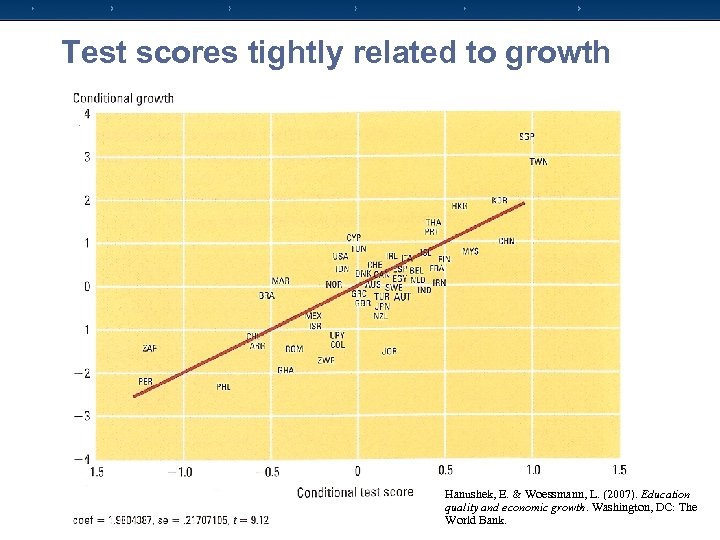 Test scores tightly related to growth Hanushek, E. & Woessmann, L. (2007). Education quality and economic growth. Washington, DC: The World Bank.
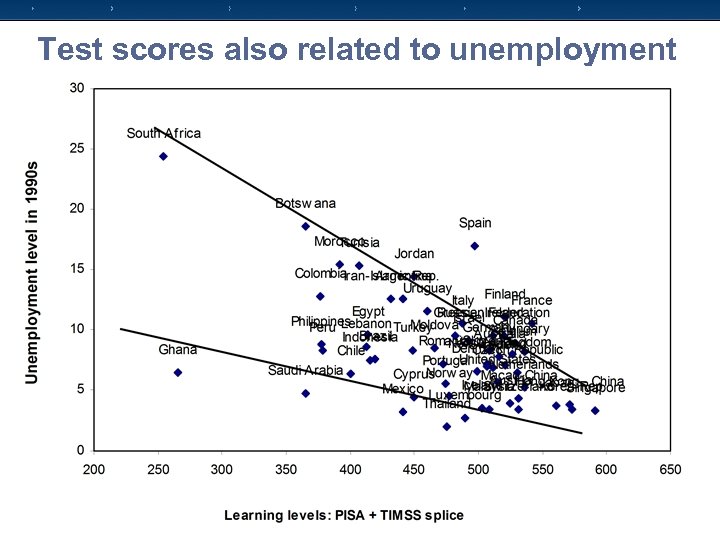 Test scores also related to unemployment Importance of Quality: Employability 6
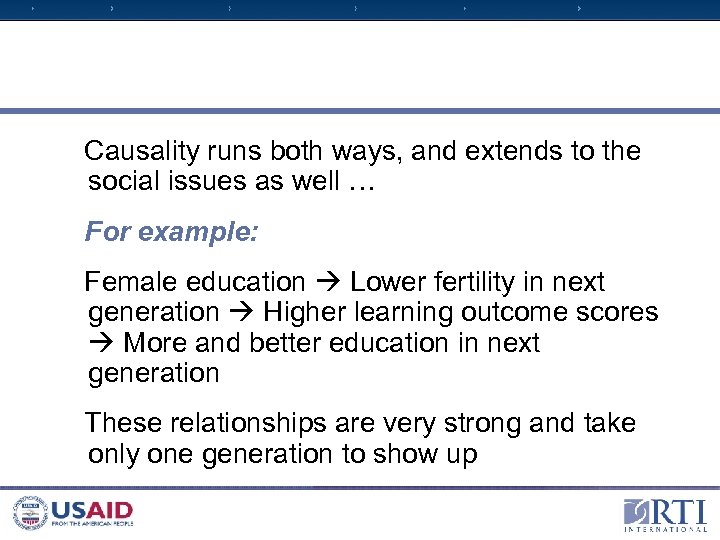 Causality runs both ways, and extends to the social issues as well … For example: Female education Lower fertility in next generation Higher learning outcome scores More and better education in next generation These relationships are very strong and take only one generation to show up
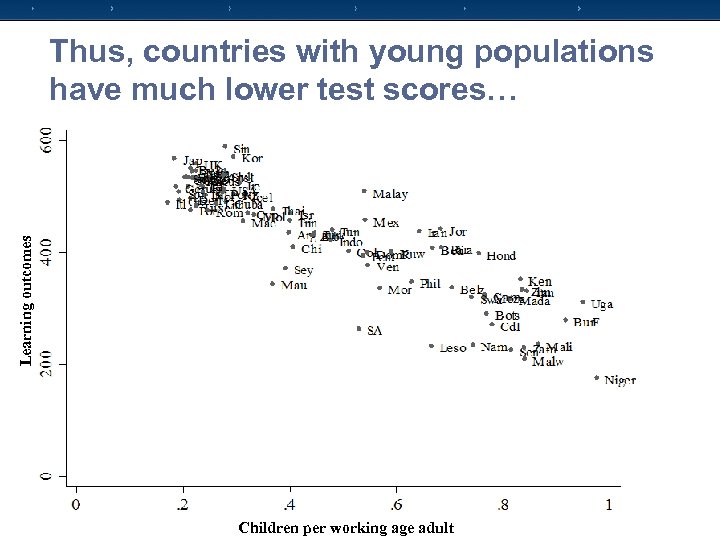 Learning outcomes Thus, countries with young populations have much lower test scores… Children per working age adult
 So education quality is important for economic and social sectors And vice-versa … But: how are countries doing on quality? And, how is early literacy related to education quality …?
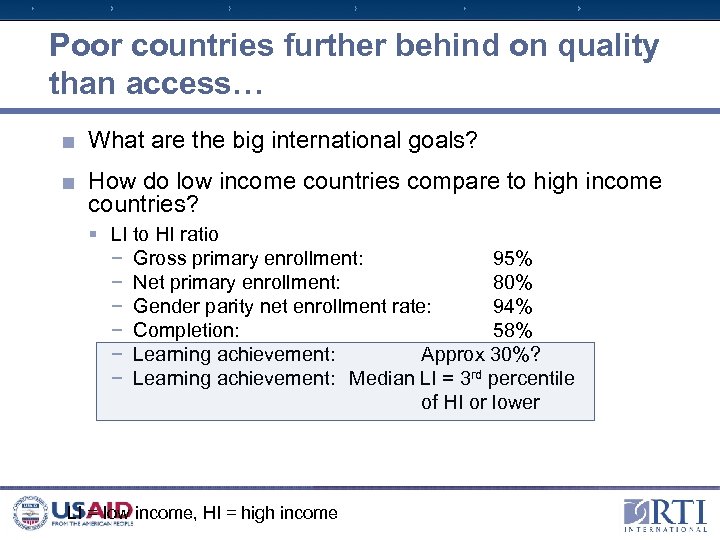 Poor countries further behind on quality than access… ■ What are the big international goals? ■ How do low income countries compare to high income countries? § LI to HI ratio − Gross primary enrollment: 95% − Net primary enrollment: 80% − Gender parity net enrollment rate: 94% − Completion: 58% − Learning achievement: Approx 30%? − Learning achievement: Median LI = 3 rd percentile of HI or lower LI = low income, HI = high income
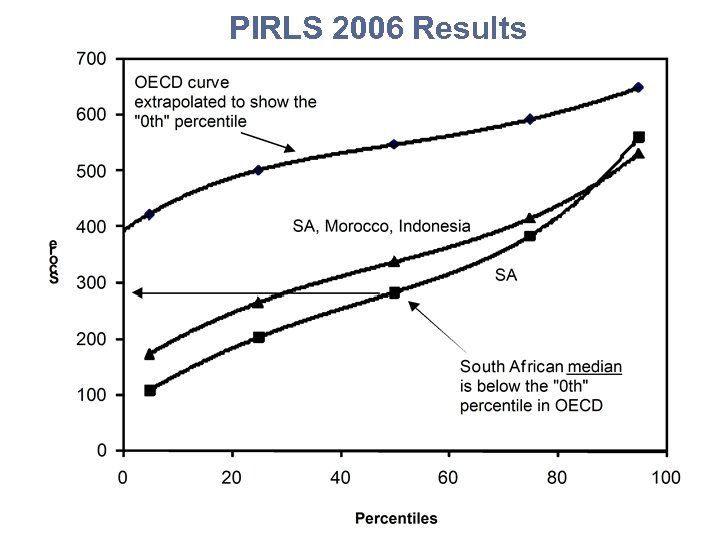 PIRLS 2006 Results
 § So education quality is important for economic and social sectors § And vice-versa … § And poor countries are doing horribly with regard to quality… § But how is early literacy related to education quality …?
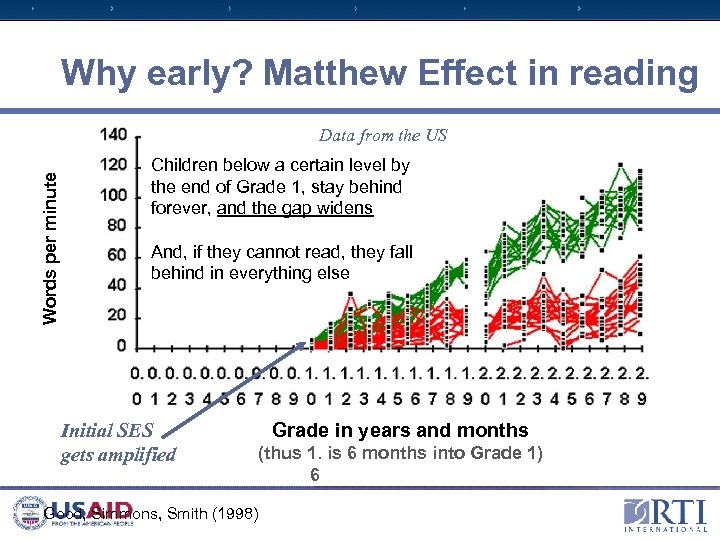 Why early? Matthew Effect in reading Words per minute Data from the US Children below a certain level by the end of Grade 1, stay behind forever, and the gap widens And, if they cannot read, they fall behind in everything else Initial SES gets amplified Grade in years and months (thus 1. is 6 months into Grade 1) 6 Good, Simmons, Smith (1998)
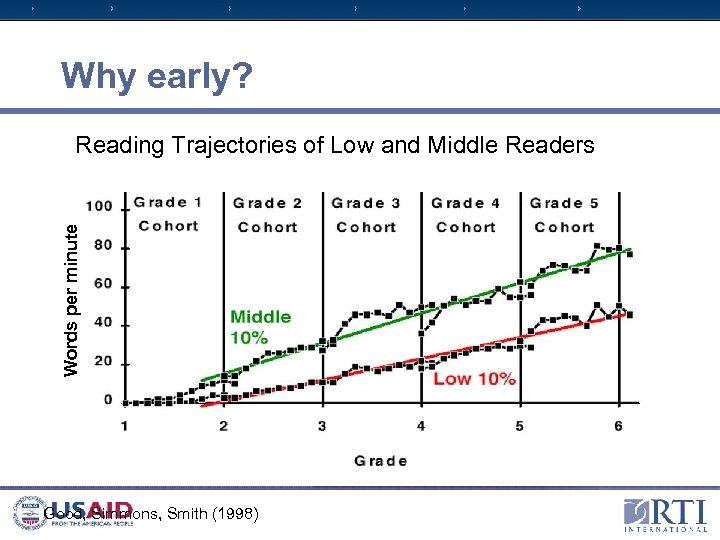 Why early? Words per minute Reading Trajectories of Low and Middle Readers Good, Simmons, Smith (1998)
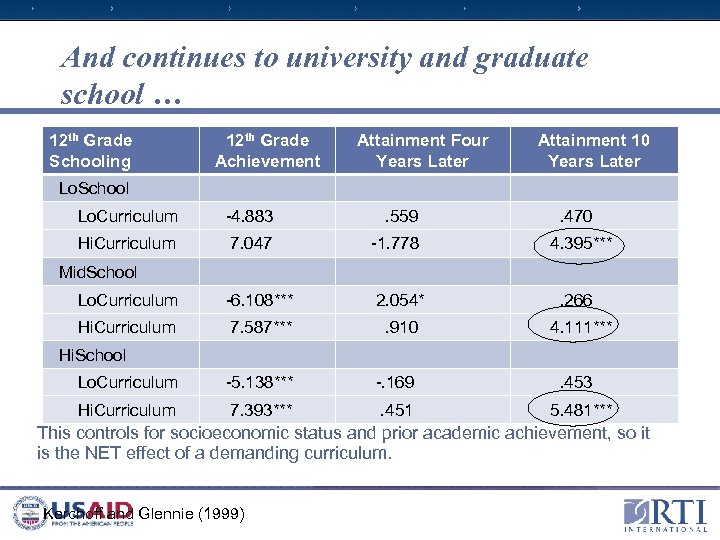 And continues to university and graduate school … 12 th Grade Schooling 12 th Grade Achievement Attainment Four Years Later Attainment 10 Years Later Lo. School Lo. Curriculum -4. 883 . 559 Hi. Curriculum 7. 047 -1. 778 Lo. Curriculum -6. 108*** 2. 054* Hi. Curriculum 7. 587*** . 910 Lo. Curriculum -5. 138*** -. 169 Hi. Curriculum 7. 393*** . 451 . 470 4. 395*** Mid. School. 266 4. 111*** Hi. School. 453 5. 481*** This controls for socioeconomic status and prior academic achievement, so it is the NET effect of a demanding curriculum. Kerchoff and Glennie (1999)
 Why early? ■ Not only does the problem, if unresolved, amplify over time, but… ■ According to various experts, fixing a problem: § in grade 1 takes 30 minutes § in grade 5 takes 2 hours ■ Teaching good habits early is key, and it becomes very difficult to remediate later 16
 Outline 1. Importance of the issue • Quality education social & economic development • But countries are doing horribly on quality • Why early literacy? What is the relation to quality? 2. What USAID, other donors are doing (sample FTI, UNESCO, Hewlett) 3. USAID can avail knowledge on how to improve early literacy 17
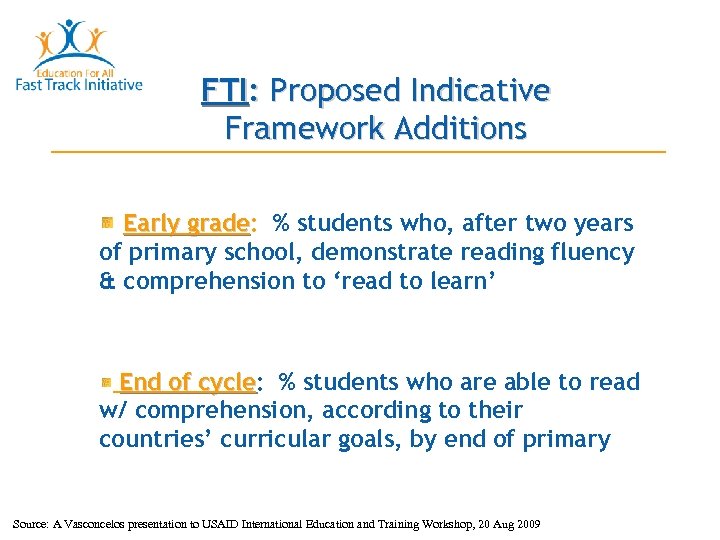 FTI: Proposed Indicative Framework Additions Early grade: % students who, after two years grade of primary school, demonstrate reading fluency & comprehension to ‘read to learn’ End of cycle: % students who are able to read cycle w/ comprehension, according to their countries’ curricular goals, by end of primary Source: A Vasconcelos presentation to USAID International Education and Training Workshop, 20 Aug 2009
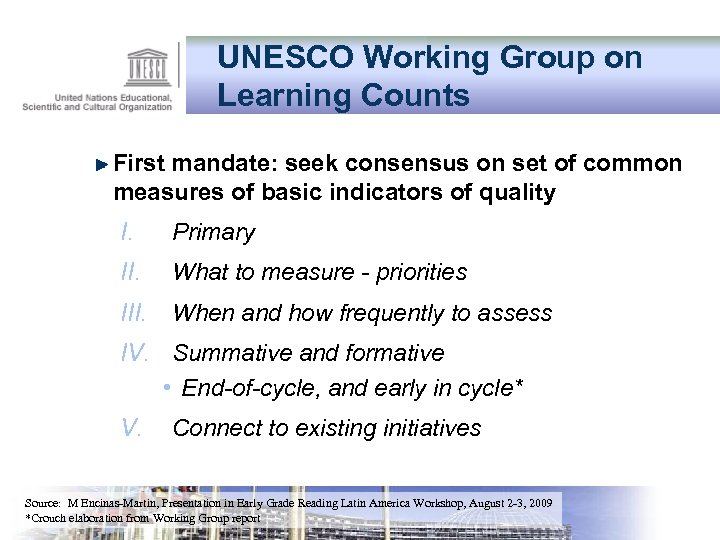 UNESCO Working Group on Learning Counts First mandate: seek consensus on set of common measures of basic indicators of quality I. Primary II. What to measure - priorities III. When and how frequently to assess IV. Summative and formative • End-of-cycle, and early in cycle* V. Connect to existing initiatives Source: M Encinas-Martin, Presentation in Early Grade Reading Latin America Workshop, August 2 -3, 2009 *Crouch elaboration from Working Group report
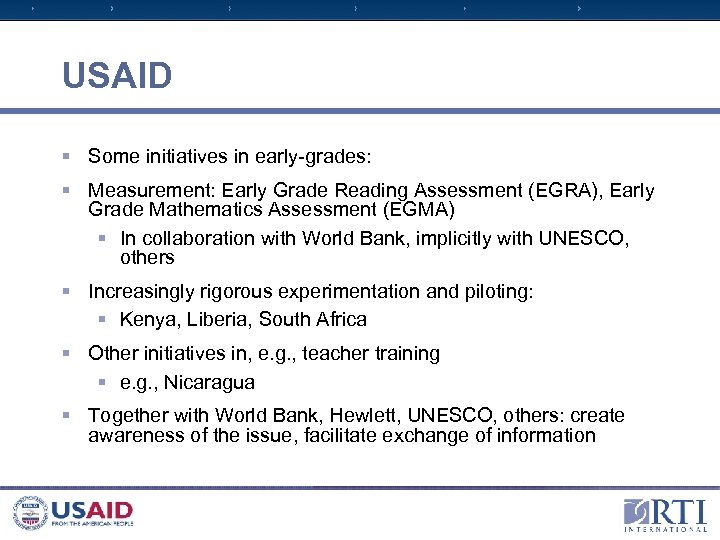 USAID § Some initiatives in early-grades: § Measurement: Early Grade Reading Assessment (EGRA), Early Grade Mathematics Assessment (EGMA) § In collaboration with World Bank, implicitly with UNESCO, others § Increasingly rigorous experimentation and piloting: § Kenya, Liberia, South Africa § Other initiatives in, e. g. , teacher training § e. g. , Nicaragua § Together with World Bank, Hewlett, UNESCO, others: create awareness of the issue, facilitate exchange of information
 One significant private donor: Hewlett § Rigorous baselines in 4 countries in Africa on early grade reading § Social advocacy, bringing Pratham-type work from India to Africa, doing work on policy dialogue to go from experimentation to scale-up § Rigorous experimentation in reading improvement in India, Kenya, Mali
 Outline 1. Importance of the issue • Quality education social & economic development • But countries are doing horribly on quality • Why early literacy? What is the relation to quality? 2. What USAID and other donors are doing (sample FTI, UNESCO, Hewlett) 3. USAID can avail specific knowledge on how to improve early literacy 22
 USAID can avail good knowledge § Improving literacy in early grades in a strong way is doable § It has been done by other donors § It has been done by countries themselves § USAID is funding baseline assessment methods § USAID is increasingly accumulating evidence using rigorous (randomized, treatment-and-control) methods
 Measurement and measurement-based improvement § Funded development of EGRA § Review lit, propose instrument, panel reviews, piloted, rereview, meeting and disseminating, many usages now (30+ countries, 20+ languages as of this date; not all “official”) § Move on to math, piloted instrument in Kenya, EGMA § Other donors buy in with lots of leverage: World Bank, Hewlett § Move to writing (third “R”? ), perhaps UNESCO § Measurement-based improvement § USAID/Kenya: work with Aga Khan, smallish but meaningful experiment, interesting results § USAID/Liberia: large, rigorous experiment, tightly controlled § USAID/South Africa (via Integrated Education Project): small but fast-turnaround experiment
 All this is producing knowledge of whether it is possible to improve, how quickly, and how… Some examples…
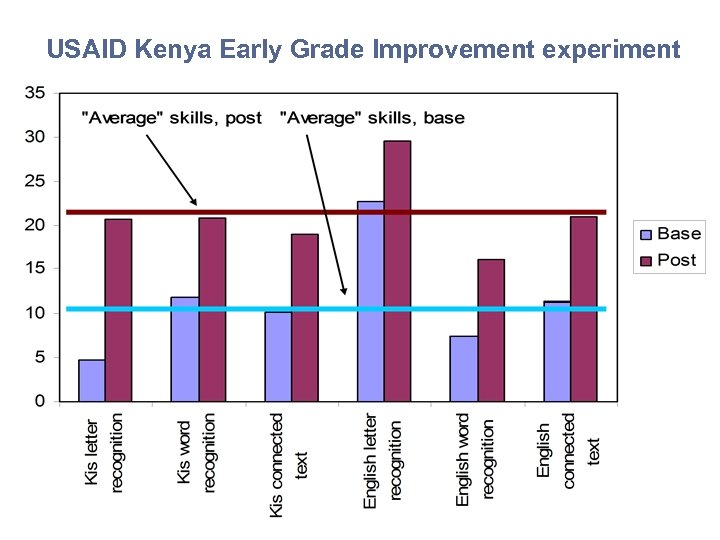 USAID Kenya Early Grade Improvement experiment
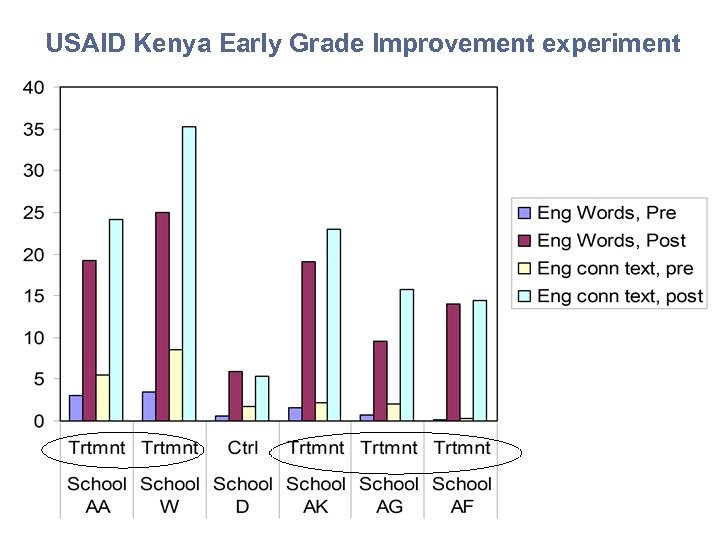 USAID Kenya Early Grade Improvement experiment Six schools with most percentage improvement
 § Not just USAID § Others § DFID has experience in this area… (Breakthrough to Literacy, in Zambia) § Local “donors” and NGOs such as Pratham in India (see example), Molteno and READ in South Africa, etc. § Lots to draw from!
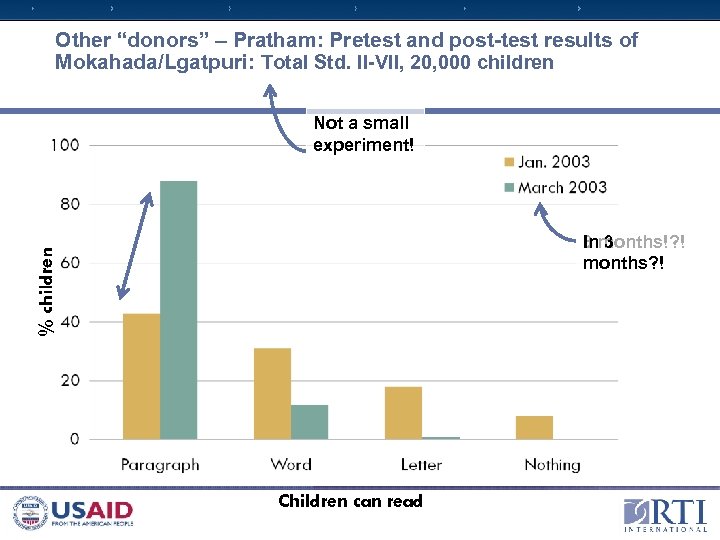 Other “donors” – Pratham: Pretest and post-test results of Mokahada/Lgatpuri: Total Std. II-VII, 20, 000 children Not a small experiment! % children In 3 3 months!? ! months? ! Children can read
 What does it seem to take? § Measurement, data, on outcomes § Used for baseline and importantly for feedback § Knowledge that there will be measurement repeatedly and at the end § Relentless focus on a well-defined outcome (improve early grade fluency and comprehension, say) § Very specific teacher professional development in skills desired (e. g. early reading), and not general training; also intense § Materials: books, books! For classroom and for home, for instruction, and for fun
 In conclusion… § Ed quality is key to socioeconomic development § Early quality, including early literacy, is key to overall quality § We are increasingly able to measure, and measure early § We are increasingly able to know “what works” in developing literacy well and early, and demonstrate it § Donors beginning to “mandate” (or use softer word) use of quality indicators and evidence § All this needs to be further solidified, lessons learned to be shared, scale to be increased