


 Скачать презентацию Literacy Paraprofessional Training Module Arkansas Department of Education
f6ad7cfd5cace6ef034157d8c97df8fe.ppt
- Количество слайдов: 51
 Literacy Paraprofessional Training Module Arkansas Department of Education Special Education Unit 1
 Why do students need to n learn how to read? n 2
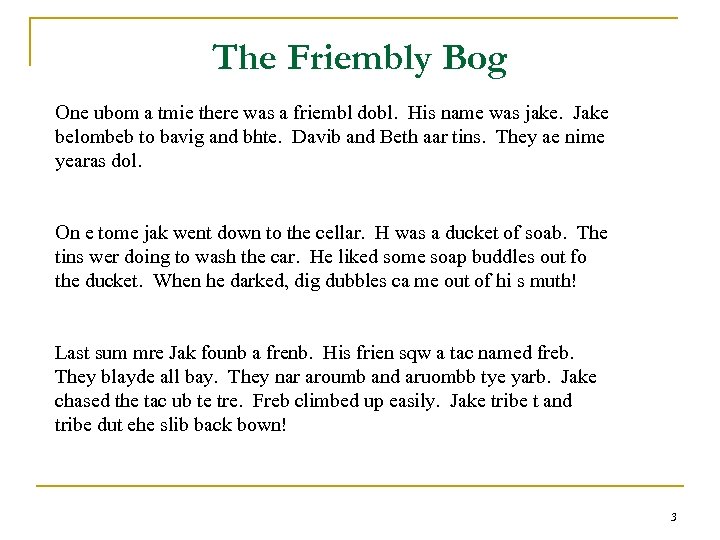 The Friembly Bog One ubom a tmie there was a friembl dobl. His name was jake. Jake belombeb to bavig and bhte. Davib and Beth aar tins. They ae nime yearas dol. On e tome jak went down to the cellar. H was a ducket of soab. The tins wer doing to wash the car. He liked some soap buddles out fo the ducket. When he darked, dig dubbles ca me out of hi s muth! Last sum mre Jak founb a frenb. His frien sqw a tac named freb. They blayde all bay. They nar aroumb and aruombb tye yarb. Jake chased the tac ub te tre. Freb climbed up easily. Jake tribe t and tribe dut ehe slib back bown! 3
 Task Force Cindy O’Riley, Coordinator Arkansas Personnel Development, ADE, SEU n Ann Addison, Paraprofessional, Sheridan School District Donna Alliston, Professional Development Coordinator, AR Dept. of Health and Human Services, Division of Child Care and Early Childhood Education n Mary Calloway, School Improvement Supervisor, ADE n Melanie Crider, Paraprofessional, Clinton School District n Karen Massey, Early Childhood Coordinator, SWAEC/EC n Lisa Oden, Instructor, SAU-Tech n Rhonda Saunders, SEA, Early Childhood, ADE, SEU n Debbie White, Teacher, Cabot School District n Diane Stockman, Teacher, Cabot School District n Dale Ball, Special Education Supervisor, Newport School District n Joyce Sullivan, Special Education Supervisor, Beebe School District n Chenell Loudermill, Speech/Language Pathologist, Little Rock School District n Jana Breyer, Paraprofessional, Sheridan School District n Lisa Haley, Coordinator, SIG Literacy n Rose Mary Burks, Consultant, SIG Literacy n Susan Friberg, Consultant, SIG Literacy n n n 4
 PRE-TEST n n n CIRCLE PRE-TEST PRINT NAME COMPLETE TEST SCORE TEST WRITE SCORE AT THE TOP (facilitator) 5
 Goals of Literacy Module n n Gain an awareness and understanding of Arkansas initiatives and the frameworks. Understand the role of the five essential elements of literacy. Understand how to apply systematic and direct practice to assist students in acquiring literacy skills. Apply instructional techniques and content that will reinforce effective reading instruction. 6
 Research Findings In Literacy n Five Essential Elements of Reading q q q Phonemic Awareness Phonics Fluency Comprehension Vocabulary 7
 English Language Arts Frameworks n Standards q q Oral and Visual Communications Writing Reading Inquiring/Researching q 8
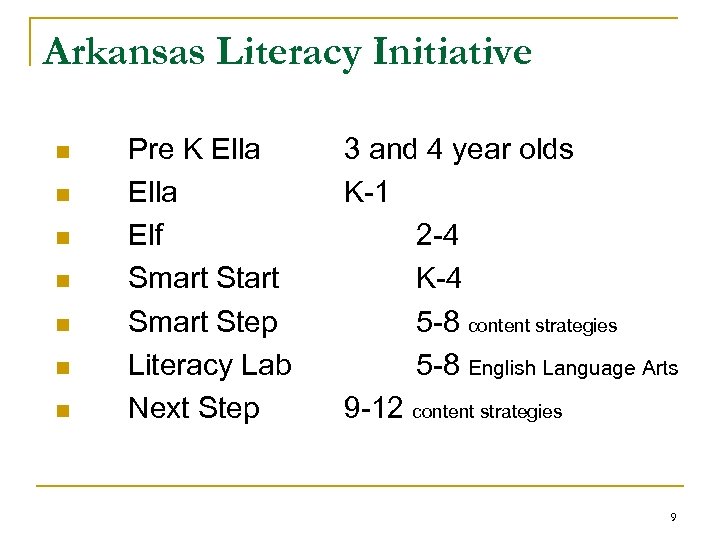 Arkansas Literacy Initiative n n n n Pre K Ella Elf Smart Start Smart Step Literacy Lab Next Step 3 and 4 year olds K-1 2 -4 K-4 5 -8 content strategies 5 -8 English Language Arts 9 -12 content strategies 9
 Pre K Ella q q q Professional development for early childhood educators Provides a literacy foundation for young children Standards based as related to the Arkansas Early Childhood Education Frameworks 10
 ELLA K-1 Effective Literacy 2 -4 n The Reading Process n n n Comprehension Reading Fluency n Writing Development n Assessment n Flexible Grouping Phonemic Awareness Word Study (Spelling/Phonics Development) Vocabulary 11
 Smart Start n n • • A comprehensive plan for student achievement, that includes: 1. Standards – the frameworks 2. Professional Development 3. Student Assessment 4. Accountability 12
 Literacy Lab n n n Strategic Reading with Comprehension Instruction Writing Instruction Vocabulary Instruction Word Study Assessment § Grades 5 -8 13
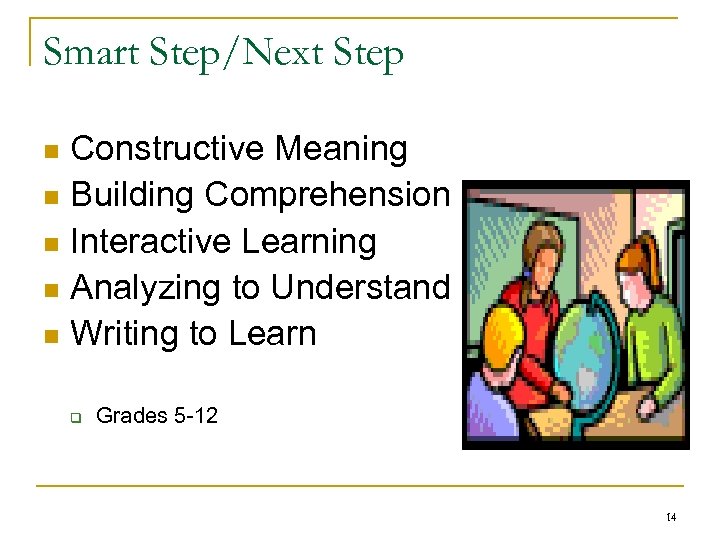 Smart Step/Next Step Constructive Meaning n Building Comprehension n Interactive Learning n Analyzing to Understand n Writing to Learn n q Grades 5 -12 14
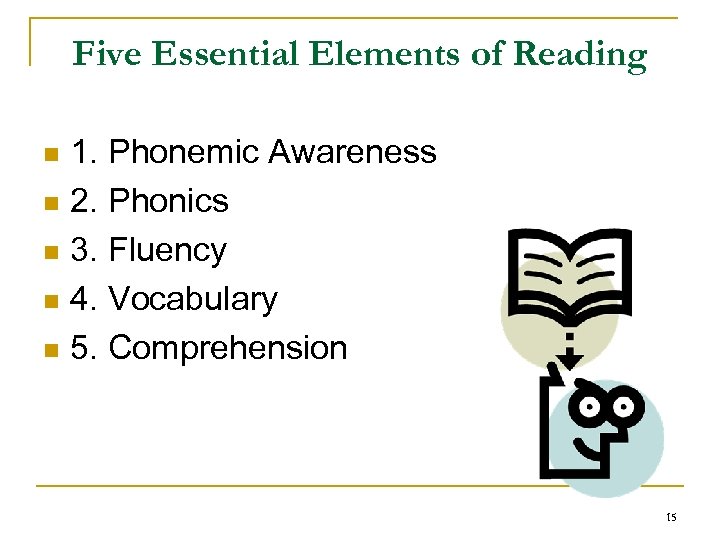 Five Essential Elements of Reading 1. Phonemic Awareness n 2. Phonics n 3. Fluency n 4. Vocabulary n 5. Comprehension n 15
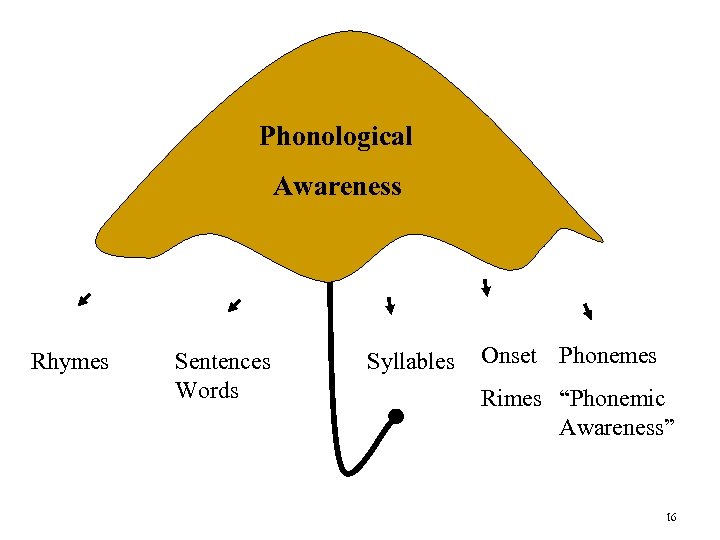 Phonological Awareness Rhymes Sentences Words Syllables Onset Phonemes Rimes “Phonemic Awareness” 16
 Components of Phonological Awareness Rhyming n n Identify and producing words that sound the same. n Simple oral activities: n n Do these words rhyme? n n Tell me a word that rhymes with _ 17
 Components of Phonological Awareness continued n Segmentation n n Breaking whole words into individual sounds or word parts. 18
 Components of Phonological Awareness continued n n n Onset and Rime Onsets and rimes are parts of spoken language that are smaller than syllables but larger than phonemes. Onset – initial consonant sound of a syllable Rime – vowel and all that follows 19
 Components of Phonological Awareness continued n n n Isolation/Grapheme Identification of one phoneme by position in a word, the knowledge of sound symbol correspondence. 20
 Components of Phonological Awareness continued n Deletion n n Manipulation of root words, syllables, and phonemes in a word. 21
 Components of Phonological Awareness continued n n Substitution To isolate a phoneme in a word, then change it to another phoneme forming a new word 22
 Components of Phonological Awareness continued n Blending n n Combining individual phonemes to form words. n 23
 Components of Phonological Awareness continued n n Decoding Generalizing knowledge of sound/symbol correspondences and blending sounds into unknown words. 24
 Phonemic Awareness n The ability to notice, n think about, and work n with the individual n sounds (phonemes) in 25
 The Speech Sounds of English n Handout 1 - Vowel Chart n Video § Moats 2003 26
 BREAK n 10 Minute Break 27
 Activity 1 n Spin n the Web Reinforcement of Phonemic Awareness n Handout 2 – word cards 28
 Phonics n Phonics is the understanding that there is a n predictable relationship between phonemes, n (sounds of spoken language) and graphemes, n (the letters and spellings that represent those n sounds in written language). 29
 Phonics Instruction n n Teaches students to connect letters or written language with the individual sounds they make when spoken. Teaches students how to use letter-sound relationships to read or write words. 30
 Activity 2 n Word n Wheel Reinforcement of Phonics n Handout 3 and 3 a 31
 Fluency n q q q The ability to read a sentence, paragraph, or any text accurately and quickly. Reading with speed, accuracy, and proper expression; not hurried reading. 32
 Factors Related to Sustaining Fluency and Phrasing n Recognizing and solving words in a quick, automatic way. n Recognizing phrase units. n Being aware of and using punctuation. n Activating and using background knowledge. n 33
 Factors Related to Sustaining Fluency and Phrasing (continued) n n Understanding and using the organizational structure of the text. n Using meaning and language structure to monitor reading (making sure reading makes sense and sounds right). n Predicting at the word, phrase, and text level. n n 34
 Fluency Instruction n Methods to practice fluency: n n n Adult-Student share reading Choral/Echo Reading Taped Reading Paired Reading 35
 Activity 3 n The n Great Depression Reinforcement of Fluency n Handout 4 and 4 a 36
 Sight Words that are read fluently and n automatically at first sight. n 37
 Vocabulary v v Understanding what words mean by themselves and in sentences. Understanding word meanings to read with fluency and comprehension. 38
 Vocabulary Instruction The act of teaching vocabulary prior to n introducing a passage or text to students. n n 1. Pre-read selected reading material n 2. Consider vocabulary that needs to be introduced to students 3. Teach vocabulary before student reads n n text 39
 Activity 4 n Idioms n Reinforcement for Vocabulary n Handout 5 and 5 a 40
 Comprehension n The Reason for Reading q Understanding what sentences, paragraphs, and stories are trying to tell us. q Making sense of what we hear and read. q Understanding what has been read. 41
 Strategies in Development of Comprehension n n n Prediction – asking students to tell what they think will happen. Apply background knowledge – asking students to tell what they know about a topic. Retell – asking students to retell in his/her own words what they have just read. 42
 Comprehension Instruction n Active Thinking Students think about what the words mean and picture them in their minds. 43
 Activity 5 n Reinforcement for Comprehension n Handout 6 n 44
 What Struggling Readers Need n n n Targeted Intervention Explicit instruction Systematic instruction (in order) More time on task More practice 45
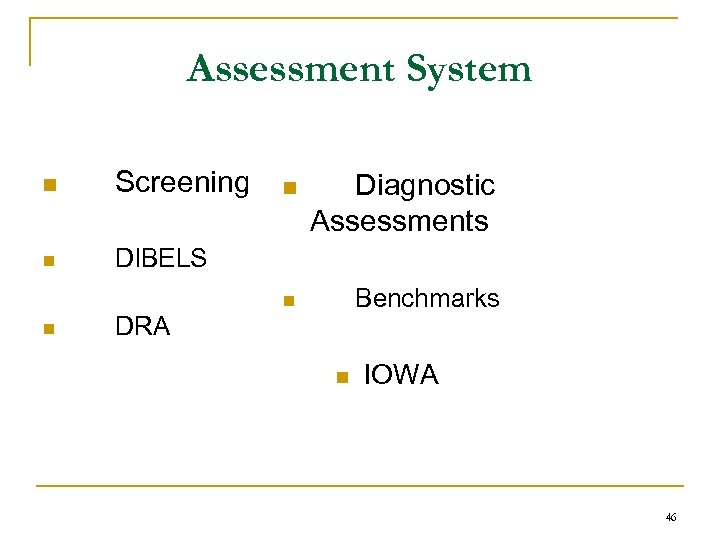 Assessment System n Screening n DIBELS n Diagnostic Assessments Benchmarks n n DRA n IOWA 46
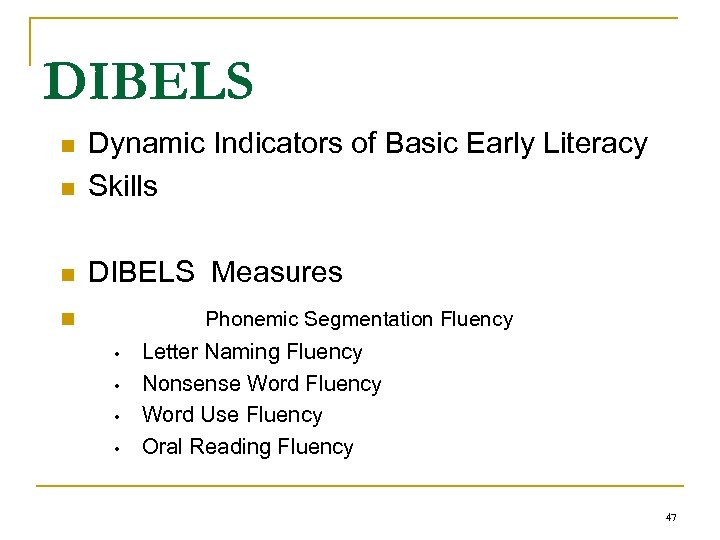 DIBELS n Dynamic Indicators of Basic Early Literacy Skills n DIBELS Measures n Phonemic Segmentation Fluency n • • Letter Naming Fluency Nonsense Word Fluency Word Use Fluency Oral Reading Fluency 47
 DRA Developmental Reading Assessment n Used in K-3 Classrooms n n Literature Based Instructional Reading Program n A set of 20 stories that increase in difficulty 48
 Diagnostic Assessments n n n Benchmark Assessment – Arkansas criterion-referenced test of literacy and math that is aligned to frameworks. Iowa Test of Basic Skills – Norm – referenced Test of reading comprehension and math problem solving. 49
 Connections n n “Good readers rely on background knowledge to help them make sense of text. Ignoring existing prior knowledge puts readers at a great disadvantage. It is vital that students make connections when they read. It’s up to teachers to show them how. ” - Chris Tovani from I Read It, But I Don’t Get It 50
 Post-Test n n n CIRCLE POST-TEST PRINT NAME COMPLETE TEST SCORE TEST WRITE SCORE AT THE TOP (facilitator) 51