 Скачать презентацию Literacy and Linguistics Dick Hudson UCLan November 2012
56602517b51133de79ebe695425a8707.ppt
- Количество слайдов: 34



Literacy and Linguistics Dick Hudson UCLan November 2012 1
Plan 1. Literacy – a crisis for both L 1 and L 2 2. Linguistics 3. The elements of literacy 1. Transcription • spelling 2. Composition • grammar, vocabulary, punctuation 4. The way forward 2
1. Literacy: the Daily Mail • One adult in five is illiterate • by SARAH HARRIS, Daily Mail (19 Nov 2012) • One in five British adults struggles to read and write, official research has revealed. • They are 'functionally illiterate', which means that they have the reading age of the average 11 -year-old or worse. • The appalling figures, revealed by Education Secretary Estelle Morris yesterday, are a legacy of the 1970 s and 1980 s when there was a lack of emphasis on the three Rs in schools. 3
More in The Daily Mail • By Leon Watson, Mail Online (29 March 2012) • Britain has up to eight million adults who are functionally illiterate, … they struggle to read a medicine label or use a chequebook. • … costing the UK economy £ 81 billion a year … • the highest cost in Europe - twice Germany's, three times France's • the UK was ranked third worst for reading and writing • '… illiteracy is a disease that we are aiming to eradicate' 4
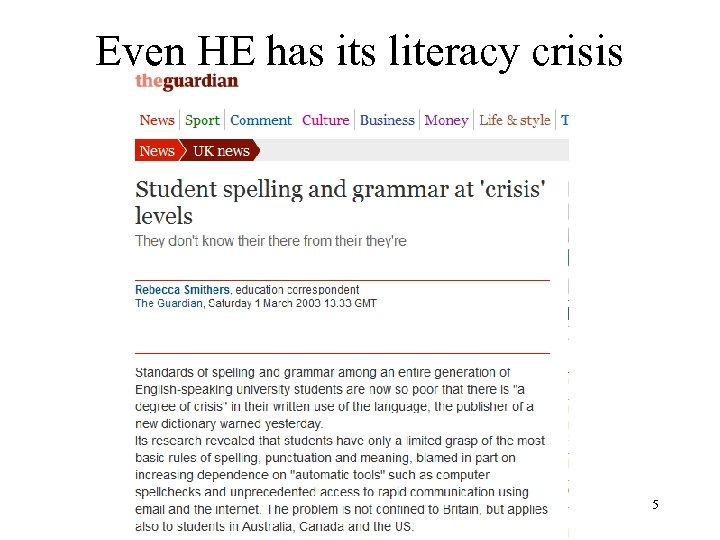
Even HE has its literacy crisis 5
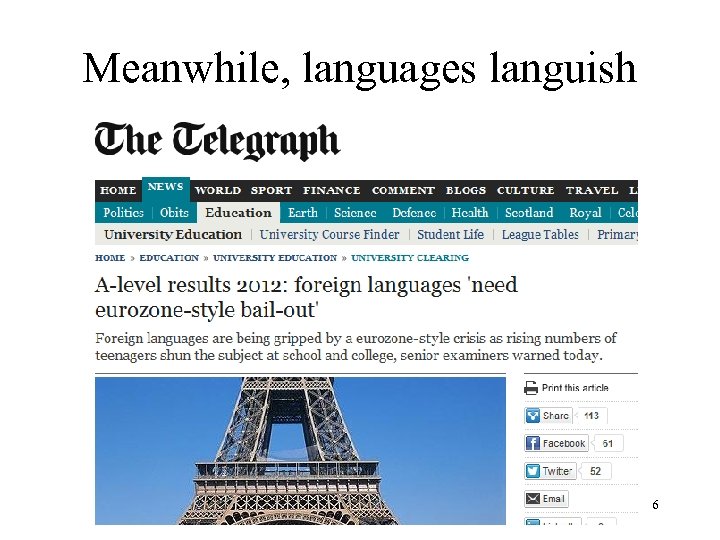
Meanwhile, languages languish 6
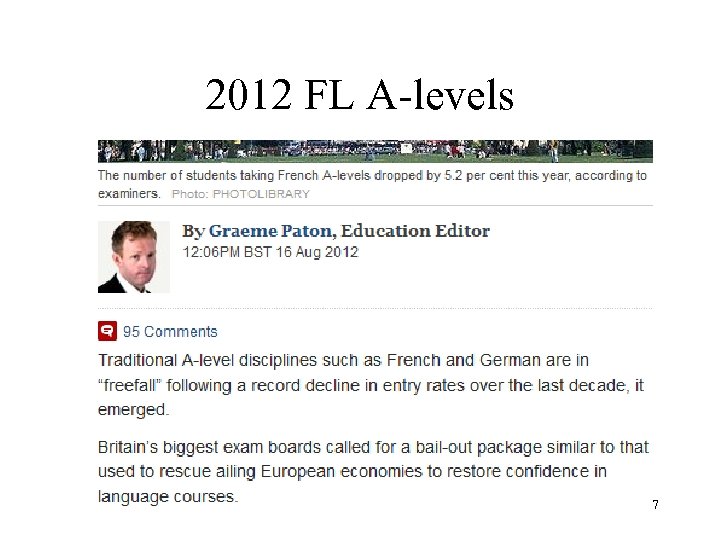
2012 FL A-levels 7
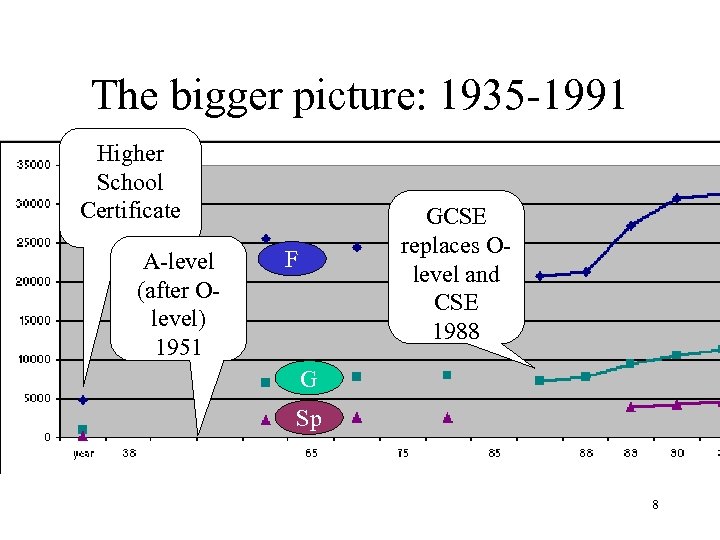
The bigger picture: 1935 -1991 Higher School Certificate A-level (after Olevel) 1951 GCSE replaces Olevel and CSE 1988 F G Sp 8
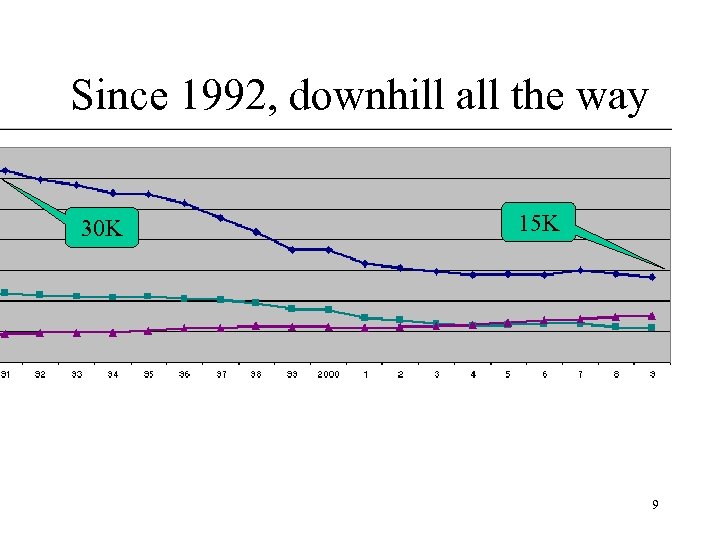
Since 1992, downhill all the way 30 K 15 K 9
So what? • Language education is in crisis. • Language skills are inadequate – and may be declining? • The crisis affects traditional L 1 literacy • but also FL • and maybe the two are connected? 10
So what is literacy? • Skills: – 'transcription' – handwriting, spelling – 'composition' – grammar, etc. • Knowledge About Language (KAL) – for understanding tools – for growth 11
What is mature literacy? • Enough KAL for adult needs • Enough languages for adult needs. – How many is that? – Which languages? – Need to learn L 2, L 3, … as adult. 12
2. Linguistics • The study of language – especially, language structure • It has a long history – Babylon 2, 000 BC – India 500 BC – Greece 300 BC • Always concerned with literacy. 13
Linguistics to the rescue? • Uniting L 1 English and Foreign Languages – 'Language Awareness' • Intellectual framework for discussion – e. g. growth, not error-avoidance • Detailed models and descriptions – e. g. speech versus writing • Links to cognitive science – e. g. how do we learn? 14
Linguistics as we know it? • Yes, but with more work on … • writing – the system – how it differs from speech • school-age development • explicit and implicit learning – including pedagogy 15
3. The elements of literacy a. Transcription skills in writing/reading – spelling b. Composition skills – grammar – vocabulary – punctuation • In L 1 English and FLs 16
How linguistics may help • • Transcription skills Composition skills Both writing and reading Both L 1 and FL 17
a. Transcription skills: spelling • • Phonological awareness Phoneme-grapheme correspondences • • • research-based list effects of accent effects of subsystem • • Germanic vs Latin vs Greek for L 1 English and Foreign Languages 18
Spelling and morphology • Morphological awareness – e. g. box vs socks • Effects of morphology on spelling – NB morphology conflicts with 'phonics' – e. g. morph + ology – contrast: more + over 19
Linguists as engineers • Spelling reform? – probably not feasible • Letter names – What do we call <a>? – Why /bi: / but /ɛf/? – And <w> = ? – What a mess! – Surely we can do better than that? 20
b. Composition skills: grammar • Schools should help grammars to grow – e. g. the house in which he lives – The more books I read, the less I can remember • But how? – explicit teaching – with metalanguage – with expert teachers 21
How linguistics can help • School grammar is in crisis – It died between 1900 and 1970 – So today's teachers didn't learn it at school • Linguists can help by: – training teachers – writing classroom material – agreeing analyses and terminology for schools 22
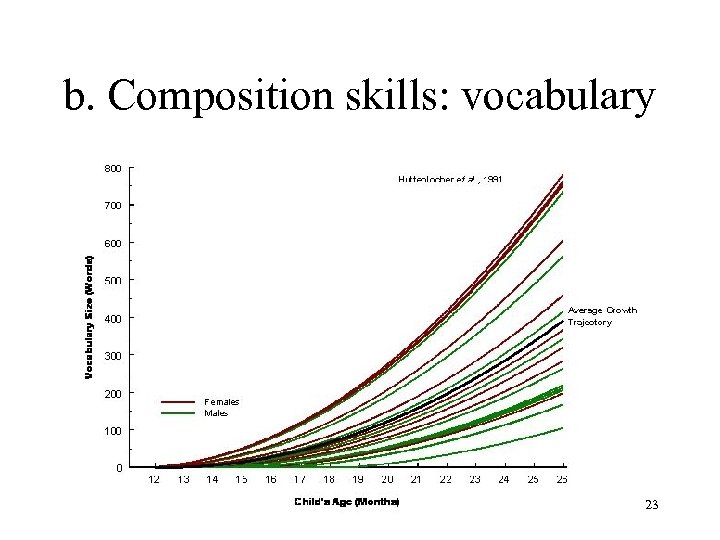
b. Composition skills: vocabulary 23
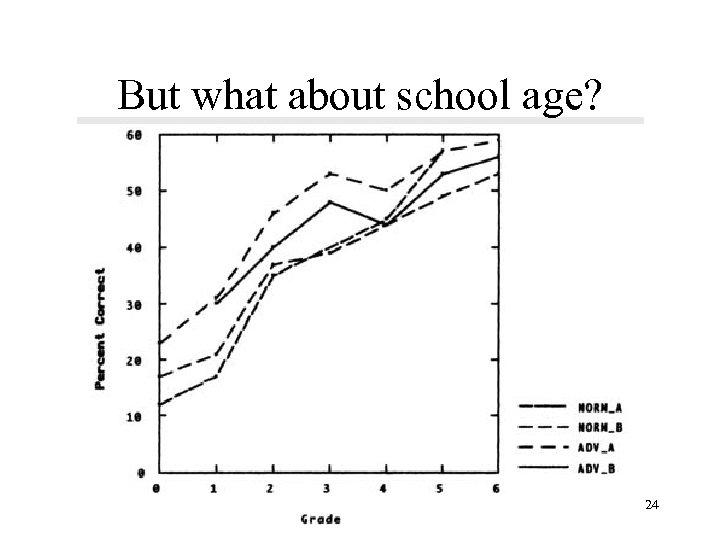
But what about school age? 24
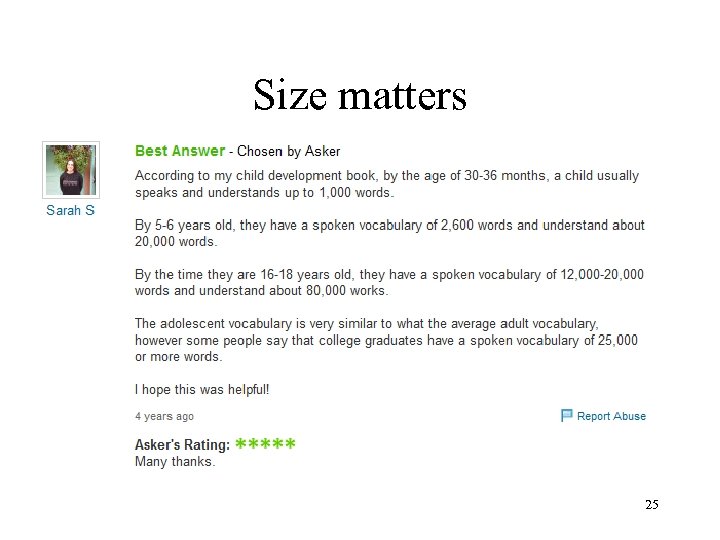
Size matters 25
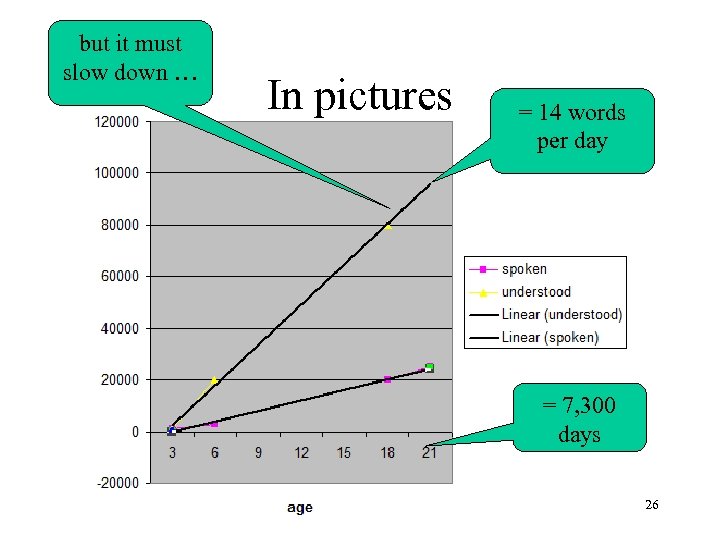
but it must slow down … In pictures = 14 words per day = 7, 300 days 26
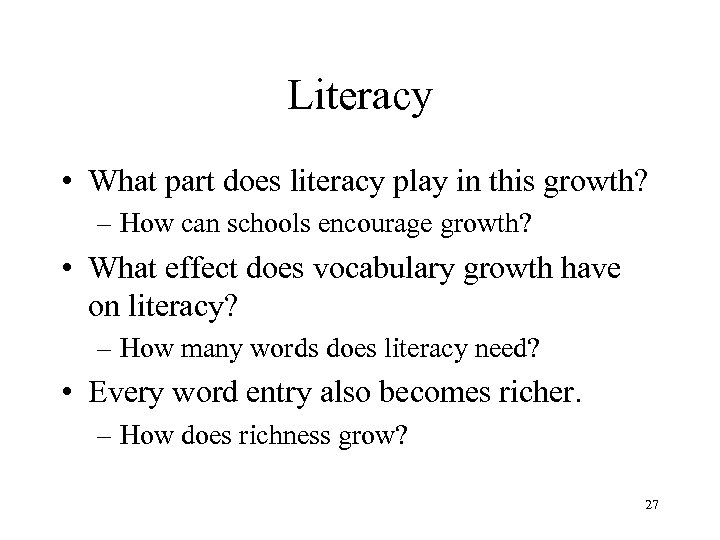
Literacy • What part does literacy play in this growth? – How can schools encourage growth? • What effect does vocabulary growth have on literacy? – How many words does literacy need? • Every word entry also becomes richer. – How does richness grow? 27
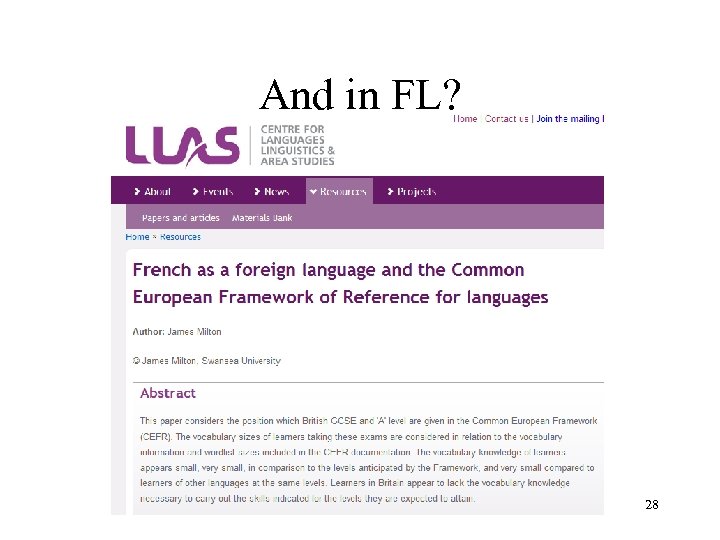
And in FL? 28
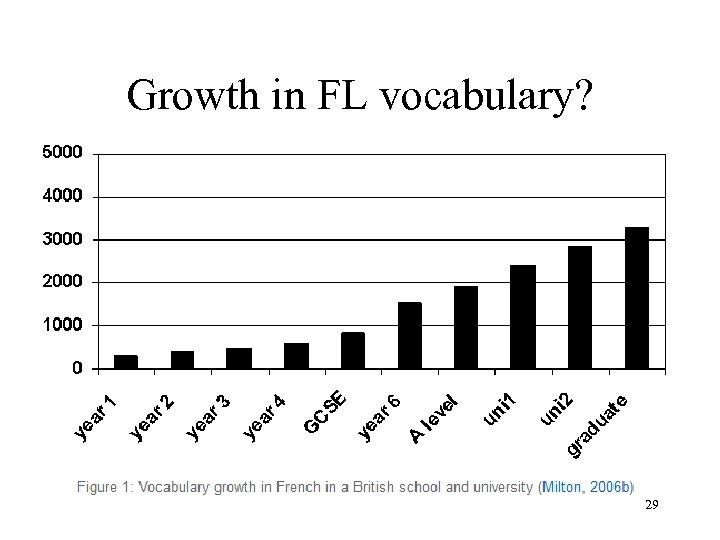
Growth in FL vocabulary? 29
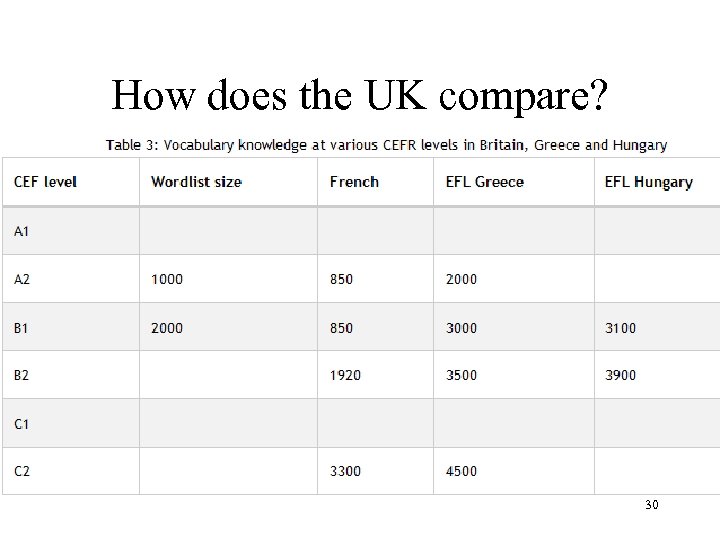
How does the UK compare? 30
b. Composition skills: punctuation • Linguists should research punctuation – What is a sentence? – When do we use a comma? – How do we punctuate bullet points? • Linguists should produce – training material – reference material 31
Linguists as engineers • Punctuation practice is a mess. • Punctuate these: – Are you ready# because it's time to leave# – He said# "I love you#"# – I have two questions# Where are we going? When will we be back? • Linguists could do better than this!! 32
4. The way forward • More research by linguists on literacy. • More engagement by linguists with schools – More acceptance of linguistics by schools. • More cooperation between English and FL teachers. – Maybe the two crises are related? 33
Thank you • This slideshow can be downloaded at www. phon. ucl. ac. uk/home/dick/talks. htm 34
Скачать презентацию Literacy and Linguistics Dick Hudson UCLan November 2012
56602517b51133de79ebe695425a8707.ppt