


 Скачать презентацию Listening and speaking Reading Grammar Writing Culture express
d1a36e0a09be993c7ecd2ba43ba9aab0.ppt
- Количество слайдов: 195
 Listening and speaking Reading Grammar Writing Culture express
 Content Listening and speaking Reading Grammar Writing Culture express
 Listening and speaking Reading Grammar Writing Listening and speaking l Pronunciation and listening skills l Conversations l Passage Culture express
 Listening and speaking Reading Grammar Writing Culture express Pronunciation and listening skills Divide the following passage into sense groups. Then read after the recording and pay attention to the pauses between sense groups. Tips 意群是语句中能够表示最小语义单位的单词或词组,一 般根据句法结构、逻辑关系或句子意义来划分。在朗读 长句时,可以在意群之间作短暂的停顿以换气。意群之 间的停顿不是固定的,而是相对灵活的。正确的停顿能 够更好地表达句子的意义,也使得朗读比较轻松并有节奏。
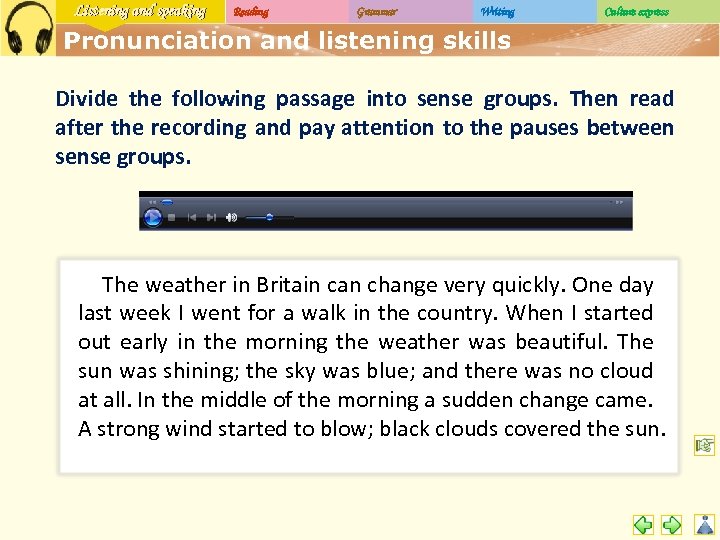 Listening and speaking Reading Grammar Writing Culture express Pronunciation and listening skills Divide the following passage into sense groups. Then read after the recording and pay attention to the pauses between sense groups. The weather in Britain can change very quickly. One day last week I went for a walk in the country. When I started out early in the morning the weather was beautiful. The sun was shining; the sky was blue; and there was no cloud at all. In the middle of the morning a sudden change came. A strong wind started to blow; black clouds covered the sun.
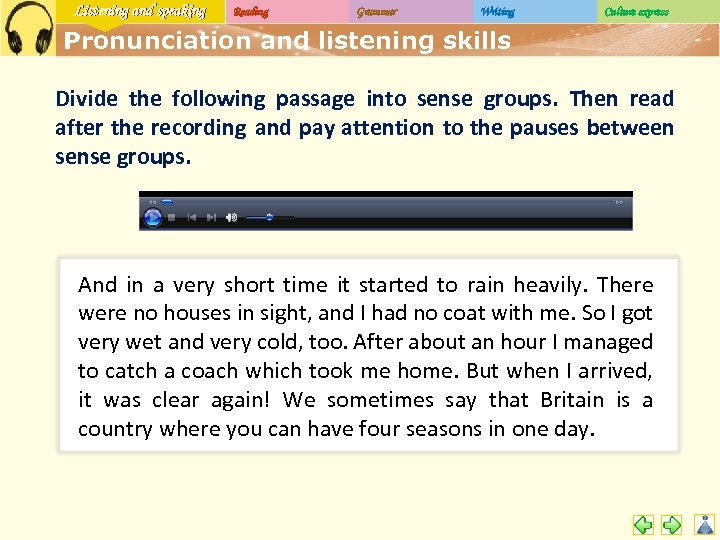 Listening and speaking Reading Grammar Writing Culture express Pronunciation and listening skills Divide the following passage into sense groups. Then read after the recording and pay attention to the pauses between sense groups. And in a very short time it started to rain heavily. There were no houses in sight, and I had no coat with me. So I got very wet and very cold, too. After about an hour I managed to catch a coach which took me home. But when I arrived, it was clear again! We sometimes say that Britain is a country where you can have four seasons in one day.
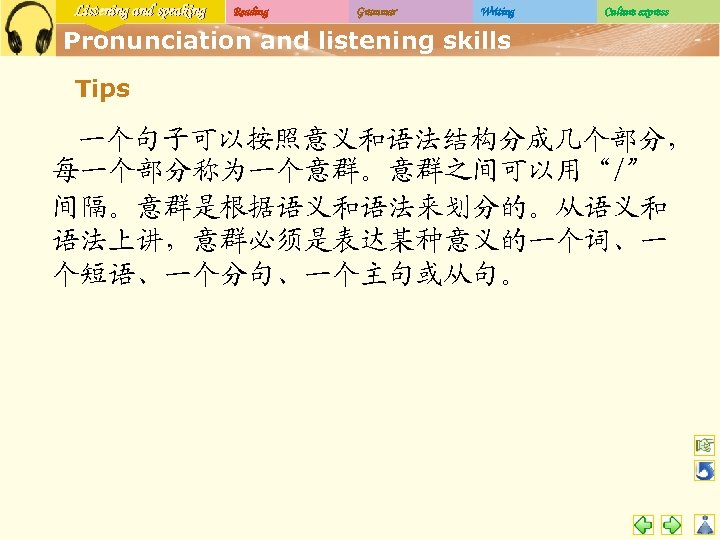 Listening and speaking Reading Grammar Writing Culture express Pronunciation and listening skills Tips 一个句子可以按照意义和语法结构分成几个部分, 每一个部分称为一个意群。意群之间可以用“/” 间隔。意群是根据语义和语法来划分的。从语义和 语法上讲,意群必须是表达某种意义的一个词、一 个短语、一个分句、一个主句或从句。
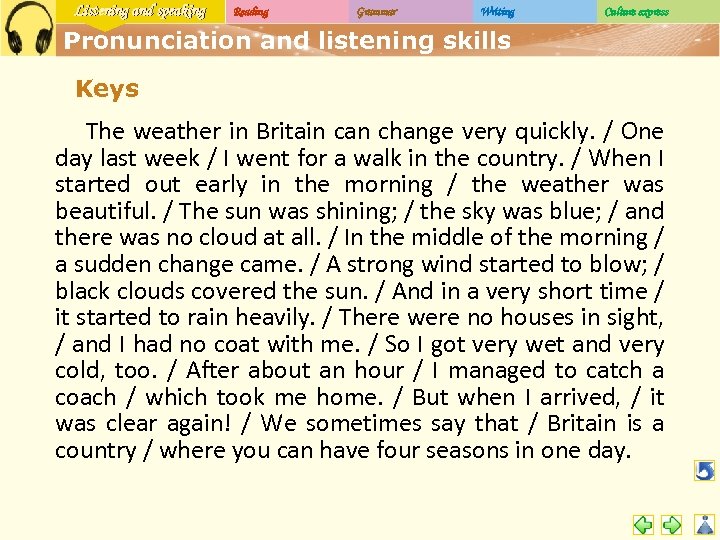 Listening and speaking Reading Grammar Writing Culture express Pronunciation and listening skills Keys The weather in Britain can change very quickly. / One day last week / I went for a walk in the country. / When I started out early in the morning / the weather was beautiful. / The sun was shining; / the sky was blue; / and there was no cloud at all. / In the middle of the morning / a sudden change came. / A strong wind started to blow; / black clouds covered the sun. / And in a very short time / it started to rain heavily. / There were no houses in sight, / and I had no coat with me. / So I got very wet and very cold, too. / After about an hour / I managed to catch a coach / which took me home. / But when I arrived, / it was clear again! / We sometimes say that / Britain is a country / where you can have four seasons in one day.
 Listening and speaking Reading Grammar Writing Conversations l Conversation 1 Exercises Functional language l Conversation 2 Exercises Functional language Culture express
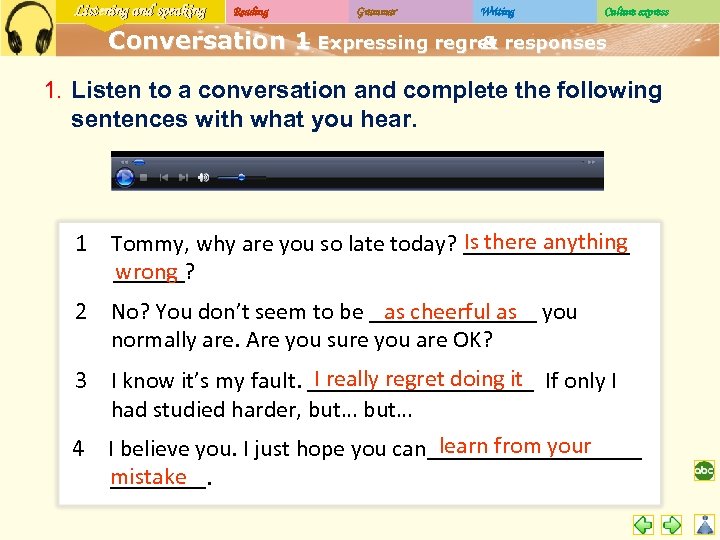 Listening and speaking Reading Grammar Writing Culture express Conversation 1 Expressing regret responses – & 1. Listen to a conversation and complete the following sentences with what you hear. Is there anything 1 Tommy, why are you so late today? _______ wrong ______? 2 No? You don’t seem to be _______ you as cheerful as normally are. Are you sure you are OK? I really regret doing it 3 I know it’s my fault. __________ If only I had studied harder, but… learn from your 4 I believe you. I just hope you can_________ mistake ____.
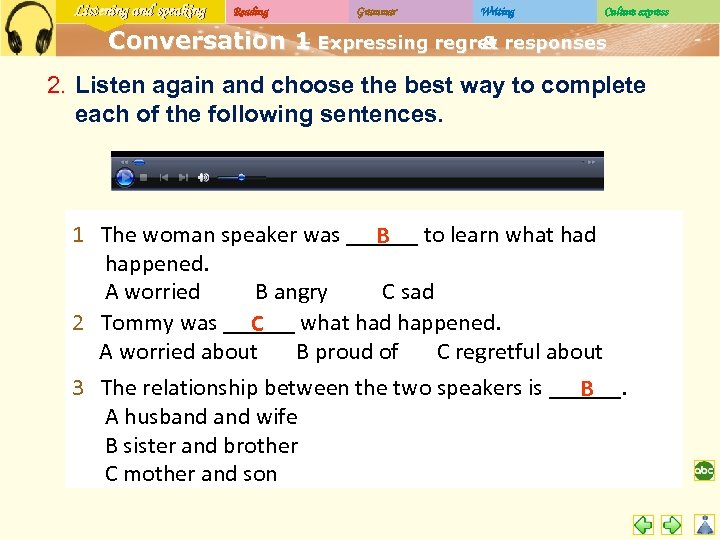 Listening and speaking Reading Grammar Writing Culture express Conversation 1 Expressing regret responses – & 2. Listen again and choose the best way to complete each of the following sentences. 1 The woman speaker was ______ to learn what had B happened. A worried B angry C sad 2 Tommy was ______ what had happened. C A worried about B proud of C regretful about 3 The relationship between the two speakers is ______. B A husband wife B sister and brother C mother and son
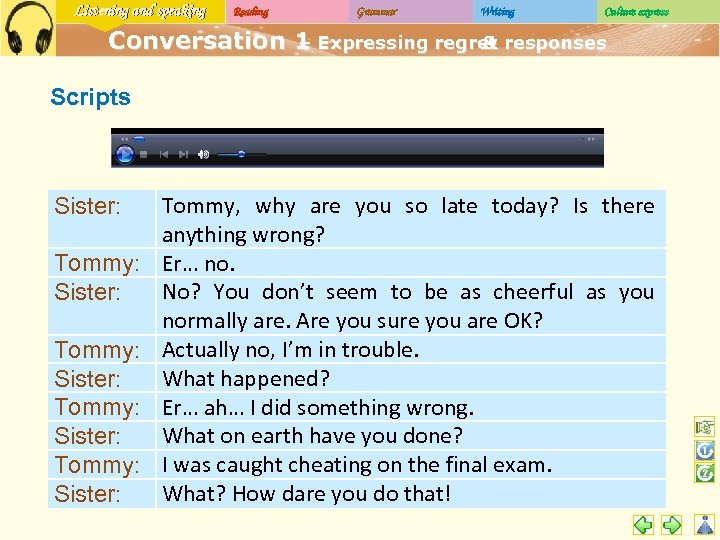 Listening and speaking Reading Grammar Writing Culture express Conversation 1 Expressing regret responses – & Scripts Sister: Tommy: Sister: Tommy, why are you so late today? Is there anything wrong? Er… no. No? You don’t seem to be as cheerful as you normally are. Are you sure you are OK? Actually no, I’m in trouble. What happened? Er… ah… I did something wrong. What on earth have you done? I was caught cheating on the final exam. What? How dare you do that!
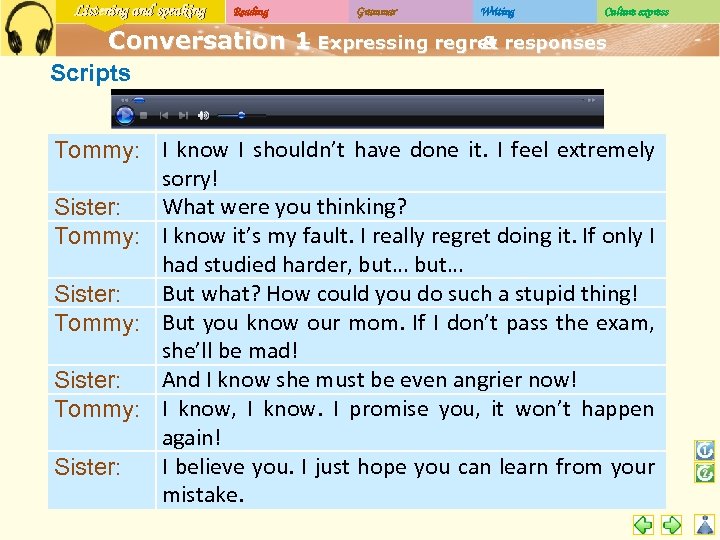 Listening and speaking Reading Grammar Writing Culture express Conversation 1 Expressing regret responses – & Scripts Tommy: I know I shouldn’t have done it. I feel extremely sorry! What were you thinking? Sister: Tommy: I know it’s my fault. I really regret doing it. If only I had studied harder, but… But what? How could you do such a stupid thing! Sister: Tommy: But you know our mom. If I don’t pass the exam, she’ll be mad! And I know she must be even angrier now! Sister: Tommy: I know, I know. I promise you, it won’t happen again! I believe you. I just hope you can learn from your Sister: mistake.
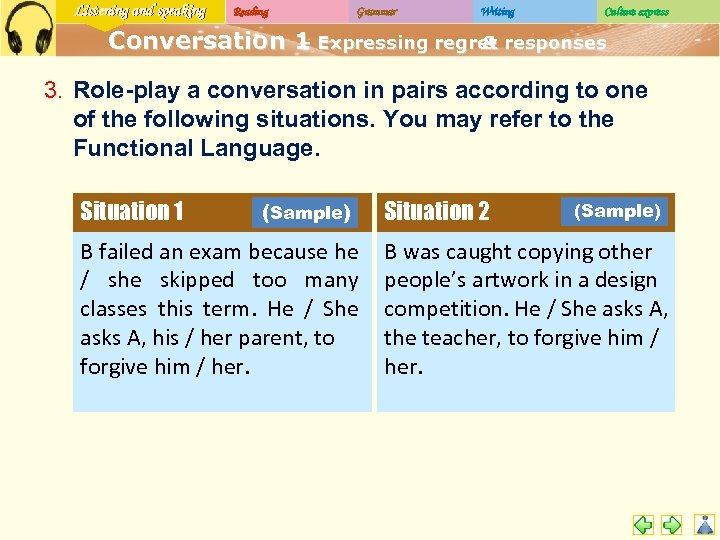 Listening and speaking Reading Grammar Writing Culture express Conversation 1 Expressing regret responses – & 3. Role-play a conversation in pairs according to one of the following situations. You may refer to the Functional Language. Situation 1 (Sample) B failed an exam because he / she skipped too many classes this term. He / She asks A, his / her parent, to forgive him / her. Situation 2 (Sample) B was caught copying other people’s artwork in a design competition. He / She asks A, the teacher, to forgive him / her.
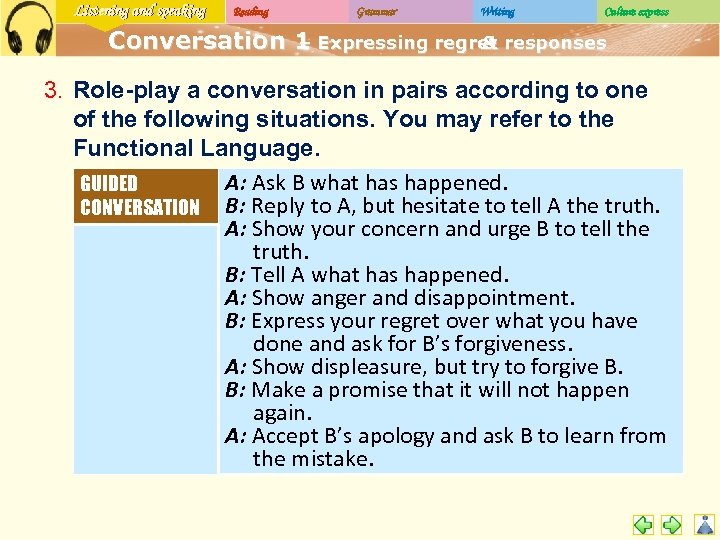 Listening and speaking Reading Grammar Writing Culture express Conversation 1 Expressing regret responses – & 3. Role-play a conversation in pairs according to one of the following situations. You may refer to the Functional Language. A: Ask B what has happened. GUIDED CONVERSATION B: Reply to A, but hesitate to tell A the truth. A: Show your concern and urge B to tell the truth. B: Tell A what has happened. A: Show anger and disappointment. B: Express your regret over what you have done and ask for B’s forgiveness. A: Show displeasure, but try to forgive B. B: Make a promise that it will not happen again. A: Accept B’s apology and ask B to learn from the mistake.
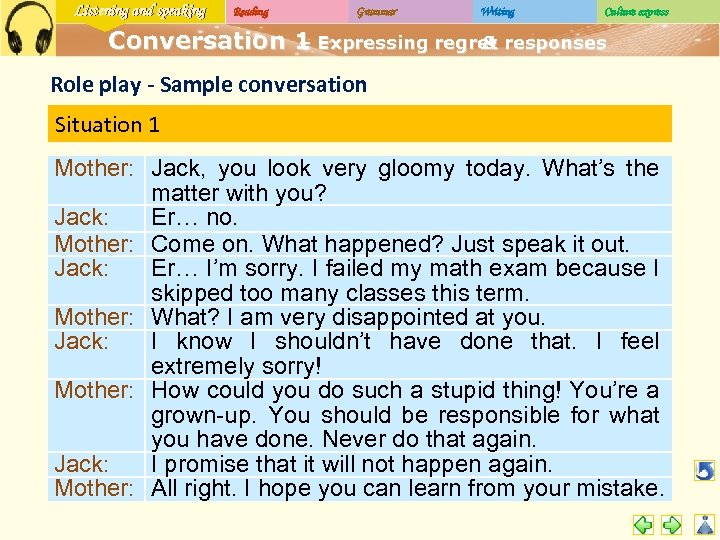 Listening and speaking Reading Grammar Writing Culture express Conversation 1 Expressing regret responses – & Role play - Sample conversation Situation 1 Mother: Jack, you look very gloomy today. What’s the matter with you? Jack: Er… no. Mother: Come on. What happened? Just speak it out. Jack: Er… I’m sorry. I failed my math exam because I skipped too many classes this term. Mother: What? I am very disappointed at you. Jack: I know I shouldn’t have done that. I feel extremely sorry! Mother: How could you do such a stupid thing! You’re a grown-up. You should be responsible for what you have done. Never do that again. Jack: I promise that it will not happen again. Mother: All right. I hope you can learn from your mistake.
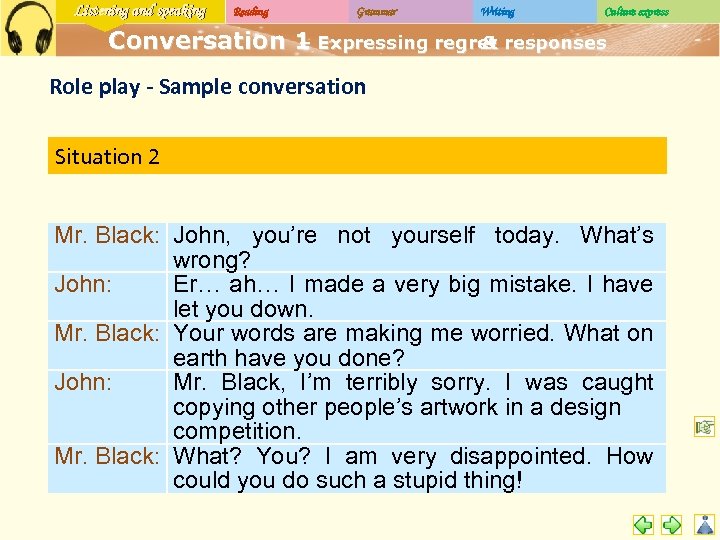 Listening and speaking Reading Grammar Writing Culture express Conversation 1 Expressing regret responses – & Role play - Sample conversation Situation 2 Mr. Black: John, you’re not yourself today. What’s wrong? John: Er… ah… I made a very big mistake. I have let you down. Mr. Black: Your words are making me worried. What on earth have you done? John: Mr. Black, I’m terribly sorry. I was caught copying other people’s artwork in a design competition. Mr. Black: What? You? I am very disappointed. How could you do such a stupid thing!
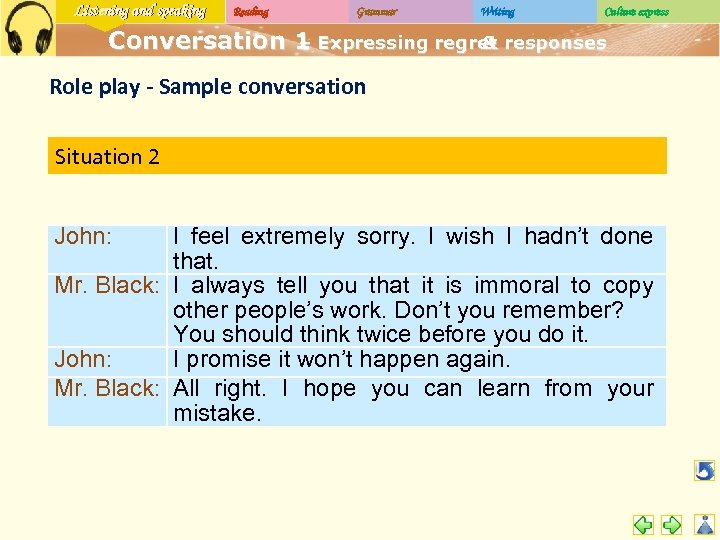 Listening and speaking Reading Grammar Writing Culture express Conversation 1 Expressing regret responses – & Role play - Sample conversation Situation 2 John: I feel extremely sorry. I wish I hadn’t done that. Mr. Black: I always tell you that it is immoral to copy other people’s work. Don’t you remember? You should think twice before you do it. John: I promise it won’t happen again. Mr. Black: All right. I hope you can learn from your mistake.
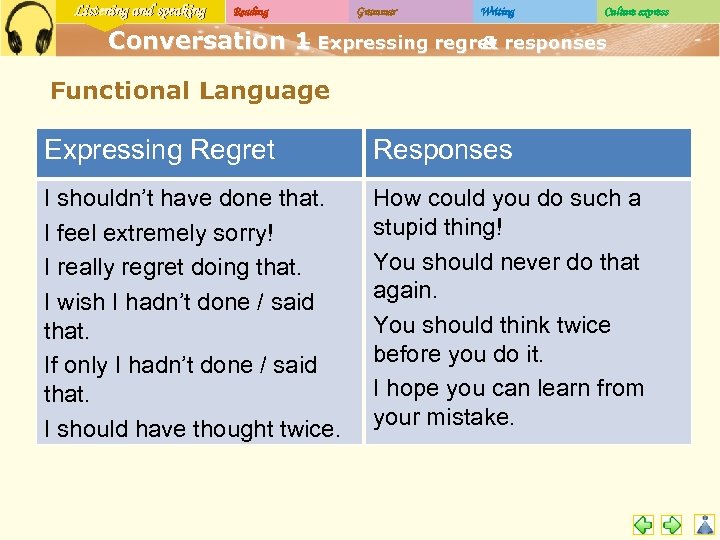 Listening and speaking Reading Grammar Writing Culture express Conversation 1 Expressing regret responses – & Functional Language Expressing Regret Responses I shouldn’t have done that. I feel extremely sorry! I really regret doing that. I wish I hadn’t done / said that. If only I hadn’t done / said that. I should have thought twice. How could you do such a stupid thing! You should never do that again. You should think twice before you do it. I hope you can learn from your mistake.
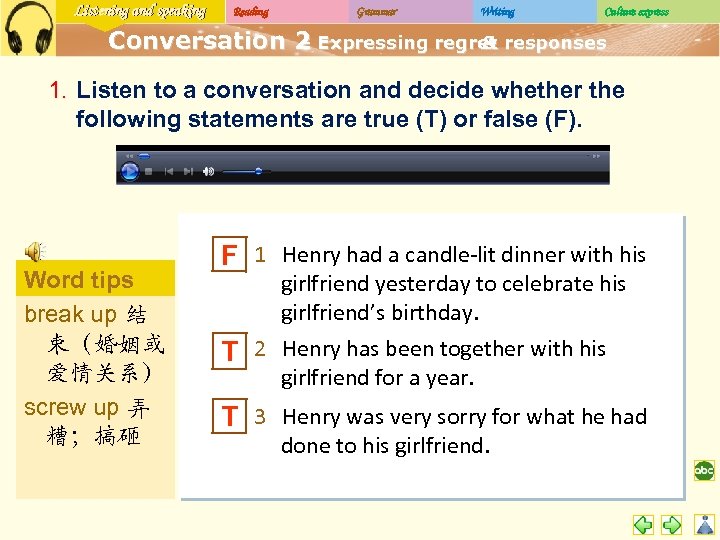 Listening and speaking Reading Grammar Writing Culture express Conversation 2 Expressing regret responses – & 1. Listen to a conversation and decide whether the following statements are true (T) or false (F). Word tips break up 结 束(婚姻或 爱情关系) screw up 弄 糟;搞砸 F 1 Henry had a candle-lit dinner with his girlfriend yesterday to celebrate his girlfriend’s birthday. T 2 Henry has been together with his girlfriend for a year. T 3 Henry was very sorry for what he had done to his girlfriend.
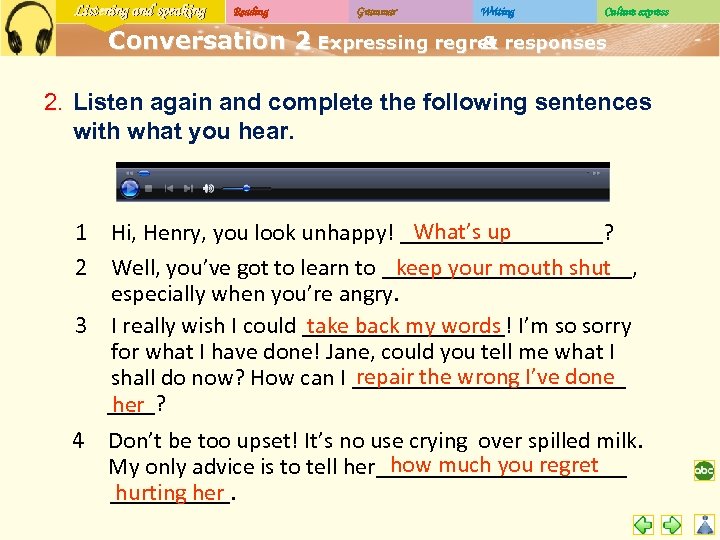 Listening and speaking Reading Grammar Writing Culture express Conversation 2 Expressing regret responses – & 2. Listen again and complete the following sentences with what you hear. What’s up 1 Hi, Henry, you look unhappy! _________? keep your mouth shut 2 Well, you’ve got to learn to ___________, especially when you’re angry. take back my words 3 I really wish I could _________! I’m so sorry for what I have done! Jane, could you tell me what I repair the wrong I’ve done shall do now? How can I ____________? her 4 Don’t be too upset! It’s no use crying over spilled milk. how much you regret My only advice is to tell her___________. hurting her
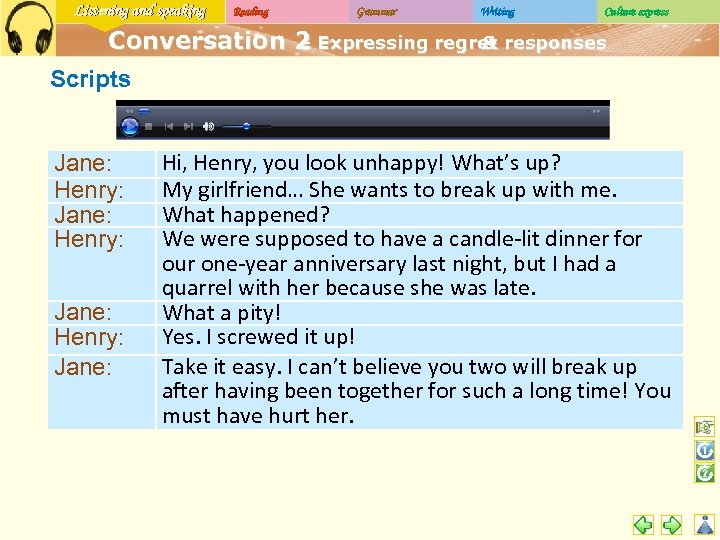 Listening and speaking Reading Grammar Writing Culture express Conversation 2 Expressing regret responses – & Scripts Jane: Henry: Jane: Hi, Henry, you look unhappy! What’s up? My girlfriend… She wants to break up with me. What happened? We were supposed to have a candle-lit dinner for our one-year anniversary last night, but I had a quarrel with her because she was late. What a pity! Yes. I screwed it up! Take it easy. I can’t believe you two will break up after having been together for such a long time! You must have hurt her.
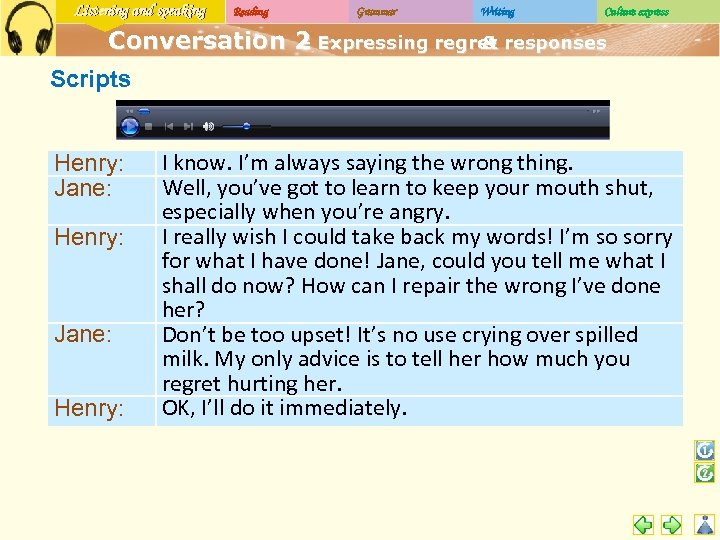 Listening and speaking Reading Grammar Writing Culture express Conversation 2 Expressing regret responses – & Scripts Henry: Jane: Henry: I know. I’m always saying the wrong thing. Well, you’ve got to learn to keep your mouth shut, especially when you’re angry. I really wish I could take back my words! I’m so sorry for what I have done! Jane, could you tell me what I shall do now? How can I repair the wrong I’ve done her? Don’t be too upset! It’s no use crying over spilled milk. My only advice is to tell her how much you regret hurting her. OK, I’ll do it immediately.
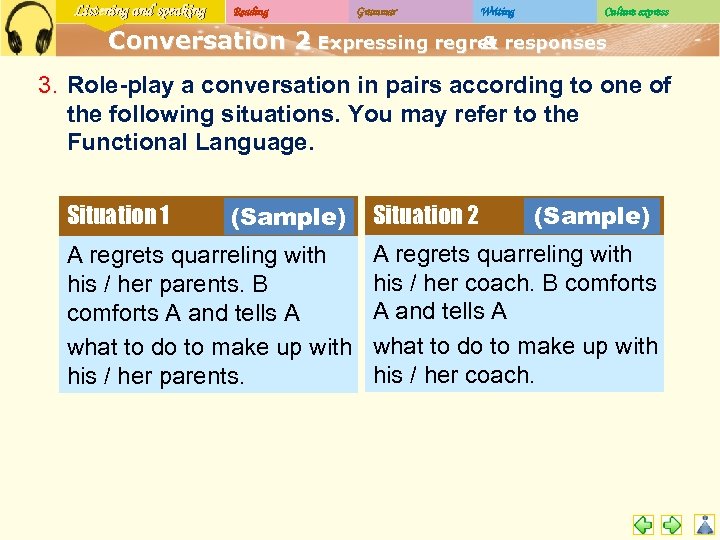 Listening and speaking Reading Grammar Writing Culture express Conversation 2 Expressing regret responses – & 3. Role-play a conversation in pairs according to one of the following situations. You may refer to the Functional Language. Situation 1 (Sample) A regrets quarreling with his / her parents. B comforts A and tells A what to do to make up with his / her parents. Situation 2 (Sample) A regrets quarreling with his / her coach. B comforts A and tells A what to do to make up with his / her coach.
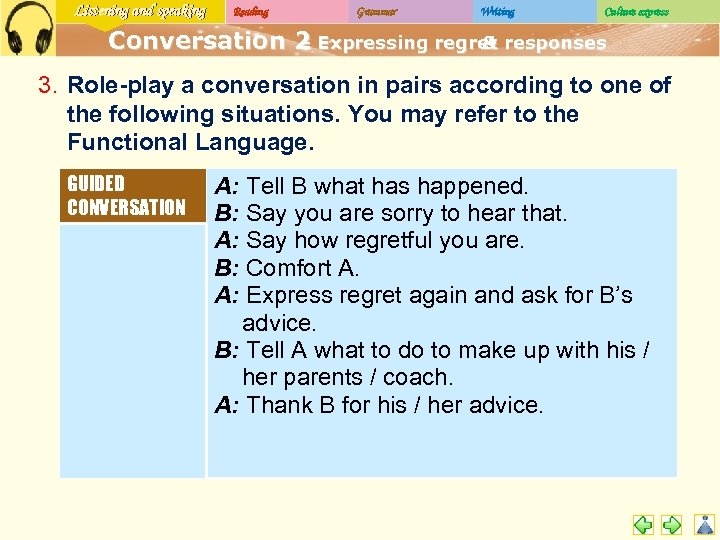 Listening and speaking Reading Grammar Writing Culture express Conversation 2 Expressing regret responses – & 3. Role-play a conversation in pairs according to one of the following situations. You may refer to the Functional Language. GUIDED CONVERSATION A: Tell B what has happened. B: Say you are sorry to hear that. A: Say how regretful you are. B: Comfort A. A: Express regret again and ask for B’s advice. B: Tell A what to do to make up with his / her parents / coach. A: Thank B for his / her advice.
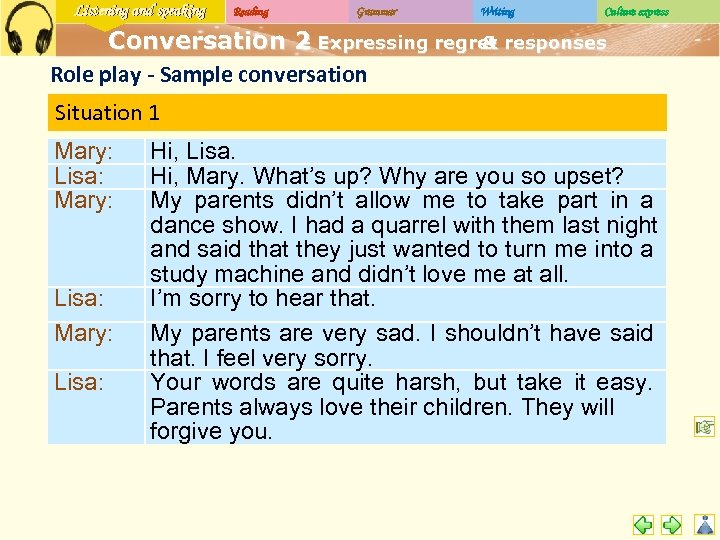 Listening and speaking Reading Grammar Writing Culture express Conversation 2 Expressing regret responses – & Role play - Sample conversation Situation 1 Mary: Lisa: Hi, Lisa. Hi, Mary. What’s up? Why are you so upset? My parents didn’t allow me to take part in a dance show. I had a quarrel with them last night and said that they just wanted to turn me into a study machine and didn’t love me at all. I’m sorry to hear that. My parents are very sad. I shouldn’t have said that. I feel very sorry. Your words are quite harsh, but take it easy. Parents always love their children. They will forgive you.
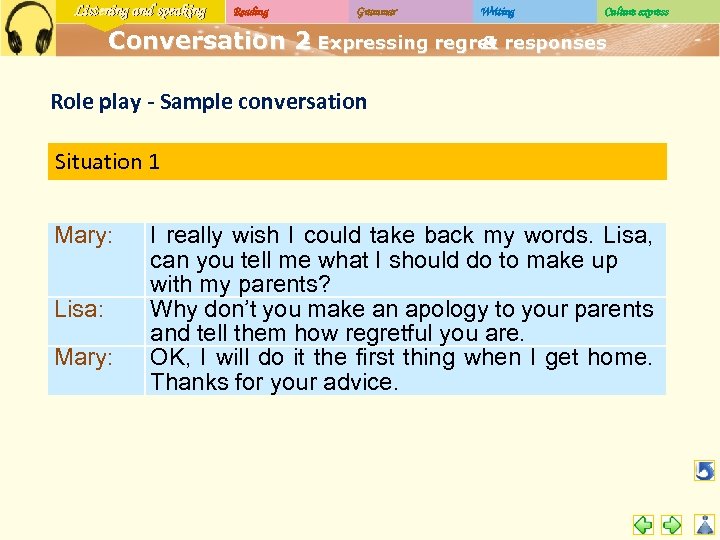 Listening and speaking Reading Grammar Writing Culture express Conversation 2 Expressing regret responses – & Role play - Sample conversation Situation 1 Mary: Lisa: Mary: I really wish I could take back my words. Lisa, can you tell me what I should do to make up with my parents? Why don’t you make an apology to your parents and tell them how regretful you are. OK, I will do it the first thing when I get home. Thanks for your advice.
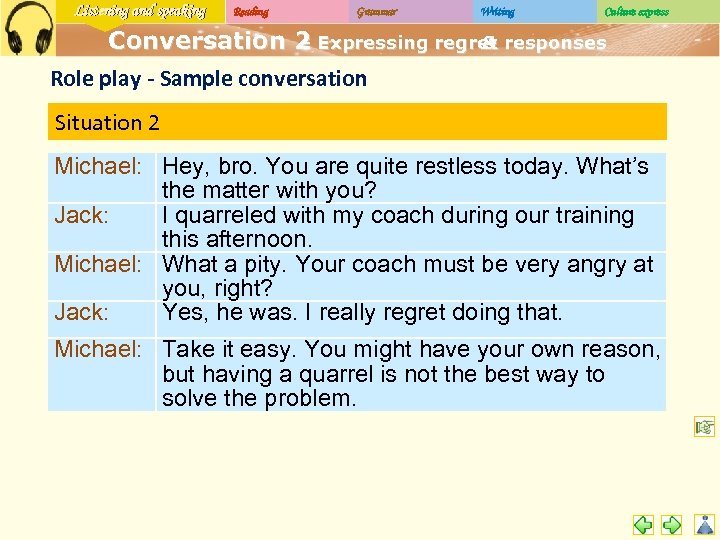 Listening and speaking Reading Grammar Writing Culture express Conversation 2 Expressing regret responses – & Role play - Sample conversation Situation 2 Michael: Hey, bro. You are quite restless today. What’s the matter with you? Jack: I quarreled with my coach during our training this afternoon. Michael: What a pity. Your coach must be very angry at you, right? Jack: Yes, he was. I really regret doing that. Michael: Take it easy. You might have your own reason, but having a quarrel is not the best way to solve the problem.
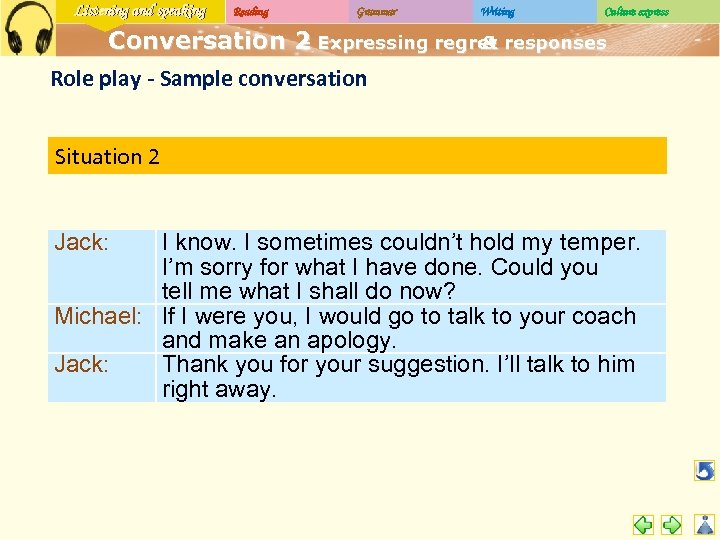 Listening and speaking Reading Grammar Writing Culture express Conversation 2 Expressing regret responses – & Role play - Sample conversation Situation 2 Jack: I know. I sometimes couldn’t hold my temper. I’m sorry for what I have done. Could you tell me what I shall do now? Michael: If I were you, I would go to talk to your coach and make an apology. Jack: Thank you for your suggestion. I’ll talk to him right away.
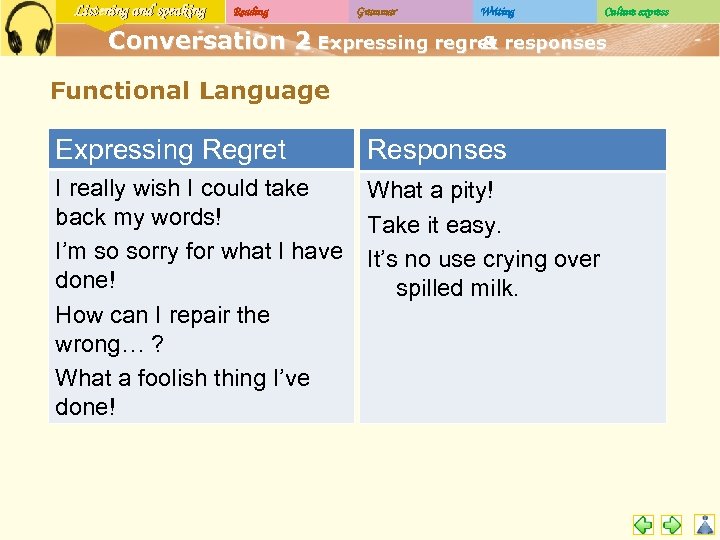 Listening and speaking Reading Grammar Writing Culture express Conversation 2 Expressing regret responses – & Functional Language Expressing Regret Responses I really wish I could take What a pity! back my words! Take it easy. I’m so sorry for what I have It’s no use crying over done! spilled milk. How can I repair the wrong… ? What a foolish thing I’ve done!
 Listening and speaking Reading Grammar Writing Culture express Passage 1. Listen to a passage and complete the following table with what you hear. Word tips Malaga 马拉加(西班牙南部港市) influential adj. 有影响力的 monk n. 修道士;僧侣 Pope n. 教皇 immense adj. 巨大的
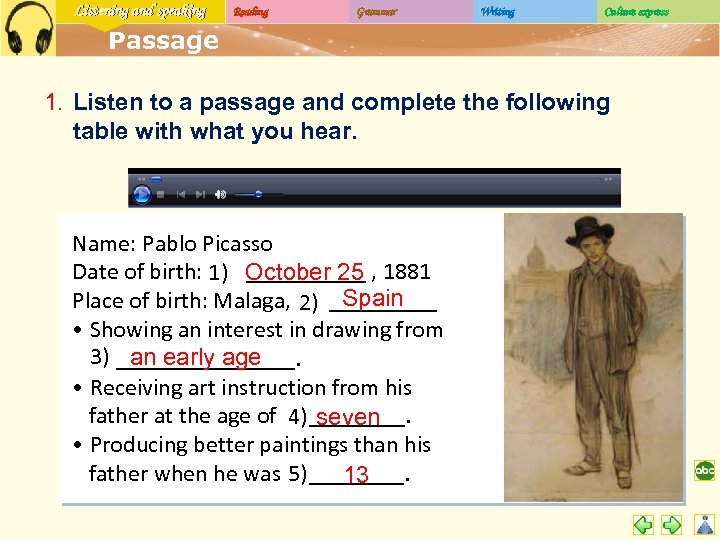 Listening and speaking Reading Grammar Writing Culture express Passage 1. Listen to a passage and complete the following table with what you hear. Name: Pablo Picasso Date of birth: 1) October 25 , 1881 _____ Spain Place of birth: Malaga, 2) _____ • Showing an interest in drawing from 3) ________. an early age • Receiving art instruction from his father at the age of 4) ____. seven • Producing better paintings than his father when he was 5) ____. 13
 Listening and speaking Reading Grammar Writing Culture express Passage 2. Listen again and decide whether the following statements are true (T) or false (F). F 1 Picasso’s mother thought that he was only an ordinary boy and could achieve nothing. F 2 Picasso was a good student at school. T 3 Picasso is famous for his contributions to modern art. T 4 Picasso worked in many different styles and media.
 Listening and speaking Reading Grammar Writing Culture express Passage Scripts Born on October 25, 1881, in Malaga, Spain, Pablo Picasso is one of the greatest and most influential artists of the 20 th century. He once said, “When I was a child, my mother said to me, ‘If you become a soldier, you’ll be a general. If you become a monk, you’ll end up as the Pope. ’ Instead I became a painter and ended up as Picasso. ” From an early age Picasso showed an interest in drawing. At the age of seven, he began receiving art instruction from his father, who was an art teacher.
 Listening and speaking Reading Grammar Writing Culture express Passage Scripts By the time he was 13, his paintings were already better than his father’s. Soon, he lost all desire to do any schoolwork and instead spent his school days doodling on his notebooks. Finally Pablo Picasso became one of the most recognized figures in 20 th-century art. Best known for his contributions to modern art, Picasso worked in a number of different styles and in nearly every medium. His artistic achievements brought him worldwide fame and immense fortune.
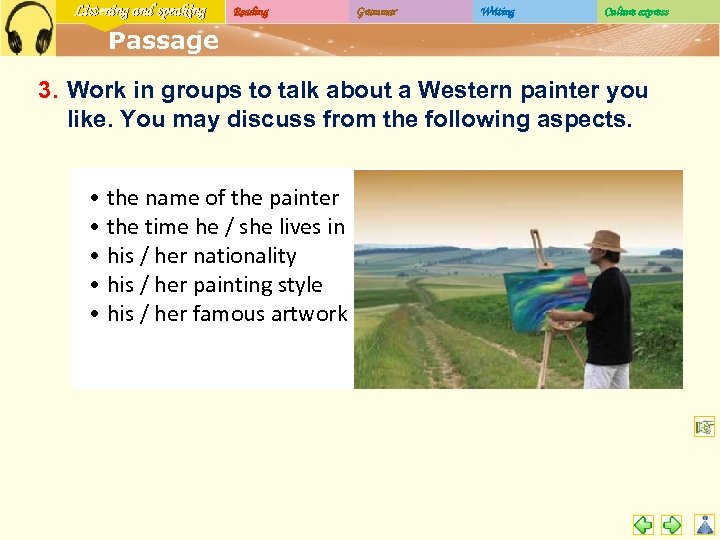 Listening and speaking Reading Grammar Writing Culture express Passage 3. Work in groups to talk about a Western painter you like. You may discuss from the following aspects. • the name of the painter • the time he / she lives in • his / her nationality • his / her painting style • his / her famous artwork
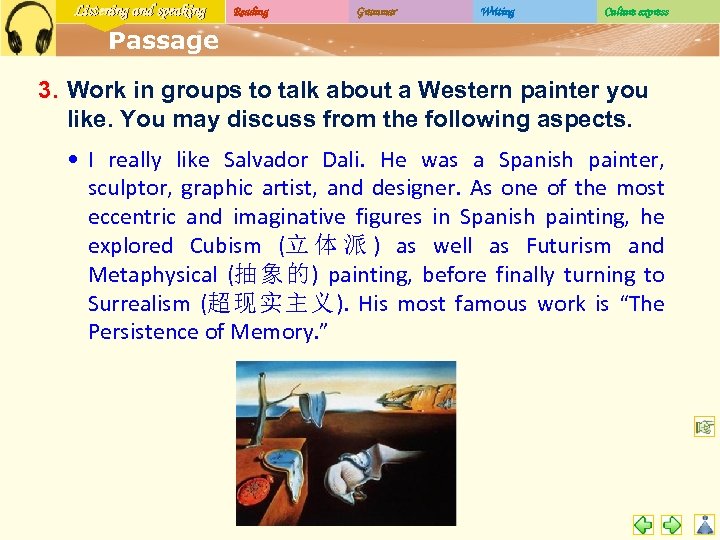 Listening and speaking Reading Grammar Writing Culture express Passage 3. Work in groups to talk about a Western painter you like. You may discuss from the following aspects. • I really like Salvador Dali. He was a Spanish painter, sculptor, graphic artist, and designer. As one of the most eccentric and imaginative figures in Spanish painting, he explored Cubism (立 体 派 ) as well as Futurism and Metaphysical (抽象的) painting, before finally turning to Surrealism (超现实主义). His most famous work is “The Persistence of Memory. ”
 Listening and speaking Reading Grammar Writing Culture express Passage 3. Work in groups to talk about a Western painter you like. You may discuss from the following aspects. • I like Andy Warhol. He was an American artist, a leading figure in the visual art movement known as Pop art. His works explore the relationship between artistic expression, celebrity culture and advertisement that flourished in the 1960 s. After a successful career as a commercial illustrator, Warhol became a renowned and sometimes controversial artist. The Andy Warhol Museum is in his native city, Pittsburgh, Pennsylvania. It is the largest museum in the United States dedicated to a single artist. He worked across a wide range of media-painting, photography, drawing, and sculpture.
 Listening and speaking Reading Grammar Writing l Passage A A dance with Dad l Passage B The story behind a masterpiece Culture express
 Listening and speaking Reading Grammar Writing Passage A A dance with Dad l Lead-in l Text study l Exercises Culture express
 Listening and speaking Reading Grammar Writing Passage A A dance with Dad – Lead-in l Video appreciation l Extended reading l Pre-reading questions Culture express
 Listening and speaking Reading Grammar Writing Passage A A dance with Dad – Lead-in - Video appreciation Culture express
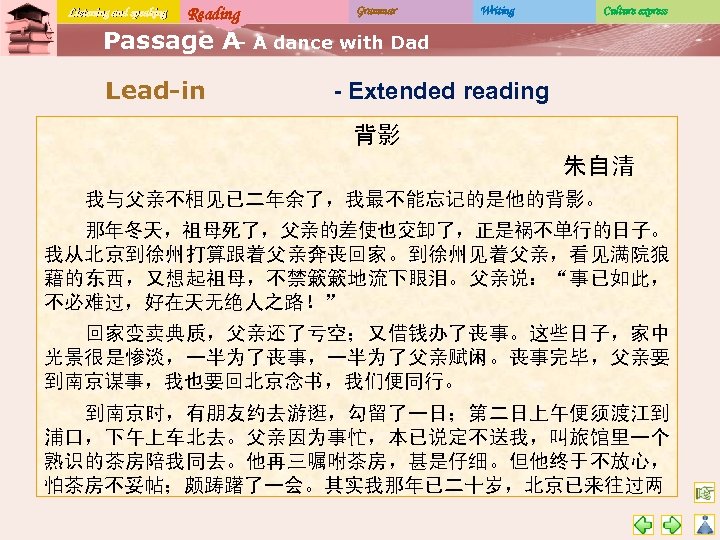 Listening and speaking Reading Grammar Writing Culture express Passage A A dance with Dad – Lead-in - Extended reading 背影 朱自清 我与父亲不相见已二年余了,我最不能忘记的是他的背影。 那年冬天,祖母死了,父亲的差使也交卸了,正是祸不单行的日子。 我从北京到徐州打算跟着父亲奔丧回家。到徐州见着父亲,看见满院狼 藉的东西,又想起祖母,不禁簌簌地流下眼泪。父亲说:“事已如此, 不必难过,好在天无绝人之路!” 回家变卖典质,父亲还了亏空;又借钱办了丧事。这些日子,家中 光景很是惨淡,一半为了丧事,一半为了父亲赋闲。丧事完毕,父亲要 到南京谋事,我也要回北京念书,我们便同行。 到南京时,有朋友约去游逛,勾留了一日;第二日上午便须渡江到 浦口,下午上车北去。父亲因为事忙,本已说定不送我,叫旅馆里一个 熟识的茶房陪我同去。他再三嘱咐茶房,甚是仔细。但他终于不放心, 怕茶房不妥帖;颇踌躇了一会。其实我那年已二十岁,北京已来往过两
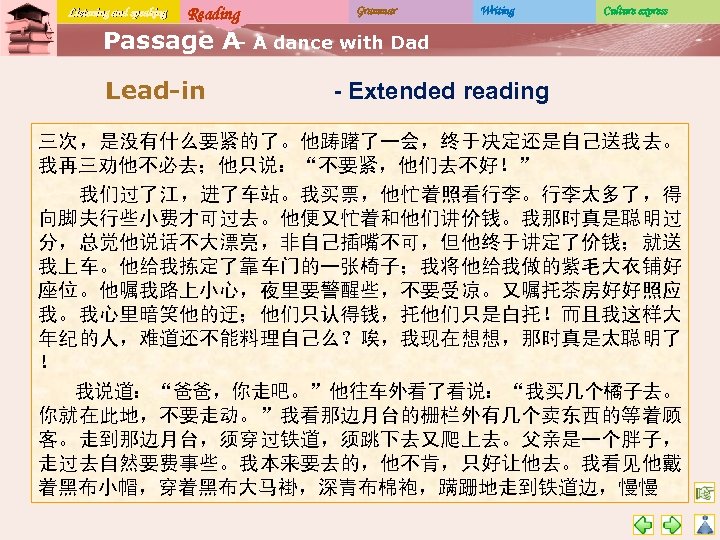 Listening and speaking Reading Grammar Writing Culture express Passage A A dance with Dad – Lead-in - Extended reading 三次,是没有什么要紧的了。他踌躇了一会,终于决定还是自己送我去。 我再三劝他不必去;他只说:“不要紧,他们去不好!” 我们过了江,进了车站。我买票,他忙着照看行李。行李太多了,得 向脚夫行些小费才可过去。他便又忙着和他们讲价钱。我那时真是聪明过 分,总觉他说话不大漂亮,非自己插嘴不可,但他终于讲定了价钱;就送 我上车。他给我拣定了靠车门的一张椅子;我将他给我做的紫毛大衣铺好 座位。他嘱我路上小心,夜里要警醒些,不要受凉。又嘱托茶房好好照应 我。我心里暗笑他的迂;他们只认得钱,托他们只是白托!而且我这样大 年纪的人,难道还不能料理自己么?唉,我现在想想,那时真是太聪明了 ! 我说道:“爸爸,你走吧。”他往车外看了看说:“我买几个橘子去。 你就在此地,不要走动。”我看那边月台的栅栏外有几个卖东西的等着顾 客。走到那边月台,须穿过铁道,须跳下去又爬上去。父亲是一个胖子, 走过去自然要费事些。我本来要去的,他不肯,只好让他去。我看见他戴 着黑布小帽,穿着黑布大马褂,深青布棉袍,蹒跚地走到铁道边,慢慢
 Listening and speaking Reading Grammar Writing Culture express Passage A A dance with Dad – Lead-in - Extended reading 探身下去,尚不大难。可是他穿过铁道,要爬上那边月台,就不容易了。 他用两手攀着上面,两脚再向上缩;他肥胖的身子向左微倾,显出努力的 样子,这时我看见他的背影,我的泪很快地流下来了。我赶紧拭干了泪。 怕他看见,也怕别人看见。我再向外看时,他已抱了朱红的橘子往回走了。 过铁道时,他先将橘子散放在地上,自己慢慢爬下,再抱起橘子走。到这 边时,我赶紧去搀他。他和我走到车上,将橘子一股脑儿放在我的皮大衣 上。于是扑扑衣上的泥土,心里很轻松似的。过一会说:“我走了,到那 边来信!”我望着他走出去。他走了几步,回头看见我,说:“进去吧, 里边没人。”等他的背影混入来来往往的人里,再找不着了,我便进来坐 下,我的眼泪又来了。 近几年来,父亲和我都是东奔西走,家中光景是一日不如一日。他少 年出外谋生,独立支持,做了许多大事。哪知老境却如此颓唐!他触目伤 怀,自然情不能自已。情郁于中,自然要发之于外;家庭琐屑便往往触他 之怒。他待我渐渐不同往日。但最近两年的不见,他终于忘却我的不好,
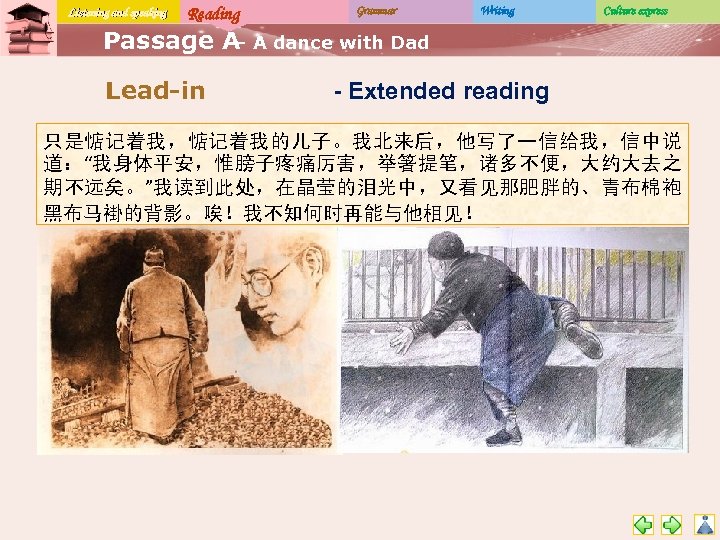 Listening and speaking Reading Grammar Writing Culture express Passage A A dance with Dad – Lead-in - Extended reading 只是惦记着我,惦记着我的儿子。我北来后,他写了一信给我,信中说 道:“我身体平安,惟膀子疼痛厉害,举箸提笔,诸多不便,大约大去之 期不远矣。”我读到此处,在晶莹的泪光中,又看见那肥胖的、青布棉袍 黑布马褂的背影。唉!我不知何时再能与他相见!
 Listening and speaking Reading Grammar Writing Culture express Passage A A dance with Dad – Pre-reading questions Work in groups to discuss the following questions. 1. What do you think is the difference between motherly love and fatherly love? 2. Did you have any unpleasant experience with your parents when you were a teenager? If yes, how did you repair the relationship with them?
 Listening and speaking Reading Grammar Writing Culture express Passage A A dance with Dad – Pre-reading questions Work in groups to discuss the following questions. 1. What do you think is the difference between motherly love and fatherly love? Motherly love is direct and soft. Fatherly love is powerful and indirect. Fathers usually don’t show their love directly, but support the family silently.
 Listening and speaking Reading Grammar Writing Culture express Passage A A dance with Dad – Pre-reading questions Work in groups to discuss the following questions. 2. Did you have any unpleasant experience with your parents when you were a teenager? If yes, how did you repair the relationship with them? Yes, I did have some unpleasant experience with my parents, but I have solved them appropriately. Once I stayed outside with my friends and came back home late at night. They just got angry with me and shouted at me. I was so sad and wanted to argue with them. But then, I told myself that I should explain the reason and apologize. After my apology, my parents also calmed down and said they were too impulsive. So we can see that good communication may guarantee a good relationship with our parents.
 Listening and speaking Reading Grammar Writing Passage A A dance with Dad – Text study l Text reading l Organization of the text l Language points Culture express
 Listening and speaking Reading Grammar Writing Culture express Passage A A dance with Dad 1. I am dancing with my father at my parents’ 50 th wedding anniversary celebration. The band is playing an old-fashioned waltz as we move gracefully across the floor. His hand on my waist is ____________ as guiding as it always was, and he hums the tune to _________________________ himself in a steady, youthful way. _________________________ Around around we go, laughing and nodding to the other _________________________ dancers. ____ We are the best dancers on the floor, they tell us. My father squeezes my hand smiles at me.
 Listening and speaking Reading Grammar Writing Culture express Passage A A dance with Dad 2. _________________________ As we continue to dip and sway, I remember a time when I was almost four, and my father came home _________________________ from work, swooped me into his arms and began to _________________________ dance me around the table. ______________My mother laughed at us, told us dinner would get cold. But my father said, “She’s just caught the rhythm of the dance! Dinner can wait. ” And then he sang out, “Roll out the barrel, we’ll have a barrel of fun, ” and I sang back, “We’ve got the blues on the run. ” That night he taught me polka and waltz while dinner waited.
 Listening and speaking Reading Grammar Writing Culture express Passage A A dance with Dad 3. We danced through the years. When I was five, my father taught me “Shuffle Off to Buffalo. ” Later we won a dance contest at a Camp Fire Girls. Then we learned jitterbug at the USO. Once my father caught on to the steps, he danced with everyone in the hall. We all laughed and clapped for my father, the real dancer.
 Listening and speaking Reading Grammar Writing Culture express Passage A A dance with Dad 4. One night when I was 15, lost in some painful, _________________________ adolescent mood, my father put on a stack of _________________________ records and teased me to dance with him. ____________________ “C’mon, ” he said. “Let’s get those blues on the run. ” I____ turned away from him, and hugged my pain closer than _________________________ My father put his hand on my shoulder, and before. I jumped out of the chair screaming, “Don’t touch me! I am sick and tired of dancing ___________________ with you!” The hurt on his face did not escape me, but the words were out, and I could not call them _________________________ I ran to my room sobbing hysterically. back.
 Listening and speaking Reading Grammar Writing Culture express Passage A A dance with Dad 5. We did not dance together after that night. I found other partners, and my father waited up for me after dances, sitting in his favorite chair. Sometimes he would be asleep when I came in, and I would wake him, saying, “If you were so tired, you should have gone to bed. ” 6. “No, no, ” he’d say. “I was just waiting for you. ” 7. Then we’d lock up the house and go to bed. 8. My father waited up for me all through my high school and ________________________ college years while I danced my way out of his life. _____________________
 Listening and speaking Reading Grammar Writing Culture express Passage A A dance with Dad 9. One night, shortly after my first child was born, my mother called to tell me my father was ill. “A heart problem, ” she said. “Now, don’t come. Three hundred miles. It would upset your father. We will just have to wait. I’ll let you know. ” 10. My father’s tests showed some heart disease, but a proper ________ diet restored him back to good health. Then little things _________________________ followed: a problem with his ____________ back, more heart trouble, a minor operation on his eyes. Yet his dancing did not stop. My mother wrote that they had joined a dance club. “You remember how your father loves to dance. ” _______________ 11. ______________________ tears Yes, I remembered. My eyes filled up with remembering those times when we danced together.
 Listening and speaking Reading Grammar Writing Culture express Passage A A dance with Dad 12. After my father retired, we mended our relationship. Hugs and kisses were common when we visited each other. But my father did not ask me to dance. He danced instead with his grandchildren; my daughters knew how to waltz before they could read. 13. “One, two, three, and one, two, three, ” my father would count. “Won’t you come and waltz with me? ” Sometimes my heart would ache to hear him say those words to my daughters. I knew my father was waiting for an apology from me, and I could never find the right words.
 Listening and speaking Reading Grammar Writing Culture express Passage A A dance with Dad 14. As the time for my parents’ 50 th anniversary came, my brothers and I met to plan the party. My older brother said, “Do you remember that night you wouldn’t dance with him? Boy, was he mad! I couldn’t believe he’d get so mad about a thing like that. I’ll bet you haven’t __________ danced with him since. ” ___________ I did not tell him he was right. 15. My younger brother promised to get the band. 16. “Make sure they can play waltzes and polkas, ” I told him. 17. _________________________ “Dad can dance to anything, ” he said. 18. __________ all I wanted to do was dance once I did not tell him that more with my father.
 Listening and speaking Reading Grammar Writing Culture express Passage A A dance with Dad 19. When the band began to play after dinner, my parents took the floor. They danced around the room, inviting the others to join them. The guests rose to their feet, clapping for the golden couple. My father danced with his granddaughters, and then the band began to play the “Beer Barrel Polka. ” 20. “Roll out the barrel, ” I heard my father sing. Then I knew it was time. I knew the words I must say to my father before he would dance with me once more. ________ I moved my way through a few couples and tapped my daughter on the _________________________ shoulder. 21. “Excuse me, ” I said, almost choking on my words. “But I believe this is my dance. ” ______________ My father stood rooted to the spot. Our eyes met and traveled back to that night when I _________________________ was 15.
 Listening and speaking Reading Grammar Writing Culture express Passage A A dance with Dad 22. In a trembling voice, I sang, “Let’s get those blues on the run. ” 23. My father bowed and said, “Oh, yes. I’ve been waiting for you. ” 24. _________________________ Then he started to laugh, and we moved into each other’s arms, pausing for a moment so we could _________________________ catch once more the rhythm of the dance. ____________________
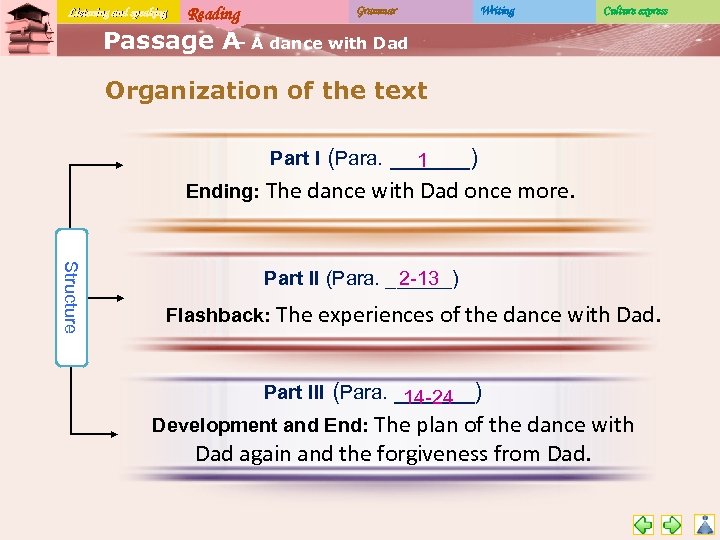 Listening and speaking Reading Grammar Writing Culture express Passage A A dance with Dad – Organization of the text Part I (Para. ______) 1 Ending: The dance with Dad once more. Structure Part II (Para. ______) 2 -13 Flashback: The experiences of the dance with Dad. Part III (Para. ______) 14 -24 Development and End: The plan of the dance with Dad again and the forgiveness from Dad.
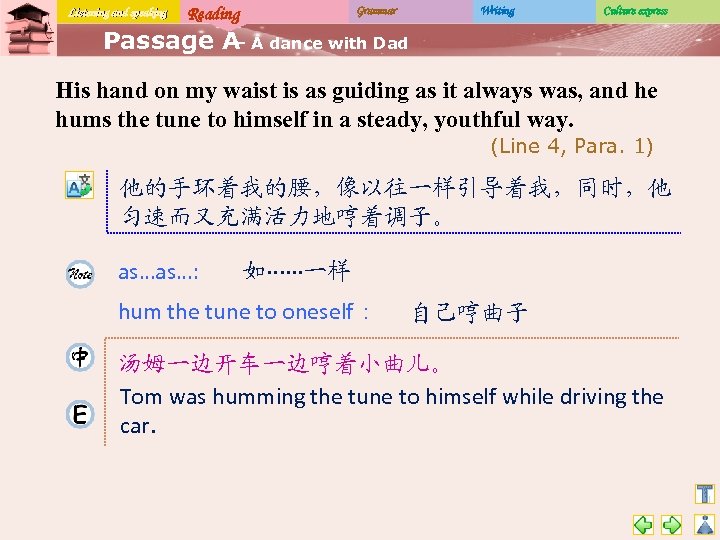 Listening and speaking Reading Grammar Writing Culture express Passage A A dance with Dad – His hand on my waist is as guiding as it always was, and he hums the tune to himself in a steady, youthful way. (Line 4, Para. 1) 他的手环着我的腰,像以往一样引导着我,同时,他 匀速而又充满活力地哼着调子。 as…as…: 如······一样 hum the tune to oneself: 自己哼曲子 汤姆一边开车一边哼着小曲儿。 Tom was humming the tune to himself while driving the car.
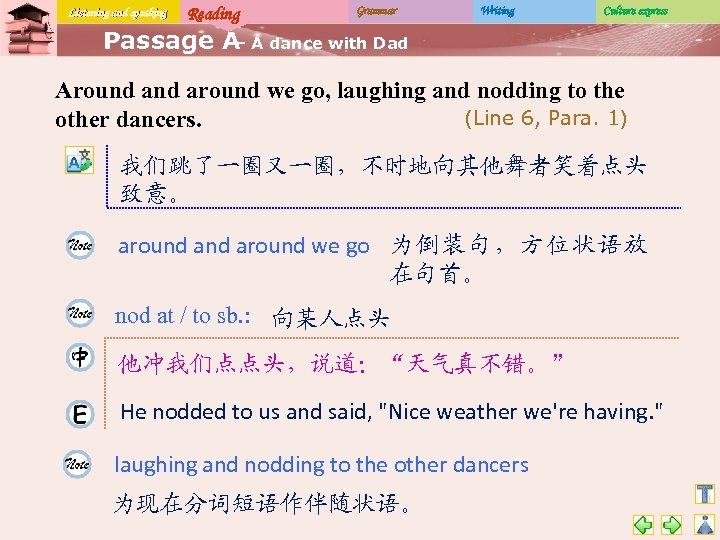 Listening and speaking Reading Grammar Writing Culture express Passage A A dance with Dad – Around around we go, laughing and nodding to the (Line 6, Para. 1) other dancers. 我们跳了一圈又一圈,不时地向其他舞者笑着点头 致意。 around we go 为倒装句,方位状语放 在句首。 nod at / to sb. : 向某人点头 他冲我们点点头,说道:“天气真不错。” He nodded to us and said, "Nice weather we're having. " laughing and nodding to the other dancers 为现在分词短语作伴随状语。
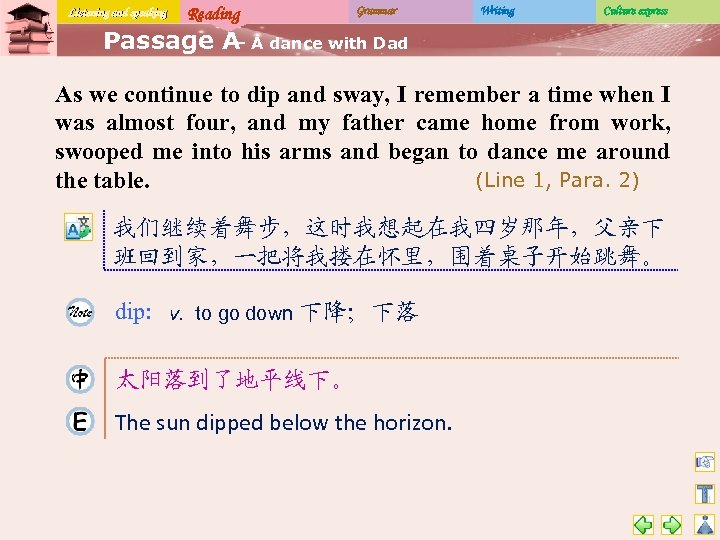 Listening and speaking Reading Grammar Writing Culture express Passage A A dance with Dad – As we continue to dip and sway, I remember a time when I was almost four, and my father came home from work, swooped me into his arms and began to dance me around (Line 1, Para. 2) the table. 我们继续着舞步,这时我想起在我四岁那年,父亲下 班回到家,一把将我搂在怀里,围着桌子开始跳舞。 dip: v. to go down 下降;下落 太阳落到了地平线下。 The sun dipped below the horizon.
 Listening and speaking Reading Grammar Writing Culture express Passage A A dance with Dad – As we continue to dip and sway, I remember a time when I was almost four, and my father came home from work, swooped me into his arms and began to dance me around (Line 1, Para. 2) the table. 我们继续着舞步,这时我想起在我四岁那年,父亲下 班回到家,一把将我搂在怀里,围着桌子开始跳舞。 swoop: v. to seize or snatch sth. in one sudden movement 一下子抓住 她在孩子的身后追赶着,一下子把他抱在了怀里。 She rushed after the child and swooped him up in her arms.
 Listening and speaking Reading Grammar Writing Culture express Passage A A dance with Dad – One night when I was 15, lost in some painful, adolescent mood, my father put on a stack of records and teased me to (Line 1, Para. 4) dance with him. 我十五岁那年的一个晚上,由于青春期的多愁善感, 我非常悲伤。父亲拿出一摞唱片,非要我跟他跳舞。 lost in some painful, adolescent mood为过去分词短语作 伴随状语。some 在句中意为“某个;某种”。 in a good / bad mood: 心情好/差 put on sth. / put sth. on: 播放(唱片、磁带或激光唱片) 我们到书房听点儿音乐吧。 Let's go into the study and put on some music.
 Listening and speaking Reading Grammar Writing Culture express Passage A A dance with Dad – One night when I was 15, lost in some painful, adolescent mood, my father put on a stack of records and teased me to (Line 1, Para. 4) dance with him. 我十五岁那年的一个晚上,由于青春期的多愁善感, 我非常悲伤。父亲拿出一摞唱片,非要我跟他跳舞。 a stack of sth. : a large amount of sth. 大量(大批,许多) 某物 桌子上有很多报纸。 There a stack of news papers on the desk.
 Listening and speaking Reading Grammar Writing Culture express Passage A A dance with Dad – I turned away from him, and hugged my pain closer than (Line 5, Para. before. 4) 我转过身,陷入了更深的痛苦中。 hugged my pain 采用了拟人(personification)的修辞手 法。
 Listening and speaking Reading Grammar Writing Culture express Passage A A dance with Dad – The hurt on his face did not escape me, but the words were (Line 9, Para. 4) out, and I could not call them back. 我看到了他脸上受伤的表情,但话已出口,我无法 收回。 escape: if sth. escapes you, you cannot remember it or you do notice it 被遗忘;被忽略 It was an actor whose name escapes me for the moment. 那个男演员的名字我一时想不起来了。 escape sb’s attention / notice: 逃过某人的注意;被某 人忽视
 Listening and speaking Reading Grammar Writing Culture express Passage A A dance with Dad – Then little things followed: a problem with his back, more heart trouble, a minor operation on his eyes. (Line 3, Para. 10) 之后又出现了一些小毛病:背部的问题,更多心脏的 问题,眼部动了次小手术。 problem: n. sth. wrong with your health or with part of your body 疾病 operation on / for: (身体某个部位的)手术 She had an operation on her knee at the clinic. 她在诊所做了个膝盖手术。
 Listening and speaking Reading Grammar Writing Culture express Passage A A dance with Dad – My father waited up for me all through my high school and college years while I danced my way out of his life. (Line 1, Para. 8) 在我上高中和大学的几年里,每次我出去跳舞,父亲 都会一直等我回家,但我却舞出了他的生活。 dance my way out of his life 根据上下文可以这样理解: I danced with other partners rather than my father.
 Listening and speaking Reading Grammar Writing Culture express Passage A A dance with Dad – My eyes filled up with tears remembering those times when (Line 1, Para. 11) we danced together. 想起曾经那些共舞的时光,我的眼里充满了泪水。 fill up: v. if a container or place fills up, or if you fill it up, it becomes full 装满;使充满 His office began to fill up with people. 他的办公室里挤满了人。 be full of
 Listening and speaking Reading Grammar Writing Culture express Passage A A dance with Dad – I’ll bet you haven’t danced with him since. (Line 6, Para. 14) 我敢肯定从那以后,你没和他跳过舞吧。 I / I’ll bet: used to say that you are fairly sure that sth. is true, sth. is happening, etc. although you cannot prove this 我敢肯定;我敢保证 我肯定是你做的早餐并且清洗了餐具。 I bet you make breakfast and wash up the plates, too.
 Listening and speaking Reading Grammar Writing Culture express Passage A A dance with Dad – I did not tell him that all I wanted to do was dance once more with my father. (Line 1, Para. 18) 我没有告诉他,我只是想和父亲再跳一次舞。 that 从句为 tell 的宾语从句。 dance 的用法为不定式作表语,文中省略了 to。 不定式作表语原则上是不能省略 to 的,但是主语部 分有动词 do 的某种形式时,用作表语的不定式可以 省略 to。
 Listening and speaking Reading Grammar Writing Culture express Passage A A dance with Dad – I moved my way through a few couples and tapped my daughter on the shoulder. (Line 4, Para. 20) 我穿过人群,拍了拍女儿的肩膀。 tap sb. on the shoulder / arm / chest, etc. : 轻拍某人的 肩膀 / 胳膊 / 胸膛等等 一个学生拍了拍老师的胳膊,老师转过身来。 The teacher turned as one student tapped him on the arm.
 Listening and speaking Reading Grammar Writing Culture express Passage A A dance with Dad – My father stood rooted to the spot. Our eyes met and traveled back to that night when I was 15. (Line 2, Para. 21) 父亲呆了一样站在那里。我们都注视着对方,思绪 飞回到我十五岁的那个夜晚。 rooted to the spot / floor / ground, etc. : so shocked, surprised, or frightened that you cannot move(震惊、惊 讶或害怕得)呆住不动 听到这个消息,她呆了一样地站在那里。 On hearing the news, she stood rooted to the spot.
 Listening and speaking Reading Grammar Writing Culture express Passage A A dance with Dad – Then he started to laugh, and we moved into each other’s arms, pausing for a moment so we could catch once more (Line 1, Para. 24) the rhythm of the dance. 说完,他大笑起来。我们挽着彼此的胳膊,停了一下, 以便再次跟上舞曲的节奏。 pause for a moment: 稍稍停顿片刻 回答问题之前他停顿了片刻。 He paused for a moment before answered the question.
 Listening and speaking Reading Grammar Writing Culture express Passage A A dance with Dad – Then he started to laugh, and we moved into each other’s arms, pausing for a moment so we could catch once more (Line 1, Para. 24) the rhythm of the dance. 说完,他大笑起来。我们挽着彼此的胳膊,停了一下, 以便再次跟上舞曲的节奏。 catch the rhythm: 抓住节奏 她试了好几次老是跟不上节奏。 She tried for several times but failed to catch the rhythm of the music.
 Listening and speaking Reading Grammar Writing Culture express Passage A A dance with Dad – shuffle (Line 2, Para. 3) n. (usu sing. 通常作单数) shuffling walk or movement 拖着 脚步走;缓慢地走 walk with an exhausted shuffle 拖著疲惫不堪的脚步走 v. to walk slowly and noisily, without lifting your feet off the ground 拖着脚步走;缓慢地走 He shuffled across the room to the window. 他拖着脚走到房间那头的窗户跟前。
 Listening and speaking Reading Grammar Writing Culture express Passage A A dance with Dad – catch on (Line 5, Para. 3) to begin to understand or realize sth. (开始)明白,意识到 他是个外国人,未能理解这个笑话的含意。 Being a foreigner, he did not catch on the joke. catch on to: 理解;突然了解 It took me a long time to catch on to the directions. 我花了很久才弄明白说明书的意思。
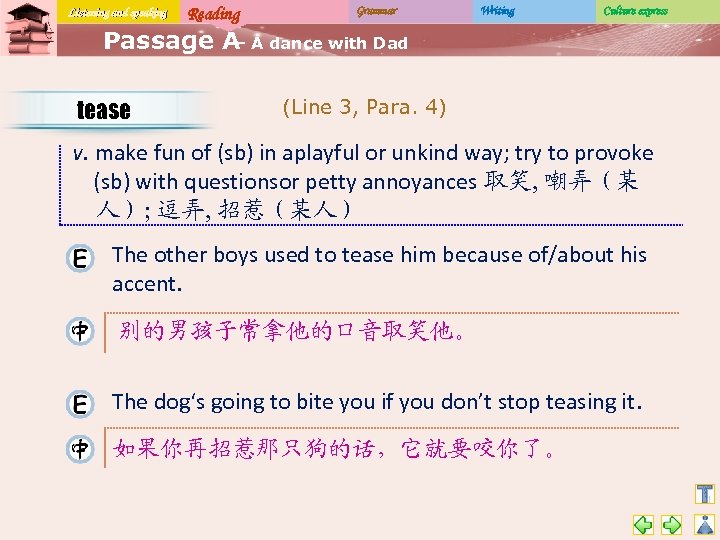 Listening and speaking Reading Grammar Writing Culture express Passage A A dance with Dad – tease (Line 3, Para. 4) v. make fun of (sb) in aplayful or unkind way; try to provoke (sb) with questionsor petty annoyances 取笑, 嘲弄(某 人); 逗弄, 招惹(某人) The other boys used to tease him because of/about his accent. 别的男孩子常拿他的口音取笑他。 The dog‘s going to bite you if you don’t stop teasing it. 如果你再招惹那只狗的话,它就要咬你了。
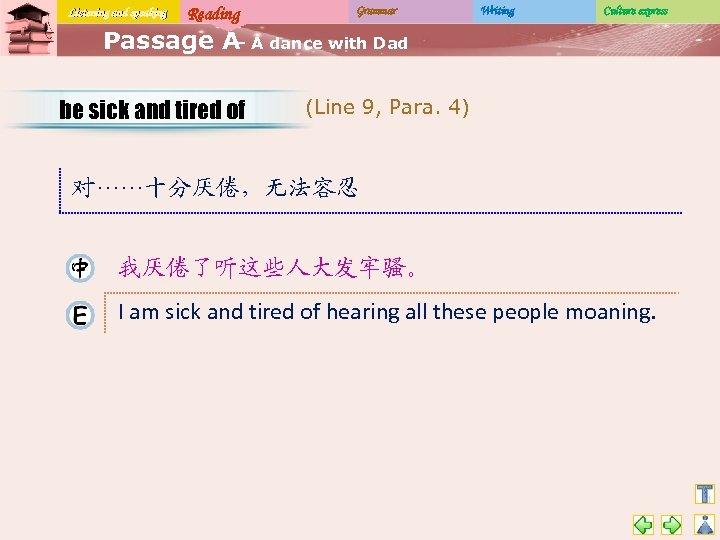 Listening and speaking Reading Grammar Writing Culture express Passage A A dance with Dad – be sick and tired of (Line 9, Para. 4) 对······十分厌倦,无法容忍 我厌倦了听这些人大发牢骚。 I am sick and tired of hearing all these people moaning.
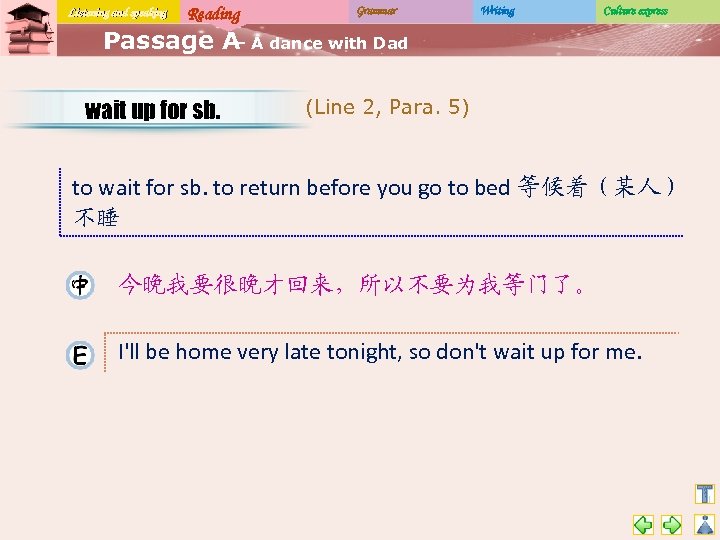 Listening and speaking Reading Grammar Writing Culture express Passage A A dance with Dad – wait up for sb. (Line 2, Para. 5) to wait for sb. to return before you go to bed 等候着(某人) 不睡 今晚我要很晚才回来,所以不要为我等门了。 I'll be home very late tonight, so don't wait up for me.
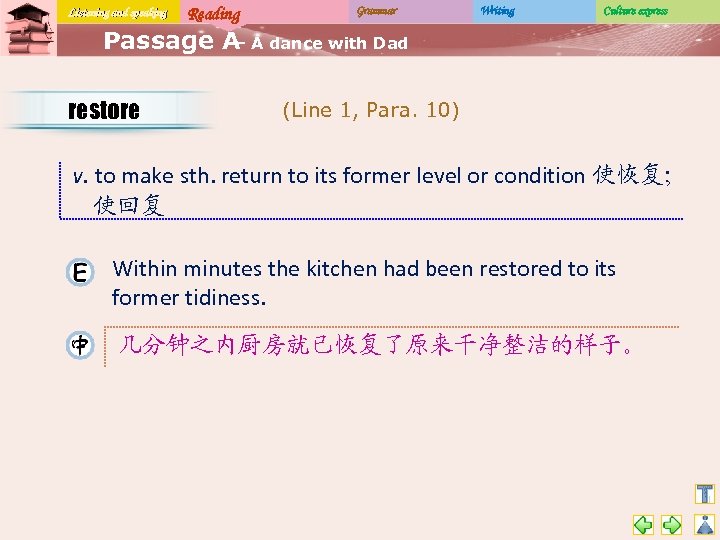 Listening and speaking Reading Grammar Writing Culture express Passage A A dance with Dad – restore (Line 1, Para. 10) v. to make sth. return to its former level or condition 使恢复; 使回复 Within minutes the kitchen had been restored to its former tidiness. 几分钟之内厨房就已恢复了原来干净整洁的样子。
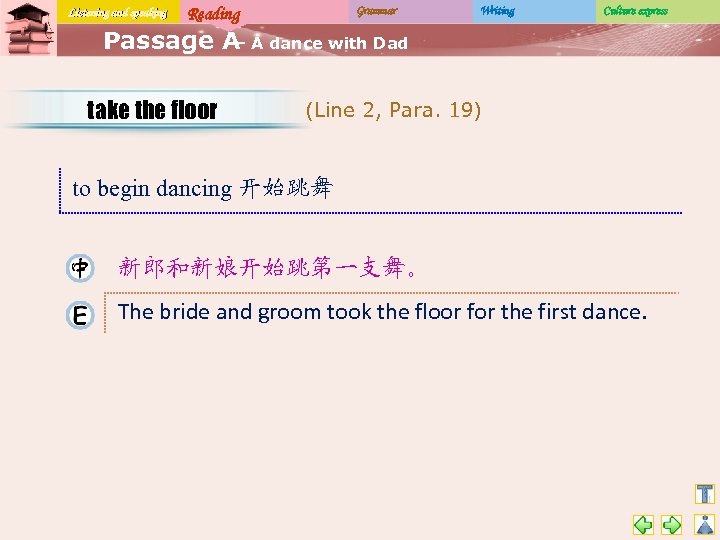 Listening and speaking Reading Grammar Writing Culture express Passage A A dance with Dad – take the floor (Line 2, Para. 19) to begin dancing 开始跳舞 新郎和新娘开始跳第一支舞。 The bride and groom took the floor for the first dance.
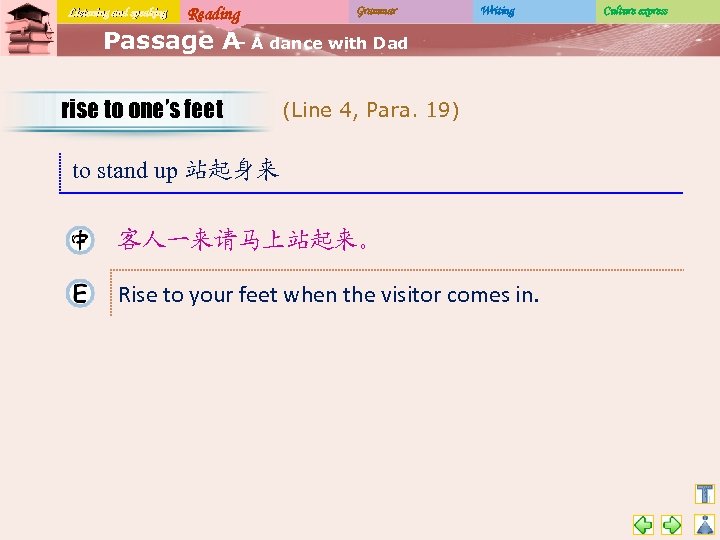 Listening and speaking Reading Grammar Writing Passage A A dance with Dad – rise to one’s feet (Line 4, Para. 19) to stand up 站起身来 客人一来请马上站起来。 Rise to your feet when the visitor comes in. Culture express
 Listening and speaking Reading Grammar Writing Passage A Exercises – l Comprehension l Vocabulary & Structure l Translation Culture express
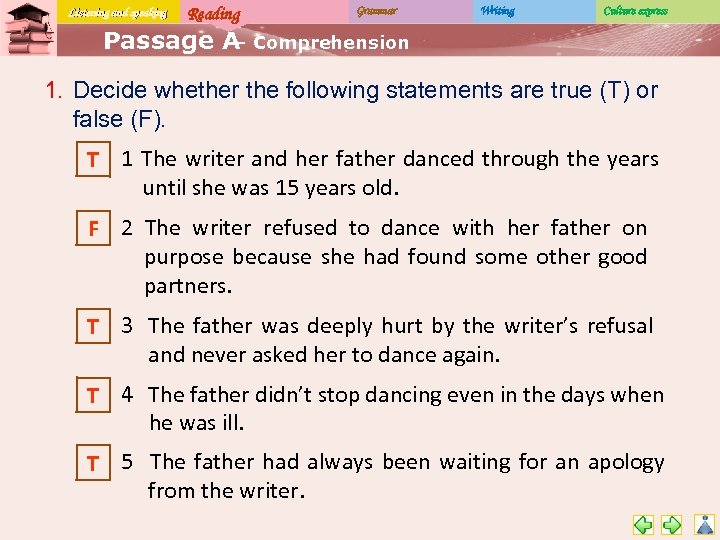 Listening and speaking Reading Grammar Writing Culture express Passage A Comprehension – 1. Decide whether the following statements are true (T) or false (F). T 1 The writer and her father danced through the years until she was 15 years old. F 2 The writer refused to dance with her father on purpose because she had found some other good partners. T 3 The father was deeply hurt by the writer’s refusal and never asked her to dance again. T 4 The father didn’t stop dancing even in the days when he was ill. T 5 The father had always been waiting for an apology from the writer.
 Listening and speaking Reading Grammar Writing Culture express Passage A Comprehension – 2. Work in groups to discuss the following questions. 1 What does the writer mean by saying that “I danced my way out of his life” in Paragraph 8? 2 Why did the writer’s father stand rooted to the spot when the writer invited him to dance at his 50 th wedding anniversary?
 Listening and speaking Reading Grammar Writing Culture express Passage A Comprehension – 2. Work in groups to discuss the following questions. 1 What does the writer mean by saying that “I danced my way out of his life” in Paragraph 8? It means the writer danced with other partners rather than her father. It indicates the relationship between the writer and her father nearly collapsed. They had little communication with each other as if the father disappeared in her life.
 Listening and speaking Reading Grammar Writing Culture express Passage A Comprehension – 2. Work in groups to answer the following questions. 2 Why did the writer’s father stand rooted to the spot when the writer invited him to dance at his 50 th wedding anniversary? The father was once deeply hurt by the writer’s refusal, and never thought the writer would make an apology. Now he was shocked and touched when the writer apologized and invited him to dance.
 Listening and speaking Reading Grammar Writing Culture express Passage A Vocabulary and structure – 1. Compare each pair of words and complete the following sentences with the right one. Change the form if necessary. 1. hysterically She sobbed ______, and her thin body was shaken. Hysterical ______ fans tried to stop Madonna’s car at the airport. 2. contestant contests Few ______ in the recent history of British boxing have been so exciting. contestant She is the youngest ______ in the chess competition.
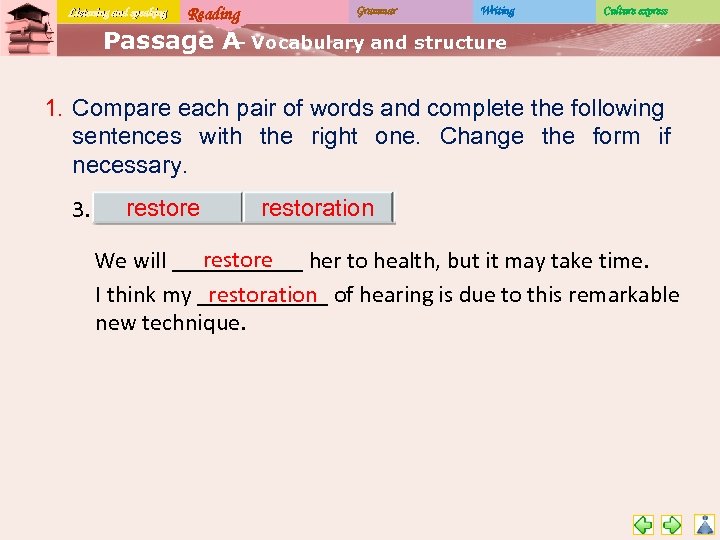 Listening and speaking Reading Grammar Writing Culture express Passage A Vocabulary and structure – 1. Compare each pair of words and complete the following sentences with the right one. Change the form if necessary. 3. restore restoration restore We will ______ her to health, but it may take time. I think my ______ of hearing is due to this remarkable restoration new technique.
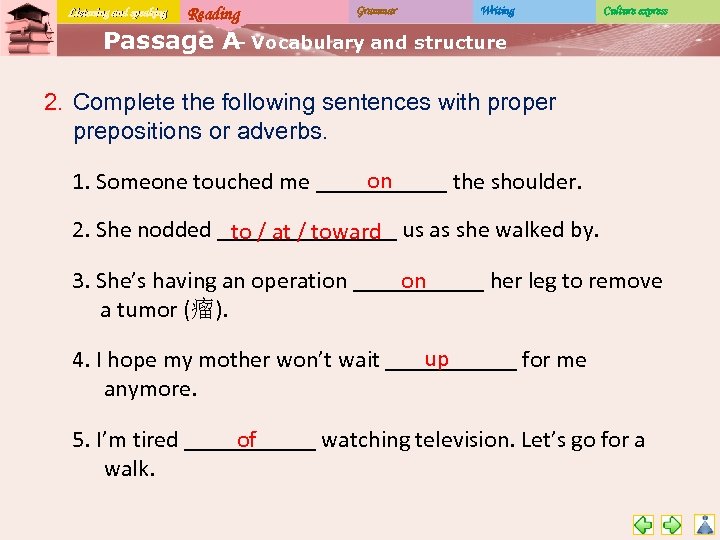 Listening and speaking Reading Grammar Writing Culture express Passage A Vocabulary and structure – 2. Complete the following sentences with proper prepositions or adverbs. on 1. Someone touched me ______ the shoulder. 2. She nodded ________ us as she walked by. to / at / toward 3. She’s having an operation ______ her leg to remove on a tumor (瘤). up 4. I hope my mother won’t wait ______ for me anymore. 5. I’m tired ______ watching television. Let’s go for a of walk.
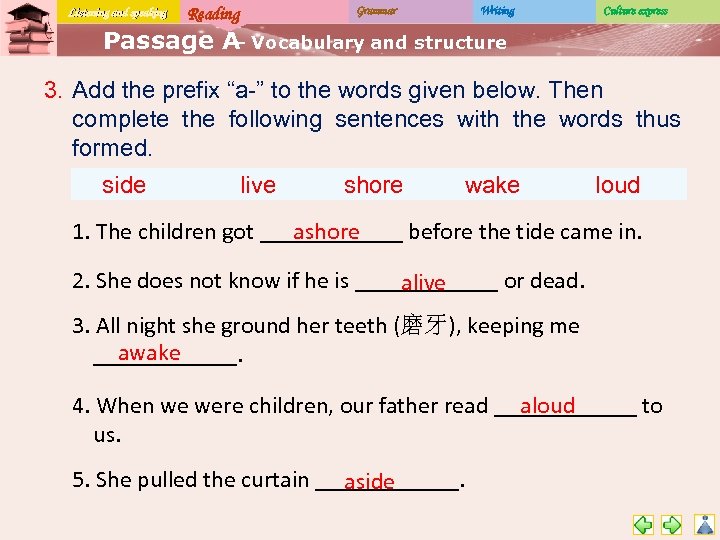 Listening and speaking Reading Grammar Writing Culture express Passage A Vocabulary and structure – 3. Add the prefix “a-” to the words given below. Then complete the following sentences with the words thus formed. side live shore wake loud 1. The children got ______ before the tide came in. ashore 2. She does not know if he is ______ or dead. alive 3. All night she ground her teeth (磨牙), keeping me awake ______. 4. When we were children, our father read ______ to aloud us. 5. She pulled the curtain ______. aside
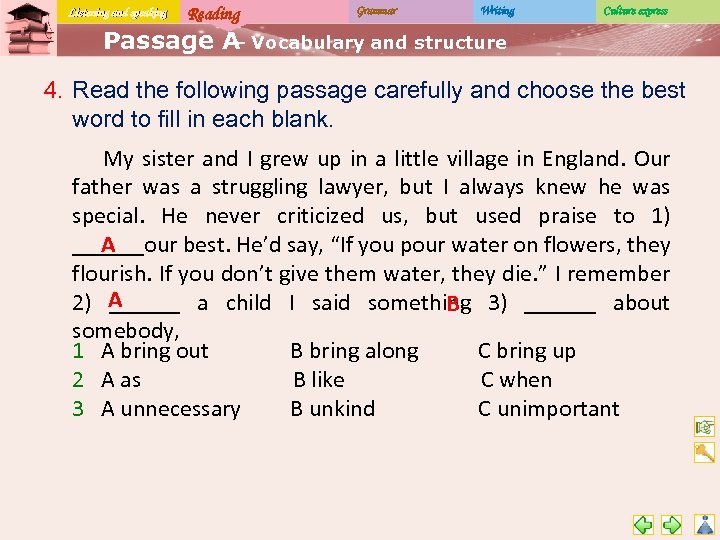 Listening and speaking Reading Grammar Writing Culture express Passage A Vocabulary and structure – 4. Read the following passage carefully and choose the best word to fill in each blank. My sister and I grew up in a little village in England. Our father was a struggling lawyer, but I always knew he was special. He never criticized us, but used praise to 1) ______our best. He’d say, “If you pour water on flowers, they A flourish. If you don’t give them water, they die. ” I remember 2) A ______ a child I said something 3) ______ about B somebody, 1 A bring out B bring along C bring up 2 A as B like C when 3 A unnecessary B unkind C unimportant
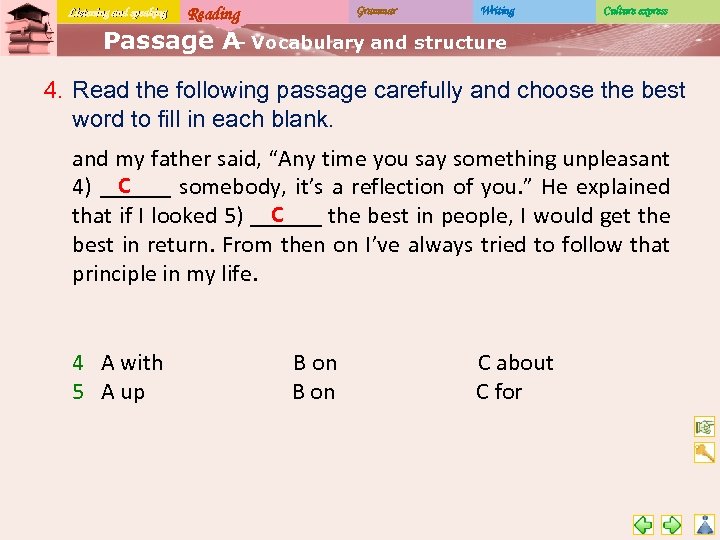 Listening and speaking Reading Grammar Writing Culture express Passage A Vocabulary and structure – 4. Read the following passage carefully and choose the best word to fill in each blank. and my father said, “Any time you say something unpleasant C 4) ______ somebody, it’s a reflection of you. ” He explained C that if I looked 5) ______ the best in people, I would get the best in return. From then on I’ve always tried to follow that principle in my life. 4 A with 5 A up B on C about C for
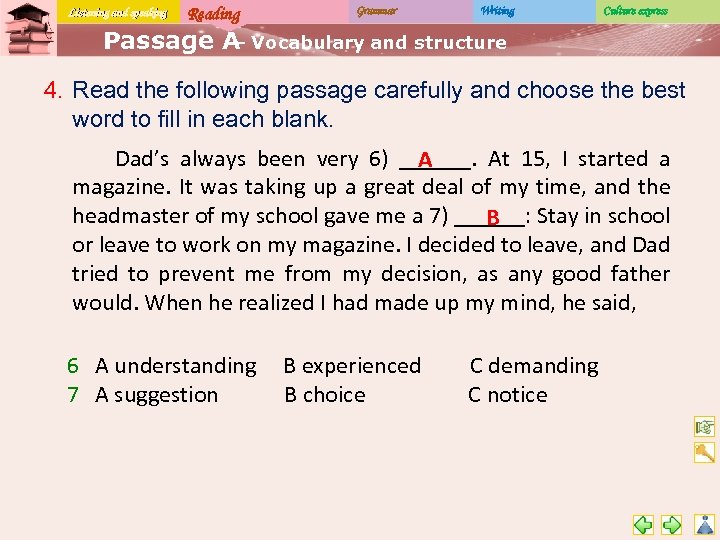 Listening and speaking Reading Grammar Writing Culture express Passage A Vocabulary and structure – 4. Read the following passage carefully and choose the best word to fill in each blank. Dad’s always been very 6) ______. At 15, I started a A magazine. It was taking up a great deal of my time, and the headmaster of my school gave me a 7) ______: Stay in school B or leave to work on my magazine. I decided to leave, and Dad tried to prevent me from my decision, as any good father would. When he realized I had made up my mind, he said, 6 A understanding 7 A suggestion B experienced B choice C demanding C notice
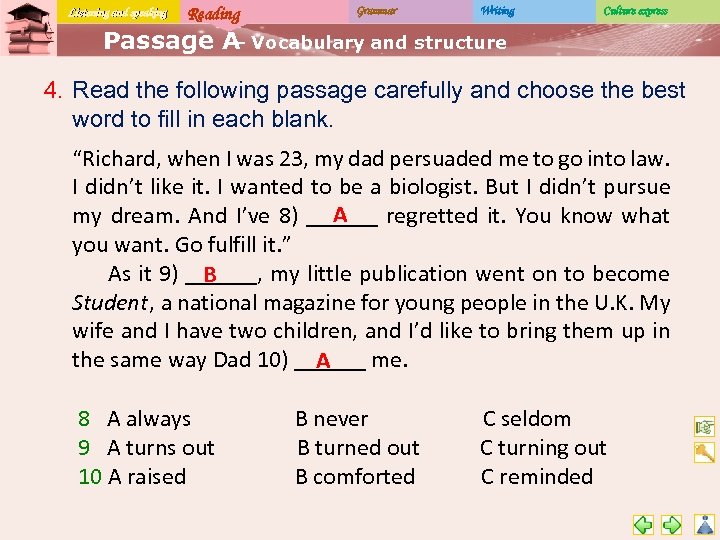 Listening and speaking Reading Grammar Writing Culture express Passage A Vocabulary and structure – 4. Read the following passage carefully and choose the best word to fill in each blank. “Richard, when I was 23, my dad persuaded me to go into law. I didn’t like it. I wanted to be a biologist. But I didn’t pursue A my dream. And I’ve 8) ______ regretted it. You know what you want. Go fulfill it. ” As it 9) ______, my little publication went on to become B Student, a national magazine for young people in the U. K. My wife and I have two children, and I’d like to bring them up in the same way Dad 10) ______ me. A 8 A always 9 A turns out 10 A raised B never B turned out B comforted C seldom C turning out C reminded
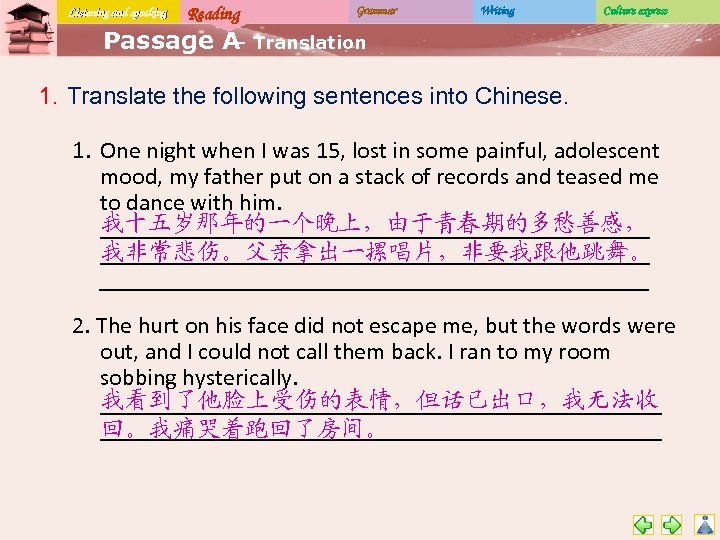 Listening and speaking Reading Grammar Writing Culture express Passage A Translation – 1. Translate the following sentences into Chinese. 1. One night when I was 15, lost in some painful, adolescent mood, my father put on a stack of records and teased me to dance with him. 我十五岁那年的一个晚上,由于青春期的多愁善感, _______________________ 我非常悲伤。父亲拿出一摞唱片,非要我跟他跳舞。 ______________________________________________ 2. The hurt on his face did not escape me, but the words were out, and I could not call them back. I ran to my room sobbing hysterically. 我看到了他脸上受伤的表情,但话已出口,我无法收 ________________________ 回。我痛哭着跑回了房间。 ________________________
 Listening and speaking Reading Grammar Writing Culture express Passage A Translation – 2. Translate the following sentences into English with the help of the words given in brackets. 我们都知道母爱对于孩子身心发育的重要性。但是, 最近的研究表明,父爱对孩子的性格发育也起着至关重 要的作用。父爱对孩子的影响和母爱一样大,有时甚至 比母爱的影响更大。(development, indicate, critical) We all know the importance of a mother’s love for children’s physical and mental development. However, recent research indicates that a father’s love is also critical to children’s personality development. The influence of the father’s love on children is as great as and occasionally greater than the influence of the mother’s love.
 Listening and speaking Reading Grammar Writing Culture express Passage B The story behind a masterpiece l Lead-in l Text study l Exercises
 Listening and speaking Reading Grammar Writing Passage B The story behind a masterpiece – Lead-in l Pre-reading activity l Background information l Video appreciation Culture express
 Listening and speaking Reading Grammar Writing Culture express Passage B The story behind a masterpiece – Pre-reading Work in groups to discuss the following questions. 1. What do you know about Picasso’s style of painting? Sample answer: Pablo Picasso is one of the greatest and most influential artists of the 20 th century. He demonstrated extraordinary artistic talent in his early years, painting in a realistic manner through his childhood and adolescence. During the first decade of the 20 th century, his style changed as he experimented with different theories, techniques, and ideas. His works, just as his life, is not unified, continuous and stable at all. He has no fixed idea; there a great variety of styles in his works. His paintings can be passionate, manic (躁 狂的), loving, hateful, sincere or hypocritical, and the styles are changing constantly.
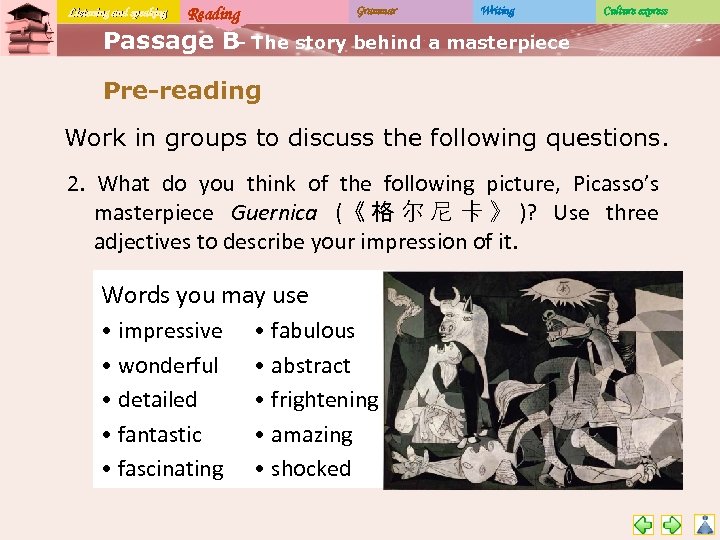 Listening and speaking Reading Grammar Writing Culture express Passage B The story behind a masterpiece – Pre-reading Work in groups to discuss the following questions. 2. What do you think of the following picture, Picasso’s masterpiece Guernica (《 格 尔 尼 卡 》 )? Use three adjectives to describe your impression of it. Words you may use • impressive • wonderful • detailed • fantastic • fascinating • fabulous • abstract • frightening • amazing • shocked
 Listening and speaking Reading Grammar Writing Culture express Passage B The story behind a masterpiece – Pre-reading Work in groups to discuss the following questions. 2. What do you think of the following picture, Picasso’s masterpiece Guernica (《 格 尔 尼 卡 》 )? Use three adjectives to describe your impression of it. Sample answer: At first sight, I was shocked by the abstract outline of the painting. But as I looked more into the picture, I was touched by its detailed description of the characters.
 Listening and speaking Reading Grammar Writing Passage B The story behind a masterpiece – Background information 1. Pablo Picasso 2. Guernica Culture express
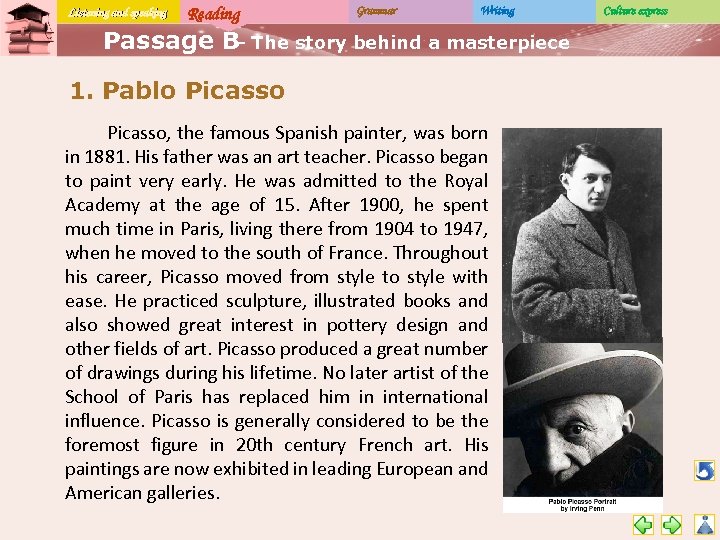 Listening and speaking Reading Grammar Writing Passage B The story behind a masterpiece – 1. Pablo Picasso, the famous Spanish painter, was born in 1881. His father was an art teacher. Picasso began to paint very early. He was admitted to the Royal Academy at the age of 15. After 1900, he spent much time in Paris, living there from 1904 to 1947, when he moved to the south of France. Throughout his career, Picasso moved from style to style with ease. He practiced sculpture, illustrated books and also showed great interest in pottery design and other fields of art. Picasso produced a great number of drawings during his lifetime. No later artist of the School of Paris has replaced him in international influence. Picasso is generally considered to be the foremost figure in 20 th century French art. His paintings are now exhibited in leading European and American galleries. Culture express
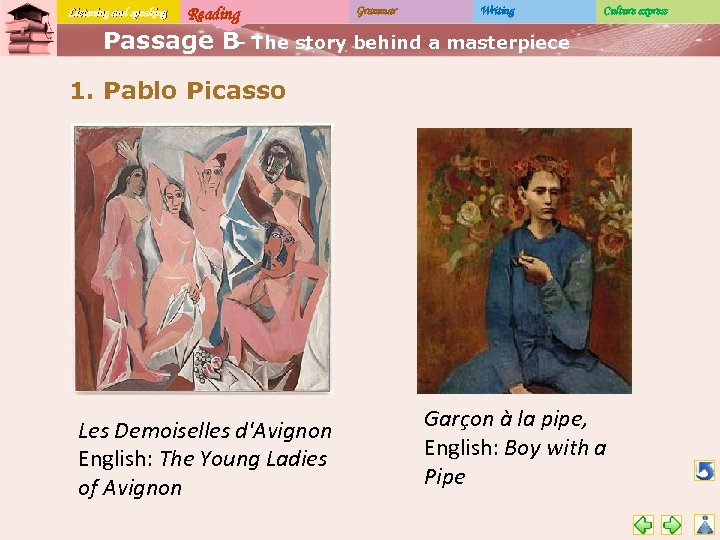 Listening and speaking Reading Grammar Writing Culture express Passage B The story behind a masterpiece – 1. Pablo Picasso Les Demoiselles d'Avignon English: The Young Ladies of Avignon Garçon à la pipe, English: Boy with a Pipe
 Listening and speaking Reading Grammar Writing Passage B The story behind a masterpiece – 2. Guernica Culture express
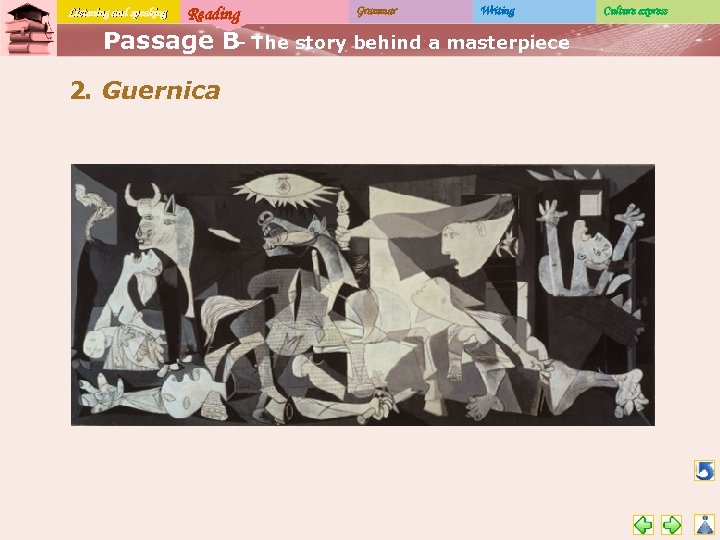
 Listening and speaking Reading Grammar Writing Culture express Passage B The story behind a masterpiece – 2. Guernica is a painting by Pablo Picasso. It was created in response to the bombing of Guernica, a Basque Country village in northern Spain, by German and Italian warplanes at the behest of the Spanish Nationalist forces on 26 April 1937 during the Spanish Civil War. Guernica is a statement against fascism, showing the tragedies of war and the suffering it inflicts upon individuals, particularly innocent civilians. This work has gained a monumental status, becoming a perpetual reminder of the tragedies of war, an anti-war symbol, and an embodiment of peace. Upon completion, Guernica was displayed around the world in a brief tour, becoming famous and widely acclaimed. This tour helped bring the Spanish Civil War to the world's attention.
 Listening and speaking Reading Grammar Writing Passage B The story behind a masterpiece – Lead-in - Video appreciation Guernica Culture express
 Listening and speaking Reading Grammar Writing Passage B The story behind a masterpiece – Text study l Text reading l Organization of the text l Language points Culture express
 Listening and speaking Reading Grammar Writing Culture express Passage B The story behind a masterpiece 1. It’s the heart of winter, 1941. Pablo Picasso was living and working on the top floor of an old house on the Left Bank of Paris. Most of Europe was under the control of the Third Reich at the time. Every so often, Picasso got visits from the Gestapo. One day, there was a visit that passed into Picasso’s legend. The _________ unwelcome visitor snooped around a bit and noticed there were _________________________ postcards of Picasso’s most famous work lying around, which _________________________ showed what happened when German bombs fell on a small _________________________ Basque town in the Spanish Civil War. ‘‘Did you do this? ’’ he said. ‘‘Oh, no, ’’ said Picasso. ‘‘You did. Go on, take one as a souvenir. ’’ Great response, good story, but what can art really do in the face of war? Shouldn’t art just stick to what it does best— the delivery _________________________ of pleasure, and forget about being a paintbrush warrior? _________________________ Or is it, when the bombs are dropping, that we find out what art is really _________________________ for? ___
 Listening and speaking Reading Grammar Writing Culture express Passage B The story behind a masterpiece 2. __________________________ On April 26, 1937, a group of German aircraft, in support of the Spanish fascists, ruined the town of ___________________________________________________ Guernica with 40 tons of bombs, killing more than 1, 600 people. It was the first time that Europe had _________________________ suffered such a ruthless, massive bombing. Picasso’s _____________________ response was to create the most important painting of his life—Guernica.
 Listening and speaking Reading Grammar Writing Culture express Passage B The story behind a masterpiece 3. __________________________ As soon as Picasso heard the news, he was inspired into a frenzy of energy and creativity and, in less than six weeks, he __________________________ managed to cover an enormous canvas measuring about 30 __________________________ square meters. Picasso wasn’t just commemorating one _______ catastrophe, but a whole century of suffering. And the way that Picasso did this was by creating a massive jumble of __________________________ injured and dismembered limbs, as if the bombs had just been __________________________ dropped from the air and just gone off in front of us. If you _______________________ look at the light bulb with its jagged flare at the top, it feels like an explosion going off just as we’re looking. And here to the left is such a pitiful picture of a woman carrying the body of her dead child. The way that Picasso painted her face is __________________ most affecting, because it is almost like, in her deepest __________________________ sorrow, her entire identity is dissolving before our eyes. And ___________________ her
 Listening and speaking Reading Grammar Writing Culture express Passage B The story behind a masterpiece 3. nostrils and her eyes seem to be dripping right off her head. This soft, soft feel of her flesh leads up to that terrifying image __________________________ of her mouth with that piercing tongue as if you could almost __________________________ hear the sharp sound of a mother’s total, in-the-moment grief __________________________ at the loss of her dear child. ______________ The painting is a perpetual reminder of the destruction of war on innocent lives.
 Listening and speaking Reading Grammar Writing Culture express Passage B The story behind a masterpiece 4. Guernica was first shown at the Paris World’s Fair in 1937, the regular international exhibition of industry, culture, and art. But Guernica’s timing was critical to its later success. ______ As the world stood unsteadily on the edge of the Second World War, __________________________ the painting was sent on a global tour in support of the fight __________________________ against fascism in Spain. __________ And when the world did descend into war, the painting came to symbolize the massacre and horror that humankind ever faced. After the war, the painting was eventually returned to Madrid in 1981, eight years after Picasso’s death. 5. Today Guernica remains a powerful symbol against war. Whenever there’s an anti-war protest, you’re likely to see __________________________ images of Guernica among the banners and signs. ____________________
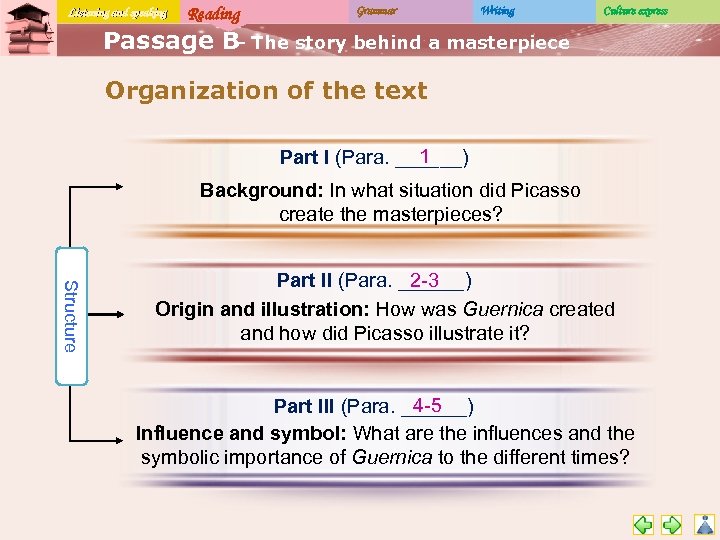 Listening and speaking Reading Grammar Writing Culture express Passage B The story behind a masterpiece – Organization of the text 1 Part I (Para. ______) Background: In what situation did Picasso create the masterpieces? Structure Part II (Para. ______) 2 -3 Origin and illustration: How was Guernica created and how did Picasso illustrate it? 4 -5 Part III (Para. ______) Influence and symbol: What are the influences and the symbolic importance of Guernica to the different times?
 Listening and speaking Reading Grammar Writing Culture express Passage B The story behind a masterpiece – every so often (Line 5, Para. 1) 有时;偶尔 他会时不时回头看她一眼。 Every so often he would turn and look at her. 同义 短语 :every now and then 虽然她已经毕业了,偶尔还是会给我打打电话。 Though she has graduated, she still phones me every so often.
 Listening and speaking Reading Grammar Writing Passage B The story behind a masterpiece – pass into (Line 6, Para. 1) 融入;逐渐变成 水沸腾时变成蒸汽。 When water boils, it passes into steam. Culture express
 Listening and speaking Reading Grammar Writing Culture express Passage B The story behind a masterpiece – The unwelcome visitor snooped around a bit and noticed there were postcards of Picasso’s most famous work lying around, which showed what happened when German bombs fell on a small Basque town in the Spanish Civil (Line 7, Para. 1) War. 这位不受欢迎的造访者四处窥探了一小会儿,发现周 围零乱地摆放着印有毕加索名画的明信片,明信片上 画的是西班牙内战时德国轰炸巴斯克一个小镇的情景。 unwelcome adj. (1) unwelcome guests, visitors, etc. are people that you do not want in your home 不受欢迎的 他们以前把她当做不受欢迎的人。 They had always regarded her as an unwelcome person.
 Listening and speaking Reading Grammar Writing Culture express Passage B The story behind a masterpiece – The unwelcome visitor snooped around a bit and noticed there were postcards of Picasso’s most famous work lying around, which showed what happened when German bombs fell on a small Basque town in the Spanish Civil (Line 7, Para. 1) War. 这位不受欢迎的造访者四处窥探了一小会儿,发现周 围零乱地摆放着印有毕加索名画的明信片,明信片上 画的是西班牙内战时德国轰炸巴斯克一个小镇的情景。 unwelcome adj. (2) not wanted, because it might cause embarrassment or problems 不希望要 的;讨厌的 她不得不接受一些有关她家庭的令人不快的事实。 She was forced to face up to a few unwelcome truths about her family.
 Listening and speaking Reading Grammar Writing Culture express Passage B The story behind a masterpiece – The unwelcome visitor snooped around a bit and noticed there were postcards of Picasso’s most famous work lying around, which showed what happened when German bombs fell on a small Basque town in the Spanish Civil (Line 7, Para. 1) War. 这位不受欢迎的造访者四处窥探了一小会儿,发现周 围零乱地摆放着印有毕加索名画的明信片,明信片上 画的是西班牙内战时德国轰炸巴斯克一个小镇的情景。 snoop v. to try to find out private information about sb. or sth. by secretly looking at his / her things 窥 探;窥视 别刺探我的事情! Don't snoop into my affairs!
 Listening and speaking Reading Grammar Writing Culture express Passage B The story behind a masterpiece – The unwelcome visitor snooped around a bit and noticed there were postcards of Picasso’s most famous work lying around, which showed what happened when German bombs fell on a small Basque town in the Spanish Civil (Line 7, Para. 1) War. 这位不受欢迎的造访者四处窥探了一小会儿,发现周 围零乱地摆放着印有毕加索名画的明信片,明信片上 画的是西班牙内战时德国轰炸巴斯克一个小镇的情景。 lying around 为现在分词短语作后置定语, 意味“凌乱 地摆放(在某处)” 如果你还是像那样乱放袜子,下次你肯定还找不着。 If you leave your socks lying around like that, you won’t find them next time.
 Listening and speaking Reading Grammar Writing Culture express Passage B The story behind a masterpiece – The unwelcome visitor snooped around a bit and noticed there were postcards of Picasso’s most famous work lying around, which showed what happened when German bombs fell on a small Basque town in the Spanish Civil (Line 7, Para. 1) War. 这位不受欢迎的造访者四处窥探了一小会儿,发现周 围零乱地摆放着印有毕加索名画的明信片,明信片上 画的是西班牙内战时德国轰炸巴斯克一个小镇的情景。 which 引 导 非 限 制 性 定 语 从 句 , 其 先 行 词 为 postcards of Picasso’s most famous work。 the Spanish Civil War: 西班牙内战。1936年至 1939 年,西班牙人民在共和国政府领导下反对国内法西 斯武装叛乱,抗击德、意武装干涉。在这场战争中, 人民阵线领导的共和国政府被颠覆。
 Listening and speaking Reading Grammar Writing Culture express Passage B The story behind a masterpiece – in the face of (Line 2, Para. 1) 面对问题 / 困难 / 危险 他们面对困难表现了坚强的毅力。 They showed great perseverance in the face of difficulty. 大敌当前我们必须加强团结. We must strengthen our unity in the face of powerful enemies.
 Listening and speaking Reading Grammar Writing Culture express Passage B The story behind a masterpiece – Shouldn’t art just stick to what it does best—the delivery of pleasure, and forget about being a paintbrush warrior? (Line 15, Para. 1) 难道艺术不应该坚持发挥其所长——传递快乐,而不 要成为一名画笔战士吗? stick to to do or keep doing what you said you would do or what you believe in, even when it is difficult 遵守;信守;坚持 坚持你的原则,就会胜利。 Stick to your principles, and you will win through.
 Listening and speaking Reading Grammar Writing Culture express Passage B The story behind a masterpiece – Shouldn’t art just stick to what it does best—the delivery of pleasure, and forget about being a paintbrush warrior? (Line 15, Para. 1) 难道艺术不应该坚持发挥其所长——传递快乐,而不 要成为一名画笔战士吗? what it does best 为宾语从句。 paintbrush warrior 本意为“画笔战士”,结合上下文, 可以理解为: Art can create some paintings which may serve as a warrior to fight against the war.
 Listening and speaking Reading Grammar Writing Culture express Passage B The story behind a masterpiece – Or is it, when the bombs are dropping, that we find out (Line 17, Para. 1) what art is really for? 抑或是,只有当炸弹从天而降时,我们才能搞清楚艺 术的真正目的是什么。 what=the thing that,在文中作 find out 的宾语从句。
 Listening and speaking Reading Grammar Writing Culture express Passage B The story behind a masterpiece – On April 26, 1937, a group of German aircraft, in support of the Spanish fascists, ruined the town of Guernica with 40 tons of bombs, killing more than 1, 600 people. (Line 1, Para. 2) 1937 年 4 月26 日,出于支持西班牙法西斯分子的目 的,德国的一批飞机用 40 吨炸弹将西班牙格尔尼卡镇 夷为平地,造成 1, 600 多人死亡。 in support of sb. / sth. : 支持某人或者某事 科学家必须提供证据以支持其理论。 A scientist must produce evidence in support of his theory. killing more than 1, 600 people 为现在分词短语作结 果状语。
 Listening and speaking Reading Grammar Writing Culture express Passage B The story behind a masterpiece – It was the first time that Europe had suffered such a ruthless, massive bombing. (Line 4, Para. 2) 这是欧洲第一次遭受这样无情的大规模轰炸。 It is / was the first time (that) sth. / sb. has / had done sth. : 某事物或者某人第一次做某事 这个句型表示截止到说话时为止主语的一种经历。主 句用一般现在时,从句要用现在完成时;主句用一般 过去时,从句要用过去完成时。 这是我第一次来上海。 It is the first time that I have been to Shanghai. 这是他第一次不参加会议。 It was the first time that he hadn’t attended the meeting.
 Listening and speaking Reading Grammar Writing Culture express Passage B The story behind a masterpiece – As soon as Picasso heard the news, he was inspired into a frenzy of energy and creativity and, in less than six weeks, he managed to cover an enormous canvas measuring about (Line 1, Para. 3) 30 square meters. 当毕加索听到格尔尼卡被炸的消息时,一股强烈的能 量和创造力被激发出来,在不到六周的时间里,他就 成功完成了一副约 30 平方米的巨幅油画。 inspire: v. to make sb. have a particular feeling or react in a particular way 使产生(某种感情或反 应);激起 是什么促使你改名的? What inspired you to change your name?
 Listening and speaking Reading Grammar Writing Culture express Passage B The story behind a masterpiece – As soon as Picasso heard the news, he was inspired into a frenzy of energy and creativity and, in less than six weeks, he managed to cover an enormous canvas measuring about (Line 1, Para. 3) 30 square meters. 当毕加索听到格尔尼卡被炸的消息时,一股强烈的能 量和创造力被激发出来,在不到六周的时间里,他就 成功完成了一副约 30 平方米的巨幅油画。 frenzy: n. (1) a period in which people do a lot of things very quickly 一阵忙碌 他们离婚的传言引起了媒体的强烈关注。 Rumors of their divorce stirred up a frenzy of media attention.
 Listening and speaking Reading Grammar Writing Culture express Passage B The story behind a masterpiece – As soon as Picasso heard the news, he was inspired into a frenzy of energy and creativity and, in less than six weeks, he managed to cover an enormous canvas measuring about (Line 1, Para. 3) 30 square meters. 当毕加索听到格尔尼卡被炸的消息时,一股强烈的能 量和创造力被激发出来,在不到六周的时间里,他就 成功完成了一副约 30 平方米的巨幅油画。 frenzy: n. (2) the state of being very anxious, excited, and unable to control your behavior 狂热;狂 乱;疯狂 这篇精心设计的演说煽动听众使他们发狂。 The cleverly designed speech lashed the audience into a frenzy.
 Listening and speaking Reading Grammar Writing Culture express Passage B The story behind a masterpiece – As soon as Picasso heard the news, he was inspired into a frenzy of energy and creativity and, in less than six weeks, he managed to cover an enormous canvas measuring about (Line 1, Para. 3) 30 square meters. 当毕加索听到格尔尼卡被炸的消息时,一股强烈的能 量和创造力被激发出来,在不到六周的时间里,他就 成功完成了一副约 30 平方米的巨幅油画。 measuring about 30 square meters 的用法为现在分词 短语作定语。 measure: v. to be a particular size, length, or amount( 某 物的)体积/长度/数额为······ 床的宽度超过了6英尺。 The bed measured over six feet in width.
 Listening and speaking Reading Grammar Writing Culture express Passage B The story behind a masterpiece – And the way that Picasso did this was by creating a massive jumble of injured and dismembered limbs, as if the bombs had just been dropped from the air and just gone off in front of us. (Line 7, Para. 3) 毕加索的方式就是创作了一大堆受伤和被肢解的肢体, 就像炸弹刚刚从天而降,在我们面前爆炸了一样。 jumble: n. a mixture of things that are in no particular order 杂乱的一堆 商业区里商店和饭馆杂乱拥挤。 The business district is a crowded jumble of shops and restaurants. in a jumble 杂乱地
 Listening and speaking Reading Grammar Writing Culture express Passage B The story behind a masterpiece – And the way that Picasso did this was by creating a massive jumble of injured and dismembered limbs, as if the bombs had just been dropped from the air and just gone off in front of us. (Line 7, Para. 3) 毕加索的方式就是创作了一大堆受伤和被肢解的肢体, 就像炸弹刚刚从天而降,在我们面前爆炸了一样。 injured 和 dismembered 的用法为过去分词作定语。 成品 finished product 有家具的房间 furnished room
 Listening and speaking Reading Grammar Writing Culture express Passage B The story behind a masterpiece – And the way that Picasso did this was by creating a massive jumble of injured and dismembered limbs, as if the bombs had just been dropped from the air and just gone off in front of us. (Line 7, Para. 3) 毕加索的方式就是创作了一大堆受伤和被肢解的肢体, 就像炸弹刚刚从天而降,在我们面前爆炸了一样。 as if 引导的状语从句中使用虚拟语气,表示对过去情 况的假设时,从句用过去完成时。 他看起来像是认识那位著名的作家好多年了。 He looked as if he had known that famous writer for years.
 Listening and speaking Reading Grammar Writing Culture express Passage B The story behind a masterpiece – And the way that Picasso did this was by creating a massive jumble of injured and dismembered limbs, as if the bombs had just been dropped from the air and just gone off in front of us. (Line 7, Para. 3) 毕加索的方式就是创作了一大堆受伤和被肢解的肢体, 就像炸弹刚刚从天而降,在我们面前爆炸了一样。 go off: (1) 爆炸 炸弹几分钟后爆炸,炸毁了那辆车。 A few minutes later the bomb went off, destroying the vehicle. go off: (2) 对······不再喜欢;失去对······的兴趣 我开始对这一想法失去兴趣了。 I started to go off the idea.
 Listening and speaking Reading Grammar Writing Culture express Passage B The story behind a masterpiece – The way that Picasso painted her face is most affecting, because it is almost like, in her deepest sorrow, her entire (Line 14, Para. 3) identity is dissolving before our eyes. 毕加索画她脸的方式非常感人,就仿佛在她最深处的 悲痛中,她整个人的特征在我们眼前消解了一样。 in her deepest sorrow 前置用于强调,正常的语序为 her entire identity is dissolving in her deepest sorrow before our eyes. dissolve v. (1) if a solid substance dissolves in a liquid, it is mixed into the liquid so that it becomes included in it 溶解 把盐放在温水里溶解。 Dissolve the salt in the warm water.
 Listening and speaking Reading Grammar Writing Culture express Passage B The story behind a masterpiece – The way that Picasso painted her face is most affecting, because it is almost like, in her deepest sorrow, her entire (Line 14, Para. 3) identity is dissolving before our eyes. 毕加索画她脸的方式非常感人,就仿佛在她最深处的 悲痛中,她整个人的特征在我们眼前消解了一样。 dissolve v. (2) to disappear or stop existing, or to make sth. do this, especially a feeling (使)消失; (使)破灭 四天之后,她想要找到本的希望破灭了。 After four days, her hopes of finding Ben began to dissolve.
 Listening and speaking Reading Grammar Writing Culture express Passage B The story behind a masterpiece – This soft, soft feel of her flesh leads up to that terrifying image of her mouth with that piercing tongue as if you could almost hear the sharp sound of a mother’s total, in-the-moment grief (Line 19, Para. 3) at the loss of her dear child. 那种软软的,软软的肉体的感觉使我们看到那可怕的 景象:她的嘴,还有尖尖的舌头,好像你几乎可以听 到母亲在失去心爱孩子那一刻所发出的尖利而悲伤的 声音。 lead up to sth. : if a series of events or a period of time leads up to an event, it comes before it or causes it 是 ······的先导;导致,引起,造成 他的马虎导致了他的离职。 His carelessness led up to his dismissal.
 Listening and speaking Reading Grammar Writing Culture express Passage B The story behind a masterpiece – This soft, soft feel of her flesh leads up to that terrifying image of her mouth with that piercing tongue as if you could almost hear the sharp sound of a mother’s total, in-the-moment grief (Line 19, Para. 3) at the loss of her dear child. 那种软软的,软软的肉体的感觉使我们看到那可怕的 景象:她的嘴,还有尖尖的舌头,好像你几乎可以听 到母亲在失去心爱孩子那一刻所发出的尖利而悲伤的 声音。 in-the-moment 为合成形容词,意为“当下的,即时即 刻的” at the loss of 失去······
 Listening and speaking Reading Grammar Writing Culture express Passage B The story behind a masterpiece – But Guernica ’s timing was critical to its later success. (Line 3, Para. 4) 但是《格尔尼卡》的展出时机对其后来的成功至关重 要。 timing the time when sb. does sth. or when sth. happens, especially when you are considering how suitable this is( 某人做某事或某事发生 的)时间 不管是计划好的还是巧合,他对时机的把握堪称完美。 Whether by design or accident his timing was perfect.
 Listening and speaking Reading Grammar Writing Culture express Passage B The story behind a masterpiece – But Guernica ’s timing was critical to its later success. (Line 3, Para. 4) 但是《格尔尼卡》的展出时机对其后来的成功至关重 要。 be critical to sth. be crucial / important to sth. 对某事 物是关键性的 这些会谈对和平发展的未来至关重要。 These talks are critical to the future of the peace process.
 Listening and speaking Reading Grammar Writing Culture express Passage B The story behind a masterpiece – As the world stood unsteadily on the edge of the Second World War, the painting was sent on a global tour in support of the fight against fascism in Spain. (Line 4, Para. 4) 当世界在第二次世界大战的边缘摇摇欲坠时,这幅 画被送往全球巡回展出,支持西班牙反法西斯斗争。 on the edge of sth. : 某事(尤指坏事)快要发生 他们的经济处于崩溃的边缘。 Their economy is on the edge of collapse. on a global tour: 全球巡回(展览、演出等)
 Listening and speaking Reading Grammar Writing Culture express Passage B The story behind a masterpiece – descend (Line 8, Para. 4) v. to move from a higher level to a lower one 下落;下降 一直往下走,最终你会突然看到那条隐秘的瀑布。 As you descend, suddenly you see at last the hidden waterfall. descend into: 向下行 这个农民是第一个下到这个深达六十英尺的井里的人。 The farmer was the first to descend into the 60 -foot well.
 Listening and speaking Reading Grammar Writing Culture express Passage B The story behind a masterpiece – Whenever there’s an anti-war protest, you’re likely to see images of Guernica among the banners and signs. (Line 2, Para. 5) 每当有反战抗议示威时,你就会看到横幅和标牌中《 格尔尼卡》的形象。 whenever 引导时间状语从句,意为“每当”。 每当我听到这支曲子,我就会想起你。 Whenever I hear that tune, I think of you.
 Listening and speaking Reading Grammar Writing Culture express Passage B The story behind a masterpiece – Whenever there’s an anti-war protest, you’re likely to see images of Guernica among the banners and signs. (Line 2, Para. 5) 每当有反战抗议示威时,你就会看到横幅和标牌中《 格尔尼卡》的形象。 anti-war protest: 反战抗议 anti- 为前缀,意为“ opposed to”。 要是你不去,他们就会认为你不合群。 They'll think you're being antisocial if you don't go.
 Listening and speaking Reading Grammar Writing Passage B Exercises – l Comprehension l Vocabulary & structure l Translation l Oral work Culture express
 Listening and speaking Reading Grammar Writing Culture express Passage B Comprehension – 1. Decide whether the following statements are true (T) or false (F). F 1 The whole Europe was under the control of the Third Reich in 1941. F 2 Picasso’s house was often visited by the Gestapo. F 3 Picasso created Guernica in less than a month. T 4 Picasso was commemorating a whole century of suffering by creating Guernica. T 5 Guernica went on a global tour in support of the fight against fascism in Spain.
 Listening and speaking Reading Grammar Writing Culture express Passage B Comprehension – 2. Work in groups to discuss the following questions. 1. Do you think art should stick to what it does best, i. e. , the delivery of pleasure, instead of being a paintbrush warrior? No. I think art should not only deliver pleasure but also the sad side of life. Art’s function is to let people enjoy the beauty, know the real side of life, and reflect on it.
 Listening and speaking Reading Grammar Writing Culture express Passage B Comprehension – 2. What role do you think Guernica plays in times of war? Guernica is a powerful symbol in support of the fight against war. Through showing the massacre and horror caused by war, it inspires people’s pursuit of peace and encouraged them to fight for it in times of war.
 Listening and speaking Reading Grammar Writing Culture express Passage B Vocabulary and structure – 1. Replace the underlined words in the following sentences with the words given below with similar meaning. Change the form if necessary. disappear damage complete fear poor 1. The little kitten looked so pitiful out in the rain. _____ disappeared 2. His newly found confidence dissolved. _____ damage 3. The building must be saved from destruction. _______ 4. He was in entire ignorance of what was being done. complete _____ 5. She ran away in horror from the snake. _____ fear
 Listening and speaking Reading Grammar Writing Culture express Passage B Vocabulary and structure – 2. Complete the following sentences with the words given below. unwelcome frenzy horror terrifying critical enormous 1. Due to the help of his classmates, Tom has made _____ progress in his math this term. enormous unwelcome 2. His arrogance made him _____ in our home. 3. At the sight of blood, that girl drew back in _______. horror terrifying 4. This was, by far, the most ____ event in my life. 5. These talks are _____to the future of the critical peace process. frenzy 6. The house was in a(n) ____ of activity as we got ready for the party.
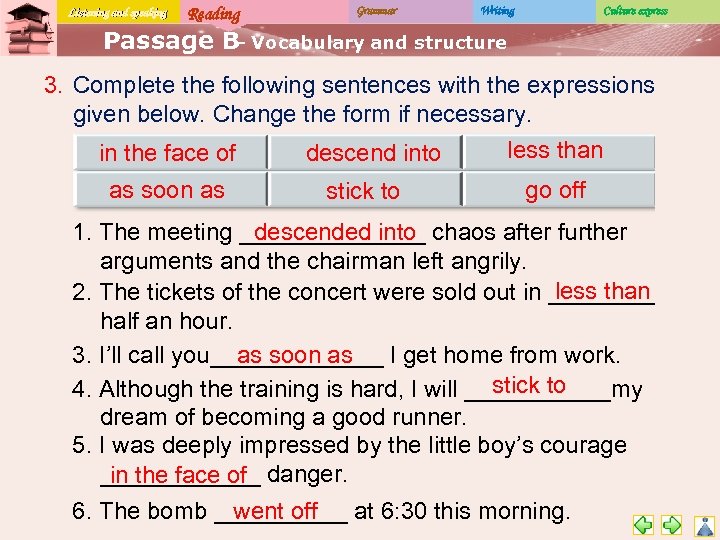 Listening and speaking Reading Grammar Writing Culture express Passage B Vocabulary and structure – 3. Complete the following sentences with the expressions given below. Change the form if necessary. in the face of as soon as descend into stick to less than go off 1. The meeting _______ chaos after further descended into arguments and the chairman left angrily. less than 2. The tickets of the concert were sold out in ____ half an hour. 3. I’ll call you_______ I get home from work. as soon as stick to 4. Although the training is hard, I will ______my dream of becoming a good runner. 5. I was deeply impressed by the little boy’s courage ______ danger. in the face of 6. The bomb _____ at 6: 30 this morning. went off
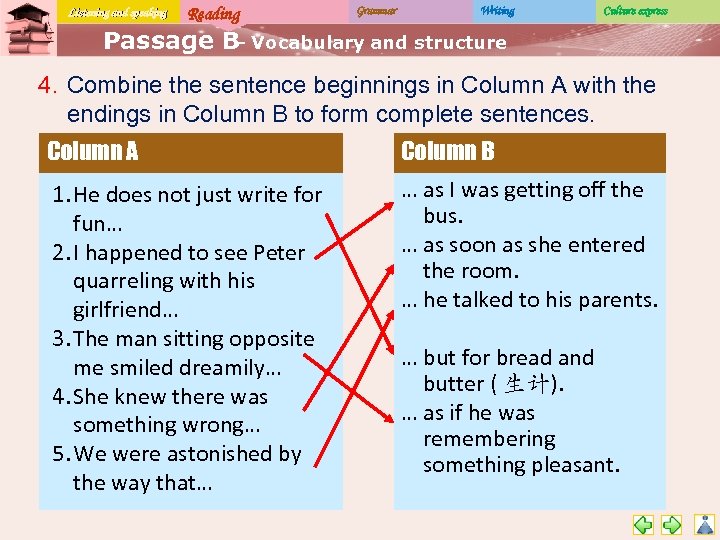 Listening and speaking Reading Grammar Writing Culture express Passage B Vocabulary and structure – 4. Combine the sentence beginnings in Column A with the endings in Column B to form complete sentences. Column A Column B 1. He does not just write for fun… 2. I happened to see Peter quarreling with his girlfriend… 3. The man sitting opposite me smiled dreamily… 4. She knew there was something wrong… 5. We were astonished by the way that… … as I was getting off the bus. … as soon as she entered the room. … he talked to his parents. … but for bread and butter ( 生计). … as if he was remembering something pleasant.
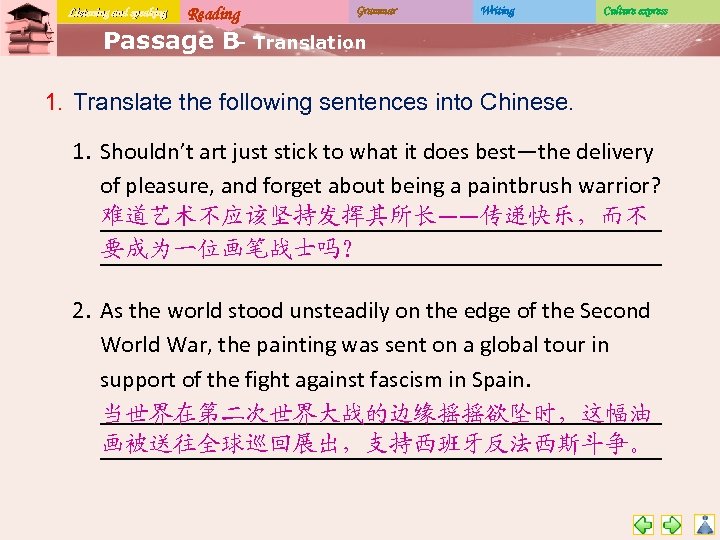 Listening and speaking Reading Grammar Writing Culture express Passage B Translation – 1. Translate the following sentences into Chinese. 1. Shouldn’t art just stick to what it does best—the delivery of pleasure, and forget about being a paintbrush warrior? 难道艺术不应该坚持发挥其所长——传递快乐,而不 ________________________ 要成为一位画笔战士吗? ________________________ 2. As the world stood unsteadily on the edge of the Second World War, the painting was sent on a global tour in support of the fight against fascism in Spain. ________________________ 当世界在第二次世界大战的边缘摇摇欲坠时,这幅油 画被送往全球巡回展出,支持西班牙反法西斯斗争。 ________________________
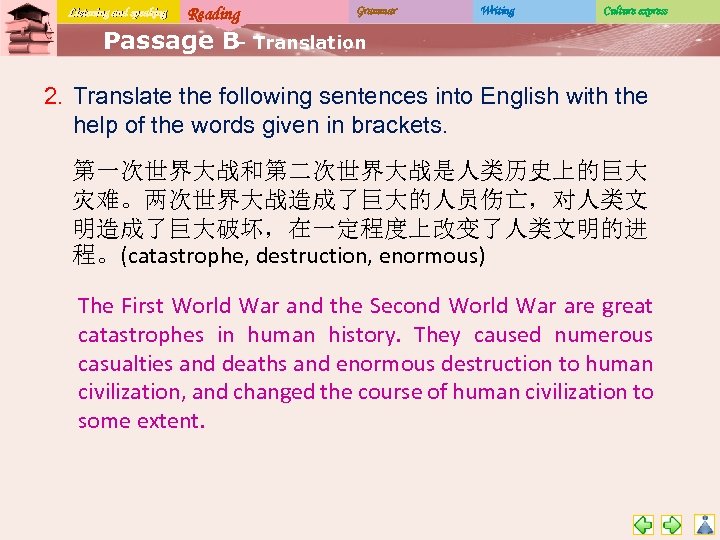 Listening and speaking Reading Grammar Writing Culture express Passage B Translation – 2. Translate the following sentences into English with the help of the words given in brackets. 第一次世界大战和第二次世界大战是人类历史上的巨大 灾难。两次世界大战造成了巨大的人员伤亡,对人类文 明造成了巨大破坏,在一定程度上改变了人类文明的进 程。(catastrophe, destruction, enormous) The First World War and the Second World War are great catastrophes in human history. They caused numerous casualties and deaths and enormous destruction to human civilization, and changed the course of human civilization to some extent.
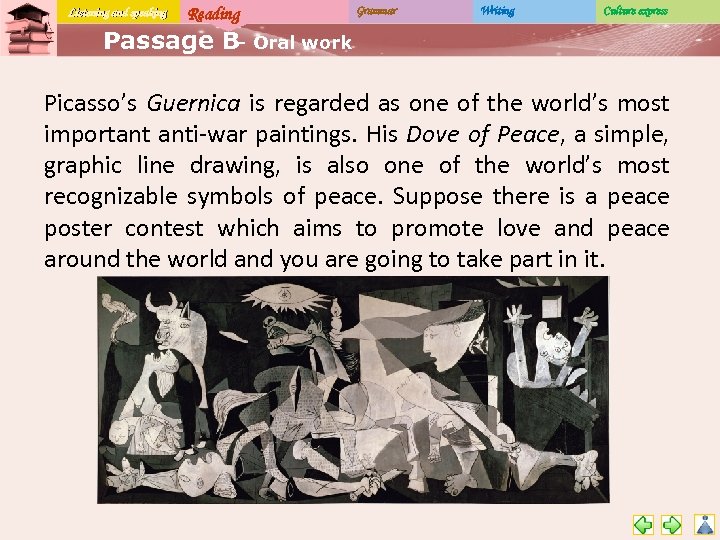 Listening and speaking Reading Grammar Writing Culture express Passage B Oral work – Picasso’s Guernica is regarded as one of the world’s most important anti-war paintings. His Dove of Peace, a simple, graphic line drawing, is also one of the world’s most recognizable symbols of peace. Suppose there is a peace poster contest which aims to promote love and peace around the world and you are going to take part in it.
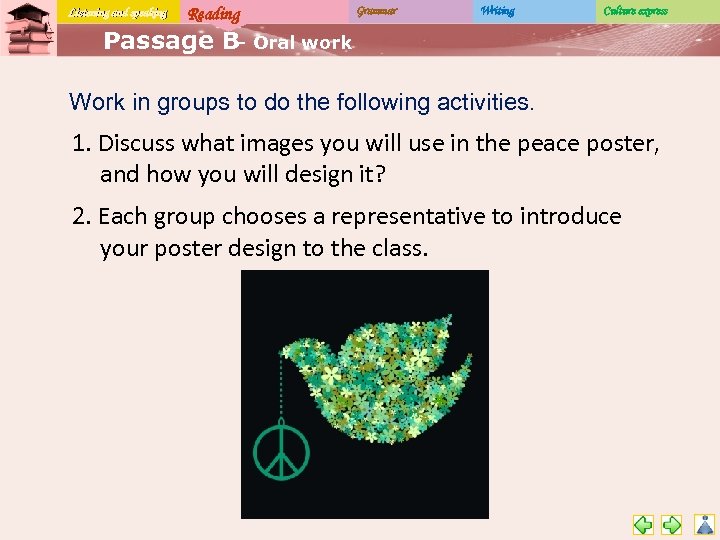 Listening and speaking Reading Grammar Writing Culture express Passage B Oral work – Work in groups to do the following activities. 1. Discuss what images you will use in the peace poster, and how you will design it? 2. Each group chooses a representative to introduce your poster design to the class.
 Listening and speaking Reading Grammar Writing Culture express Passage B Oral work – Work in groups to do the following activities. 1. Discuss what images you will use in the peace poster, and how you will design it? The images that we use in our poster are a boy, a girl and a dove. The children are raising their hands to let go of the dove. Dove is regarded as a symbol of peace all over the world. The children represent purity, innocence and the future of the world. This design shows that only when we live in a peaceful world, can our life be safer and more enjoyable.
 Listening and speaking Reading Grammar l Attributive clauses ( 定语从句) l Exercises Writing Culture express
 Listening and speaking Reading Grammar Writing l 以关系代词引导的定语从句 l 以关系副词引导的定语从句 l 限制性定语从句和非限制性 定语从句 Culture express
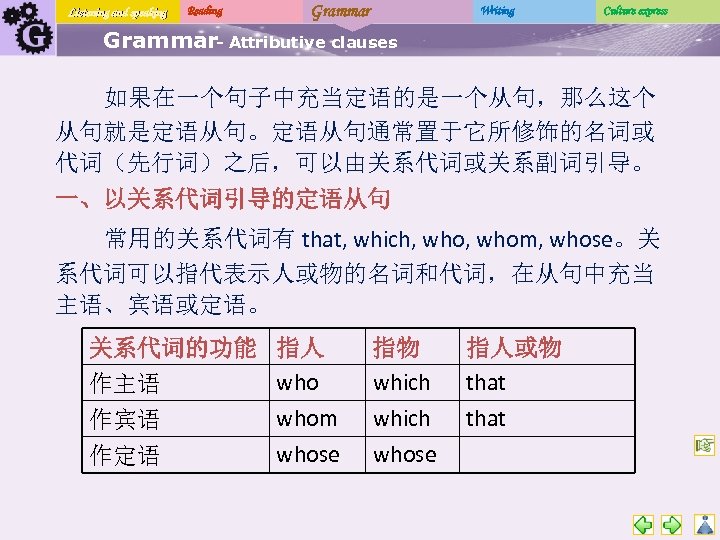 Listening and speaking Reading Grammar Writing Culture express Grammar- Attributive clauses 如果在一个句子中充当定语的是一个从句,那么这个 从句就是定语从句。定语从句通常置于它所修饰的名词或 代词(先行词)之后,可以由关系代词或关系副词引导。 一、以关系代词引导的定语从句 常用的关系代词有 that, which, whom, whose。关 系代词可以指代表示人或物的名词和代词,在从句中充当 主语、宾语或定语。 关系代词的功能 作主语 作宾语 作定语 指人 whom whose 指物 which whose 指人或物 that
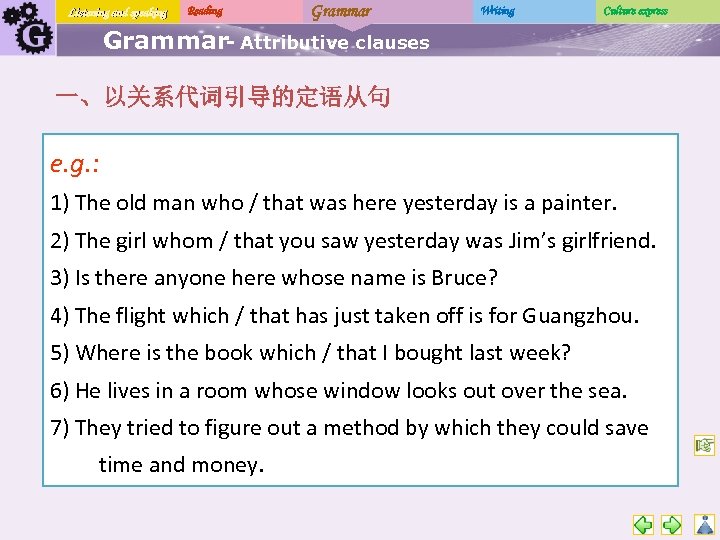 Listening and speaking Reading Grammar Writing Culture express Grammar- Attributive clauses 一、以关系代词引导的定语从句 e. g. : 1) The old man who / that was here yesterday is a painter. 2) The girl whom / that you saw yesterday was Jim’s girlfriend. 3) Is there anyone here whose name is Bruce? 4) The flight which / that has just taken off is for Guangzhou. 5) Where is the book which / that I bought last week? 6) He lives in a room whose window looks out over the sea. 7) They tried to figure out a method by which they could save time and money.
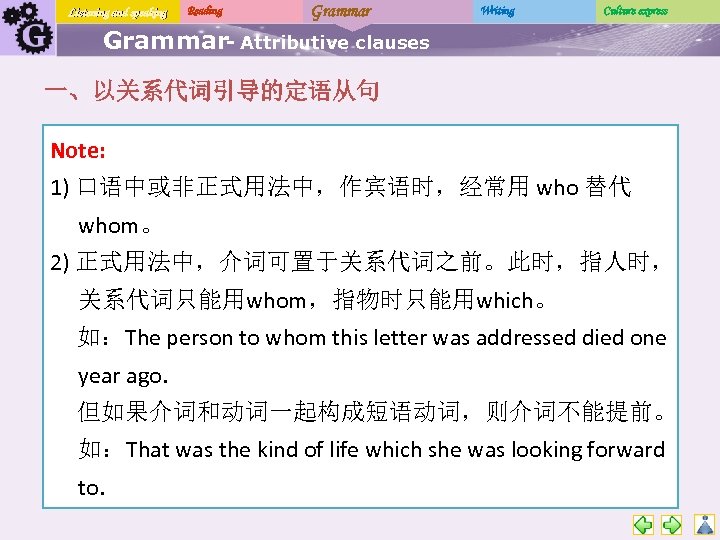 Listening and speaking Reading Grammar Writing Culture express Grammar- Attributive clauses 一、以关系代词引导的定语从句 Note: 1) 口语中或非正式用法中,作宾语时,经常用 who 替代 whom。 2) 正式用法中,介词可置于关系代词之前。此时,指人时, 关系代词只能用whom,指物时只能用which。 如:The person to whom this letter was addressed died one year ago. 但如果介词和动词一起构成短语动词,则介词不能提前。 如:That was the kind of life which she was looking forward to.
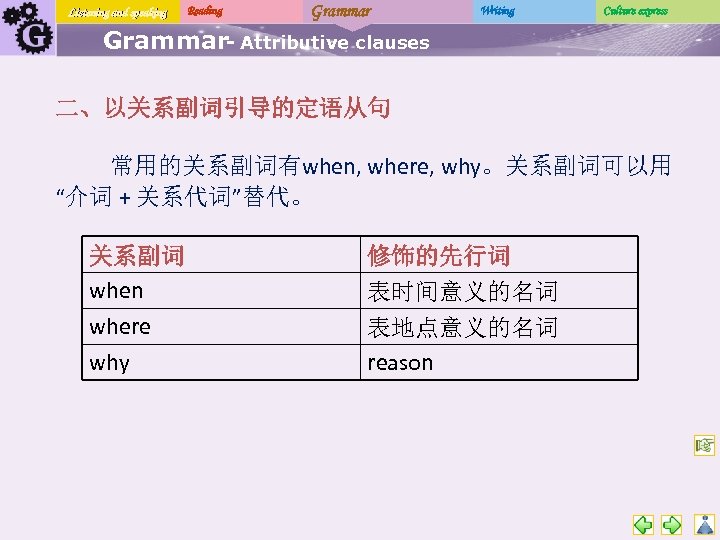 Listening and speaking Reading Grammar Writing Culture express Grammar- Attributive clauses 二、以关系副词引导的定语从句 常用的关系副词有when, where, why。关系副词可以用 “介词 + 关系代词”替代。 关系副词 when where why 修饰的先行词 表时间意义的名词 表地点意义的名词 reason
 Listening and speaking Reading Grammar Writing Culture express Grammar- Attributive clauses 二、以关系副词引导的定语从句 e. g. 1) I’ll never forget the day when (= on which ) I came to this university. 2) I happen to know a lake where (= in which) we can swim. 3) The reason why (= for which) Johnson left school was not clear.
 Listening and speaking Reading Grammar Writing Culture express Grammar- Attributive clauses 三、限制性定语从句和非限制性定语从句与先行词的关系非常密切,如果去掉 从句,主句的意思就会不完整或发生变化。限制性定语从 句和主句之间没有逗号。 e. g. : 1) I came back for the passport that I had forgotten. 2) This is the store where I lost my wallet.
 Listening and speaking Reading Grammar Writing Culture express Grammar- Attributive clauses 三、限制性定语从句和非限制性定语从句与先行词的关系比较松散,对先行词 起补充说明的作用,有时对主句作进一步说明,如果去掉, 对主句意义没有太大的影响。非限制性定语从句与主句之 间用逗号分隔。非限制性定语从句不能用that引导。 e. g. : 1) Mr. Smith, for whom I worked, was generous with overtime payment. 2) Lee always helps us, which is very kind of him.
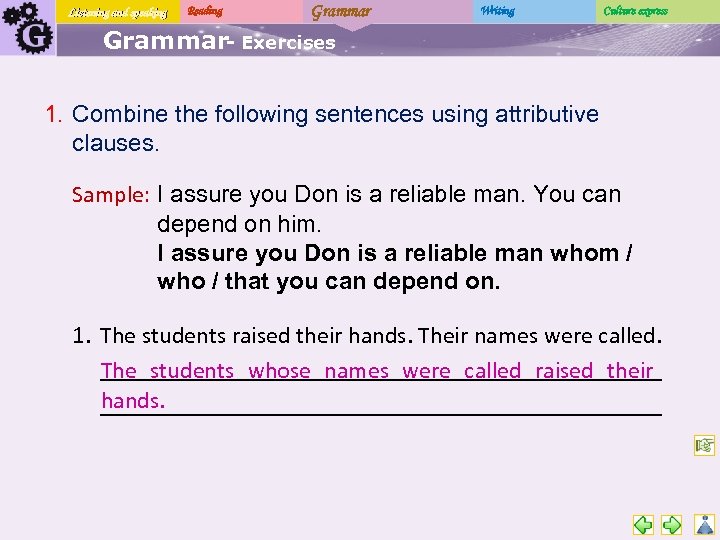 Listening and speaking Reading Grammar Writing Culture express Grammar- Exercises 1. Combine the following sentences using attributive clauses. Sample: I assure you Don is a reliable man. You can depend on him. I assure you Don is a reliable man whom / who / that you can depend on. 1. The students raised their hands. Their names were called. ________________________ The students whose names were called raised their hands. ________________________
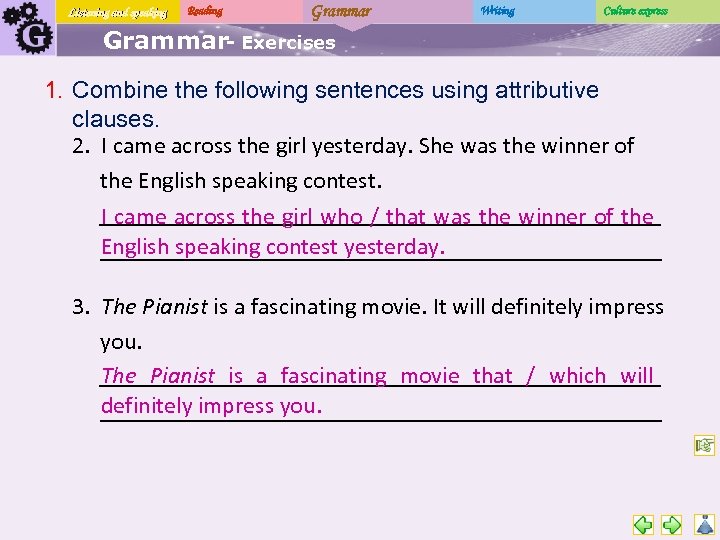 Listening and speaking Reading Grammar Writing Culture express Grammar- Exercises 1. Combine the following sentences using attributive clauses. 2. I came across the girl yesterday. She was the winner of the English speaking contest. ________________________ I came across the girl who / that was the winner of the English speaking contest yesterday. ________________________ 3. The Pianist is a fascinating movie. It will definitely impress you. The Pianist is a fascinating movie that / which will ________________________ definitely impress you. ________________________
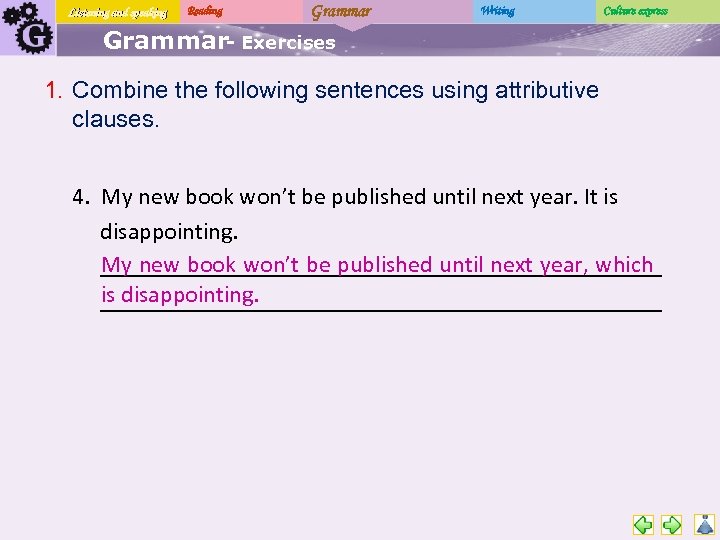 Listening and speaking Reading Grammar Writing Culture express Grammar- Exercises 1. Combine the following sentences using attributive clauses. 4. My new book won’t be published until next year. It is disappointing. My new book won’t be published until next year, which ________________________ is disappointing. ________________________
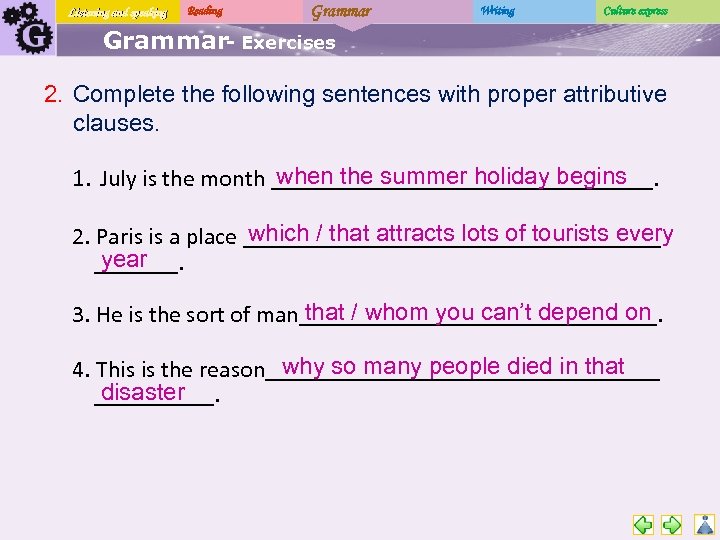 Listening and speaking Reading Grammar Writing Culture express Grammar- Exercises 2. Complete the following sentences with proper attributive clauses. when the summer holiday begins 1. July is the month ________________. which / that attracts lots of tourists every 2. Paris is a place __________________ year _______. that / whom you can’t depend on 3. He is the sort of man_______________. why so many people died in that 4. This is the reason_________________ disaster _____.
 Listening and speaking Reading Writing Grammar Writing l Letters of invitation(邀请信) l Exercises Culture express
 Listening and speaking Reading Grammar Writing Culture express Writing Letters of invitation - Notes 邀请信是社会交往和外事活动中常用的一种邀约性书信。 邀请 信一般分为 两种:一种是事务 性信函,如邀请 某人 参加会议、典礼等较为正式的场合;另一种是个人信函, 如邀请 某人参加晚会、生日聚会等活动 。邀请 信的语 言 应简单 、明了,语 气应 真诚 、热 情。 邀请 信的主要内容一般包括: 1 说 明邀请 的原因和场 合; 2 说明邀请参加的具体活动及细节安排和注意事项,如: 时间 、地点、人员 、着装要求等; 3 表明对 被邀请 人参加活动 的期盼,并请 对 方确认 能否 接 受邀请 。要求对 方作出答复时 ,通常写R. S. V. P. (意为 “请赐 复”)。
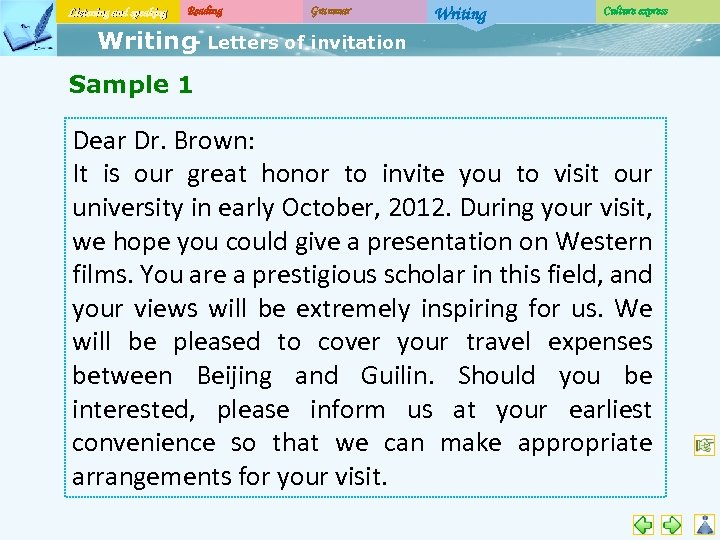 Listening and speaking Reading Grammar Writing Culture express Writing Letters of invitation Sample 1 Dear Dr. Brown: It is our great honor to invite you to visit our university in early October, 2012. During your visit, we hope you could give a presentation on Western films. You are a prestigious scholar in this field, and your views will be extremely inspiring for us. We will be pleased to cover your travel expenses between Beijing and Guilin. Should you be interested, please inform us at your earliest convenience so that we can make appropriate arrangements for your visit.
 Listening and speaking Reading Grammar Writing Culture express Writing Letters of invitation Sample 1 We look forward to your coming with great pleasure. Please feel free to contact us for any questions or concerns that you might have. Yours sincerely, XXX Dean of the College of Arts Guilin University of Technology
 Listening and speaking Reading Grammar Writing Culture express Writing Letters of invitation 评析 开篇首先表明了邀请对方的意图以及具 体时间。然后赞美了被邀请者的学术水平, 表达了对被邀请人的期盼之情。在信尾表达 了希望被邀请人接受邀请的诚意。语言正式、 简明而真诚。
 Listening and speaking Reading Grammar Writing Culture express Writing Letters of invitation Sample 2 Dear Prof. Gates: It’s our great pleasure to invite you to attend the 6 th anniversary of our E-times English Club at Zhongnan Concert Hall. Would it be possible for you to join us on Saturday, October 15, at 6 p. m. ? We would be very happy if you could be with us. R. S. V. P. E-times English Club
 Listening and speaking Reading Grammar Writing Culture express Writing Letters of invitation - 评析 开篇表明了邀请的目的,即参加E时代英 语俱乐部的六周年庆祝晚会,以及晚会的具 体时间和地点。第二段表达了希望被邀请人 能够参加的愿望。措辞诚恳。
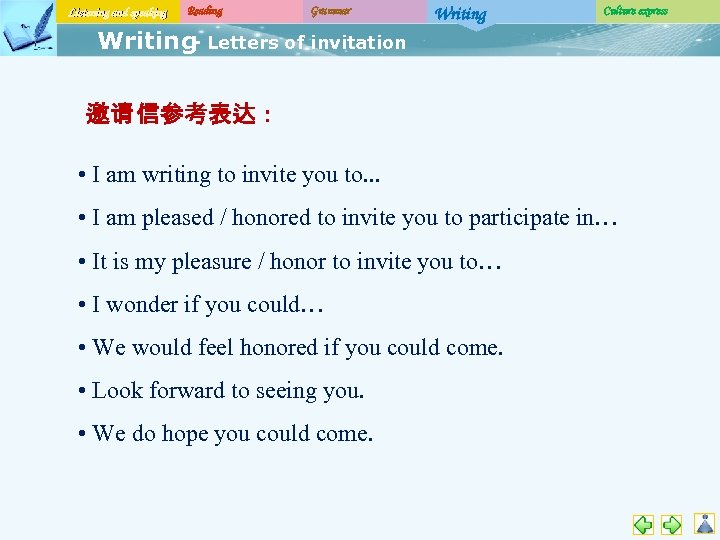 Listening and speaking Reading Grammar Writing Culture express Writing Letters of invitation 邀请 信参考表达: • I am writing to invite you to. . . • I am pleased / honored to invite you to participate in… • It is my pleasure / honor to invite you to… • I wonder if you could… • We would feel honored if you could come. • Look forward to seeing you. • We do hope you could come.
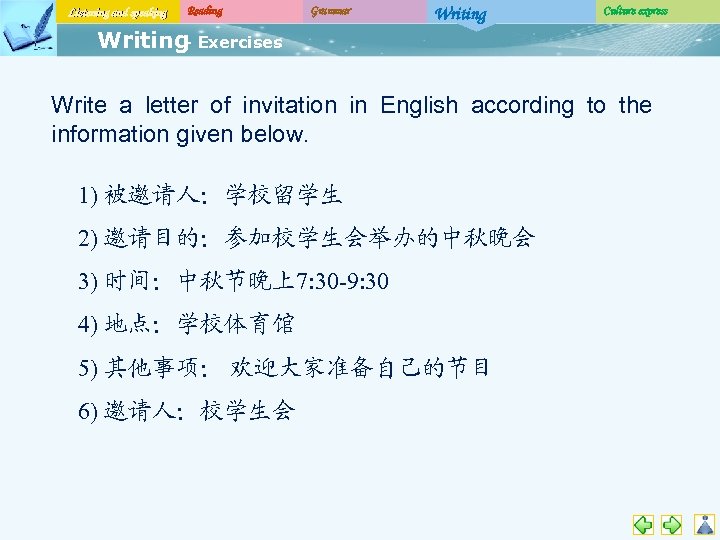 Listening and speaking Reading Grammar Writing Culture express Writing Exercises - Write a letter of invitation in English according to the information given below. 1) 被邀请人:学校留学生 2) 邀请目的:参加校学生会举办的中秋晚会 3) 时间:中秋节晚上7: 30 -9: 30 4) 地点:学校体育馆 5) 其他事项: 欢迎大家准备自己的节目 6) 邀请人:校学生会
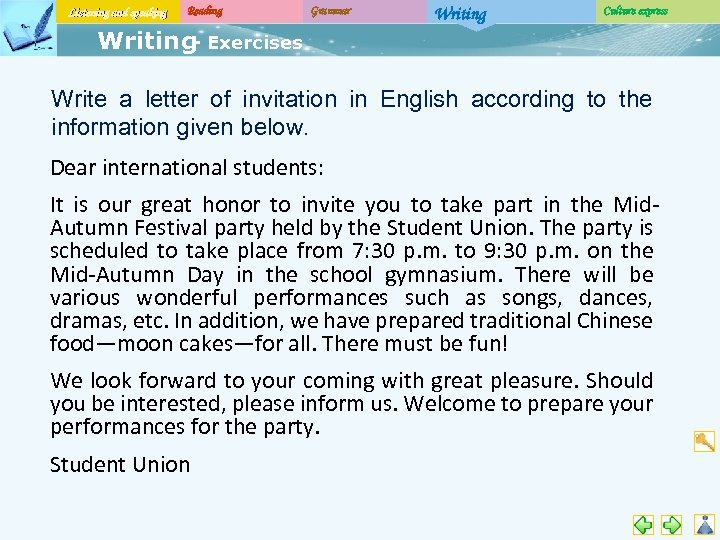 Listening and speaking Reading Grammar Writing Culture express Writing Exercises Write a letter of invitation in English according to the information given below. Dear international students: It is our great honor to invite you to take part in the Mid. Autumn Festival party held by the Student Union. The party is scheduled to take place from 7: 30 p. m. to 9: 30 p. m. on the Mid-Autumn Day in the school gymnasium. There will be various wonderful performances such as songs, dances, dramas, etc. In addition, we have prepared traditional Chinese food—moon cakes—for all. There must be fun! We look forward to your coming with great pleasure. Should you be interested, please inform us. Welcome to prepare your performances for the party. Student Union
 Listening and speaking Reading Grammar Culture express Writing Culture express l Schools of modern art l Questions
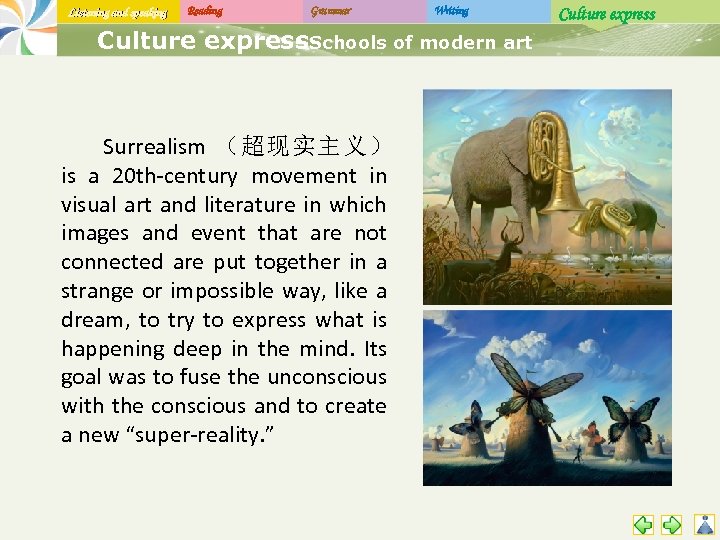 Listening and speaking Reading Grammar Writing Culture express. Schools of modern art - Surrealism (超现实主义) is a 20 th-century movement in visual art and literature in which images and event that are not connected are put together in a strange or impossible way, like a dream, to try to express what is happening deep in the mind. Its goal was to fuse the unconscious with the conscious and to create a new “super-reality. ” Culture express
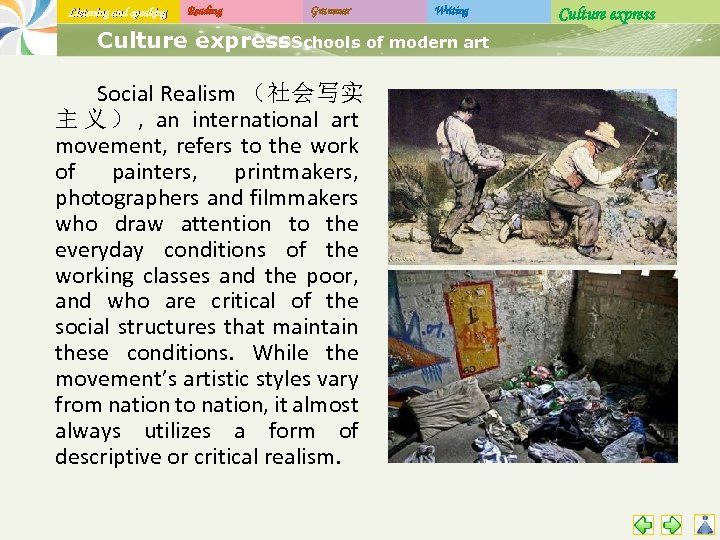 Listening and speaking Reading Grammar Writing Culture express. Schools of modern art - Social Realism (社会写实 主 义 ) , an international art movement, refers to the work of painters, printmakers, photographers and filmmakers who draw attention to the everyday conditions of the working classes and the poor, and who are critical of the social structures that maintain these conditions. While the movement’s artistic styles vary from nation to nation, it almost always utilizes a form of descriptive or critical realism. Culture express
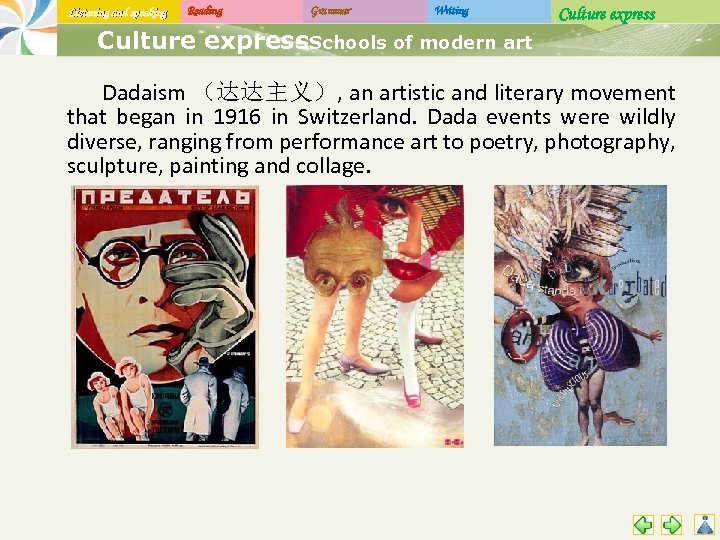 Listening and speaking Reading Grammar Writing Culture express. Schools of modern art Dadaism (达达主义), an artistic and literary movement that began in 1916 in Switzerland. Dada events were wildly diverse, ranging from performance art to poetry, photography, sculpture, painting and collage.
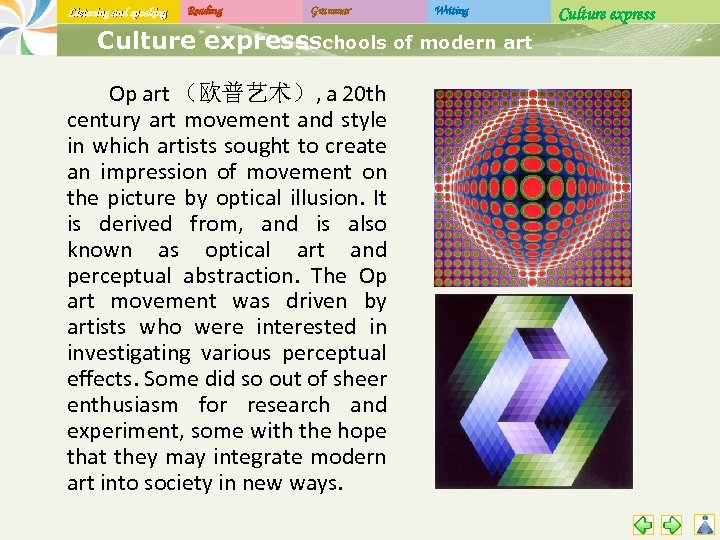 Listening and speaking Reading Grammar Writing Culture express. Schools of modern art Op art (欧普艺术), a 20 th century art movement and style in which artists sought to create an impression of movement on the picture by optical illusion. It is derived from, and is also known as optical art and perceptual abstraction. The Op art movement was driven by artists who were interested in investigating various perceptual effects. Some did so out of sheer enthusiasm for research and experiment, some with the hope that they may integrate modern art into society in new ways. Culture express
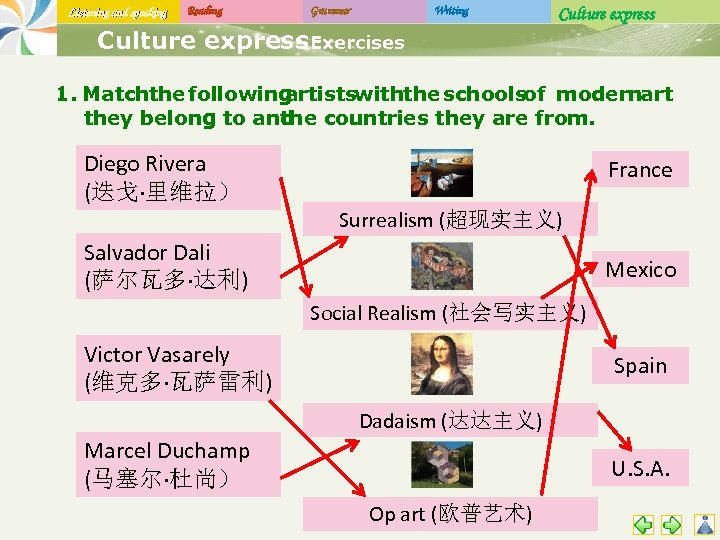 Listening and speaking Reading Grammar Writing Culture express. Exercises 1. Matchthe following artistswiththe schoolsof modernart they belong to and countries they are from. the Diego Rivera (迭戈·里维拉) France Surrealism (超现实主义) Salvador Dali (萨尔瓦多·达利) Mexico Social Realism (社会写实主义) Victor Vasarely (维克多·瓦萨雷利) Spain Dadaism (达达主义) Marcel Duchamp (马塞尔·杜尚) U. S. A. Op art (欧普艺术)
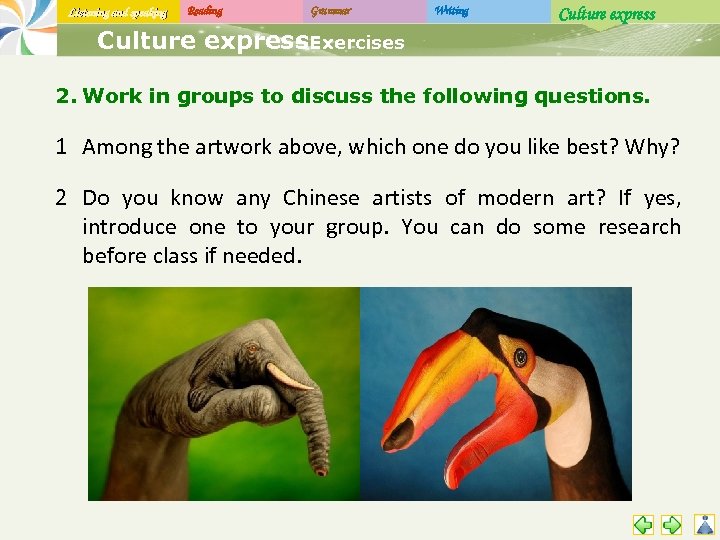 Listening and speaking Reading Grammar Writing Culture express. Exercises 2. Work in groups to discuss the following questions. 1 Among the artwork above, which one do you like best? Why? 2 Do you know any Chinese artists of modern art? If yes, introduce one to your group. You can do some research before class if needed.
 Listening and speaking Reading Grammar Writing Culture express. Exercises 2. Work in groups to discuss the following questions. 1 Among the artwork above, which one do you like best? Why? Among the artwork above, I like Victor Vasarely’s best. This painting employs a method concerning the interactions between illusion and picture plane (画面), and between understanding and seeing. Although it doesn’t show the sharp contrast between black and white, its use of optical illusions is impressive. When the viewer looks at them, he may have a strong impression on the movement, hidden images, flashing, or patterns. Like the geometric art from which it had sprung, this artwork was highly appropriate to modern society. In my opinion, it is a fresh way to illustrate the complexity of the world.
 Listening and speaking Reading Grammar Writing Culture express. Exercises Work in groups to discuss the following questions. 2 Do you know any Chinese artists of modern art? If yes, introduce one to your group. You can do some research before class if needed. • I really admire Cai Guoqiang very much. Cai Guoqiang was born in 1957 in Quanzhou, Fujian Province, China. Cai’s pratice draws on a wide variety of symbols, narratives, traditions and methods such as drawing, video and performance. He also gained widespread attention as the Director of Visual and Special Effects for the opening and closing ceremonies of the 2008 Summer Olympics in Beijing. • He won Golden Lion at the 48 th Venice Biennale (威尼斯 双年展). In 2012, he was awarded the Praemium Imperiale (日 本 皇 室 世 界 文 化 奖 ) in Tokyo as the first Chinese national laureate.