 Скачать презентацию Listen to the noise Bridge dynamics and topology
08481088e8d772d72e48e468c6e56588.ppt
- Количество слайдов: 20



Listen to the noise: Bridge dynamics and topology of complex networks Singapore Jie Ren (任 捷) NUS Graduate School for Integrative Sciences & Engineering National University of Singapore
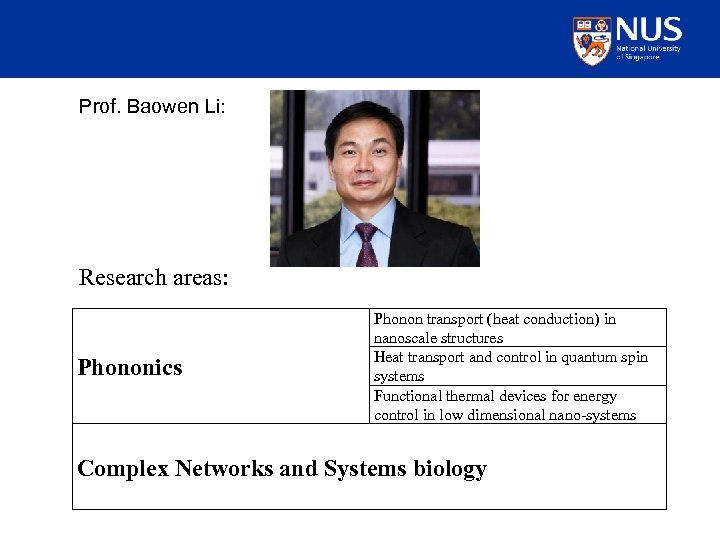
Prof. Baowen Li: Research areas: Phononics Phonon transport (heat conduction) in nanoscale structures Heat transport and control in quantum spin systems Functional thermal devices for energy control in low dimensional nano-systems Complex Networks and Systems biology

Group Photo
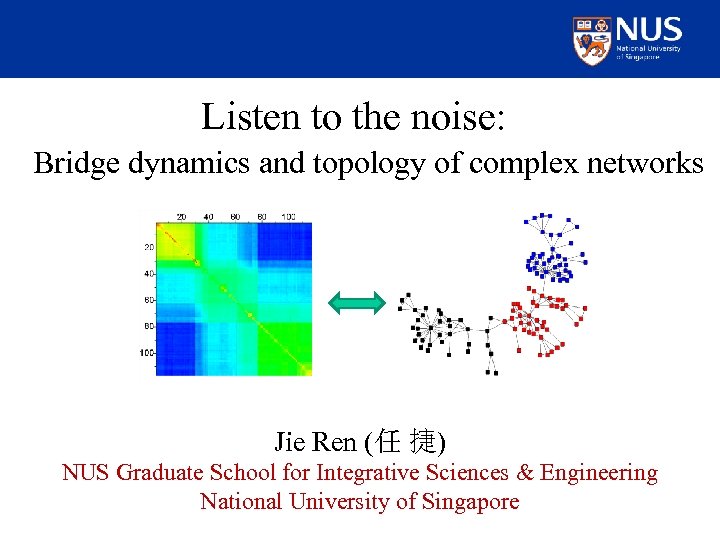
Listen to the noise: Bridge dynamics and topology of complex networks Jie Ren (任 捷) NUS Graduate School for Integrative Sciences & Engineering National University of Singapore
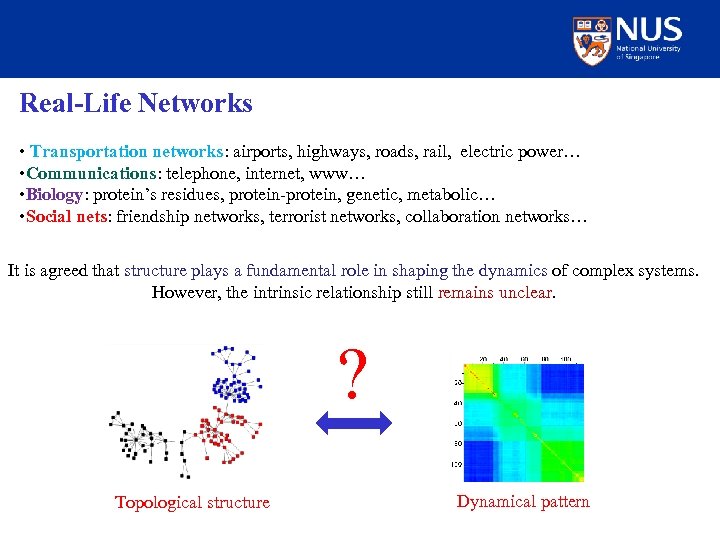
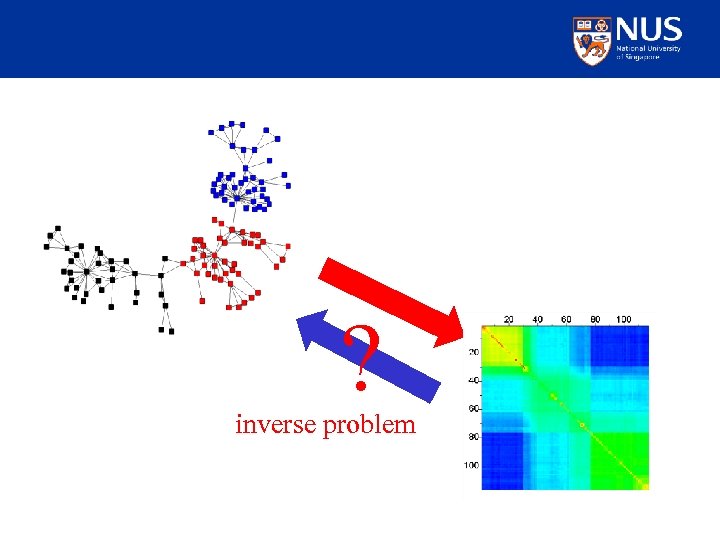
Real-Life Networks • Transportation networks: airports, highways, roads, rail, electric power… • Communications: telephone, internet, www… • Biology: protein’s residues, protein-protein, genetic, metabolic… • Social nets: friendship networks, terrorist networks, collaboration networks… It is agreed that structure plays a fundamental role in shaping the dynamics of complex systems. However, the intrinsic relationship still remains unclear. ? Topological structure Dynamical pattern
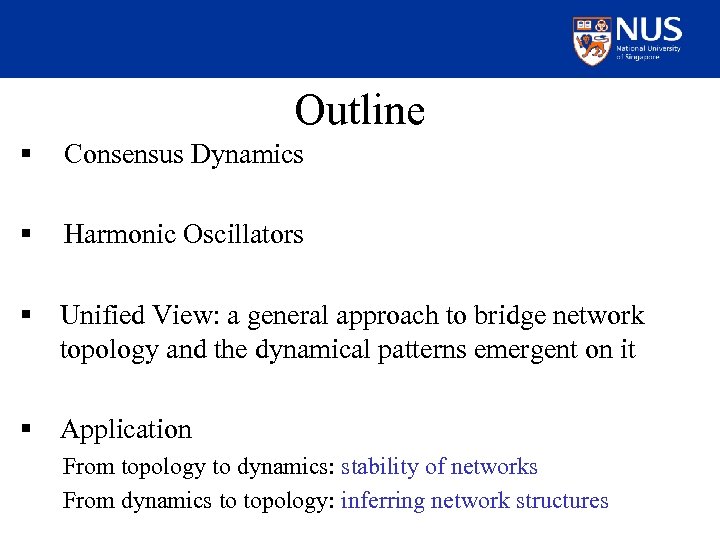
Outline § Consensus Dynamics § Harmonic Oscillators § Unified View: a general approach to bridge network topology and the dynamical patterns emergent on it § Application From topology to dynamics: stability of networks From dynamics to topology: inferring network structures
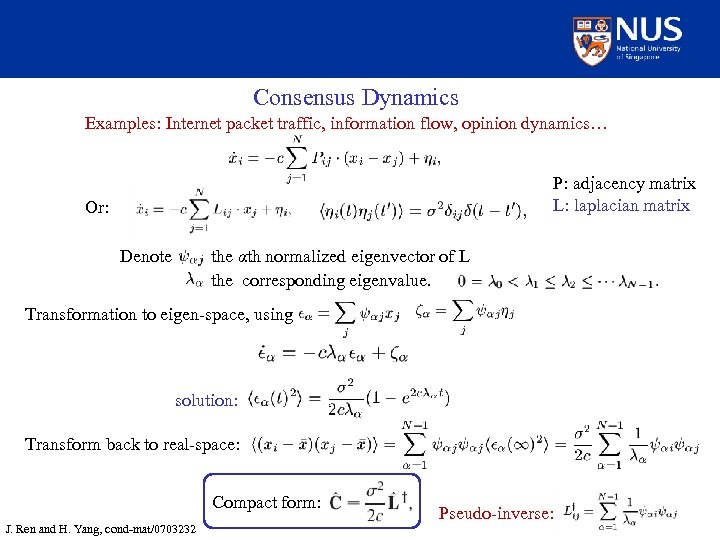
Consensus Dynamics Examples: Internet packet traffic, information flow, opinion dynamics… P: adjacency matrix L: laplacian matrix Or: Denote the αth normalized eigenvector of L the corresponding eigenvalue. Transformation to eigen-space, using solution: Transform back to real-space: Compact form: J. Ren and H. Yang, cond-mat/0703232 Pseudo-inverse:
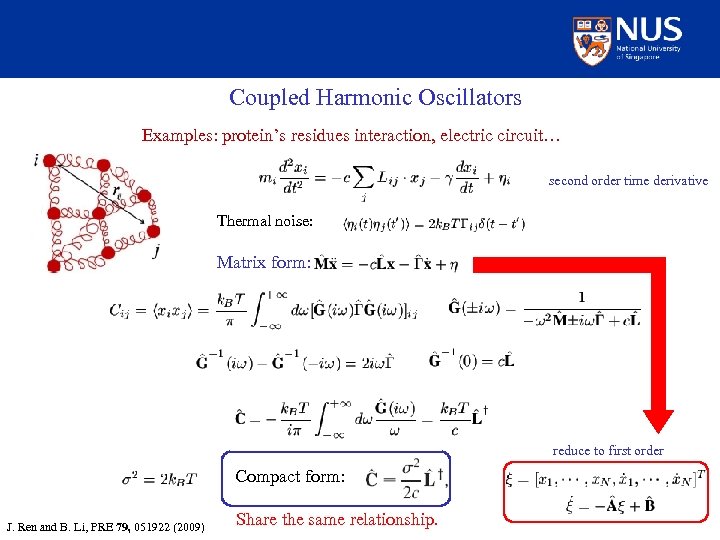
Coupled Harmonic Oscillators Examples: protein’s residues interaction, electric circuit… second order time derivative Thermal noise: Matrix form: reduce to first order Compact form: J. Ren and B. Li, PRE 79, 051922 (2009) Share the same relationship.
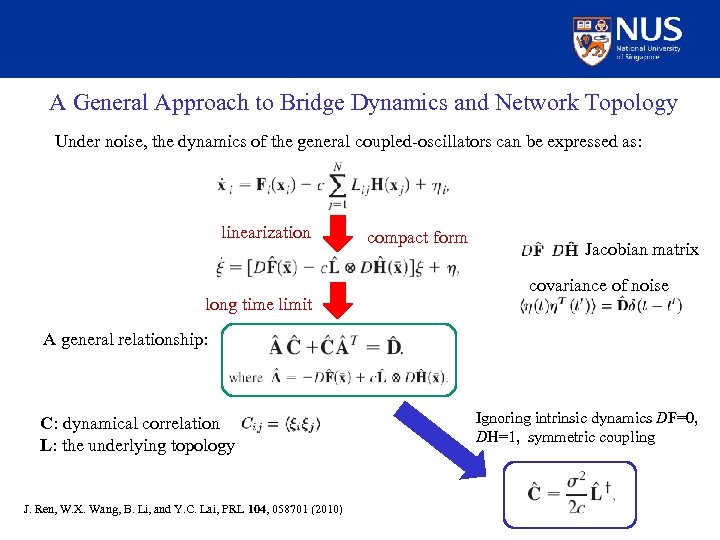
A General Approach to Bridge Dynamics and Network Topology Under noise, the dynamics of the general coupled-oscillators can be expressed as: linearization long time limit compact form Jacobian matrix covariance of noise A general relationship: C: dynamical correlation L: the underlying topology J. Ren, W. X. Wang, B. Li, and Y. C. Lai, PRL 104, 058701 (2010) Ignoring intrinsic dynamics DF=0, DH=1, symmetric coupling
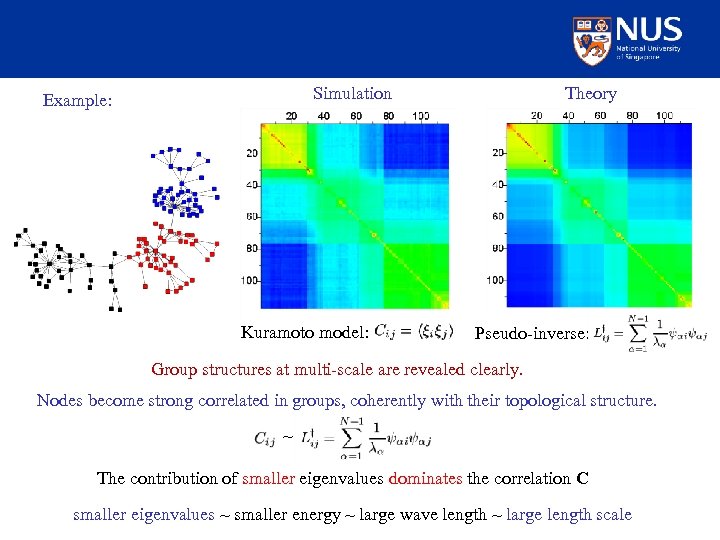
Simulation Example: Kuramoto model: Theory Pseudo-inverse: Group structures at multi-scale are revealed clearly. Nodes become strong correlated in groups, coherently with their topological structure. ~ The contribution of smaller eigenvalues dominates the correlation C smaller eigenvalues ~ smaller energy ~ large wave length ~ large length scale
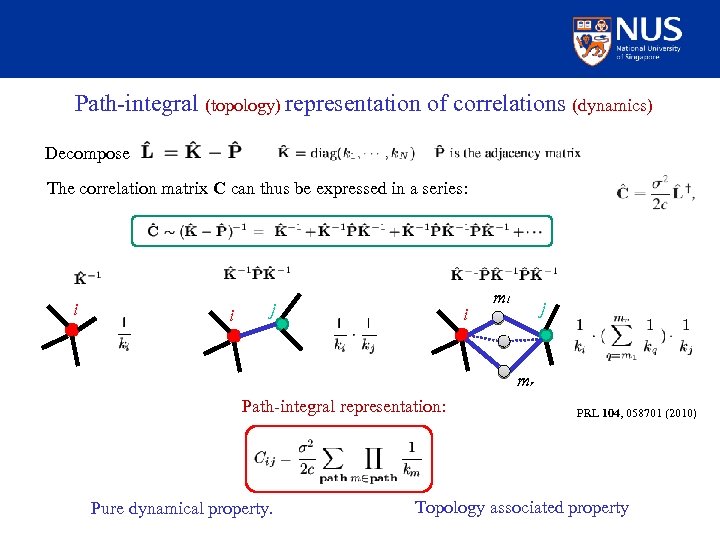
Path-integral (topology) representation of correlations (dynamics) Decompose The correlation matrix C can thus be expressed in a series: i i j i m 1 j mr Path-integral representation: Pure dynamical property. PRL 104, 058701 (2010) Topology associated property
Application From topology to dynamics: stability of networks J. Ren and B. Li, PRE 79, 051922 (2009) From dynamics to topology: inferring network structures J. Ren, W. X. Wang, B. Li, and Y. C. Lai, PRL 104, 058701 (2010) W. X. Wang, J. Ren, Y. C. Lai, and B. Li, in preparation.
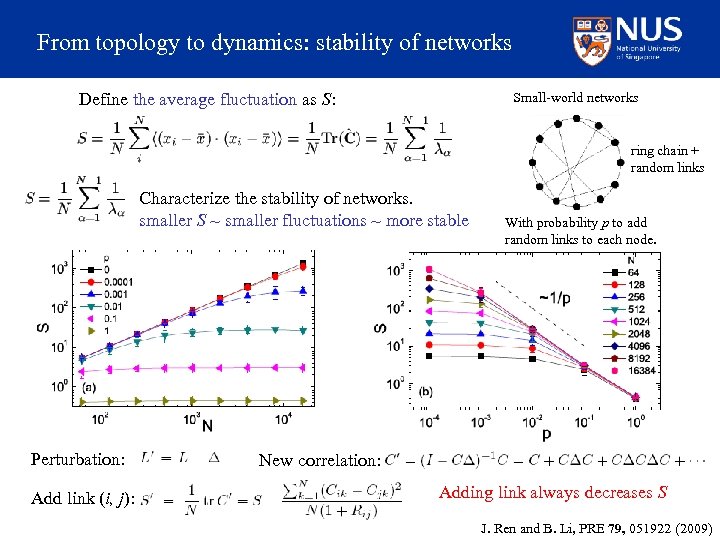
From topology to dynamics: stability of networks Define the average fluctuation as S: Small-world networks ring chain + random links Characterize the stability of networks. smaller S ~ smaller fluctuations ~ more stable Perturbation: Add link (i, j): With probability p to add random links to each node. New correlation: Adding link always decreases S J. Ren and B. Li, PRE 79, 051922 (2009)
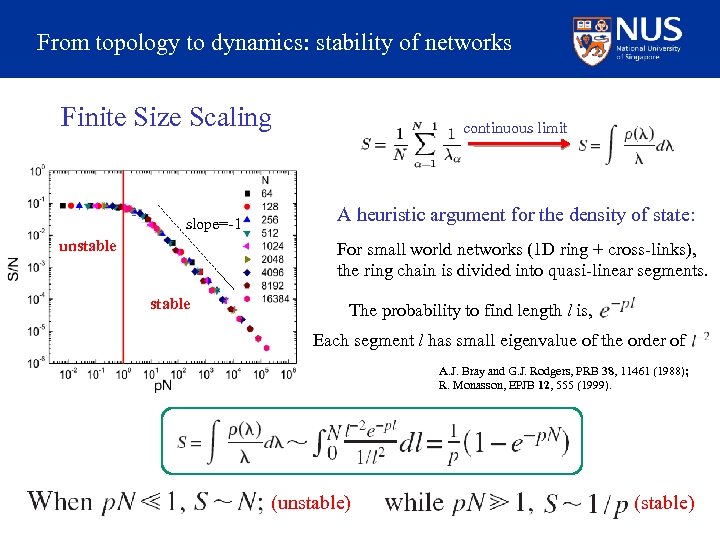
From topology to dynamics: stability of networks Finite Size Scaling slope=-1 unstable continuous limit A heuristic argument for the density of state: For small world networks (1 D ring + cross-links), the ring chain is divided into quasi-linear segments. stable The probability to find length l is, Each segment l has small eigenvalue of the order of A. J. Bray and G. J. Rodgers, PRB 38, 11461 (1988); R. Monasson, EPJB 12, 555 (1999). (unstable) (stable)
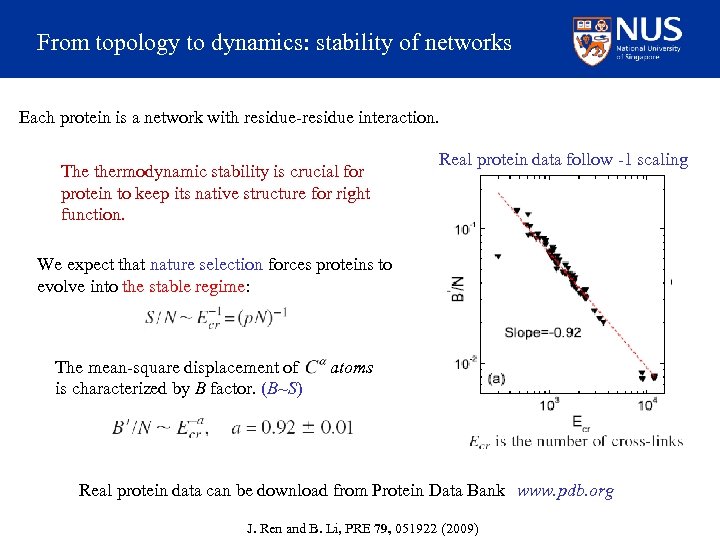
From topology to dynamics: stability of networks Each protein is a network with residue-residue interaction. The thermodynamic stability is crucial for protein to keep its native structure for right function. Real protein data follow -1 scaling We expect that nature selection forces proteins to evolve into the stable regime: The mean-square displacement of is characterized by B factor. (B~S) atoms Real protein data can be download from Protein Data Bank www. pdb. org J. Ren and B. Li, PRE 79, 051922 (2009)
? inverse problem
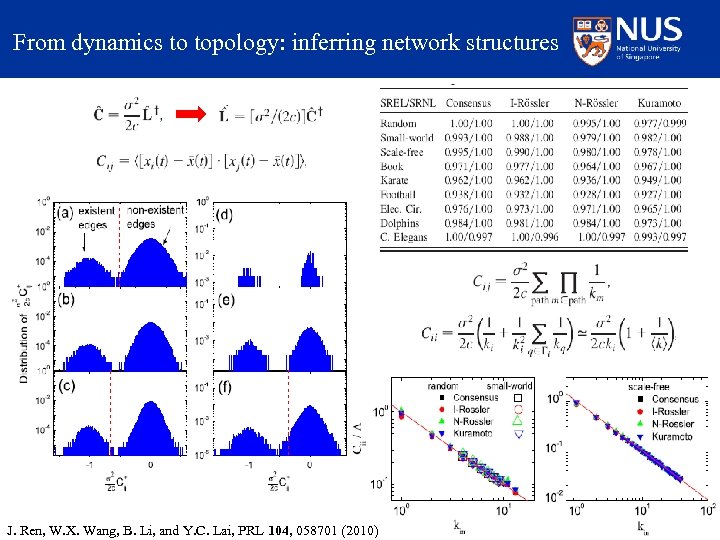
From dynamics to topology: inferring network structures J. Ren, W. X. Wang, B. Li, and Y. C. Lai, PRL 104, 058701 (2010)
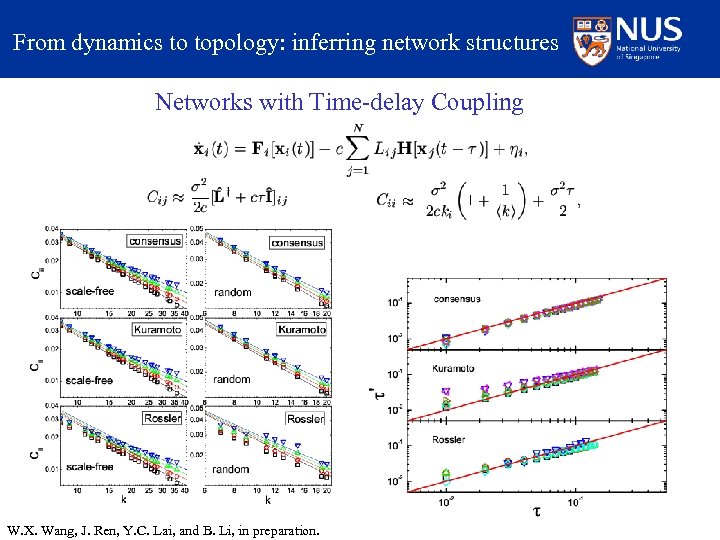
From dynamics to topology: inferring network structures Networks with Time-delay Coupling W. X. Wang, J. Ren, Y. C. Lai, and B. Li, in preparation.
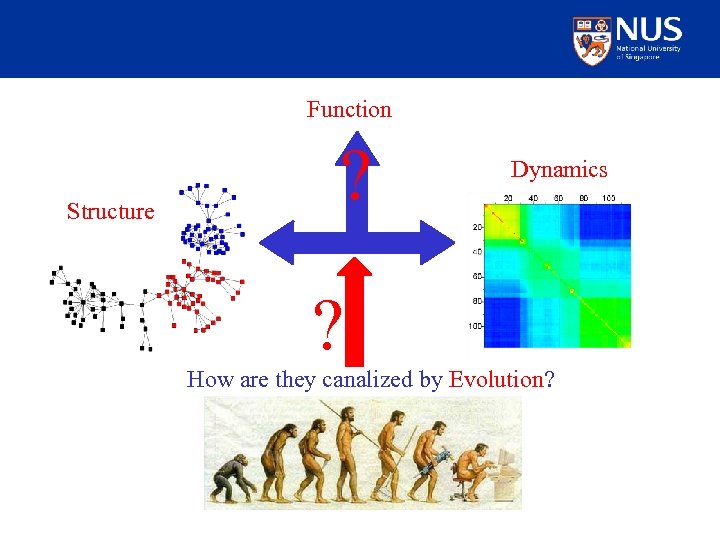
Function Structure ? Dynamics ? How are they canalized by Evolution?

Collaborators: Prof. Baowen Li (NUS) Prof. Huijie Yang (USSC) Dr. Wen-Xu Wang (ASU) Prof. Ying-Cheng Lai (ASU) Thanks!
Скачать презентацию Listen to the noise Bridge dynamics and topology
08481088e8d772d72e48e468c6e56588.ppt