


Listed in the Red Data Book of Birds of the Republic of Kalmykia
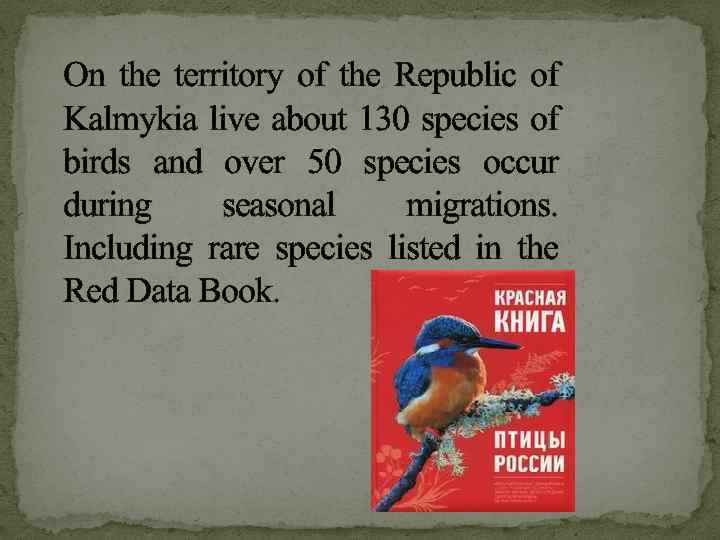
On the territory of the Republic of Kalmykia live about 130 species of birds and over 50 species occur during seasonal migrations. Including rare species listed in the Red Data Book.
The Red Book of the Republic of Kalmykia - an official document, an annotated list of rare and endangered animals, plants and fungi of the Republic of Kalmykia. Lists (lists) of objects of flora and fauna listed in the Red Book of the Republic of Kalmykia approved by the Government of the Republic of Kalmykia of December 13, 2010 № 387. The Red Book of Kalmykia included 147 species (subspecies) of animals and 286 species (subspecies) of plants and fungi. Category status taxa are installed in accordance with the scale of assessment of the status of animals Guidelines on management of the Red Data Book of the Russian Federation, developed by FSI "All-Russian Research Institute for Nature Conservation"
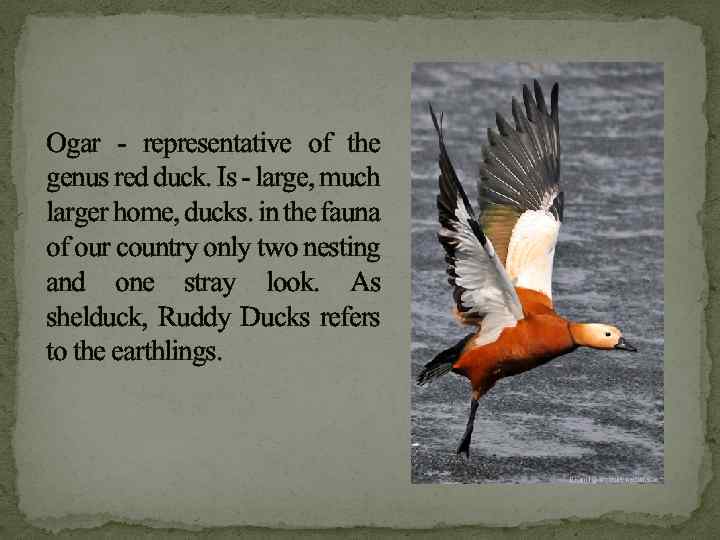
Ogar - representative of the genus red duck. Is - large, much larger home, ducks. in the fauna of our country only two nesting and one stray look. As shelduck, Ruddy Ducks refers to the earthlings.
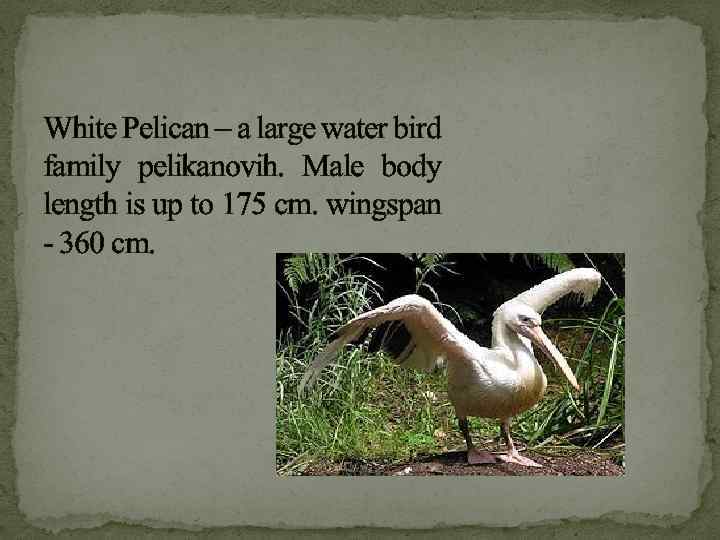
White Pelican – a large water bird family pelikanovih. Male body length is up to 175 cm. wingspan - 360 cm.
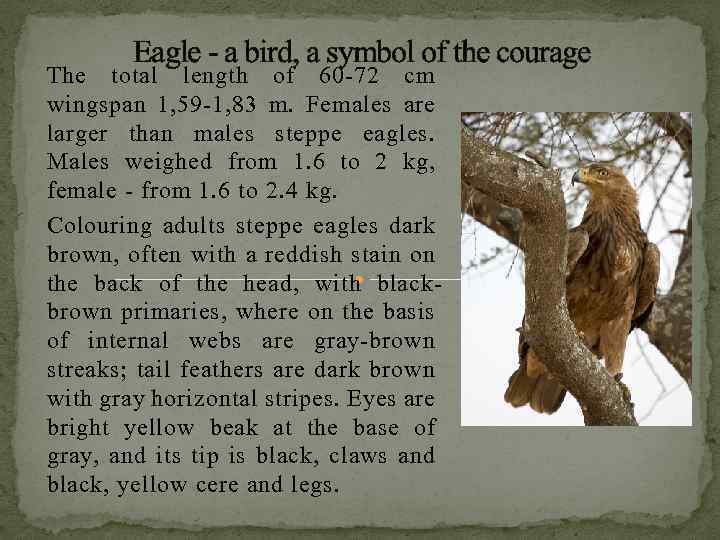
Eagle - a bird, a symbol of the courage The total length of 60 -72 cm wingspan 1, 59 -1, 83 m. Females are larger than males steppe eagles. Males weighed from 1. 6 to 2 kg, female - from 1. 6 to 2. 4 kg. Colouring adults steppe eagles dark brown, often with a reddish stain on the back of the head, with blackbrown primaries, where on the basis of internal webs are gray-brown streaks; tail feathers are dark brown with gray horizontal stripes. Eyes are bright yellow beak at the base of gray, and its tip is black, claws and black, yellow cere and legs.
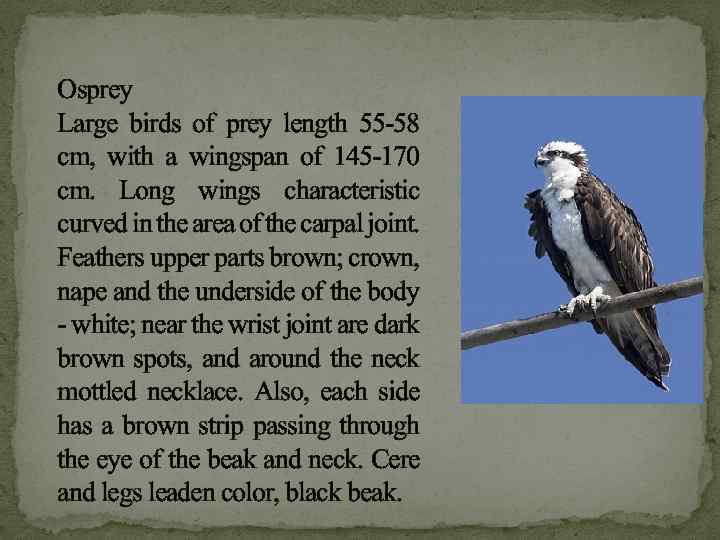
Osprey Large birds of prey length 55 -58 cm, with a wingspan of 145 -170 cm. Long wings characteristic curved in the area of the carpal joint. Feathers upper parts brown; crown, nape and the underside of the body - white; near the wrist joint are dark brown spots, and around the neck mottled necklace. Also, each side has a brown strip passing through the eye of the beak and neck. Cere and legs leaden color, black beak.
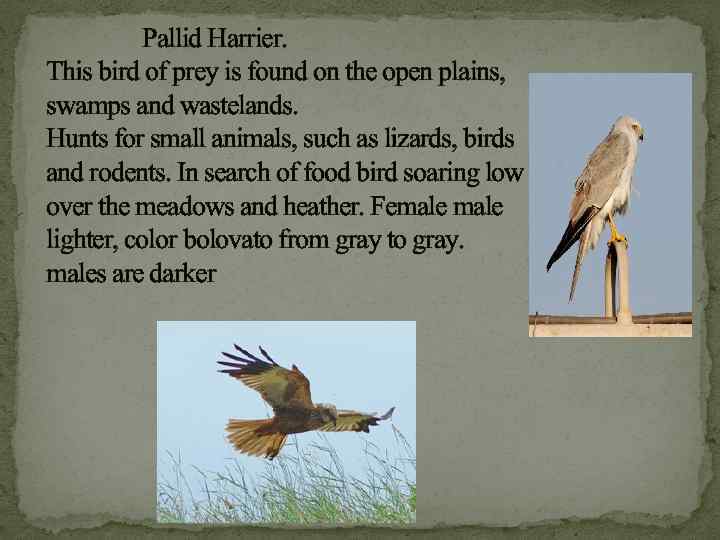
Pallid Harrier. This bird of prey is found on the open plains, swamps and wastelands. Hunts for small animals, such as lizards, birds and rodents. In search of food bird soaring low over the meadows and heather. Female lighter, color bolovato from gray to gray. males are darker
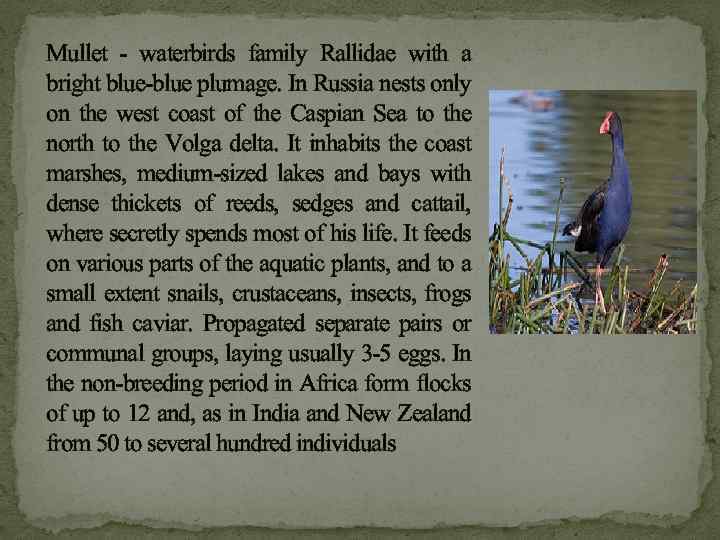
Mullet - waterbirds family Rallidae with a bright blue-blue plumage. In Russia nests only on the west coast of the Caspian Sea to the north to the Volga delta. It inhabits the coast marshes, medium-sized lakes and bays with dense thickets of reeds, sedges and cattail, where secretly spends most of his life. It feeds on various parts of the aquatic plants, and to a small extent snails, crustaceans, insects, frogs and fish caviar. Propagated separate pairs or communal groups, laying usually 3 -5 eggs. In the non-breeding period in Africa form flocks of up to 12 and, as in India and New Zealand from 50 to several hundred individuals
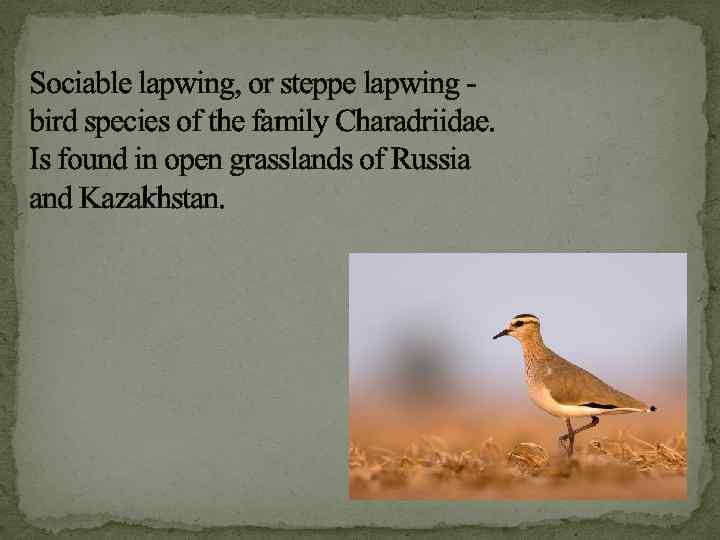
Sociable lapwing, or steppe lapwing bird species of the family Charadriidae. Is found in open grasslands of Russia and Kazakhstan.
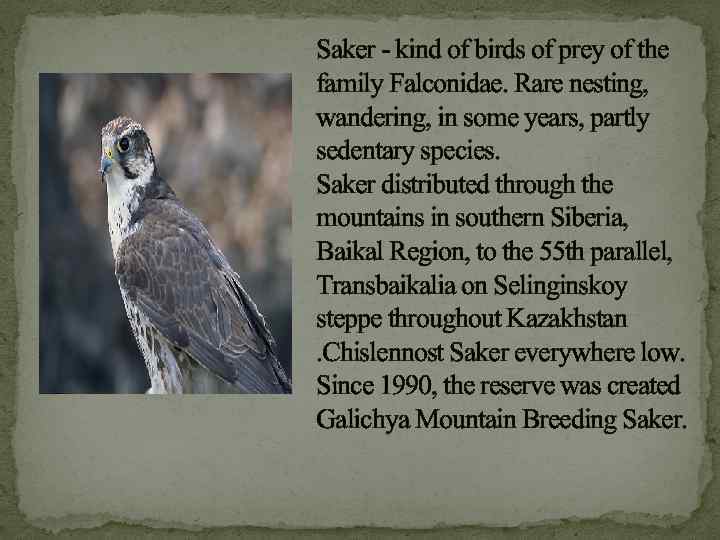
Saker - kind of birds of prey of the family Falconidae. Rare nesting, wandering, in some years, partly sedentary species. Saker distributed through the mountains in southern Siberia, Baikal Region, to the 55 th parallel, Transbaikalia on Selinginskoy steppe throughout Kazakhstan. Chislennost Saker everywhere low. Since 1990, the reserve was created Galichya Mountain Breeding Saker.
On the territory of the Republic of Kalmykia is also home to rare birds such as: small cormorant, pond heron, white-headed duck, a small swan, black kite, serpent eagle, black vulture, belladonna, bustard, little bustard, Caspian Plover, Avocet and other.
