


 Скачать презентацию LISI ENSMA École Nationale Supérieure de Mécanique et d Aérotechnique
009ca55a60ebcfc79e0becdd357a7a82.ppt
- Количество слайдов: 33
 LISI/ENSMA École Nationale Supérieure de Mécanique et d’Aérotechnique 1, avenue Clément Ader - BP 40109 - 86961 Futuroscope cedex - France PLib ontologies (ISO 13584 / IEC 61360): Where are we ? Guy Pierra pierra@ensma. fr
 Content • Standardization • Tools availability • Who use PLIB? • Conclusion: Vision for the future 2
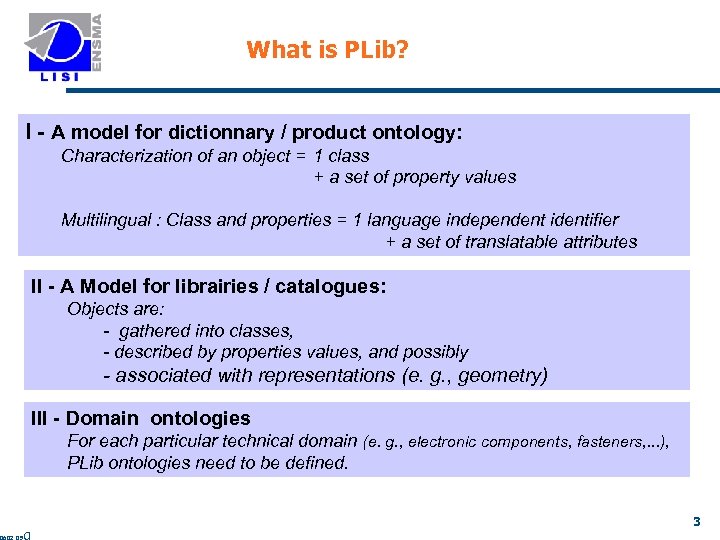 What is PLib? I - A model for dictionnary / product ontology: Characterization of an object = 1 class + a set of property values Multilingual : Class and properties = 1 language independent identifier + a set of translatable attributes II - A Model for librairies / catalogues: Objects are: - gathered into classes, - described by properties values, and possibly - associated with representations (e. g. , geometry) III - Domain ontologies For each particular technical domain (e. g. , electronic components, fasteners, . . . ), PLib ontologies need to be defined. 3
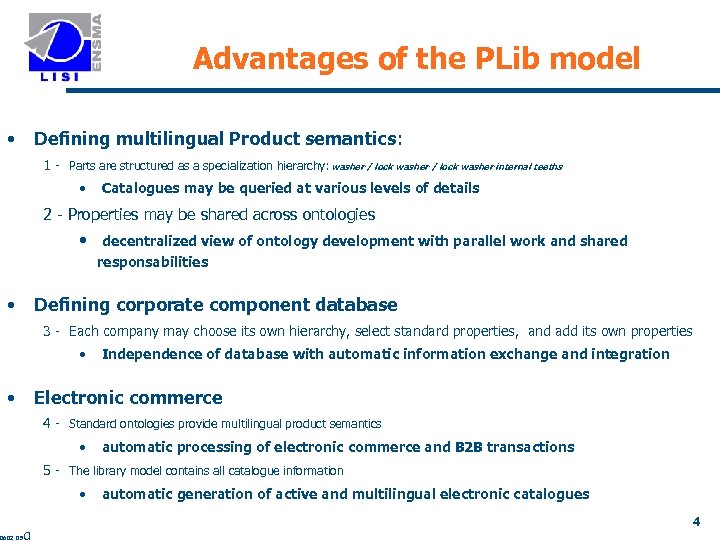 Advantages of the PLib model • Defining multilingual Product semantics: 1 - Parts are structured as a specialization hierarchy: washer / lock washer internal teeths • Catalogues may be queried at various levels of details 2 - Properties may be shared across ontologies • decentralized view of ontology development with parallel work and shared responsabilities • Defining corporate component database 3 - Each company may choose its own hierarchy, select standard properties, and add its own properties • • Independence of database with automatic information exchange and integration Electronic commerce 4 - Standard ontologies provide multilingual product semantics • automatic processing of electronic commerce and B 2 B transactions 5 - The library model contains all catalogue information • automatic generation of active and multilingual electronic catalogues 4
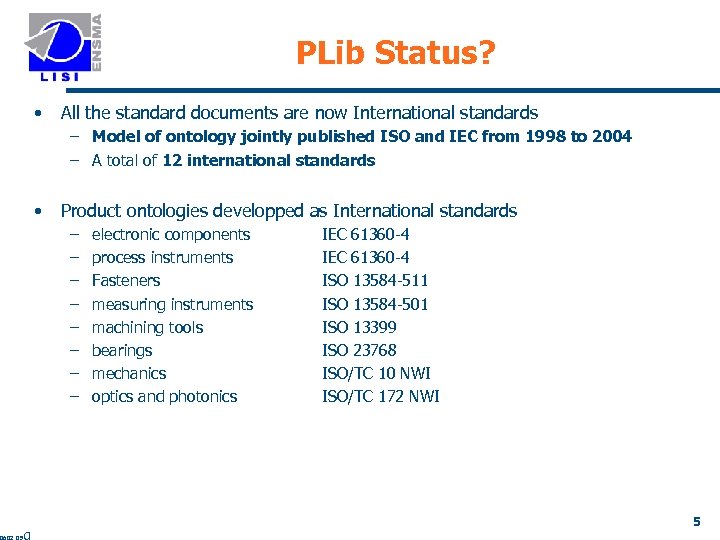 PLib Status? • All the standard documents are now International standards – Model of ontology jointly published ISO and IEC from 1998 to 2004 – A total of 12 international standards • Product ontologies developped as International standards – – – – electronic components process instruments Fasteners measuring instruments machining tools bearings mechanics optics and photonics IEC 61360 -4 ISO 13584 -511 ISO 13584 -501 ISO 13399 ISO 23768 ISO/TC 10 NWI ISO/TC 172 NWI 5
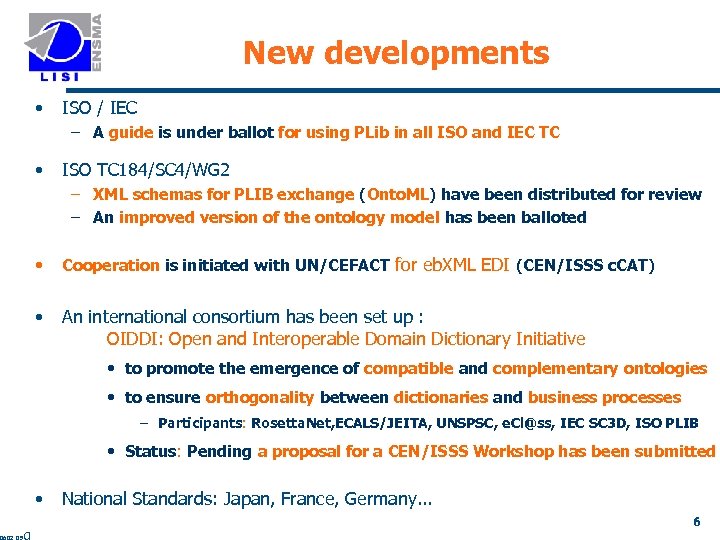 New developments • ISO / IEC – A guide is under ballot for using PLib in all ISO and IEC TC • ISO TC 184/SC 4/WG 2 – XML schemas for PLIB exchange (Onto. ML) have been distributed for review – An improved version of the ontology model has been balloted • Cooperation is initiated with UN/CEFACT for eb. XML EDI (CEN/ISSS c. CAT) • An international consortium has been set up : OIDDI: Open and Interoperable Domain Dictionary Initiative • to promote the emergence of compatible and complementary ontologies • to ensure orthogonality between dictionaries and business processes – Participants: Rosetta. Net, ECALS/JEITA, UNSPSC, e. Cl@ss, IEC SC 3 D, ISO PLIB • Status: Pending a proposal for a CEN/ISSS Workshop has been submitted • National Standards: Japan, France, Germany. . . 6
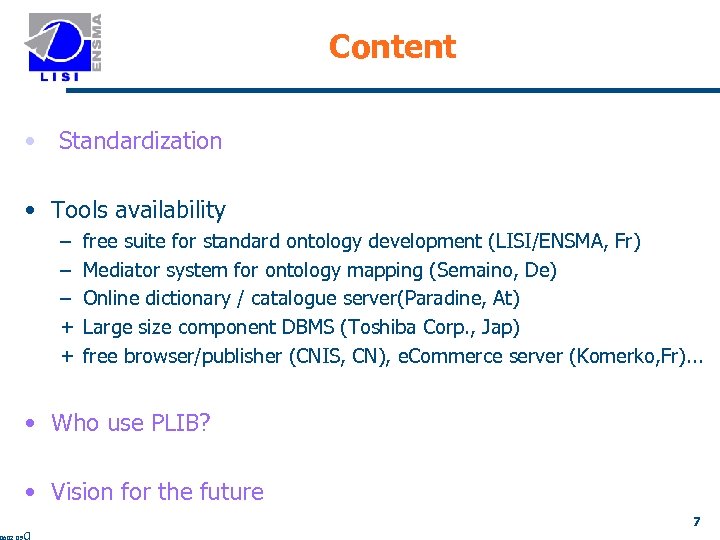 Content • Standardization • Tools availability – – – + + free suite for standard ontology development (LISI/ENSMA, Fr) Mediator system for ontology mapping (Semaino, De) Online dictionary / catalogue server(Paradine, At) Large size component DBMS (Toshiba Corp. , Jap) free browser/publisher (CNIS, CN), e. Commerce server (Komerko, Fr). . . • Who use PLIB? • Vision for the future 7
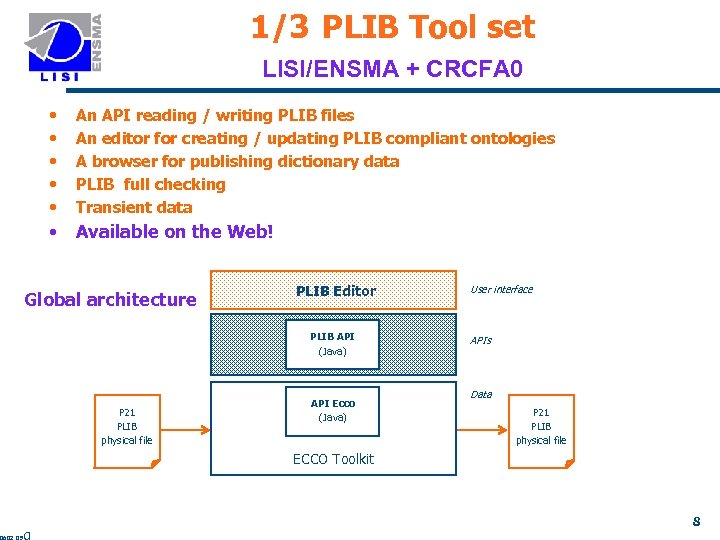 1/3 PLIB Tool set LISI/ENSMA + CRCFA 0 • • • An API reading / writing PLIB files An editor for creating / updating PLIB compliant ontologies A browser for publishing dictionary data PLIB full checking Transient data • Available on the Web! Global architecture PLIB Editor PLIB API (Java) P 21 PLIB physical file API Ecco (Java) User interface APIs Data P 21 PLIB physical file ECCO Toolkit 8
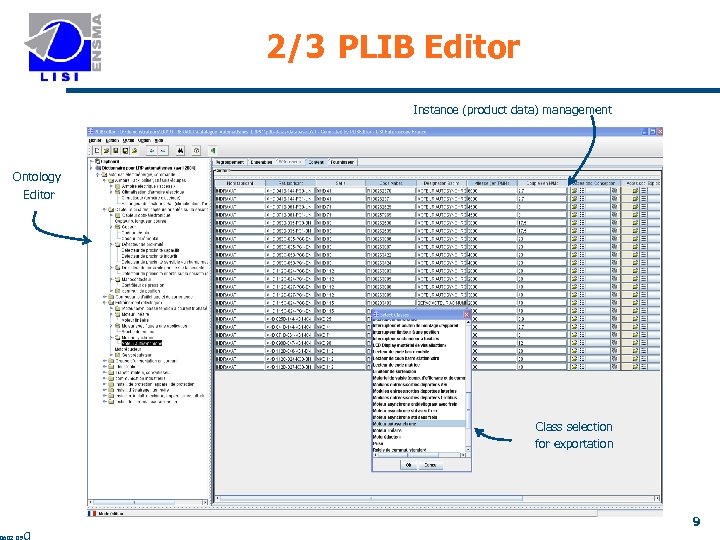 2/3 PLIB Editor Instance (product data) management Ontology Editor Class selection for exportation 9
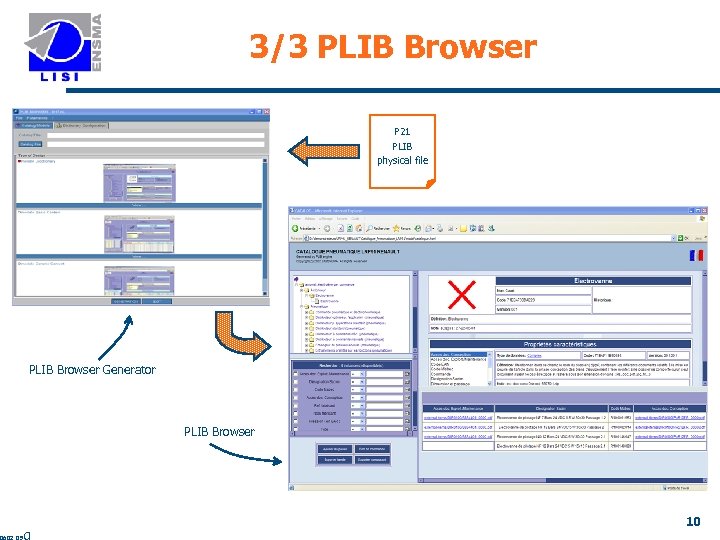 3/3 PLIB Browser P 21 PLIB physical file PLIB Browser Generator PLIB Browser 10
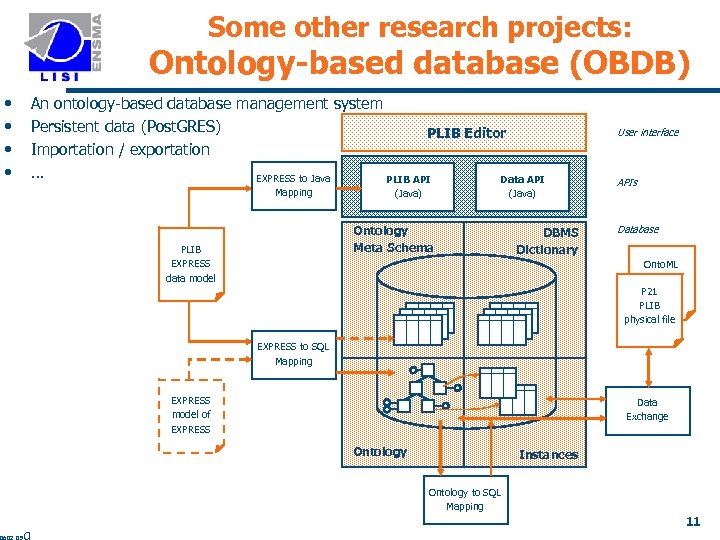 Some other research projects: Ontology-based database (OBDB) • • An ontology-based database management system Persistent data (Post. GRES) PLIB Editor Importation / exportation. . . EXPRESS to Java PLIB API Data API Mapping (Java) Ontology Meta Schema PLIB EXPRESS data model DBMS Dictionary User interface APIs Database Onto. ML P 21 PLIB physical file EXPRESS to SQL Mapping EXPRESS model of EXPRESS Data Exchange Ontology Instances Ontology to SQL Mapping 11
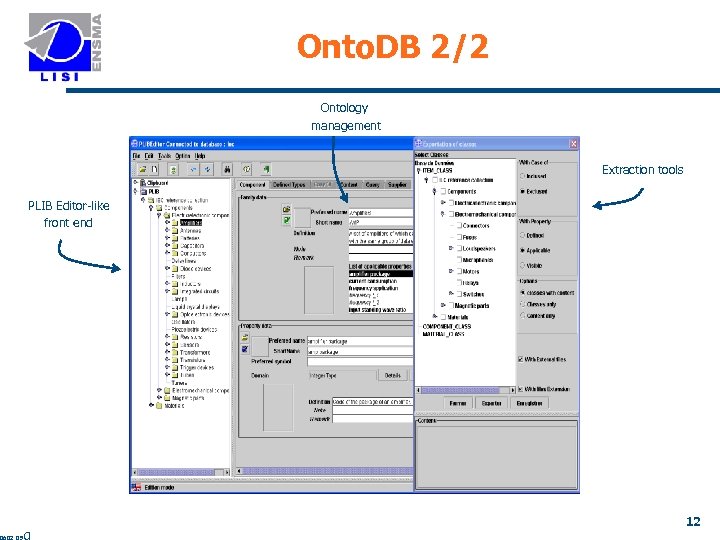 Onto. DB 2/2 Ontology management Extraction tools PLIB Editor-like front end 12
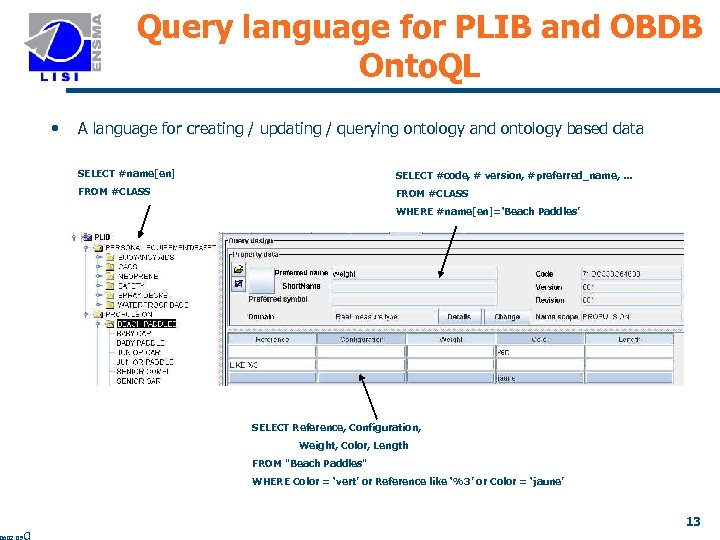 Query language for PLIB and OBDB Onto. QL • A language for creating / updating / querying ontology and ontology based data SELECT #name[en] SELECT #code, # version, #preferred_name, … FROM #CLASS WHERE #name[en]=‘Beach Paddles’ SELECT Reference, Configuration, Weight, Color, Length FROM "Beach Paddles" WHERE Color = ‘vert’ or Reference like ‘%3’ or Color = ‘jaune’ 13
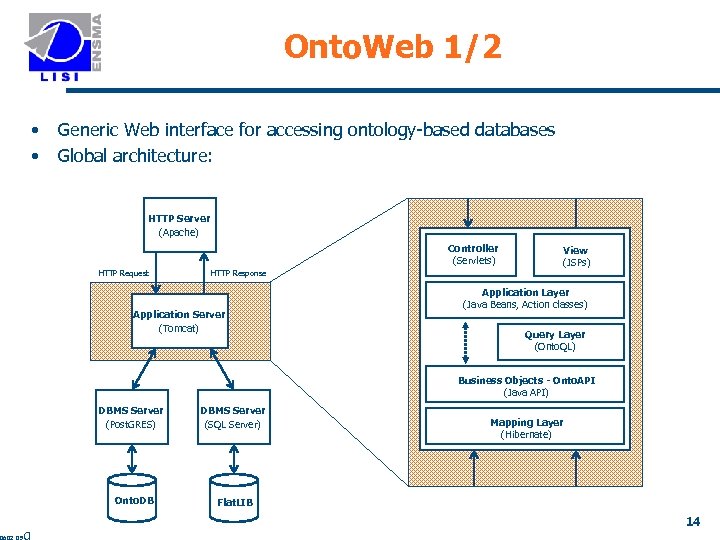 Onto. Web 1/2 • • Generic Web interface for accessing ontology-based databases Global architecture: HTTP Server (Apache) Controller (Servlets) HTTP Request HTTP Response Application Server (Tomcat) View (JSPs) Application Layer (Java Beans, Action classes) Query Layer (Onto. QL) Business Objects - Onto. API (Java API) DBMS Server (Post. GRES) Onto. DB DBMS Server (SQL Server) Mapping Layer (Hibernate) Flat. LIB 14
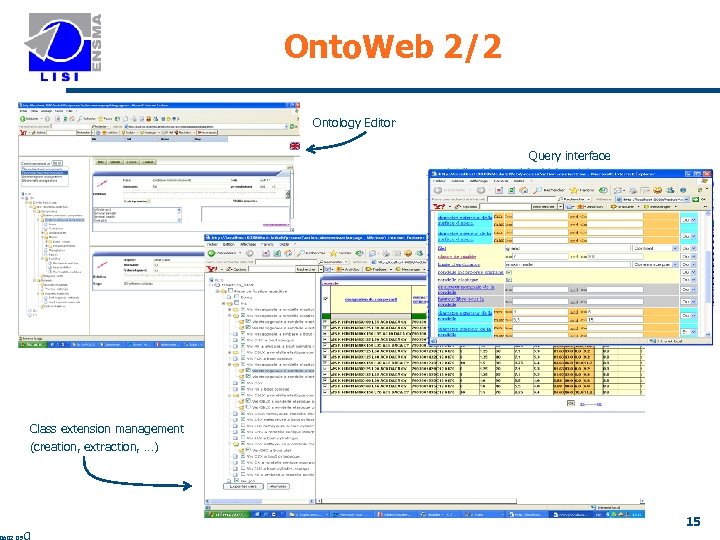 Onto. Web 2/2 Ontology Editor Query interface Class extension management (creation, extraction, …) 15
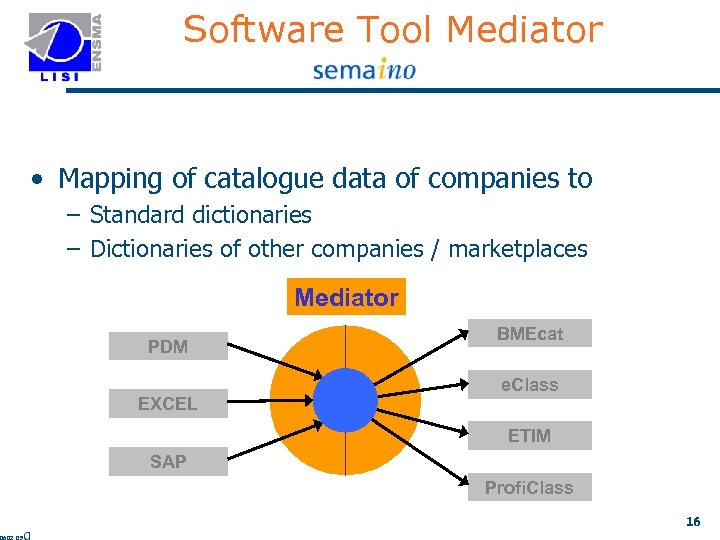 Software Tool Mediator • Mapping of catalogue data of companies to – Standard dictionaries – Dictionaries of other companies / marketplaces Mediator PDM EXCEL BMEcat e. Class ETIM SAP Profi. Class 16
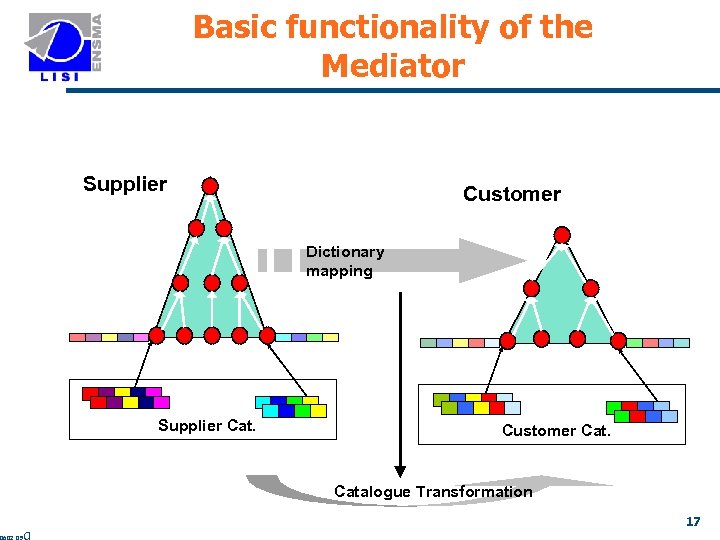 Basic functionality of the Mediator Supplier Customer Dictionary mapping Supplier Cat. Customer Catalogue Transformation 17
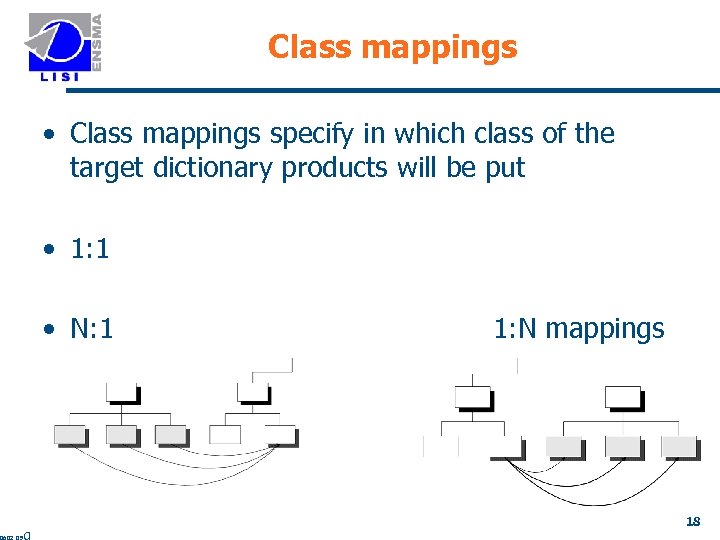 Class mappings • Class mappings specify in which class of the target dictionary products will be put • 1: 1 • N: 1 1: N mappings 18
 Property Mappings • Property mappings determine the value which is given to a property in generated e-catalogue • 1: 1 and 1: n mappings – The value of the target property is taken from the related source property – One source property may be mapped to several target properties • Transformation functions – Predefined functions – User defined functions (Syntax taken from SQL) 19
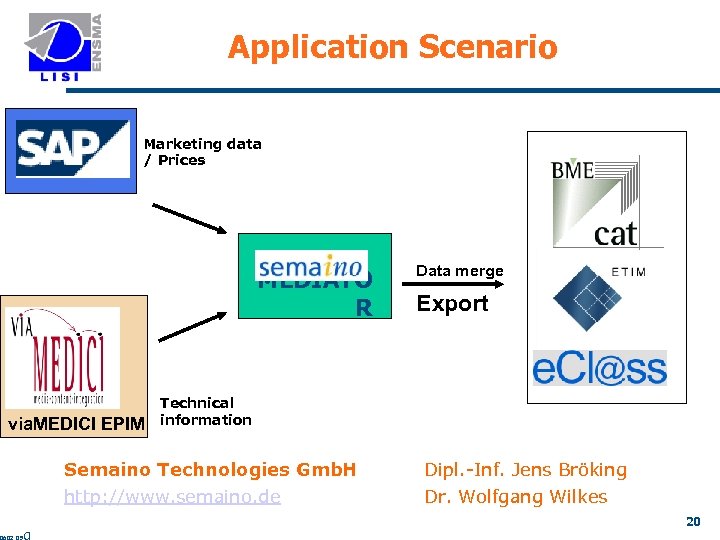 Application Scenario Marketing data / Prices MEDIATO R via. MEDICI EPIM Data merge Export Technical information Semaino Technologies Gmb. H Dipl. -Inf. Jens Bröking http: //www. semaino. de Dr. Wolfgang Wilkes 20
 eptos™ – Paradine Online Dictionary • Online Dictionary to develop and maintain Classification Systems and Property Dictionaries • Offered as Product or ASP Service • Data model according to ISO 13584 / IEC 61360 • Online workflow for standardization of properties and classes • Some customers: ISO, DIN, e. Cl@ss, . . . 21
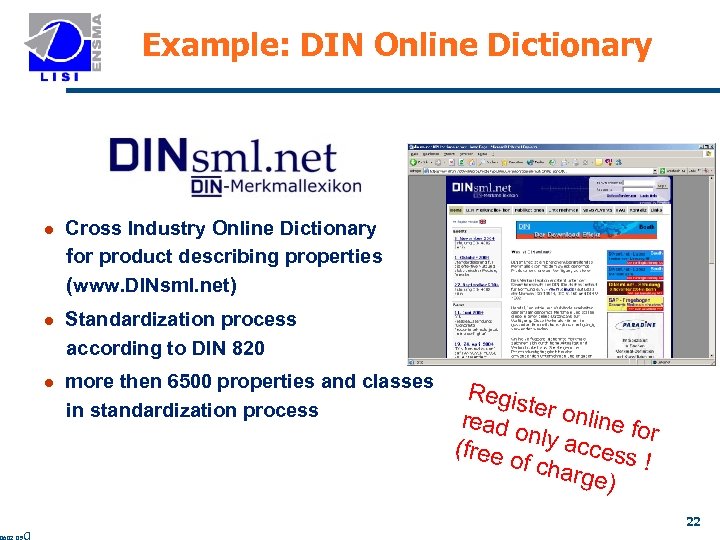 Example: DIN Online Dictionary l Cross Industry Online Dictionary for product describing properties (www. DINsml. net) l Standardization process according to DIN 820 l more then 6500 properties and classes in standardization process Regis ter on l read only a ine for c (free of cha cess ! rge) 22
 capra™ – Paradine Corporate Dictionary • Online Dictionary to take over and adapt Classification Systems / Property Dictionaries as well as developing own Dictionaries • Offered as Product or ASP Service • Data model according to ISO 13584 / IEC 61360 • Valuation and Exchange of Products (Import/Export) • Some customers: PROLIST, Zeiss, . . . 23
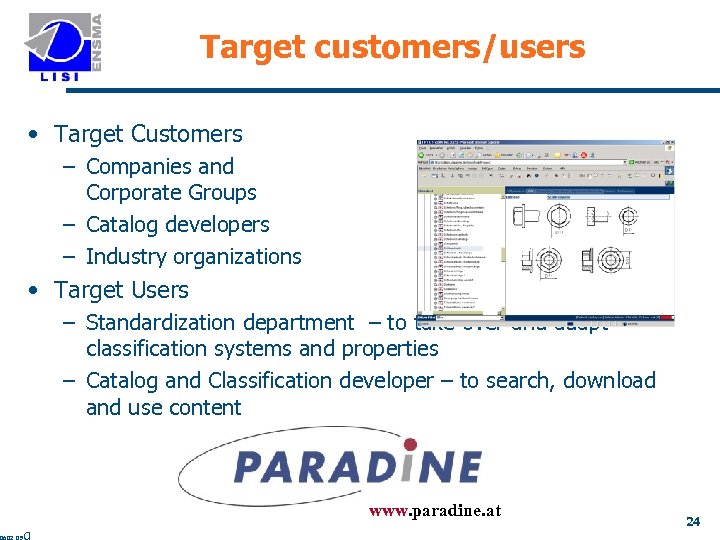 Target customers/users • Target Customers – Companies and Corporate Groups – Catalog developers – Industry organizations • Target Users – Standardization department – to take over and adapt classification systems and properties – Catalog and Classification developer – to search, download and use content www. paradine. at 24
 Content • Standardization • Tools availability • Who use PLIB? – Japan, China, Germany, Austria, – The French case. . . • Conclusion: Vision for the future 25
 Who use PLib: The French case Description of Non Production Materials • A joint project Application to: gerard. chaumond@renault. com jacques. bardot@mpsa. com bernard. jeanneau@tixis. arcelor. com
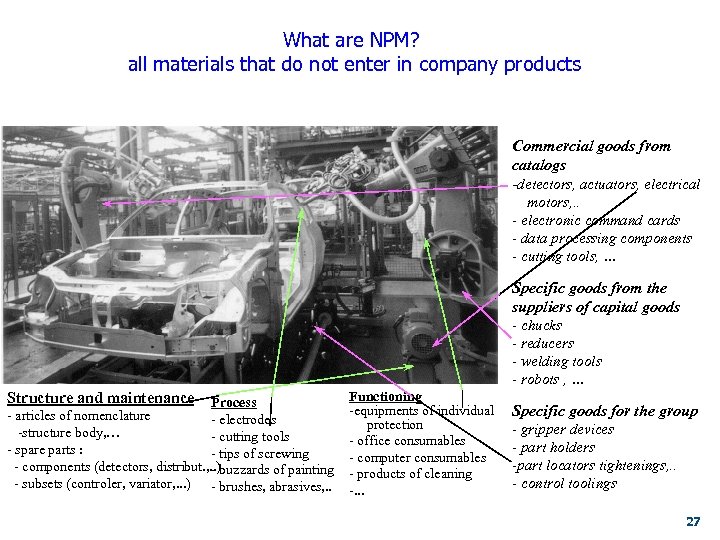 What are NPM? all materials that do not enter in company products Commercial goods from catalogs -detectors, actuators, electrical motors, . . - electronic command cards - data processing components - cutting tools, … Specific goods from the suppliers of capital goods - chucks - reducers - welding tools - robots , … Structure and maintenance Process - articles of nomenclature - electrodes -structure body, … - cutting tools - spare parts : - tips of screwing - components (detectors, distribut. , . . ) - buzzards of painting - subsets (controler, variator, . . . ) - brushes, abrasives, . . Functioning -equipments of individual protection - office consumables - computer consumables - products of cleaning -. . . Specific goods for the group - gripper devices - part holders -part locators tightenings, . . - control toolings 27
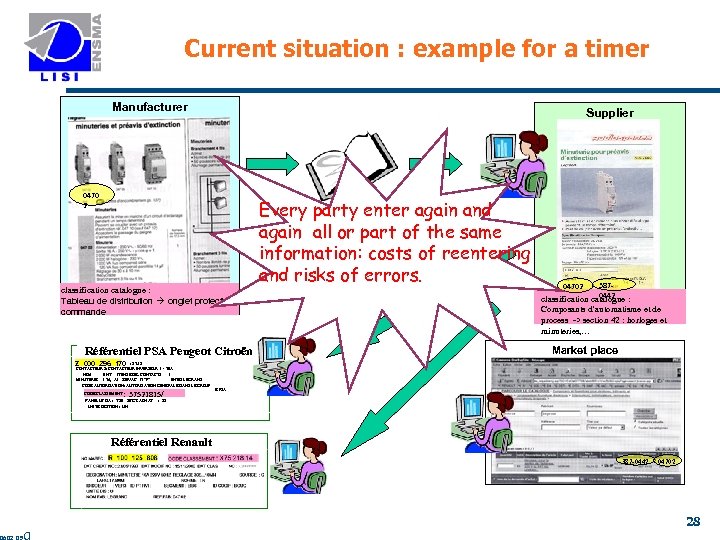 Current situation : example for a timer Manufacturer Supplier 0470 2 Every party enter again and again all or part of the same information: costs of reentering and risks of errors. classification catalogue : Tableau de distribution onglet protection commande Référentiel PSA Peugeot Citroën Z 000 296 170 : 3752 04702 387 - 0442 classification catalogue : Composants d’automatisme et de process -> section 42 : horloges et minuteries, … Market place CONTACTEUR & CONTACTEUR INVERSEUR I > 10 A NOM !INT !TENS BOB. !CONTACTS ! MINUTERIE ! 16, A! 230 VAC !1 "F" !04702 LEGRAND CODE AUTORISATION : AUTORISATION GENERALE DANS LE GROUP : 37521815/ CODE CLASSEMENT FAMILLE DA : T 80 SECT. ACHAT : 88 E PSA UNITE GESTION : UN Référentiel Renault 387 -0442 04702 28
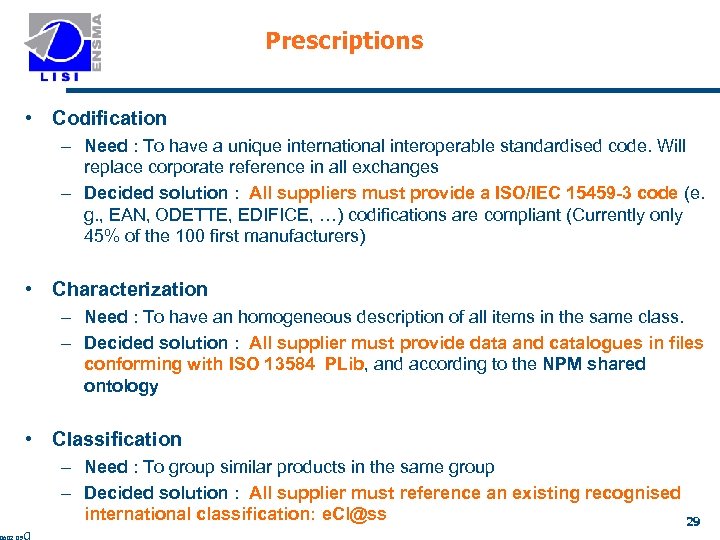 Prescriptions • Codification – Need : To have a unique international interoperable standardised code. Will replace corporate reference in all exchanges – Decided solution : All suppliers must provide a ISO/IEC 15459 -3 code (e. g. , EAN, ODETTE, EDIFICE, …) codifications are compliant (Currently only 45% of the 100 first manufacturers) • Characterization – Need : To have an homogeneous description of all items in the same class. – Decided solution : All supplier must provide data and catalogues in files conforming with ISO 13584 PLib, and according to the NPM shared ontology • Classification – Need : To group similar products in the same group – Decided solution : All supplier must reference an existing recognised international classification: e. Cl@ss 29
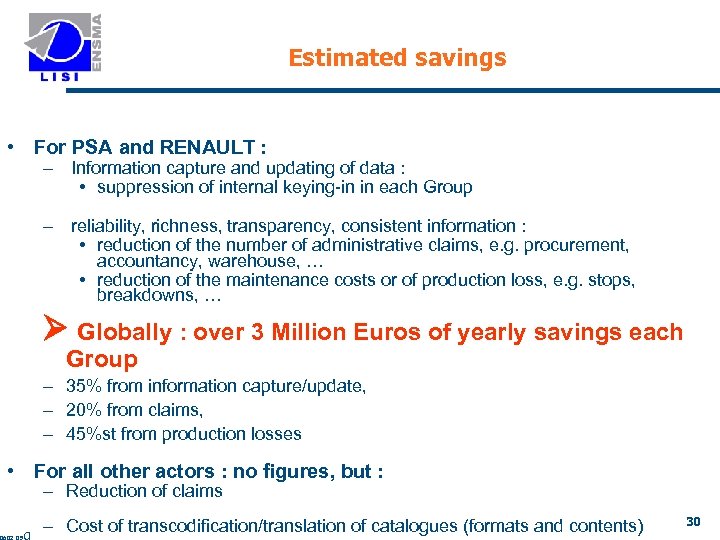 Estimated savings • For PSA and RENAULT : – Information capture and updating of data : • suppression of internal keying-in in each Group – reliability, richness, transparency, consistent information : • reduction of the number of administrative claims, e. g. procurement, accountancy, warehouse, … • reduction of the maintenance costs or of production loss, e. g. stops, breakdowns, … Globally : over 3 Million Euros of yearly savings each Group – 35% from information capture/update, – 20% from claims, – 45%st from production losses • For all other actors : no figures, but : – Reduction of claims – Cost of transcodification/translation of catalogues (formats and contents) 30
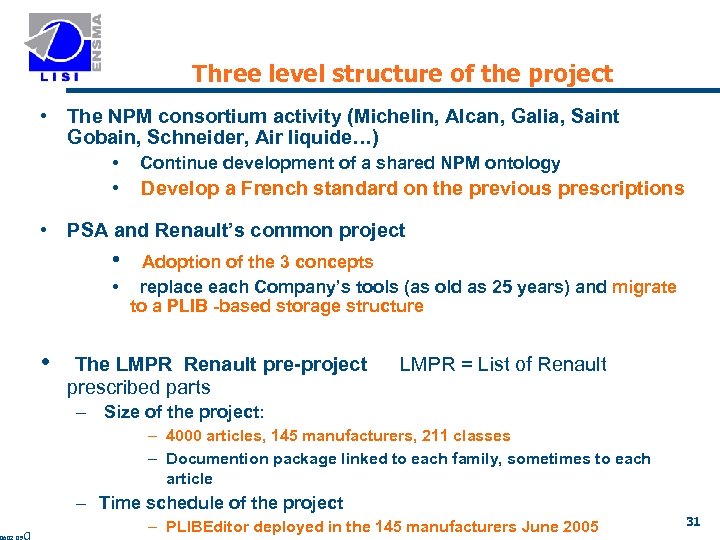 Three level structure of the project • The NPM consortium activity (Michelin, Alcan, Galia, Saint Gobain, Schneider, Air liquide…) • Continue development of a shared NPM ontology • Develop a French standard on the previous prescriptions • PSA and Renault’s common project • Adoption of the 3 concepts • replace each Company’s tools (as old as 25 years) and migrate to a PLIB -based storage structure • The LMPR Renault pre-project prescribed parts LMPR = List of Renault – Size of the project: – 4000 articles, 145 manufacturers, 211 classes – Documention package linked to each family, sometimes to each article – Time schedule of the project – PLIBEditor deployed in the 145 manufacturers June 2005 31
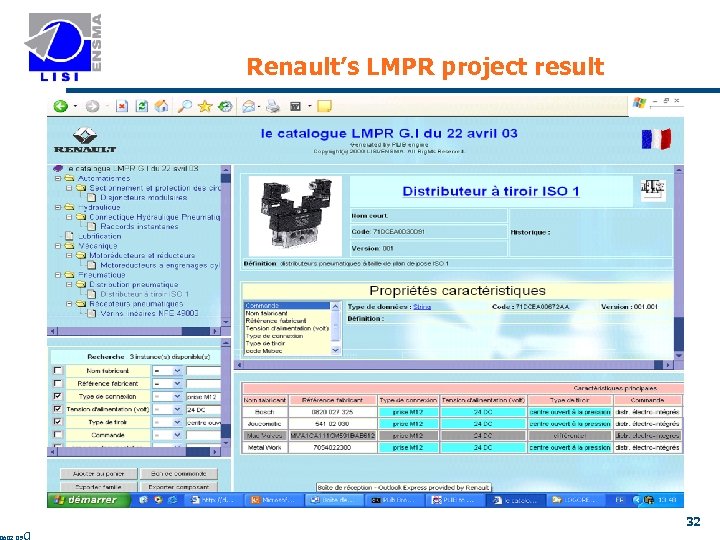 Renault’s LMPR project result 32
 Conclusion: Vision for the next 5 years • Over the next 5 years, all global players will have changed – their current item databases (with same attributes for all products) – for PLib-like databases (Structured classes with specific properties). • Over the next 5 years, all global players will have changed their requirements about product information: – product = product + characterization data – full electronic exchange not only for e-commerce (commercial data) but also for engineering (technical data) • integration of engineering and procurement • PLIB is just in time: – – the technology is mature the technology is good New competitors emerge just to hurry up to promoting it and establishing it in Europa, in Asia …and elsewhere 33