


 Скачать презентацию LIS 385 T Information Architecture and Design
395793ba312a132ddadf842f1cf27b28.ppt
- Количество слайдов: 16
 LIS 385 T – Information Architecture and Design Site Maps By Norma Palomino
 Site Maps - Introduction n Diagramming tools q Powerful tool of communication
 Site Maps – Introduction (cont’d) n Diagramming tools q Powerful tool of communication in organizing: n Applied in sophisticated analysis of data in manufacturing n Data about the relationship between quality and productivity can be show as….
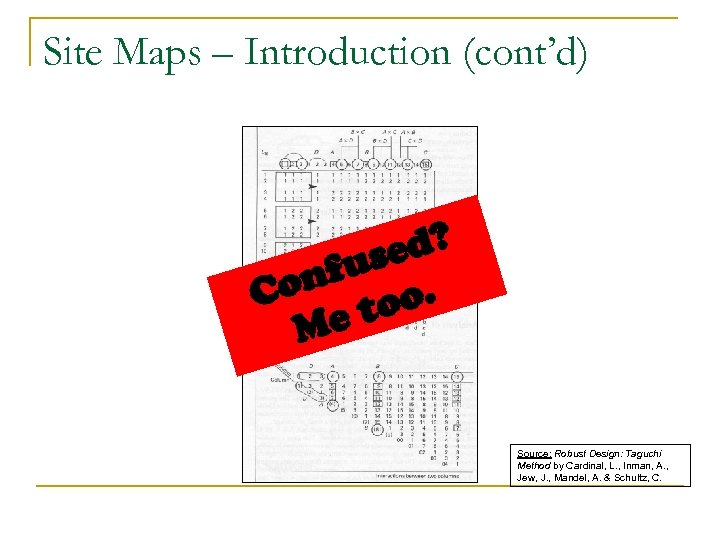 Site Maps – Introduction (cont’d) d? use nf Co too. Me Source: Robust Design: Taguchi Method by Cardinal, L. , Inman, A. , Jew, J. , Mandel, A. & Schultz, C.
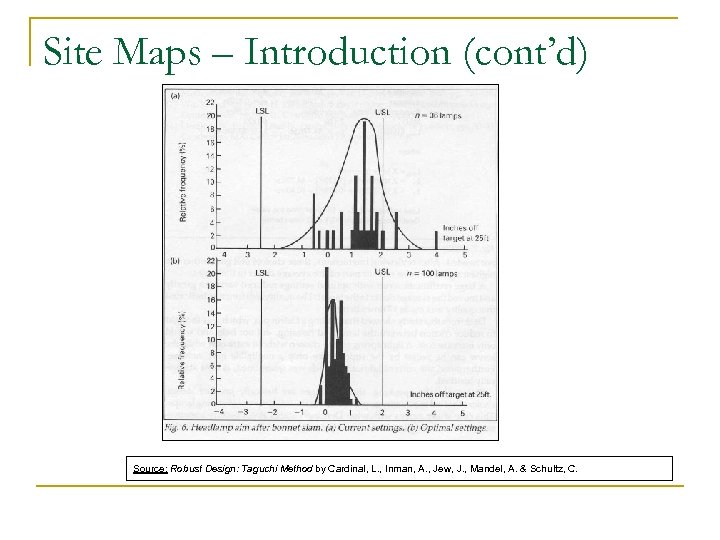 Site Maps – Introduction (cont’d) Source: Robust Design: Taguchi Method by Cardinal, L. , Inman, A. , Jew, J. , Mandel, A. & Schultz, C.
 Site Maps – Introduction (cont’d) n n Three kinds of diagramming tools for IA: Storyboards (source: Storyboarding, Retrieved from http: //w 3. tvi. cc. nm. us/~jvelez/MMS 170/storyboard/index. htm) n n Walt Disney’s process of designing cartoons Applied to IA… q Schematics (“wireframes”) q Site Maps (“blueprints”)
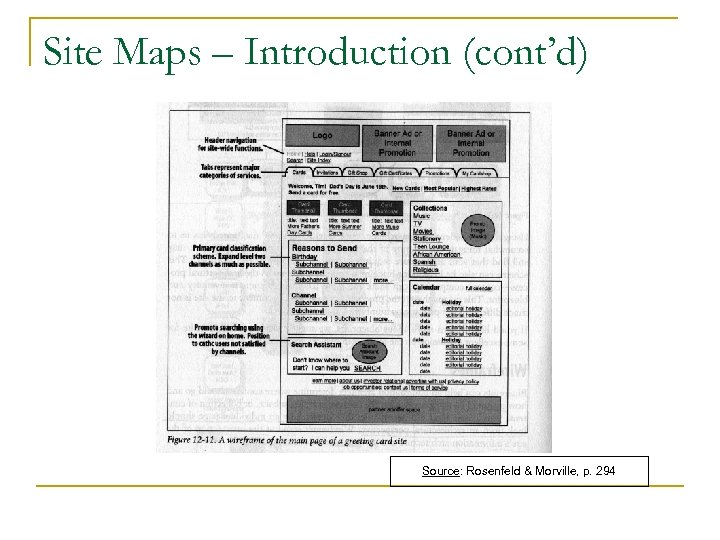 Site Maps – Introduction (cont’d) Source: Rosenfeld & Morville, p. 294
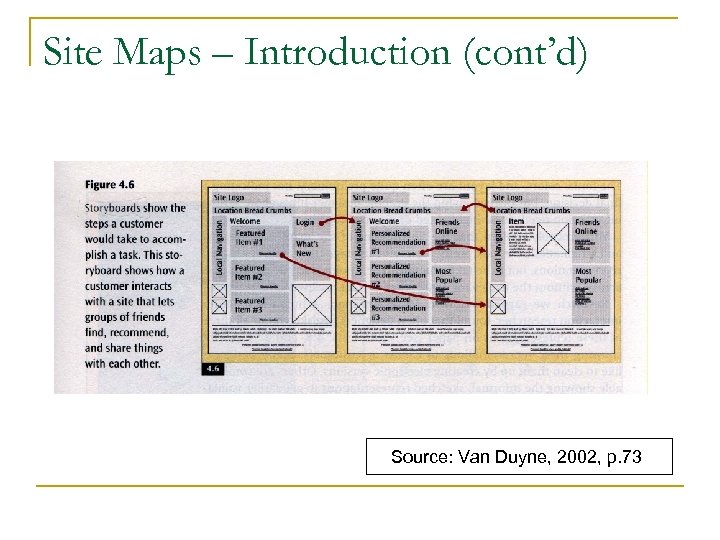 Site Maps – Introduction (cont’d) Source: Van Duyne, 2002, p. 73
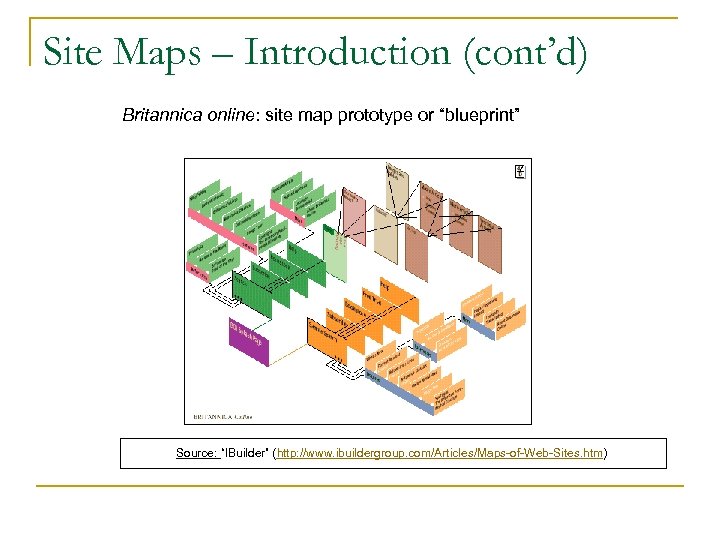 Site Maps – Introduction (cont’d) Britannica online: site map prototype or “blueprint” Source: “IBuilder” (http: //www. ibuildergroup. com/Articles/Maps-of-Web-Sites. htm)
 Site Maps - Discussion n Two kinds of Site Maps: q Organization tool: “blueprint” q Navigation tool: “table of content” n “Table of contents” are not “Indexes” ! § “Candyland Crafts" § “Lawrence Livermore”
 Site Maps - Discussion (cont’d) n A Site Map constitutes a hierarchical arrangements of data q q Structure of the site Relationship among subjects within the content of the site n n Book’s “Table of Contents” metaphor Two kind of “finding” activities: browsing and searching (Rosenfeld & Morville, p. 170) q q Browsing site maps Searching indexes
 Site Maps - Discussion (cont’d) n Kinds of Site Maps for Navigation q Textual q Graphical q Interactive
 Site Maps - Discussion (cont’d) n Site Maps for Navigation q Careful!. . . New technology can fail!. . q (Ooops…)
 Site Maps - Conclusion n The model of site maps has to be chosen regarding the kind of information the user will look for n Don confuse “Index” with “Table of Contents”! n Morville: “the state of the art in print-based navigation technologies includes tables of contents and back-of-the-book indexes. These tools have stood the test of time because they work” (Mapping your web site, 2002, Commandment #2, ¶). n Use Index and Table of Contents (“Site Maps”) as complimentary tools for your web site
 Site Maps - Sources “Cybergeography”: http: //www. cybergeography. org/atlas. html “i. Builder”: http: //www. ibuildergroup. com/Articles/Maps-of. Web-Sites. htm “Mappa Mundi” http: //mappa. mundi. net/maps/
 Site Maps - Bibliography n n n Cockburn, A. & Jones, S. (1996). Which way now? Analyzing and easing inadequacies in WWW navigation. International Journal of Human-Computer Studies, 45, 104 -129 Di. Nucci, D. (1998). Getting there from here. Print: America’s Graphic Design Magazine, 52(Sep-Oct), 5. Retrieved October 15, 2002, from http: //www. printmag. com/ Gagnon, G. (2002, February). Mapping your site [Electronic version retreived from http: //www. pcmag. com/article 2/0, 4149, 2992, 00. asp]. PC Magazine, 1 -3 Hart, Ch. W. L. , Maher, D. & Montelongo, M. (1988). Florida Power Light Quality Improvement (QI) Story Exercise (A). Boston, MA: Harvard Business School. Morville. P. (2002). Mapping your web site. Semantic Studios. Retrieved October 15, 2002, from: http: //semanticstudios. com/publications/web_architect/ mapping. html Miksa, F. (2000). A general outline of information entity access control. Retrieved October 4, 2002, from the University of Texas at Austin, LIS 384 K. 8 Blackboard Site: http: //courses. utexas. edu/bin/common/course. pl? course_id=_60544 _1&frame=top Pilgrim, C. J. & Leung, Y. K. (1999). Designing WWW Site Map Systems. Paper presented at the 10 th International Workshop on Database & Expert Systems Applications, held on September 01 - 03, 1999 in Florence, Italy. Retrieved October 15, 2002, from: http: //www. computer. org/proceedings/dexa/0281/ 02810253 abs. htm Rosenfeld, L. & Morville, P. (2002). Information Architecture for the World Wide Web. 2 nd ed. Cambridge, MA: O’Reilly. Shneiderman, B. (1997). Designing information-abundant web sites: issues and recommendations. International Journal of Human-Computer Studies, 47, 5 -29 Sifer, M. & Liechti, O. (1999). Zooming in One Dimension Can Be Better Than Two: An Interface for Placing Search Results in Context with a Restricted Sitemap , Hiroshima University. Paper presented at the IEEE Symposium on Visual Languages held on September 13 - 16, 1999 in Tokyo, Japan. Retrieved October 15, 2002, from the IEE web page: http: //www. computer. org/proceedings/vl/02160072 abs. htm Van Duyne, Landay, J. A. & Hong, J. I. (2002). The Design of Sites: Patterns, Principles and Processes for Crafting a Customer-Centered Web Experience. Boston: Addison-Wesley