


 Скачать презентацию Linking Police and Hospital Data The Israeli
69e5f4a25909cb623d5facb1fc6d5c41.ppt
- Количество слайдов: 26
 Linking Police and Hospital Data – The Israeli Experience Orit Yalon – Shuqrun Israel Central Bureau of Statistics 31. 11. 09 1
 Israel Central Bureau of Statistics – The legal basis The Statistics Act: Obligation to provide data Obligation to guard data confidentiality ICBS is the only institution which is allowed to link identified records 2
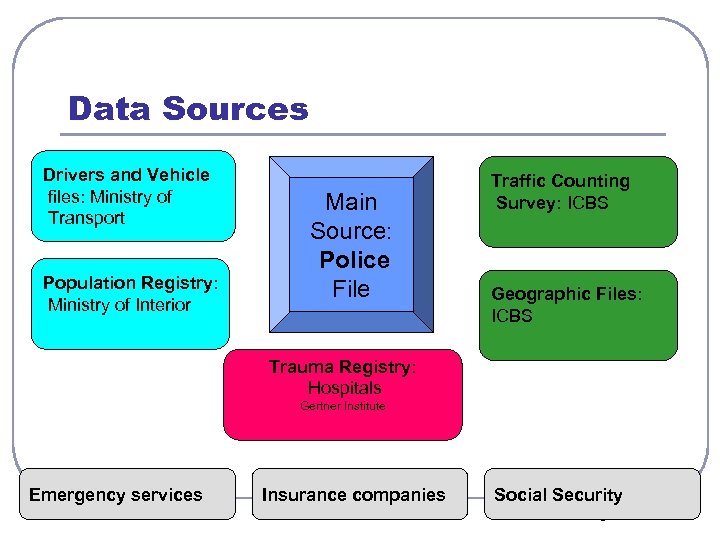 Data Sources Drivers and Vehicle files: Ministry of Transport Population Registry: Ministry of Interior Main Source: Police File Traffic Counting Survey: ICBS Geographic Files: ICBS Trauma Registry: Hospitals Gertner Institute Emergency services Insurance companies Social Security 3
 Dissemination of data on Road Accidents Accumulated detailed data on a monthly, quarterly and yearly basis. Our publications, files, table generator and map generator are available free of charge on the ICBS website, and can also be purchased in printed or digital formats 4
 Background (1) l l Data on road accidents are analyzed at ICBS mainly on the basis of the Road Accidents file that is received monthly from the Israel Police There was a claim that there are more severely injured casualties in road accidents that are hospitalized than are reported by the police 5
 Background (2) l l Due to this claim ICBS, funded by the Israel National Road Safety Authority, conducted research in 2004 which compared between data on casualties in road accidents from the Police and hospitals (9 trauma centers), for 2002 Purpose of research: • Enriching the existing information at ICBS • Expanding the existing databases 6
 Research results (1) l The results from comparing the files show that most of the variables are similar, but there are differences in the variables describing severity of injury and severity of accident Severity of injury – definition of ‘seriously injured’: A person who was hospitalized as a result of a road accident for a period of 24 hours or more, not for observation only 7
 Research results (2) l l l The analysis of severity of injury was done according to the length of hospitalization found in the hospital file It was found that of the casualties listed in both files, in the hospital file there were approximately double the amount of seriously injured than in the police file These seriously injured casualties were listed in the police file as slightly injured 8
 Presentation of research results l l l The Israel National Road Safety Authority (NRSA) Representative of the Israel Police Gertner Institute, The Israel National Center for Trauma & Emergency Medicine Research l The Public Advisory Committee on the road accident database (composed of members from different government agencies, Universities, and of course the Israel National Road Safety Authority and ICBS). 9
 Main decisions of the Public Advisory Committee l l l Police data will continue to be the main data source. Data from other sources should be used to supplement, enrich and verify it. Severity of injury will continue to be based on length of hospitalization (24 h) The variable ‘length of hospitalization’ set by the hospital will determine the severity of the injury 10
 Attaining trauma data l During the years 2005 -2008 great efforts were made to attain data from the hospitals: • The structure of the file was defined • A technological system was developed to record • the data and implemented in most of the hospitals An agreement was signed between NRSA and Gertner Institute to fund a part time job for a data recorder in each of the hospitals 11
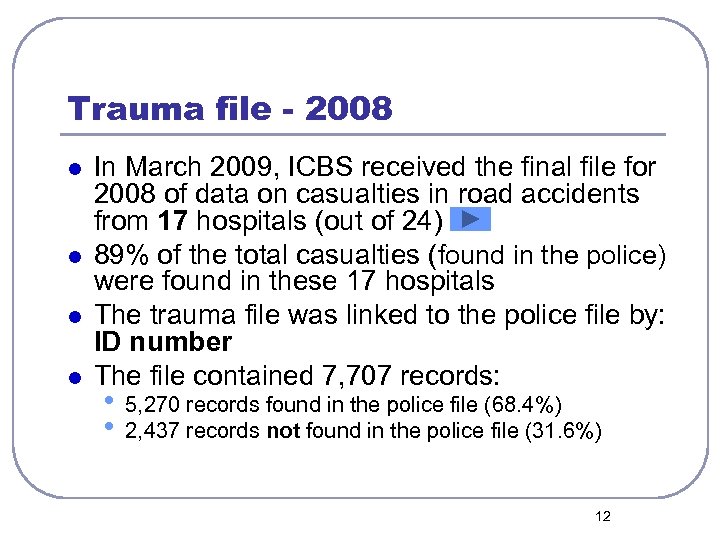 Trauma file - 2008 l l In March 2009, ICBS received the final file for 2008 of data on casualties in road accidents from 17 hospitals (out of 24) 89% of the total casualties (found in the police) were found in these 17 hospitals The trauma file was linked to the police file by: ID number The file contained 7, 707 records: • • 5, 270 records found in the police file (68. 4%) 2, 437 records not found in the police file (31. 6%) 12
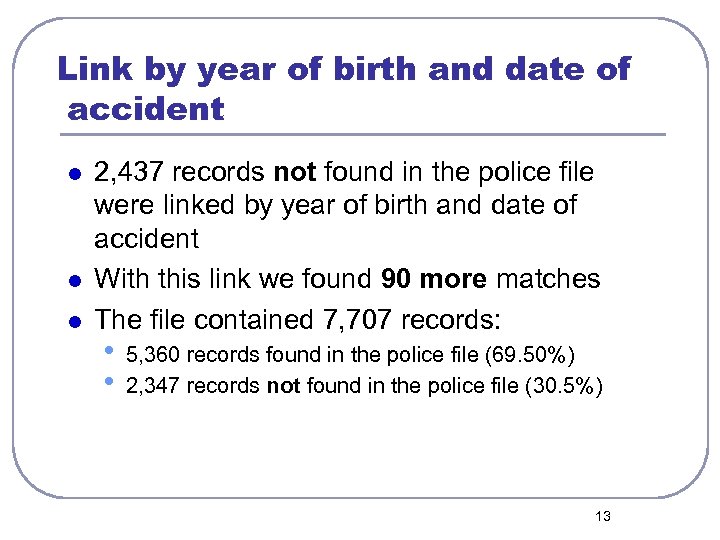 Link by year of birth and date of accident l l l 2, 437 records not found in the police file were linked by year of birth and date of accident With this link we found 90 more matches The file contained 7, 707 records: • • 5, 360 records found in the police file (69. 50%) 2, 347 records not found in the police file (30. 5%) 13
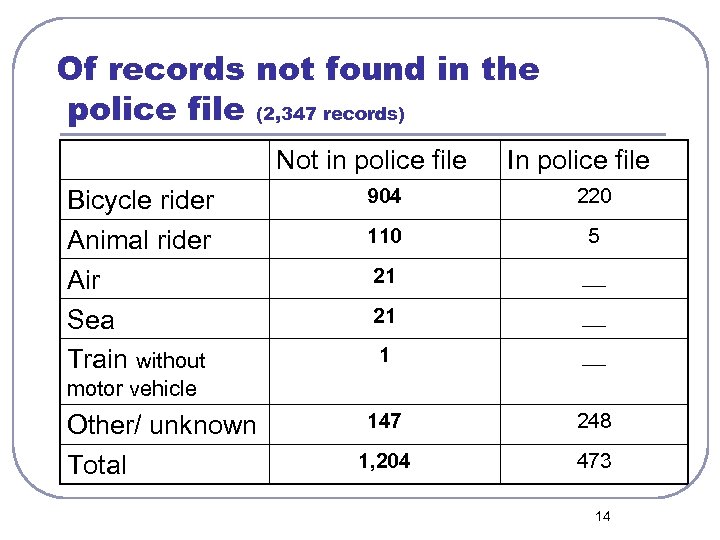 Of records not found in the police file (2, 347 records) Not in police file Bicycle rider Animal rider Air Sea Train without In police file 904 220 110 5 21 __ 147 248 1, 204 473 motor vehicle Other/ unknown Total 14
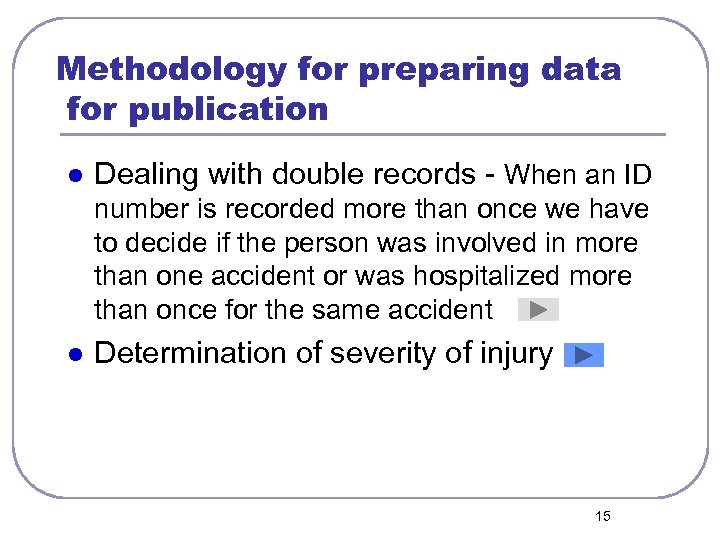 Methodology for preparing data for publication l Dealing with double records - When an ID number is recorded more than once we have to decide if the person was involved in more than one accident or was hospitalized more than once for the same accident l Determination of severity of injury 15
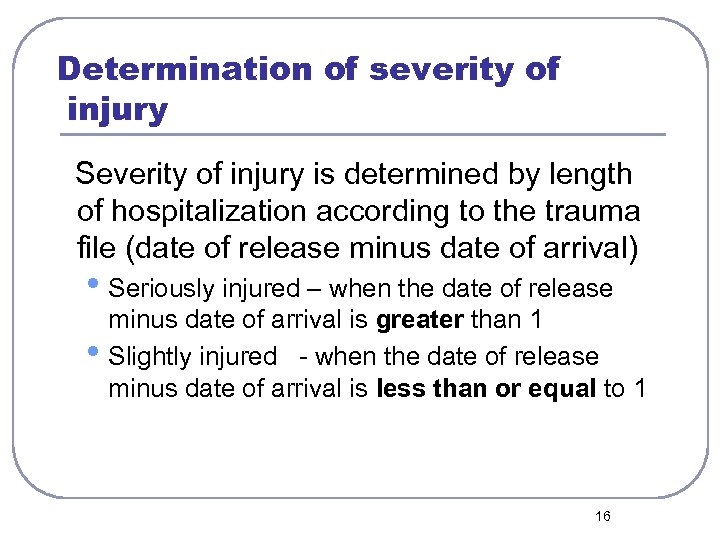 Determination of severity of injury Severity of injury is determined by length of hospitalization according to the trauma file (date of release minus date of arrival) • Seriously injured – when the date of release • minus date of arrival is greater than 1 Slightly injured - when the date of release minus date of arrival is less than or equal to 1 16
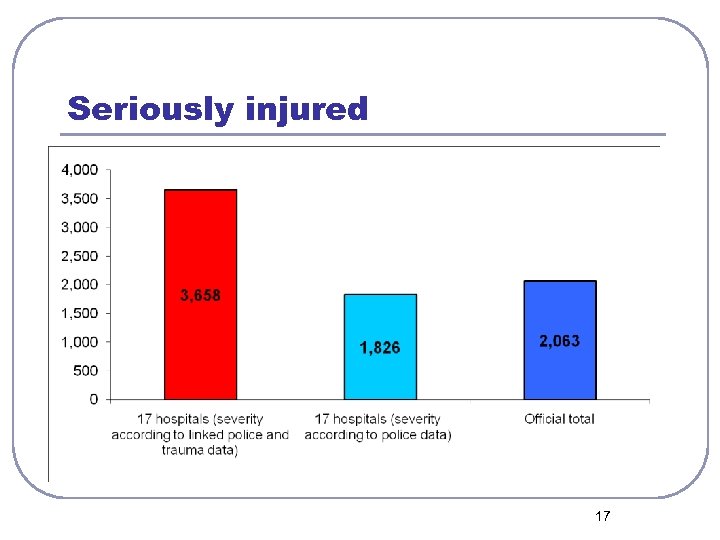 Seriously injured 17
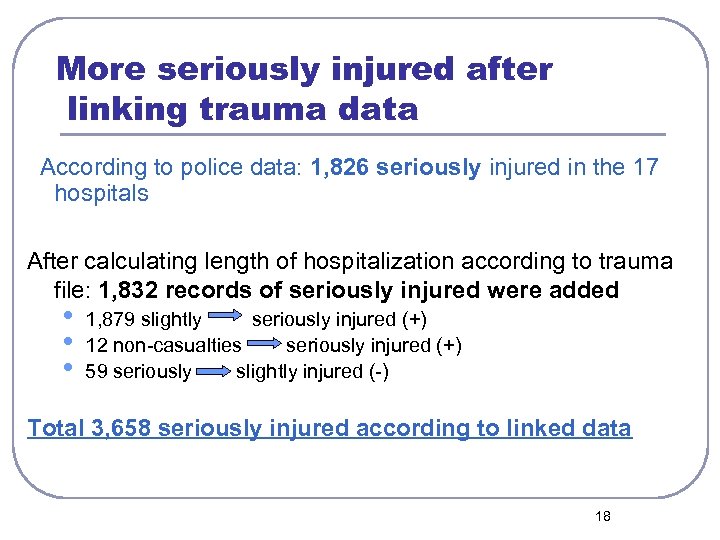 More seriously injured after linking trauma data According to police data: 1, 826 seriously injured in the 17 hospitals After calculating length of hospitalization according to trauma file: 1, 832 records of seriously injured were added • • • 1, 879 slightly seriously injured (+) 12 non-casualties seriously injured (+) 59 seriously slightly injured (-) Total 3, 658 seriously injured according to linked data 18
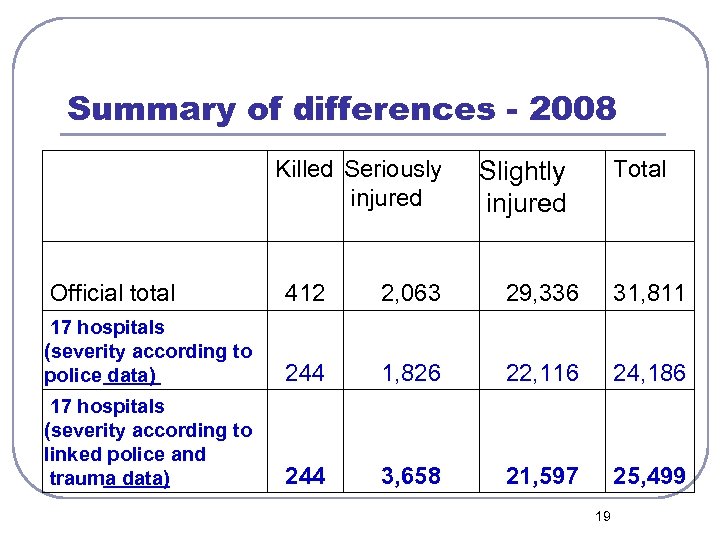 Summary of differences - 2008 Killed Seriously injured Total Slightly injured Official total 412 2, 063 29, 336 31, 811 17 hospitals (severity according to police data) 244 1, 826 22, 116 24, 186 17 hospitals (severity according to linked police and trauma data) 244 3, 658 21, 597 25, 499 19
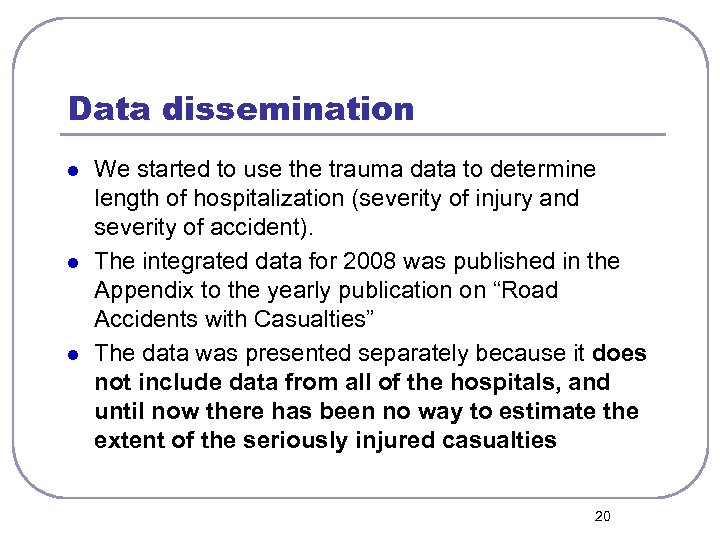 Data dissemination l l l We started to use the trauma data to determine length of hospitalization (severity of injury and severity of accident). The integrated data for 2008 was published in the Appendix to the yearly publication on “Road Accidents with Casualties” The data was presented separately because it does not include data from all of the hospitals, and until now there has been no way to estimate the extent of the seriously injured casualties 20
 Ongoing improvements (1) Problem of adhering to definition: Seriously injured = A person who was hospitalized as a result of a road accident for a period of 24 hours or more, not for observation only l It is difficult to filter out casualties who were hospitalized for observation only l Calculating 24 hours is problematic because the variable “time of release” is unreliable 21
 Ongoing improvements (2) l Lack of completeness - Data was received from only 17 hospitals, although there are more than 24 hospitals that deal with road accidents casualties, therefore the data was published separately Recently 2 hospitals have expressed readiness to join the trauma registry and we hope they will join soon 22
 23
23
 Selected variables in the file ID number, first name, last name, population group, age, sex, hospital, date of arrival to hospital, date of release from hospital, ISS (measure of severity of injury), destination after release, type of evacuation vehicle, type of casualty, location in vehicle, use of safety devices, type of accident, type of vehicle 24
 Examples for dealing with double records (1) l l Identical trauma ID numbers with different final digits - we assume that it is the same accident Date of release from hospital of one record is identical to date of arrival at 2 nd hospital of the other record – we assume that it is the same accident. We choose the earliest date of arrival from the 1 st record and date of release from the 2 nd record 25
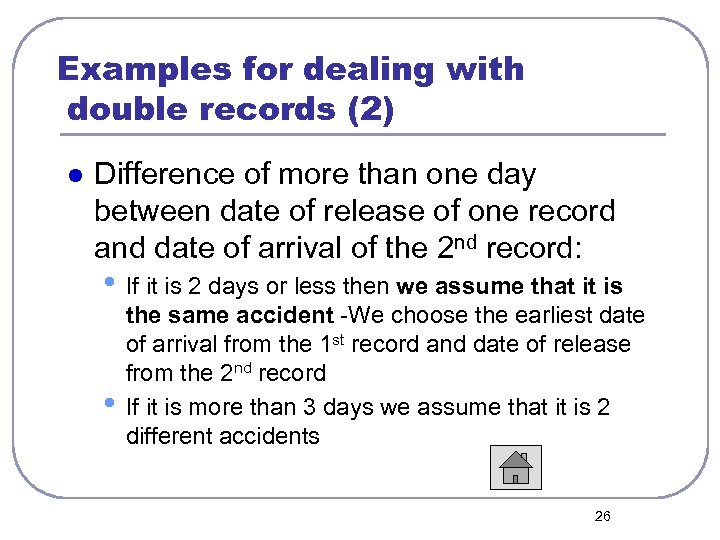 Examples for dealing with double records (2) l Difference of more than one day between date of release of one record and date of arrival of the 2 nd record: • If it is 2 days or less then we assume that it is • the same accident -We choose the earliest date of arrival from the 1 st record and date of release from the 2 nd record If it is more than 3 days we assume that it is 2 different accidents 26