


 Скачать презентацию Linguistics week 3 What is language 2 Phonetics
aa6f2409507ab8a4cf3514e70f9ab2e0.ppt
- Количество слайдов: 22
 Linguistics week 3 What is language? 2 Phonetics and Phonology 1
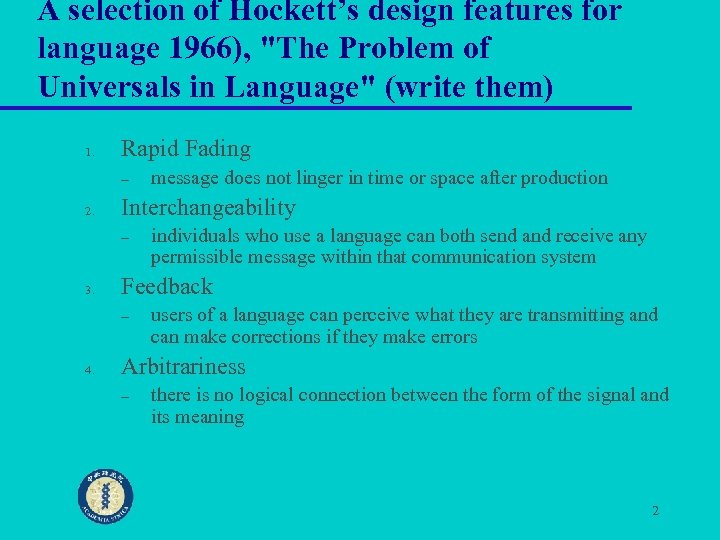 A selection of Hockett’s design features for language 1966), "The Problem of Universals in Language" (write them) 1. Rapid Fading – 2. Interchangeability – 3. individuals who use a language can both send and receive any permissible message within that communication system Feedback – 4. message does not linger in time or space after production users of a language can perceive what they are transmitting and can make corrections if they make errors Arbitrariness – there is no logical connection between the form of the signal and its meaning 2
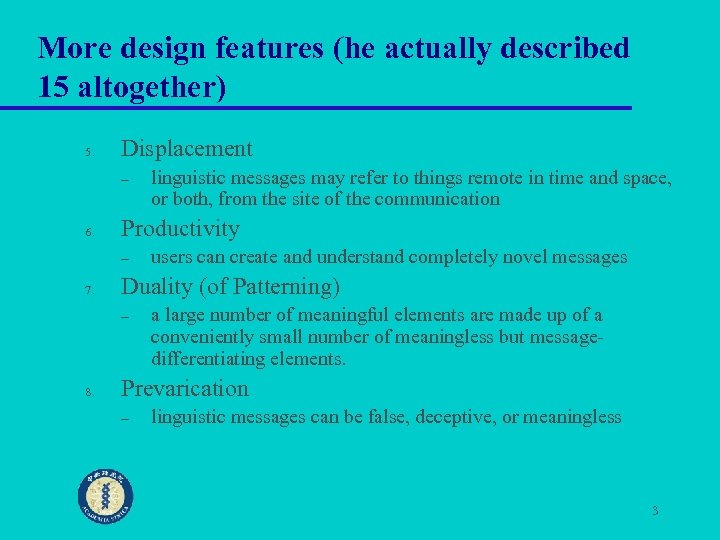 More design features (he actually described 15 altogether) 5. Displacement – 6. Productivity – 7. users can create and understand completely novel messages Duality (of Patterning) – 8. linguistic messages may refer to things remote in time and space, or both, from the site of the communication a large number of meaningful elements are made up of a conveniently small number of meaningless but messagedifferentiating elements. Prevarication – linguistic messages can be false, deceptive, or meaningless 3
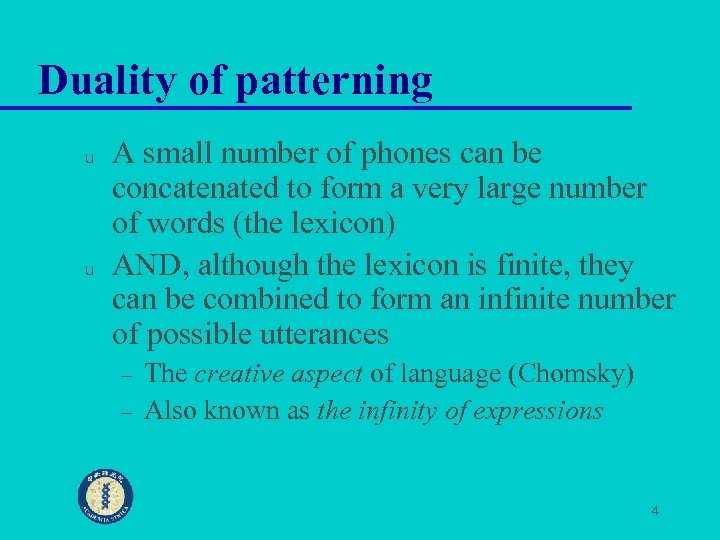 Duality of patterning u u A small number of phones can be concatenated to form a very large number of words (the lexicon) AND, although the lexicon is finite, they can be combined to form an infinite number of possible utterances – – The creative aspect of language (Chomsky) Also known as the infinity of expressions 4
 The infinity of expressions u There is no upper limit on sentence length – – u u Some interesting examples on page 10 “One is a number…” We can be almost as creative as we wish in forming new sentences Probably, no-one has ever said before: – – “Ming Chuan linguistics students usually ride motorbikes through Manchester, wearing moccasins and carrying a mop-bucket” The utterance is “pragmatically odd”: it makes sense, but… 5
 So, is anything possible? Can we create any utterance we want? u Maybe, a good utterance must “make sense”? – – u But some utterances are impossible – u WRONG!: Chomsky gave the famous example “Colorless green ideas sleep furiously” This is syntactically well-formed (although semantically it is ill-formed) “Sleep ideas colorless green furiously” is syntactically ill-formed page 11 here, practise prag, sem, synt i/f utts in chin 6
 So, what utterances are OK? u We have – – u a finite lexicon an infinite number of possible utterances no room in our brains to store all those utterances no requirement to make sense… So how is it decided? 7
 Our linguistic knowledge u u (=our knowledge of our own language) This consists of – – A lexicon (a finite number of words) A grammar (count noun!): that is, a finite set of rules stating what is possible » Note that we are not consciously aware of what these rules are; like the rules for muscle control! 8
 Back to what linguists do! u Finite lexicon + finite set of rules (grammar) u infinity of expressions Lexicon: easy. - Buy a dictionary. u Grammar: difficult. - This is what linguists do 9
 Phonetics: the sounds of language u Not language-specific – – u Describes sounds produced in any or all languages Phonology describes the sound patterns in particular languages, like English or Chinese For example – – This is how to make the sound [p] The consonant cluster /pr/ is OK in English, not in Chinese 10
 Conveying a linguistic message (diagram of this slide and next on board) 1. 2. 3. 4. An idea in speaker’s mind: semantic representation Then, a lexical (words) and grammatical realization of the idea A phonological representation, in the speaker’s mind Next… 11
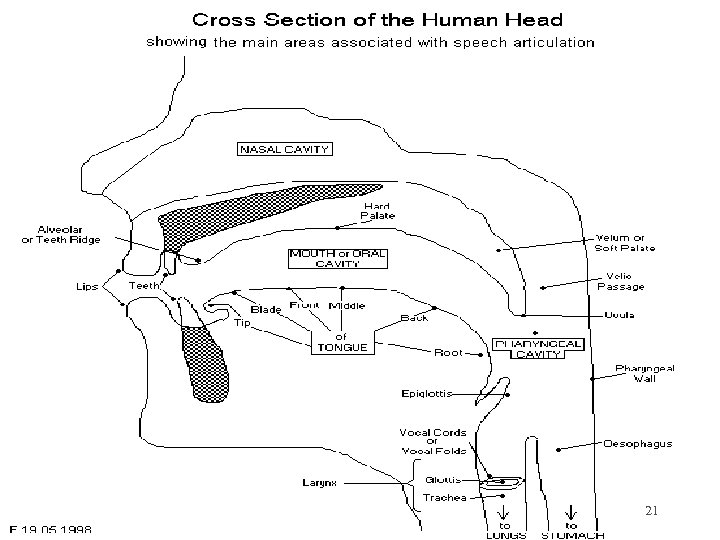
 Conveying a linguistic message: three phonetic phases (p 41) u Articulatory phonetics – – u Acoustic phonetics – u How the sound signal travels through the air Auditory phonetics – u How the speaker uses the organs of speech to produce the sound This is the phase that we are most interested in, for this class How the acoustic signal is perceived, including studies of the ear (Of course, the final non-phonetic stages involve interpretation of the message by the hearer… right up to pragmatic level) 12
 Phones: sound segments u u When we know a language, we can segment an utterance into phones We can do this even though there is no break between phones – – u If we don’t know the language, we can’t do this segmentation – u Cat has 3 phones But we don’t say k—a—t It just sounds like one continuous stream of sound Actually all language is one continuous stream of sound – – The tongue (and other moving parts) move gradually They don’t jump between positions 13
 How many phones? Say them to your neighbor. u u u Dog? Rabbit? Phone Knot Comb China 14
 Two kinds of segment: consonants and vowels u u Consonants: air flow from lungs is obstructed in some way (p 48) Vowels: the air flows freely – u Vowels are often represented in English spelling by a e i o u – u This is why doctors ask for “aaaahhh” But spelling pronunciation (p 40) Chinese: – – The consonants are ㄅㄆㄇㄈ… The vowels are ㄚㄛㄜㄝ… (but not always) 15
 Problems with consonant-vowel distinction u Glides (or semivowels) /j/ and /w/ don’t seem to involve much obstruction – u u but most linguists think of them as consonants (check page 46, Approximants) ㄦ causes an obstruction, and is thought of as a consonant by linguists Some of the ㄅㄆㄇ symbols often represent two phones, one consonant and one vowel – Can you say which? 16
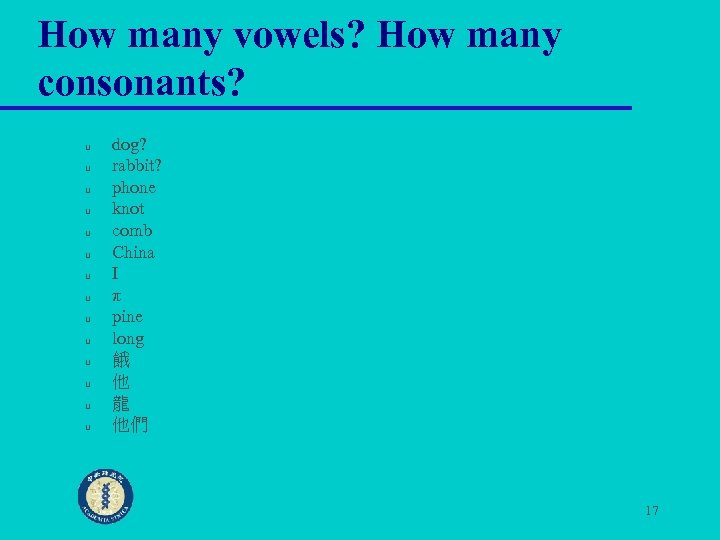 How many vowels? How many consonants? u u u u dog? rabbit? phone knot comb China I π pine long 餓 他 龍 他們 17
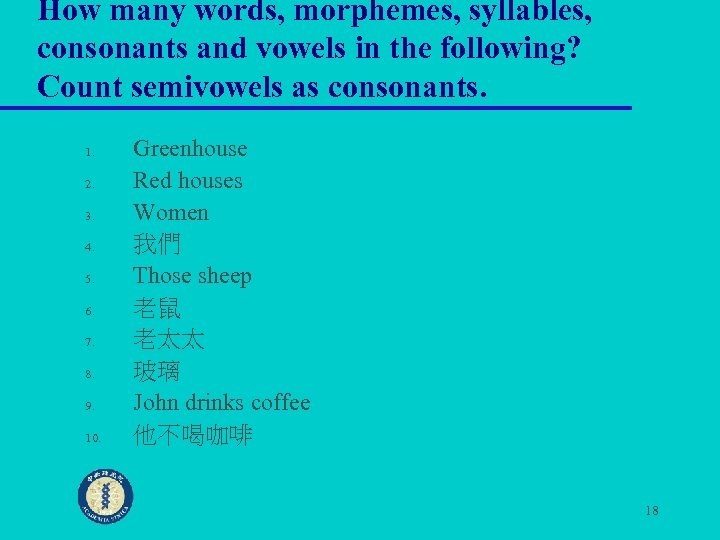 How many words, morphemes, syllables, consonants and vowels in the following? Count semivowels as consonants. 1. 2. 3. 4. 5. 6. 7. 8. 9. 10. Greenhouse Red houses Women 我們 Those sheep 老鼠 老太太 玻璃 John drinks coffee 他不喝咖啡 18
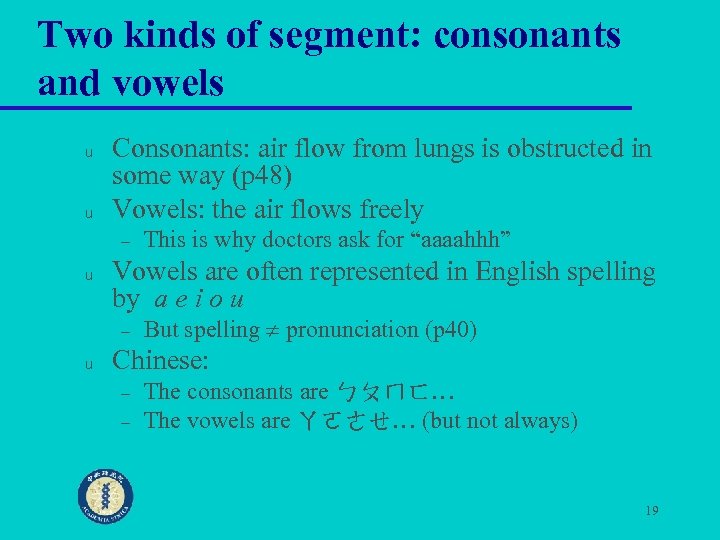 Two kinds of segment: consonants and vowels u u Consonants: air flow from lungs is obstructed in some way (p 48) Vowels: the air flows freely – u Vowels are often represented in English spelling by a e i o u – u This is why doctors ask for “aaaahhh” But spelling pronunciation (p 40) Chinese: – – The consonants are ㄅㄆㄇㄈ… The vowels are ㄚㄛㄜㄝ… (but not always) 19
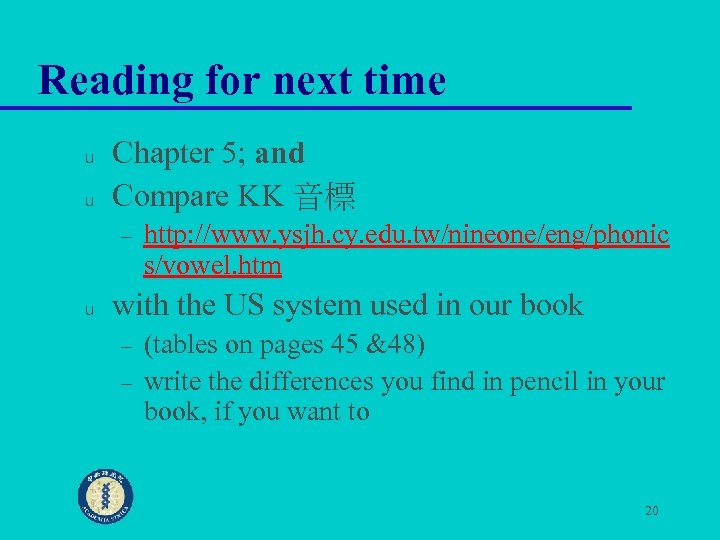 Reading for next time u u Chapter 5; and Compare KK 音標 – u http: //www. ysjh. cy. edu. tw/nineone/eng/phonic s/vowel. htm with the US system used in our book – – (tables on pages 45 &48) write the differences you find in pencil in your book, if you want to 20
 21
21
 Language presentations u Next time (extra credit for being brave!) – – u u 10 -15 minutes Talk about – – – u u Serena: Spanish ? Karen: Japanese Where? Who? How many? Interesting facts about the language Relationship with other languages Sounds of the language Morphology and syntax (= grammar) You can use wikipedia and ethnologue to help you BUT you must also visit the library – – – Borrow books about the language Bring the books to class Tell us your opinion of the books and websites you used 22