


 Скачать презентацию Linguistics week 2 What do linguists do What
686e8ffdc058bebe2d976bfd087bb6ce.ppt
- Количество слайдов: 18
 Linguistics week 2 What do linguists do? What is language? 1
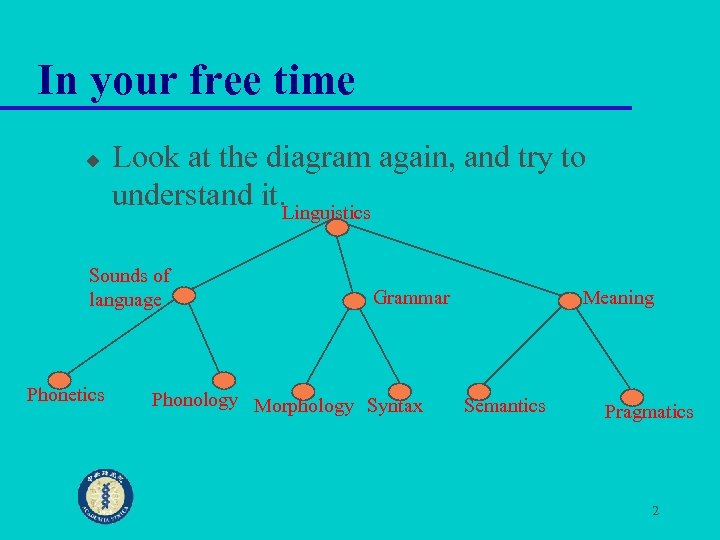 In your free time u Look at the diagram again, and try to understand it. Linguistics Sounds of language Phonetics Grammar Phonology Morphology Syntax Meaning Semantics Pragmatics 2
 And take a look at 分支學科 u On this website – u http: //zh. wikipedia. org/wiki/Wikipedia: %E 8% AF%AD%E 8%A 8%80%E 5%AD%A 6%E 9% A 6%96%E 9%A 1%B 5 And read about Animal “Languages” in Chapter 1 of your book. 3
 Introducing Linguistics u u What do linguists do? Grammar, and other aspects of language Relationships between languages How is linguistics used in the real world? 4
 What do linguists do? u They don’t necessarily “learn languages” – u They are often interested in the structure of languages. They might – – – u specialize in one language, or a group of languages compare different languages study features shared by all languages Many linguists study speech sounds, and grammar – u Linguist and 語言學 are confusing terms What fields, please? A brief outline of some semester 2 topics: 5
 Historical linguistics u How languages are related – Language families » Indo-European, Sino-Tibetan… – Areal linguistics » Greek, Bulgarian – Mostly borrowed words; also shared grammatical features (any examples? ) » Chinese, Korean, Japanese u How language changes over time – – – sounds: poor vs paw, suit. vocab: 咖啡, 颱風. Calque: 摩天大樓, skyscraper, gratte-ciel grammar: Did you eat yet? Adversative passive 被 6
 Sociolinguistics u Diglossia: “high” and “low” prestige languages – – – The role of Mandarin and Taiwanese in a bilingual society Ta-hsüeh-shih-ching The changing role of English in Taiwan society: borrowing, or showing case and size: code-switching, or lexicalized Chinese words? 7
 Applications for linguistics u u Speech disorders Forensic linguistics – – u u Accent detection Style verification (eg police style) Language teaching Computational applications – – – Machine translation Speech recognition and synthesis Language identification 8
 So, what is language? u u u It’s a non-count noun, here – the phenomenon of language Do you think the utterances of parrots and mynah birds count as language? What about the “animal languages” you read about? What about deaf signing? What about the “sign language” you use? What about “body language”? 9
 A selection of Hockett’s design features for language 1966), "The Problem of Universals in Language" (write them) 1. Rapid Fading – 2. Interchangeability – 3. individuals who use a language can both send and receive any permissible message within that communication system Feedback – 4. message does not linger in time or space after production users of a language can perceive what they are transmitting and can make corrections if they make errors Arbitrariness – there is no logical connection between the form of the signal and its meaning 10
 More design features (he actually described 15 altogether) 5. Displacement – 6. Productivity – 7. users can create and understand completely novel messages Duality (of Patterning) – 8. linguistic messages may refer to things remote in time and space, or both, from the site of the communication a large number of meaningful elements are made up of a conveniently small number of meaningless but messagedifferentiating elements. Prevarication – linguistic messages can be false, deceptive, or meaningless 11
 Bee dancing u u http: //www. skylon. co. uk/hba/beekeeping. html#da nce Honey bees perform a sort of dance when they return to the hive, after finding food, which shows – – – u the direction relative to the sun the distance perhaps, the quality of the food source Is it a kind of language? – Does it satisfy any of Hockett’s design features? 12
 Duality of patterning u u A small number of phones can be concatenated to form a very large number of words (the lexicon) AND, although the lexicon is finite, they can be combined to form an infinite number of possible utterances – – The creative aspect of language (Chomsky) Also known as the infinity of expressions 13
 The infinity of expressions u There is no upper limit on sentence length – – u u Some interesting examples on page 10 “One is a number…” We can be almost as creative as we wish in forming new sentences Probably, no-one has ever said before: – – “Ming Chuan linguistics students usually ride motorbikes through Manchester, wearing moccasins and carrying a mop-bucket” The utterance is “pragmatically odd”: it makes sense, but… 14
 So, is anything possible? Can we create any utterance we want? u Maybe, a good utterance must “make sense”? – – u But some utterances are impossible – u WRONG!: Chomsky gave the famous example “Colorless green ideas sleep furiously” This is syntactically well-formed (although semantically it is ill-formed) “Sleep ideas colorless green furiously” is syntactically ill-formed page 11 here, practise prag, sem, synt i/f utts in chin 15
 So, what utterances are OK? u We have – – u a finite lexicon an infinite number of possible utterances no room in our brains to store all those utterances no requirement to make sense… So how is it decided? 16
 Our linguistic knowledge u u (=our knowledge of our own language) This consists of – – A lexicon (a finite number of words) A grammar (count noun!): that is, a finite set of rules stating what is possible » Note that we are not consciously aware of what these rules are; like the rules for muscle control! » Now, we have 3 meanings of the word grammar! 17
 Back to what linguists do! u Finite lexicon + finite set of rules (grammar) u infinity of expressions Lexicon: easy. - Buy a dictionary. u Grammar: difficult. - This is what linguists do 18