


 Скачать презентацию Linguistic features of Germanic languages CONTENTS Phonetics
Linguistic features of Germanic languages.pptx
- Количество слайдов: 14
 Linguistic features of Germanic languages
 CONTENTS Phonetics – 1) word stress 2) vowels 3) consonants Morphology – 1) changing of grammatical forms 2) parts of speech Vocabulary
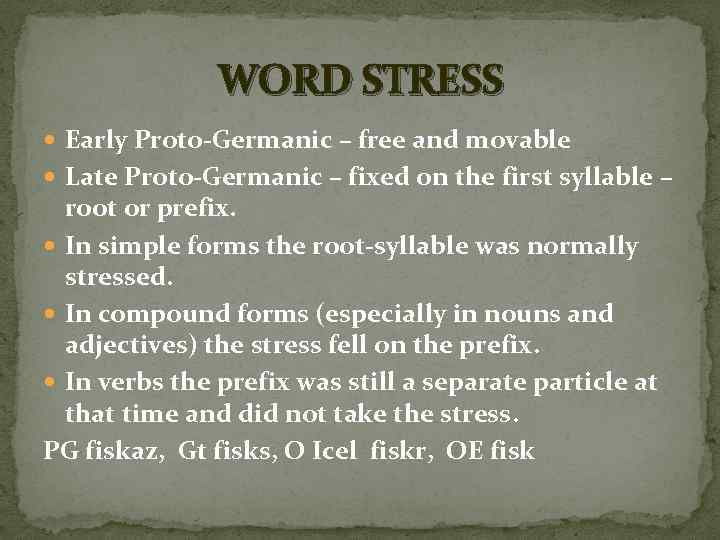 WORD STRESS Early Proto-Germanic – free and movable Late Proto-Germanic – fixed on the first syllable – root or prefix. In simple forms the root-syllable was normally stressed. In compound forms (especially in nouns and adjectives) the stress fell on the prefix. In verbs the prefix was still a separate particle at that time and did not take the stress. PG fiskaz, Gt fisks, O Icel fiskr, OE fisk
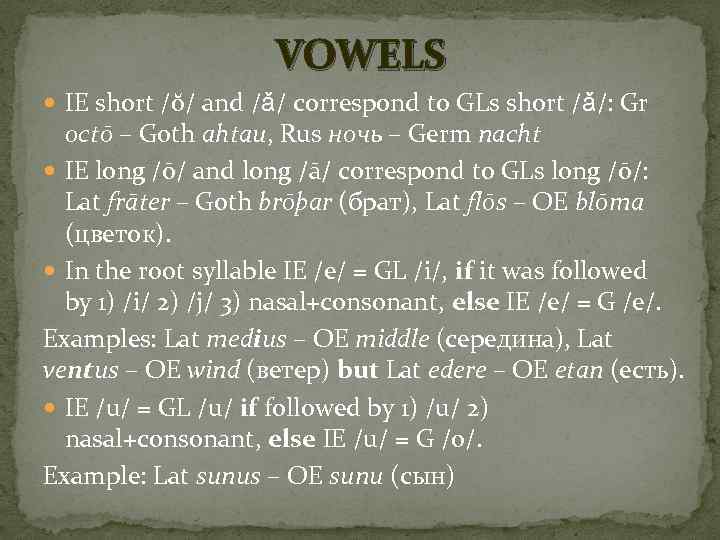 VOWELS IE short /ŏ/ and /ǎ/ correspond to GLs short /ǎ/: Gr octō – Goth ahtau, Rus ночь – Germ nacht IE long /ō/ and long /ā/ correspond to GLs long /ō/: Lat frāter – Goth brōþar (брат), Lat flōs – OE blōma (цветок). In the root syllable IE /e/ = GL /i/, if it was followed by 1) /i/ 2) /j/ 3) nasal+consonant, else IE /e/ = G /e/. Examples: Lat medius – OE middle (середина), Lat ventus – OE wind (ветер) but Lat edere – OE etan (есть). IE /u/ = GL /u/ if followed by 1) /u/ 2) nasal+consonant, else IE /u/ = G /o/. Example: Lat sunus – OE sunu (сын)
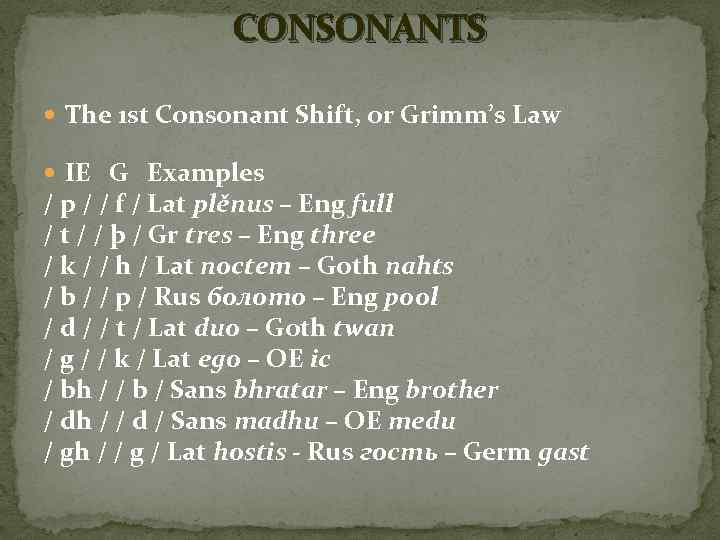 CONSONANTS The 1 st Consonant Shift, or Grimm’s Law IE G Examples / p / / f / Lat plěnus – Eng full / t / / þ / Gr tres – Eng three / k / / h / Lat noctem – Goth nahts / b / / p / Rus болото – Eng pool / d / / t / Lat duo – Goth twan / g / / k / Lat ego – OE ic / bh / / b / Sans bhratar – Eng brother / dh / / d / Sans madhu – OE medu / gh / / g / Lat hostis - Rus гость – Germ gast
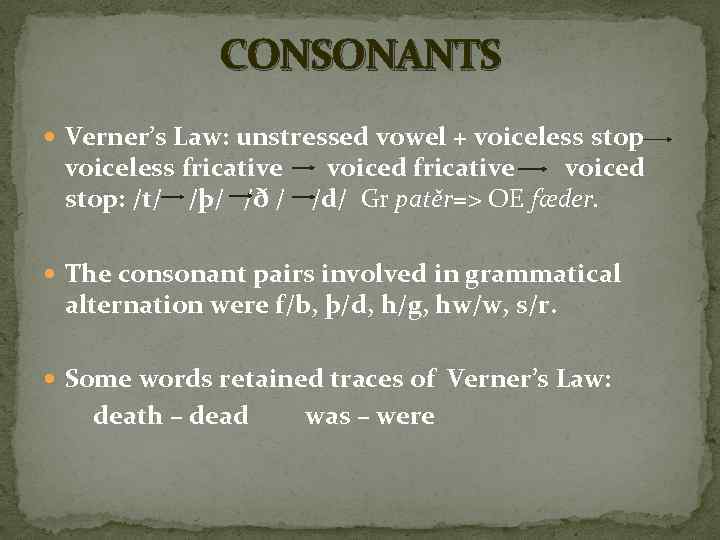 CONSONANTS Verner’s Law: unstressed vowel + voiceless stop voiceless fricative voiced stop: /t/ /þ/ /ð / /d/ Gr patěr=> OE fæder. The consonant pairs involved in grammatical alternation were f/b, þ/d, h/g, hw/w, s/r. Some words retained traces of Verner’s Law: death – dead was – were
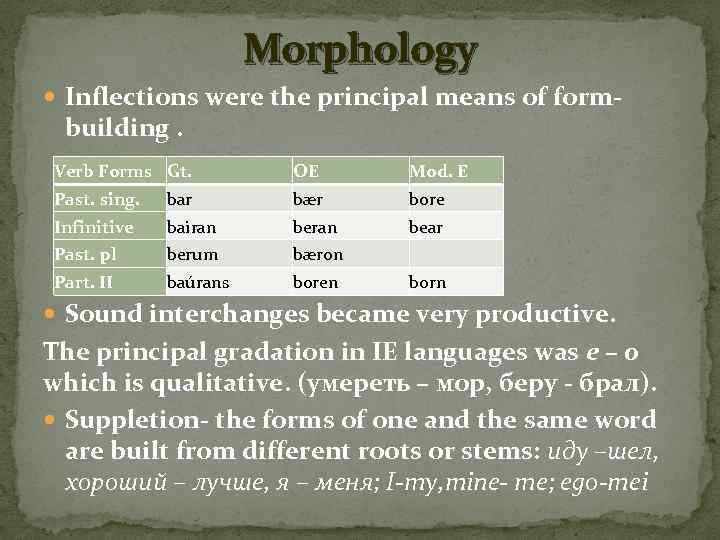 Morphology Inflections were the principal means of form- building. Verb Forms Gt. OE Mod. E Past. sing. bar bær bore Infinitive bairan bear Past. pl berum bæron Part. II baúrans boren born Sound interchanges became very productive. The principal gradation in IE languages was e – o which is qualitative. (умереть – мор, беру - брал). Suppletion- the forms of one and the same word are built from different roots or stems: иду –шел, хороший – лучше, я – меня; I-my, mine- me; ego-mei
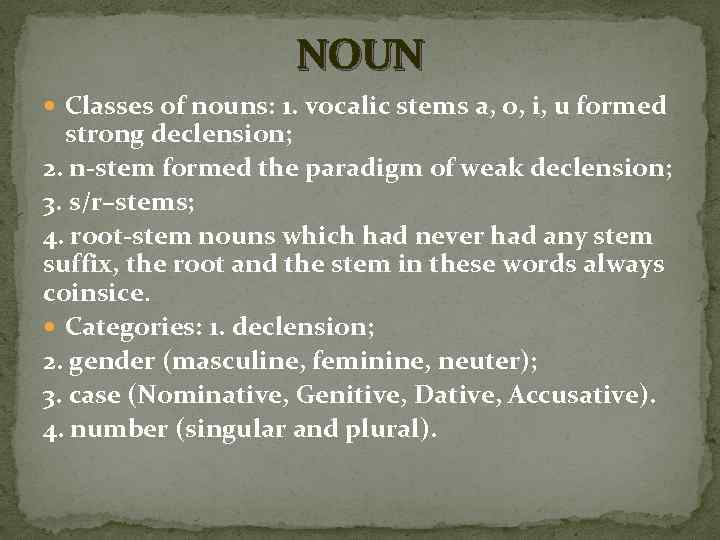 NOUN Classes of nouns: 1. vocalic stems a, o, i, u formed strong declension; 2. n-stem formed the paradigm of weak declension; 3. s/r–stems; 4. root-stem nouns which had never had any stem suffix, the root and the stem in these words always coinsice. Categories: 1. declension; 2. gender (masculine, feminine, neuter); 3. case (Nominative, Genitive, Dative, Accusative). 4. number (singular and plural).
 ADJECTIVE Adjective declension in all GLs has no parallel with other IE languages. 1. strong declension which is a combination of substantival and pronominal endings; 2. weak declenstion which reflected the declension of n-stem substantives. Categories: 1. gender; 2. number; 3. case; 4. degrees of comparison (positive, comparative, superlative). Comparative degree was built by means of the suffixes –iza, -oza; superlative degree was built with the suffixes –ist, -ost.
 PRONOUNS The oldest classes are personal, demonstrative and interrogative. Personal pronoun had only two persons, the 3 rd person developed later from the demonstrative pronouns. Another ancient feature was the dual number of personal pronouns (ic – wit – wē; þu – ʒit – ʒē ).
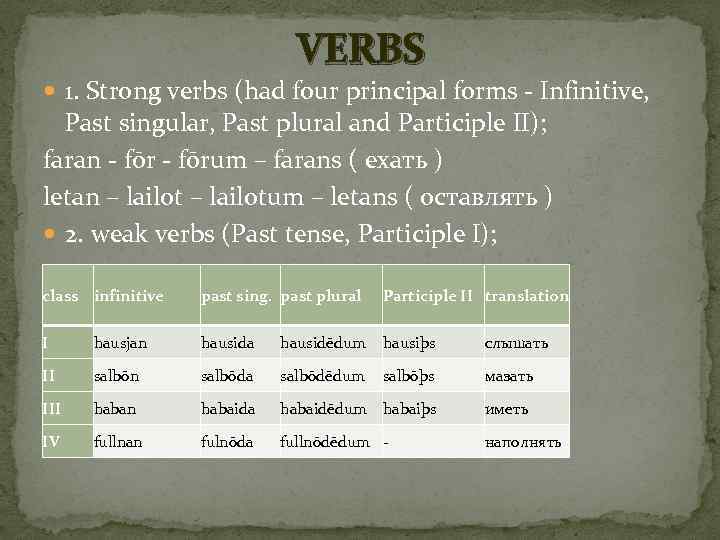 VERBS 1. Strong verbs (had four principal forms - Infinitive, Past singular, Past plural and Participle II); faran - fōrum – farans ( ехать ) letan – lailotum – letans ( оставлять ) 2. weak verbs (Past tense, Participle I); class infinitive past sing. past plural Participle II translation I hausjan hausida hausidēdum hausiþs слышать II salbōn salbōda salbōdēdum salbōþs мазать III haban habaida habaidēdum habaiþs иметь IV fullnan fulnōda fullnōdēdum - наполнять
 VERBS 3. united preterit-present verbs (used vowel gradation to derive the forms of the present tense while their form of the preterit was build with the help of the dental suffix. . Examples: OE wītan (inf) - wāt (pres sg) – wĭton (pres pl) – wiste (pret sg) – wiston (pret pl) - ʓewiten (P 2) (знать). Here belong modal verbs , verbs denoting possession and verbs denoting estimation. Categories: 1. number; 2. tense (Present and Past); 3. mood (indicative, imperative and subjunctive);
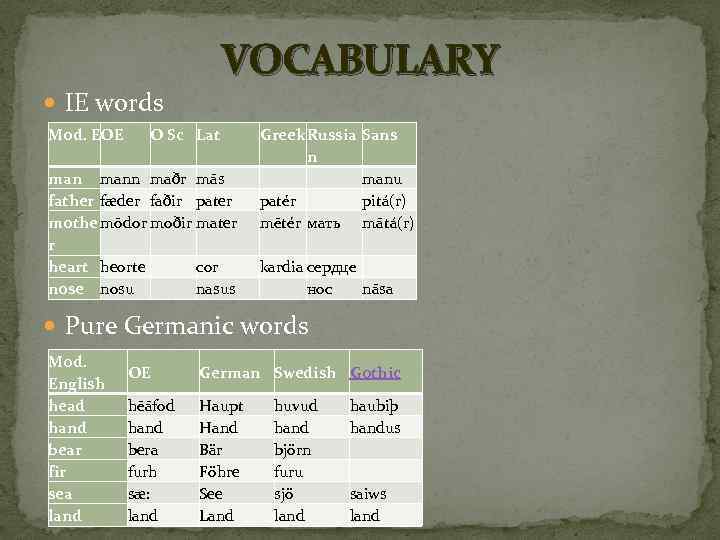 IE words Mod. E E O VOCABULARY O Sc Lat mann maðr mās father fæder faðir pater mothe mōdor moðir mater r heart heorte cor nose nosu nasus Greek Russia Sans n manu patér pitá(r) mētér мать mātá(r) kardia сердце нос nāsa Pure Germanic words Mod. English head hand bear fir sea land OE German Swedish Gothic hēāfod hand bera furh sæ: land Haupt Hand Bär Föhre See Land huvud hand björn furu sjö land haubiþ handus saiws land
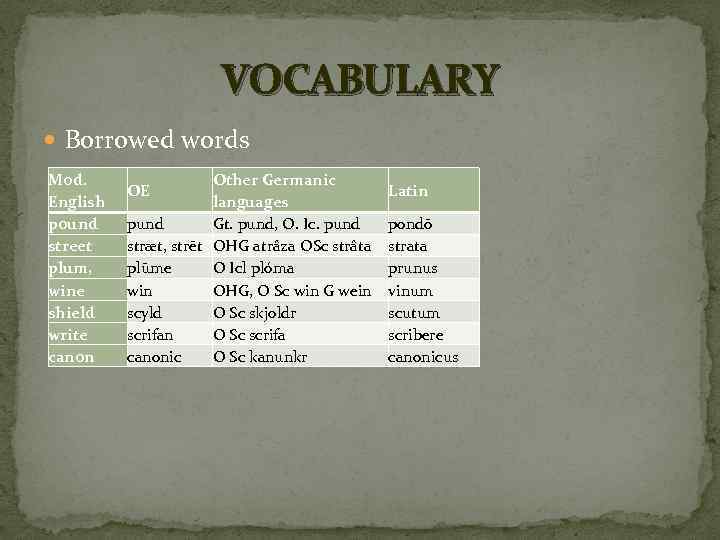 VOCABULARY Borrowed words Mod. English pound street plum, wine shield write canon Other Germanic languages pund Gt. pund, O. Ic. pund stræt, strēt OHG atrâza OSc strâta plūme O Icl plóma win OHG, O Sc win G wein scyld O Sc skjoldr scrifan O Sc scrifa canonic O Sc kanunkr OE Latin pondō strata prunus vinum scutum scribere canonicus