


 Скачать презентацию LINGUE IN PIAZZA Ref 225857 -CP-1 -2005
b82b52efdece98aaabdcc7b0cedb82de.ppt
- Количество слайдов: 24
 “LINGUE IN PIAZZA” . Ref. 225857 -CP-1 -2005 -1 -IT-LINGUA-L 1 Autonomy in language learning
 Autonomous learning means: Control over the learning process n Acquiring learning strategies n Acquiring ways to use these strategies without the help of a teacher (Thomson -1996 – we are born independent students but when we learn a language , autonomousn learning becomes difficult and we prefer the direction of a teacher) n More control over objectives n More control over the ways in which we learn n
 Autonomous learning n Offers learners the freedom to take decisions on: - content - organization - pace of study
 An autonomous learner is: n n n n n Methodical and disciplined Logical and analytical reflective flexible Responsible and persistent Creative and willing to take risks confident Aware of the learning process Able to assess and criticise
 Before starting n n n n n I must accept responsibilty for my studies I must understand the aims of my studies I must know my level of English I must identify my immediate aims I must plan my learning programme. The use of a diary is useful. When the student writes a learning plan, the level of involvement increases – Martyn 1994 I must identify learning problems I must be able to select I must understand the learning process I must measure my progress from time to time
 The autonomous student doesn’t need to be alone! Autonomous learning does not mean isolated learning. Several studies have shown that many aspects of learning are best done with other students n Study groups n Tandem n chat n
 Why is English so difficult? n There are so many words! There are more words in English than in any other language in the world. English is a Germanic language but with the Norman conquest, many new words entered the language from French and Latin. For example, the Anglo-Saxons had two words for cooking - cook and bake but the French who were perhaps better cooks – introduced many more words – fry, grill, roast. In the Renaissance, the English language was considered to be inferior so many words were introduced from French, Italian and Spanish. For this reason, we often have two or more words when one would be enough! Freedom (Anglo-Saxon) liberty (French) Graveyard (Anglo-Saxon) cemetery (French) Heaven (Anglo-Saxon) paradise (French) n Read ‘about the language’ www. lingueinpiazza. it n n
 Why is English so difficult? The spoken word often does not reflect the written version n The English and Americans eat their words! n The pronunciation is difficult n It is not a logical language and there are many exceptions to the rules n
 But there are some advantages! The structure of English is quite simple. There are no cases or declinations – the relationship of words depends on word order. Nouns do not have a gender and the adjectives do not change n Considering the ubiquity of the English language, it is quite easy to find ways to learn it autonomously – 70% of Internet sites are in English for example and many world famous musicians are English or American n
 Why don’t you write English as you speak it? n n The main reasons date back to the Middle Ages when the written language was more or less fixed. There are various different dialects in Britain and in the 13° century, everyone wrote in his own dialect. Then the London dialect became the official written language. The dialect of London changed over the centuries but the written version remained the same. Therefore we still have the written language of seven centuries ago though the spoken language has changed. For example, the pronunciation of vowels has changed and many consonants are no longer pronounced in certain words (Wednesday, know, gnome, scientist)
 n Another problem goes back to the Norman conquest. The Norman scribes wrote English according to French writing conventions. For example, the word ‘country’ was pronounced ‘cuntri’ by the Anglo-Saxons but the French wrote ‘ou’ for the ‘u’ sound
 n In the eigthteenth century, scholars tried to improve the language by inserting consonants to indicate the Latin origin of the word. No English person has ever pronounced the ‘s’ in the word ‘island’ – it was put in to indicate the Latin root – as in castle, debt, doubt, receipt, tomb
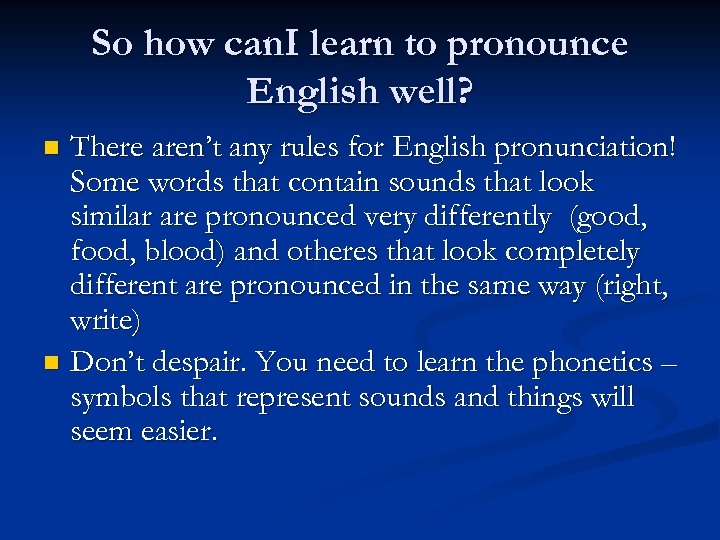 So how can. I learn to pronounce English well? There aren’t any rules for English pronunciation! Some words that contain sounds that look similar are pronounced very differently (good, food, blood) and otheres that look completely different are pronounced in the same way (right, write) n Don’t despair. You need to learn the phonetics – symbols that represent sounds and things will seem easier. n
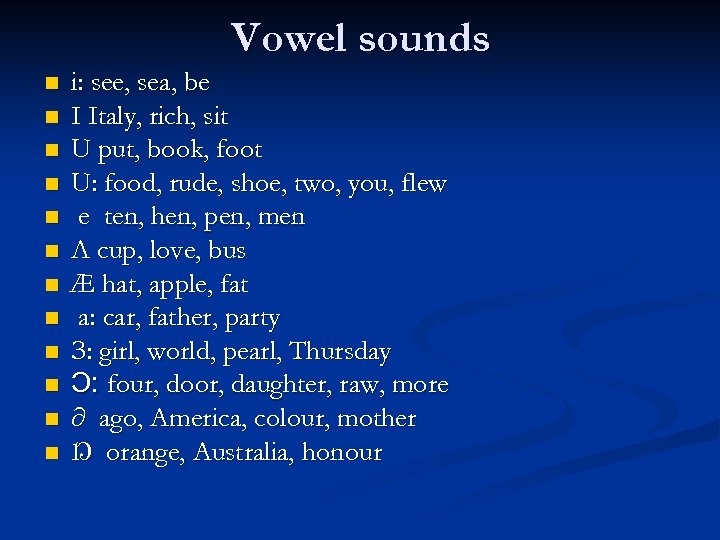 Vowel sounds n n n i: see, sea, be I Italy, rich, sit U put, book, foot U: food, rude, shoe, two, you, flew e ten, hen, pen, men Λ cup, love, bus Æ hat, apple, fat a: car, father, party З: girl, world, pearl, Thursday Ɔ: four, door, daughter, raw, more ∂ ago, America, colour, mother Ŋ orange, Australia, honour
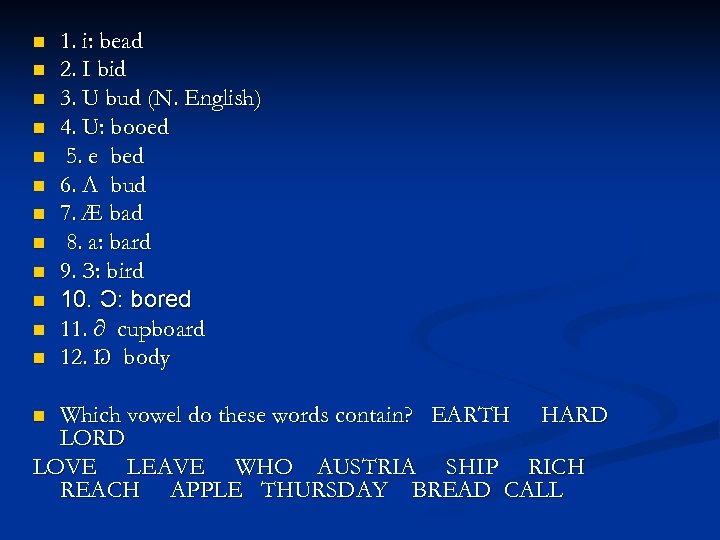 n n n 1. i: bead 2. I bid 3. U bud (N. English) 4. U: booed 5. e bed 6. Λ bud 7. Æ bad 8. a: bard 9. З: bird 10. Ɔ: bored 11. ∂ cupboard 12. Ŋ body Which vowel do these words contain? EARTH HARD LOVE LEAVE WHO AUSTRIA SHIP RICH REACH APPLE THURSDAY BREAD CALL n
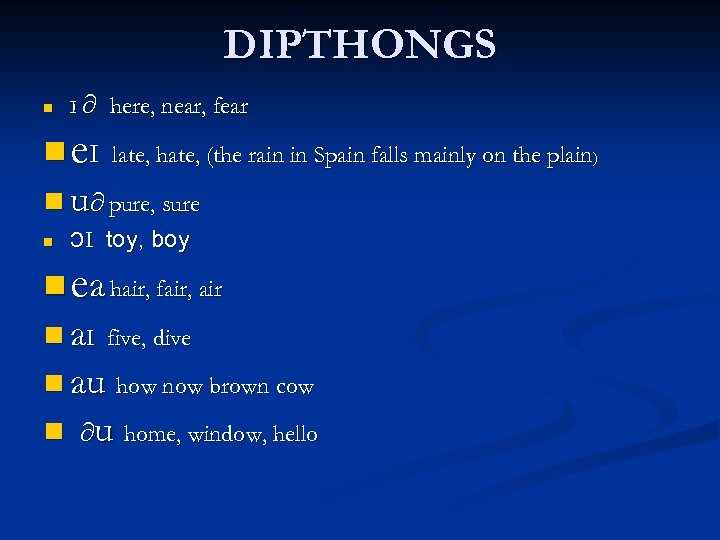 DIPTHONGS n I∂ n e. I here, near, fear late, hate, (the rain in Spain falls mainly on the plain) n u∂ pure, sure n ƆI toy, boy n ea hair, fair, air n a. I five, dive n au how now brown cow n ∂u home, window, hello
 You say yes, I say no You say stop and I say go, go Oh, no You say goodbye and I say hello Hello, hello I don't know why you say goodbye I say hello I say high, you say low You say why, and I say I don't know Oh, no You say goodbye and I say hello Hello, hello I don't know why you say goodbye I say hello Why, why, why Do you say good bye Goodbye, bye Oh, no You say goodbye and I say hello Hello, hello I don't know why you say goodbye I say hello, hello I don't know why you say goodbye I say hello Hello
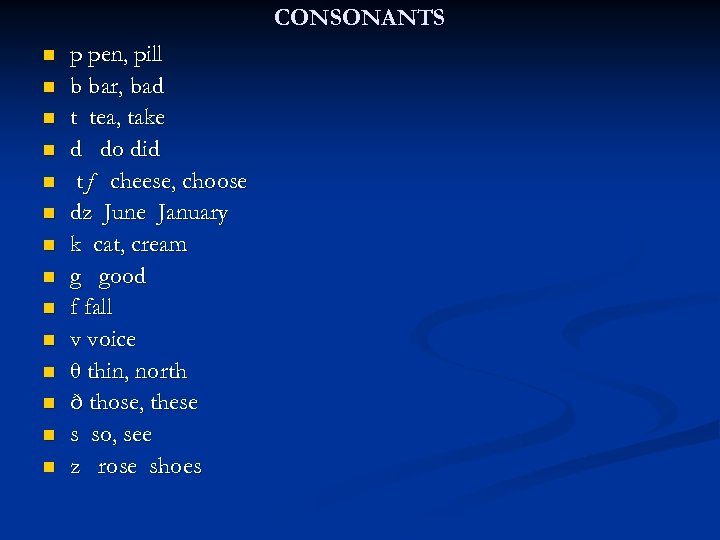 CONSONANTS n n n n p pen, pill b bar, bad t tea, take d do did tƒ cheese, choose dz June January k cat, cream g good f fall v voice θ thin, north ð those, these s so, see z rose shoes
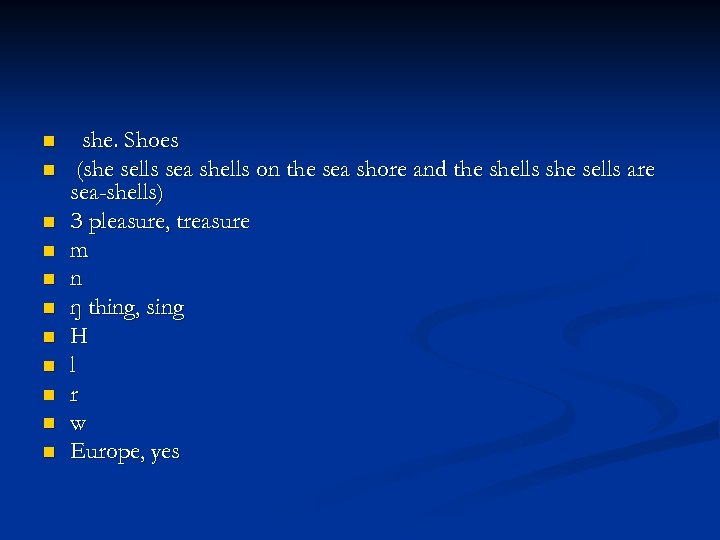 n n n she. Shoes (she sells sea shells on the sea shore and the shells she sells are sea-shells) З pleasure, treasure m n ŋ thing, sing H l r w Europe, yes
 n n n Yesterday, all my troubles seemed so far away Now it looks as thought they're here to stay Oh I believe in yesterday Suddenly, I'm not half the man I used to be There's a shadow hanging over me Oh yesterday, came suddenly Why she, had to go I don't know she wouldn't say I said, something wrong Now I long for yesterday Yesterday, love was such an easy game to play Now I need a place to hide away Oh I believe in yesterday. Why she, had to go I don't know She wouldn't say I said, something wrong Now I long for yesterday Yesterday, love was such an easy game to play Now I need a place to hide away Oh I believe in yesterday.
 Go onto the site www. your. Dictionary. com and find the pronunciation for these words Reign n Sword n Malignant n Knight n Amazing n Oregano n Arrangement n Mountain n colonel appalling doubt exhausting scientist birthday cupboard further
 Test your English First you must find your level of English – do a test on a website www. learn 4 good. com (40 questions to establish your level – quite easy) n www. englishlearner. com (you already need to know your level) n www. languagesystems. com (a bit difficult) n www. learnenglish. org (very difficult) n
 Study groups Find two or three people in the group of your level (go round the class asking ‘what’s your level of English? ) n Discuss why you want to learn English n What are the difficulties in your opinion? n How can you overcome these difficulties? n Do you know your learning style? Do you have a good memory? Do you have to write down words to learn them? n
 In your groups of two or three, try to write a learning plan For example: n Understand better the pronuncation n Buy a good dictionary n Do exercises on verbs n Learn irregular past verbs n Learn some useful expressions n