Скачать презентацию Lingua Cultura e Istituzioni dei Paesi di Lingua
1d11b7d9d200c72f273134b7284e229a.ppt
- Количество слайдов: 198
 Lingua, Cultura e Istituzioni dei Paesi di Lingua Inglese Corso di Laurea Triennale a. a. 2015 -2016 Studenti A-L Prof. TANIA ZULLI tzulli@uniroma 3. it
 Tutte le informazioni sul corso: www. uniroma 3. it Scienze Politiche www. scienzepolitiche. uniroma 3. it Docente Materiali Didattici PROGRAMMA 2015 -2016 FAQ 2015 -2016
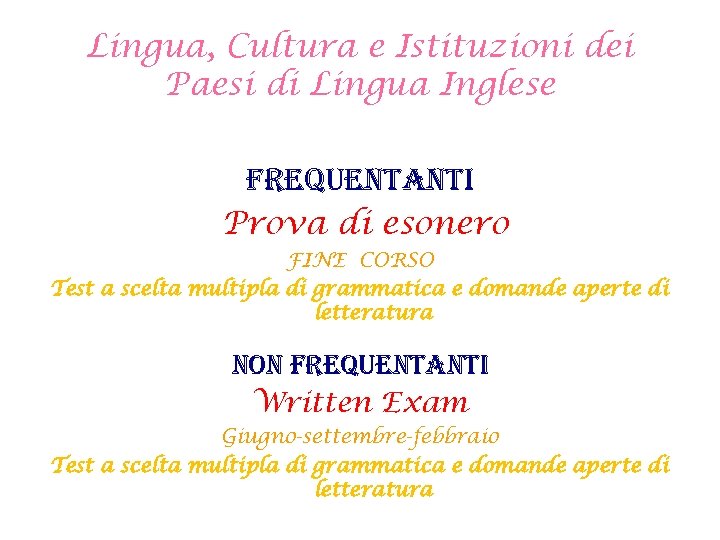 Lingua, Cultura e Istituzioni dei Paesi di Lingua Inglese FREQUENTANTI Prova di esonero FINE CORSO Test a scelta multipla di grammatica e domande aperte di letteratura NON FREQUENTANTI Written Exam Giugno-settembre-febbraio Test a scelta multipla di grammatica e domande aperte di letteratura
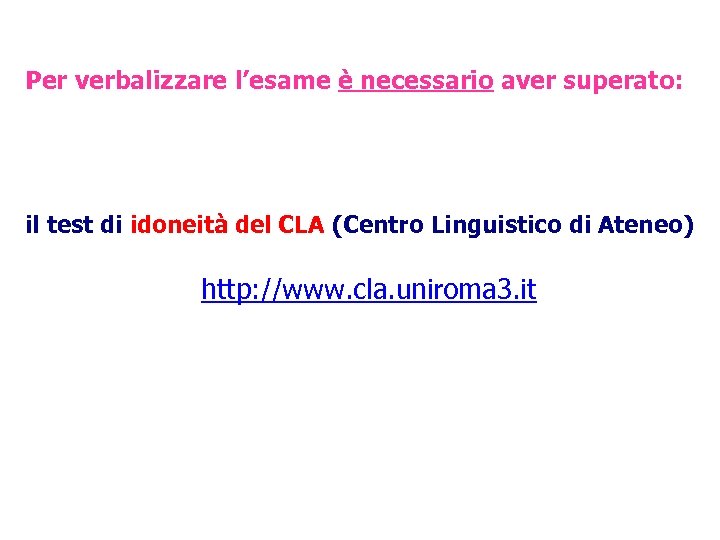 Per verbalizzare l’esame è necessario aver superato: il test di idoneità del CLA (Centro Linguistico di Ateneo) http: //www. cla. uniroma 3. it
 Hints and Tips L’ISCRIZIONE ALL'ESAME È OBBLIGATORIA LO SCRITTO PUO’ ESSERE VEBALIZZATO ENTRO 3 SESSIONI INCLUSA QUELLA IN CUI È SOSTENUTO IL PROGRAMMA D’ESAME SARA’ VALIDO FINO ALLA SESSIONE DI GENNAIO-FEBBRAIO 2017.
 “E. M. Forster AND THE CULTURE OF EMPIRE” • Module I. English Grammar: Learning the Language • Module II : E. M. Forster • Module III. A Passage to India Numero crediti formativi: 8/7
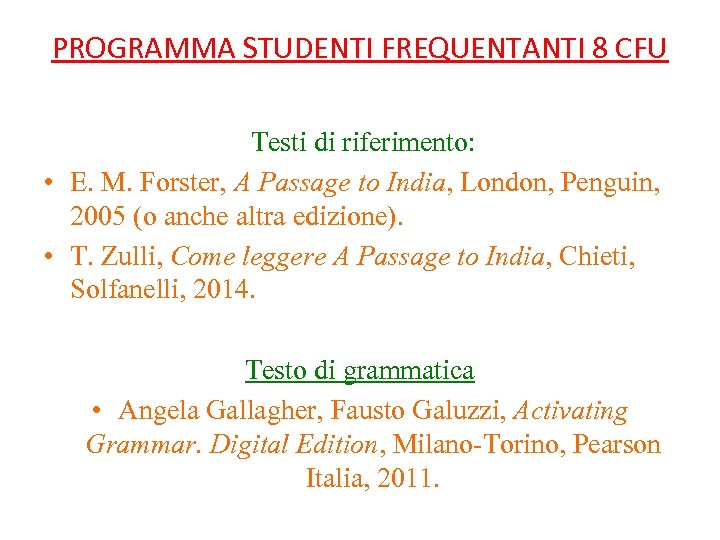 PROGRAMMA STUDENTI FREQUENTANTI 8 CFU Testi di riferimento: • E. M. Forster, A Passage to India, London, Penguin, 2005 (o anche altra edizione). • T. Zulli, Come leggere A Passage to India, Chieti, Solfanelli, 2014. Testo di grammatica • Angela Gallagher, Fausto Galuzzi, Activating Grammar. Digital Edition, Milano-Torino, Pearson Italia, 2011.
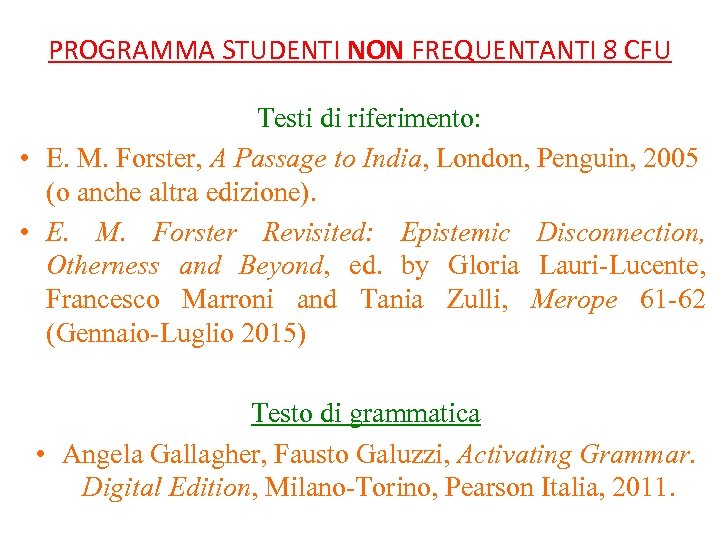 PROGRAMMA STUDENTI NON FREQUENTANTI 8 CFU Testi di riferimento: • E. M. Forster, A Passage to India, London, Penguin, 2005 (o anche altra edizione). • E. M. Forster Revisited: Epistemic Disconnection, Otherness and Beyond, ed. by Gloria Lauri-Lucente, Francesco Marroni and Tania Zulli, Merope 61 -62 (Gennaio-Luglio 2015) Testo di grammatica • Angela Gallagher, Fausto Galuzzi, Activating Grammar. Digital Edition, Milano-Torino, Pearson Italia, 2011.
 I testi possono essere acquistati presso Libreria “LIBROPOLI” Via Giulio Rocco 25, 00154 Roma Tel. 06/57133154 (nei pressi della sede del Rettorato in via Ostiense) Libreria “SILVIO D’AMICO” Via Chiabrera, 00154 Roma Per le dispense di grammatica: COPISTERIA APPUNTI via Chiabrera
 MODULE I ENGLISH GRAMMAR: Learning the Language Il primo modulo analizzerà alcune tra le principali strutture grammaticali e morfo-sintattiche della lingua inglese. To Be-To Have-Present Simple-Present Continuous-Simple Pas Perfect-Past Perfect-Future Forms-First, Second, Third Cond Possessive Adjectives and Pronouns-Genitive-Comparatives Verbs-Duration Form-The Passive-Reported Speech-Some, A Nouns with Plural Verb-Reflexive Pronouns-Phrasal Ver
 MODULE II E. M. Forster Il secondo modulo sarà incentrato sull’analisi della figura di E. M. Forster, il cui ruolo di intellettuale e romanziere a cavallo tra il diciannovesimo e il ventesimo secolo rivela interessanti aspetti di connessione di mondi antitetici, contrasti storici, sociali e individuali. La missione di collegamento dei poli oppositivi dell’esistenza, al di là dell’aspetto narrativo, è una missione personale, morale, di conoscenza e comprensione del genere umano, compiuta secondo le regole del pensiero liberale. Nel suo dar voce ai molteplici aspetti dell’esistenza, l’opera forsteriana segue, in una linea ideale, le coordinate ideologiche del liberalismo, che ammette perfettibilità ma non perfezione, aspira alla completezza senza mai raggiungerla. Pur tenendo presente una molteplicità di livelli di analisi (letterario, storico, politico, culturale e teorico), l’approccio critico si fonderà sulla lettura ravvicinata di testi letterari e sull’esplorazione di alcuni meccanismi di testualizzazione che mostrano il ruolo della cultura e della letteratura all’interno del periodo storico-politico di riferimento.
 MODULE III A Passage to India Il terzo modulo si concentrerà sulla lettura di uno dei romanzi di E. M. Forster, A Passage to India, tematicamente basato sulla descrizione del mondo coloniale e sulle dinamiche relazionali tra oriente e occidente. A Passage to India segna il momento di massima creatività della scrittura di E. M. Forster, decretando il punto di arrivo di un lungo processo di esplorazione narrativa, intrapresa dall’autore attraverso opere precedenti. Oltre al merito culturale di rappresentazione delle evoluzioni sociali e razziali, il valore del romanzo è da ricercare nel processo di meditazione sulle forme artistiche e letterarie che esso propone. Nel corso delle lezioni i principali aspetti del romanzo verranno analizzati nel contesto del loro valore storico-sociale e nella prospettiva dei diversi sistemi culturali chiamati in causa.
 MODULE I ENGLISH GRAMMAR
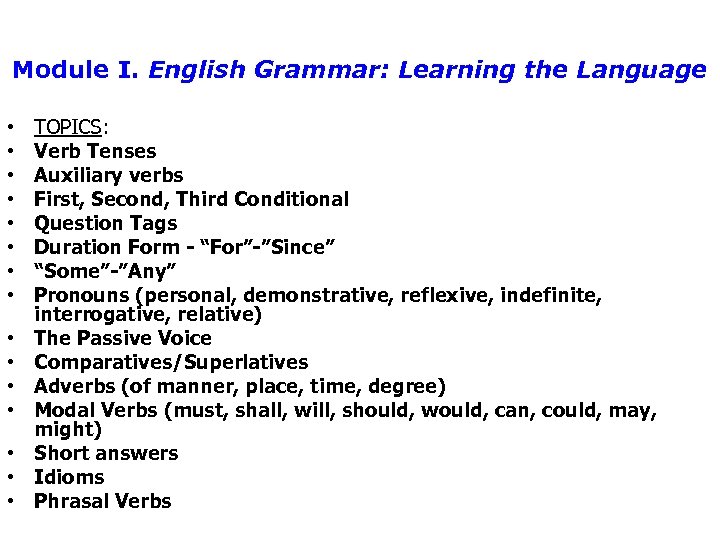 Module I. English Grammar: Learning the Language • • • • TOPICS: Verb Tenses Auxiliary verbs First, Second, Third Conditional Question Tags Duration Form - “For”-”Since” “Some”-”Any” Pronouns (personal, demonstrative, reflexive, indefinite, interrogative, relative) The Passive Voice Comparatives/Superlatives Adverbs (of manner, place, time, degree) Modal Verbs (must, shall, will, should, would, can, could, may, might) Short answers Idioms Phrasal Verbs
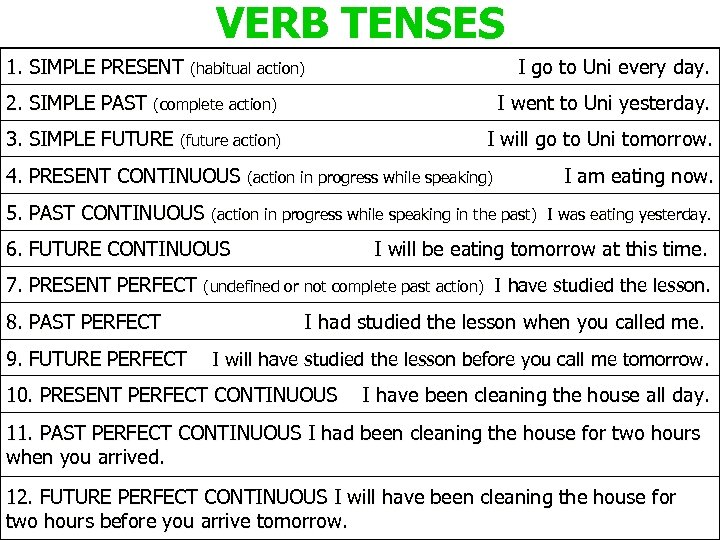 VERB TENSES 1. SIMPLE PRESENT (habitual action) I go to Uni every day. 2. SIMPLE PAST (complete action) I went to Uni yesterday. 3. SIMPLE FUTURE (future action) I will go to Uni tomorrow. 4. PRESENT CONTINUOUS (action in progress while speaking) I am eating now. 5. PAST CONTINUOUS (action in progress while speaking in the past) I was eating yesterday. 6. FUTURE CONTINUOUS I will be eating tomorrow at this time. 7. PRESENT PERFECT (undefined or not complete past action) I have studied the lesson. 8. PAST PERFECT I had studied the lesson when you called me. 9. FUTURE PERFECT I will have studied the lesson before you call me tomorrow. 10. PRESENT PERFECT CONTINUOUS I have been cleaning the house all day. 11. PAST PERFECT CONTINUOUS I had been cleaning the house for two hours when you arrived. 12. FUTURE PERFECT CONTINUOUS I will have been cleaning the house for two hours before you arrive tomorrow.
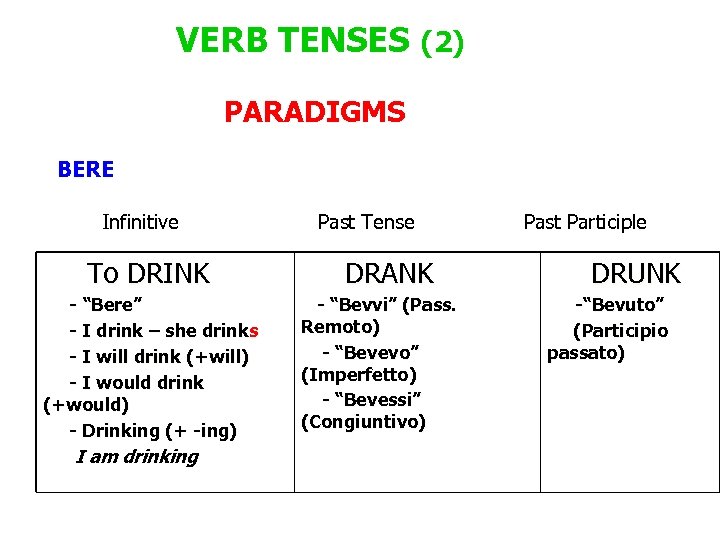 VERB TENSES (2) PARADIGMS BERE Infinitive Past Tense Past Participle To DRINK DRANK DRUNK - “Bere” - I drink – she drinks - I will drink (+will) - I would drink (+would) - Drinking (+ -ing) I am drinking - “Bevvi” (Pass. Remoto) - “Bevevo” (Imperfetto) - “Bevessi” (Congiuntivo) -“Bevuto” (Participio passato)
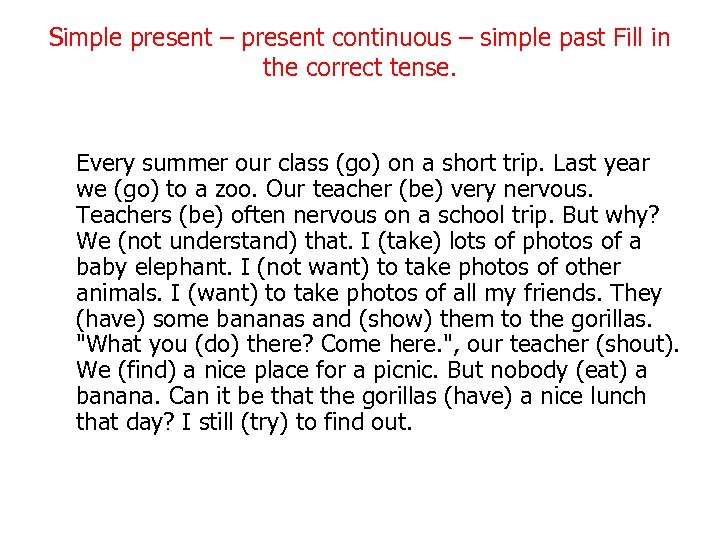 Simple present – present continuous – simple past Fill in the correct tense. Every summer our class (go) on a short trip. Last year we (go) to a zoo. Our teacher (be) very nervous. Teachers (be) often nervous on a school trip. But why? We (not understand) that. I (take) lots of photos of a baby elephant. I (not want) to take photos of other animals. I (want) to take photos of all my friends. They (have) some bananas and (show) them to the gorillas. "What you (do) there? Come here. ", our teacher (shout). We (find) a nice place for a picnic. But nobody (eat) a banana. Can it be that the gorillas (have) a nice lunch that day? I still (try) to find out.
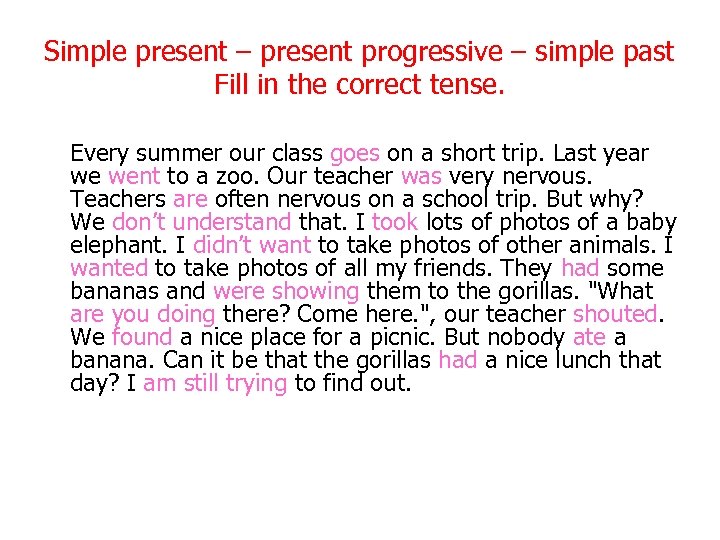 Simple present – present progressive – simple past Fill in the correct tense. Every summer our class goes on a short trip. Last year we went to a zoo. Our teacher was very nervous. Teachers are often nervous on a school trip. But why? We don’t understand that. I took lots of photos of a baby elephant. I didn’t want to take photos of other animals. I wanted to take photos of all my friends. They had some bananas and were showing them to the gorillas. "What are you doing there? Come here. ", our teacher shouted. We found a nice place for a picnic. But nobody ate a banana. Can it be that the gorillas had a nice lunch that day? I am still trying to find out.
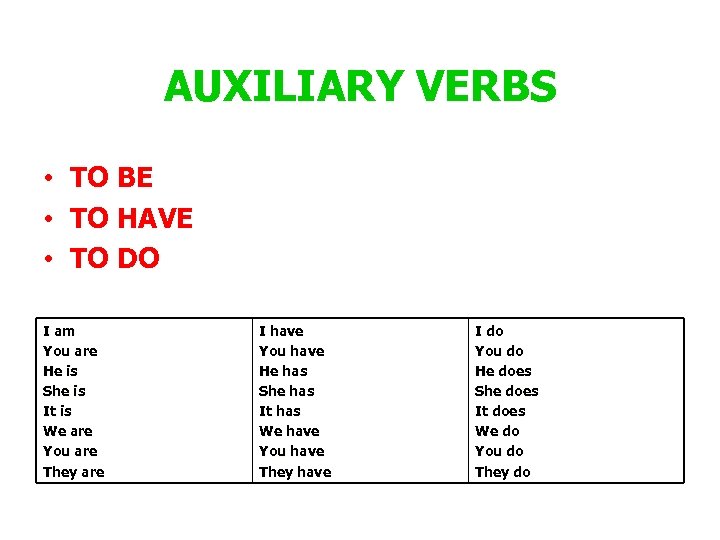 AUXILIARY VERBS • TO BE • TO HAVE • TO DO I am You are He is She is It is We are You are They are I have You have He has She has It has We have You have They have I do You do He does She does It does We do You do They do
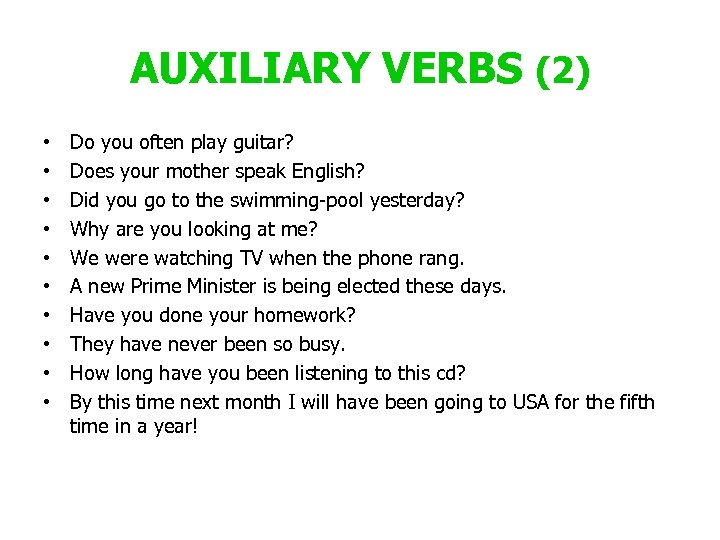 AUXILIARY VERBS (2) • • • Do you often play guitar? Does your mother speak English? Did you go to the swimming-pool yesterday? Why are you looking at me? We were watching TV when the phone rang. A new Prime Minister is being elected these days. Have you done your homework? They have never been so busy. How long have you been listening to this cd? By this time next month I will have been going to USA for the fifth time in a year!
 AUXILIARY VERBS (3) • Other Auxiliary Verbs are the MODAL VERBS: Shall, will, should, would, can, could, must, may, might
 AUXILIARY VERBS Choose the correct auxiliary verb. Q 1 - We ____ done it yet. don't didn't hasn't haven't Q 2 - ____ you think they are coming tonight? Do Does Did Have Has Q 3 - ____ you see them yesterday? Do Did Have Has
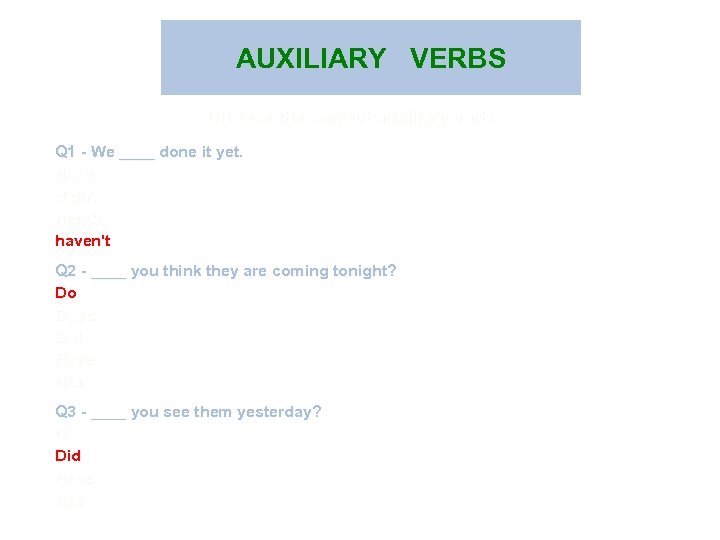 AUXILIARY VERBS Choose the correct auxiliary verb. Q 1 - We ____ done it yet. don't didn't hasn't haven't Q 2 - ____ you think they are coming tonight? Do Does Did Have Has Q 3 - ____ you see them yesterday? Do Did Have Has
 AUXILIARY VERBS Choose the correct auxiliary verb. Q 4 - ____ you going this evening? Are Have Do Q 5 - How long ____ it take you to get home? do does Q 6 - What ____ you reading at the moment? are do have Q 7 - It was horrible. I really ____ like it. didn't
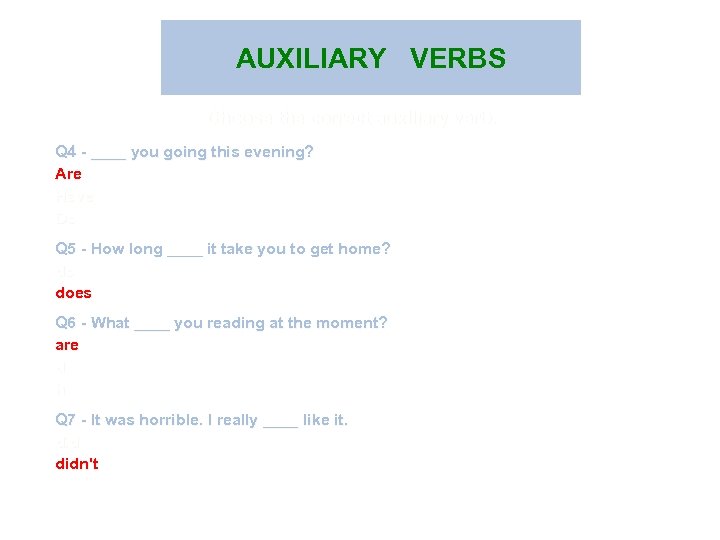 AUXILIARY VERBS Choose the correct auxiliary verb. Q 4 - ____ you going this evening? Are Have Do Q 5 - How long ____ it take you to get home? do does Q 6 - What ____ you reading at the moment? are do have Q 7 - It was horrible. I really ____ like it. didn't
 AUXILIARY VERBS Choose the correct auxiliary verb. Q 8 - They ____ rung back yet. have has haven't hasn't Q 9 - ____ you learn it when you were at school? Do Does Did Have Has Q 10 - ____ you enjoying your meal? Do Is Are Have Has
 AUXILIARY VERBS Choose the correct auxiliary verb. Q 8 - They ____ rung back yet. have has haven't hasn't Q 9 - ____ you learn it when you were at school? Do Does Did Have Has Q 10 - ____ you enjoying your meal? Do Is Are Have Has
 AUXILIARY VERBS Choose the correct auxiliary verb. Q 11 - ____ you decided yet? Have Has Do Did Does Q 12 - ____ everybody going to be there? Is Are Do Q 13 - ____ they live near you? Does Do Have Are
 AUXILIARY VERBS Choose the correct auxiliary verb. Q 11 - ____ you decided yet? Have Has Do Did Does Q 12 - ____ everybody going to be there? Is Are Do Q 13 - ____ they live near you? Does Do Have Are
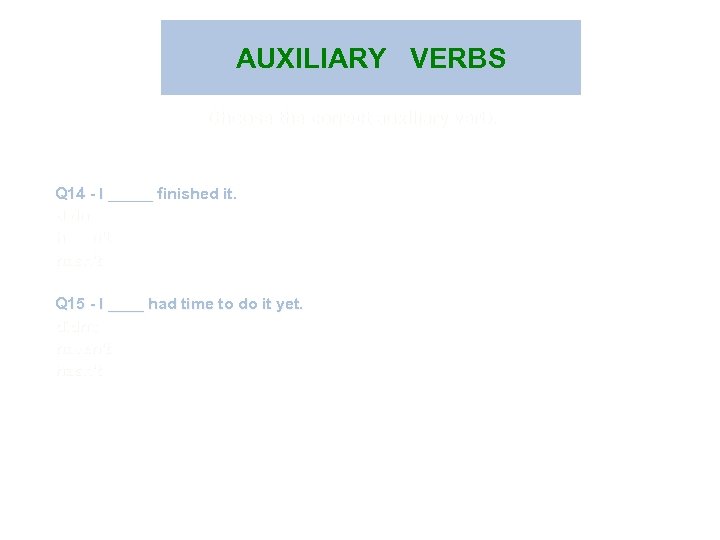 AUXILIARY VERBS Choose the correct auxiliary verb. Q 14 - I _____ finished it. didn't haven't hasn't Q 15 - I ____ had time to do it yet. didn't haven't hasn't
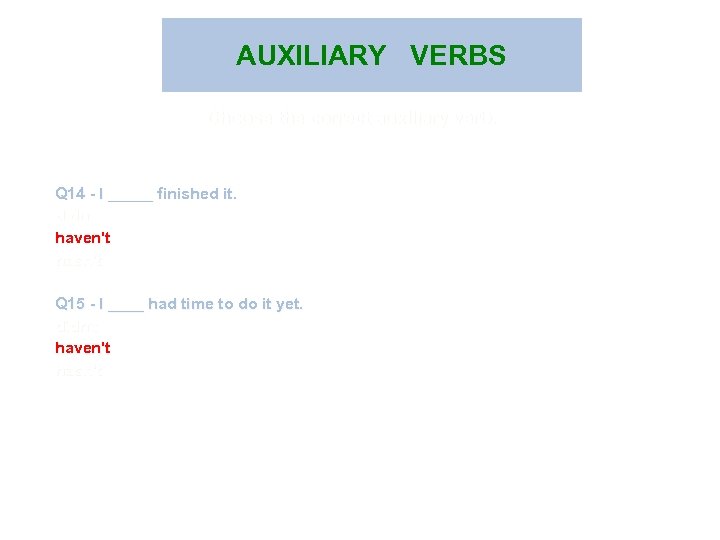 AUXILIARY VERBS Choose the correct auxiliary verb. Q 14 - I _____ finished it. didn't haven't hasn't Q 15 - I ____ had time to do it yet. didn't haven't hasn't
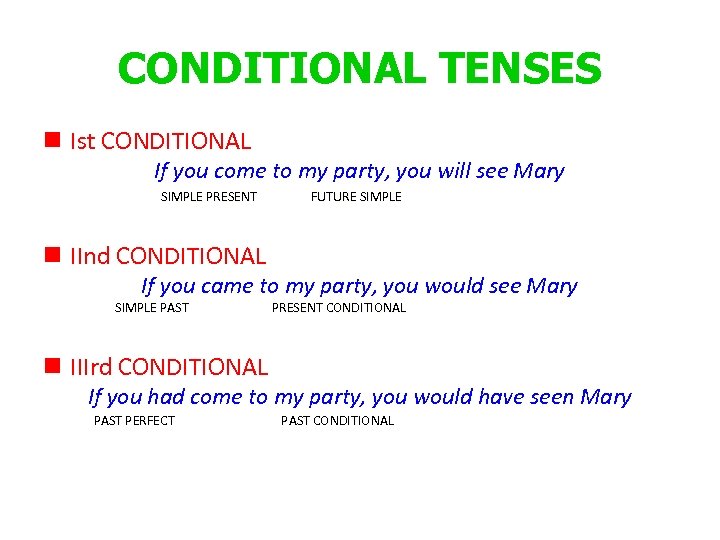 CONDITIONAL TENSES n Ist CONDITIONAL If you come to my party, you will see Mary SIMPLE PRESENT FUTURE SIMPLE n IInd CONDITIONAL If you came to my party, you would see Mary SIMPLE PAST PRESENT CONDITIONAL n IIIrd CONDITIONAL If you had come to my party, you would have seen Mary PAST PERFECT PAST CONDITIONAL
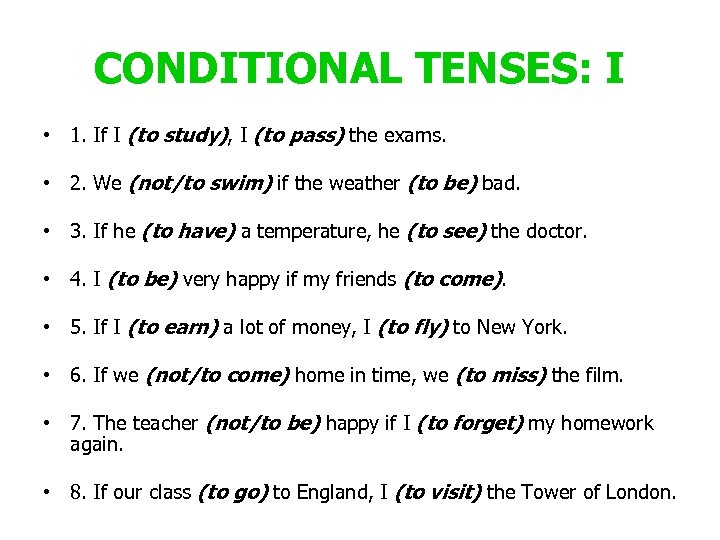 CONDITIONAL TENSES: I • 1. If I (to study), I (to pass) the exams. • 2. We (not/to swim) if the weather (to be) bad. • 3. If he (to have) a temperature, he (to see) the doctor. • 4. I (to be) very happy if my friends (to come). • 5. If I (to earn) a lot of money, I (to fly) to New York. • 6. If we (not/to come) home in time, we (to miss) the film. • 7. The teacher (not/to be) happy if I (to forget) my homework again. • 8. If our class (to go) to England, I (to visit) the Tower of London.
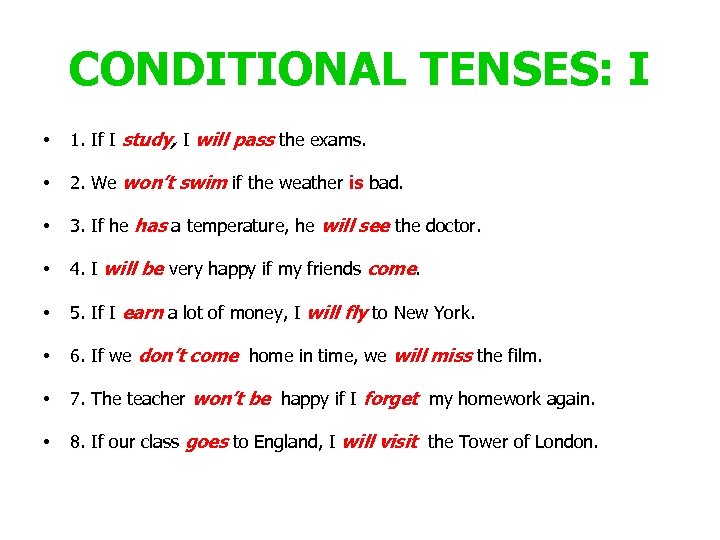 CONDITIONAL TENSES: I • 1. If I study, I will pass the exams. • 2. We won’t swim if the weather is bad. if the weather • 3. If he has a temperature, he will see the doctor. • 4. I will be very happy if my friends come. • 5. If I earn a lot of money, I will fly to New York. • 6. If we don’t come home in time, we will miss the film. • 7. The teacher won’t be happy if I forget my homework again. • 8. If our class goes to England, I will visit the Tower of London.
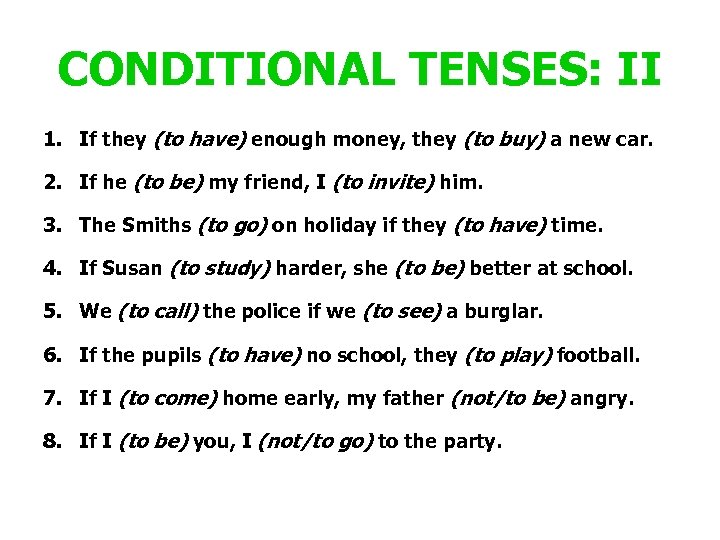 CONDITIONAL TENSES: II 1. If they (to have) enough money, they (to buy) a new car. 2. If he (to be) my friend, I (to invite) him. 3. The Smiths (to go) on holiday if they (to have) time. 4. If Susan (to study) harder, she (to be) better at school. 5. We (to call) the police if we (to see) a burglar. 6. If the pupils (to have) no school, they (to play) football. 7. If I (to come) home early, my father (not/to be) angry. 8. If I (to be) you, I (not/to go) to the party.
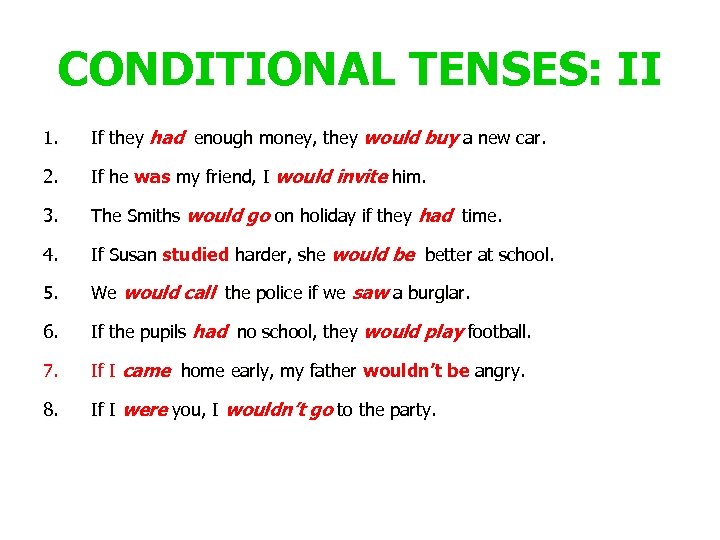 CONDITIONAL TENSES: II 1. If they had enough money, they would buy a new car. 2. If he was my friend, I would invite him. If he 3. The Smiths would go on holiday if they had time. 4. If Susan studied harder, she would be better at school. If Susan 5. We would call the police if we saw a burglar. 6. If the pupils had no school, they would play football. 7. If I came home early, my father wouldn’t be angry. home early, my father 8. If I were you, I wouldn’t go to the party
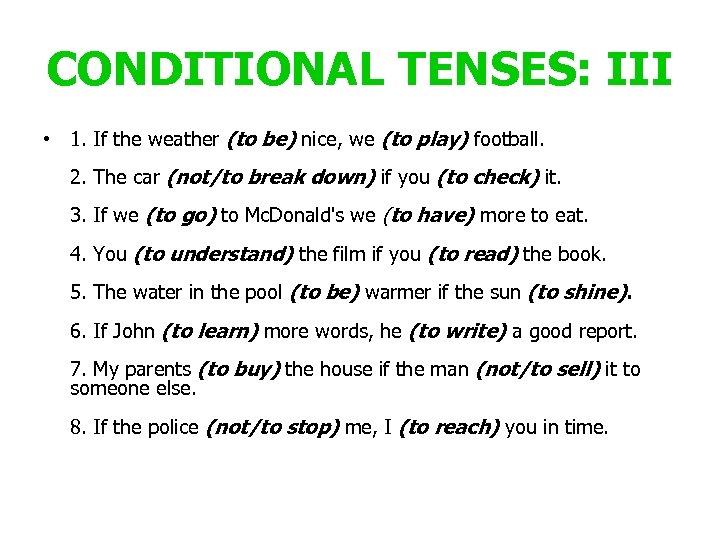 CONDITIONAL TENSES: III • 1. If the weather (to be) nice, we (to play) football. 2. The car (not/to break down) if you (to check) it. 3. If we (to go) to Mc. Donald's we (to have) more to eat. 4. You (to understand) the film if you (to read) the book. 5. The water in the pool (to be) warmer if the sun (to shine). 6. If John (to learn) more words, he (to write) a good report. 7. My parents (to buy) the house if the man (not/to sell) it to someone else. 8. If the police (not/to stop) me, I (to reach) you in time.
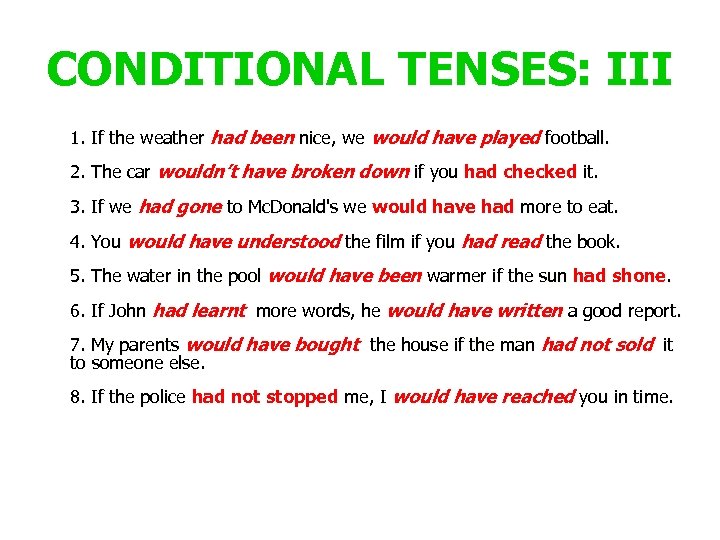 CONDITIONAL TENSES: III 1. If the weather had been nice, we would have played football. 2. The car wouldn’t have broken down if you had checked it. if you 3. If we had gone to Mc. Donald's we would have had more to eat. to Mc. Donald's we 4. You would have understood the film if you had read the book. 5. The water in the pool would have been warmer if the sun had shone. warmer if the sun 6. If John had learnt more words, he would have written a good report. 7. My parents would have bought the house if the man had not sold it to someone else. 8. If the police had not stopped me, I would have reached you in time. 8. If the police
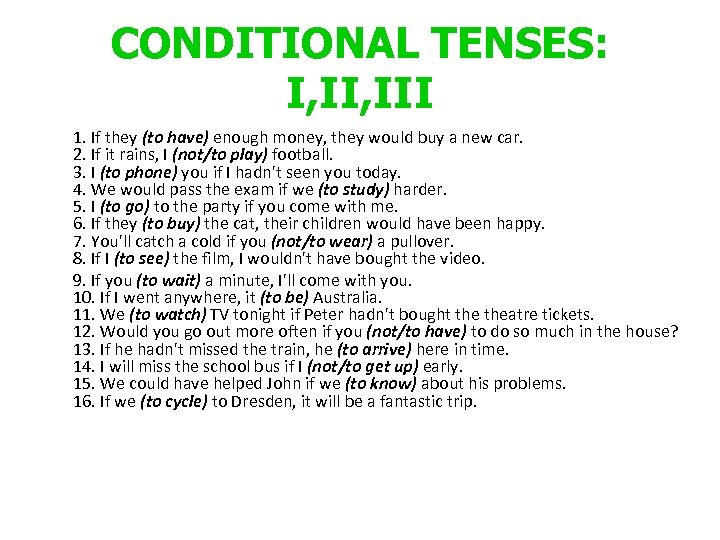 CONDITIONAL TENSES: I, III 1. If they (to have) enough money, they would buy a new car. 2. If it rains, I (not/to play) football. 3. I (to phone) you if I hadn't seen you today. 4. We would pass the exam if we (to study) harder. 5. I (to go) to the party if you come with me. 6. If they (to buy) the cat, their children would have been happy. 7. You'll catch a cold if you (not/to wear) a pullover. 8. If I (to see) the film, I wouldn't have bought the video. 9. If you (to wait) a minute, I'll come with you. 10. If I went anywhere, it (to be) Australia. 11. We (to watch) TV tonight if Peter hadn't bought theatre tickets. 12. Would you go out more often if you (not/to have) to do so much in the house? 13. If he hadn't missed the train, he (to arrive) here in time. 14. I will miss the school bus if I (not/to get up) early. 15. We could have helped John if we (to know) about his problems. 16. If we (to cycle) to Dresden, it will be a fantastic trip.
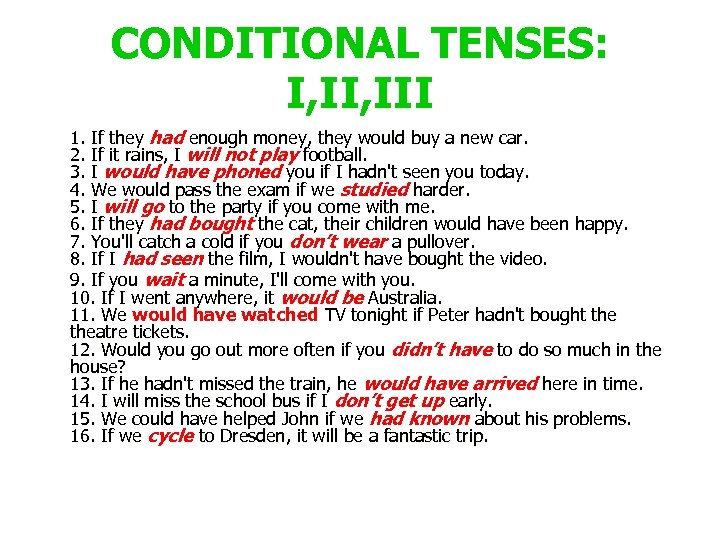 CONDITIONAL TENSES: I, III 1. If they had enough money, they would buy a new car. 2. If it rains, I will not play football. 3. I would have phoned you if I hadn't seen you today. 4. We would pass the exam if we studied harder. 5. I will go to the party if you come with me. 6. If they had bought the cat, their children would have been happy. 7. You'll catch a cold if you don’t wear a pullover. 8. If I had seen the film, I wouldn't have bought the video. 9. If you wait a minute, I'll come with you. 10. If I went anywhere, it would be Australia. 11. We would have watched TV tonight if Peter hadn't bought the 11. We theatre tickets. 12. Would you go out more often if you didn’t have to do so much in the house? 13. If he hadn't missed the train, he would have arrived here in time. 14. I will miss the school bus if I don’t get up early. 15. We could have helped John if we had known about his problems. 16. If we cycle to Dresden, it will be a fantastic trip.
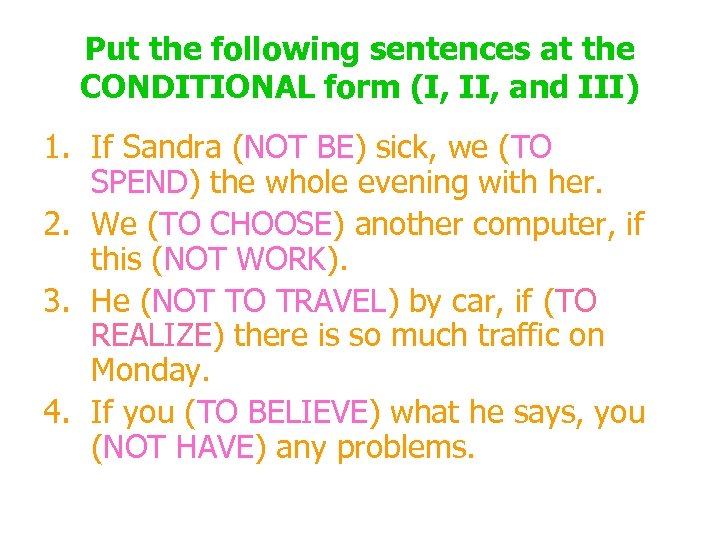 Put the following sentences at the CONDITIONAL form (I, II, and III) 1. If Sandra (NOT BE) sick, we (TO SPEND) the whole evening with her. 2. We (TO CHOOSE) another computer, if this (NOT WORK). 3. He (NOT TO TRAVEL) by car, if (TO REALIZE) there is so much traffic on Monday. 4. If you (TO BELIEVE) what he says, you (NOT HAVE) any problems.
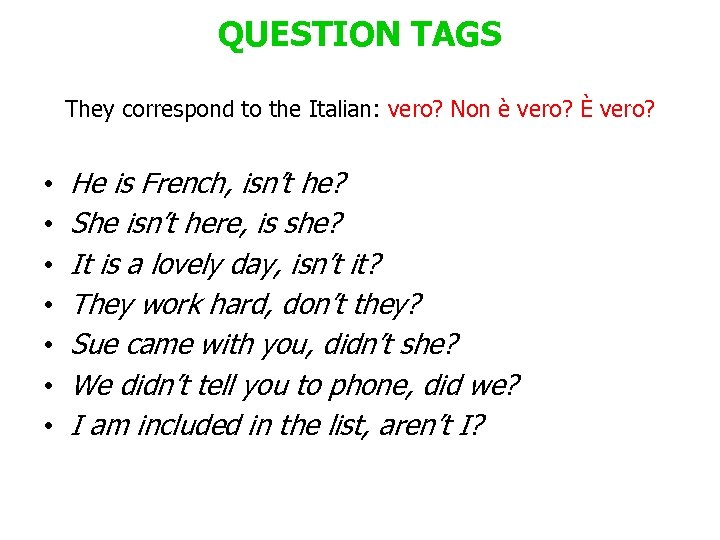 QUESTION TAGS They correspond to the Italian: vero? Non è vero? È vero? They correspond to the Italian: • • He is French, isn’t he? She isn’t here, is she? It is a lovely day, isn’t it? They work hard, don’t they? Sue came with you, didn’t she? We didn’t tell you to phone, did we? I am included in the list, aren’t I?
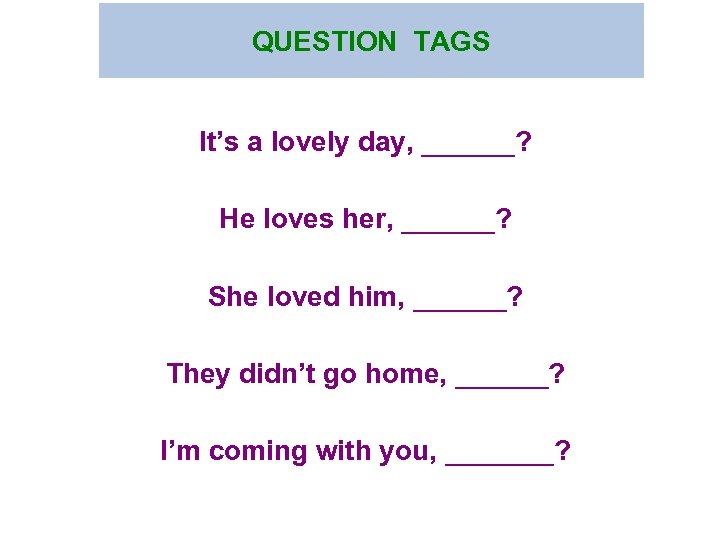 QUESTION TAGS It’s a lovely day, ______? He loves her, ______? She loved him, ______? They didn’t go home, ______? I’m coming with you, _______?
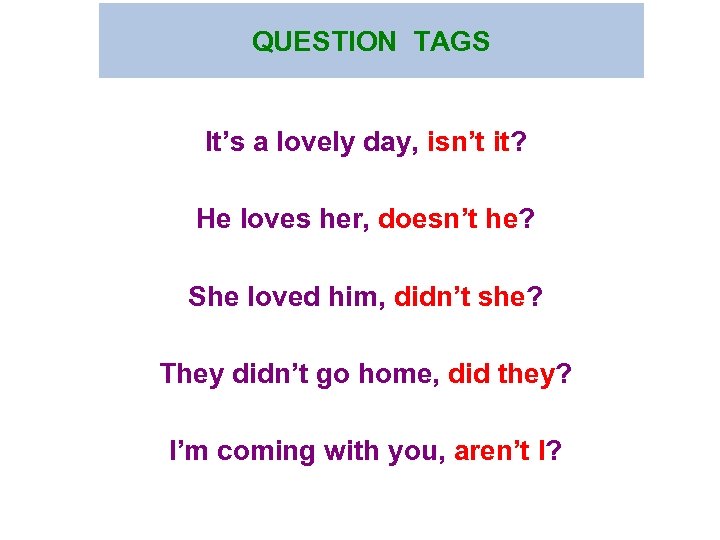 QUESTION TAGS It’s a lovely day, isn’t it? He loves her, doesn’t he? She loved him, didn’t she? They didn’t go home, did they? I’m coming with you, aren’t I?
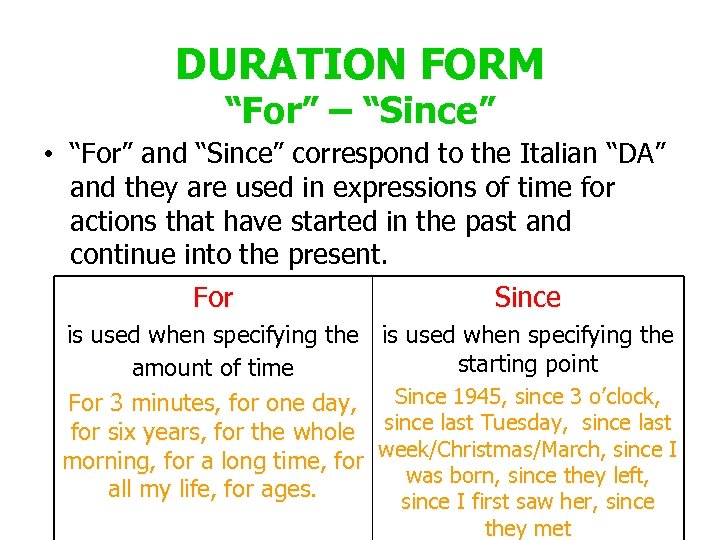 DURATION FORM “For” – “Since” • “For” and “Since” correspond to the Italian “DA” and they are used in expressions of time for actions that have started in the past and continue into the present. For Since is used when specifying the starting point amount of time For 3 minutes, for one day, Since 1945, since 3 o’clock, for six years, for the whole since last Tuesday, since last week/Christmas/March, since I morning, for a long time, for was born, since they left, all my life, for ages. since I first saw her, since they met
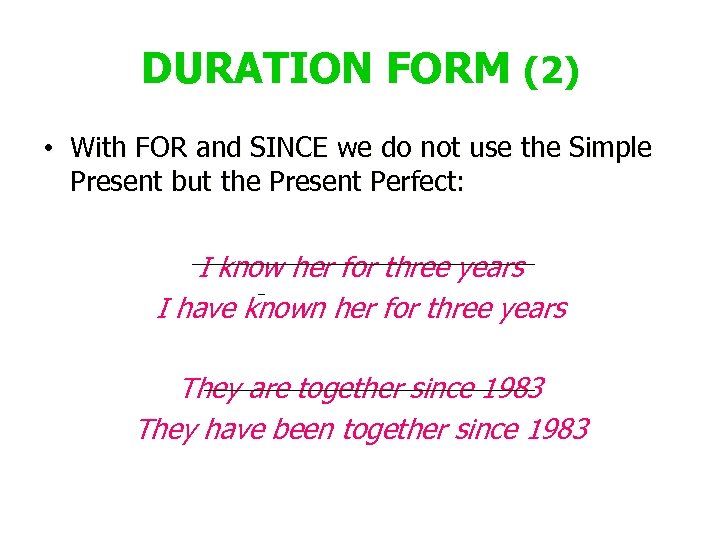 DURATION FORM (2) • With FOR and SINCE we do not use the Simple Present but the Present Perfect: I know her for three years I have known her for three years They are together since 1983 They have been together since 1983
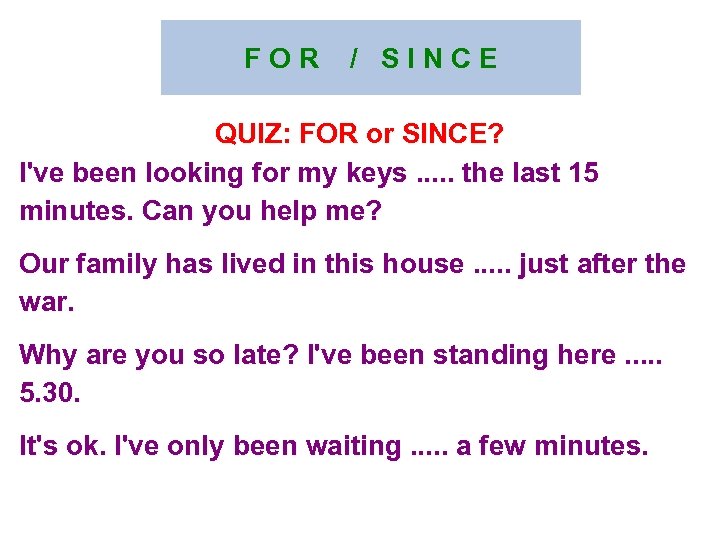 F O R / S I N C E QUIZ: FOR or SINCE? I've been looking for my keys. . . the last 15 minutes. Can you help me? Our family has lived in this house. . . just after the war. Why are you so late? I've been standing here. . . 5. 30. It's ok. I've only been waiting. . . a few minutes.
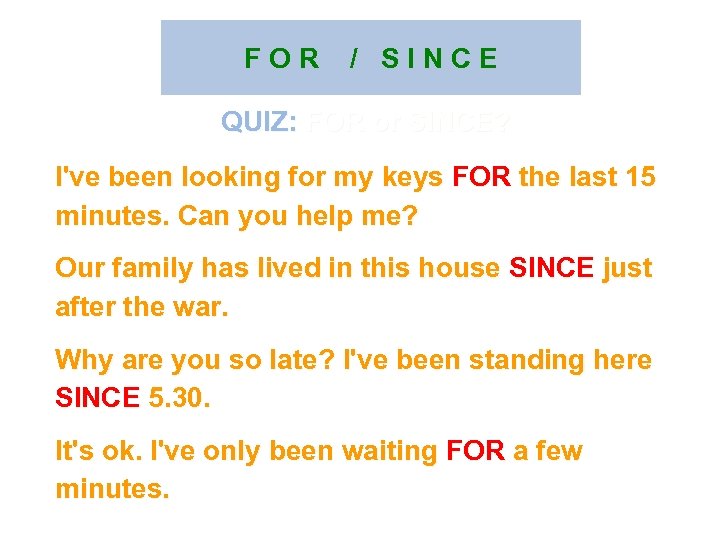 F O R / S I N C E QUIZ: FOR or SINCE? I've been looking for my keys FOR the last 15 minutes. Can you help me? Our family has lived in this house SINCE just after the war. Why are you so late? I've been standing here SINCE 5. 30. It's ok. I've only been waiting FOR a few minutes.
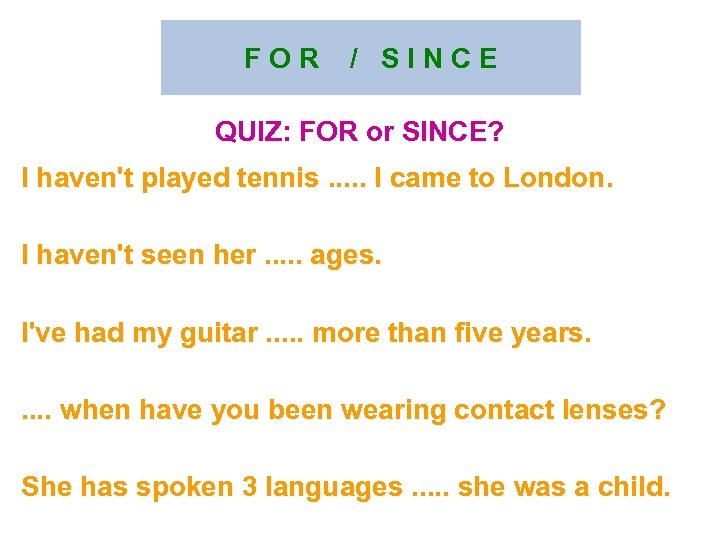 F O R / S I N C E QUIZ: FOR or SINCE? I haven't played tennis. . . I came to London. I haven't seen her. . . ages. I've had my guitar. . . more than five years. . . when have you been wearing contact lenses? She has spoken 3 languages. . . she was a child.
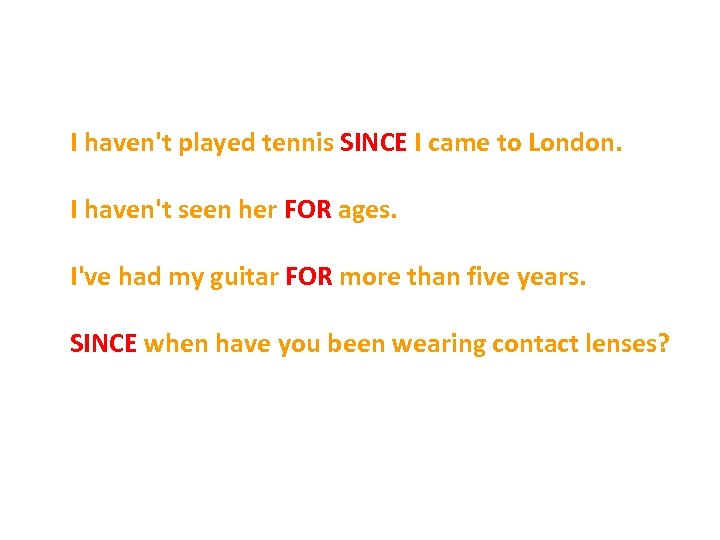 I haven't played tennis SINCE I came to London. I haven't seen her FOR ages. I've had my guitar FOR more than five years. SINCE when have you been wearing contact lenses?
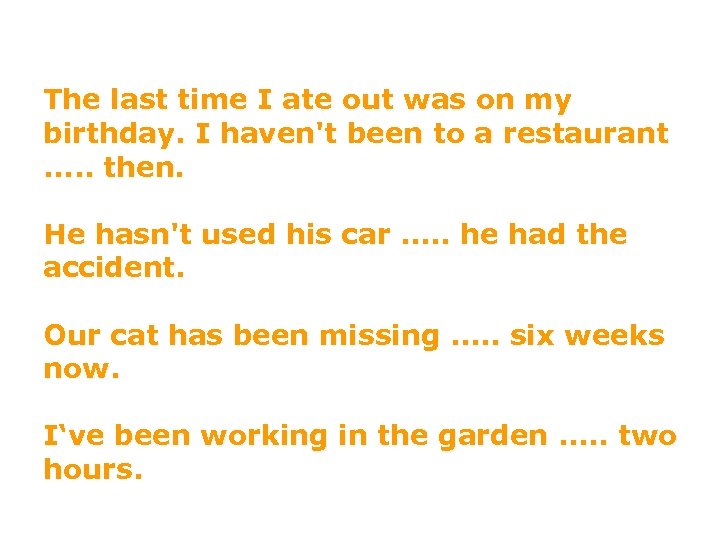 The last time I ate out was on my birthday. I haven't been to a restaurant. . . then. He hasn't used his car. . . he had the accident. Our cat has been missing. . . six weeks now. I‘ve been working in the garden. . . two hours.
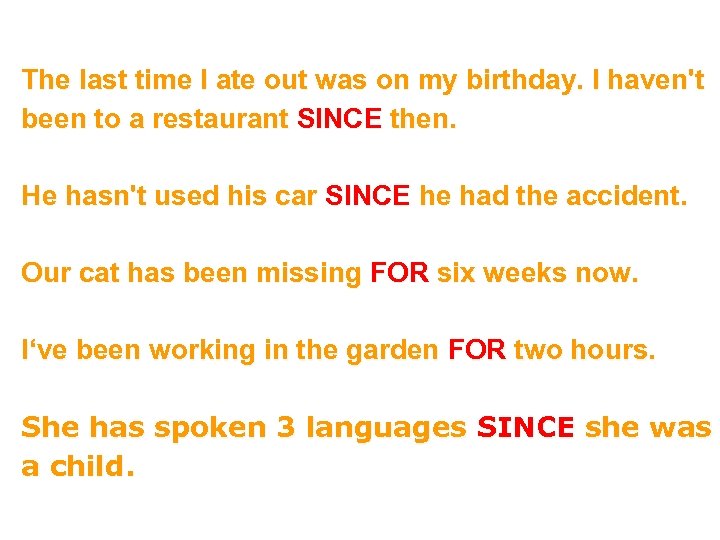 The last time I ate out was on my birthday. I haven't been to a restaurant SINCE then. He hasn't used his car SINCE he had the accident. Our cat has been missing FOR six weeks now. I‘ve been working in the garden FOR two hours. She has spoken 3 languages SINCE she was a child.
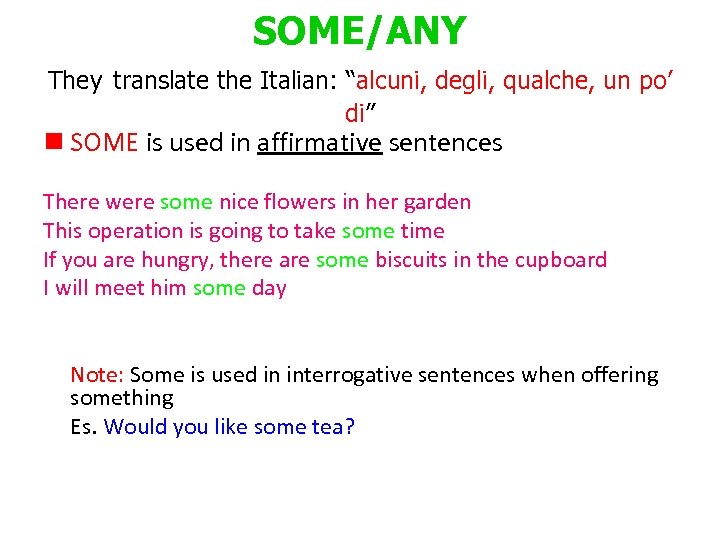 SOME/ANY They translate the Italian: “alcuni, degli, qualche, un po’ di” n SOME is used in affirmative sentences There were some nice flowers in her garden This operation is going to take some time If you are hungry, there are some biscuits in the cupboard I will meet him some day Note: Some is used in interrogative sentences when offering something Es. Would you like some tea?
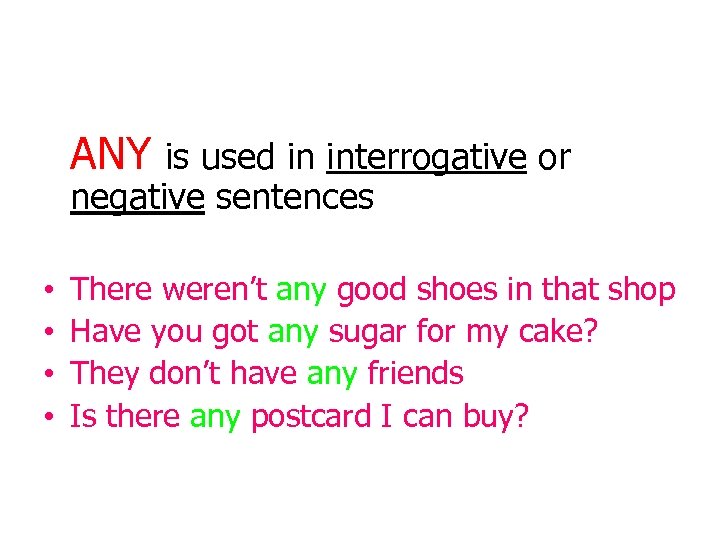 ANY is used in interrogative or negative sentences • • There weren’t any good shoes in that shop Have you got any sugar for my cake? They don’t have any friends Is there any postcard I can buy?
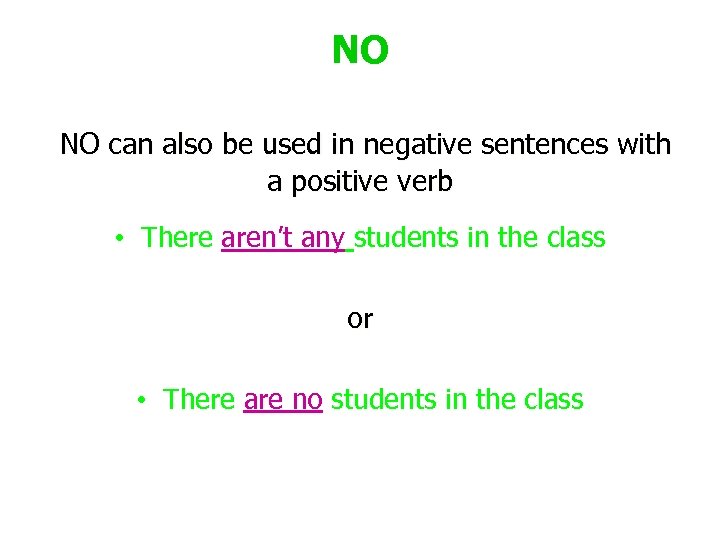 NO NO can also be used in negative sentences with a positive verb • There aren’t any students in the class or • There are no students in the class
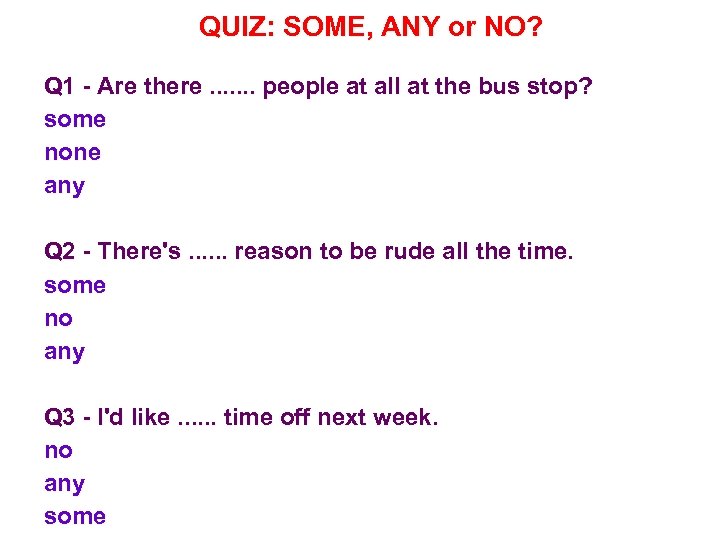 QUIZ: SOME, ANY or NO? Q 1 - Are there. . . . people at all at the bus stop? some none any Q 2 - There's. . . reason to be rude all the time. some no any Q 3 - I'd like. . . time off next week. no any some
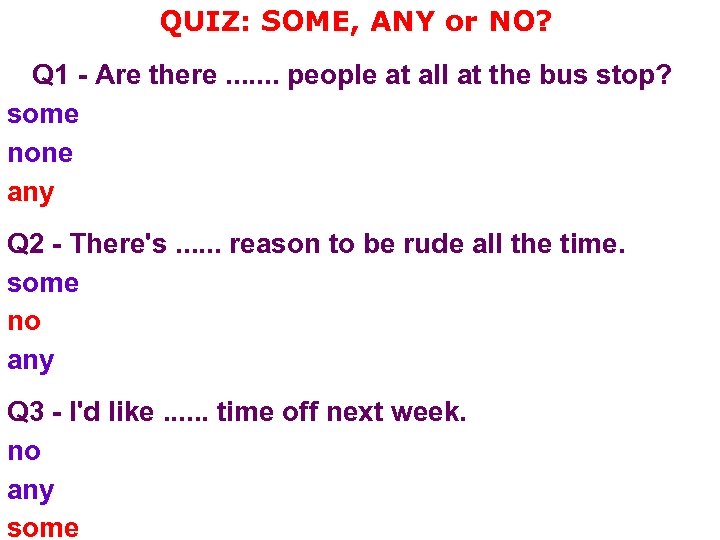 QUIZ: SOME, ANY or NO? Q 1 - Are there. . . . people at all at the bus stop? some none any Q 2 - There's. . . reason to be rude all the time. some no any Q 3 - I'd like. . . time off next week. no any some
 QUIZ: SOME, ANY or NO? Q 4 - There's . . . coffee left; could you get some while you're out? no some any Q 5 - I must get to the bank because I haven't got. . . money for the weekend. some no any Q 6 - Could I have. . . . more tea, please? no some any
 QUIZ: SOME, ANY or NO? Q 4 - There's . . . coffee left; could you get some while you're out? no some any Q 5 - I must get to the bank because I haven't got. . . money for the weekend. some no any Q 6 - Could I have. . . . more tea, please? no some
 QUIZ: SOME, ANY or NO? Q 7 - When we got to the cinema, there weren't . . . . tickets left. some no any Q 8 - My car stopped because there was. . . petrol left. any no some Q 9 - The shop had. . . . milk so we'll have to drink our coffee black. some no any
 QUIZ: SOME, ANY or NO? Q 7 - When we got to the cinema, there weren't. . . . tickets left. some no any Q 8 - My car stopped because there was. . . petrol left. any no some Q 9 - The shop had. . . . milk so we'll have to drink our coffee black. some no any
 QUIZ: SOME, ANY or NO? Q 10 - There must be. . . . job for me; I really need the work. some no any Q 11 - She's worried because she has got. . . . interviews next week and they always make her nervous. some no any Q 12 -. . . . newspapers support the Government, but most don't. No Any Some
 QUIZ: SOME, ANY or NO? Q 10 - There must be. . . . job for me; I really need the work. some no any Q 11 - She's worried because she has got. . . . interviews next week and they always make her nervous. some no any Q 12 -. . . . newspapers support the Government, but most don't. No Any
 QUIZ: SOME, ANY or NO? Q 13 - You shouldn't take. . . . medicine without reading the information first. some any no Q 14 - I'll have to get my TV fixed as I've been having. . . . problems with it. any no some Q 15 -. . . . smoke without a fire. Some No Any
 QUIZ: SOME, ANY or NO? Q 13 - You shouldn't take. . . . medicine without reading the information first. some any no Q 14 - I'll have to get my TV fixed as I've been having. . . . problems with it. any no some Q 15 -. . . . smoke without a fire. Some No Any
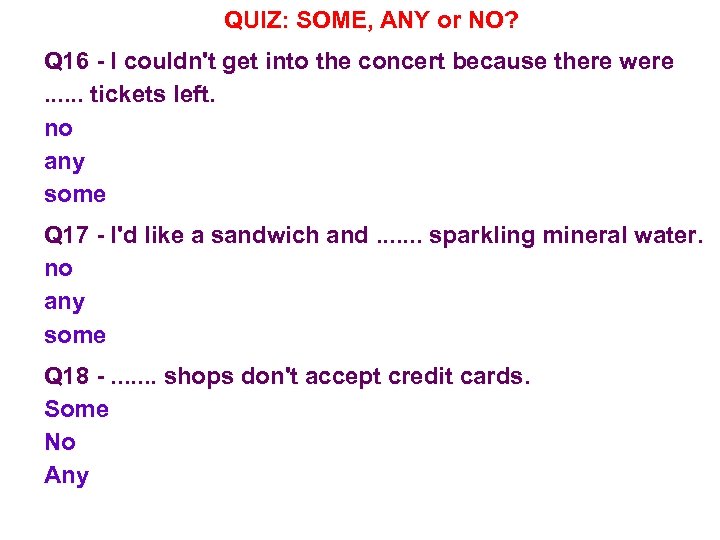 QUIZ: SOME, ANY or NO? Q 16 - I couldn't get into the concert because there were . . . tickets left. no any some Q 17 - I'd like a sandwich and. . . . sparkling mineral water. no any some Q 18 -. . . . shops don't accept credit cards. Some No Any
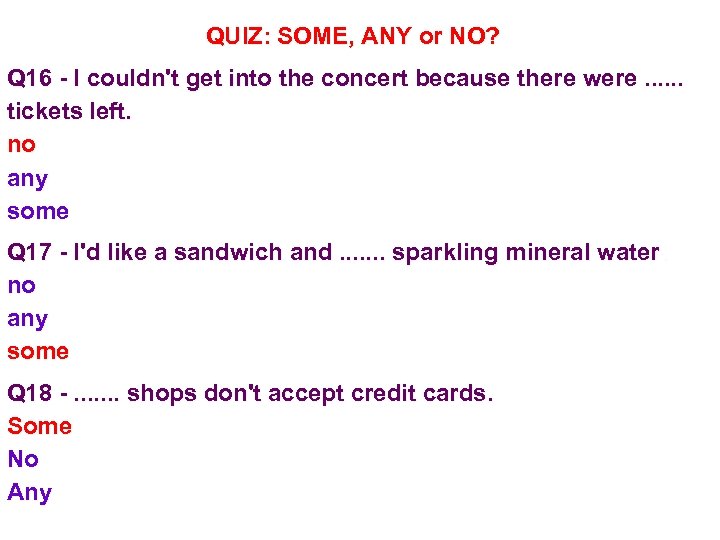 QUIZ: SOME, ANY or NO? Q 16 - I couldn't get into the concert because there were. . . tickets left. no any some Q 17 - I'd like a sandwich and. . . . sparkling mineral water. no any some Q 18 -. . . . shops don't accept credit cards. Some No Any
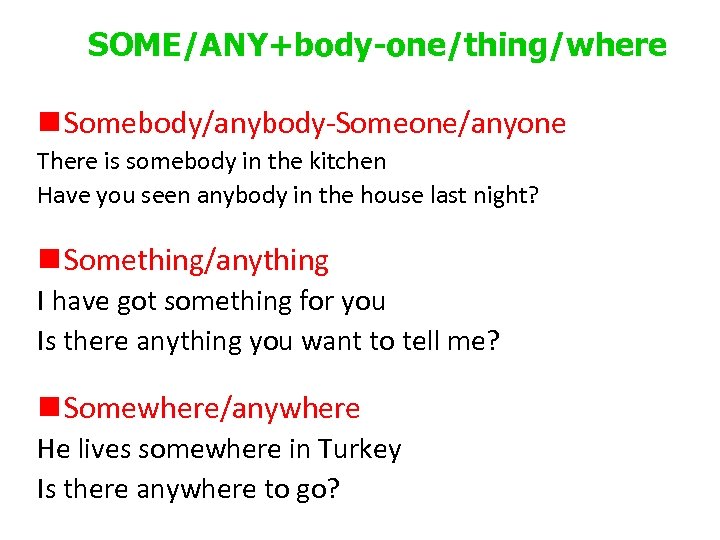 SOME/ANY+body-one/thing/where n Somebody/anybody-Someone/anyone There is somebody in the kitchen Have you seen anybody in the house last night? n Something/anything I have got something for you Is there anything you want to tell me? n Somewhere/anywhere He lives somewhere in Turkey Is there anywhere to go?
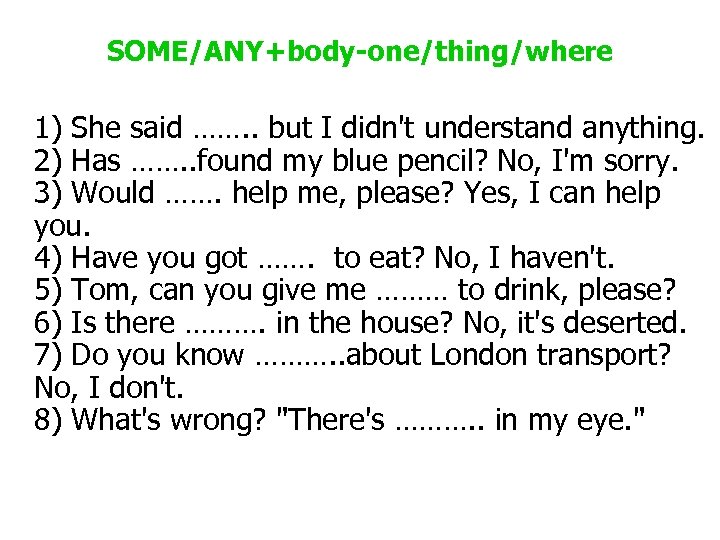 SOME/ANY+body-one/thing/where 1) She said ……. . but I didn't understand anything. 2) Has ……. . found my blue pencil? No, I'm sorry. 3) Would ……. help me, please? Yes, I can help you. 4) Have you got ……. to eat? No, I haven't. 5) Tom, can you give me ……… to drink, please? 6) Is there ………. in the house? No, it's deserted. 7) Do you know ………. . about London transport? No, I don't. 8) What's wrong? "There's ………. . in my eye. "
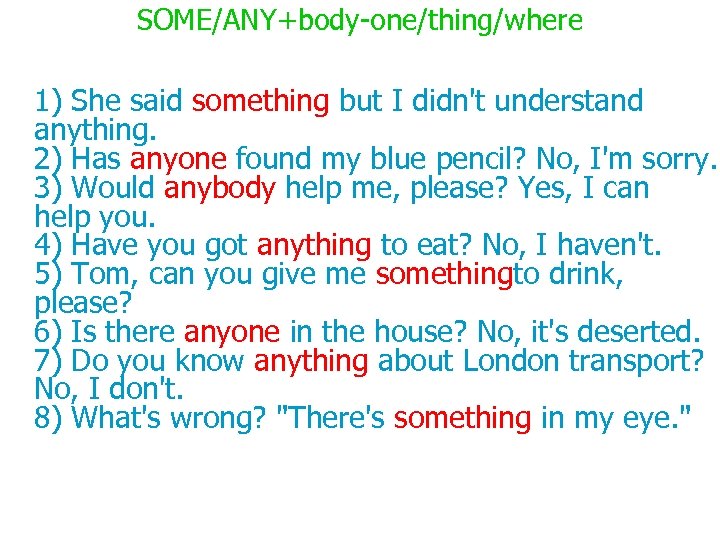 SOME/ANY+body-one/thing/where 1) She said something but I didn't understand anything. 2) Has anyone found my blue pencil? No, I'm sorry. 3) Would anybody help me, please? Yes, I can help you. 4) Have you got anything to eat? No, I haven't. 5) Tom, can you give me somethingto drink, please? 6) Is there anyone in the house? No, it's deserted. 7) Do you know anything about London transport? No, I don't. 8) What's wrong? "There's something in my eye. "
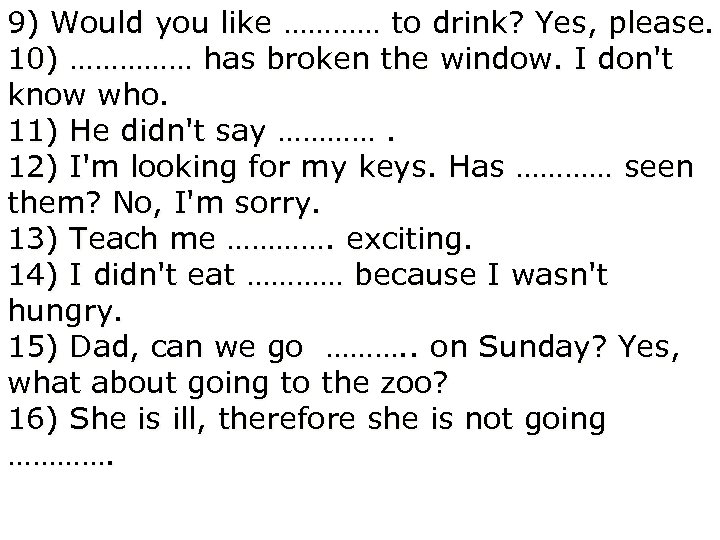 9) Would you like ………… to drink? Yes, please. 10) …………… has broken the window. I don't know who. 11) He didn't say …………. 12) I'm looking for my keys. Has ………… seen them? No, I'm sorry. 13) Teach me …………. exciting. 14) I didn't eat ………… because I wasn't hungry. 15) Dad, can we go ………. . on Sunday? Yes, what about going to the zoo? 16) She is ill, therefore she is not going ………….
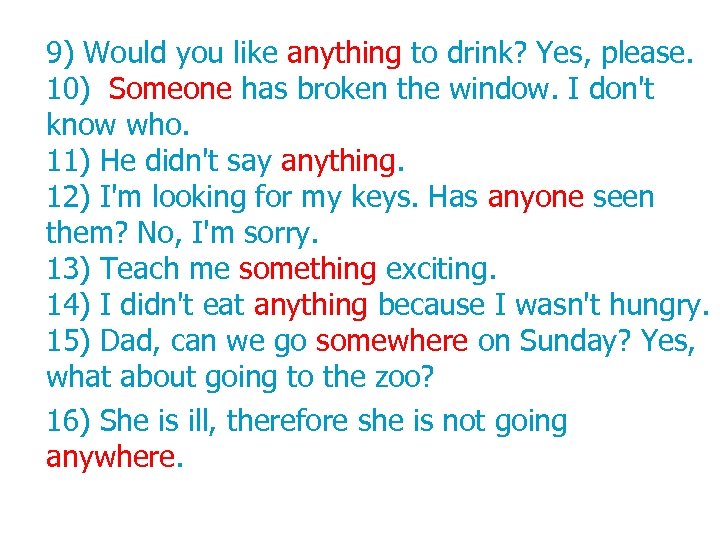 9) Would you like anything to drink? Yes, please. 10) Someone has broken the window. I don't know who. 11) He didn't say anything. 12) I'm looking for my keys. Has anyone seen them? No, I'm sorry. 13) Teach me something exciting. 14) I didn't eat anything because I wasn't hungry. 15) Dad, can we go somewhere on Sunday? Yes, what about going to the zoo? 16) She is ill, therefore she is not going anywhere.
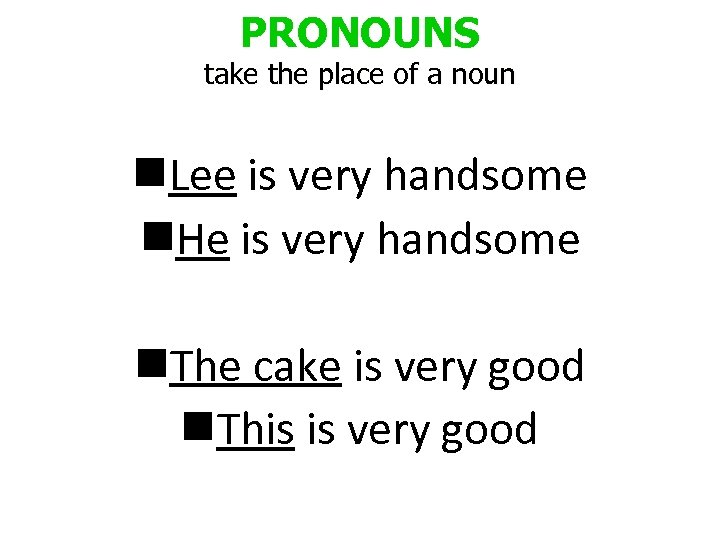 PRONOUNS take the place of a noun n. Lee is very handsome n. He is very handsome n. The cake is very good n. This is very good
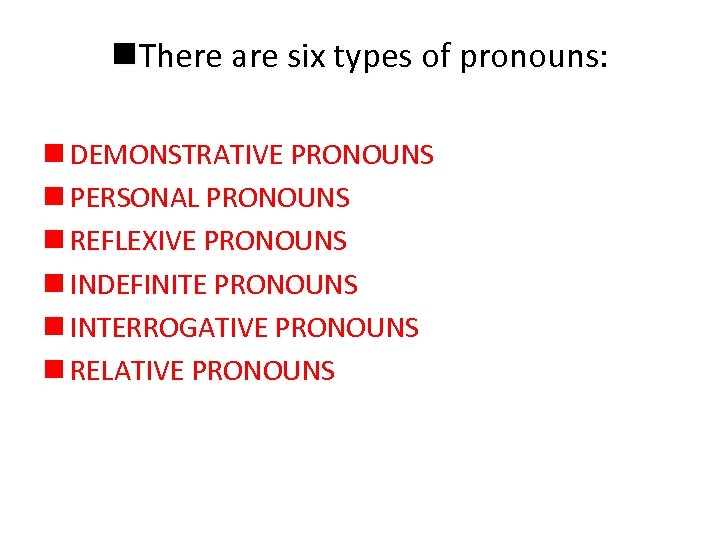 n. There are six types of pronouns: n DEMONSTRATIVE PRONOUNS n PERSONAL PRONOUNS n REFLEXIVE PRONOUNS n INDEFINITE PRONOUNS n INTERROGATIVE PRONOUNS n RELATIVE PRONOUNS
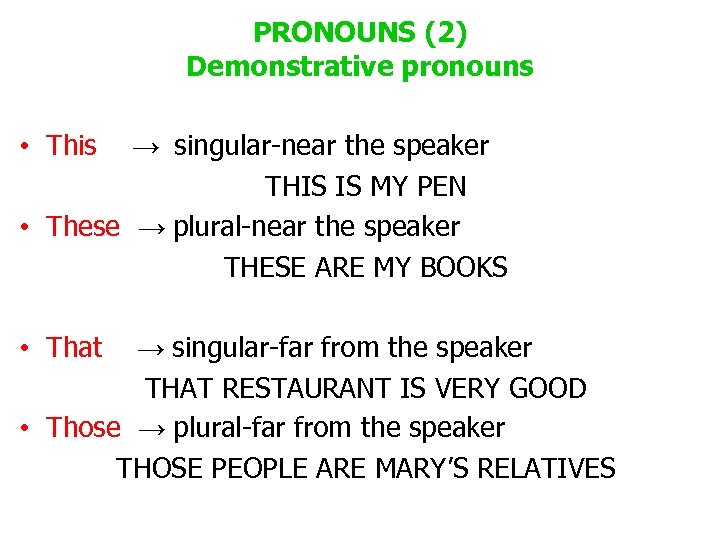 PRONOUNS (2) Demonstrative pronouns • This → singular-near the speaker THIS IS MY PEN • These → plural-near the speaker THESE ARE MY BOOKS • That → singular-far from the speaker THAT RESTAURANT IS VERY GOOD • Those → plural-far from the speaker THOSE PEOPLE ARE MARY’S RELATIVES
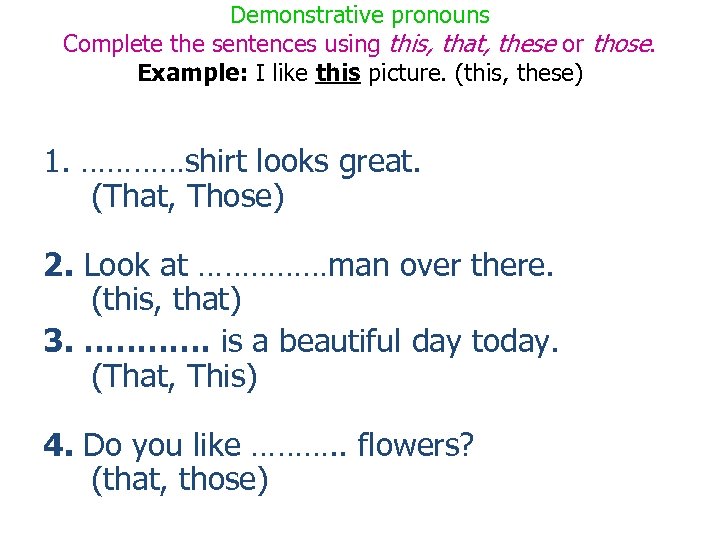 Demonstrative pronouns Complete the sentences using this, that, these or those. Example: I like this picture. (this, these) 1. …………shirt looks great. (That, Those) 2. Look at ……………man over there. (this, that) 3. ………… is a beautiful day today. (That, This) 4. Do you like ………. . flowers? (that, those)
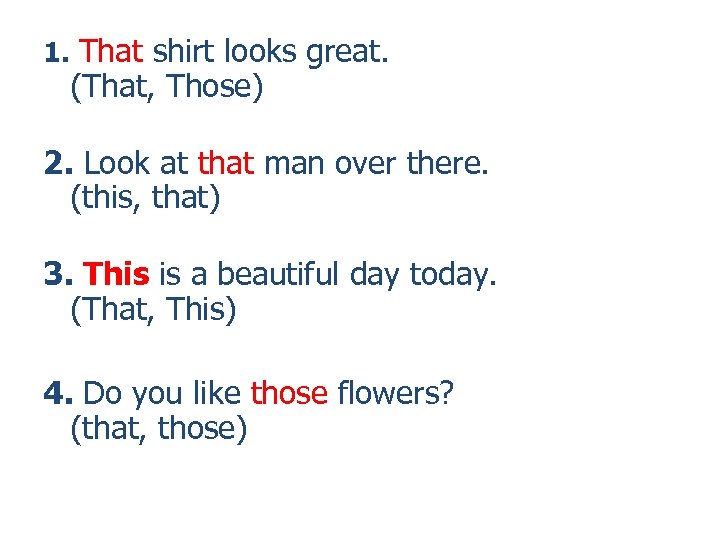 1. That shirt looks great. (That, Those) 2. Look at that man over there. (this, that) 3. This is a beautiful day today. (That, This) 4. Do you like those flowers? (that, those)
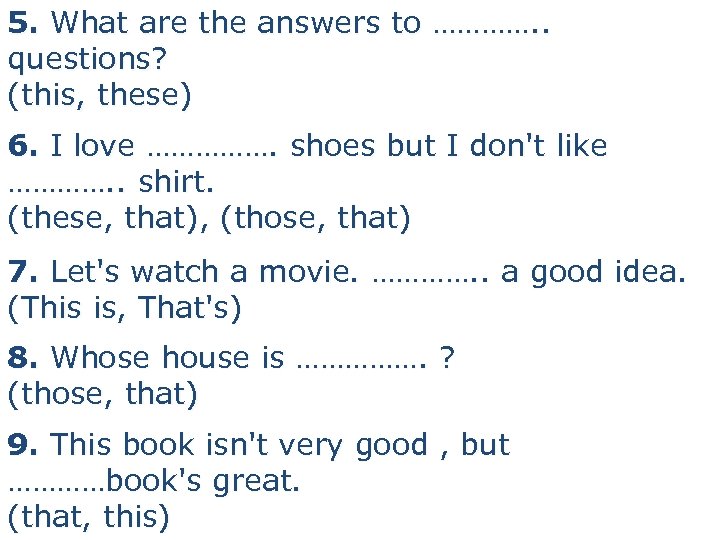 5. What are the answers to …………. . questions? (this, these) 6. I love ……………. shoes but I don't like …………. . shirt. (these, that), (those, that) 7. Let's watch a movie. …………. . a good idea. (This is, That's) 8. Whose house is ……………. ? (those, that) 9. This book isn't very good , but …………book's great. (that, this)
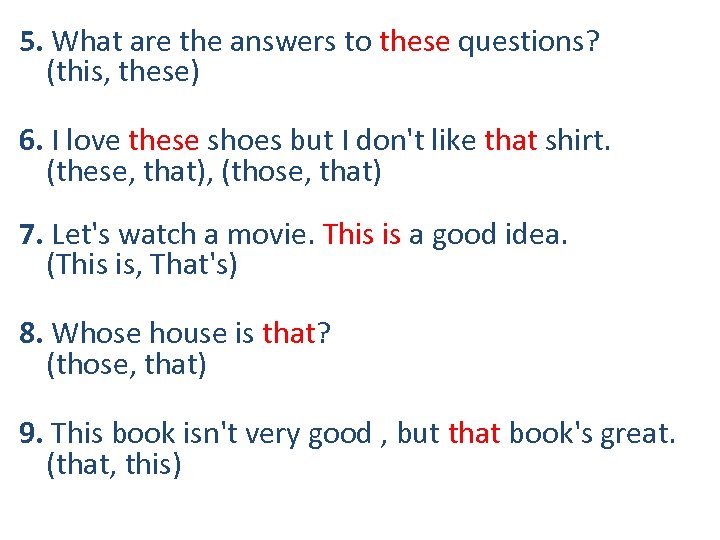 5. What are the answers to these questions? (this, these) 6. I love these shoes but I don't like that shirt. (these, that), (those, that) 7. Let's watch a movie. This is a good idea. (This is, That's) 8. Whose house is that? (those, that) 9. This book isn't very good , but that book's great. (that, this)
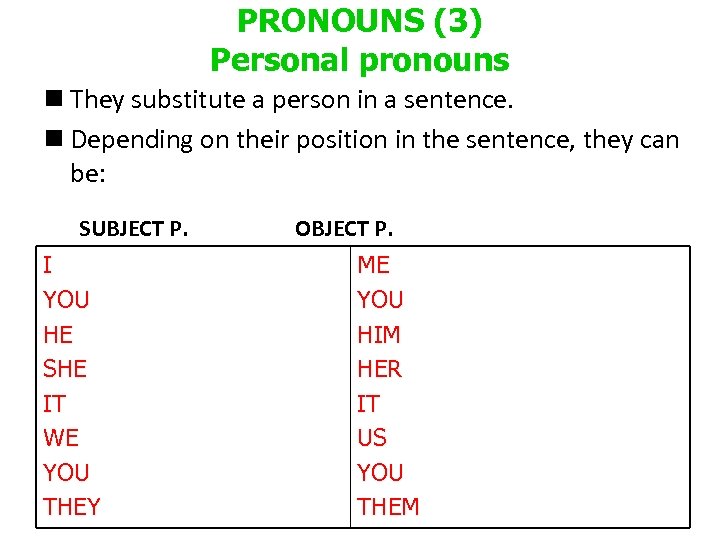 PRONOUNS (3) Personal pronouns n They substitute a person in a sentence. n Depending on their position in the sentence, they can be: SUBJECT P. I YOU HE SHE IT WE YOU THEY OBJECT P. ME YOU HIM HER IT US YOU THEM
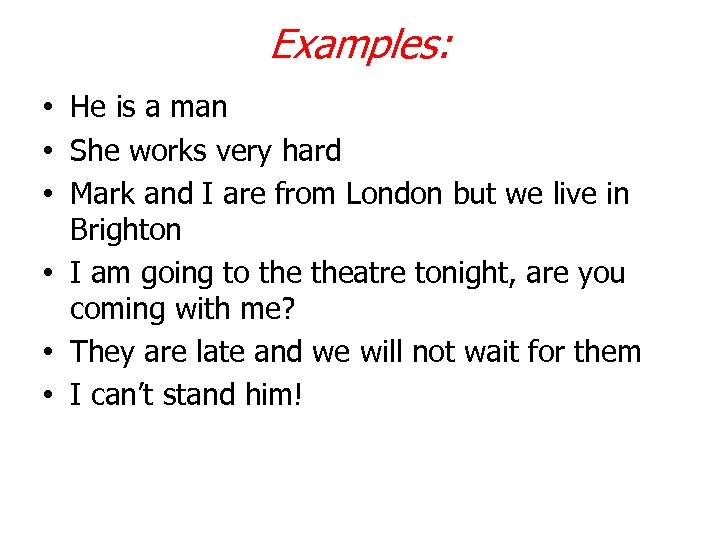 Examples: • He is a man • She works very hard • Mark and I are from London but we live in Brighton • I am going to theatre tonight, are you coming with me? • They are late and we will not wait for them • I can’t stand him!
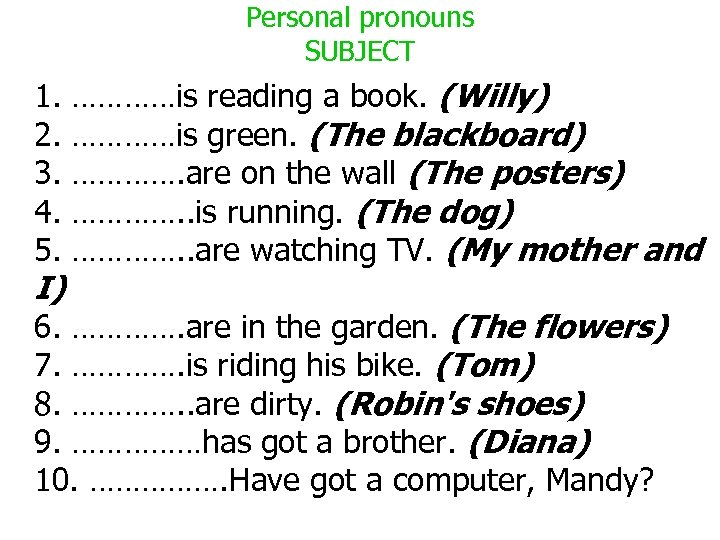 Personal pronouns SUBJECT 1. …………is reading a book. (Willy) 2. …………is green. (The blackboard) 3. …………. are on the wall (The posters) 4. …………. . is running. (The dog) 5. …………. . are watching TV. (My mother and I) 6. …………. are in the garden. (The flowers) 7. …………. is riding his bike. (Tom) 8. …………. . are dirty. (Robin's shoes) 9. ……………has got a brother. (Diana) 10. ……………. Have got a computer, Mandy?
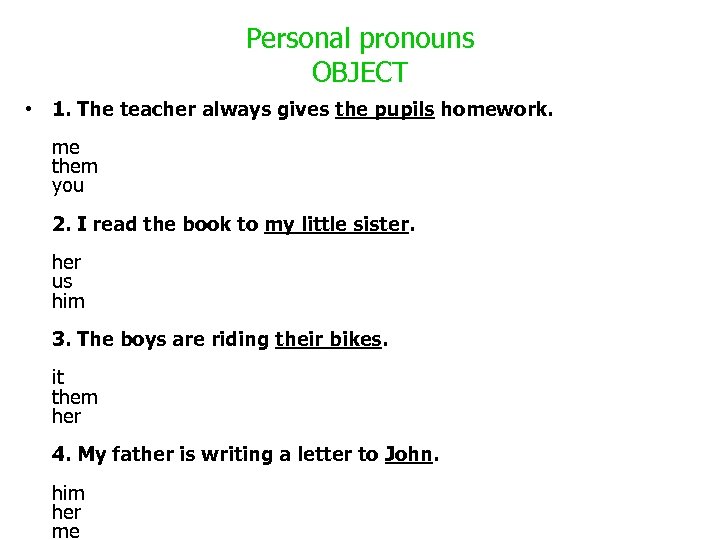 Personal pronouns OBJECT • 1. The teacher always gives the pupils homework. me them you 2. I read the book to my little sister. her us him 3. The boys are riding their bikes. it them her 4. My father is writing a letter to John. him her me
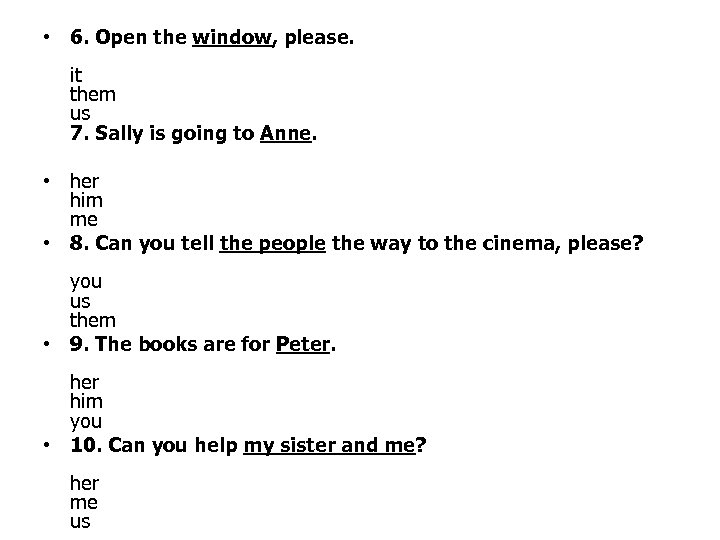 • 6. Open the window, please. it them us 7. Sally is going to Anne. • her him me • 8. Can you tell the people the way to the cinema, please? you us them • 9. The books are for Peter. her him you • 10. Can you help my sister and me? her me us
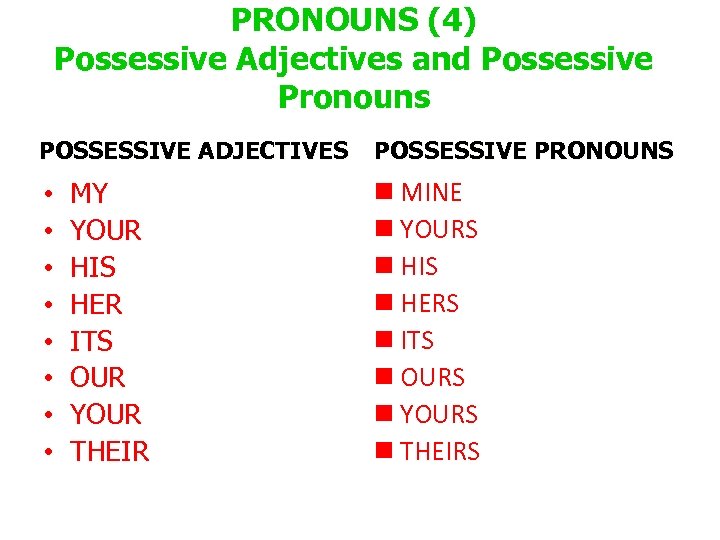 PRONOUNS (4) Possessive Adjectives and Possessive Pronouns POSSESSIVE ADJECTIVES • • MY YOUR HIS HER ITS OUR YOUR THEIR POSSESSIVE PRONOUNS n MINE n YOURS n HIS n HERS n ITS n OURS n YOURS n THEIRS
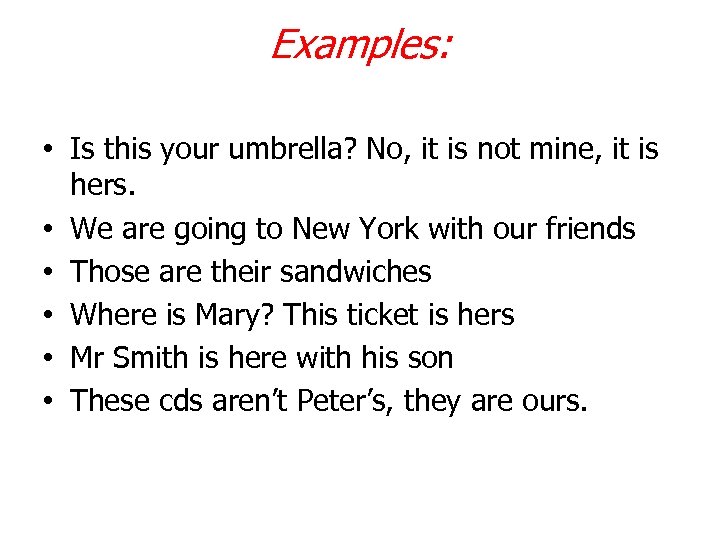 Examples: • Is this your umbrella? No, it is not mine, it is hers. • We are going to New York with our friends • Those are their sandwiches • Where is Mary? This ticket is hers • Mr Smith is here with his son • These cds aren’t Peter’s, they are ours.
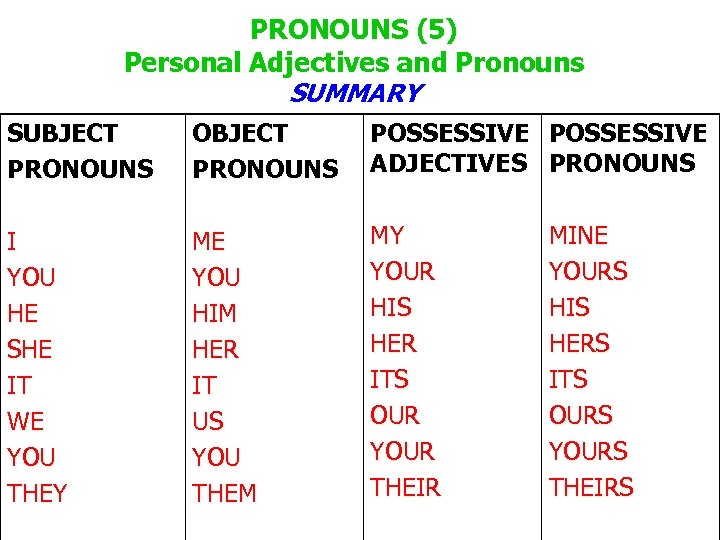 PRONOUNS (5) Personal Adjectives and Pronouns SUMMARY SUBJECT PRONOUNS OBJECT PRONOUNS POSSESSIVE ADJECTIVES PRONOUNS I YOU HE SHE IT WE YOU THEY ME YOU HIM HER IT US YOU THEM MY YOUR HIS HER ITS OUR YOUR THEIR MINE YOURS HIS HERS ITS OURS YOURS THEIRS
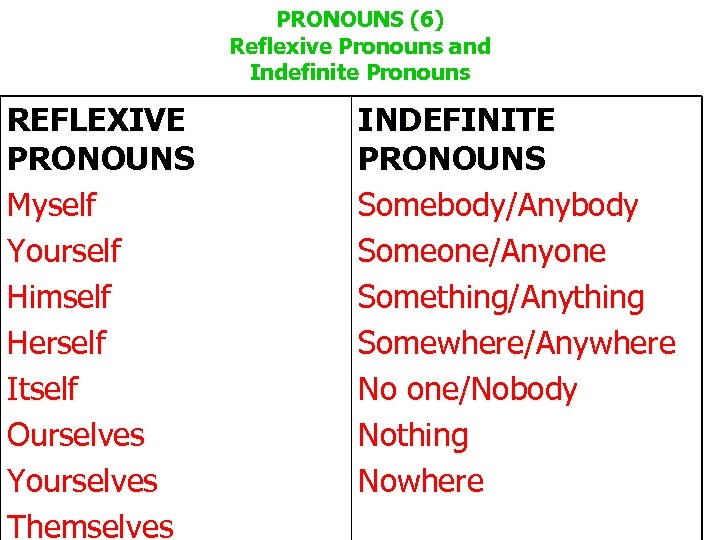 PRONOUNS (6) Reflexive Pronouns and Indefinite Pronouns REFLEXIVE PRONOUNS Myself Yourself Himself Herself Itself Ourselves Yourselves Themselves INDEFINITE PRONOUNS Somebody/Anybody Someone/Anyone Something/Anything Somewhere/Anywhere No one/Nobody Nothing Nowhere
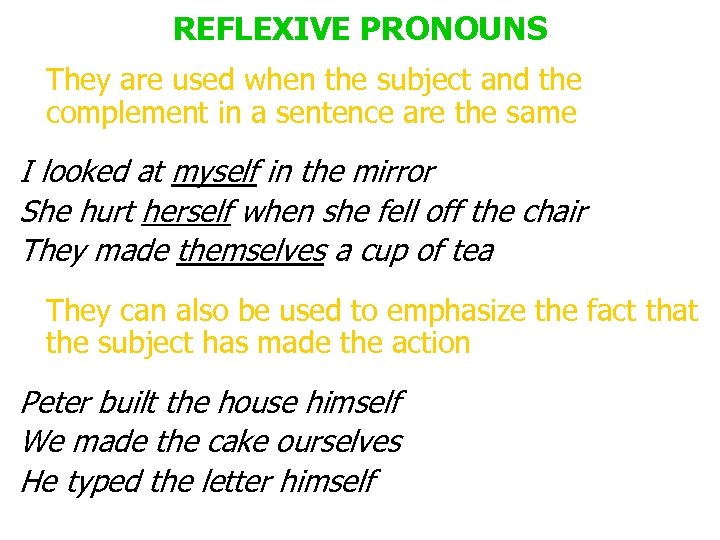 REFLEXIVE PRONOUNS They are used when the subject and the complement in a sentence are the same I looked at myself in the mirror She hurt herself when she fell off the chair They made themselves a cup of tea They can also be used to emphasize the fact that the subject has made the action Peter built the house himself We made the cake ourselves He typed the letter himself
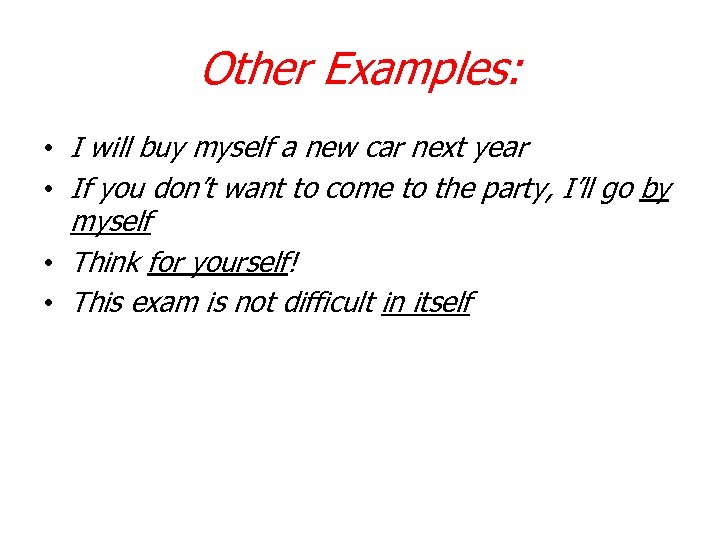 Other Examples: • I will buy myself a new car next year • If you don’t want to come to the party, I’ll go by myself • Think for yourself! • This exam is not difficult in itself
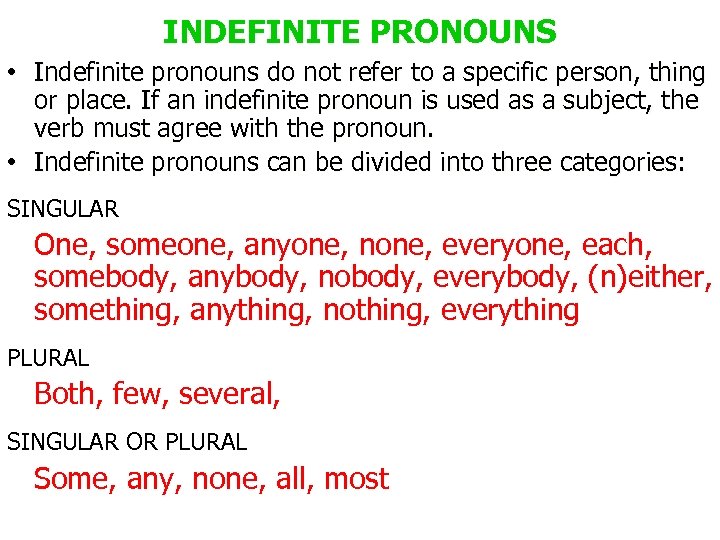 INDEFINITE PRONOUNS • Indefinite pronouns do not refer to a specific person, thing or place. If an indefinite pronoun is used as a subject, the verb must agree with the pronoun. • Indefinite pronouns can be divided into three categories: SINGULAR One, someone, anyone, none, everyone, each, somebody, anybody, nobody, everybody, (n)either, something, anything, nothing, everything PLURAL Both, few, several, SINGULAR OR PLURAL Some, any, none, all, most
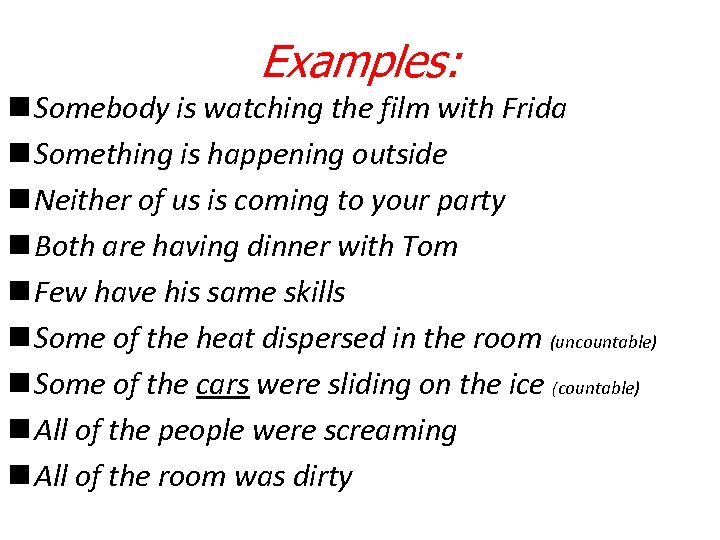 Examples: n Somebody is watching the film with Frida n Something is happening outside n Neither of us is coming to your party n Both are having dinner with Tom n Few have his same skills n Some of the heat dispersed in the room (uncountable) n Some of the cars were sliding on the ice (countable) n All of the people were screaming n All of the room was dirty
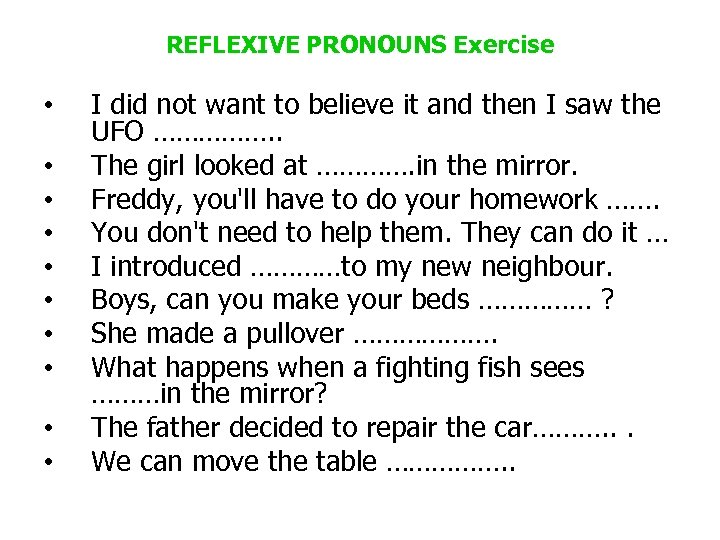 REFLEXIVE PRONOUNS Exercise • • • I did not want to believe it and then I saw the UFO ……………. . The girl looked at …………. in the mirror. Freddy, you'll have to do your homework ……. You don't need to help them. They can do it … I introduced …………to my new neighbour. Boys, can you make your beds …………… ? She made a pullover ………………. What happens when a fighting fish sees ………in the mirror? The father decided to repair the car………. . . We can move the table ……………. .
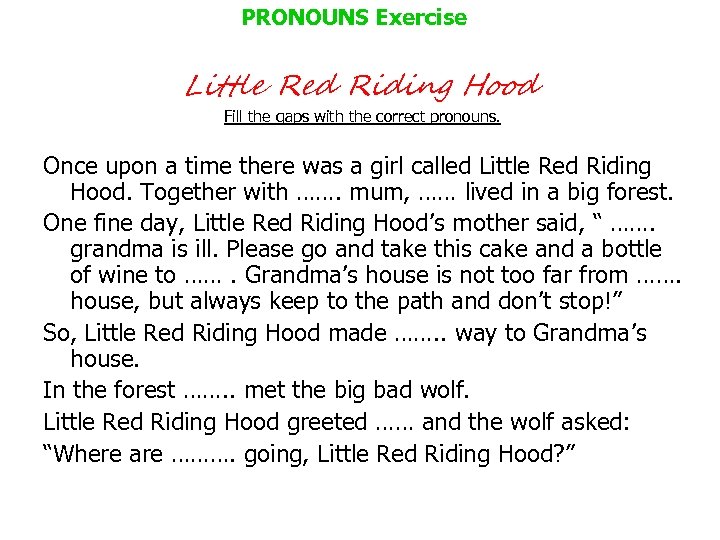 PRONOUNS Exercise Little Red Riding Hood Fill the gaps with the correct pronouns. Once upon a time there was a girl called Little Red Riding Hood. Together with ……. mum, …… lived in a big forest. One fine day, Little Red Riding Hood’s mother said, “ ……. grandma is ill. Please go and take this cake and a bottle of wine to ……. Grandma’s house is not too far from ……. house, but always keep to the path and don’t stop!” So, Little Red Riding Hood made ……. . way to Grandma’s house. In the forest ……. . met the big bad wolf. Little Red Riding Hood greeted …… and the wolf asked: “Where are ………. going, Little Red Riding Hood? ”
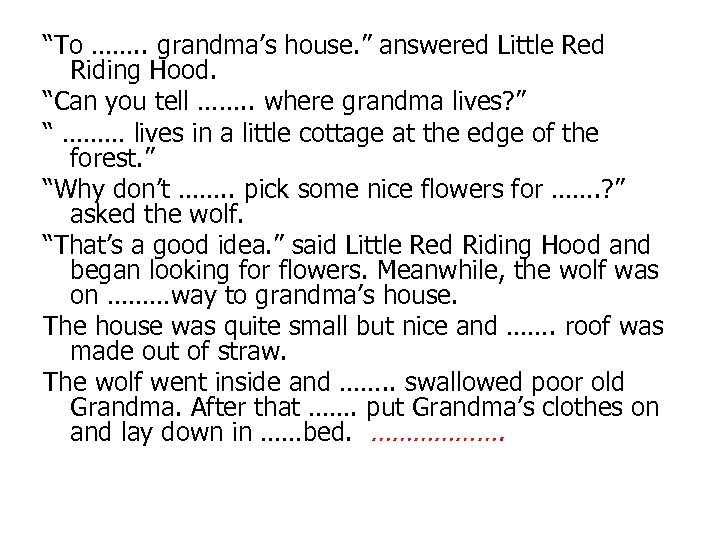 “To ……. . grandma’s house. ” answered Little Red Riding Hood. “Can you tell ……. . where grandma lives? ” “ ……… lives in a little cottage at the edge of the forest. ” “Why don’t ……. . pick some nice flowers for ……. ? ” asked the wolf. “That’s a good idea. ” said Little Red Riding Hood and began looking for flowers. Meanwhile, the wolf was on ………way to grandma’s house. The house was quite small but nice and ……. roof was made out of straw. The wolf went inside and ……. . swallowed poor old Grandma. After that ……. put Grandma’s clothes on and lay down in ……bed. ……………….
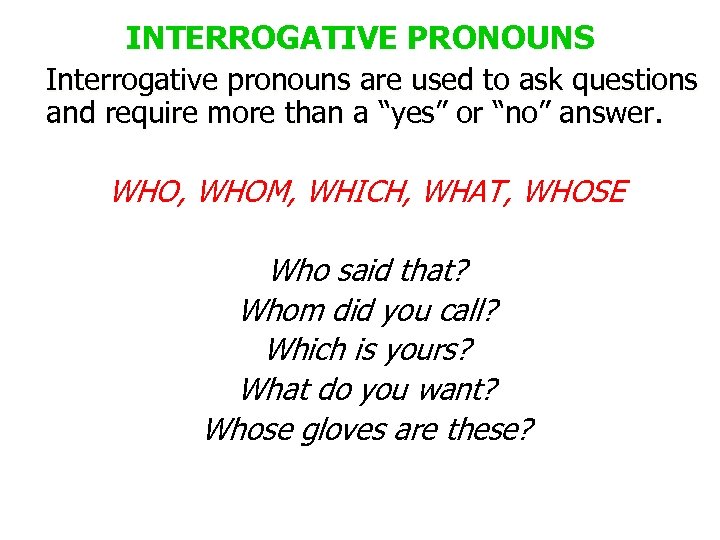 INTERROGATIVE PRONOUNS Interrogative pronouns are used to ask questions and require more than a “yes” or “no” answer. WHO, WHOM, WHICH, WHAT, WHOSE Who said that? Whom did you call? Which is yours? What do you want? Whose gloves are these?
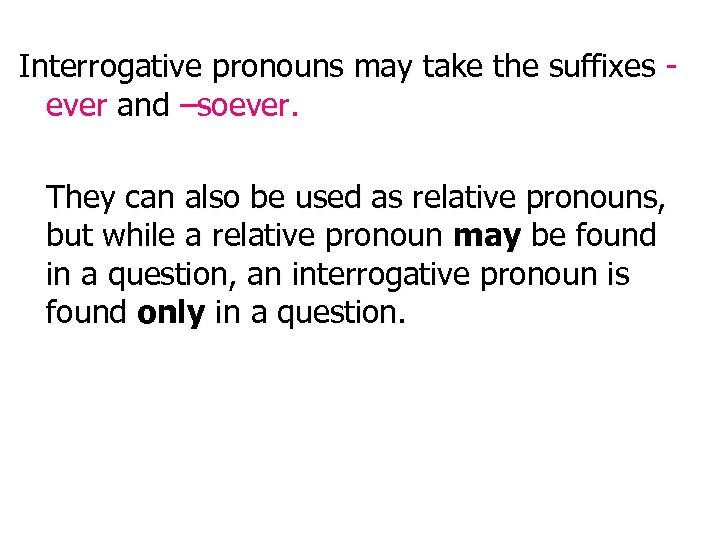 Interrogative pronouns may take the suffixes ever and –soever. and They can also be used as relative pronouns, but while a relative pronoun may be found in a question, an interrogative pronoun is found only in a question.
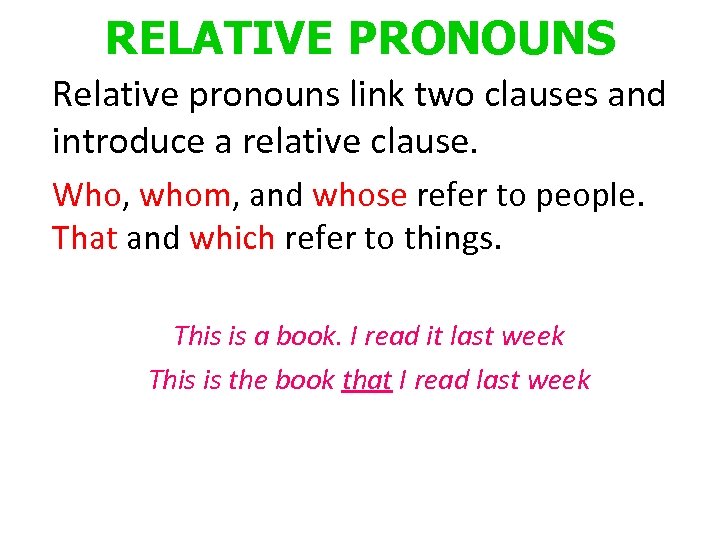 RELATIVE PRONOUNS Relative pronouns link two clauses and introduce a relative clause. Who, whom, and whose refer to people. That and which refer to things. This is a book. I read it last week This is the book that I read last week
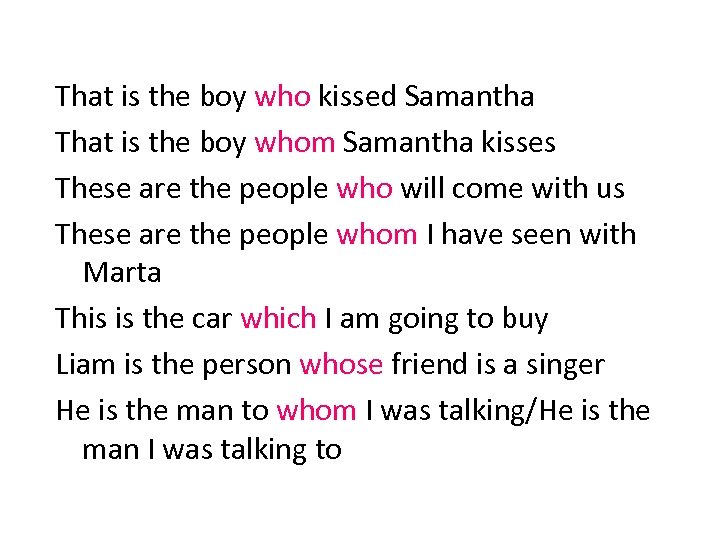 That is the boy who kissed Samantha That is the boy whom Samantha kisses These are the people who will come with us These are the people whom I have seen with Marta This is the car which I am going to buy Liam is the person whose friend is a singer He is the man to whom I was talking/He is the man I was talking to
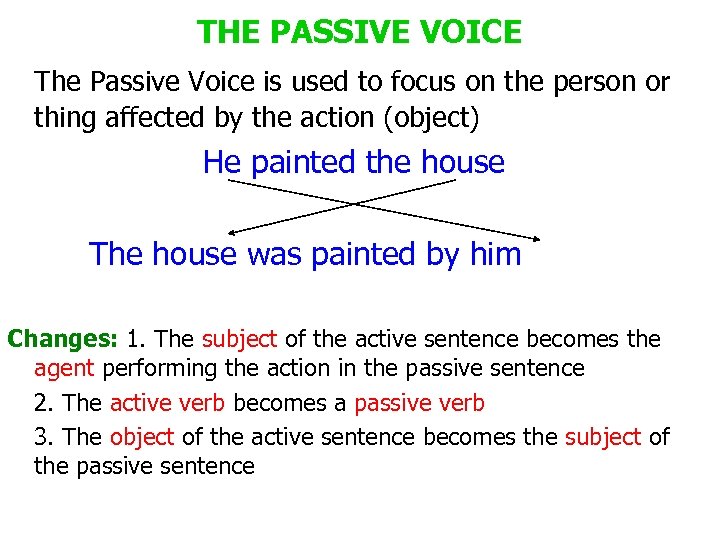 THE PASSIVE VOICE The Passive Voice is used to focus on the person or thing affected by the action (object) He painted the house The house was painted by him Changes: 1. The subject of the active sentence becomes the agent performing the action in the passive sentence 2. The active verb becomes a passive verb 3. The object of the active sentence becomes the subject of the passive sentence
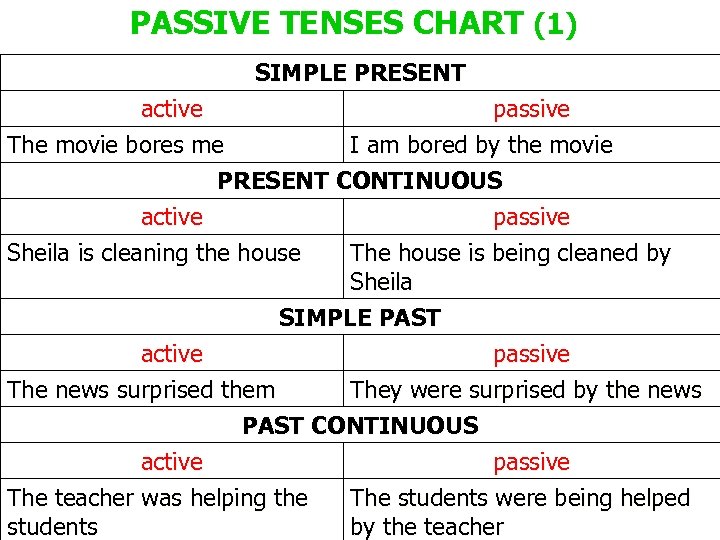 PASSIVE TENSES CHART (1) SIMPLE PRESENT active The movie bores me passive I am bored by the movie PRESENT CONTINUOUS active passive Sheila is cleaning the house The house is being cleaned by Sheila SIMPLE PAST active The news surprised them passive They were surprised by the news PAST CONTINUOUS active The teacher was helping the students passive The students were being helped by the teacher
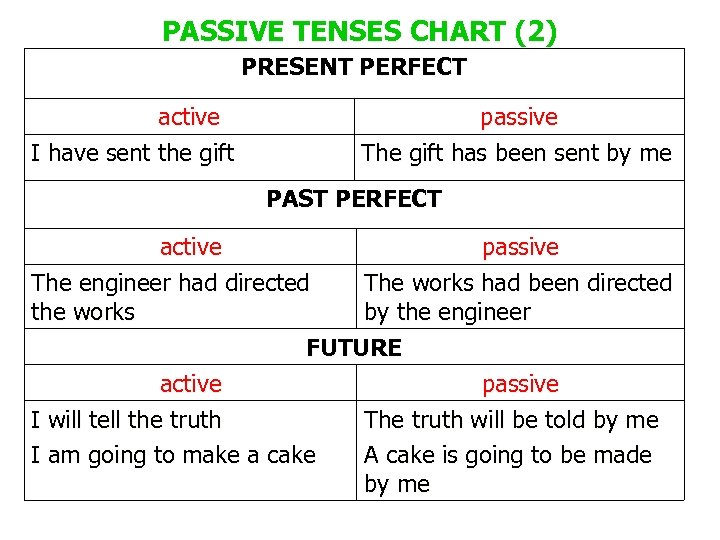 PASSIVE TENSES CHART (2) PRESENT PERFECT active I have sent the gift passive The gift has been sent by me PAST PERFECT active passive The engineer had directed The works had been directed the works by the engineer FUTURE active passive I will tell the truth The truth will be told by me I am going to make a cake A cake is going to be made by me
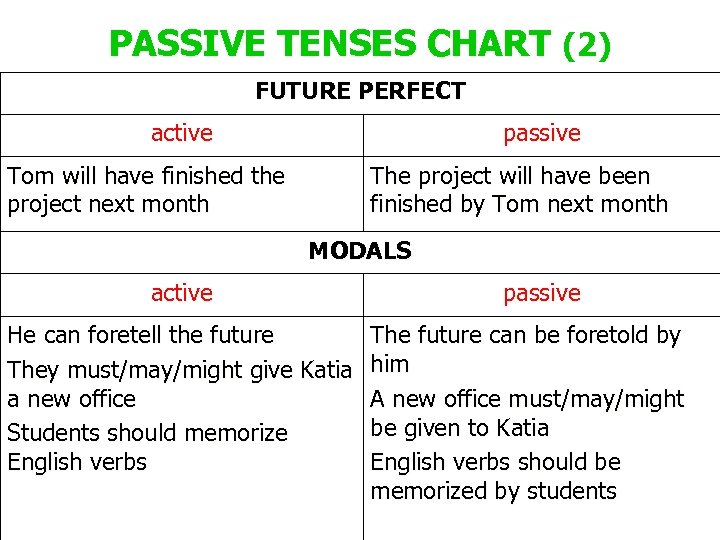 PASSIVE TENSES CHART (2) FUTURE PERFECT active passive Tom will have finished the project next month The project will have been finished by Tom next month MODALS active He can foretell the future They must/may/might give Katia a new office Students should memorize English verbs passive The future can be foretold by him A new office must/may/might be given to Katia English verbs should be memorized by students
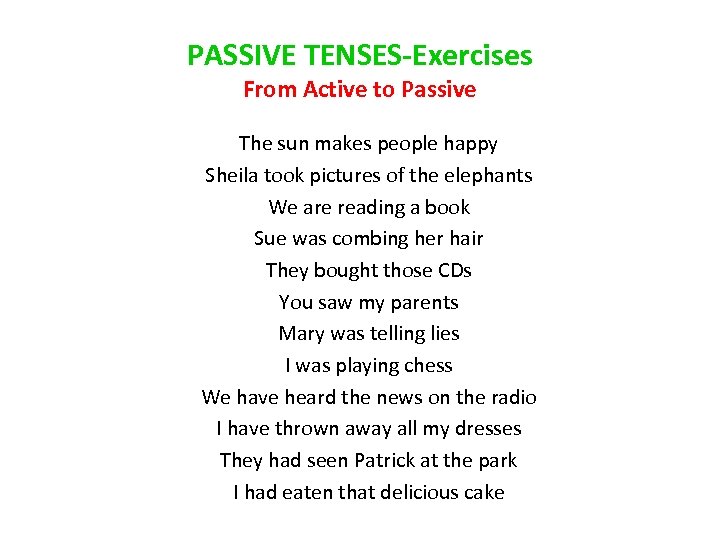 PASSIVE TENSES-Exercises From Active to Passive The sun makes people happy Sheila took pictures of the elephants We are reading a book Sue was combing her hair They bought those CDs You saw my parents Mary was telling lies I was playing chess We have heard the news on the radio I have thrown away all my dresses They had seen Patrick at the park I had eaten that delicious cake
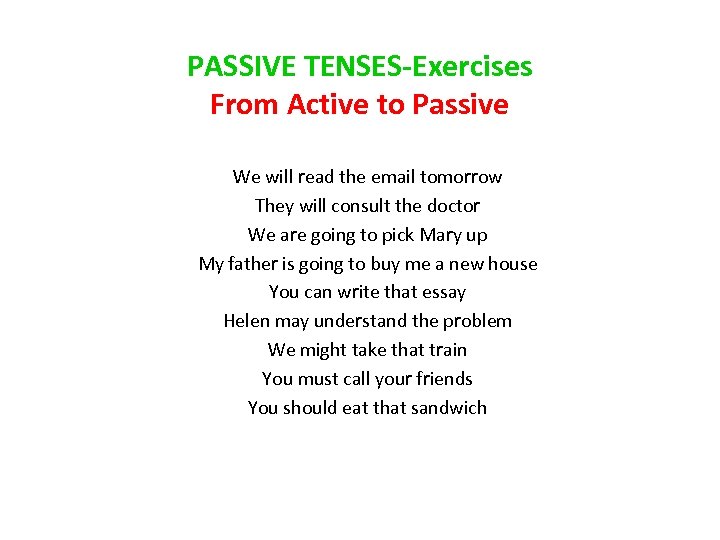 PASSIVE TENSES-Exercises From Active to Passive We will read the email tomorrow They will consult the doctor We are going to pick Mary up My father is going to buy me a new house You can write that essay Helen may understand the problem We might take that train You must call your friends You should eat that sandwich
 COMPARATIVES/SUPERLATIVES • Comparatives and superlatives are used to compare two or more things. • Comparatives are formed using -er or more and Comparatives are formed using or superlatives are formed using –est or most. superlatives are formed using or Comparatives compare two things. The second term of comparison is introduced by “than”, but you can also use a conjunction like ‘but’. Andrea is taller than Gianni. Andrea is tall, but Luigi is taller.
 COMPARATIVES/SUPERLATIVES Superlatives compare more than two things. Superlative adjectives are preceded by ‘the’. The second term of comparison is usually introduced by “of”, “in”, “among” etc. Filippo is the tallest in the class. Andrea is tall, and Luigi is taller, but Filippo is the tallest of all.
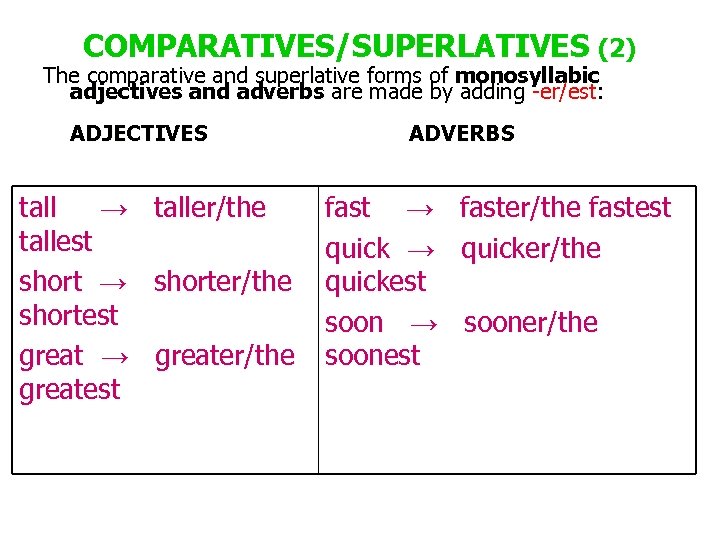 COMPARATIVES/SUPERLATIVES (2) The comparative and superlative forms of monosyllabic adjectives and adverbs are made by adding -er/est: are made by adding ADJECTIVES ADVERBS tall → taller/the tallest short → shorter/the shortest great → greater/the greatest fast → faster/the fastest quick → quicker/the quickest soon → sooner/the soonest
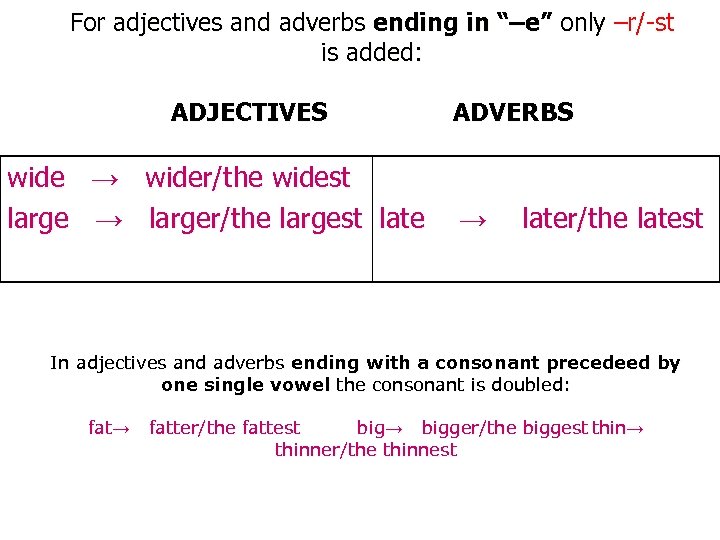 For adjectives and adverbs ending in “–e” only –r/-st only is added: ADJECTIVES ADVERBS wide → wider/the widest large → larger/the largest late → later/the latest In adjectives and adverbs ending with a consonant precedeed by one single vowel the consonant is doubled: fat→ fatter/the fattest big→ bigger/the biggest thin→ thinner/the thinnest
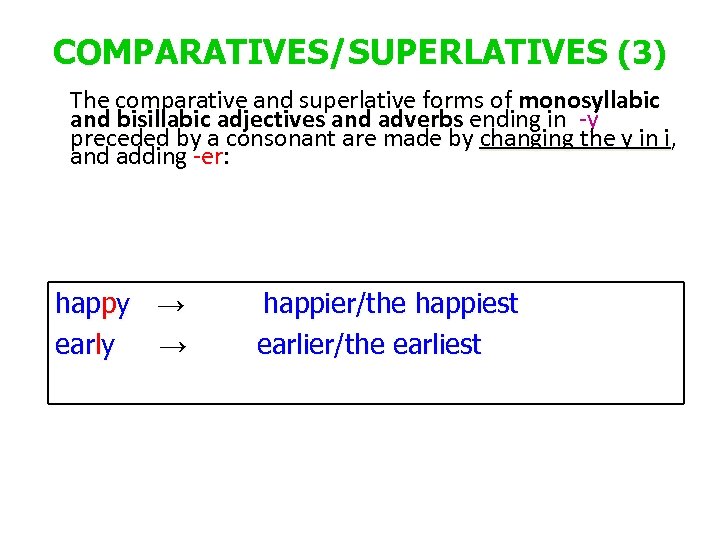 COMPARATIVES/SUPERLATIVES (3) The comparative and superlative forms of monosyllabic and bisillabic adjectives and adverbs ending in -y preceded by a consonant are made by changing the y in i, and adding -er: happy → happier/the happiest early → earlier/the earliest
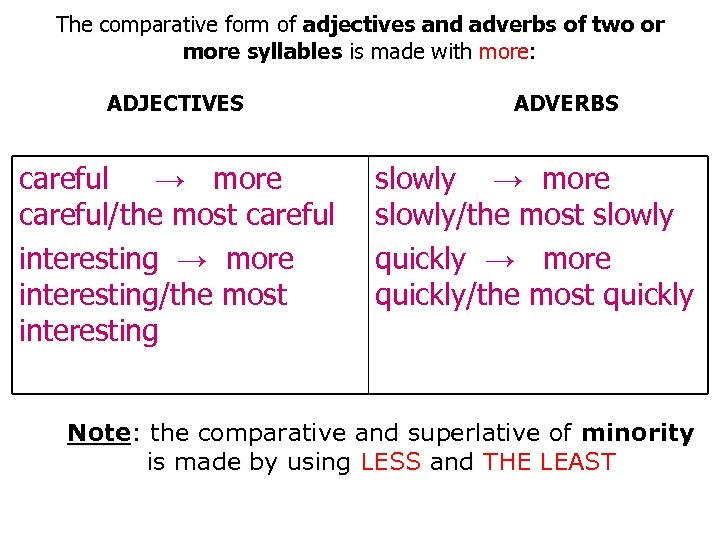 The comparative form of adjectives and adverbs of two or more syllables is made with more: is made with ADJECTIVES ADVERBS careful → more careful/the most careful interesting → more interesting/the most interesting slowly → more slowly/the most slowly quickly → more quickly/the most quickly Note: the comparative and superlative of minority is made by using LESS and THE LEAST
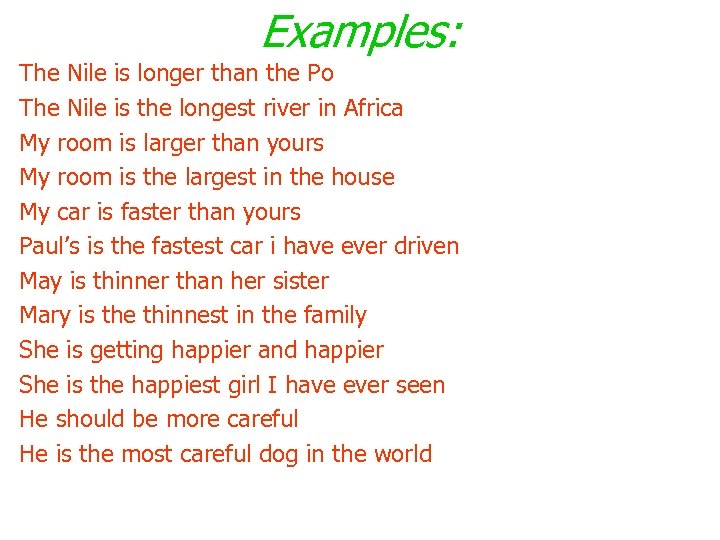 Examples: The Nile is longer than the Po The Nile is the longest river in Africa My room is larger than yours My room is the largest in the house My car is faster than yours Paul’s is the fastest car i have ever driven May is thinner than her sister Mary is the thinnest in the family She is getting happier and happier She is the happiest girl I have ever seen He should be more careful He is the most careful dog in the world
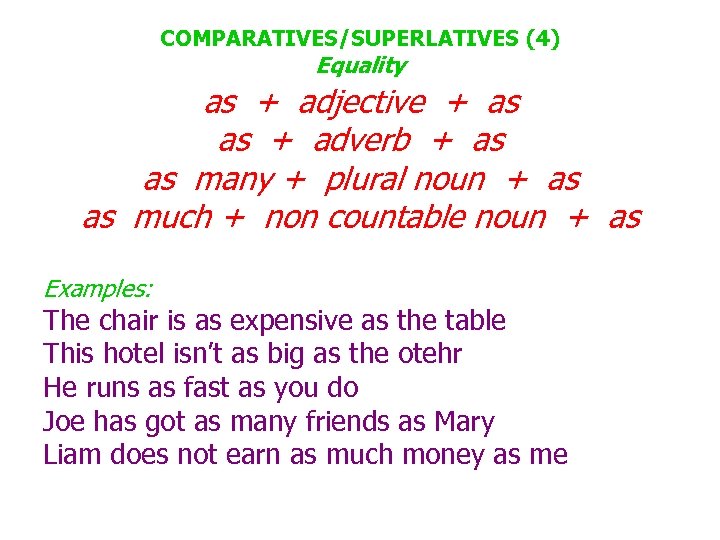 COMPARATIVES/SUPERLATIVES (4) Equality as + adjective + as as + adverb + as as many + plural noun + as as much + non countable noun + as Examples: The chair is as expensive as the table This hotel isn’t as big as the otehr He runs as fast as you do Joe has got as many friends as Mary Liam does not earn as much money as me
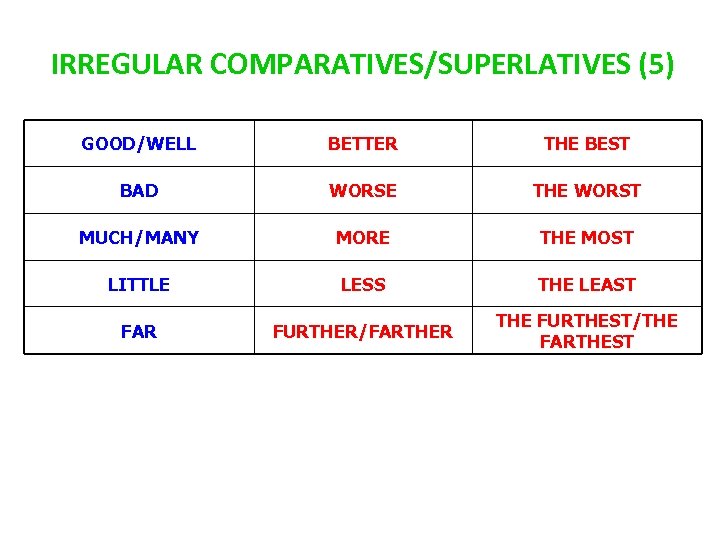 IRREGULAR COMPARATIVES/SUPERLATIVES (5) GOOD/WELL BETTER THE BEST BAD WORSE THE WORST MUCH/MANY MORE THE MOST LITTLE LESS THE LEAST FAR FURTHER/FARTHER THE FURTHEST/THE FARTHEST
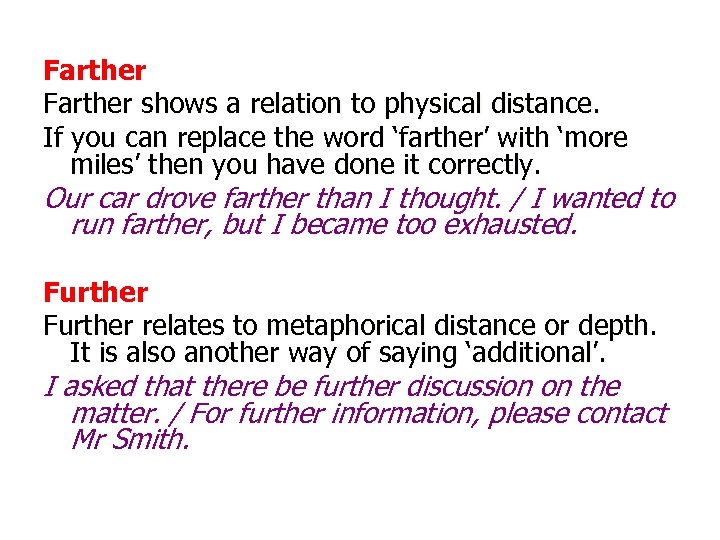 Farther shows a relation to physical distance. If you can replace the word ‘farther’ with ‘more miles’ then you have done it correctly. Our car drove farther than I thought. / I wanted to run farther, but I became too exhausted. Further relates to metaphorical distance or depth. It is also another way of saying ‘additional’. I asked that there be further discussion on the matter. / For further information, please contact Mr Smith.
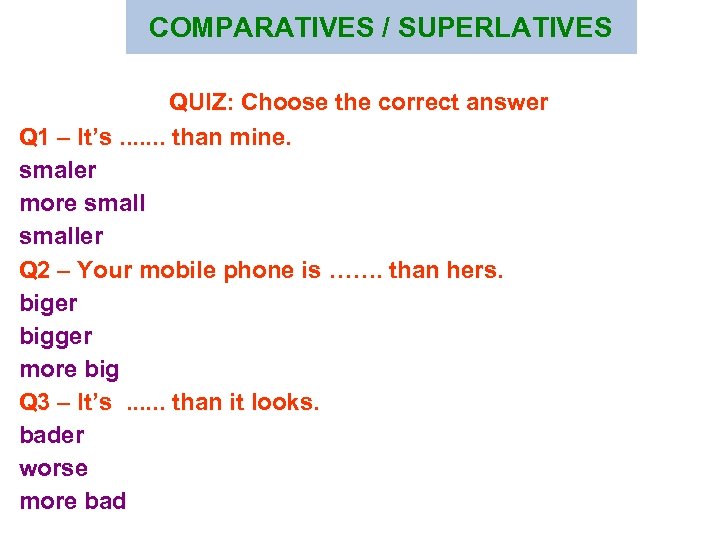 COMPARATIVES / SUPERLATIVES QUIZ: Choose the correct answer Q 1 – It’s. . . . than mine. smaler more smaller Q 2 – Your mobile phone is ……. than hers. biger bigger more big Q 3 – It’s . . . than it looks. bader worse more bad
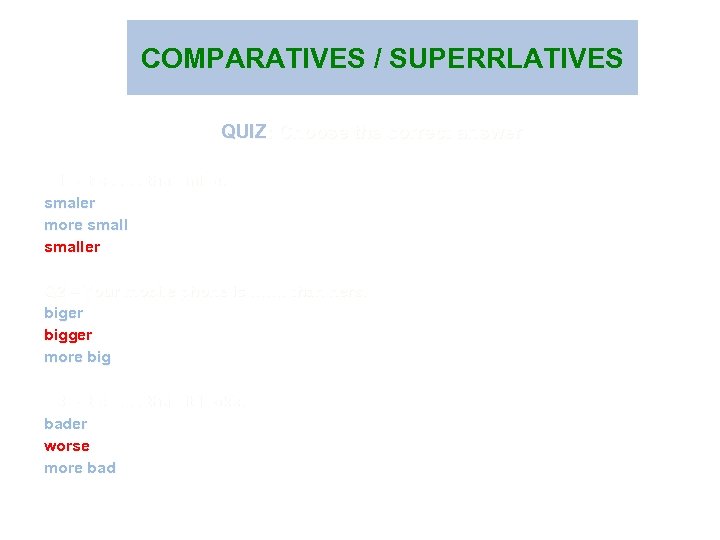 COMPARATIVES / SUPERRLATIVES QUIZ: Choose the correct answer Q 1 – It’s. . . . than mine. smaler more smaller Q 2 – Your mobile phone is ……. than hers. biger bigger more big Q 3 – It’s . . . than it looks. bader worse more bad
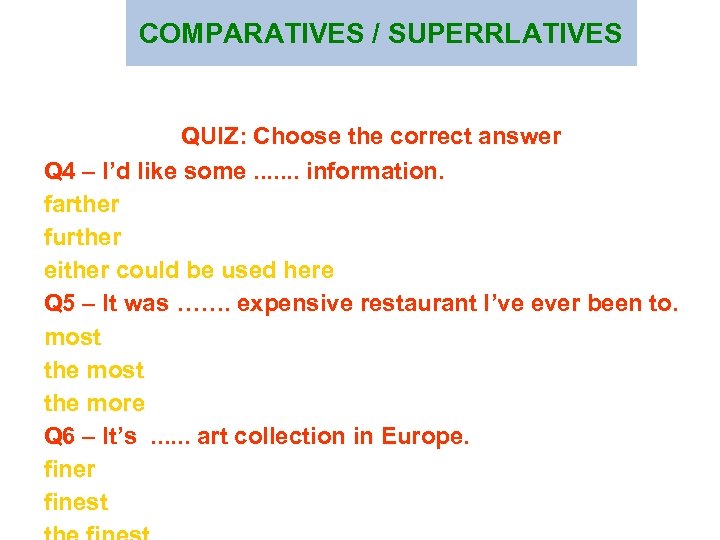 COMPARATIVES / SUPERRLATIVES QUIZ: Choose the correct answer Q 4 – I’d like some. . . . information. farther further either could be used here Q 5 – It was ……. expensive restaurant I’ve ever been to. most the more Q 6 – It’s . . . art collection in Europe. finer finest
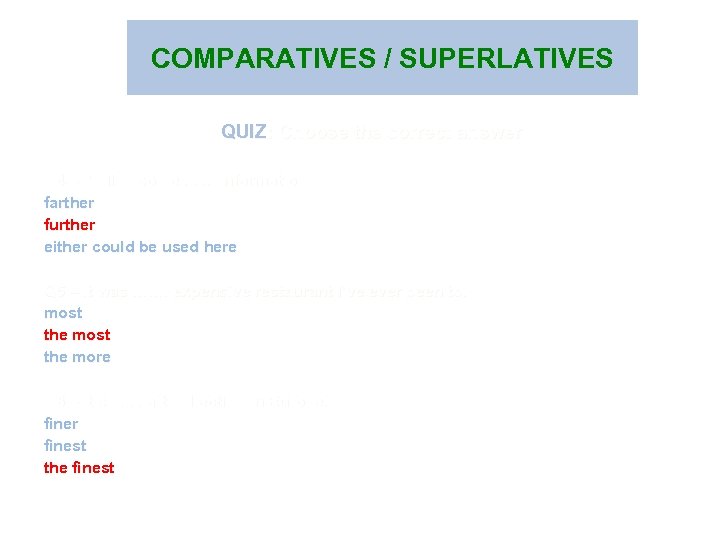 COMPARATIVES / SUPERLATIVES QUIZ: Choose the correct answer Q 4 – I’d like some. . . . information. farther further either could be used here Q 5 – It was ……. expensive restaurant I’ve ever been to. most the more Q 6 – It’s . . . art collection in Europe. finer finest the finest
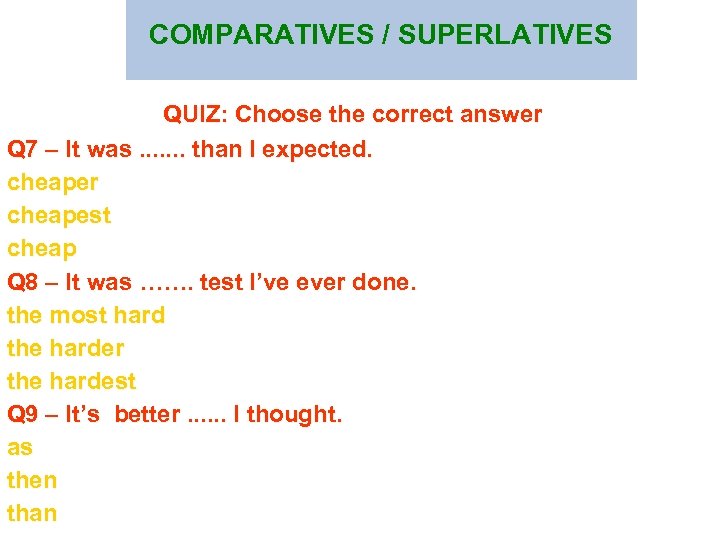 COMPARATIVES / SUPERLATIVES QUIZ: Choose the correct answer Q 7 – It was. . . . than I expected. cheaper cheapest cheap Q 8 – It was ……. test I’ve ever done. the most hard the harder the hardest Q 9 – It’s better. . . I thought. as then than
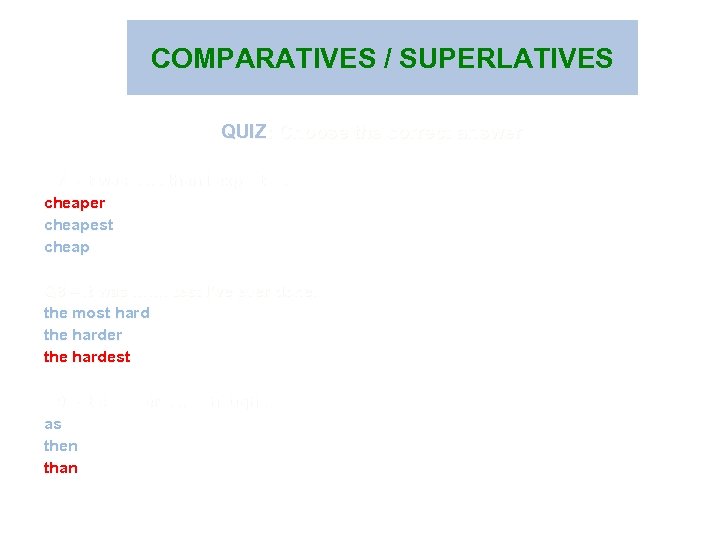 COMPARATIVES / SUPERLATIVES QUIZ: Choose the correct answer Q 7 – It was. . . . than I expected. cheaper cheapest cheap Q 8 – It was ……. test I’ve ever done. the most hard the harder the hardest Q 9 – It’s better. . . I thought. as then than
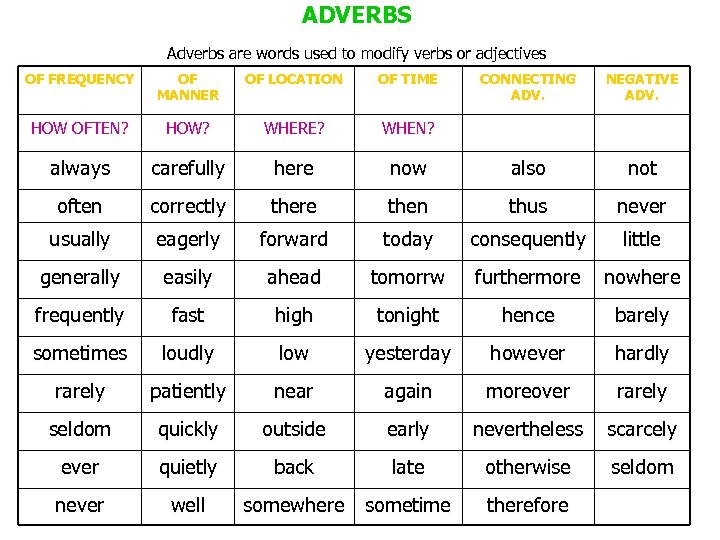 ADVERBS Adverbs are words used to modify verbs or adjectives OF FREQUENCY OF MANNER OF LOCATION OF TIME CONNECTING ADV. NEGATIVE ADV. HOW OFTEN? HOW? WHERE? WHEN? always carefully here now also not often correctly there then thus never usually eagerly forward today consequently little generally easily ahead tomorrw furthermore nowhere frequently fast high tonight hence barely sometimes loudly low yesterday however hardly rarely patiently near again moreover rarely seldom quickly outside early nevertheless scarcely ever quietly back late otherwise seldom never well somewhere sometime therefore
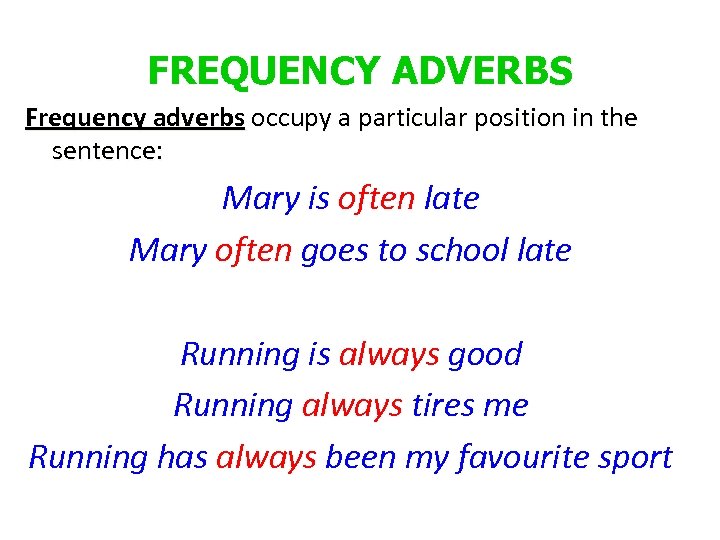 FREQUENCY ADVERBS Frequency adverbs occupy a particular position in the sentence: Mary is often late Mary often goes to school late Running is always good Running always tires me Running has always been my favourite sport
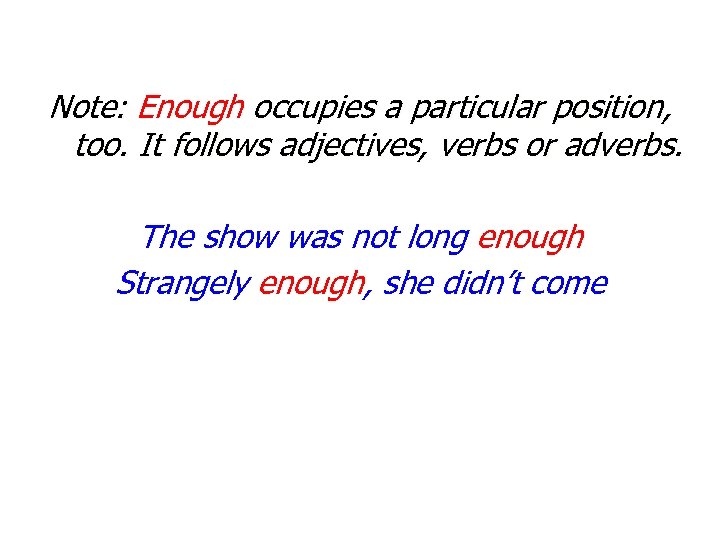 Note: Enough occupies a particular position, too. It follows adjectives, verbs or adverbs. The show was not long enough Strangely enough, she didn’t come
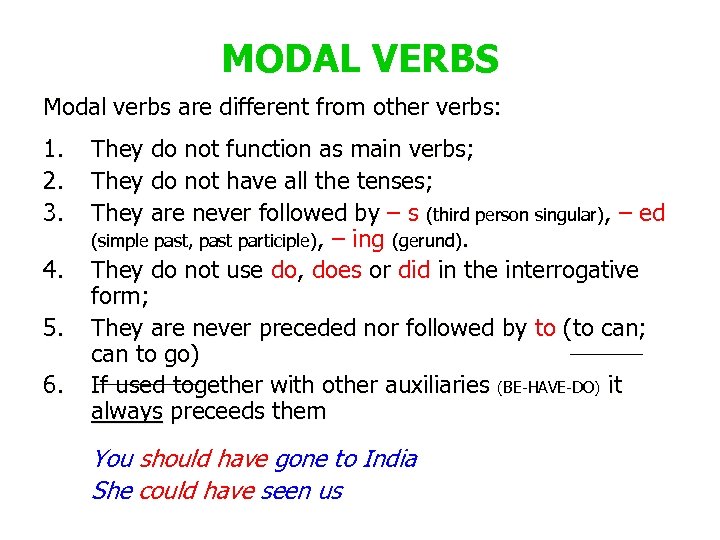 MODAL VERBS Modal verbs are different from other verbs: 1. 2. 3. 4. 5. 6. They do not function as main verbs; They do not have all the tenses; They are never followed by – s (third person singular), – ed They are never followed by , (simple past, past participle), – ing (gerund). , They do not use do, does or did in the interrogative They do not use , or form; They are never preceded nor followed by to (to can; They are never preceded nor followed by can to go) If used together with other auxiliaries (BE-HAVE-DO) it always preceeds them You should have gone to India She could have seen us
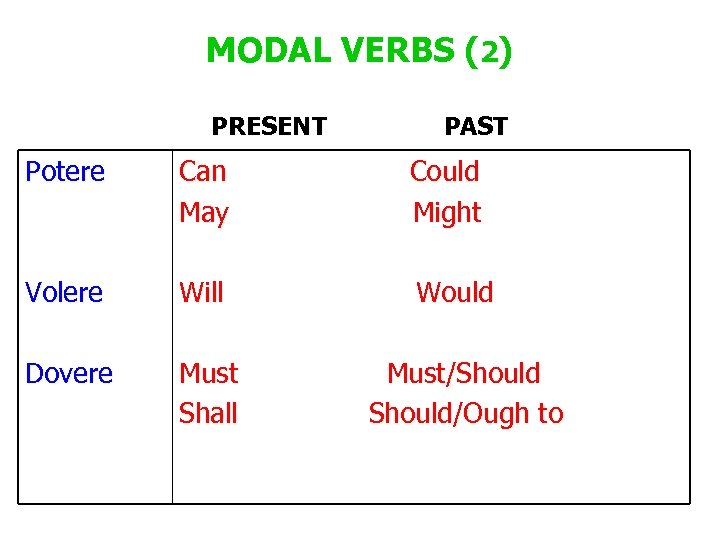 MODAL VERBS (2) PRESENT PAST Potere Can Could May Might Volere Will Would Dovere Must Must/Should Shall Should/Ough to
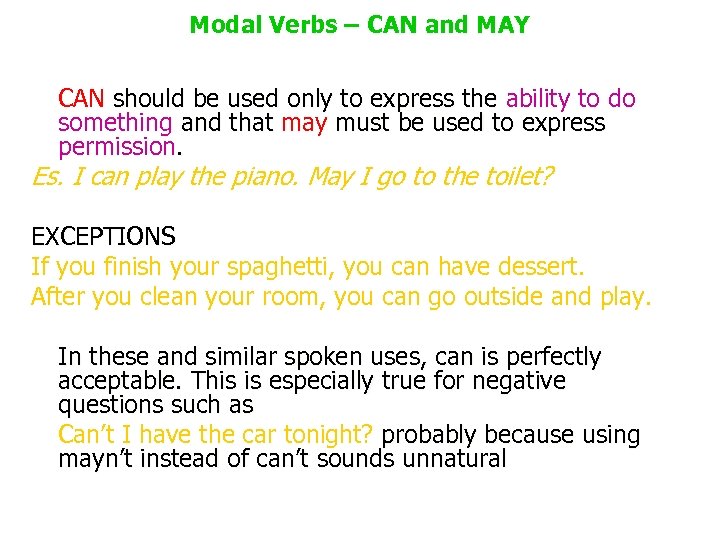 Modal Verbs – CAN and MAY CAN should be used only to express the ability to do should be used only to express the something and that may must be used to express and that permission. Es. I can play the piano. May I go to the toilet? EXCEPTIONS If you finish your spaghetti, you can have dessert. After you clean your room, you can go outside and play. In these and similar spoken uses, can is perfectly acceptable. This is especially true for negative questions such as Can’t I have the car tonight? probably because using mayn’t instead of can’t sounds unnatural
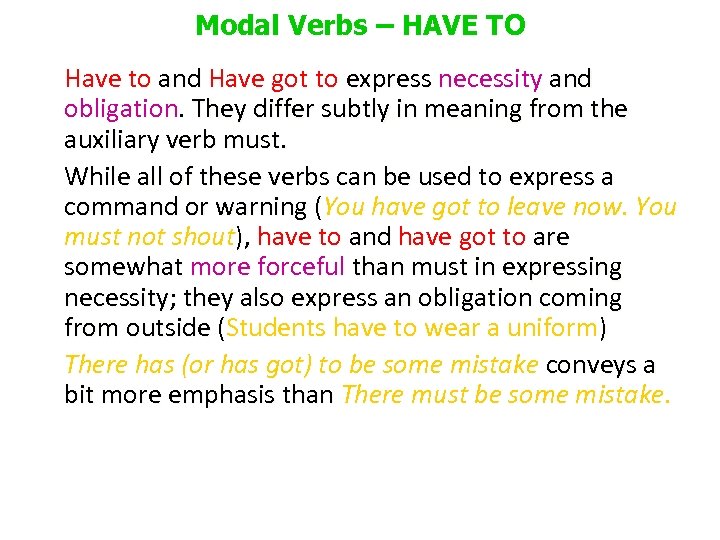 Modal Verbs – HAVE TO Have to and Have got to express necessity and obligation. They differ subtly in meaning from the auxiliary verb must. While all of these verbs can be used to express a command or warning (You have got to leave now. You ( must not shout), have to and have got to are somewhat more forceful than must in expressing necessity; they also express an obligation coming from outside (Students have to wear a uniform) ( There has (or has got) to be some mistake conveys a bit more emphasis than There must be some mistake.
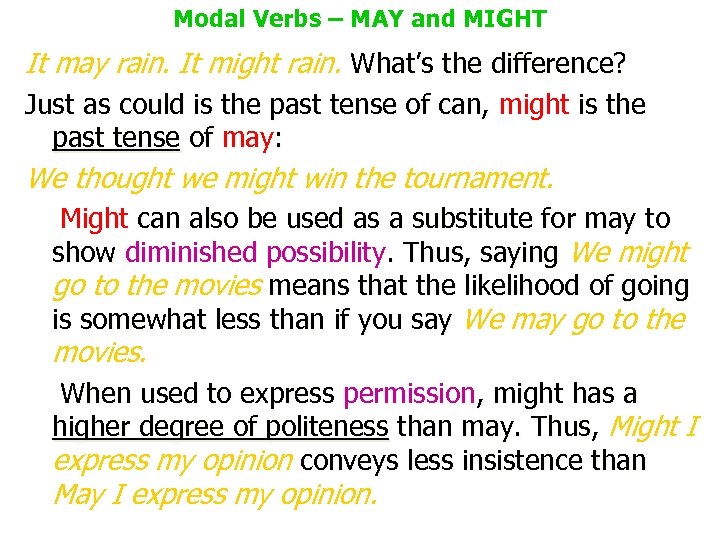 Modal Verbs – MAY and MIGHT It may rain. It might rain. What’s the difference? Just as could is the past tense of can, might is the Just as could is the past tense of can, past tense of may: of We thought we might win the tournament. Might can also be used as a substitute for may to show diminished possibility. Thus, saying We might show go to the movies means that the likelihood of going is somewhat less than if you say We may go to the movies. When used to express permission, might has a When used to express higher degree of politeness than may. Thus, Might I express my opinion conveys less insistence than May I express my opinion.
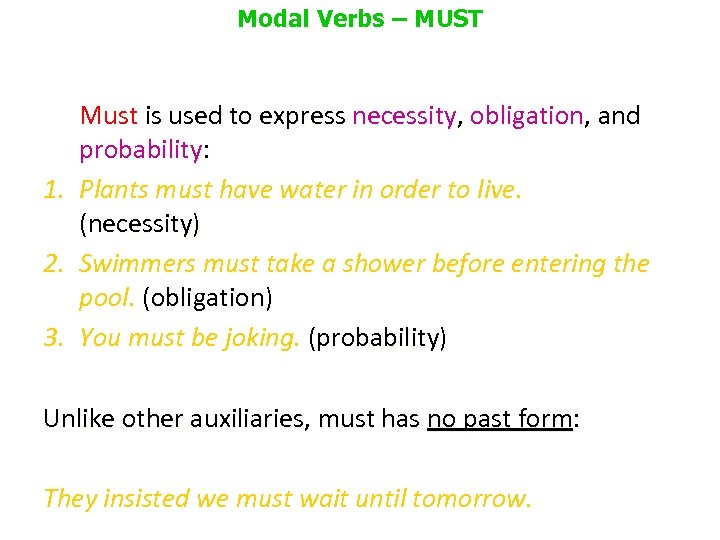 Modal Verbs – MUST Must is used to express necessity, obligation, and probability: 1. Plants must have water in order to live. (necessity) 2. Swimmers must take a shower before entering the pool. (obligation) 3. You must be joking. (probability) Unlike other auxiliaries, must has no past form: They insisted we must wait until tomorrow.
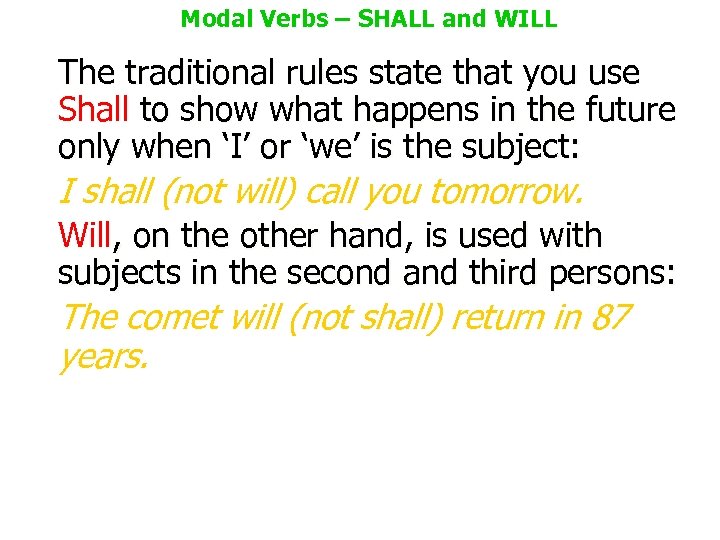 Modal Verbs – SHALL and WILL The traditional rules state that you use Shall to show what happens in the future only when ‘I’ or ‘we’ is the subject: I shall (not will) call you tomorrow. Will, on the other hand, is used with subjects in the second and third persons: The comet will (not shall) return in 87 years.
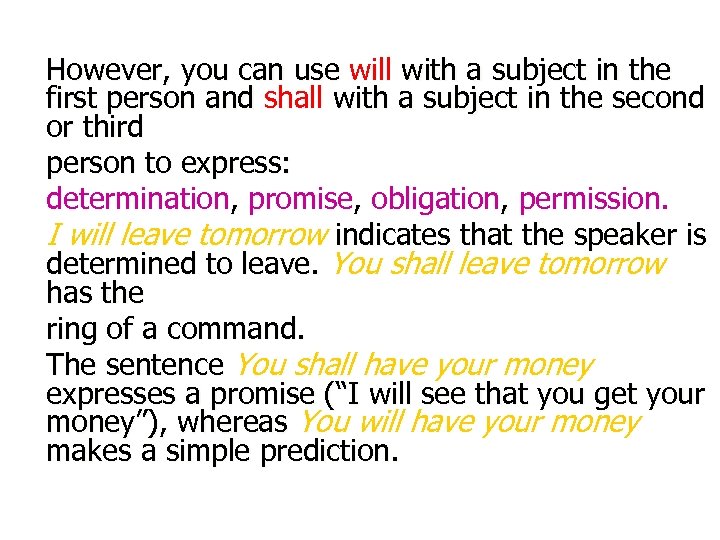 However, you can use will with a subject in the However, you can use first person and shall with a subject in the second first person and or third person to express: determination, promise, obligation, permission. , , , I will leave tomorrow indicates that the speaker is determined to leave. You shall leave tomorrow has the ring of a command. The sentence You shall have your money expresses a promise (“I will see that you get your money”), whereas You will have your money makes a simple prediction.
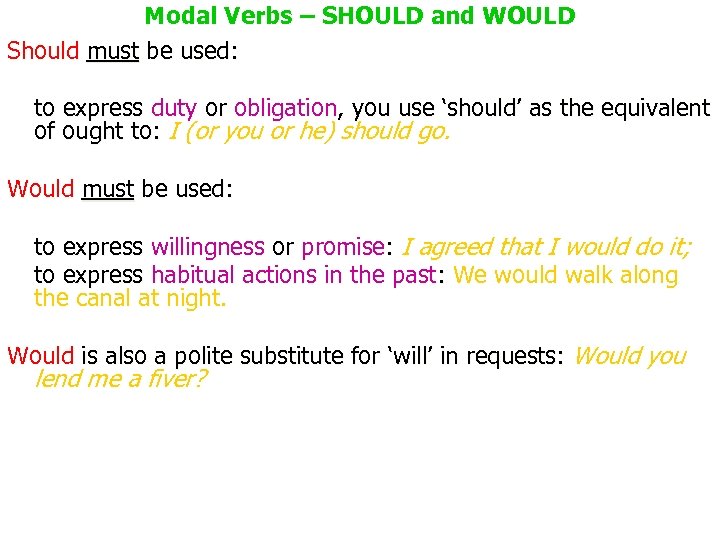 Modal Verbs – SHOULD and WOULD Should must be used: to express duty or obligation, you use ‘should’ as the equivalent to express or of ought to: I (or you or he) should go. Would must be used: to express willingness or promise: I agreed that I would do it; to express or to express habitual actions in the past: We would walk along to express : the canal at night. Would is also a polite substitute for ‘will’ in requests: Would you lend me a fiver?
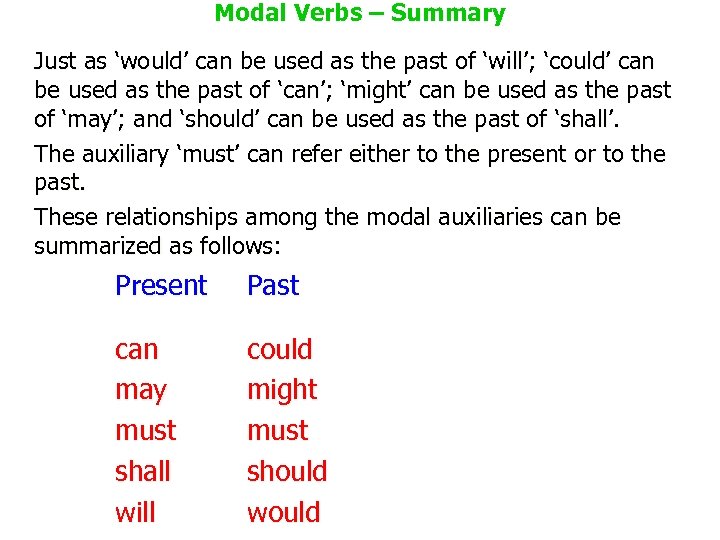 Modal Verbs – Summary Just as ‘would’ can be used as the past of ‘will’; ‘could’ can be used as the past of ‘can’; ‘might’ can be used as the past of ‘may’; and ‘should’ can be used as the past of ‘shall’. The auxiliary ‘must’ can refer either to the present or to the past. These relationships among the modal auxiliaries can be summarized as follows: Present Past can may must shall will could might must should would
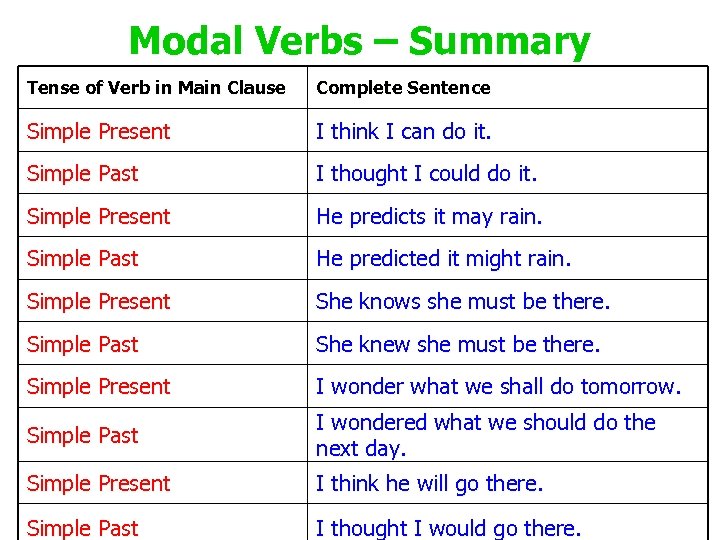 Modal Verbs – Summary Tense of Verb in Main Clause Complete Sentence Simple Present I think I can do it. Simple Past I thought I could do it. Simple Present He predicts it may rain. Simple Past He predicted it might rain. Simple Present She knows she must be there. Simple Past She knew she must be there. Simple Present I wonder what we shall do tomorrow. Simple Past I wondered what we should do the next day. Simple Present I think he will go there. Simple Past I thought I would go there.
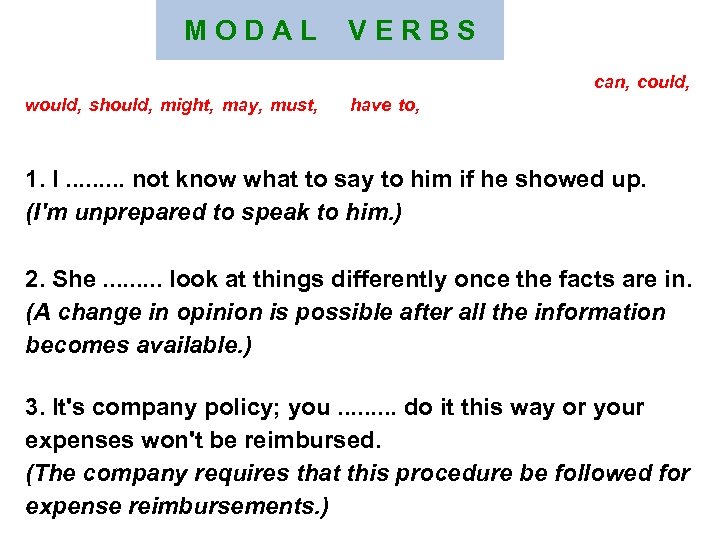 M O D A L V E R B S Fill in the blanks in each sentence using a modal verb, such as can, could, would, should, might, may, must, or have to, based on the situational hints shown in italics. Select the modal that seems most appropriate for the situation described, and be prepared to explain your choice. 1. I. . not know what to say to him if he showed up. (I'm unprepared to speak to him. ) 2. She. . look at things differently once the facts are in. (A change in opinion is possible after all the information becomes available. ) 3. It's company policy; you. . do it this way or your expenses won't be reimbursed. (The company requires that this procedure be followed for expense reimbursements. )
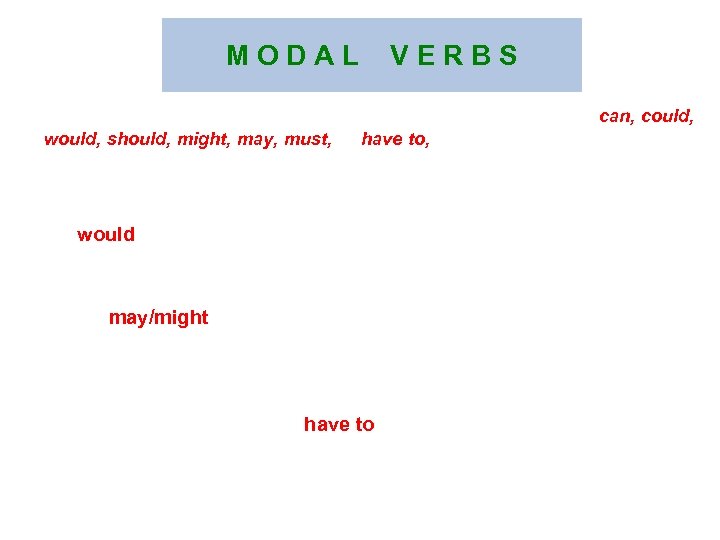 M O D A L V E R B S Fill in the blanks in each sentence using a modal verb, such as can, could, would, should, might, may, must, or have to, based on the situational hints shown in italics. Select the modal that seems most appropriate for the situation described, and be prepared to explain your choice. ------------------------------------------------------- 1. I would not know what to say to him if he showed up. (I'm unprepared to speak to him. ) 2. She may/might look at things differently once the facts are in. (A change in opinion is possible after all the information becomes available. ) 3. It's company policy; you have to do it this way or your expenses won't be reimbursed. (The company requires that this procedure be followed for expense reimbursements. )
 M O D A L V E R B S 4. I'm in terrible shape! I. . exercise more! (I've decided that more exercise is an absolute necessity for me. ) 5. . you get this report done for us by tomorrow morning? (Are you willing and able to prepare this report by tomorrow if we ask you? ) 6. . you handle this much work on a regular basis? (Do you have the capacity to handle this much work regularly? ) 7. We were worried about you. You. . have called us as soon as you knew you'd be late. (Calling someone when you will be late is a good idea, in my
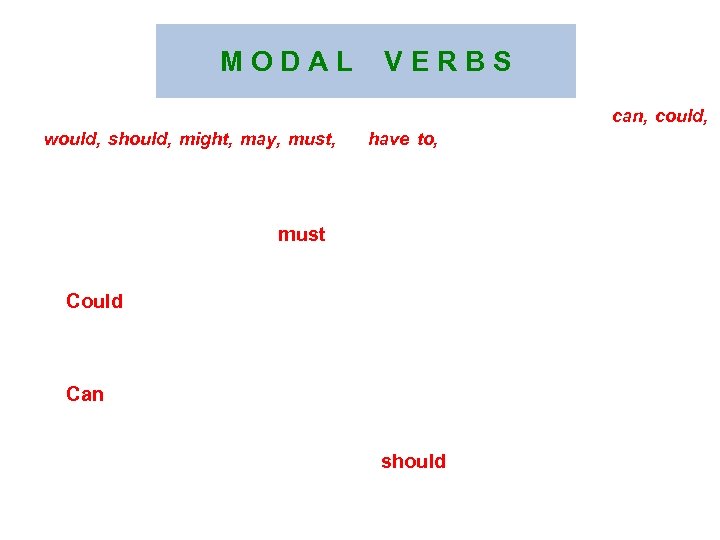 M O D A L V E R B S Fill in the blanks in each sentence using a modal verb, such as can, could, would, should, might, may, must, or have to, based on the situational hints shown in italics. Select the modal that seems most appropriate for the situation described, and be prepared to explain your choice. ------------------------------------------------------------------------------------------------------------------------------- 4. I'm in terrible shape! I must exercise more! (I've decided that more exercise is an absolute necessity for me. ) 5. Could you get this report done for us by tomorrow morning? (Are you willing and able to prepare this report by tomorrow if we ask you? ) 6. Can you handle this much work on a regular basis? (Do you have the capacity to handle this much work regularly? ) 7. We were worried about you. You should have called us as soon as you knew you'd be late. (Calling someone when you will be late is a good idea, in my opinion. )
 M O D A L V E R B S 8. You. . want to think a little more carefully about that before trying it next time. (I think you were stupid not to think more carefully about it. ) 9. This computer's not working. It. . have been damaged by the thunderstorm. (The damage is a logical deduction based on the information available. ) 10. Ellen. . be sent to London this summer, if the board decides that the situation there warrants it. (The trip is certainly possible, but whether or not she goes depends on the board's preference. )
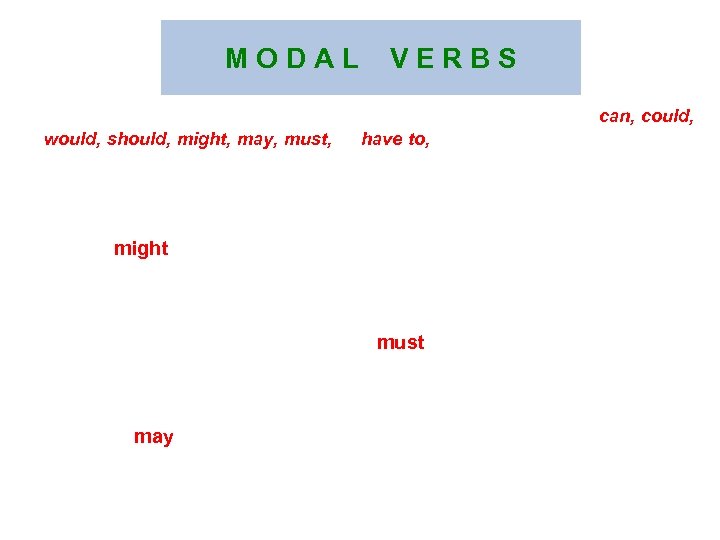 M O D A L V E R B S Fill in the blanks in each sentence using a modal verb, such as can, could, would, should, might, may, must, or have to, based on the situational hints shown in italics. Select the modal that seems most appropriate for the situation described, and be prepared to explain your choice. ----------------------------------------------------------------------------------------------------------------------------- 8. You might want to think a little more carefully about that before trying it next time. (I think you were stupid not to think more carefully about it. ) 9. This computer's not working. It must have been damaged by the thunderstorm. (The damage is a logical deduction based on the information available. ) 10. Ellen may be sent to London this summer, if the board decides that the situation there warrants it. (The trip is certainly possible, but whether or not she goes depends on the board's preference. )
 M O D A L V E R B S 11. My trainer says I'm in terrible shape. According to him I . . exercise more. (My trainer is trying to compel me to exercise more. ) 12. You . . always try reinstalling Windows, that might work if the disk is corrupt. (This is one possible course of action, and there's a possibility of it working under certain conditions. ) 13. I. . not do that if I were you! (I don't think your behaviour is prudent, and my own normal behaviour is different. )
 M O D A L V E R B S Fill in the blanks in each sentence using a modal verb, such as can, could, would, should, might, may, must, or have to, based on the situational hints shown in italics. Select the modal that seems most appropriate for the situation described, and be prepared to explain your choice. ----------------------------------------------------------------------------------------------------------------------------- 11. My trainer says I'm in terrible shape. According to him I have to exercise more. (My trainer is trying to compel me to exercise more. ) 12. You could always try reinstalling Windows, that might work if the disk is corrupt. (This is one possible course of action, and there's a possibility of it working under certain conditions. ) 13. I would not do that if I were you! (I don't think your behavior is prudent, and my own normal behavior is different. )
 M O D A L V E R B S 14. When she was young, she. . play tennis every single day, rain or shine. (She did this habitually when she was young, although she doesn’t necessarily do it now. ) 15. . I suggest this dark blue jacket? (You're a customer in my upscale store, and I'm trying to be very polite. ) 16. I . . admit, it's a very nice-looking car. (I have no choice but to admit that the car looks nice. ) 17. She. . admit that it was a very nice-looking car. (She had no choice but to admit that the car looked nice. )
 M O D A L V E R B S Fill in the blanks in each sentence using a modal verb, such as can, could, would, should, might, may, must, or have to, based on the situational hints shown in italics. Select the modal that seems most appropriate for the situation described, and be prepared to explain your choice. ----------------------------------------------------------------------------------------------------------------------------- 14. When she was young, she would play tennis every single day, rain or shine. (She did this habitually when she was young, although she doesn’t necessarily do it now. ) 15. Might/May/Could/Can I suggest this dark blue jacket? (You're a customer in my upscale store, and I'm trying to be very polite. ) 16. I must admit, it's a very nice-looking car. (I have no choice but to admit that the car looks nice. ) 17. She had to admit that it was a very nice-looking car. (She had no choice but to admit that the car looked nice. )
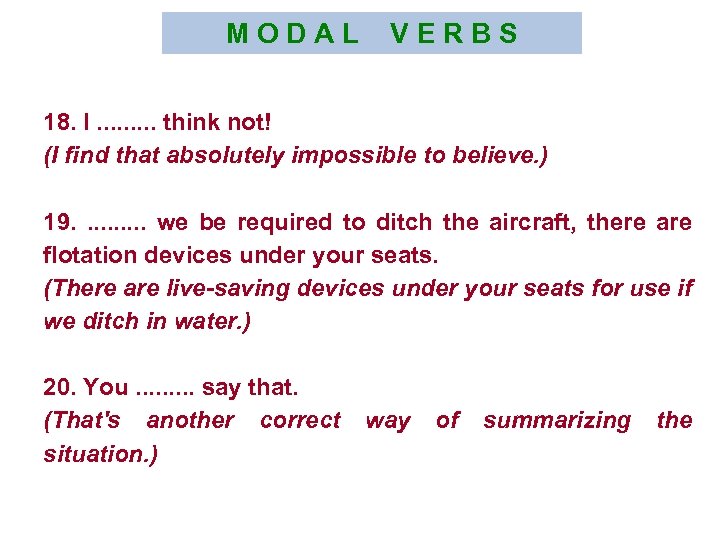 M O D A L V E R B S 18. I. . think not! (I find that absolutely impossible to believe. ) 19. . we be required to ditch the aircraft, there are flotation devices under your seats. (There are live-saving devices under your seats for use if we ditch in water. ) 20. You. . say that. (That's another correct situation. ) way of summarizing the
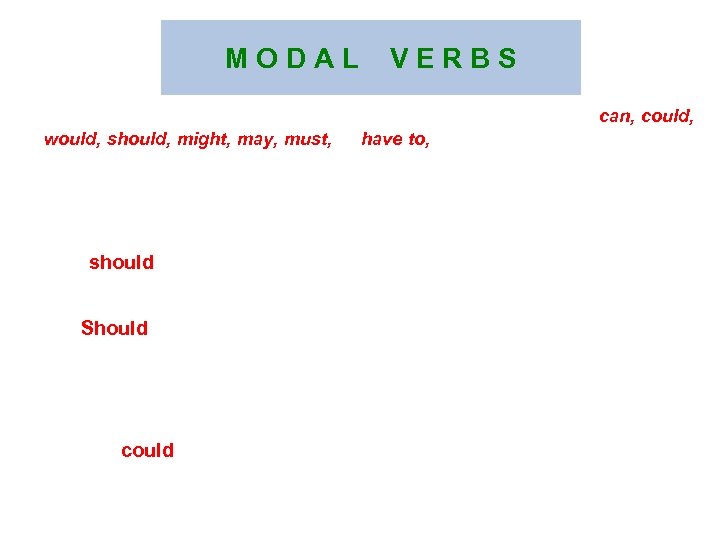 M O D A L V E R B S Fill in the blanks in each sentence using a modal verb, such as can, could, would, should, might, may, must, or have to, based on the situational hints shown in italics. Select the modal that seems most appropriate for the situation described, and be prepared to explain your choice. ----------------------------------------------------------------------------------------------------------------------------- 18. I should think not! (I find that absolutely impossible to believe. ) 19. Should we be required to ditch the aircraft, there are flotation devices under your seats. (There are live-saving devices under your seats for use if we ditch in water. ) 20. You could say that. (That's another correct way of summarizing the situation. )
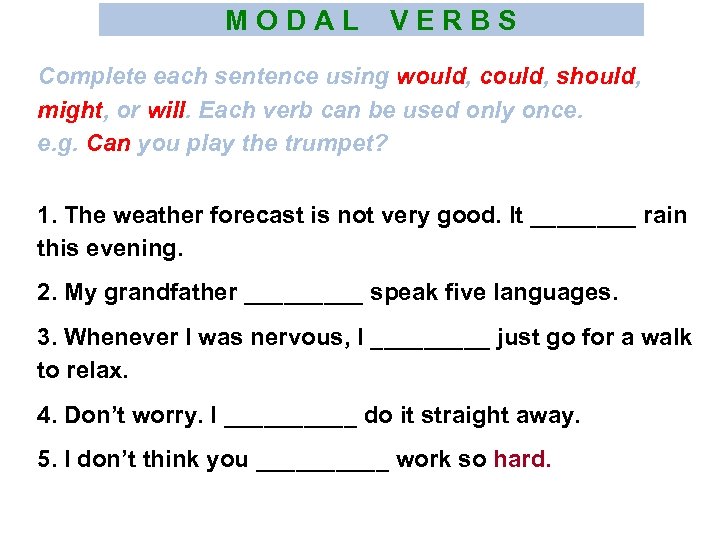 M O D A L V E R B S Complete each sentence using would, could, should, might, or will. Each verb can be used only once. e. g. Can you play the trumpet? 1. The weather forecast is not very good. It ____ rain this evening. 2. My grandfather _____ speak five languages. 3. Whenever I was nervous, I _____ just go for a walk to relax. 4. Don’t worry. I _____ do it straight away. 5. I don’t think you _____ work so hard.
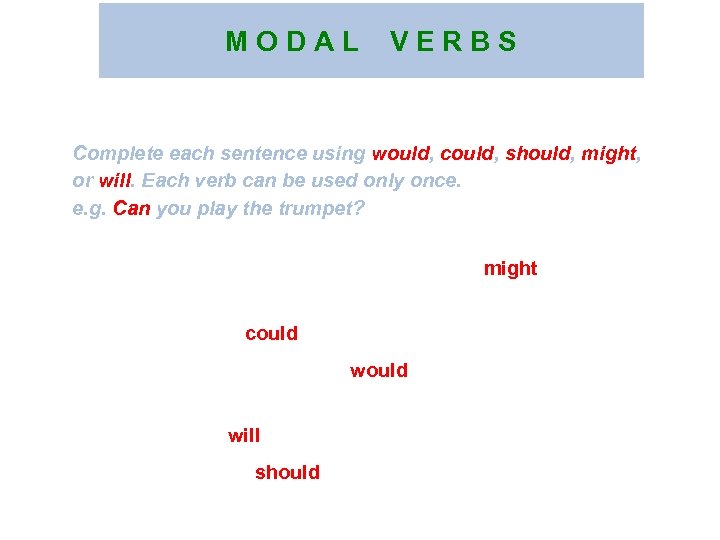 M O D A L V E R B S Complete each sentence using would, could, should, might, or will. Each verb can be used only once. e. g. Can you play the trumpet? 1. The weather forecast is not very good. It might rain this evening. 2. My grandfather could speak five languages. 3. Whenever I was nervous, I would (= used to) just go for a walk to relax. 4. Don’t worry. I will do it straight away. 5. I don’t think you should work so hard.
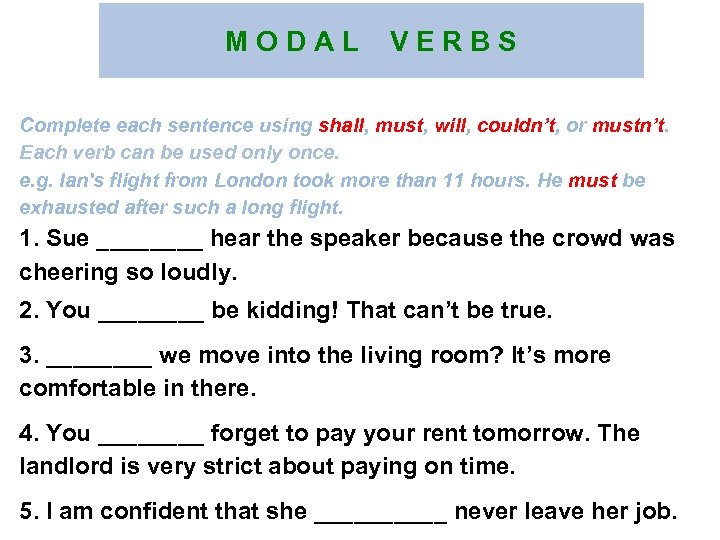 M O D A L V E R B S Complete each sentence using shall, must, will, couldn’t, or mustn’t. Each verb can be used only once. e. g. Ian's flight from London took more than 11 hours. He must be exhausted after such a long flight. 1. Sue ____ hear the speaker because the crowd was cheering so loudly. 2. You ____ be kidding! That can’t be true. 3. ____ we move into the living room? It’s more comfortable in there. 4. You ____ forget to pay your rent tomorrow. The landlord is very strict about paying on time. 5. I am confident that she _____ never leave her job.
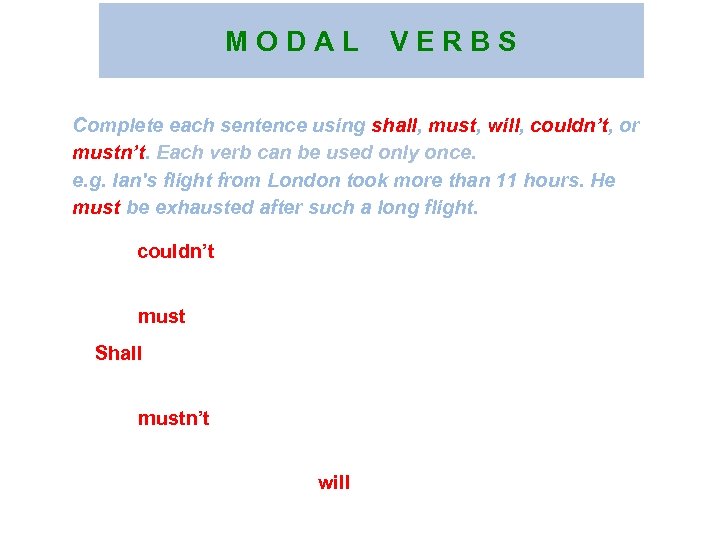 M O D A L V E R B S Complete each sentence using shall, must, will, couldn’t, or mustn’t. Each verb can be used only once. e. g. Ian's flight from London took more than 11 hours. He must be exhausted after such a long flight. 1. Sue couldn’t hear the speaker because the crowd was cheering so loudly. 2. You must be kidding! That can’t be true. 3. Shall we move into the living room? It’s more comfortable in there. 4. You mustn’t forget to pay your rent tomorrow. The landlord is very strict about paying on time. 5. I am confident that she will never leave her job.
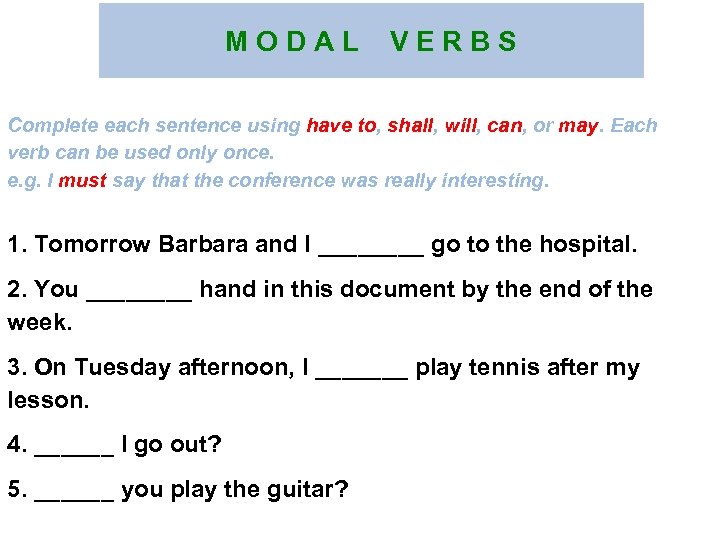 M O D A L V E R B S Complete each sentence using have to, shall, will, can, or may. Each verb can be used only once. e. g. I must say that the conference was really interesting. 1. Tomorrow Barbara and I ____ go to the hospital. 2. You ____ hand in this document by the end of the week. 3. On Tuesday afternoon, I _______ play tennis after my lesson. 4. ______ I go out? 5. ______ you play the guitar?
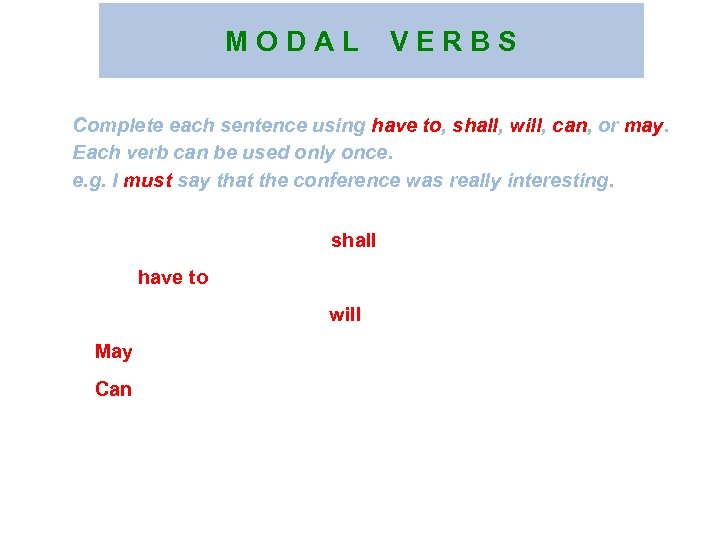 M O D A L V E R B S Complete each sentence using have to, shall, will, can, or may. Each verb can be used only once. e. g. I must say that the conference was really interesting. 1. Tomorrow Barbara and I shall go to the hospital. 2. You have to hand in this document by the end of the week. 3. On Tuesday afternoon, I will play tennis after my lesson. 4. May I go out? 5. Can you play the guitar?
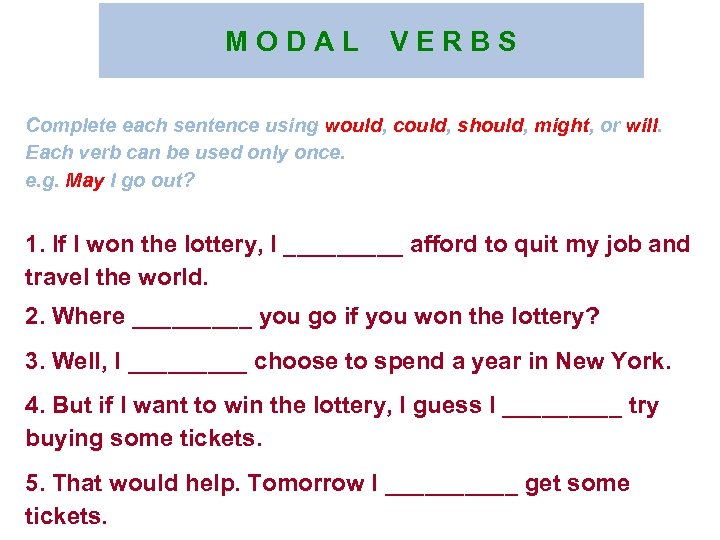 M O D A L V E R B S Complete each sentence using would, could, should, might, or will. Each verb can be used only once. e. g. May I go out? 1. If I won the lottery, I _____ afford to quit my job and travel the world. 2. Where _____ you go if you won the lottery? 3. Well, I _____ choose to spend a year in New York. 4. But if I want to win the lottery, I guess I _____ try buying some tickets. 5. That would help. Tomorrow I _____ get some tickets.
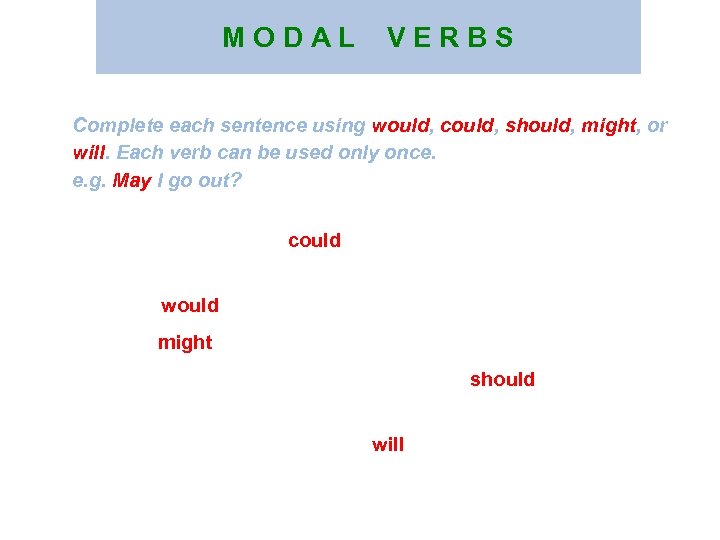 M O D A L V E R B S Complete each sentence using would, could, should, might, or will. Each verb can be used only once. e. g. May I go out? 1. If I won the lottery, I could afford to quit my job and travel the world. 2. Where would you go if you won the lottery? 3. Well, I might choose to spend a year in New York. 4. But if I want to win the lottery, I guess I should try buying some tickets. 5. That would help. Tomorrow I will get some tickets.
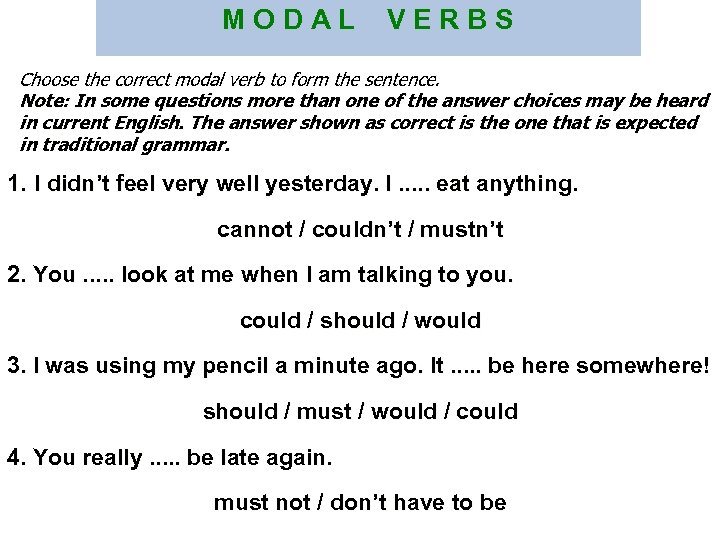 M O D A L V E R B S Choose the correct modal verb to form the sentence. Note: In some questions more than one of the answer choices may be heard in current English. The answer shown as correct is the one that is expected in traditional grammar. 1. I didn’t feel very well yesterday. I. . . eat anything. cannot / couldn’t / mustn’t 2. You. . . look at me when I am talking to you. could / should / would 3. I was using my pencil a minute ago. It. . . be here somewhere! should / must / would / could 4. You really. . . be late again. must not / don’t have to be
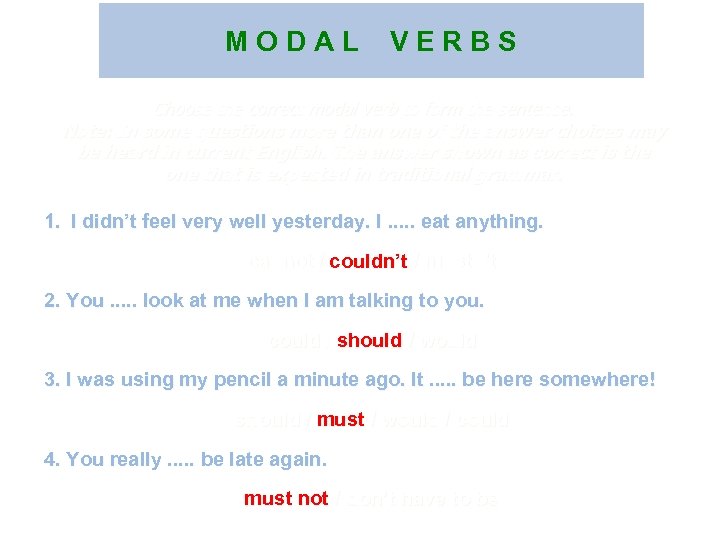 M O D A L V E R B S Choose the correct modal verb to form the sentence. Note: In some questions more than one of the answer choices may be heard in current English. The answer shown as correct is the one that is expected in traditional grammar. 1. I didn’t feel very well yesterday. I. . . eat anything. cannot / couldn’t / mustn’t 2. You. . . look at me when I am talking to you. could / should / would 3. I was using my pencil a minute ago. It. . . be here somewhere! should / must / would / could 4. You really. . . be late again. must not / don’t have to be
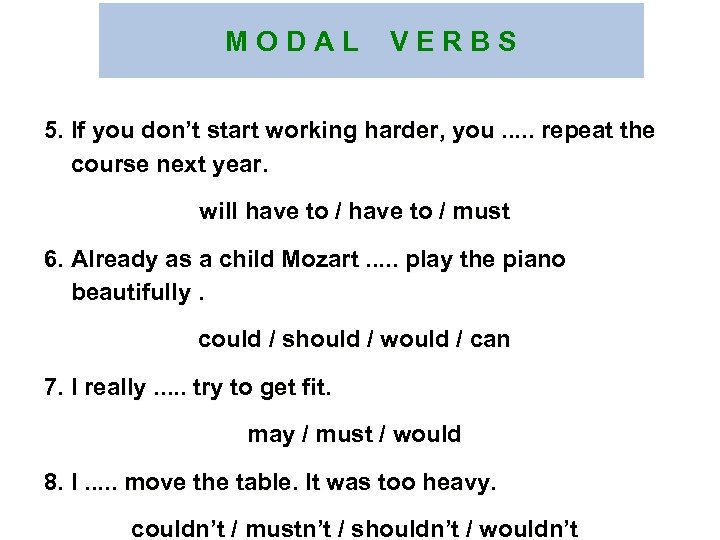 M O D A L V E R B S 5. If you don’t start working harder, you. . . repeat the course next year. will have to / must 6. Already as a child Mozart. . . play the piano beautifully. could / should / would / can 7. I really. . . try to get fit. may / must / would 8. I. . . move the table. It was too heavy. couldn’t / mustn’t / shouldn’t / wouldn’t
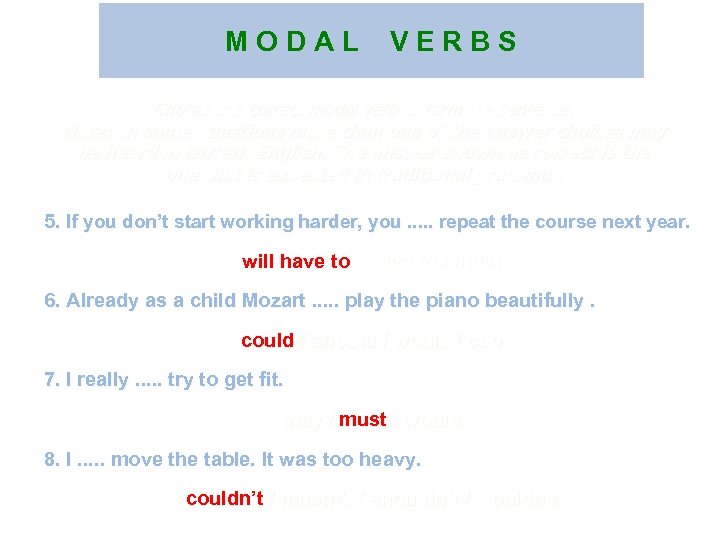 M O D A L V E R B S Choose the correct modal verb to form the sentence. Note: In some questions more than one of the answer choices may be heard in current English. The answer shown as correct is the one that is expected in traditional grammar. 5. If you don’t start working harder, you. . . repeat the course next year. will have to / must 6. Already as a child Mozart. . . play the piano beautifully. could / should / would / can 7. I really. . . try to get fit. may / must / would 8. I. . . move the table. It was too heavy. couldn’t / mustn’t / shouldn’t / wouldn’t
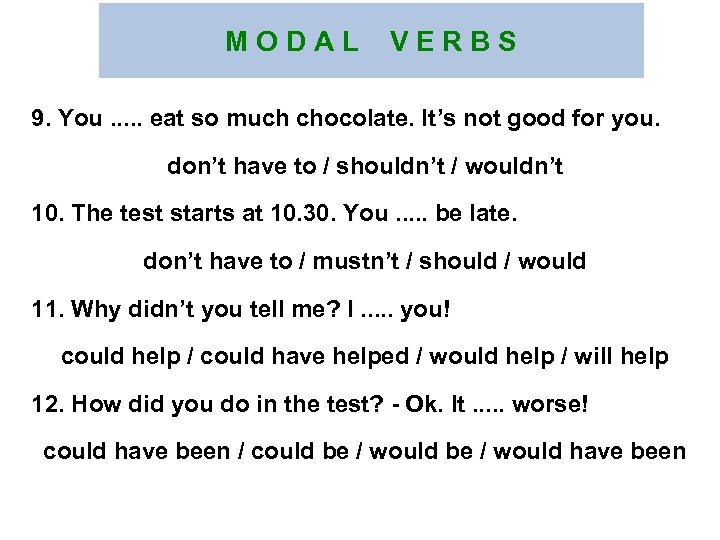 M O D A L V E R B S 9. You. . . eat so much chocolate. It’s not good for you. don’t have to / shouldn’t / wouldn’t 10. The test starts at 10. 30. You. . . be late. don’t have to / mustn’t / should / would 11. Why didn’t you tell me? I. . . you! could help / could have helped / would help / will help 12. How did you do in the test? - Ok. It. . . worse! could have been / could be / would have been
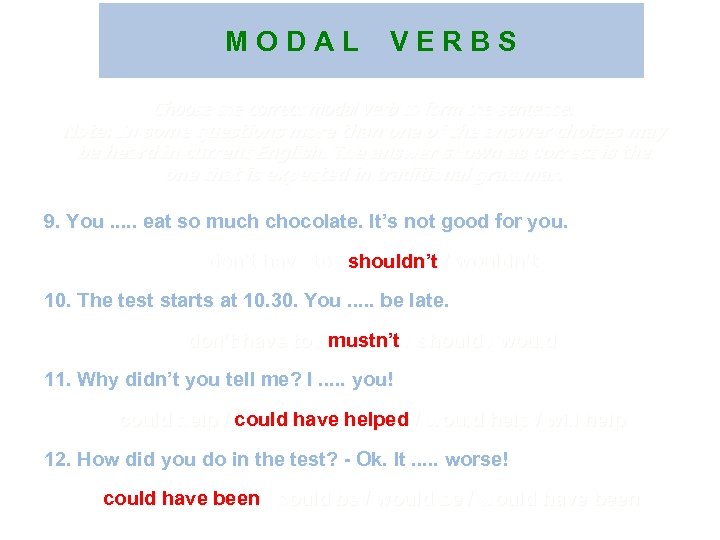 M O D A L V E R B S Choose the correct modal verb to form the sentence. Note: In some questions more than one of the answer choices may be heard in current English. The answer shown as correct is the one that is expected in traditional grammar. 9. You. . . eat so much chocolate. It’s not good for you. don’t have to / shouldn’t / wouldn’t 10. The test starts at 10. 30. You. . . be late. don’t have to / mustn’t / should / would 11. Why didn’t you tell me? I. . . you! could help / could have helped / would help / will help 12. How did you do in the test? - Ok. It. . . worse! could have been / could be / would have been
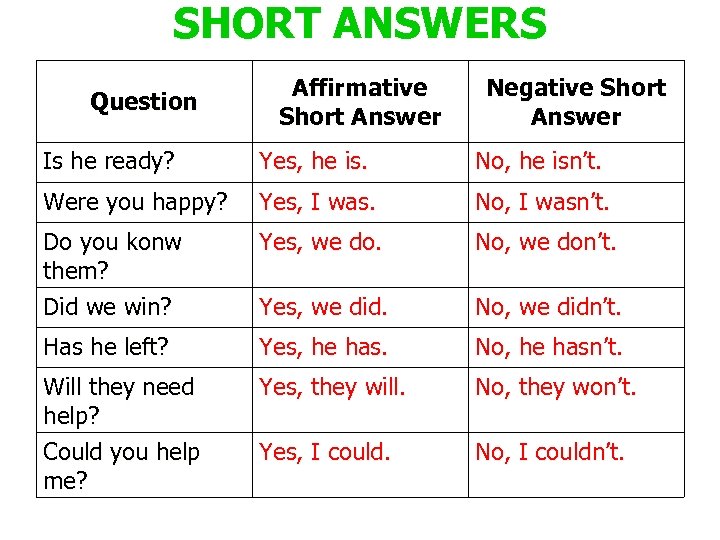 SHORT ANSWERS Question Affirmative Short Answer Negative Short Answer Is he ready? Yes, he is. No, he isn’t. Were you happy? Yes, I was. No, I wasn’t. Do you konw them? Did we win? Yes, we do. No, we don’t. Yes, we did. No, we didn’t. Has he left? Yes, he has. No, he hasn’t. Will they need help? Could you help me? Yes, they will. No, they won’t. Yes, I could. No, I couldn’t.
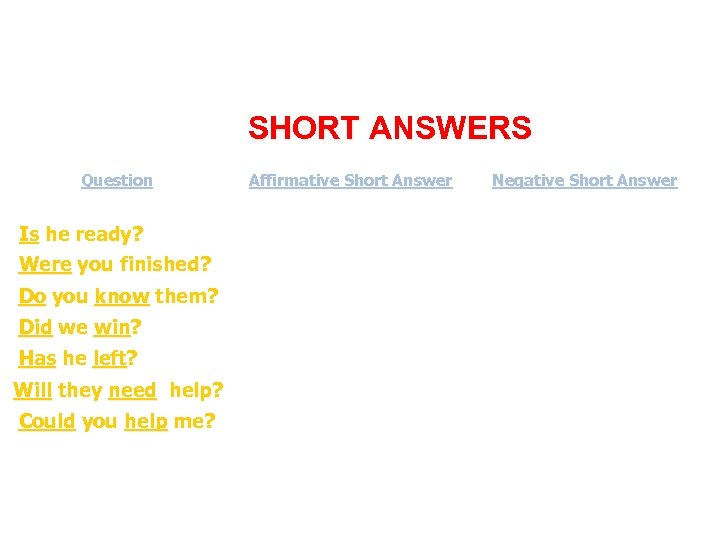 SHORT ANSWERS Question Is he ready? Were you finished? Do you know them? Did we win? Has he left? Will they need help? Could you help me? Affirmative Short Answer Negative Short Answer
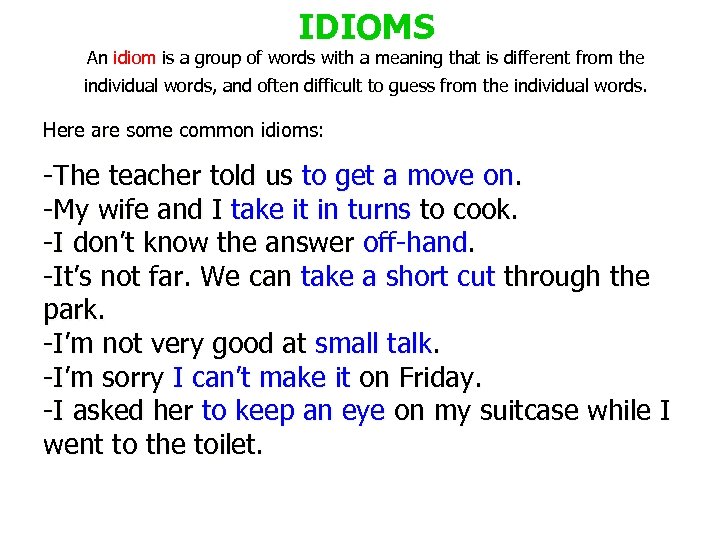 IDIOMS An idiom is a group of words with a meaning that is different from the An individual words, and often difficult to guess from the individual words. Here are some common idioms: -The teacher told us to get a move on. -My wife and I take it in turns to cook. -I don’t know the answer off-hand. -It’s not far. We can take a short cut through the park. -I’m not very good at small talk. -I’m sorry I can’t make it on Friday. -I asked her to keep an eye on my suitcase while I went to the toilet.
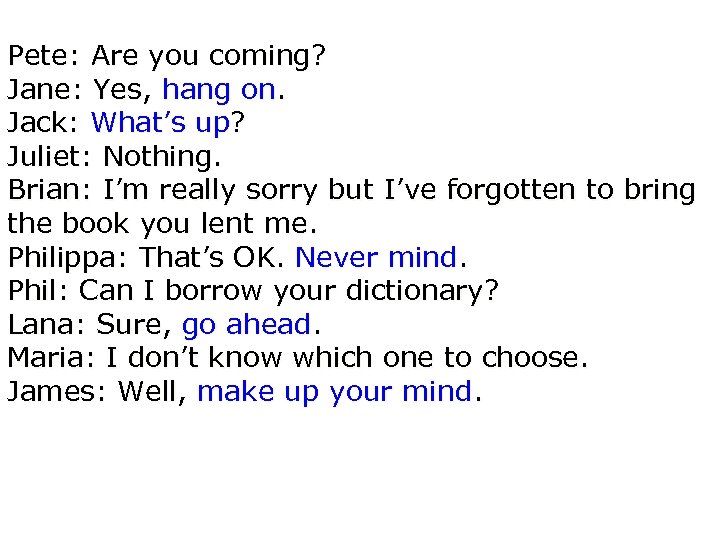 Pete: Are you coming? Jane: Yes, hang on. Jack: What’s up? Juliet: Nothing. Brian: I’m really sorry but I’ve forgotten to bring the book you lent me. Philippa: That’s OK. Never mind. Phil: Can I borrow your dictionary? Lana: Sure, go ahead. Maria: I don’t know which one to choose. James: Well, make up your mind.
 1. I feel like a drink. 2. They’ve gone for good. 3. I’m tied-up all afternoon. 4. She was pulling my leg when she said that. 5. I can probably make do with a smaller flat.
 Jack: - Hello? Bobby: - Hello. This is Bobby here. Can I speak to Nicola, please? Jack: Hi, Bobby! Sorry, I’m afraid she’s not in at the moment. She said she would come back by 6. You might ring her up on her mobile. Bobby: - That’s alright, I’ll give her a ring straightaway. Thanks a lot, Jack: No worries, Bobby. Speak to you later. Bye.
 IDIOMS (2) ON THE PHONE • Jack: - Hello? • Andrew: - Hello. This is Andrew here. Can I speak to Nicola, please? • Jack: Sure! Hold on a sec. • ---- • Jack: Hello? • Sharon: Hi, it’s Sharon here. Is Nicola there? • Jack: Yes, she is. Please hold on.
 SHOPPING 1. AT THE NEWSAGENT’S Margaret: - Good morning. Can I have the Guardian, please? Newsagent: - Sure! Hang on a second, I’ll get it for you… There you go. Margaret: Cheers. Have a nice day! Newsagent: And you! See you later.
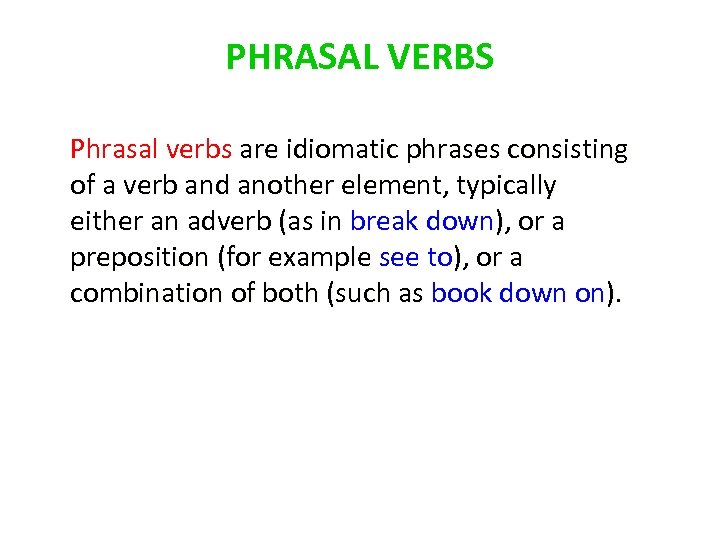 PHRASAL VERBS Phrasal verbs are idiomatic phrases consisting of a verb and another element, typically either an adverb (as in break down), or a preposition (for example see to), or a combination of both (such as book down on).
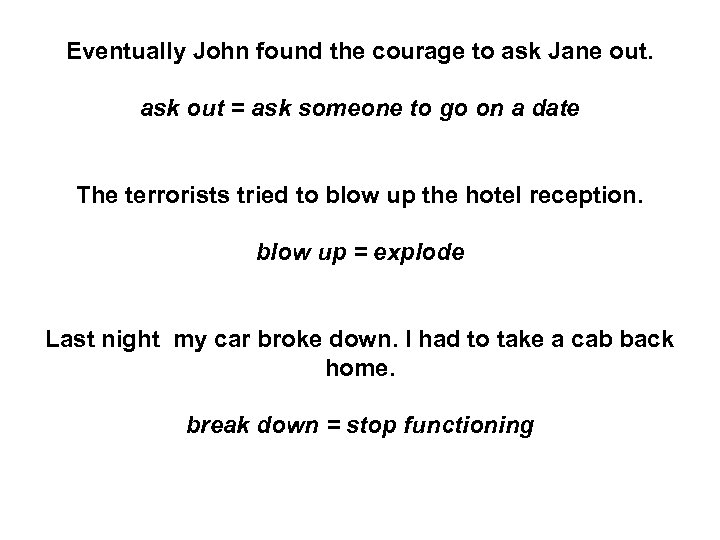 Eventually John found the courage to ask Jane out. ask out = ask someone to go on a date The terrorists tried to blow up the hotel reception. blow up = explode Last night my car broke down. I had to take a cab back home. break down = stop functioning
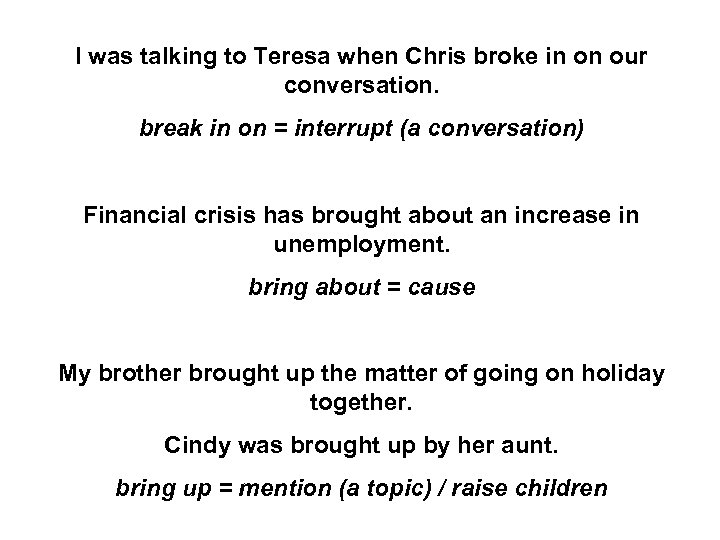 I was talking to Teresa when Chris broke in on our conversation. break in on = interrupt (a conversation) Financial crisis has brought about an increase in unemployment. bring about = cause My brother brought up the matter of going on holiday together. Cindy was brought up by her aunt. bring up = mention (a topic) / raise children
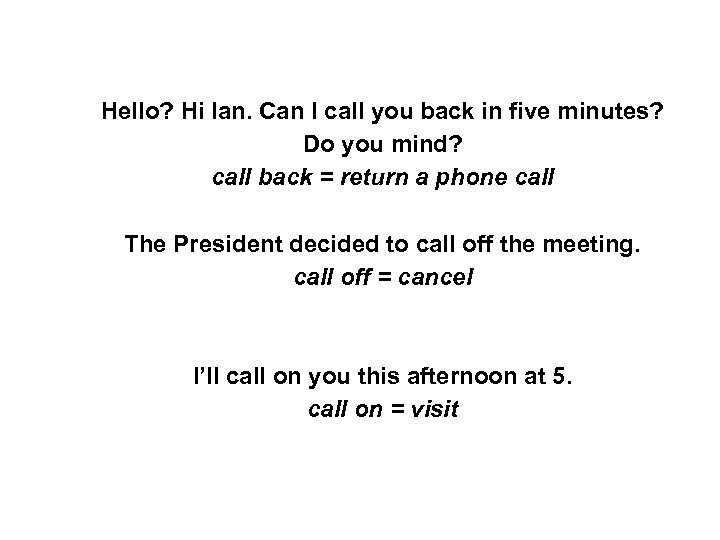 Hello? Hi Ian. Can I call you back in five minutes? Do you mind? call back = return a phone call The President decided to call off the meeting. call off = cancel I’ll call on you this afternoon at 5. call on = visit
 That way of dressing has caught on among Italian youngsters. catch on = become popular After our trip, it was time to catch up with the news around town. catch up with = keep abreast . Sunny weather always cheers me up. cheer up = make someone feel happier
 I look forward to coming back here as soon as possible. come back = return to a place The burglar tried to come in through the back door. come in = enter . Will you come over tomorrow for lunch? come over = visit
 Derek is so wise! He always comes up with good advice. come up with = contribute (suggestion, money) That’s a mistake! You’ve got to cross it out. cross out = draw a line through . From now on we’d better cut down on telephone expenses. cut down on = curtail expenses
 The essay I wrote was poor, so I had to do it over again. do over = repeat a job The other day Jenny dropped by. It was a real pleasure. drop by = visit without appointment . Fred dropped off the parcel at the fish and chips shop. drop off = leave something/someone somewhere
 - Any plans for this evening? - Well, I’d like to eat out = dine in a restaurant Bob couldn't quite figure out why she was so depressed. figure out = find the answer by logic . If you want to apply for that job, you’ve got to fill out this form. fill out = complete a form
 George found out that his wife was having an affair. find out = discover information I get along quite well with Brian. He’s a laugh. get along with = have a good relationship with If you don’t work hard, you’ll never get away with this exam. . get away with = escape blame
 Yesterday I got back from school later than I expected. get back (from) = return from somewhere Although Jim is broke, he seems to get by without borrowing money. get by = survive . I’d better get down to some serious work now. get down to = start doing seriously
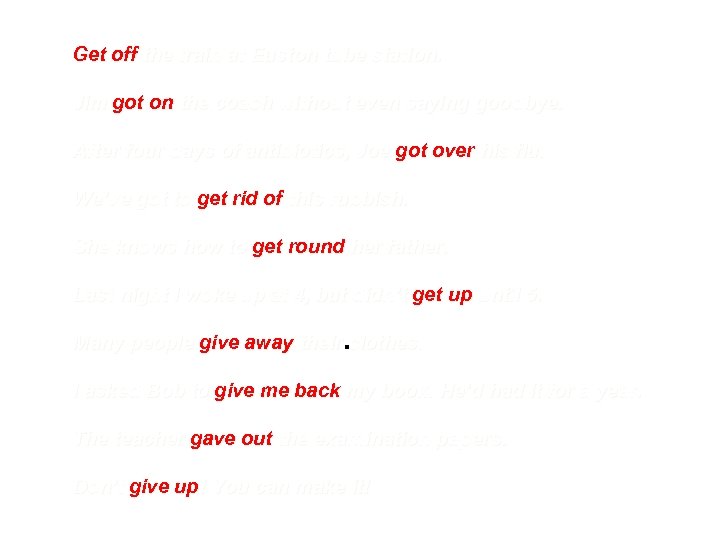 Get off the train at Euston tube station. Jim got on the coach without even saying goodbye. After four days of antibiotics, Joe got over his flu. We’ve got to get rid of this rubbish. She knows how to get round her father. Last night I woke up at 4, but didn’t get up until 5. Many people give away their clothes. . I asked Bob to give me back my book. He’d had it for a year. The teacher gave out the examination papers. Don’t give up! You can make it!
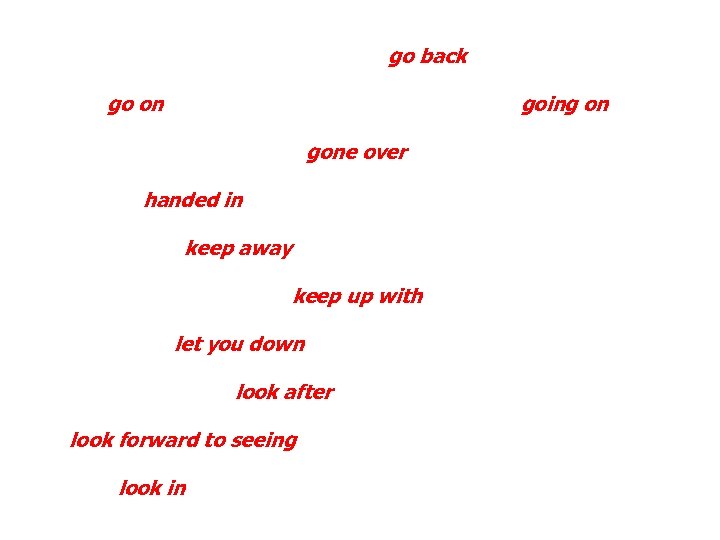 It's hard to imagine that I'll ever go back to Lappenranta. Let's go on to discuss the next point. / What's going on here? The student should have gone over her essay twice. I’ve just handed in my written paper. Let’s hope for the best. You'd better keep away from him. He's a crook! These days, it’s hard to keep up with the Joneses. I will never let you down. My sister loves to look after her cat. I look forward to seeing you at the weekend. I may look in at the party on my way home.
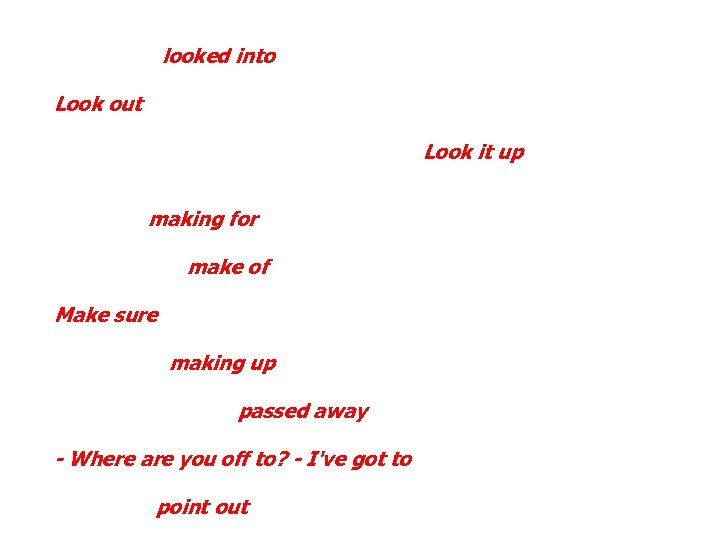 The police looked into her disappearance. Look out! You're gonna spill your drink. - What does ‘awry’ mean? - No idea. Look it up in the dictionary. We were making for the exit when we met Alan. What do you make of it? Make sure that the lights are switched off before you leave. She enjoys making up lies just for the sake of it. Winston Churchill passed away in 1965. - Where are you off to? - I've got to pick up some food. I’d like to point out that his performance was really poor.
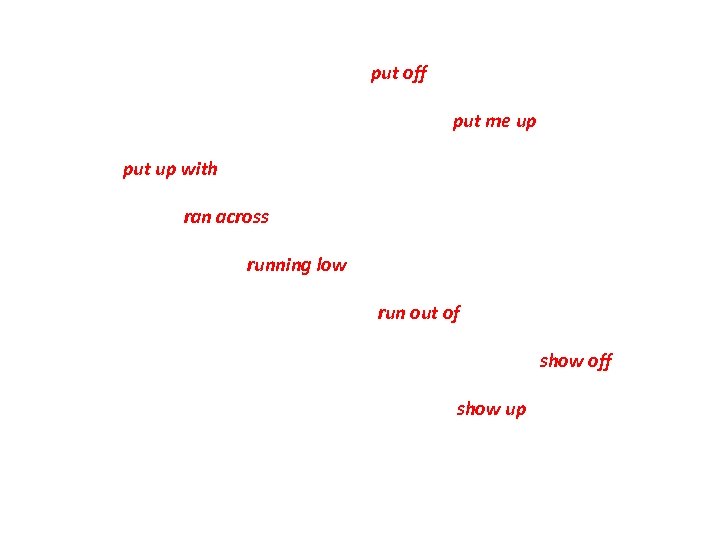 Due to a flight delay, the gig was first put off, and then called off. When I was in London, a Scottish friend of mine put me up. I had to put up with a great deal of nonsense. The other day I ran across my ex girlfriend. Our water supplies are running low. Suddenly Bill went out because he had run out of cigarettes. When he sat down at the piano, we knew he was going to show off. He was supposed to take an exam, but he didn't show up.
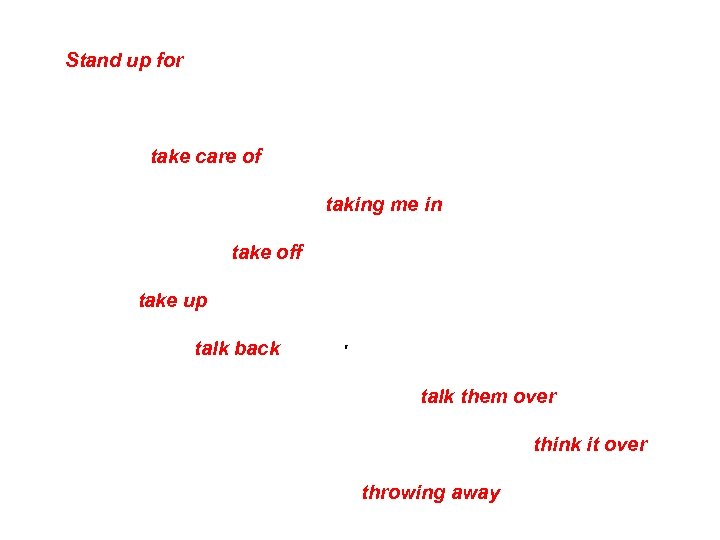 “Stand up for your rights”, said the activist. That kid takes after his dad. - Will you take care of the kid? - Of course I will. - I won the lottery! - Are you taking me in? It’s hot in here. I’ll take off my sweater. I should take up swimming for the sake of my health. You shouldn’t talk back to your teacher. . We have serious problems here. Let’s talk them over. - How about a trip this weekend? - Sounds OK. I’ll think it over. That woman is crazy. She loves throwing away £ 5 notes.
 - What a nice sweater! - Why don’t you try it on, then? Will you turn down the radio? / Bob's application was turned down. Turn off the washing machine. Everybody is asleep. It’s dark in here. Turn on the lights. My grandpa can’t hear, so he’s always turning up his hearing aid. She woke up as the alarm clock went off. Watch out! There’s a fast car coming.
 Out of… danger / condition / touch / reach / sorts / the question to get on one’s nerves to be on good terms with sb. to be in two minds (about sth. ) to make one’s mind up (about sth. ) to be splitting one’s sides . to be blowing one’s own trumpet to change one’s tune
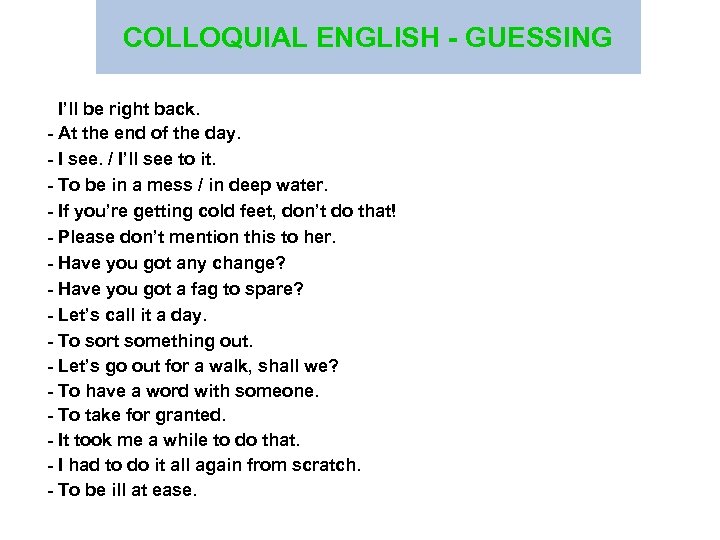 COLLOQUIAL ENGLISH - GUESSING - I’ll be right back. - At the end of the day. - I see. / I’ll see to it. - To be in a mess / in deep water. - If you’re getting cold feet, don’t do that! - Please don’t mention this to her. - Have you got any change? - Have you got a fag to spare? - Let’s call it a day. - To sort something out. - Let’s go out for a walk, shall we? - To have a word with someone. - To take for granted. - It took me a while to do that. - I had to do it all again from scratch. - To be ill at ease.
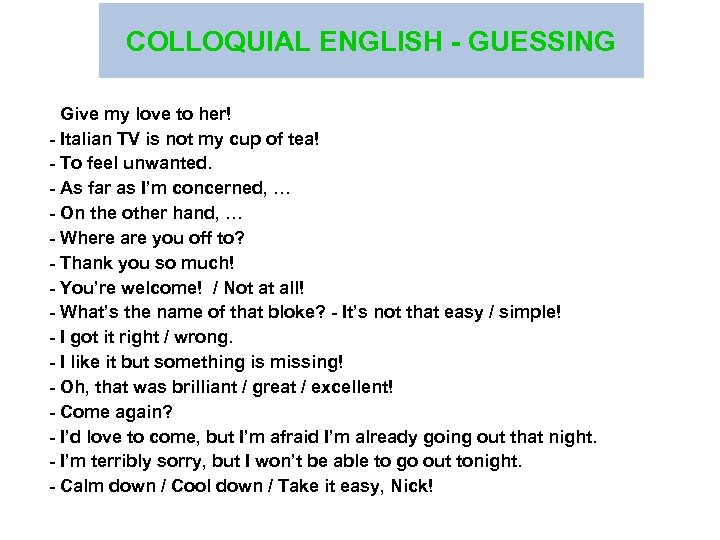 COLLOQUIAL ENGLISH - GUESSING - Give my love to her! - Italian TV is not my cup of tea! - To feel unwanted. - As far as I’m concerned, … - On the other hand, … - Where are you off to? - Thank you so much! - You’re welcome! / Not at all! - What’s the name of that bloke? - It’s not that easy / simple! - I got it right / wrong. - I like it but something is missing! - Oh, that was brilliant / great / excellent! - Come again? - I’d love to come, but I’m afraid I’m already going out that night. - I’m terribly sorry, but I won’t be able to go out tonight. - Calm down / Cool down / Take it easy, Nick!
 COLLOQUIAL ENGLISH - GUESSING - To breathe sigh of relief - I (don’t) fancy you - Are you two back together? - How was your day? - a quid - to stand on ceremony - once in a while - to have a word with someone - to tell off - time is up - serves you right! - to call names - between you and me - I would like to live in London for good. - This is on me! - To speak one’s mind
 COLLOQUIAL ENGLISH - GUESSING - I’m trying my best to … - I think it’s stunning! - Do you? - Jane is still in two minds about that matter. - To relieve one’s pain (stress) - Sounds good to me, let’s do it! - These days / Nowadays - Have we met before? - Will you be alright? - I’ll be fine! - Be safe! - Do you always sleep this late? - It’s not fair on her. - Why not? - Have you seen Ian around? - Yes, I have just seen him. He’s gone for an eye test. - What’s wrong? You look miserable!
 COLLOQUIAL ENGLISH - GUESSING GET… - confused / dressed / fat / ill / lost / married / old / warm - I’m totally stunned / amazed / astonished / bewildered - Living in London costs an arm and a leg. - Good morning everybody / everyone! - Juliet’s got mixed feelings about that. - I like that sweater. - Why don’t you try it on, then? - To say hello / hi / bye to sb for me - Green fingers / green-fingered - Did you sleep well? – Yes, that noise didn’t keep me awake. - How was your day? - She needed a small loan to tide her over. - You’ll never get away with this exam. - Let’s get down to business. - In the end, all the hard work I had done over the summer paid off. - Green fingers / green-fingered
 COLLOQUIAL ENGLISH - GUESSING - Did you sleep well? - Yes, that noise didn’t keep me awake. - How was your day? - She needed a small loan to tide her over. - You’ll never get away with this exam. - Let’s get down to business. - In the end, all the hard work I had done over the summer paid off. - I don’t really like this job. How about you? - Well, to me it’s just the other way round. - After I’d cooled off, I realized I was being irrational. - The noise they made was driving me crazy. - It’s no use crying over spilt milk. - Come round when you can! - Thanks for popping in! - It’s alright. - Fancy some juice? Yes, please! That’ll do. - Right then! I’d better go / get going now. - You’re overreacting! Don’t be so emotional!
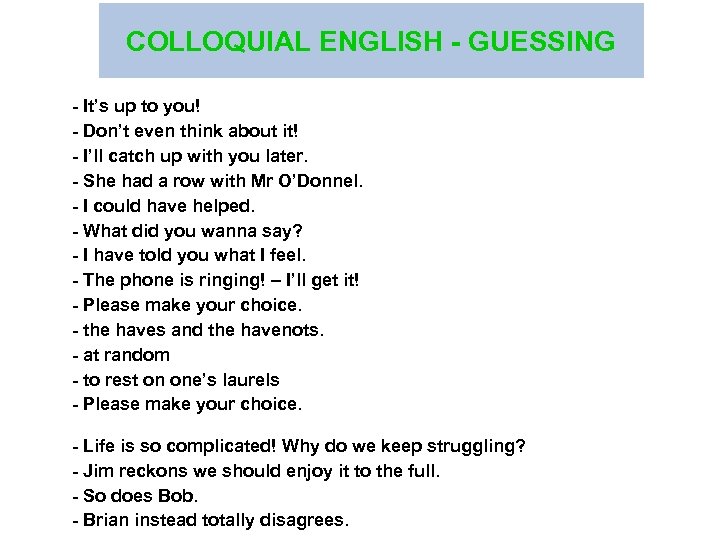 COLLOQUIAL ENGLISH - GUESSING - It’s up to you! - Don’t even think about it! - I’ll catch up with you later. - She had a row with Mr O’Donnel. - I could have helped. - What did you wanna say? - I have told you what I feel. - The phone is ringing! – I’ll get it! - Please make your choice. - the haves and the havenots. - at random - to rest on one’s laurels - Please make your choice. - Life is so complicated! Why do we keep struggling? - Jim reckons we should enjoy it to the full. - So does Bob. - Brian instead totally disagrees.
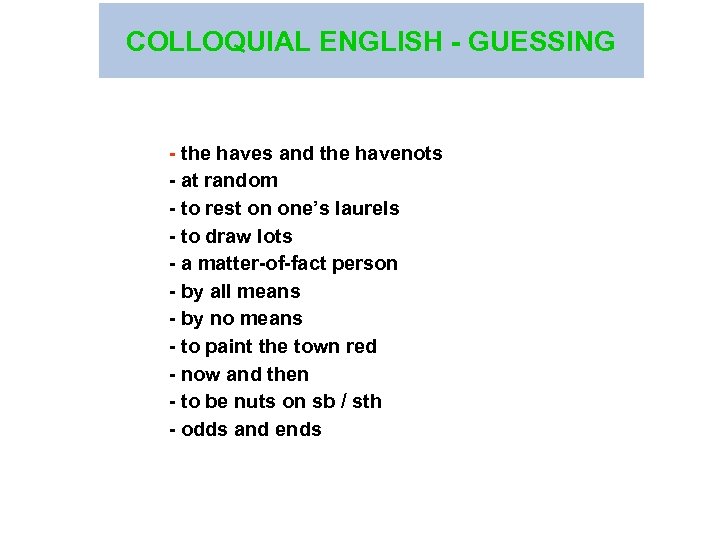 COLLOQUIAL ENGLISH - GUESSING - the haves and the havenots - at random - to rest on one’s laurels - to draw lots - a matter-of-fact person - by all means - by no means - to paint the town red - now and then - to be nuts on sb / sth - odds and ends
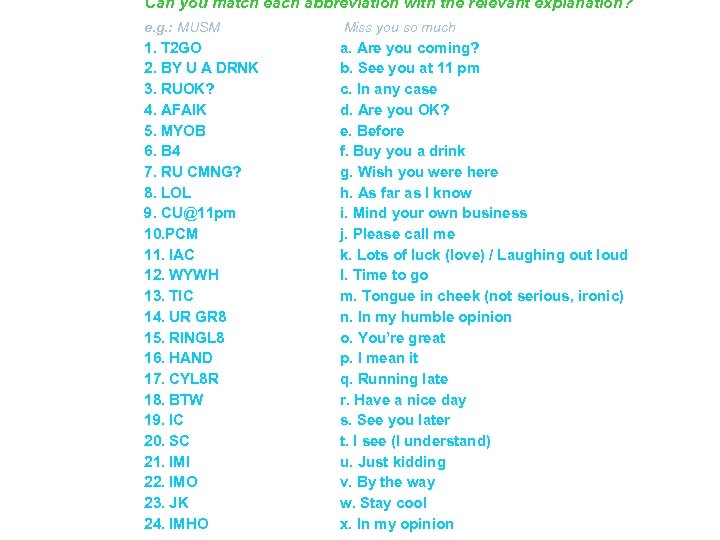 Can you match each abbreviation with the relevant explanation? e. g. : MUSM Miss you so much 1. T 2 GO 2. BY U A DRNK 3. RUOK? 4. AFAIK 5. MYOB 6. B 4 7. RU CMNG? 8. LOL 9. CU@11 pm 10. PCM 11. IAC 12. WYWH 13. TIC 14. UR GR 8 15. RINGL 8 16. HAND 17. CYL 8 R 18. BTW 19. IC 20. SC 21. IMI 22. IMO 23. JK 24. IMHO a. Are you coming? b. See you at 11 pm c. In any case d. Are you OK? e. Before f. Buy you a drink g. Wish you were h. As far as I know i. Mind your own business j. Please call me k. Lots of luck (love) / Laughing out loud l. Time to go m. Tongue in cheek (not serious, ironic) n. In my humble opinion o. You’re great p. I mean it q. Running late r. Have a nice day s. See you later t. I see (I understand) u. Just kidding v. By the way w. Stay cool x. In my opinion
 MAIN REFERENCES n Murphy R. , English Grammar in Use, Cambridge University Press, 1994. n Ambrosini R. , Rutt A. , Elia A. , The UK: Learning the Language, Studying the Culture, Roma, Carocci, 2005. WEBSITES http: //owl. english. purdue. edu/handouts/print/esltensverb. html http: //wwwnew. towson. edu/ows/ http: //web 2. uvcs. uvic. ca/elc/studyzone/330/grammar/index. htm http: //esl. fis. edu/grammar/rules/ http: //www. usingenglish. com/ http: //www. eslbee. com http: //www. fortunecity. com/bally/durrus/153/gramtoc. html http: //www. atkielski. com/inlink. php? /ESLPublic/ http: //www. bartleby. com http: //www. wikipedia. org