 Скачать презентацию Ling 411 10 Functional Brain Imaging cont d
9ba92f39ecc1996ea1ca8267b0e9afbe.ppt
- Количество слайдов: 64



Ling 411 – 10 Functional Brain Imaging (cont’d) MEG
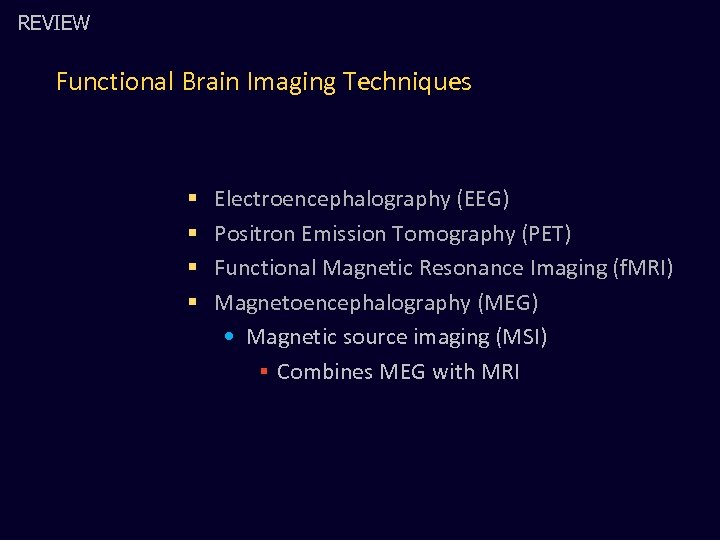
REVIEW Functional Brain Imaging Techniques § § Electroencephalography (EEG) Positron Emission Tomography (PET) Functional Magnetic Resonance Imaging (f. MRI) Magnetoencephalography (MEG) • Magnetic source imaging (MSI) § Combines MEG with MRI
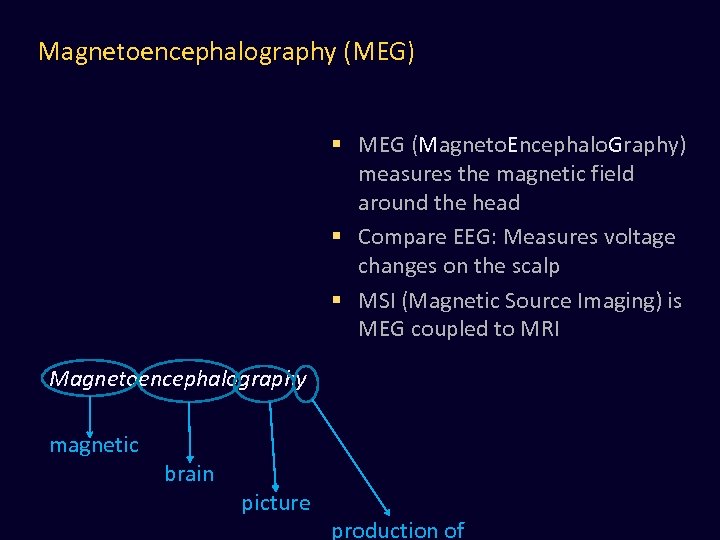
Magnetoencephalography (MEG) § MEG (Magneto. Encephalo. Graphy) measures the magnetic field around the head § Compare EEG: Measures voltage changes on the scalp § MSI (Magnetic Source Imaging) is MEG coupled to MRI Magnetoencephalography magnetic brain picture production of
Magnetoencephalography (MEG) § MEG (Magneto. Encephalo. Graphy) measures the magnetic field around the head § Compare EEG: Measures voltage changes on the scalp § MSI (Magnetic Source Imaging) is MEG coupled to MRI
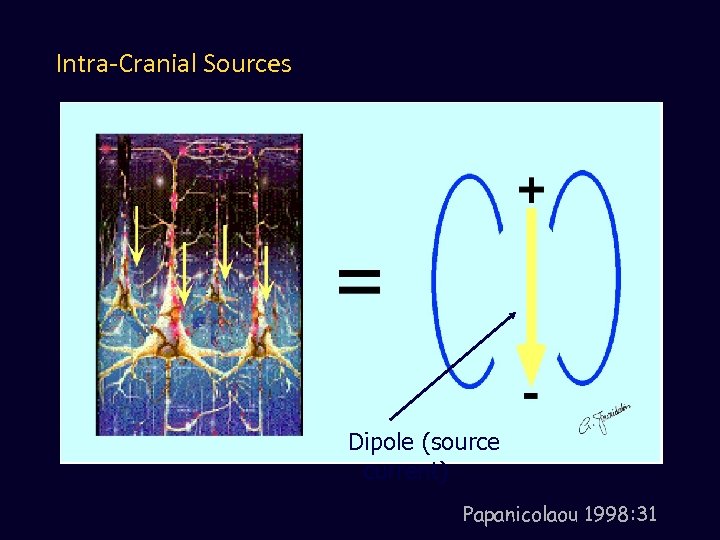
Intra-Cranial Sources Dipole (source current) Papanicolaou 1998: 31
How MEG works § Records the magnetic flux or the magnetic fields that arise from the source current § A current is always associated with a magnetic field perpendicular to its direction § Magnetic flux lines are not distorted as they pass through the brain tissue because biological tissues offer practically no resistance to them (cf. EEG)
Magnetoencephalography (MEG) § Records the magnetic flux or the magnetic fields that arise from the source current § A current is always associated with a magnetic field perpendicular to its direction § Magnetic flux lines are not distorted as they pass through the brain tissue because biological tissues offer practically no resistance to them (cf. EEG)
A dipole is a small current source § Dipole generates a magnetic field § Dendritic current from apical dendrites of pyramidal neurons § At least 10, 000 neighboring neurons firing “simultaneously” for MEG to detect
Recording of the Magnetic Flux § Recorded by special sensors called magnetometers § A magnetometer is a loop of wire placed parallel to the head surface § The strength (density) of the magnetic flux at a certain point determines the strength of the current produced in the magnetometer § If a number of magnetometers are placed at regular intervals across the head surface, the shape of the entire distribution by a brain activity source can be determined (in theory)
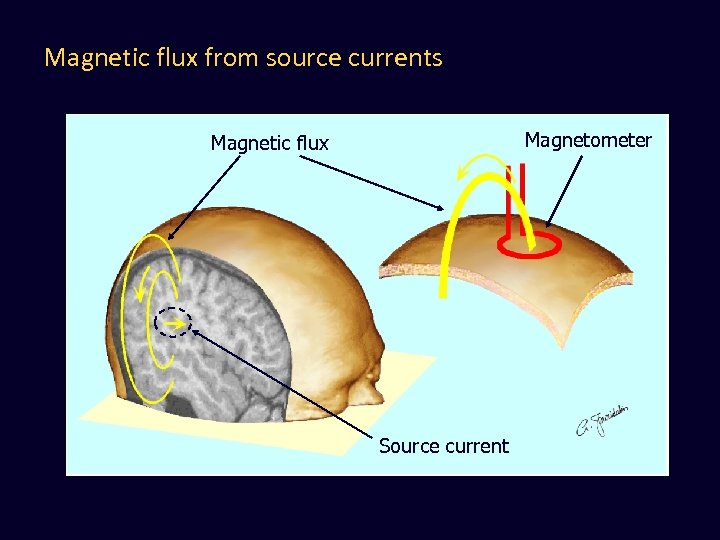
Magnetic flux from source currents Magnetometer Magnetic flux Source current
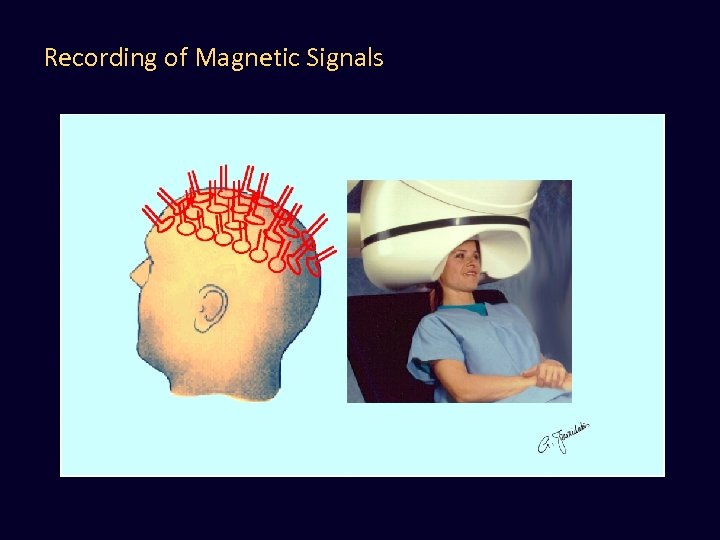
Recording of Magnetic Signals
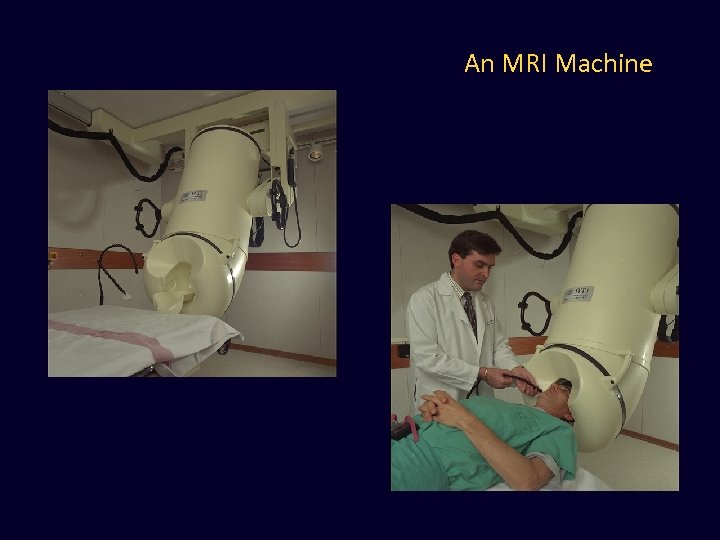
An MRI Machine
Recording of the Magnetic Flux § Present day machines have 248 magnetometers § The magnetic fields that reach the head surface are extremely small § Approximately one million times weaker than the ambient magnetic field of the earth § Because the magnetic fields are extremely small, the magnetometers must be superconductive (have extremely low resistance) § Resistance in wires is lowered when the wires are cooled to extremely low temperatures
Recording of the Magnetic Flux § When the temperature of the wires approaches absolute zero, the wires become superconductive § The magnetometer wires are housed in a thermally insulated drum (dewar) filled with liquid helium § The liquid helium keeps the wires at a temperature of about 4 degrees Kelvin § The magnetometers are superconductive at this temperature
Recording of the Magnetic Flux § The currents produced in the magnetometers are also extremely weak and must be amplified § Superconductive Quantum Interference Devices (SQUIDS) § The magnetometers and their SQUIDS are kept in a dewar, which is filled with liquid helium to keep them at an extremely low temperature
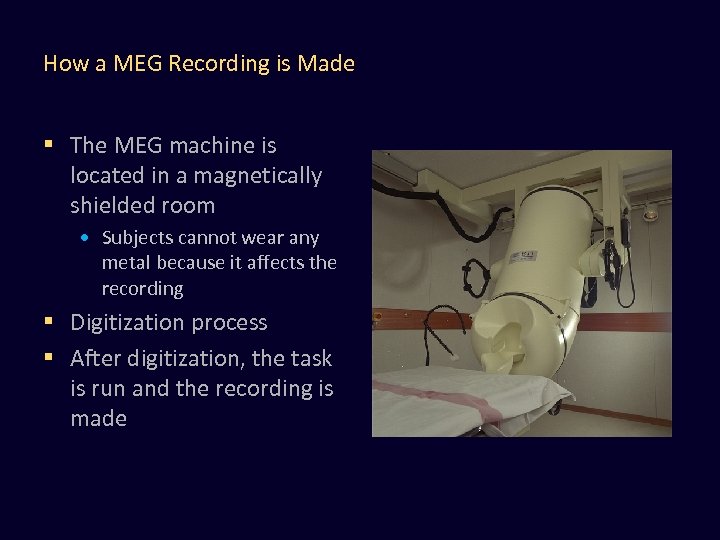
How a MEG Recording is Made § The MEG machine is located in a magnetically shielded room • Subjects cannot wear any metal because it affects the recording § Digitization process § After digitization, the task is run and the recording is made
The Digitization Process § Needed for co-registration with MRI • MRI scan is done later • Provides images • MSI – Magnetic Source Imaging § Method • 5 points § 3 electrodes on forehead § 2 earpieces • Subjects must remain extremely still during the digitization process § After digitization, the task is run and the recording is made
Dipolar Distribution of the Magnetic Flux § In the following figure, one set of concentric circles represents the magnetic flux exiting the head and the other represents the re-entering flux § This is called a dipolar distribution § The two points where the recorded flux has the highest value are called extrema § The flux density diminishes progressively, forming iso-field contours
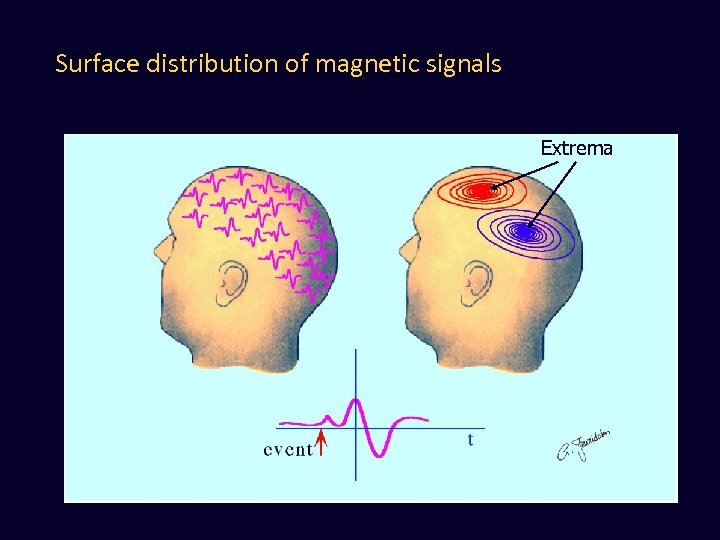
Surface distribution of magnetic signals Extrema
Dipolar Distribution of the Magnetic Flux From the dipolar distributions, we can determine some characteristics of the source The source is below the mid-point between the extrema (points where recorded flux has highest value) The source is at a depth proportional to the distance between the extrema § 1. 2. • • 3. 4. Extrema that are close together indicate a source close to the surface of the brain A source deeper in the brain produces extrema that are further apart The source’s strength is reflected in the intensity of the recorded flux The orientation of the extrema on the head surface indicates the orientation of the source
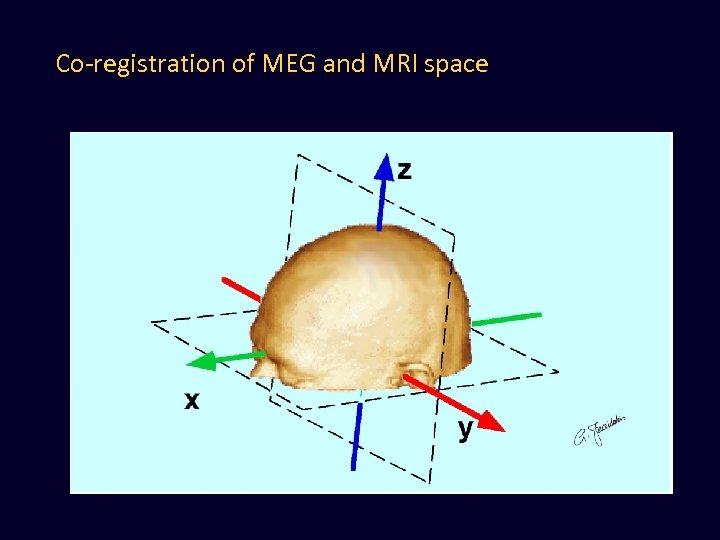
Co-registration of MEG and MRI space
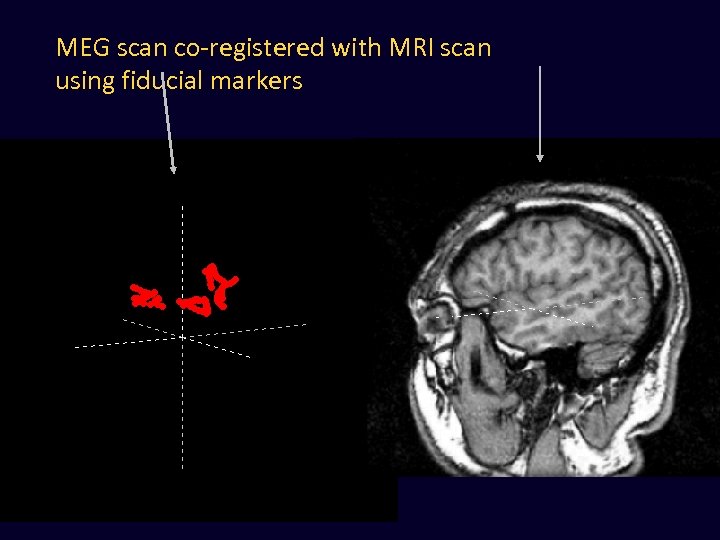
MEG scan co-registered with MRI scan using fiducial markers
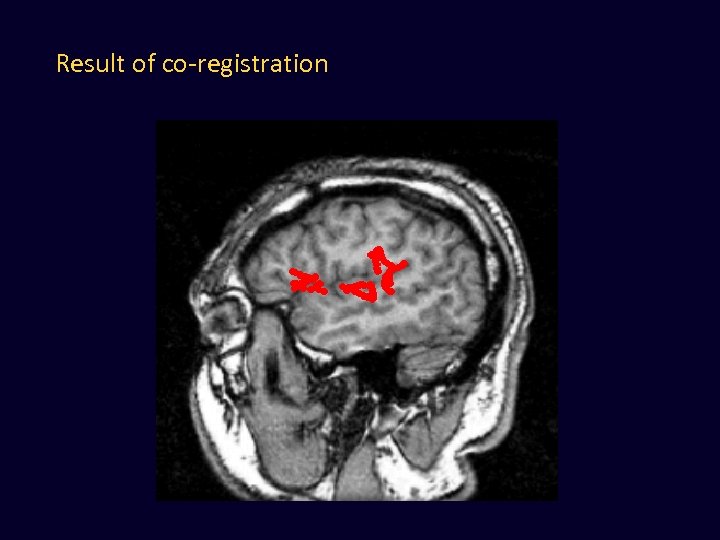
Result of co-registration
Event-related brain responses: EEG & MEG § Both types of signals come from the same type of event: active dipoles • Different directions from the dipoles • Detected by different devices § With EEG • ERP – event-related potential § With MEG • ERF – event-related (magnetic) field • Addition from 100 or more trials for each tested condition needed to get measurable data
The inverse problem § A problem for EEG and MEG § Locating the dipole(s) based on signals reaching surface of scalp § Problem: Multiple solutions are possible • Cf. solving x + y = 24 § Computer uses iterative procedure to come up with best fit § The problem is compounded by the fact that the brain is a parallel processor • Many dipoles at each temporal sampling point
MSI before neurosurgery § MSI is preferred because mapping by cortical stimulation increases the patients’ susceptibility to infections as a result of lengthened surgery durations § MSI can be performed prior to the scheduled surgery so that the surgeons can plan the best way to remove the damaged area while avoiding language areas as best they can
Temporal Resolution of MEG § Excellent – unlike f. MRI and PET § The temporal order of activation of areas in a pattern can be discerned § The time course of the activation can be followed § MEG has potential to detect the activation of several brain regions as they become active from moment to moment during a complex function such as recognition
Temporal Resolution of MEG § Only with MEG can we detect the activation of several brain regions as they become active from moment to moment during a complex function such as recognition § But it is (at present state of the art) virtually impossible to achieve precision
Time course of activation § We can follow the activation of a source across time § The magnetic fields recorded in MEG are evoked § Activation at each point in time is recorded (millisecond sensitivity) § Sources of early components of Evoked Fields circumscribe the modality-specific sensory areas § Sources of late components circumscribe different sets of brain regions (mostly association cortex) • These activation patterns are function- (or task-) specific
Spatial limitation of MEG § Magnetic flux is perpendicular to direction of electrical current flow § Flux is therefore relatively easy to detect if dendrites are parallel to surface of skull • i. e. , for pyramidal neurons along the sides of sulci § But hard or impossible to detect if vertical • i. e. , for pyramidal neurons at tops of gyri or at bottoms of sulci
The challenge of MSI § The cortex is a parallel processor • Hundreds or thousands of dipoles can be active simultaneously § Multiple dipoles make comprehensive inverse dipole modeling virtually impossible § Hence, compromises are necessary • Sample larger time spans (up to 500 ms) • Sample larger areas (up to several sq cm)
Other limitations of MEG and EEG § Problem: orientation of dipoles § For MEG • Activity in some areas is practically undetectable § Dipoles at tops of gyri § Dipoles at bottoms of sulci § For EEG • Dipoles on sides of sulci are hard to detect

Some MEG/MSI Findings
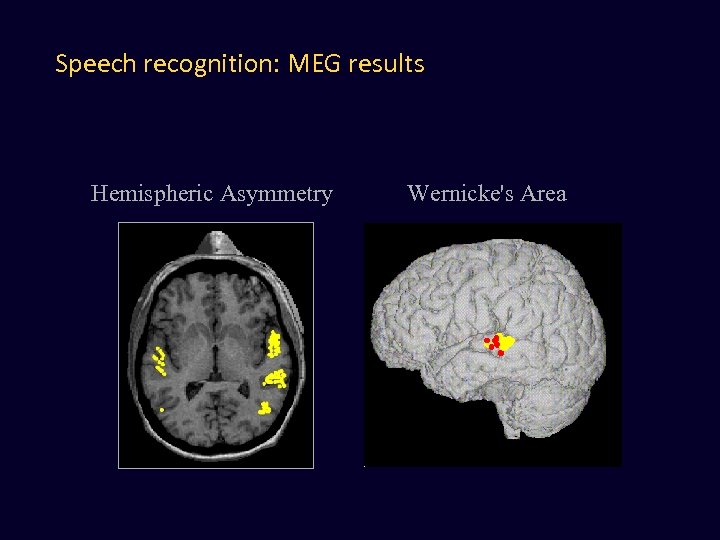
Speech recognition: MEG results Hemispheric Asymmetry Wernicke's Area
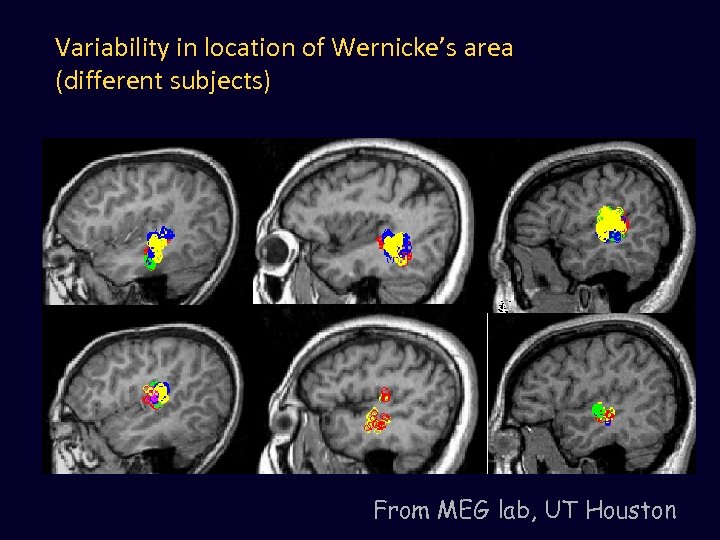
Variability in location of Wernicke’s area (different subjects) From MEG lab, UT Houston
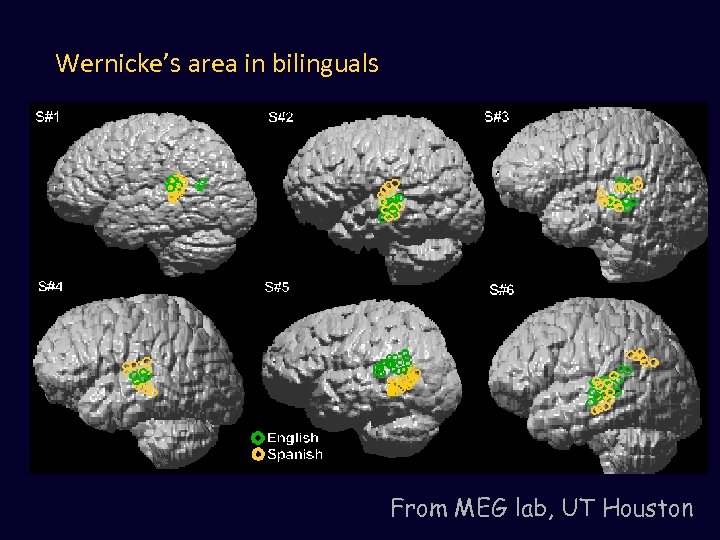
Wernicke’s area in bilinguals From MEG lab, UT Houston
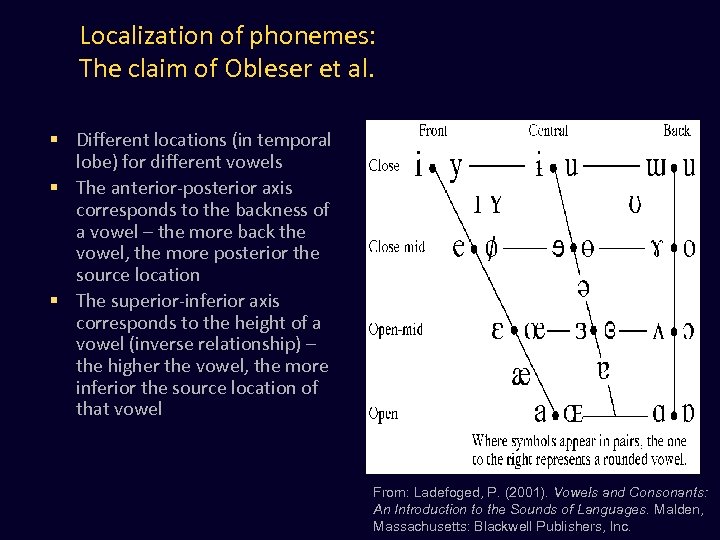
Localization of phonemes: The claim of Obleser et al. § Different locations (in temporal lobe) for different vowels § The anterior-posterior axis corresponds to the backness of a vowel – the more back the vowel, the more posterior the source location § The superior-inferior axis corresponds to the height of a vowel (inverse relationship) – the higher the vowel, the more inferior the source location of that vowel From: Ladefoged, P. (2001). Vowels and Consonants: An Introduction to the Sounds of Languages. Malden, Massachusetts: Blackwell Publishers, Inc.
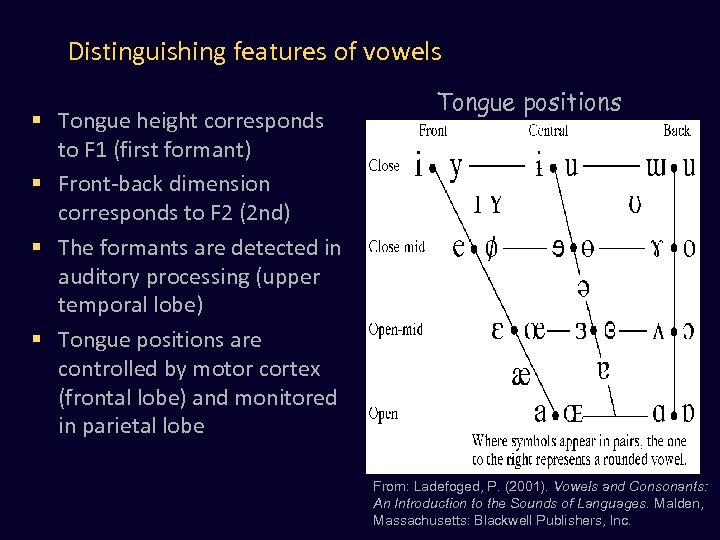
Distinguishing features of vowels § Tongue height corresponds to F 1 (first formant) § Front-back dimension corresponds to F 2 (2 nd) § The formants are detected in auditory processing (upper temporal lobe) § Tongue positions are controlled by motor cortex (frontal lobe) and monitored in parietal lobe Tongue positions From: Ladefoged, P. (2001). Vowels and Consonants: An Introduction to the Sounds of Languages. Malden, Massachusetts: Blackwell Publishers, Inc.
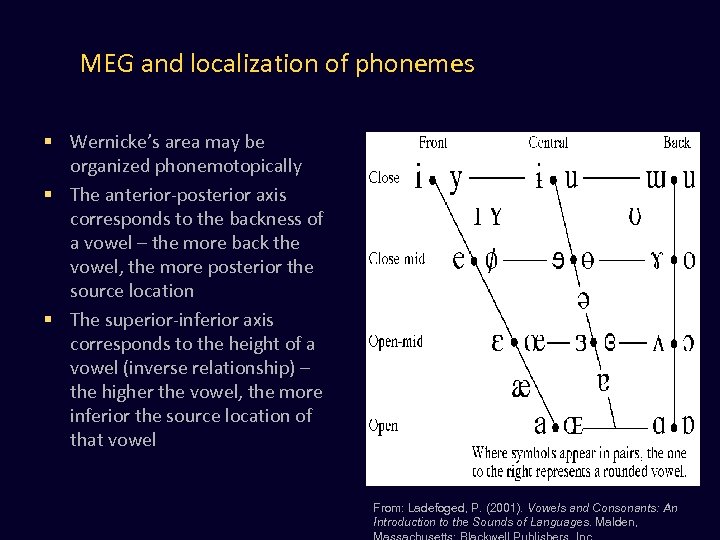
MEG and localization of phonemes § Wernicke’s area may be organized phonemotopically § The anterior-posterior axis corresponds to the backness of a vowel – the more back the vowel, the more posterior the source location § The superior-inferior axis corresponds to the height of a vowel (inverse relationship) – the higher the vowel, the more inferior the source location of that vowel From: Ladefoged, P. (2001). Vowels and Consonants: An Introduction to the Sounds of Languages. Malden,
MEG and localization of phonemes § Results: The relative positions of neural representations for vowels in Wernicke’s area correlate with the relative positions of the vowels in articulatory space • • Obleser, Elbert, Lahiri, & Eulitz, 2003 Obleser, Lahiri, & Eulitz, 2004 Obleser, Elbert, & Eulitz, 2004 Eulitz, Obleser, & Lahiri, 2004 § Can this finding be replicated? • Finding supported by different lab! • Shestakova, Brattico, Soloviev, Klucharec, & Huotilainen, 2004!
![Shestakova et al. experiment (2004) § Done in Helsinki, Russian vowels [i a u]](https://present5.com/presentation/9ba92f39ecc1996ea1ca8267b0e9afbe/image-41.jpg "Shestakova et al. experiment (2004) § Done in Helsinki, Russian vowels [i a u]")
Shestakova et al. experiment (2004) § Done in Helsinki, Russian vowels [i a u] • Obleser et al. in Germany, German vowels [i a u] § Results similar to those of Obleser et al. • Higher cortical location for [a] • Front-back cortical location corresponds to articulatory positions § They go two steps further: • Input from different speakers (all male) • Similar findings in both LH and RH
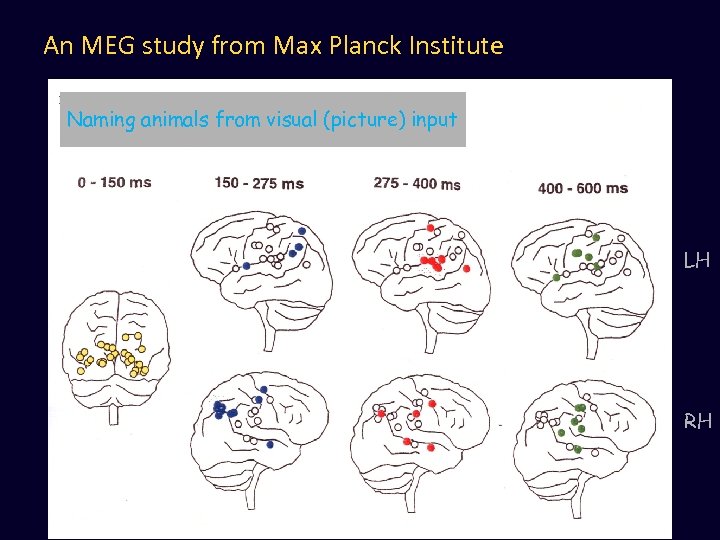
An MEG study from Max Planck Institute Naming animals from visual (picture) input LH RH

More information on MEG § The University of Texas Health Science Center at Houston Division of Clinical Neurosciences MEG Lab: • http: //www. uth. tmc. edu/clinicalneuro/ § Papanicolaou, A. (1998). Fundamentals of Functional Brain Imaging: A Guide to the Methods and their Applications to Psychology and Behavioral Neuroscience. Lisse: Swets & Zeitlinger.
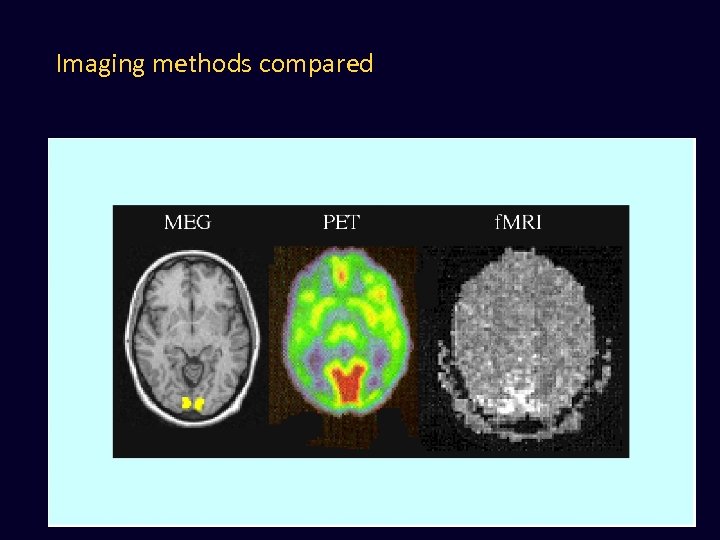
Imaging methods compared
A practical consideration: Cost § Most expensive: MEG • About $2 million for the machine • $1 million for magnetically shielded room § Next most expensive: PET § Next: f. MRI § Cheapest: EEG
Temporal resolution – summary § PET: 40 seconds and up § f. MRI: 10 seconds or more § MEG and EEG: instantaneous • Theoretically it is possible to do ms by ms tracking, to follow time course of activation • Commonly used sampling rate for MEG: 4 ms • Practically, such tracking is difficult or impossible § The inverse problem § Too many dipoles at each point in time
Spatial Resolution § EEG: Poor § PET: Fair – 4 -5 mm § f. MRI: Fair – 4 -5 mm • MRI: Good – 1 mm or less § MEG: Fairly good – 3 -4 mm or less • Under good conditions
Sensitivity of Imaging Methods § All of the methods have limited sensitivity § MEG • 10, 000 dendrites in close proximity have to be active to detect signal § PET and f. MRI • Similar limitations § Any activation that involves fewer numbers goes undetected
Other limitations of MEG and EEG § Problem: orientation of dipoles § For MEG • Activity in some areas is practically undetectable § Dipoles at tops of gyri § Dipoles at bottoms of sulci § For EEG • Dipoles on sides of sulci are hard to detect

Neuronal Structure and Function (Pulverműller 2002, Chapter 2)

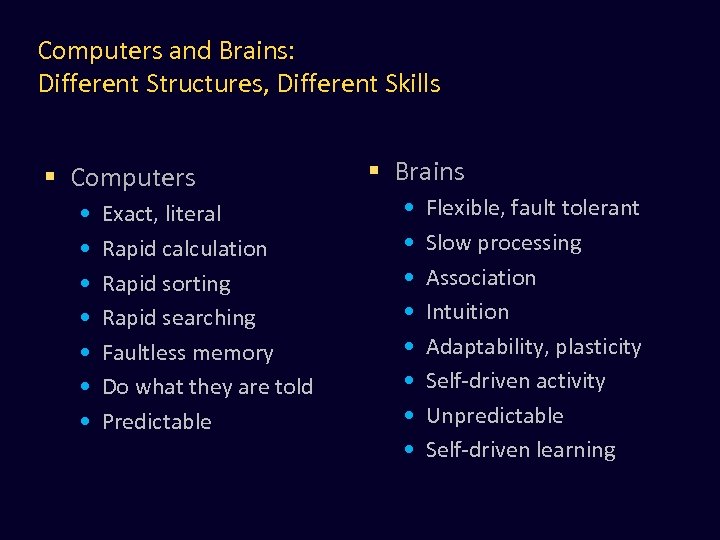
Neuronal Structure and Function I The Cortex is a Network § Pulvermüller (2002): • The brain is not like a computer “…any hardware computer configuration can realize almost any computer program or piece of software. ” “… it may be that the neuronal structures themselves teach us about aspects of the computational processes that are laid down in these structures. ” § Connectivity as key property
Since it is a network, The cortex operates by means of connections § Grey matter • The functional units are not individual neurons but clusters of neurons § Cortical columns (cf. next slide) • Horizontal connections to and from neighboring columns § Excitatory § Inhibitory § White matter • Connections between distant columns § Excitatory only
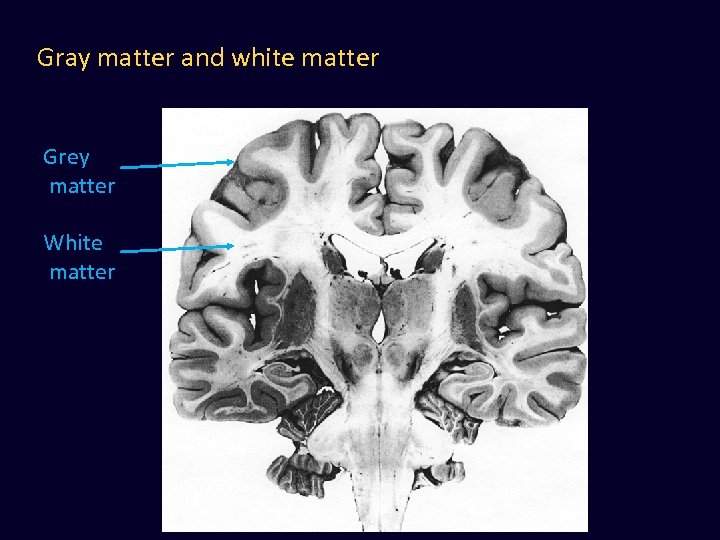
Gray matter and white matter Grey matter White matter
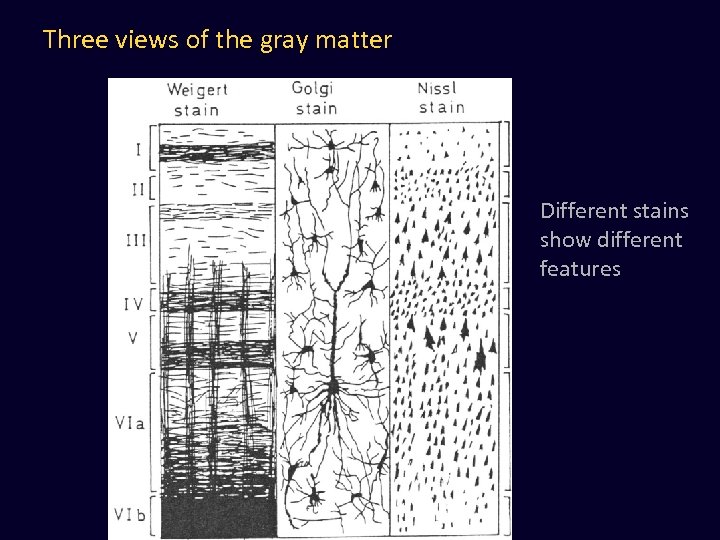
Three views of the gray matter Different stains show different features
Computers and Brains: Different Structures, Different Skills § Computers • • Exact, literal Rapid calculation Rapid sorting Rapid searching Faultless memory Do what they are told Predictable § Brains • • Flexible, fault tolerant Slow processing Association Intuition Adaptability, plasticity Self-driven activity Unpredictable Self-driven learning
Things that brains but not computers can do § Acquire information to varying degrees • “Entrenchment” • How does it work? § Variable connection strength § Connections get stronger with repeated use § Perform at varying skill levels • Degrees of alertness, attentiveness • Variation in reaction time • Mechanisms: § Global neurotransmitters (next slide) § Variation in blood flow § Variation in available nutrients § Presence or absence of fatigue § Presence or absence of intoxication
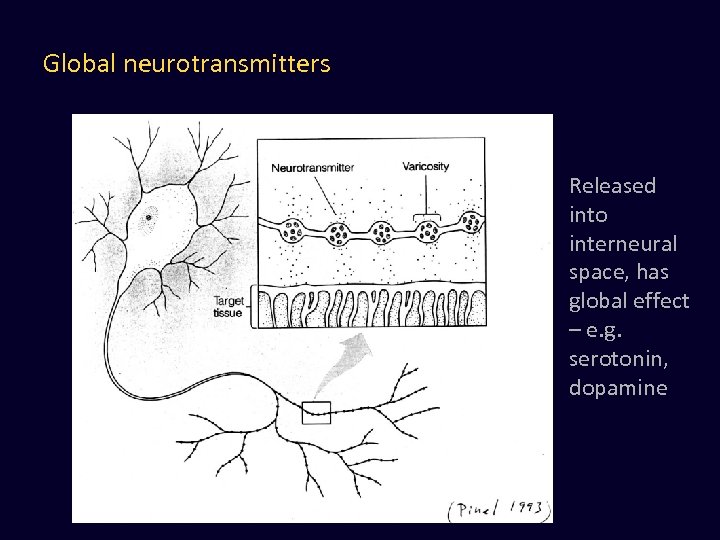
Global neurotransmitters Released into interneural space, has global effect – e. g. serotonin, dopamine
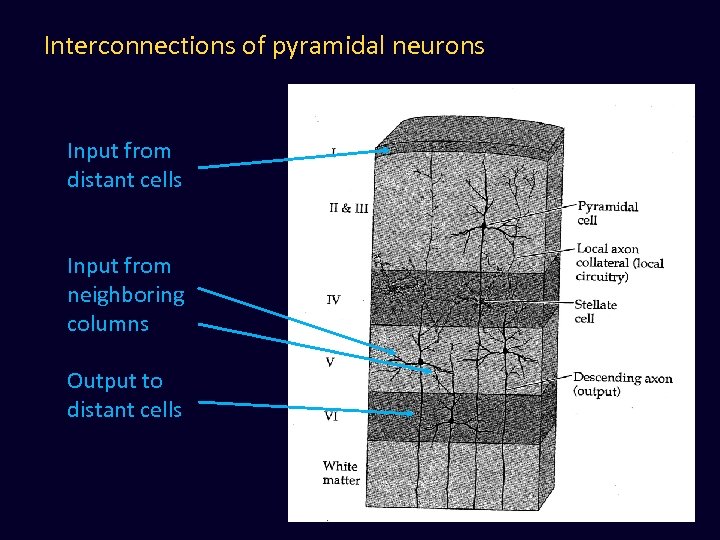
Neuronal Structure and Function: Connectivity § White matter: it’s all connections • Far more voluminous than gray matter • Cortico-cortical connections § The fibers are axons of pyramidal neurons § They are all excitatory • White since the fibers are coated with myelin § Myelin: glial cells § There also grey matter connections • Unmyelinated • Local • Horizontal, through gray matter • Excitatory and inhibitory
Pyramidal neurons and their connections § Connecting fibers • Dendrites (input): length 2 mm or less • Axons (output): length up to 10 cm § Synapses • Afferent synapses: up to 50, 000 § From distant and nearby sources • Distant – to apical dendrite • Local – to basal dendrites or cell body • Efferent synapses: up to 50, 000 § On distant and nearby destinations • Distant – main axon, through white matter • Local – collateral axons, through gray matter
Proportion of pyramidal cells in the cortex § Abeles (1991: 52) says 70% § Mountcastle says 70% - 80% (1998: 54) • Based on information from Feldman (1984) § Pulvermüller (2002: 13) says 85% • Based on information from Braitenburg & Schüz (1998) § Some difference comes from how spiny stellate cells are counted • Pyramidal or not? § No discrete boundary between these categories
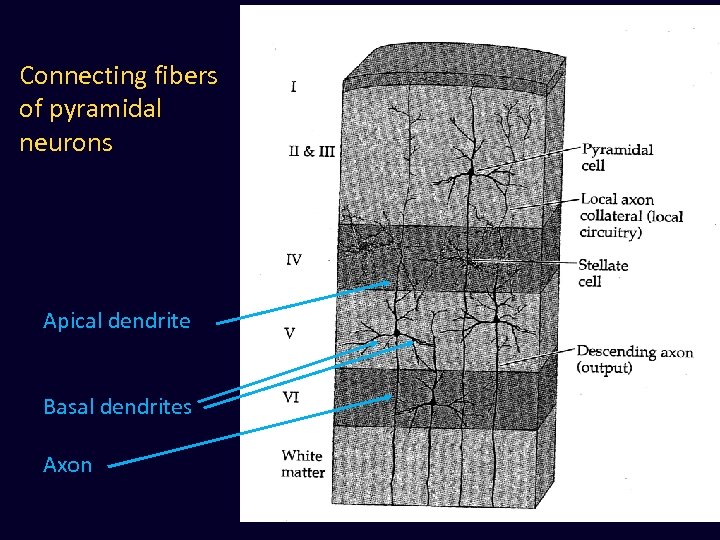
Connecting fibers of pyramidal neurons Apical dendrite Basal dendrites Axon
Interconnections of pyramidal neurons Input from distant cells Input from neighboring columns Output to distant cells
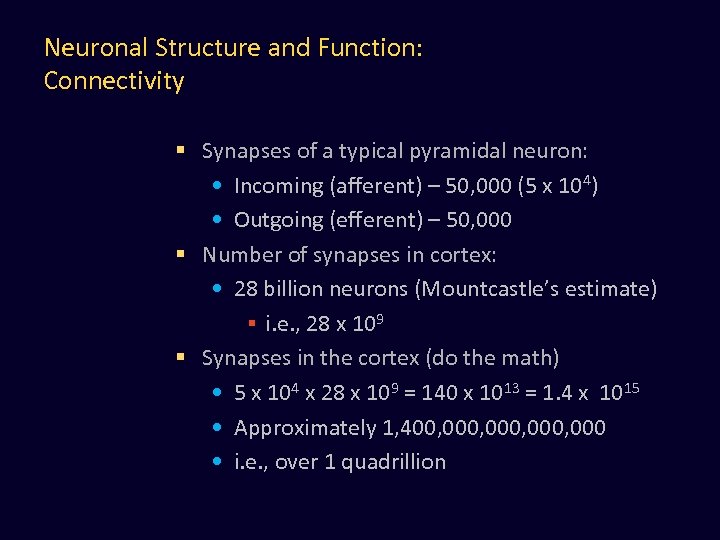
Neuronal Structure and Function: Connectivity § Synapses of a typical pyramidal neuron: • Incoming (afferent) – 50, 000 (5 x 10⁴) • Outgoing (efferent) – 50, 000 § Number of synapses in cortex: • 28 billion neurons (Mountcastle’s estimate) § i. e. , 28 x 109 § Synapses in the cortex (do the math) • 5 x 104 x 28 x 109 = 140 x 1013 = 1. 4 x 10¹⁵ • Approximately 1, 400, 000, 000 • i. e. , over 1 quadrillion

end
Скачать презентацию Ling 411 10 Functional Brain Imaging cont d
9ba92f39ecc1996ea1ca8267b0e9afbe.ppt