


 Скачать презентацию Linear Collider Physics Detector Simulation Software Norman
9bfaa2470dd4311d972ae1e7352ce44b.ppt
- Количество слайдов: 40
 Linear Collider Physics & Detector Simulation Software Norman Graf SLAC July 21, 2006 Maryland Physics Department Colloquium
 Charge • Summarize the status of the regional physics and detector simulation efforts. Simulation Mission Statement • Provide full simulation capabilities for Linear Collider physics program: – Physics simulations – Detector designs • Need flexibility for: – New detector geometries/technologies 2
 Goals • Facilitate contribution from physicists in different locations with various amounts of time available • Provide a general-purpose framework for physics software development. • Use standard code interface & data formats. • Simulate benchmark physics processes on different full detector designs. • Analyze physics performance based on full reconstruction and iterate. 3
 4
4
 Overview • Event Generation (stdhep as standard format) • LCIO (event data model and persistency format) • Fast detector response simulations – 4 -vector smearing or simple swimming and parameterized showers. • Full detector simulations – Complex detector geometries, full Geant 4 response • Common datasets • Grid • Future 5
 “Signal” and Diagnostic Samples • Number of canonical data samples have been established: • simple single particles: , , e, +/- , n, … • composite single particles: 0, , K 0 S , , • Z Pole events: comparison to SLD/LEP • WW, ZZ, tt, qq, tau pairs, mu pairs, Z , Zh, … • http: //www. lcsim. org/datasets/ftp. html • Beam backgrounds from Guinea. Pig and CAIN for standard ILC configurations also available. 6
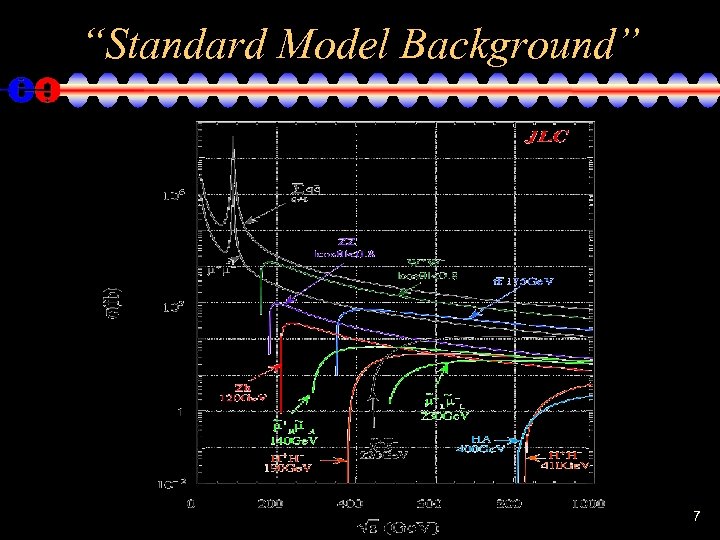 “Standard Model Background” 7
 “Standard Model Background” • Generate an inclusive set of MC events with all SM processes + backgrounds arising from beam- and brems-strahlung photons and machine-related particles. 500 fb-1 @ 0. 5 Te. V, 2 ab-1 @ 1. 0 Te. V – WHIZARD Monte Carlo used to generate all 0, 2, 4, 6 -fermion and t quark dominated 8 -fermion processes. • Used for realistic analyses and represents a “standard” sample. • Canonical background for Beyond-SM searches. • 100% e- and e+ polarization used in generation. Arbitrary electron, positron polarization simulated by properly combining data sets. • Fully fragmented MC data sets are produced. PYTHIA is used for final state QED & QCD parton showering, fragmentation, particle decay. • 1 year’s worth of stdhep files fits on one external harddrive. 8
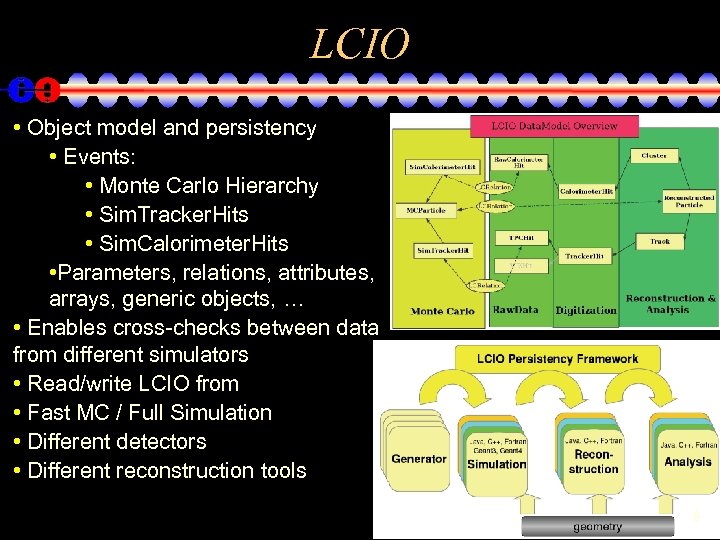 LCIO • Object model and persistency • Events: • Monte Carlo Hierarchy • Sim. Tracker. Hits • Sim. Calorimeter. Hits • Parameters, relations, attributes, arrays, generic objects, … • Enables cross-checks between data from different simulators • Read/write LCIO from • Fast MC / Full Simulation • Different detectors • Different reconstruction tools 9
 Fast Detector Response Simulation • Covariantly smear tracks with matrices derived from geometry, materials and point resolution using Billoir’s formulation. • Smear neutrals according to expected calorimeter resolution (EM for , HAD for neutral hadrons) • Create reconstructed particles from tracks and clusters ( , e, from MC, +/-, K 0 L for others) • Can also dial in arbitrary effective jet energy resolution. 10 • Uses runtime geometry (compact. xml ).
 lelaps • Fast detector response package. • Handles decays in flight, multiple scattering and energy loss in trackers. • Parameterizes particle showers in calorimeters. • Produces LCIO data at the hit level. • Uses runtime geometry (compact. xml godl). • An excellent tool for designing tracking detectors! http: //lelaps. freehep. org/index. html 11
 Quick. Sim overview • VTX, IT, TPC, CAL • Model for Tracker – circular trajectory parabolic trajectory – With multiple scattering, without energy loss – Equally spaced sampling • Model for Calorimeter – EM signal by e/ , HD signal by hadron, muon no signal – Segmented calorimeter. Lateral spreads are generated by an analytic form. • Uses runtime geometry from ASCII file. 12
 Sim. Det • Parameterized fast Monte Carlo (f 77) • Hard coded geometry: TESLA TDR Detector • Smears tracks with full covariance matrix and produces calorimeter clusters representing particle showers. • Response tuned to correspond to full detector simulation + reconstruction (Brahms, Geant 3). • Writes LCIO. • Development halted. 13
 Full Detector Response Simulation • Use Geant 4 toolkit to describe interaction of particles with matter and fields. • Thin layer of LC-specific C++ provides access to: – Event Generator input ( binary stdhep format ) – Detector Geometry description ( various solutions ) – Detector Hits ( LCIO ) 14
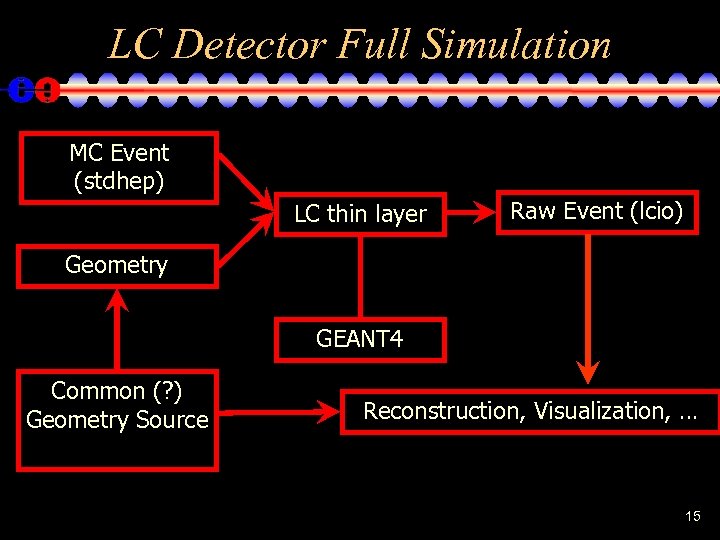 LC Detector Full Simulation MC Event (stdhep) LC thin layer Raw Event (lcio) Geometry GEANT 4 Common (? ) Geometry Source Reconstruction, Visualization, … 15
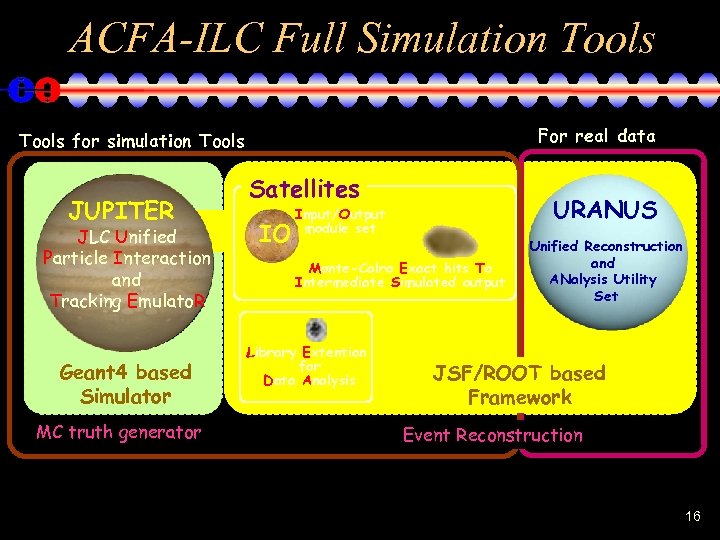 ACFA-ILC Full Simulation Tools For real data Tools for simulation Tools JUPITER JLC Unified Particle Interaction and Tracking Emulato. R Satellites IO Input/Output module set METIS Monte-Calro Exact hits To Intermediate Simulated output URANUS Unified Reconstruction and ANalysis Utility Set LEDA Geant 4 based Simulator MC truth generator Library Extention for Data Analysis JSF/ROOT based Framework Event Reconstruction 16
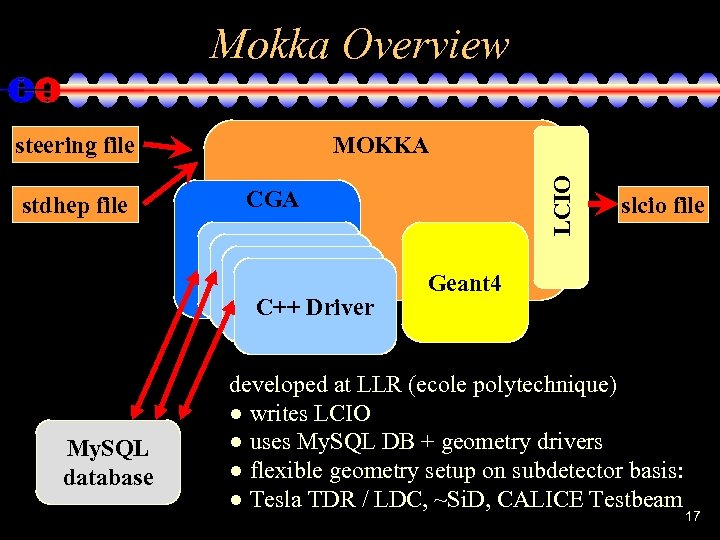 Mokka Overview steering file CGA C++ Driver My. SQL database LCIO stdhep file MOKKA slcio file Geant 4 developed at LLR (ecole polytechnique) ● writes LCIO ● uses My. SQL DB + geometry drivers ● flexible geometry setup on subdetector basis: ● Tesla TDR / LDC, ~Si. D, CALICE Testbeam 17
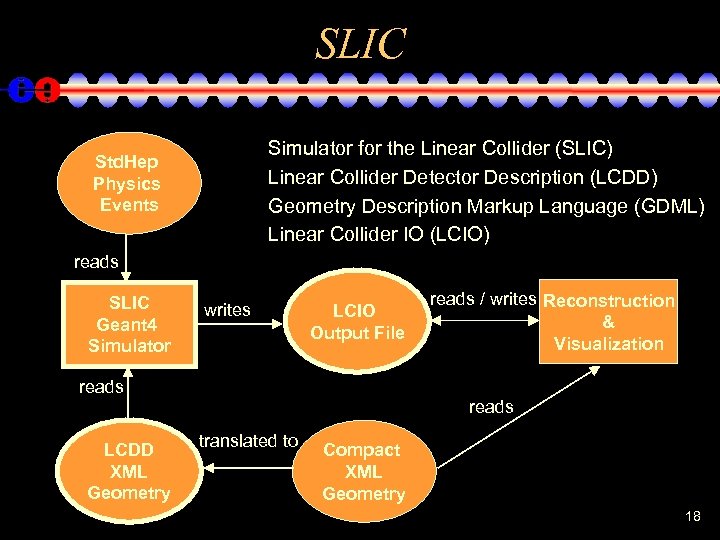 SLIC Simulator for the Linear Collider (SLIC) Linear Collider Detector Description (LCDD) Geometry Description Markup Language (GDML) Linear Collider IO (LCIO) Std. Hep Physics Events reads SLIC Geant 4 Simulator writes LCIO Output File reads LCDD XML Geometry reads / writes Reconstruction & Visualization reads translated to Compact XML Geometry 18
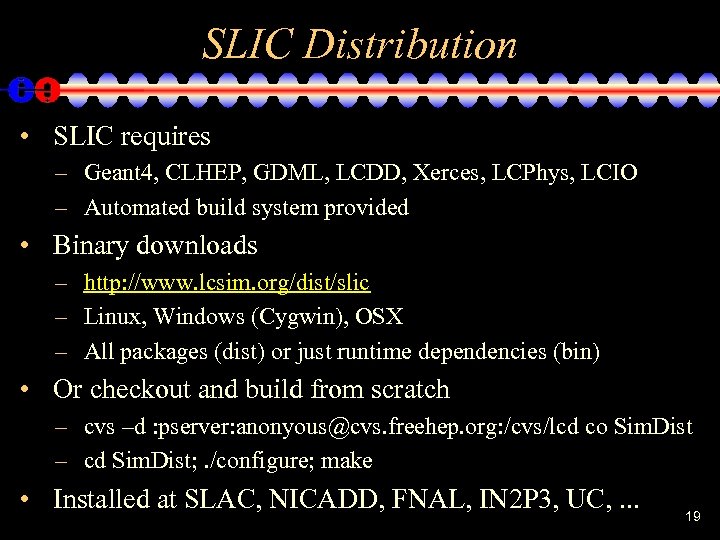 SLIC Distribution • SLIC requires – Geant 4, CLHEP, GDML, LCDD, Xerces, LCPhys, LCIO – Automated build system provided • Binary downloads – http: //www. lcsim. org/dist/slic – Linux, Windows (Cygwin), OSX – All packages (dist) or just runtime dependencies (bin) • Or checkout and build from scratch – cvs –d : pserver: anonyous@cvs. freehep. org: /cvs/lcd co Sim. Dist – cd Sim. Dist; . /configure; make • Installed at SLAC, NICADD, FNAL, IN 2 P 3, UC, . . . 19
 Geant 4 Calorimeter Studies • Still investing a lot of time understanding Geant 4! • Strong EM calorimeter resolution dependence on range cuts, reported several years ago, appears to be fixed in latest Geant 4 releases. • Energy non-conservation in hadron showers. – Bugs found in GEISHA and patches provided for G 4 several years ago, not all of which were adopted. – n and n treated with different models. – Dennis Wright (SLAC) appointed hadronics cocoordinator. More rapid turnaround on fixes. 20
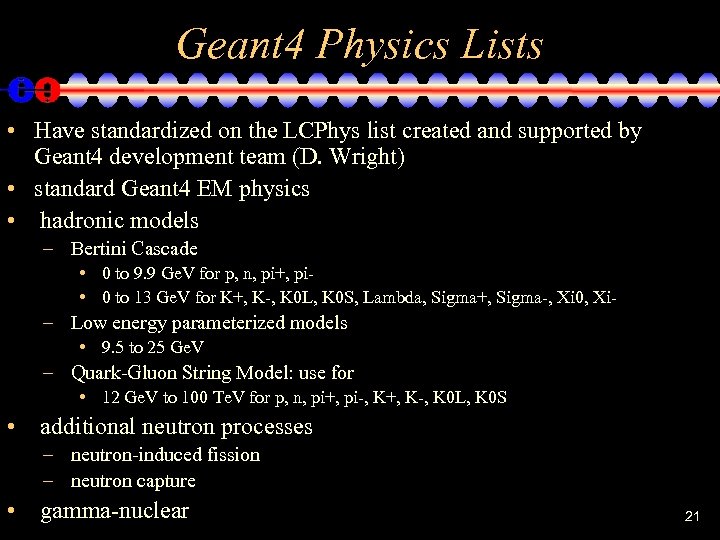 Geant 4 Physics Lists • Have standardized on the LCPhys list created and supported by Geant 4 development team (D. Wright) • standard Geant 4 EM physics • hadronic models – Bertini Cascade • 0 to 9. 9 Ge. V for p, n, pi+, pi • 0 to 13 Ge. V for K+, K-, K 0 L, K 0 S, Lambda, Sigma+, Sigma-, Xi 0, Xi- – Low energy parameterized models • 9. 5 to 25 Ge. V – Quark-Gluon String Model: use for • 12 Ge. V to 100 Te. V for p, n, pi+, pi-, K+, K-, K 0 L, K 0 S • additional neutron processes – neutron-induced fission – neutron capture • gamma-nuclear 21
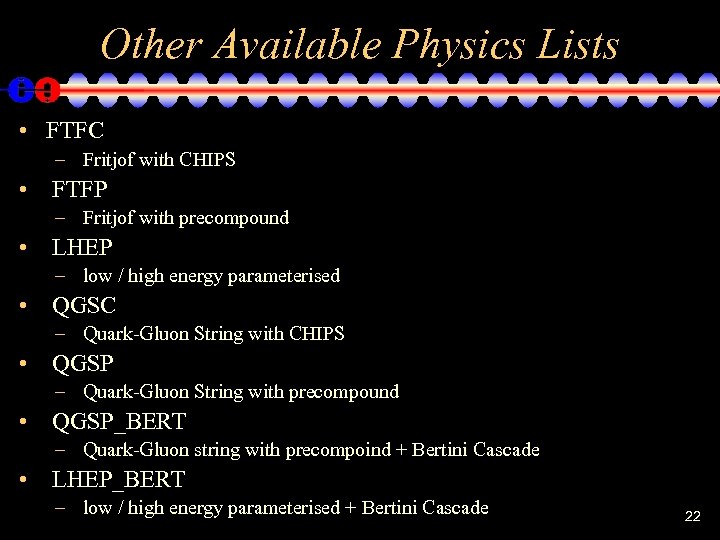 Other Available Physics Lists • FTFC – Fritjof with CHIPS • FTFP – Fritjof with precompound • LHEP – low / high energy parameterised • QGSC – Quark-Gluon String with CHIPS • QGSP – Quark-Gluon String with precompound • QGSP_BERT – Quark-Gluon string with precompoind + Bertini Cascade • LHEP_BERT – low / high energy parameterised + Bertini Cascade 22
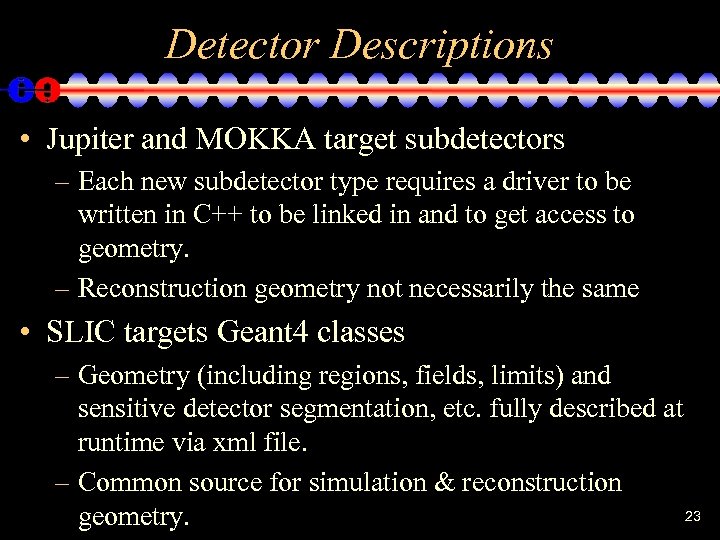 Detector Descriptions • Jupiter and MOKKA target subdetectors – Each new subdetector type requires a driver to be written in C++ to be linked in and to get access to geometry. – Reconstruction geometry not necessarily the same • SLIC targets Geant 4 classes – Geometry (including regions, fields, limits) and sensitive detector segmentation, etc. fully described at runtime via xml file. – Common source for simulation & reconstruction 23 geometry.
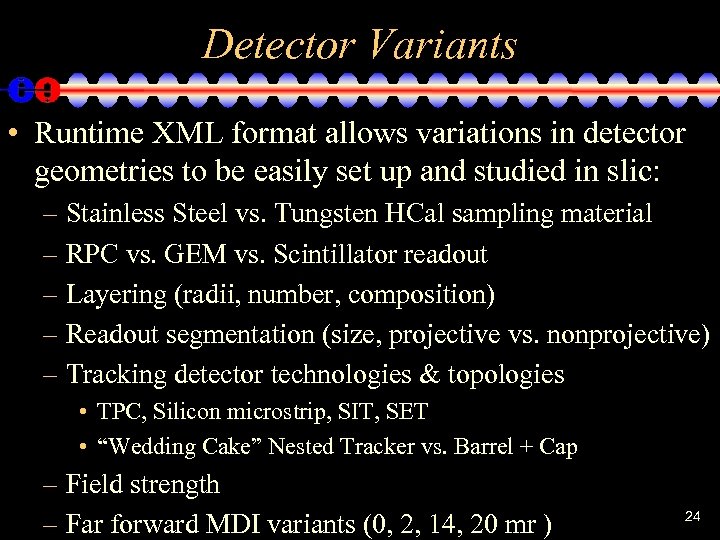 Detector Variants • Runtime XML format allows variations in detector geometries to be easily set up and studied in slic: – Stainless Steel vs. Tungsten HCal sampling material – RPC vs. GEM vs. Scintillator readout – Layering (radii, number, composition) – Readout segmentation (size, projective vs. nonprojective) – Tracking detector technologies & topologies • TPC, Silicon microstrip, SIT, SET • “Wedding Cake” Nested Tracker vs. Barrel + Cap – Field strength – Far forward MDI variants (0, 2, 14, 20 mr ) 24
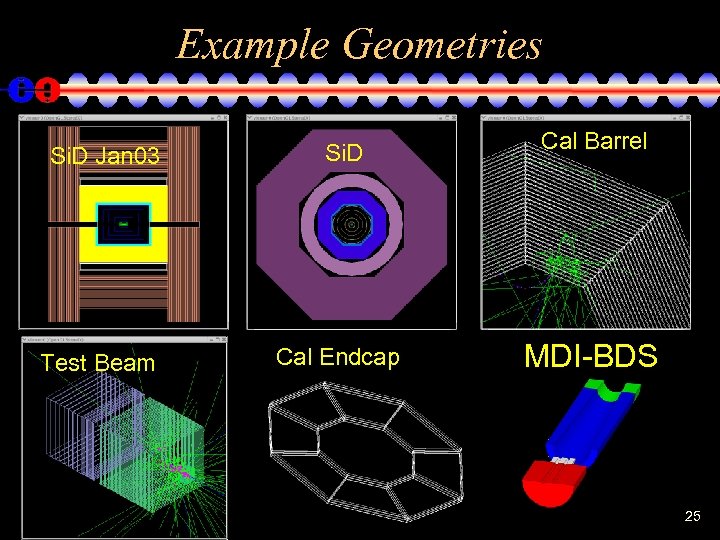 Example Geometries Si. D Jan 03 Si. D Cal Barrel Test Beam Cal Endcap MDI-BDS 25
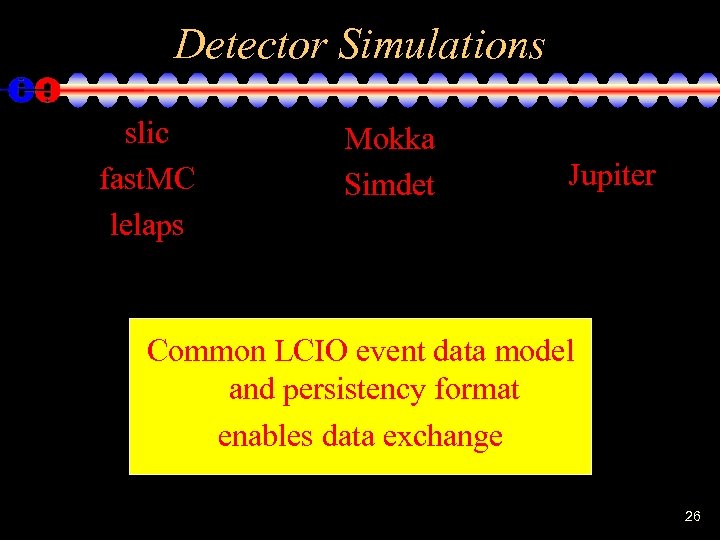 Detector Simulations slic fast. MC lelaps Mokka Simdet Jupiter Common LCIO event data model and persistency format enables data exchange 26
 Geometry • LCIO allows data files generated by different simulators to be exchanged between regions & detectors. • However, as detector designs become more realistic and geometries become more complex, problem of how to access the detector description becomes more severe. • Most important short-term task for software groups is to solve this problem. 27
 Software Portals • A number of software portals is available for further information, primarily maintained by the regional software working groups. • Working to establish one point of contact under the aegis of the WWS, but not there yet. 28
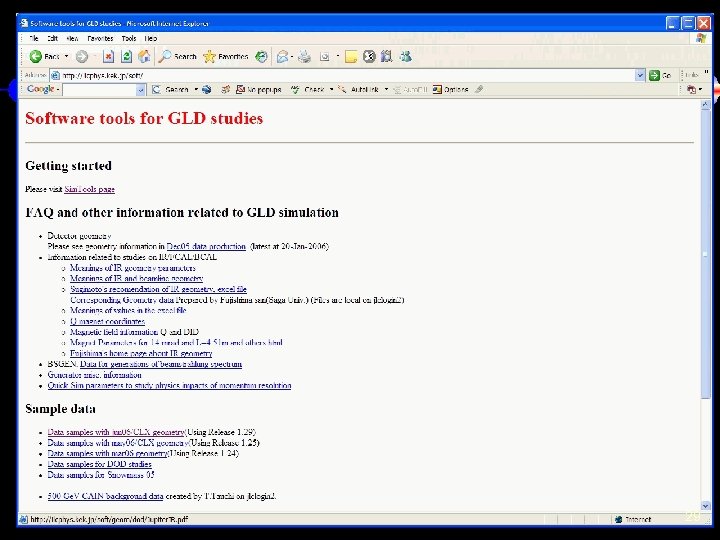 Software Portals • A number of software portals is available for further information, primarily maintained by the regional software working groups. • Working to establish one point of contact under the aegis of the WWS, but not there yet. 29
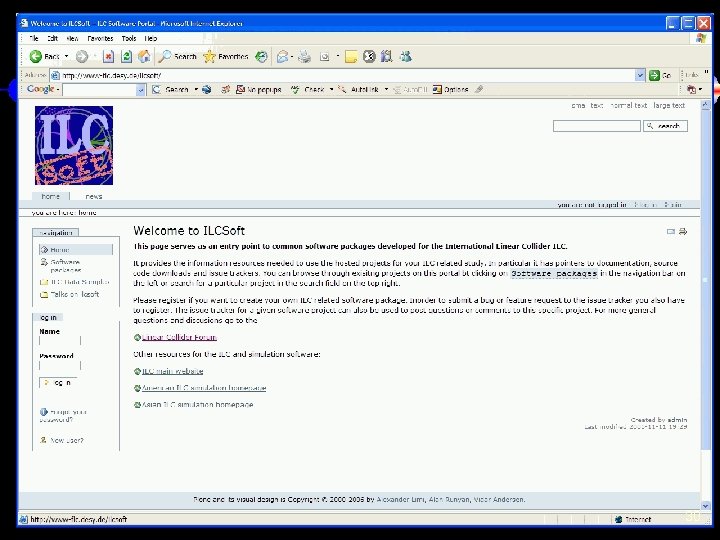 Software Portals • A number of software portals is available for further information, primarily maintained by the regional software working groups. • Working to establish one point of contact under the aegis of the WWS, but not there yet. 30
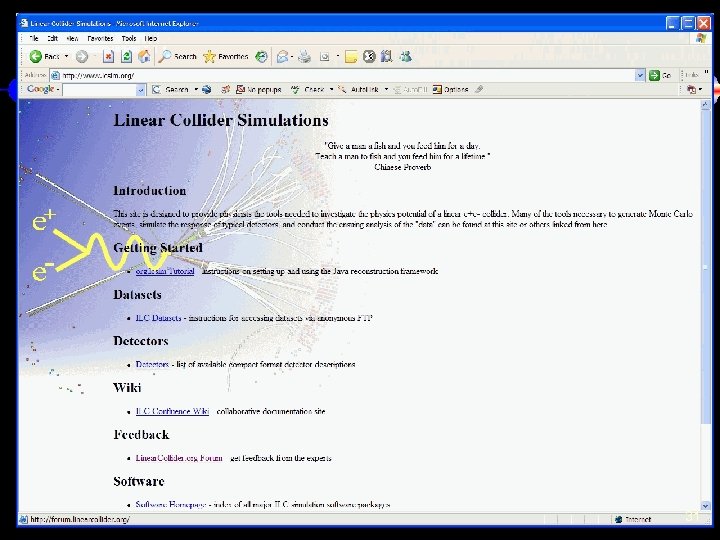 Software Portals • A number of software portals is available for further information, primarily maintained by the regional software working groups. • Working to establish one point of contact under the aegis of the WWS, but not there yet. 31
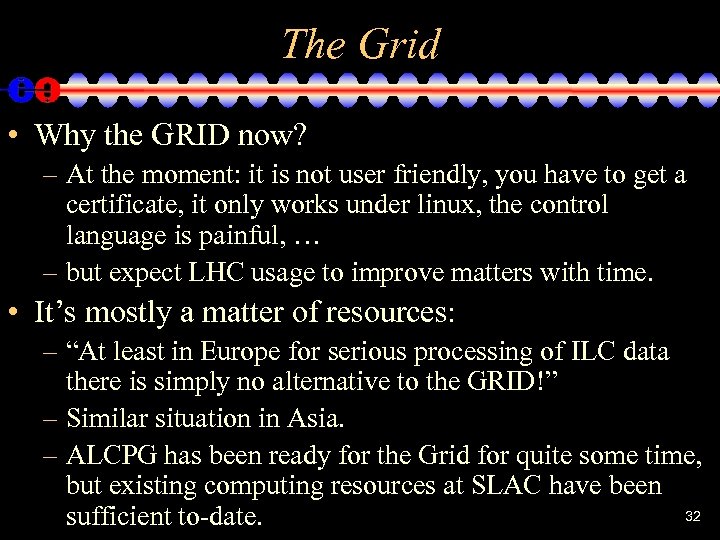 The Grid • Why the GRID now? – At the moment: it is not user friendly, you have to get a certificate, it only works under linux, the control language is painful, … – but expect LHC usage to improve matters with time. • It’s mostly a matter of resources: – “At least in Europe for serious processing of ILC data there is simply no alternative to the GRID!” – Similar situation in Asia. – ALCPG has been ready for the Grid for quite some time, but existing computing resources at SLAC have been 32 sufficient to-date.
 ACFA-ILC GRID View Most computing resources hidden behind firewall – Current solutions • WEB/FTP : needs to transfer data inside fire wall to outside • VPN : Can make a direct connection, but not efficient to transfer large data – Future solutions • Share data by Data GRID • Middle ware: – EU – LCG, NA – OSG, Belle Other GRID system – ECFA group: Developed ILC VO on LCG – KEKCC: Development – new middle ware. Will support LCG. • How to proceed – Define ILC VO using KEKCC hardware + disks for ILC 33
 ECFA-ILC and the Grid • The VOs ‘ilc’ and ‘calice’ are hosted at DESY w/ all core services • Registration to ‘ilc’ is managed by LCG (http: //lcgregistrar. cern. ch) and has become a so-called global VO in EGEE • ‘ilc’ currently supported by ~10 UKI sites, LAL, Freiburg, DESY (3500 CPUs, 42 TB) • Data have been moved to SLAC with Grid tools - Visit http: //grid. desy. de for more information. 34
 Access to ACFA-ILC Data Samples • Full simulation data sample for detector studies – Data sets: dec 05, mar 06, may 06, jun 06 – Links available at http: //ilcphys. kek. jp/soft/ – Single , k 0 L, , 0, e-, at 1 – 500 Ge. V : 1 K or 10 k events – e+e- uds quarks pair, ccbar, bbbar at 91. 18, 200, 350, 500, 10 k-20 k events – Cain background data – e+e- ZH lepton + qqbar, 4 -jet, 2 -jet events at 350 Ge. V 35
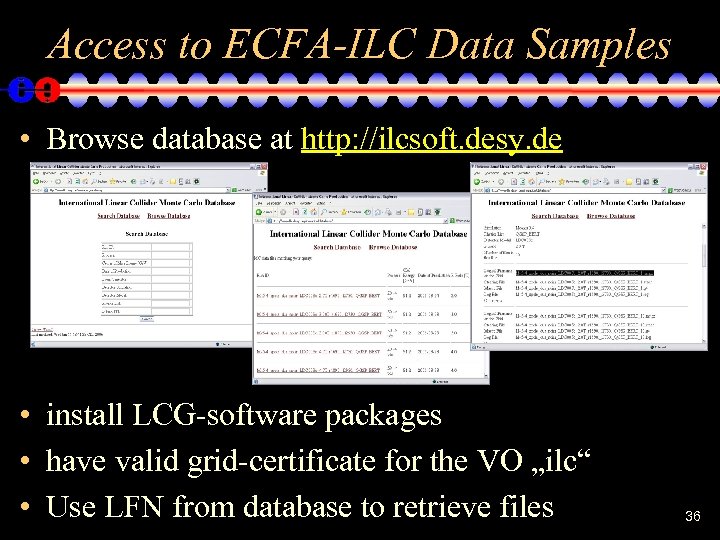 Access to ECFA-ILC Data Samples • Browse database at http: //ilcsoft. desy. de • install LCG-software packages • have valid grid-certificate for the VO „ilc“ • Use LFN from database to retrieve files 36
 Access to ALCPG Data Samples • LCIO data samples available via anonymous FTP – http: //www. lcsim. org/datasets/ftp. html • single. Particle diagnostic events • Z Pole diagnostic events • ILC 500 – WW, ZZ, tt, qq, tau pairs, mu pairs, Z , Zh, … • stdhep (contains MC input events + provenance) • detector used for simulation – slcio • slic (lelaps, Mokka, Jupiter) : simulator package used • logs: full information on jobs 37
 Future Plans • Continue efforts to target interfaces and collaborate/cooperate as much as possible between the regions. • Continue to develop and improve LCIO. • Package interoperability limited not only by language barriers (C++, Root, Java). • Critical need for a geometry interface to allow sharing of detector designs as well as data. 38
 Future of Simulations • The physics and detector simulation software developer community is very small. • The expectations are large. • Not clear how this effort competes against detector hardware R&D efforts to secure resources. – Primarily supported by labs: DESY, KEK, LLR, SLAC. • Severely manpower limited. Additional resources map directly onto increased functionality! 39
 Additional Information • ILC Forum - http: //forum. linearcollider. org • LCIO - http: //lcio. desy. de • lcsim. org - http: //www. lcsim. org • ECFA-ILC - http: //ilcsoft. desy. de • ACFA-ILC - http: //ilcphys. kek. jp/soft/ 40