 Скачать презентацию LINEAR COLLIDER BEAM INSTRUMENTATION T LEFEVRE CERN ON
bd03a1b2865a82344ad04696f7fc43d5.ppt
- Количество слайдов: 21



LINEAR COLLIDER BEAM INSTRUMENTATION T. LEFEVRE, CERN ON THE BEHALF OF THE LC BEAM INSTRUMENTATION COMMUNITY
LINEAR COLLIDER BEAM INSTRUMENTATION o Overview of Beam instrumentation for Linear Collider o Selection (5) of the main beam instrumentation R&D o Conclusion and perspectives
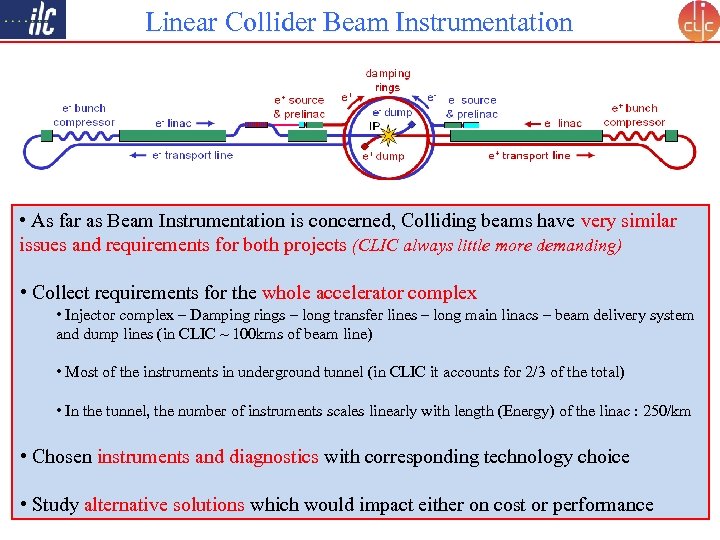
Linear Collider Beam Instrumentation • As far as Beam Instrumentation is concerned, Colliding beams have very similar issues and requirements for both projects (CLIC always little more demanding) • Collect requirements for the whole accelerator complex • Injector complex – Damping rings – long transfer lines – long main linacs – beam delivery system and dump lines (in CLIC ~ 100 kms of beam line) • Most of the instruments in underground tunnel (in CLIC it accounts for 2/3 of the total) • In the tunnel, the number of instruments scales linearly with length (Energy) of the linac : 250/km • Chosen instruments and diagnostics with corresponding technology choice • Study alternative solutions which would impact either on cost or performance
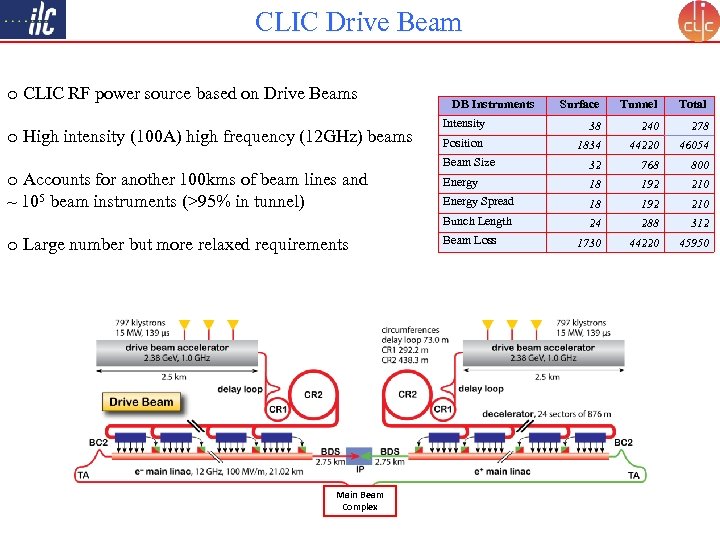
CLIC Drive Beam o CLIC RF power source based on Drive Beams o Large number but more relaxed requirements Main Beam Complex Tunnel Total Intensity 38 240 278 Position 1834 44220 46054 32 768 800 Energy 18 192 210 Energy Spread 18 192 210 Bunch Length o Accounts for another 100 kms of beam lines and ~ 105 beam instruments (>95% in tunnel) Surface Beam Size o High intensity (100 A) high frequency (12 GHz) beams DB Instruments 24 288 312 1730 44220 45950 Beam Loss
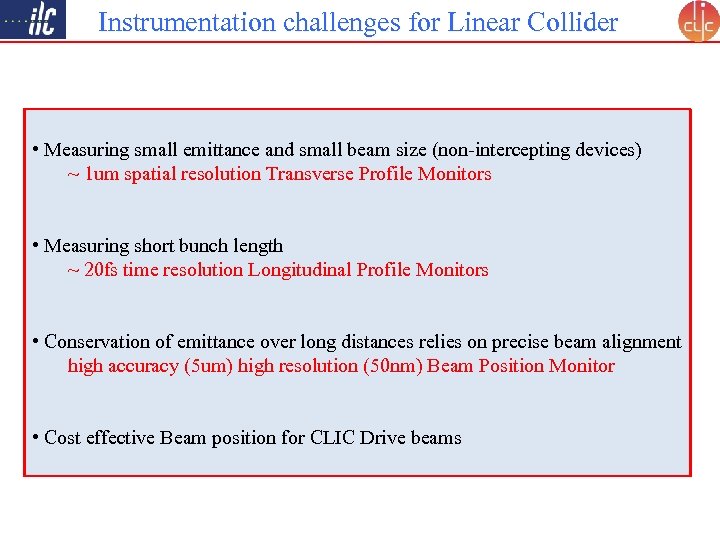
Instrumentation challenges for Linear Collider • Measuring small emittance and small beam size (non-intercepting devices) ~ 1 um spatial resolution Transverse Profile Monitors • Measuring short bunch length ~ 20 fs time resolution Longitudinal Profile Monitors • Conservation of emittance over long distances relies on precise beam alignment high accuracy (5 um) high resolution (50 nm) Beam Position Monitor • Cost effective Beam position for CLIC Drive beams
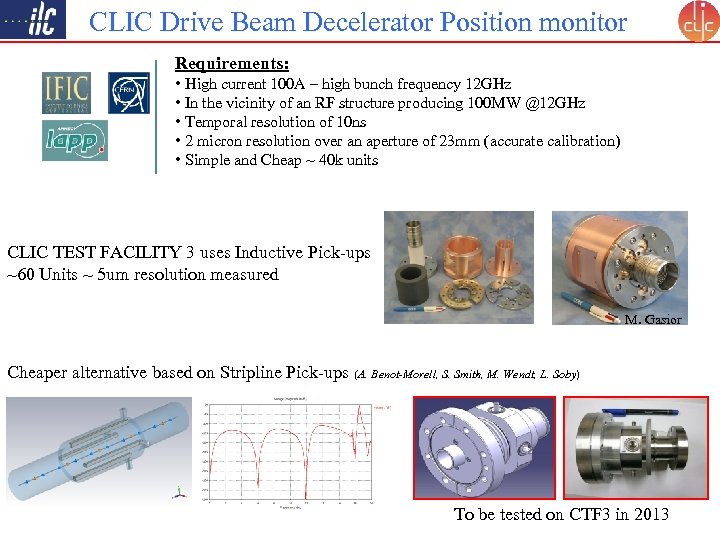
CLIC Drive Beam Decelerator Position monitor Requirements: • High current 100 A – high bunch frequency 12 GHz • In the vicinity of an RF structure producing 100 MW @12 GHz • Temporal resolution of 10 ns • 2 micron resolution over an aperture of 23 mm (accurate calibration) • Simple and Cheap ~ 40 k units CLIC TEST FACILITY 3 uses Inductive Pick-ups ~60 Units ~ 5 um resolution measured M. Gasior Cheaper alternative based on Stripline Pick-ups (A. Benot-Morell, S. Smith, M. Wendt, L. Soby) To be tested on CTF 3 in 2013
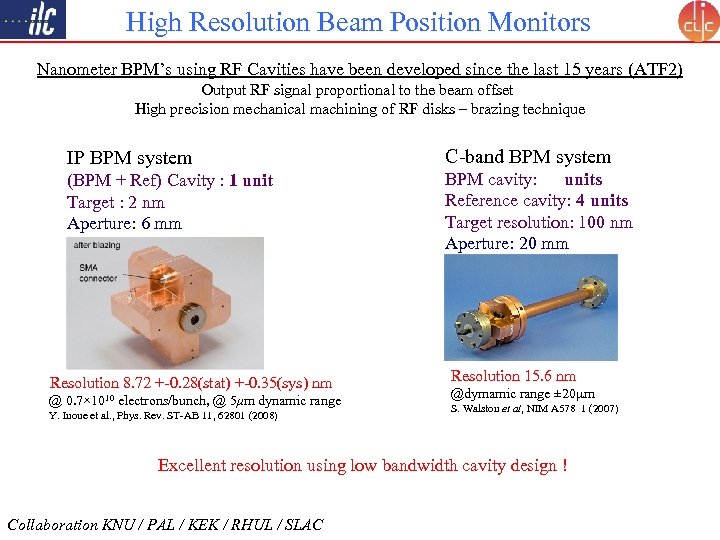
High Resolution Beam Position Monitors Nanometer BPM’s using RF Cavities have been developed since the last 15 years (ATF 2) Output RF signal proportional to the beam offset High precision mechanical machining of RF disks – brazing technique IP BPM system C-band BPM system (BPM + Ref) Cavity : 1 unit Target : 2 nm Aperture: 6 mm BPM cavity: 34 units Reference cavity: 4 units Target resolution: 100 nm Aperture: 20 mm Resolution 8. 72 +-0. 28(stat) +-0. 35(sys) nm @ 0. 7× 10¹⁰ electrons/bunch, @ 5μm dynamic range Y. Inoue et al. , Phys. Rev. ST-AB 11, 62801 (2008) Resolution 15. 6 nm @dymamic range ± 20 m S. Walston et al, NIM A 578 1 (2007) Excellent resolution using low bandwidth cavity design ! Collaboration KNU / PAL / KEK / RHUL / SLAC
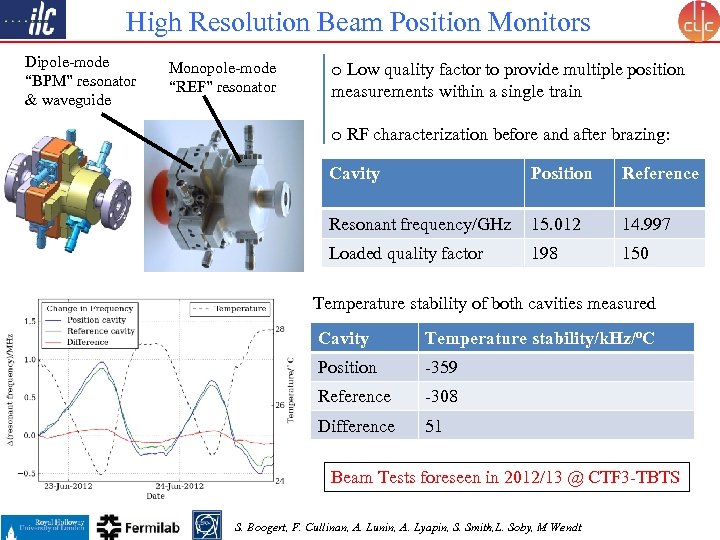
High Resolution Beam Position Monitors Dipole-mode “BPM” resonator & waveguide Monopole-mode “REF” resonator o Low quality factor to provide multiple position measurements within a single train o RF characterization before and after brazing: Cavity Position Reference Resonant frequency/GHz 15. 012 14. 997 Loaded quality factor 198 150 Temperature stability of both cavities measured Cavity Temperature stability/k. Hz/o. C Position -359 Reference -308 Difference 51 Beam Tests foreseen in 2012/13 @ CTF 3 -TBTS S. Boogert, F. Cullinan, A. Lunin, A. Lyapin, S. Smith, L. Soby, M Wendt
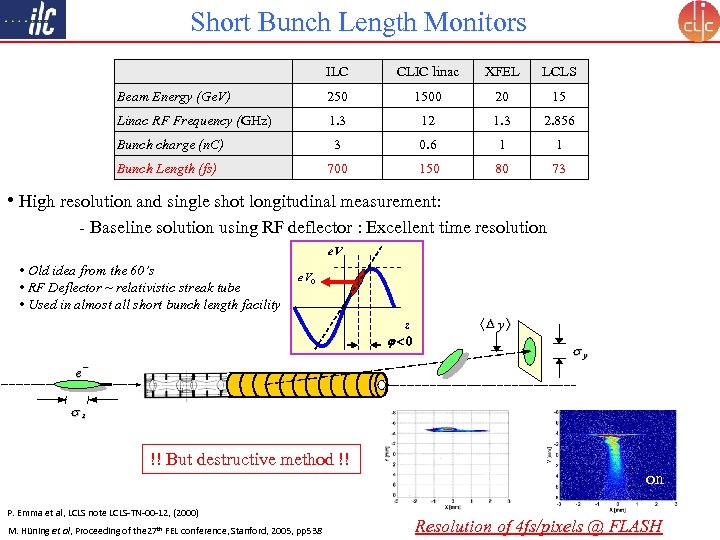
Short Bunch Length Monitors ILC CLIC linac XFEL LCLS Beam Energy (Ge. V) 250 1500 20 15 Linac RF Frequency (GHz) 1. 3 12 1. 3 2. 856 Bunch charge (n. C) 3 0. 6 1 1 Bunch Length (fs) 700 150 80 73 • High resolution and single shot longitudinal measurement: - Baseline solution using RF deflector : Excellent time resolution e. V • Old idea from the 60’s • RF Deflector ~ relativistic streak tube • Used in almost all short bunch length facility e. V 0 z j < 0 - áD yñ s y e s z !! But destructive method !! P. Emma et al, LCLS note LCLS-TN-00 -12, (2000) M. Hüning et al, Proceeding of the 27 th FEL conference, Stanford, 2005, pp 538 off on Resolution of 4 fs/pixels @ FLASH
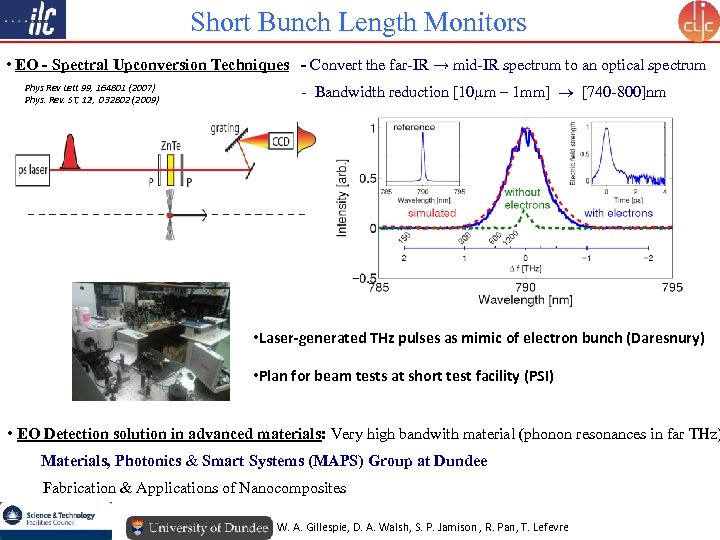
Short Bunch Length Monitors • EO - Spectral Upconversion Techniques - Convert the far-IR → mid-IR spectrum to an optical spectrum Phys Rev Lett 99, 164801 (2007) Phys. Rev. ST, 12, 032802 (2009) - Bandwidth reduction [10 m – 1 mm] [740 -800]nm • Laser-generated THz pulses as mimic of electron bunch (Daresnury) • Plan for beam tests at short test facility (PSI) • EO Detection solution in advanced materials: Very high bandwith material (phonon resonances in far THz) Materials, Photonics & Smart Systems (MAPS) Group at Dundee Fabrication & Applications of Nanocomposites W. A. Gillespie, D. A. Walsh, S. P. Jamison , R. Pan, T. Lefevre
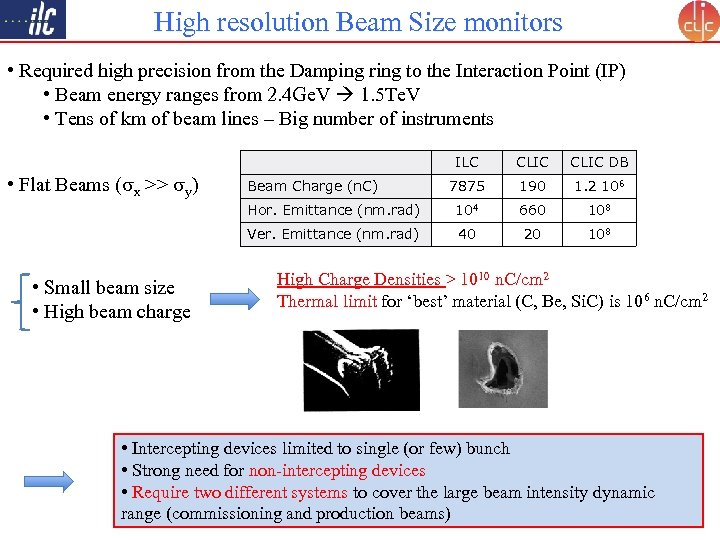
High resolution Beam Size monitors • Required high precision from the Damping ring to the Interaction Point (IP) • Beam energy ranges from 2. 4 Ge. V 1. 5 Te. V • Tens of km of beam lines – Big number of instruments ILC 7875 190 1. 2 106 104 660 108 Ver. Emittance (nm. rad) • Small beam size • High beam charge CLIC DB Hor. Emittance (nm. rad) • Flat Beams (sx >> sy) CLIC 40 20 108 Beam Charge (n. C) High Charge Densities > 1010 n. C/cm 2 Thermal limit for ‘best’ material (C, Be, Si. C) is 106 n. C/cm 2 • Intercepting devices limited to single (or few) bunch • Strong need for non-intercepting devices • Require two different systems to cover the large beam intensity dynamic range (commissioning and production beams)
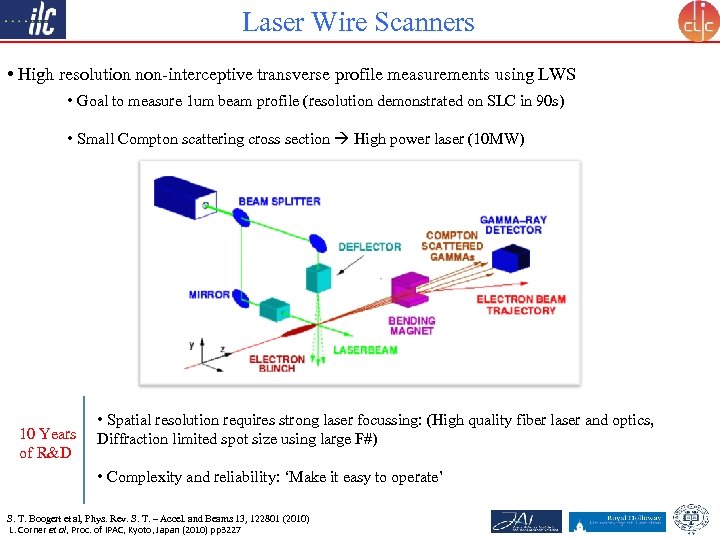
Laser Wire Scanners • High resolution non-interceptive transverse profile measurements using LWS • Goal to measure 1 um beam profile (resolution demonstrated on SLC in 90 s) • Small Compton scattering cross section High power laser (10 MW) 10 Years of R&D • Spatial resolution requires strong laser focussing: (High quality fiber laser and optics, Diffraction limited spot size using large F#) • Complexity and reliability: ‘Make it easy to operate’ S. T. Boogert et al, Phys. Rev. S. T. – Accel. and Beams 13, 122801 (2010) L. Corner et al, Proc. of IPAC, Kyoto, Japan (2010) pp 3227
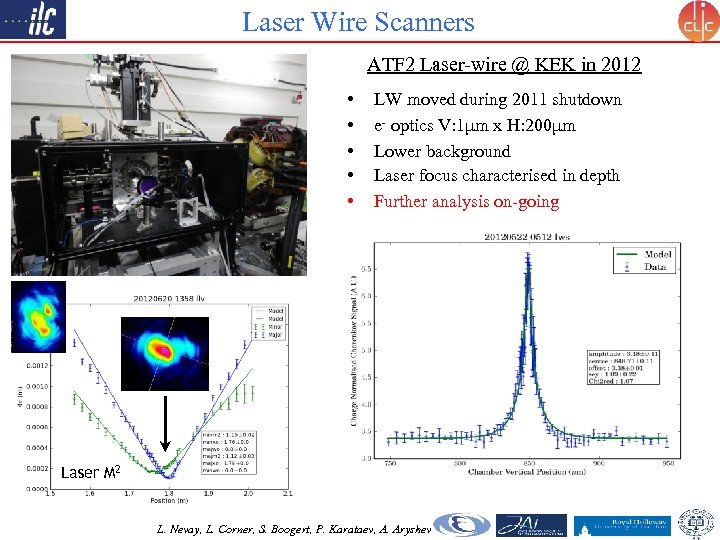
Laser Wire Scanners ATF 2 Laser-wire @ KEK in 2012 • • • LW moved during 2011 shutdown e- optics V: 1μm x H: 200μm Lower background Laser focus characterised in depth Further analysis on-going Laser M 2 L. Nevay, L. Corner, S. Boogert, P. Karataev, A. Aryshev
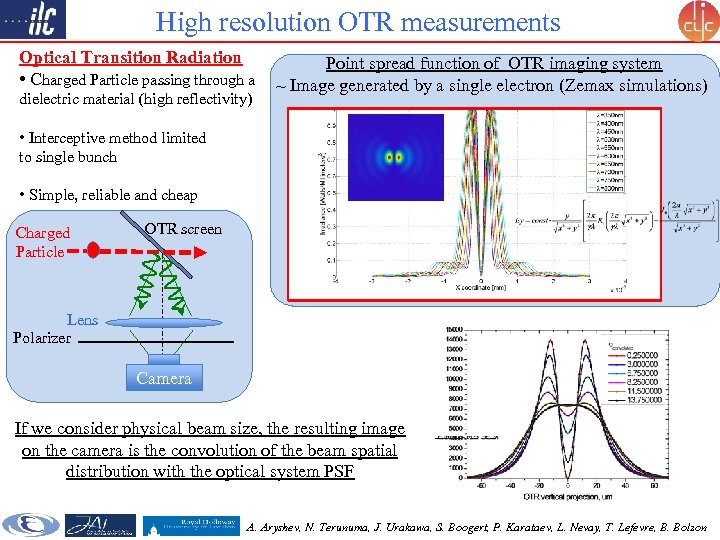
High resolution OTR measurements Optical Transition Radiation Point spread function of OTR imaging system • Charged Particle passing through a ~ Image generated by a single electron (Zemax simulations) dielectric material (high reflectivity) • Interceptive method limited to single bunch • Simple, reliable and cheap Charged Particle OTR screen Lens Polarizer Camera If we consider physical beam size, the resulting image on the camera is the convolution of the beam spatial distribution with the optical system PSF A. Aryshev, N. Terunuma, J. Urakawa, S. Boogert, P. Karataev, L. Nevay, T. Lefevre, B. Bolzon
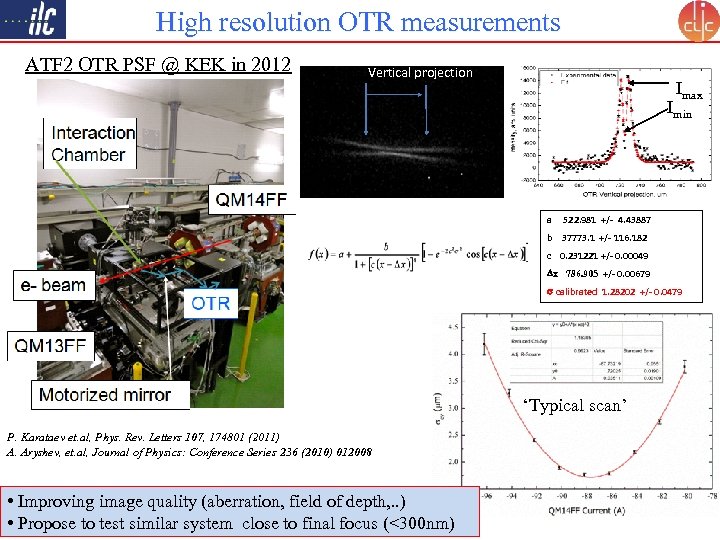
High resolution OTR measurements ATF 2 OTR PSF @ KEK in 2012 Vertical projection Imax Imin a 522. 981 +/- 4. 43887 b 37773. 1 +/- 116. 182 c 0. 231221 +/- 0. 00049 Dx 786. 905 +/- 0. 00679 s calibrated 1. 28202 +/- 0. 0479 ‘Typical scan’ P. Karataev et. al, Phys. Rev. Letters 107, 174801 (2011) A. Aryshev, et. al, Journal of Physics: Conference Series 236 (2010) 012008 • Improving image quality (aberration, field of depth, . . ) • Propose to test similar system close to final focus (<300 nm)
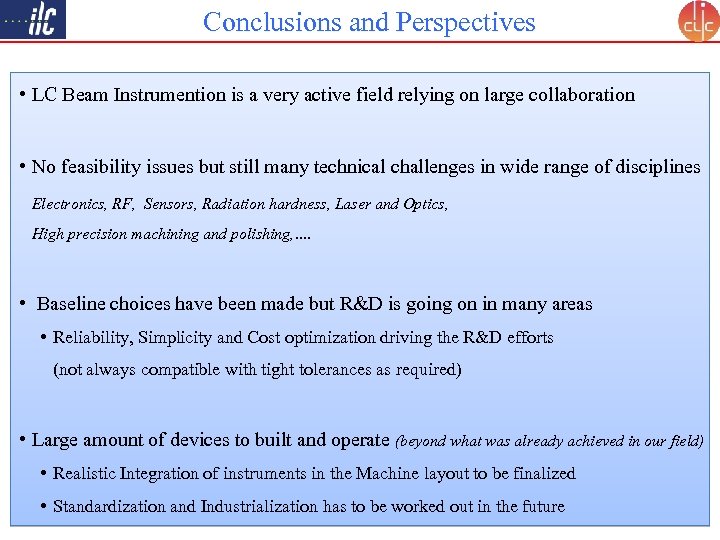
Conclusions and Perspectives • LC Beam Instrumention is a very active field relying on large collaboration • No feasibility issues but still many technical challenges in wide range of disciplines Electronics, RF, Sensors, Radiation hardness, Laser and Optics, High precision machining and polishing, …. • Baseline choices have been made but R&D is going on in many areas • Reliability, Simplicity and Cost optimization driving the R&D efforts (not always compatible with tight tolerances as required) • Large amount of devices to built and operate (beyond what was already achieved in our field) • Realistic Integration of instruments in the Machine layout to be finalized • Standardization and Industrialization has to be worked out in the future
Thanks all the ILC/CLIC contributors to this talk Thanks for your attention
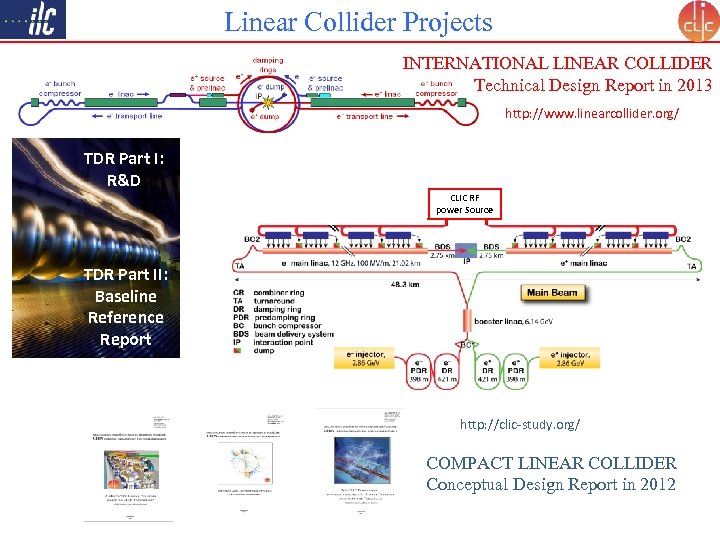
Linear Collider Projects Design from 2006 INTERNATIONAL LINEAR COLLIDER Technical Design Report in 2013 http: //www. linearcollider. org/ TDR Part I: R&D CLIC RF power Source TDR Part II: Baseline Reference Report http: //clic-study. org/ COMPACT LINEAR COLLIDER Conceptual Design Report in 2012
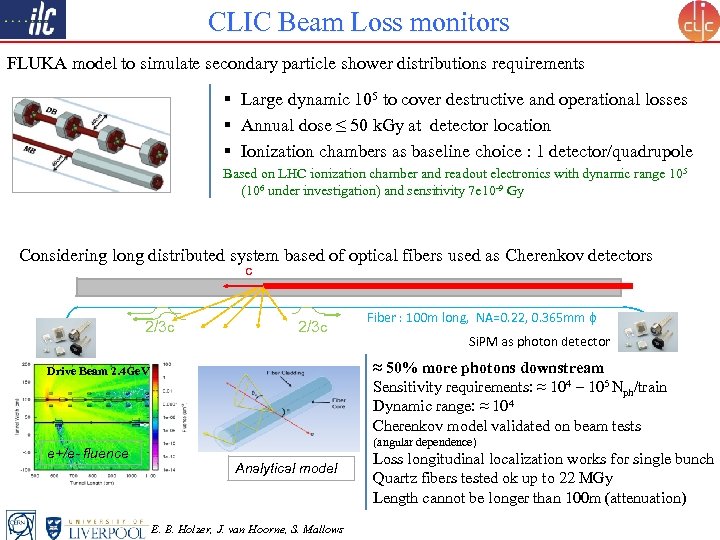
CLIC Beam Loss monitors FLUKA model to simulate secondary particle shower distributions requirements § Large dynamic 105 to cover destructive and operational losses § Annual dose ≤ 50 k. Gy at detector location § Ionization chambers as baseline choice : 1 detector/quadrupole Based on LHC ionization chamber and readout electronics with dynamic range 105 (106 under investigation) and sensitivity 7 e 10 -9 Gy Considering long distributed system based of optical fibers used as Cherenkov detectors c 2/3 c Si. PM as photon detector ≈ 50% more photons downstream Sensitivity requirements: ≈ 104 – 105 Nph/train Dynamic range: ≈ 104 Cherenkov model validated on beam tests Drive Beam 2. 4 Ge. V e+/e- fluence Fiber : 100 m long, NA=0. 22, 0. 365 mm ϕ (angular dependence) Analytical model E. B. Holzer, J. van Hoorne, S. Mallows Loss longitudinal localization works for single bunch Quartz fibers tested ok up to 22 MGy Length cannot be longer than 100 m (attenuation)
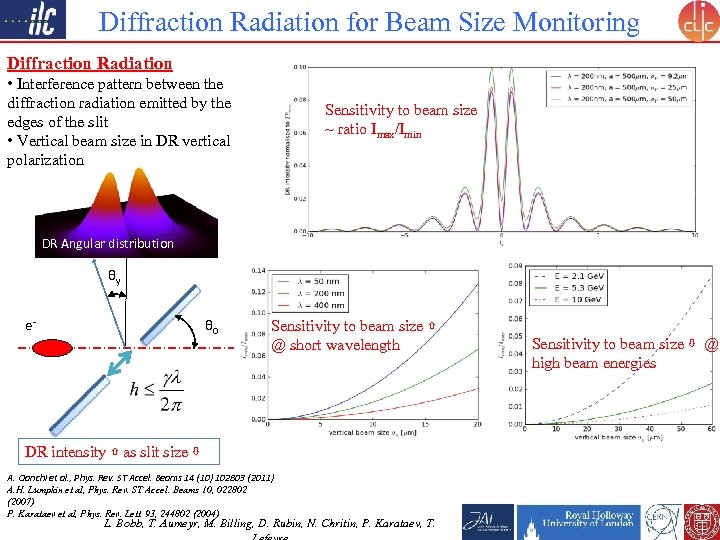
Diffraction Radiation for Beam Size Monitoring Diffraction Radiation • Interference pattern between the diffraction radiation emitted by the edges of the slit • Vertical beam size in DR vertical polarization Sensitivity to beam size ~ ratio Imax/Imin DR Angular distribution θy e- θ 0 Sensitivity to beam size ⇧ @ short wavelength DR intensity ⇧ as slit size ⇩ A. Cianchi et al. , Phys. Rev. ST Accel. Beams 14 (10) 102803 (2011) A. H. Lumpkin et al, Phys. Rev. ST Accel. Beams 10, 022802 (2007) P. Karataev et al, Phys. Rev. Lett. 93, 244802 (2004) L. Bobb, T. Aumeyr, M. Billing, D. Rubin, N. Chritin, P. Karataev, T. Sensitivity to beam size ⇩ @ high beam energies
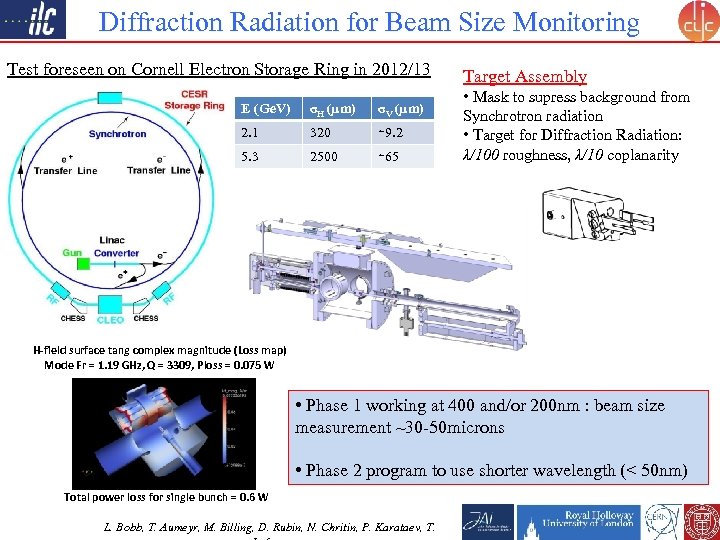
Diffraction Radiation for Beam Size Monitoring Test foreseen on Cornell Electron Storage Ring in 2012/13 E (Ge. V) σH (µm) σV (µm) 2. 1 320 ∼ 9. 2 5. 3 2500 ∼ 65 Target Assembly • Mask to supress background from Synchrotron radiation • Target for Diffraction Radiation: λ/100 roughness, λ/10 coplanarity H-field surface tang complex magnitude (Loss map) Mode Fr = 1. 19 GHz, Q = 3309, Ploss = 0. 075 W • Phase 1 working at 400 and/or 200 nm : beam size measurement ~30 -50 microns • Phase 2 program to use shorter wavelength (< 50 nm) Total power loss for single bunch = 0. 6 W L. Bobb, T. Aumeyr, M. Billing, D. Rubin, N. Chritin, P. Karataev, T.
Скачать презентацию LINEAR COLLIDER BEAM INSTRUMENTATION T LEFEVRE CERN ON
bd03a1b2865a82344ad04696f7fc43d5.ppt