


 Скачать презентацию Line Operations Safety Assessment LOSA Maintenance Mx Operations
161d44d18569648cb5d2741355d5875b.ppt
- Количество слайдов: 118
 Line Operations Safety Assessment (LOSA): Maintenance (Mx) Operations – Base Training Scenarios August 2014 (v 6) 1
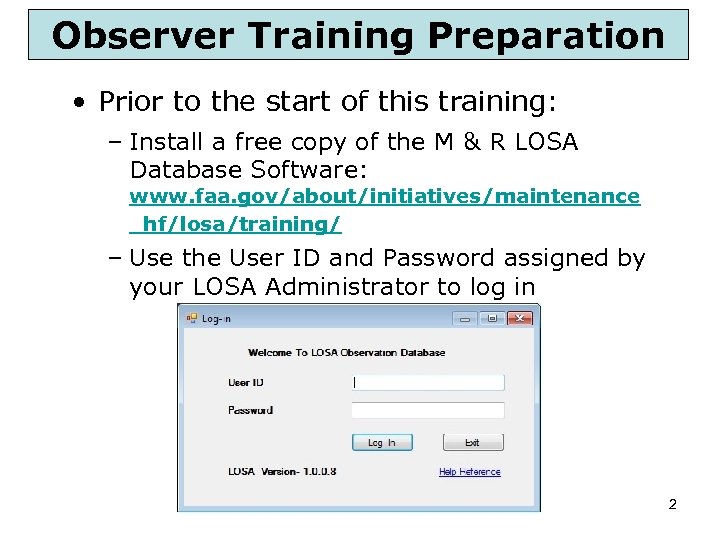 Observer Training Preparation • Prior to the start of this training: – Install a free copy of the M & R LOSA Database Software: www. faa. gov/about/initiatives/maintenance _hf/losa/training/ – Use the User ID and Password assigned by your LOSA Administrator to log in 2
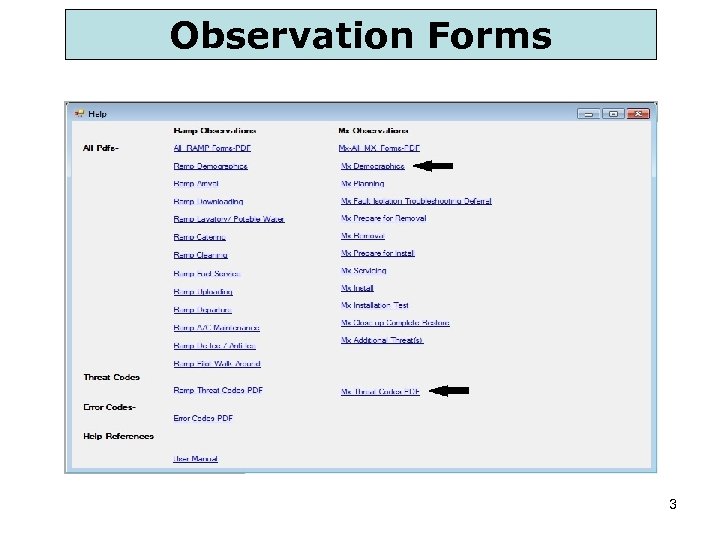 Observation Forms 3
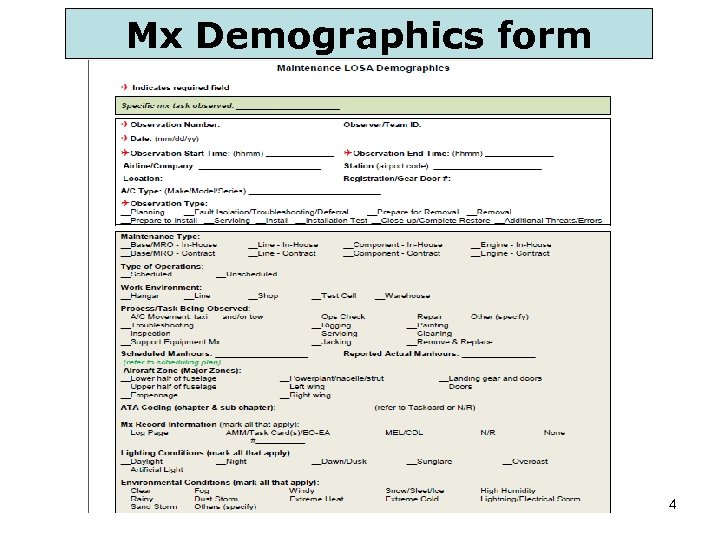 Mx Demographics form 4
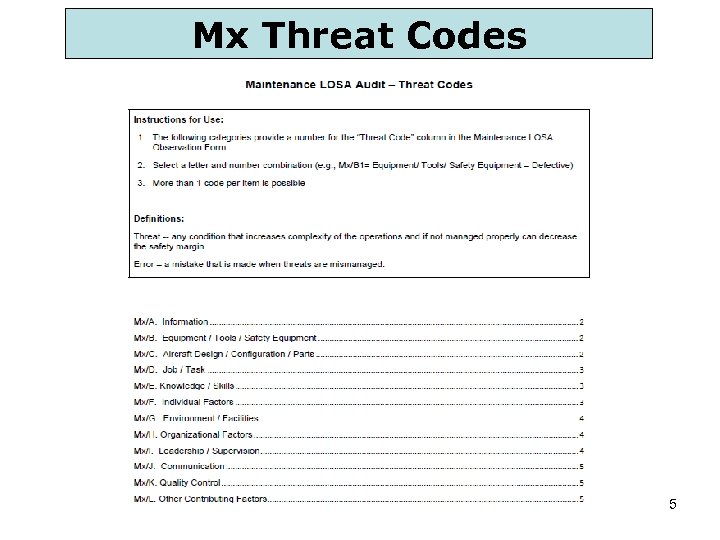 Mx Threat Codes 5
 General Guidelines • The form is a guide and a place to record data for later analysis • Do not need to observe everything on the forms § Observe and take “samples” of behaviors in the hangar or shop or on the ramp § The form is not in the spirit of a starting engine or pre-takeoff checklist • The observer as a Subject Matter Expert (SME) will probably notice threats and errors without needing the form as a cue • Take notes during observation then fill in the forms later 6
 Observer Preparation • Take a few minutes before an observation to review the form – Make a general plan for your observations – Be open to changing your plan and look for the unexpected 7
 Observation Example 8
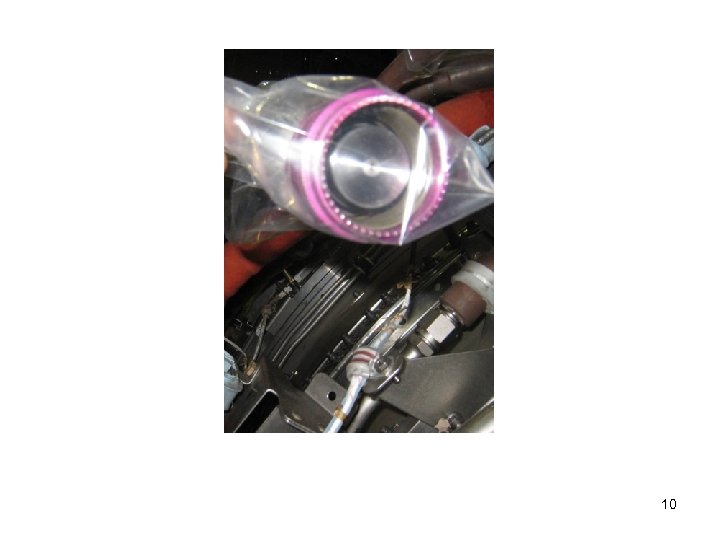
 Situation The mechanic I was observing got to work at 6: 00 am that morning and started a #2 engine change procedure on a B 757 -200. After disconnecting the first quick disconnect line, he got paged and went to take a phone call from his wife. He came back and finished up disconnecting and capping the remaining quick disconnects, but he did not cap the first quick disconnect line. He signed the work card without noticing his error. When answering the demographics questions, the mechanic stated that he was a midnight shift (10: 00 pm to 6: 00 am) mechanic. He was called in to work the day shift on his second day off. On his first day off, he went bowling with his family until 11: 30 pm. He got the call to report at 6: 00 am for the day shift after arriving back home around midnight. 9
 10
10
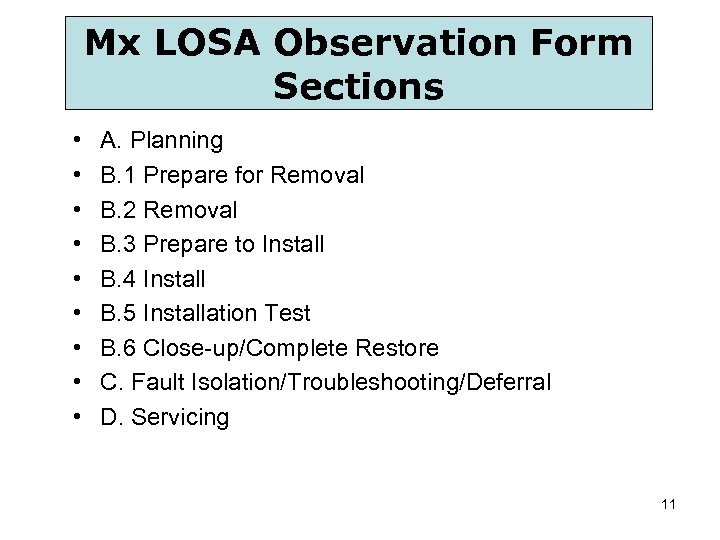 Mx LOSA Observation Form Sections • • • A. Planning B. 1 Prepare for Removal B. 2 Removal B. 3 Prepare to Install B. 4 Install B. 5 Installation Test B. 6 Close-up/Complete Restore C. Fault Isolation/Troubleshooting/Deferral D. Servicing 11
 LOSA Observation Form 12
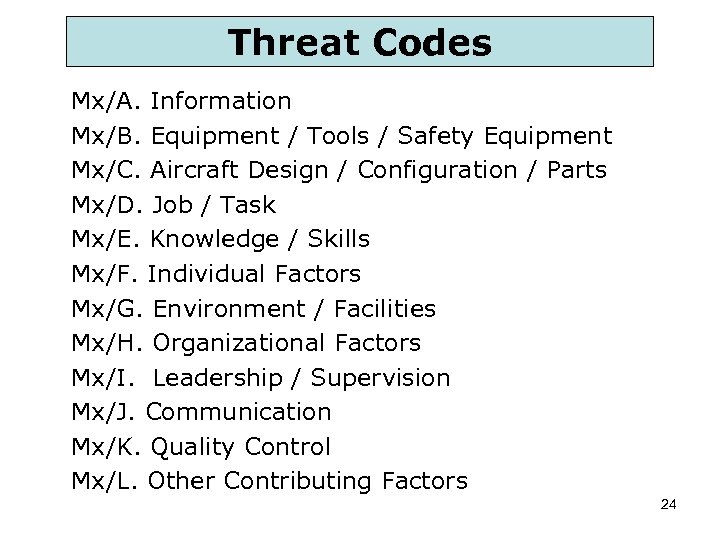
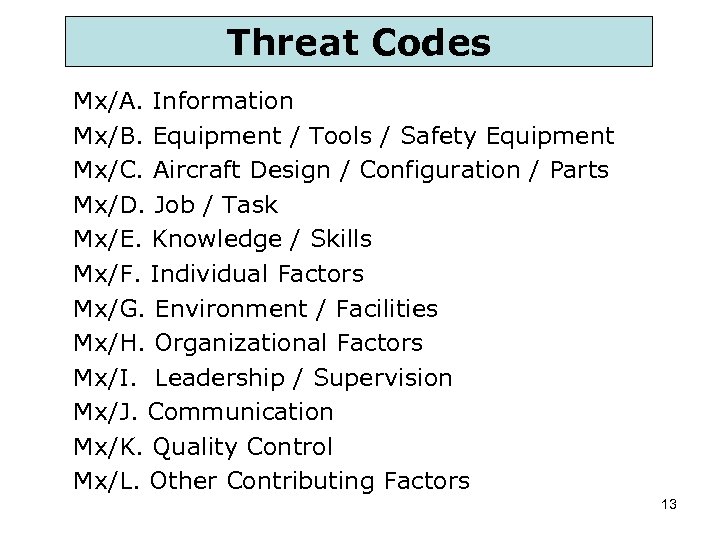 Threat Codes Mx/A. Information Mx/B. Equipment / Tools / Safety Equipment Mx/C. Aircraft Design / Configuration / Parts Mx/D. Job / Task Mx/E. Knowledge / Skills Mx/F. Individual Factors Mx/G. Environment / Facilities Mx/H. Organizational Factors Mx/I. Leadership / Supervision Mx/J. Communication Mx/K. Quality Control Mx/L. Other Contributing Factors 13
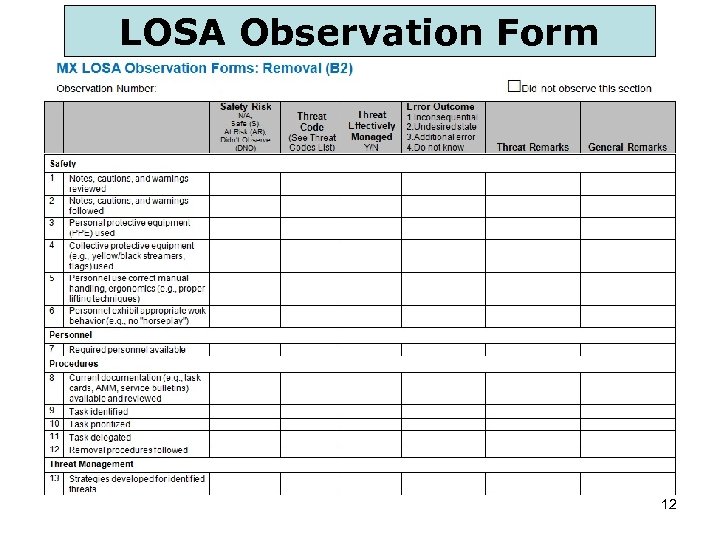
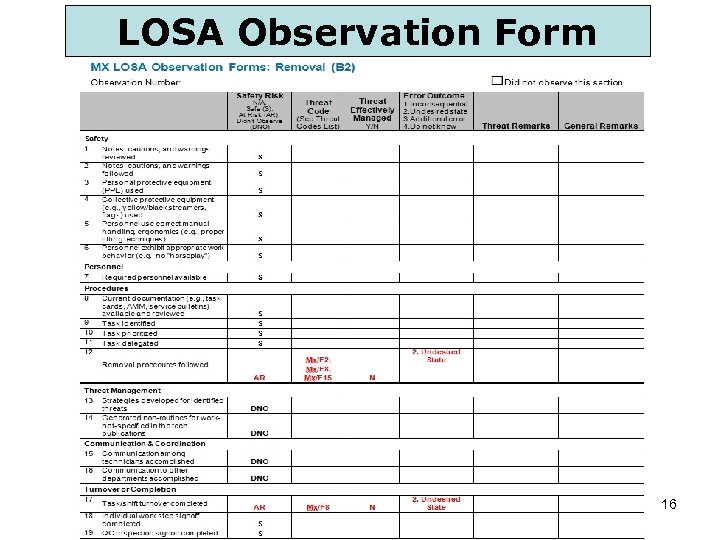
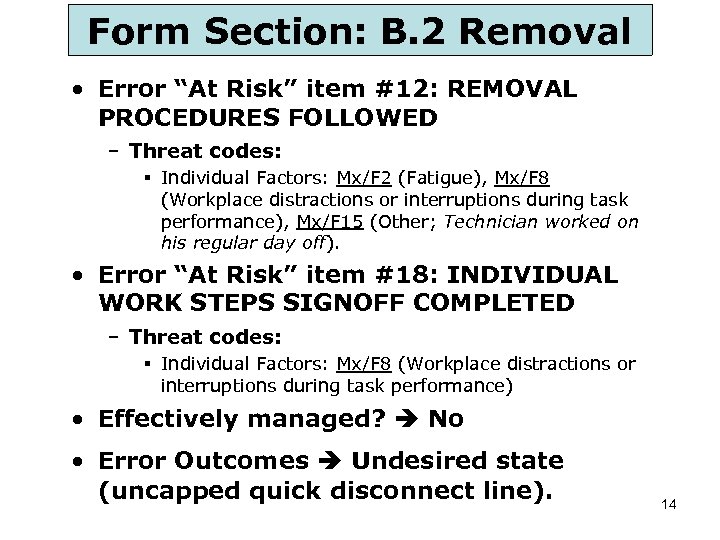 Form Section: B. 2 Removal • Error “At Risk” item #12: REMOVAL PROCEDURES FOLLOWED – Threat codes: § Individual Factors: Mx/F 2 (Fatigue), Mx/F 8 (Workplace distractions or interruptions during task performance), Mx/F 15 (Other; Technician worked on his regular day off). • Error “At Risk” item #18: INDIVIDUAL WORK STEPS SIGNOFF COMPLETED – Threat codes: § Individual Factors: Mx/F 8 (Workplace distractions or interruptions during task performance) • Effectively managed? No • Error Outcomes Undesired state (uncapped quick disconnect line). 14
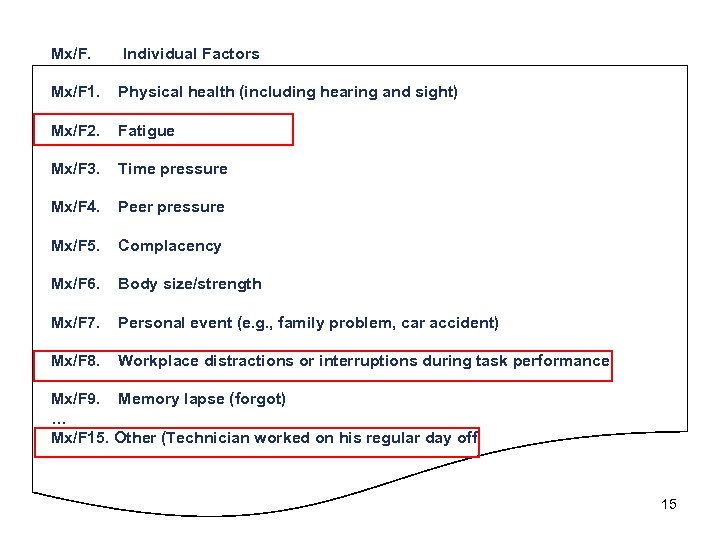 Mx/F. Individual Factors Mx/F 1. Physical health (including hearing and sight) Mx/F 2. Fatigue Mx/F 3. Time pressure Mx/F 4. Peer pressure Mx/F 5. Complacency Mx/F 6. Body size/strength Mx/F 7. Personal event (e. g. , family problem, car accident) Mx/F 8. Workplace distractions or interruptions during task performance Mx/F 9. Memory lapse (forgot) … Mx/F 15. Other (Technician worked on his regular day off 15
 LOSA Observation Form 16
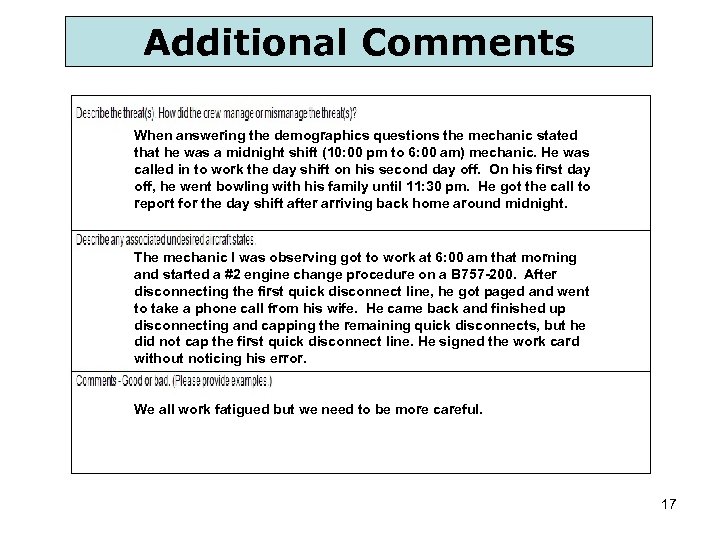 Additional Comments When answering the demographics questions the mechanic stated that he was a midnight shift (10: 00 pm to 6: 00 am) mechanic. He was called in to work the day shift on his second day off. On his first day off, he went bowling with his family until 11: 30 pm. He got the call to report for the day shift after arriving back home around midnight. The mechanic I was observing got to work at 6: 00 am that morning and started a #2 engine change procedure on a B 757 -200. After disconnecting the first quick disconnect line, he got paged and went to take a phone call from his wife. He came back and finished up disconnecting and capping the remaining quick disconnects, but he did not cap the first quick disconnect line. He signed the work card without noticing his error. We all work fatigued but we need to be more careful. 17
 Practice Observations 18
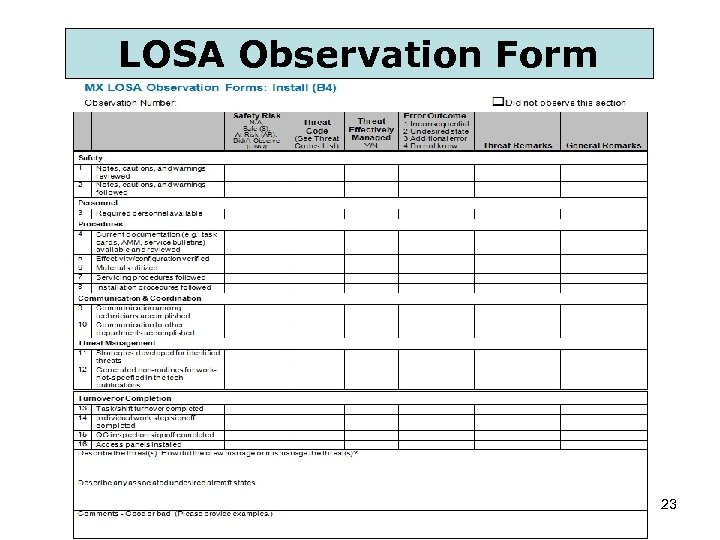
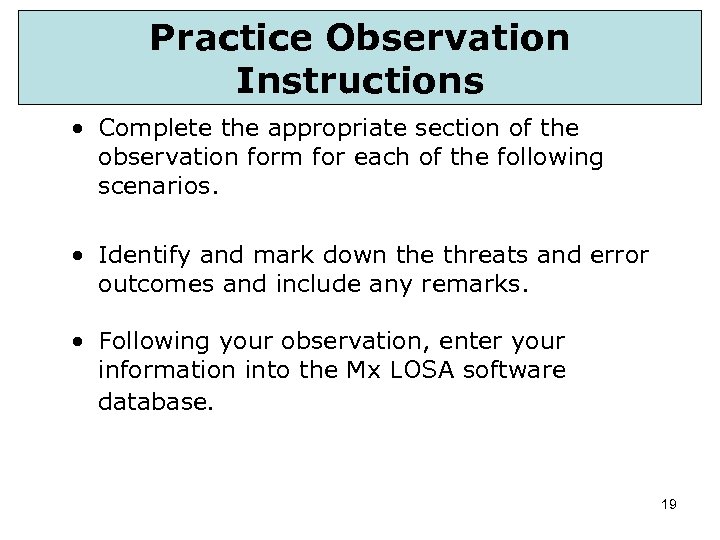 Practice Observation Instructions • Complete the appropriate section of the observation form for each of the following scenarios. • Identify and mark down the threats and error outcomes and include any remarks. • Following your observation, enter your information into the Mx LOSA software database. 19
 Scenario #1: Incorrect Tires 20
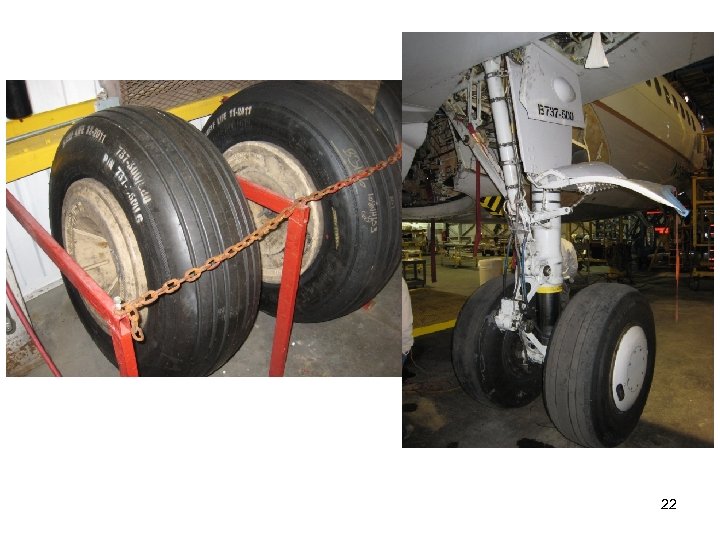
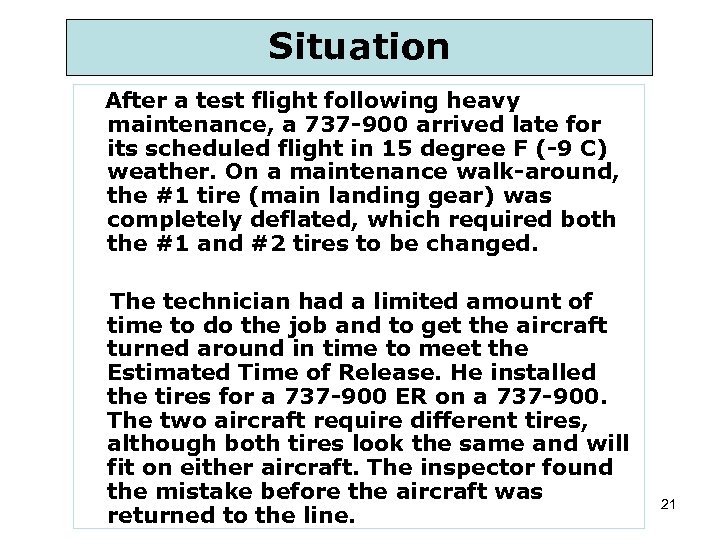 Situation After a test flight following heavy maintenance, a 737 -900 arrived late for its scheduled flight in 15 degree F (-9 C) weather. On a maintenance walk-around, the #1 tire (main landing gear) was completely deflated, which required both the #1 and #2 tires to be changed. The technician had a limited amount of time to do the job and to get the aircraft turned around in time to meet the Estimated Time of Release. He installed the tires for a 737 -900 ER on a 737 -900. The two aircraft require different tires, although both tires look the same and will fit on either aircraft. The inspector found the mistake before the aircraft was returned to the line. 21
 22
22
 LOSA Observation Form 23
 Threat Codes Mx/A. Information Mx/B. Equipment / Tools / Safety Equipment Mx/C. Aircraft Design / Configuration / Parts Mx/D. Job / Task Mx/E. Knowledge / Skills Mx/F. Individual Factors Mx/G. Environment / Facilities Mx/H. Organizational Factors Mx/I. Leadership / Supervision Mx/J. Communication Mx/K. Quality Control Mx/L. Other Contributing Factors 24
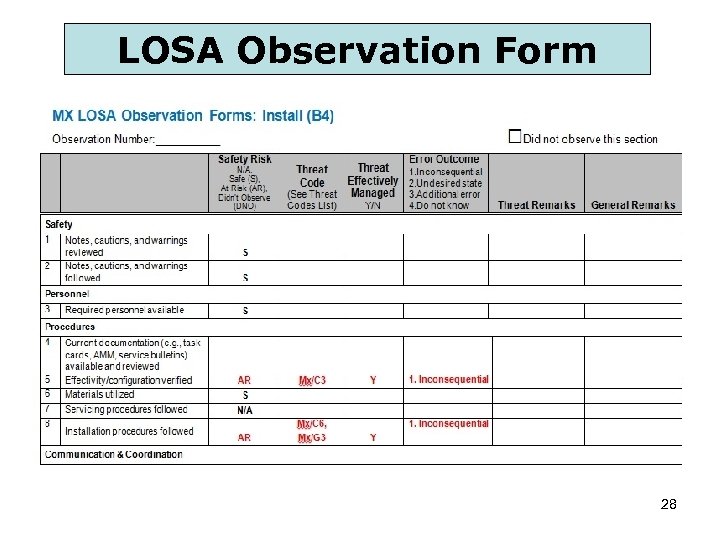
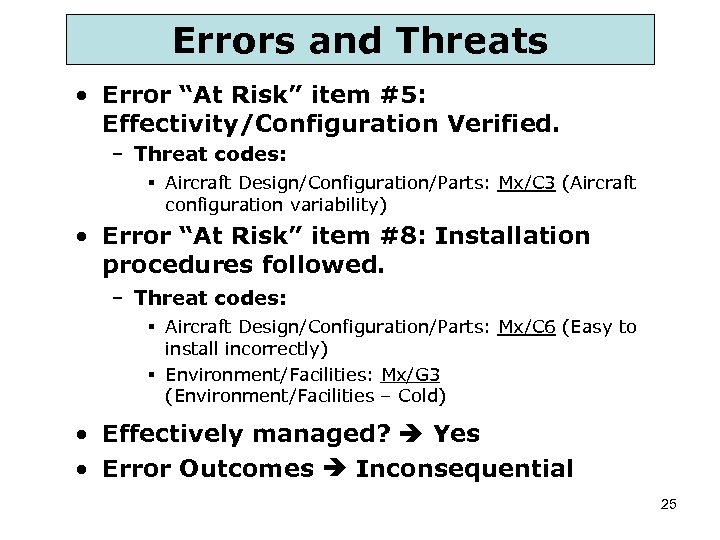 Errors and Threats • Error “At Risk” item #5: Effectivity/Configuration Verified. – Threat codes: § Aircraft Design/Configuration/Parts: Mx/C 3 (Aircraft configuration variability) • Error “At Risk” item #8: Installation procedures followed. – Threat codes: § Aircraft Design/Configuration/Parts: Mx/C 6 (Easy to install incorrectly) § Environment/Facilities: Mx/G 3 (Environment/Facilities – Cold) • Effectively managed? Yes • Error Outcomes Inconsequential 25
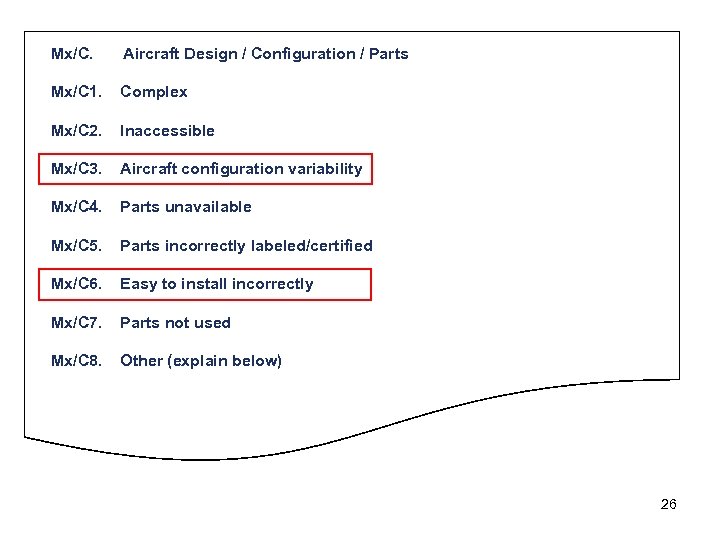 Mx/C. Aircraft Design / Configuration / Parts Mx/C 1. Complex Mx/C 2. Inaccessible Mx/C 3. Aircraft configuration variability Mx/C 4. Parts unavailable Mx/C 5. Parts incorrectly labeled/certified Mx/C 6. Easy to install incorrectly Mx/C 7. Parts not used Mx/C 8. Other (explain below) 26
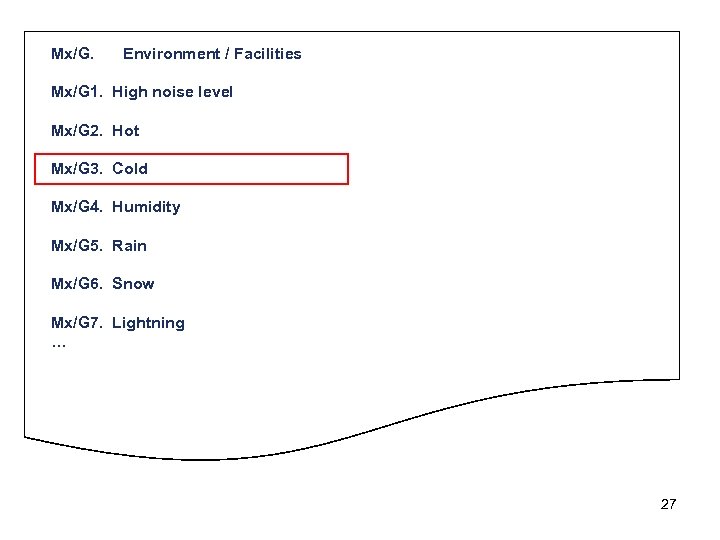 Mx/G. Environment / Facilities Mx/G 1. High noise level Mx/G 2. Hot Mx/G 3. Cold Mx/G 4. Humidity Mx/G 5. Rain Mx/G 6. Snow Mx/G 7. Lightning … 27
 LOSA Observation Form 28
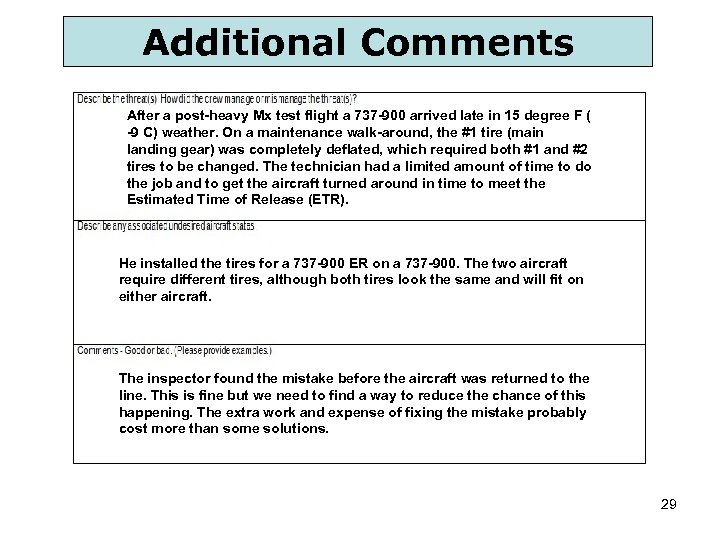 Additional Comments After a post-heavy Mx test flight a 737 -900 arrived late in 15 degree F ( -9 C) weather. On a maintenance walk-around, the #1 tire (main landing gear) was completely deflated, which required both #1 and #2 tires to be changed. The technician had a limited amount of time to do the job and to get the aircraft turned around in time to meet the Estimated Time of Release (ETR). He installed the tires for a 737 -900 ER on a 737 -900. The two aircraft require different tires, although both tires look the same and will fit on either aircraft. The inspector found the mistake before the aircraft was returned to the line. This is fine but we need to find a way to reduce the chance of this happening. The extra work and expense of fixing the mistake probably cost more than some solutions. 29
 Scenario #2: Transducer Out of Rig 30
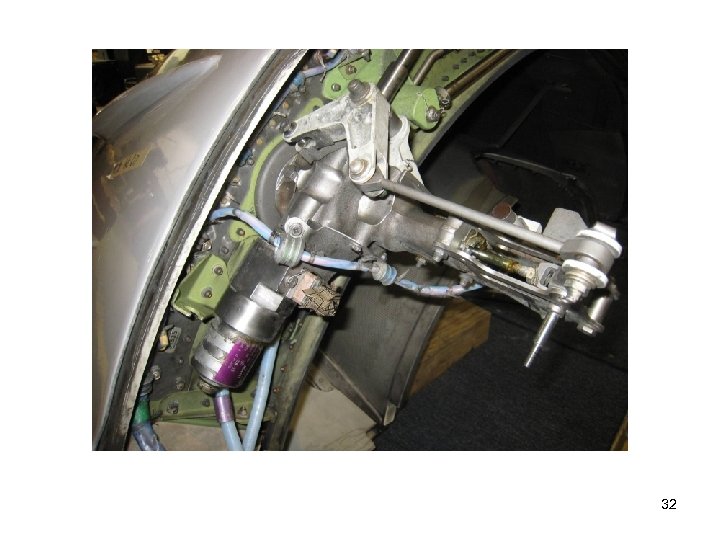
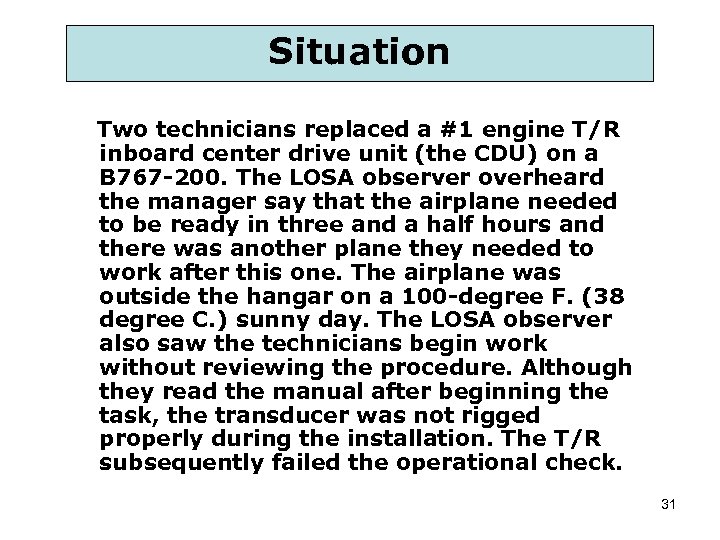 Situation Two technicians replaced a #1 engine T/R inboard center drive unit (the CDU) on a B 767 -200. The LOSA observer overheard the manager say that the airplane needed to be ready in three and a half hours and there was another plane they needed to work after this one. The airplane was outside the hangar on a 100 -degree F. (38 degree C. ) sunny day. The LOSA observer also saw the technicians begin work without reviewing the procedure. Although they read the manual after beginning the task, the transducer was not rigged properly during the installation. The T/R subsequently failed the operational check. 31
 32
32
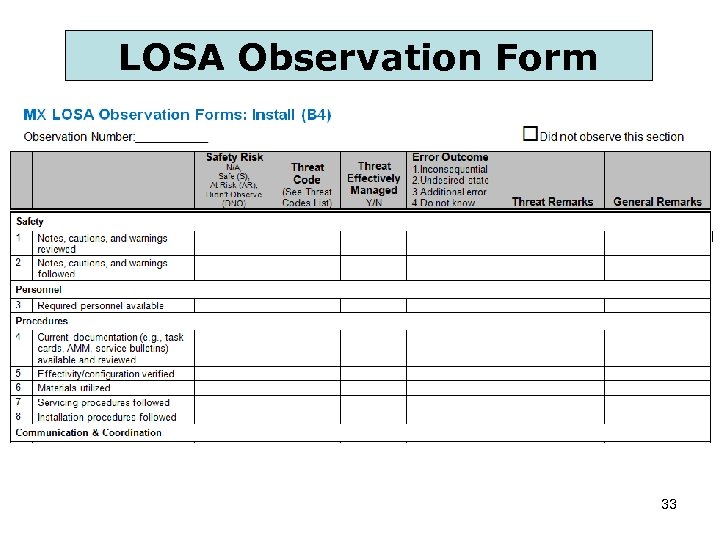 LOSA Observation Form 33
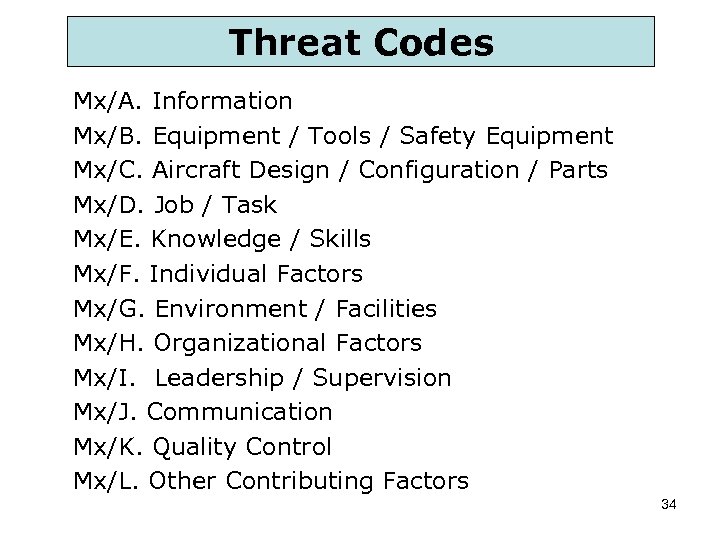 Threat Codes Mx/A. Information Mx/B. Equipment / Tools / Safety Equipment Mx/C. Aircraft Design / Configuration / Parts Mx/D. Job / Task Mx/E. Knowledge / Skills Mx/F. Individual Factors Mx/G. Environment / Facilities Mx/H. Organizational Factors Mx/I. Leadership / Supervision Mx/J. Communication Mx/K. Quality Control Mx/L. Other Contributing Factors 34
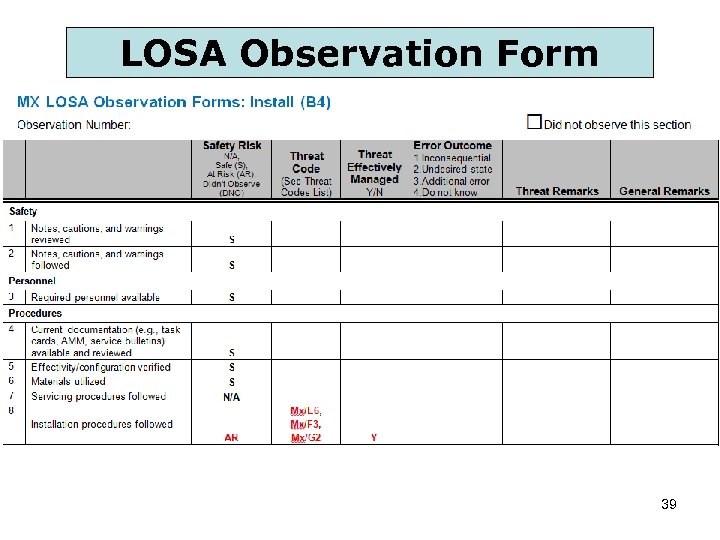
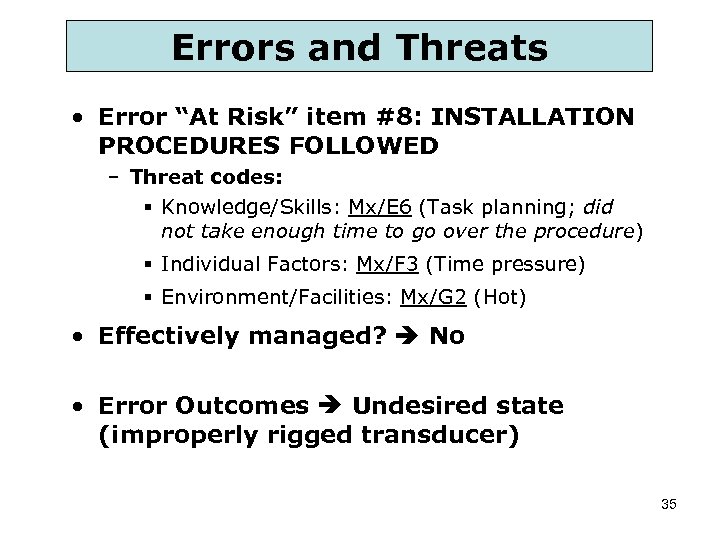 Errors and Threats • Error “At Risk” item #8: INSTALLATION PROCEDURES FOLLOWED – Threat codes: § Knowledge/Skills: Mx/E 6 (Task planning; did not take enough time to go over the procedure) § Individual Factors: Mx/F 3 (Time pressure) § Environment/Facilities: Mx/G 2 (Hot) • Effectively managed? No • Error Outcomes Undesired state (improperly rigged transducer) 35
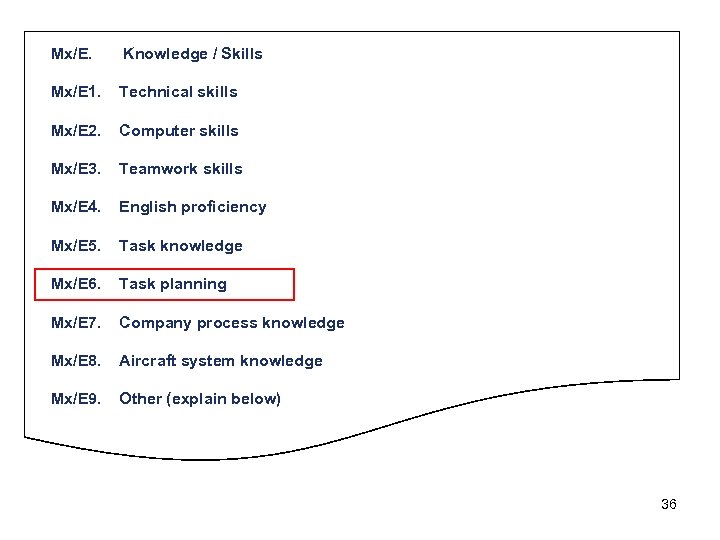 Mx/E. Knowledge / Skills Mx/E 1. Technical skills Mx/E 2. Computer skills Mx/E 3. Teamwork skills Mx/E 4. English proficiency Mx/E 5. Task knowledge Mx/E 6. Task planning Mx/E 7. Company process knowledge Mx/E 8. Aircraft system knowledge Mx/E 9. Other (explain below) 36
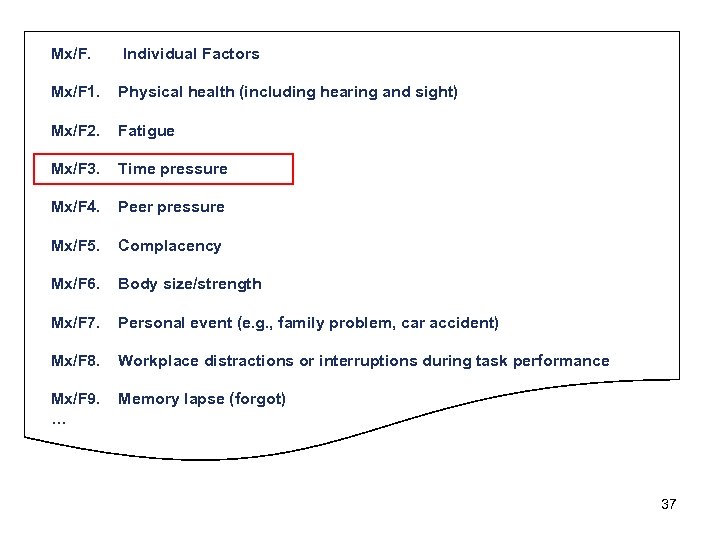 Mx/F. Individual Factors Mx/F 1. Physical health (including hearing and sight) Mx/F 2. Fatigue Mx/F 3. Time pressure Mx/F 4. Peer pressure Mx/F 5. Complacency Mx/F 6. Body size/strength Mx/F 7. Personal event (e. g. , family problem, car accident) Mx/F 8. Workplace distractions or interruptions during task performance Mx/F 9. … Memory lapse (forgot) 37
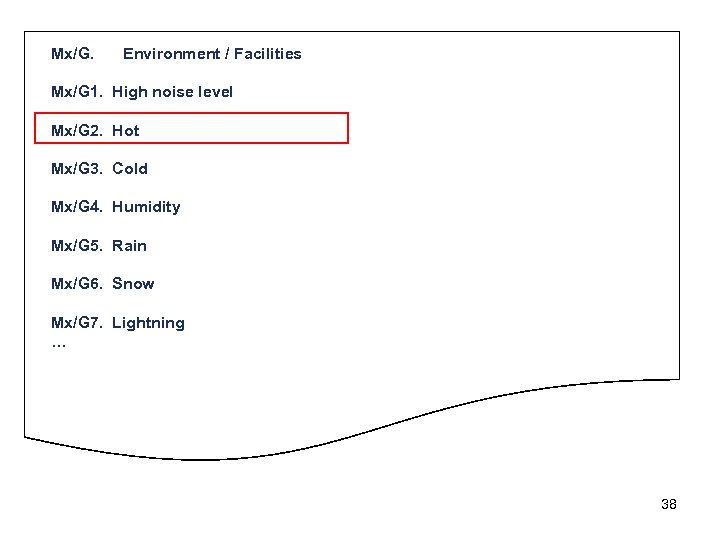 Mx/G. Environment / Facilities Mx/G 1. High noise level Mx/G 2. Hot Mx/G 3. Cold Mx/G 4. Humidity Mx/G 5. Rain Mx/G 6. Snow Mx/G 7. Lightning … 38
 LOSA Observation Form 39
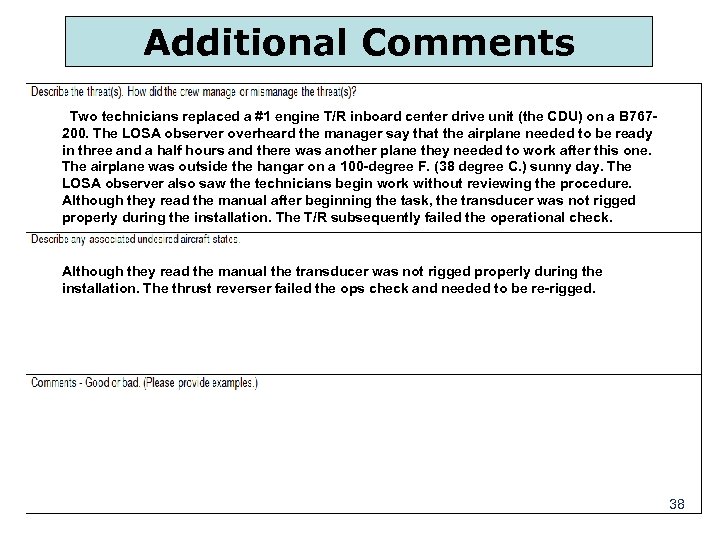 Additional Comments Two technicians replaced a #1 engine T/R inboard center drive unit (the CDU) on a B 767200. The LOSA observer overheard the manager say that the airplane needed to be ready in three and a half hours and there was another plane they needed to work after this one. The airplane was outside the hangar on a 100 -degree F. (38 degree C. ) sunny day. The LOSA observer also saw the technicians begin work without reviewing the procedure. Although they read the manual after beginning the task, the transducer was not rigged properly during the installation. The T/R subsequently failed the operational check. Although they read the manual the transducer was not rigged properly during the installation. The thrust reverser failed the ops check and needed to be re-rigged. 38
 Scenario #3: B 737 -500 Down-Jacking 41
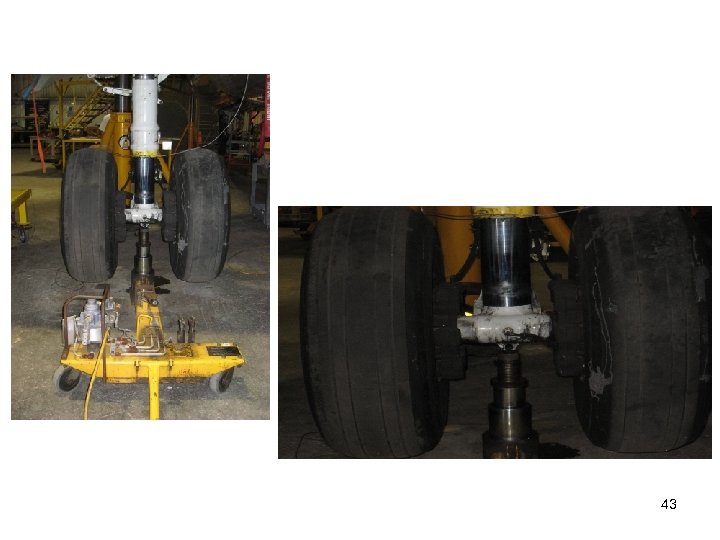
 Situation Technicians were performing gear swing on a 737 -500. After completing the operational check, one of the technicians cleared the aircraft for down jacking. As the aircraft was being lowered, the LOSA observer realized a maintenance stand had not been removed from under the tail compartment access door, and stopped the down jacking. They removed the stand continued lowering the aircraft. 42
 43
43
 LOSA Observation Form 42
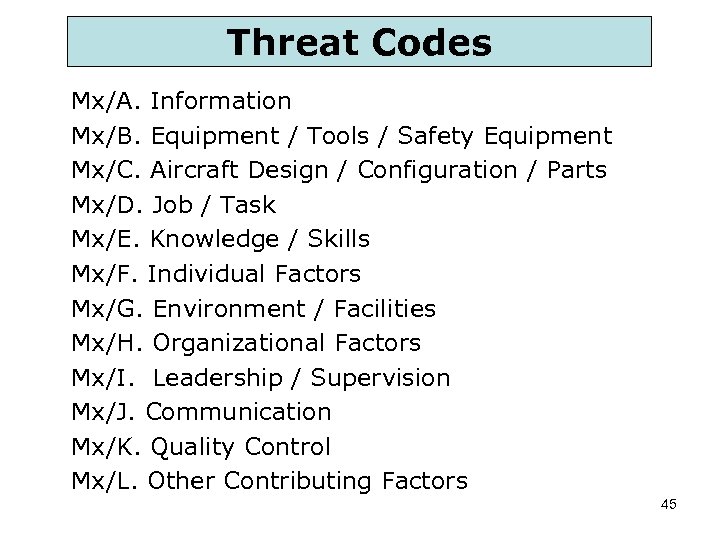 Threat Codes Mx/A. Information Mx/B. Equipment / Tools / Safety Equipment Mx/C. Aircraft Design / Configuration / Parts Mx/D. Job / Task Mx/E. Knowledge / Skills Mx/F. Individual Factors Mx/G. Environment / Facilities Mx/H. Organizational Factors Mx/I. Leadership / Supervision Mx/J. Communication Mx/K. Quality Control Mx/L. Other Contributing Factors 45
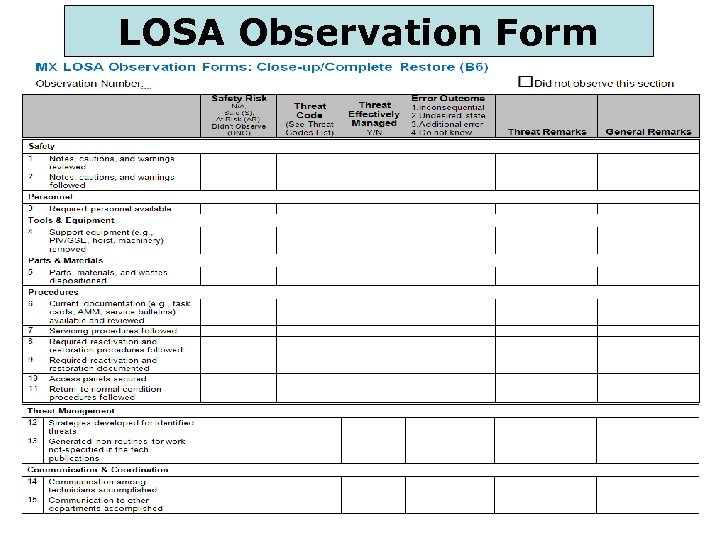
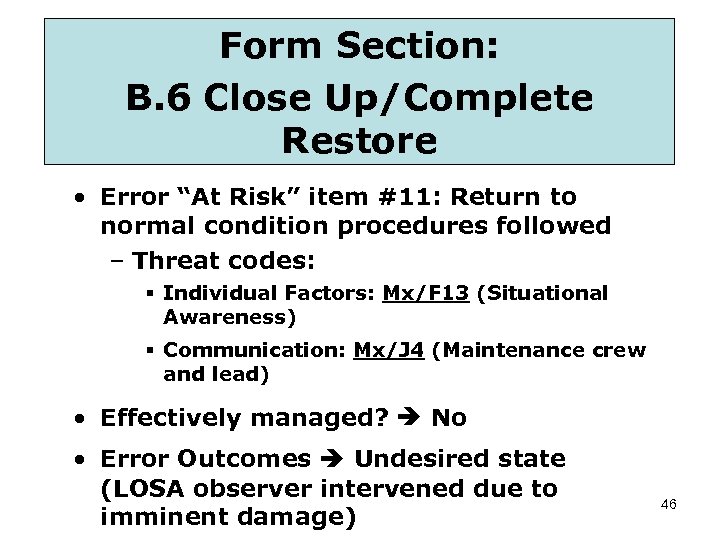 Form Section: B. 6 Close Up/Complete Restore • Error “At Risk” item #11: Return to normal condition procedures followed – Threat codes: § Individual Factors: Mx/F 13 (Situational Awareness) § Communication: Mx/J 4 (Maintenance crew and lead) • Effectively managed? No • Error Outcomes Undesired state (LOSA observer intervened due to imminent damage) 46
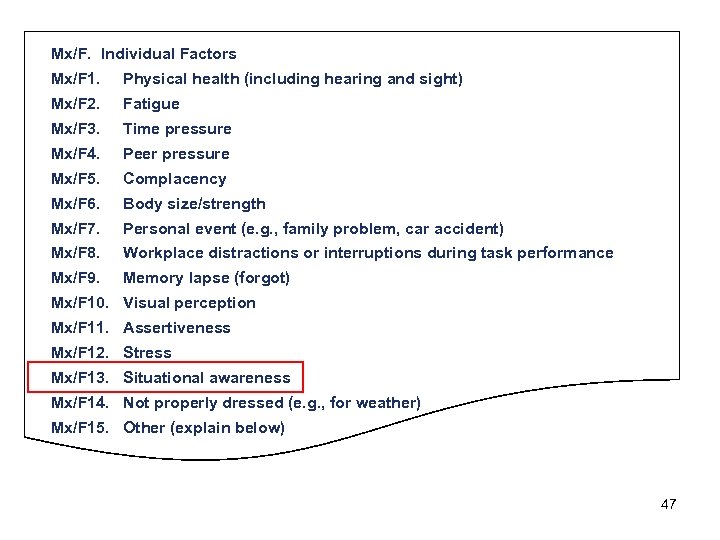 Mx/F. Individual Factors Mx/F 1. Physical health (including hearing and sight) Mx/F 2. Fatigue Mx/F 3. Time pressure Mx/F 4. Peer pressure Mx/F 5. Complacency Mx/F 6. Body size/strength Mx/F 7. Personal event (e. g. , family problem, car accident) Mx/F 8. Workplace distractions or interruptions during task performance Mx/F 9. Memory lapse (forgot) Mx/F 10. Visual perception Mx/F 11. Assertiveness Mx/F 12. Stress Mx/F 13. Situational awareness Mx/F 14. Not properly dressed (e. g. , for weather) Mx/F 15. Other (explain below) 47
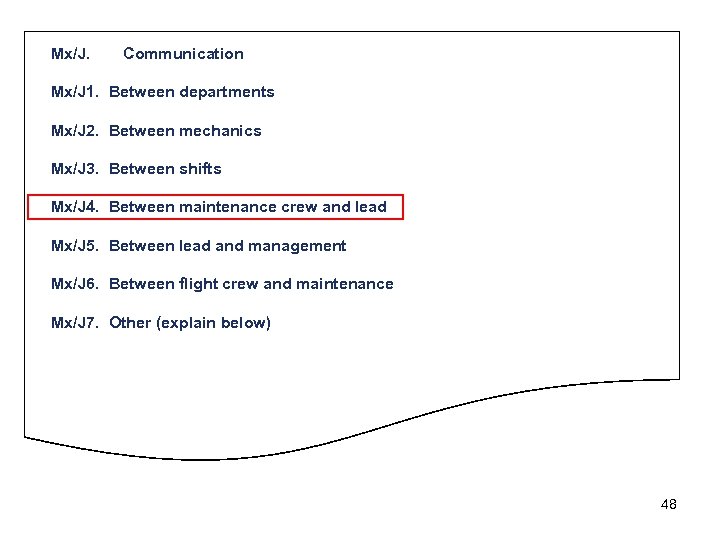 Mx/J. Communication Mx/J 1. Between departments Mx/J 2. Between mechanics Mx/J 3. Between shifts Mx/J 4. Between maintenance crew and lead Mx/J 5. Between lead and management Mx/J 6. Between flight crew and maintenance Mx/J 7. Other (explain below) 48
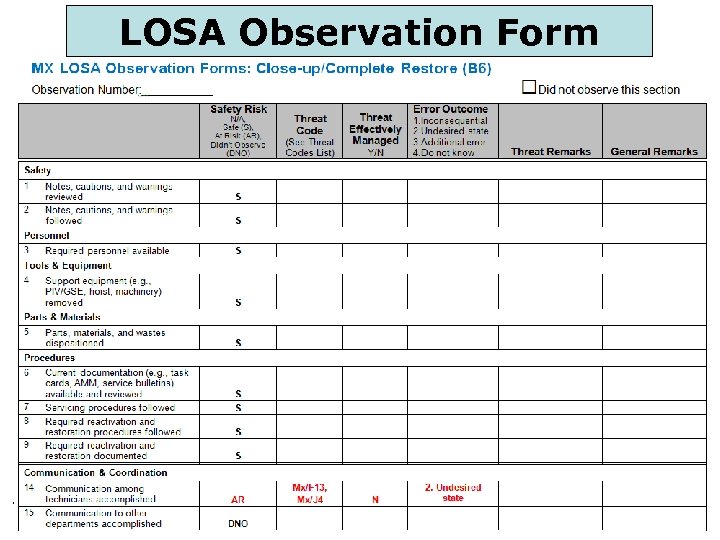 LOSA Observation Form 47
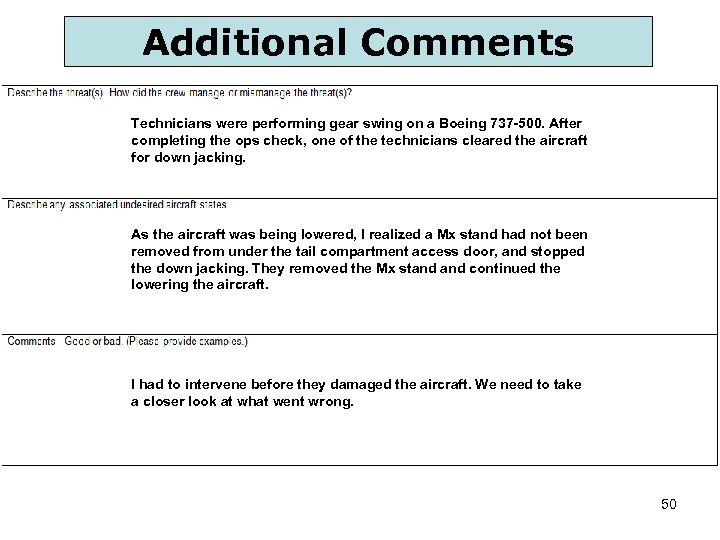 Additional Comments Technicians were performing gear swing on a Boeing 737 -500. After completing the ops check, one of the technicians cleared the aircraft for down jacking. As the aircraft was being lowered, I realized a Mx stand had not been removed from under the tail compartment access door, and stopped the down jacking. They removed the Mx stand continued the lowering the aircraft. I had to intervene before they damaged the aircraft. We need to take a closer look at what went wrong. 50
 Scenario #4: Improperly Pinned Slide 51
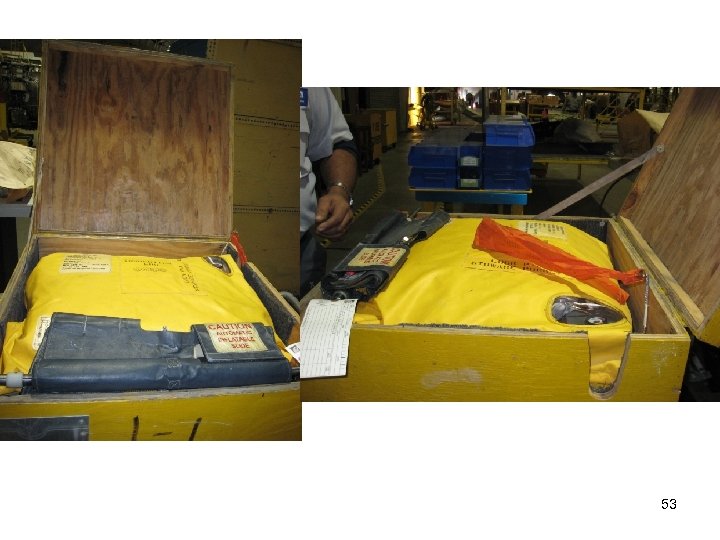
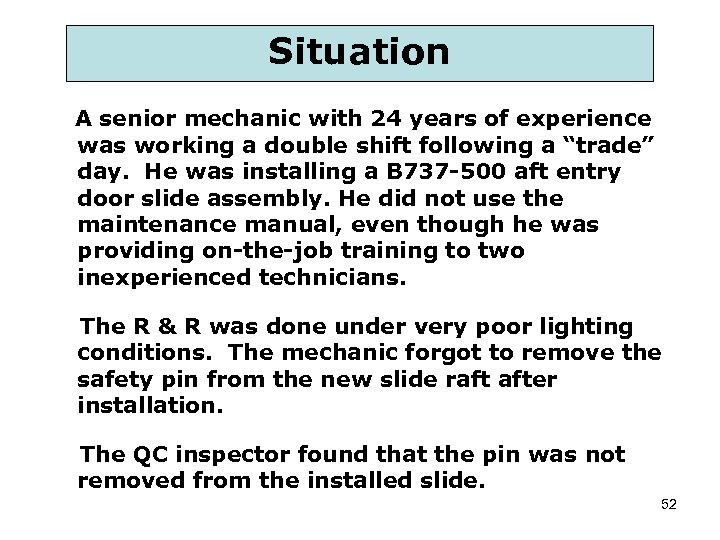 Situation A senior mechanic with 24 years of experience was working a double shift following a “trade” day. He was installing a B 737 -500 aft entry door slide assembly. He did not use the maintenance manual, even though he was providing on-the-job training to two inexperienced technicians. The R & R was done under very poor lighting conditions. The mechanic forgot to remove the safety pin from the new slide raft after installation. The QC inspector found that the pin was not removed from the installed slide. 52
 53
53
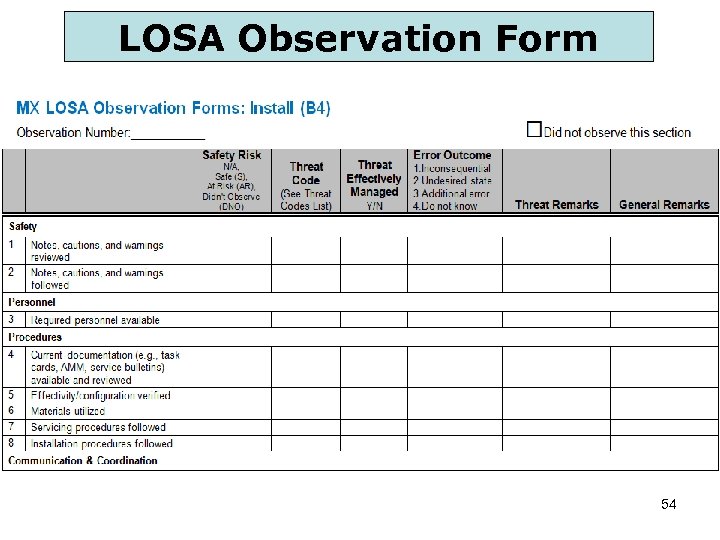 LOSA Observation Form 54
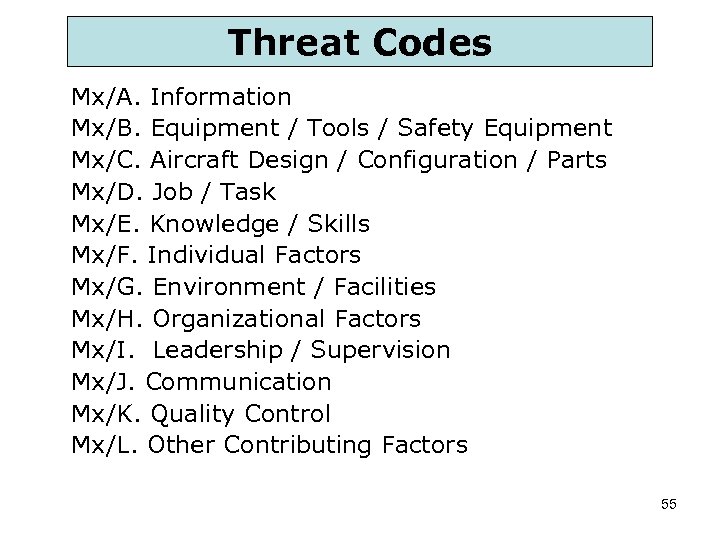 Threat Codes Mx/A. Information Mx/B. Equipment / Tools / Safety Equipment Mx/C. Aircraft Design / Configuration / Parts Mx/D. Job / Task Mx/E. Knowledge / Skills Mx/F. Individual Factors Mx/G. Environment / Facilities Mx/H. Organizational Factors Mx/I. Leadership / Supervision Mx/J. Communication Mx/K. Quality Control Mx/L. Other Contributing Factors 55
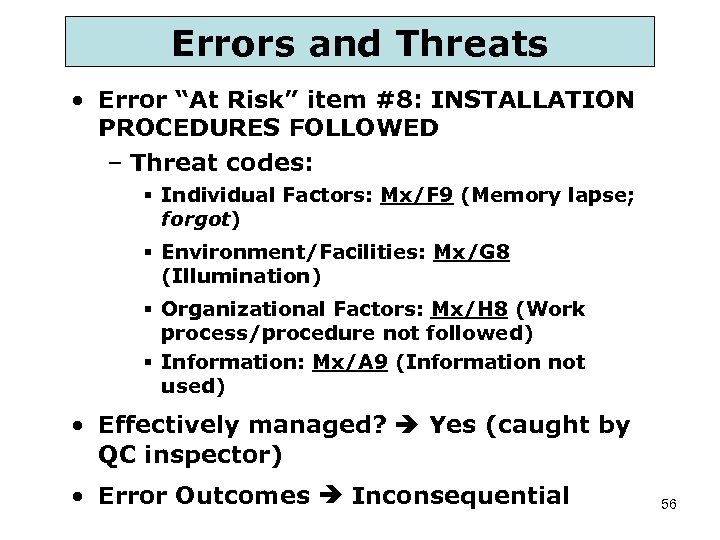 Errors and Threats • Error “At Risk” item #8: INSTALLATION PROCEDURES FOLLOWED – Threat codes: § Individual Factors: Mx/F 9 (Memory lapse; forgot) § Environment/Facilities: Mx/G 8 (Illumination) § Organizational Factors: Mx/H 8 (Work process/procedure not followed) § Information: Mx/A 9 (Information not used) • Effectively managed? Yes (caught by QC inspector) • Error Outcomes Inconsequential 56
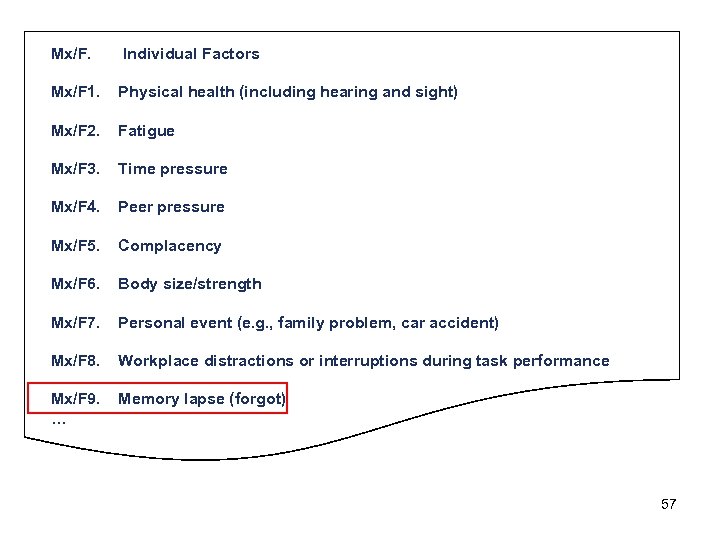 Mx/F. Individual Factors Mx/F 1. Physical health (including hearing and sight) Mx/F 2. Fatigue Mx/F 3. Time pressure Mx/F 4. Peer pressure Mx/F 5. Complacency Mx/F 6. Body size/strength Mx/F 7. Personal event (e. g. , family problem, car accident) Mx/F 8. Workplace distractions or interruptions during task performance Mx/F 9. … Memory lapse (forgot) 57
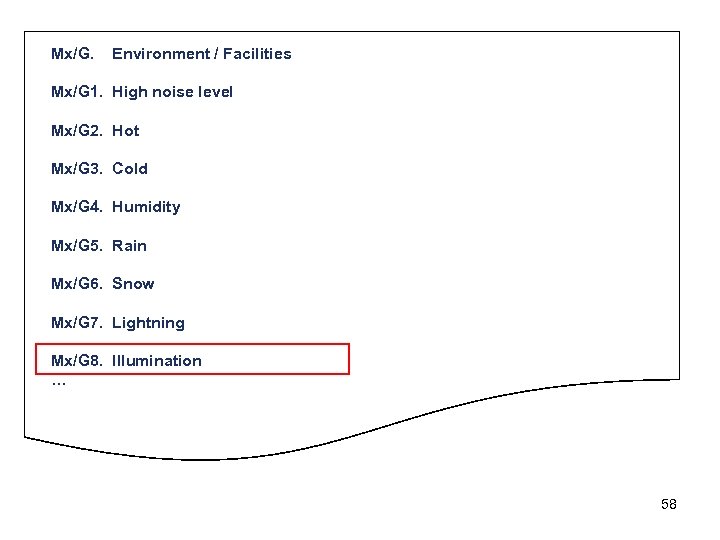 Mx/G. Environment / Facilities Mx/G 1. High noise level Mx/G 2. Hot Mx/G 3. Cold Mx/G 4. Humidity Mx/G 5. Rain Mx/G 6. Snow Mx/G 7. Lightning Mx/G 8. Illumination … 58
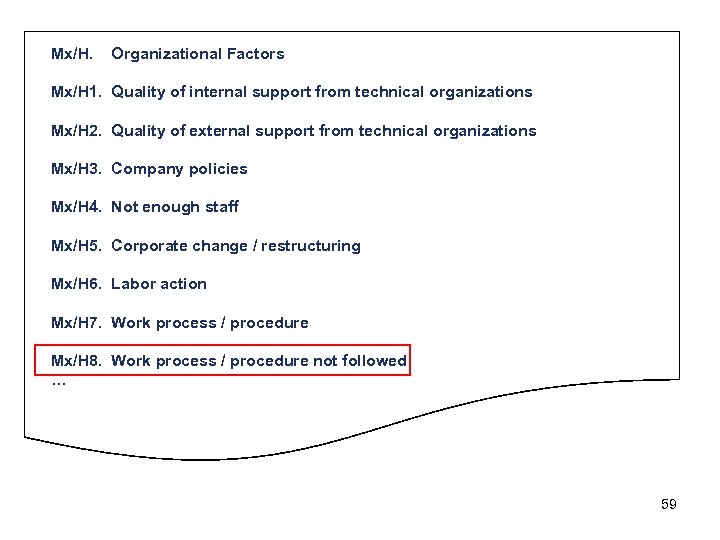 Mx/H. Organizational Factors Mx/H 1. Quality of internal support from technical organizations Mx/H 2. Quality of external support from technical organizations Mx/H 3. Company policies Mx/H 4. Not enough staff Mx/H 5. Corporate change / restructuring Mx/H 6. Labor action Mx/H 7. Work process / procedure Mx/H 8. Work process / procedure not followed … 59
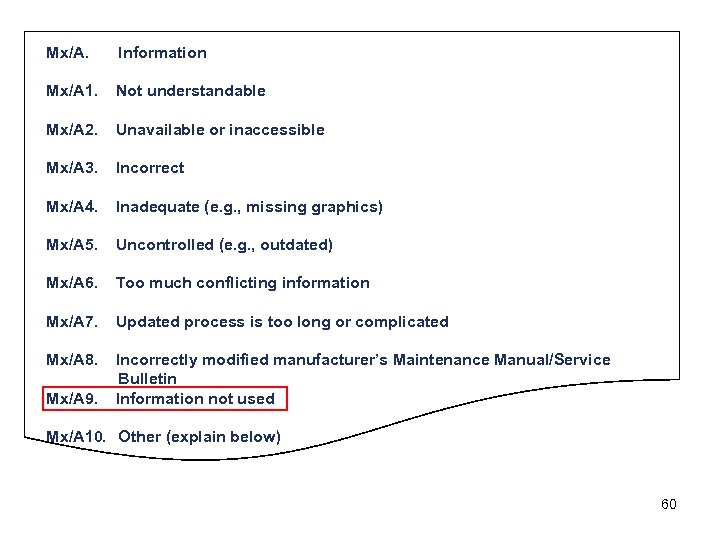 Mx/A. Information Mx/A 1. Not understandable Mx/A 2. Unavailable or inaccessible Mx/A 3. Incorrect Mx/A 4. Inadequate (e. g. , missing graphics) Mx/A 5. Uncontrolled (e. g. , outdated) Mx/A 6. Too much conflicting information Mx/A 7. Updated process is too long or complicated Mx/A 8. Incorrectly modified manufacturer’s Maintenance Manual/Service Bulletin Information not used Mx/A 9. Mx/A 10. Other (explain below) 60
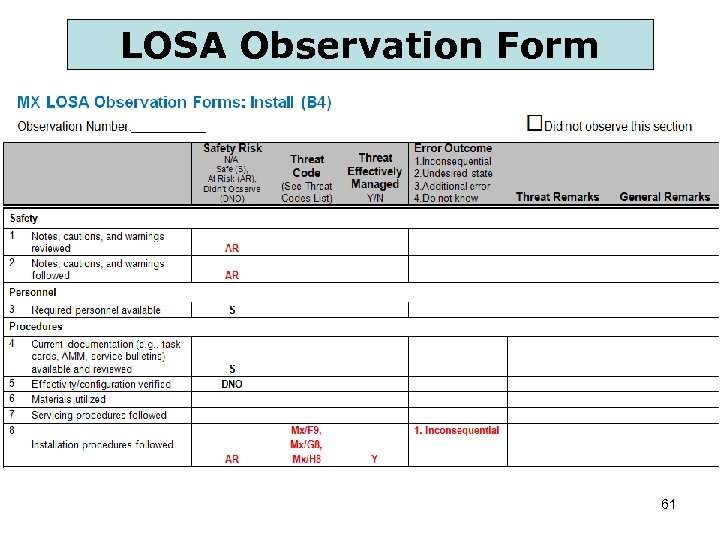 LOSA Observation Form 61
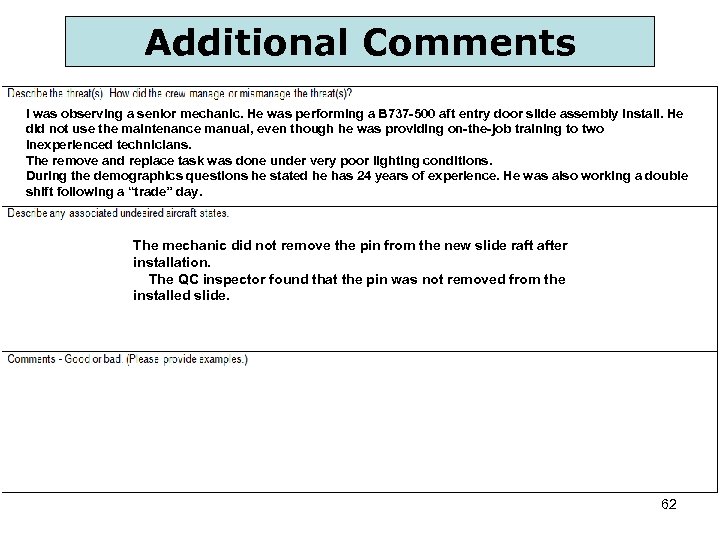 Additional Comments I was observing a senior mechanic. He was performing a B 737 -500 aft entry door slide assembly install. He did not use the maintenance manual, even though he was providing on-the-job training to two inexperienced technicians. The remove and replace task was done under very poor lighting conditions. During the demographics questions he stated he has 24 years of experience. He was also working a double shift following a “trade” day. The mechanic did not remove the pin from the new slide raft after installation. The QC inspector found that the pin was not removed from the installed slide. 62
 This Concludes the Line Operations Safety Assessment (LOSA): Maintenance (Mx) Operations – Base Training Scenarios
 Line Operations Safety Assessment (LOSA): Maintenance (Mx) Operations – Line Training Scenarios August 2014 (v 6)
 Observation Example 65
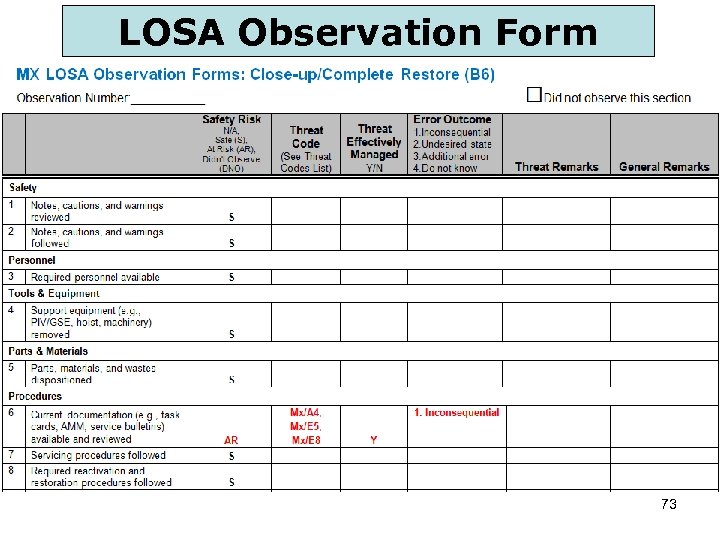
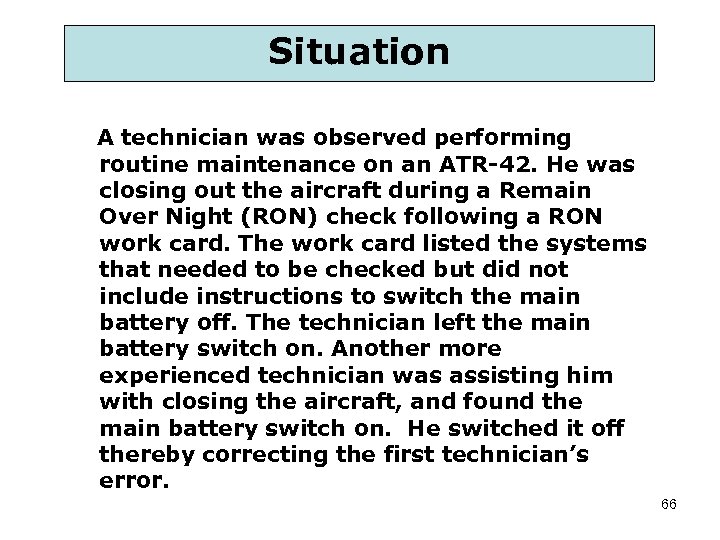 Situation A technician was observed performing routine maintenance on an ATR-42. He was closing out the aircraft during a Remain Over Night (RON) check following a RON work card. The work card listed the systems that needed to be checked but did not include instructions to switch the main battery off. The technician left the main battery switch on. Another more experienced technician was assisting him with closing the aircraft, and found the main battery switch on. He switched it off thereby correcting the first technician’s error. 66
 67
67
 LOSA Observation Form 68
 Threat Codes Mx/A. Information Mx/B. Equipment / Tools / Safety Equipment Mx/C. Aircraft Design / Configuration / Parts Mx/D. Job / Task Mx/E. Knowledge / Skills Mx/F. Individual Factors Mx/G. Environment / Facilities Mx/H. Organizational Factors Mx/I. Leadership / Supervision Mx/J. Communication Mx/K. Quality Control Mx/L. Other Contributing Factors 69
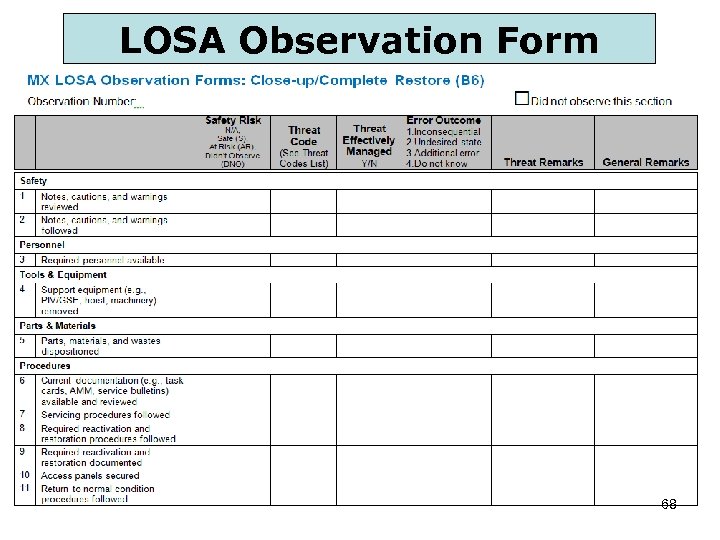
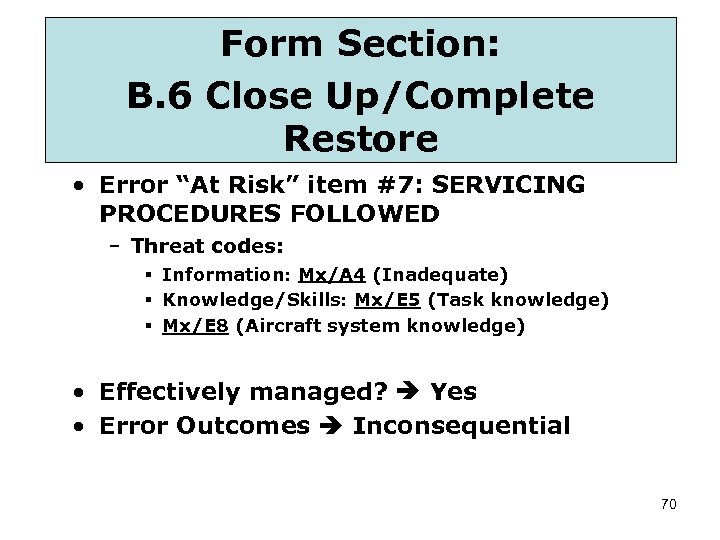 Form Section: B. 6 Close Up/Complete Restore • Error “At Risk” item #7: SERVICING PROCEDURES FOLLOWED – Threat codes: § Information: Mx/A 4 (Inadequate) § Knowledge/Skills: Mx/E 5 (Task knowledge) § Mx/E 8 (Aircraft system knowledge) • Effectively managed? Yes • Error Outcomes Inconsequential 70
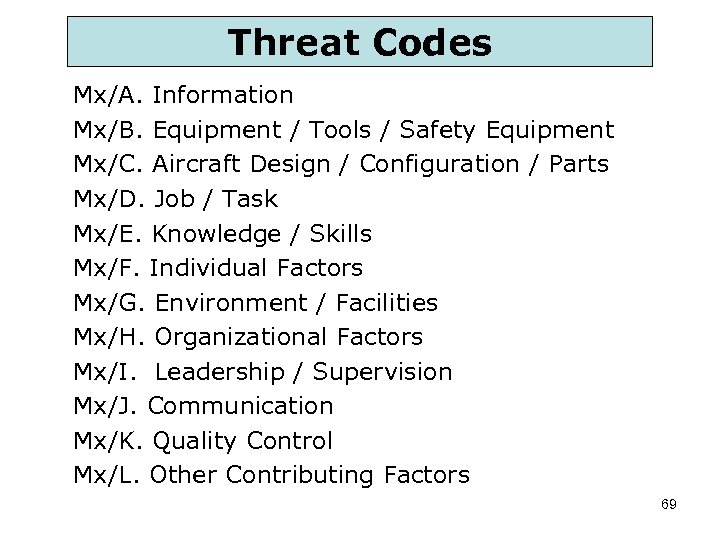
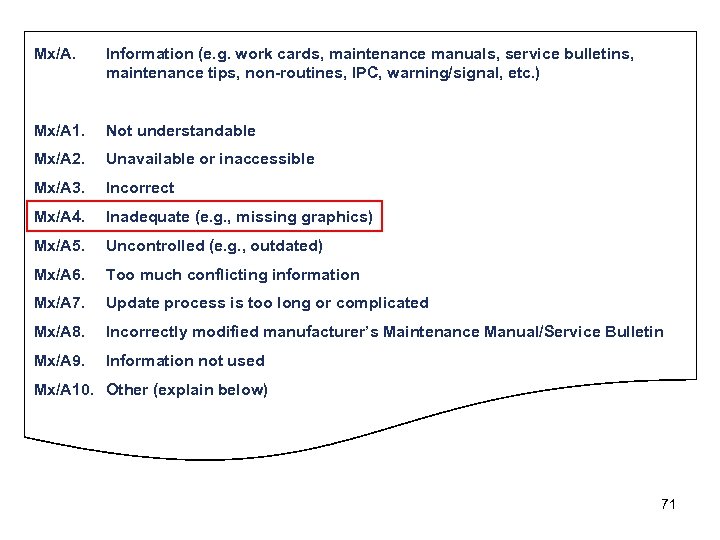 Mx/A. Information (e. g. work cards, maintenance manuals, service bulletins, maintenance tips, non-routines, IPC, warning/signal, etc. ) Mx/A 1. Not understandable Mx/A 2. Unavailable or inaccessible Mx/A 3. Incorrect Mx/A 4. Inadequate (e. g. , missing graphics) Mx/A 5. Uncontrolled (e. g. , outdated) Mx/A 6. Too much conflicting information Mx/A 7. Update process is too long or complicated Mx/A 8. Incorrectly modified manufacturer’s Maintenance Manual/Service Bulletin Mx/A 9. Information not used Mx/A 10. Other (explain below) 71
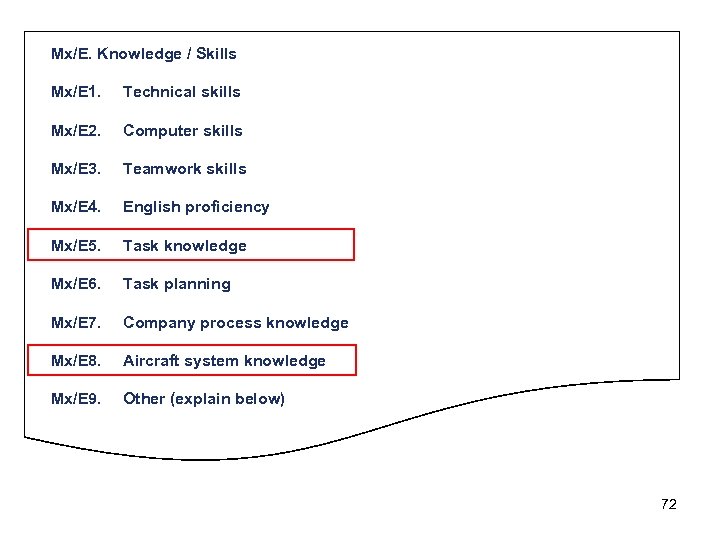 Mx/E. Knowledge / Skills Mx/E 1. Technical skills Mx/E 2. Computer skills Mx/E 3. Teamwork skills Mx/E 4. English proficiency Mx/E 5. Task knowledge Mx/E 6. Task planning Mx/E 7. Company process knowledge Mx/E 8. Aircraft system knowledge Mx/E 9. Other (explain below) 72
 LOSA Observation Form 73
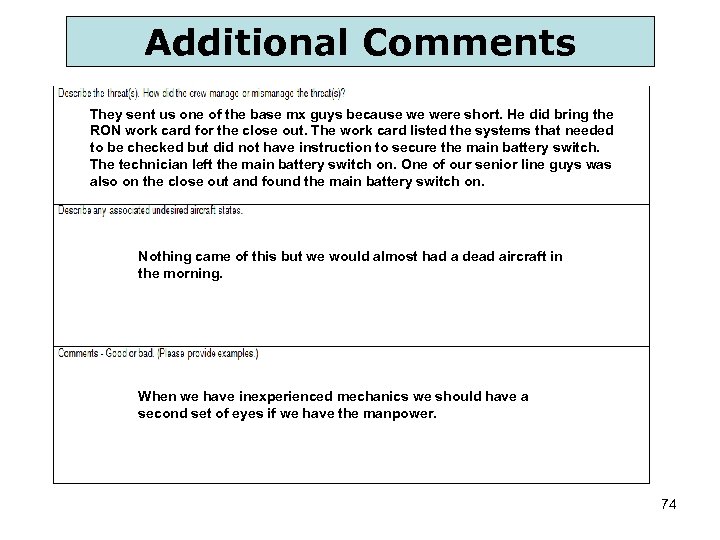 Additional Comments They sent us one of the base mx guys because we were short. He did bring the RON work card for the close out. The work card listed the systems that needed to be checked but did not have instruction to secure the main battery switch. The technician left the main battery switch on. One of our senior line guys was also on the close out and found the main battery switch on. Nothing came of this but we would almost had a dead aircraft in the morning. When we have inexperienced mechanics we should have a second set of eyes if we have the manpower. 74
 Practice Observations 75
 Practice Observation Instructions • Please complete the appropriate section of the observation form for each of the following scenarios. • Identify and mark down the threats and errors and include any remarks. • Following your observation, enter your information into the Mx LOSA software database. 76
 Scenario #1: Rag Left in Equipment Bay 77
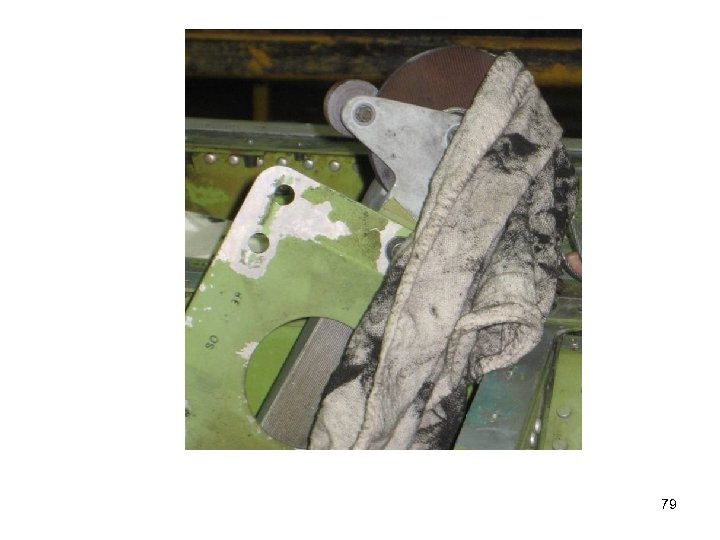
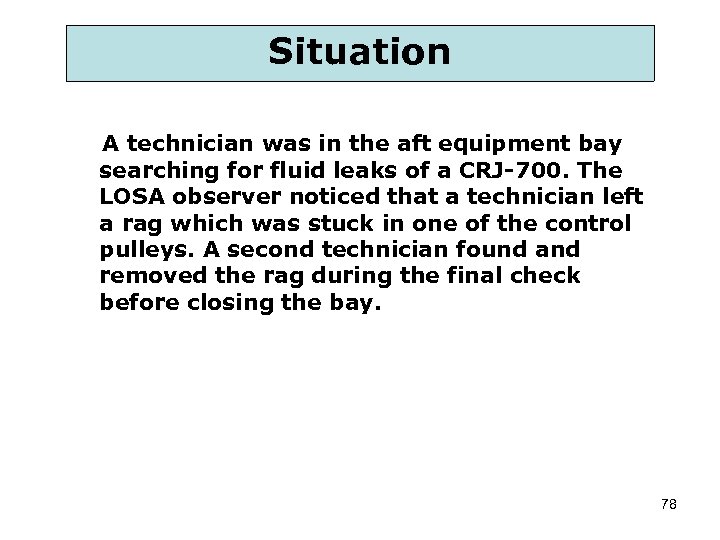 Situation A technician was in the aft equipment bay searching for fluid leaks of a CRJ-700. The LOSA observer noticed that a technician left a rag which was stuck in one of the control pulleys. A second technician found and removed the rag during the final check before closing the bay. 78
 79
79
 LOSA Observation Form 80
 Threat Codes Mx/A. Information Mx/B. Equipment / Tools / Safety Equipment Mx/C. Aircraft Design / Configuration / Parts Mx/D. Job / Task Mx/E. Knowledge / Skills Mx/F. Individual Factors Mx/G. Environment / Facilities Mx/H. Organizational Factors Mx/I. Leadership / Supervision Mx/J. Communication Mx/K. Quality Control Mx/L. Other Contributing Factors 81
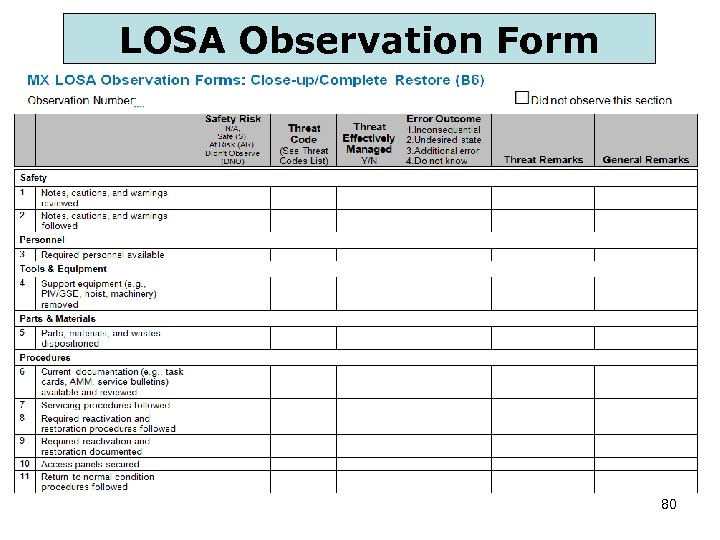
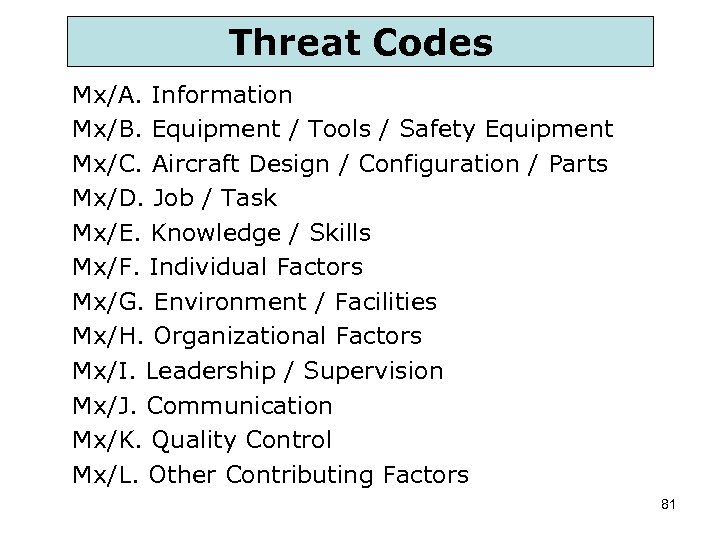
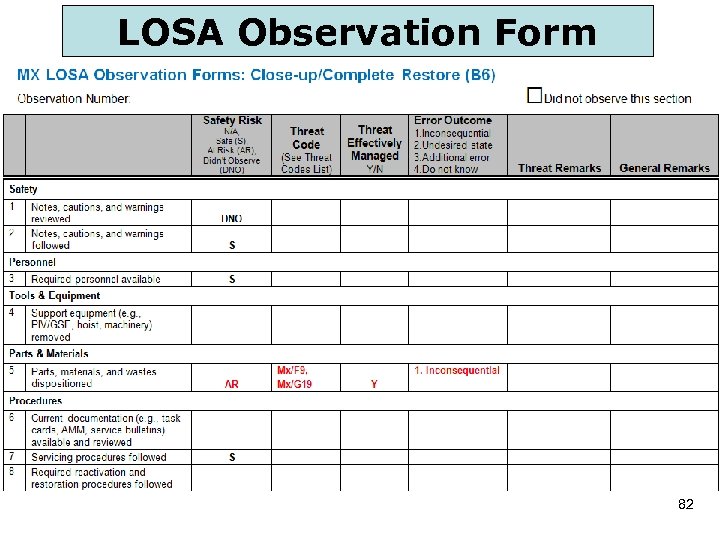
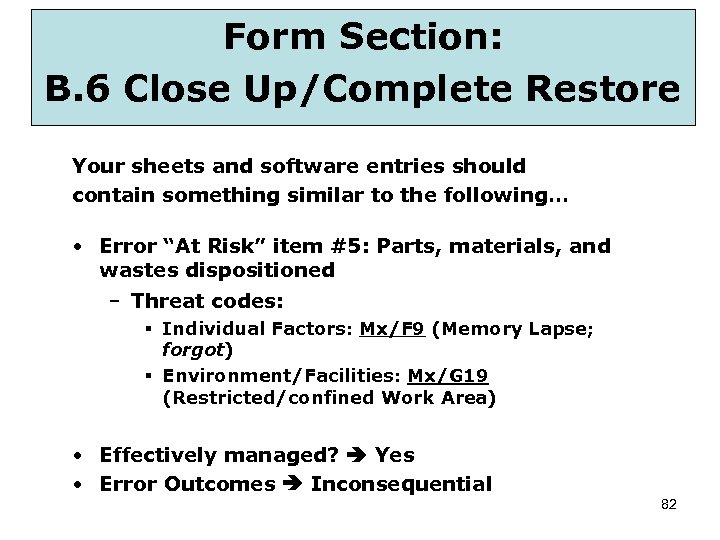 Form Section: B. 6 Close Up/Complete Restore Your sheets and software entries should contain something similar to the following… • Error “At Risk” item #5: Parts, materials, and wastes dispositioned – Threat codes: § Individual Factors: Mx/F 9 (Memory Lapse; forgot) § Environment/Facilities: Mx/G 19 (Restricted/confined Work Area) • Effectively managed? Yes • Error Outcomes Inconsequential 82
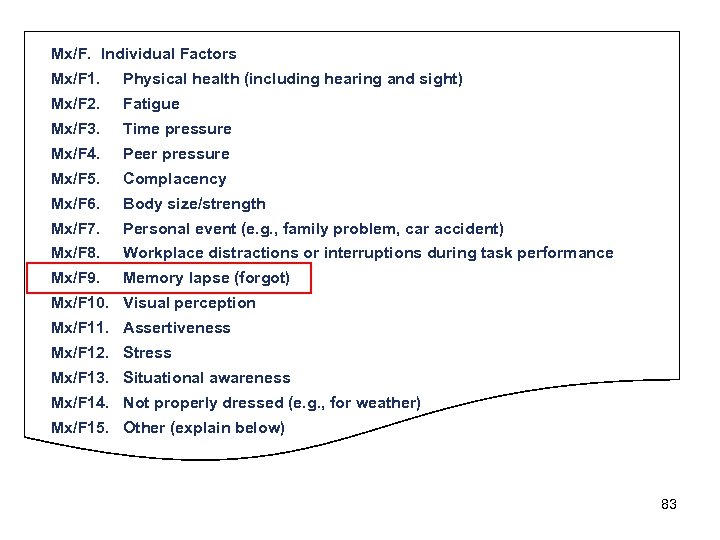 Mx/F. Individual Factors Mx/F 1. Physical health (including hearing and sight) Mx/F 2. Fatigue Mx/F 3. Time pressure Mx/F 4. Peer pressure Mx/F 5. Complacency Mx/F 6. Body size/strength Mx/F 7. Personal event (e. g. , family problem, car accident) Mx/F 8. Workplace distractions or interruptions during task performance Mx/F 9. Memory lapse (forgot) Mx/F 10. Visual perception Mx/F 11. Assertiveness Mx/F 12. Stress Mx/F 13. Situational awareness Mx/F 14. Not properly dressed (e. g. , for weather) Mx/F 15. Other (explain below) 83
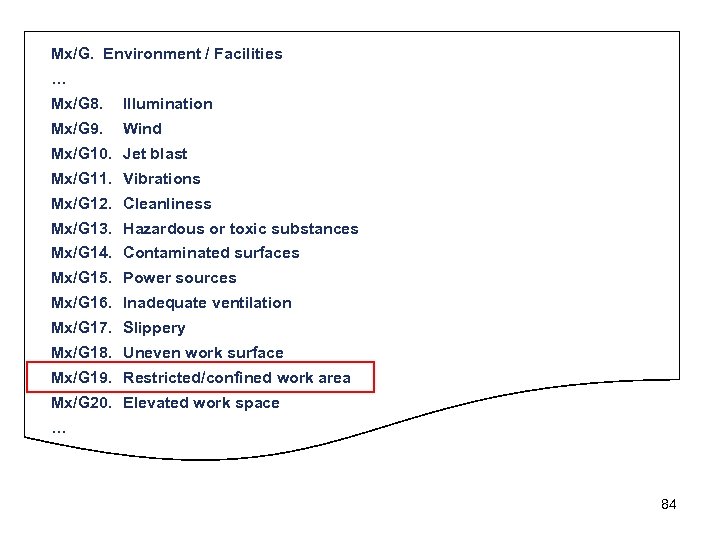 Mx/G. Environment / Facilities … Mx/G 8. Illumination Mx/G 9. Wind Mx/G 10. Jet blast Mx/G 11. Vibrations Mx/G 12. Cleanliness Mx/G 13. Hazardous or toxic substances Mx/G 14. Contaminated surfaces Mx/G 15. Power sources Mx/G 16. Inadequate ventilation Mx/G 17. Slippery Mx/G 18. Uneven work surface Mx/G 19. Restricted/confined work area Mx/G 20. Elevated work space … 84
 LOSA Observation Form 82
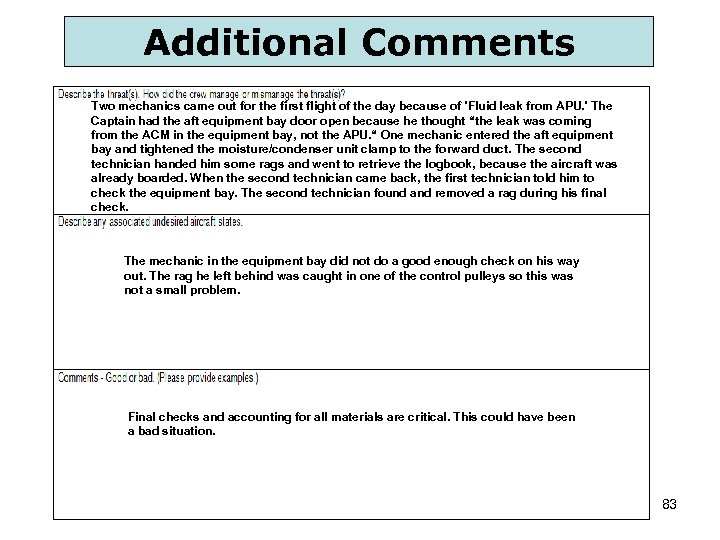 Additional Comments Two mechanics came out for the first flight of the day because of 'Fluid leak from APU. ' The Captain had the aft equipment bay door open because he thought “the leak was coming from the ACM in the equipment bay, not the APU. “ One mechanic entered the aft equipment bay and tightened the moisture/condenser unit clamp to the forward duct. The second technician handed him some rags and went to retrieve the logbook, because the aircraft was already boarded. When the second technician came back, the first technician told him to check the equipment bay. The second technician found and removed a rag during his final check. The mechanic in the equipment bay did not do a good enough check on his way out. The rag he left behind was caught in one of the control pulleys so this was not a small problem. Final checks and accounting for all materials are critical. This could have been a bad situation. 83
 Scenario #2: MEL Violation 87
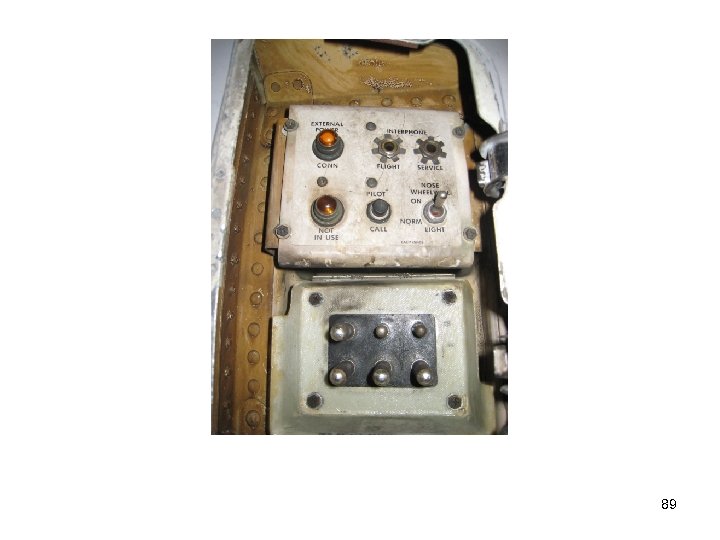
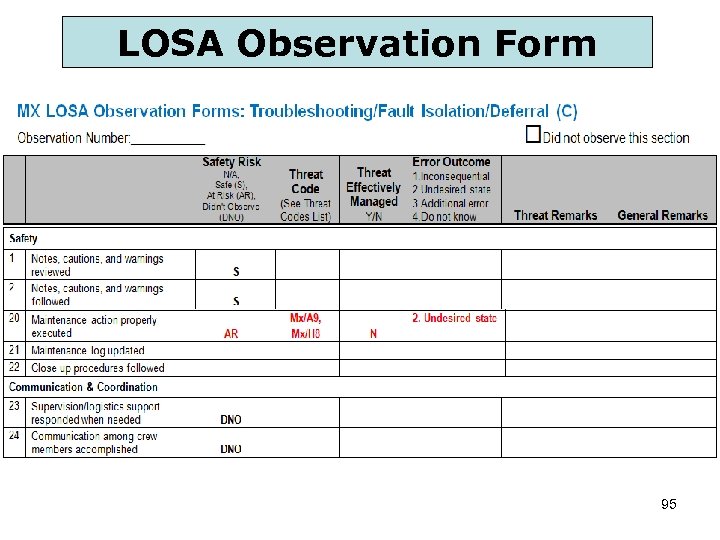
 Situation A line technician deferred inoperative ground power lights on an B 737 aircraft which was allowed by the Minimum Equipment List (MEL). However he did not carry out the maintenance procedure that was required by the MEL to verify that the avionics vent fan warning horn was operative. 88
 89
89
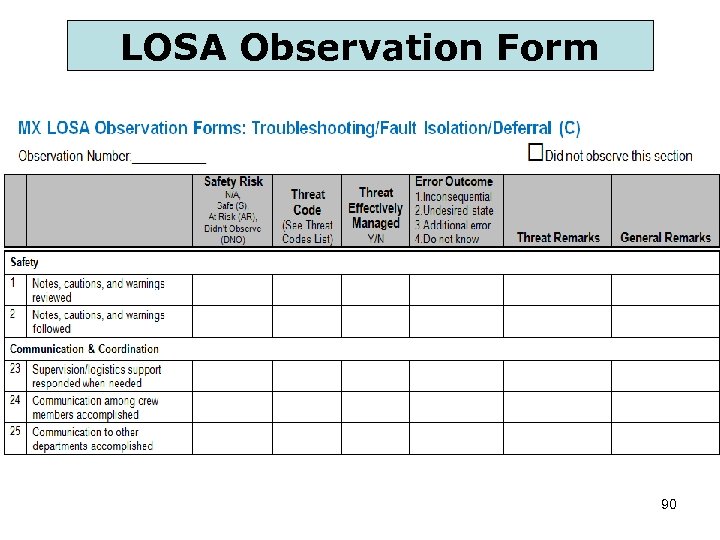 LOSA Observation Form 90
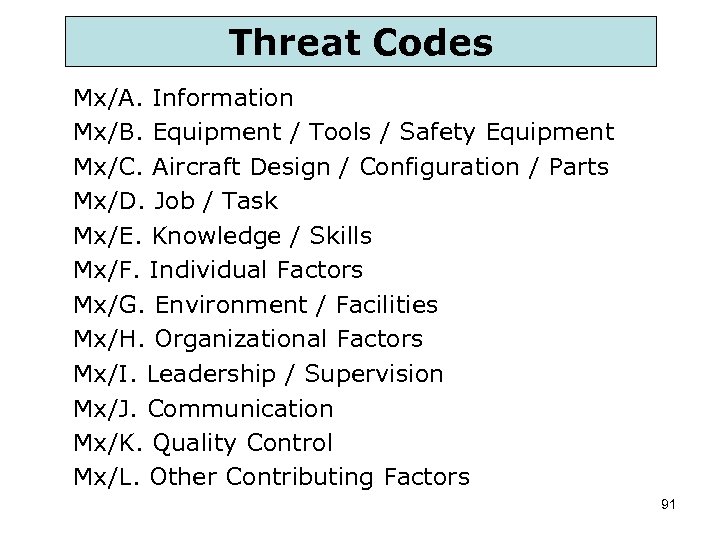 Threat Codes Mx/A. Information Mx/B. Equipment / Tools / Safety Equipment Mx/C. Aircraft Design / Configuration / Parts Mx/D. Job / Task Mx/E. Knowledge / Skills Mx/F. Individual Factors Mx/G. Environment / Facilities Mx/H. Organizational Factors Mx/I. Leadership / Supervision Mx/J. Communication Mx/K. Quality Control Mx/L. Other Contributing Factors 91
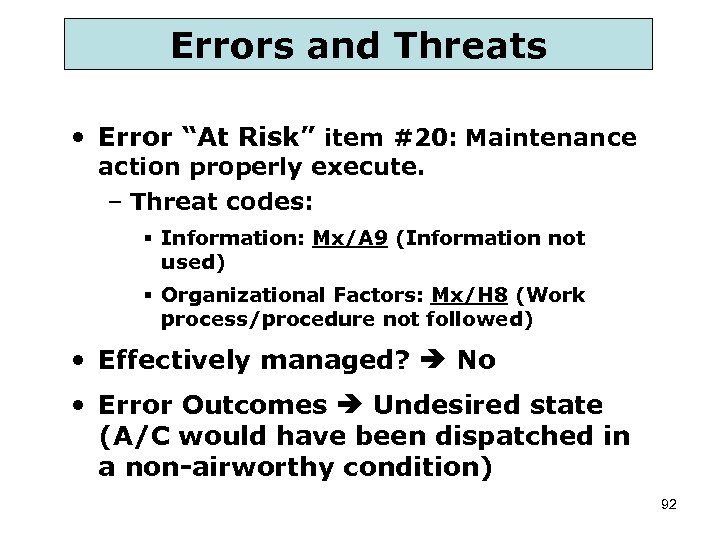 Errors and Threats • Error “At Risk” item #20: Maintenance action properly execute. – Threat codes: § Information: Mx/A 9 (Information not used) § Organizational Factors: Mx/H 8 (Work process/procedure not followed) • Effectively managed? No • Error Outcomes Undesired state (A/C would have been dispatched in a non-airworthy condition) 92
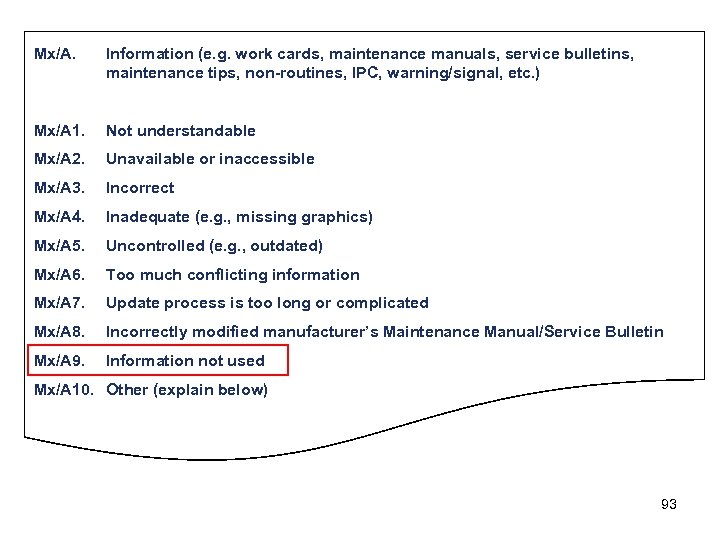 Mx/A. Information (e. g. work cards, maintenance manuals, service bulletins, maintenance tips, non-routines, IPC, warning/signal, etc. ) Mx/A 1. Not understandable Mx/A 2. Unavailable or inaccessible Mx/A 3. Incorrect Mx/A 4. Inadequate (e. g. , missing graphics) Mx/A 5. Uncontrolled (e. g. , outdated) Mx/A 6. Too much conflicting information Mx/A 7. Update process is too long or complicated Mx/A 8. Incorrectly modified manufacturer’s Maintenance Manual/Service Bulletin Mx/A 9. Information not used Mx/A 10. Other (explain below) 93
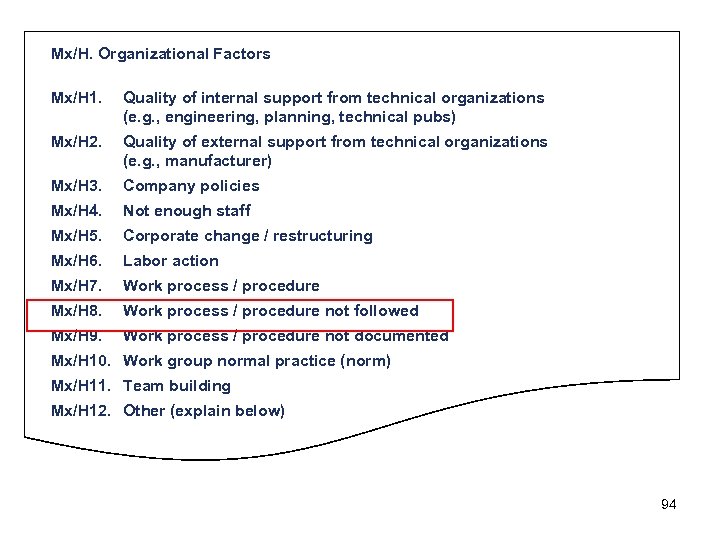 Mx/H. Organizational Factors Mx/H 1. Quality of internal support from technical organizations (e. g. , engineering, planning, technical pubs) Mx/H 2. Quality of external support from technical organizations (e. g. , manufacturer) Mx/H 3. Company policies Mx/H 4. Not enough staff Mx/H 5. Corporate change / restructuring Mx/H 6. Labor action Mx/H 7. Work process / procedure Mx/H 8. Work process / procedure not followed Mx/H 9. Work process / procedure not documented Mx/H 10. Work group normal practice (norm) Mx/H 11. Team building Mx/H 12. Other (explain below) 94
 LOSA Observation Form 95
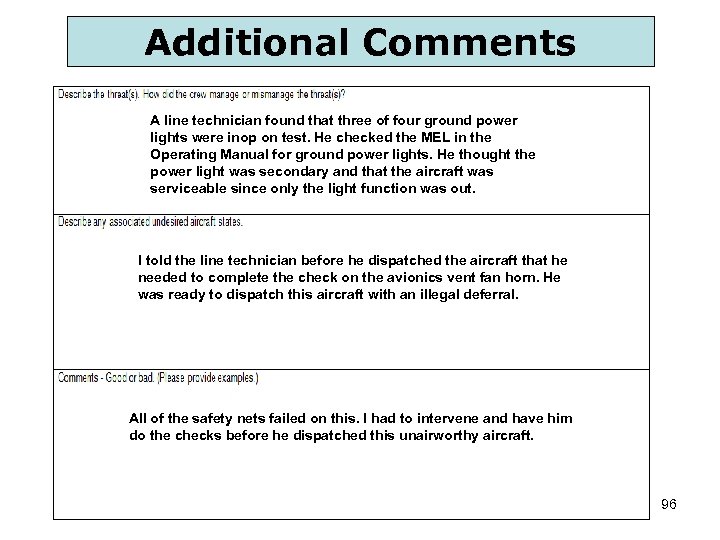 Additional Comments A line technician found that three of four ground power lights were inop on test. He checked the MEL in the Operating Manual for ground power lights. He thought the power light was secondary and that the aircraft was serviceable since only the light function was out. I told the line technician before he dispatched the aircraft that he needed to complete the check on the avionics vent fan horn. He was ready to dispatch this aircraft with an illegal deferral. All of the safety nets failed on this. I had to intervene and have him do the checks before he dispatched this unairworthy aircraft. 96
 Scenario #3: Engine Oil Filler Cap 97
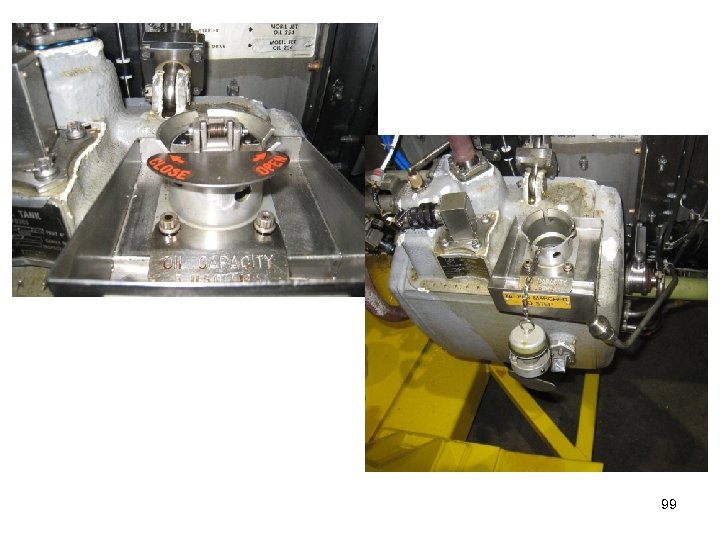
 Situation An inexperienced line technician was servicing oil on the right engine on a B 737800 after engine shutdown. The technician was observed putting on the oil filler cap, but did not lock it down. A lead technician standing nearby saw that it was not locked and corrected the problem. The technician was unfamiliar with the cap. 98
 99
99
 LOSA Observation Form 100
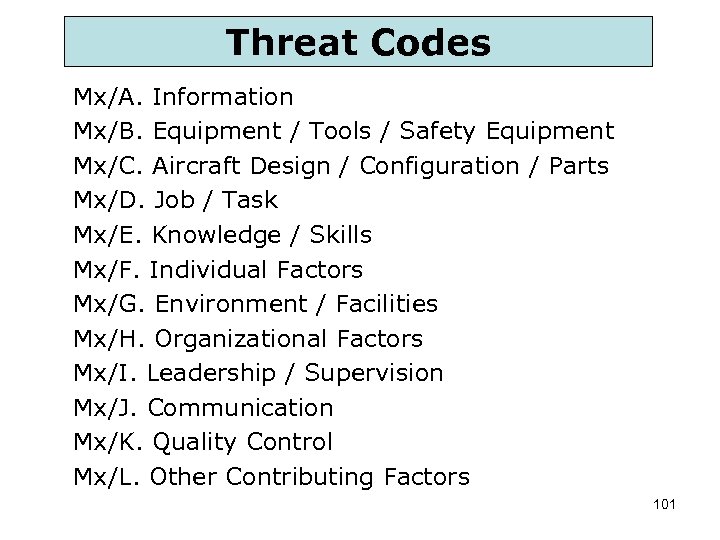 Threat Codes Mx/A. Information Mx/B. Equipment / Tools / Safety Equipment Mx/C. Aircraft Design / Configuration / Parts Mx/D. Job / Task Mx/E. Knowledge / Skills Mx/F. Individual Factors Mx/G. Environment / Facilities Mx/H. Organizational Factors Mx/I. Leadership / Supervision Mx/J. Communication Mx/K. Quality Control Mx/L. Other Contributing Factors 101
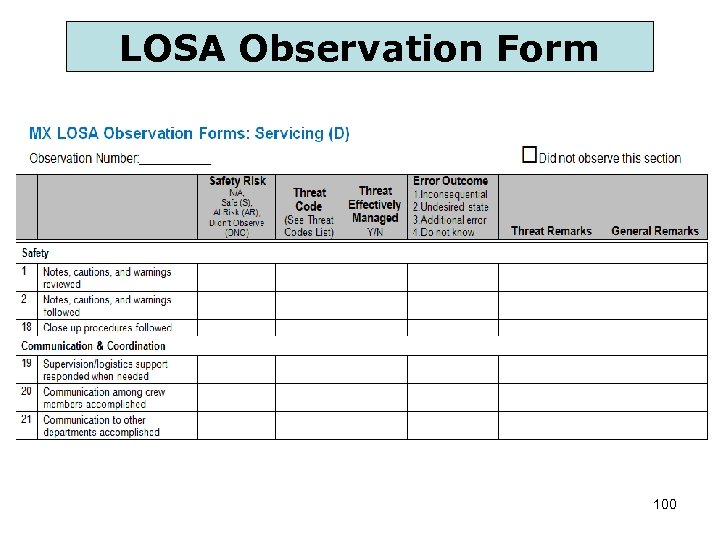
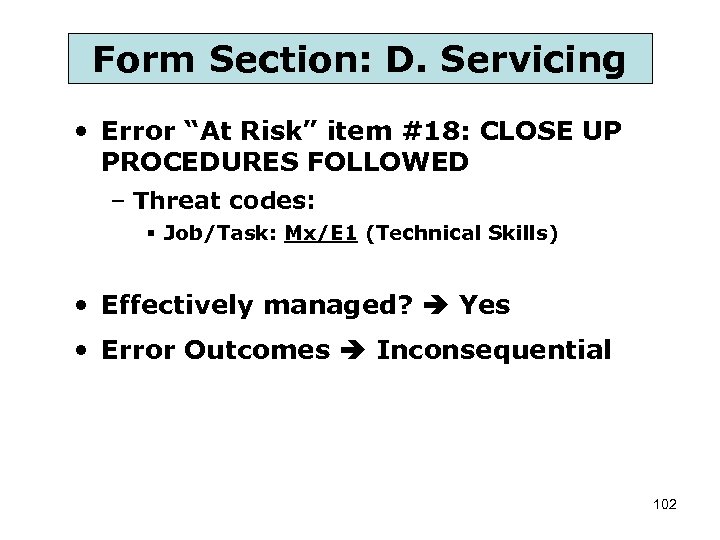 Form Section: D. Servicing • Error “At Risk” item #18: CLOSE UP PROCEDURES FOLLOWED – Threat codes: § Job/Task: Mx/E 1 (Technical Skills) • Effectively managed? Yes • Error Outcomes Inconsequential 102
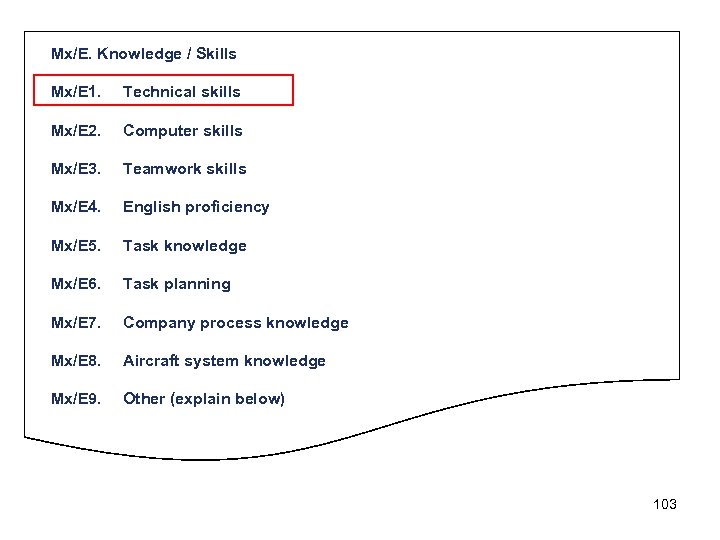 Mx/E. Knowledge / Skills Mx/E 1. Technical skills Mx/E 2. Computer skills Mx/E 3. Teamwork skills Mx/E 4. English proficiency Mx/E 5. Task knowledge Mx/E 6. Task planning Mx/E 7. Company process knowledge Mx/E 8. Aircraft system knowledge Mx/E 9. Other (explain below) 103
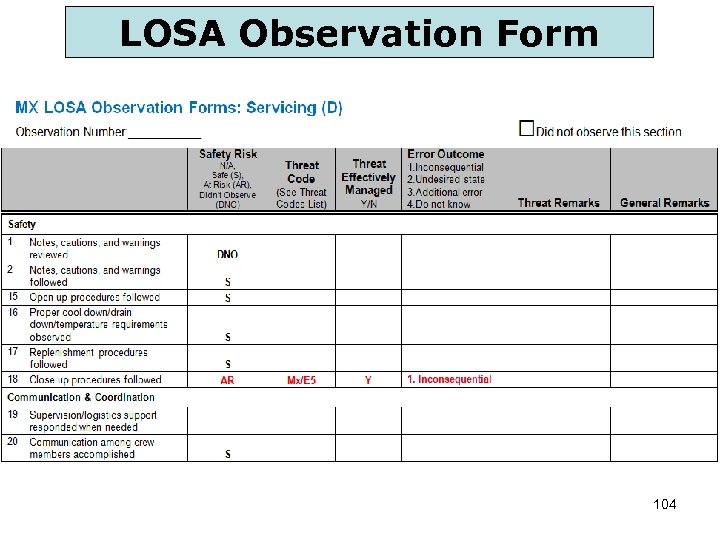 LOSA Observation Form 104
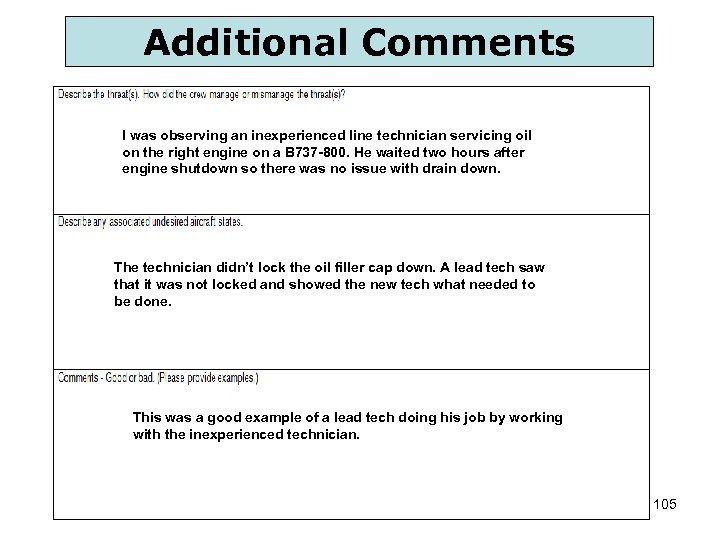 Additional Comments I was observing an inexperienced line technician servicing oil on the right engine on a B 737 -800. He waited two hours after engine shutdown so there was no issue with drain down. The technician didn’t lock the oil filler cap down. A lead tech saw that it was not locked and showed the new tech what needed to be done. This was a good example of a lead tech doing his job by working with the inexperienced technician. 105
 Scenario #4: 757 Blind Oil Fill 106
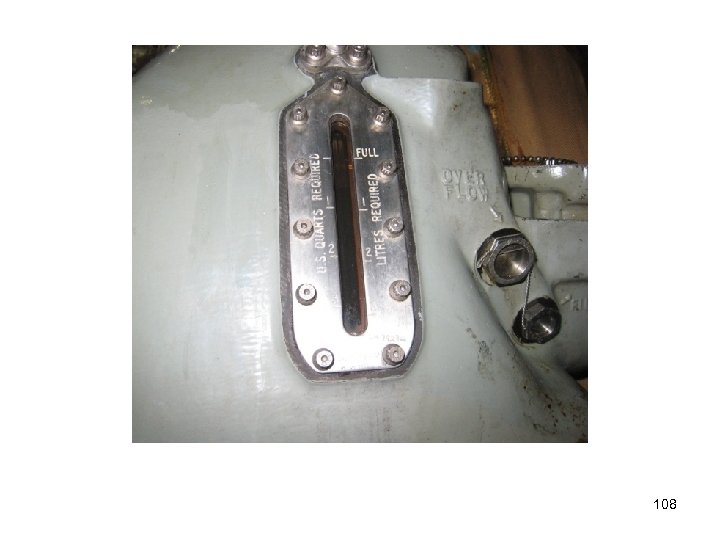
 Situation The crew of a B 757 -200 that had been parked for over an hour called with the #2 engine EICAS showing only 12 quarts static at the gate. Because of time pressure, the lead technician had a line technician do a blind fill of 14 quarts of oil without running the engine first. This resulted in an overfilled oil reservoir. 107
 108
108
 LOSA Observation Form 109
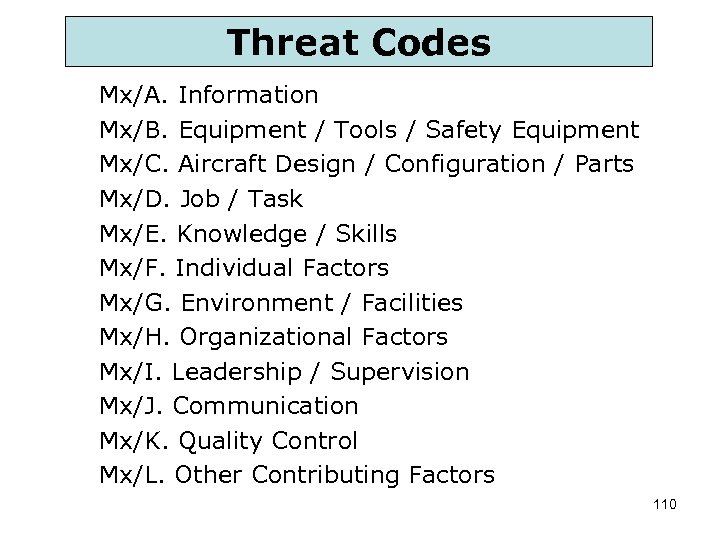 Threat Codes Mx/A. Information Mx/B. Equipment / Tools / Safety Equipment Mx/C. Aircraft Design / Configuration / Parts Mx/D. Job / Task Mx/E. Knowledge / Skills Mx/F. Individual Factors Mx/G. Environment / Facilities Mx/H. Organizational Factors Mx/I. Leadership / Supervision Mx/J. Communication Mx/K. Quality Control Mx/L. Other Contributing Factors 110
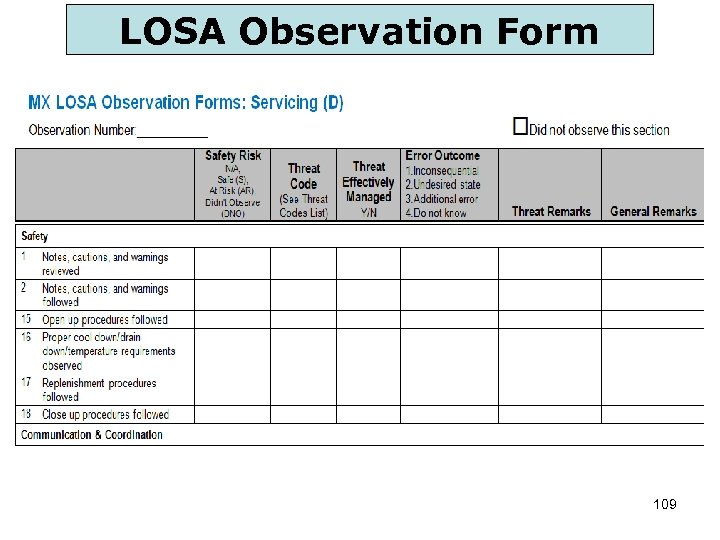
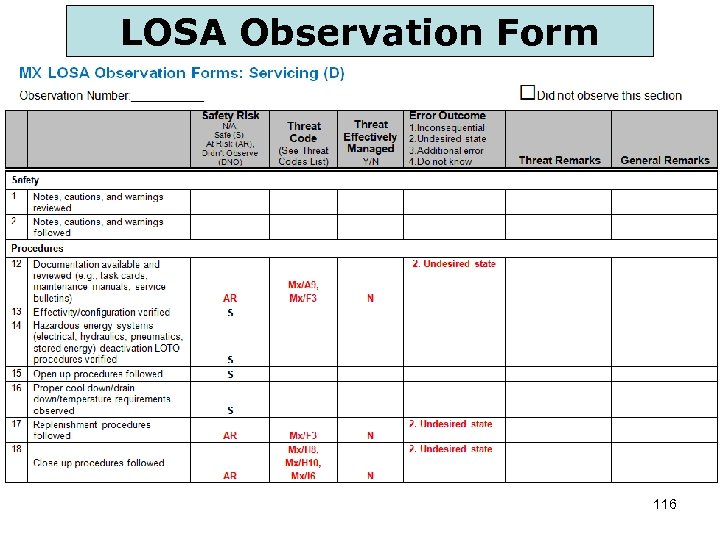
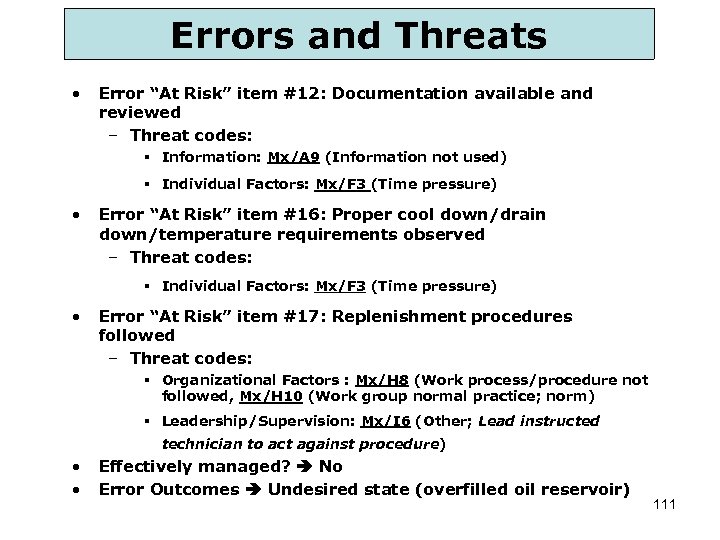 Errors and Threats • Error “At Risk” item #12: Documentation available and reviewed – Threat codes: § Information: Mx/A 9 (Information not used) § Individual Factors: Mx/F 3 (Time pressure) • Error “At Risk” item #16: Proper cool down/drain down/temperature requirements observed – Threat codes: § Individual Factors: Mx/F 3 (Time pressure) • Error “At Risk” item #17: Replenishment procedures followed – Threat codes: § Organizational Factors : Mx/H 8 (Work process/procedure not followed, Mx/H 10 (Work group normal practice; norm) § Leadership/Supervision: Mx/I 6 (Other; Lead instructed technician to act against procedure) • • Effectively managed? No Error Outcomes Undesired state (overfilled oil reservoir) 111
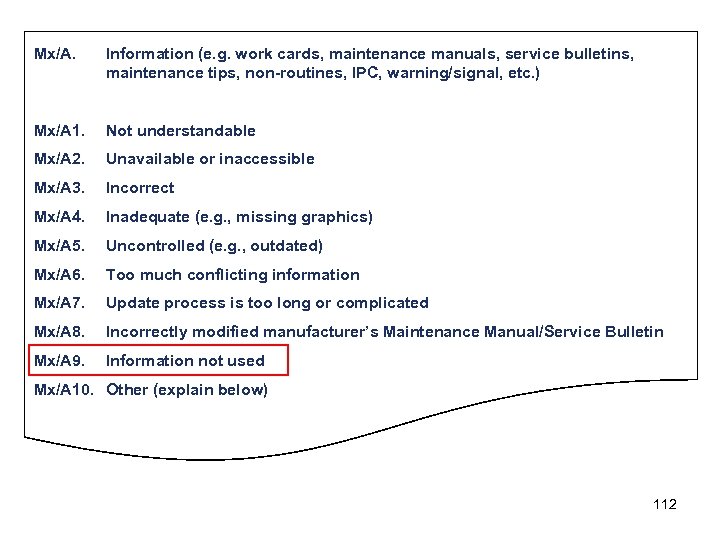 Mx/A. Information (e. g. work cards, maintenance manuals, service bulletins, maintenance tips, non-routines, IPC, warning/signal, etc. ) Mx/A 1. Not understandable Mx/A 2. Unavailable or inaccessible Mx/A 3. Incorrect Mx/A 4. Inadequate (e. g. , missing graphics) Mx/A 5. Uncontrolled (e. g. , outdated) Mx/A 6. Too much conflicting information Mx/A 7. Update process is too long or complicated Mx/A 8. Incorrectly modified manufacturer’s Maintenance Manual/Service Bulletin Mx/A 9. Information not used Mx/A 10. Other (explain below) 112
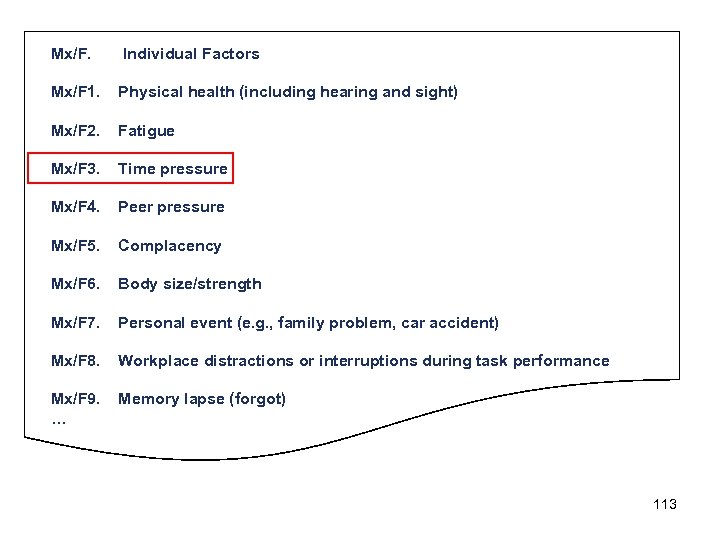 Mx/F. Individual Factors Mx/F 1. Physical health (including hearing and sight) Mx/F 2. Fatigue Mx/F 3. Time pressure Mx/F 4. Peer pressure Mx/F 5. Complacency Mx/F 6. Body size/strength Mx/F 7. Personal event (e. g. , family problem, car accident) Mx/F 8. Workplace distractions or interruptions during task performance Mx/F 9. … Memory lapse (forgot) 113
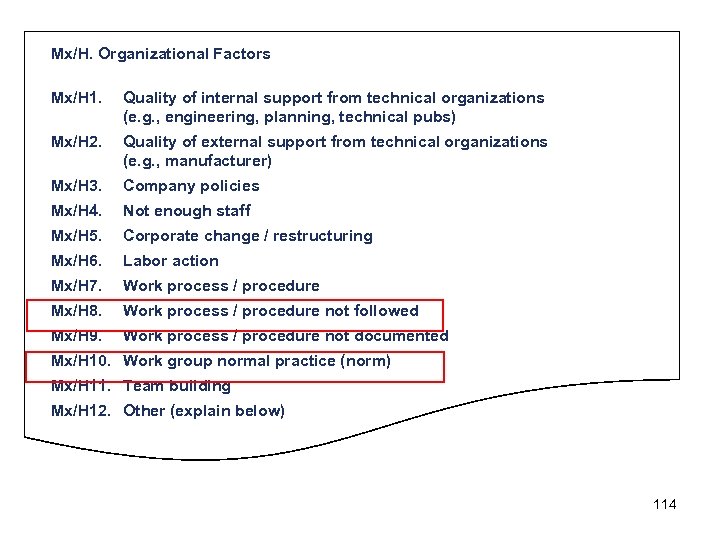 Mx/H. Organizational Factors Mx/H 1. Quality of internal support from technical organizations (e. g. , engineering, planning, technical pubs) Mx/H 2. Quality of external support from technical organizations (e. g. , manufacturer) Mx/H 3. Company policies Mx/H 4. Not enough staff Mx/H 5. Corporate change / restructuring Mx/H 6. Labor action Mx/H 7. Work process / procedure Mx/H 8. Work process / procedure not followed Mx/H 9. Work process / procedure not documented Mx/H 10. Work group normal practice (norm) Mx/H 11. Team building Mx/H 12. Other (explain below) 114
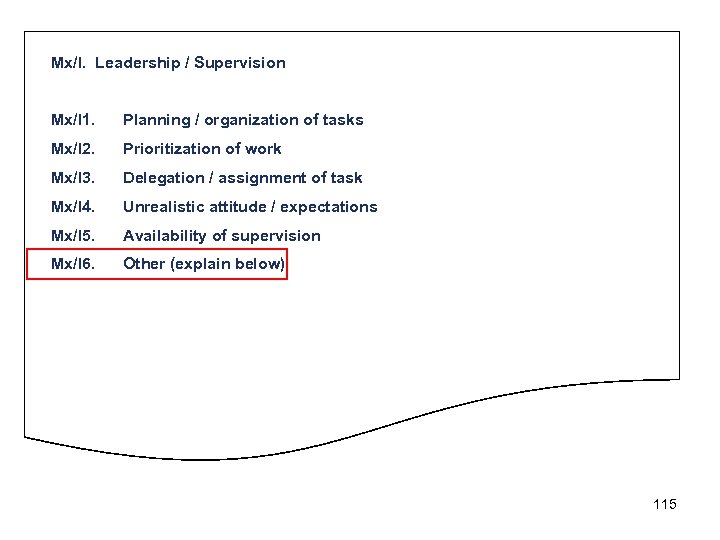 Mx/I. Leadership / Supervision Mx/I 1. Planning / organization of tasks Mx/I 2. Prioritization of work Mx/I 3. Delegation / assignment of task Mx/I 4. Unrealistic attitude / expectations Mx/I 5. Availability of supervision Mx/I 6. Other (explain below) 115
 LOSA Observation Form 116
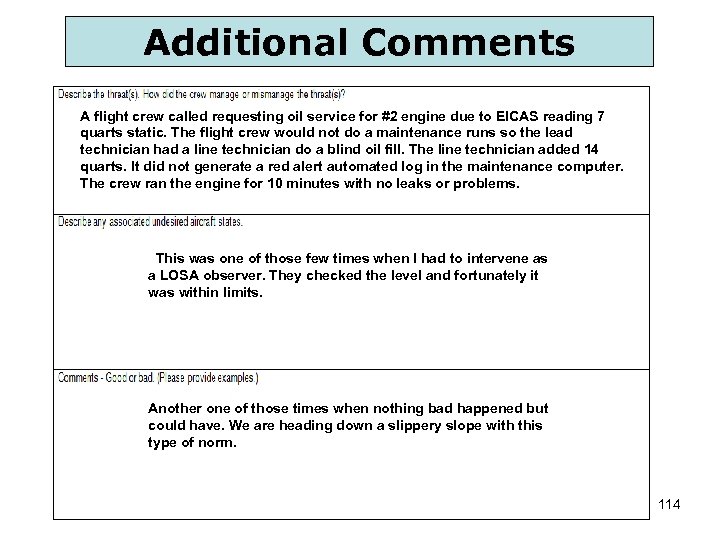 Additional Comments A flight crew called requesting oil service for #2 engine due to EICAS reading 7 quarts static. The flight crew would not do a maintenance runs so the lead technician had a line technician do a blind oil fill. The line technician added 14 quarts. It did not generate a red alert automated log in the maintenance computer. The crew ran the engine for 10 minutes with no leaks or problems. This was one of those few times when I had to intervene as a LOSA observer. They checked the level and fortunately it was within limits. Another one of those times when nothing bad happened but could have. We are heading down a slippery slope with this type of norm. 114
 This Concludes the Line Operations Safety Assessment (LOSA): Maintenance (Mx) Operations – Line Training Scenarios Visit the LOSA website: www. faa. gov/about/initiatives/maintenance_hf/losa/