 Скачать презентацию Lincolnshire Compact The impact of the public sector
9b8920e191fc3de141c959be9feb6f92.ppt
- Количество слайдов: 14



Lincolnshire Compact The impact of the public sector and the private sector working collaboratively to deliver public services – ‘Make or Buy’ and the pros and cons of working together Phil Ruston Business Development Director, Citizen Services, Serco UK & Europe December 2017 1 Serco Internal
Outline Agenda • The Business Services Market and why it is important to UK PLC? • What benefits does collaborative, partnership working bring to public service delivery? • Where does it work well and where does it work less well? • Make or Buy? 2 Serco Group plc - January 2020 Serco Internal
• According to the National Audit Office, the UK government spends £ 100 bn a year on the delivery of services by external providers • Private and not-for-profit providers have long played a role in the public sector as far back as competitive tendering in 1980 – with the UK now the largest and most sophisticated public service economy in the world • In the UK public sector alone, providers employ just over 1 million people according the Business Services Association 3 Serco Internal
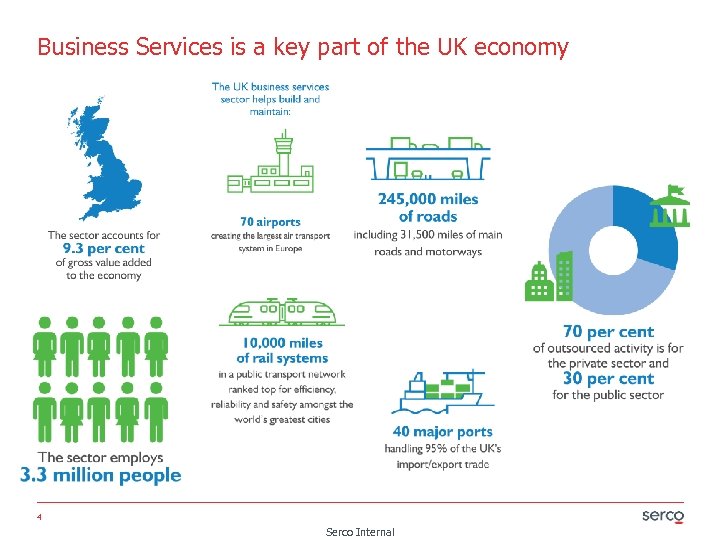
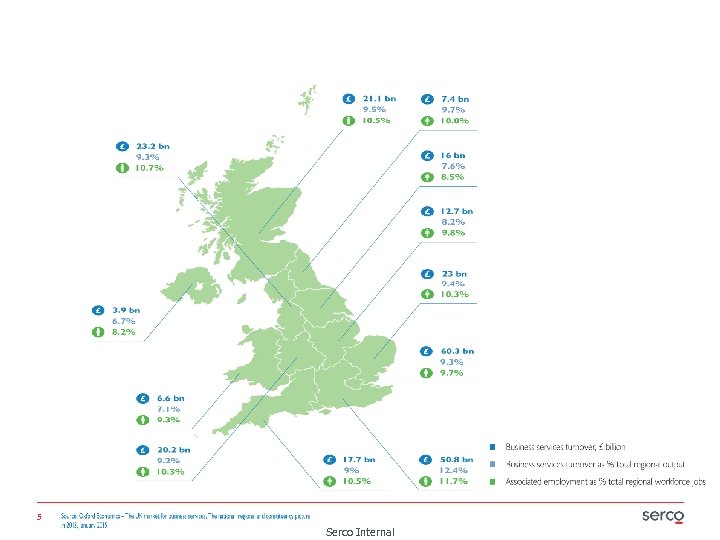
Business Services is a key part of the UK economy 4 Serco Internal
5 Serco Internal
Achieving the intended benefits of contracting-out • Getting a specialist in to deliver services can free up the client to focus on policy, strategy and stakeholders, and also deliver economies of scale. It can often provide access to skills that are difficult to retain inhouse; contractors can provide clearer career paths for specialists and are not restrained by more rigid public sector pay structures. • Involving a private sector partner can help to do things that are difficult to do within the way the public sector manages itself, such as facilitating ‘spend to save’ risk investment, using commercial incentives, and providing operational flexibility. • Differentiating between the commissioner and the provider can help stimulate the reform of public services, particularly through the rigour of defining services through a contract, stimulating the search for new ways of providing the services and establishing a more rigorous performance regime. Source : The role of major contractors in the delivery of public services – National Audit Office 6 Serco Internal
Productivity • We know there is a productivity challenge in the UK economy • Recent research by Centre for Economic Performance (CEP) found that most UK cities lag behind German productivity average. • Compared to UK’s ten “Core Cities” productivity in Munich is 88% higher and 42. 8% higher in Rotterdam • January – June 2017 saw the strongest half year performance since 2012 with most activity focussed on private sector • BSA research also shows a link between greater use of business services and productivity. 1% increase in outsourcing adds £ 2 Bn of productivity gains to the UK economy • Also showed that productivity gains were not at the expense of jobs and most intensive users of outsourcing experienced more than double average annual export growth*. • Skills and training is also a key to productivity gains. UK Employers spend less than nearly all other major EU economies and less than the EU average, a gap that has widened since 2005* * 7 Serco Internal
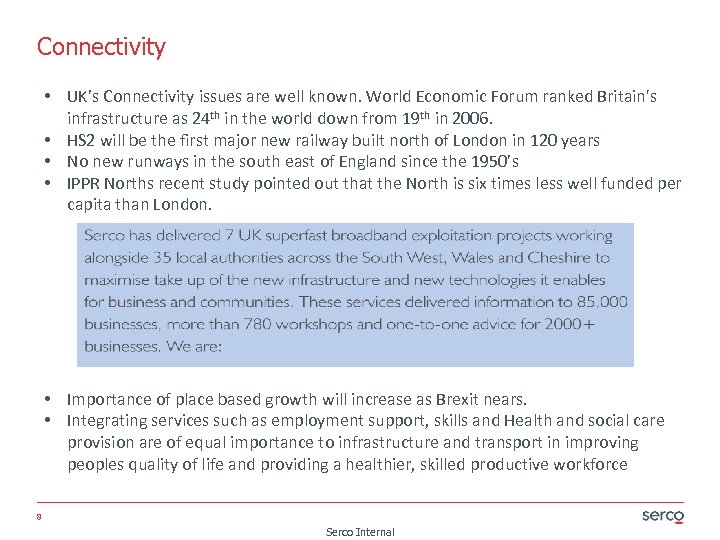
Connectivity • UK’s Connectivity issues are well known. World Economic Forum ranked Britain's infrastructure as 24 th in the world down from 19 th in 2006. • HS 2 will be the first major new railway built north of London in 120 years • No new runways in the south east of England since the 1950’s • IPPR Norths recent study pointed out that the North is six times less well funded per capita than London. • Importance of place based growth will increase as Brexit nears. • Integrating services such as employment support, skills and Health and social care provision are of equal importance to infrastructure and transport in improving peoples quality of life and providing a healthier, skilled productive workforce 8 Serco Internal
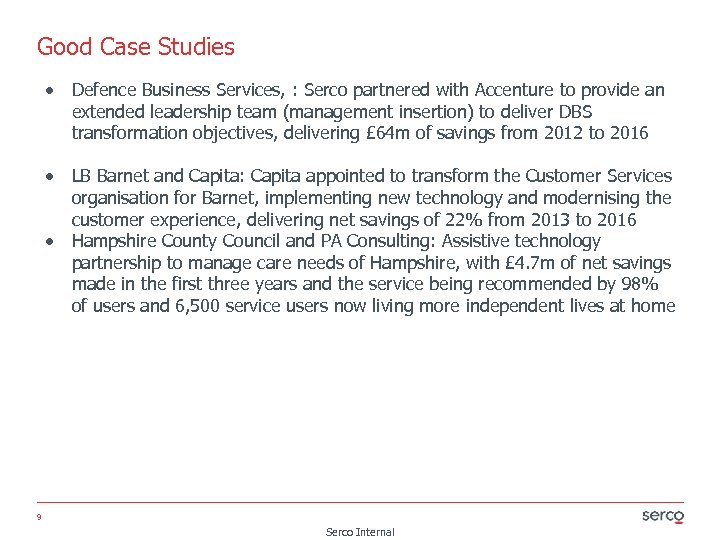
Good Case Studies Defence Business Services, : Serco partnered with Accenture to provide an extended leadership team (management insertion) to deliver DBS transformation objectives, delivering £ 64 m of savings from 2012 to 2016 LB Barnet and Capita: Capita appointed to transform the Customer Services organisation for Barnet, implementing new technology and modernising the customer experience, delivering net savings of 22% from 2013 to 2016 Hampshire County Council and PA Consulting: Assistive technology partnership to manage care needs of Hampshire, with £ 4. 7 m of net savings made in the first three years and the service being recommended by 98% of users and 6, 500 service users now living more independent lives at home 9 Serco Internal
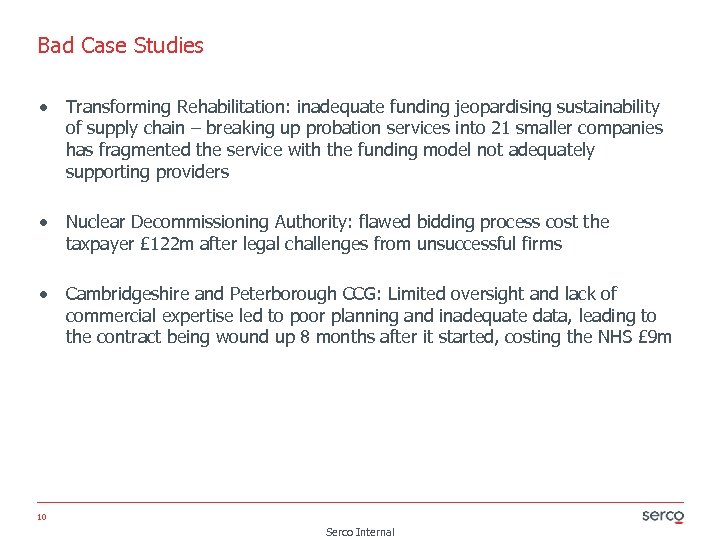
Bad Case Studies Transforming Rehabilitation: inadequate funding jeopardising sustainability of supply chain – breaking up probation services into 21 smaller companies has fragmented the service with the funding model not adequately supporting providers Nuclear Decommissioning Authority: flawed bidding process cost the taxpayer £ 122 m after legal challenges from unsuccessful firms Cambridgeshire and Peterborough CCG: Limited oversight and lack of commercial expertise led to poor planning and inadequate data, leading to the contract being wound up 8 months after it started, costing the NHS £ 9 m 10 Serco Internal
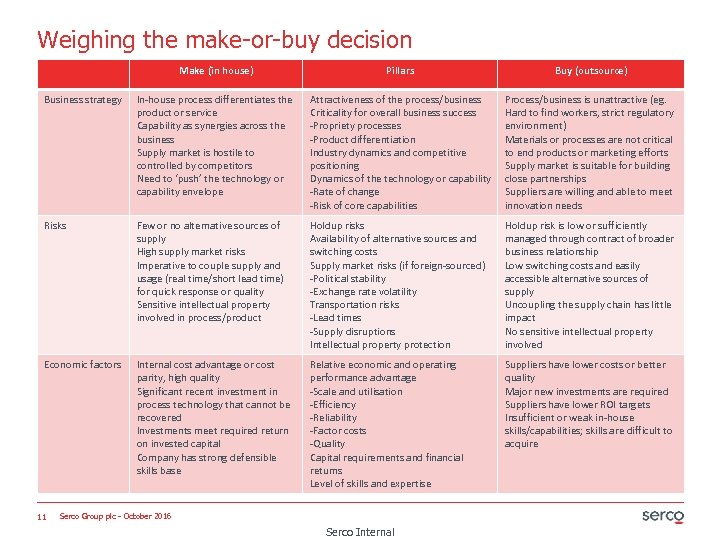
Weighing the make-or-buy decision Make (in house) Pillars Buy (outsource) Business strategy In-house process differentiates the product or service Capability as synergies across the business Supply market is hostile to controlled by competitors Need to ‘push’ the technology or capability envelope Attractiveness of the process/business Criticality for overall business success -Propriety processes -Product differentiation Industry dynamics and competitive positioning Dynamics of the technology or capability -Rate of change -Risk of core capabilities Process/business is unattractive (eg. Hard to find workers, strict regulatory environment) Materials or processes are not critical to end products or marketing efforts Supply market is suitable for building close partnerships Suppliers are willing and able to meet innovation needs Risks Few or no alternative sources of supply High supply market risks Imperative to couple supply and usage (real time/short lead time) for quick response or quality Sensitive intellectual property involved in process/product Holdup risks Availability of alternative sources and switching costs Supply market risks (if foreign-sourced) -Political stability -Exchange rate volatility Transportation risks -Lead times -Supply disruptions Intellectual property protection Holdup risk is low or sufficiently managed through contract of broader business relationship Low switching costs and easily accessible alternative sources of supply Uncoupling the supply chain has little impact No sensitive intellectual property involved Economic factors Internal cost advantage or cost parity, high quality Significant recent investment in process technology that cannot be recovered Investments meet required return on invested capital Company has strong defensible skills base Relative economic and operating performance advantage -Scale and utilisation -Efficiency -Reliability -Factor costs -Quality Capital requirements and financial returns Level of skills and expertise Suppliers have lower costs or better quality Major new investments are required Suppliers have lower ROI targets Insufficient or weak in-house skills/capabilities; skills are difficult to acquire 11 Serco Group plc - October 2016 Serco Internal
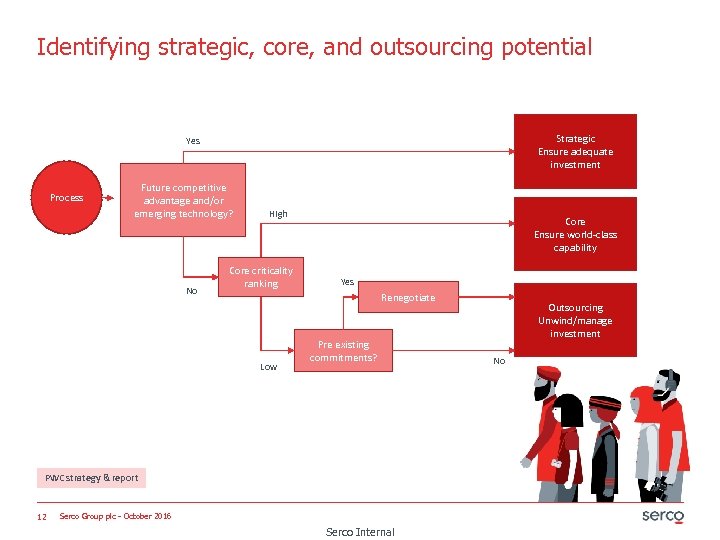
Identifying strategic, core, and outsourcing potential Strategic Ensure adequate investment Yes Process Future competitive advantage and/or emerging technology? No High Core criticality ranking Low Core Ensure world-class capability Yes Renegotiate Pre existing commitments? PWC strategy & report 12 Serco Group plc - October 2016 Serco Internal Outsourcing Unwind/manage investment No
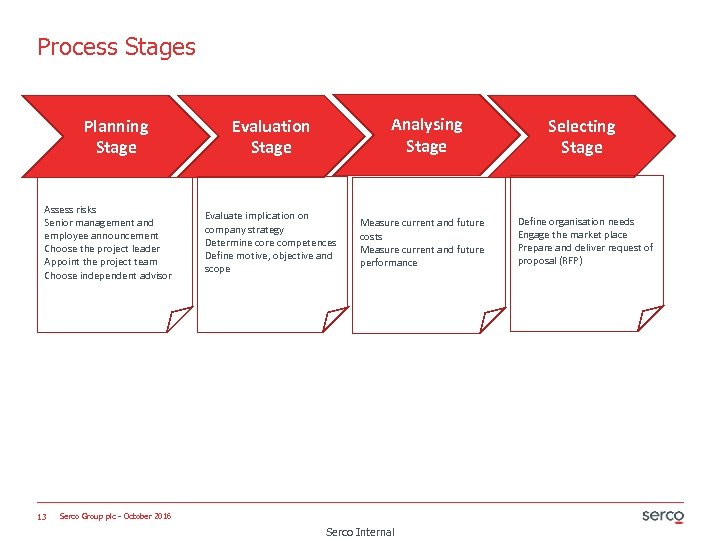
Process Stages Planning Stage Assess risks Senior management and employee announcement Choose the project leader Appoint the project team Choose independent advisor 13 Analysing Stage Evaluation Stage Evaluate implication on company strategy Determine core competences Define motive, objective and scope Measure current and future costs Measure current and future performance Serco Group plc - October 2016 Serco Internal Selecting Stage Define organisation needs Engage the market place Prepare and deliver request of proposal (RFP)
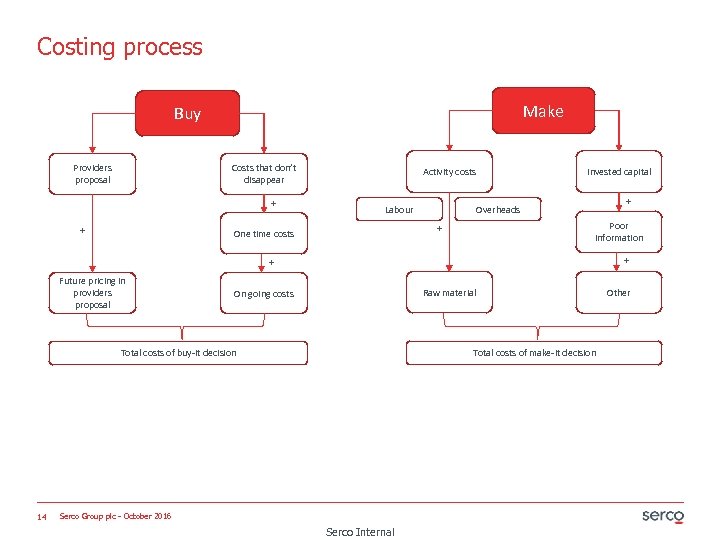
Costing process Make Buy Providers proposal Costs that don’t disappear + + Activity costs Labour Invested capital Poor information + One time costs + Overheads + + Future pricing in providers proposal Raw material On going costs Total costs of make-it decision Total costs of buy-it decision 14 Serco Group plc - October 2016 Serco Internal Other
Скачать презентацию Lincolnshire Compact The impact of the public sector
9b8920e191fc3de141c959be9feb6f92.ppt