 Скачать презентацию Lincoln-Douglas Debate The Forensics Files The Forensics
0c3b46181e09725560a4d5e4dcf92bf9.ppt
- Количество слайдов: 108



Lincoln-Douglas Debate The Forensics Files © The Forensics Files
Contents n n n Introduction The Format Argument Structure Standards in LD Evaluating Resolutions Case Writing & Researching Burdens Debating The Affirmative Rebuttals The Negative Speeches Cross-Examination Tournaments © The Forensics Files
Back to Table of Contents Introduction n Types of Debate Cross Examination Debate n Lincoln-Douglas Debate n Public Forum Debate n © The Forensics Files
Back to Table of Contents Introduction n Cross Examination Debate n n n First type of debate Teams of two compete Also called ‘policy debate’ The debate focuses on a resolution which provides parameters for solving a problem. The affirmative presents a problem and a solution (called the ‘plan’) which fits within the parameters set by the resolution. The negative tries to show that the plan won’t work, doesn’t fit the parameters or that a better solution exists. © The Forensics Files
Back to Table of Contents Introduction n Lincoln-Douglas Debate Individual debate n Also called ‘value debate’ n Individuals debate a resolution that focuses on a moral or ethical truth statement n Affirmative attempts to prove the statement true. n Negative attempts to show that the statement is false or show that the affirmative did not prove it true. n © The Forensics Files
Back to Table of Contents Introduction n Public Forum Debate Teams of two compete n Newest form of debate n Also called ‘Ted Turner Debate’ n The resolutions focus on topics related to current events. n The debate focuses on persuading a judge that the resolution is or is not true. n © The Forensics Files
Back to Table of Contents Introduction n Origins of Lincoln-Douglas Debate n n n Reaction to CX debate Many began to think that CX was too fast and unrealistic. Modeled after the debates between Lincoln and Douglas for the Illinois senate. Instead of focusing on a plan, LD debate focuses on values and issues of morality. LD introduced the value and criterion structure which serves as the way to evaluate the round. This structure allows the judge to pick a winner based on which side achieves certain moral principles. © The Forensics Files
Back to Table of Contents Introduction n Burdens for each side n n n There are no ‘official’ burdens in debate, but there are some commonly accepted burdens in most regions. The affirmative is typically thought to have the burden of proof. This is usually interpreted to mean that the affirmative must prove the resolution true in its entirety. The negative is typically thought to have the burden of clash. This usually means they have the burden to show that the affirmative’s reasoning is flawed and/or that the resolution is false. © The Forensics Files
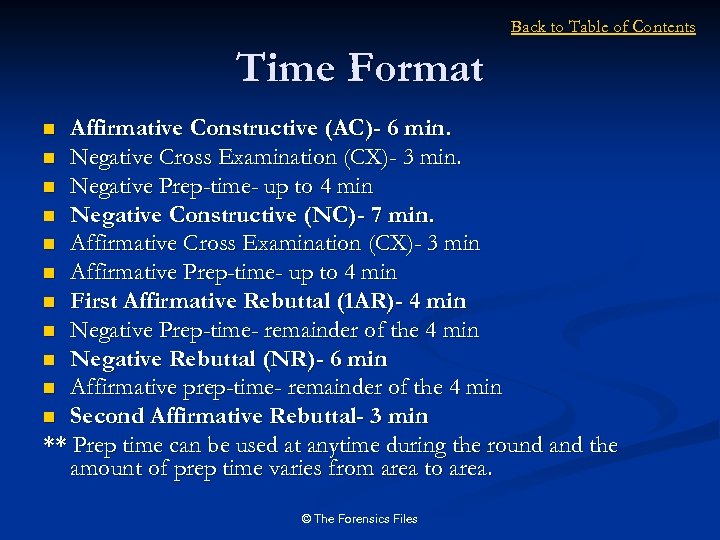
Back to Table of Contents Time Format Affirmative Constructive (AC)- 6 min. n Negative Cross Examination (CX)- 3 min. n Negative Prep-time- up to 4 min n Negative Constructive (NC)- 7 min. n Affirmative Cross Examination (CX)- 3 min n Affirmative Prep-time- up to 4 min n First Affirmative Rebuttal (1 AR)- 4 min n Negative Prep-time- remainder of the 4 min n Negative Rebuttal (NR)- 6 min n Affirmative prep-time- remainder of the 4 min n Second Affirmative Rebuttal- 3 min ** Prep time can be used at anytime during the round and the amount of prep time varies from area to area. n © The Forensics Files
Back to Table of Contents Argument Structure Proving something true. © The Forensics Files
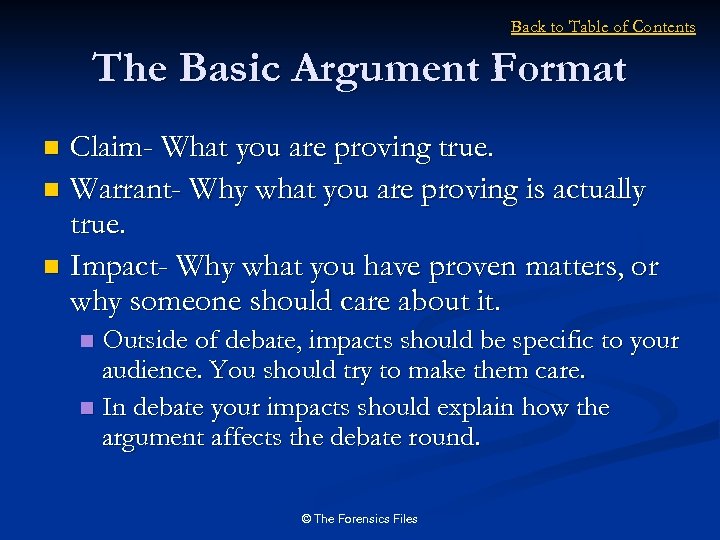
Back to Table of Contents The Basic Argument Format Claim- What you are proving true. n Warrant- Why what you are proving is actually true. n Impact- Why what you have proven matters, or why someone should care about it. n Outside of debate, impacts should be specific to your audience. You should try to make them care. n In debate your impacts should explain how the argument affects the debate round. n © The Forensics Files
Back to Table of Contents Claim This is the statement that you are proving true. n Answers the question ‘what? ’ n Example n n Claim: The Dallas Cowboys are the best football team. © The Forensics Files
Back to Table of Contents Warrant These are the reasons why the claim is true. n The more warrants, the more credible the argument is. n Example n n Claim: The Dallas Cowboys are the best football team. n Warrant: The Dallas Cowboys have won many Superbowls. n Warrant: The Cowboys have a strong offense. © The Forensics Files
Back to Table of Contents Impact n n This is the reason why the argument matters. No matter how true an argument is, if there is no reason to care about it, then it doesn’t matter. Answers the question ‘so what? ’ Example n n Claim: The Dallas Cowboys are the best football team. Warrant: The Dallas Cowboys have won many Superbowls. Warrant: The Dallas Cowboys have a strong offense. Impact: The Dallas Cowboys will win the Superbowl. © The Forensics Files
Back to Table of Contents Types of Impacts n In debate there are two basic levels or types of impacts. n n Out-of-round impacts- these are things that you are debating about. If you argue that the resolution is true or false because of an impact then you are making an argument about something that will happen out of the round, in the real world. In-round impacts- these explain how your argument actually affects the current debate round. n For example: The impact that I have proven the resolution true is an impact that is actually happening in the debate round, not in the real world. © The Forensics Files
Back to Table of Contents Refuting an Argument In order for an argument to carry any weight in a debate round, all three parts of the argument must be intact. n In order to refute an argument you only need to take out one part. n However, an argument usually only needs one warrant and one impact, so you must refute all warrants or all impacts. n © The Forensics Files
Back to Table of Contents Standards in Lincoln. Douglas Debate The Weighing Mechanisms © The Forensics Files
Back to Table of Contents What are standards? n Value n Criterion n Debating the standards n Impacting to the standards n © The Forensics Files
Back to Table of Contents What are the Standards? Standards are used to weigh the impacts in the debate round. n Only impacts that relate to the given standard are relevant in the debate round. n Thus they are used to narrow the debate to a few key issues. n © The Forensics Files
Back to Table of Contents Standards in Everyday Life n n Everyday we all use standards to make decisions. For example, we all have standards for friendship. These usually include loyalty, trustworthiness, and compassion. These are all standards for friendship. Teachers also use standards for grading. If you’ve ever had a project and your teacher has given you grading criteria or a rubric, then your teacher was giving you standards for getting a good grade. These function in a similar manner in debate. © The Forensics Files
Back to Table of Contents Value The value is the first part of the traditional LD standards structure. n The value is the goal that each debater is trying to show that her side achieves. n Values are often derived from the resolution. For example, if the resolution asks if something is just, then the value usually is justice. n Values are abstract goals, they are not tangible objects. n © The Forensics Files
Back to Table of Contents Requirements for the Value The value must somehow link to the resolution, this means that it must reflect a goal that the resolution implies is good or worth achieving. n The value should also be something that is inherently good; something that is valuable. n n Other common values are liberty, societal welfare, morality, and legitimate government. © The Forensics Files
Back to Table of Contents Criterion n n There are many different conceptions of the criterion. The criterion is the mechanism to achieve the value. By meeting or achieving the criterion, the value should also be met. Different debaters will establish how to meet the criterion in different ways. There is no set way to do this, but remember to make it clear how to impact to your criterion. n For example, if your criterion is protecting rights, you need to explain if some rights violations can occur or if any violation at all will prevent someone from meeting the standard. © The Forensics Files
Back to Table of Contents Requirements for the Criterion n The criterion should be a verb, it should be an action that can be taken to meet the value. Good criterion- protecting rights n Bad criterion- safety (No verb) n n The criterion should be measurable. Good criterion- ensuring consistent punishment n Bad criterion- protecting welfare (cannot measure welfare) n © The Forensics Files
Back to Table of Contents Requirements for the Criterion The criterion should be specific. n The criterion should be necessary to achieve the value. This means that you shouldn’t be able to achieve the value without this criterion. n The criterion should be sufficient to meet the value, in other words, you should be able to achieve the value by meeting the criterion alone. n © The Forensics Files
Back to Table of Contents Debating the Standards n n n Remember that both you and your opponent will present a value and a criterion, but only one of them will be used at the end of the round to evaluate the other arguments. Thus you need to show the judge why they should prefer your standards. There at least two distinct levels of debating in an LD round, the standards debate and the case debate. The standards debate should only discuss the validity of USING the standards to weigh the round. The standards debate should NOT discuss whether or not you achieve the standard. © The Forensics Files
Back to Table of Contents Arguments to use while debating the standards n Value n n n Doesn’t link to the resolution Isn’t inherently valuable Criterion n n n Doesn’t link to the value Isn’t necessary to achieve the value Isn’t sufficient to achieve the value Isn’t measurable Need another standard to weigh it Is too vague No brightline for when it has been achieved © The Forensics Files
Back to Table of Contents Impacting to the Standards n n Having the better standards DOES NOT mean that you have won the round! To win the round you must show that you have better achieved the standards. It is possible to have the better standards and still lose the round if your opponent shows that they impacts to your standard are greater than yours. After discussing an argument, you should show it functions to achieve the criterion. Also, you should discuss how those impacts show that you meet the criterion more than your opponent does. © The Forensics Files
Back to Table of Contents Evaluating Resolutions “The topic is out! Now what? ” © The Forensics Files
Back to Table of Contents Evaluative term n Agent of Action n Comparative v. Non-comparative n Every word matters n © The Forensics Files
Back to Table of Contents Evaluative term n n The evaluative term/phrase is the part of the resolution that asks the question. It tells you what the resolution is questioning. Ex. Resolved: Murder is wrong. n n The evaluative term is “is wrong. ” The resolution is asking if the subject, murder, “is wrong. ” That is the question for the debate. Ex. Identify the evaluative term in the following resolutions: n n n Resolved: Killing in self-defense is just. Resolved: Killing in self-defense is acceptable. Resolved: Killing in self-defense should be legal. © The Forensics Files
Back to Table of Contents Evaluative term n Resolved: Killing in self-defense is just. n n Resolved: Killing in self-defense is acceptable. n n ‘Is just’ ‘Is acceptable’ Resolved: Killing in self-defense should be legal. n ‘Should be legal’ © The Forensics Files
Back to Table of Contents Agent of Action n n The Agent of Action is the entity that will be performing the action in the resolution. There are often several interpretations of the agent of action. Sometimes the Agent of Action is the entity evaluating the resolution as well. Identify the agent of action in the resolution: n n n Resolved: Killing in self-defense is just. Resolved: Killing in self-defense is acceptable. Resolved: Killing in self-defense should be legal. © The Forensics Files
Back to Table of Contents Agent of Action n Resolved: Killing in self-defense is just. n Possibly the person doing the killing n n Also could be whoever is determining justice- usually society or even a legal system n n This agent might be making the desicion that the resolution is asking for. Resolved: Killing in self-defense is acceptable. n Most likely the agent here is the person doing the killing. n n This person is taking the action of killing Because the resolution does not ask for justice, but rather acceptability, the individual is most likely the actor. Resolved: Killing in self-defense should be legal. n The legal system changes the agent here, society or the legislative system determines legality. © The Forensics Files
Back to Table of Contents Comparative v. Non-comparative n n Comparative resolutions are resolutions that ask for one thing to be valued above another. Here a view examples: n n n Resolved: Individual claims to privacy ought to be valued above claims to societal welfare. Resolved: An individual’s obligation to society ought to outweigh society’s obligation to the individual. Non-comparative resolutions usually only evaluate one thing. n The self-defense resolution is an example of a noncomparative resolution. © The Forensics Files
Back to Table of Contents Every Word Matters Simple words can change the entire debate and meaning of a resolution. n Ex. Do you see the difference between these resolutions? n n Resolved: Killing in self-defense is the just response. n Resolved: Killing in self-defense is acceptable. n Resolved: Killing in self-defense should be legal. © The Forensics Files
Back to Table of Contents Every Word Matters n Resolved: Killing in self-defense is the just response. n n n Resolved: Killing in self-defense is a just response. n n The difference here is that ‘a’ suggests that there can be other just responses as well. Resolved: Killing in self-defense is acceptable. n n Just seems to mean that this action is the right thing to do. ‘The’ suggests that there is only one just action or that this is the most just action. Here the evaluative phrase ‘is acceptable’ has changed and now the resolution is asking not if it is the action is the right thing to do but rather if it is ok to do. Resolved: Killing in self-defense should be legal. n Here the agent of action has changed, we are no longer evaluating if the person that is committing the killing is correct but rather if society should allow the action. © The Forensics Files
Back to Table of Contents Other Word Choices Other words are important too. For example if the resolution uses ‘a’ instead of ‘the’ it can completely change the debate. n When you evaluate resolutions make sure to pay attention to all of the words in the resolution so you can anticipate things your opponents will try. n © The Forensics Files
Back to Table of Contents Case Writing and Researching Where to get started © The Forensics Files
Back to Table of Contents Constructing value and criterion n Constructing contentions n Tips for researching the resolution n Using evidence in case n © The Forensics Files
Back to Table of Contents Constructing the Value n n Your value is the ultimate goal that you are trying to achieve. A true value should be good in and of itself. For example, justice, rights, and life are all intrinsically good. You should pick a value that is specific to the resolution. Many times your value will be prescribed by the resolution. For example, with a resolution that questions whether or not an action is just, you would value justice. © The Forensics Files
Back to Table of Contents Constructing the Criterion n n Your criterion measures whether or not you have met your value and should be presented in-case after your value. Your criterion should provide a clear calculus to weigh the round. For example, a criterion of “protecting rights” is weighable, which means that the debater who best protects rights should win the round. Since your criterion should be weighable, your criterion must contain a verb. You should use a value/criterion structure that will be easy for you to meet. © The Forensics Files
Back to Table of Contents Constructing the Contentions n n n Your contentions are your main arguments that illustrate how you impact to your criterion and should be presented in the case after your criterion. Most cases have two to three contentions and it is advisable for you not to exceed this amount. Each contention requires time and analysis and the more contentions you have the less substantive each of them becomes. Each of your contentions should follow the basic argument structure of claim – warrant – impact. Each contention should be presented with a tagline (claim), which is a brief 4 -8 word sentence that summarizes your argument. Example, “My first contention is that the use of the death penalty decreases the rights of the convicted. ” © The Forensics Files
Back to Table of Contents Tips for researching the resolution n n Before you begin writing your case you should have a proper understanding of the resolution. After this you can begin researching for evidence to use in your case. Evidence can be found from numerous places ranging from printed material like books to online material like academic journals. Anything you decide to use should come from a reputable source. Using evidence in your case is a great way to support your arguments and an even better way to gain credibility. © The Forensics Files
Back to Table of Contents Using Evidence in-case n n Evidence can be utilized to highlight aspects of the claims, warrants, and impacts that you are making. Many times a professional who has spent years in a specific field can better explain the implication of one of your arguments. Although evidence can be used to boost credibility and to explain an argument, evidence itself is not necessary to constructing a case. If you can better explain an argument yourself then you should. Remember, a good argument is good because it is explained well, not because of who says it. © The Forensics Files
Back to Table of Contents Citing Evidence You should site your evidence in-case before you say it. Additionally, although it is perfectly fine to simply say a name or an organization, you should have the full citation available. n The idea is that anybody who wanted to access the source of your evidence could do so by your citation. This requirement acts as a check on debaters making up evidence. n Your citation does not need to follow any specific format, but it should contain things like author’s name, organization, title, date, and url if you retrieved it online. n Example, Director of Legal Studies at the University of Texas, John Doe explains, “----------------------------------------------------------------------------------------------------------------------------------------------------” n (Doe, John. University of Texas. Policy Journal. “Aspects of Law, ” p. 20. March 16, 2006. ) © The Forensics Files
Back to Table of Contents Evidence Out of Context n n When using evidence, you should include, or have available, the whole paragraph from which you are pulling from. This is to ensure that you are not taking the author out of context. If you only included parts of the paragraph then there would be no way to decipher whether or not the author comes to a clear conclusion. Additionally, this makes the debate unfair because now your opponent cannot specifically indict your author/evidence because they do not have access to all of it. You do not have to read the whole paragraph in round; many times there is superfluous information that does not need to be said. You can simply underline the parts that you want to read and only read those. © The Forensics Files
Back to Table of Contents Burdens Winning the Round © The Forensics Files
Back to Table of Contents Types of Burdens n Establishing Burdens n Refuting Burdens n Meeting Burdens n © The Forensics Files
Back to Table of Contents Types of Burdens n Remember: n n n The Affirmative is often assumed to have the burden of proof. The Negative is often assumed to have the burden of clash. Besides these preliminary burdens there are two general categories of burdens: n n Offensive burdens Defensive burdens © The Forensics Files
Back to Table of Contents Offensive Burdens n n Offensive burdens are burdens that generate offense for a debater when they meet them. Usually offensive burdens are placed upon oneself. A debater will argue that if the offensive burden is met, then they win the round or have at least done what they need to do to win the round. The criterion often serves as an offensive burden. If the criterion is met, usually that debater will win the round. © The Forensics Files
Back to Table of Contents Defensive Burdens n n n Defensive burdens are necessary but not sufficient to win rounds. This means that a debater must meet the burden before they can gain offense or attempt to win the round, but meeting the burden isn’t enough to win the round alone. Defensive burdens are generally placed by the debater’s opponent. Defensive burdens make the round harder for the person who has to meet them because they require extra work in the round but don’t usually generate more offense for the debater once they meet them. © The Forensics Files
Back to Table of Contents Establishing Burdens n n n Burdens should be structured in the same ways as any other argument. First, you must establish what the burden is. You must explain how your opponent can meet the burden, you why they are not meeting the burden. Second, you must explain why the burden must be met. Often you can derive a burden from the wording of the resolution or the phrasing of the standard. If these imply a burden that is not explicit you can attempt to make them meet it. You can also explain why the resolution means you only have one burden. Third, you must explain why the burden is more important than other issues in the round. Fourth, you must explain why this is important enough to vote off of. Fifth, you must explain how this burden affects the round. Usually for an offensive burden the implication will be that you win the round. For a defensive burden, the implication is that the burden must be met before your opponent can have a chance of winning the round. © The Forensics Files
Back to Table of Contents Refuting Offensive Burdens n n First, placing a defensive burden on your opponent is a good way to impede an offensive burden. The offensive burden doesn’t function to win the round if there is a defensive burden that isn’t met. Second, you can nullify the burden by doing one of the following: n n n Refute the justification for the burden, explain that the resolution implies more than just meeting this one burden. Show that even if the burden is important, it is not more important than the other issues in the round. Show that the implication of not meeting the burden doesn’t really matter. © The Forensics Files
Back to Table of Contents Refuting Defensive Burdens n In order to nullify a defensive burden you must do one of the following: Meet the burden n Refute the justification for the burden, explain that the resolution does not imply that you must do whatever your opponent argues you must. n Show that even if the burden is important, it is not more important than the other issues in the round. n Show that the implication of not meeting the burden doesn’t really matter. n © The Forensics Files
Back to Table of Contents Meeting Burdens n When attempting to meet burdens it is important to: Use the same rhetoric or word choice as the burden. This will make it clear that you have met the burden. n Explain the implication of meeting the burden. Discuss how this burden affects the round and the way that the judge should evaluate the arguments. n © The Forensics Files
Back to Table of Contents Last Note n n Burdens can be very difficult to understand or deal with. If you are having trouble with burdens a good approach is to refute the concept of a burden. Burdens are usually arbitrary and do not provide sufficient justification as to why they are more important than the standards. You can always argue that because they are arbitrary and that all the necessary burdens are already incorporated into the standards that the judge should not evaluate other burdens in the round. © The Forensics Files
Back to Table of Contents Debating Putting things into Practice © The Forensics Files
Back to Table of Contents Speech Times n Prep Time n Flex Prep n Pre-Flows n Flowing n Sign-Posting n © The Forensics Files
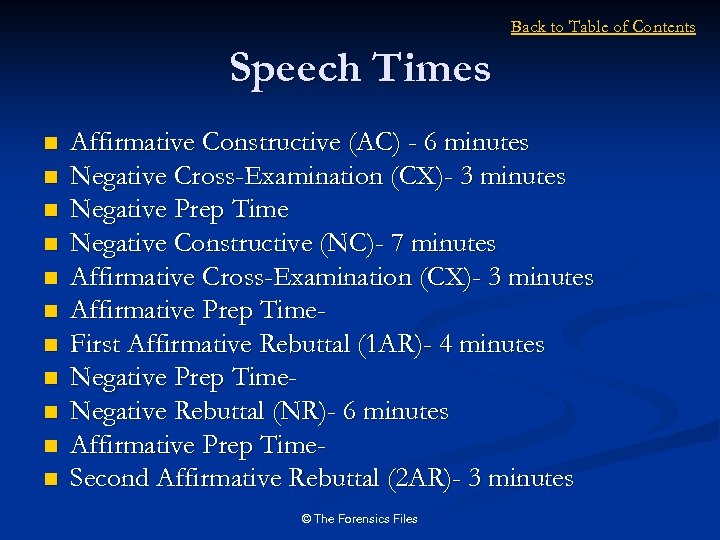
Back to Table of Contents Speech Times n n n Affirmative Constructive (AC) - 6 minutes Negative Cross-Examination (CX)- 3 minutes Negative Prep Time Negative Constructive (NC)- 7 minutes Affirmative Cross-Examination (CX)- 3 minutes Affirmative Prep Time. First Affirmative Rebuttal (1 AR)- 4 minutes Negative Prep Time. Negative Rebuttal (NR)- 6 minutes Affirmative Prep Time. Second Affirmative Rebuttal (2 AR)- 3 minutes © The Forensics Files
Back to Table of Contents Prep Time n n n Each debater begins each round with a certain amount of prep time. The amount varies from tournament to tournament and from region to region. Make sure to check with the tournament to determine how much the debaters will have for their rounds. The minimum amount is 3 minutes The debaters may use their prep time before both of their unprepared speeches. These speeches are the negative constructive and rebuttal and the affirmative first and second rebuttals. Once you have used all of your prep time, you must stop preparing, and give your speech. The time can be divided between the two preparation periods however the debater chooses. n For example, the debate might use two minutes during the first part and one minute during the second. © The Forensics Files
Flex Prep n n The preparation periods follow both cross-examination periods. At some larger tournaments, debaters are allowed to use the time together. n n n This means that the 3 minutes of cross-examination is added to the prep time and the debaters may use all of this time for preparation. They may also ask questions during the entire time. Usually questions are allowed in both preparation periods if this system is used. Remember that if flex prep is not use, you may not ask questions during prep time. Check with the tournament to determine if flex prep will be used. © The Forensics Files
Back to Table of Contents Pre-Flows n n n n Before you debate, it is necessary for you to write all of your arguments down so that you can keep track of them during the round. To do this, first take two pieces of computer paper. Make five columns on one and four columns on the other. If you are affirming, you will write your arguments on the paper with five columns. If you are negating, you will write your arguments on the paper with four columns. You will write your arguments from your case in the first column on your respective paper. Write these as small as you can, but make sure you can still read them. You will want to leave space between each argument so that you have room to write your opponent’s responses next to your argument. Make sure you write down your value, criterion, taglines from your case, your authors’ names and. Files your evidence says. © The Forensics what
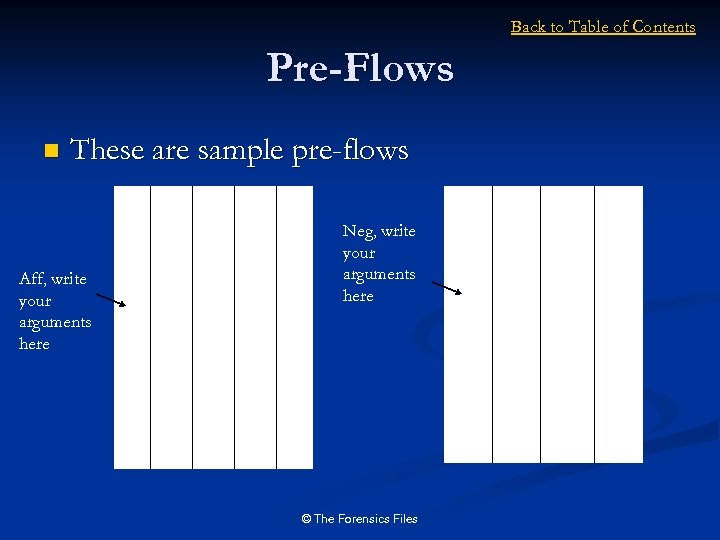
Back to Table of Contents Pre-Flows n These are sample pre-flows Aff, write your arguments here Neg, write your arguments here © The Forensics Files
Back to Table of Contents Pre-Flows For each round you will need a pre-flow of your case. n You will also need a blank pre-flow so that you can write down your opponents arguments. n So, if you are Affirming, you will have one paper will five columns that has your case pre-flowed on it. You will also have one paper with four columns that are all blank. n © The Forensics Files
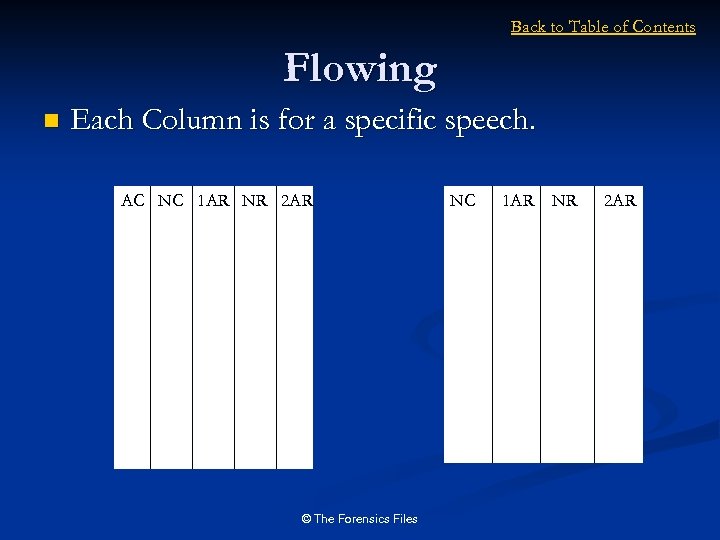
Back to Table of Contents Flowing n Each Column is for a specific speech. AC NC 1 AR NR 2 AR © The Forensics Files NC 1 AR NR 2 AR
Back to Table of Contents Flowing n n n Flowing is a method of keeping track of the arguments in the debate round. You will write the responses to an argument next to that argument, in the correct speech column. For example, if you are the affirmative debater, you will flow the negative case in the first column on the paper with four columns. Then, when your opponent finishes reading their case, you will flow their responses to your case in the column next to where you pre-flowed your case. The paper with five columns is where all arguments about the affirmative case should go and this is called the affirmative flow. The paper with four columns is where all arguments about the negative case should go and this is called the negative flow. © The Forensics Files
Back to Table of Contents Sign-Posting n n The judge will use their own flow to determine who won the round. Remember that they have to write all of the arguments down, so you want to make sure that you are clear. Sign-posting means explaining to the judge what argument you are referring to and where it is on the flow. You should tell the judge physically where the argument is. n n Ex. “Go to the first argument in my contention. ” Then explain what the argument says so that the judge knows exactly where to write what you are saying. © The Forensics Files
Back to Table of Contents Affirmative Rebuttals Proving the Resolution is Still True © The Forensics Files
Back to Table of Contents Goal of affirmative speeches n 1 AR- First Affirmative Rebuttal n 2 AR- Second Affirmative Rebuttal n Structuring voters n © The Forensics Files
Back to Table of Contents A Note about Affirming n n The advantage of affirming is that you have the first and last speech. The disadvantage of affirming is that you have much shorter speeches than your opponent. Because of the time disadvantage, it is important that you be selective in which issues you want to discuss in your speech. You will not be able to cover everything in the round; so you need to show why things that you are winning are more important than the things you cannot address. © The Forensics Files
Back to Table of Contents Goal of Affirmative speeches n The goals of the Affirmative rebuttals are: Show that your case or offense is still intact. n Establish enough offense to win the round. n Explain why what you are winning is more important than what your opponent is winning. n Prove the resolution true. n © The Forensics Files
Back to Table of Contents Order of the 1 AR n n n Burdens Overviews (which are still usually a type of burden) Values Criteria Offense- always start with your case because you need offense to be able to win the round. Defense- You should try to refute your opponents arguments but winning your own arguments is more important. © The Forensics Files
Back to Table of Contents 1 AR Formula- Burdens and Standards n n n n n My burden is to prove the resolution true. If I do this then you sign your ballot affirmative. ***Go to the overview, my opponent says this is pre-standard, but the implications are only bad if they impact to a standard and it does not, thus the overview is not a reason to negate. Go to my value, my value links to the resolution because ____. My opponent argues that my value _____, this is untrue because____. My opponent’s value does not link to the resolution because _____. My criterion is the proper method to achieve my value because _______. My opponent argues _____ against my criterion, these are untrue because ____. The problems with my opponent’s criterion are (insufficient, unnecessary, circular, etc. ) Therefore, my criterion of ____ is now the only weighing mechanism for the round, if I comparatively meet this criterion better, then I have met my burden for the round and you vote affirmative. © The Forensics Files
Back to Table of Contents 1 AR Formula- Extending Offense n n Go to the __(restate the argument)_____ argument in contention one (give the physical location of this argument on the flow). My opponent argues _____ against this. This is untrue because _____. Therefore, I am winning this argument. The implication of this argument is that ______( state out-of-round impact… ex. Terrorism)___. This shows that I am comparatively achieving the standard better because _____. Thus I have met my burden for the round and you can vote for me. Go to the negative case. Remember I have already won the round, but if you don’t buy that, I’m going to refute the negative anyway. © The Forensics Files
Back to Table of Contents 1 AR Formula. Refuting the Negative Case n n n Go to ____(state the physical location of the argument on the flow)____. My opponent argues _______ (restate their argument)_____. This is untrue because ___________. (Repeat all the way down the negative flow) End of speech: Remember my job is to prove the resolution true, I have done that by meeting the criterion and achieving the value. Therefore, I urge an affirmative ballot. © The Forensics Files
Back to Table of Contents 1 AR Notes n n n Remember to impact the arguments to the standards when extending and refuting. Try to compare the arguments during this speech, remember that you will probably not win every argument in the round so you should show why the arguments your opponent is winning do not matter. It is important to always start with the affirmative case because you need to have offense. If you and your opponent have offense, you can still win the round, but if you have no offense then you have virtually no chance of winning the round. © The Forensics Files
Back to Table of Contents Order of 2 AR Burdens n Overviews (which are still usually a type of burden) n Values n Criteria n Offense- including final weighing n Defense- including final weighing n Voters/ Voting Issues n © The Forensics Files
Back to Table of Contents 2 AR vs. 1 AR n n In the 2 AR you can follow a similar format as the 1 AR but you need to be more comparative in your analysis. That is, compare what you are winning to what your opponent could be winning. The 2 AR should summarize the discussions that have taken place in the round and give reasons as to why you have won. Remember a voting issue should be an impact to the standard or a burden; it should not be the value or the criterion. You should not make new arguments in the 2 AR. © The Forensics Files
Back to Table of Contents Voting Issues Voting issues should write the ballot for the judge. Explain why you have won the round. n A voting issue should be an argument on the flow whose impact is that the resolution is true. This is usually an impact to the standard. n You should compare your voting issues to the negative voting issues and show why yours are more important or why theirs are not really reasons to vote for them. n © The Forensics Files
Back to Table of Contents The Negative Speeches Disproving the resolution © The Forensics Files
Back to Table of Contents Goal of negative speeches n NC- Negative Constructive n NR- Negative Rebuttal n Structuring voters n © The Forensics Files
A Note about Negating n n The advantage of negating is that you have longer speeches. The disadvantage of negating is that your opponent has the first and last speeches. Your goal should be to make the affirmative’s job much harder by using your time advantage to make a good number of arguments and to make offensive arguments as well. Your opponent will have to be selective about what they cover in their speeches so you want to make sure that as many issues as possible are important in the round. © The Forensics Files
Back to Table of Contents Goal of Negative speeches n The goals of the Negative rebuttals are: Show that your case or offense is still intact. n Establish enough offense to win the round. n Show that your opponent doesn’t have sufficient offense to win the round. n Explain why what you are winning is more important than what your opponent is winning. n © The Forensics Files
Back to Table of Contents Order of the NC n n n Read your case- this establishes your offense Respond to any framework discussion. Framework arguments are arguments that present observations or ideas that shape the debate. Respond to the standards debate- usually this means showing why your standards are preferable. Refute the affirmative offense. Watch out for any ‘pre -standards’ arguments. Remember in the NC you are basically only refuting your opponents arguments. © The Forensics Files
Back to Table of Contents NC Formula- standards n n Go to my opponent’s value, it does not link to the resolution because ____. My criterion is the proper method to achieve my value because _______. The problems with my opponent’s criterion are (insufficient, unnecessary, circular, etc. ) Therefore, my criterion of ____ is now the only weighing mechanism for the round, if I comparatively meet this criterion better, then I have met my burden for the round and you vote negative. © The Forensics Files
Back to Table of Contents NC Formula- responding to offense n n n Go to ____(state the physical location of the argument on the flow)____. My opponent argues _______ (restate their argument)_____. This is untrue because ___________. (Repeat all the way down the affirmative flow) **You should also try to make offensive arguments, to do this you must show why an argument they make actually supports your side of the resolution or why they actually cause the problems they are trying to prevent. © The Forensics Files
Back to Table of Contents NC Notes Remember, if you can refute the main premise behind the case your opponent’s 1 AR will be much more difficult. n Refuting the claim, warrant and impact as well as the link to the criterion for the arguments in the affirmative case will make it much harder for the affirmative to rebuild the argument. n © The Forensics Files
Back to Table of Contents NR-Negative Rebuttal n n There is no set ‘order’ for this speech. In this speech you need to do all of the following: n n n Discuss the standards debate Rebuild your offense Show why the offense your opponent extended doesn’t matter or is still not true. Compare your offense to your opponents. Give voting issues. Do not make new responses to the affirmative case. © The Forensics Files
Back to Table of Contents NR Formula-extending offense n Go to the __(restate the argument)_____ argument in contention one (give the physical location of this argument on the flow). My opponent argues _____ against this. This is untrue because _____. Therefore, I am winning this argument. The implication of this argument is that ______( state out-of-round impact… ex. Terrorism)___. This shows that I am comparatively achieving the standard better because _____. Thus I have met my burden for the round and you can vote for me. n ***This should be used to rebuild arguments in your case during the NR. © The Forensics Files
Back to Table of Contents Giving Voting Issues n n n Voting issues should write the ballot for the judge. Explain why you have won the round. A voting issue should be an argument on the flow whose impact is that the resolution is true. This is usually an impact to the standard. You should compare your voting issues to the affirmative voting issues and show why yours are more important or why theirs are not really reasons to vote for them. However, the affirmative has not given their voting issues yet, so you should weigh between your voting issues and the offense they extended in the 1 AR. © The Forensics Files
Back to Table of Contents CX “Who, What, Where, When, Why, How? ” © The Forensics Files
Contents Overview n Purpose of CX n CX strategy n © The Forensics Files
Back to Table of Contents Overview n n n There are two 3 -minute cross examination (CX) periods. There is a CX after the affirmative constructive (AC) where the negative has an opportunity to ask the affirmative questions. The affirmative has an opportunity to ask the negative questions after the negative constructive (NC). You should stand during CX and remain facing the judge. Just as in every speech you should time CX while you’re asking and answering questions. © The Forensics Files
Back to Table of Contents Purpose of CX n 1. CX should be utilized for three main goals: Filling in missing parts of your flow. If you missed a tag line to a contention, author’s name, or any other important information you should ask for that first. Not only does this increases your clarity because now you can reference arguments exactly as they were made by your opponent, but it also makes it easier for the judge to see exactly where you are on the flow. © The Forensics Files
Back to Table of Contents Purpose of CX n 2. CX should be utilized for three main goals: Clarifying arguments that you do not understand. It doesn’t matter if you perfectly flow every one of your opponent’s arguments if you do not understand them. Don’t be afraid to ask “why? ” If nothing else, during CX you can go down your opponent’s case and ask “why is that true? ” © The Forensics Files
Back to Table of Contents Purpose of CX n 3. CX should be utilized for three main goals: “Tricking” your opponent or pointing out flaws in your opponent’s arguments. If you recognize that there is a contradiction in your opponent’s case then, if you have time after the first two steps of CX, question them about their faulty logic. © The Forensics Files
Back to Table of Contents CX Strategy n n n Refrain from being overbearing in CX. Often times judges will deduct speaker points for being rude. Similarly, refrain from being overly evasive, try to respond to your opponent’s questions as clearly as you can. If your opponent is being overbearing or even rude do not engage them. Simply step back and let them rant. Best case scenario, the judge will deduct speaker points from them. Worst case scenario, they will waste all of their CX time. Maintain your professionalism. CX should be handled as if it were a speech. © The Forensics Files
Back to Table of Contents Tournaments The Culmination of All that Work © The Forensics Files
Back to Table of Contents Preparation n Attire n Professionalism n Postings n Speaker Points n Breaks n Outrounds n © The Forensics Files
Back to Table of Contents Preparation before the tournament is as important as your performance at the tournament. n Be sure to make sure you have all of the following: n Cases printed and organized n Extra paper n Plenty of pens n Pre-flows n © The Forensics Files
Back to Table of Contents Attire Your attire says a great deal about your commitment to the activity. n You should wear a suit or professional business clothing. n Like it or not, debate is an activity that you are judged in and your appearance can be as important as your case writing or your rebuttal skills. n © The Forensics Files
Back to Table of Contents Professionalism n n n Your behavior at tournaments is very important. You are being judged in and out of the debate round. You should behave in a professional manner at all times. Of course, having fun is one of the important parts of debate, but make sure your fun is appropriate. You are a representative of yourself and your school and you should represent both of them with pride. © The Forensics Files
Back to Table of Contents Postings When rounds are announced a piece of paper will be put on the wall. This paper will have each debater on it with their opponent, the side they are debating, the room number and the judge for the round. n These are called the ‘postings’ or ‘pairings. ’ n These will have the times for the rounds as well… Don’t be late! n © The Forensics Files
Back to Table of Contents Speaker Points n n n During you debate rounds your judge will award what are called ‘speaker points. ’ There are many different scales for speaker points usually they are on a 10 point scale, sometimes 20 -30 and sometimes 40 -50. Judges have fairly free-range in assigning speaker points. Most assign them based on how well you speak during the round. Some assign them based on your strategy in the round. Rude behavior can greatly decrease your speaker points. Speaker points are used to rank the debaters after their win-loss records. © The Forensics Files
Back to Table of Contents Breaks n n Tournaments will announce before the tournament what they will be ‘breaking’ to. ‘Breaks’ are the debaters that advance past the preliminary rounds. Triple-octafinals break the top 64, double-octafinals break the top 32, Octafinals break the top 16, quarters break the top 8 and semifinals break the top 4. The rankings are based first on win-loss record, then adjusted speaker points (drop the highest and lowest), then total speaker points, then usually opponents winloss record. © The Forensics Files
Back to Table of Contents Out-rounds n n Out-rounds are paired based on preliminary seeding. The top seed will debate the lowest seed, the second seed will debate the second lowest seed and so-on. ‘Breaking brackets’ occurs when members of the same team are set to ‘hit’ or debate each other. When this happens, the tournament may rearrange the bracket so the teammates are no longer debating each other. However, not all tournaments do this. © The Forensics Files
Back to Table of Contents A Final Note Tournaments are the culmination of all of your hard work. They can be overwhelming at times but you’ll figure things out pretty soon. n Good Luck! n © The Forensics Files
Скачать презентацию Lincoln-Douglas Debate The Forensics Files The Forensics
0c3b46181e09725560a4d5e4dcf92bf9.ppt