


 Скачать презентацию Limits on the Viscosity to Entropy Ratio from
8a7953338ab4945205662d7d7e4984a8.ppt
- Количество слайдов: 15
 Limits on the Viscosity to Entropy Ratio from PHENIX Data on Single Electron Production Ralf Averbeck, for the University Collaboration Quark Matter 2008 Jaipur, India, February 3 -10, 2008
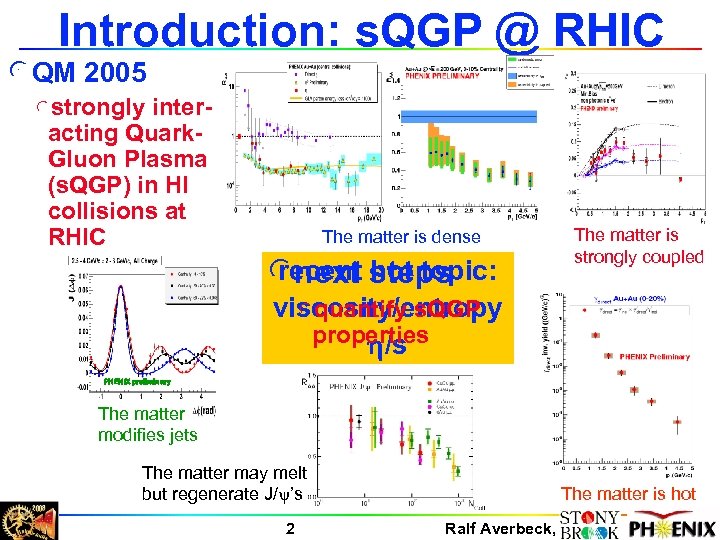 Introduction: s. QGP @ RHIC l. QM 2005 lstrongly interacting Quark. Gluon Plasma (s. QGP) in HI collisions at RHIC The matter is dense recent hot topic: lnext steps lquantify s. QGP viscosity/entropy properties h/s The matter is strongly coupled PHENIX preliminary The matter modifies jets The matter may melt but regenerate J/y’s 2 The matter is hot Ralf Averbeck, ,
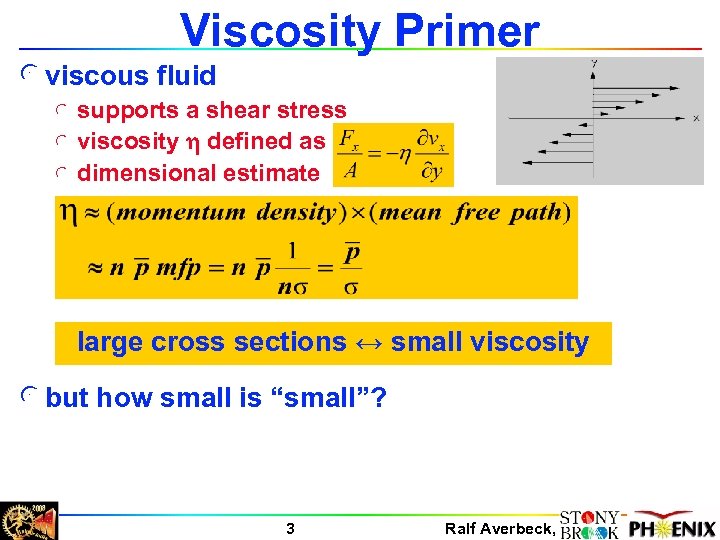 Viscosity Primer l viscous fluid l supports a shear stress l viscosity h defined as l dimensional estimate large cross sections ↔ small viscosity l but how small is “small”? 3 Ralf Averbeck, ,
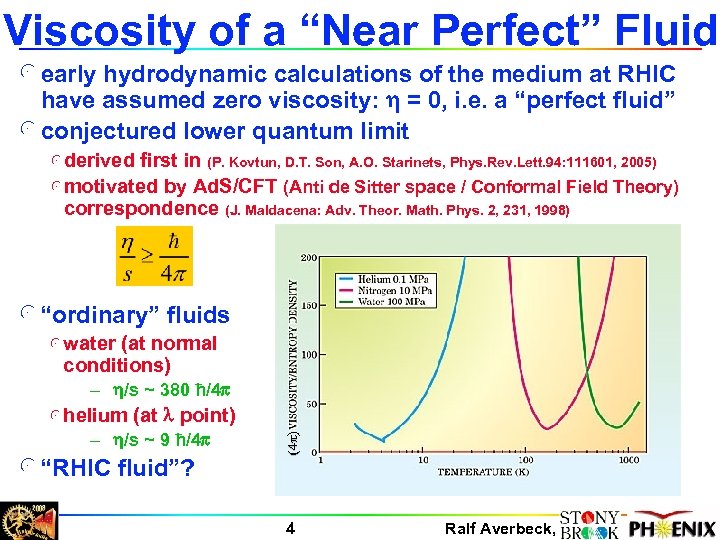 Viscosity of a “Near Perfect” Fluid l early hydrodynamic calculations of the medium at RHIC have assumed zero viscosity: h = 0, i. e. a “perfect fluid” l conjectured lower quantum limit l derived first in (P. Kovtun, D. T. Son, A. O. Starinets, Phys. Rev. Lett. 94: 111601, 2005) l motivated by Ad. S/CFT (Anti de Sitter space / Conformal Field Theory) correspondence (J. Maldacena: Adv. Theor. Math. Phys. 2, 231, 1998) l “ordinary” fluids l water (at normal conditions) – h/s ~ 380 ћ/4 p (at l point) – h/s ~ 9 ћ/4 p l “RHIC fluid”? (4 p) l helium 4 Ralf Averbeck, ,
 Measuring h/s l need observables that are sensitive to shear stress l damping (flow, fluctuations, heavy quark motion) ~ h/s l flow l R. Lacey et al. : Phys. Rev. Lett. 98: 092301, 2007 – “Has the QCD critical point been signaled by observations at RHIC? ” l H. -J. Drescher et al. : Phys. Rev. C 76: 024905, 2007 – “The Centrality Dependence of Elliptic Flow, the Hydrodynamic Limit, and the Viscosity of Hot QCD” l fluctuations l S. Gavin and M. Abdel-Aziz: Phys. Rev. Lett. 97: 162302, 2006 – “Measuring Shear Viscosity Using Transverse Momentum Correlations in Relativistic Nuclear Collisions” l heavy quark motion (drag, flow) l A. Adare et al. (PHENIX Collaboration): Phys. Rev. Lett. 98: 092301, 2007 – “Energy Loss and Flow of Heavy Quarks in Au+Au Collisions at = 200 Ge. V” 5 Ralf Averbeck, , √s. NN
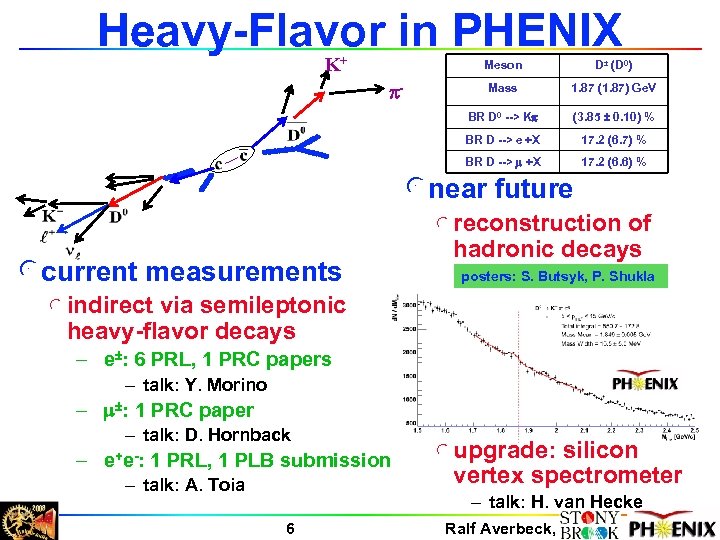 Heavy-Flavor in PHENIX K+ Meson 1. 87 (1. 87) Ge. V (3. 85 ± 0. 10) % BR D --> e +X 17. 2 (6. 7) % BR D --> m +X lcurrent measurements l indirect via semileptonic heavy-flavor decays Mass BR D 0 --> Kp p- D± (D 0) 17. 2 (6. 6) % lnear future l reconstruction of hadronic decays posters: S. Butsyk, P. Shukla – e±: 6 PRL, 1 PRC papers – talk: Y. Morino – m±: 1 PRC paper – talk: D. Hornback – e+e-: 1 PRL, 1 PLB submission – talk: A. Toia l upgrade: silicon vertex spectrometer – talk: H. van Hecke 6 Ralf Averbeck, ,
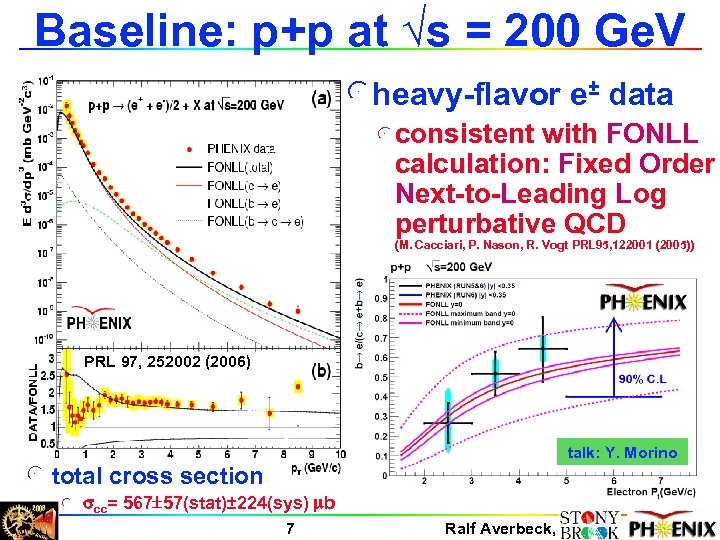 Baseline: p+p at √s = 200 Ge. V lheavy-flavor e± data lconsistent with FONLL calculation: Fixed Order Next-to-Leading Log perturbative QCD (M. Cacciari, P. Nason, R. Vogt PRL 95, 122001 (2005)) PRL 97, 252002 (2006) talk: Y. Morino l total cross section l scc= 567± 57(stat)± 224(sys) mb 7 Ralf Averbeck, ,
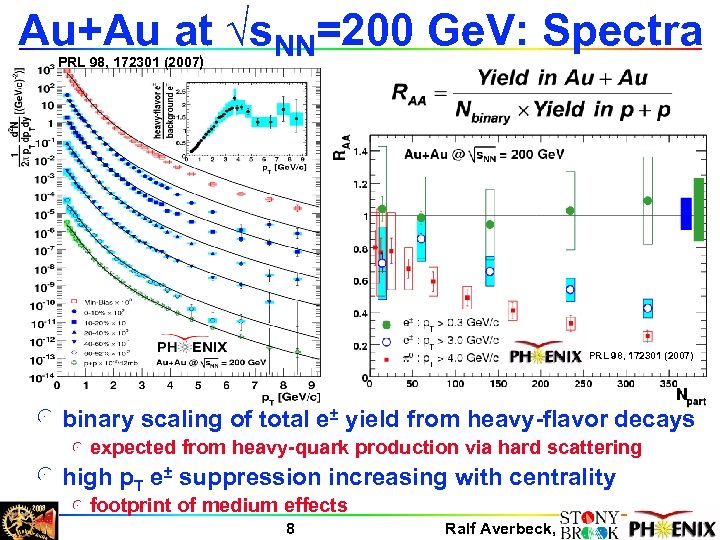 Au+Au at √s. NN=200 Ge. V: Spectra PRL 98, 172301 (2007) l binary scaling of total e± yield from heavy-flavor decays l expected from heavy-quark production via hard scattering l high p. T e± suppression increasing with centrality l footprint of medium effects 8 Ralf Averbeck, ,
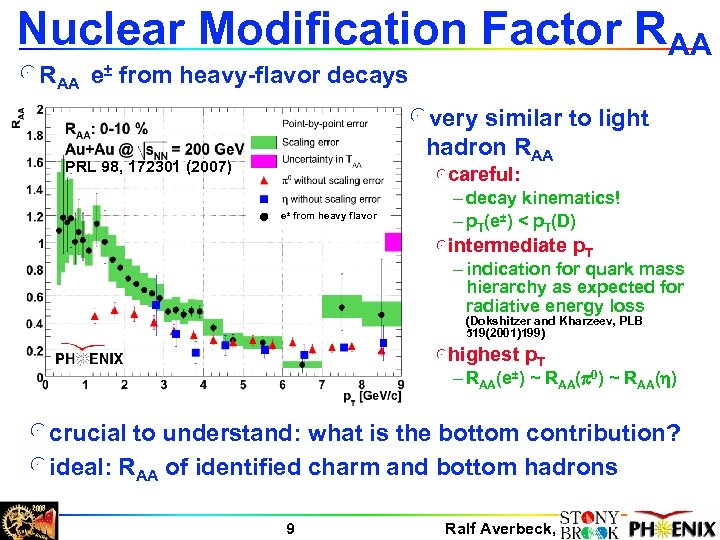 Nuclear Modification Factor RAA l. RAA e± from heavy-flavor decays lvery similar to light hadron RAA PRL 98, 172301 (2007) lcareful: e± from heavy flavor – decay kinematics! – p. T(e±) < p. T(D) lintermediate p. T – indication for quark mass hierarchy as expected for radiative energy loss (Dokshitzer and Kharzeev, PLB 519(2001)199) lhighest p. T – RAA(e±) ~ RAA(p 0) ~ RAA(h) lcrucial to understand: what is the bottom contribution? lideal: RAA of identified charm and bottom hadrons 9 Ralf Averbeck, ,
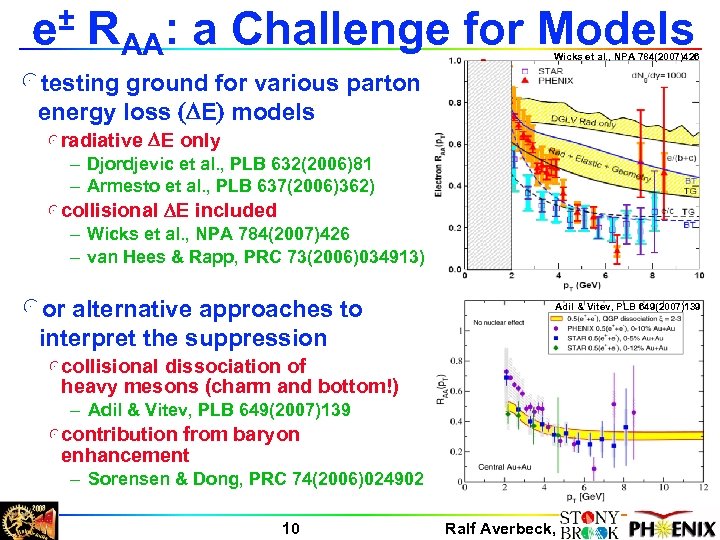 e± RAA: a Challenge for Models Wicks et al. , NPA 784(2007)426 ltesting ground for various parton energy loss (DE) models lradiative DE only – Djordjevic et al. , PLB 632(2006)81 – Armesto et al. , PLB 637(2006)362) lcollisional DE included – Wicks et al. , NPA 784(2007)426 – van Hees & Rapp, PRC 73(2006)034913) lor alternative approaches to Adil & Vitev, PLB 649(2007)139 interpret the suppression lcollisional dissociation of heavy mesons (charm and bottom!) – Adil & Vitev, PLB 649(2007)139 lcontribution from baryon enhancement – Sorensen & Dong, PRC 74(2006)024902 10 Ralf Averbeck, ,
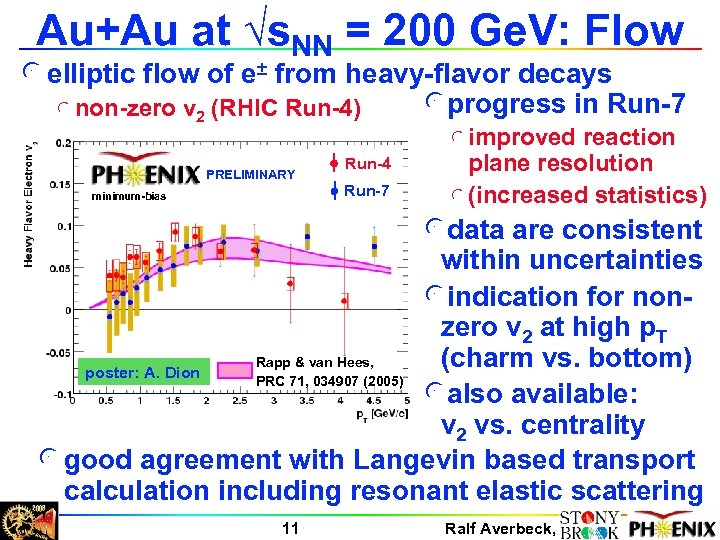 Au+Au at √s. NN = 200 Ge. V: Flow l elliptic flow of e± from heavy-flavor decays lprogress in Run-7 l non-zero v 2 (RHIC Run-4) l improved reaction Run-4 plane resolution PRELIMINARY Run-7 minimum-bias l (increased statistics) ldata are consistent within uncertainties lindication for nonzero v 2 at high p. T (charm vs. bottom) Rapp & van Hees, PRL 98, 172301 (2007) poster: A. Dion PRC 71, 034907 (2005) lalso available: v 2 vs. centrality l good agreement with Langevin based transport calculation including resonant elastic scattering 11 Ralf Averbeck, ,
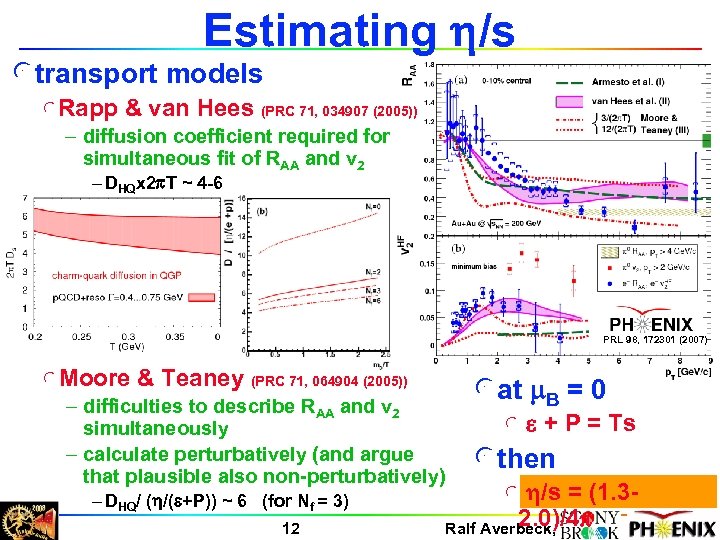 Estimating h/s ltransport models l. Rapp & van Hees (PRC 71, 034907 (2005)) – diffusion coefficient required for simultaneous fit of RAA and v 2 – DHQx 2 p. T ~ 4 -6 PRL 98, 172301 (2007) l. Moore & Teaney (PRC 71, 064904 (2005)) lat m. B = 0 – difficulties to describe RAA and v 2 l e + P = Ts simultaneously – calculate perturbatively (and argue lthen that plausible also non-perturbatively) l h/s = (1. 3– DHQ/ (h/(e+P)) ~ 6 (for Nf = 3) 2. 0)/4 p , Ralf Averbeck, 12
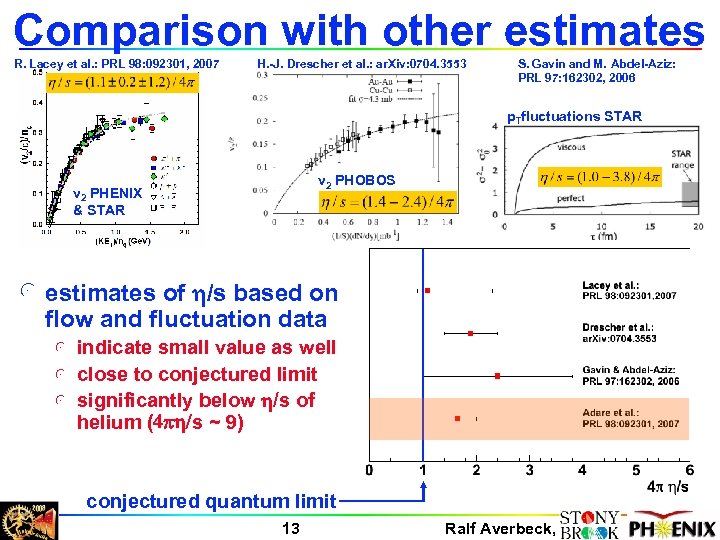 Comparison with other estimates R. Lacey et al. : PRL 98: 092301, 2007 H. -J. Drescher et al. : ar. Xiv: 0704. 3553 S. Gavin and M. Abdel-Aziz: PRL 97: 162302, 2006 p. Tfluctuations STAR v 2 PHOBOS v 2 PHENIX & STAR l estimates of h/s based on flow and fluctuation data l l l indicate small value as well close to conjectured limit significantly below h/s of helium (4 ph/s ~ 9) conjectured quantum limit 13 Ralf Averbeck, ,
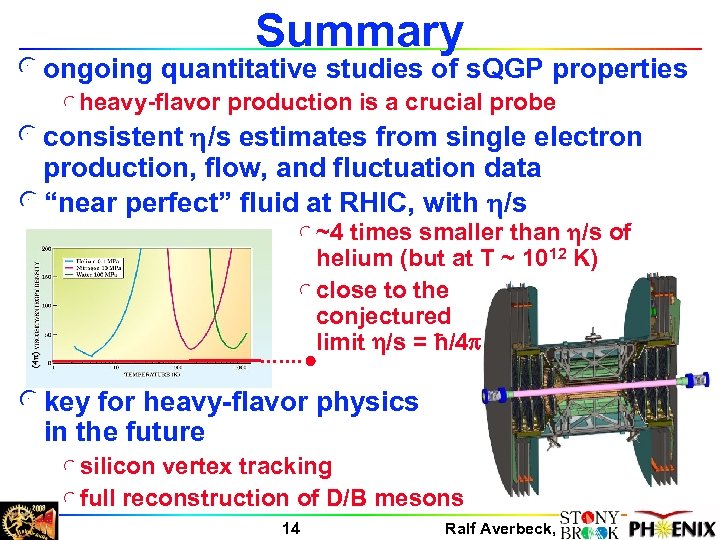 Summary l ongoing quantitative studies of s. QGP properties l heavy-flavor production is a crucial probe l consistent h/s estimates from single electron production, flow, and fluctuation data l “near perfect” fluid at RHIC, with h/s times smaller than h/s of helium (but at T ~ 1012 K) l close to the conjectured limit h/s = ћ/4 p l ~4 (4 p) . . …. . l key for heavy-flavor physics in the future l silicon vertex tracking l full reconstruction of D/B mesons 14 Ralf Averbeck, ,
 The PHENIX Collaboration Universidade de São Paulo, Instituto de Física, Caixa Postal 66318, São Paulo CEP 05315 -970, Brazil Institute of Physics, Academia Sinica, Taipei 11529, Taiwan China Institute of Atomic Energy (CIAE), Beijing, People's Republic of China Peking University, Beijing, People's Republic of China Charles University, Ovocnytrh 5, Praha 1, 116 36, Prague, Czech Republic Czech Technical University, Zikova 4, 166 36 Prague 6, Czech Republic Institute of Physics, Academy of Sciences of the Czech Republic, Na Slovance 2, 182 21 Prague 8, Czech Republic Helsinki Institute of Physics and University of Jyväskylä, P. O. Box 35, FI-40014 Jyväskylä, Finland Dapnia, CEA Saclay, F-91191, Gif-sur-Yvette, France Laboratoire Leprince-Ringuet, Ecole Polytechnique, CNRS-IN 2 P 3, Route de Saclay, F-91128, Palaiseau, France Laboratoire de Physique Corpusculaire (LPC), Université Blaise Pascal, CNRS-IN 2 P 3, Clermont-Fd, 63177 Aubiere Cedex, France IPN-Orsay, Universite Paris Sud, CNRS-IN 2 P 3, BP 1, F-91406, Orsay, France SUBATECH (Ecole des Mines de Nantes, CNRS-IN 2 P 3, Université de Nantes) BP 20722 - 44307, Nantes, France Institut für Kernphysik, University of Münster, D-48149 Münster, Germany Debrecen University, H-4010 Debrecen, Egyetem tér 1, Hungary ELTE, Eötvös Loránd University, H - 1117 Budapest, Pázmány P. s. 1/A, Hungary KFKI Research Institute for Particle and Nuclear Physics of the Hungarian Academy of Sciences (MTA KFKI RMKI), H-1525 Budapest 114, POBox 49, Budapest, Hungary Department of Physics, Banaras Hindu University, Varanasi 221005, India Bhabha Atomic Research Centre, Bombay 400 085, India Weizmann Institute, Rehovot 76100, Israel Center for Nuclear Study, Graduate School of Science, University of Tokyo, 7 -3 -1 Hongo, Bunkyo, Tokyo 113 -0033, Japan Hiroshima University, Kagamiyama, Higashi-Hiroshima 739 -8526, Japan KEK, High Energy Accelerator Research Organization, Tsukuba, Ibaraki 305 -0801, Japan Kyoto University, Kyoto 606 -8502, Japan Abilene Christian University, Abilene, TX 79699, U. S. Nagasaki Institute of Applied Science, Nagasaki-shi, Nagasaki 851 -0193, Japan Collider-Accelerator Department, Brookhaven National Laboratory, Upton, NY 11973 -5000, U. S. RIKEN, The Institute of Physical and Chemical Research, Wako, Saitama 351 -0198, Japan Physics Department, Brookhaven National Laboratory, Upton, NY 11973 -5000, U. S. Physics Department, Rikkyo University, 3 -34 -1 Nishi-Ikebukuro, Toshima, Tokyo 171 -8501, Japan University of California - Riverside, CA 92521, U. S. Department of Physics, Tokyo Institute of Technology, Oh- okayama, Meguro, Tokyo 152 -8551, Japan University of Colorado, Boulder, CO 80309, U. S. Institute of Physics, University of Tsukuba, Ibaraki 305, Japan Columbia University, New York, NY 10027 and Nevis Laboratories, Irvington, NY 10533, U. S. Waseda University, Advanced Research Institute for Science and Engineering, 17 Kikui-cho, Florida Institute of Technology, Melbourne, FL 32901, U. S. Shinjuku-ku, Tokyo 162 -0044, Japan Florida State University, Tallahassee, FL 32306, U. S. Chonbuk National University, Jeonju, Korea Georgia State University, Atlanta, GA 30303, U. S. Ewha Womans University, Seoul 120 -750, Korea University of Illinois at Urbana-Champaign, Urbana, IL 61801, U. S. KAERI, Cyclotron Application Laboratory, Seoul, South Korea Iowa State University, Ames, IA 50011, U. S. Kangnung National University, Kangnung 210 -702, South Korea Lawrence Livermore National Laboratory, Livermore, CA 94550, U. S. Korea University, Seoul, 136 -701, Korea Los Alamos National Laboratory, Los Alamos, NM 87545, U. S. Myongji University, Yongin, Kyonggido 449 -728, Korea University of Maryland, College Park, MD 20742, U. S. System Electronics Laboratory, Seoul National University, Seoul, South Korea Department of Physics, University of Massachusetts, Amherst, MA 01003 -9337, U. S. Yonsei University, IPAP, Seoul 120 -749, Korea Muhlenberg College, Allentown, PA 18104 -5586, U. S. IHEP Protvino, State Research Center of Russian Federation, Institute for High Energy Physics, University of New Mexico, Albuquerque, NM 87131, U. S. Protvino, 142281, Russia New Mexico State University, Las Cruces, NM 88003, U. S. Joint Institute for Nuclear Research, 141980 Dubna, Moscow Region, Russia Oak Ridge National Laboratory, Oak Ridge, TN 37831, U. S. Russian Research Center "Kurchatov Institute", Moscow, Russia RIKEN BNL Research Center, Brookhaven National Laboratory, Upton, NY 11973 -5000, U. S. PNPI, Petersburg Nuclear Physics Institute, Gatchina, Leningrad region, 188300, Russia Chemistry Department, Stony Brook University, Stony Brook, SUNY, NY 11794 -3400, U. S. Saint Petersburg State Polytechnic University, St. Petersburg, Russia Department of Physics and Astronomy, Stony Brook University, SUNY, Stony Brook, NY 11794, U. S. Skobeltsyn Institute of Nuclear Physics, Lomonosov Moscow State University, Vorob'evy Gory, University of Tennessee, Knoxville, TN 37996, U. S. Moscow 119992, Russia Vanderbilt University, Nashville, TN 37235, U. S. Department of Physics, Lund University, Box 118, SE-221 00 Lund, Sweden 14 Countries; 69 Institutions July 2007 15 Ralf Averbeck, ,