


 Скачать презентацию Limiting Reagents and Percent Yield Limiting Reagents
4e4b8f8ef44ba75e00ef6f1d66c74279.ppt
- Количество слайдов: 17
 Limiting Reagents and Percent Yield
 Limiting Reagents n n n You have 18 cars bodies and 43 tires. How many cars could you build? You have 23 pieces of bread, 18 pieces of ham, and 29 pieces of cheese. How many ham and cheese sandwiches could you make? You need 20 m. L of chocolate syrup and 250 m. L of milk to make one glass of chocolate milk. If you had 433 ml of chocolate syrup and 4987 m. L of milk, how many glasses of chocolate milk could you make?
 Limiting Reagents n What is a limiting reagent? n When you go to the candy store and you want to buy 100 red fish for 1 cent each, but you only have 80 cents. Your limiting reagent for this transaction is your 80 cents.
 Limiting Reagents Limiting reagent: limits or determines the amount of product that can be formed in a reaction; the reaction occurs only until the limiting reagent is used up n Excess reagent: reactant that is not completely used up in the reaction n
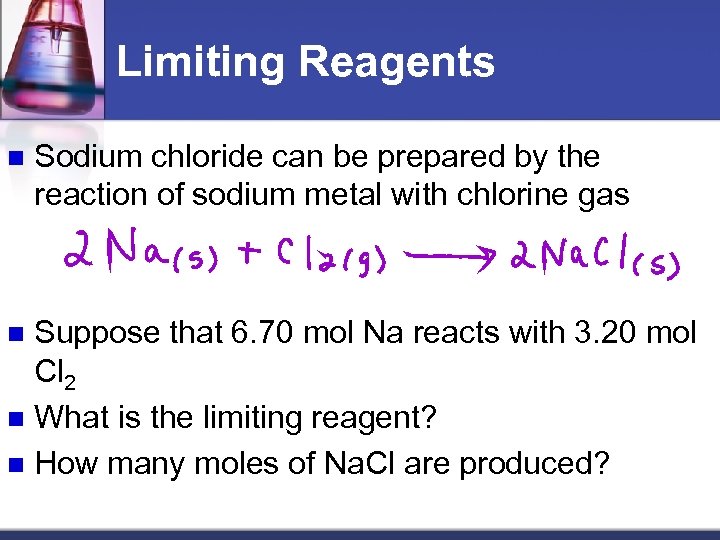 Limiting Reagents n Sodium chloride can be prepared by the reaction of sodium metal with chlorine gas Suppose that 6. 70 mol Na reacts with 3. 20 mol Cl 2 n What is the limiting reagent? n How many moles of Na. Cl are produced? n
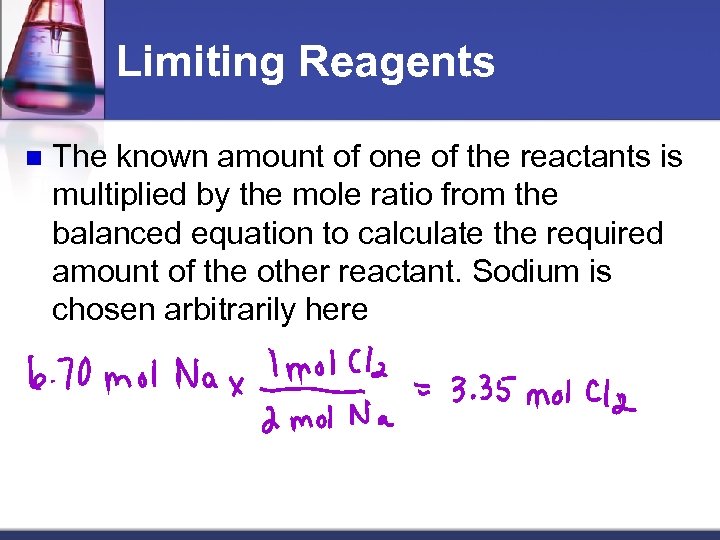 Limiting Reagents n The known amount of one of the reactants is multiplied by the mole ratio from the balanced equation to calculate the required amount of the other reactant. Sodium is chosen arbitrarily here
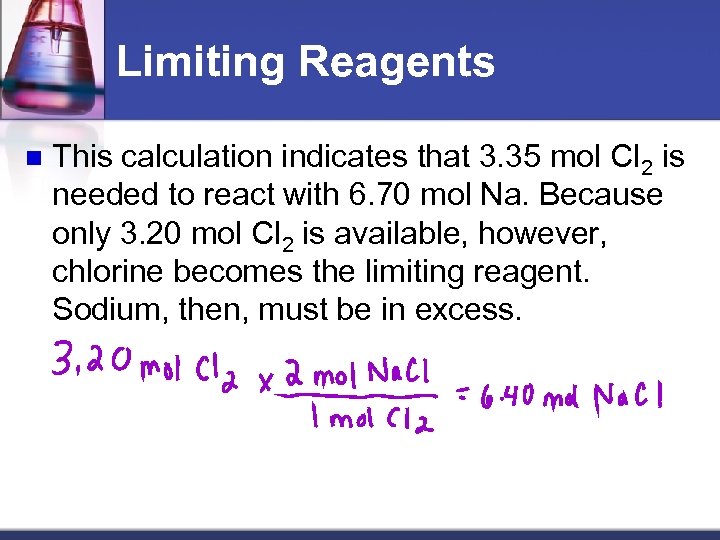 Limiting Reagents n This calculation indicates that 3. 35 mol Cl 2 is needed to react with 6. 70 mol Na. Because only 3. 20 mol Cl 2 is available, however, chlorine becomes the limiting reagent. Sodium, then, must be in excess.
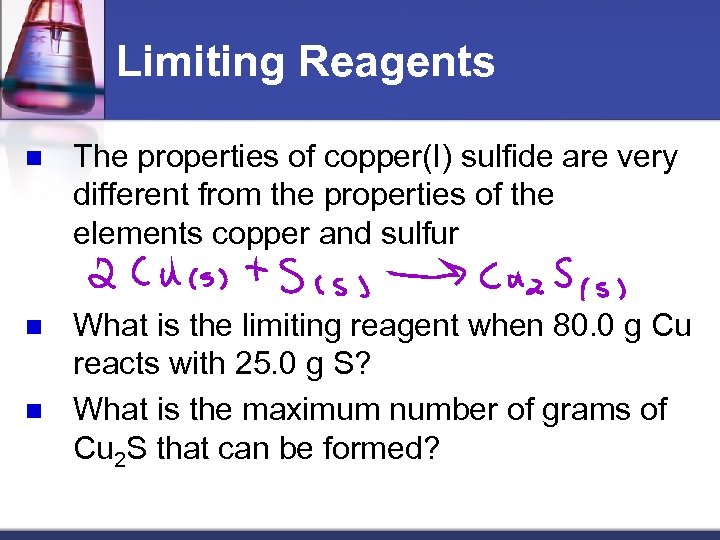 Limiting Reagents n The properties of copper(I) sulfide are very different from the properties of the elements copper and sulfur n What is the limiting reagent when 80. 0 g Cu reacts with 25. 0 g S? What is the maximum number of grams of Cu 2 S that can be formed? n
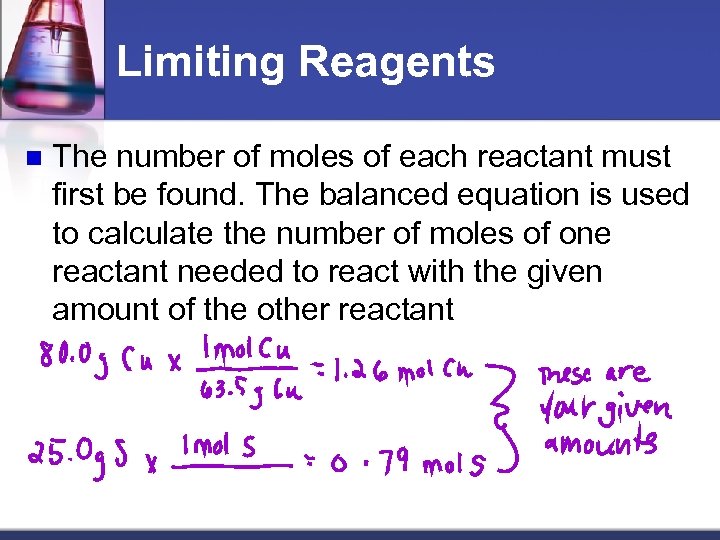 Limiting Reagents n The number of moles of each reactant must first be found. The balanced equation is used to calculate the number of moles of one reactant needed to react with the given amount of the other reactant
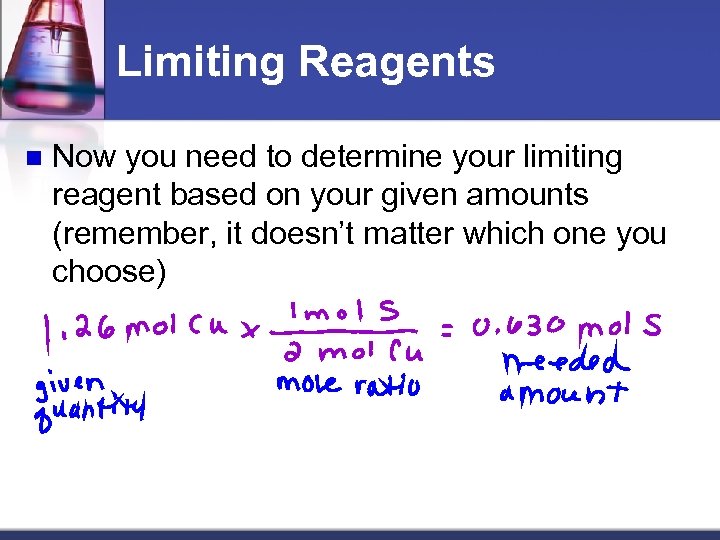 Limiting Reagents n Now you need to determine your limiting reagent based on your given amounts (remember, it doesn’t matter which one you choose)
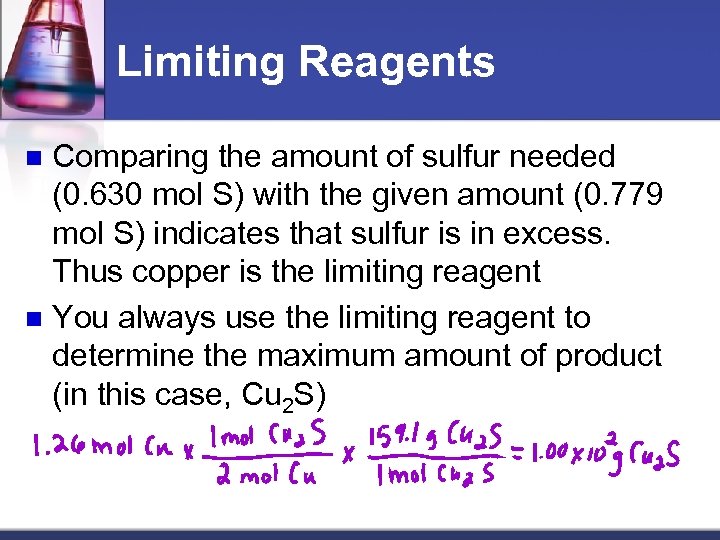 Limiting Reagents Comparing the amount of sulfur needed (0. 630 mol S) with the given amount (0. 779 mol S) indicates that sulfur is in excess. Thus copper is the limiting reagent n You always use the limiting reagent to determine the maximum amount of product (in this case, Cu 2 S) n
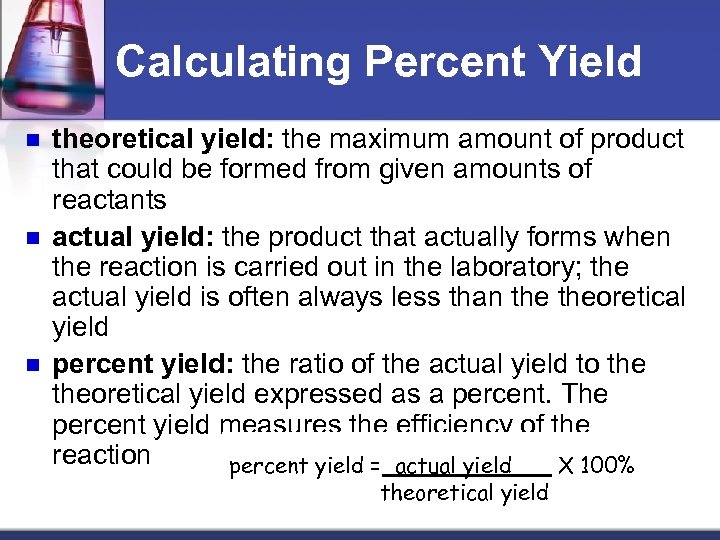 Calculating Percent Yield n n n theoretical yield: the maximum amount of product that could be formed from given amounts of reactants actual yield: the product that actually forms when the reaction is carried out in the laboratory; the actual yield is often always less than theoretical yield percent yield: the ratio of the actual yield to theoretical yield expressed as a percent. The percent yield measures the efficiency of the reaction percent yield = actual yield X 100% theoretical yield
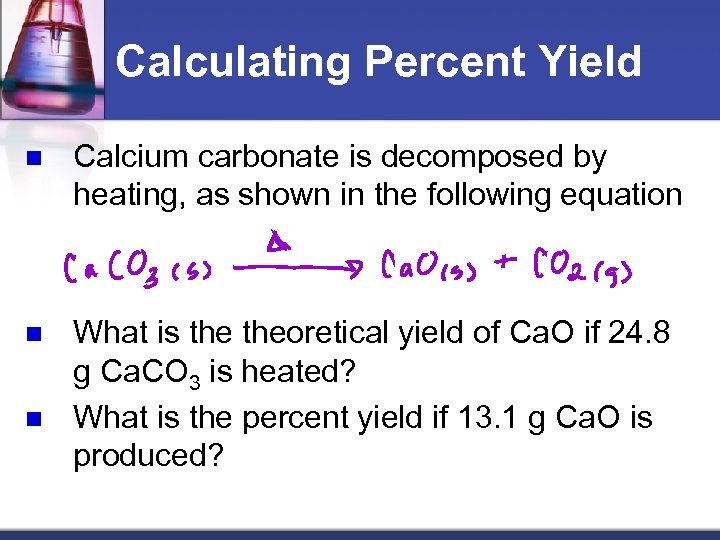 Calculating Percent Yield n Calcium carbonate is decomposed by heating, as shown in the following equation n What is theoretical yield of Ca. O if 24. 8 g Ca. CO 3 is heated? What is the percent yield if 13. 1 g Ca. O is produced? n
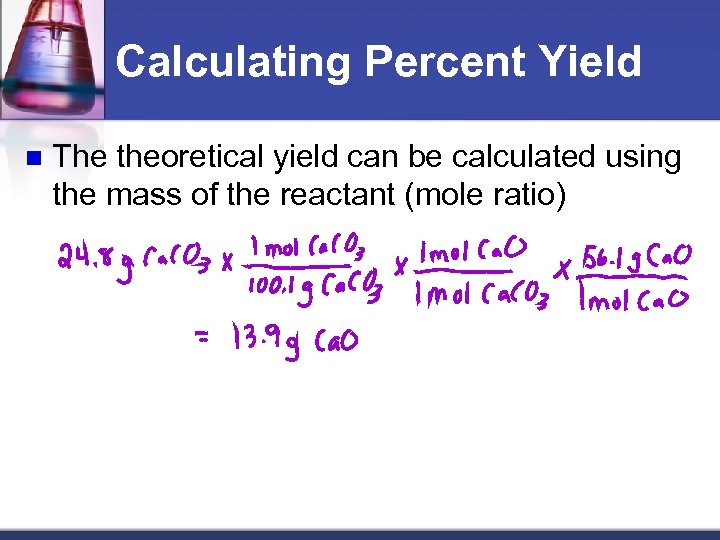 Calculating Percent Yield n The theoretical yield can be calculated using the mass of the reactant (mole ratio)
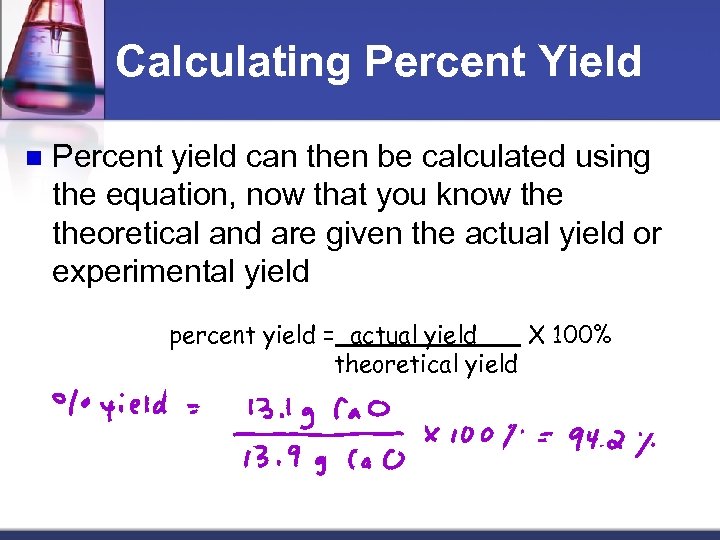 Calculating Percent Yield n Percent yield can then be calculated using the equation, now that you know theoretical and are given the actual yield or experimental yield percent yield = actual yield X 100% theoretical yield
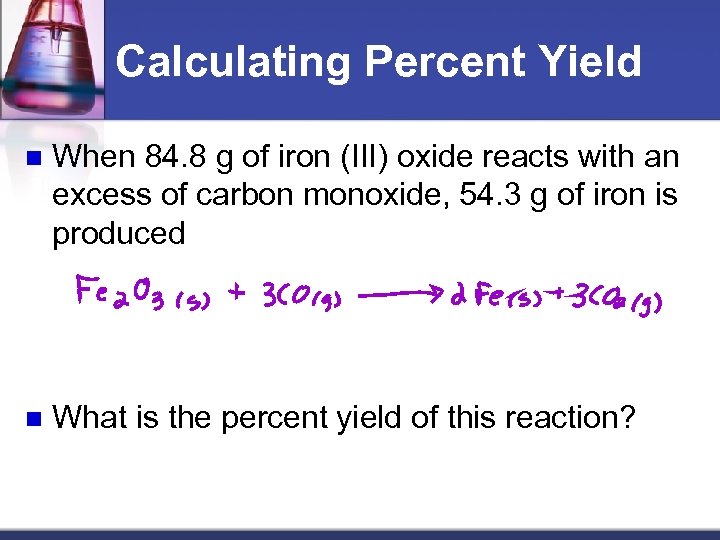 Calculating Percent Yield n When 84. 8 g of iron (III) oxide reacts with an excess of carbon monoxide, 54. 3 g of iron is produced n What is the percent yield of this reaction?
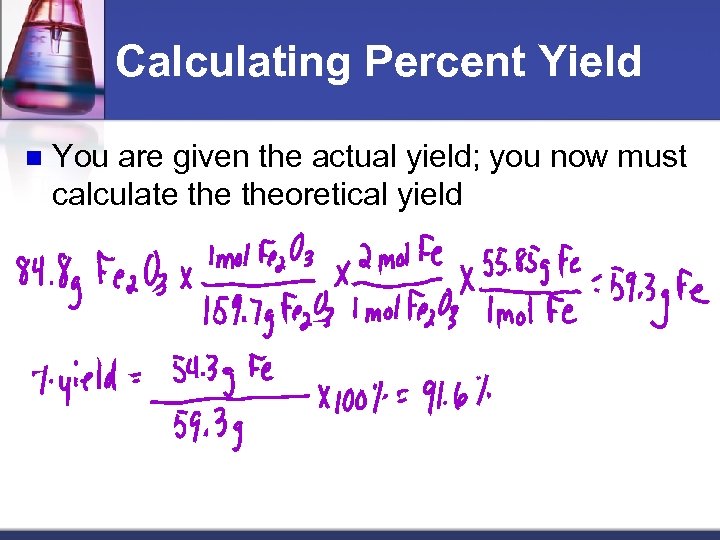 Calculating Percent Yield n You are given the actual yield; you now must calculate theoretical yield