


 Скачать презентацию Limiting Reactant Stoichiometry Refresher Recall The
621011e5ab343516ec81cce8c3b80799.ppt
- Количество слайдов: 13
 Limiting Reactant
 Stoichiometry Refresher Recall: • The mole ratio can be used to determine the quantity (moles) or mass of reactants consumed and products formed • However, usually there is one reactant which will be consumed entirely and the other reactant is left over (in excess)
 Excess Reactant: The reactant that is NOT completely consumed in a chemical reaction (i. e. it is in excess) Limiting Reactant: The reactant that is completely consumed in a chemical reaction. It limits how much product is formed.
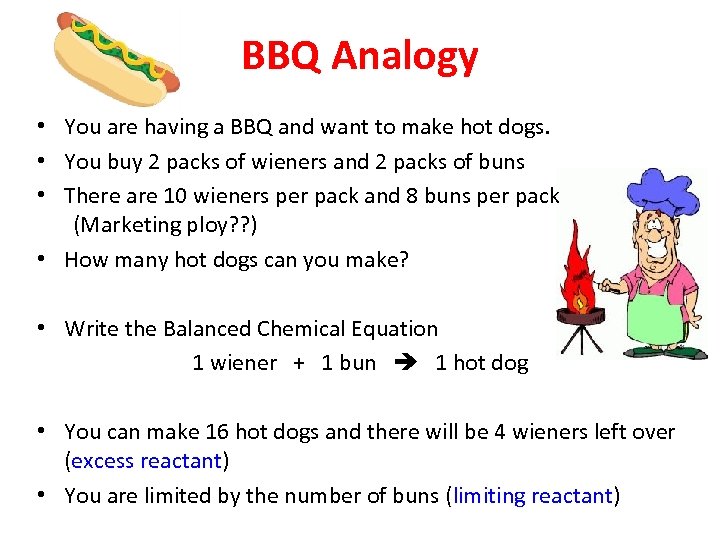 BBQ Analogy • You are having a BBQ and want to make hot dogs. • You buy 2 packs of wieners and 2 packs of buns • There are 10 wieners per pack and 8 buns per pack (Marketing ploy? ? ) • How many hot dogs can you make? • Write the Balanced Chemical Equation 1 wiener + 1 bun 1 hot dog • You can make 16 hot dogs and there will be 4 wieners left over (excess reactant) • You are limited by the number of buns (limiting reactant)
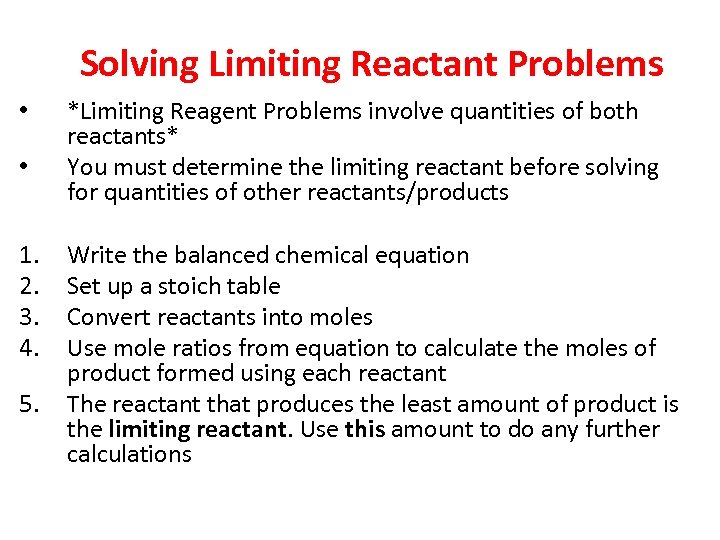 Solving Limiting Reactant Problems • • 1. 2. 3. 4. 5. *Limiting Reagent Problems involve quantities of both reactants* You must determine the limiting reactant before solving for quantities of other reactants/products Write the balanced chemical equation Set up a stoich table Convert reactants into moles Use mole ratios from equation to calculate the moles of product formed using each reactant The reactant that produces the least amount of product is the limiting reactant. Use this amount to do any further calculations
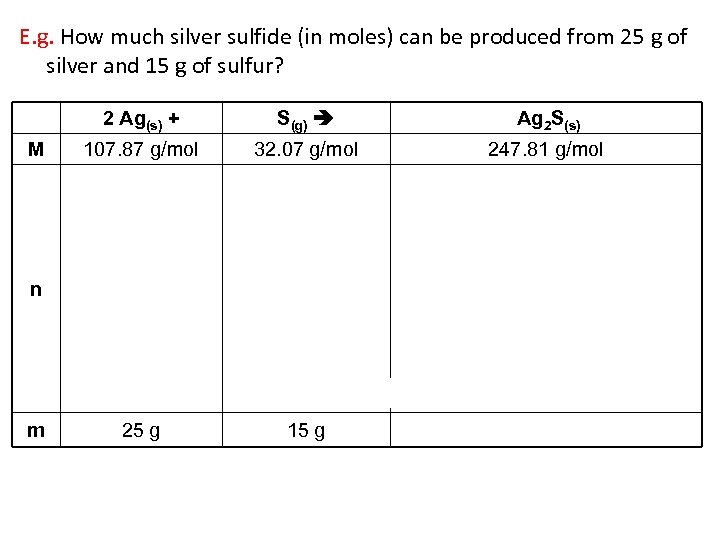 E. g. How much silver sulfide (in moles) can be produced from 25 g of silver and 15 g of sulfur? 2 Ag(s) + Ag 2 S(s) 107. 87 g/mol M S(g) 32. 07 g/mol 247. 81 g/mol = n 25 g 107. 87 g/mol = 0. 2318 mol = 15 g 32. 07 g = 0. 4677 mol Using Ag: = 1 mol. Ag 2 S x 0. 2318 mol. Ag 2 mol. Ag = 0. 1159 mol. Ag 2 S Using S: = 1 mol. Ag 2 S x 0. 4677 mol. S 1 mol. S = 0. 4677 mol. Mg. O 0. 1159 mol < 0. 4677 mol Ag limits m 25 g 15 g
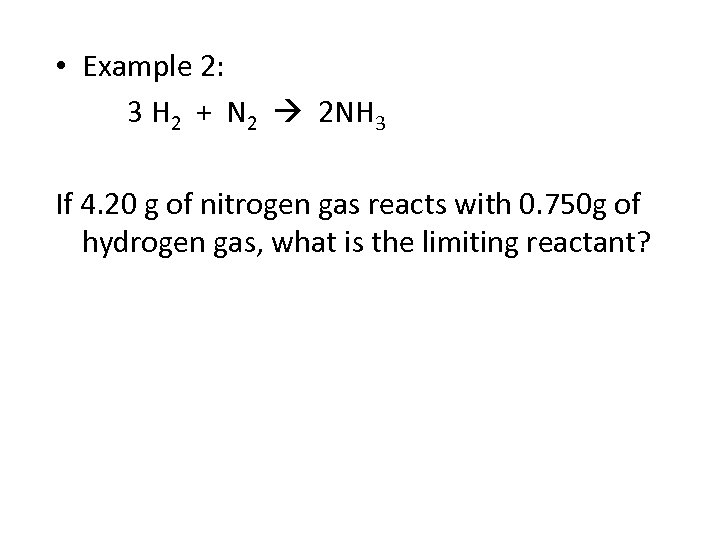 • Example 2: 3 H 2 + N 2 2 NH 3 If 4. 20 g of nitrogen gas reacts with 0. 750 g of hydrogen gas, what is the limiting reactant?
 Practice Makes Perfect • P. 254 # 23 - 26
 Limiting Reactants Part 2
 • Once we know what is the limiting reactant, we can use this to continue to solve problems and determine amounts (moles or masses) for other reactants or products
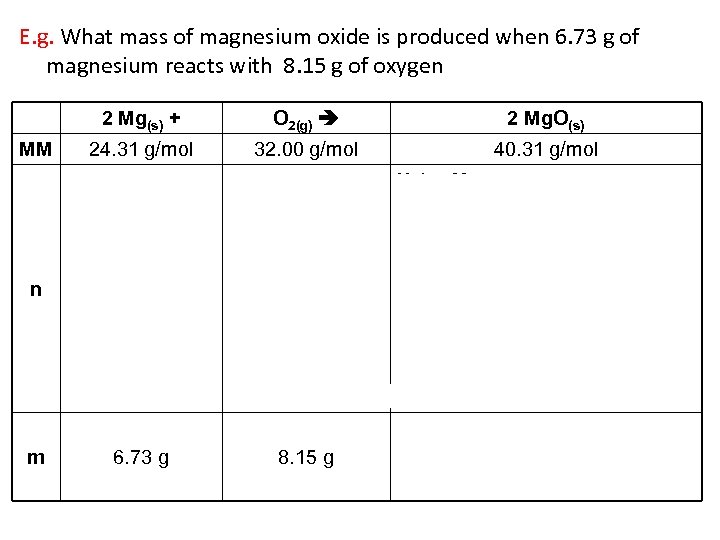 E. g. What mass of magnesium oxide is produced when 6. 73 g of magnesium reacts with 8. 15 g of oxygen 2 Mg(s) + MM n O 2(g) 2 Mg. O(s) 24. 31 g/mol 32. 00 g/mol 40. 31 g/mol = 6. 73 g 24. 31 g/mol = 0. 2769 mol = 8. 15 g 32. 00 g/mol = 0. 2547 mol Using Mg: = 2 mol. Mg. O x 0. 2769 mol. Mg 2 mol. Mg = 0. 2769 mol. Mg. O Using O 2: = 2 mol. Mg. O x 0. 2547 mol. O 2 1 mol. O 2 = 0. 5094 mol. Mg. O 0. 2769 mol < 0. 5094 mol Mg limits m 6. 73 g 8. 15 g = 0. 2769 mol X 40. 31 g/ mol = 11. 2 g
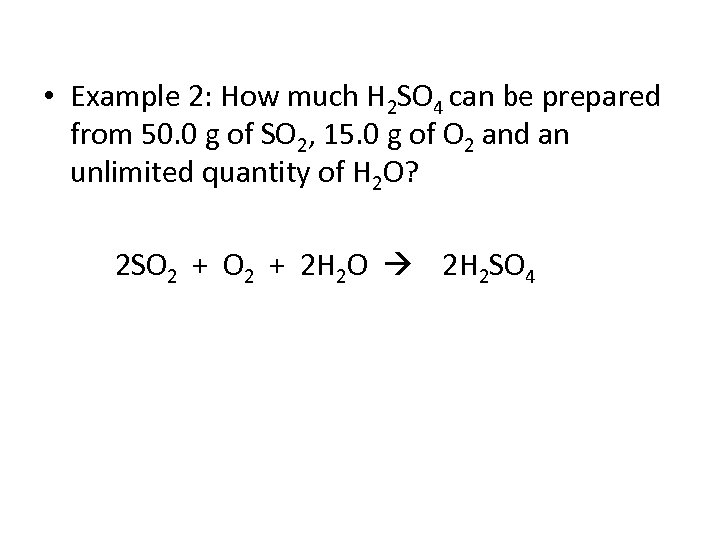 • Example 2: How much H 2 SO 4 can be prepared from 50. 0 g of SO 2, 15. 0 g of O 2 and an unlimited quantity of H 2 O? 2 SO 2 + 2 H 2 O 2 H 2 SO 4
 Practice! • P. 257 # 27 – 30 • P. 258 # 1, 2 a, 3, 5