


 Скачать презентацию Limited Access Orders in the Developing World A
3e0afcafbb091340ccf8318de65bf6b1.ppt
- Количество слайдов: 13
 Limited Access Orders in the Developing World: A new approach to the problem of development Douglass C. North, John Joseph Wallis, Steven Webb and Barry R. Weingast
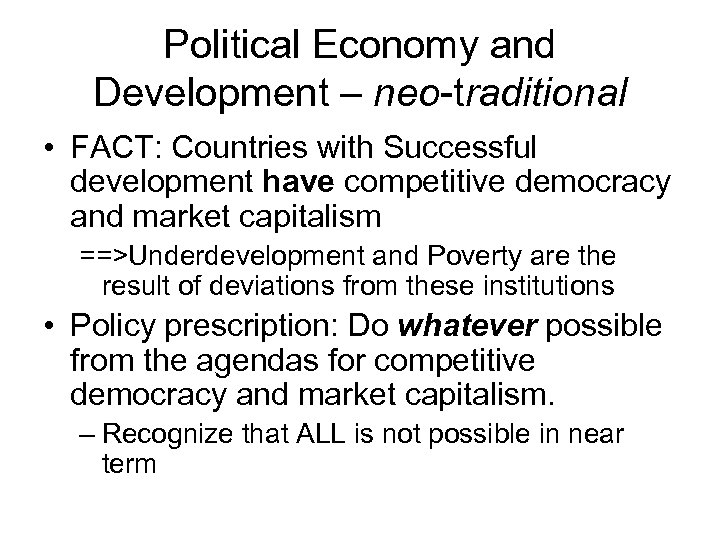 Political Economy and Development – neo-traditional • FACT: Countries with Successful development have competitive democracy and market capitalism ==>Underdevelopment and Poverty are the result of deviations from these institutions • Policy prescription: Do whatever possible from the agendas for competitive democracy and market capitalism. – Recognize that ALL is not possible in near term
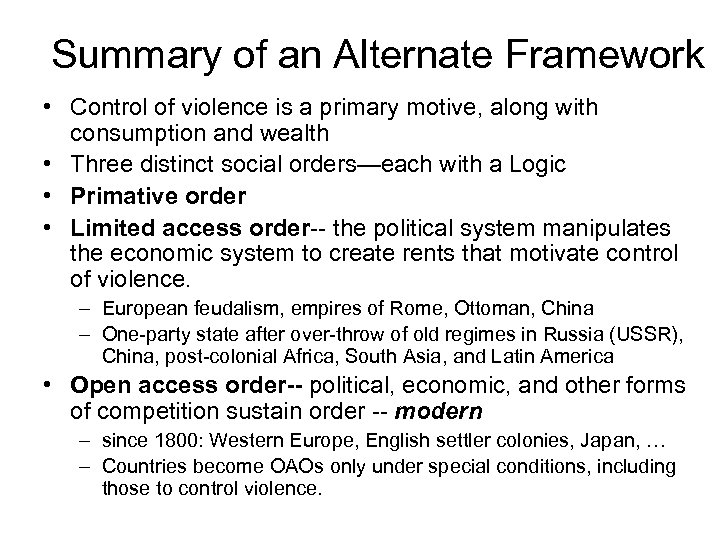 Summary of an Alternate Framework • Control of violence is a primary motive, along with consumption and wealth • Three distinct social orders—each with a Logic • Primative order • Limited access order-- the political system manipulates the economic system to create rents that motivate control of violence. – European feudalism, empires of Rome, Ottoman, China – One-party state after over-throw of old regimes in Russia (USSR), China, post-colonial Africa, South Asia, and Latin America • Open access order-- political, economic, and other forms of competition sustain order -- modern – since 1800: Western Europe, English settler colonies, Japan, … – Countries become OAOs only under special conditions, including those to control violence.
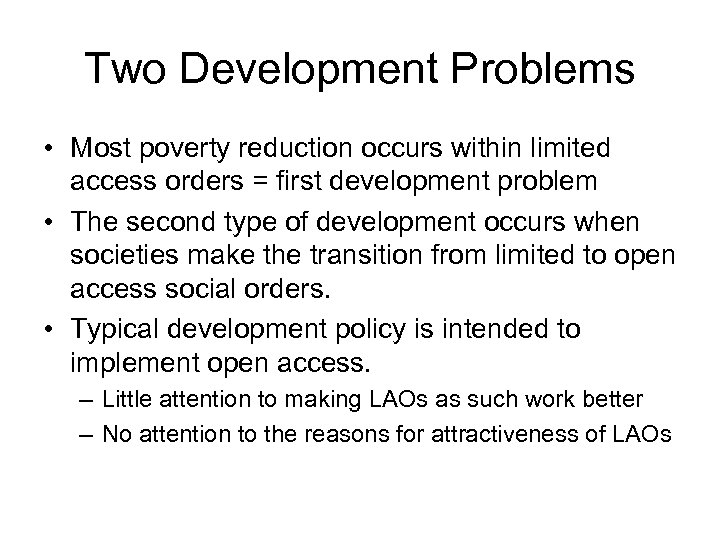 Two Development Problems • Most poverty reduction occurs within limited access orders = first development problem • The second type of development occurs when societies make the transition from limited to open access social orders. • Typical development policy is intended to implement open access. – Little attention to making LAOs as such work better – No attention to the reasons for attractiveness of LAOs
 Logic of the Limited Access Order • The limited access order emerges as a solution to endemic violence – Reducing violence is more important to most people than having freedom or more wealth – LAO = Default option -- Main order for most of recorded history and most of today’s world • The limited access order political system creates economic rents through limited access and then uses the rents to sustain order. – Having an organization with support from the ruler is the most critical privilege, the means to support other claims – Limiting access to organizations—political, military, economic, religious
 Variation: Limited Access Orders 1) Fragile limited access orders: Only a dominant coalition; fragile; limited institutions; personal relations dominate. 2) Basic limited access orders: – the state has a stable organization, with a potentially durable institutional structure of suborganizations – but limited or no elite organizations outside state 3) Mature limited access order: Stable perpetual state, and support for public and private elite organizations. • Progress is stepwise credible commitments build on each other and thus take time – Progress is not certain – Reverses do happen
 Open Access Orders – and the Transition • Open access orders sustain open entry to political and economic organizations. • Built around effective competition in both political and economic systems. • All citizens have the ability to form contractual organizations.
 Doorstep and Transition • Some limited access orders move to positions in which transition to open access can be sustained. • We call these the Doorstep Conditions – Rule of law for elites – Perpetuity for both organizations and states – Consolidated, political control of organizations with violence potential (military, police, etc) • The conditions: – Create the possibility of impersonal exchange among elites. – Facilitate expansion of the elite who can participate. • All three are necessary for transition, although not sufficient
 What does this framework imply for the development problems facing the WB? • Three sets of research questions: – How do societies evolve within social orders, particularly within limited access orders? – How to make the transition from one order to another? – How this relates to the specifics of the modern world and the development issues facing the World Bank?
 Limited Access Orders in a world dominated by OAOs • Do LAOs today have advantages to catch up in development to OAOs? – Well-established OAO institutional forms more rapid institutional development is sometimes possible • On several dimensions our framework suggests disadvantages as well – The world political order–survival of the unfit – Technology – Multinational firms
 OAO technology for LAOs • Development vs. Economic Growth – Development = improving institutions • Importing OAO technology for growth – elites get more consumption and power internationally – without improving their LAO institutions • LAO elites may control entry of technology and access to it • More rents and domestic power for elite
 Multinational Firms coming to LAOs • How does the presence of multinational firms backed with sanctions from OAOs affect the incentives of LAO elites to create better domestic institutions? • Model for development? Or a substitute? • Banks and other financial services • Guarantee of property rights • Joint ventures give international backing to property rights of elites, reducing incentive for domestic institutions for property rights. • Dual economies and the informal sector • space for non-elite economic activity Non-threatening to the elites
 Next research questions • The transition to OAO is an important problem, but not the only problem the World Bank and development agencies should address. • Implications of the framework for how to get limited access orders to perform better. – Does this strengthen the position of elites? – Does this help the poor? – Does this increase or decrease the chance of eventual transition of OAO? • Next research steps; – Case studies to understand experience beyond North Atlantic region