


 Скачать презентацию LIGO Status and Update XLII Rencontres de Moriond
ce3cf5c818b56cfd058513d5e96b896f.ppt
- Количество слайдов: 26
 LIGO: Status and Update XLII Rencontres de Moriond Albert Lazzarini (on behalf of the LIGO Scientific Collaboration) La Thuile, Val d'Aosta, Italy March 11 -18, 2007 LIGO - G 070036 -00 -M LIGO Laboratory at Caltech Colliding Black Holes courtesy of NCSA
 Outline n Overview of LIGO n The current status n n n Astrophysics results n n n The current science run LIGO’s future evolution Sources Previews of later talks Towards a world-wide network of ground-based detectors for gravitational waves LIGO - G 070036 -00 -M LIGO Laboratory at Caltech 2
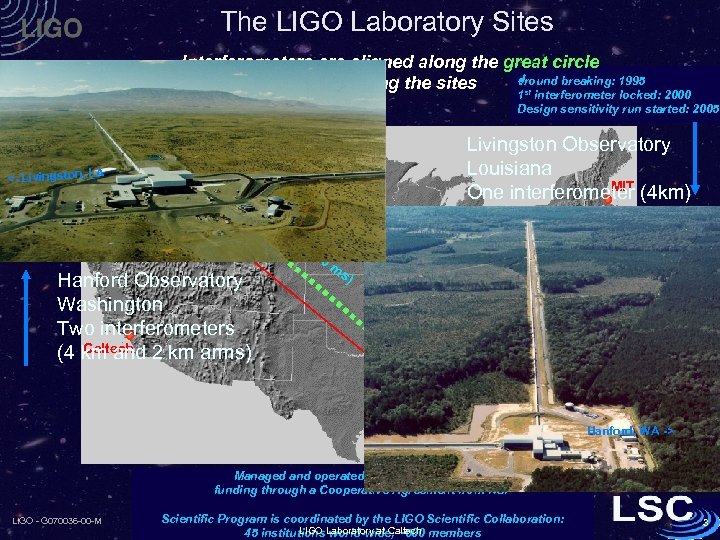 The LIGO Laboratory Sites Interferometers are aligned along the great circle round breaking: 1995 connecting the sites st 1 interferometer locked: 2000 Design sensitivity run started: 2005 Hanford, WA Livingston Observatory Louisiana MIT One interferometer (4 km) A <- Livingston, L Hanford Observatory Washington Two interferometers Caltech (4 km and 2 km arms) (L 300 /c 2 = km 10 m s) Livingston, LA Hanford, WA -> Managed and operated by Caltech & MIT with funding through a Cooperative Agreement from NSF LIGO - G 070036 -00 -M Scientific Program is coordinated by the LIGO Scientific Collaboration: LIGO world-wide, ~500 45 institutions Laboratory at Caltech members 3
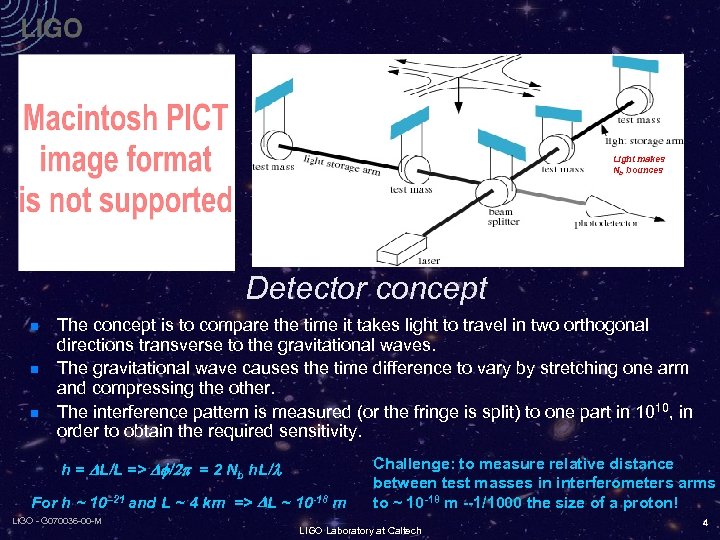 Light makes Nb bounces Detector concept n n n The concept is to compare the time it takes light to travel in two orthogonal directions transverse to the gravitational waves. The gravitational wave causes the time difference to vary by stretching one arm and compressing the other. The interference pattern is measured (or the fringe is split) to one part in 1010, in order to obtain the required sensitivity. h = L/L => / = 2 Nb h. L/ For h ~ 10– 21 and L ~ 4 km => L ~ 10 -18 m LIGO - G 070036 -00 -M Challenge: to measure relative distance between test masses in interferometers arms to ~ 10 -18 m --1/1000 the size of a proton! LIGO Laboratory at Caltech 4
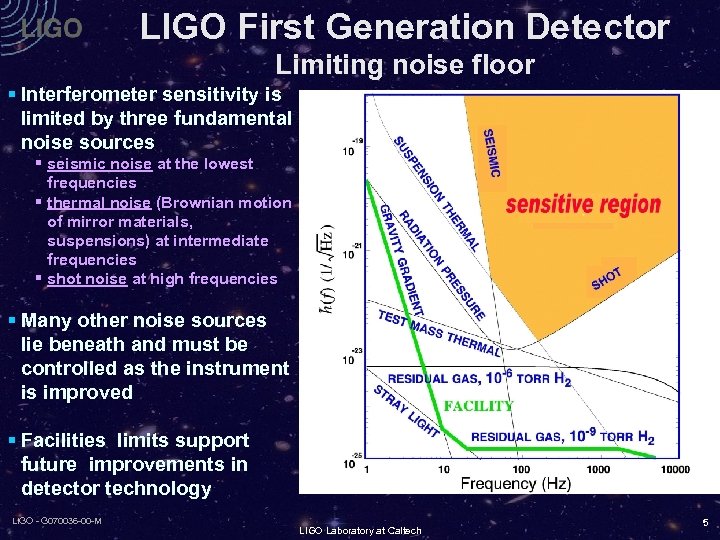 LIGO First Generation Detector Limiting noise floor § Interferometer sensitivity is limited by three fundamental noise sources § seismic noise at the lowest frequencies § thermal noise (Brownian motion of mirror materials, suspensions) at intermediate frequencies § shot noise at high frequencies § Many other noise sources lie beneath and must be controlled as the instrument is improved § Facilities limits support future improvements in detector technology LIGO - G 070036 -00 -M LIGO Laboratory at Caltech 5
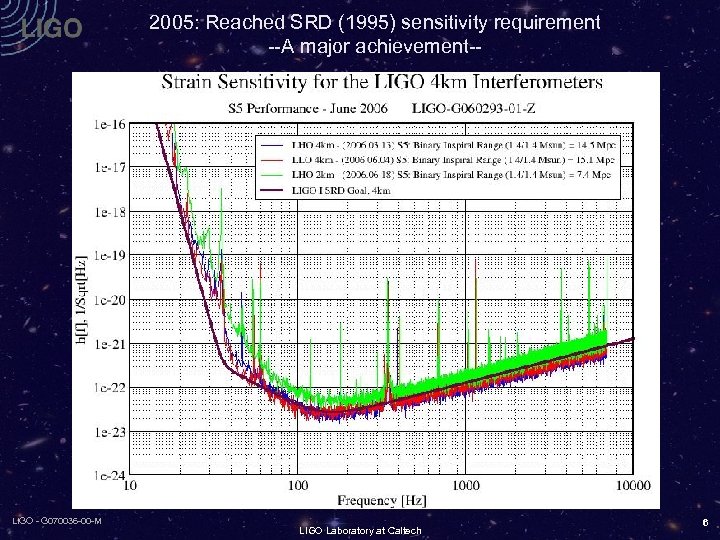 2005: Reached SRD (1995) sensitivity requirement --A major achievement-- LIGO - G 070036 -00 -M LIGO Laboratory at Caltech 6
 The current search for gravitational waves n Science Run 5 at design sensitivity began in November 2005 and is ongoing; Will end summer 2007 With 1 year live-time of 2 -site coincident data n n n Searching for signals in audio band (~50 Hz to few k. Hz) n Run is going extremely well n Figure of merit: range at beginning of run for 1. 4 Mo neutron star pairs n n Sky and orientation averaged, S/N=8 for 4 km IFOs: > 10 Mpc n for 2 km IFO: > 5 Mpc Range is now ~50% greater than beginning of run … n n LIGO - G 070036 -00 -M LIGO Laboratory at Caltech 7
 Recent Control Room Graphics LIGO - G 070036 -00 -M LIGO Laboratory at Caltech 8
 Range -- Trend over entire run S 5 LIGO - G 070036 -00 -M LIGO Laboratory at Caltech 9
 Progress of S 5 Nov 2005 through Feb 2007 Cumulative Up-time Projected End of S 5 1 Year Coincident Observation LIGO - G 070036 -00 -M LIGO Laboratory at Caltech 10
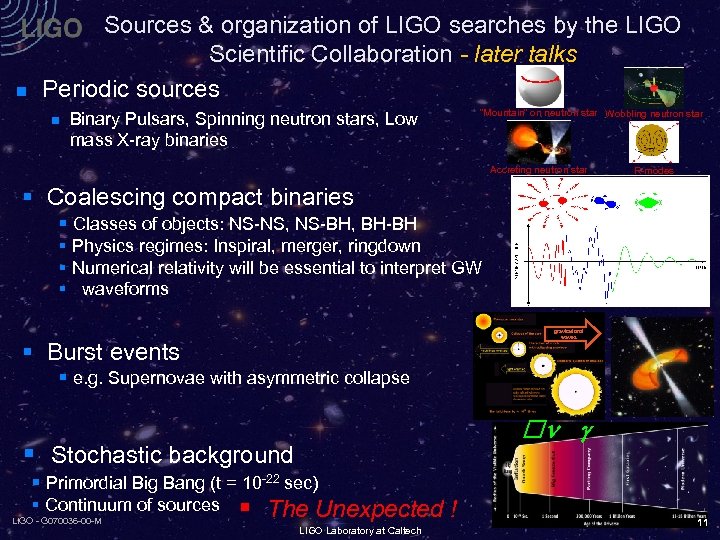 n Sources & organization of LIGO searches by the LIGO Scientific Collaboration - later talks Periodic sources n Binary Pulsars, Spinning neutron stars, Low mass X-ray binaries “Mountain” on neutron star Wobbling neutron star Accreting neutron star R-modes § Coalescing compact binaries § Classes of objects: NS-NS, NS-BH, BH-BH § Physics regimes: Inspiral, merger, ringdown § Numerical relativity will be essential to interpret GW § waveforms gravitational waves § Burst events § e. g. Supernovae with asymmetric collapse § Stochastic background § Primordial Big Bang (t = 10 -22 sec) § Continuum of sources LIGO - G 070036 -00 -M § The Unexpected ! LIGO Laboratory at Caltech 11
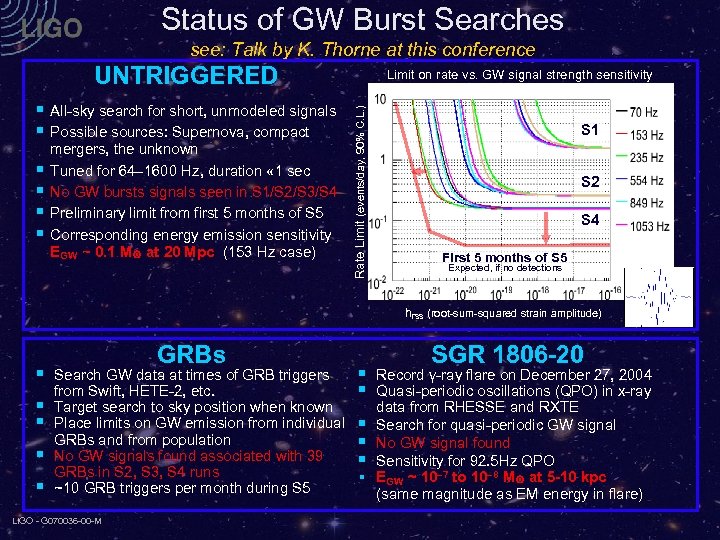 Status of GW Burst Searches see: Talk by K. Thorne at this conference UNTRIGGERED § § All-sky search for short, unmodeled signals Possible sources: Supernova, compact mergers, the unknown Tuned for 64– 1600 Hz, duration « 1 sec No GW bursts signals seen in S 1/S 2/S 3/S 4 Preliminary limit from first 5 months of S 5 Corresponding energy emission sensitivity EGW ~ 0. 1 M☉ at 20 Mpc (153 Hz case) Rate Limit (events/day, 90% C. L. ) § § Limit on rate vs. GW signal strength sensitivity S 1 S 2 S 4 First 5 months of S 5 Expected, if no detections hrss (root-sum-squared strain amplitude) § § § GRBs SGR 1806 -20 Search GW data at times of GRB triggers § Record γ-ray flare on December 27, 2004 from Swift, HETE-2, etc. § Quasi-periodic oscillations (QPO) in x-ray Target search to sky position when known data from RHESSE and RXTE Place limits on GW emission from individual § Search for quasi-periodic GW signal GRBs and from population § No GW signal found No GW signals found associated with 39 § Sensitivity for 92. 5 Hz QPO GRBs in S 2, S 3, S 4 runs § EGW ~ 10– 7 to 10– 8 M☉ at 5 -10 kpc ~10 GRB triggers per month during S 5 (same magnitude as EM energy in flare) LIGO - G 070036 -00 -M
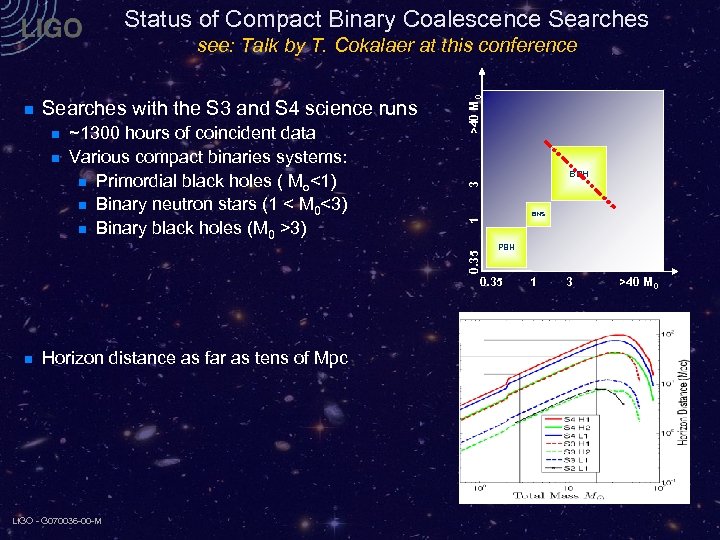 Status of Compact Binary Coalescence Searches n BBH 0. 35 n ~1300 hours of coincident data Various compact binaries systems: n Primordial black holes ( Mo<1) n Binary neutron stars (1 < M 0<3) n Binary black holes (M 0 >3) 3 Searches with the S 3 and S 4 science runs BNS 1 n >40 M 0 see: Talk by T. Cokalaer at this conference PBH 0. 35 n Horizon distance as far as tens of Mpc LIGO - G 070036 -00 -M 1 3 >40 M 0
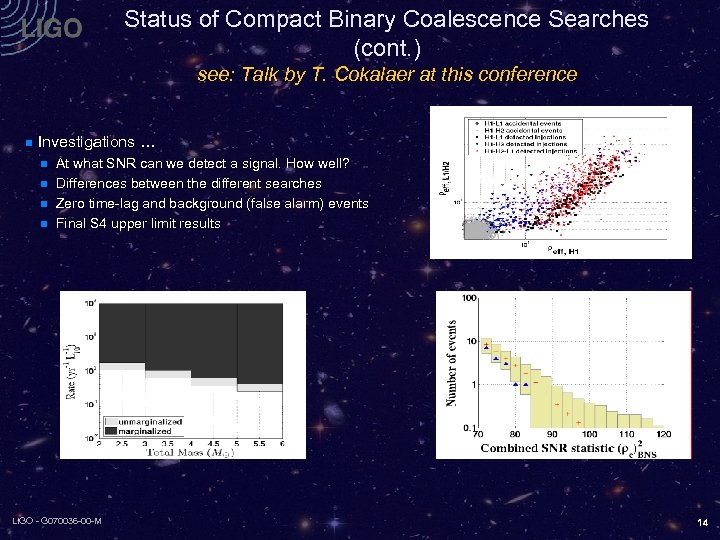 Status of Compact Binary Coalescence Searches (cont. ) see: Talk by T. Cokalaer at this conference n Investigations … n n At what SNR can we detect a signal. How well? Differences between the different searches Zero time-lag and background (false alarm) events Final S 4 upper limit results LIGO - G 070036 -00 -M 14
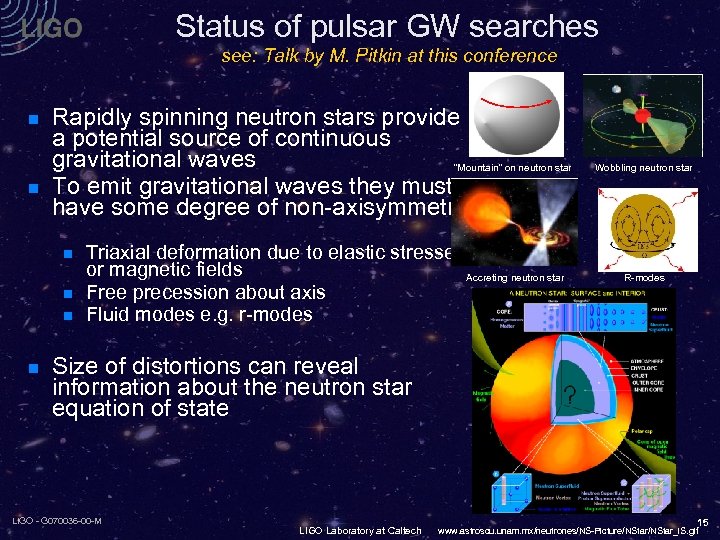 Status of pulsar GW searches see: Talk by M. Pitkin at this conference n n Rapidly spinning neutron stars provide a potential source of continuous gravitational waves “Mountain” on neutron star To emit gravitational waves they must have some degree of non-axisymmetry n n Triaxial deformation due to elastic stresses or magnetic fields Accreting neutron star Free precession about axis Fluid modes e. g. r-modes Wobbling neutron star R-modes Size of distortions can reveal information about the neutron star equation of state LIGO - G 070036 -00 -M LIGO Laboratory at Caltech 15 www. astroscu. unam. mx/neutrones/NS-Picture/NStar_l. S. gif
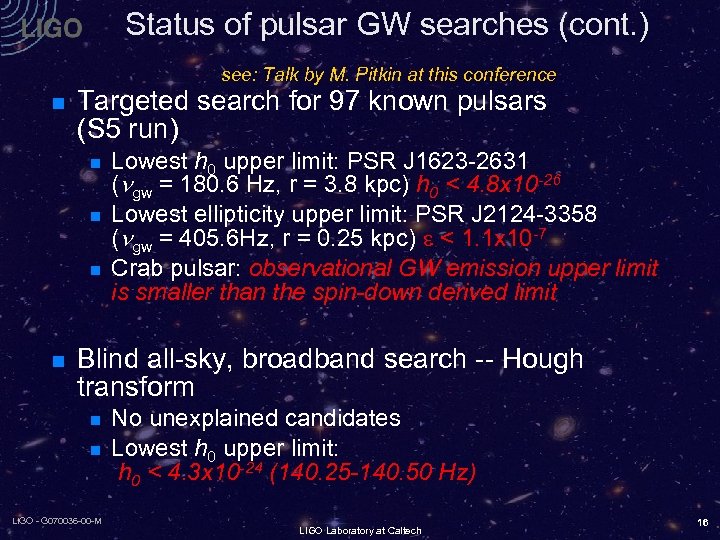 Status of pulsar GW searches (cont. ) see: Talk by M. Pitkin at this conference n Targeted search for 97 known pulsars (S 5 run) n n Lowest h 0 upper limit: PSR J 1623 -2631 ( gw = 180. 6 Hz, r = 3. 8 kpc) h 0 < 4. 8 x 10 -26 Lowest ellipticity upper limit: PSR J 2124 -3358 ( gw = 405. 6 Hz, r = 0. 25 kpc) < 1. 1 x 10 -7 Crab pulsar: observational GW emission upper limit is smaller than the spin-down derived limit Blind all-sky, broadband search -- Hough transform n n LIGO - G 070036 -00 -M No unexplained candidates Lowest h 0 upper limit: h 0 < 4. 3 x 10 -24 (140. 25 -140. 50 Hz) LIGO Laboratory at Caltech 16
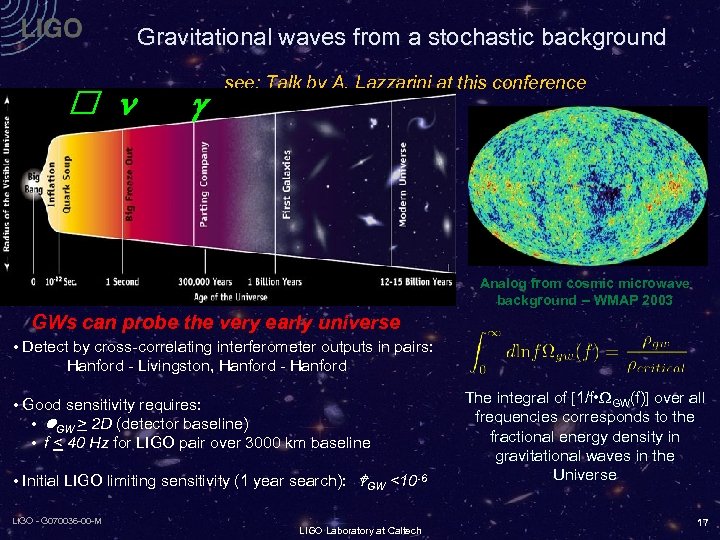 Gravitational waves from a stochastic background see: Talk by A. Lazzarini at this conference Analog from cosmic microwave background -- WMAP 2003 GWs can probe the very early universe • Detect by cross-correlating interferometer outputs in pairs: Hanford - Livingston, Hanford - Hanford • Good sensitivity requires: • GW > 2 D (detector baseline) • f < 40 Hz for LIGO pair over 3000 km baseline • Initial LIGO limiting sensitivity (1 year search): GW <10 -6 LIGO - G 070036 -00 -M LIGO Laboratory at Caltech The integral of [1/f • GW(f)] over all frequencies corresponds to the fractional energy density in gravitational waves in the Universe 17
 Stochastic signals see: Talk by A. Lazzarini at this conference n Stochastic backgrounds can arise either from n n n Cosmological processes, such as inflation, phase transitions, or cosmic strings, or from Astrophysical processes, as the superposition of many signals from the other signal classes already described earlier in talk. n e. g. , GW spectrum due to cosmological BH ring downs (Regimbau & Fotopoulos Characterize the strength by n GW(f), defined as the fraction of cosmic closure density in the background, in a logarithmic frequency interval near frequency f. LIGO - G 070036 -00 -M LIGO Laboratory at Caltech 18
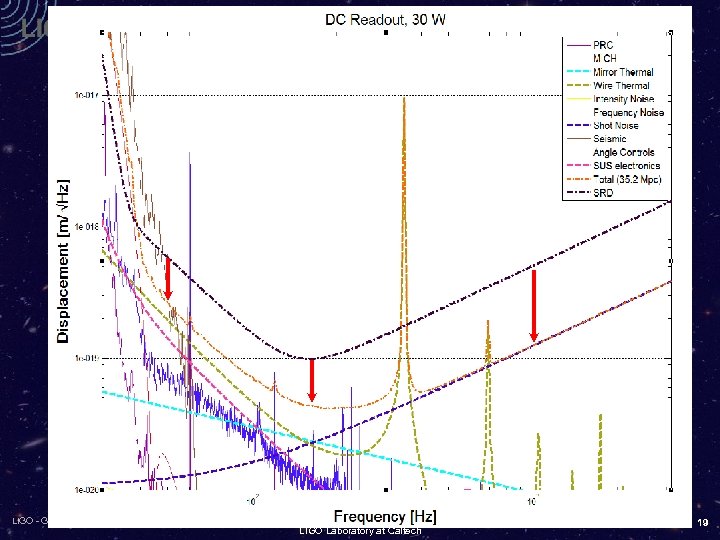 Beyond the current Science Run: Enhancements to initial LIGO n Enhance sensitivity by ~2 X (~8 X increase in observing volume)to increase chances of observing GW waves between end of S 5 and decommissioning of initial LIGO in ~late 2010 (for Adv. LIGO), n n Goal- next science run with enhanced sensitivity in 2009 Approach. Begin S 6 n Use Advanced LIGO technologies wherever possible to gain experience & save money n n n Experience will reduce Advanced LIGO commissioning time Due to limited $, people, time choose enhancements with most impact, chance of success What enhancements to implement? n n End S 6 Enhance the two 4 km IFOs (one at each site), not the 2 km Readout enhancement--Reduce noise and junk light at dark port sensing-- add mode filter cavity, DC readout of GW channel, move into vacuum, seismically isolate Increase laser power by ~3. 5 -- modify things like thermal compensation to handle power Details -- Enhanced LIGO presentation at this conference by R. Adhikari LIGO - G 070036 -00 -M LIGO Laboratory at Caltech 19
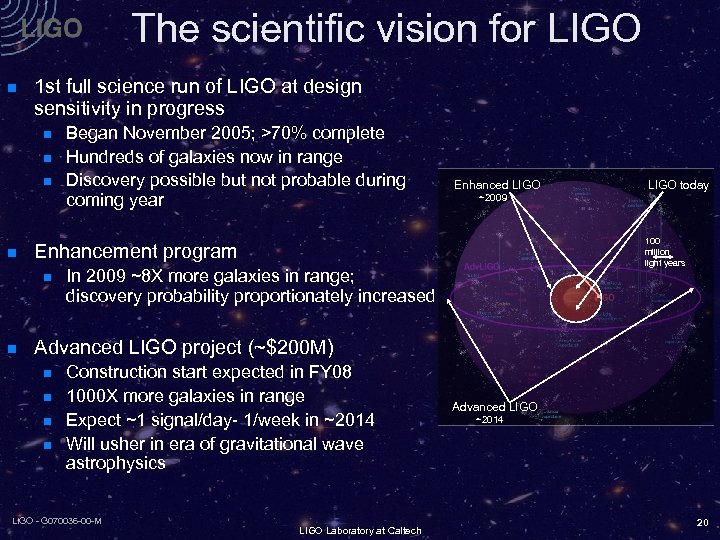 The scientific vision for LIGO n 1 st full science run of LIGO at design sensitivity in progress n n Enhanced LIGO today ~2009 100 million light years Enhancement program n n Began November 2005; >70% complete Hundreds of galaxies now in range Discovery possible but not probable during coming year In 2009 ~8 X more galaxies in range; discovery probability proportionately increased Advanced LIGO project (~$200 M) n n Construction start expected in FY 08 1000 X more galaxies in range Expect ~1 signal/day- 1/week in ~2014 Will usher in era of gravitational wave astrophysics LIGO - G 070036 -00 -M LIGO Laboratory at Caltech Advanced LIGO ~2014 20
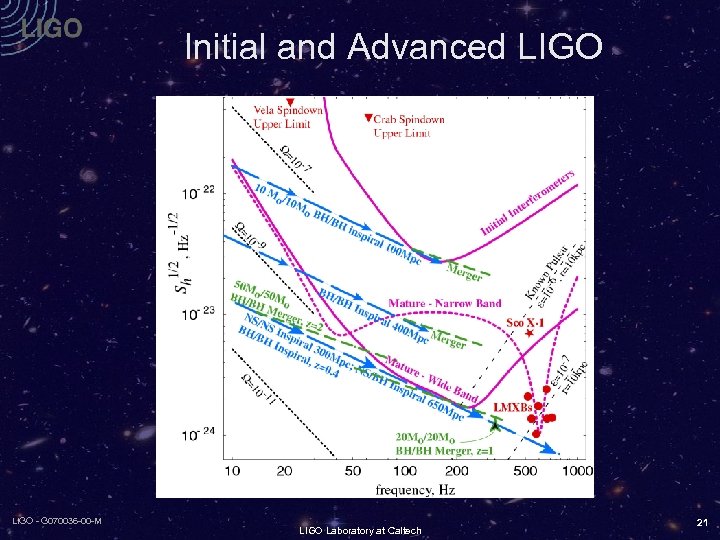 Initial and Advanced LIGO - G 070036 -00 -M LIGO Laboratory at Caltech 21
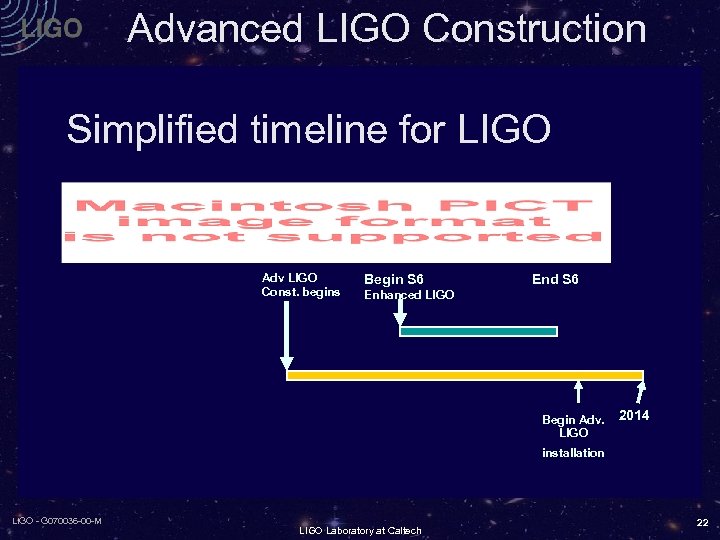 Advanced LIGO Construction n Advanced LIGO construction funding was included in the President’s FY 08 Budget Request for Major Research Equipment and Facilities Construction (MREFC) Simplified infrastructure and experience Build on initial LIGO timeline for LIGO n n Higher power laser, improved seismic suspension and isolation, signal recycling & improved readout (like enhancements), larger mirrors (to handle increased thermal load), etc. Schedule: October 2007 -August 2014, includes 11 months schedule contingency Adv LIGO Const. begins Total NSF cost (then-year $): n n Begin S 6 End S 6 Enhanced LIGO $205 M including ~4. 2%/yr inflation and 27% contingency $24 M equivalent contributions by UK and Germany: each worth equivalent of ~$6 M for development and $6 M for fabrication of hardware n This hardware is now being tested; delivery ahead of US schedule n Lasers support Enhanced LIGO Begin Adv. LIGO 2014 installation LIGO - G 070036 -00 -M LIGO Laboratory at Caltech 22
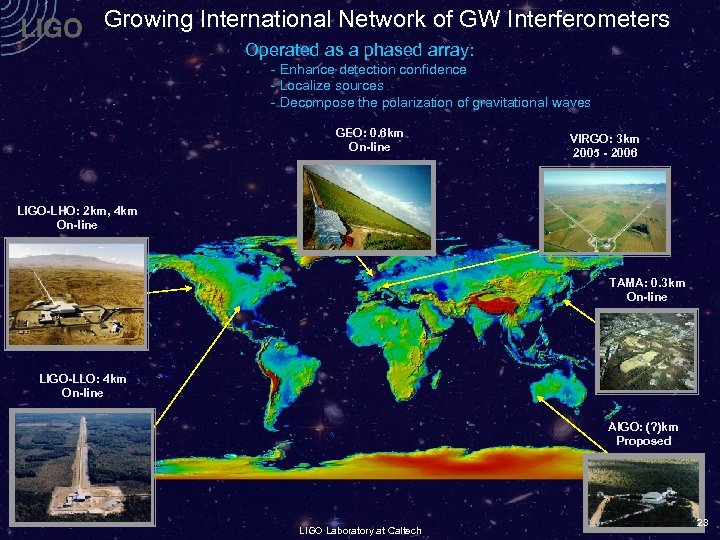 Growing International Network of GW Interferometers Operated as a phased array: - - Enhance detection confidence - Localize sources - Decompose the polarization of gravitational waves GEO: 0. 6 km On-line VIRGO: 3 km 2005 - 2006 LIGO-LHO: 2 km, 4 km On-line TAMA: 0. 3 km On-line LIGO-LLO: 4 km On-line AIGO: (? )km Proposed LIGO - G 070036 -00 -M LIGO Laboratory at Caltech 23
 Status of the global network n GEO and LIGO carry out all observing and data analysis as one team, the LIGO Scientific Collaboration (LSC). n LSC and Virgo have concluded negotiations on joint operations and data analysis. n n More on next slide LIGO carries out joint searches with the network of resonant detectors. LIGO - G 070036 -00 -M LIGO Laboratory at Caltech 24
 LIGO-Virgo Joint Cooperation on Data Analysis n LIGO and Virgo have just consummated an agreement (MOU) defining a forward looking vision of joint analysis and observational cooperation n n Signed Feb 2007 - LIGO, LSC, GEO, Virgo, EGO One scenario to illustrate—others are possible Coordination of all aspects of data analysis n n n Joint working groups Joint collaboration meetings Full data sharing when Virgo begins its long-term scientific observation Joint publication of results once data sharing begins Joint operations/observations n Coordination of future upgrades & shutdowns n MOU is open to future additions as other observatories come on line (e. g. , LCGT, AIGO, …) n Heralds a new era of international cooperation to optimize the chances of detection & observation LIGO - G 070036 -00 -M LIGO Laboratory at Caltech 25
 Summary n LIGO is operating in a science mode at design sensitivity n n Sensitivity/range relative to S 5 sensitivity will be n n 1 st long science run is ~60% complete No detection yet LIGO data analysis is starting to produce interesting upper limits increased ~ 2 X in 2009 and, a factor 10 X in ~2014 with Advanced LIGO Expect to be doing GW astrophysics with Advanced LIGO Efforts towards an international network of ground-based GW detectors are gaining momentum LIGO - G 070036 -00 -M LIGO Laboratory at Caltech 26