 Скачать презентацию LIGO Data Computing Update Albert Lazzarini LIGO
b05a5249d9422e68d6094c28da494700.ppt
- Количество слайдов: 41



LIGO Data & Computing Update Albert Lazzarini LIGO Laboratory at Caltech 12 th Meeting of the LIGO Laboratory PAC 26 June 2002 Cambridge, MA LIGO-G 020266 -00 -E PAC Meeting 2002. 06. 27 -28 LIGO Laboratory at Caltech
Outline for this talk • Simulation & Modeling • Data Analysis Systems • Grid Computing • Staffing LIGO-G 020266 -00 -E PAC Meeting 2002. 06. 27 -28 LIGO Laboratory at Caltech
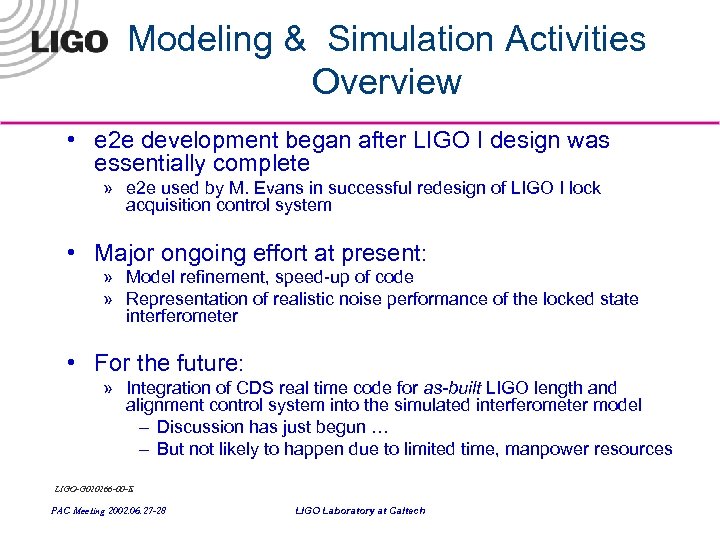
Modeling & Simulation Activities Overview • e 2 e development began after LIGO I design was essentially complete » e 2 e used by M. Evans in successful redesign of LIGO I lock acquisition control system • Major ongoing effort at present: » Model refinement, speed-up of code » Representation of realistic noise performance of the locked state interferometer • For the future: » Integration of CDS real time code for as-built LIGO length and alignment control system into the simulated interferometer model – Discussion has just begun … – But not likely to happen due to limited time, manpower resources LIGO-G 020266 -00 -E PAC Meeting 2002. 06. 27 -28 LIGO Laboratory at Caltech
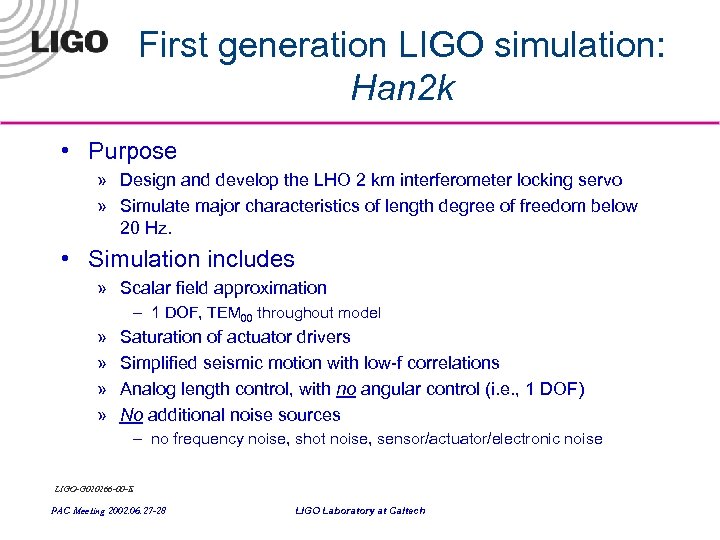
First generation LIGO simulation: Han 2 k • Purpose » Design and develop the LHO 2 km interferometer locking servo » Simulate major characteristics of length degree of freedom below 20 Hz. • Simulation includes » Scalar field approximation – 1 DOF, TEM 00 throughout model » » Saturation of actuator drivers Simplified seismic motion with low-f correlations Analog length control, with no angular control (i. e. , 1 DOF) No additional noise sources – no frequency noise, shot noise, sensor/actuator/electronic noise LIGO-G 020266 -00 -E PAC Meeting 2002. 06. 27 -28 LIGO Laboratory at Caltech
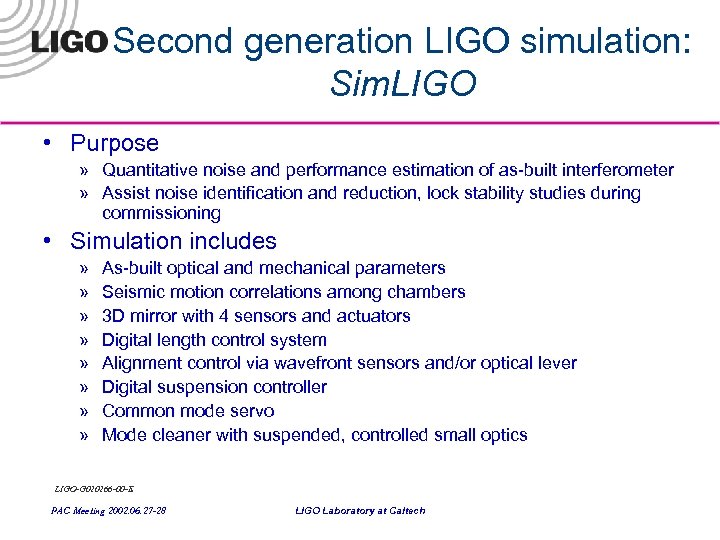
Second generation LIGO simulation: Sim. LIGO • Purpose » Quantitative noise and performance estimation of as-built interferometer » Assist noise identification and reduction, lock stability studies during commissioning • Simulation includes » » » » As-built optical and mechanical parameters Seismic motion correlations among chambers 3 D mirror with 4 sensors and actuators Digital length control system Alignment control via wavefront sensors and/or optical lever Digital suspension controller Common mode servo Mode cleaner with suspended, controlled small optics LIGO-G 020266 -00 -E PAC Meeting 2002. 06. 27 -28 LIGO Laboratory at Caltech
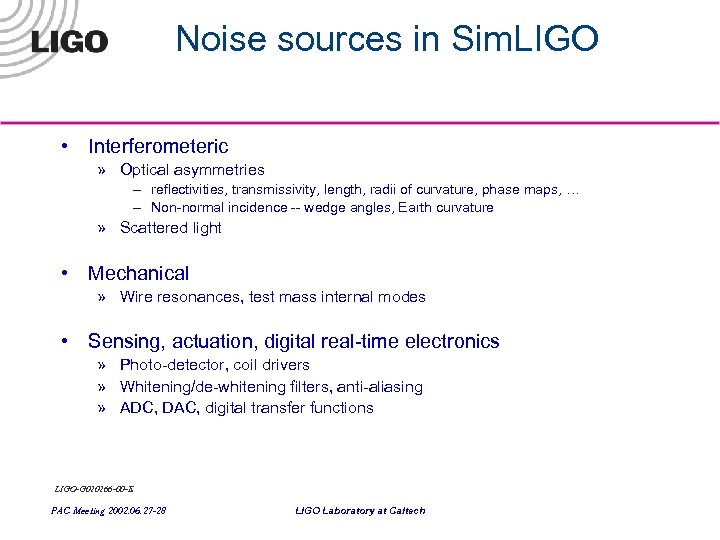
Noise sources in Sim. LIGO • Interferometeric » Optical asymmetries – reflectivities, transmissivity, length, radii of curvature, phase maps, … – Non-normal incidence -- wedge angles, Earth curvature » Scattered light • Mechanical » Wire resonances, test mass internal modes • Sensing, actuation, digital real-time electronics » Photo-detector, coil drivers » Whitening/de-whitening filters, anti-aliasing » ADC, DAC, digital transfer functions LIGO-G 020266 -00 -E PAC Meeting 2002. 06. 27 -28 LIGO Laboratory at Caltech
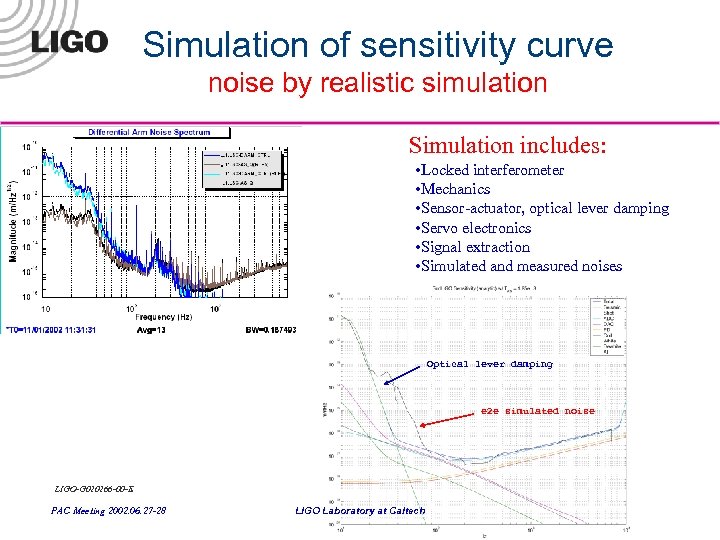
Simulation of sensitivity curve noise by realistic simulation Simulation includes: • Locked interferometer • Mechanics • Sensor-actuator, optical lever damping • Servo electronics • Signal extraction • Simulated and measured noises • … Optical lever damping e 2 e simulated noise LIGO-G 020266 -00 -E PAC Meeting 2002. 06. 27 -28 LIGO Laboratory at Caltech
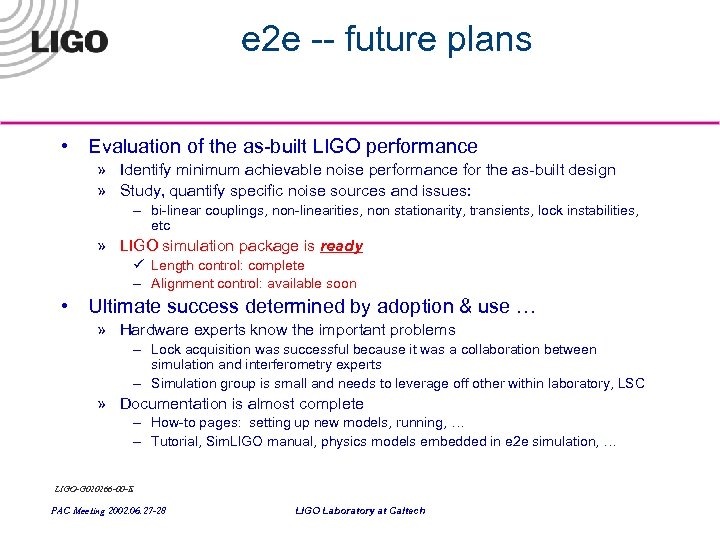
e 2 e -- future plans • Evaluation of the as-built LIGO performance » Identify minimum achievable noise performance for the as-built design » Study, quantify specific noise sources and issues: – bi-linear couplings, non-linearities, non stationarity, transients, lock instabilities, etc » LIGO simulation package is ready ü Length control: complete – Alignment control: available soon • Ultimate success determined by adoption & use … » Hardware experts know the important problems – Lock acquisition was successful because it was a collaboration between simulation and interferometry experts – Simulation group is small and needs to leverage off other within laboratory, LSC » Documentation is almost complete – How-to pages: setting up new models, running, … – Tutorial, Sim. LIGO manual, physics models embedded in e 2 e simulation, … LIGO-G 020266 -00 -E PAC Meeting 2002. 06. 27 -28 LIGO Laboratory at Caltech
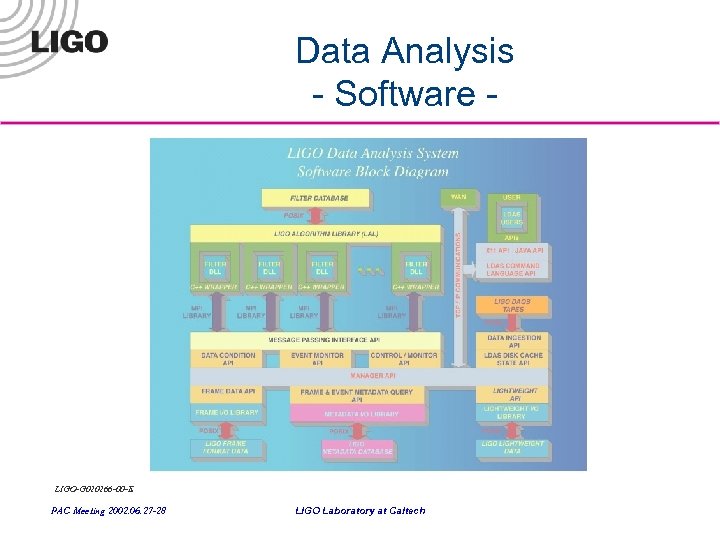
Data Analysis - Software - LIGO-G 020266 -00 -E PAC Meeting 2002. 06. 27 -28 LIGO Laboratory at Caltech
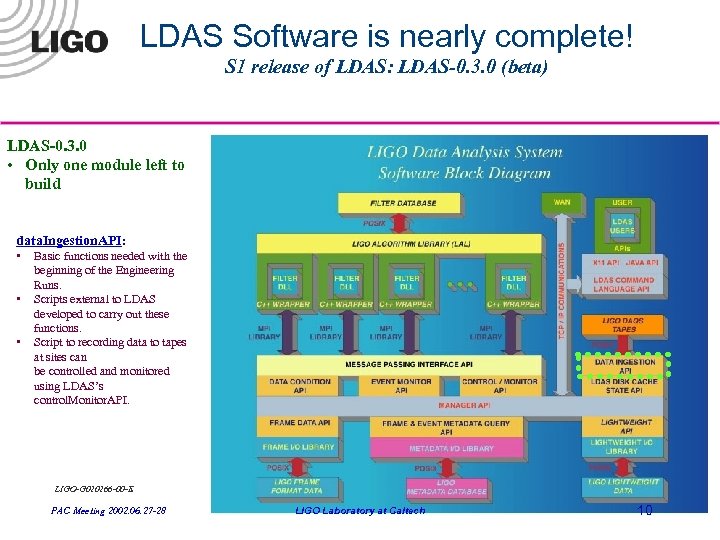
LDAS Software is nearly complete! S 1 release of LDAS: LDAS-0. 3. 0 (beta) LDAS-0. 3. 0 • Only one module left to build data. Ingestion. API: • • • Basic functions needed with the beginning of the Engineering Runs. Scripts external to LDAS developed to carry out these functions. Script to recording data to tapes at sites can be controlled and monitored using LDAS’s control. Monitor. API. LIGO-G 020266 -00 -E PAC Meeting 2002. 06. 27 -28 LIGO Laboratory at Caltech 10
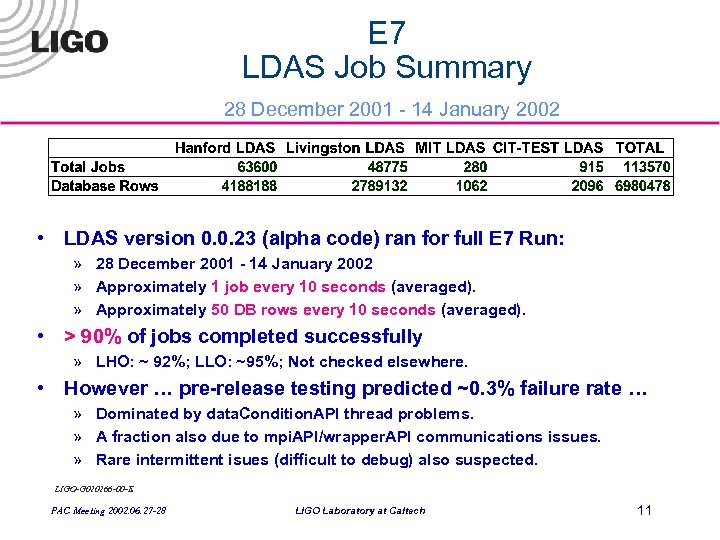
E 7 LDAS Job Summary 28 December 2001 - 14 January 2002 • LDAS version 0. 0. 23 (alpha code) ran for full E 7 Run: » 28 December 2001 - 14 January 2002 » Approximately 1 job every 10 seconds (averaged). » Approximately 50 DB rows every 10 seconds (averaged). • > 90% of jobs completed successfully » LHO: ~ 92%; LLO: ~95%; Not checked elsewhere. • However … pre-release testing predicted ~0. 3% failure rate … » Dominated by data. Condition. API thread problems. » A fraction also due to mpi. API/wrapper. API communications issues. » Rare intermittent isues (difficult to debug) also suspected. LIGO-G 020266 -00 -E PAC Meeting 2002. 06. 27 -28 LIGO Laboratory at Caltech 11
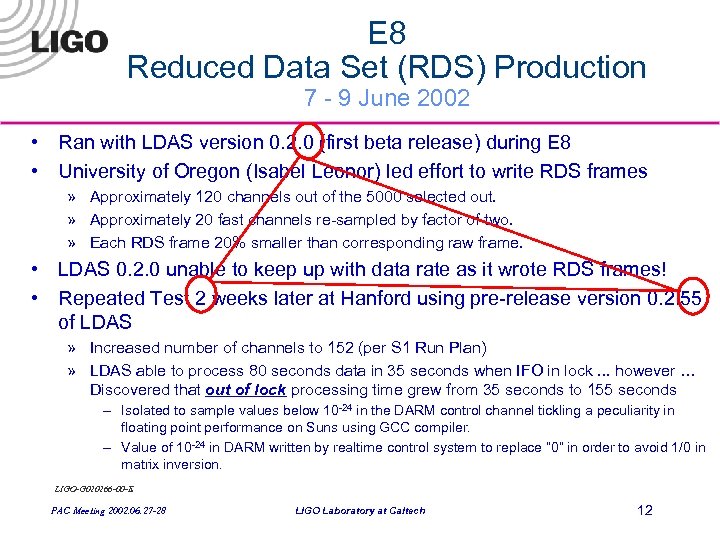
E 8 Reduced Data Set (RDS) Production 7 - 9 June 2002 • Ran with LDAS version 0. 2. 0 (first beta release) during E 8 • University of Oregon (Isabel Leonor) led effort to write RDS frames » Approximately 120 channels out of the 5000 selected out. » Approximately 20 fast channels re-sampled by factor of two. » Each RDS frame 20% smaller than corresponding raw frame. • LDAS 0. 2. 0 unable to keep up with data rate as it wrote RDS frames! • Repeated Test 2 weeks later at Hanford using pre-release version 0. 2. 55 of LDAS » Increased number of channels to 152 (per S 1 Run Plan) » LDAS able to process 80 seconds data in 35 seconds when IFO in lock. . . however … Discovered that out of lock processing time grew from 35 seconds to 155 seconds – Isolated to sample values below 10 -24 in the DARM control channel tickling a peculiarity in floating point performance on Suns using GCC compiler. – Value of 10 -24 in DARM written by realtime control system to replace “ 0” in order to avoid 1/0 in matrix inversion. LIGO-G 020266 -00 -E PAC Meeting 2002. 06. 27 -28 LIGO Laboratory at Caltech 12
LDAS at MIT • LDAS at MIT has become central to analysis activities within the BURST Upper Limits Group. » See http: //www. ligo. caltech. edu/LIGO_web/0203 news/0203 mit. html • LDAS used by Sylvestre at MIT to analyze E 7 data and contributed to his recent Ph. D. dissertation. • Burst Group worked with LDAS development team to test pre-Science Run version of LDAS. • As part of the analysis of E 7 data, 6. 5 days of E 7 data were analyzed in a single day: » 1554 jobs submitted to LDAS-MIT and completed successfully » (3 DSOs) x (2 IFOs) x (1 waveform) x (7 amplitudes) x (37 360 sec intervals) LIGO-G 020266 -00 -E PAC Meeting 2002. 06. 27 -28 LIGO Laboratory at Caltech 13
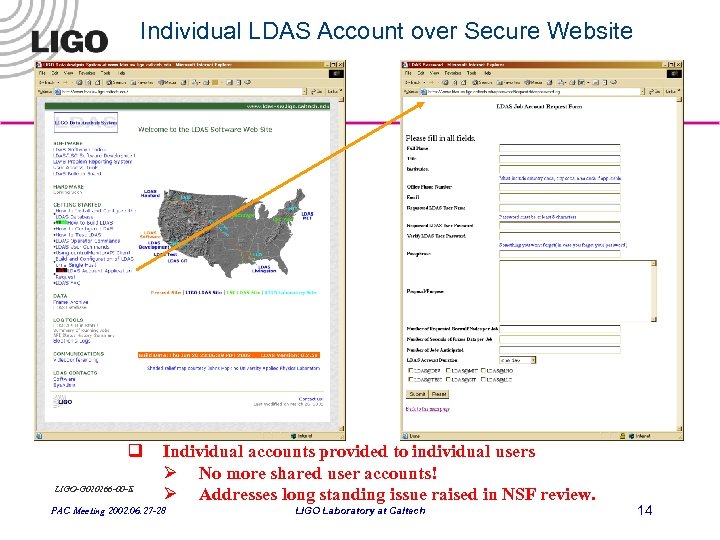
Individual LDAS Account over Secure Website q LIGO-G 020266 -00 -E Individual accounts provided to individual users Ø No more shared user accounts! Ø Addresses long standing issue raised in NSF review. PAC Meeting 2002. 06. 27 -28 LIGO Laboratory at Caltech 14
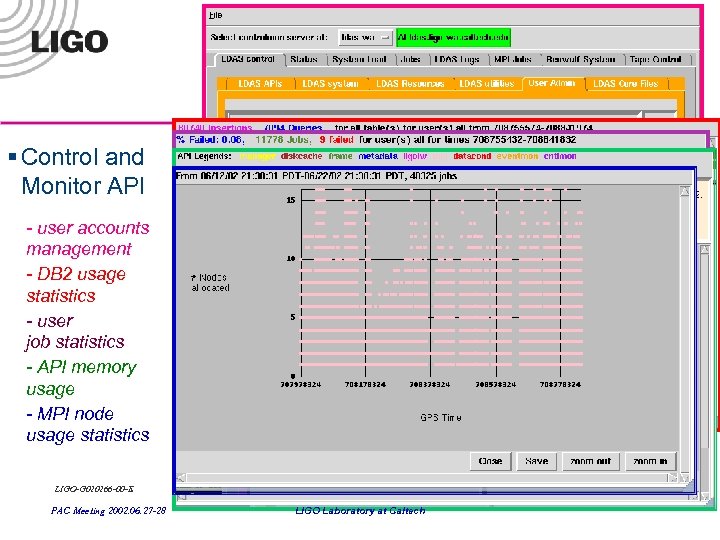
§ Control and Monitor API - user accounts management - DB 2 usage statistics - user job statistics - API memory usage - MPI node usage statistics LIGO-G 020266 -00 -E PAC Meeting 2002. 06. 27 -28 LIGO Laboratory at Caltech
LDAS Plan for S 1 Run • Third beta release of LDAS will be used (version 0. 3. 0) • Exhaustive testing of release for three weeks prior to S 1: » First week consisted of internal testing and bug fixing » Second week continued internal testing and began integration testing with LAL and LALwrapper codes » Carried out collaborative RDS testing at LHO and Burst Group analysis testing at MIT in the third week. » Pushed pre-release 0. 2. 58 to UWM one week before S 1 Run. • Push release to all Laboratory sites (just) before S 1 begins. » “Just in time delivery” • LSC (through LSUG group) will work with LDAS to “ramp” up to the S 1 Run analysis plan. LIGO-G 020266 -00 -E PAC Meeting 2002. 06. 27 -28 LIGO Laboratory at Caltech 16
Issues from LDAS software • • Version 5 Frame Specification significantly delayed and has resulted in some loss of schedule and reduced functionality for the Science Run. Reduced Data Sets are not very reduced! » Frame size (>20% of raw data) taxing the current capabilities of LDAS and will demand reworking some of the frame. API to be able to support this load. • • It is demanding to develop beta level code while supporting use of LDAS for science and supporting growing population of LSC users, LDAS installations. LSC participation in code (algorithm) development has significantly decreased due to change of focus towards Upper Limits Group activities. » Needed signal processing functionality not yet unimplemented: Kalman filter, SI units management, process history, filter coefficient tracking, test signal generation, data type conversion (real->int), data alignment - handling filter delays • LDAS use model evolution continues » continued need for programming activities vis-à-vis science LIGO-G 020266 -00 -E PAC Meeting 2002. 06. 27 -28 LIGO Laboratory at Caltech 17
Data Analysis - Hardware STK@CIT MPI Cluster@ LHO LIGO-G 020266 -00 -E T 3 RAID @LHO PAC Meeting 2002. 06. 27 -28 LIGO Laboratory at Caltech
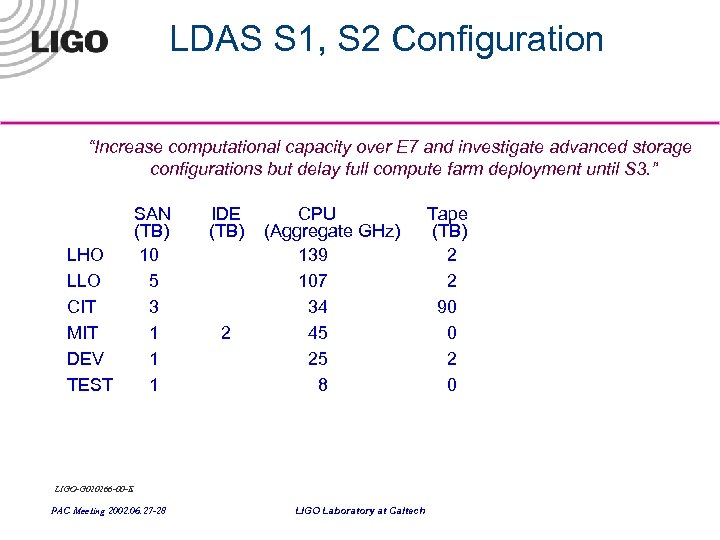
LDAS S 1, S 2 Configuration “Increase computational capacity over E 7 and investigate advanced storage configurations but delay full compute farm deployment until S 3. ” LHO LLO CIT MIT DEV TEST SAN (TB) 10 5 3 1 1 1 IDE (TB) 2 CPU (Aggregate GHz) 139 107 34 45 25 8 LIGO-G 020266 -00 -E PAC Meeting 2002. 06. 27 -28 LIGO Laboratory at Caltech Tape (TB) 2 2 90 0 2 0
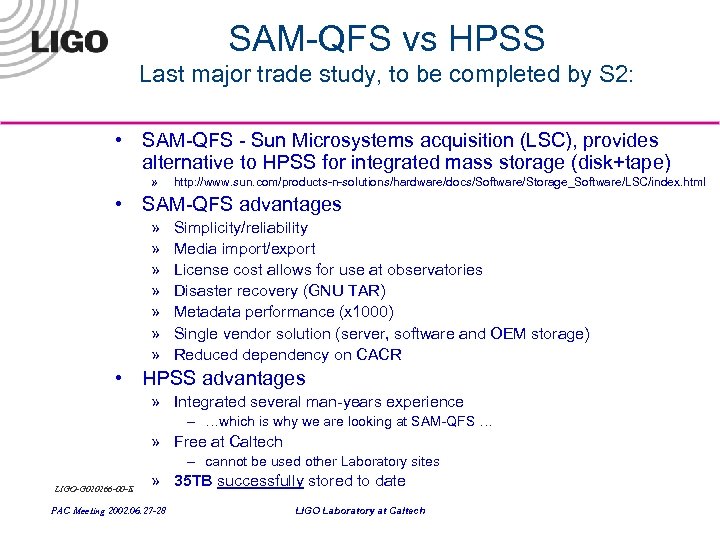
SAM-QFS vs HPSS Last major trade study, to be completed by S 2: • SAM-QFS - Sun Microsystems acquisition (LSC), provides alternative to HPSS for integrated mass storage (disk+tape) » http: //www. sun. com/products-n-solutions/hardware/docs/Software/Storage_Software/LSC/index. html • SAM-QFS advantages » » » » Simplicity/reliability Media import/export License cost allows for use at observatories Disaster recovery (GNU TAR) Metadata performance (x 1000) Single vendor solution (server, software and OEM storage) Reduced dependency on CACR • HPSS advantages » Integrated several man-years experience – …which is why we are looking at SAM-QFS … » Free at Caltech – cannot be used other Laboratory sites LIGO-G 020266 -00 -E » 35 TB successfully stored to date PAC Meeting 2002. 06. 27 -28 LIGO Laboratory at Caltech
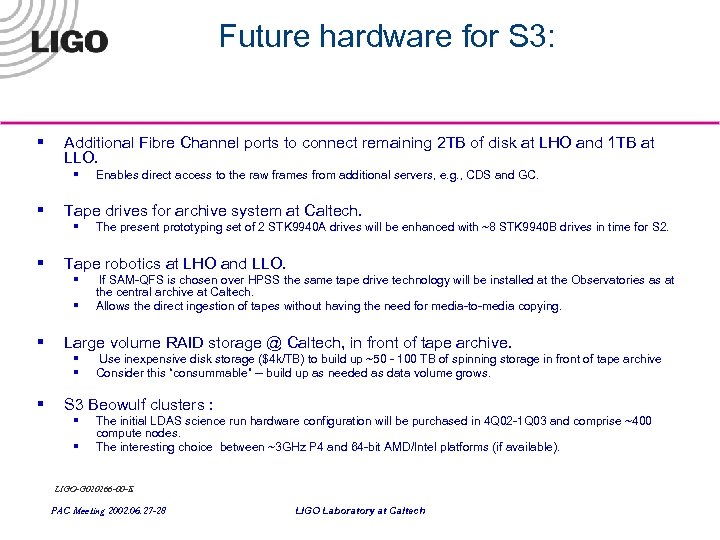
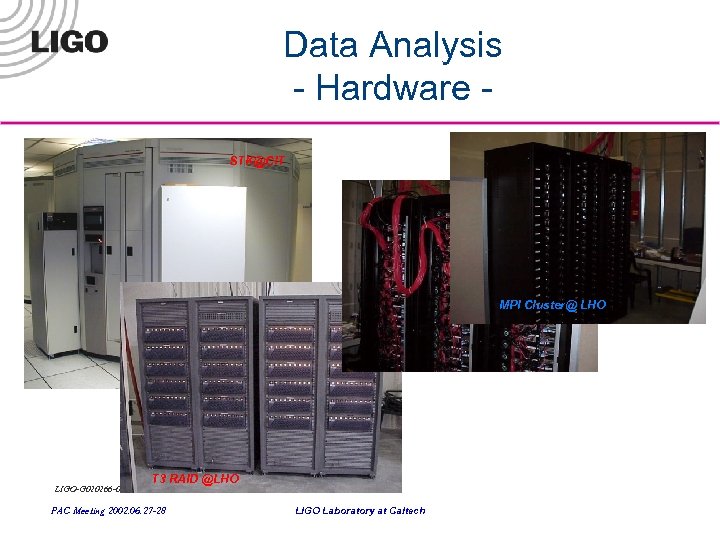
Future hardware for S 3: § Additional Fibre Channel ports to connect remaining 2 TB of disk at LHO and 1 TB at LLO. § § Tape drives for archive system at Caltech. § § § If SAM-QFS is chosen over HPSS the same tape drive technology will be installed at the Observatories as at the central archive at Caltech. Allows the direct ingestion of tapes without having the need for media-to-media copying. Large volume RAID storage @ Caltech, in front of tape archive. § § § The present prototyping set of 2 STK 9940 A drives will be enhanced with ~8 STK 9940 B drives in time for S 2. Tape robotics at LHO and LLO. § § Enables direct access to the raw frames from additional servers, e. g. , CDS and GC. Use inexpensive disk storage ($4 k/TB) to build up ~50 - 100 TB of spinning storage in front of tape archive Consider this “consummable” -- build up as needed as data volume grows. S 3 Beowulf clusters : § § The initial LDAS science run hardware configuration will be purchased in 4 Q 02 -1 Q 03 and comprise ~400 compute nodes. The interesting choice between ~3 GHz P 4 and 64 -bit AMD/Intel platforms (if available). LIGO-G 020266 -00 -E PAC Meeting 2002. 06. 27 -28 LIGO Laboratory at Caltech
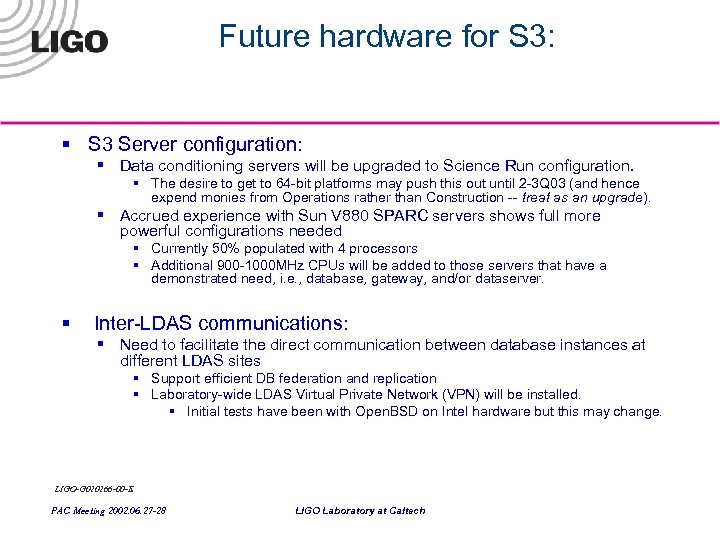
Future hardware for S 3: § S 3 Server configuration: § Data conditioning servers will be upgraded to Science Run configuration. § The desire to get to 64 -bit platforms may push this out until 2 -3 Q 03 (and hence expend monies from Operations rather than Construction -- treat as an upgrade). § Accrued experience with Sun V 880 SPARC servers shows full more powerful configurations needed § Currently 50% populated with 4 processors § Additional 900 -1000 MHz CPUs will be added to those servers that have a demonstrated need, i. e. , database, gateway, and/or dataserver. § Inter-LDAS communications: § Need to facilitate the direct communication between database instances at different LDAS sites § Support efficient DB federation and replication § Laboratory-wide LDAS Virtual Private Network (VPN) will be installed. § Initial tests have been with Open. BSD on Intel hardware but this may change. LIGO-G 020266 -00 -E PAC Meeting 2002. 06. 27 -28 LIGO Laboratory at Caltech
Data Analysis - Wide Area Network (WAN) - LIGO-G 020266 -00 -E PAC Meeting 2002. 06. 27 -28 LIGO Laboratory at Caltech
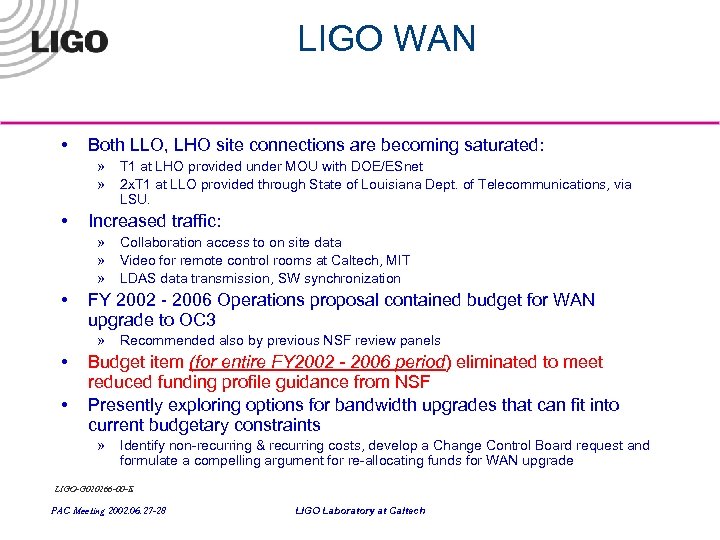
LIGO WAN • Both LLO, LHO site connections are becoming saturated: » T 1 at LHO provided under MOU with DOE/ESnet » 2 x. T 1 at LLO provided through State of Louisiana Dept. of Telecommunications, via LSU. • Increased traffic: » Collaboration access to on site data » Video for remote control rooms at Caltech, MIT » LDAS data transmission, SW synchronization • FY 2002 - 2006 Operations proposal contained budget for WAN upgrade to OC 3 » Recommended also by previous NSF review panels • • Budget item (for entire FY 2002 - 2006 period) eliminated to meet reduced funding profile guidance from NSF Presently exploring options for bandwidth upgrades that can fit into current budgetary constraints » Identify non-recurring & recurring costs, develop a Change Control Board request and formulate a compelling argument for re-allocating funds for WAN upgrade LIGO-G 020266 -00 -E PAC Meeting 2002. 06. 27 -28 LIGO Laboratory at Caltech
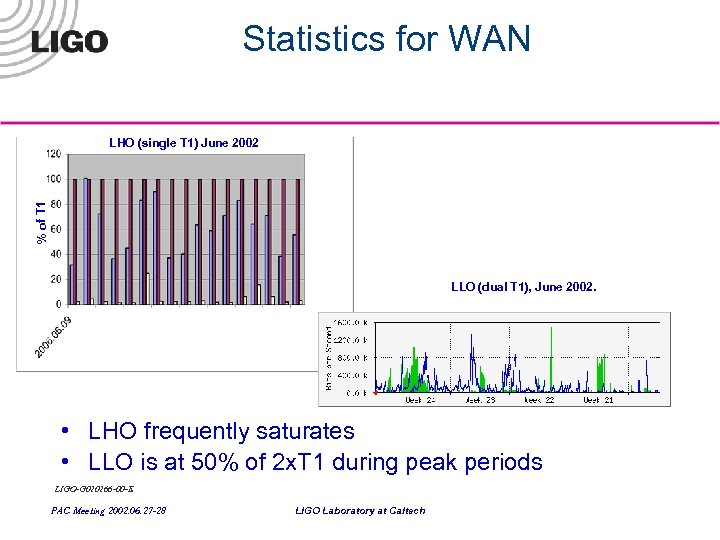
Statistics for WAN % of T 1 LHO (single T 1) June 2002 LLO (dual T 1), June 2002. • LHO frequently saturates • LLO is at 50% of 2 x. T 1 during peak periods LIGO-G 020266 -00 -E PAC Meeting 2002. 06. 27 -28 LIGO Laboratory at Caltech
LIGO WAN • LHO » Landscape of options has changed markedly over past 18 months » New PUC enterprise, Energy Northwest (ENW), has installed fibre-optic infrastructure along the power grid rights-of-way throughout Washington » Provides good service at reasonable cost for government, non-profit organizations - Battelle/DOE have already migrated to ENW » Cost of OC 3 is expected to be ~13 X less per Mbps than present T 1 costs: – OC 3 annual costs would be additional $84 k/year over what LIGO pays for T 1 » LIGO will continue its MOU with DOE/ESnet and share infrastructure, BW with PNNL/Battelle – Mutual cooperation between NSF, DOE deemed important to PNNL, LIGO » Awaiting quote for service from PNNL, ENW in order to formulate a proposal to LIGO Laboratory Directorate LIGO-G 020266 -00 -E PAC Meeting 2002. 06. 27 -28 LIGO Laboratory at Caltech
LIGO WAN • LLO » Unlike LHO, the LA State infrastructure is linked to commercial enterprise – Market rate for bandwidth in southeastern US is higher – Fewer options (only Bell South) • Several expected competitors aborted plans after the. com collapse in FY 2000 -2001 » Presently in a “wait and see” mode, while identifying options » Two factors mitigate situation vis-à-vis LHO: – Data rate, volume is 0. 5 as great – Present bandwidth is already twice as great • 2 T 1 lines in place vs. 1 at LHO LIGO-G 020266 -00 -E PAC Meeting 2002. 06. 27 -28 LIGO Laboratory at Caltech
Data Analysis - Grid Computing Gri. Phy. N: Grid Physics Network i. VDGL: International Virtual Data Grid Laboratory LIGO-G 020266 -00 -E PAC Meeting 2002. 06. 27 -28 LIGO Laboratory at Caltech
Grid activities Gri. Phy. N & i. VDGL • LIGO/Caltech, UWM, PSU members of collaborations • Gri. Phy. N - CS + Applications research focused on: » Virtual data in LIGO analysis – Use of transformation catalogs to keep track of previously requested, performed transformations that can be used to accelerate data requests – Determine if the data product is instantiated, if so where, if not, how to compute it. – Plan & execute data movements and computations required to support specific analyses » LIGO data mirroring using gridtools – Automated, robust replication between Tier 1 & Tier 2 sites » Developing an interface between the grid environment and the native LDAS environment – Extending LDAS into a grid-enabled environment -- longer term goal » Grid security infrastructure – Provide data access only to collaboration members – Provide a level of security to LDAS computing LIGO-G 020266 -00 -E PAC Meeting 2002. 06. 27 -28 LIGO Laboratory at Caltech
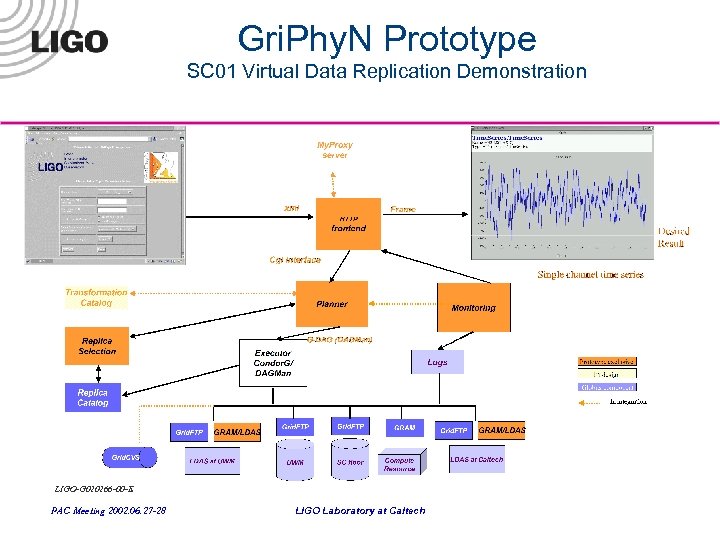
Gri. Phy. N Prototype SC 01 Virtual Data Replication Demonstration LIGO-G 020266 -00 -E PAC Meeting 2002. 06. 27 -28 LIGO Laboratory at Caltech
Virtual Data Prototype Functionality • The detailed prototype functionality was as follows: » User inputs request using a web browser. User can specify: – Data channel name – Time of interest – Desired output data location » » Request is transformed into XML Request Interpreter: Understand an XML-specified request Acquire user’s proxy credentials Replica Selection: Consult replica catalog for available data, select replica “closest to the desired output location” » Request Planner: – If data available: plan necessary data movement – Else: Construct a plan to produce data not available, including execution location selection. Select input data location (“close to compute resources”), schedule data movements etc… – Specify plan in DAGMan format (a Condor-G specification format) » Request Executor: submit DAGMan specified plan to Condor-G » Return requested data to the user specified location in Frame format LIGO-G 020266 -00 -E » Provide a graphical view LIGO Laboratory at Caltech the XSIL frame viewer. of the data by using PAC Meeting 2002. 06. 27 -28
i. VDGL • i. VDGL will provide resources to deploy, support (in a limited fashion) the first 2 LIGO Tier 2 centers: » UWM – extension of existing MRI-funded hardware - provides out-year hardware renewal » PSU – greenfield Tier 2 center to be implemented by end of CY 2002 » Limited FTE support to operate centers – Postdocs, students – Matching university funds from PSU will provide limited IT support LIGO-G 020266 -00 -E PAC Meeting 2002. 06. 27 -28 LIGO Laboratory at Caltech
i. VDGL Trans-oceanic testbed • LIGO and Virgo have agreed to implementation of a data exchange protocol based on grid technology » Exchange limited environmental channels to explore geophysical tele-correlations in anticipation of future network analysis using Virgo, LIGO as an array. » Current prototype system developed by LIGO postdoc, CACR scientist, and Virgo collaborators • Plan is to work with Virgo to migrate to grid toolkit to provide more robust, automated data exchanges around the clock » Fits into the US-EU grid collaboration strategy LIGO-G 020266 -00 -E PAC Meeting 2002. 06. 27 -28 LIGO Laboratory at Caltech
ITR 2003 Proposal to NSF for i. VDGL Operations • ITR 2003 announcement of opportunity expected from NSF this summer • LSC Computing Committee organizing a collaboration -wide proposal to request funding to operate LSC Tier 2 centers for LIGO Science Run(s) » ITR 2000: Gri. Phy. N ->C/S + Applications R&D, prototyping » ITR 2001: i. VDGL-> Center buildup (2 for LSC), port, install Gri. Phy. N deliverables to Tier 2 centers » ITR 2003: request manpower to operate centers to do the science – Scientists, systems adminstration (~ 10 FTE across 2 LSC sites, Lab. sites) – Help desk, 7 x 24 operations support LIGO-G 020266 -00 -E PAC Meeting 2002. 06. 27 -28 LIGO Laboratory at Caltech
Data & Computing - Personnel - LIGO-G 020266 -00 -E PAC Meeting 2002. 06. 27 -28 LIGO Laboratory at Caltech
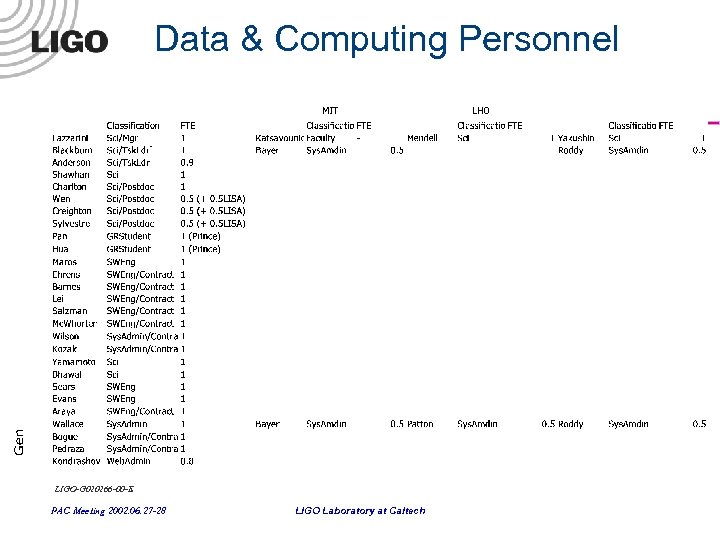
Data & Computing Personnel LIGO-G 020266 -00 -E PAC Meeting 2002. 06. 27 -28 LIGO Laboratory at Caltech
FINIS LIGO-G 020266 -00 -E PAC Meeting 2002. 06. 27 -28 LIGO Laboratory at Caltech
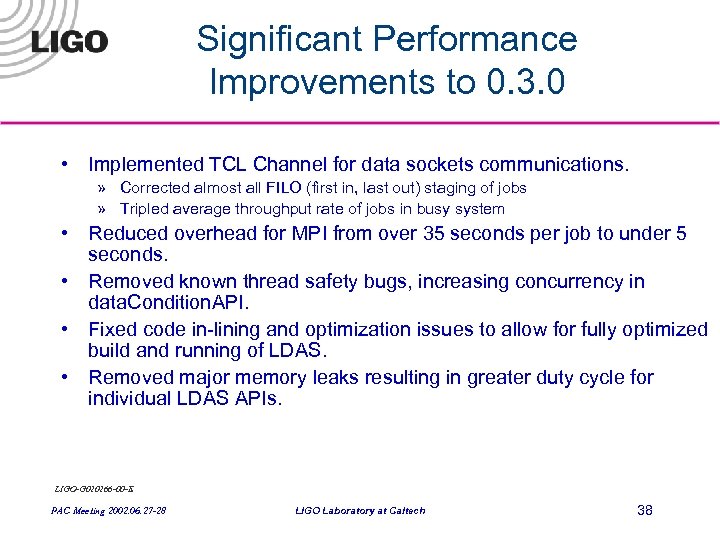
Significant Performance Improvements to 0. 3. 0 • Implemented TCL Channel for data sockets communications. » Corrected almost all FILO (first in, last out) staging of jobs » Tripled average throughput rate of jobs in busy system • Reduced overhead for MPI from over 35 seconds per job to under 5 seconds. • Removed known thread safety bugs, increasing concurrency in data. Condition. API. • Fixed code in-lining and optimization issues to allow for fully optimized build and running of LDAS. • Removed major memory leaks resulting in greater duty cycle for individual LDAS APIs. LIGO-G 020266 -00 -E PAC Meeting 2002. 06. 27 -28 LIGO Laboratory at Caltech 38
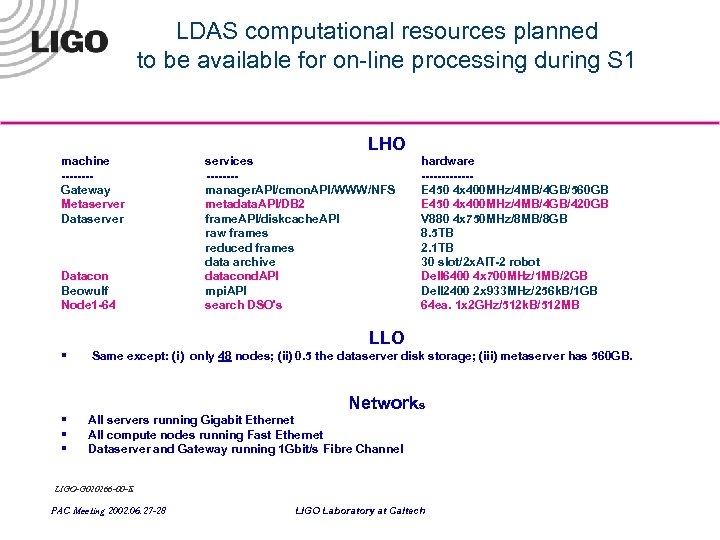
LDAS computational resources planned to be available for on-line processing during S 1 LHO machine -------Gateway Metaserver Datacon Beowulf Node 1 -64 services -------manager. API/cmon. API/WWW/NFS metadata. API/DB 2 frame. API/diskcache. API raw frames reduced frames data archive datacond. API mpi. API search DSO's hardware ------E 450 4 x 400 MHz/4 MB/4 GB/560 GB E 450 4 x 400 MHz/4 MB/4 GB/420 GB V 880 4 x 750 MHz/8 MB/8 GB 8. 5 TB 2. 1 TB 30 slot/2 x. AIT-2 robot Dell 6400 4 x 700 MHz/1 MB/2 GB Dell 2400 2 x 933 MHz/256 k. B/1 GB 64 ea. 1 x 2 GHz/512 k. B/512 MB LLO § Same except: (i) only 48 nodes; (ii) 0. 5 the dataserver disk storage; (iii) metaserver has 560 GB. Networks § § § All servers running Gigabit Ethernet All compute nodes running Fast Ethernet Dataserver and Gateway running 1 Gbit/s Fibre Channel LIGO-G 020266 -00 -E PAC Meeting 2002. 06. 27 -28 LIGO Laboratory at Caltech
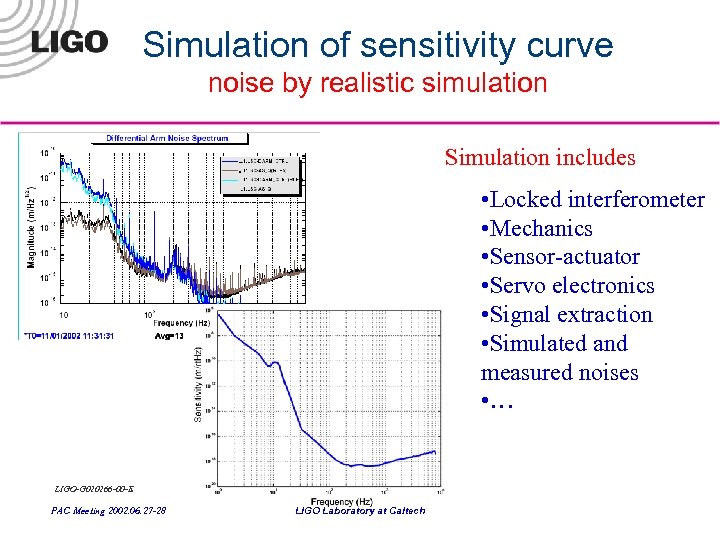
Simulation of sensitivity curve noise by realistic simulation Simulation includes • Locked interferometer • Mechanics • Sensor-actuator • Servo electronics • Signal extraction • Simulated and measured noises • … LIGO-G 020266 -00 -E PAC Meeting 2002. 06. 27 -28 LIGO Laboratory at Caltech
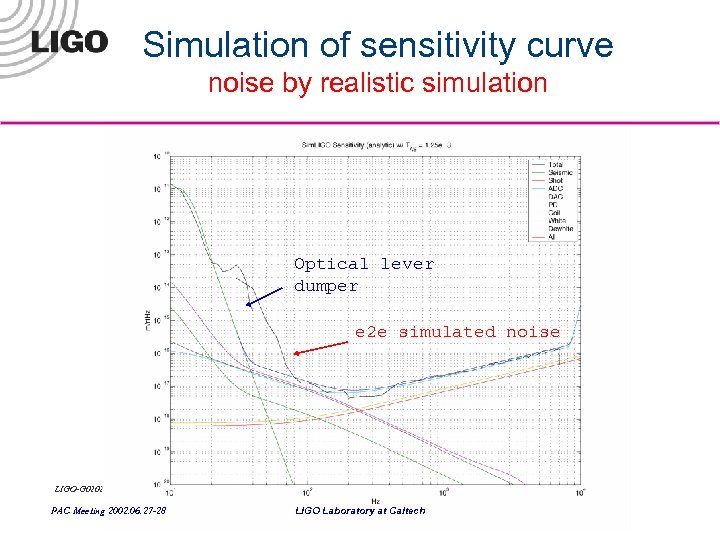
Simulation of sensitivity curve noise by realistic simulation Optical lever dumper e 2 e simulated noise LIGO-G 020266 -00 -E PAC Meeting 2002. 06. 27 -28 LIGO Laboratory at Caltech
Скачать презентацию LIGO Data Computing Update Albert Lazzarini LIGO
b05a5249d9422e68d6094c28da494700.ppt