


 Скачать презентацию LIGO and Advanced LIGO Technical Issues Dave Ottaway
05eea1aac80a8dae5b2d078840df9fc5.ppt
- Количество слайдов: 22
 LIGO and Advanced LIGO: Technical Issues Dave Ottaway (for LIGO Scientific Community) LIGO Lab Kavli Institute for Astrophysics and Space Research, Massachusetts Institute of Technology
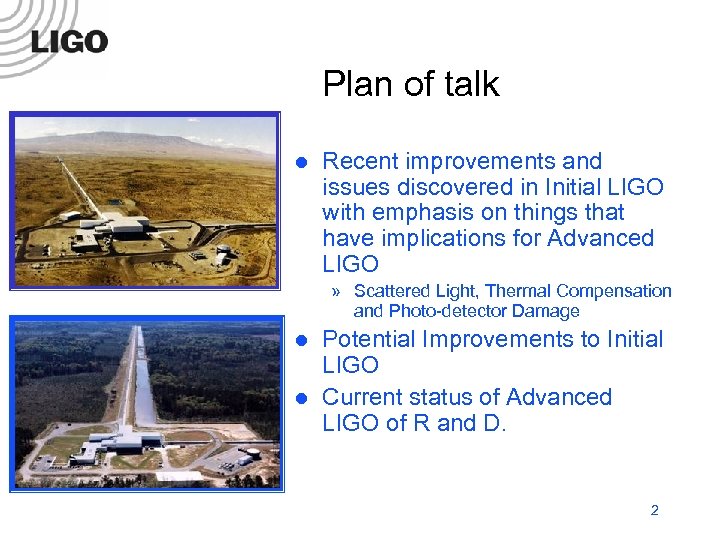 Plan of talk l Recent improvements and issues discovered in Initial LIGO with emphasis on things that have implications for Advanced LIGO » Scattered Light, Thermal Compensation and Photo-detector Damage l l Potential Improvements to Initial LIGO Current status of Advanced LIGO of R and D. 2
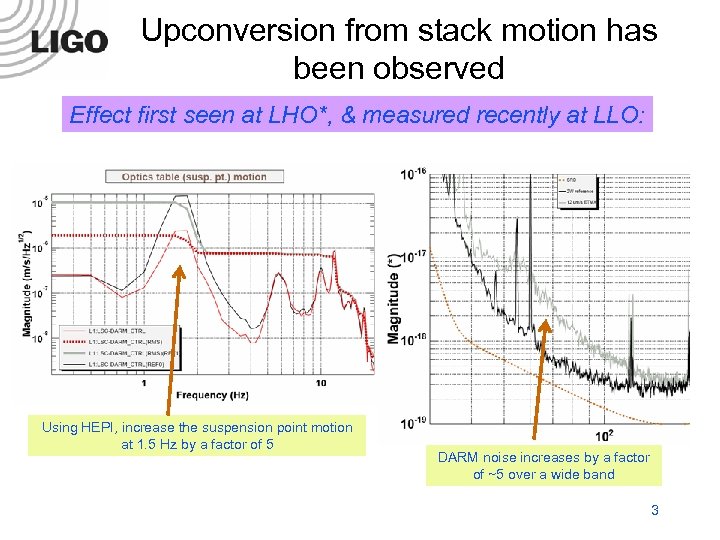 Upconversion from stack motion has been observed Effect first seen at LHO*, & measured recently at LLO: Using HEPI, increase the suspension point motion at 1. 5 Hz by a factor of 5 DARM noise increases by a factor of ~5 over a wide band 3
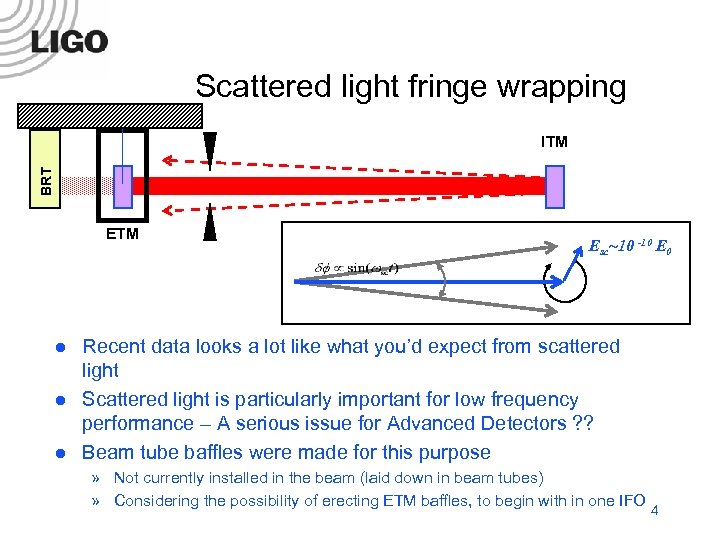 Scattered light fringe wrapping BRT ITM ETM l l l Esc~10 -10 E 0 Recent data looks a lot like what you’d expect from scattered light Scattered light is particularly important for low frequency performance – A serious issue for Advanced Detectors ? ? Beam tube baffles were made for this purpose » Not currently installed in the beam (laid down in beam tubes) » Considering the possibility of erecting ETM baffles, to begin with in one IFO 4
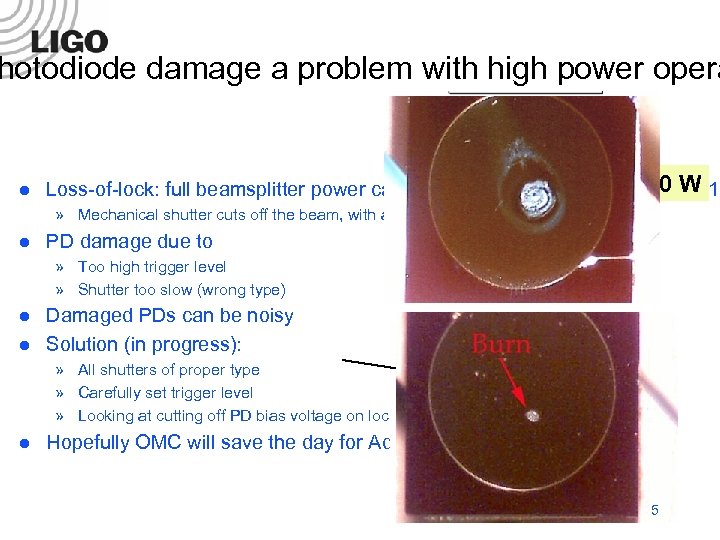 hotodiode damage a problem with high power opera 5 msec l ~100 a ~10 Loss-of-lock: full beamsplitter power can be dumped out the AS port, in W » Mechanical shutter cuts off the beam, with a trigger delay of about 6 msec l PD damage due to » Too high trigger level » Shutter too slow (wrong type) l l Damaged PDs can be noisy Solution (in progress): » All shutters of proper type » Carefully set trigger level » Looking at cutting off PD bias voltage on lock-loss l Red: replaced damaged PDs Hopefully OMC will save the day for Advanced LIGO 5
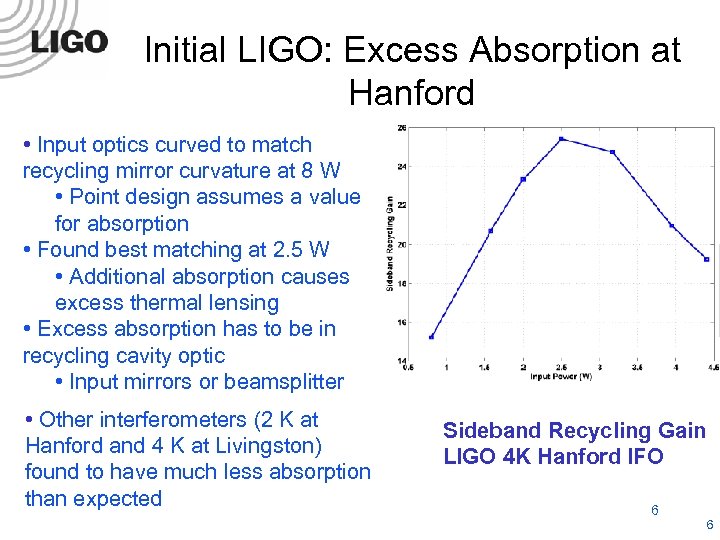 Initial LIGO: Excess Absorption at Hanford • Input optics curved to match recycling mirror curvature at 8 W • Point design assumes a value for absorption • Found best matching at 2. 5 W • Additional absorption causes excess thermal lensing • Excess absorption has to be in recycling cavity optic • Input mirrors or beamsplitter • Other interferometers (2 K at Hanford and 4 K at Livingston) found to have much less absorption than expected Sideband Recycling Gain LIGO 4 K Hanford IFO 6 6
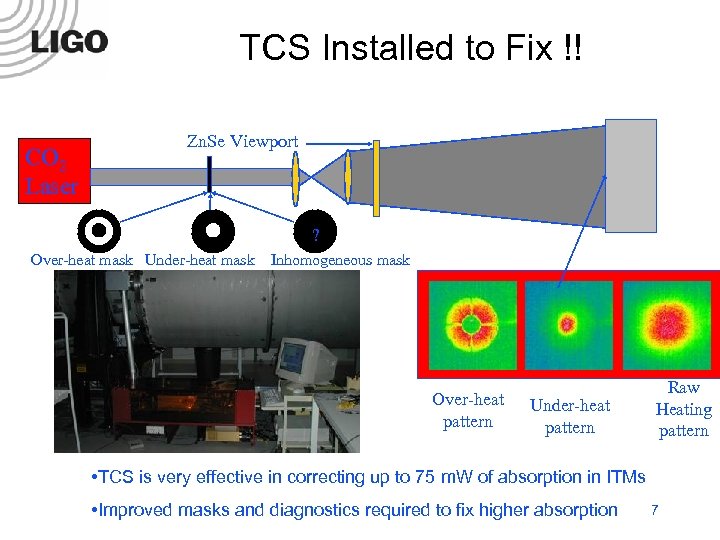 TCS Installed to Fix !! CO 2 Laser Zn. Se Viewport ? Over-heat mask Under-heat mask Inhomogeneous mask Over-heat pattern Under-heat pattern Raw Heating pattern • TCS is very effective in correcting up to 75 m. W of absorption in ITMs • Improved masks and diagnostics required to fix higher absorption 7
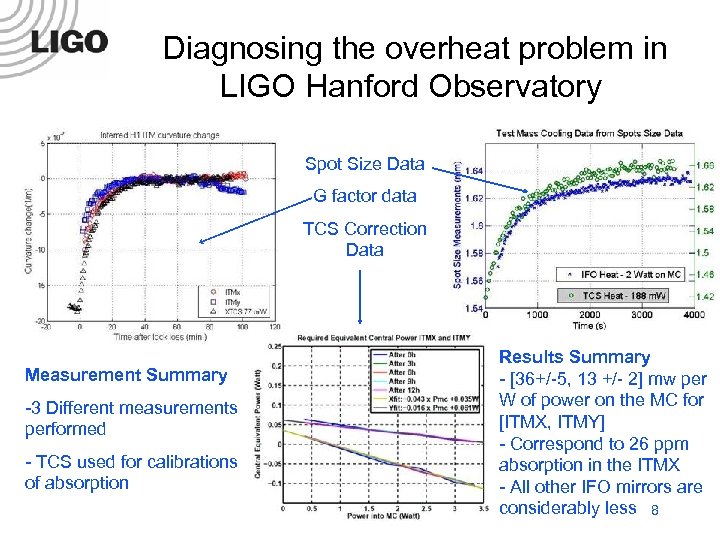 Diagnosing the overheat problem in LIGO Hanford Observatory Spot Size Data G factor data TCS Correction Data Measurement Summary -3 Different measurements performed - TCS used for calibrations of absorption Results Summary - [36+/-5, 13 +/- 2] mw per W of power on the MC for [ITMX, ITMY] - Correspond to 26 ppm absorption in the ITMX - All other IFO mirrors are considerably less 8
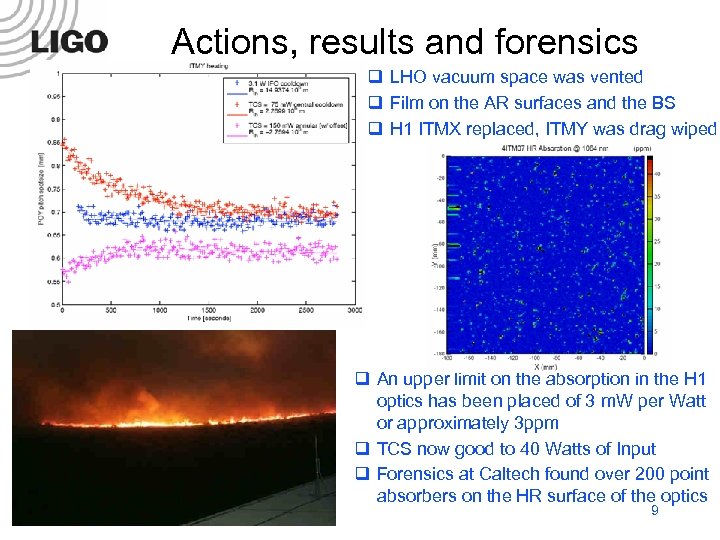 Actions, results and forensics q LHO vacuum space was vented q Film on the AR surfaces and the BS q H 1 ITMX replaced, ITMY was drag wiped q An upper limit on the absorption in the H 1 optics has been placed of 3 m. W per Watt or approximately 3 ppm q TCS now good to 40 Watts of Input q Forensics at Caltech found over 200 point absorbers on the HR surface of the optics 9
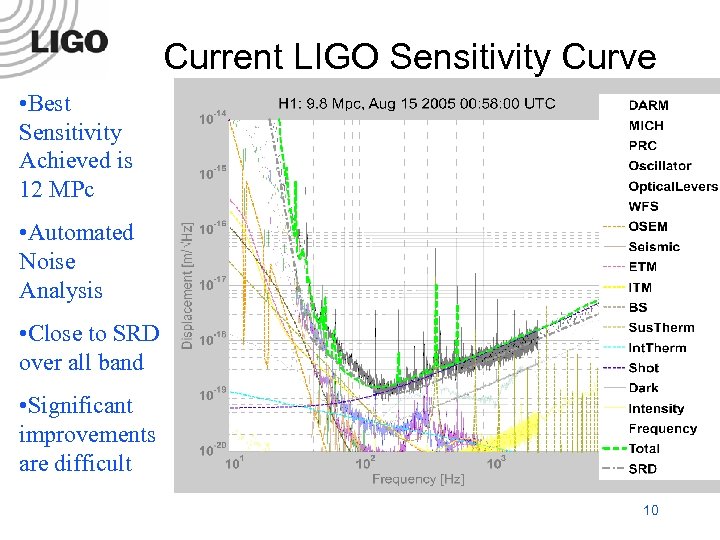 Current LIGO Sensitivity Curve • Best Sensitivity Achieved is 12 MPc • Automated Noise Analysis • Close to SRD over all band • Significant improvements are difficult 10
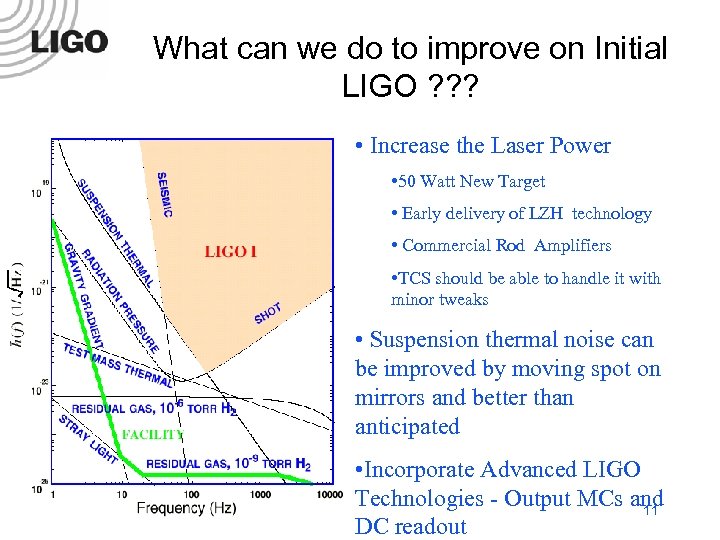 What can we do to improve on Initial LIGO ? ? ? • Increase the Laser Power • 50 Watt New Target • Early delivery of LZH technology • Commercial Rod Amplifiers • TCS should be able to handle it with minor tweaks • Suspension thermal noise can be improved by moving spot on mirrors and better than anticipated • Incorporate Advanced LIGO Technologies - Output MCs and 11 DC readout
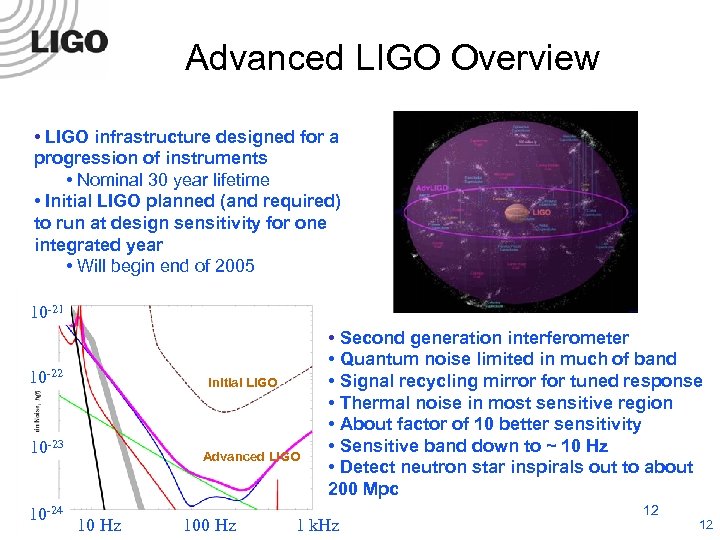 Advanced LIGO Overview • LIGO infrastructure designed for a progression of instruments • Nominal 30 year lifetime • Initial LIGO planned (and required) to run at design sensitivity for one integrated year • Will begin end of 2005 10 -21 10 -22 Initial LIGO 10 -23 10 -24 Advanced LIGO 10 Hz 100 Hz • Second generation interferometer • Quantum noise limited in much of band • Signal recycling mirror for tuned response • Thermal noise in most sensitive region • About factor of 10 better sensitivity • Sensitive band down to ~ 10 Hz • Detect neutron star inspirals out to about 200 Mpc 1 k. Hz 12 12
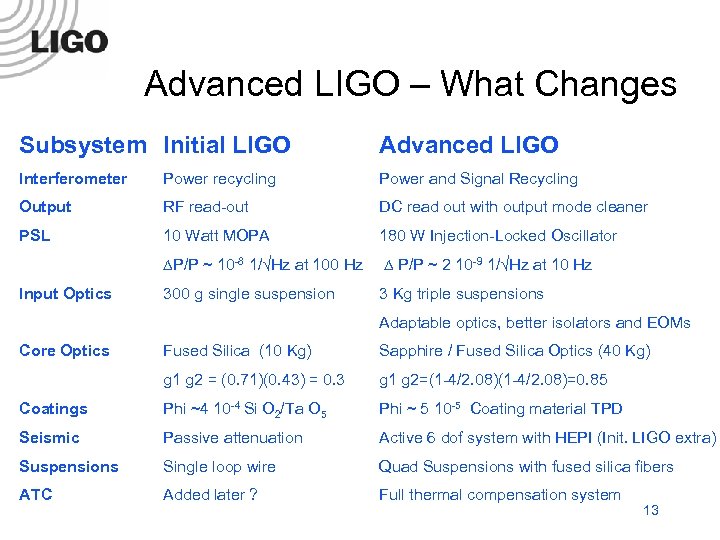 Advanced LIGO – What Changes Subsystem Initial LIGO Advanced LIGO Interferometer Power recycling Power and Signal Recycling Output RF read-out DC read out with output mode cleaner PSL 10 Watt MOPA 180 W Injection-Locked Oscillator P/P ~ 10 -8 1/ Hz at 100 Hz P/P ~ 2 10 -9 1/ Hz at 10 Hz 300 g single suspension 3 Kg triple suspensions Input Optics Adaptable optics, better isolators and EOMs Core Optics Fused Silica (10 Kg) Sapphire / Fused Silica Optics (40 Kg) g 1 g 2 = (0. 71)(0. 43) = 0. 3 g 1 g 2=(1 -4/2. 08)=0. 85 Coatings Phi ~4 10 -4 Si O 2/Ta O 5 Phi ~ 5 10 -5 Coating material TPD Seismic Passive attenuation Active 6 dof system with HEPI (Init. LIGO extra) Suspensions Single loop wire Quad Suspensions with fused silica fibers ATC Added later ? Full thermal compensation system 13
 Progress on Sub-Systems l l Significant Progress Made on All Sub-systems In the interest of time will review » » l Seismic Suspensions Coatings Prototyping and Test Facilities Please ask about any others at the end 14
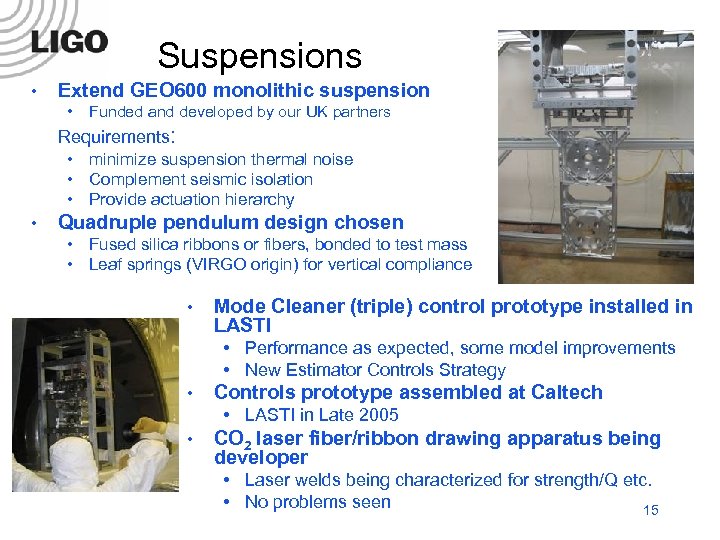 Suspensions • Extend GEO 600 monolithic suspension • Funded and developed by our UK partners Requirements: • minimize suspension thermal noise • Complement seismic isolation • Provide actuation hierarchy • Quadruple pendulum design chosen • Fused silica ribbons or fibers, bonded to test mass • Leaf springs (VIRGO origin) for vertical compliance • Mode Cleaner (triple) control prototype installed in LASTI • Performance as expected, some model improvements • New Estimator Controls Strategy • Controls prototype assembled at Caltech • LASTI in Late 2005 • CO 2 laser fiber/ribbon drawing apparatus being developer • Laser welds being characterized for strength/Q etc. • No problems seen 15
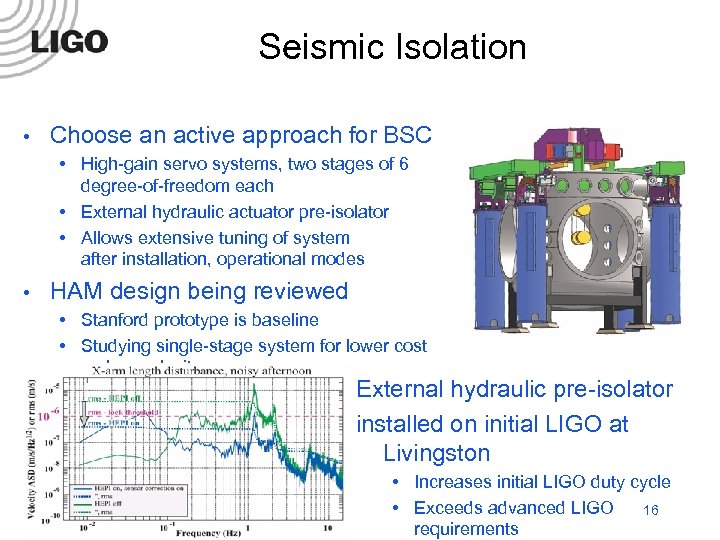 Seismic Isolation • Choose an active approach for BSC • High-gain servo systems, two stages of 6 degree-of-freedom each • External hydraulic actuator pre-isolator • Allows extensive tuning of system after installation, operational modes • HAM design being reviewed • Stanford prototype is baseline • Studying single-stage system for lower cost and complexity External hydraulic pre-isolator installed on initial LIGO at Livingston • Increases initial LIGO duty cycle • Exceeds advanced LIGO 16 requirements
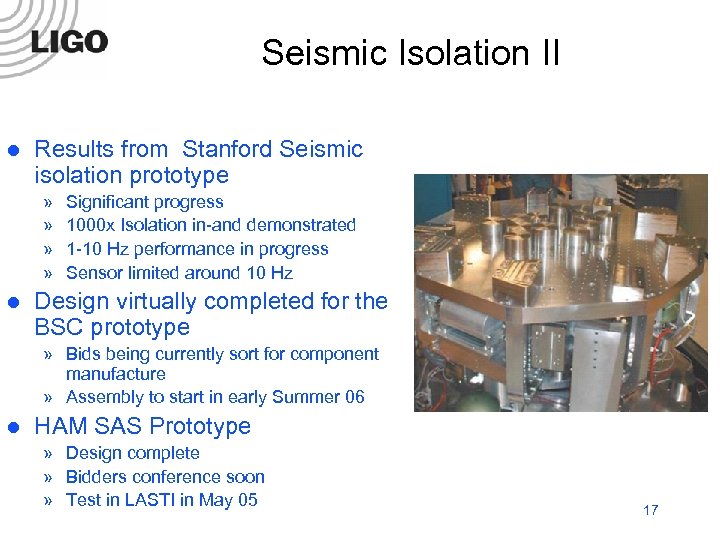 Seismic Isolation II l Results from Stanford Seismic isolation prototype » » l Significant progress 1000 x Isolation in-and demonstrated 1 -10 Hz performance in progress Sensor limited around 10 Hz Design virtually completed for the BSC prototype » Bids being currently sort for component manufacture » Assembly to start in early Summer 06 l HAM SAS Prototype » Design complete » Bidders conference soon » Test in LASTI in May 05 17
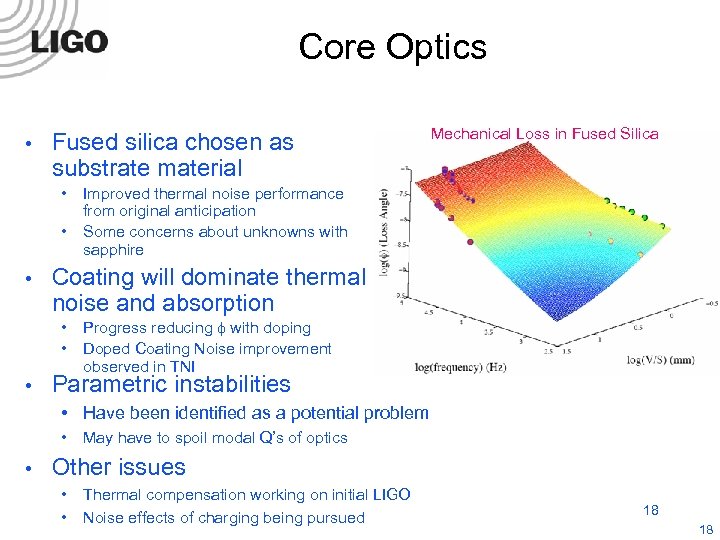 Core Optics • Fused silica chosen as substrate material • • • Improved thermal noise performance from original anticipation Some concerns about unknowns with sapphire Coating will dominate thermal noise and absorption • • • Mechanical Loss in Fused Silica Progress reducing f with doping Doped Coating Noise improvement observed in TNI Parametric instabilities • Have been identified as a potential problem • • May have to spoil modal Q’s of optics Other issues • • Thermal compensation working on initial LIGO Noise effects of charging being pursued 18 18
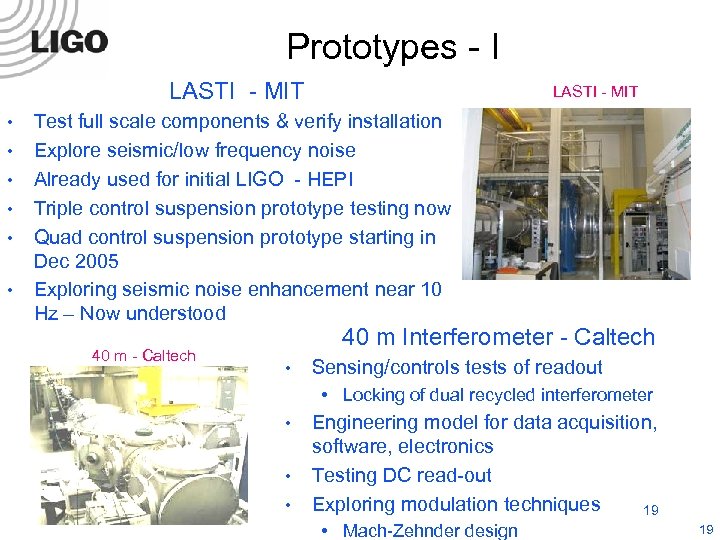 Prototypes - I LASTI - MIT • • • LASTI - MIT Test full scale components & verify installation Explore seismic/low frequency noise Already used for initial LIGO - HEPI Triple control suspension prototype testing now Quad control suspension prototype starting in Dec 2005 Exploring seismic noise enhancement near 10 Hz – Now understood 40 m - Caltech 40 m Interferometer - Caltech • Sensing/controls tests of readout • Locking of dual recycled interferometer • • • Engineering model for data acquisition, software, electronics Testing DC read-out Exploring modulation techniques 19 • Mach-Zehnder design 19
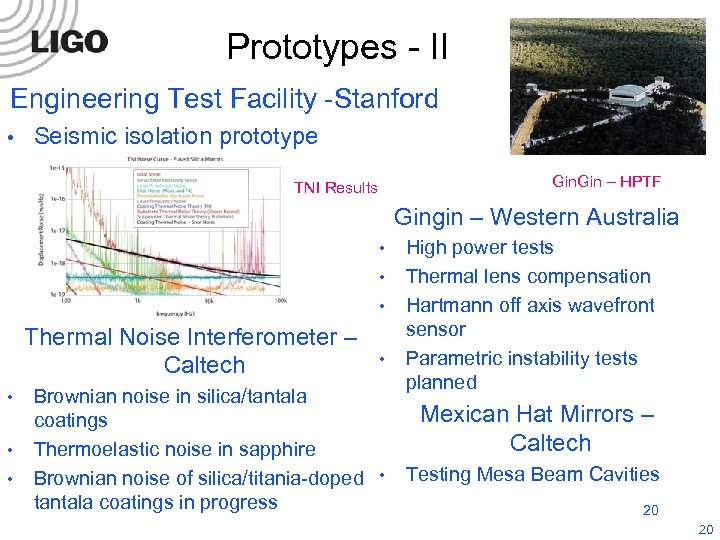 Prototypes - II Engineering Test Facility -Stanford • Seismic isolation prototype Gin – HPTF TNI Results Gingin – Western Australia • • • Thermal Noise Interferometer – Caltech • • • Brownian noise in silica/tantala coatings Thermoelastic noise in sapphire Brownian noise of silica/titania-doped tantala coatings in progress • High power tests Thermal lens compensation Hartmann off axis wavefront sensor Parametric instability tests planned Mexican Hat Mirrors – Caltech • Testing Mesa Beam Cavities 20 20
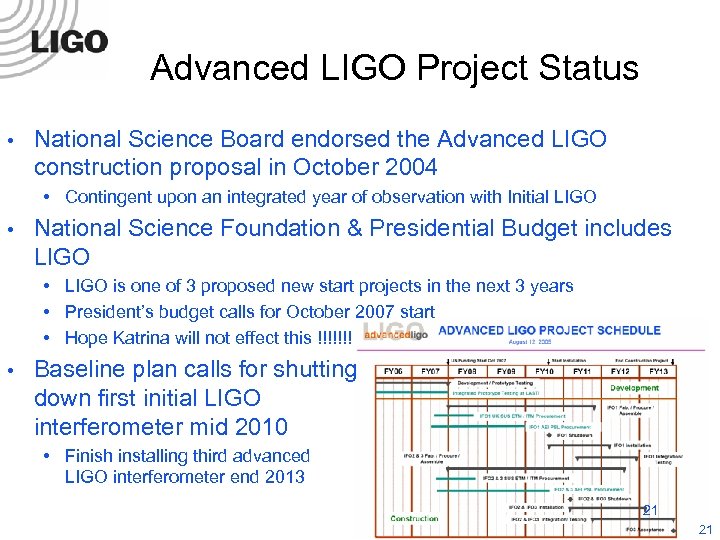 Advanced LIGO Project Status • National Science Board endorsed the Advanced LIGO construction proposal in October 2004 • Contingent upon an integrated year of observation with Initial LIGO • National Science Foundation & Presidential Budget includes LIGO • LIGO is one of 3 proposed new start projects in the next 3 years • President’s budget calls for October 2007 start • Hope Katrina will not effect this !!!!!!! • Baseline plan calls for shutting down first initial LIGO interferometer mid 2010 • Finish installing third advanced LIGO interferometer end 2013 21 21
 Conclusions l l Initial LIGO is virtually at the Science Requirements 5 th Science Run (S 5) due to start in November Significant Progress has been made in Advanced LIGO R and D A year of testing full scale prototypes is ahead of us 22