


 Скачать презентацию Lighting up the light-shedding of illuminated enlightenment of
d6ae443b06e99bc5e9f7747d2edf53bc.ppt
- Количество слайдов: 18
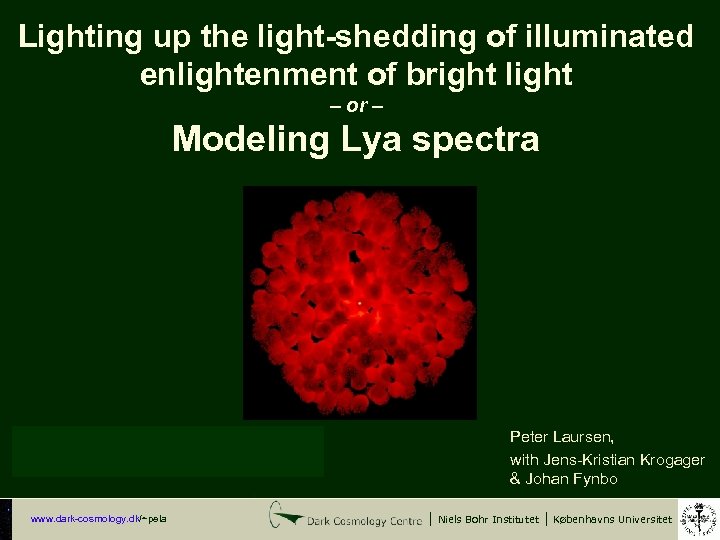 Lighting up the light-shedding of illuminated enlightenment of bright light – or – Modeling Lya spectra Peter Laursen, with Jens-Kristian Krogager & Johan Fynbo www. dark-cosmology. dk/~pela | Niels Bohr Institutet | Københavns Universitet
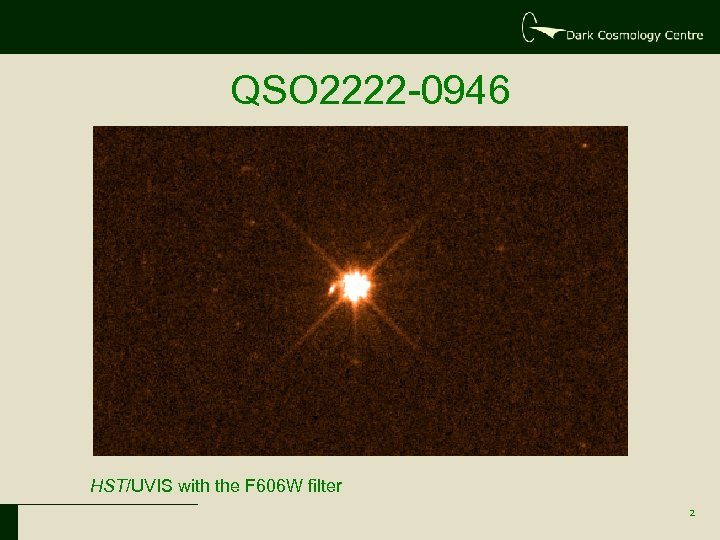 QSO 2222 -0946 HST/UVIS with the F 606 W filter 2
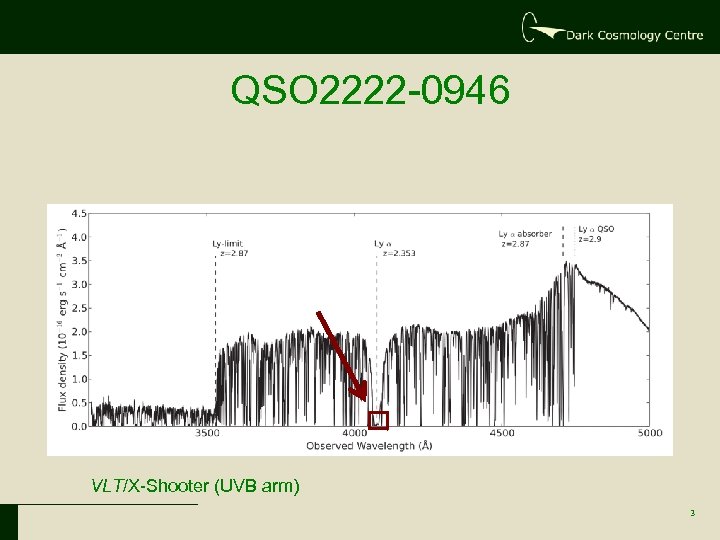 QSO 2222 -0946 VLT/X-Shooter (UVB arm) 3
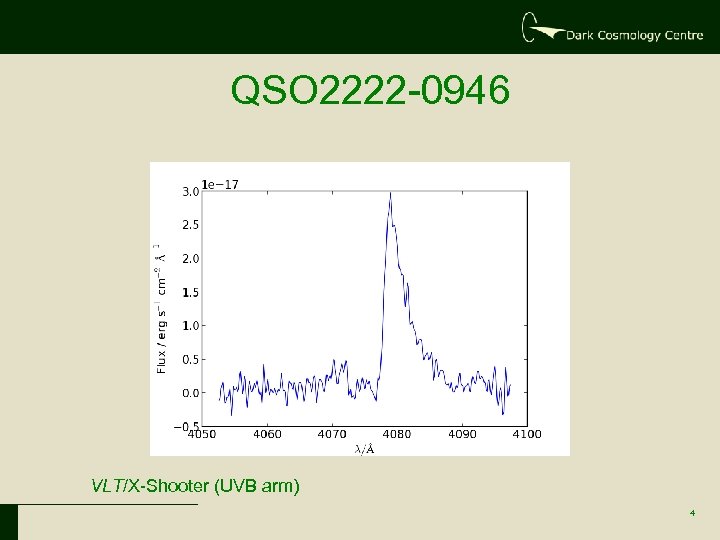 QSO 2222 -0946 VLT/X-Shooter (UVB arm) 4
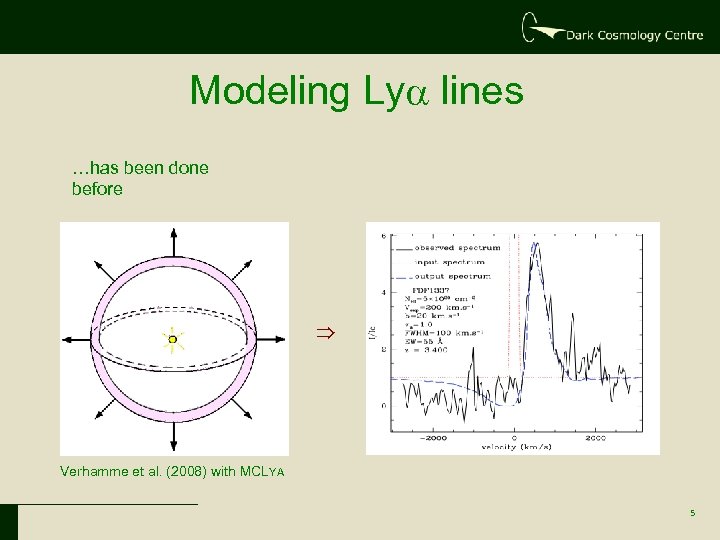 Modeling Lya lines …has been done before ⇒ Verhamme et al. (2008) with MCLYA 5
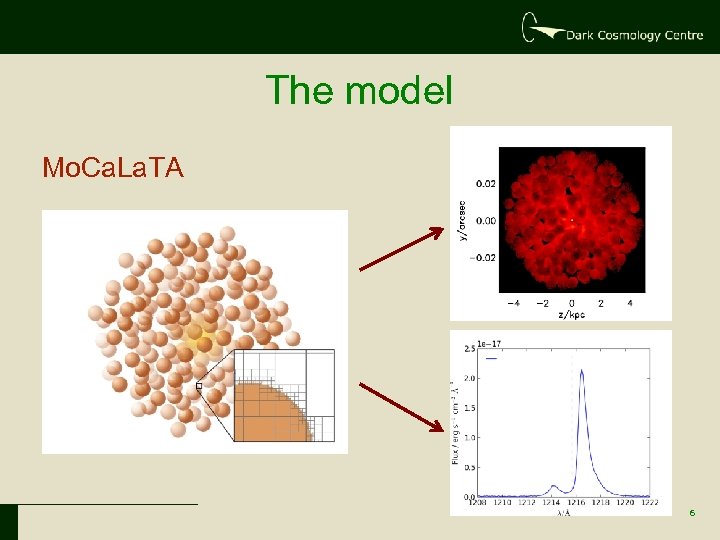 The model Mo. Ca. La. TA 6
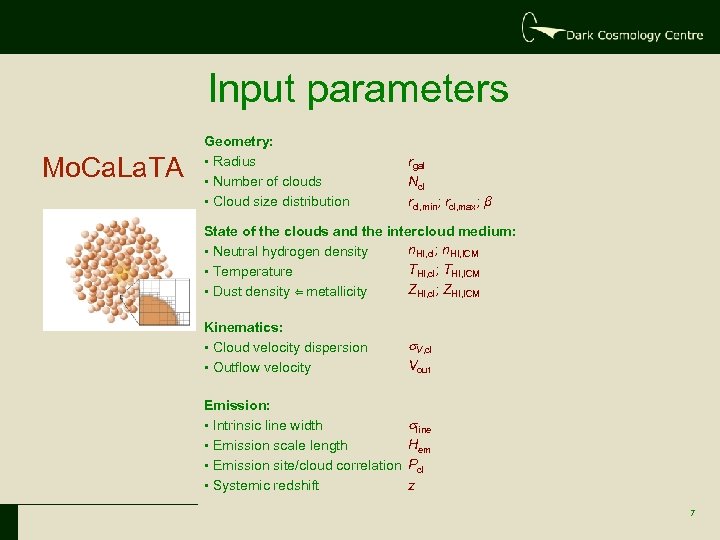 Input parameters Mo. Ca. La. TA Geometry: • Radius • Number of clouds • Cloud size distribution rgal Ncl rcl, min; rcl, max; β State of the clouds and the intercloud medium: n. HI, cl; n. HI, ICM • Neutral hydrogen density THI, cl; THI, ICM • Temperature ZHI, cl; ZHI, ICM • Dust density ⇐ metallicity Kinematics: • Cloud velocity dispersion • Outflow velocity Emission: • Intrinsic line width • Emission scale length • Emission site/cloud correlation • Systemic redshift s. V, cl Vout sline Hem Pcl z 7
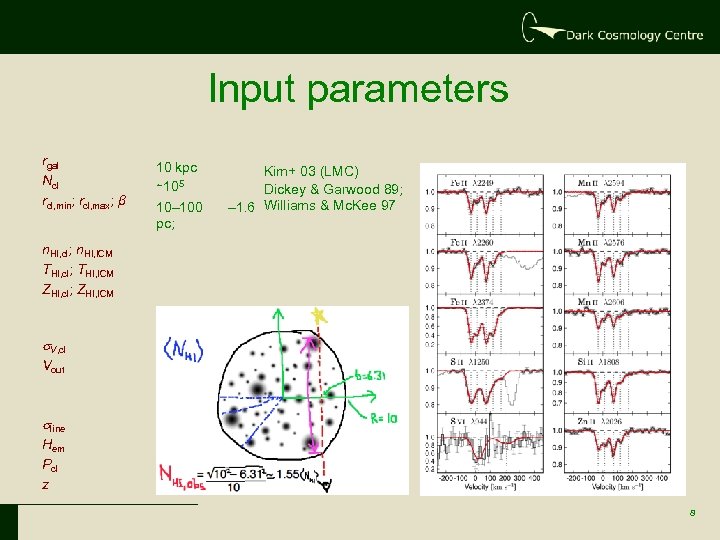 Input parameters rgal Ncl rcl, min; rcl, max; β 10 kpc ∼ 105 10– 100 pc; Kim+ 03 (LMC) Dickey & Garwood 89; – 1. 6 Williams & Mc. Kee 97 n. HI, cl; n. HI, ICM THI, cl; THI, ICM ZHI, cl; ZHI, ICM s. V, cl Vout sline Hem Pcl z 8
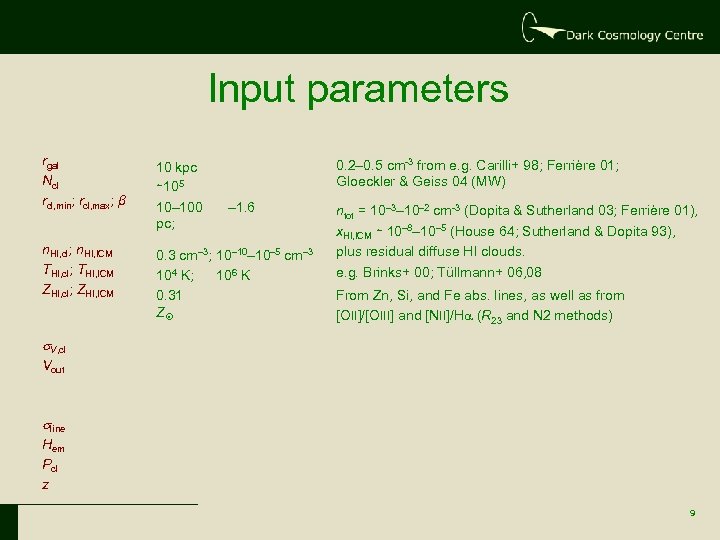 Input parameters rgal Ncl rcl, min; rcl, max; β 10 kpc ∼ 105 10– 100 pc; n. HI, cl; n. HI, ICM THI, cl; THI, ICM ZHI, cl; ZHI, ICM 0. 3 cm– 3; 10– 10– 5 cm– 3 106 K 104 K; 0. 31 Z 0. 2– 0. 5 cm-3 from e. g. Carilli+ 98; Ferrière 01; Gloeckler & Geiss 04 (MW) – 1. 6 ntot = 10– 3– 10– 2 cm-3 (Dopita & Sutherland 03; Ferrière 01), x. HI, ICM ∼ 10– 8– 10– 5 (House 64; Sutherland & Dopita 93), plus residual diffuse HI clouds. e. g. Brinks+ 00; Tüllmann+ 06, 08 From Zn, Si, and Fe abs. lines, as well as from [OII]/[OIII] and [NII]/Ha (R 23 and N 2 methods) s. V, cl Vout sline Hem Pcl z 9
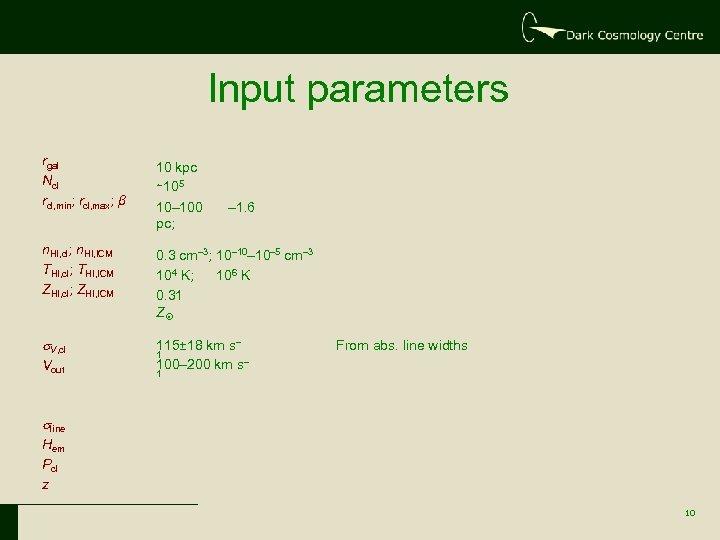 Input parameters rgal Ncl rcl, min; rcl, max; β 10 kpc ∼ 105 10– 100 pc; n. HI, cl; n. HI, ICM THI, cl; THI, ICM ZHI, cl; ZHI, ICM 0. 3 cm– 3; 10– 10– 5 cm– 3 104 K; 106 K 0. 31 Z s. V, cl 115± 18 km s– 1 100– 200 km s– Vout – 1. 6 From abs. line widths 1 sline Hem Pcl z 10
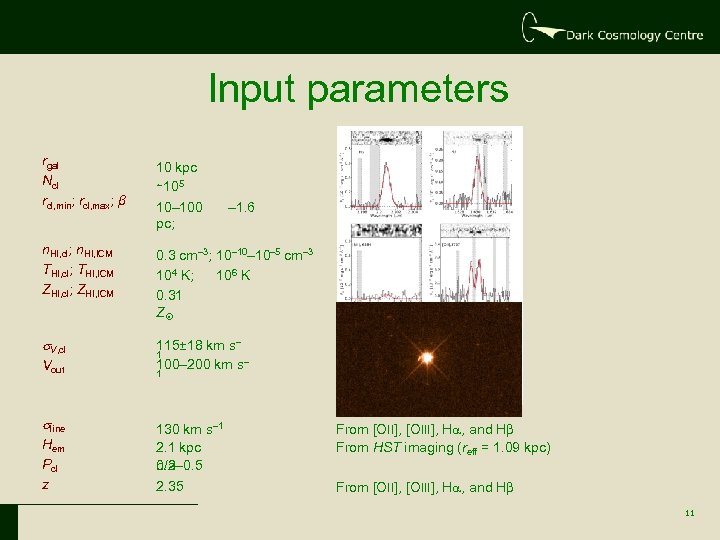 Input parameters rgal Ncl rcl, min; rcl, max; β 10 kpc ∼ 105 10– 100 pc; n. HI, cl; n. HI, ICM THI, cl; THI, ICM ZHI, cl; ZHI, ICM 0. 3 cm– 3; 10– 10– 5 cm– 3 104 K; 106 K 0. 31 Z s. V, cl 115± 18 km s– 1 100– 200 km s– Vout sline Hem Pcl z – 1. 6 1 130 km s– 1 2. 1 kpc n/a 0. 2– 0. 5 From [OII], [OIII], Ha, and Hb From HST imaging (reff = 1. 09 kpc) 2. 35 From [OII], [OIII], Ha, and Hb 11
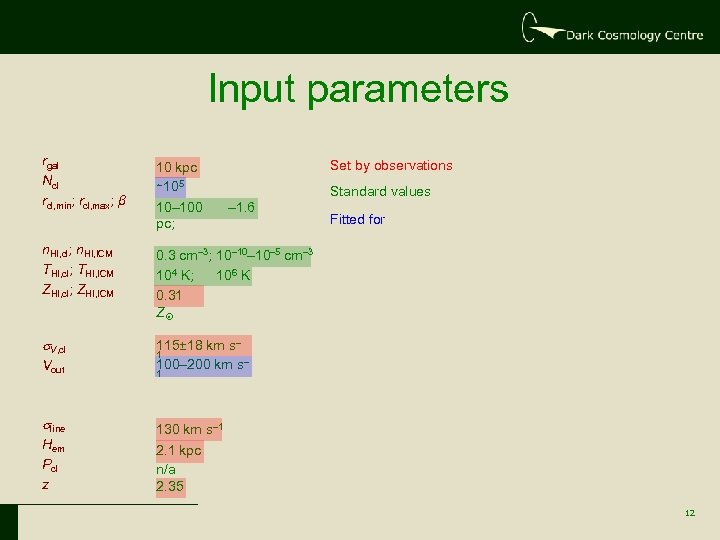 Input parameters rgal Ncl rcl, min; rcl, max; β 10 kpc ∼ 105 10– 100 pc; Set by observations Standard values – 1. 6 n. HI, cl; n. HI, ICM THI, cl; THI, ICM ZHI, cl; ZHI, ICM 0. 3 cm– 3; 10– 10– 5 cm– 3 104 K; 106 K 0. 31 Z s. V, cl Fitted for 115± 18 km s– 1 100– 200 km s– Vout sline Hem Pcl z 1 130 km s– 1 2. 1 kpc n/a 2. 35 12
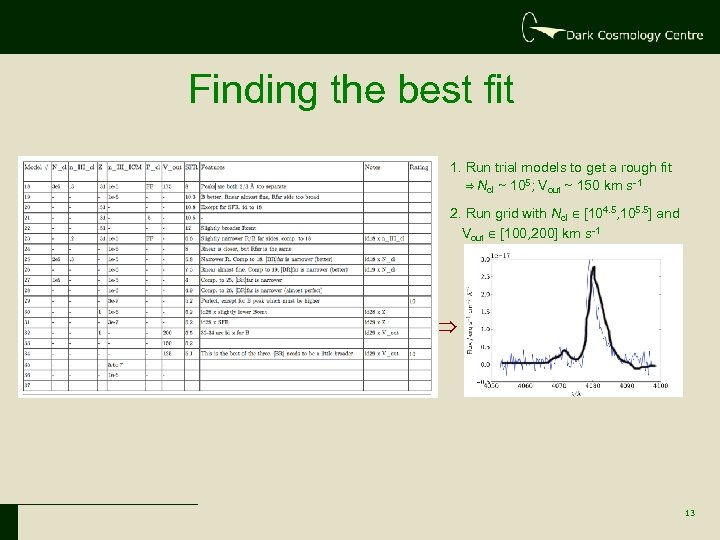 Finding the best fit 1. Run trial models to get a rough fit ⇒ Ncl ∼ 105; Vout ∼ 150 km s-1 2. Run grid with Ncl ∈ [104. 5, 105. 5] and Vout ∈ [100, 200] km s-1 ⇒ 13
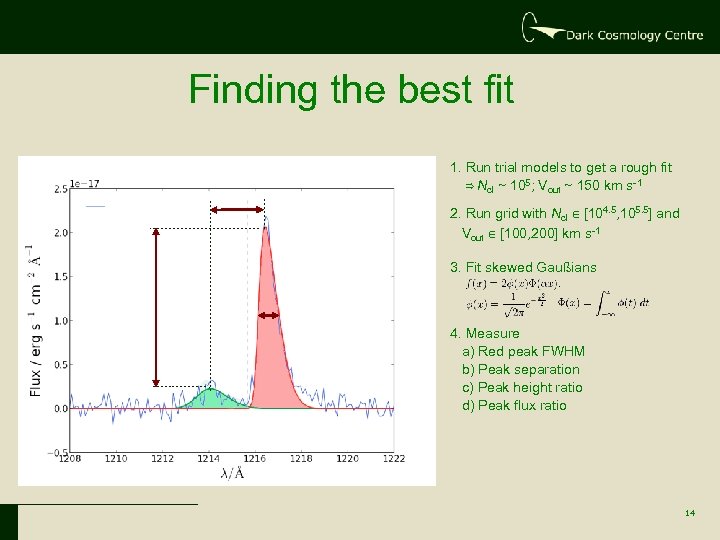 Finding the best fit 1. Run trial models to get a rough fit ⇒ Ncl ∼ 105; Vout ∼ 150 km s-1 2. Run grid with Ncl ∈ [104. 5, 105. 5] and Vout ∈ [100, 200] km s-1 3. Fit skewed Gaußians 4. Measure a) Red peak FWHM b) Peak separation c) Peak height ratio d) Peak flux ratio 14
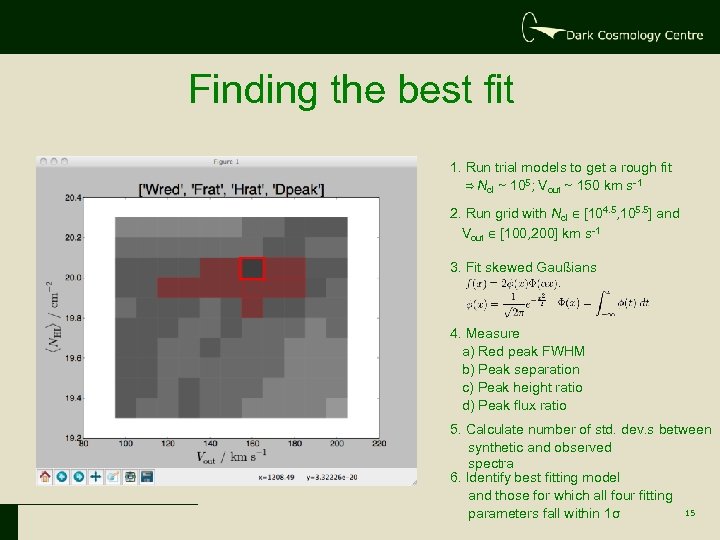 Finding the best fit 1. Run trial models to get a rough fit ⇒ Ncl ∼ 105; Vout ∼ 150 km s-1 2. Run grid with Ncl ∈ [104. 5, 105. 5] and Vout ∈ [100, 200] km s-1 3. Fit skewed Gaußians 4. Measure a) Red peak FWHM b) Peak separation c) Peak height ratio d) Peak flux ratio 5. Calculate number of std. dev. s between synthetic and observed spectra 6. Identify best fitting model and those for which all four fitting 15 parameters fall within 1σ
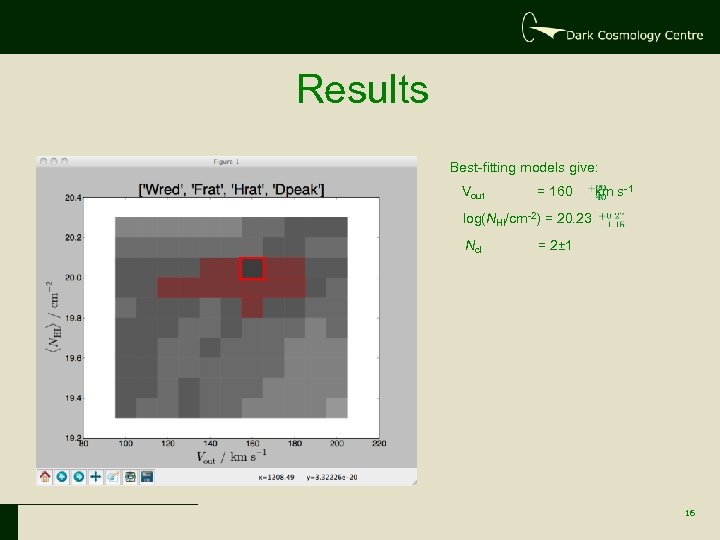 Results Best-fitting models give: Vout = 160 km s-1 log(NHI/cm-2) = 20. 23 Ncl = 2± 1 16
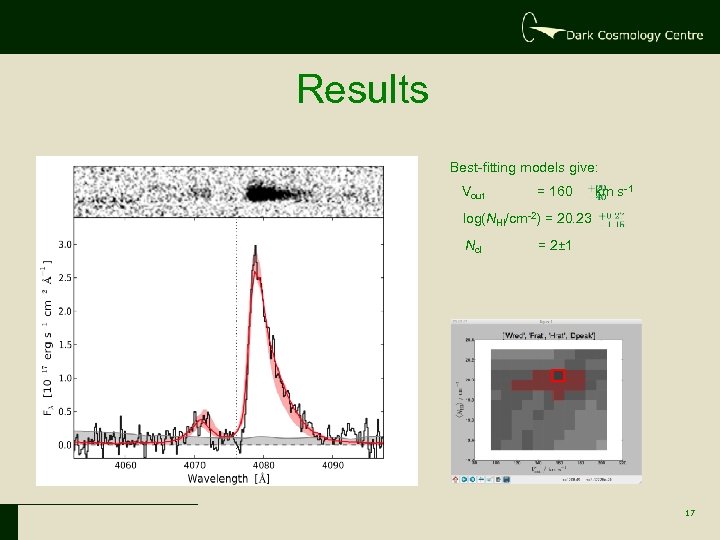 Results Best-fitting models give: Vout = 160 km s-1 log(NHI/cm-2) = 20. 23 Ncl = 2± 1 17
 Conclusion • Fitting Lya lines requires information about several parameters. A simple spectrum isn’t really enough. 18