


 Скачать презентацию LIGHTING DEVICES TEST RESULTS Ethiopia Results June 2009
49ee99850435bdcd938640908321a9e7.ppt
- Количество слайдов: 156
 LIGHTING DEVICES TEST RESULTS Ethiopia Results June 2009
 Report Overview 1 Lighting Africa Overview / Market Intelligence Program 2 Market Research Approach 3 Lighting Devices Testing: Setting the Scene 4 Lighting Devices Tested 5 How Do We Assess Potential? 6 Brief Country Overview 7 Main Product Findings By Country 8 Recommendations By Country 9 Executive Summary Ethiopia © 2008 International Finance Corporation – The World Bank All Rights Reserved 2
 LIGHTING AFRICA OVERVIEW / MARKET INTELLIGENCE PROGRAM
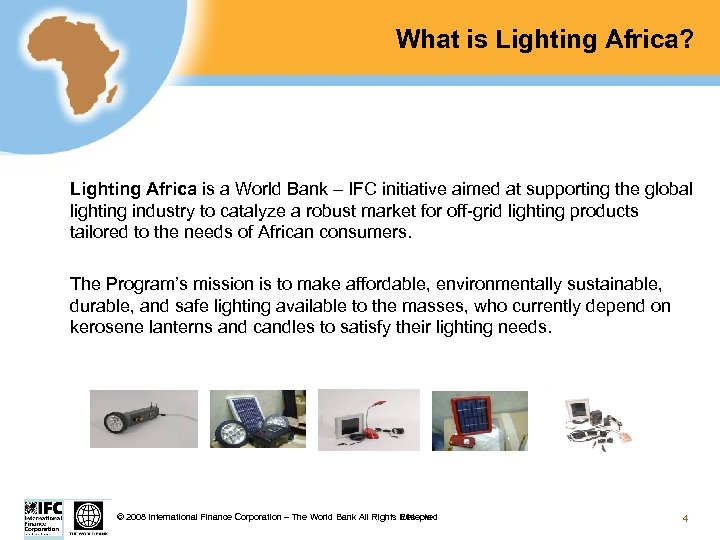 What is Lighting Africa? Lighting Africa is a World Bank – IFC initiative aimed at supporting the global lighting industry to catalyze a robust market for off-grid lighting products tailored to the needs of African consumers. The Program’s mission is to make affordable, environmentally sustainable, durable, and safe lighting available to the masses, who currently depend on kerosene lanterns and candles to satisfy their lighting needs. Ethiopia © 2008 International Finance Corporation – The World Bank All Rights Reserved 4
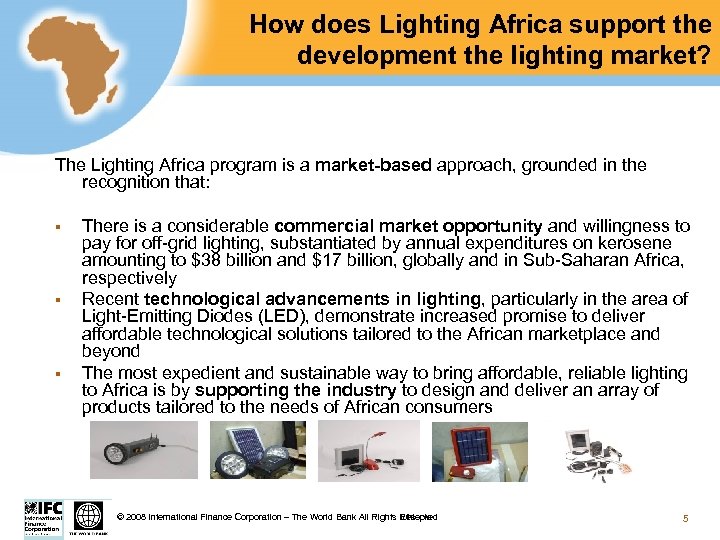 How does Lighting Africa support the development the lighting market? The Lighting Africa program is a market-based approach, grounded in the recognition that: § § § There is a considerable commercial market opportunity and willingness to pay for off-grid lighting, substantiated by annual expenditures on kerosene amounting to $38 billion and $17 billion, globally and in Sub-Saharan Africa, respectively Recent technological advancements in lighting, particularly in the area of Light-Emitting Diodes (LED), demonstrate increased promise to deliver affordable technological solutions tailored to the African marketplace and beyond The most expedient and sustainable way to bring affordable, reliable lighting to Africa is by supporting the industry to design and deliver an array of products tailored to the needs of African consumers Ethiopia © 2008 International Finance Corporation – The World Bank All Rights Reserved 5
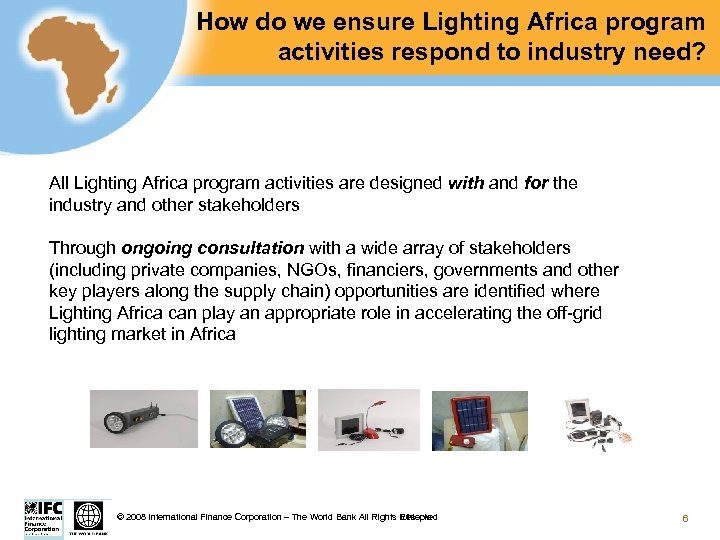 How do we ensure Lighting Africa program activities respond to industry need? All Lighting Africa program activities are designed with and for the industry and other stakeholders Through ongoing consultation with a wide array of stakeholders (including private companies, NGOs, financiers, governments and other key players along the supply chain) opportunities are identified where Lighting Africa can play an appropriate role in accelerating the off-grid lighting market in Africa Ethiopia © 2008 International Finance Corporation – The World Bank All Rights Reserved 6
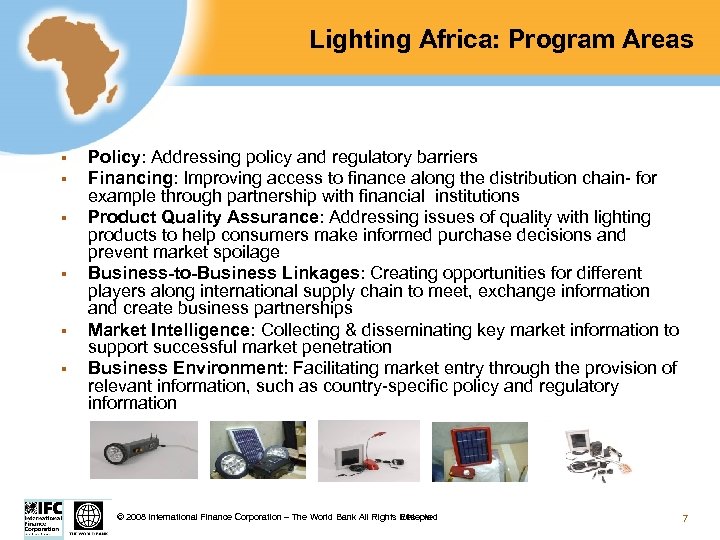 Lighting Africa: Program Areas § § § Policy: Addressing policy and regulatory barriers Financing: Improving access to finance along the distribution chain- for example through partnership with financial institutions Product Quality Assurance: Addressing issues of quality with lighting products to help consumers make informed purchase decisions and prevent market spoilage Business-to-Business Linkages: Creating opportunities for different players along international supply chain to meet, exchange information and create business partnerships Market Intelligence: Collecting & disseminating key market information to support successful market penetration Business Environment: Facilitating market entry through the provision of relevant information, such as country-specific policy and regulatory information Ethiopia © 2008 International Finance Corporation – The World Bank All Rights Reserved 7
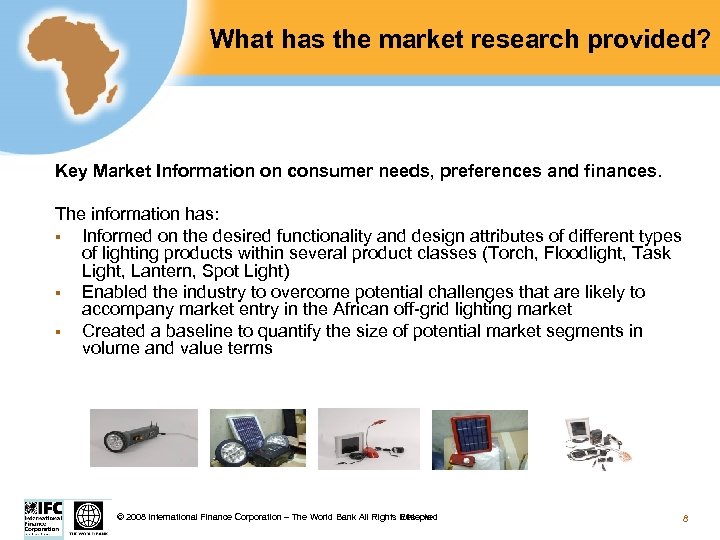 What has the market research provided? Key Market Information on consumer needs, preferences and finances. The information has: § Informed on the desired functionality and design attributes of different types of lighting products within several product classes (Torch, Floodlight, Task Light, Lantern, Spot Light) § Enabled the industry to overcome potential challenges that are likely to accompany market entry in the African off-grid lighting market § Created a baseline to quantify the size of potential market segments in volume and value terms Ethiopia © 2008 International Finance Corporation – The World Bank All Rights Reserved 8
 Lighting Africa: Why Market Research? § While anecdotal evidence shows a substantial opportunity in the off-grid lighting market in Africa, much of the industry lacks the information needed to develop and market products appropriate to meet the needs of African consumers § This is the result of a premature and undeveloped market, but one with demonstrable potential – the fuel-based lighting market in Africa is currently worth more than $17 billion per year – yet is still largely undefined, untapped, and unrealized § In response to the industry’s call to provide greater comprehension to the scope of this emergent market opportunity, Lighting Africa developed a Market Research program Ethiopia © 2008 International Finance Corporation – The World Bank All Rights Reserved 9
 MARKET RESEARCH APPROACH
 Research International: Background and Related Experience The research was conducted by Research International East Africa, a subsidiary of the global market research firm: Research International is one of the world's largest custom market research agencies, with offices in 50 countries worldwide and over 30 years of expertise. Ethiopia © 2008 International Finance Corporation – The World Bank All Rights Reserved 11
 Research Methodology § Currently, the Lighting Africa market research program covers 5 countries: Ghana, Kenya, Zambia, Ethiopia and Tanzania § Two key market segments: households & micro-businesses in rural and urban areas § The market study involves studies of the market in Africa to provide insights that form the basis for innovative product ideas; and is comprised of three research methods: An exploratory phase involving a qualitative product testing element 2. A quantitative Habits and Attitudes survey of the population 3. Quantitative Lighting Devices Testing, using the proprietary e. Valuate. TM methodology, to quantify the acceptance and likely uptake of existing, new and revised product ideas for the market in Africa 1. Ethiopia © 2008 International Finance Corporation – The World Bank All Rights Reserved 12
 LIGHTING DEVICES TESTING: SETTING THE SCENE
 Lighting Devices Testing Context § The purpose of the lighting devices research is to: – – Assess consumer acceptance and potential for each of the lighting devices tested within the context of norms Prioritise and provide guidance as to which products to take forward to the next stage of development Ethiopia © 2008 International Finance Corporation – The World Bank All Rights Reserved 14
 HOW DO WE ASSESS POTENTIAL?
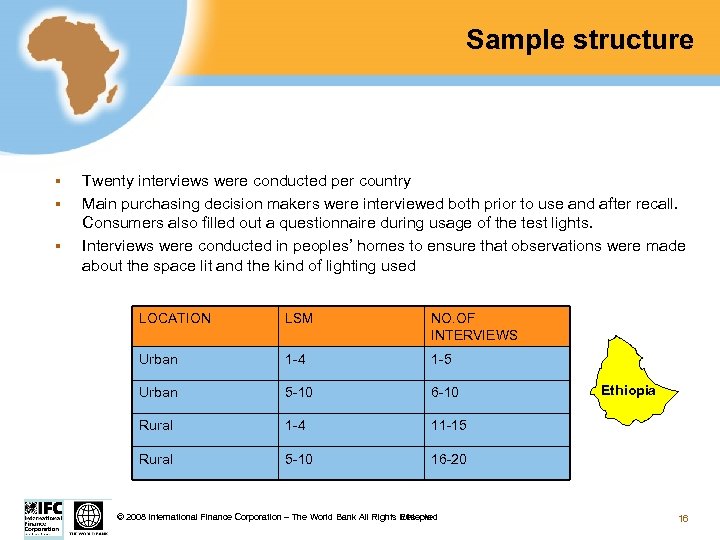 Sample structure § § § Twenty interviews were conducted per country Main purchasing decision makers were interviewed both prior to use and after recall. Consumers also filled out a questionnaire during usage of the test lights. Interviews were conducted in peoples’ homes to ensure that observations were made about the space lit and the kind of lighting used LOCATION LSM NO. OF INTERVIEWS Urban 1 -4 1 -5 Urban 5 -10 6 -10 Rural 1 -4 11 -15 Rural 5 -10 16 -20 Ethiopia © 2008 International Finance Corporation – The World Bank All Rights Reserved Ethiopia 16
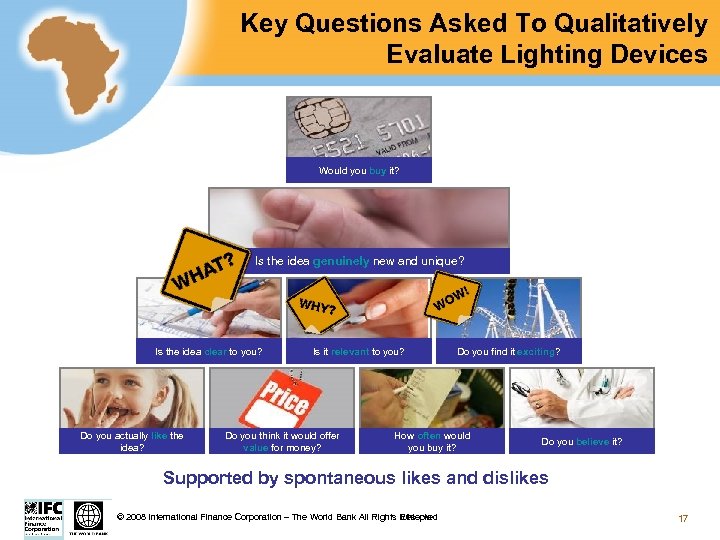 Key Questions Asked To Qualitatively Evaluate Lighting Devices Would you buy it? Is the idea genuinely new and unique? Is the idea clear to you? Do you actually like the idea? Is it relevant to you? Do you think it would offer value for money? Do you find it exciting? How often would you buy it? Do you believe it? Supported by spontaneous likes and dislikes Ethiopia © 2008 International Finance Corporation – The World Bank All Rights Reserved 17
 Key qualitative questions Interviews focused on answering these questions: Who is the consumer? § Consumer demographics and characteristics of households How does the consumer use light? § Current lighting habits, attitudes, preferences and needs How do consumers perceive the products? § Assessment of the new products versus product characteristics, features, learning and marketing approach What does the consumer want? § Assessment of needs for current lighting in and around the home Which products do consumers prefer? § Product preferences (performance and design features) and developing a quality standard for lighting How much is the consumer willing to pay? § Consumer economics (intent and capacity to pay for lighting) Ethiopia © 2008 International Finance Corporation – The World Bank All Rights Reserved 18
 Predicting the likelihood of successful product launch § What we know about successful product launches is that there is a lot more at stake than merely identifying which products should be launched versus which shouldn’t. In predicting the likelihood of a successful product launch we must also identify key drivers that will ensure long term success § Within developing markets, measures of new product success are slightly different from other parts of the world. In developing markets consumers have little disposable income which means their behaviour with regards to new purchases will be quite conservative – they will not take chances buying into new products if they are not sure whether the product will work for them or not § In order to predict the likelihood of successful product launch, it is important to understand 3 critical measures: the “WHAT? ”, the “WHY? ” and the “WOW? ”. These will be discussed in further detail in the next slides § Additional to these three measures, it must be kept in mind that the cost of the new product, in this case the lighting device, will undoubtedly remain a main driver in creating purchase intent amongst consumers with low levels of disposable income Ethiopia © 2008 International Finance Corporation – The World Bank All Rights Reserved 19
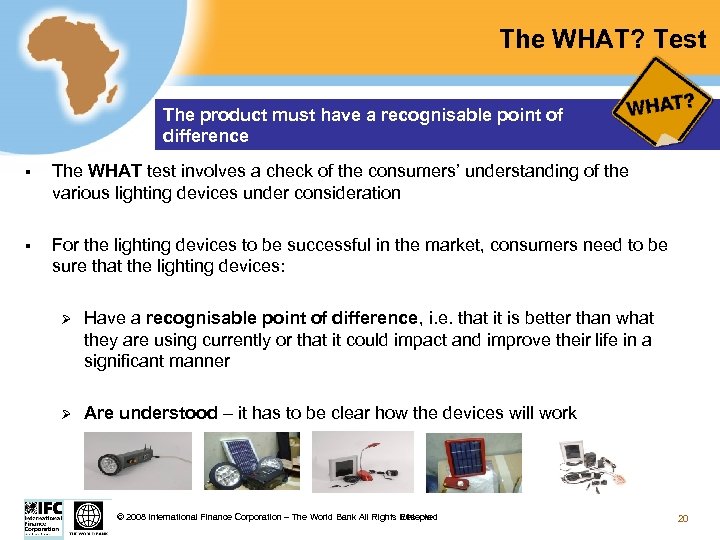 The WHAT? Test The product must have a recognisable point of difference § The WHAT test involves a check of the consumers’ understanding of the various lighting devices under consideration § For the lighting devices to be successful in the market, consumers need to be sure that the lighting devices: Ø Have a recognisable point of difference, i. e. that it is better than what they are using currently or that it could impact and improve their life in a significant manner Ø Are understood – it has to be clear how the devices will work Ethiopia © 2008 International Finance Corporation – The World Bank All Rights Reserved 20
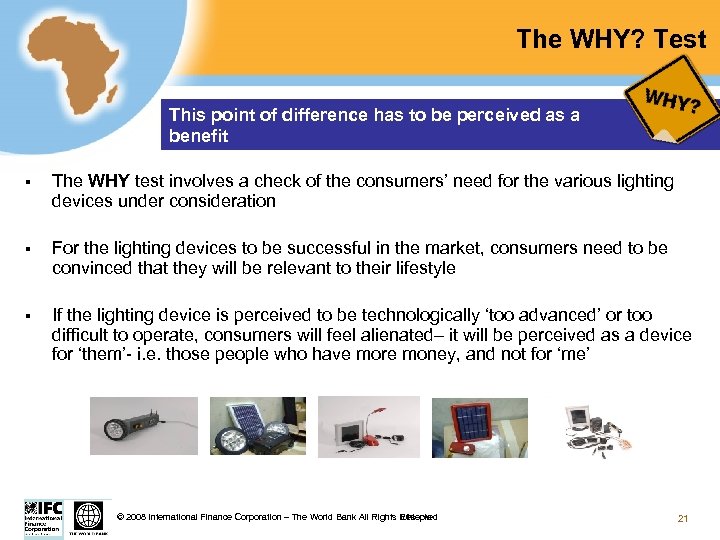 The WHY? Test This point of difference has to be perceived as a benefit § The WHY test involves a check of the consumers’ need for the various lighting devices under consideration § For the lighting devices to be successful in the market, consumers need to be convinced that they will be relevant to their lifestyle § If the lighting device is perceived to be technologically ‘too advanced’ or too difficult to operate, consumers will feel alienated– it will be perceived as a device for ‘them’- i. e. those people who have more money, and not for ‘me’ Ethiopia © 2008 International Finance Corporation – The World Bank All Rights Reserved 21
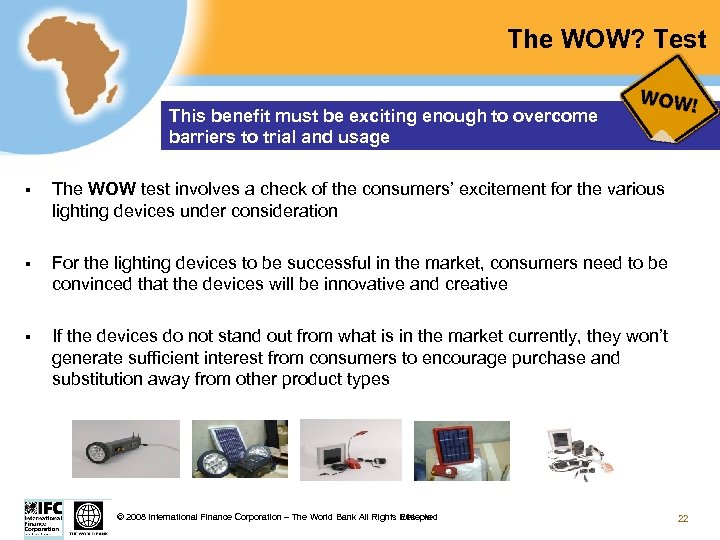 The WOW? Test This benefit must be exciting enough to overcome barriers to trial and usage § The WOW test involves a check of the consumers’ excitement for the various lighting devices under consideration § For the lighting devices to be successful in the market, consumers need to be convinced that the devices will be innovative and creative § If the devices do not stand out from what is in the market currently, they won’t generate sufficient interest from consumers to encourage purchase and substitution away from other product types Ethiopia © 2008 International Finance Corporation – The World Bank All Rights Reserved 22
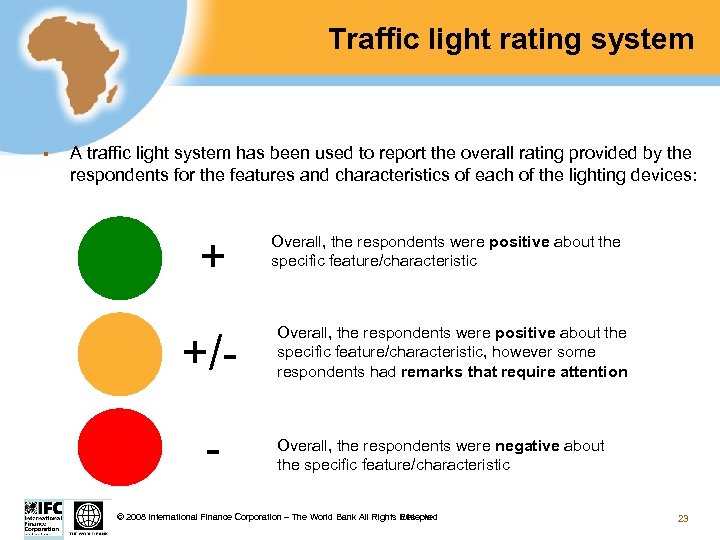 Traffic light rating system § A traffic light system has been used to report the overall rating provided by the respondents for the features and characteristics of each of the lighting devices: + +/- Overall, the respondents were positive about the specific feature/characteristic, however some respondents had remarks that require attention Overall, the respondents were negative about the specific feature/characteristic Ethiopia © 2008 International Finance Corporation – The World Bank All Rights Reserved 23
 BRIEF COUNTRY OVERVIEW Ethiopia
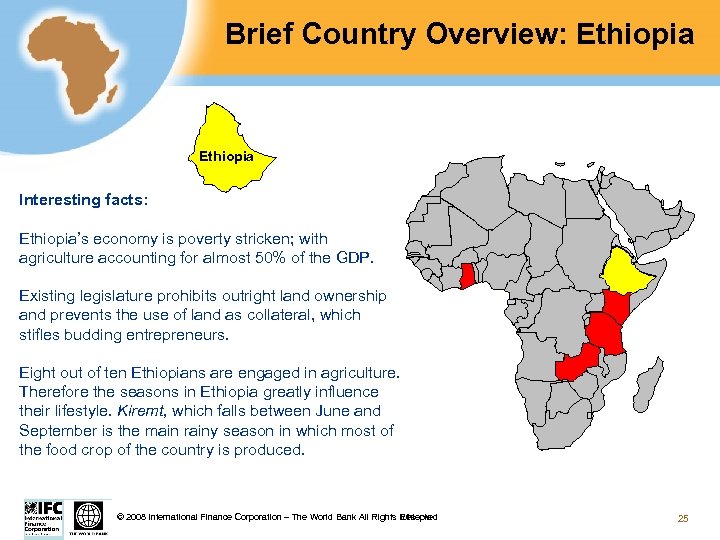 Brief Country Overview: Ethiopia Interesting facts: Ethiopia’s economy is poverty stricken; with agriculture accounting for almost 50% of the GDP. Existing legislature prohibits outright land ownership and prevents the use of land as collateral, which stifles budding entrepreneurs. Eight out of ten Ethiopians are engaged in agriculture. Therefore the seasons in Ethiopia greatly influence their lifestyle. Kiremt, which falls between June and September is the main rainy season in which most of the food crop of the country is produced. Ethiopia © 2008 International Finance Corporation – The World Bank All Rights Reserved 25
 ELECTRICITY
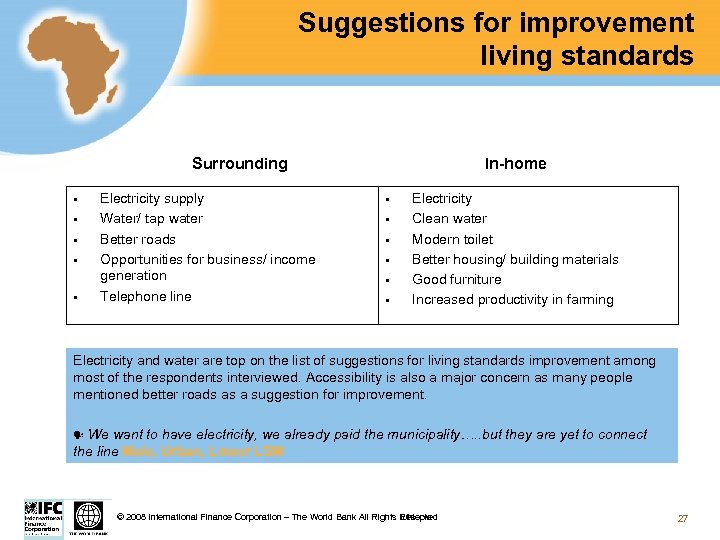 Suggestions for improvement living standards Surrounding § § § Electricity supply Water/ tap water Better roads Opportunities for business/ income generation Telephone line In-home § § § Electricity Clean water Modern toilet Better housing/ building materials Good furniture Increased productivity in farming Electricity and water are top on the list of suggestions for living standards improvement among most of the respondents interviewed. Accessibility is also a major concern as many people mentioned better roads as a suggestion for improvement. We want to have electricity, we already paid the municipality…. . but they are yet to connect the line Male, Urban, Lower LSM Ethiopia © 2008 International Finance Corporation – The World Bank All Rights Reserved 27
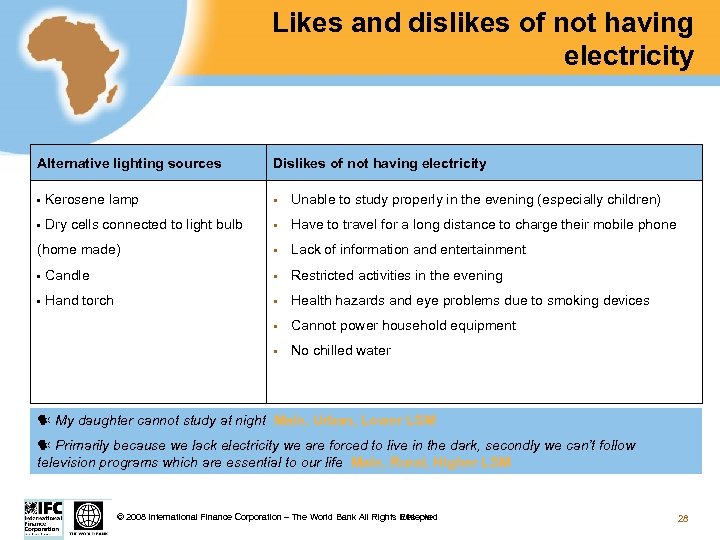 Likes and dislikes of not having electricity Alternative lighting sources Dislikes of not having electricity • Kerosene lamp § Unable to study properly in the evening (especially children) • Dry cells connected to light bulb § Have to travel for a long distance to charge their mobile phone § Lack of information and entertainment (home made) • Candle § Restricted activities in the evening • Hand torch § Health hazards and eye problems due to smoking devices § Cannot power household equipment § No chilled water My daughter cannot study at night Male, Urban, Lower LSM Primarily because we lack electricity we are forced to live in the dark, secondly we can’t follow television programs which are essential to our life Male, Rural, Higher LSM Ethiopia © 2008 International Finance Corporation – The World Bank All Rights Reserved 28
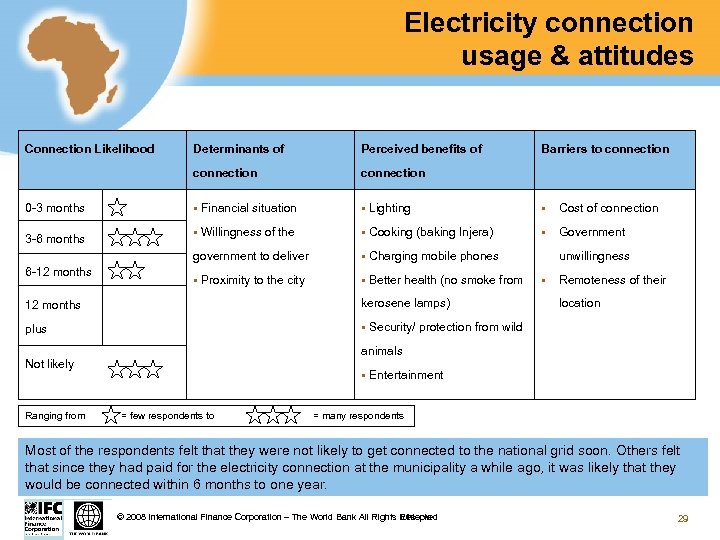 Electricity connection usage & attitudes Connection Likelihood Perceived benefits of connection 0 -3 months Determinants of Barriers to connection 6 -12 months Financial situation § Lighting § Cost of connection § Willingness of the § Cooking (baking Injera) § Government government to deliver 3 -6 months § § Charging mobile phones Proximity to the city § Better health (no smoke from § 12 months kerosene lamps) plus § § Remoteness of their location Security/ protection from wild animals Not likely Ranging from unwillingness § = few respondents to Entertainment = many respondents Most of the respondents felt that they were not likely to get connected to the national grid soon. Others felt that since they had paid for the electricity connection at the municipality a while ago, it was likely that they would be connected within 6 months to one year. Ethiopia © 2008 International Finance Corporation – The World Bank All Rights Reserved 29
 LIGHTING
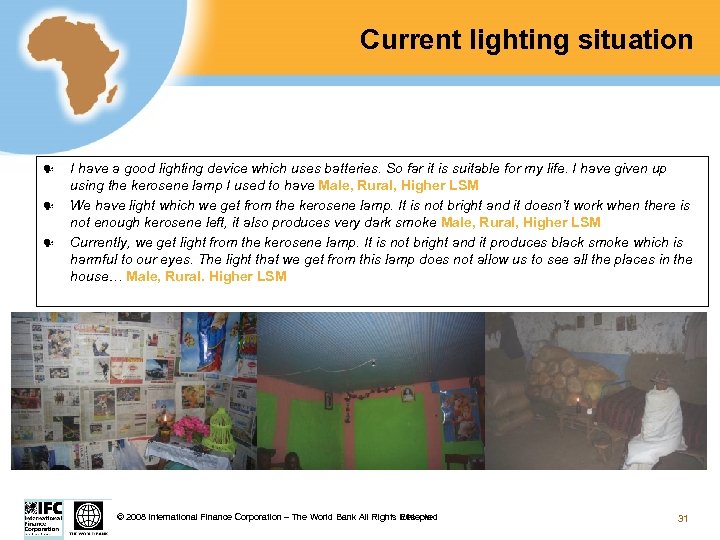 Current lighting situation I have a good lighting device which uses batteries. So far it is suitable for my life. I have given up using the kerosene lamp I used to have Male, Rural, Higher LSM We have light which we get from the kerosene lamp. It is not bright and it doesn’t work when there is not enough kerosene left, it also produces very dark smoke Male, Rural, Higher LSM Currently, we get light from the kerosene lamp. It is not bright and it produces black smoke which is harmful to our eyes. The light that we get from this lamp does not allow us to see all the places in the house… Male, Rural. Higher LSM Ethiopia © 2008 International Finance Corporation – The World Bank All Rights Reserved 31
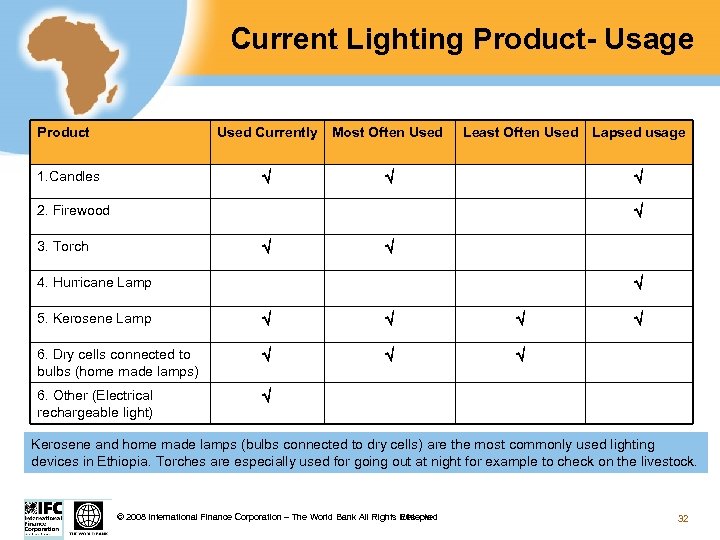 Current Lighting Product- Usage Product Used Currently 1. Candles Most Often Used Least Often Used Lapsed usage 2. Firewood 3. Torch 4. Hurricane Lamp 5. Kerosene Lamp 6. Dry cells connected to bulbs (home made lamps) 6. Other (Electrical rechargeable light) Kerosene and home made lamps (bulbs connected to dry cells) are the most commonly used lighting devices in Ethiopia. Torches are especially used for going out at night for example to check on the livestock. Ethiopia © 2008 International Finance Corporation – The World Bank All Rights Reserved 32
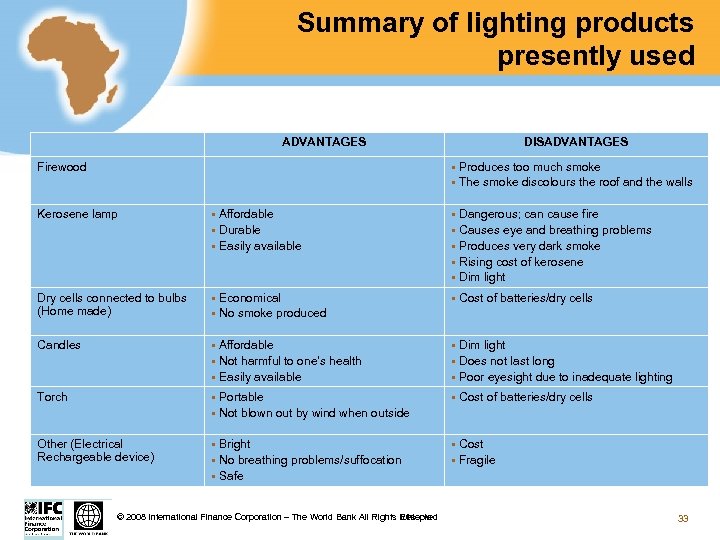 Summary of lighting products presently used ADVANTAGES Firewood DISADVANTAGES Produces too much smoke § The smoke discolours the roof and the walls § Kerosene lamp § Affordable § Durable § Easily available § Dry cells connected to bulbs (Home made) § Economical § No smoke produced § Candles § Affordable § Not harmful to one’s health § Easily available § Torch § Portable § Not blown out by wind when outside § Other (Electrical Rechargeable device) § Bright § No breathing problems/suffocation § Safe § Ethiopia © 2008 International Finance Corporation – The World Bank All Rights Reserved Dangerous; can cause fire § Causes eye and breathing problems § Produces very dark smoke § Rising cost of kerosene § Dim light Cost of batteries/dry cells Dim light § Does not last long § Poor eyesight due to inadequate lighting Cost of batteries/dry cells Cost § Fragile 33
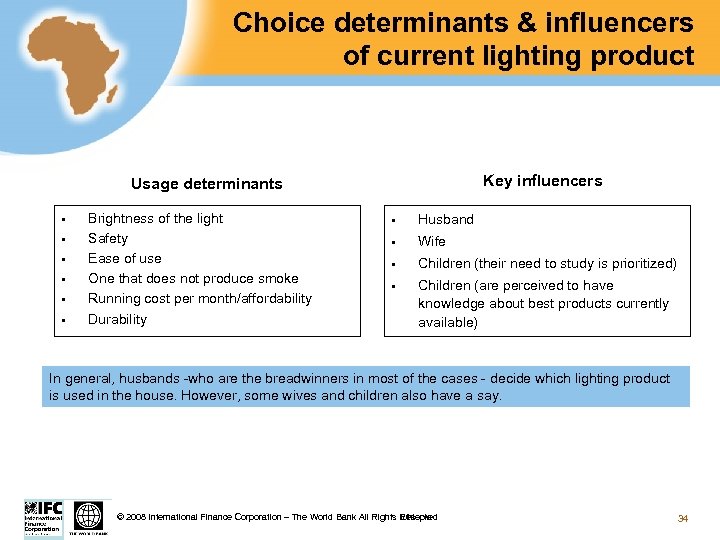 Choice determinants & influencers of current lighting product Key influencers Usage determinants § § § Brightness of the light Safety Ease of use One that does not produce smoke Running cost per month/affordability Durability § Husband § Wife § Children (their need to study is prioritized) § Children (are perceived to have knowledge about best products currently available) In general, husbands -who are the breadwinners in most of the cases - decide which lighting product is used in the house. However, some wives and children also have a say. Ethiopia © 2008 International Finance Corporation – The World Bank All Rights Reserved 34
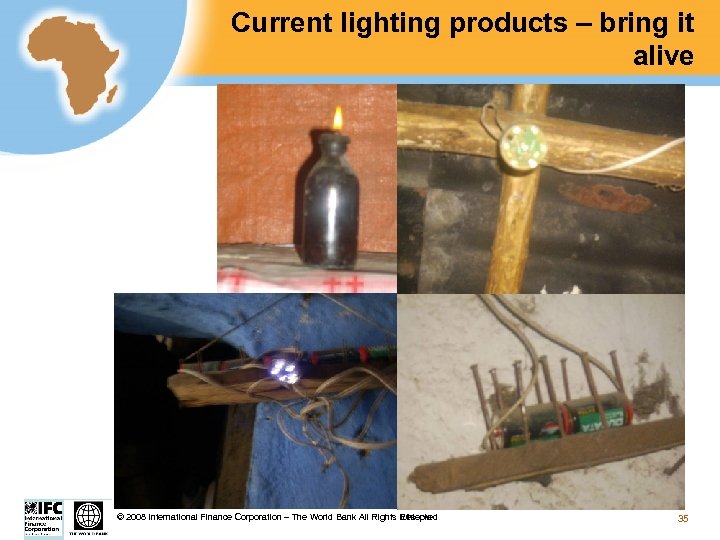 Current lighting products – bring it alive Ethiopia © 2008 International Finance Corporation – The World Bank All Rights Reserved 35
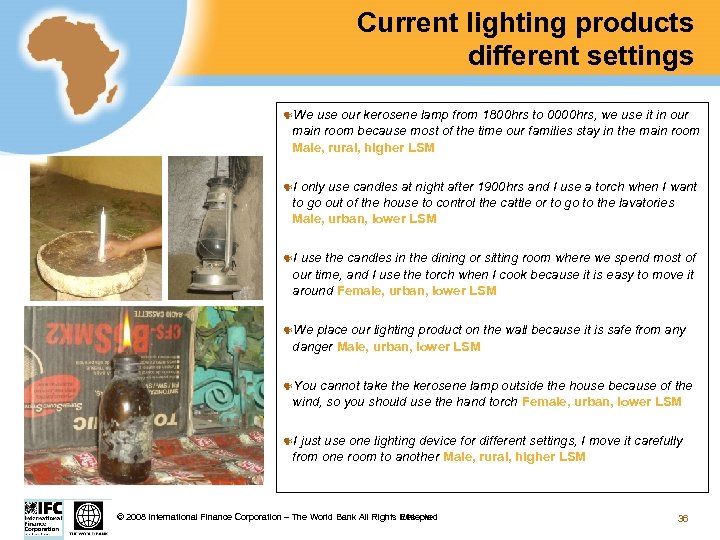 Current lighting products different settings We use our kerosene lamp from 1800 hrs to 0000 hrs, we use it in our main room because most of the time our families stay in the main room Male, rural, higher LSM I only use candles at night after 1900 hrs and I use a torch when I want to go out of the house to control the cattle or to go to the lavatories Male, urban, lower LSM I use the candles in the dining or sitting room where we spend most of our time, and I use the torch when I cook because it is easy to move it around Female, urban, lower LSM We place our lighting product on the wall because it is safe from any danger Male, urban, lower LSM You cannot take the kerosene lamp outside the house because of the wind, so you should use the hand torch Female, urban, lower LSM I just use one lighting device for different settings, I move it carefully from one room to another Male, rural, higher LSM Ethiopia © 2008 International Finance Corporation – The World Bank All Rights Reserved 36
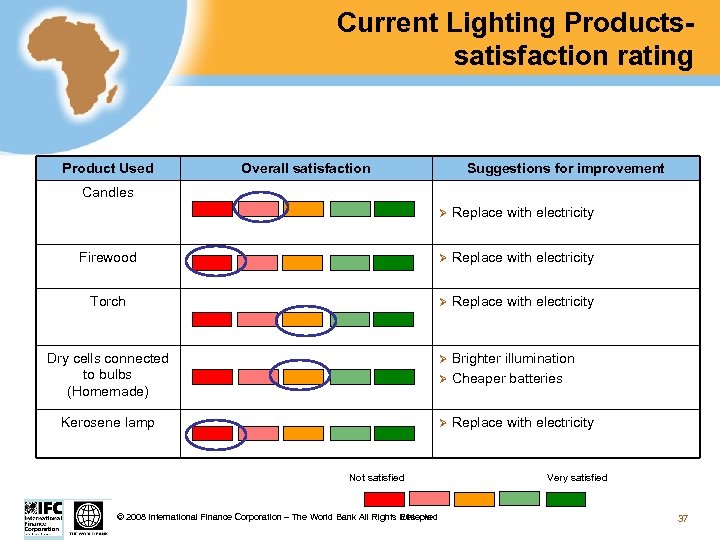 Current Lighting Productssatisfaction rating Product Used Overall satisfaction Suggestions for improvement Candles Ø Replace with electricity Firewood Ø Replace with electricity Torch Ø Replace with electricity Dry cells connected to bulbs (Homemade) Ø Kerosene lamp Ø Brighter illumination Ø Cheaper batteries Not satisfied Ethiopia © 2008 International Finance Corporation – The World Bank All Rights Reserved Replace with electricity Very satisfied 37
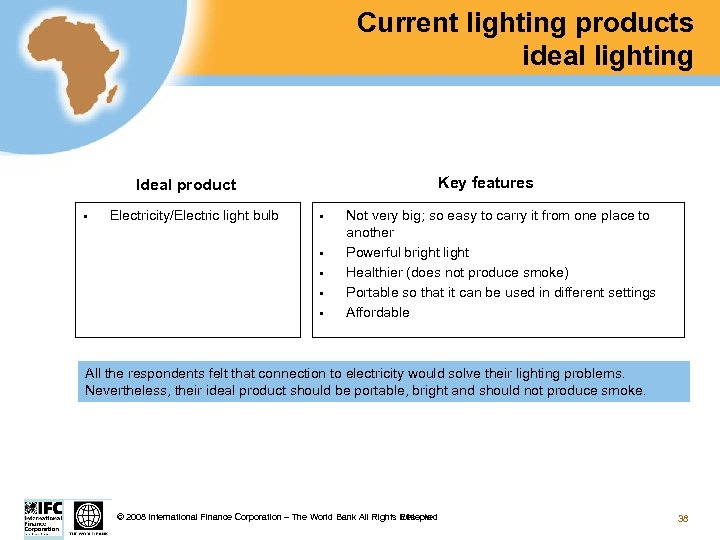 Current lighting products ideal lighting Key features Ideal product § Electricity/Electric light bulb § § § Not very big; so easy to carry it from one place to another Powerful bright light Healthier (does not produce smoke) Portable so that it can be used in different settings Affordable All the respondents felt that connection to electricity would solve their lighting problems. Nevertheless, their ideal product should be portable, bright and should not produce smoke. Ethiopia © 2008 International Finance Corporation – The World Bank All Rights Reserved 38
 MAIN PRODUCT FINDINGS
 TM 41
TM 41
 TEST PRODUCT EVALUATION Before Placement
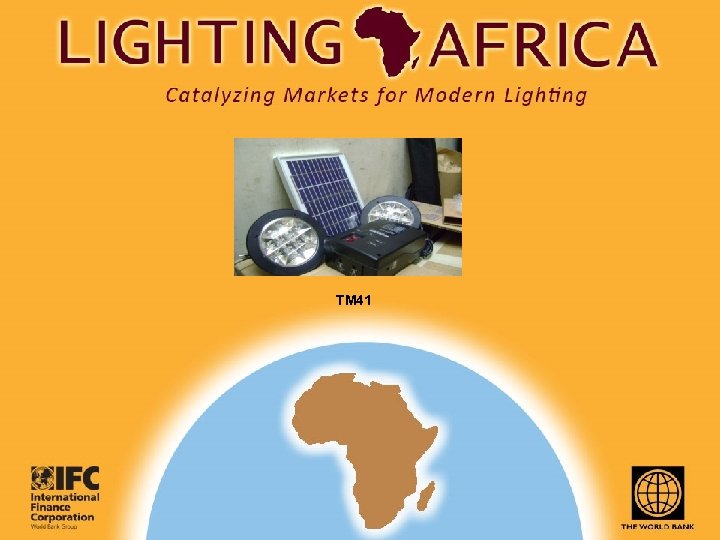
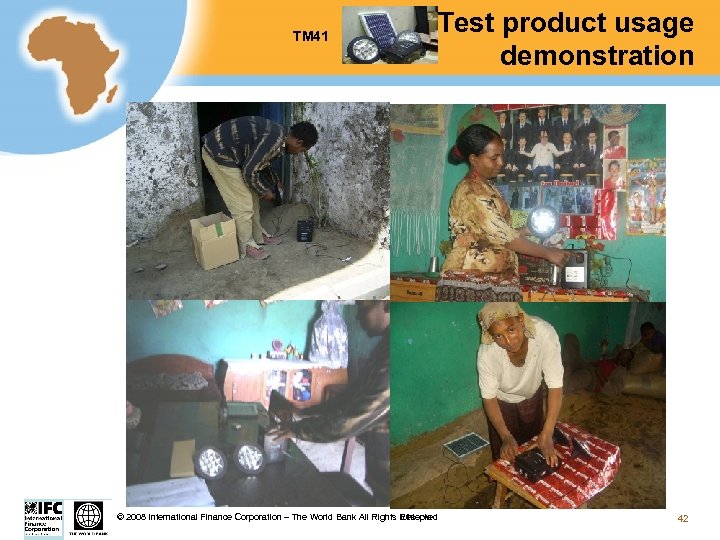 TM 41 Test product usage demonstration Ethiopia © 2008 International Finance Corporation – The World Bank All Rights Reserved 42
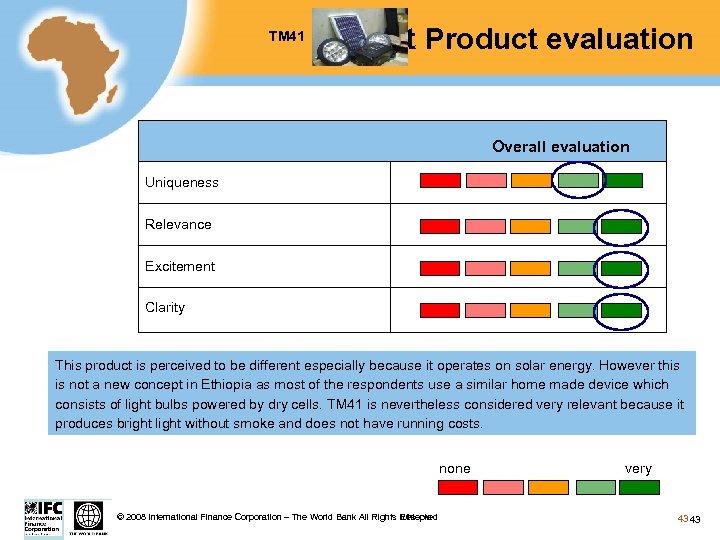 TM 41 Test Product evaluation Overall evaluation Uniqueness Relevance Excitement Clarity This product is perceived to be different especially because it operates on solar energy. However this is not a new concept in Ethiopia as most of the respondents use a similar home made device which consists of light bulbs powered by dry cells. TM 41 is nevertheless considered very relevant because it produces bright light without smoke and does not have running costs. none Ethiopia © 2008 International Finance Corporation – The World Bank All Rights Reserved very 4343
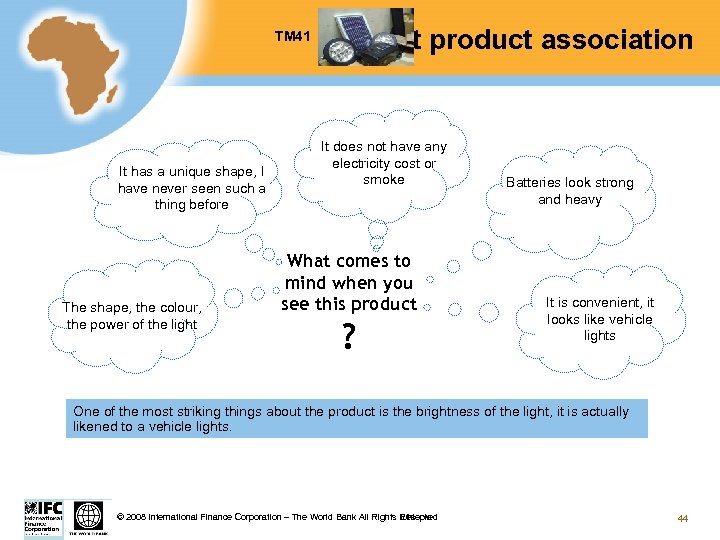 Test product association TM 41 It has a unique shape, I have never seen such a thing before The shape, the colour, the power of the light It does not have any electricity cost or smoke What comes to mind when you see this product ? Batteries look strong and heavy It is convenient, it looks like vehicle lights One of the most striking things about the product is the brightness of the light, it is actually likened to a vehicle lights. Ethiopia © 2008 International Finance Corporation – The World Bank All Rights Reserved 44
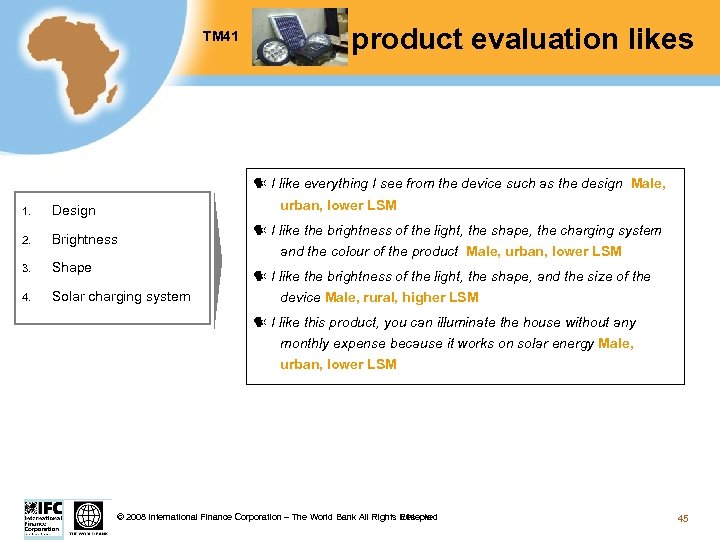 TM 41 Test product evaluation likes I like everything I see from the device such as the design Male, urban, lower LSM 1. Design 2. Brightness 3. Shape 4. Solar charging system I like the brightness of the light, the shape, the charging system and the colour of the product Male, urban, lower LSM I like the brightness of the light, the shape, and the size of the device Male, rural, higher LSM I like this product, you can illuminate the house without any monthly expense because it works on solar energy Male, urban, lower LSM Ethiopia © 2008 International Finance Corporation – The World Bank All Rights Reserved 45
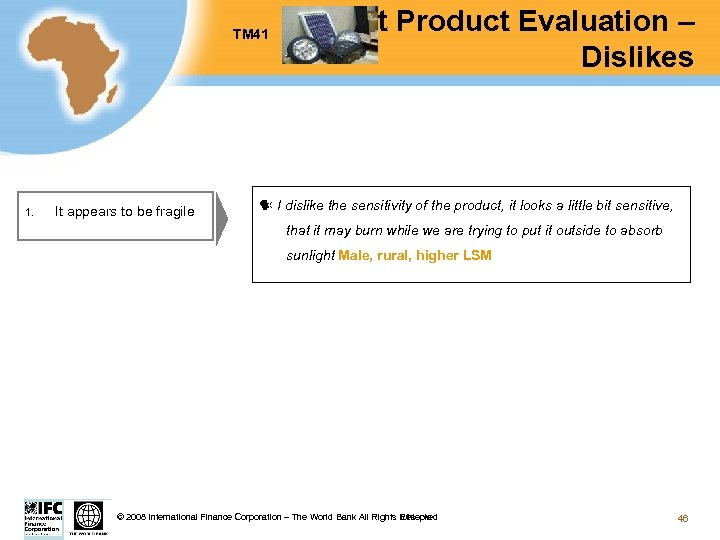 TM 41 1. It appears to be fragile Test Product Evaluation – Dislikes I dislike the sensitivity of the product, it looks a little bit sensitive, that it may burn while we are trying to put it outside to absorb sunlight Male, rural, higher LSM Ethiopia © 2008 International Finance Corporation – The World Bank All Rights Reserved 46
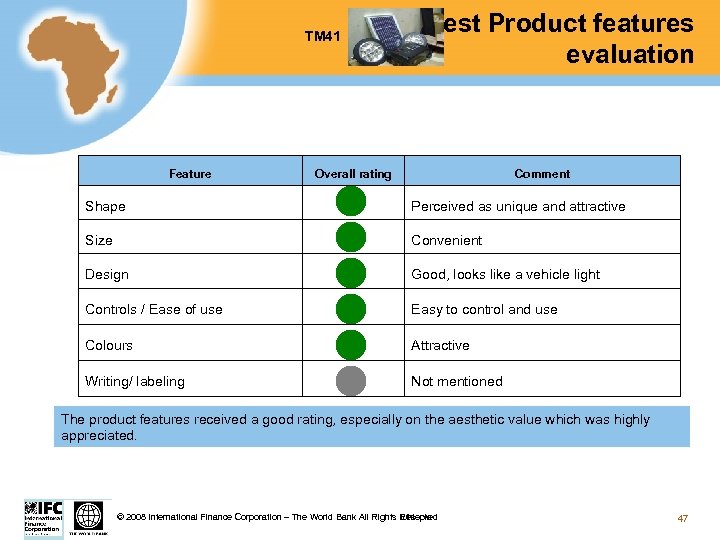 TM 41 Feature Test Product features evaluation Overall rating Comment Shape Perceived as unique and attractive Size Convenient Design Good, looks like a vehicle light Controls / Ease of use Easy to control and use Colours Attractive Writing/ labeling Not mentioned The product features received a good rating, especially on the aesthetic value which was highly appreciated. Ethiopia © 2008 International Finance Corporation – The World Bank All Rights Reserved 47
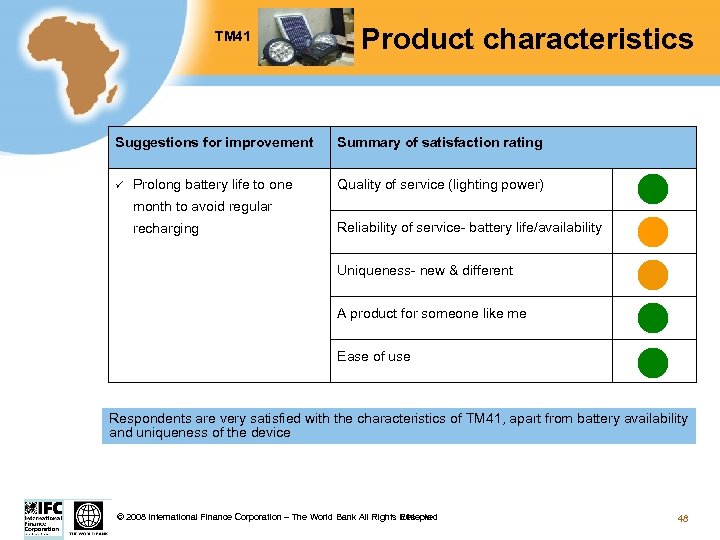 TM 41 Test Product characteristics Suggestions for improvement Summary of satisfaction rating Prolong battery life to one Quality of service (lighting power) ü month to avoid regular recharging Reliability of service- battery life/availability Uniqueness- new & different A product for someone like me Ease of use Respondents are very satisfied with the characteristics of TM 41, apart from battery availability and uniqueness of the device Ethiopia © 2008 International Finance Corporation – The World Bank All Rights Reserved 48
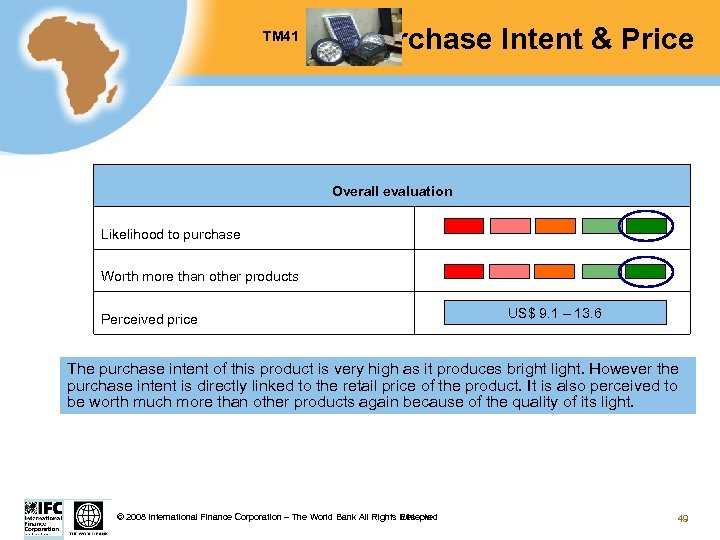 TM 41 Purchase Intent & Price Overall evaluation Likelihood to purchase Worth more than other products Perceived price US$ 9. 1 – 13. 6 The purchase intent of this product is very high as it produces bright light. However the purchase intent is directly linked to the retail price of the product. It is also perceived to be worth much more than other products again because of the quality of its light. Ethiopia © 2008 International Finance Corporation – The World Bank All Rights Reserved 49
 TM 41 Test product summary before testing This product meets the two most important needs of consumers in Ethiopia; it is a product with no health risk (no smoke) and without running costs. In addition, respondents like the § brightness of this product as well as the convenient design. There is only one suggestion for improvement which involves prolonging the battery life to last for a month when fully charged. This may be arising from the fact that even though respondents are excited about the solar charging aspect, they are concerned about the long rainy season between June and September (Kiremt). § The purchase intent of this product is very high because of the quality of the light. However this is only on condition that the price will be affordable. § Ethiopia © 2008 International Finance Corporation – The World Bank All Rights Reserved 50
 TEST PRODUCT EVALUATION After Recall
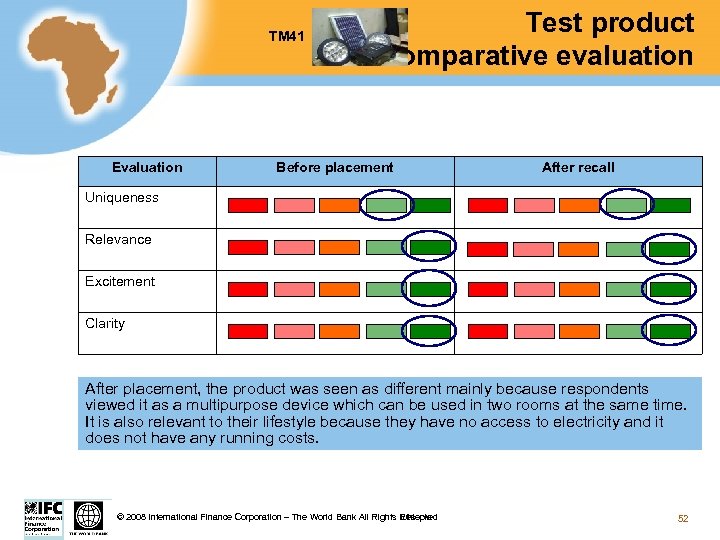 TM 41 Evaluation Test product comparative evaluation Before placement After recall Uniqueness Relevance Excitement Clarity After placement, the product was seen as different mainly because respondents viewed it as a multipurpose device which can be used in two rooms at the same time. It is also relevant to their lifestyle because they have no access to electricity and it does not have any running costs. Ethiopia © 2008 International Finance Corporation – The World Bank All Rights Reserved 52
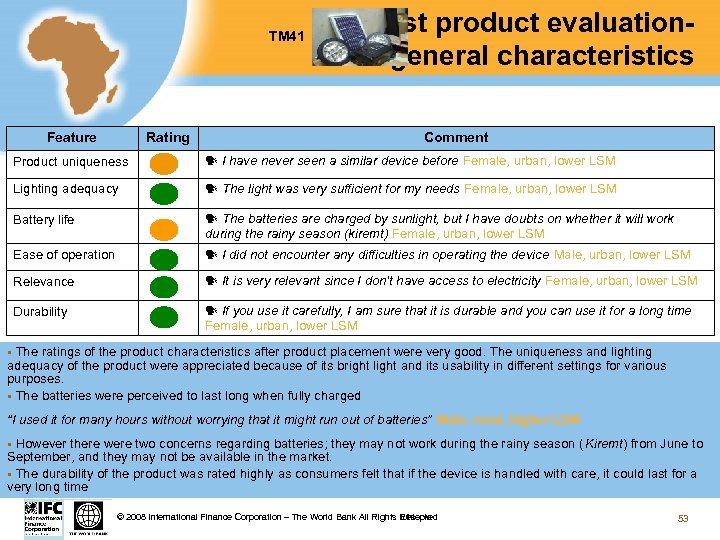 TM 41 Feature Rating Test product evaluationgeneral characteristics Comment Product uniqueness I have never seen a similar device before Female, urban, lower LSM Lighting adequacy The light was very sufficient for my needs Female, urban, lower LSM Battery life The batteries are charged by sunlight, but I have doubts on whether it will work during the rainy season (kiremt) Female, urban, lower LSM Ease of operation I did not encounter any difficulties in operating the device Male, urban, lower LSM Relevance It is very relevant since I don’t have access to electricity Female, urban, lower LSM Durability If you use it carefully, I am sure that it is durable and you can use it for a long time Female, urban, lower LSM The ratings of the product characteristics after product placement were very good. The uniqueness and lighting adequacy of the product were appreciated because of its bright light and its usability in different settings for various purposes. § The batteries were perceived to last long when fully charged § “I used it for many hours without worrying that it might run out of batteries” Male, rural, higher LSM However there were two concerns regarding batteries; they may not work during the rainy season ( Kiremt) from June to September, and they may not be available in the market. § The durability of the product was rated highly as consumers felt that if the device is handled with care, it could last for a very long time § Ethiopia © 2008 International Finance Corporation – The World Bank All Rights Reserved 53
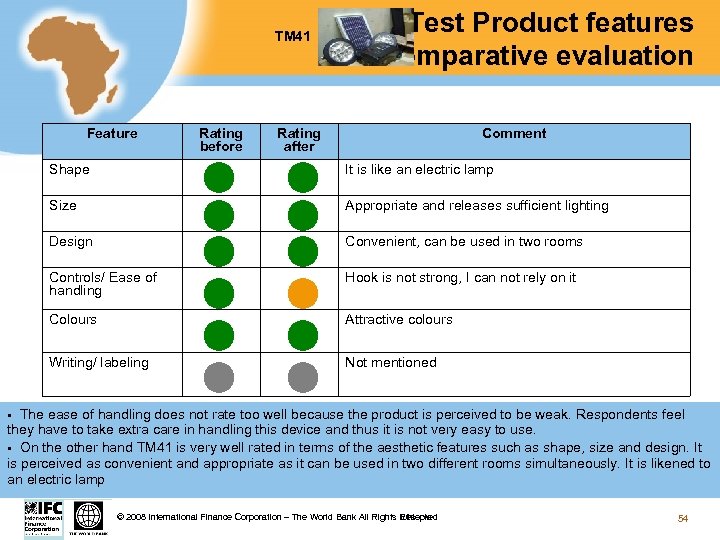 TM 41 Feature Rating before Test Product features comparative evaluation Rating after Comment Shape It is like an electric lamp Size Appropriate and releases sufficient lighting Design Convenient, can be used in two rooms Controls/ Ease of handling Hook is not strong, I can not rely on it Colours Attractive colours Writing/ labeling Not mentioned The ease of handling does not rate too well because the product is perceived to be weak. Respondents feel they have to take extra care in handling this device and thus it is not very easy to use. § On the other hand TM 41 is very well rated in terms of the aesthetic features such as shape, size and design. It is perceived as convenient and appropriate as it can be used in two different rooms simultaneously. It is likened to an electric lamp § Ethiopia © 2008 International Finance Corporation – The World Bank All Rights Reserved 54
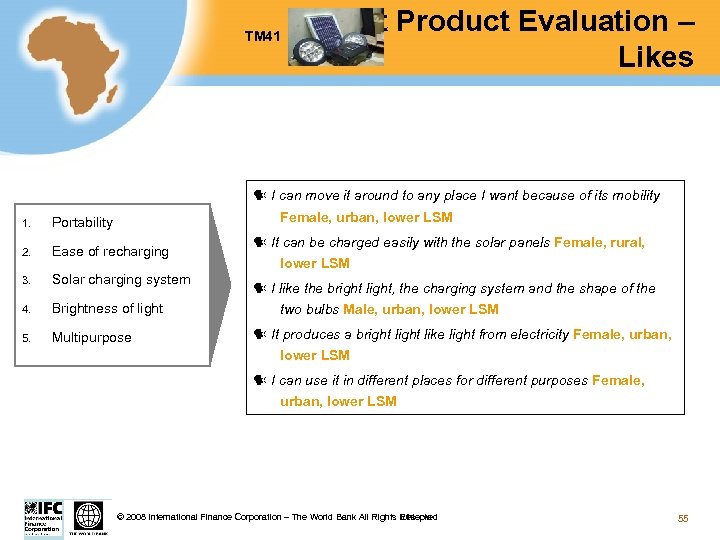 TM 41 Test Product Evaluation – Likes I can move it around to any place I want because of its mobility Female, urban, lower LSM 1. Portability 2. Ease of recharging 3. Solar charging system 4. Brightness of light 5. Multipurpose It can be charged easily with the solar panels Female, rural, lower LSM I like the bright light, the charging system and the shape of the two bulbs Male, urban, lower LSM It produces a bright like light from electricity Female, urban, lower LSM I can use it in different places for different purposes Female, urban, lower LSM Ethiopia © 2008 International Finance Corporation – The World Bank All Rights Reserved 55
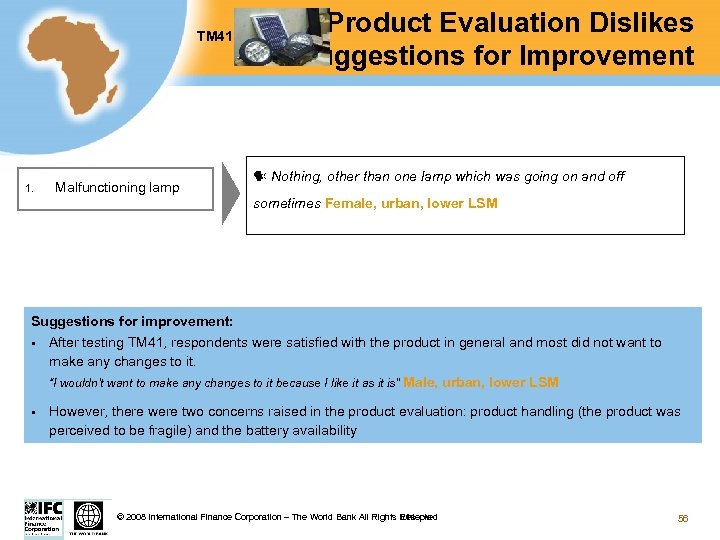 TM 41 1. Malfunctioning lamp Test Product Evaluation Dislikes & Suggestions for Improvement Nothing, other than one lamp which was going on and off sometimes Female, urban, lower LSM Suggestions for improvement: § After testing TM 41, respondents were satisfied with the product in general and most did not want to make any changes to it. “I wouldn’t want to make any changes to it because I like it as it is” Male, urban, lower LSM § However, there were two concerns raised in the product evaluation: product handling (the product was perceived to be fragile) and the battery availability Ethiopia © 2008 International Finance Corporation – The World Bank All Rights Reserved 56
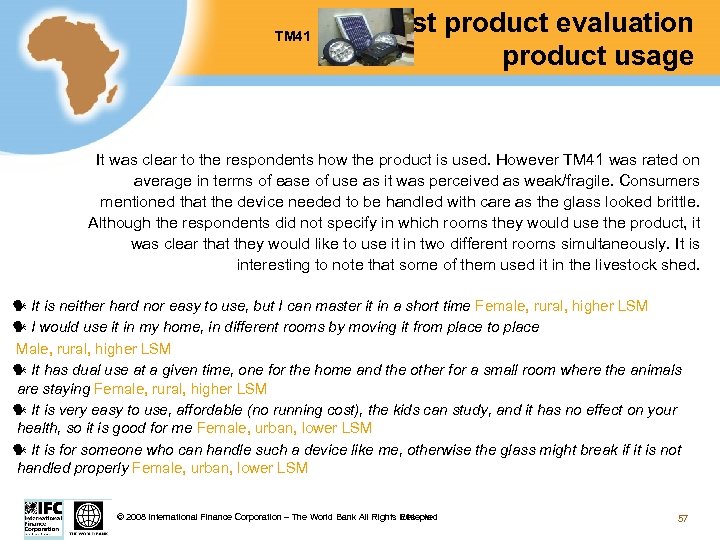 TM 41 Test product evaluation product usage It was clear to the respondents how the product is used. However TM 41 was rated on average in terms of ease of use as it was perceived as weak/fragile. Consumers mentioned that the device needed to be handled with care as the glass looked brittle. Although the respondents did not specify in which rooms they would use the product, it was clear that they would like to use it in two different rooms simultaneously. It is interesting to note that some of them used it in the livestock shed. It is neither hard nor easy to use, but I can master it in a short time Female, rural, higher LSM I would use it in my home, in different rooms by moving it from place to place Male, rural, higher LSM It has dual use at a given time, one for the home and the other for a small room where the animals are staying Female, rural, higher LSM It is very easy to use, affordable (no running cost), the kids can study, and it has no effect on your health, so it is good for me Female, urban, lower LSM It is for someone who can handle such a device like me, otherwise the glass might break if it is not handled properly Female, urban, lower LSM Ethiopia © 2008 International Finance Corporation – The World Bank All Rights Reserved 57
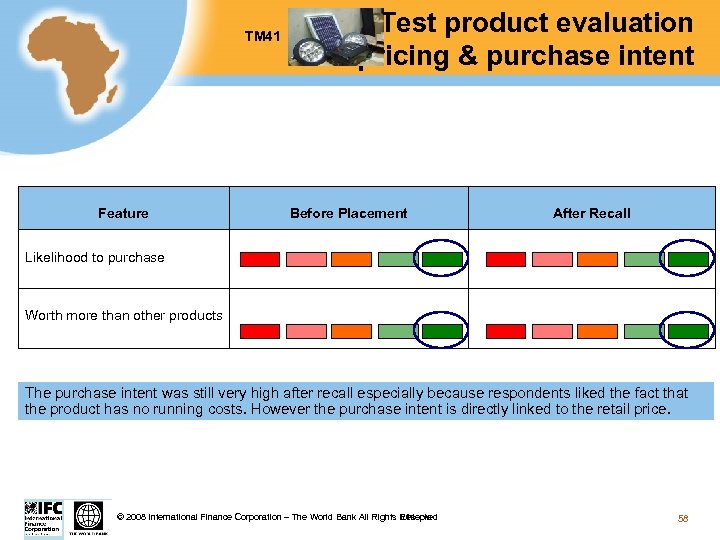 TM 41 Feature Test product evaluation pricing & purchase intent Before Placement After Recall Likelihood to purchase Worth more than other products The purchase intent was still very high after recall especially because respondents liked the fact that the product has no running costs. However the purchase intent is directly linked to the retail price. Ethiopia © 2008 International Finance Corporation – The World Bank All Rights Reserved 58
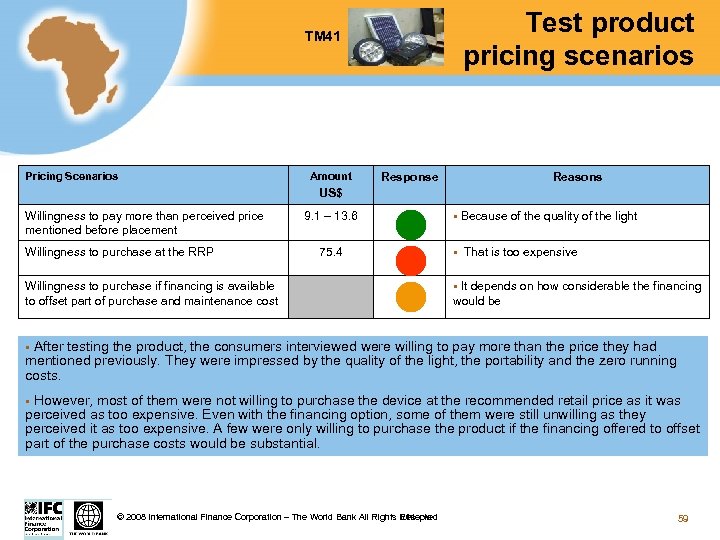 Test product pricing scenarios TM 41 Pricing Scenarios Amount Response Reasons US$ Willingness to pay more than perceived price mentioned before placement Willingness to purchase at the RRP 9. 1 – 13. 6 § 75. 4 § Willingness to purchase if financing is available to offset part of purchase and maintenance cost Because of the quality of the light That is too expensive It depends on how considerable the financing would be § After testing the product, the consumers interviewed were willing to pay more than the price they had mentioned previously. They were impressed by the quality of the light, the portability and the zero running costs. § However, most of them were not willing to purchase the device at the recommended retail price as it was perceived as too expensive. Even with the financing option, some of them were still unwilling as they perceived it as too expensive. A few were only willing to purchase the product if the financing offered to offset part of the purchase costs would be substantial. § Ethiopia © 2008 International Finance Corporation – The World Bank All Rights Reserved 59
 KO 13
KO 13
 TEST PRODUCT EVALUATION Before Placement
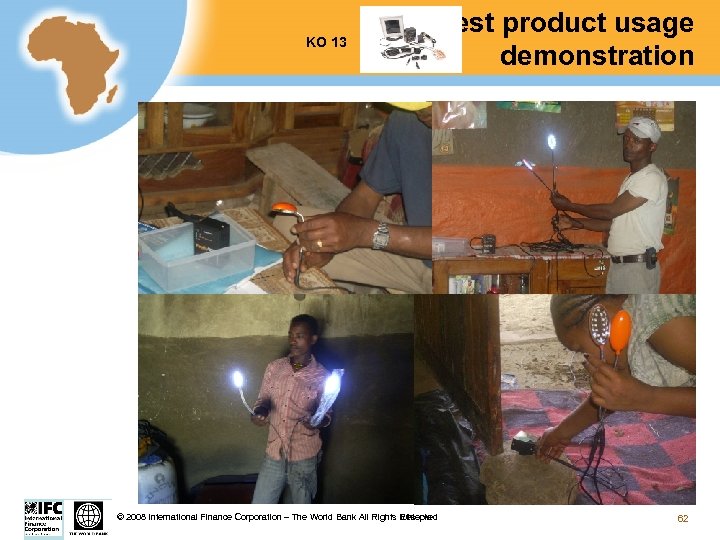 KO 13 Test product usage demonstration Ethiopia © 2008 International Finance Corporation – The World Bank All Rights Reserved 62
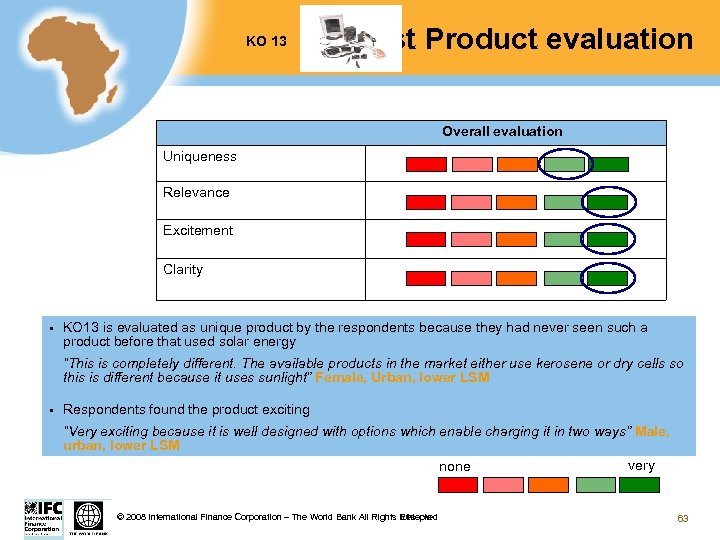 KO 13 Test Product evaluation Overall evaluation Uniqueness Relevance Excitement Clarity § KO 13 is evaluated as unique product by the respondents because they had never seen such a product before that used solar energy “This is completely different. The available products in the market either use kerosene or dry cells so this is different because it uses sunlight” Female, Urban, lower LSM § Respondents found the product exciting “Very exciting because it is well designed with options which enable charging it in two ways” Male, urban, lower LSM very none Ethiopia © 2008 International Finance Corporation – The World Bank All Rights Reserved 63
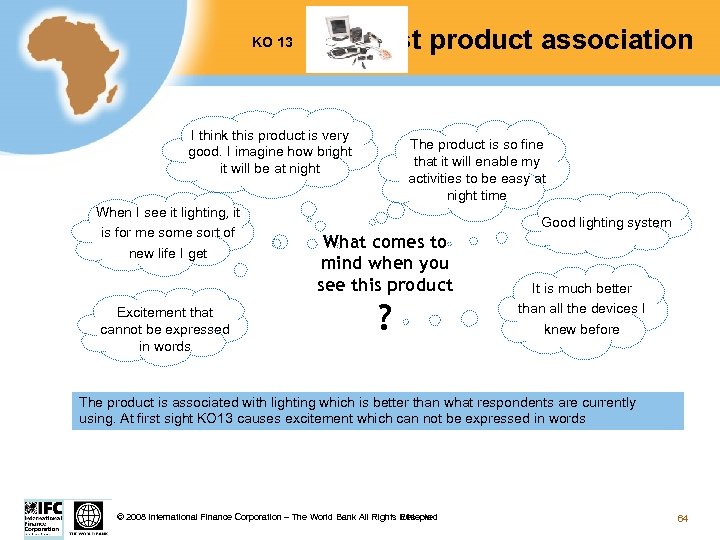 Test product association KO 13 I think this product is very good. I imagine how bright it will be at night When I see it lighting, it is for me sort of new life I get Excitement that cannot be expressed in words The product is so fine that it will enable my activities to be easy at night time Good lighting system What comes to mind when you see this product ? It is much better than all the devices I knew before The product is associated with lighting which is better than what respondents are currently using. At first sight KO 13 causes excitement which can not be expressed in words Ethiopia © 2008 International Finance Corporation – The World Bank All Rights Reserved 64
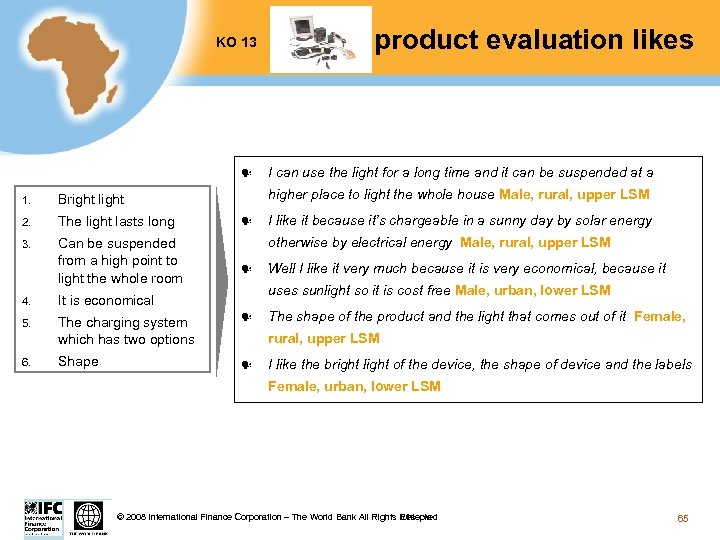 KO 13 1. The light lasts long 3. Can be suspended from a high point to light the whole room 4. The charging system which has two options 6. Shape I like it because it’s chargeable in a sunny day by solar energy otherwise by electrical energy Male, rural, upper LSM Well I like it very much because it is very economical, because it uses sunlight so it is cost free Male, urban, lower LSM It is economical 5. I can use the light for a long time and it can be suspended at a higher place to light the whole house Male, rural, upper LSM Bright light 2. Test product evaluation likes The shape of the product and the light that comes out of it Female, rural, upper LSM I like the bright light of the device, the shape of device and the labels Female, urban, lower LSM Ethiopia © 2008 International Finance Corporation – The World Bank All Rights Reserved 65
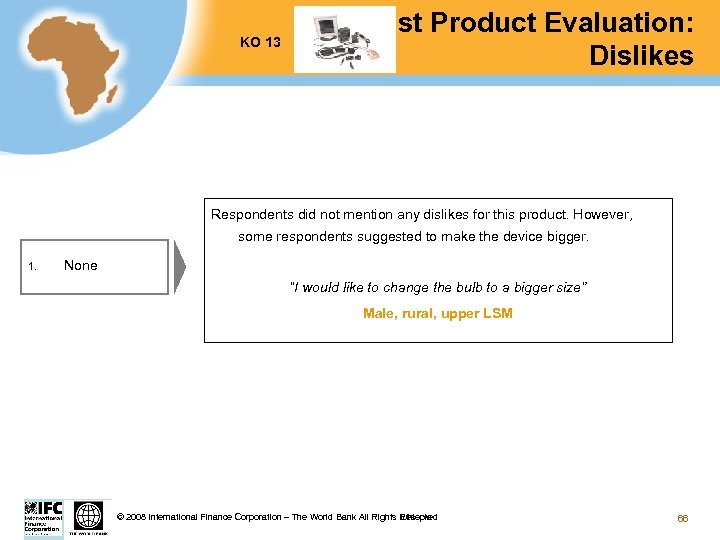 KO 13 Test Product Evaluation: Dislikes Respondents did not mention any dislikes for this product. However, some respondents suggested to make the device bigger. 1. None “I would like to change the bulb to a bigger size” Male, rural, upper LSM Ethiopia © 2008 International Finance Corporation – The World Bank All Rights Reserved 66
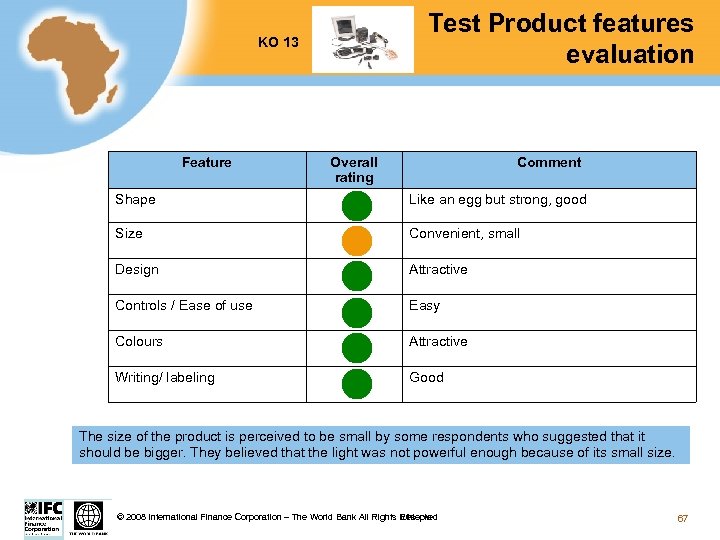 Test Product features evaluation KO 13 Feature Overall rating Comment Shape Like an egg but strong, good Size Convenient, small Design Attractive Controls / Ease of use Easy Colours Attractive Writing/ labeling Good The size of the product is perceived to be small by some respondents who suggested that it should be bigger. They believed that the light was not powerful enough because of its small size. Ethiopia © 2008 International Finance Corporation – The World Bank All Rights Reserved 67
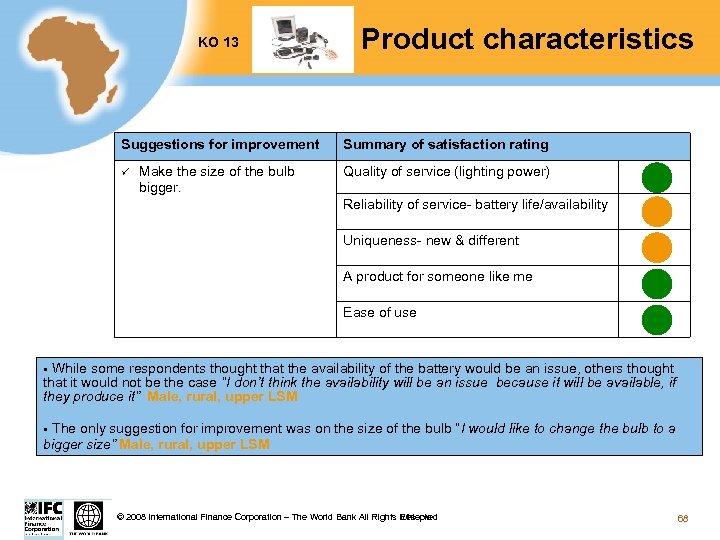 KO 13 Test Product characteristics Suggestions for improvement Summary of satisfaction rating Make the size of the bulb bigger. Quality of service (lighting power) ü Reliability of service- battery life/availability Uniqueness- new & different A product for someone like me Ease of use While some respondents thought that the availability of the battery would be an issue, others thought that it would not be the case “I don’t think the availability will be an issue because it will be available, if they produce it” Male, rural, upper LSM § The only suggestion for improvement was on the size of the bulb “I would like to change the bulb to a bigger size” Male, rural, upper LSM § Ethiopia © 2008 International Finance Corporation – The World Bank All Rights Reserved 68
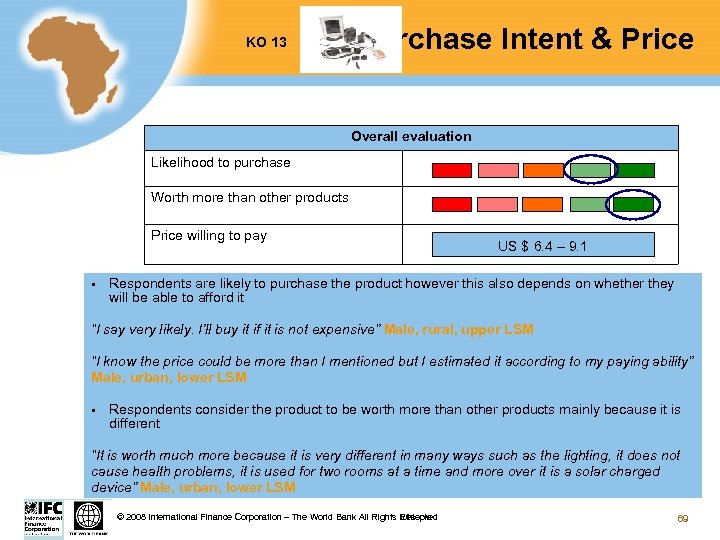 KO 13 Purchase Intent & Price Overall evaluation Likelihood to purchase Worth more than other products Price willing to pay § US $ 6. 4 – 9. 1 Respondents are likely to purchase the product however this also depends on whether they will be able to afford it “I say very likely. I’ll buy it if it is not expensive” Male, rural, upper LSM “I know the price could be more than I mentioned but I estimated it according to my paying ability” Male, urban, lower LSM § Respondents consider the product to be worth more than other products mainly because it is different “It is worth much more because it is very different in many ways such as the lighting, it does not cause health problems, it is used for two rooms at a time and more over it is a solar charged device” Male, urban, lower LSM Ethiopia © 2008 International Finance Corporation – The World Bank All Rights Reserved 69
 KO 13 Test product summary before testing § KO 13 is different from any lighting device that respondents have ever seen because of its unique features such as bright light, two charging options and specifically, solar charging. The bright light without smoke makes it relevant to respondents’ lighting needs § Respondents are excited about its design; that it does not produce smoke and has no running costs because it can be charged by solar energy § The general features of the product are well accepted although some respondents think that the size of the bulbs is too small and suggest that it should be made bigger § While some respondents believe that the availability of the battery will be an issue, others think that once the product is in the market, the battery will also be available § Respondents are willing to purchase the product if they are able to afford it once it is in the market § It is worth much more than other products because of its unique features and functionality. It is also thought to be very durable if used carefully Ethiopia © 2008 International Finance Corporation – The World Bank All Rights Reserved 70
 TEST PRODUCT EVALUATION After Placement
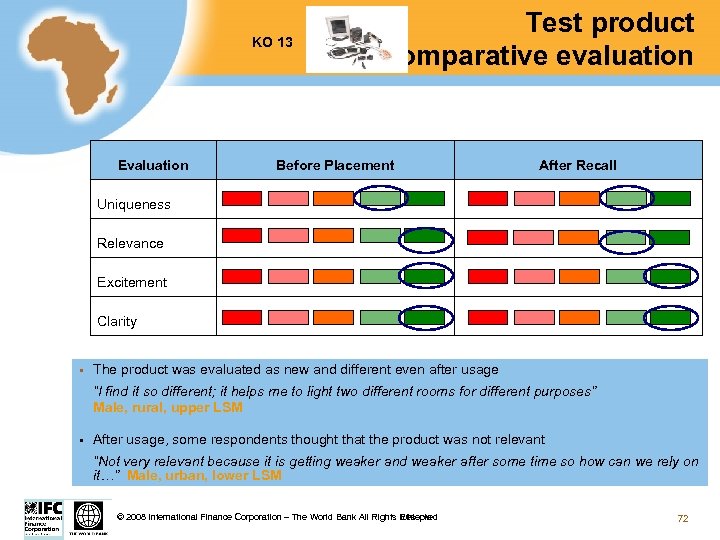 KO 13 Evaluation Test product comparative evaluation Before Placement After Recall Uniqueness Relevance Excitement Clarity § The product was evaluated as new and different even after usage “I find it so different; it helps me to light two different rooms for different purposes” Male, rural, upper LSM § After usage, some respondents thought that the product was not relevant “Not very relevant because it is getting weaker and weaker after some time so how can we rely on it…” Male, urban, lower LSM Ethiopia © 2008 International Finance Corporation – The World Bank All Rights Reserved 72
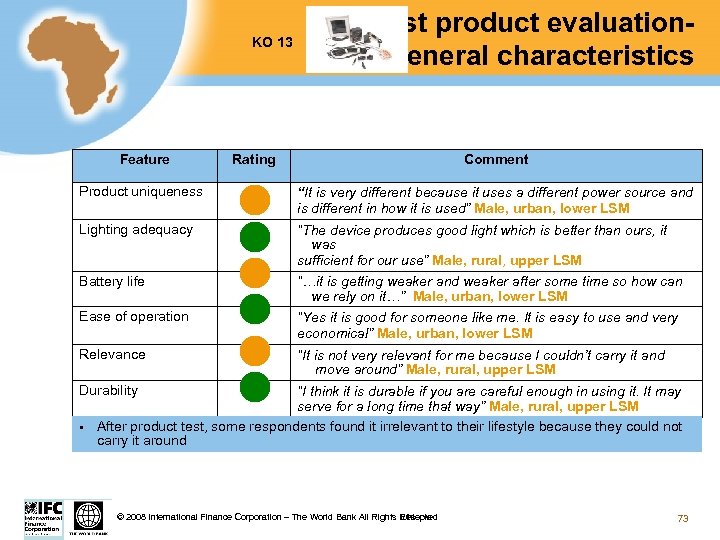 KO 13 Feature Test product evaluationgeneral characteristics Rating Comment Product uniqueness “It is very different because it uses a different power source and is different in how it is used” Male, urban, lower LSM Lighting adequacy “The device produces good light which is better than ours, it was sufficient for our use” Male, rural, upper LSM Battery life “…it is getting weaker and weaker after some time so how can we rely on it…” Male, urban, lower LSM Ease of operation “Yes it is good for someone like me. It is easy to use and very economical” Male, urban, lower LSM Relevance “It is not very relevant for me because I couldn’t carry it and move around” Male, rural, upper LSM Durability § “I think it is durable if you are careful enough in using it. It may serve for a long time that way” Male, rural, upper LSM After product test, some respondents found it irrelevant to their lifestyle because they could not carry it around Ethiopia © 2008 International Finance Corporation – The World Bank All Rights Reserved 73
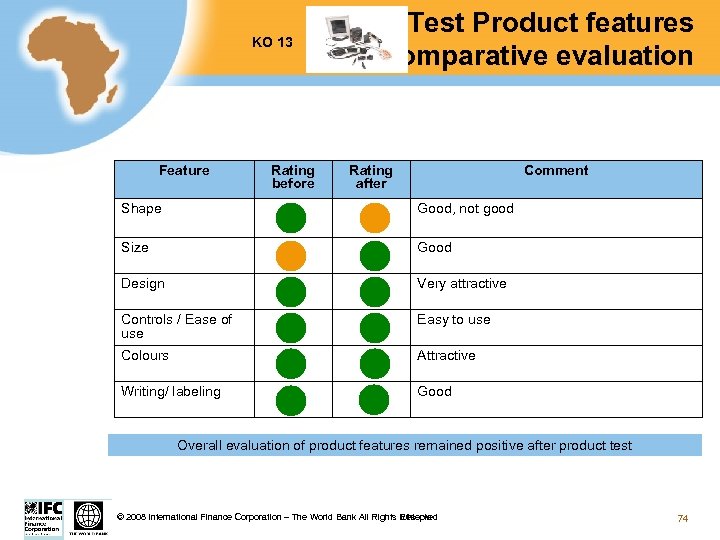 KO 13 Feature Rating before Test Product features comparative evaluation Rating after Comment Shape Good, not good Size Good Design Very attractive Controls / Ease of use Easy to use Colours Attractive Writing/ labeling Good Overall evaluation of product features remained positive after product test Ethiopia © 2008 International Finance Corporation – The World Bank All Rights Reserved 74
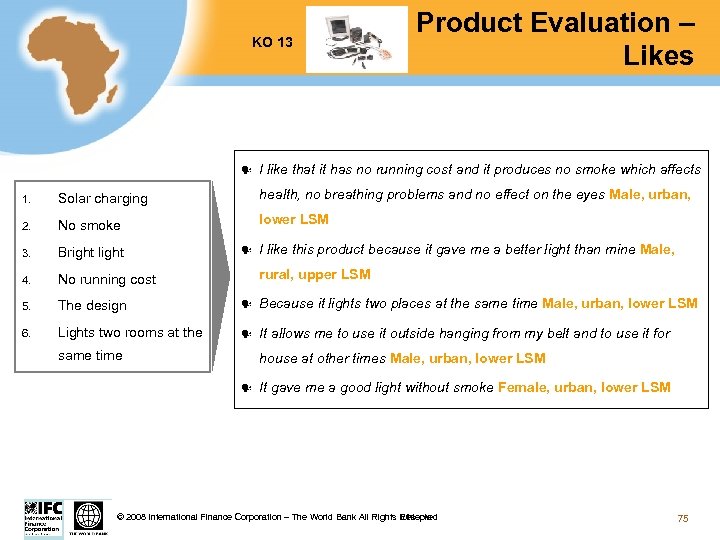 KO 13 Test Product Evaluation – Likes I like that it has no running cost and it produces no smoke which affects 1. Solar charging health, no breathing problems and no effect on the eyes Male, urban, 2. No smoke lower LSM 3. Bright light 4. No running cost 5. The design Because it lights two places at the same time Male, urban, lower LSM 6. Lights two rooms at the It allows me to use it outside hanging from my belt and to use it for I like this product because it gave me a better light than mine Male, rural, upper LSM same time house at other times Male, urban, lower LSM It gave me a good light without smoke Female, urban, lower LSM Ethiopia © 2008 International Finance Corporation – The World Bank All Rights Reserved 75
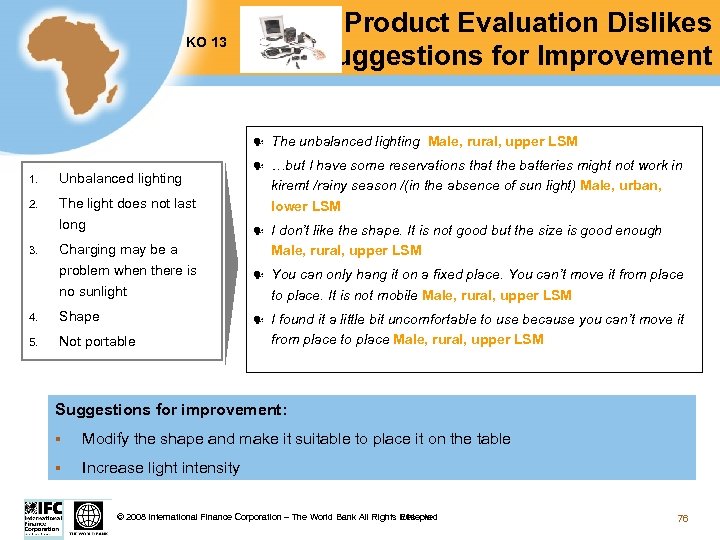 Test Product Evaluation Dislikes & Suggestions for Improvement KO 13 The unbalanced lighting Male, rural, upper LSM …but I have some reservations that the batteries might not work in kiremt /rainy season /(in the absence of sun light) Male, urban, lower LSM long Charging may be a problem when there is I don’t like the shape. It is not good but the size is good enough Male, rural, upper LSM You can only hang it on a fixed place. You can’t move it from place to place. It is not mobile Male, rural, upper LSM I found it a little bit uncomfortable to use because you can’t move it from place to place Male, rural, upper LSM 1. Unbalanced lighting 2. The light does not last 3. no sunlight 4. Shape 5. Not portable Suggestions for improvement: § Modify the shape and make it suitable to place it on the table § Increase light intensity Ethiopia © 2008 International Finance Corporation – The World Bank All Rights Reserved 76
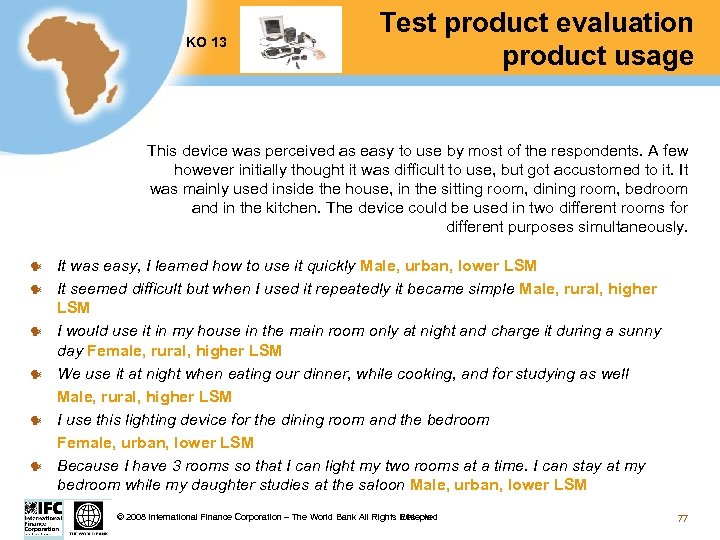 KO 13 Test product evaluation product usage This device was perceived as easy to use by most of the respondents. A few however initially thought it was difficult to use, but got accustomed to it. It was mainly used inside the house, in the sitting room, dining room, bedroom and in the kitchen. The device could be used in two different rooms for different purposes simultaneously. It was easy, I learned how to use it quickly Male, urban, lower LSM It seemed difficult but when I used it repeatedly it became simple Male, rural, higher LSM I would use it in my house in the main room only at night and charge it during a sunny day Female, rural, higher LSM We use it at night when eating our dinner, while cooking, and for studying as well Male, rural, higher LSM I use this lighting device for the dining room and the bedroom Female, urban, lower LSM Because I have 3 rooms so that I can light my two rooms at a time. I can stay at my bedroom while my daughter studies at the saloon Male, urban, lower LSM Ethiopia © 2008 International Finance Corporation – The World Bank All Rights Reserved 77
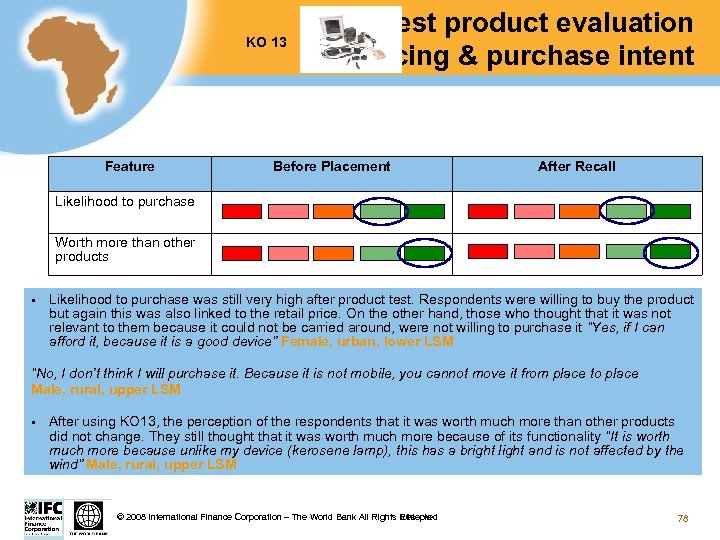 KO 13 Feature Test product evaluation pricing & purchase intent Before Placement After Recall Likelihood to purchase Worth more than other products § Likelihood to purchase was still very high after product test. Respondents were willing to buy the product but again this was also linked to the retail price. On the other hand, those who thought that it was not relevant to them because it could not be carried around, were not willing to purchase it “Yes, if I can afford it, because it is a good device” Female, urban, lower LSM “No, I don’t think I will purchase it. Because it is not mobile, you cannot move it from place to place Male, rural, upper LSM § After using KO 13, the perception of the respondents that it was worth much more than other products did not change. They still thought that it was worth much more because of its functionality “It is worth much more because unlike my device (kerosene lamp), this has a bright light and is not affected by the wind” Male, rural, upper LSM Ethiopia © 2008 International Finance Corporation – The World Bank All Rights Reserved 78
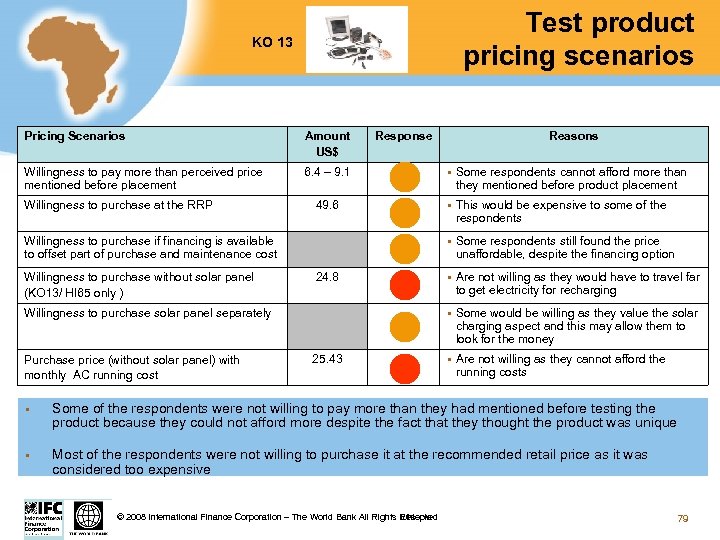 Test product pricing scenarios KO 13 Pricing Scenarios Amount US$ Willingness to pay more than perceived price mentioned before placement 6. 4 – 9. 1 § Some respondents cannot afford more than they mentioned before product placement 49. 6 § This would be expensive to some of the respondents § Some respondents still found the price unaffordable, despite the financing option § Are not willing as they would have to travel far to get electricity for recharging § Some would be willing as they value the solar charging aspect and this may allow them to look for the money § Are not willing as they cannot afford the running costs Willingness to purchase at the RRP Response Willingness to purchase if financing is available to offset part of purchase and maintenance cost Willingness to purchase without solar panel (KO 13/ HI 65 only ) 24. 8 Willingness to purchase solar panel separately Purchase price (without solar panel) with monthly AC running cost 25. 43 Reasons § Some of the respondents were not willing to pay more than they had mentioned before testing the product because they could not afford more despite the fact that they thought the product was unique § Most of the respondents were not willing to purchase it at the recommended retail price as it was considered too expensive Ethiopia © 2008 International Finance Corporation – The World Bank All Rights Reserved 79
 UR 83
UR 83
 TEST PRODUCT EVALUATION Before Placement
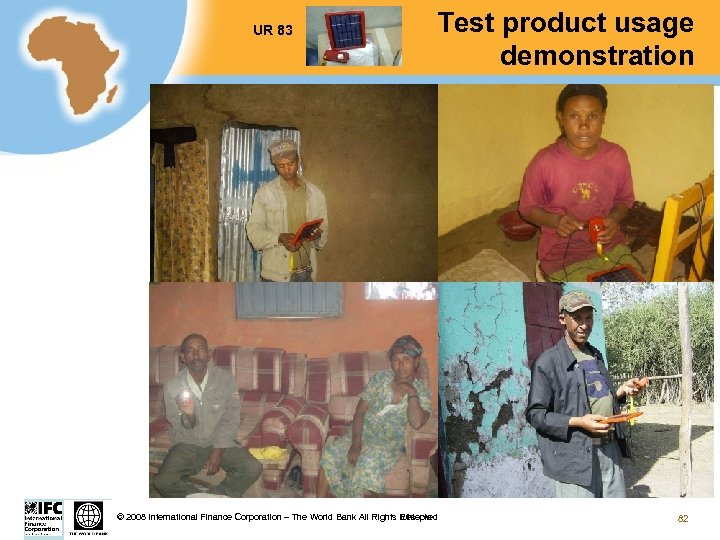 UR 83 Test product usage demonstration Ethiopia © 2008 International Finance Corporation – The World Bank All Rights Reserved 82
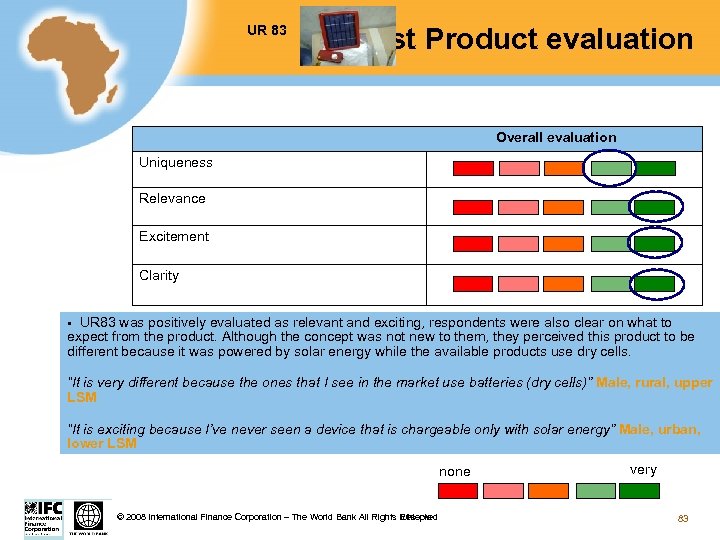 UR 83 Test Product evaluation Overall evaluation Uniqueness Relevance Excitement Clarity UR 83 was positively evaluated as relevant and exciting, respondents were also clear on what to expect from the product. Although the concept was not new to them, they perceived this product to be different because it was powered by solar energy while the available products use dry cells. § “It is very different because the ones that I see in the market use batteries (dry cells)” Male, rural, upper LSM “It is exciting because I’ve never seen a device that is chargeable only with solar energy” Male, urban, lower LSM none Ethiopia © 2008 International Finance Corporation – The World Bank All Rights Reserved very 83
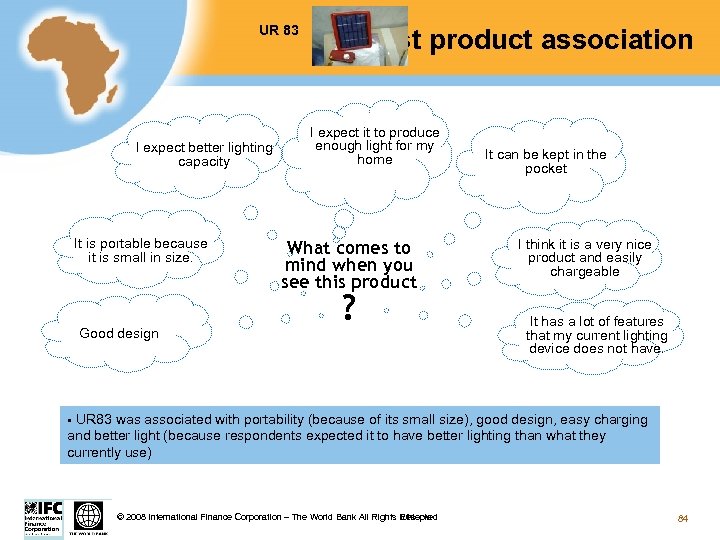 UR 83 I expect better lighting capacity It is portable because it is small in size. Good design Test product association I expect it to produce enough light for my home What comes to mind when you see this product ? It can be kept in the pocket I think it is a very nice product and easily chargeable It has a lot of features that my current lighting device does not have. UR 83 was associated with portability (because of its small size), good design, easy charging and better light (because respondents expected it to have better lighting than what they currently use) § Ethiopia © 2008 International Finance Corporation – The World Bank All Rights Reserved 84
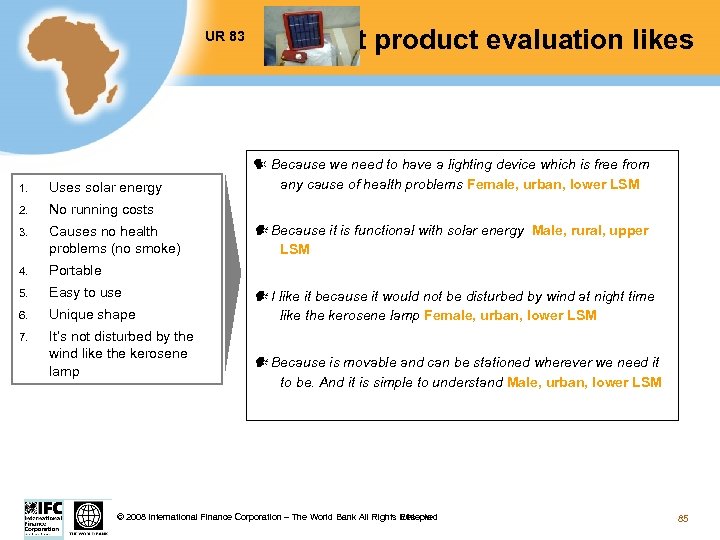 UR 83 1. Uses solar energy 2. Causes no health problems (no smoke) Because we need to have a lighting device which is free from any cause of health problems Female, urban, lower LSM No running costs 3. Test product evaluation likes 4. Easy to use 6. Unique shape 7. It’s not disturbed by the wind like the kerosene lamp LSM Portable 5. Because it is functional with solar energy Male, rural, upper I like it because it would not be disturbed by wind at night time like the kerosene lamp Female, urban, lower LSM Because is movable and can be stationed wherever we need it to be. And it is simple to understand Male, urban, lower LSM Ethiopia © 2008 International Finance Corporation – The World Bank All Rights Reserved 85
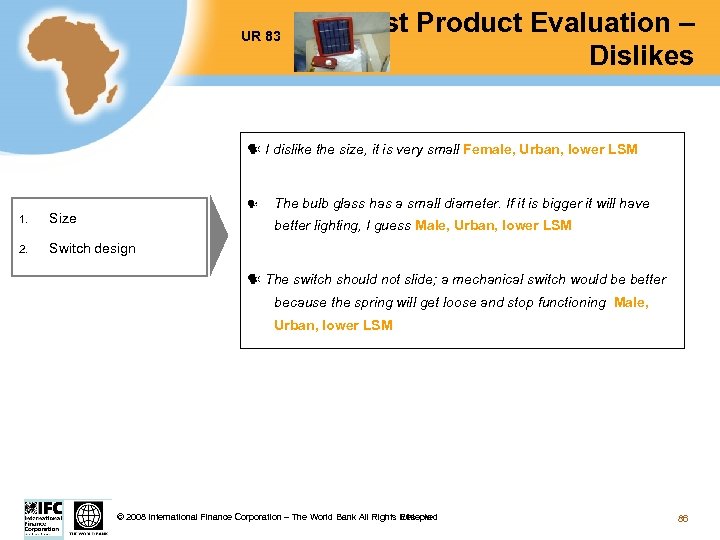 UR 83 Test Product Evaluation – Dislikes I dislike the size, it is very small Female, Urban, lower LSM 1. Size 2. The bulb glass has a small diameter. If it is bigger it will have Switch design better lighting, I guess Male, Urban, lower LSM The switch should not slide; a mechanical switch would be better because the spring will get loose and stop functioning Male, Urban, lower LSM Ethiopia © 2008 International Finance Corporation – The World Bank All Rights Reserved 86
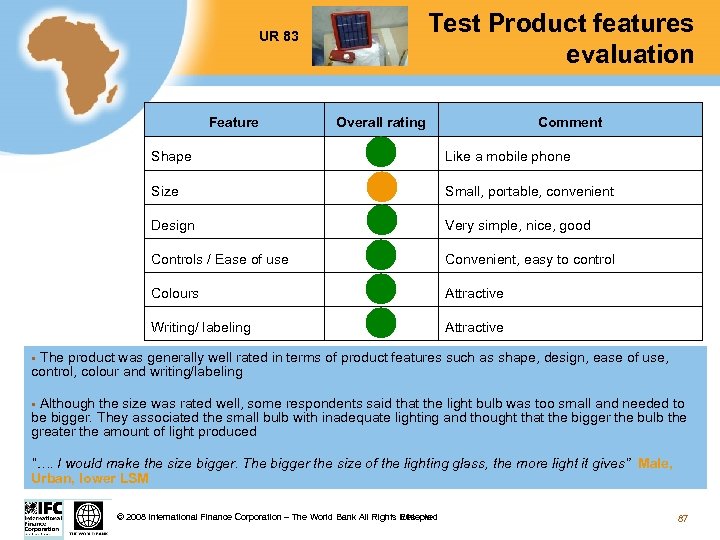 Test Product features evaluation UR 83 Feature Overall rating Comment Shape Like a mobile phone Size Small, portable, convenient Design Very simple, nice, good Controls / Ease of use Convenient, easy to control Colours Attractive Writing/ labeling Attractive The product was generally well rated in terms of product features such as shape, design, ease of use, control, colour and writing/labeling § Although the size was rated well, some respondents said that the light bulb was too small and needed to be bigger. They associated the small bulb with inadequate lighting and thought that the bigger the bulb the greater the amount of light produced § “…. I would make the size bigger. The bigger the size of the lighting glass, the more light it gives” Male, Urban, lower LSM Ethiopia © 2008 International Finance Corporation – The World Bank All Rights Reserved 87
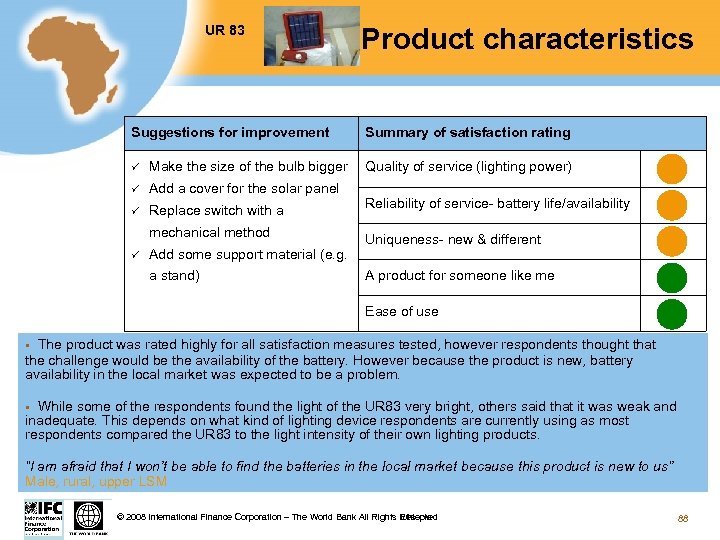 UR 83 Test Product characteristics Suggestions for improvement ü Make the size of the bulb bigger ü Add a cover for the solar panel ü Replace switch with a mechanical method ü Add some support material (e. g. a stand) Summary of satisfaction rating Quality of service (lighting power) Reliability of service- battery life/availability Uniqueness- new & different A product for someone like me Ease of use The product was rated highly for all satisfaction measures tested, however respondents thought that the challenge would be the availability of the battery. However because the product is new, battery availability in the local market was expected to be a problem. § While some of the respondents found the light of the UR 83 very bright, others said that it was weak and inadequate. This depends on what kind of lighting device respondents are currently using as most respondents compared the UR 83 to the light intensity of their own lighting products. § “I am afraid that I won’t be able to find the batteries in the local market because this product is new to us” Male, rural, upper LSM Ethiopia © 2008 International Finance Corporation – The World Bank All Rights Reserved 88
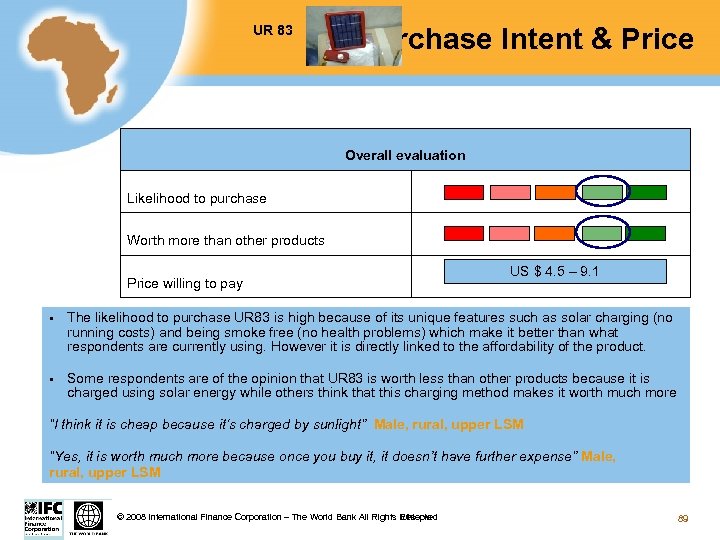 UR 83 Purchase Intent & Price Overall evaluation Likelihood to purchase Worth more than other products Price willing to pay US $ 4. 5 – 9. 1 § The likelihood to purchase UR 83 is high because of its unique features such as solar charging (no running costs) and being smoke free (no health problems) which make it better than what respondents are currently using. However it is directly linked to the affordability of the product. § Some respondents are of the opinion that UR 83 is worth less than other products because it is charged using solar energy while others think that this charging method makes it worth much more “I think it is cheap because it‘s charged by sunlight” Male, rural, upper LSM “Yes, it is worth much more because once you buy it, it doesn’t have further expense” Male, rural, upper LSM Ethiopia © 2008 International Finance Corporation – The World Bank All Rights Reserved 89
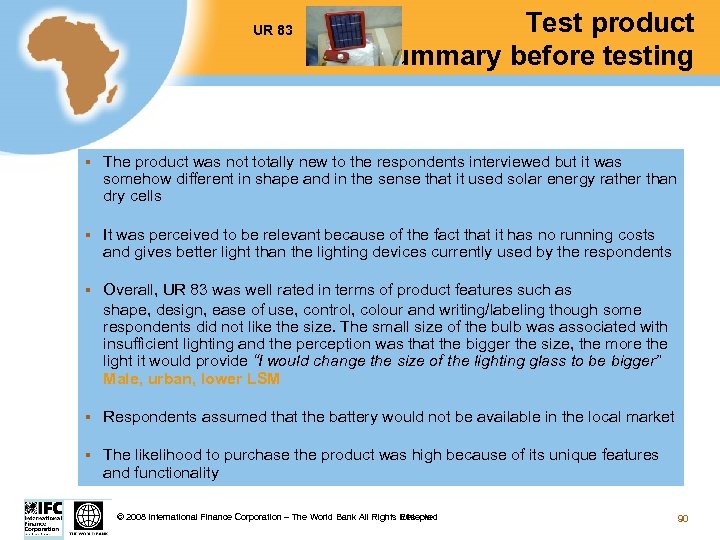 UR 83 Test product summary before testing § The product was not totally new to the respondents interviewed but it was somehow different in shape and in the sense that it used solar energy rather than dry cells § It was perceived to be relevant because of the fact that it has no running costs and gives better light than the lighting devices currently used by the respondents § Overall, UR 83 was well rated in terms of product features such as shape, design, ease of use, control, colour and writing/labeling though some respondents did not like the size. The small size of the bulb was associated with insufficient lighting and the perception was that the bigger the size, the more the light it would provide “I would change the size of the lighting glass to be bigger” Male, urban, lower LSM § Respondents assumed that the battery would not be available in the local market § The likelihood to purchase the product was high because of its unique features and functionality Ethiopia © 2008 International Finance Corporation – The World Bank All Rights Reserved 90
 TEST PRODUCT EVALUATION After Recall
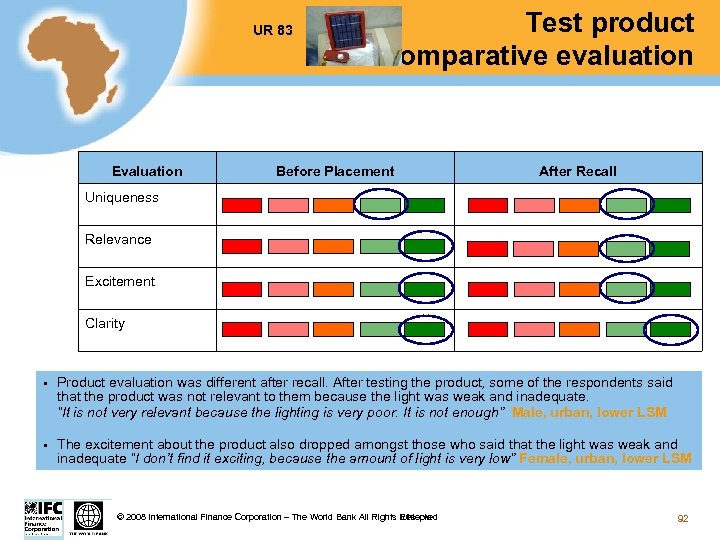 UR 83 Evaluation Test product comparative evaluation Before Placement After Recall Uniqueness Relevance Excitement Clarity § Product evaluation was different after recall. After testing the product, some of the respondents said that the product was not relevant to them because the light was weak and inadequate. “It is not very relevant because the lighting is very poor. It is not enough” Male, urban, lower LSM § The excitement about the product also dropped amongst those who said that the light was weak and inadequate “I don’t find it exciting, because the amount of light is very low” Female, urban, lower LSM Ethiopia © 2008 International Finance Corporation – The World Bank All Rights Reserved 92
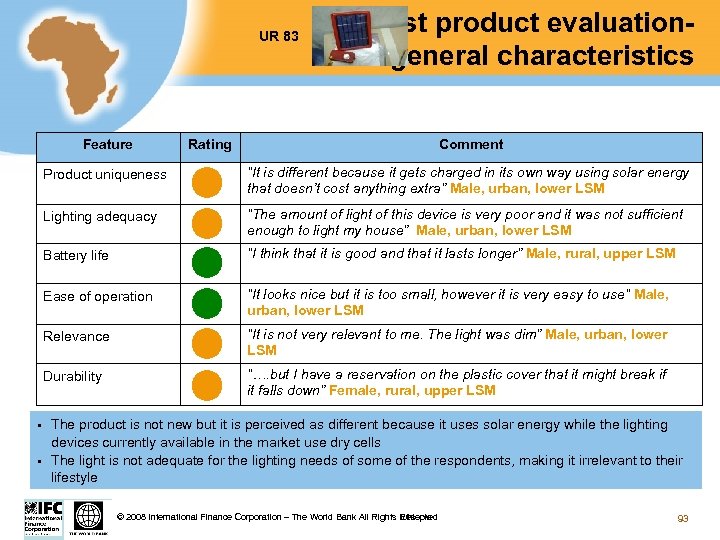 UR 83 Feature Test product evaluationgeneral characteristics Rating Comment Product uniqueness Lighting adequacy “I think that it is good and that it lasts longer” Male, rural, upper LSM Ease of operation “It looks nice but it is too small, however it is very easy to use“ Male, urban, lower LSM Relevance “It is not very relevant to me. The light was dim” Male, urban, lower LSM Durability § “The amount of light of this device is very poor and it was not sufficient enough to light my house” Male, urban, lower LSM Battery life § “It is different because it gets charged in its own way using solar energy that doesn’t cost anything extra” Male, urban, lower LSM “…. but I have a reservation on the plastic cover that it might break if it falls down” Female, rural, upper LSM The product is not new but it is perceived as different because it uses solar energy while the lighting devices currently available in the market use dry cells The light is not adequate for the lighting needs of some of the respondents, making it irrelevant to their lifestyle Ethiopia © 2008 International Finance Corporation – The World Bank All Rights Reserved 93
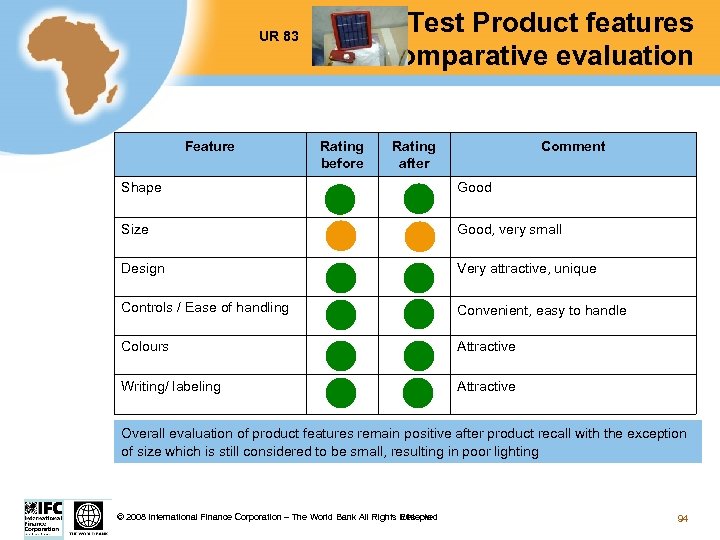 Test Product features comparative evaluation UR 83 Feature Rating before Rating after Comment Shape Good Size Good, very small Design Very attractive, unique Controls / Ease of handling Convenient, easy to handle Colours Attractive Writing/ labeling Attractive Overall evaluation of product features remain positive after product recall with the exception of size which is still considered to be small, resulting in poor lighting Ethiopia © 2008 International Finance Corporation – The World Bank All Rights Reserved 94
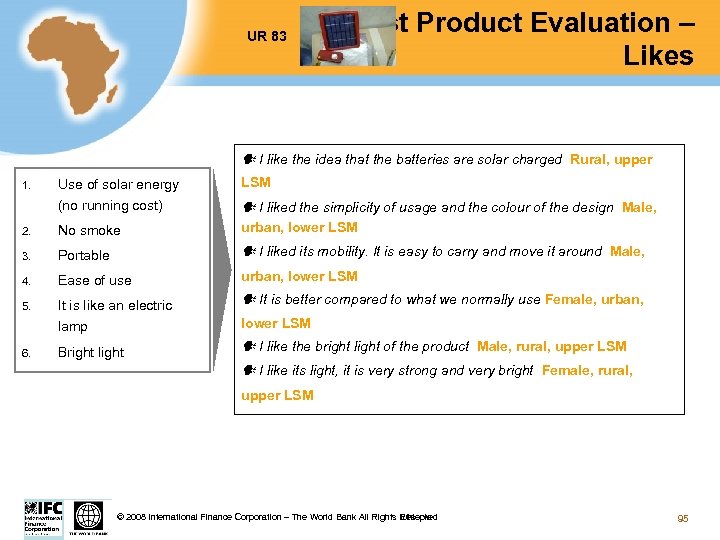 UR 83 Test Product Evaluation – Likes I like the idea that the batteries are solar charged Rural, upper Use of solar energy LSM (no running cost) I liked the simplicity of usage and the colour of the design Male, 2. No smoke urban, lower LSM 3. Portable I liked its mobility. It is easy to carry and move it around Male, 4. Ease of use urban, lower LSM 5. It is like an electric It is better compared to what we normally use Female, urban, lamp lower LSM Bright light I like the bright light of the product Male, rural, upper LSM 1. 6. I like its light, it is very strong and very bright Female, rural, upper LSM Ethiopia © 2008 International Finance Corporation – The World Bank All Rights Reserved 95
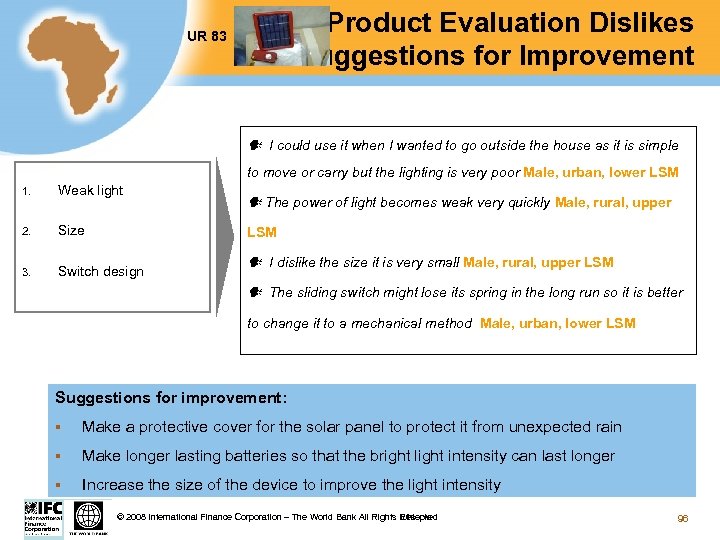 UR 83 Test Product Evaluation Dislikes & Suggestions for Improvement I could use it when I wanted to go outside the house as it is simple to move or carry but the lighting is very poor Male, urban, lower LSM 1. Weak light 2. Size 3. Switch design The power of light becomes weak very quickly Male, rural, upper LSM I dislike the size it is very small Male, rural, upper LSM The sliding switch might lose its spring in the long run so it is better to change it to a mechanical method Male, urban, lower LSM Suggestions for improvement: § Make a protective cover for the solar panel to protect it from unexpected rain § Make longer lasting batteries so that the bright light intensity can last longer § Increase the size of the device to improve the light intensity Ethiopia © 2008 International Finance Corporation – The World Bank All Rights Reserved 96
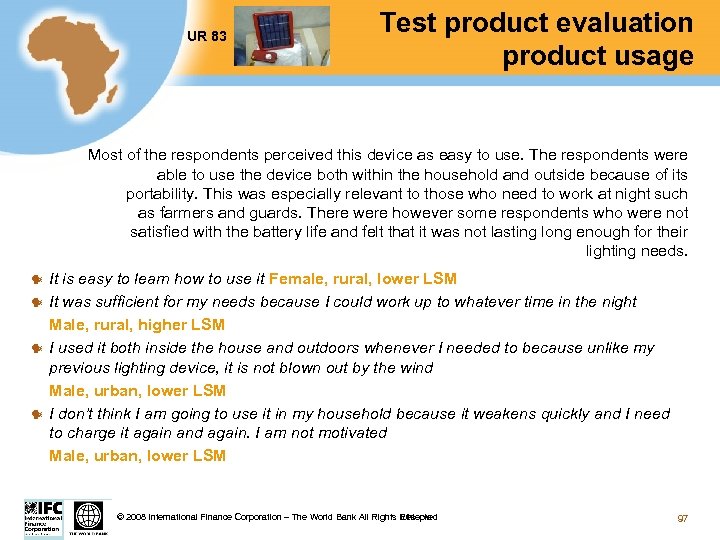 UR 83 Test product evaluation product usage Most of the respondents perceived this device as easy to use. The respondents were able to use the device both within the household and outside because of its portability. This was especially relevant to those who need to work at night such as farmers and guards. There were however some respondents who were not satisfied with the battery life and felt that it was not lasting long enough for their lighting needs. It is easy to learn how to use it Female, rural, lower LSM It was sufficient for my needs because I could work up to whatever time in the night Male, rural, higher LSM I used it both inside the house and outdoors whenever I needed to because unlike my previous lighting device, it is not blown out by the wind Male, urban, lower LSM I don’t think I am going to use it in my household because it weakens quickly and I need to charge it again and again. I am not motivated Male, urban, lower LSM Ethiopia © 2008 International Finance Corporation – The World Bank All Rights Reserved 97
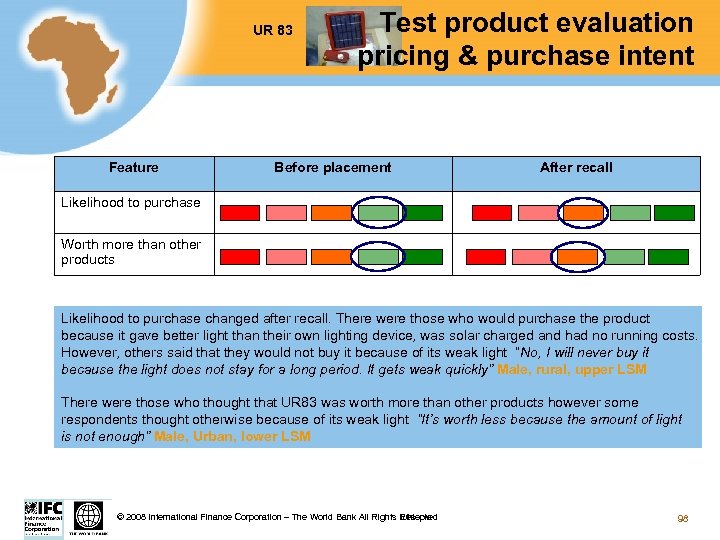 UR 83 Feature Test product evaluation pricing & purchase intent Before placement After recall Likelihood to purchase Worth more than other products Likelihood to purchase changed after recall. There were those who would purchase the product because it gave better light than their own lighting device, was solar charged and had no running costs. However, others said that they would not buy it because of its weak light “No, I will never buy it because the light does not stay for a long period. It gets weak quickly” Male, rural, upper LSM There were those who thought that UR 83 was worth more than other products however some respondents thought otherwise because of its weak light “It’s worth less because the amount of light is not enough” Male, Urban, lower LSM Ethiopia © 2008 International Finance Corporation – The World Bank All Rights Reserved 98
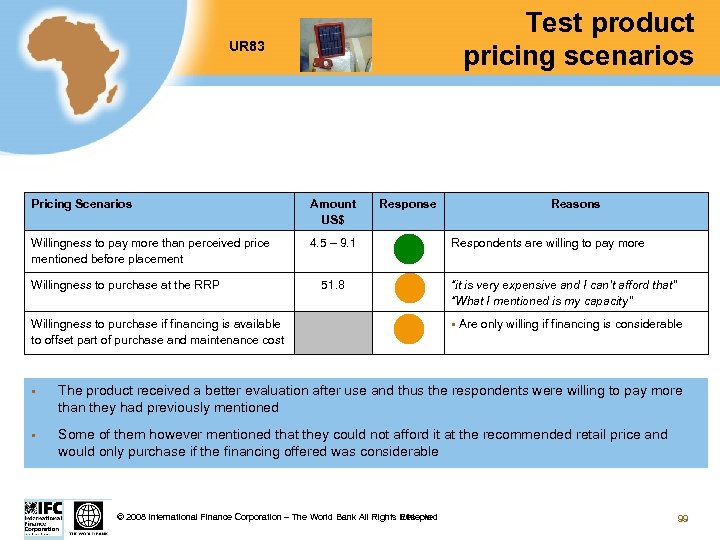 Test product pricing scenarios UR 83 Pricing Scenarios Amount US$ Willingness to pay more than perceived price mentioned before placement 4. 5 – 9. 1 Willingness to purchase at the RRP Response 51. 8 Willingness to purchase if financing is available to offset part of purchase and maintenance cost Reasons Respondents are willing to pay more “it is very expensive and I can’t afford that” “What I mentioned is my capacity” § Are only willing if financing is considerable § The product received a better evaluation after use and thus the respondents were willing to pay more than they had previously mentioned § Some of them however mentioned that they could not afford it at the recommended retail price and would only purchase if the financing offered was considerable Ethiopia © 2008 International Finance Corporation – The World Bank All Rights Reserved 99
 HI 65
HI 65
 TEST PRODUCT EVALUATION Before Placement
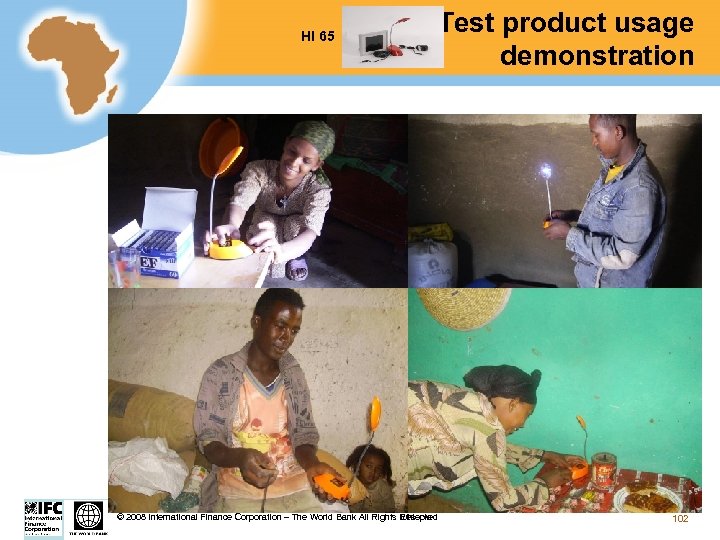 HI 65 Test product usage demonstration Ethiopia © 2008 International Finance Corporation – The World Bank All Rights Reserved 102
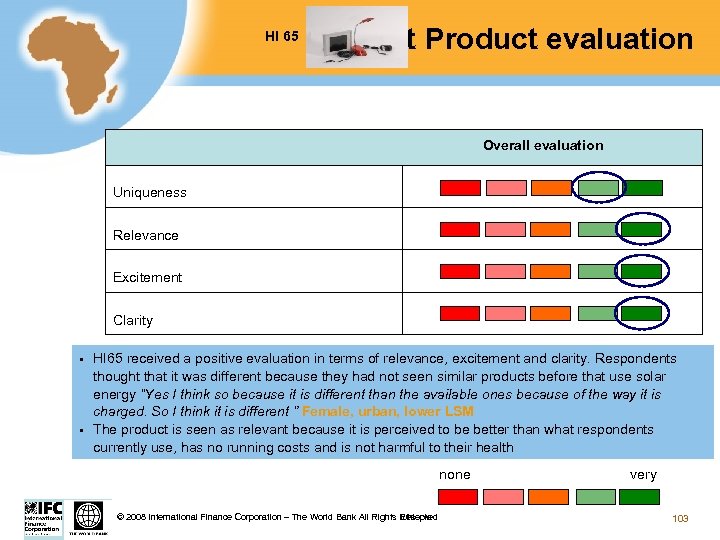 HI 65 Test Product evaluation Overall evaluation Uniqueness Relevance Excitement Clarity § § HI 65 received a positive evaluation in terms of relevance, excitement and clarity. Respondents thought that it was different because they had not seen similar products before that use solar energy “Yes I think so because it is different than the available ones because of the way it is charged. So I think it is different ” Female, urban, lower LSM The product is seen as relevant because it is perceived to be better than what respondents currently use, has no running costs and is not harmful to their health none Ethiopia © 2008 International Finance Corporation – The World Bank All Rights Reserved very 103
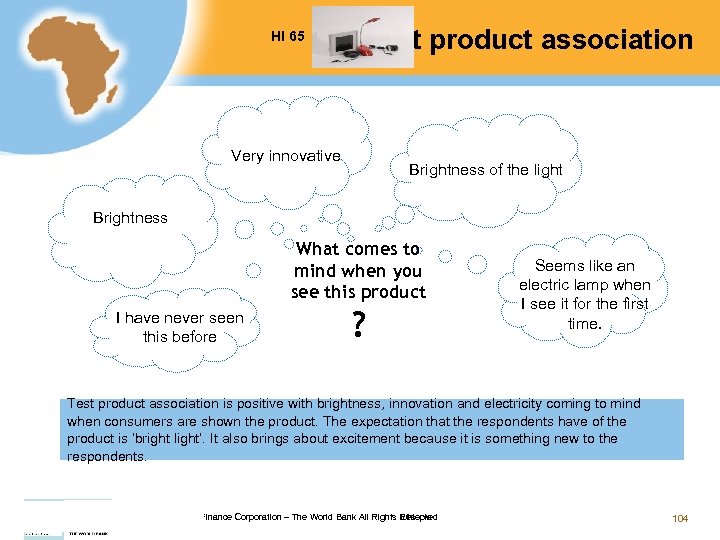 HI 65 Test product association Very innovative Brightness of the light Brightness What comes to mind when you see this product I have never seen this before ? Seems like an electric lamp when I see it for the first time. Test product association is positive with brightness, innovation and electricity coming to mind when consumers are shown the product. The expectation that the respondents have of the product is ‘bright light’. It also brings about excitement because it is something new to the respondents. Ethiopia © 2008 International Finance Corporation – The World Bank All Rights Reserved 104
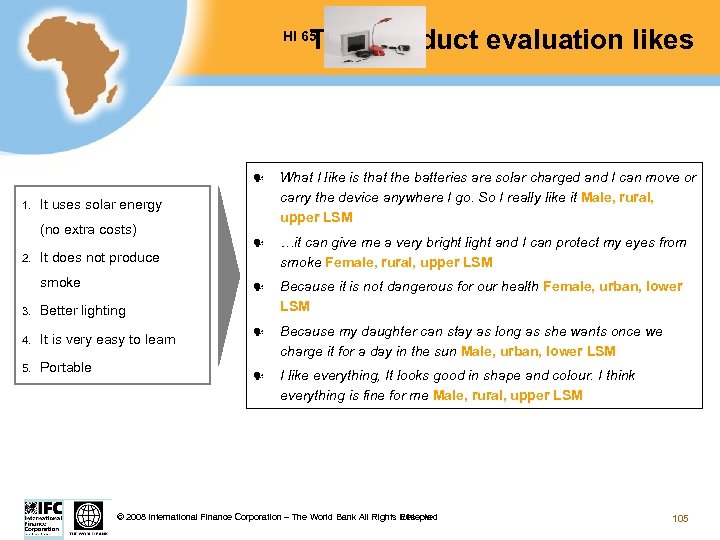 Test product evaluation likes HI 65 1. What I like is that the batteries are solar charged and I can move or carry the device anywhere I go. So I really like it Male, rural, upper LSM …it can give me a very bright light and I can protect my eyes from smoke Female, rural, upper LSM Because it is not dangerous for our health Female, urban, lower LSM Because my daughter can stay as long as she wants once we charge it for a day in the sun Male, urban, lower LSM I like everything, It looks good in shape and colour. I think everything is fine for me Male, rural, upper LSM It uses solar energy (no extra costs) 2. It does not produce smoke 3. Better lighting 4. It is very easy to learn 5. Portable Ethiopia © 2008 International Finance Corporation – The World Bank All Rights Reserved 105
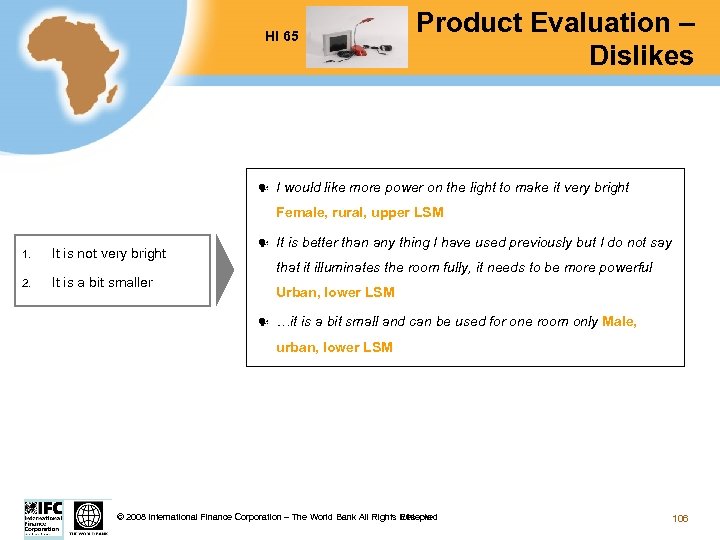 HI 65 Test Product Evaluation – Dislikes I would like more power on the light to make it very bright Female, rural, upper LSM 1. It is not very bright 2. It is a bit smaller It is better than any thing I have used previously but I do not say that it illuminates the room fully, it needs to be more powerful Urban, lower LSM …it is a bit small and can be used for one room only Male, urban, lower LSM Ethiopia © 2008 International Finance Corporation – The World Bank All Rights Reserved 106
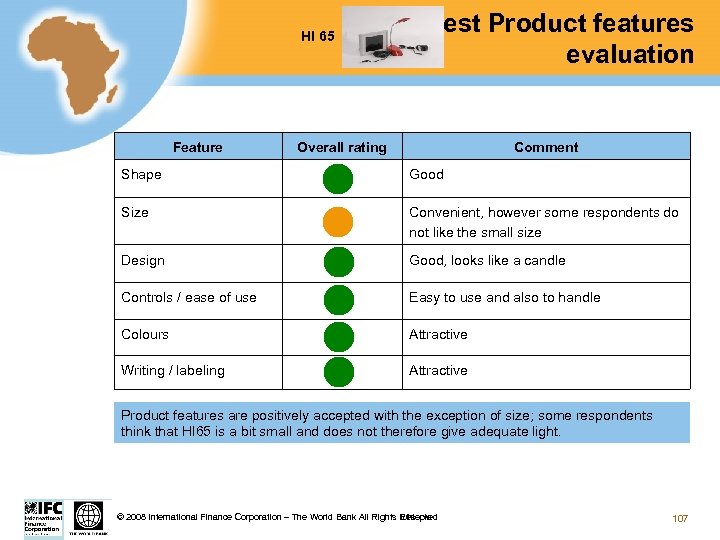 HI 65 Feature Test Product features evaluation Overall rating Comment Shape Good Size Convenient, however some respondents do not like the small size Design Good, looks like a candle Controls / ease of use Easy to use and also to handle Colours Attractive Writing / labeling Attractive Product features are positively accepted with the exception of size; some respondents think that HI 65 is a bit small and does not therefore give adequate light. Ethiopia © 2008 International Finance Corporation – The World Bank All Rights Reserved 107
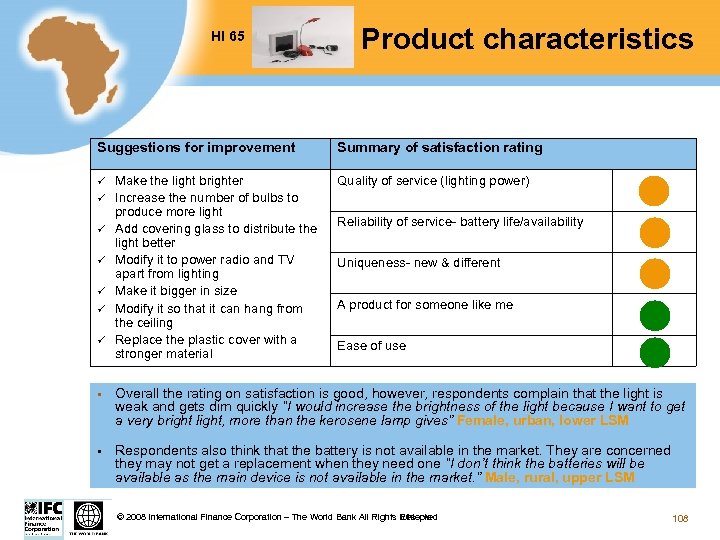 HI 65 Test Product characteristics Suggestions for improvement ü ü ü ü Make the light brighter Increase the number of bulbs to produce more light Add covering glass to distribute the light better Modify it to power radio and TV apart from lighting Make it bigger in size Modify it so that it can hang from the ceiling Replace the plastic cover with a stronger material Summary of satisfaction rating Quality of service (lighting power) Reliability of service- battery life/availability Uniqueness- new & different A product for someone like me Ease of use § Overall the rating on satisfaction is good, however, respondents complain that the light is weak and gets dim quickly “I would increase the brightness of the light because I want to get a very bright light, more than the kerosene lamp gives” Female, urban, lower LSM § Respondents also think that the battery is not available in the market. They are concerned they may not get a replacement when they need one “I don’t think the batteries will be available as the main device is not available in the market. ” Male, rural, upper LSM Ethiopia © 2008 International Finance Corporation – The World Bank All Rights Reserved 108
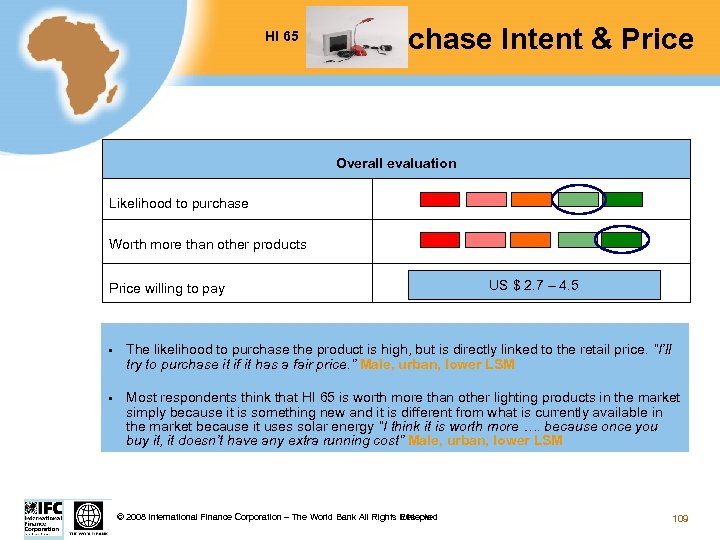 HI 65 Purchase Intent & Price Overall evaluation Likelihood to purchase Worth more than other products Price willing to pay US $ 2. 7 – 4. 5 § The likelihood to purchase the product is high, but is directly linked to the retail price. “I’ll try to purchase it if it has a fair price. ” Male, urban, lower LSM § Most respondents think that HI 65 is worth more than other lighting products in the market simply because it is something new and it is different from what is currently available in the market because it uses solar energy “I think it is worth more …. because once you buy it, it doesn’t have any extra running cost” Male, urban, lower LSM Ethiopia © 2008 International Finance Corporation – The World Bank All Rights Reserved 109
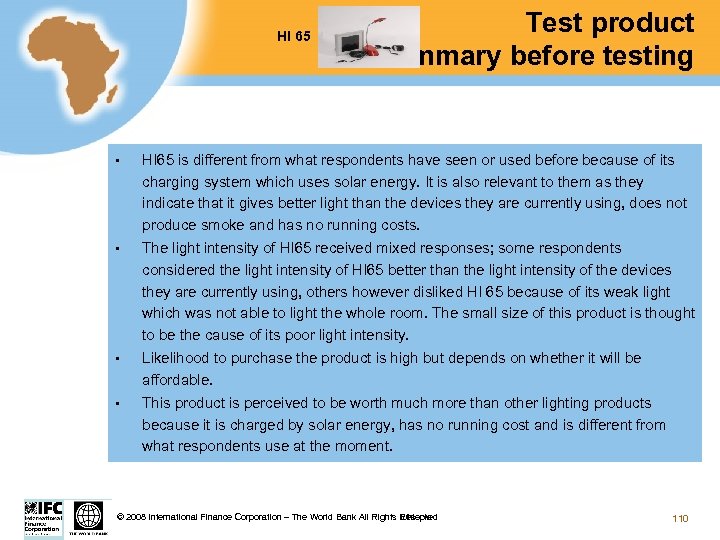 HI 65 Test product summary before testing § HI 65 is different from what respondents have seen or used before because of its charging system which uses solar energy. It is also relevant to them as they indicate that it gives better light than the devices they are currently using, does not produce smoke and has no running costs. § The light intensity of HI 65 received mixed responses; some respondents considered the light intensity of HI 65 better than the light intensity of the devices they are currently using, others however disliked HI 65 because of its weak light which was not able to light the whole room. The small size of this product is thought to be the cause of its poor light intensity. § Likelihood to purchase the product is high but depends on whether it will be affordable. § This product is perceived to be worth much more than other lighting products because it is charged by solar energy, has no running cost and is different from what respondents use at the moment. Ethiopia © 2008 International Finance Corporation – The World Bank All Rights Reserved 110
 TEST PRODUCT EVALUATION After Recall
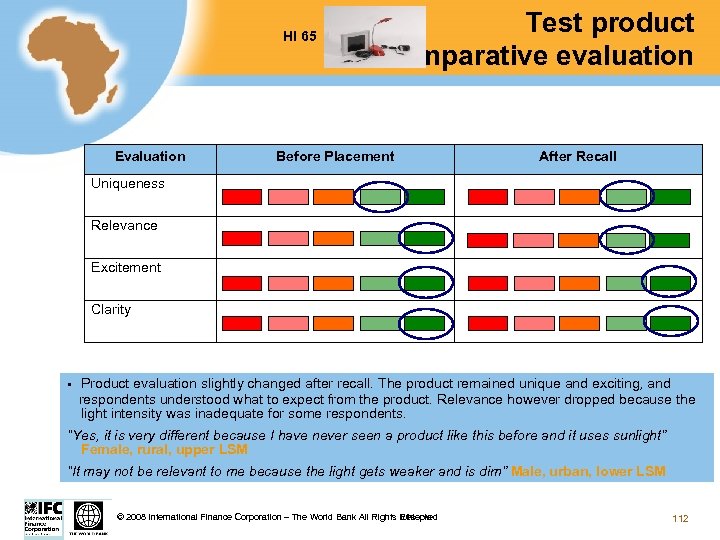 HI 65 Evaluation Test product comparative evaluation Before Placement After Recall Uniqueness Relevance Excitement Clarity § Product evaluation slightly changed after recall. The product remained unique and exciting, and respondents understood what to expect from the product. Relevance however dropped because the light intensity was inadequate for some respondents. “Yes, it is very different because I have never seen a product like this before and it uses sunlight” Female, rural, upper LSM “It may not be relevant to me because the light gets weaker and is dim” Male, urban, lower LSM Ethiopia © 2008 International Finance Corporation – The World Bank All Rights Reserved 112
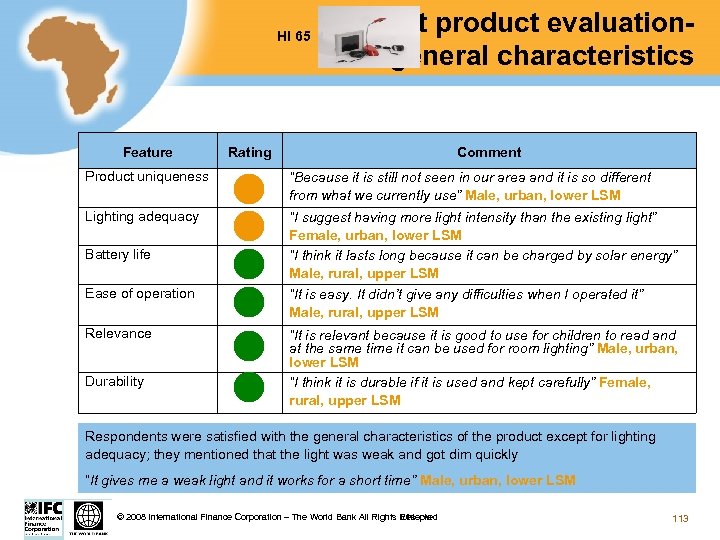 HI 65 Feature Test product evaluationgeneral characteristics Rating Comment Product uniqueness “Because it is still not seen in our area and it is so different from what we currently use” Male, urban, lower LSM Lighting adequacy “I suggest having more light intensity than the existing light” Female, urban, lower LSM “I think it lasts long because it can be charged by solar energy” Male, rural, upper LSM Battery life Ease of operation “It is easy. It didn’t give any difficulties when I operated it” Male, rural, upper LSM Relevance “It is relevant because it is good to use for children to read and at the same time it can be used for room lighting” Male, urban, lower LSM “I think it is durable if it is used and kept carefully” Female, rural, upper LSM Durability Respondents were satisfied with the general characteristics of the product except for lighting adequacy; they mentioned that the light was weak and got dim quickly “It gives me a weak light and it works for a short time” Male, urban, lower LSM Ethiopia © 2008 International Finance Corporation – The World Bank All Rights Reserved 113
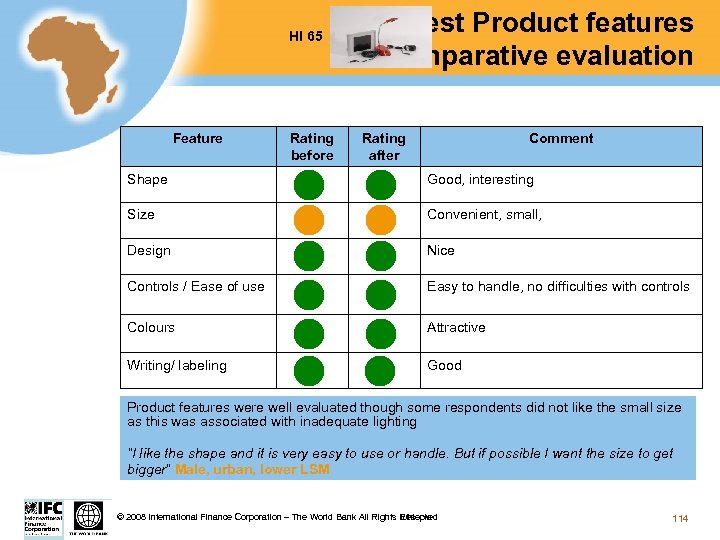 HI 65 Feature Rating before Test Product features comparative evaluation Rating after Comment Shape Good, interesting Size Convenient, small, Design Nice Controls / Ease of use Easy to handle, no difficulties with controls Colours Attractive Writing/ labeling Good Product features were well evaluated though some respondents did not like the small size as this was associated with inadequate lighting “I like the shape and it is very easy to use or handle. But if possible I want the size to get bigger” Male, urban, lower LSM Ethiopia © 2008 International Finance Corporation – The World Bank All Rights Reserved 114
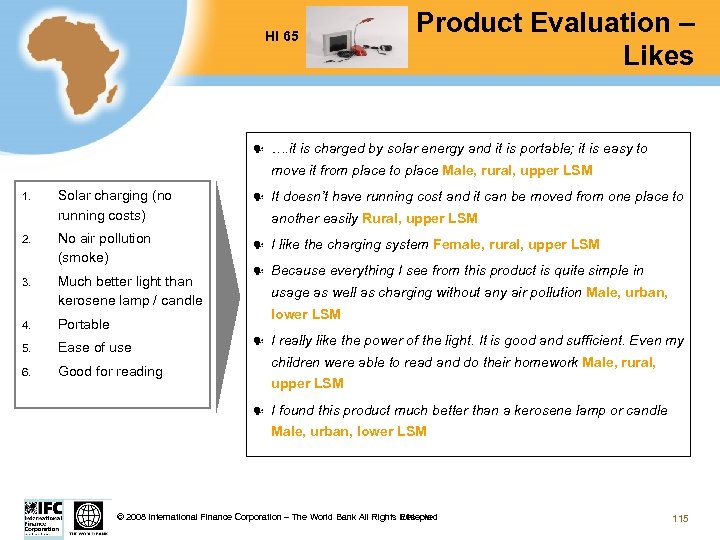 HI 65 Test Product Evaluation – Likes …. it is charged by solar energy and it is portable; it is easy to move it from place to place Male, rural, upper LSM 1. Solar charging (no running costs) 2. No air pollution (smoke) 3. Much better light than kerosene lamp / candle 4. Ease of use 6. It doesn’t have running cost and it can be moved from one place to another easily Rural, upper LSM Portable 5. Good for reading I like the charging system Female, rural, upper LSM Because everything I see from this product is quite simple in usage as well as charging without any air pollution Male, urban, lower LSM I really like the power of the light. It is good and sufficient. Even my children were able to read and do their homework Male, rural, upper LSM I found this product much better than a kerosene lamp or candle Male, urban, lower LSM Ethiopia © 2008 International Finance Corporation – The World Bank All Rights Reserved 115
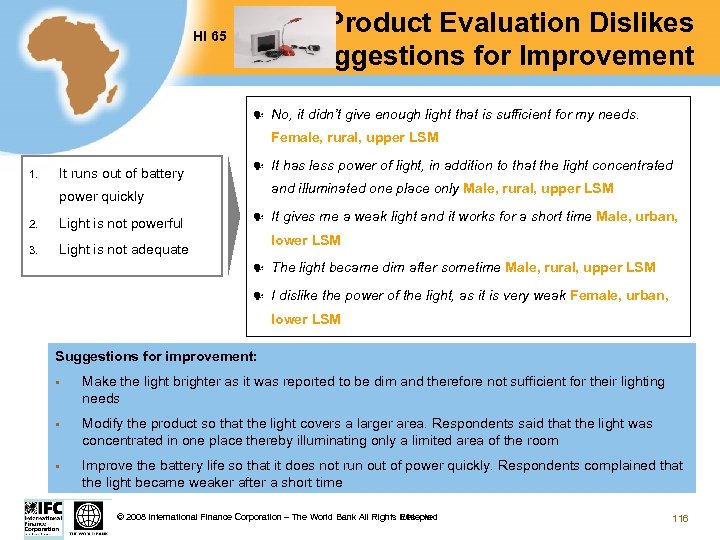 Test Product Evaluation Dislikes & Suggestions for Improvement HI 65 No, it didn’t give enough light that is sufficient for my needs. Female, rural, upper LSM 1. It runs out of battery and illuminated one place only Male, rural, upper LSM power quickly 2. Light is not powerful 3. It has less power of light, in addition to that the light concentrated Light is not adequate It gives me a weak light and it works for a short time Male, urban, lower LSM The light became dim after sometime Male, rural, upper LSM I dislike the power of the light, as it is very weak Female, urban, lower LSM Suggestions for improvement: § Make the light brighter as it was reported to be dim and therefore not sufficient for their lighting needs § Modify the product so that the light covers a larger area. Respondents said that the light was concentrated in one place thereby illuminating only a limited area of the room § Improve the battery life so that it does not run out of power quickly. Respondents complained that the light became weaker after a short time Ethiopia © 2008 International Finance Corporation – The World Bank All Rights Reserved 116
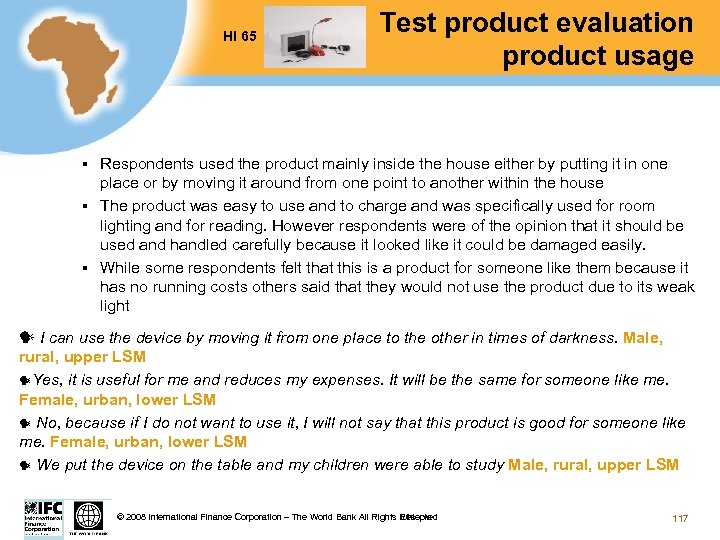 HI 65 § § § Test product evaluation product usage Respondents used the product mainly inside the house either by putting it in one place or by moving it around from one point to another within the house The product was easy to use and to charge and was specifically used for room lighting and for reading. However respondents were of the opinion that it should be used and handled carefully because it looked like it could be damaged easily. While some respondents felt that this is a product for someone like them because it has no running costs others said that they would not use the product due to its weak light I can use the device by moving it from one place to the other in times of darkness. Male, rural, upper LSM Yes, it is useful for me and reduces my expenses. It will be the same for someone like me. Female, urban, lower LSM No, because if I do not want to use it, I will not say that this product is good for someone like me. Female, urban, lower LSM We put the device on the table and my children were able to study Male, rural, upper LSM Ethiopia © 2008 International Finance Corporation – The World Bank All Rights Reserved 117
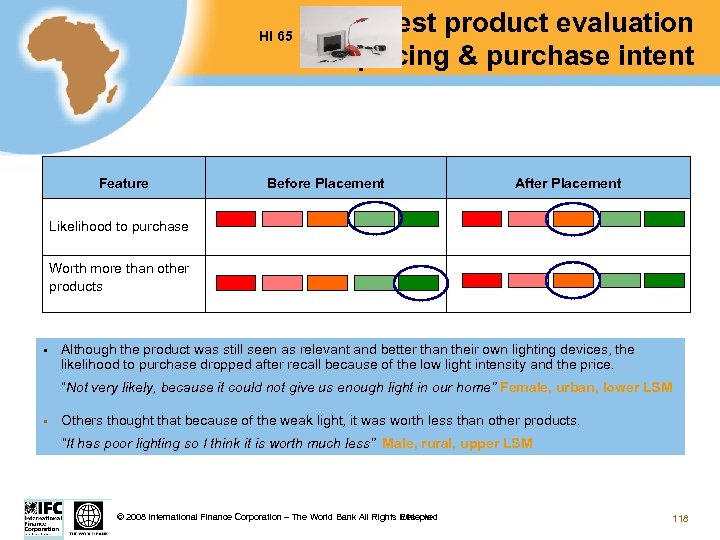 HI 65 Feature Test product evaluation pricing & purchase intent Before Placement After Placement Likelihood to purchase Worth more than other products § Although the product was still seen as relevant and better than their own lighting devices, the likelihood to purchase dropped after recall because of the low light intensity and the price. “Not very likely, because it could not give us enough light in our home” Female, urban, lower LSM § Others thought that because of the weak light, it was worth less than other products. “It has poor lighting so I think it is worth much less” Male, rural, upper LSM Ethiopia © 2008 International Finance Corporation – The World Bank All Rights Reserved 118
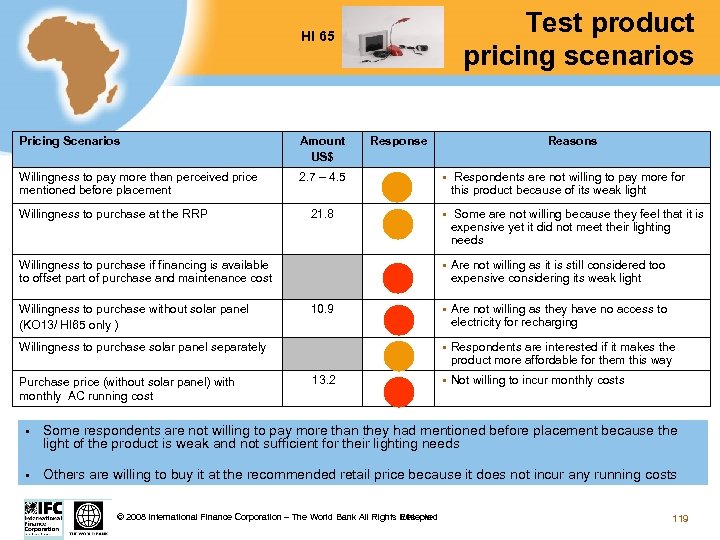 Test product pricing scenarios HI 65 Pricing Scenarios Amount US$ Willingness to pay more than perceived price mentioned before placement 2. 7 – 4. 5 § Respondents are not willing to pay more for this product because of its weak light 21. 8 § Some are not willing because they feel that it is expensive yet it did not meet their lighting needs § Are not willing as it is still considered too expensive considering its weak light § Are not willing as they have no access to electricity for recharging § Respondents are interested if it makes the product more affordable for them this way § Not willing to incur monthly costs Willingness to purchase at the RRP Response Willingness to purchase if financing is available to offset part of purchase and maintenance cost Willingness to purchase without solar panel (KO 13/ HI 65 only ) 10. 9 Willingness to purchase solar panel separately Purchase price (without solar panel) with monthly AC running cost 13. 2 Reasons § Some respondents are not willing to pay more than they had mentioned before placement because the light of the product is weak and not sufficient for their lighting needs § Others are willing to buy it at the recommended retail price because it does not incur any running costs Ethiopia © 2008 International Finance Corporation – The World Bank All Rights Reserved 119
 RY 04
RY 04
 TEST PRODUCT EVALUATION Before Placement
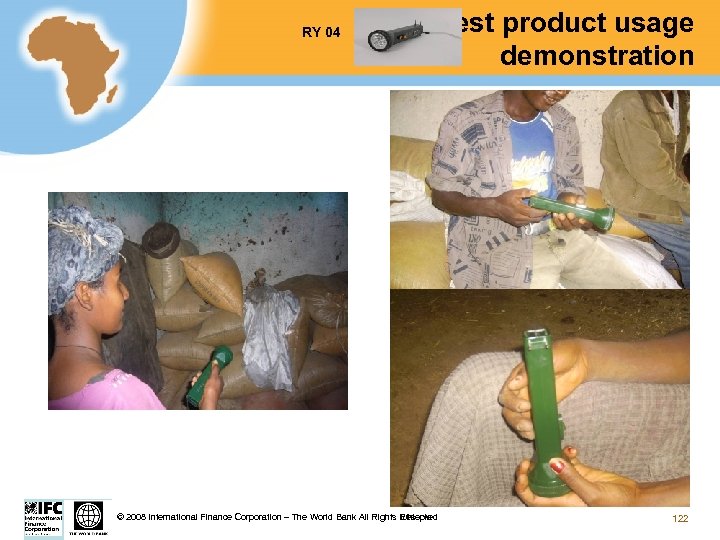 RY 04 Test product usage demonstration Ethiopia © 2008 International Finance Corporation – The World Bank All Rights Reserved 122
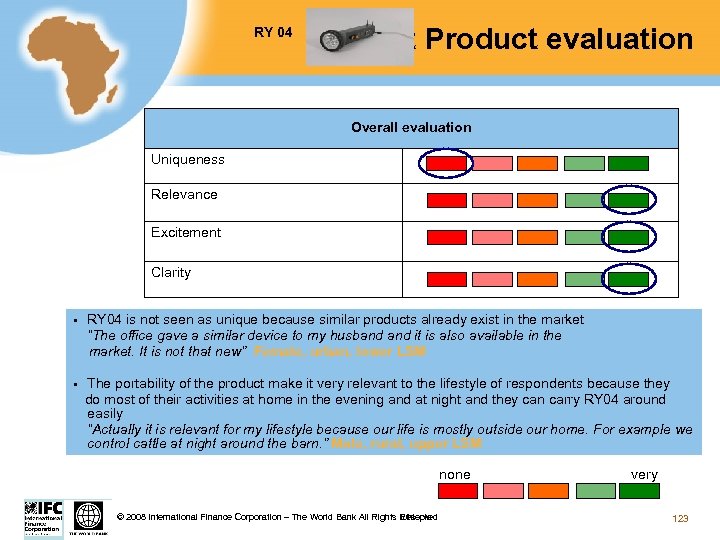 RY 04 Test Product evaluation Overall evaluation Uniqueness Relevance Excitement Clarity § RY 04 is not seen as unique because similar products already exist in the market “The office gave a similar device to my husband it is also available in the market. It is not that new” Female, urban, lower LSM § The portability of the product make it very relevant to the lifestyle of respondents because they do most of their activities at home in the evening and at night and they can carry RY 04 around easily “Actually it is relevant for my lifestyle because our life is mostly outside our home. For example we control cattle at night around the barn. ” Male, rural, upper LSM none Ethiopia © 2008 International Finance Corporation – The World Bank All Rights Reserved very 123
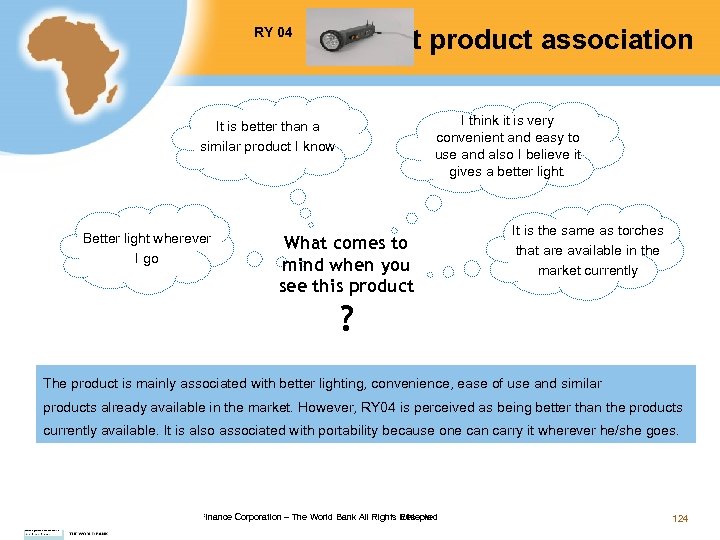 Test product association RY 04 I think it is very convenient and easy to use and also I believe it gives a better light. It is better than a similar product I know Better light wherever I go What comes to mind when you see this product It is the same as torches that are available in the market currently ? The product is mainly associated with better lighting, convenience, ease of use and similar products already available in the market. However, RY 04 is perceived as being better than the products currently available. It is also associated with portability because one can carry it wherever he/she goes. Ethiopia © 2008 International Finance Corporation – The World Bank All Rights Reserved 124
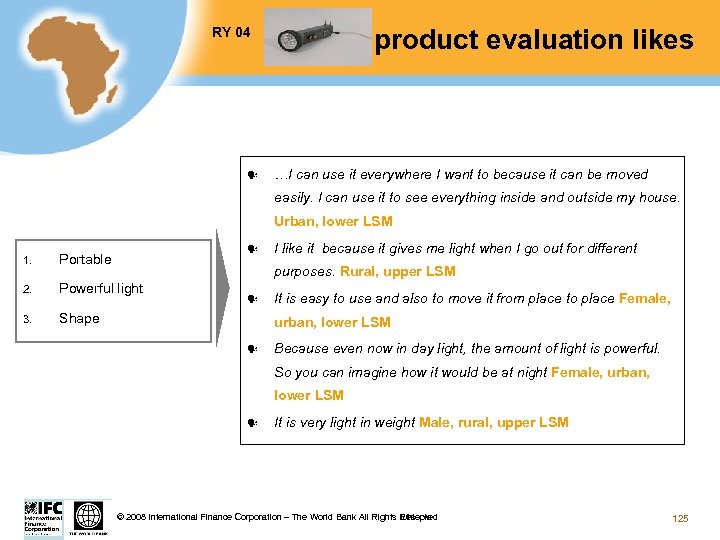 RY 04 Test product evaluation likes …I can use it everywhere I want to because it can be moved easily. I can use it to see everything inside and outside my house. Urban, lower LSM 1. Portable 2. Powerful light 3. Shape I like it because it gives me light when I go out for different purposes. Rural, upper LSM It is easy to use and also to move it from place to place Female, urban, lower LSM Because even now in day light, the amount of light is powerful. So you can imagine how it would be at night Female, urban, lower LSM It is very light in weight Male, rural, upper LSM Ethiopia © 2008 International Finance Corporation – The World Bank All Rights Reserved 125
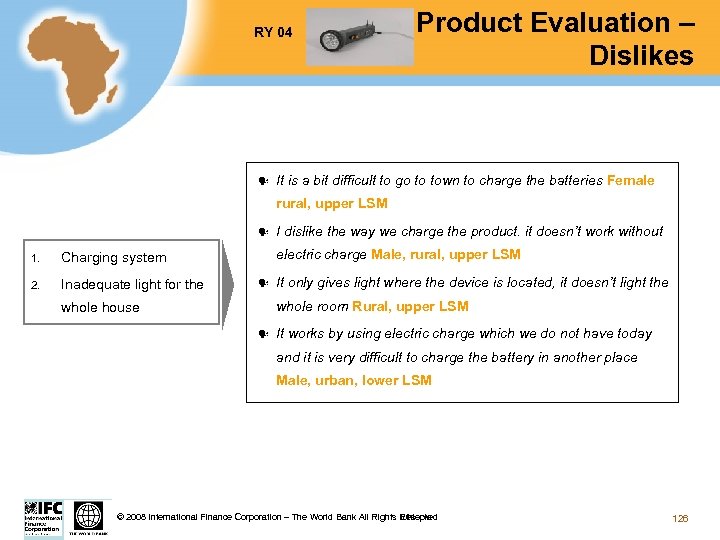 RY 04 Test Product Evaluation – Dislikes It is a bit difficult to go to town to charge the batteries Female rural, upper LSM 1. Inadequate light for the electric charge Male, rural, upper LSM Charging system 2. I dislike the way we charge the product. it doesn’t work without It only gives light where the device is located, it doesn’t light the whole room Rural, upper LSM whole house It works by using electric charge which we do not have today and it is very difficult to charge the battery in another place Male, urban, lower LSM Ethiopia © 2008 International Finance Corporation – The World Bank All Rights Reserved 126
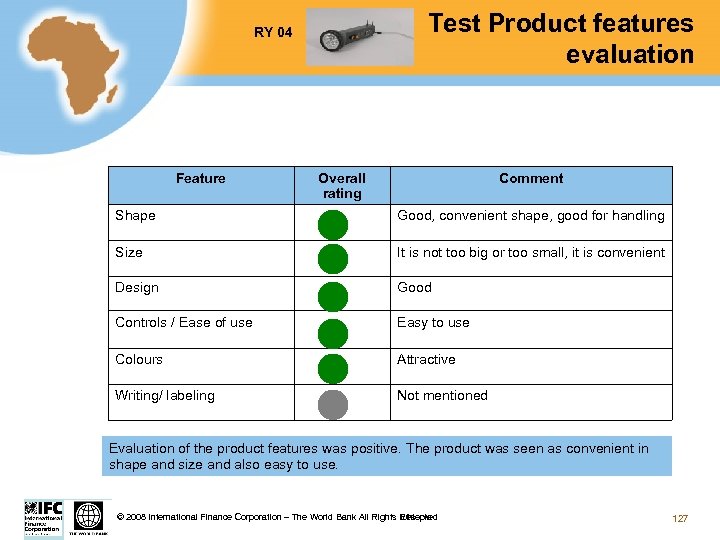 Test Product features evaluation RY 04 Feature Overall rating Comment Shape Good, convenient shape, good for handling Size It is not too big or too small, it is convenient Design Good Controls / Ease of use Easy to use Colours Attractive Writing/ labeling Not mentioned Evaluation of the product features was positive. The product was seen as convenient in shape and size and also easy to use. Ethiopia © 2008 International Finance Corporation – The World Bank All Rights Reserved 127
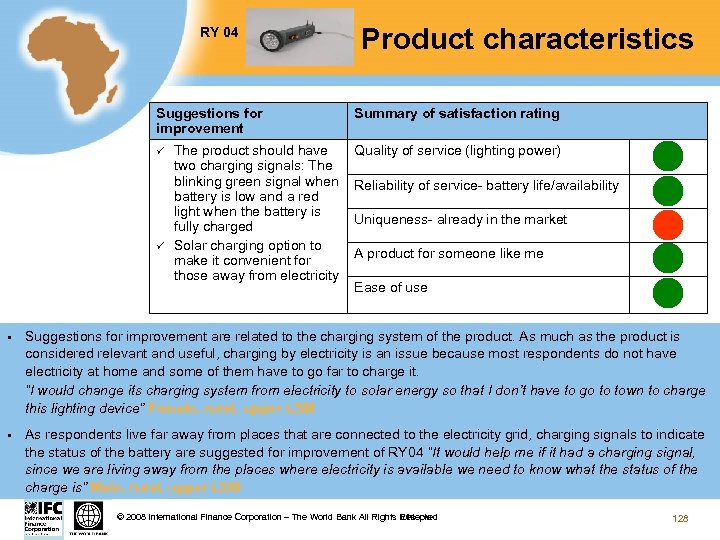 RY 04 Test Product characteristics Suggestions for improvement ü ü The product should have two charging signals: The blinking green signal when battery is low and a red light when the battery is fully charged Solar charging option to make it convenient for those away from electricity Summary of satisfaction rating Quality of service (lighting power) Reliability of service- battery life/availability Uniqueness- already in the market A product for someone like me Ease of use § Suggestions for improvement are related to the charging system of the product. As much as the product is considered relevant and useful, charging by electricity is an issue because most respondents do not have electricity at home and some of them have to go far to charge it. “I would change its charging system from electricity to solar energy so that I don’t have to go to town to charge this lighting device” Female, rural, upper LSM § As respondents live far away from places that are connected to the electricity grid, charging signals to indicate the status of the battery are suggested for improvement of RY 04 “It would help me if it had a charging signal, since we are living away from the places where electricity is available we need to know what the status of the charge is” Male, rural, upper LSM Ethiopia © 2008 International Finance Corporation – The World Bank All Rights Reserved 128
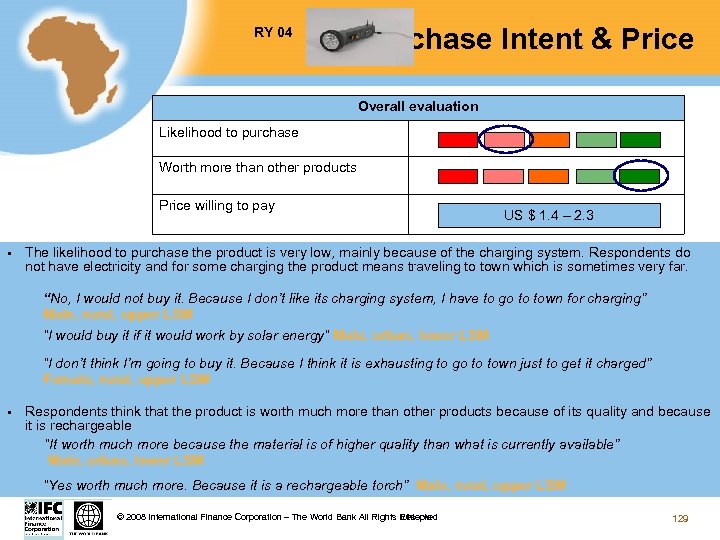 RY 04 Purchase Intent & Price Overall evaluation Likelihood to purchase Worth more than other products Price willing to pay § US $ 1. 4 – 2. 3 The likelihood to purchase the product is very low, mainly because of the charging system. Respondents do not have electricity and for some charging the product means traveling to town which is sometimes very far. “No, I would not buy it. Because I don’t like its charging system, I have to go to town for charging” Male, rural, upper LSM “I would buy it if it would work by solar energy“ Male, urban, lower LSM “I don’t think I’m going to buy it. Because I think it is exhausting to go to town just to get it charged” Female, rural, upper LSM § Respondents think that the product is worth much more than other products because of its quality and because it is rechargeable “It worth much more because the material is of higher quality than what is currently available” Male, urban, lower LSM “Yes worth much more. Because it is a rechargeable torch” Male, rural, upper LSM Ethiopia © 2008 International Finance Corporation – The World Bank All Rights Reserved 129
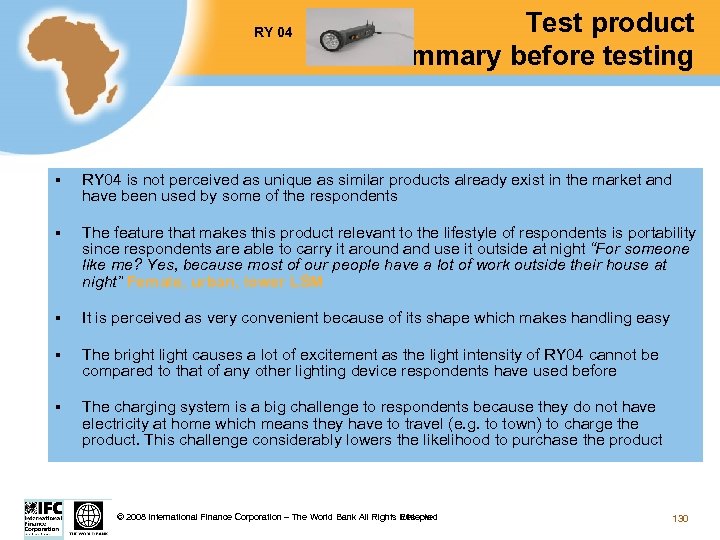 RY 04 Test product summary before testing § RY 04 is not perceived as unique as similar products already exist in the market and have been used by some of the respondents § The feature that makes this product relevant to the lifestyle of respondents is portability since respondents are able to carry it around and use it outside at night “For someone like me? Yes, because most of our people have a lot of work outside their house at night” Female, urban, lower LSM § It is perceived as very convenient because of its shape which makes handling easy § The bright light causes a lot of excitement as the light intensity of RY 04 cannot be compared to that of any other lighting device respondents have used before § The charging system is a big challenge to respondents because they do not have electricity at home which means they have to travel (e. g. to town) to charge the product. This challenge considerably lowers the likelihood to purchase the product Ethiopia © 2008 International Finance Corporation – The World Bank All Rights Reserved 130
 TEST PRODUCT EVALUATION After Recall
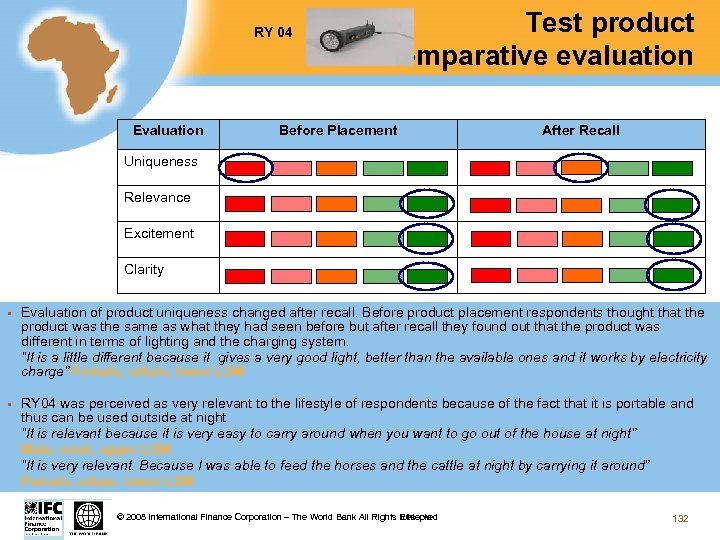 RY 04 Evaluation Test product comparative evaluation Before Placement After Recall Uniqueness Relevance Excitement Clarity § Evaluation of product uniqueness changed after recall. Before product placement respondents thought that the product was the same as what they had seen before but after recall they found out that the product was different in terms of lighting and the charging system. “It is a little different because it gives a very good light, better than the available ones and it works by electricity charge” Female, urban, lower LSM § RY 04 was perceived as very relevant to the lifestyle of respondents because of the fact that it is portable and thus can be used outside at night “It is relevant because it is very easy to carry around when you want to go out of the house at night” Male, rural, upper LSM “It is very relevant. Because I was able to feed the horses and the cattle at night by carrying it around” Female, urban, lower LSM Ethiopia © 2008 International Finance Corporation – The World Bank All Rights Reserved 132
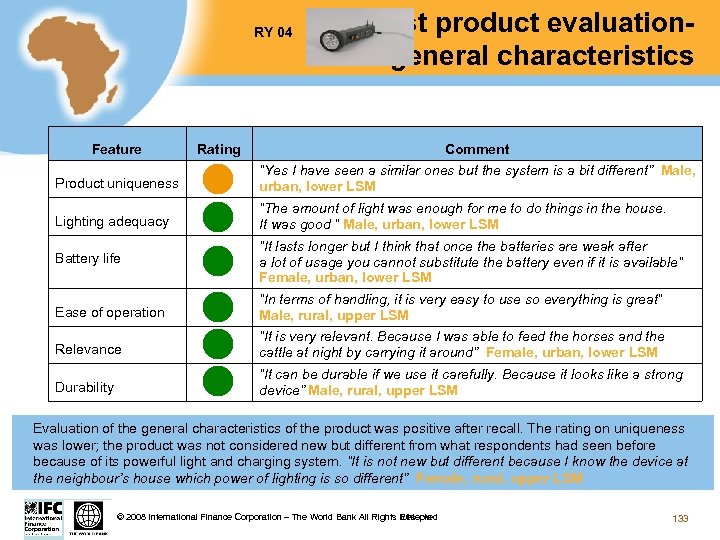 RY 04 Feature Test product evaluationgeneral characteristics Rating Comment Product uniqueness “Yes I have seen a similar ones but the system is a bit different” Male, urban, lower LSM Lighting adequacy “The amount of light was enough for me to do things in the house. It was good “ Male, urban, lower LSM Battery life “It lasts longer but I think that once the batteries are weak after a lot of usage you cannot substitute the battery even if it is available” Female, urban, lower LSM Ease of operation “In terms of handling, it is very easy to use so everything is great” Male, rural, upper LSM Relevance “It is very relevant. Because I was able to feed the horses and the cattle at night by carrying it around” Female, urban, lower LSM Durability “It can be durable if we use it carefully. Because it looks like a strong device” Male, rural, upper LSM Evaluation of the general characteristics of the product was positive after recall. The rating on uniqueness was lower; the product was not considered new but different from what respondents had seen before because of its powerful light and charging system. “It is not new but different because I know the device at the neighbour’s house which power of lighting is so different” Female, rural, upper LSM Ethiopia © 2008 International Finance Corporation – The World Bank All Rights Reserved 133
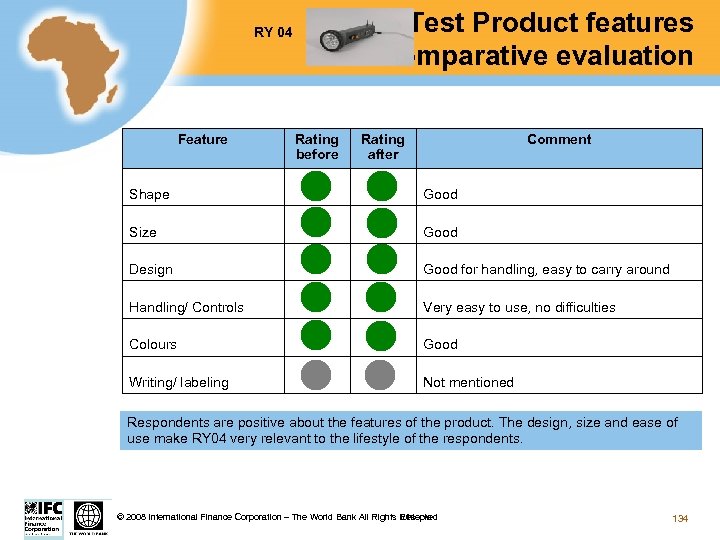 Test Product features comparative evaluation RY 04 Feature Rating before Rating after Comment Shape Good Size Good Design Good for handling, easy to carry around Handling/ Controls Very easy to use, no difficulties Colours Good Writing/ labeling Not mentioned Respondents are positive about the features of the product. The design, size and ease of use make RY 04 very relevant to the lifestyle of the respondents. Ethiopia © 2008 International Finance Corporation – The World Bank All Rights Reserved 134
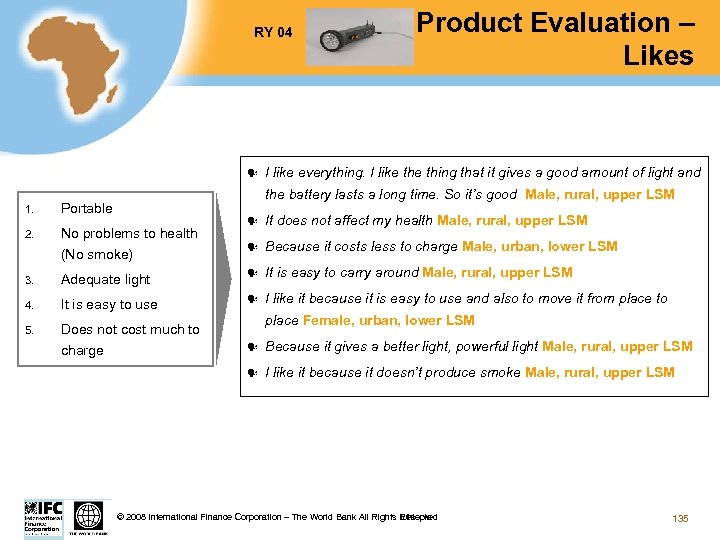 RY 04 Test Product Evaluation – Likes I like everything. I like thing that it gives a good amount of light and the battery lasts a long time. So it’s good Male, rural, upper LSM 1. Portable 2. No problems to health It does not affect my health Male, rural, upper LSM (No smoke) Because it costs less to charge Male, urban, lower LSM 3. Adequate light It is easy to carry around Male, rural, upper LSM 4. It is easy to use I like it because it is easy to use and also to move it from place to 5. Does not cost much to charge place Female, urban, lower LSM Because it gives a better light, powerful light Male, rural, upper LSM I like it because it doesn’t produce smoke Male, rural, upper LSM Ethiopia © 2008 International Finance Corporation – The World Bank All Rights Reserved 135
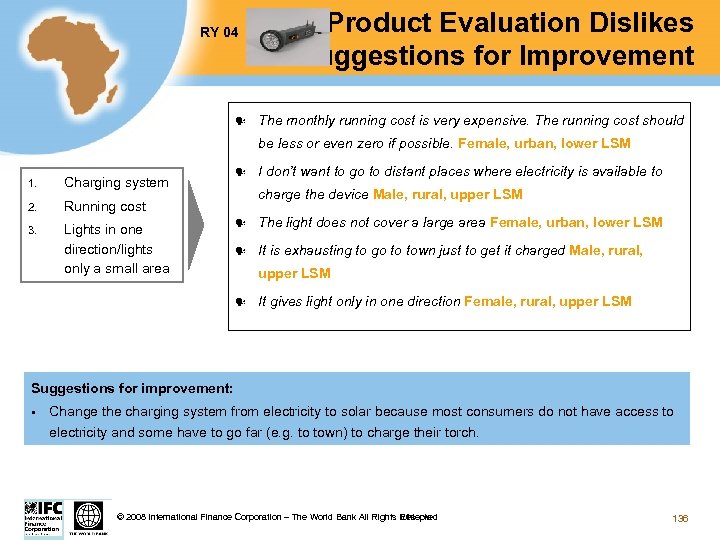 RY 04 Test Product Evaluation Dislikes & Suggestions for Improvement The monthly running cost is very expensive. The running cost should be less or even zero if possible. Female, urban, lower LSM 1. Charging system 2. Running cost 3. Lights in one direction/lights only a small area I don’t want to go to distant places where electricity is available to charge the device Male, rural, upper LSM The light does not cover a large area Female, urban, lower LSM It is exhausting to go to town just to get it charged Male, rural, upper LSM It gives light only in one direction Female, rural, upper LSM Suggestions for improvement: § Change the charging system from electricity to solar because most consumers do not have access to electricity and some have to go far (e. g. to town) to charge their torch. Ethiopia © 2008 International Finance Corporation – The World Bank All Rights Reserved 136
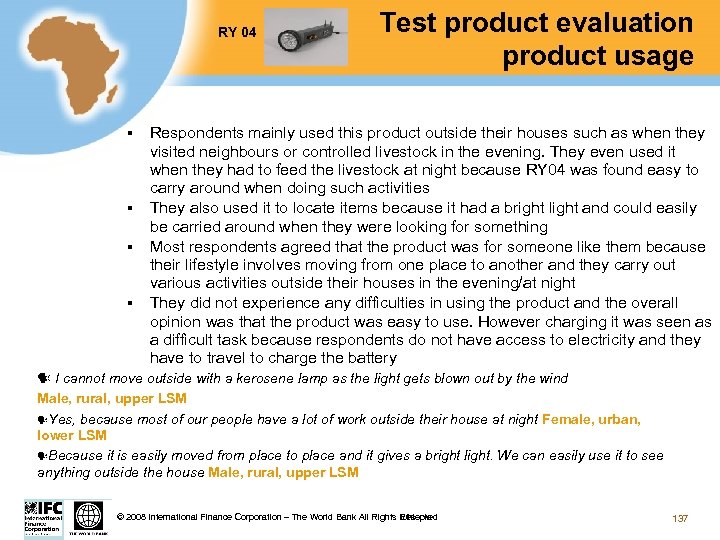 RY 04 § § Test product evaluation product usage Respondents mainly used this product outside their houses such as when they visited neighbours or controlled livestock in the evening. They even used it when they had to feed the livestock at night because RY 04 was found easy to carry around when doing such activities They also used it to locate items because it had a bright light and could easily be carried around when they were looking for something Most respondents agreed that the product was for someone like them because their lifestyle involves moving from one place to another and they carry out various activities outside their houses in the evening/at night They did not experience any difficulties in using the product and the overall opinion was that the product was easy to use. However charging it was seen as a difficult task because respondents do not have access to electricity and they have to travel to charge the battery I cannot move outside with a kerosene lamp as the light gets blown out by the wind Male, rural, upper LSM Yes, because most of our people have a lot of work outside their house at night Female, urban, lower LSM Because it is easily moved from place to place and it gives a bright light. We can easily use it to see anything outside the house Male, rural, upper LSM Ethiopia © 2008 International Finance Corporation – The World Bank All Rights Reserved 137
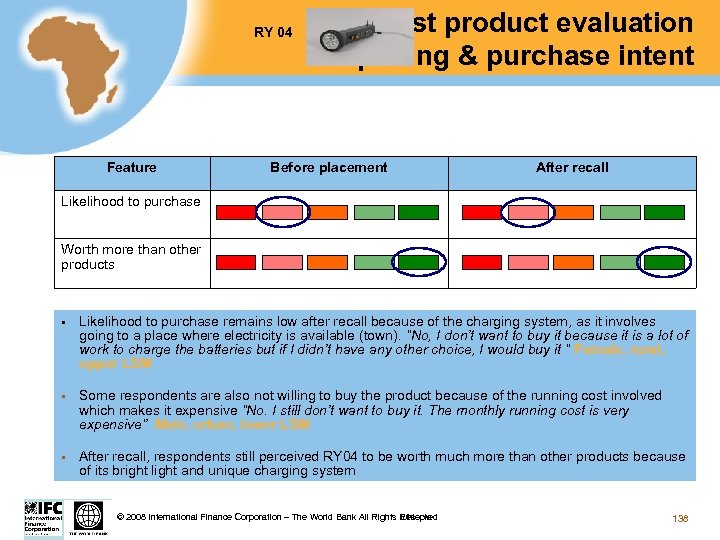 RY 04 Feature Test product evaluation pricing & purchase intent Before placement After recall Likelihood to purchase Worth more than other products § Likelihood to purchase remains low after recall because of the charging system, as it involves going to a place where electricity is available (town). “No, I don’t want to buy it because it is a lot of work to charge the batteries but if I didn’t have any other choice, I would buy it “ Female, rural, upper LSM § Some respondents are also not willing to buy the product because of the running cost involved which makes it expensive “No. I still don’t want to buy it. The monthly running cost is very expensive” Male, urban, lower LSM § After recall, respondents still perceived RY 04 to be worth much more than other products because of its bright light and unique charging system Ethiopia © 2008 International Finance Corporation – The World Bank All Rights Reserved 138
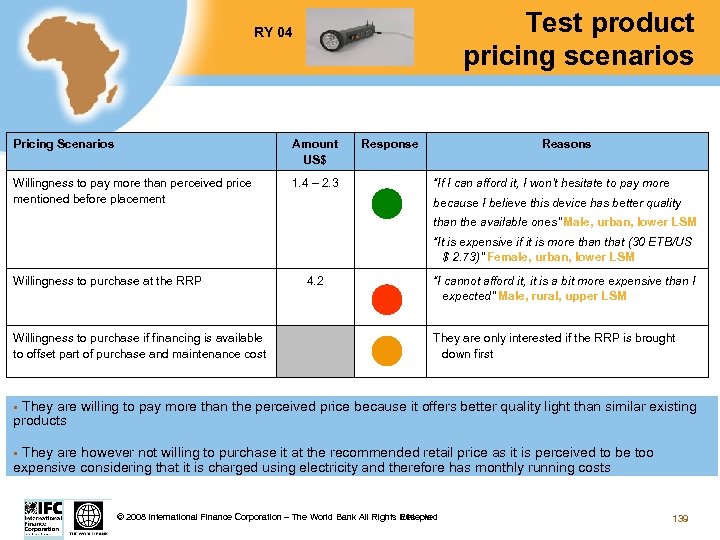 Test product pricing scenarios RY 04 Pricing Scenarios Amount US$ Willingness to pay more than perceived price mentioned before placement 1. 4 – 2. 3 Response Reasons “If I can afford it, I won’t hesitate to pay more because I believe this device has better quality than the available ones” Male, urban, lower LSM “It is expensive if it is more than that (30 ETB/US $ 2. 73)” Female, urban, lower LSM Willingness to purchase at the RRP Willingness to purchase if financing is available to offset part of purchase and maintenance cost 4. 2 “I cannot afford it, it is a bit more expensive than I expected” Male, rural, upper LSM They are only interested if the RRP is brought down first They are willing to pay more than the perceived price because it offers better quality light than similar existing products § They are however not willing to purchase it at the recommended retail price as it is perceived to be too expensive considering that it is charged using electricity and therefore has monthly running costs § Ethiopia © 2008 International Finance Corporation – The World Bank All Rights Reserved 139
 SUMMARY OF PRODUCT EVALUATION
 Insights § Charging products using electricity is a challenge. Apart from incurring running costs on charging the device, accessing electricity in Ethiopia is generally difficult as it often involves traveling to reach a place that is connected to the electricity grid. § Using solar energy would be a challenge in Ethiopia during the rainy season (June-September) because of lack of sunlight. § In Ethiopia many people use home made lighting devices. These devices are made from modifications on bulbs which are then connected to dry cells and fixed on walls and roofs just like electric bulbs. § Portability of lighting products is key for both inside and outside lighting. The Ethiopian consumers have a lot of activities outside their houses in the evening/at night such as feeding horses, controlling livestock and visiting neighbours and therefore they prefer a lighting product that they can carry around easily. Inside the house, portability is important as well because consumers need to move the product from one room to another or from place to place if it cannot light the whole room. § Smoke free lighting is important to the Ethiopian consumer because smoke is seen as a cause of health problems and irritation to the eyes. § Light intensity of the test products was compared to the light intensity of lighting devices currently used. Certain lighting products were rated highly by respondents who currently use poor lighting devices such as candles and tin lamps while at the same time they were rated poorly by those who use torch bulbs connected to dry cells. § Cost is significant to the Ethiopian consumer; the likelihood to purchase the test products depends on their prices and affordability. Solar charged products were preferred because they do not have running costs. Ethiopia © 2008 International Finance Corporation – The World Bank All Rights Reserved 141
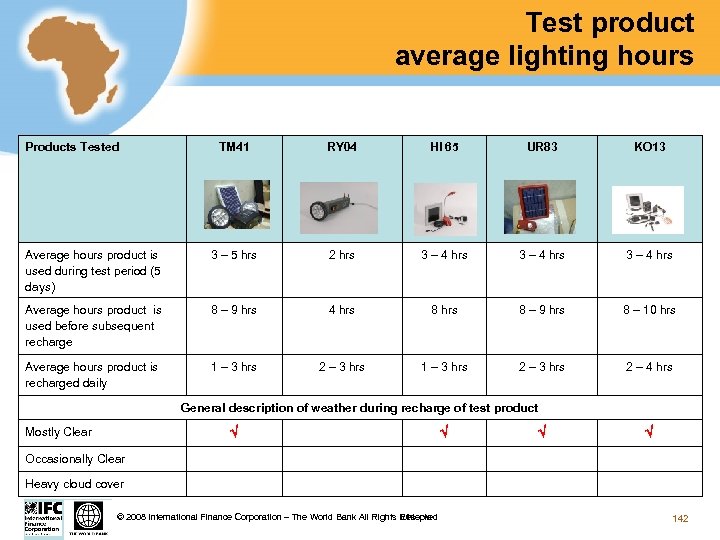 Test product average lighting hours Products Tested TM 41 RY 04 HI 65 UR 83 KO 13 Average hours product is used during test period (5 days) 3 – 5 hrs 2 hrs 3 – 4 hrs Average hours product is used before subsequent recharge 8 – 9 hrs 4 hrs 8 – 9 hrs 8 – 10 hrs Average hours product is recharged daily 1 – 3 hrs 2 – 4 hrs General description of weather during recharge of test product Mostly Clear Occasionally Clear Heavy cloud cover Ethiopia © 2008 International Finance Corporation – The World Bank All Rights Reserved 142
 Summary average lighting hours § Except for RY 04, all products were used for a similar amount of time (3 – 5 hrs). In addition, the average number of hours before the product was recharged was more or less the same. This shows that the usage and recharging habits were not dependent on the actual battery life of the product but on the usage habits and patterns of the respondents § RY 04 was mainly used as a supplementary device as it was used for very few hours by the respondents and was never recharged by most of them Ethiopia © 2008 International Finance Corporation – The World Bank All Rights Reserved 143
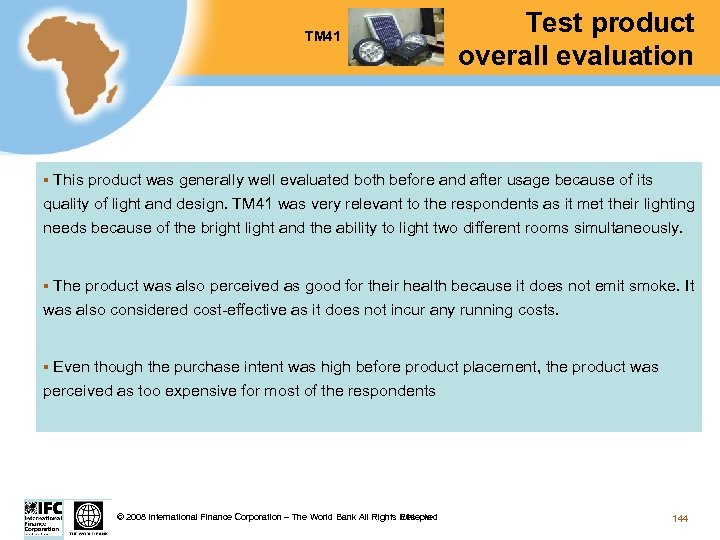 TM 41 Test product overall evaluation This product was generally well evaluated both before and after usage because of its quality of light and design. TM 41 was very relevant to the respondents as it met their lighting § needs because of the bright light and the ability to light two different rooms simultaneously. The product was also perceived as good for their health because it does not emit smoke. It was also considered cost-effective as it does not incur any running costs. § Even though the purchase intent was high before product placement, the product was perceived as too expensive for most of the respondents § Ethiopia © 2008 International Finance Corporation – The World Bank All Rights Reserved 144
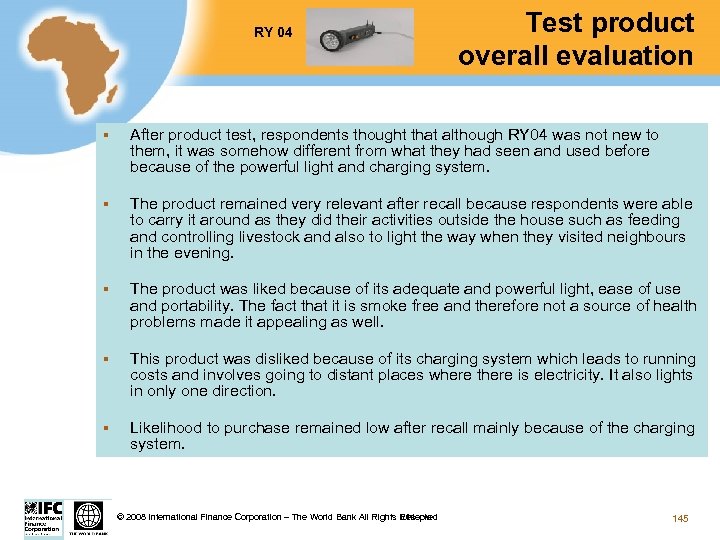 RY 04 Test product overall evaluation § After product test, respondents thought that although RY 04 was not new to them, it was somehow different from what they had seen and used before because of the powerful light and charging system. § The product remained very relevant after recall because respondents were able to carry it around as they did their activities outside the house such as feeding and controlling livestock and also to light the way when they visited neighbours in the evening. § The product was liked because of its adequate and powerful light, ease of use and portability. The fact that it is smoke free and therefore not a source of health problems made it appealing as well. § This product was disliked because of its charging system which leads to running costs and involves going to distant places where there is electricity. It also lights in only one direction. § Likelihood to purchase remained low after recall mainly because of the charging system. Ethiopia © 2008 International Finance Corporation – The World Bank All Rights Reserved 145
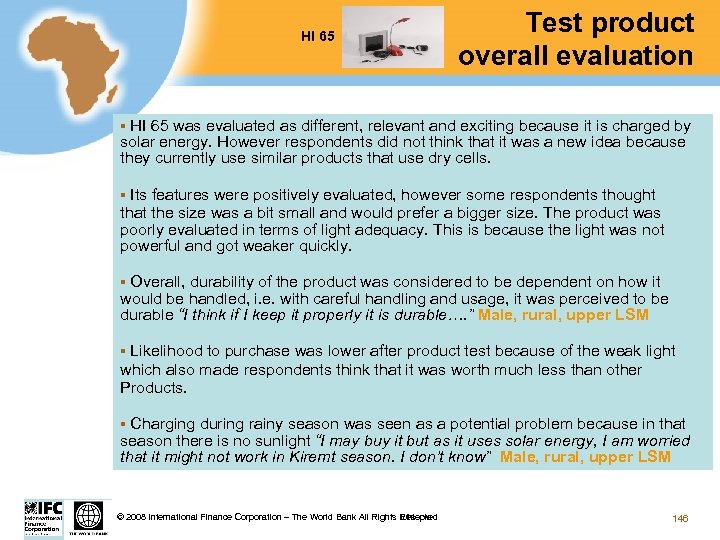 HI 65 Test product overall evaluation HI 65 was evaluated as different, relevant and exciting because it is charged by solar energy. However respondents did not think that it was a new idea because they currently use similar products that use dry cells. § Its features were positively evaluated, however some respondents thought that the size was a bit small and would prefer a bigger size. The product was poorly evaluated in terms of light adequacy. This is because the light was not powerful and got weaker quickly. § Overall, durability of the product was considered to be dependent on how it would be handled, i. e. with careful handling and usage, it was perceived to be durable “I think if I keep it properly it is durable…. ” Male, rural, upper LSM § Likelihood to purchase was lower after product test because of the weak light which also made respondents think that it was worth much less than other Products. § Charging during rainy season was seen as a potential problem because in that season there is no sunlight “I may buy it but as it uses solar energy, I am worried that it might not work in Kiremt season. I don’t know” Male, rural, upper LSM § Ethiopia © 2008 International Finance Corporation – The World Bank All Rights Reserved 146
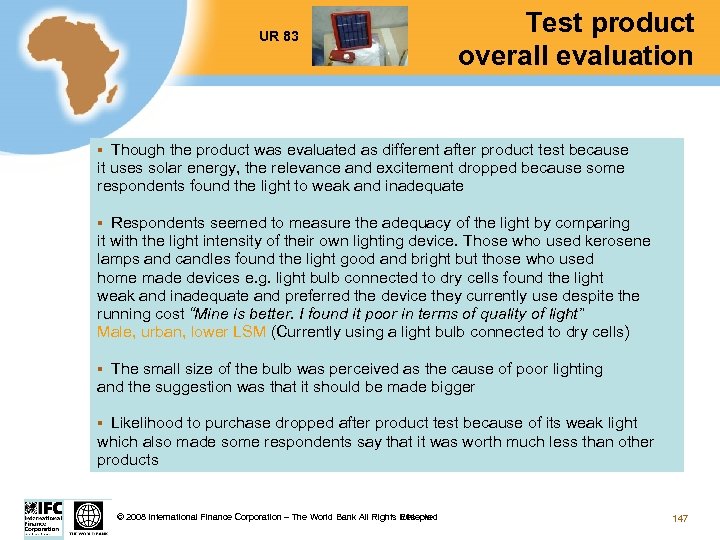 UR 83 Test product overall evaluation Though the product was evaluated as different after product test because it uses solar energy, the relevance and excitement dropped because some respondents found the light to weak and inadequate § Respondents seemed to measure the adequacy of the light by comparing it with the light intensity of their own lighting device. Those who used kerosene lamps and candles found the light good and bright but those who used home made devices e. g. light bulb connected to dry cells found the light weak and inadequate and preferred the device they currently use despite the running cost “Mine is better. I found it poor in terms of quality of light” Male, urban, lower LSM (Currently using a light bulb connected to dry cells) § The small size of the bulb was perceived as the cause of poor lighting and the suggestion was that it should be made bigger § Likelihood to purchase dropped after product test because of its weak light which also made some respondents say that it was worth much less than other products § Ethiopia © 2008 International Finance Corporation – The World Bank All Rights Reserved 147
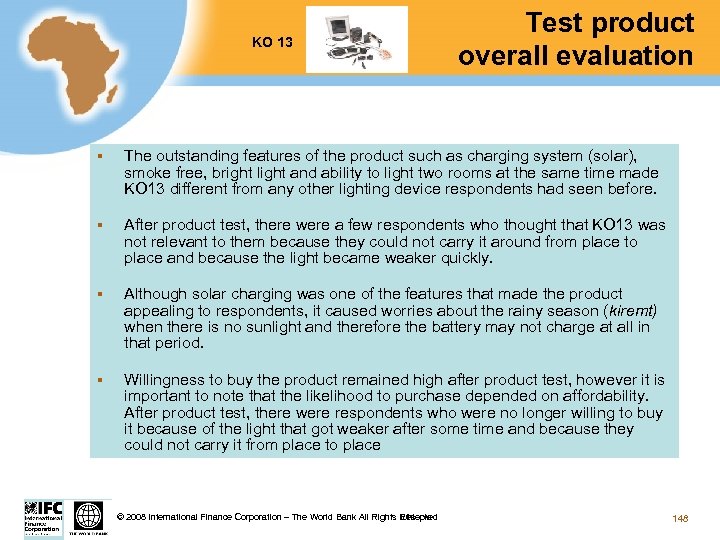 KO 13 Test product overall evaluation § The outstanding features of the product such as charging system (solar), smoke free, bright light and ability to light two rooms at the same time made KO 13 different from any other lighting device respondents had seen before. § After product test, there were a few respondents who thought that KO 13 was not relevant to them because they could not carry it around from place to place and because the light became weaker quickly. § Although solar charging was one of the features that made the product appealing to respondents, it caused worries about the rainy season (kiremt) when there is no sunlight and therefore the battery may not charge at all in that period. § Willingness to buy the product remained high after product test, however it is important to note that the likelihood to purchase depended on affordability. After product test, there were respondents who were no longer willing to buy it because of the light that got weaker after some time and because they could not carry it from place to place Ethiopia © 2008 International Finance Corporation – The World Bank All Rights Reserved 148
 RECOMMENDATIONS
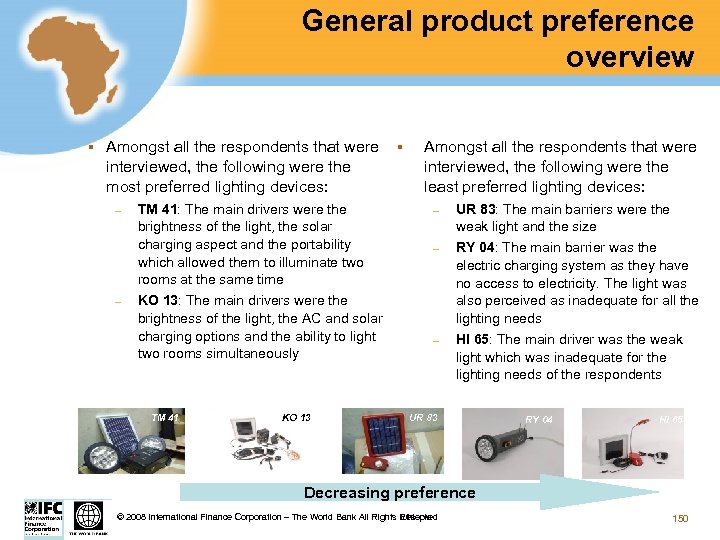 General product preference overview § Amongst all the respondents that were interviewed, the following were the most preferred lighting devices: – – TM 41: The main drivers were the brightness of the light, the solar charging aspect and the portability which allowed them to illuminate two rooms at the same time KO 13: The main drivers were the brightness of the light, the AC and solar charging options and the ability to light two rooms simultaneously TM 41 KO 13 § Amongst all the respondents that were interviewed, the following were the least preferred lighting devices: – – – UR 83: The main barriers were the weak light and the size RY 04: The main barrier was the electric charging system as they have no access to electricity. The light was also perceived as inadequate for all the lighting needs HI 65: The main driver was the weak light which was inadequate for the lighting needs of the respondents UR 83 RY 04 HI 65 Decreasing preference Ethiopia © 2008 International Finance Corporation – The World Bank All Rights Reserved 150
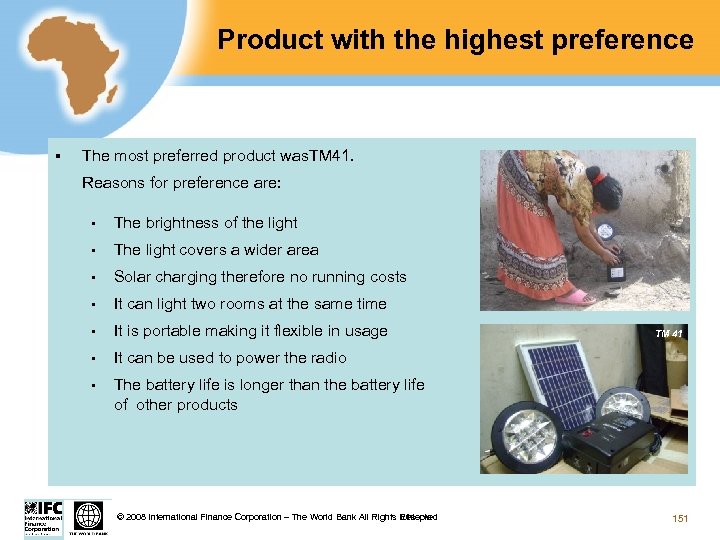 Product with the highest preference § The most preferred product was. TM 41. Reasons for preference are: • The brightness of the light • The light covers a wider area • Solar charging therefore no running costs • It can light two rooms at the same time • It is portable making it flexible in usage • It can be used to power the radio • The battery life is longer than the battery life of other products Ethiopia © 2008 International Finance Corporation – The World Bank All Rights Reserved TM 41 151
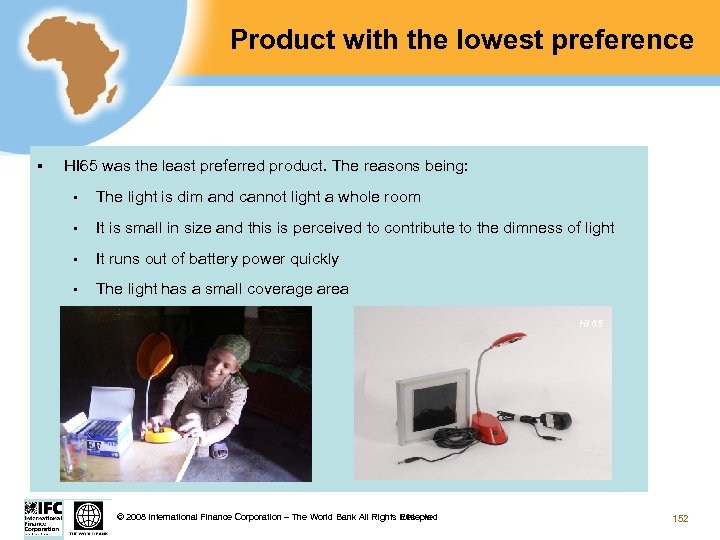 Product with the lowest preference § HI 65 was the least preferred product. The reasons being: • The light is dim and cannot light a whole room • It is small in size and this is perceived to contribute to the dimness of light • It runs out of battery power quickly • The light has a small coverage area HI 65 Ethiopia © 2008 International Finance Corporation – The World Bank All Rights Reserved 152
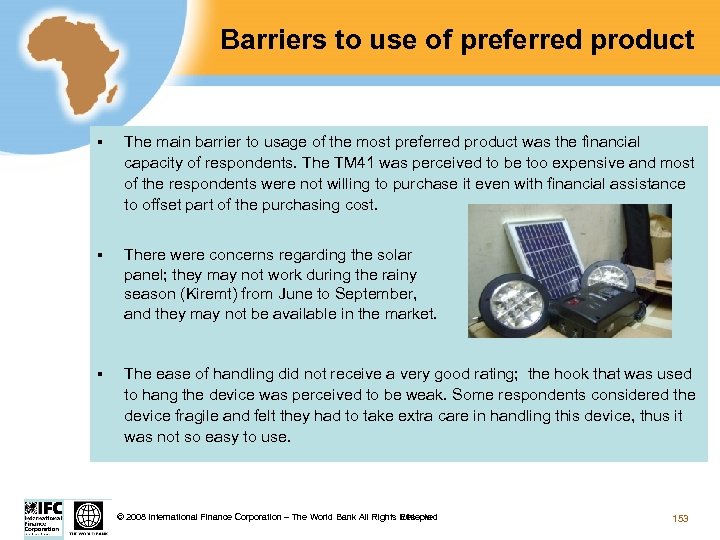 Barriers to use of preferred product § The main barrier to usage of the most preferred product was the financial capacity of respondents. The TM 41 was perceived to be too expensive and most of the respondents were not willing to purchase it even with financial assistance to offset part of the purchasing cost. § There were concerns regarding the solar panel; they may not work during the rainy season (Kiremt) from June to September, and they may not be available in the market. § The ease of handling did not receive a very good rating; the hook that was used to hang the device was perceived to be weak. Some respondents considered the device fragile and felt they had to take extra care in handling this device, thus it was not so easy to use. Ethiopia © 2008 International Finance Corporation – The World Bank All Rights Reserved 153
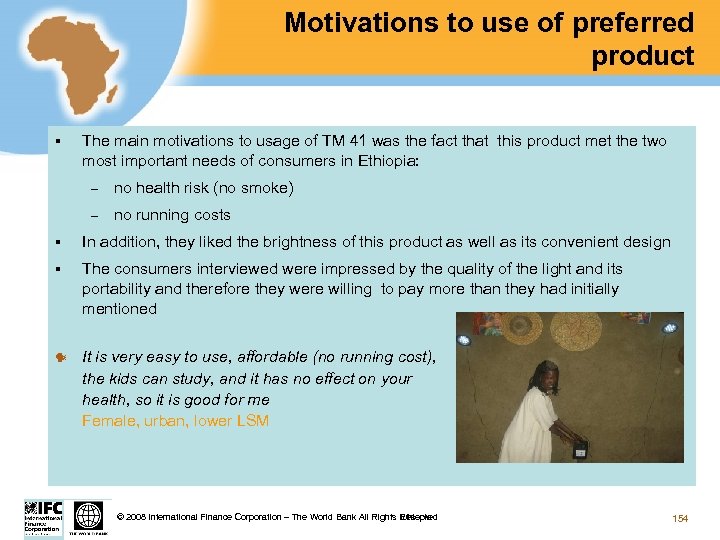 Motivations to use of preferred product § The main motivations to usage of TM 41 was the fact that this product met the two most important needs of consumers in Ethiopia: – no health risk (no smoke) – no running costs § In addition, they liked the brightness of this product as well as its convenient design § The consumers interviewed were impressed by the quality of the light and its portability and therefore they were willing to pay more than they had initially mentioned It is very easy to use, affordable (no running cost), the kids can study, and it has no effect on your health, so it is good for me Female, urban, lower LSM Ethiopia © 2008 International Finance Corporation – The World Bank All Rights Reserved 154
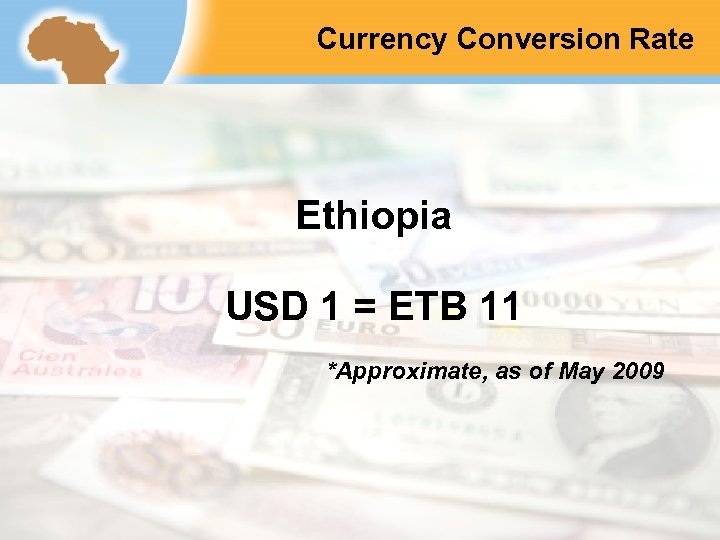 Currency Conversion Rate Ethiopia USD 1 = ETB 11 *Approximate, as of May 2009 Ethiopia © 2008 International Finance Corporation – The World Bank All Rights Reserved 155
 Ethiopia © 2008 International Finance Corporation – The World Bank All Rights Reserved 156