 Скачать презентацию Light Vehicle Rollover Background on NHTSA s Activities in
ae215792373dcf9421c4b14e42a1b70c.ppt
- Количество слайдов: 22



Light Vehicle Rollover Background on NHTSA’s Activities in this Area
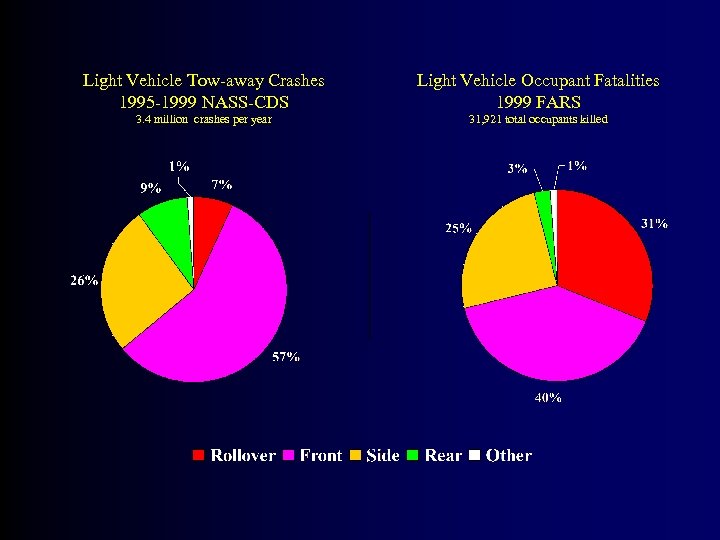
Light Vehicle Tow-away Crashes 1995 -1999 NASS-CDS Light Vehicle Occupant Fatalities 1999 FARS 3. 4 million crashes per year 31, 921 total occupants killed
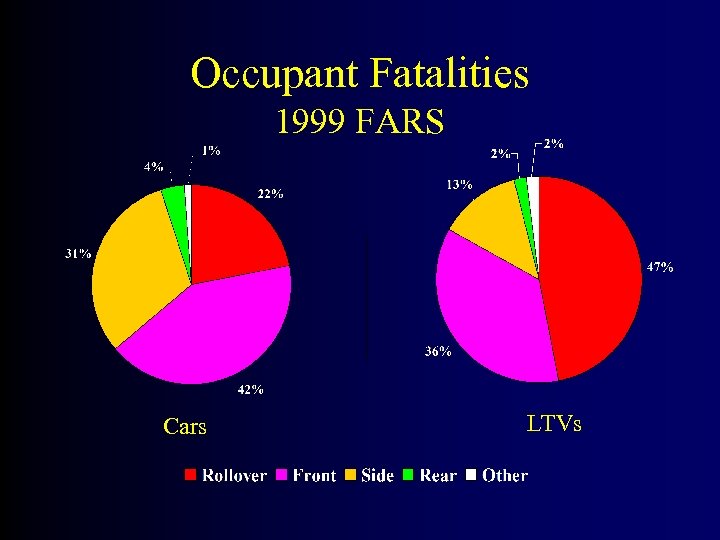
Occupant Fatalities 1999 FARS Cars LTVs
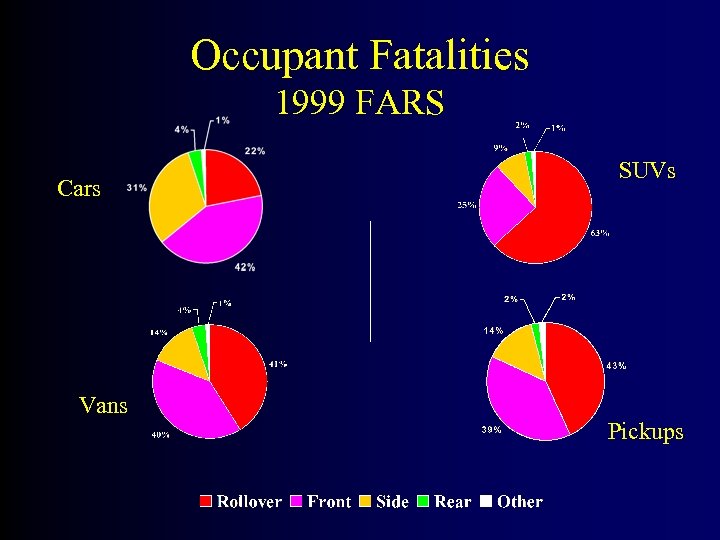
Occupant Fatalities 1999 FARS Cars Vans SUVs Pickups
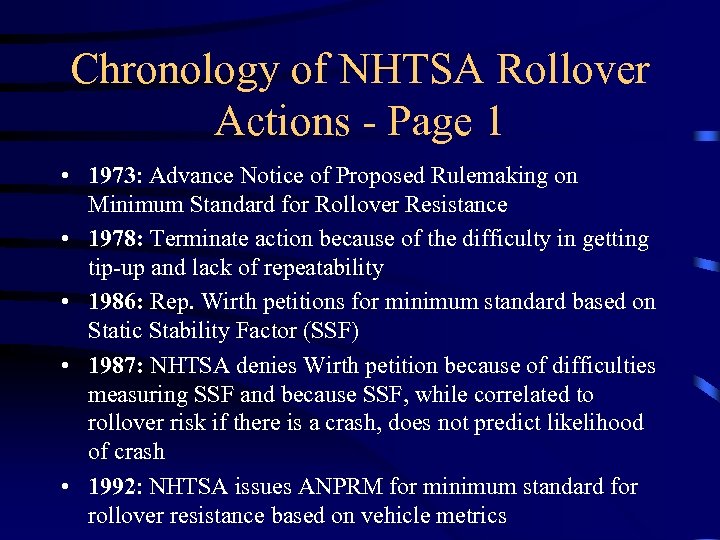
Chronology of NHTSA Rollover Actions - Page 1 • 1973: Advance Notice of Proposed Rulemaking on Minimum Standard for Rollover Resistance • 1978: Terminate action because of the difficulty in getting tip-up and lack of repeatability • 1986: Rep. Wirth petitions for minimum standard based on Static Stability Factor (SSF) • 1987: NHTSA denies Wirth petition because of difficulties measuring SSF and because SSF, while correlated to rollover risk if there is a crash, does not predict likelihood of crash • 1992: NHTSA issues ANPRM for minimum standard for rollover resistance based on vehicle metrics
The First NHTSA Rollover Rulemaking Action • 1973 ANPRM for safety standard “that would specify minimum performance requirements for rollover resistance” • Focus was on safety standard for the next 20 years – Goal is to set a level that eliminates unreasonable risk to safety – Challenge is to make it meaningful for cars and light trucks
The First NHTSA Rollover Rulemaking Action (Cont’d) • Agency’s early-70’s work was focused on rollovers on flat road surfaces, with hard driving maneuvers to induce rollover • After years of work, we concluded – Difficult to get wheel lift with even these maneuvers – Even more difficult to repeat wheel lift response • Could not use these maneuvers for standard
The Second NHTSA Rollover Rulemaking Action • NHTSA’s early work was with dynamic tests, but found too much variability • Mr. Wirth asked agency to use vehicle physical characteristics (SSF) as a surrogate measure of rollover propensity • From mid-80’s to mid-90’s, NHTSA analyzed different vehicle metrics as a potential means to address rollover • Three widely accepted metrics
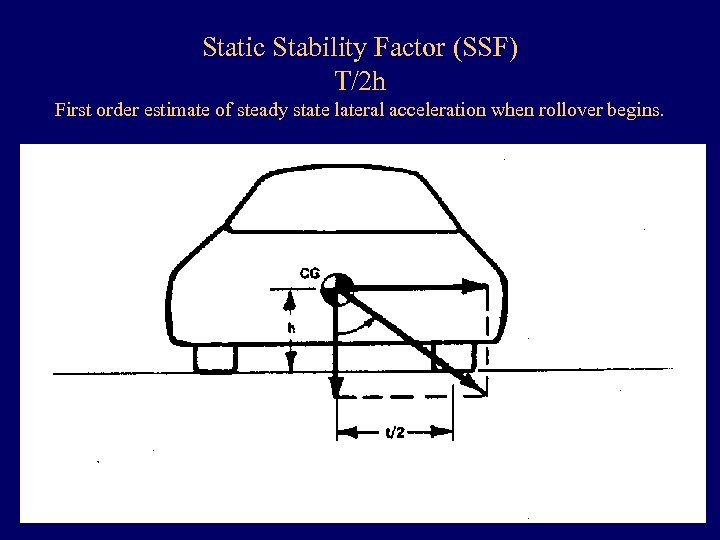
Static Stability Factor (SSF) T/2 h First order estimate of steady state lateral acceleration when rollover begins.
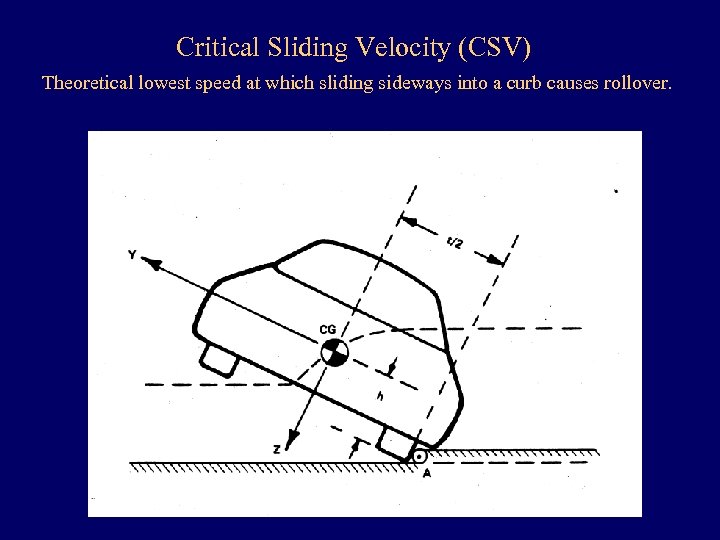
Critical Sliding Velocity (CSV) Theoretical lowest speed at which sliding sideways into a curb causes rollover. Vehicle Motion
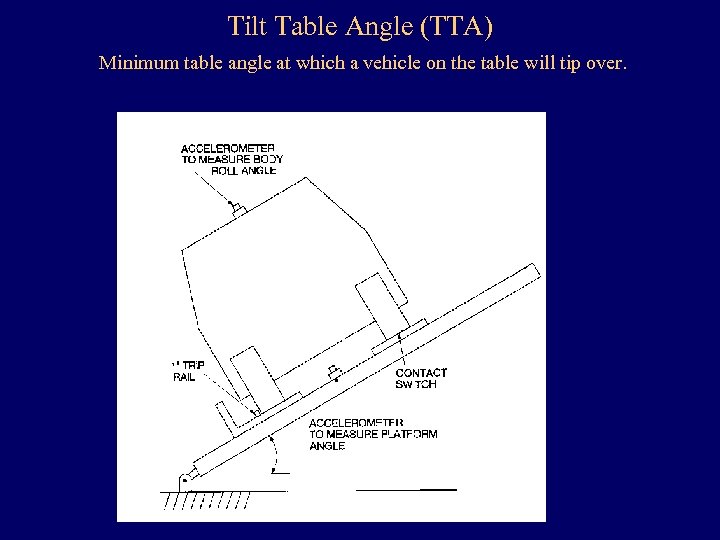
Tilt Table Angle (TTA) Minimum table angle at which a vehicle on the table will tip over.
The Second NHTSA Rollover Rulemaking Action (Cont’d) • After evaluating a standard requiring a minimum SSF, NHTSA concluded: – Requested minimum would essentially make all vehicles cars - NOT NHTSA’s mission – SSF was too simple -correlated to rollover given a crash, but could not predict likelihood of being in a crash – Difficult to repeatably measure center-ofgravity height
The Third NHTSA Rollover Rulemaking Action • In 1992, NHTSA began a rulemaking with the goal of using a vehicle metric other than SSF to establish a minimum performance standard • Hoped this would: – Establish a base level of rollover resistance – Use greater ease and repeatability of metrics – Find a metric better than SSF
Chronology of NHTSA Rollover Actions - Page 2 • 1994: NHTSA terminates rulemaking on minimum standard, but proposes consumer information based on vehicle metric • 1994: Congress suspends rollover rulemaking until National Academy of Sciences (NAS) study of consumer information • 1996: NAS study published • 1996: NHTSA begins new study of feasibility of dynamic rollover • 1999: NHTSA publishes report of its testing results
Safety Standard vs. Consumer Information • In 1994, we terminated rulemaking on a vehicle standard - benefits were too low to justify costs of redesigning most light trucks • Because of the difficulties of the standard, NHTSA suggested providing consumer information, instead of a standard • This would give the public helpful information about what they are buying without restricting their ability to buy small SUVs and pickups
Recent NHTSA Testing of Dynamic Maneuvers • In 1997, NHTSA set out to see if it was now possible to develop a practicable, repeatable and appropriate emergency handling test • Chose best procedures from existing literature and selected some for further analysis • After analysis, did further testing with three maneuvers
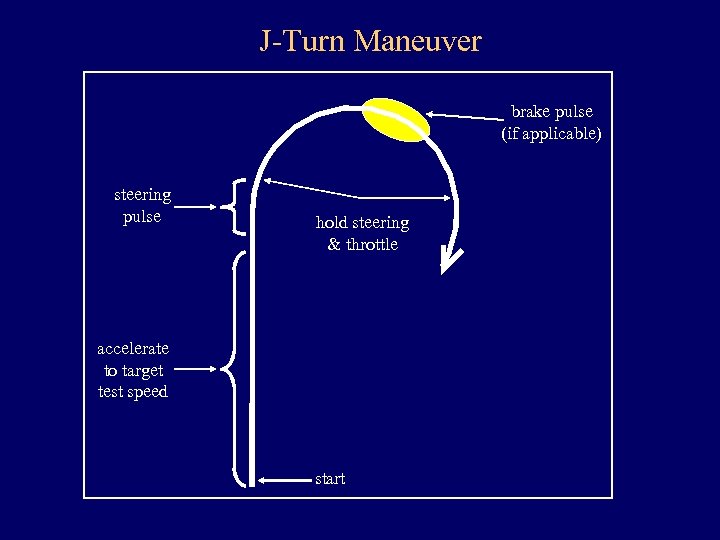
J-Turn Maneuver brake pulse (if applicable) steering pulse hold steering & throttle accelerate to target test speed start
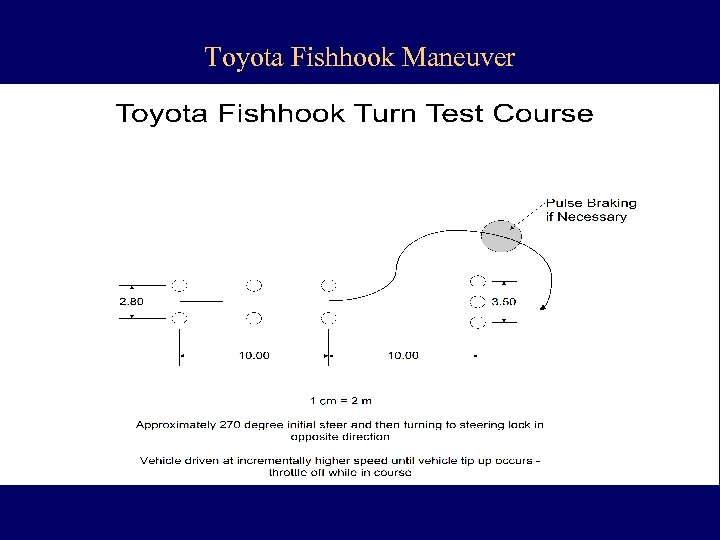
Toyota Fishhook Maneuver
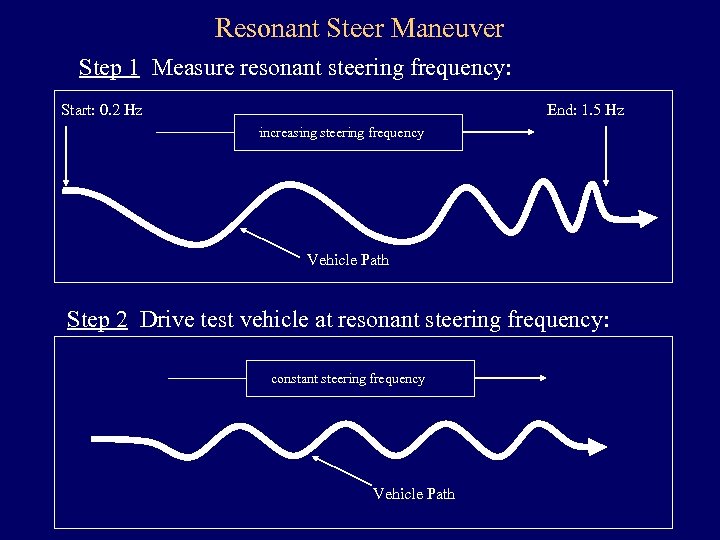
Resonant Steer Maneuver Step 1 Measure resonant steering frequency: Start: 0. 2 Hz End: 1. 5 Hz increasing steering frequency Vehicle Path Step 2 Drive test vehicle at resonant steering frequency: constant steering frequency Vehicle Path
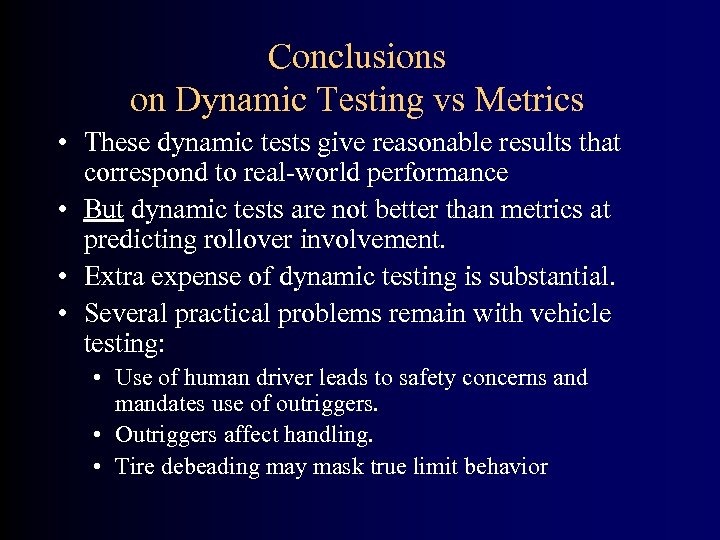
Conclusions on Dynamic Testing vs Metrics • These dynamic tests give reasonable results that correspond to real-world performance • But dynamic tests are not better than metrics at predicting rollover involvement. • Extra expense of dynamic testing is substantial. • Several practical problems remain with vehicle testing: • Use of human driver leads to safety concerns and mandates use of outriggers. • Outriggers affect handling. • Tire debeading may mask true limit behavior
Why Choose SSF as the Metric for Consumer Information? • None of the three metrics was the clear winner statistically. • SSF is the only metric that will do no harm. • SSF has broad industry acceptance as “first order” design consideration. • SSF is least complex, intuitively related to rollover.
Rollover Actions in the Past 12 Months • June 2000: NHTSA proposes rollover consumer information using SSF • October 2000: Congress mandates NAS study of NHTSA’s proposed SSF rollover information program • November 2000: Congress requires NHTSA to provide consumer information on performance in dynamic rollover testing as of November 2002 • January 2001: NHTSA issues first rollover ratings based on SSF
Скачать презентацию Light Vehicle Rollover Background on NHTSA s Activities in
ae215792373dcf9421c4b14e42a1b70c.ppt