 Скачать презентацию Light-scattering Features of Turbidity-causing Particles in Interconnected Reservoir
98f48ff931e5418a644613ece6db0cff.ppt
- Количество слайдов: 20



Light-scattering Features of Turbidity-causing Particles in Interconnected Reservoir Basins and a Connecting Stream Feng Peng and Steven W. Effler Upstate Freshwater Institute, Syracuse, New York Donald C. Pierson NYC Department of Environmental Protection David G. Smith National Institute of Water and Atmosphere, New Zealand Upstate Freshwater Inst.
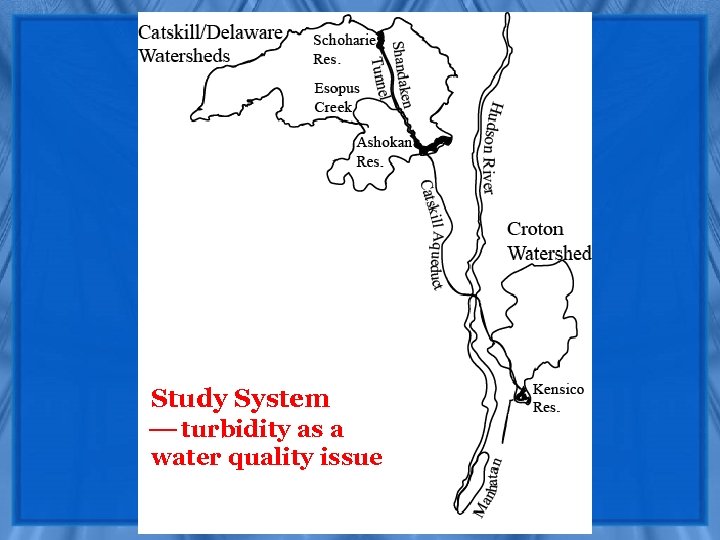
Study System turbidity as a water quality issue
Character of Light-scattering (Turbidity-causing) Particles within the Catskill System Related questions ´ What are the light-scattering characters of particles (size distributions, composition, shape) in the Catskill system? ´ Are there differences in the light scattering characteristics of particles in different parts of the Catskill System? ´ Does the potential difference cause disproportionate contributions of the source particles to turbidity (Tn) within the system?
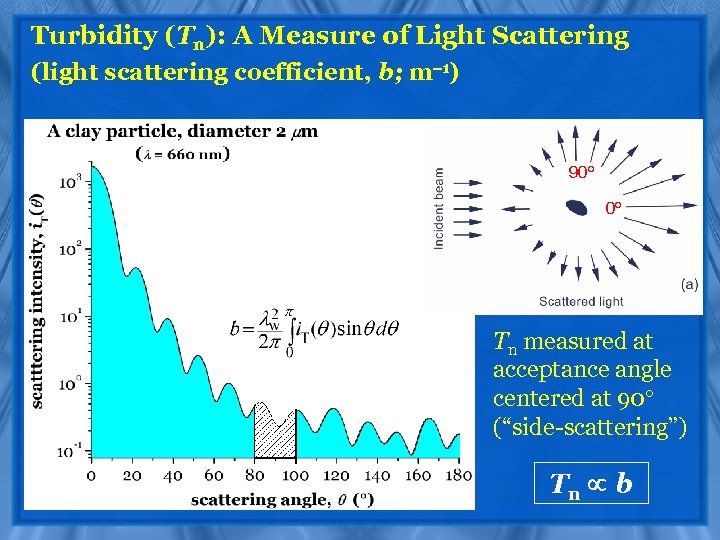
Turbidity (Tn): A Measure of Light Scattering (light scattering coefficient, b; m 1) 90º 0º Tn measured at acceptance angle centered at 90 (“side-scattering”) Tn b
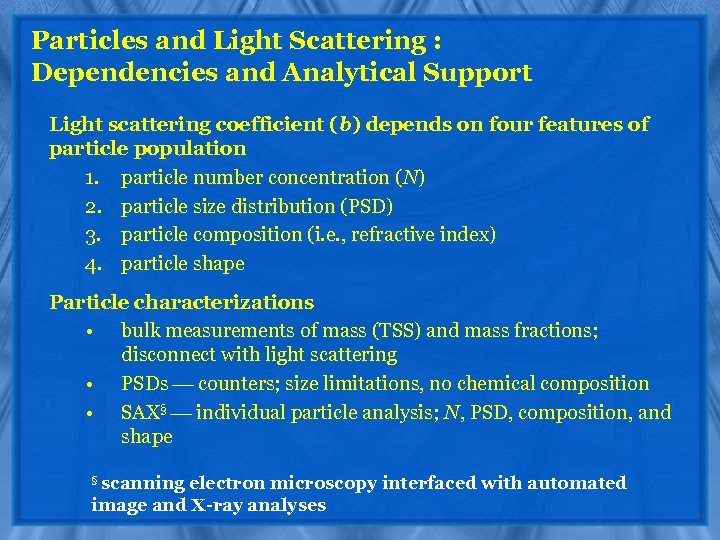
Particles and Light Scattering : Dependencies and Analytical Support Light scattering coefficient (b) depends on four features of particle population 1. particle number concentration (N) 2. particle size distribution (PSD) 3. particle composition (i. e. , refractive index) 4. particle shape Particle characterizations • bulk measurements of mass (TSS) and mass fractions; disconnect with light scattering • PSDs counters; size limitations, no chemical composition • SAX§ individual particle analysis; N, PSD, composition, and shape § scanning electron microscopy interfaced with automated image and X-ray analyses
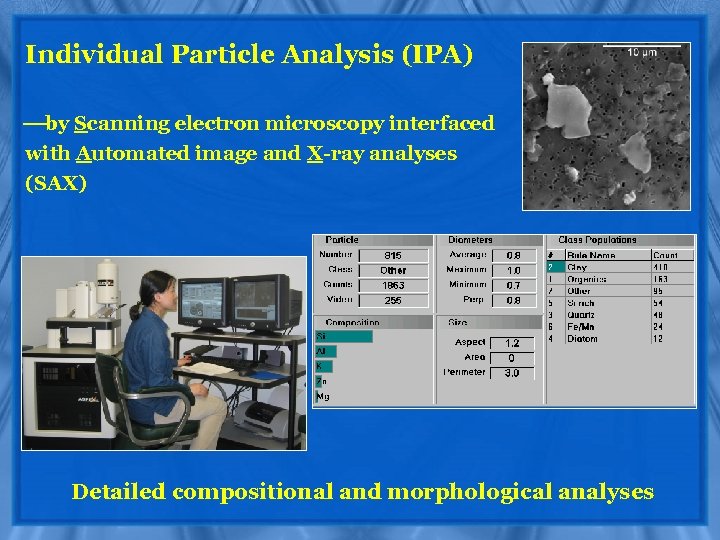
Individual Particle Analysis (IPA) by Scanning electron microscopy interfaced with Automated image and X-ray analyses (SAX) Detailed compositional and morphological analyses
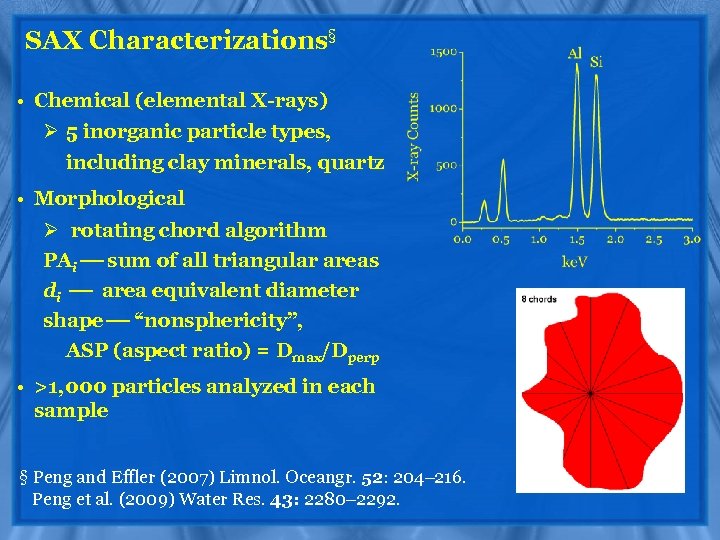
SAX Characterizations§ • Chemical (elemental X-rays) Ø 5 inorganic particle types, including clay minerals, quartz • Morphological Ø rotating chord algorithm PAi sum of all triangular areas di area equivalent diameter shape “nonsphericity”, ASP (aspect ratio) = Dmax/Dperp • >1, 000 particles analyzed in each sample § Peng and Effler (2007) Limnol. Oceangr. 52: 204 216. Peng et al. (2009) Water Res. 43: 2280 2292.
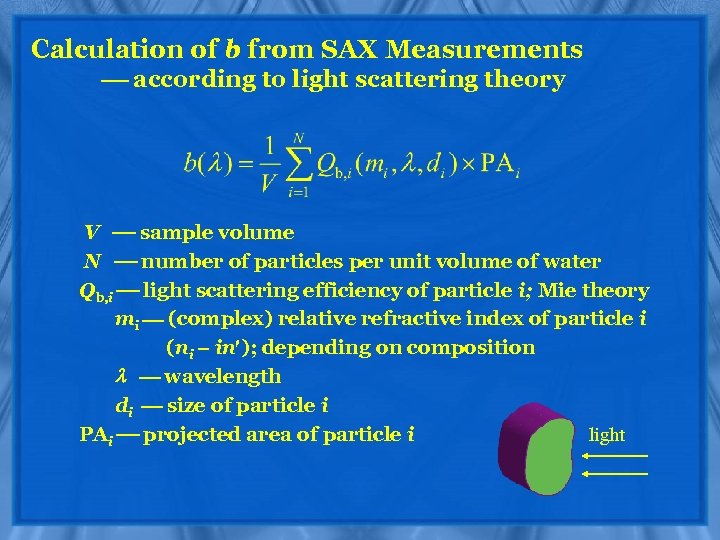
Calculation of b from SAX Measurements according to light scattering theory V sample volume N number of particles per unit volume of water Qb, i light scattering efficiency of particle i; Mie theory mi (complex) relative refractive index of particle i (ni in ); depending on composition wavelength di size of particle i PAi projected area of particle i light
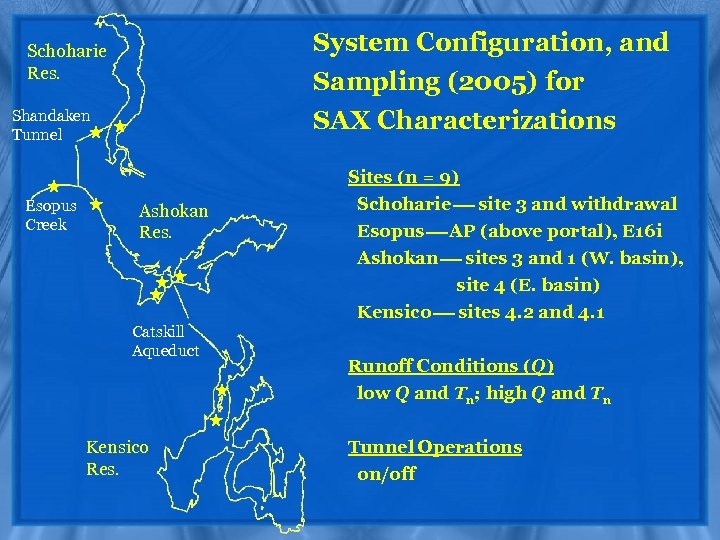
System Configuration, and Sampling (2005) for SAX Characterizations Schoharie Res. Shandaken Tunnel Sites (n = 9) Esopus Creek Ashokan Res. Catskill Aqueduct Kensico Res. Schoharie site 3 and withdrawal Esopus AP (above portal), E 16 i Ashokan sites 3 and 1 (W. basin), site 4 (E. basin) Kensico sites 4. 2 and 4. 1 Runoff Conditions (Q) low Q and Tn; high Q and Tn Tunnel Operations on/off
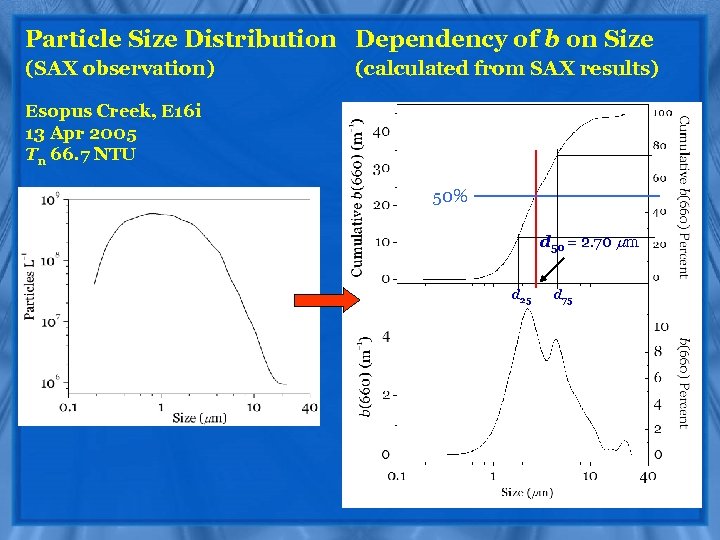
Particle Size Distribution Dependency of b on Size (SAX observation) (calculated from SAX results) Esopus Creek, E 16 i 13 Apr 2005 Tn 66. 7 NTU 50% d 50 = 2. 70 mm d 25 d 75
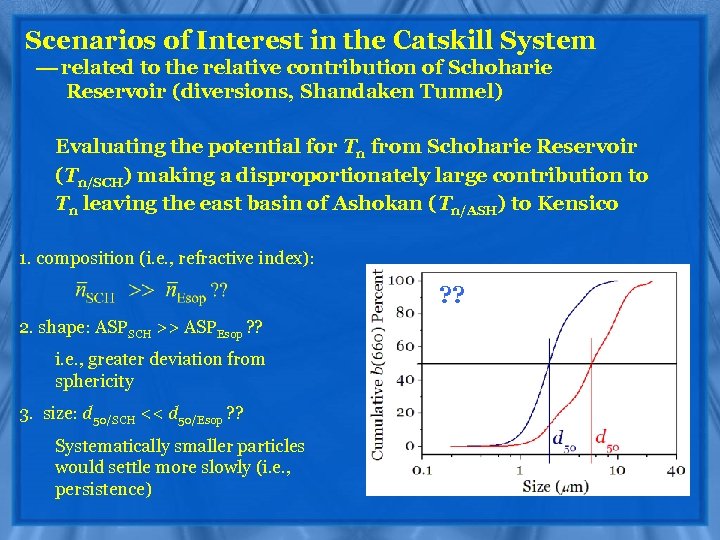
Scenarios of Interest in the Catskill System related to the relative contribution of Schoharie Reservoir (diversions, Shandaken Tunnel) Evaluating the potential for Tn from Schoharie Reservoir (Tn/SCH) making a disproportionately large contribution to Tn leaving the east basin of Ashokan (Tn/ASH) to Kensico 1. composition (i. e. , refractive index): ? ? 2. shape: ASPSCH >> ASPEsop ? ? i. e. , greater deviation from sphericity 3. size: d 50/SCH << d 50/Esop ? ? Systematically smaller particles would settle more slowly (i. e. , persistence)
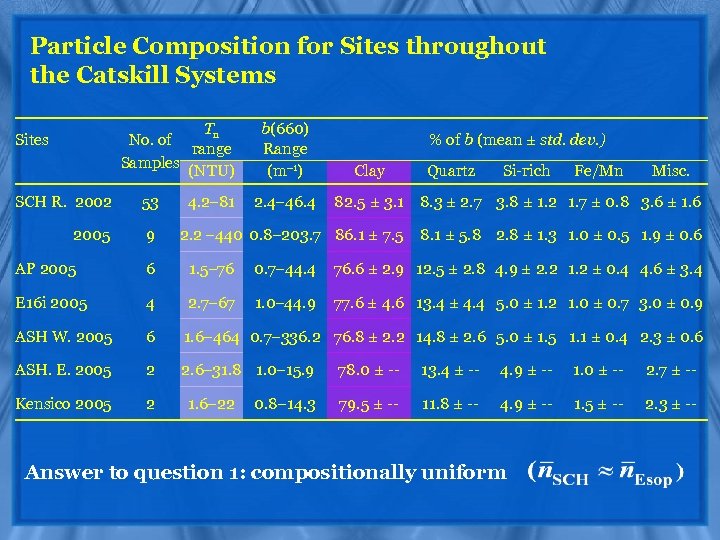
Particle Composition for Sites throughout the Catskill Systems Tn No. of range Samples (NTU) Sites SCH R. 2002 53 2005 9 b(660) Range (m 1) Clay 2. 4 46. 4 82. 5 ± 3. 1 8. 3 ± 2. 7 3. 8 ± 1. 2 1. 7 ± 0. 8 3. 6 ± 1. 6 2. 2 440 0. 8 203. 7 86. 1 ± 7. 5 8. 1 ± 5. 8 2. 8 ± 1. 3 1. 0 ± 0. 5 1. 9 ± 0. 6 4. 2 81 % of b (mean ± std. dev. ) Quartz Si-rich Fe/Mn Misc. AP 2005 6 1. 5 76 0. 7 44. 4 76. 6 ± 2. 9 12. 5 ± 2. 8 4. 9 ± 2. 2 1. 2 ± 0. 4 4. 6 ± 3. 4 E 16 i 2005 4 2. 7 67 1. 0 44. 9 77. 6 ± 4. 6 13. 4 ± 4. 4 5. 0 ± 1. 2 1. 0 ± 0. 7 3. 0 ± 0. 9 ASH W. 2005 6 1. 6 464 0. 7 336. 2 76. 8 ± 2. 2 14. 8 ± 2. 6 5. 0 ± 1. 5 1. 1 ± 0. 4 2. 3 ± 0. 6 ASH. E. 2005 2 2. 6 31. 8 1. 0 15. 9 Kensico 2005 2 1. 6 22 0. 8 14. 3 78. 0 ± -- 13. 4 ± -- 4. 9 ± -- 1. 0 ± -- 2. 7 ± -- 79. 5 ± -- 11. 8 ± -- 4. 9 ± -- 1. 5 ± -- 2. 3 ± -- Answer to question 1: compositionally uniform
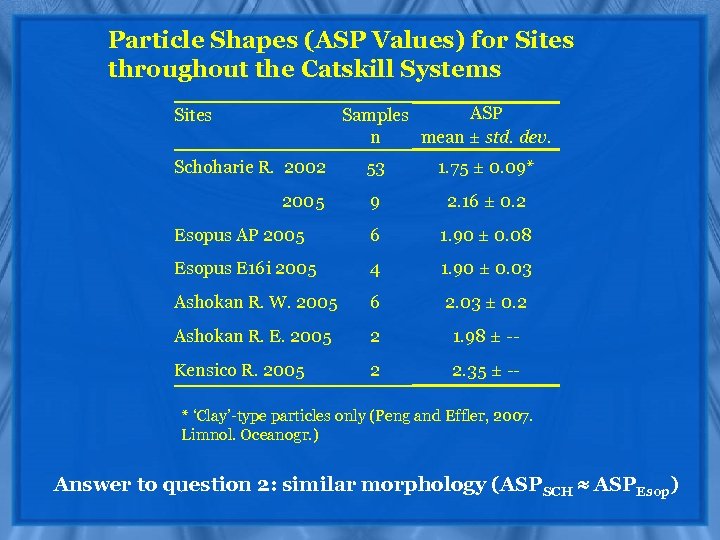
Particle Shapes (ASP Values) for Sites throughout the Catskill Systems ASP Samples n mean ± std. dev. Sites Schoharie R. 2002 53 1. 75 ± 0. 09* 2005 9 2. 16 ± 0. 2 Esopus AP 2005 6 1. 90 ± 0. 08 Esopus E 16 i 2005 4 1. 90 ± 0. 03 Ashokan R. W. 2005 6 2. 03 ± 0. 2 Ashokan R. E. 2005 2 1. 98 ± -- Kensico R. 2005 2 2. 35 ± -- * ‘Clay’-type particles only (Peng and Effler, 2007. Limnol. Oceanogr. ) Answer to question 2: similar morphology (ASPSCH ASPEsop)
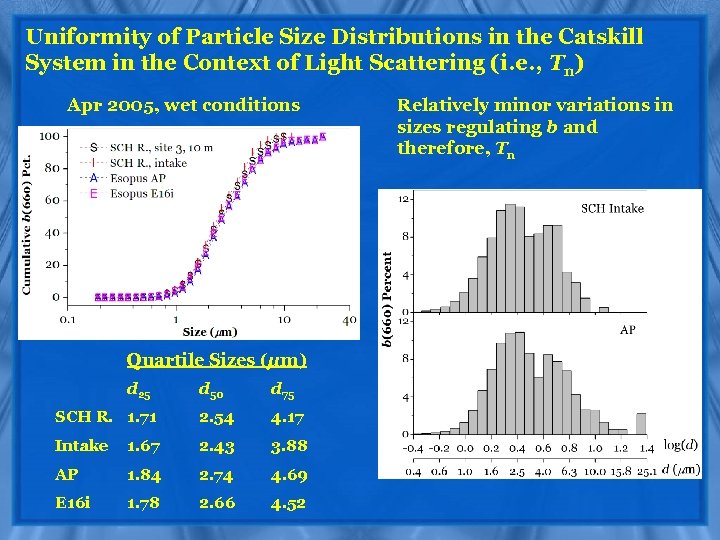
Uniformity of Particle Size Distributions in the Catskill System in the Context of Light Scattering (i. e. , Tn) Apr 2005, wet conditions Quartile Sizes (μm) d 25 d 50 d 75 SCH R. 1. 71 2. 54 4. 17 Intake 1. 67 2. 43 3. 88 AP 1. 84 2. 74 4. 69 E 16 i 1. 78 2. 66 4. 52 Relatively minor variations in sizes regulating b and therefore, Tn
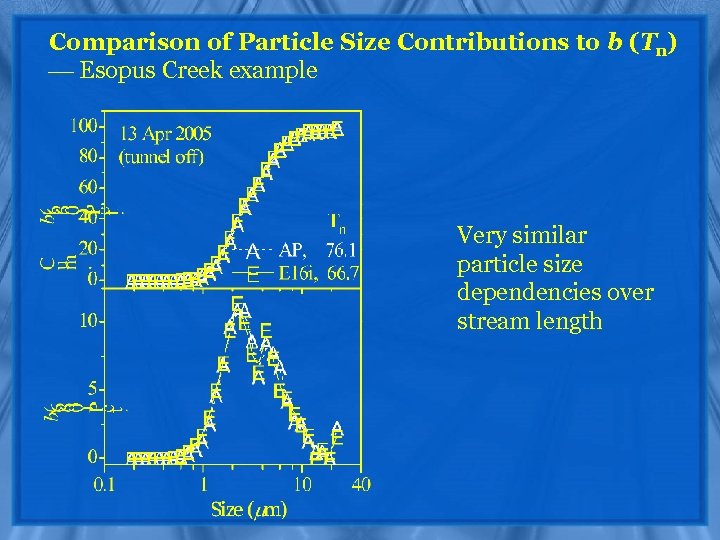
Comparison of Particle Size Contributions to b (Tn) Esopus Creek example Very similar particle size dependencies over stream length
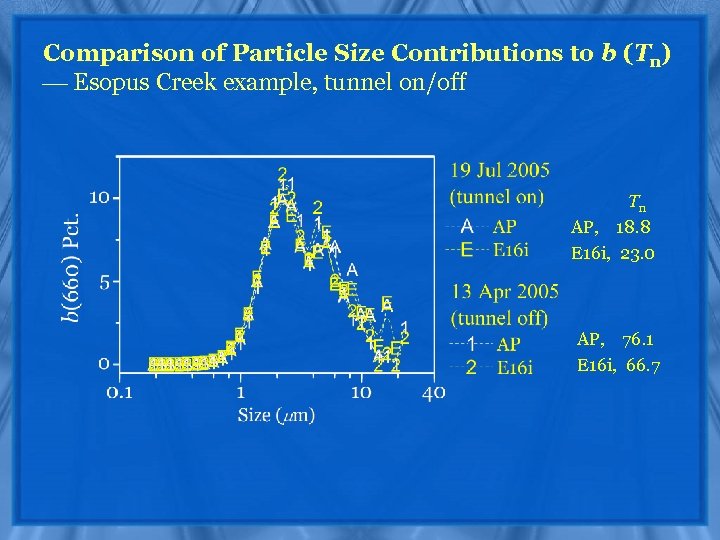
Comparison of Particle Size Contributions to b (Tn) Esopus Creek example, tunnel on/off Tn AP, 18. 8 E 16 i, 23. 0 AP, 76. 1 E 16 i, 66. 7
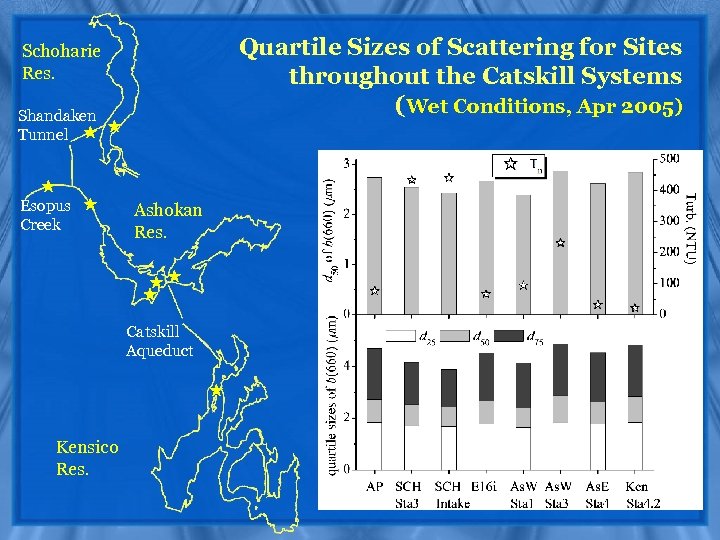
Quartile Sizes of Scattering for Sites throughout the Catskill Systems (Wet Conditions, Apr 2005) Schoharie Res. Shandaken Tunnel Esopus Creek Ashokan Res. Catskill Aqueduct Kensico Res.
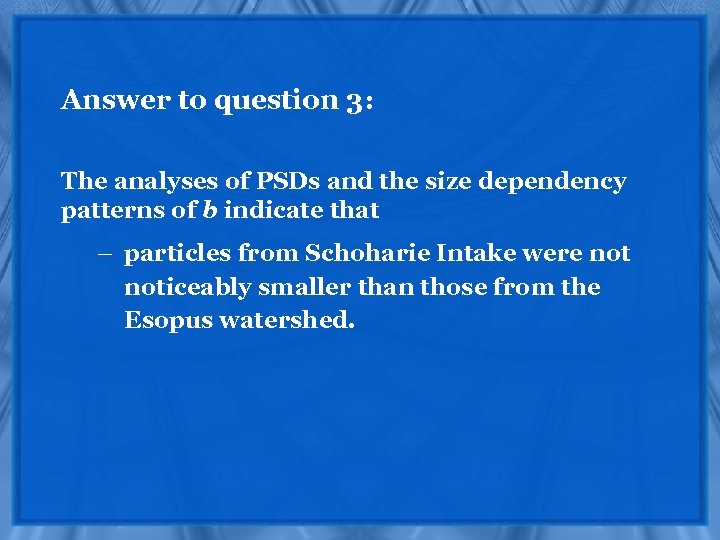
Answer to question 3: The analyses of PSDs and the size dependency patterns of b indicate that – particles from Schoharie Intake were noticeably smaller than those from the Esopus watershed.
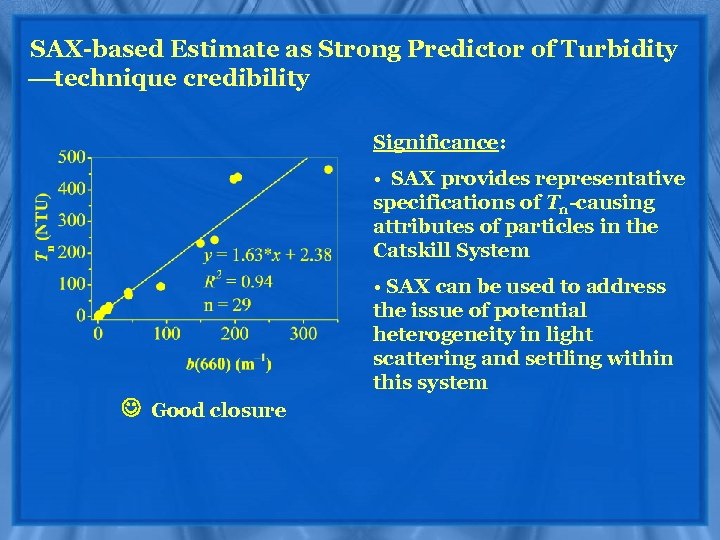
SAX-based Estimate as Strong Predictor of Turbidity technique credibility Significance: • SAX provides representative specifications of Tn-causing attributes of particles in the Catskill System • SAX can be used to address the issue of potential heterogeneity in light scattering and settling within this system Good closure
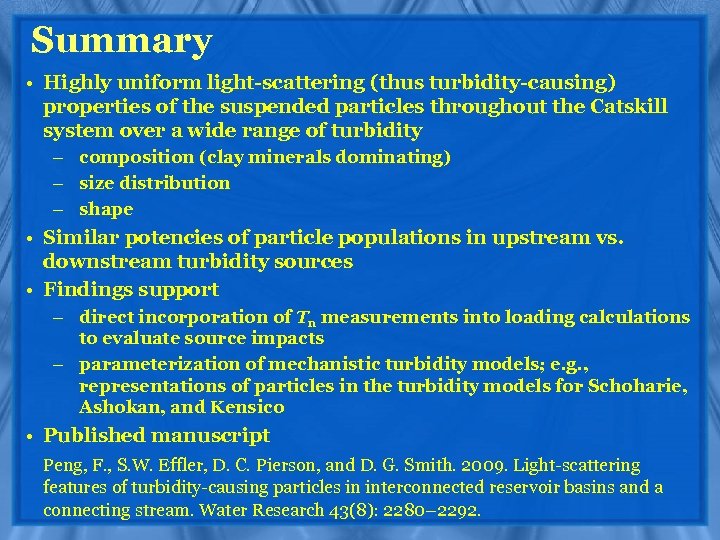
Summary • Highly uniform light-scattering (thus turbidity-causing) properties of the suspended particles throughout the Catskill system over a wide range of turbidity – composition (clay minerals dominating) – size distribution – shape • Similar potencies of particle populations in upstream vs. downstream turbidity sources • Findings support – direct incorporation of Tn measurements into loading calculations to evaluate source impacts – parameterization of mechanistic turbidity models; e. g. , representations of particles in the turbidity models for Schoharie, Ashokan, and Kensico • Published manuscript Peng, F. , S. W. Effler, D. C. Pierson, and D. G. Smith. 2009. Light-scattering features of turbidity-causing particles in interconnected reservoir basins and a connecting stream. Water Research 43(8): 2280– 2292.
Скачать презентацию Light-scattering Features of Turbidity-causing Particles in Interconnected Reservoir
98f48ff931e5418a644613ece6db0cff.ppt