


 Скачать презентацию LIFELONG GUIDANCE THE ITALIAN EXPERIENCE Research group European
2ea806453ad0ba83f02deb6d49e6a489.ppt
- Количество слайдов: 32
 LIFELONG GUIDANCE: THE ITALIAN EXPERIENCE Research group “European networks”: Euroguidance, Elgpn, Europass, EQAVET EU Networks for international mobility and guidance: Euroguidance, Elgpn, Europass and EQAVET Roma, Corso d’Italia 33 Academia Study visit Turin, 23 th and 24 th May 2013 Ms Concetta Fonzo, c. fonzo@isfol. it
 The Euroguidance Network: 20 years of guidance for mobility in Europe www. euroguidance. net
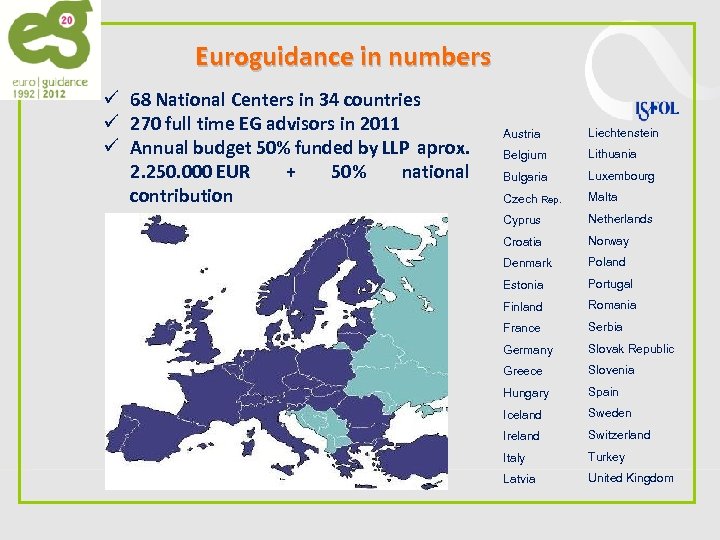 Euroguidance in numbers ü 68 National Centers in 34 countries ü 270 full time EG advisors in 2011 ü Annual budget 50% funded by LLP aprox. 2. 250. 000 EUR + 50% national contribution Austria Liechtenstein Belgium Lithuania Bulgaria Luxembourg Czech Rep. Malta Cyprus Netherlands Croatia Norway Denmark Poland Estonia Portugal Finland Romania France Serbia Germany Slovak Republic Greece Slovenia Hungary Spain Iceland Sweden Ireland Switzerland Italy Turkey Latvia United Kingdom
 T a r g e t a u d i e n c e Main target group ü Guidance practitioners Secondary target groups ü Students, pupils, parents, adults and everyone looking for learning opportunities in EU ü Trainers of guidance practitioners and other educational professionals ü Policy makers ü Related European Networks & Institutions
 Euroguidance Network Core Objectives A. Promote the European dimension in guidance B. Provide quality information on lifelong guidance and mobility for learning purposes
 Euroguidance Activities (1) (prioritised at national level according to national context) q Disseminate guidance & mobility information (printed, web, media, events) q Support the PLOTEUS Portal (answer enquiries, provide mobility advice, updating of broken links, adding new information resources) q Promote networking and up skilling of guidance practitioners (conferences, seminars, training courses, publications, study visits, mobility programs)
 Euroguidance Activities (2) (prioritised at national level according to national context) q. Enhance guidance practice (cooperate with national guidance stakeholders, develop innovative guidance methods and practices, international projects). q. Cooperate with other Guidance related Networks (synergies and common activities at national and European level with ELGPN, Europass, EURES, etc. ).
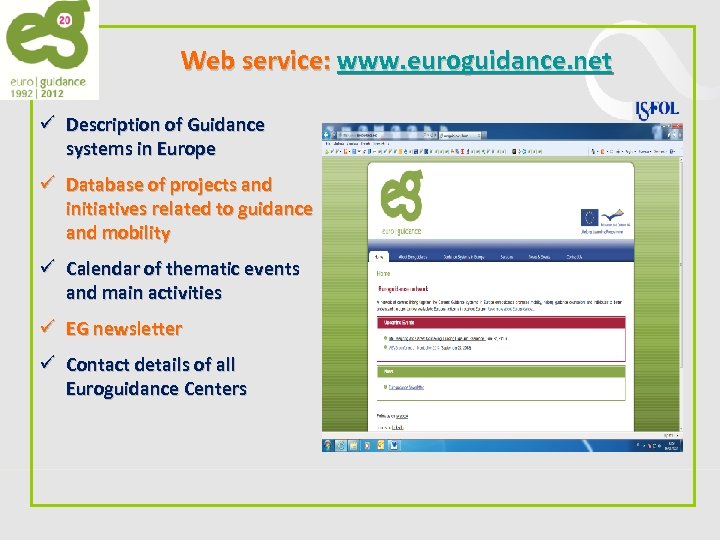 Web service: www. euroguidance. net ü Description of Guidance systems in Europe ü Database of projects and initiatives related to guidance and mobility ü Calendar of thematic events and main activities ü EG newsletter ü Contact details of all Euroguidance Centers
 Euroguidance : A network of interesting practices in lifelong guidance across EU EG annual outputs contribute to the lifelong guidance priorities set in the EU LLG Resolutions (2004, 2008): • Supporting the development of career management skills • Facilitating access to guidance services • Supporting quality assurance in guidance • Coordination and cooperation among the guidance key stakeholders
 The National Centre Euroguidance Italy: 20 years of guidance in Italy http: //euroguidance. isfol. it
 The National Centre Euroguidance Italy (1) About us: Euroguidance Italy operates at Isfol, in Rome. The National Centre is promoted by the European Commission - DG Education and Culture - and by the Ministry of Labour and Social Policies - DG for Active and Passive Policies. The purpose of Euroguidance Italy is to enable EU nationals to take up educational and training opportunities in other EU countries and to foster the promotion of Italian learning opportunities all over Europe.
 The National Centre Euroguidance Italy (2) Euroguidance Italy carries out its mission through three main activities: 1. Production of information materials dealing with education, training and career opportunities at national and international level; 2. Dissemination of information on education, training and guidance systems in Europe; 3. Organization and participation to public events dealing with guidance and mobility.
 The Elgpn Network: policies and strategies for lifelong guidance in Europe https: //ktl. jyu. fi/ktl/elgpn
 EU Council: Invitations to Member States 21. 11. 2008 • Encourage the lifelong acquisition of career management skills; • Facilitate access by all citizens to guidance services; • Develop the quality assurance of guidance provision; • Encourage coordination and cooperation among the various national, regional and local stakeholders. • Use the opportunities provided under the Lifelong Learning Programme and the European Structural Funds, in accordance with Member States' priorities.
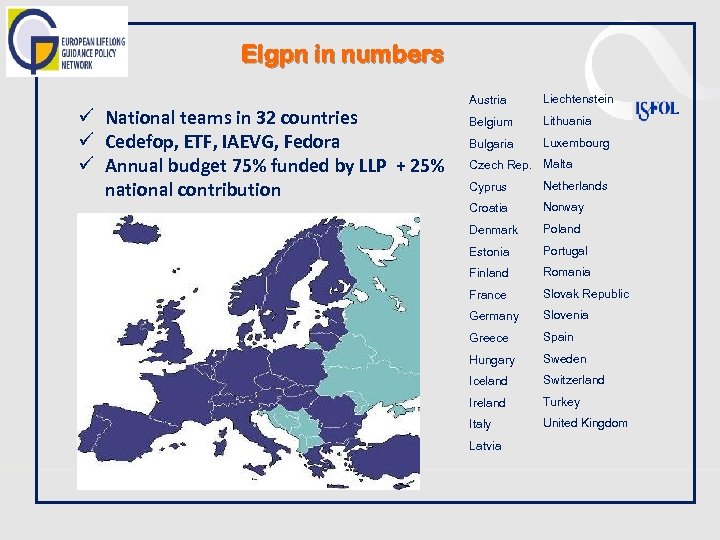 Elgpn in numbers ü National teams in 32 countries ü Cedefop, ETF, IAEVG, Fedora ü Annual budget 75% funded by LLP + 25% national contribution Austria Liechtenstein Belgium Lithuania Bulgaria Luxembourg Czech Rep. Malta Cyprus Netherlands Croatia Norway Denmark Poland Estonia Portugal Finland Romania France Slovak Republic Germany Slovenia Greece Spain Hungary Sweden Iceland Switzerland Ireland Turkey Italy United Kingdom Latvia
 Rete Elgpn obiettivi principali A. Fornire assistenza agli Stati membri dell’Ue e ai paesi limitrofi nello sviluppo della cooperazione nel campo dell’orientamento permanente nei settori dell’istruzione e del lavoro B. Comunicare i risultati in termini di politiche e strategie per l’orientamento ai decisori politici e agli stakeholder
 T a r g e t a u d i e n c e Main target group ü Policy and decision makers Secondary target groups ü Guidance practitioners
 Co-operation with other structures • The Network and the national fora has been linked, through appropriate membership or co-operation arrangements, to other relevant networks and initiatives at European level. These include: – – – CEDEFOP, ETF The Euroguidance network. HOPES network. Professional networks, e. g. IAEVG, FEDORA, NCDA Other international organisations, bodies (e. g. the OECD) Other relevant stakeholder networks (e. g. social partners, parents).
 ELGPN outputs 2011 -2012 • Reflection notes from thematic activities • Policy briefings related to thematic activities • Activity report with examples of promising/good practises in lifelong guidance policy development • Database of interesting/good policy initiatives – http: //elgpn. eu/elgpndb • National and international events with ELGPN member contributions • A set of publications, including the Elgpn Resource Kit for policy and decision makers.
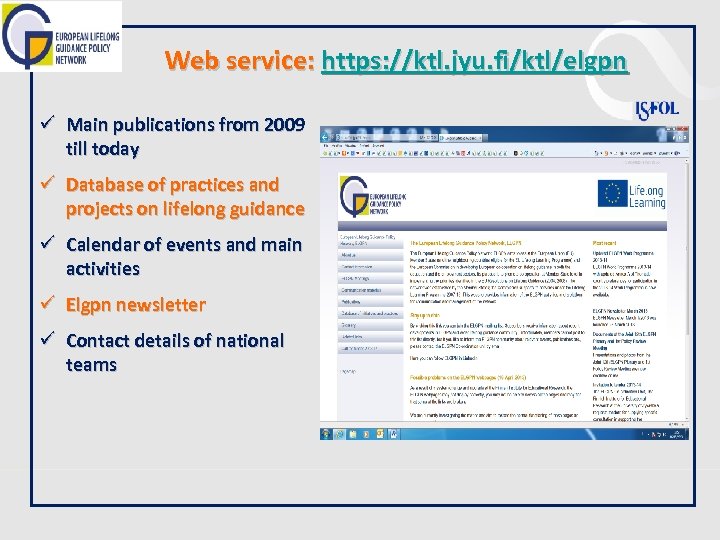 Web service: https: //ktl. jyu. fi/ktl/elgpn ü Main publications from 2009 till today ü Database of practices and projects on lifelong guidance ü Calendar of events and main activities ü Elgpn newsletter ü Contact details of national teams
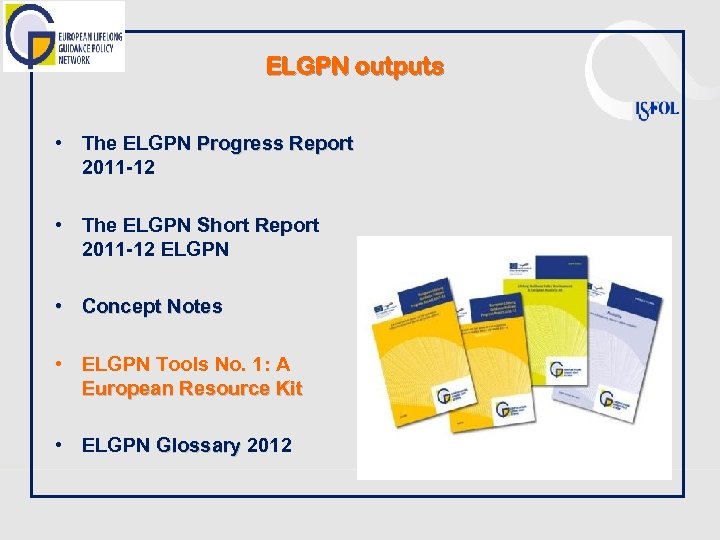 ELGPN outputs • The ELGPN Progress Report 2011 -12 • The ELGPN Short Report 2011 -12 ELGPN • Concept Notes • ELGPN Tools No. 1: A European Resource Kit • ELGPN Glossary 2012
 ELGPN strategic goal 2011 -12 • To deepen attention to the four themes within the 2008 Resolution; • to link this LLG perspective more closely to sectoral policy development – (in schools, VET, higher education, adult education, employment, and social inclusion) • at both national and EU levels; • and to produce concrete tools to support these processes, e. g – Glossary of key terminology • Adaptation of the Elgpn Resourse Kit.
 A service to citizens who wish to move throughout Europe http: //europass. cedefop. europa. eu 23
 Europass • Decision 2241/2004/EC of the European Parliament and the Council of 15 December 2004 on a single framework for the transparency of qualifications and competences. Why Transparency? Helping citizens to make their qualifications and competences easily understood, when applying for a job or a learning opportunity: Thus, facilitating the mobility of citizens for both occupational and learning purposes.
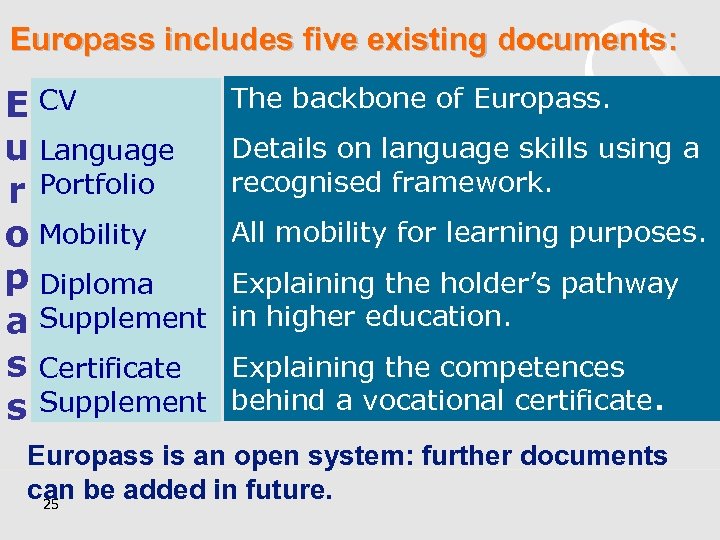 Europass includes five existing documents: E CV u Language r Portfolio o Mobility p Diploma a Supplement s Certificate s Supplement The backbone of Europass. Details on language skills using a recognised framework. All mobility for learning purposes. Explaining the holder’s pathway in higher education. Explaining the competences behind a vocational certificate. Europass is an open system: further documents can be added in future. 25
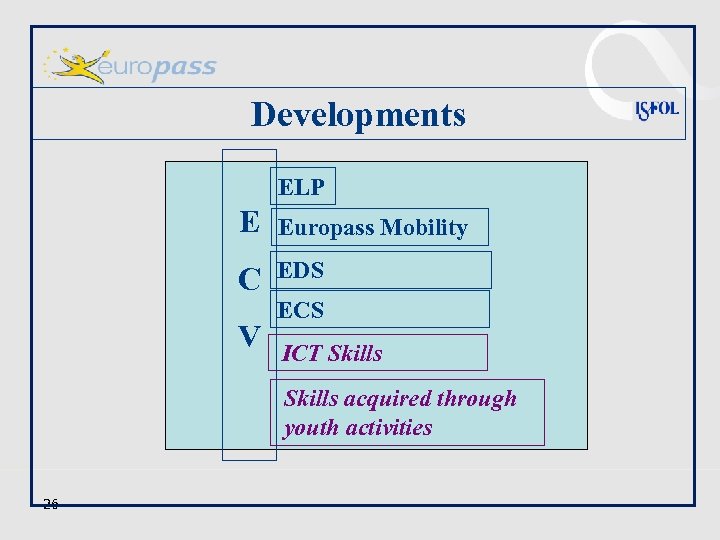 Developments ELP E Europass Mobility C EDS V ECS ICT Skills acquired through youth activities 26
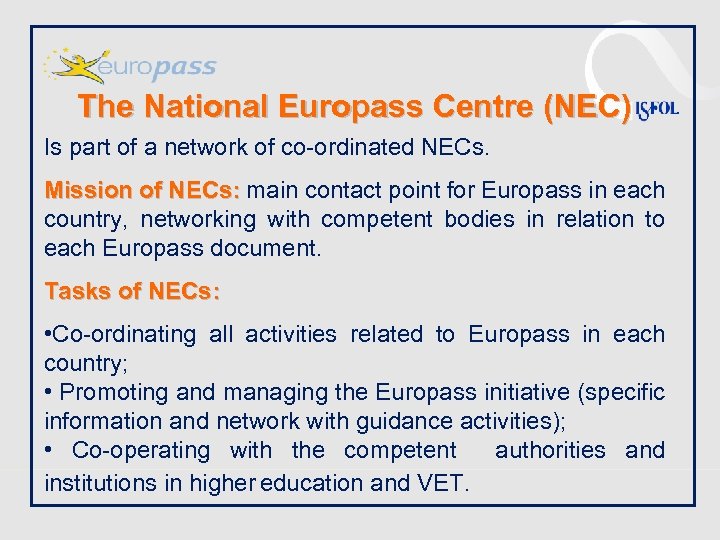 The National Europass Centre (NEC) Is part of a network of co-ordinated NECs. Mission of NECs: main contact point for Europass in each country, networking with competent bodies in relation to each Europass document. Tasks of NECs: • Co-ordinating all activities related to Europass in each country; • Promoting and managing the Europass initiative (specific information and network with guidance activities); • Co-operating with the competent authorities and institutions in higher education and VET.
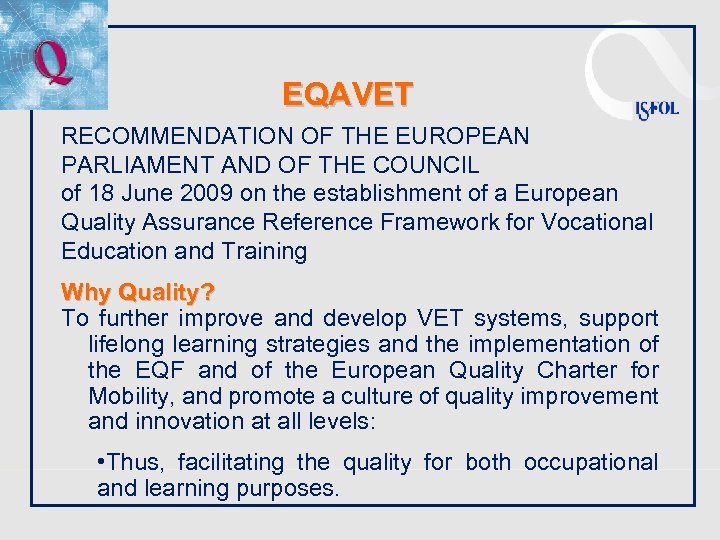 EQAVET RECOMMENDATION OF THE EUROPEAN PARLIAMENT AND OF THE COUNCIL of 18 June 2009 on the establishment of a European Quality Assurance Reference Framework for Vocational Education and Training Why Quality? To further improve and develop VET systems, support lifelong learning strategies and the implementation of the EQF and of the European Quality Charter for Mobility, and promote a culture of quality improvement and innovation at all levels: • Thus, facilitating the quality for both occupational and learning purposes.
 Italian context for Quality Assurance The development of a methodology and tools for QA in VET is the condition for the improvement of employment and the competitiveness of the system. The accountability of Systems and VET providers is the pre-condition for the construction of a quality system as required in the EQAVET Recommendation.
 The Italian Board composition The involvement of Institutions is a Key element to insure the dissemination of results. Reference Point Board is composed by: • Ministry of Labour • Ministry of Education • Regions • Social Partners • Representatives of VET providers
 Aims of the Italian Reference Point • • To spread information about the activities of the European Network (EQAVET); To support the implementation of the National Approach; To support the development of the EQAVET Programme; To promote the dissemination and the implantation of methodologies and tools for Quality Assurance; To promote the achievement of QA culture and the benefits linked to the application of tools for Quality improvement; To coordinate the National activities for the participation to the European Network Programme; To create synergies among all activities set up by different stakeholders for QA.
 Research group “European networks”: Euroguidance, Elgpn, Europass, EQAVET Thank you for your attention. Academia Study visit Turin, 23 th and 24 th May 2013 Roma, Corso d’Italia 33 Ms Concetta Fonzo, c. fonzo@isfol. it