 Скачать презентацию Life Cycle Assessment The Science behind Environmental Product
ba4b22c65c5bfd324f5a653490a3305d.ppt
- Количество слайдов: 22



Life Cycle Assessment The Science behind Environmental Product Labeling
What we will cover. . .
• Background on IERE & basics of Life Cycle Assessment (LCA) • Global picture for EPD labeling • Creating the Product Category Rule for Wine • Automated software for EPD labeling • Marketing Advantages
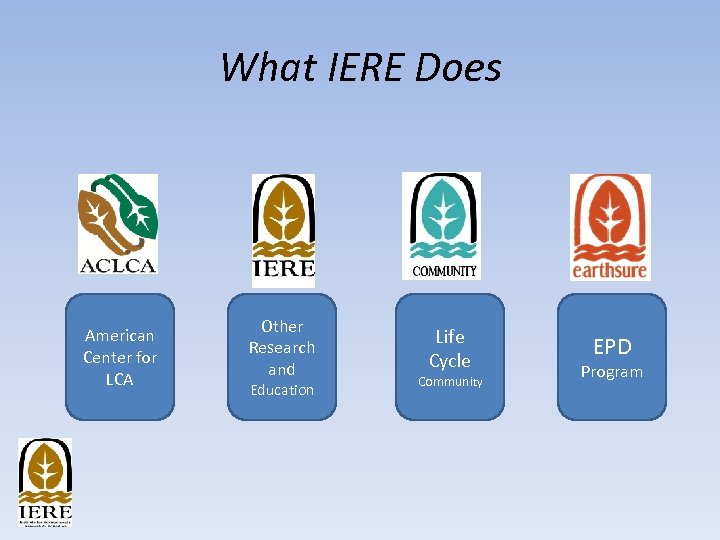
What IERE Does American Center for LCA Other Research and Education Life Cycle Community EPD Program
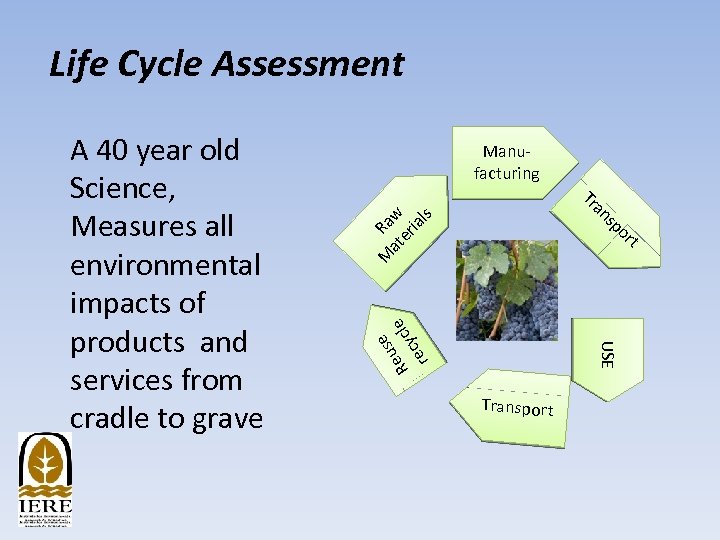
Life Cycle Assessment Manufacturing Tr a se eu cle R y rec M Ra at w er ial s ns po USE A 40 year old Science, Measures all environmental impacts of products and services from cradle to grave Transport rt
ISO and the 14040 series • ISO makes voluntary standards to support international trade: ISO is sister organization of WTO • 14040 series are guidance on how to do LCA’s • ISO 14025 is guidance on environmental product declarations • Regulation & legislation based on LCA is presumed not to present technical barriers to trade under the WTO
What’s happening around the globe? • US Implementing the ZEF Program
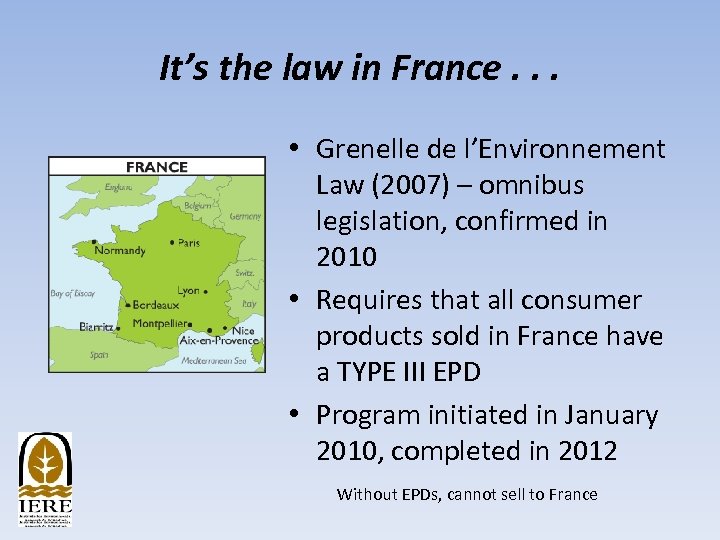
It’s the law in France. . . • Grenelle de l’Environnement Law (2007) – omnibus legislation, confirmed in 2010 • Requires that all consumer products sold in France have a TYPE III EPD • Program initiated in January 2010, completed in 2012 Without EPDs, cannot sell to France
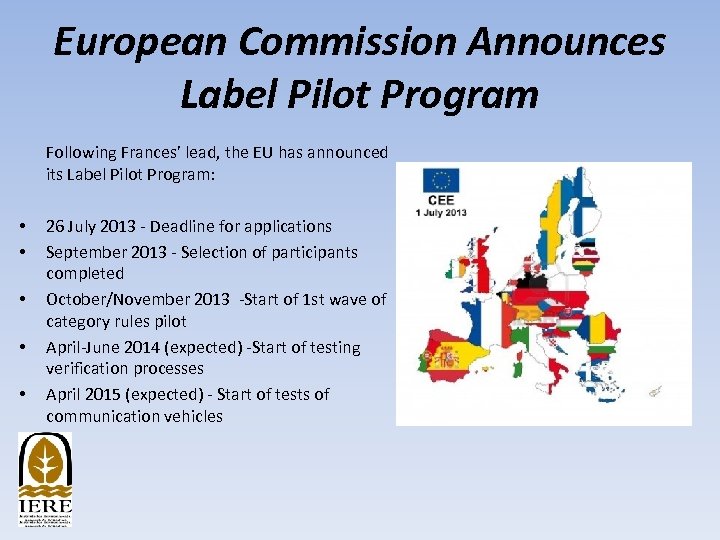
European Commission Announces Label Pilot Program Following Frances’ lead, the EU has announced its Label Pilot Program: • • • 26 July 2013 - Deadline for applications September 2013 - Selection of participants completed October/November 2013 -Start of 1 st wave of category rules pilot April-June 2014 (expected) -Start of testing verification processes April 2015 (expected) - Start of tests of communication vehicles
3 Steps to Get Your Label • Create a Product Category Rule (PCR) • Conduct a product Life Cycle Assessment (LCA) • Use LCA data to formulate a Type III Environmental Product Declaration (EPD)
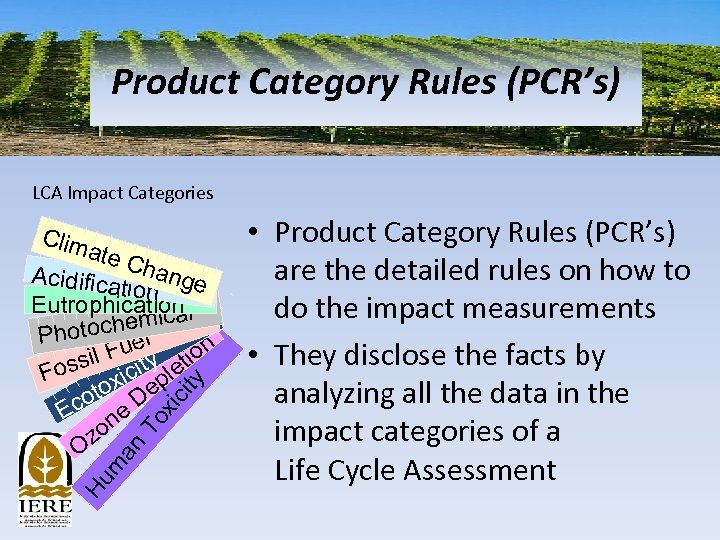
Product Category Rules (PCR’s) LCA Impact Categories Clim Hu m an To xic ity ate C Acidifica hange tion Eutrophication l chemica Photo uel n il F ity tio s Fos xic ple oto De Ec ne zo O • Product Category Rules (PCR’s) are the detailed rules on how to do the impact measurements • They disclose the facts by analyzing all the data in the impact categories of a Life Cycle Assessment
Existing PCR for Wine • A draft PCR exists for wine within the Environdec System in Europe • IERE has permission to edit for use in the U. S. • Participating wineries would serve on the PCR Committee, review and revise the draft for use by U. S. wine makers
Existing Data – Identify Gaps • Existing certifications are tracking inputs and outputs of fertilizer, pesticides, and irrigation. • LCA would require data from energy (fuel, electricity), machinery, production materials (trellis materials, packaging materials), and waste management, this fills the gaps.
Conducting your LCA 1. Choose a program operator (IERE) 2. Perform your LCA in conformance with the PCR and convert data into EPD format 3. Have the EPD independently reviewed by a certified LCA Professional 4. Receive your label from earthsure® to display on product or at POS
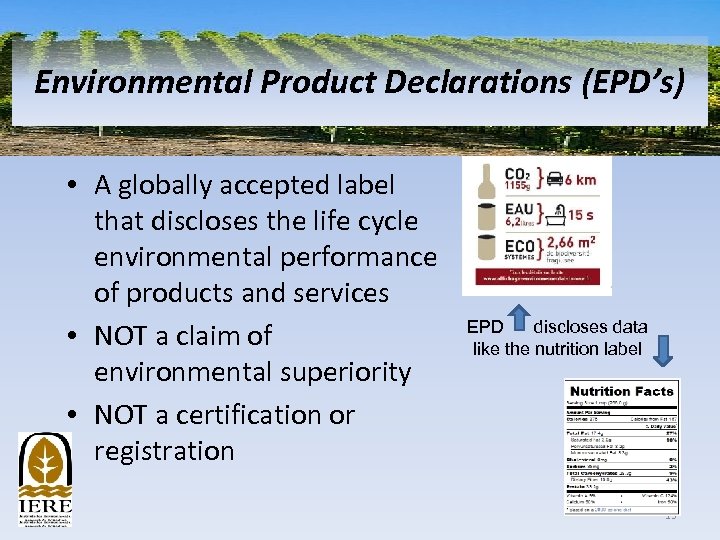
Environmental Product Declarations (EPD’s) • A globally accepted label that discloses the life cycle environmental performance of products and services • NOT a claim of environmental superiority • NOT a certification or registration EPD discloses data like the nutrition label 15
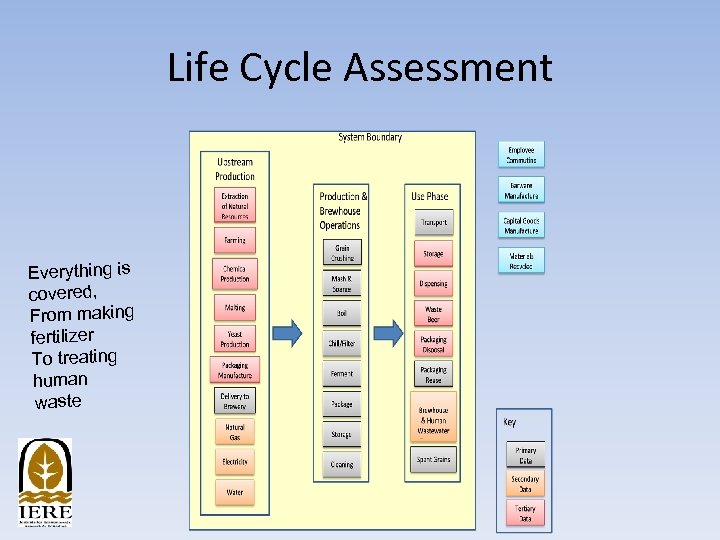
Life Cycle Assessment Everything is covered, From making fertilizer To treating human waste
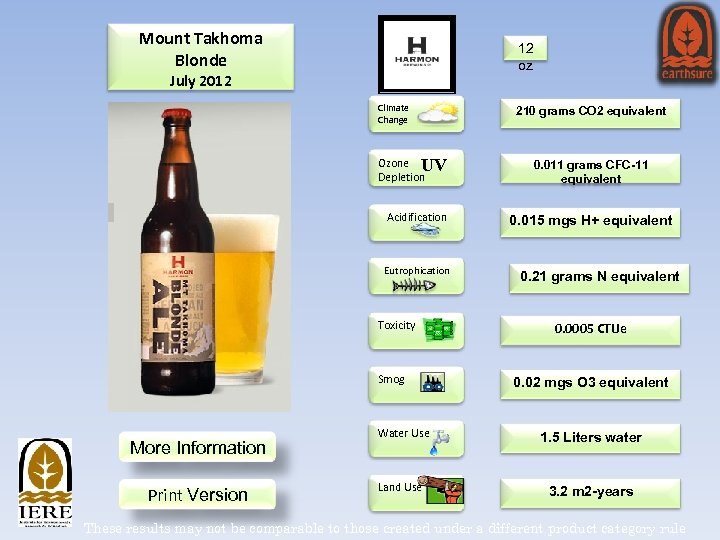
Mount Takhoma Blonde 12 oz July 2012 Climate Change Ozone UV Depletion Acidification Eutrophication Toxicity Smog More Information Print Version 210 grams CO 2 equivalent 0. 011 grams CFC-11 equivalent 0. 015 mgs H+ equivalent 0. 21 grams N equivalent 0. 0005 CTUe 0. 02 mgs O 3 equivalent Water Use 1. 5 Liters water Land Use 3. 2 m 2 -years These results may not be comparable to those created under a different product category rule
Why should you be part of this? • Let’s you use your environmental performance to drive sales • LCA identifies potential cost savings through your value chain • Increased exposure of your environmental stewardship and industry leadership • Secures global market access – EPD’s being required in some countries.

Colleen Hall Barta Director of Development 253 -208 -9702 colleen@iere. org
Скачать презентацию Life Cycle Assessment The Science behind Environmental Product
ba4b22c65c5bfd324f5a653490a3305d.ppt