


 Скачать презентацию Life After Slavery 1865 -1900 Slavery Ends
c40c005f1f25074f626b52f47d06f1ac.ppt
- Количество слайдов: 17
 Life After Slavery 1865 -1900
 Slavery Ends n n n 1863 President Lincoln signs the Emancipation Proclamation into law This document frees slaves in the Confederacy, the southern states in rebellion. Blacks living outside of the Confederacy remain slaves.
 Reconstruction n The rebuilding of the economy of Confederacy following the Civil War 13 th Amendment to the Constitution frees all slaves and officially ends slavery in the USA Former slaves leave the Plantations in search of work as freedmen
 Freedman’s Bureau n n n An organization established by the government that helped ex-slaves and poor whites Established schools, provided medical care, and helped find homes and jobs for people Helped former slaves began to build new lives for themselves away from the Plantations
 Problems n n Ex-slaves had limited job skills outside of the Plantations Little to no real education Left the plantations in large numbers traveling around looking for work Klan develops as a hate group to control the activities of ex-slaves by attacking, beating and lynching, used fear to control ex-slaves
 Black Codes n n Laws passed by southern states to control the ex -slaves White’s used these laws to maintain white supremacy in the south Prejudice and racial discrimination continues and legal segregation develops Blacks were given curfews, needed a white benefactor to do business, were jailed for minor crimes then leased out to work the Plantations, mines and lumbar yards, as servants to Whites
 Ex-slaves n n 14 th Amendment gives citizenship rights to the ex-slaves 15 th Amendment gives voting rights to the ex-slaves Hiram Revels and Blanche Bruce become the first Blacks elected to the US Senate. 1872 seven Black men are serving in the US Senate
 Education n Schools are established to teach the former slaves to read Black churches began to open universities to educate Black Students Morehouse College, Howard University, Hampton Institute, Fisk University, Shaw University, and St. Augustine’s college are among the first HBCU’s to open.
 HBCU’s n n n Historically Black Colleges and Universities Train Black Teachers and Doctors Provided education in the social graces Taught former slaves how to manage business, eat properly, dress properly, speak properly Alpha Phi Alpha founded as the 1 st All Black Fraterntiy
 Sharecropping n n n The economic system to develop in the south following the end of slavery Ex-slaves were allowed to remain on the Plantation and work as Sharecroppers. The Black Sharecropper and his family provided the labor to produce the cash crops. The White Landlord(former Master of the Plantation) provided the land supplies needed to produce the crop.
 Sharecropping n n n When the crop was sold the expenses for producing the crop was deducted from the Black Sharecroppers half of the money. The Sharecropper received any money left after expenses were deducted. White Landlords regularly cheated the Black Sharecropper who had little to no education out of his share of the money. Laws made it impossible for the Black Sharecropper to question the Landlord. Under this system, most Blacks continued to live in slave like conditions.
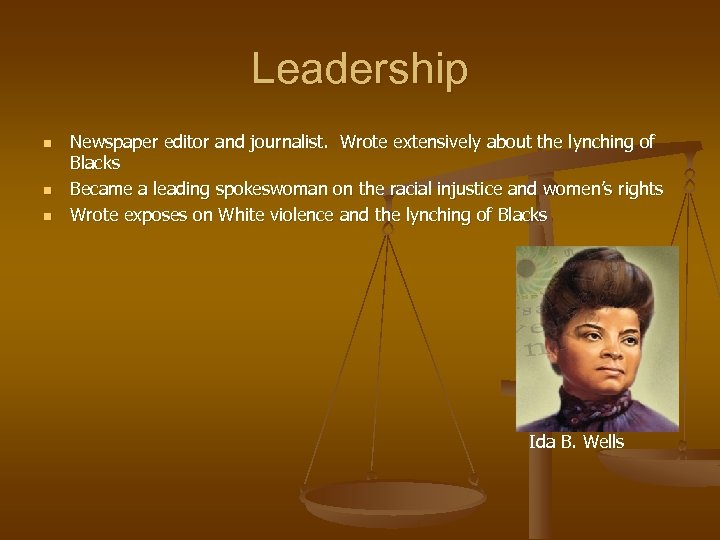 Leadership n n n Newspaper editor and journalist. Wrote extensively about the lynching of Blacks Became a leading spokeswoman on the racial injustice and women’s rights Wrote exposes on White violence and the lynching of Blacks Ida B. Wells
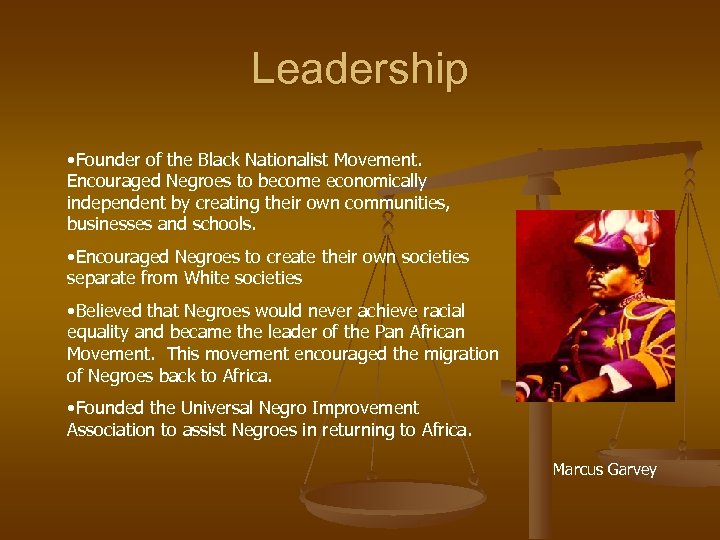 Leadership • Founder of the Black Nationalist Movement. Encouraged Negroes to become economically independent by creating their own communities, businesses and schools. • Encouraged Negroes to create their own societies separate from White societies • Believed that Negroes would never achieve racial equality and became the leader of the Pan African Movement. This movement encouraged the migration of Negroes back to Africa. • Founded the Universal Negro Improvement Association to assist Negroes in returning to Africa. Marcus Garvey
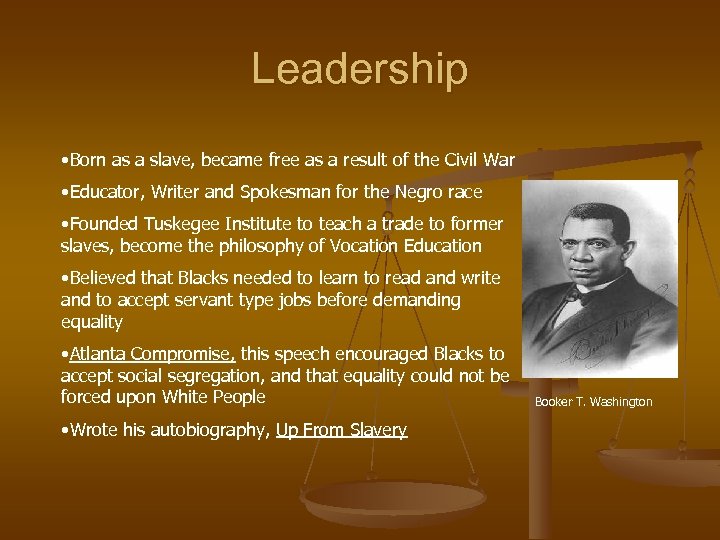 Leadership • Born as a slave, became free as a result of the Civil War • Educator, Writer and Spokesman for the Negro race • Founded Tuskegee Institute to teach a trade to former slaves, become the philosophy of Vocation Education • Believed that Blacks needed to learn to read and write and to accept servant type jobs before demanding equality • Atlanta Compromise, this speech encouraged Blacks to accept social segregation, and that equality could not be forced upon White People • Wrote his autobiography, Up From Slavery Booker T. Washington
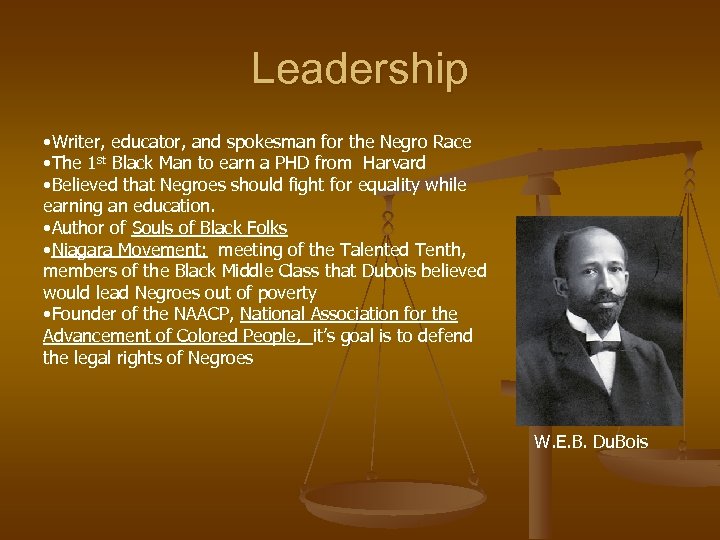 Leadership • Writer, educator, and spokesman for the Negro Race • The 1 st Black Man to earn a PHD from Harvard • Believed that Negroes should fight for equality while earning an education. • Author of Souls of Black Folks • Niagara Movement: meeting of the Talented Tenth, members of the Black Middle Class that Dubois believed would lead Negroes out of poverty • Founder of the NAACP, National Association for the Advancement of Colored People, it’s goal is to defend the legal rights of Negroes W. E. B. Du. Bois
 Leadership n n n n Benjamin Singleton: leader of the Exodusters: former slaves moving out West and established independent Black communities. Nicodemas and Lawrence, Kansas were the most well known. Madam CJ Walker: Ist Female Millionaire, invented and marketed hair care products and the straightening comb George Washington Carver: scientist at Tuskegee Institute formulated hundreds of products from the peanut and sweet potato Daniel Hale Williams: Performed the 1 st successful heart operation Matthew Henson: an explorer, was one of the 1 st men to reach the North Pole Elijah Lovejoy: invented the automatic oil cup for trains and heavy equipment Granville T. Woods: invented the automatic air brake North Carolina Mutual: 1 st successful Black owned insurance company
 Leadership n n n Elizabeth Keckley: seamstress for Mrs. Lincoln, writer of Thirty Years a Slave and Four Years in the White House Charles Chestnutt: writer from North Carolina, wrote about the problems of the “tragic mulatto, ” mixed people who were not accepted by the Black or White race. House Behind the Cedars and The Wife of His Youth, considered his most famous work Paul Laurence Dunbar: 1 st widely recognized Black Poet