


 Скачать презентацию LIFE AFTER HIGH SCHOOL College Program for Students
398456cb230dd5dd72a30b74ffe609bf.ppt
- Количество слайдов: 35
 LIFE AFTER HIGH SCHOOL; College Program for Students with Disabilities Peter Stover, MSW Eastern New Mexico University-Roswell
 Challenges Facing Individuals with Disabilities n Education q q n IDEA- Success Based ADA and Section 504 - Accessibility Based Employment q q q Competitive Expectations are high Fast skill development expected
 Barriers to College Success n n n Diminished support system Inadequate self-advocacy skills Inadequate accommodations High academic demands Inadequate life skills Inadequate social skills
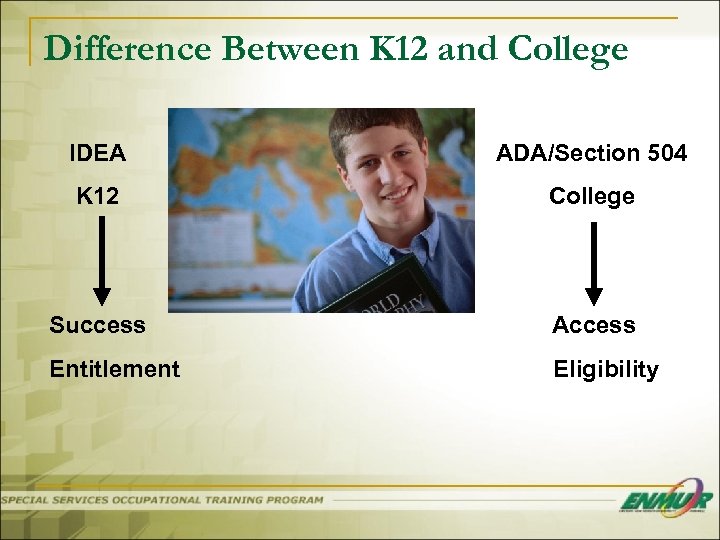 Difference Between K 12 and College IDEA ADA/Section 504 K 12 College Success Access Entitlement Eligibility
 Types of Accommodations n n n Assistive Technology Textbooks on CD Sign Language Interpreter Reader, Scribes, Note-takers Out of class testing Extended test time
 Employment and Disabilities n n Unemployment Rate: 3 times more than general population (Employment and Disability Institute, 2003) 2 out of 10 people with disabilities (20%) say their jobs involve only a small amount or almost none of their full talents and abilities (National Organization on Disability, 2000) n n n 33% of adults with disabilities live in households with total income of <$15, 000 compared to only 12% of those without disabilities (2004 US Population Census) College experience increases marketability Employers are more likely to hire someone with work experience
 Barriers to Employment Success n n n n Occupation does not match interests Getting along with co-workers Job application and interview skills inadequate Not understanding employer expectations Transportation issues Time management difficulties Difficulty getting an effective job coach
 College Programs for Students with Intellectual Disabilities n Venture Program, Bellevue Community College q q n Intended for high-functioning individuals with learning, cognitive and intellectual disabilities. The rigorous four-year program leads to an Associate in Occupational and Life Skills degree No dorms Threshold Program, Lesley University q q q Two-year, Certificate of Completion, 6 college credits Dorms available Students with diverse learning needs, low average IQ
 College Programs for Students with Intellectual Disabilities n Transition to Independent Living, Taft University q q q n Emphasis on learning independent living skills Developmentally disabled adults 2 -year waiting list Occupational Training Program, Eastern New Mexico University-Roswell q Emphasis on vocational training independent living skills
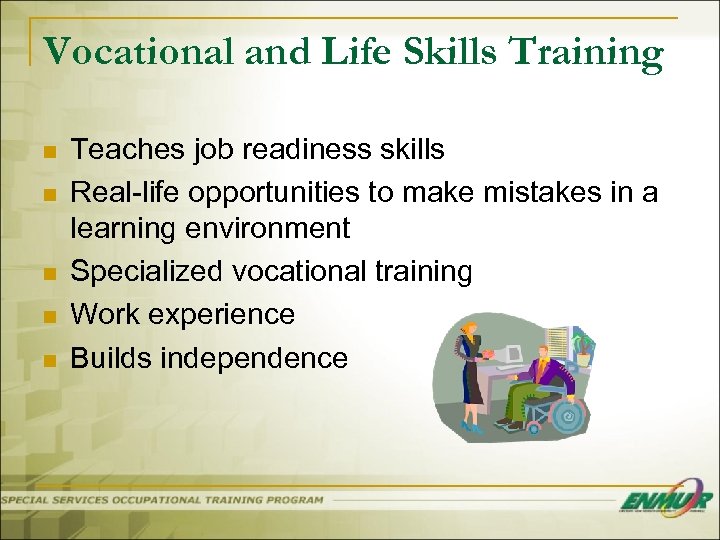 Vocational and Life Skills Training n n n Teaches job readiness skills Real-life opportunities to make mistakes in a learning environment Specialized vocational training Work experience Builds independence
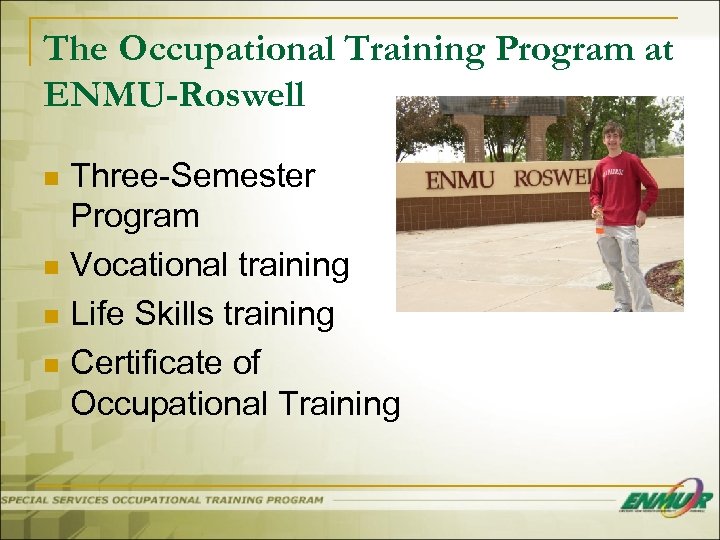 The Occupational Training Program at ENMU-Roswell Three-Semester Program n Vocational training n Life Skills training n Certificate of Occupational Training n
 ENMU-Roswell Special Services Department Mission Statement The mission of the Special Services Department is to assist with the integration of students with disabilities into the university community and to accommodate those students with the appropriate services necessary to allow full participation in all programs. n n n Functions of the Department: Occupational Training Program Academic Accommodations Vocational Evaluations
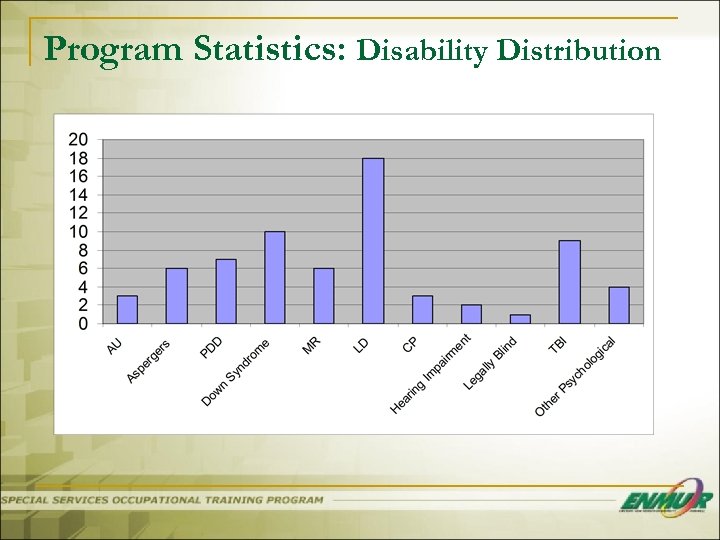 Program Statistics: Disability Distribution
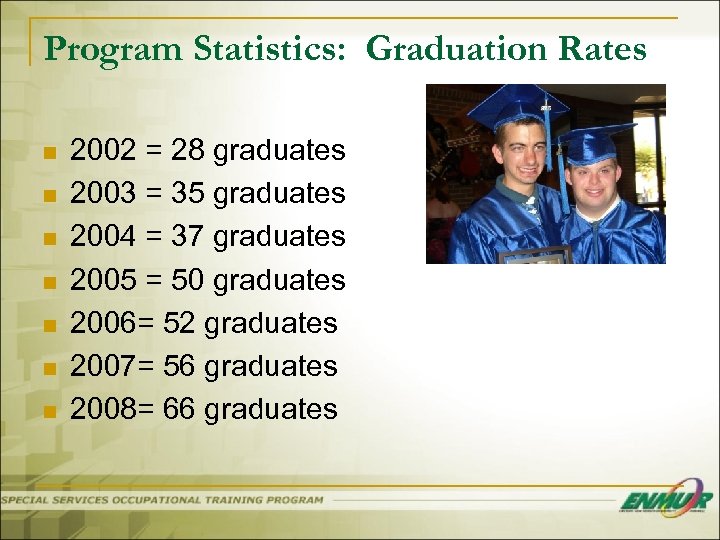 Program Statistics: Graduation Rates n n n n 2002 = 28 graduates 2003 = 35 graduates 2004 = 37 graduates 2005 = 50 graduates 2006= 52 graduates 2007= 56 graduates 2008= 66 graduates
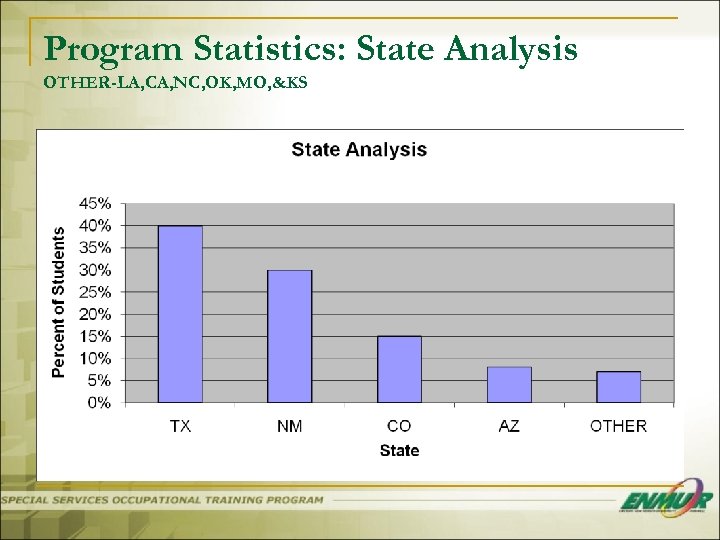 Program Statistics: State Analysis OTHER-LA, CA, NC, OK, MO, &KS
 Program Statistics: Employment Placement Rates n n n 2001: 2002: 2003: 2004: 2006: at 9 months at 12 months at 6 months -78 % employed -86 % employed -73 % employed -70 % employed -81 % employed or Higher education 2007: at 6 months- - 76 % employed or Higher education
 Entrance Requirements Vocational evaluation 1. 1. 2. Documentation of Disability 2. 1. 2. 3. 4. ENMU-R Valpar Outside evaluation accepeted Most recent IEP with testing (within last 3 -5 years) Physical disability –Medial report Interview with staff Minimum of 18 years of age
 Entrance Requirements Skill Requirements Self-Medicate independently administer daily medication Time management wake to alarm clock follow schedule Personal management Personal hygiene laundry Demonstrate effective communication skills Demonstrate appropriate social behavior
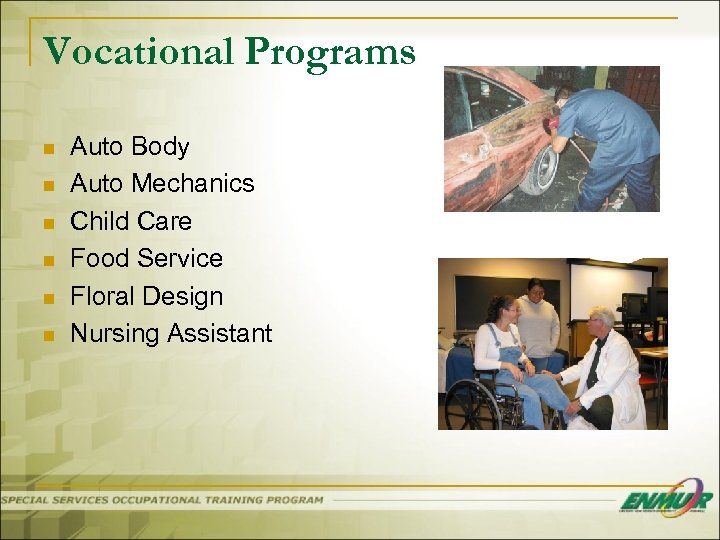 Vocational Programs n n n Auto Body Auto Mechanics Child Care Food Service Floral Design Nursing Assistant
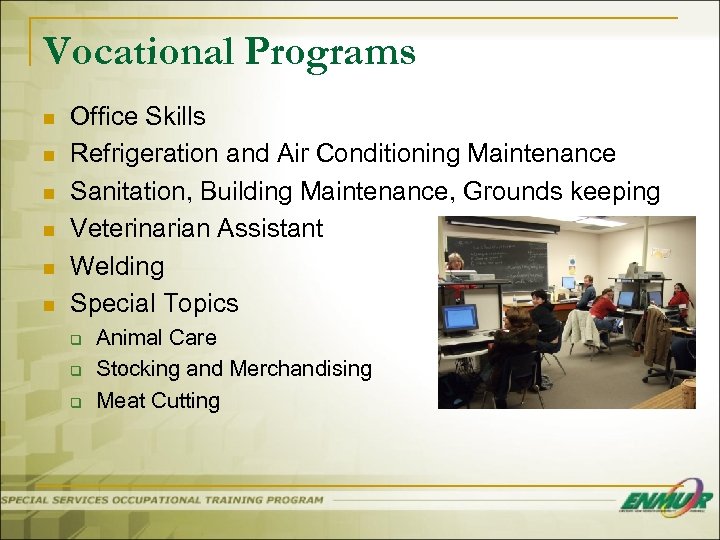 Vocational Programs n n n Office Skills Refrigeration and Air Conditioning Maintenance Sanitation, Building Maintenance, Grounds keeping Veterinarian Assistant Welding Special Topics q q q Animal Care Stocking and Merchandising Meat Cutting
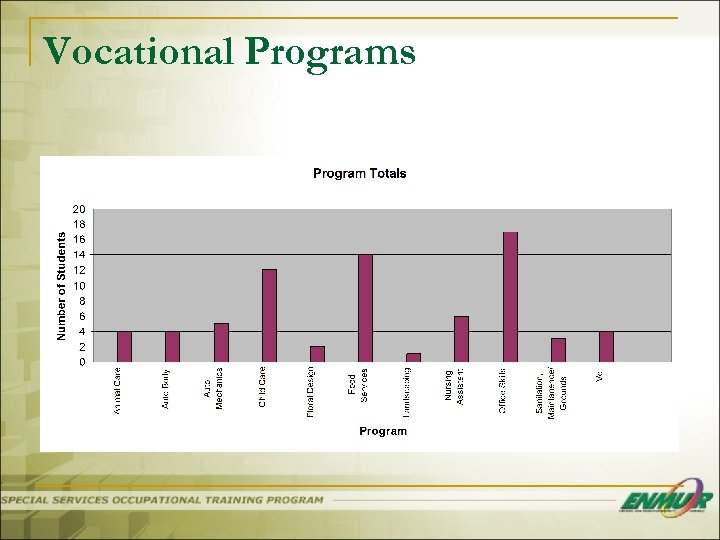 Vocational Programs
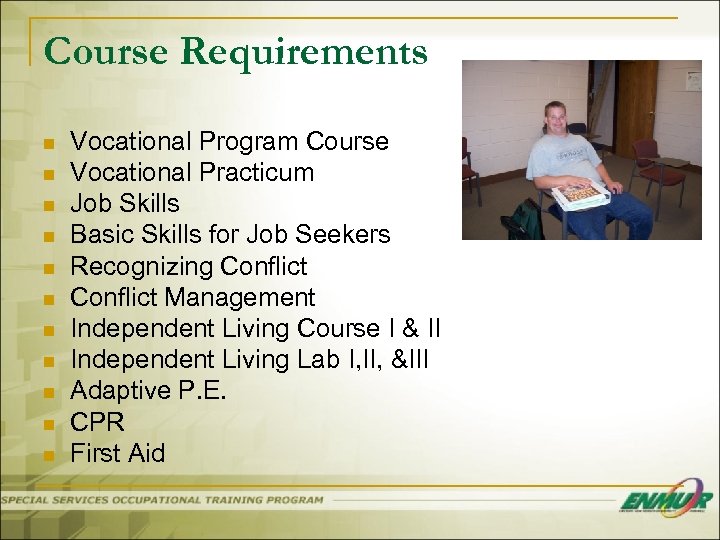 Course Requirements n n n Vocational Program Course Vocational Practicum Job Skills Basic Skills for Job Seekers Recognizing Conflict Management Independent Living Course I & II Independent Living Lab I, II, &III Adaptive P. E. CPR First Aid
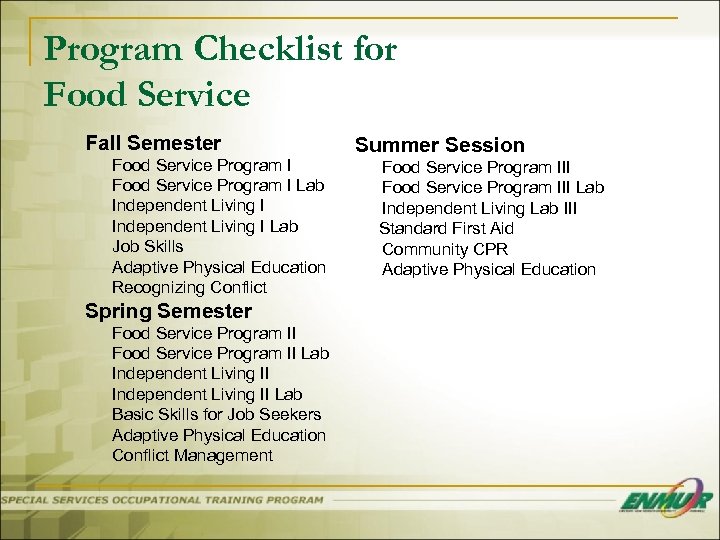 Program Checklist for Food Service Fall Semester Food Service Program I Lab Independent Living I Lab Job Skills Adaptive Physical Education Recognizing Conflict Spring Semester Food Service Program II Lab Independent Living II Lab Basic Skills for Job Seekers Adaptive Physical Education Conflict Management Summer Session Food Service Program III Lab Independent Living Lab III Standard First Aid Community CPR Adaptive Physical Education
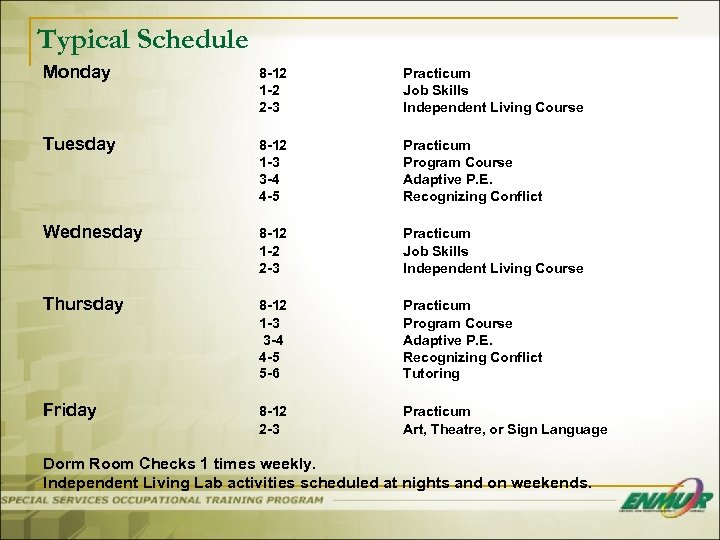 Typical Schedule Monday 8 -12 1 -2 2 -3 Practicum Job Skills Independent Living Course Tuesday 8 -12 1 -3 3 -4 4 -5 Practicum Program Course Adaptive P. E. Recognizing Conflict Wednesday 8 -12 1 -2 2 -3 Practicum Job Skills Independent Living Course Thursday 8 -12 1 -3 3 -4 4 -5 5 -6 Practicum Program Course Adaptive P. E. Recognizing Conflict Tutoring Friday 8 -12 2 -3 Practicum Art, Theatre, or Sign Language Dorm Room Checks 1 times weekly. Independent Living Lab activities scheduled at nights and on weekends.
 Completion of Program n n Strict attendance policy 75% mastery in occupational program class and practicum 60% level mastery of all other courses Students must complete all courses at the mastery levels to receive certificates
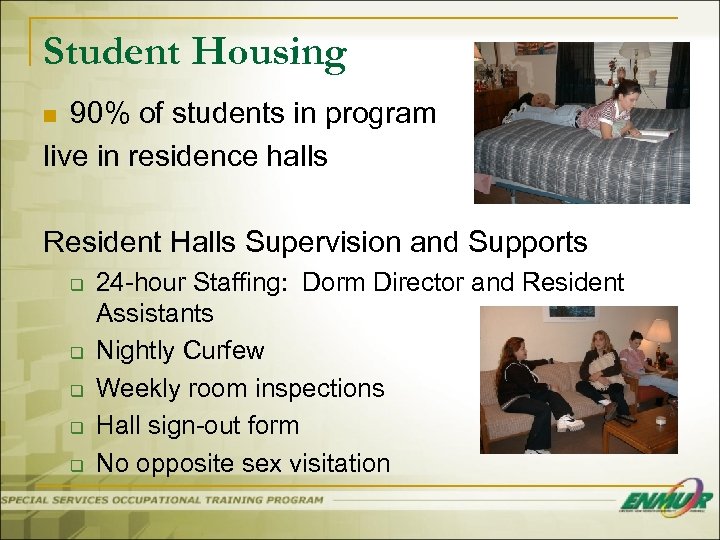 Student Housing 90% of students in program live in residence halls n Resident Halls Supervision and Supports q q q 24 -hour Staffing: Dorm Director and Resident Assistants Nightly Curfew Weekly room inspections Hall sign-out form No opposite sex visitation
 Student Housing n n New resident halls and Activity Center opened Fall 2007 Amenities q q n n n Laundry facilities Free basic cable Wireless internet Activity Center: computer lab, game room, media room Rooms available year around Weekly social activities available on and off campus Dorm and apartment style suites
 Health Services n n n Certified Family Nurse Practitioner Assists with medication refills and scheduling physician appointments Student responsible for: q q q Obtaining prescription Managing medication Finding local physician
 Additional Student Services n n n n Counseling Tutoring Grade and attendance monitoring Behavior intervention Small class sizes Independent living support Optional courses: Driver’s Education
 Tuition and Fees n n n Students pay Special Services program fee Students pay for uniforms, tools, books, supplies, and transportation costs Out of State: $4000 -$5000 for Fall and Spring semesters q $2500 for Summer Total Program Costs for Out-of-State Students: $16, 000 -$18, 000 q
 Financial Options n n n Vocational Rehabilitation Agencies (DARS) Financial Aid and Student Loans Private Pay- Payment installment options
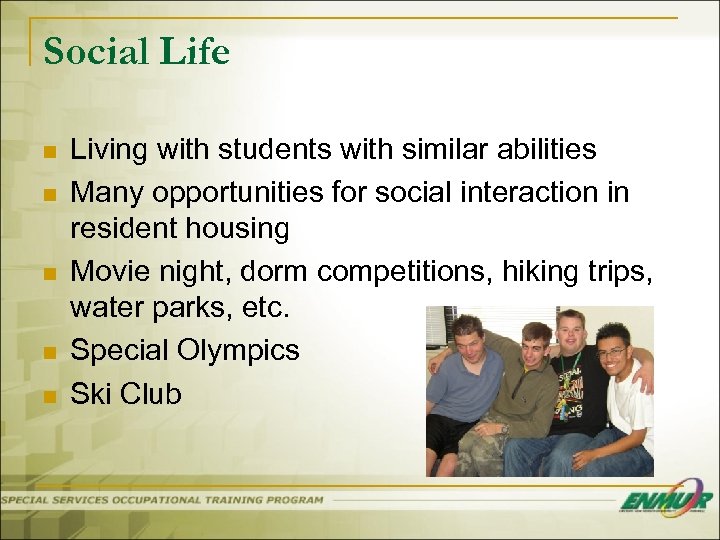 Social Life n n n Living with students with similar abilities Many opportunities for social interaction in resident housing Movie night, dorm competitions, hiking trips, water parks, etc. Special Olympics Ski Club
 Key Points n n n Successful college experience without the high academic demands High placement rates Supportive environment to learn independent living skills away from home On-the-job experience Positive social environment
 Resources n www. thinkcollege. com n www. heath. gwu. edu- George Washington Heath Resource Center n www. ahead. org- Association of Higher Education and Disability
 Questions?