


 Скачать презентацию LIDO Telecommunications Essentials Part 3 Next Generation Networks
46c8df1b4a7058af310d1910ce639fdb.ppt
- Количество слайдов: 77
 LIDO Telecommunications Essentials® Part 3 Next Generation Networks IP Services LIDO 1
 Contents • IP Telephony, unified messaging, applications • RTP, Multimedia • VOIP Qo. S revisited • Signaling protocols, ENUM • VPNs • IPTV revisited LIDO 2
 Value Added IP Applications • Evolving next-generation IP services include LIDO – – – IP virtual private networks (VPNs), IP telephony (IPT) and Voice over IP (Vo. IP), IP centrex and IP call centers, application hosting, mobility management/follow-me services, unified messaging, instant messaging (IM), presence management, Video over IP, Internet Protocol TV (IPTV), and audioconferencing, videoconferencing, and web/data 3
 IP Telephony (IPT) Definitions • There are three main categories of telephony or voice communications over IP networks, according to the ITU-T. • Internet Protocol Telephony (IPT) – The transmission of voice, fax and related services over packet-switched IP-based networks. • Internet Telephony – Telephony in which the principal transmission network is the public Internet. • Voice over IP (Vo. IP) – IP Telephony, in which the principal transmission network or networks are private, managed IPbased networks 4 LIDO
 Is IP Telephony Here? • Not all enterprises are using or considering IP Telephony services, but a large percentage are using or considering migrating to MPLS, in part because combining voice, video, and data can finally cost justify MPLS. • Most organizations are currently using predominantly ATM or Frame Relay, with some IP VPNs here and there. LIDO 5
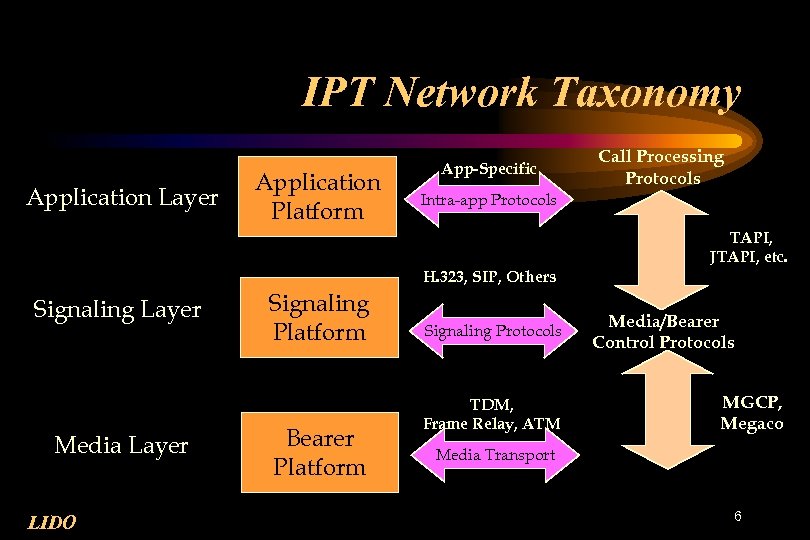 IPT Network Taxonomy Application Layer Application Platform App-Specific Call Processing Protocols Intra-app Protocols TAPI, JTAPI, etc. H. 323, SIP, Others Signaling Layer Media Layer LIDO Signaling Platform Bearer Platform Signaling Protocols TDM, Frame Relay, ATM Media/Bearer Control Protocols MGCP, Megaco Media Transport 6
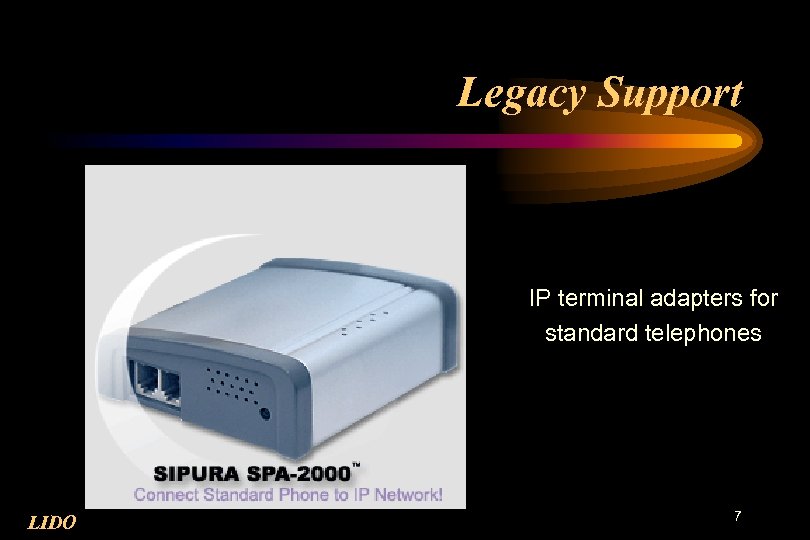 Legacy Support IP terminal adapters for standard telephones LIDO 7
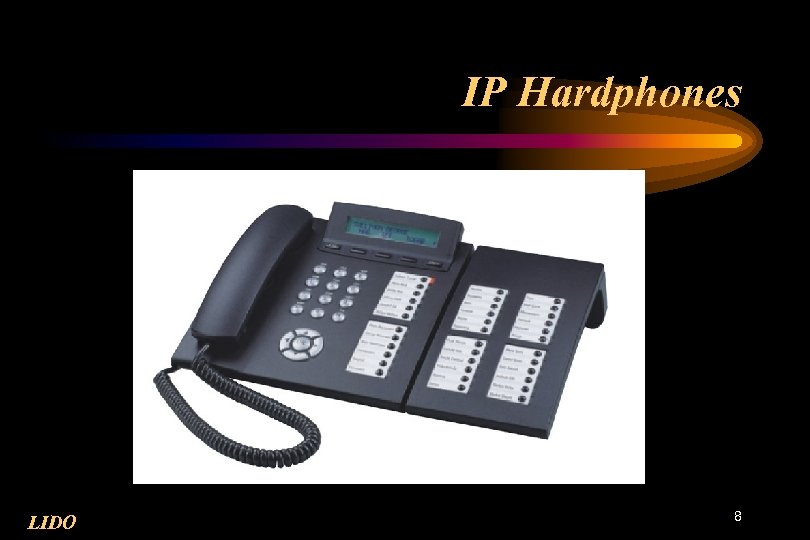 IP Hardphones LIDO 8
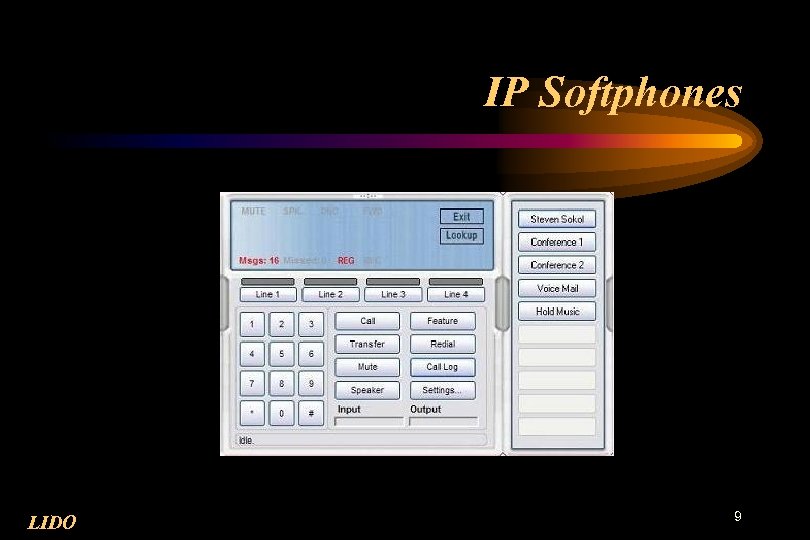 IP Softphones LIDO 9
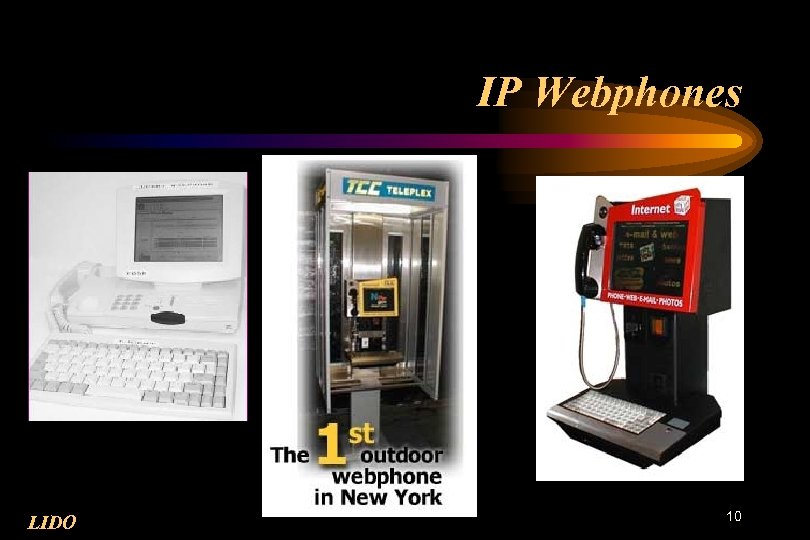 IP Webphones LIDO 10
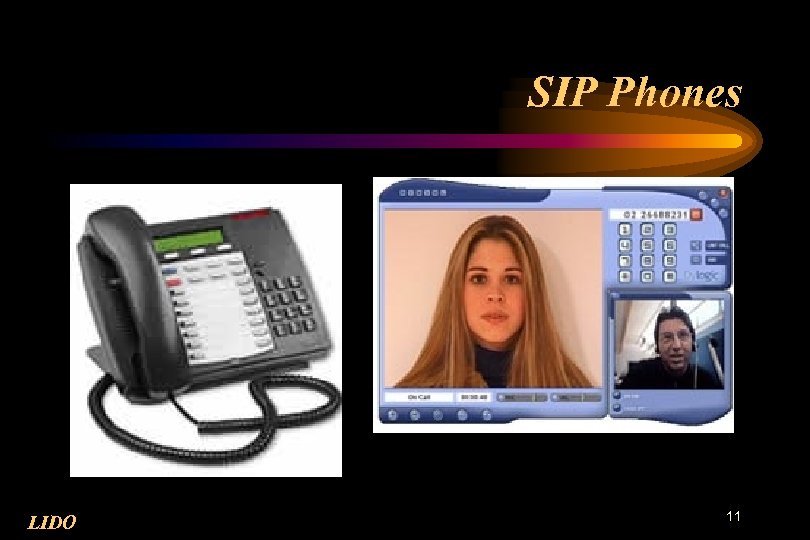 SIP Phones LIDO 11
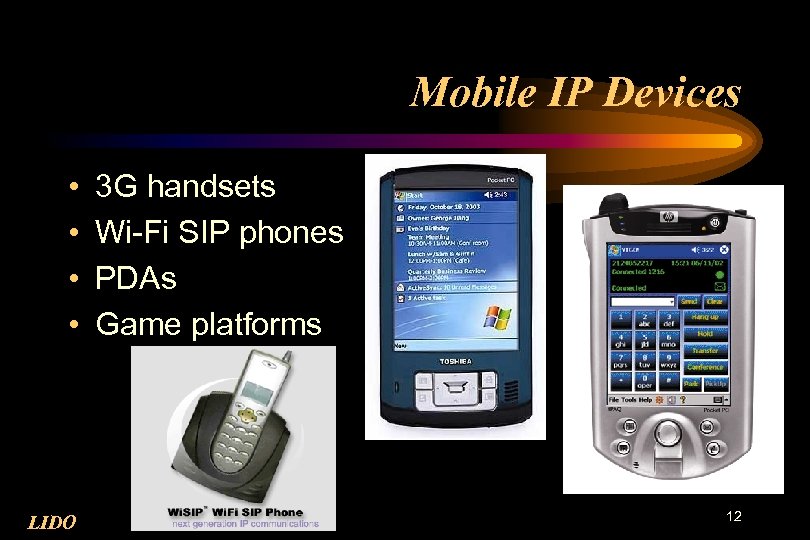 Mobile IP Devices • • LIDO 3 G handsets Wi-Fi SIP phones PDAs Game platforms 12
 IP PBXs Application Areas • Significant progress has been made in several key applications areas – Unified messaging – Conferencing applications – Collaboration applications – Presence awareness – Multimedia packages – Mobility features – Extensible SIP support LIDO 13
 IP PBXs Application Areas • The most notable trends include – Video is coming to your desktop – Document collaboration – Mobility LIDO 14
 IP PBXs : Key Collaboration and Conferencing Features – Softphone support – Use of presence (dynamic and/or static) – Mobility features – Conferencing (scheduled and/or ad hoc) – Search capabilities – Contacts/database access, integration – Video point-to-point, conferencing – Call control: of external devices LIDO – Call control: filters, find me/follow me – Recent-call history, sort, quick dial – Instant messaging – Chat; multiparty IM – Document viewing, presentation – Document collaboration, coediting – Whiteboarding – Web co-browsing 15
 IP PBXs : Key Unified Messaging Features – Redundant voice mail servers – Text-to-Speech readout of email, in multiple languages – Automatic speech recognition (ASR) – Inbox shows caller by ANI number and/or name – Voice/email shows message duration – Can reply, forward voice/email – Can add other attachments – Can send voice/email via distribution list LIDO – Can send voice/email via distribution list – Telephony User Interface (TUI)-based retrieval of voice/email – Call-out off-system voice mail delivery – Voice mail notification options – Scheduled delivery of voice mails – Can dial-back from Inbox interface – Mobility features 16
 Standards for IP Voice • Voice traffic characteristics – Isochronous traffic flow – Real-time communications – Delay-sensitive – Loss-sensitive – Low bandwidth requirements – High Quality of Service requirement LIDO 17
 Delay and Voice Quality • Delay can result in serious degradation of voice quality, and needs to be tightly controlled in packet networks. • Delay Standards – ITU recommendations – voice – 150 msec max end-to-end – Video - 80 msec max end-to-end – interactive apps - 30 -50 msec max, end-to-end LIDO 18
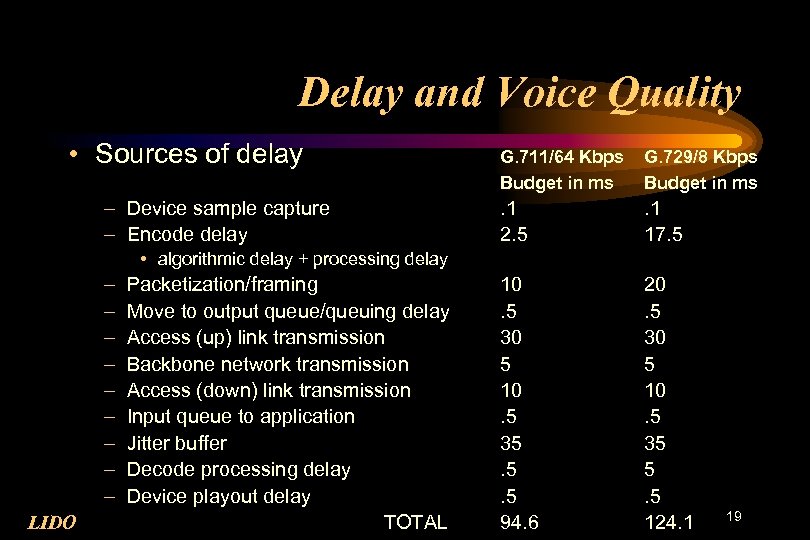 Delay and Voice Quality • Sources of delay – Device sample capture – Encode delay G. 711/64 Kbps Budget in ms G. 729/8 Kbps Budget in ms . 1 2. 5 . 1 17. 5 10. 5 30 5 10. 5 35. 5. 5 94. 6 20. 5 30 5 10. 5 35 5. 5 124. 1 • algorithmic delay + processing delay – – – – – LIDO Packetization/framing Move to output queue/queuing delay Access (up) link transmission Backbone network transmission Access (down) link transmission Input queue to application Jitter buffer Decode processing delay Device playout delay TOTAL 19
 Media Transport • Media transport protocols involved in moving the bits include – Realtime Transport Protocol (RTP) – Secure Real-Time Protocol (SRTP) • Feedback and statistics are supported via – Realtime Transport Control Protocol (RTCP) – RTCP XR (Reporting Extension) LIDO 20
 Vo. IP Quality of Service • “The problem we are trying to solve is to give “better” service to some at the expense of giving worse service to others – Qo. S fantasies to the contrary, it’s a zero sum game” (Van Jacobson) • There are several techniques employed to improve the network Qo. S. LIDO 21
 Vo. IP Qo. S Mechanisms • RED (Random Early Detect) – On a shared voice/data queue, RED does not prevent large delay and jitter for voice. RED is primarily effective to avoid congestion. • WFQ (Weighed Fair Queuing) – Each flow gets the share of the server/link bandwidth in proportion to its weight. • RSVP (Reservation Resource Protocol) – RSVP is the primary specification for handling multimedia traffic over IP subnets. It enhances connectionless besteffort service by providing Qo. S requests and guarantees. LIDO 22
 Vo. IP Qo. S Mechanisms • IP Precedence – “Poor man’s” approach to Qo. S. Sets IP Precedence/DSCP higher on voice packets, putting them in a different queue, resulting in isolation from best effort traffic. • Diff. Serv – A small bit-pattern in each packet, the Diffserv Code Point (DSCP), is used to mark a packet to receive a particular forwarding treatment, or per-hop behavior, at each network node. LIDO 23
 Vo. IP Qo. S Mechanisms • CRTP (Compressed RTP) – Involves RTP compression, reducing the traditional 40 byte header to 2 -4 bytes. • MCML (Multi-Class Multi-Link PPP) – MCML allows multiple fragment streams on a multi-link PPP session, interleaving small (i. e. voice) packets between the fragments of big packets by applying WFQ at the fragment level. LIDO 24
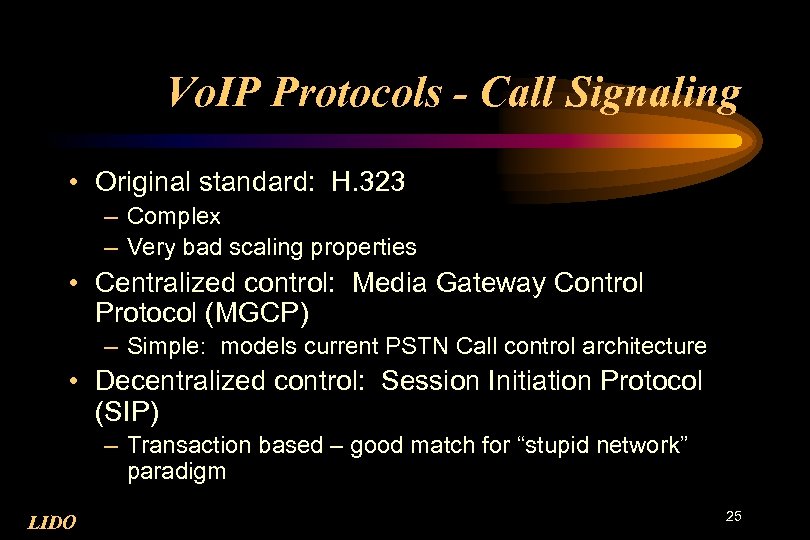 Vo. IP Protocols - Call Signaling • Original standard: H. 323 – Complex – Very bad scaling properties • Centralized control: Media Gateway Control Protocol (MGCP) – Simple: models current PSTN Call control architecture • Decentralized control: Session Initiation Protocol (SIP) – Transaction based – good match for “stupid network” paradigm LIDO 25
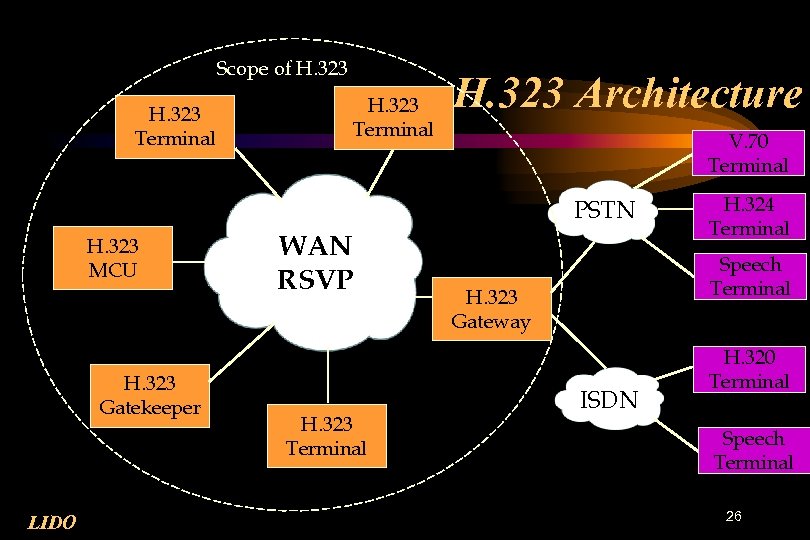 Scope of H. 323 Terminal H. 323 Architecture V. 70 Terminal PSTN H. 323 MCU H. 323 Gatekeeper LIDO WAN RSVP H. 323 Terminal H. 324 Terminal Speech Terminal H. 323 Gateway ISDN H. 320 Terminal Speech Terminal 26
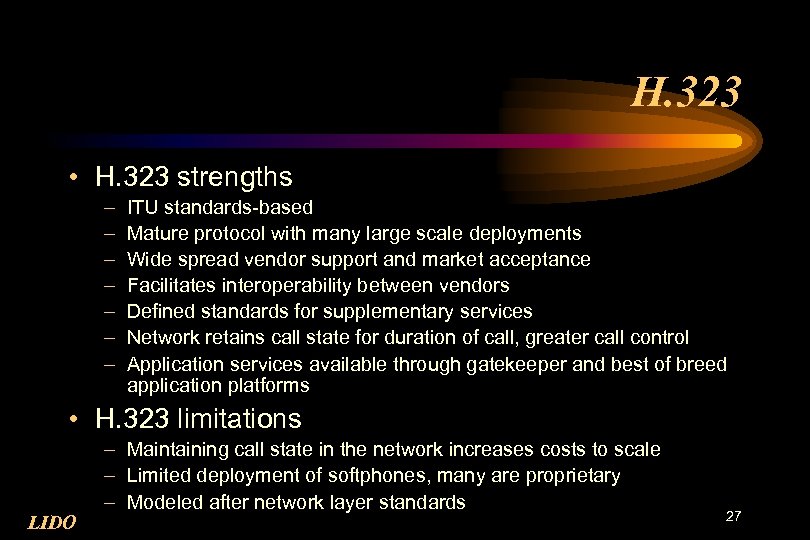 H. 323 • H. 323 strengths – – – – ITU standards-based Mature protocol with many large scale deployments Wide spread vendor support and market acceptance Facilitates interoperability between vendors Defined standards for supplementary services Network retains call state for duration of call, greater call control Application services available through gatekeeper and best of breed application platforms • H. 323 limitations LIDO – Maintaining call state in the network increases costs to scale – Limited deployment of softphones, many are proprietary – Modeled after network layer standards 27
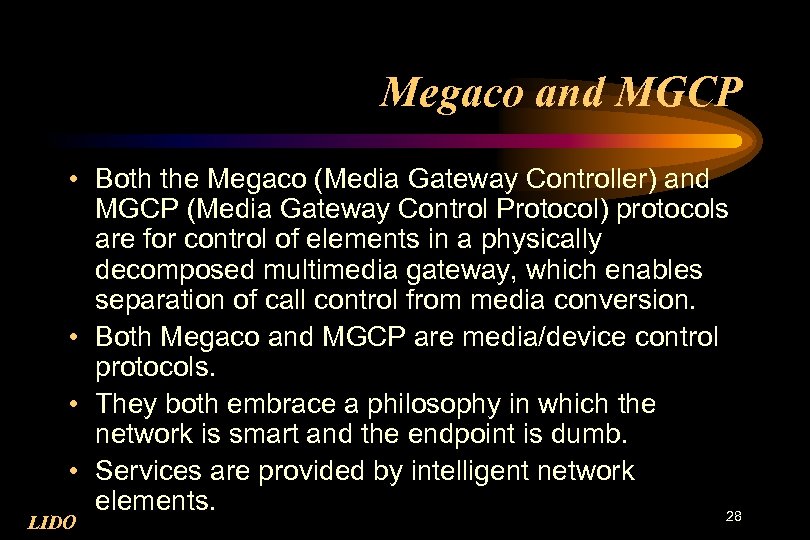 Megaco and MGCP • Both the Megaco (Media Gateway Controller) and MGCP (Media Gateway Control Protocol) protocols are for control of elements in a physically decomposed multimedia gateway, which enables separation of call control from media conversion. • Both Megaco and MGCP are media/device control protocols. • They both embrace a philosophy in which the network is smart and the endpoint is dumb. • Services are provided by intelligent network elements. 28 LIDO
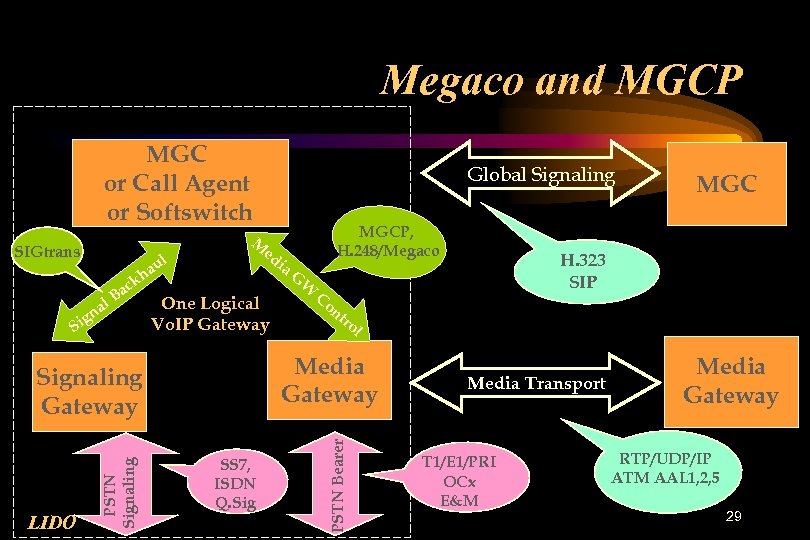 Megaco and MGCP MGC or Call Agent or Softswitch MGCP, H. 248/Megaco M l na k ac B ed ul ia ha g Si One Logical Vo. IP Gateway Co n tro l Media Gateway Signaling Gateway PSTN Signaling W SS 7, ISDN Q. Sig MGC H. 323 SIP G PSTN Bearer SIGtrans LIDO Global Signaling Media Transport T 1/E 1/PRI OCx E&M Media Gateway RTP/UDP/IP ATM AAL 1, 2, 5 29
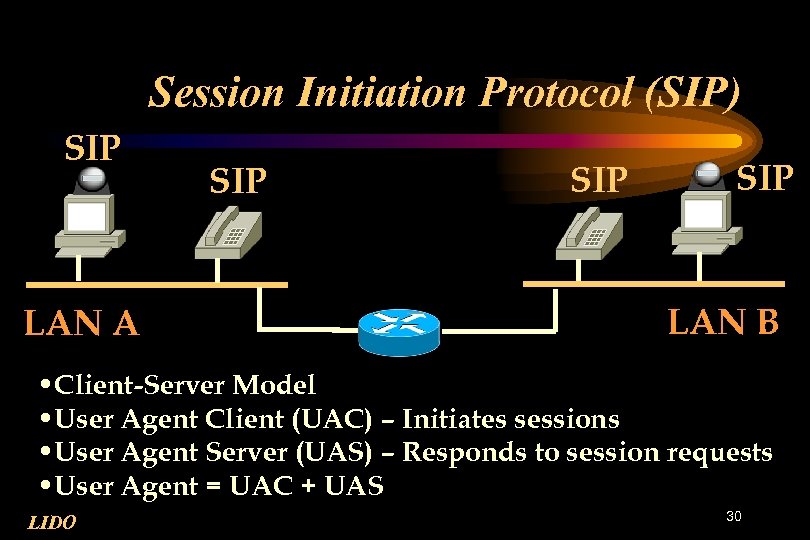 Session Initiation Protocol (SIP) SIP LAN A SIP SIP LAN B • Client-Server Model • User Agent Client (UAC) – Initiates sessions • User Agent Server (UAS) – Responds to session requests • User Agent = UAC + UAS LIDO 30
 SIP • SIP is an application-layer control protocol that can establish, modify, and terminate multimedia sessions. • SIP can also invite participants to already existing sessions, such as multicast conferences. • Media can be added to and removed from an existing session. LIDO 31
 SIP • SIP supports five facets of establishing and terminating multimedia communications: LIDO – User location: determination of the end system to be used for communication; – User availability: determination of the willingness of the called party to engage in communications; – User capabilities: determination of the media and media parameters to be used; – Session setup: "ringing", establishment of session parameters at both called and calling party; – Session management: including transfer and termination of sessions, modifying session parameters, and invoking 32 services.
 SIP • SIP is a component that can be used with other IETF protocols to build a complete multimedia architecture, such as – – Real-time Transport Protocol (RTP) Real-Time Streaming Protocol (RTSP) Media Gateway Control Protocol (Megaco) Session Description Protocol (SDP) • Therefore, SIP should be used in conjunction with other protocols in order to provide complete services to the users. LIDO 33
 SIP Network Elements • Basic SIP elements include user agents, proxies, registrars, and redirect servers. • User agents usually, but not necessarily, reside on a user's computer in the form of an application • User agents are often referred to as User Agent Server (UAS) and User Agent Client (UAC). LIDO 34
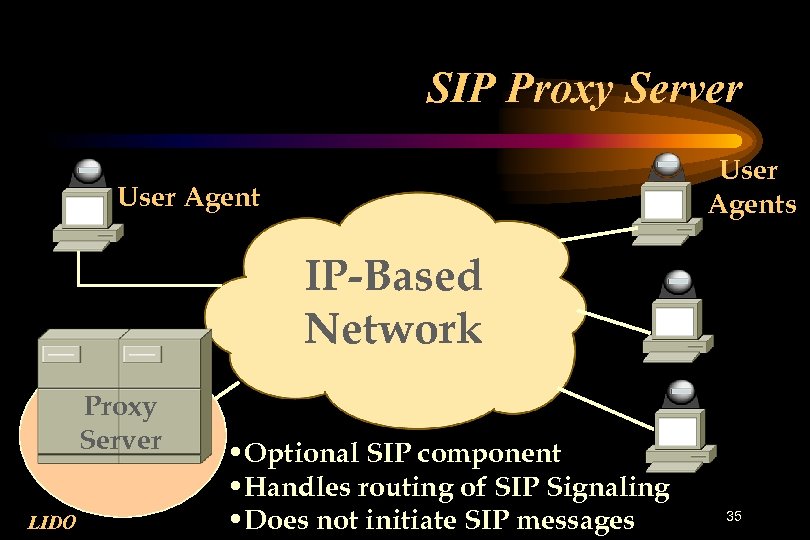 SIP Proxy Server User Agents User Agent IP-Based Network Proxy Server LIDO • Optional SIP component • Handles routing of SIP Signaling • Does not initiate SIP messages 35
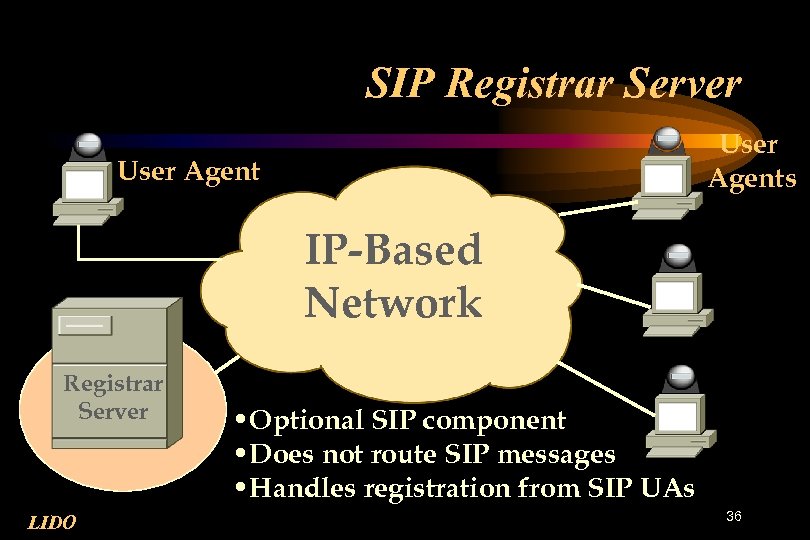 SIP Registrar Server User Agents User Agent IP-Based Network Registrar Server LIDO • Optional SIP component • Does not route SIP messages • Handles registration from SIP UAs 36
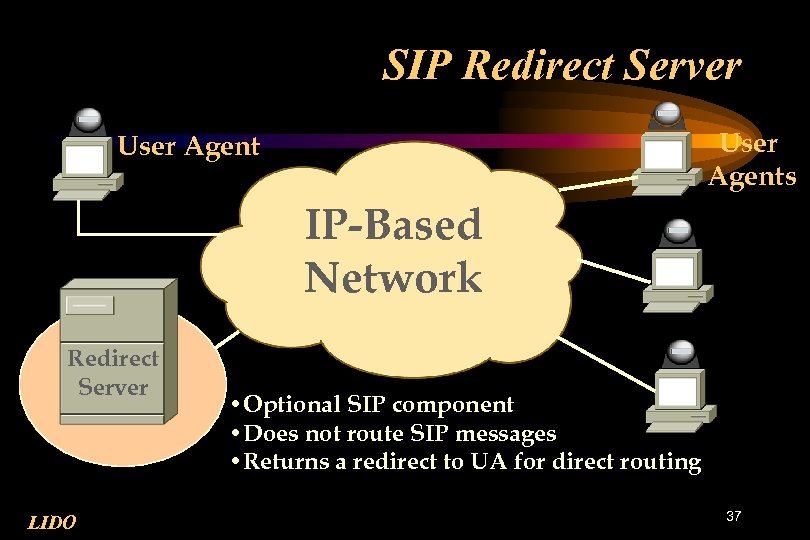 SIP Redirect Server User Agents User Agent IP-Based Network Redirect Server LIDO • Optional SIP component • Does not route SIP messages • Returns a redirect to UA for direct routing 37
 SIP and Presence • What is Presence? – Ability, willingness, desire, and capability of a user to communicate across media and devices, and even time and space. – Presence systems collect and distribute presence information to interested parties – Policy is central to presence – The value of presence is exponential with the richness of the data it has access to. LIDO 38
 SIP and Presence • Presence has great value in improving the productivity an an organization. • Accuracy is paramount to presence. • Productivity enhancement depends on accurate presence data. • There also arguments against presence. • Standards, privacy and security are concerns. LIDO 39
 Electronic Number Mapping (ENUM) • What is the issue – How do you find a telephone (number) on the Internet? – How do you find islands of connectivity across domain boundaries? • ENUM will assist in the convergence of the Public Switched Telephone Network (PSTN) and the IP network – it is the mapping of a telephone number from the PSTN to Internet services--telephone number in, URL out. LIDO 40
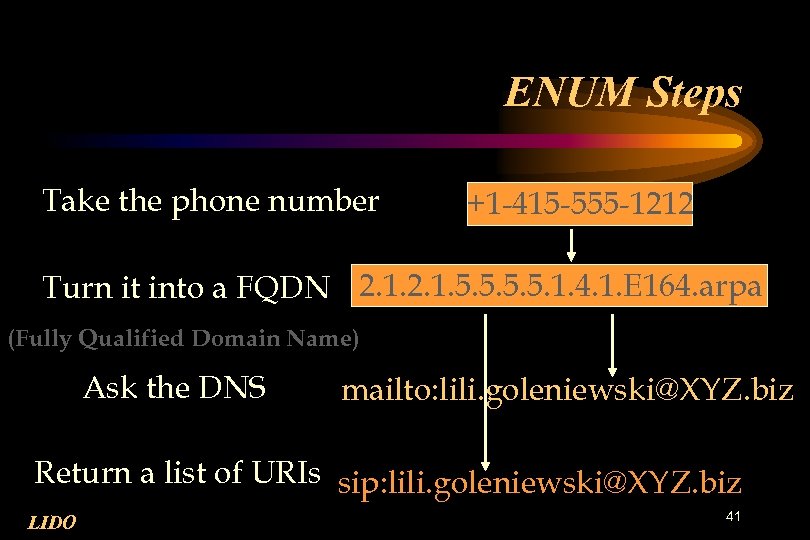 ENUM Steps Take the phone number +1 -415 -555 -1212 Turn it into a FQDN 2. 1. 5. 5. 1. 4. 1. E 164. arpa (Fully Qualified Domain Name) Ask the DNS mailto: lili. goleniewski@XYZ. biz Return a list of URIs sip: lili. goleniewski@XYZ. biz LIDO 41
 ENUM Possibilities • Because ENUM puts telephone numbers into the DNS, it allows for a wide range of applications based solely on a phone number. • Along with Vo. IP, other applications include addressing for fax machines, e-mail, instant messaging, and web sites. The possibilities are enormous. LIDO 42
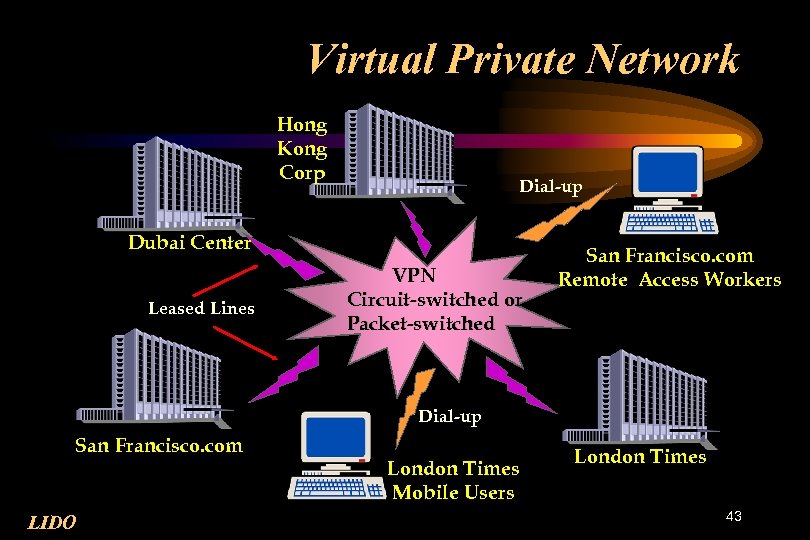 Virtual Private Network Hong Kong Corp Dial-up Dubai Center Leased Lines VPN Circuit-switched or Packet-switched San Francisco. com Remote Access Workers Dial-up San Francisco. com London Times Mobile Users LIDO London Times 43
 Virtual Private Networks • VPNs isolate customer traffic on shared service provider facilities. – Enterprise’s traffic is aggregated with other traffic. – VPNs have been around since X. 25 closed user groups and AT&T software-defined networks – VPNs look like a private network but actually run across either the public circuit switched network or public packet switched data networks • VPN is a concept, not a specific set of technologies LIDO 44
 Customer Edge Model • Customer-based – Requires CPE to be fully capable of configuring and provisioning the VPN, and thereby results in higher passthrough operating expenses for the enterprise user. – Routing intelligence resides at an end-user site. – Carriers install gateways, routers and other VPN equipment on the customer’s premises. – As this requires the carrier to manage on-site equipment, the costs associated with the on-site visits from field engineers can be high. – Preferred where customer desires to have control over all aspects of security. LIDO 45
 Provider Edge Model • Provider-based – VPN “intelligence” resides at the provider’s edge, where it can be extended out to many end-user locations. – Carriers house all necessary equipment at a point of presence near the customer’s location. – Offer the advantages of scalability, support for an increasingly diverse range of IP-based services and efficient prioritization of traffic. – Provide the foundation needed to integrate fixed and mobile VPN communications into one seamless framework. – Preferred by customers who wish to take advantage of the carrier’s VPN economies of scale. LIDO 46
 VPN Categories • There are three main categories of VPNs – Internet-based – Provisioned – IP LIDO 47
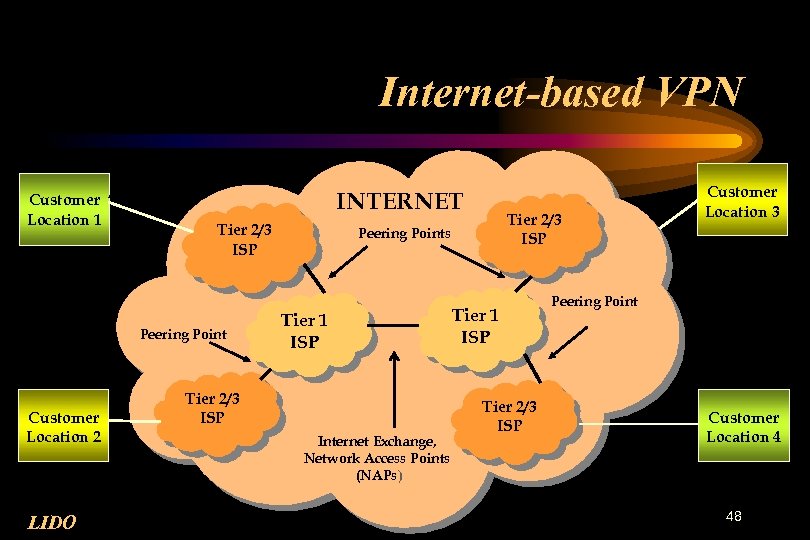 Internet-based VPN Customer Location 1 INTERNET Tier 2/3 ISP Peering Point Customer Location 2 LIDO Tier 2/3 ISP Peering Points Tier 1 ISP Tier 2/3 ISP Internet Exchange, Network Access Points (NAPs) Tier 1 ISP Tier 2/3 ISP Customer Location 3 Peering Point Customer Location 4 48
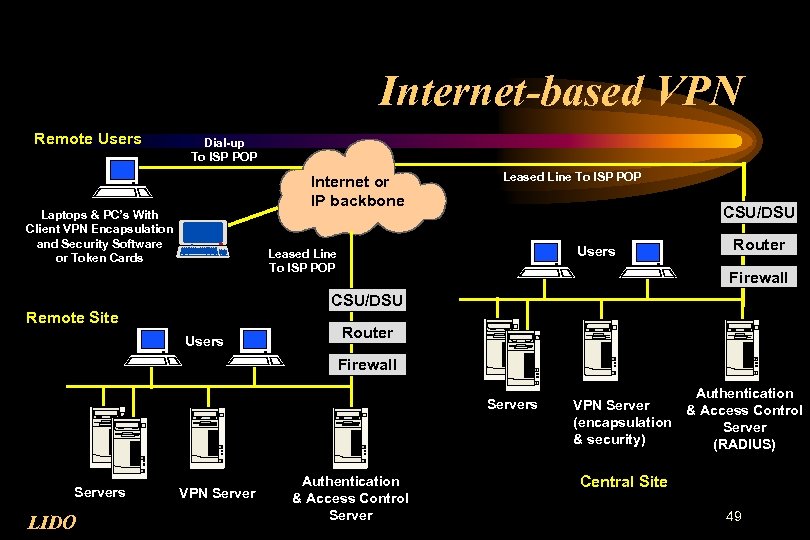 Internet-based VPN Remote Users Dial-up To ISP POP Internet or IP backbone Laptops & PC’s With Client VPN Encapsulation and Security Software or Token Cards Leased Line To ISP POP CSU/DSU Users Leased Line To ISP POP Router Firewall CSU/DSU Remote Site Users Router Firewall Servers LIDO VPN Server Authentication & Access Control Server VPN Server (encapsulation & security) Authentication & Access Control Server (RADIUS) Central Site 49
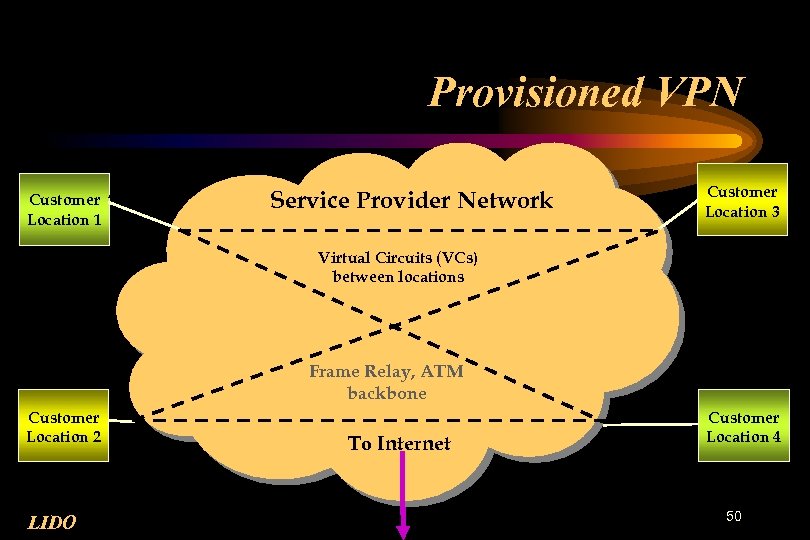 Provisioned VPN Customer Location 1 Service Provider Network Customer Location 3 Virtual Circuits (VCs) between locations Frame Relay, ATM backbone Customer Location 2 LIDO To Internet Customer Location 4 50
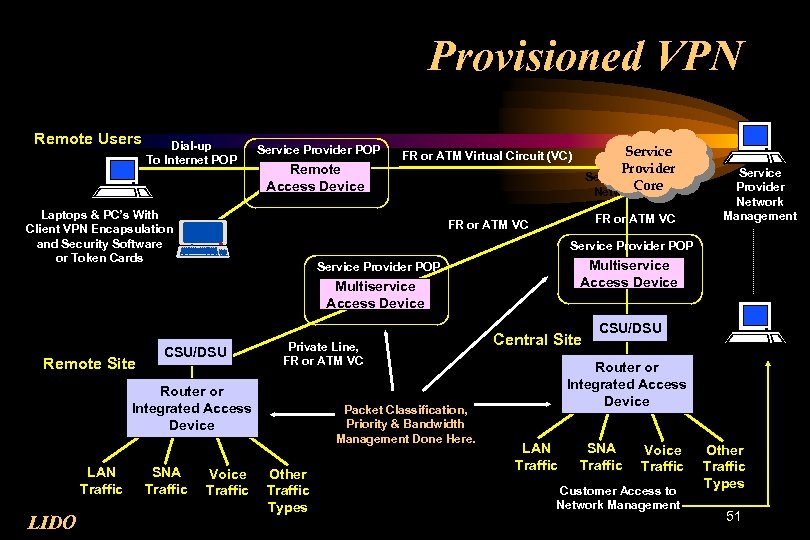 Provisioned VPN Remote Users Dial-up To Internet POP Service Provider POP Remote Access Device Laptops & PC’s With Client VPN Encapsulation and Security Software or Token Cards FR or ATM VC Multiservice Access Device Service Provider POP CSU/DSU Private Line, FR or ATM VC Router or Integrated Access Device LAN Traffic LIDO SNA Traffic Service Provider Network Management Service Provider POP Multiservice Access Device Remote Site Service Provider Core Network Core FR or ATM Virtual Circuit (VC) Voice Traffic Packet Classification, Priority & Bandwidth Management Done Here. Other Traffic Types Central Site CSU/DSU Router or Integrated Access Device LAN Traffic SNA Traffic Voice Traffic Customer Access to Network Management Other Traffic Types 51
 IP VPNs • Definition: An IP VPN is basically a private, or restricted, communications network constructed over shared IP-based networks, usually serviced on the providers' backbones, but with connections to the public Internet. • IP-based VPNs have traditionally been referred to as networks of secure links over a public IP infrastructure. LIDO 52
 IP VPNs • Today, there are three basic types of carriermanaged IP VPN services being offered – CPE-based IPSec VPN • Site-to-site enterprise VPN • Gold standard for VPN security, especially when traffic is running over the public Internet – Network-based IPSec VPN • May run over the Internet or the service provider’s private IP facilities • Customers use leased-line connections from the premises router to the service provider’s POP (point of presence) – Network-based MPLS or Virtual Router IP VPN services LIDO • Receiving the most attention today 53
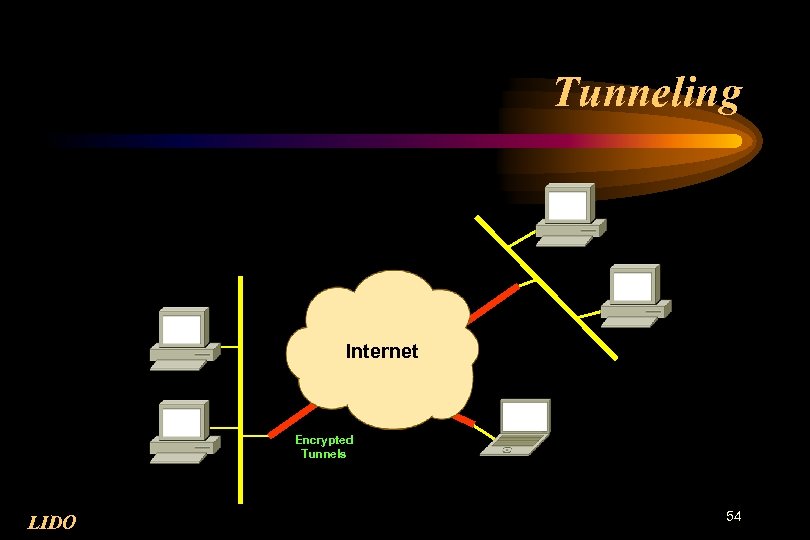 Tunneling Internet Encrypted Tunnels LIDO 54
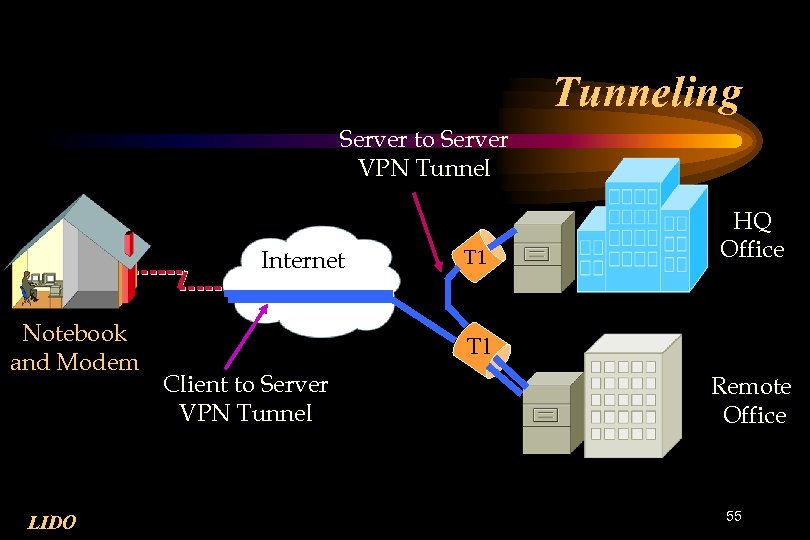 Tunneling Server to Server VPN Tunnel Internet Notebook and Modem LIDO T 1 HQ Office T 1 Client to Server VPN Tunnel Remote Office 55
 VPN Applications • There are three main applications for VPNs – Intranets – Remote Access VPNs – Extranets LIDO 56
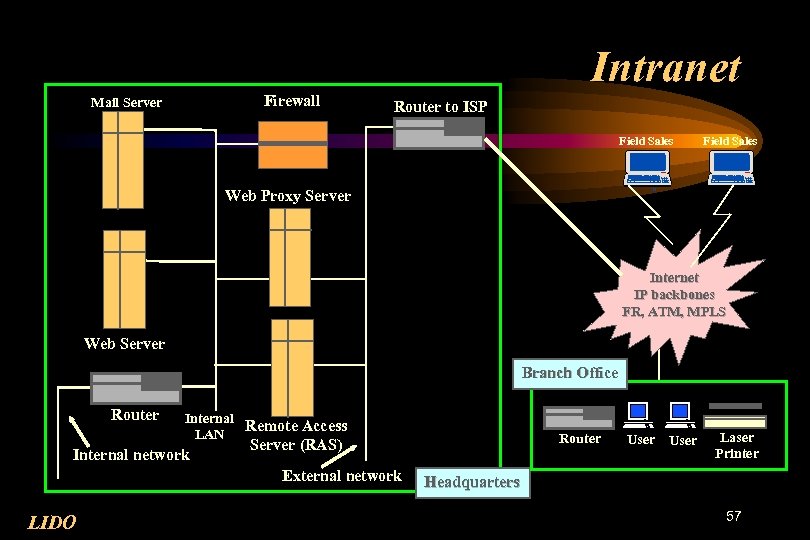 Intranet Firewall Mail Server Router to ISP Field Sales Web Proxy Server Internet IP backbones FR, ATM, MPLS Web Server Branch Office Router Internal Remote Access LAN Internal network External network LIDO Router Server (RAS) User Laser Printer Headquarters 57
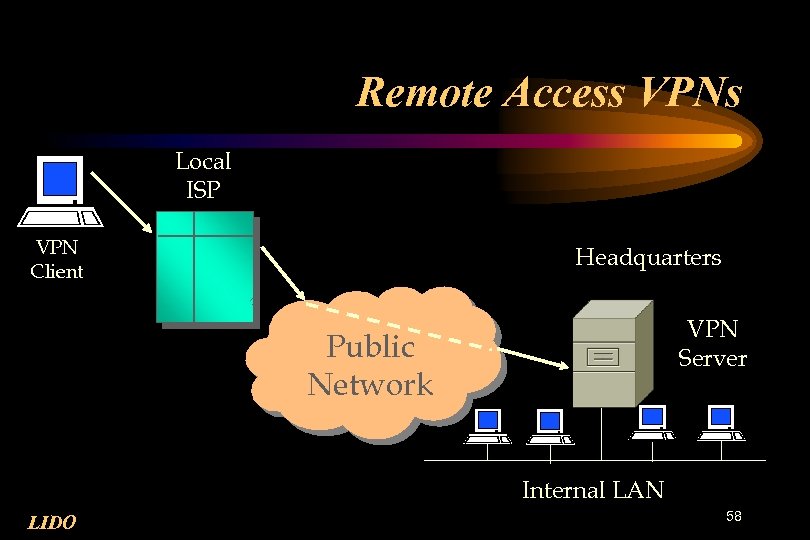 Remote Access VPNs Local ISP VPN Client Headquarters VPN Server Public Network Internal LAN LIDO 58
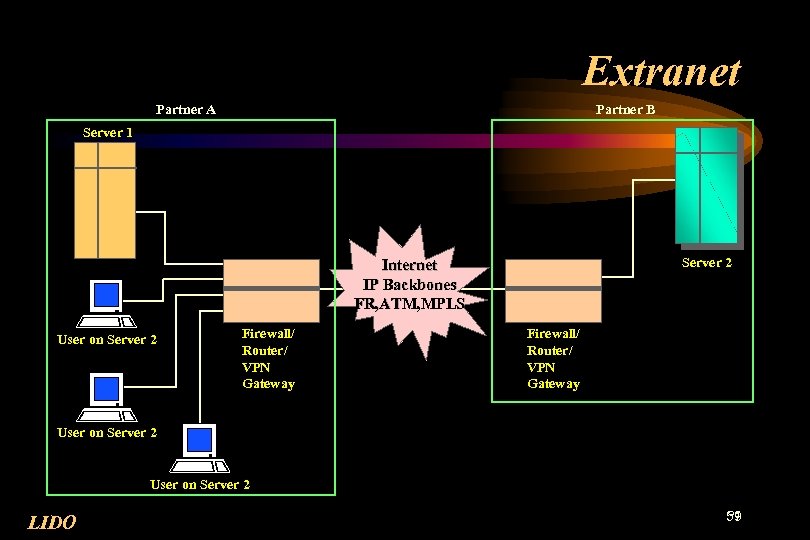 Extranet Partner A Partner B Server 1 Server 2 Internet IP Backbones FR, ATM, MPLS User on Server 2 Firewall/ Router/ VPN Gateway User on Server 2 LIDO 59 31
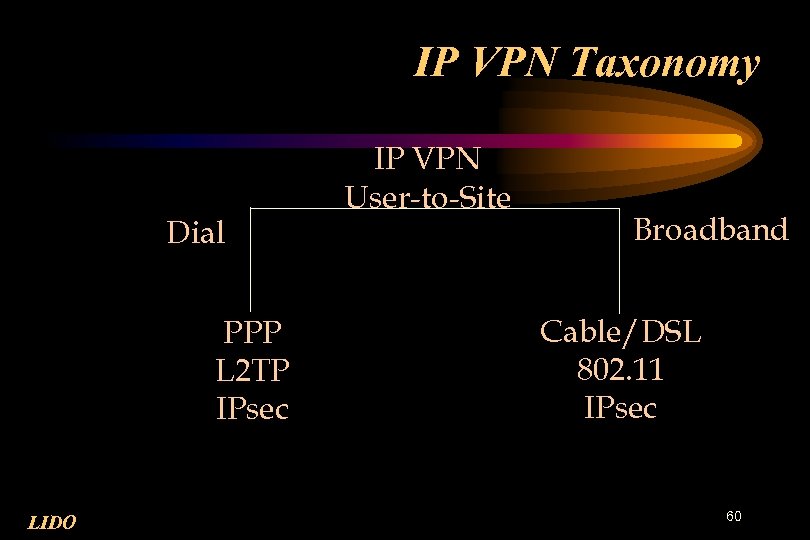 IP VPN Taxonomy Dial PPP L 2 TP IPsec LIDO IP VPN User-to-Site Broadband Cable/DSL 802. 11 IPsec 60
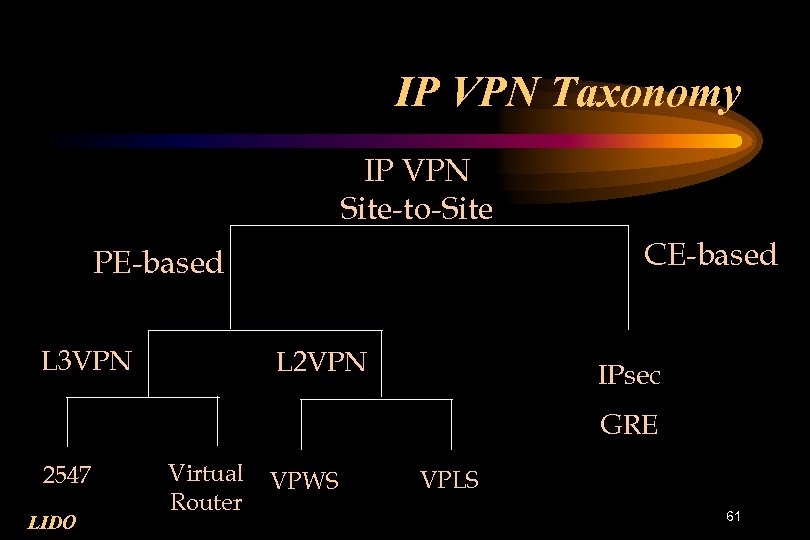 IP VPN Taxonomy IP VPN Site-to-Site CE-based PE-based L 3 VPN L 2 VPN IPsec GRE 2547 LIDO Virtual Router VPWS VPLS 61
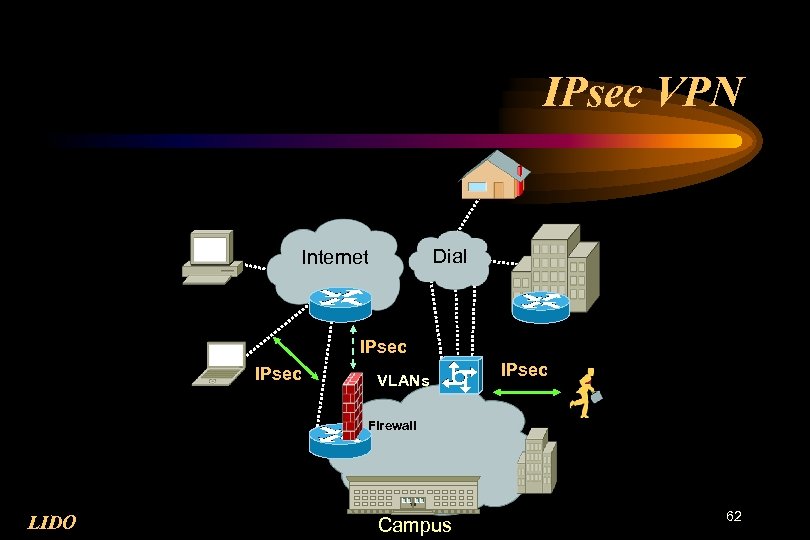 IPsec VPN Dial Internet IPsec VLANs IPsec Firewall LIDO Campus 62
 IPsec • IPSec (IP Security) is the IETF protocol suite addressing basic data integrity and security. • It covers encryption, authentication, and key exchange. • IPsec emphasizes security by authenticating both ends of the tunnel connection, negotiating the encryption protocol and key for the encrypted session and encrypting and decrypting the session establishment data. LIDO 63
 IPsec • IPsec utilizes transport and tunnel modes. • In transport mode, only the IP payload is encrypted. There is no change to the original IP header. – This is generally used between hosts or routers and also in client/server VPNs. • In tunnel mode, the entire IP datagram is encrypted; the entire original packet is encapsulated in IPsec and given a new IP header. – This mode is generally used between gateways. LIDO 64
 Generic Routing Encapsulation (GRE) • IETF RFC 2784 and RFC 1702 specify the GRE, or Generic Routing Encapsulation protocol for using IP as both the delivery and payload protocol. • It is a simple, stateless protocol that allows for the tunneling of IP in IP. • GRE tunnels can be used to form VPNs, connecting remote sites using private IP addresses via a public network. LIDO 65
 Virtual Router VPNs • In Virtual Router (VR) VPNs, each virtual router runs an instance of a routing protocol that is responsible for disseminating VPN reachability information between virtual routers. • Customer routing is extended across the provider network. • The objective of a Layer 3 virtual router VPN is to provide per-VPN routing, forwarding, Qo. S, and service management capabilities. LIDO 66
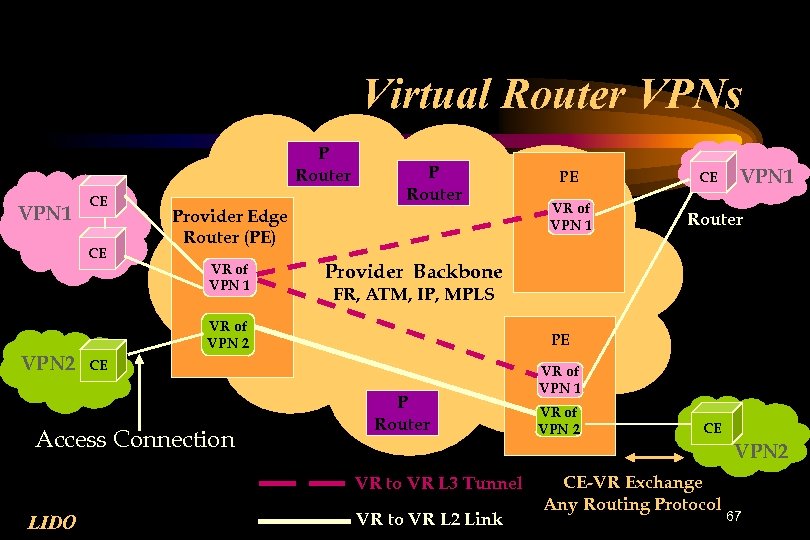 Virtual Router VPNs P Router VPN 1 CE CE Provider Edge Router (PE) VR of VPN 1 P Provider Router Backbone Router PE P Router VR of VPN 1 VR of VPN 2 CE VPN 2 VR to VR L 3 Tunnel LIDO VPN 1 FR, ATM, IP, MPLS CE Access Connection VR of VPN 1 CE Provider Backbone VR of VPN 2 PE VR to VR L 2 Link CE-VR Exchange Any Routing Protocol 67
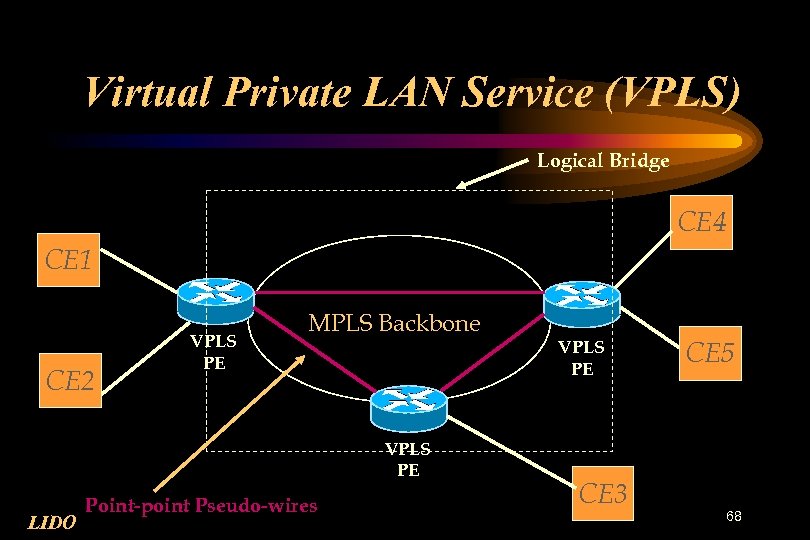 Virtual Private LAN Service (VPLS) Logical Bridge CE 4 CE 1 CE 2 VPLS PE MPLS Backbone VPLS PE LIDO Point-point Pseudo-wires VPLS PE CE 3 CE 5 68
 Virtual Private LAN Service (VPLS) • The advent of the Internet and the resulting productivity gain spurred by the adoption of new technologies is resulting in a demand for increased bandwidth and services. • Virtual Private LAN Services (VPLS) with an Ethernet infrastructure present the optimal solution for carriers to roll out new services profitably. • The benefits from reduced capital and operating expenditures add up quickly to benefit the bottomline. LIDO 69
 IPTV • IPTV delivers digital television service to a subscriber using IP over a broadband connection. • IPTV holds great promise for telcos. • IPTV is not just a replication of the passive cable TV viewing environment. • Most of the world's leading telecom providers are either investigating or deploying IPTV. LIDO 70
 IPTV • IPTV supports both live TV (multicasting) and VOD (stored video). • IPTV is viewed on a TV and requires a settop box. • The video content is usually in MPEG-2 TS (Transport Stream) format, delivered via IP Multicast. • IPTV was specifically designed to deliver high -quality content to a traditional TV through the 71 LIDO Internet.
 IPTV • Advantages of IPTV include – Two-way capability – Point-to-point distribution, which allows each viewer to view individual broadcasts – Stream control • IPTV enables providers to offer more services over the same pipe. • Streaming media is an almost identical server-side technology to IPTV, but it terminates on a PC rather than on a TV. LIDO 72
 IPTV • With IPTV, a network operator controls the whole path from the time they assemble the content to the delivery of that content to the consumer’s home. • With traditional streaming, network operators don’t have the same bandwidth control. LIDO 73
 IPTV • This need for end-to-end control has also affected how IPTV is deployed. • IPTV is being implemented by people who own the entire network. • IPTV is able to deliver full-screen, high-quality video content, while streaming is most often still limited to small-screen and relatively low-quality video. • High-definition TV is going to set another benchmark that streaming media might struggle with. LIDO 74
 IPTV • For telcos in particular, IPTV presents a ripe opportunity to establish a foothold in the nascent online video distribution market. • It’s about coming to the consumer with a bundle of offerings. • IPTV is really laying the foundation for the future. LIDO 75
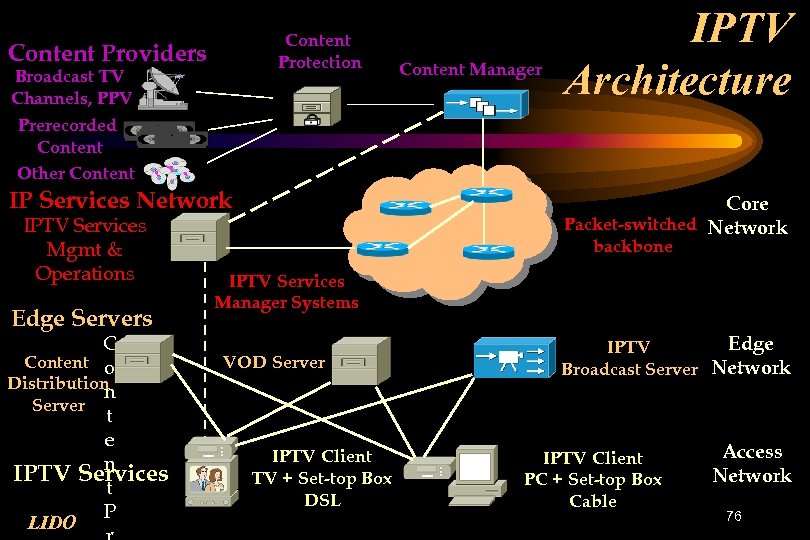 Content Protection Content Providers Broadcast TV Channels, PPV Content Manager IPTV Architecture Prerecorded Content Other Content IP Services Network IPTV Services Mgmt & Operations Edge Servers C Content o Distribution n Server t e n IPTV Services t P LIDO Core Packet-switched Network backbone IPTV Services Manager Systems VOD Server IPTV Client TV + Set-top Box DSL Edge IPTV Broadcast Server Network IPTV Client PC + Set-top Box Cable Access Network 76
 LIDO Telecommunications Essentials® IP Services Lili Goleniewski The LIDO Organization, Inc. www. telecomessentials. com +1 -415 -457 -1800 lili@lidoorg. com Skypes ID: lili. goleniewski Telecom Essentials Learning Center www. telecomessentials. com LIDO Copyright © 2007 - The LIDO Organization, Inc. All Rights Reserved 77