


 Скачать презентацию LIDO Telecommunications Essentials Part 3 Next Generation Networks
16d4f9b78b1c1457a4d97f0c0cc4c2e5.ppt
- Количество слайдов: 170
 LIDO Telecommunications Essentials® Part 3 Next Generation Networks Broadband Access Alternatives Virtual Fiber, HAN, etc. LIDO 1
 Broadband Access Drivers • The type of access you have may determine your professional and personal success. • Initial drivers were – Users' desire to find information – Users’ desire to be connected • Today’s motivators require more bandwidth and performance – Users’ desire to experience the increasingly content-rich multimedia spectacle of the Web – Users’ desire to share digital photos, music, and video LIDO 2
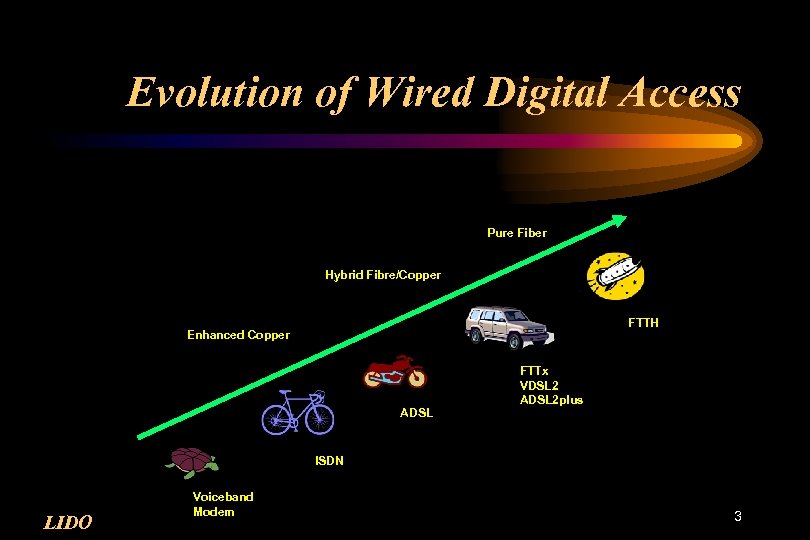 Evolution of Wired Digital Access Pure Fiber Hybrid Fibre/Copper FTTH Enhanced Copper ADSL FTTx VDSL 2 ADSL 2 plus ISDN LIDO Voiceband Modem 3
 Broadband Access Options • Twisted-Pair – HDSL, SDSL, G. SHDSL, ADSL, RASDL, ADSL 2+, ADSL 2 RE, VDSL, LR-VDSL 2– 12 MHz, SR-VDSL 2– 30 MHz • Cable TV – HFC, DOCSIS 1. 0, DOCSIS 1. 1, DOCSIS 2. 0, DOCSIS 3. 0, Packet. Cable 1. 5, Packet. Cable 2. 0, Open. Cable, Cable. Home • Fiber – FTTN, FTTH/FTTP, APON, EPON, GPON • Broadband Wireless – DBS/DTH, Wi. Max, FSO, VF • Mobile – UMTS HSDPA, CDMA EV-DO • Powerline LIDO – Broadband Powerline Telecommunications (PLT) 4
 Global Broadband Access Status • Current growth rate is more than one new subscriber every second • Big and established broadband countries have achieved high penetration growth rates are slowing • Newest broadband markets are showing the fastest growth – Africa and Middle East – Latin America and eastern Europe • China, India, and Russia to grow by leaps and bounds in the coming years LIDO 5
 Global Broadband Access Status • Currently DSL represents over 65% of the world broadband market share – The DSL Forum expects to see 500 million DSL subscribers by 2010 • Cable modem and other technologies together account for the rest of broadband usage • Fiber deployment, especially passive optical network (PON) technology, is on the rise worldwide • Wireless broadband access is poised to take-off LIDO 6
 Deployment Drivers • There are several key drivers behind a service provider moving to deploy broadband access. – The experience of slower rates of growth or even decline in their core business – The ongoing growth in the demand for highspeed data – The growing competition going on among many alternative networks LIDO 7
 Deployment Drivers • There are several drivers for deciding which broadband option to deploy. – The status of the embedded distribution plant – The service provider’s services strategy – The cost of installing the new distribution system, given the physical footprint realities, such as the terrain and environmental conditions – The required performance level of the distribution system – The physical footprint realities LIDO 8
 Footprint Reality • What is the best broadband access option? • There is no best option – it depends on the footprint reality – For example, broadband wireless may work very well in one area but provide poor performance in another because there are many trees, whose leaves act as obstacles to microwave • Multiple options are currently available. • Across different terrains, across different applications, and across different politics and regulations, one of them is bound to work and prevail as the best option. LIDO 9
 The DSL Family of Standards • The x. DSL family of standards includes a large variety of speeds and distance specifications – High Bit Rate Digital Subscriber Line (HDSL) – Symmetric (or Single) Line Digital Subscriber Line (SDSL) – Symmetric High Speed Digital Subscriber Line (G. SHDSL) – Asymmetrical Digital Subscriber Line (ADSL), including ADSL 2, ADSL 2+, and ADSL 2 -RE – Rate Adaptive Digital Subscriber Line (RADSL) – Very High Bit Rate Digital Subscriber Line (VDSL), including LR-VDSL 2– 12 MHz and SR-VDSL 2– 30 MHz. LIDO 10
 DSL Technology Background • DSL (digital subscriber line) emerged from Bellcore (now Telcordia) as a technique to filter out the incessant background noise or interference on copper wires and allow clearer connections through the use of electronic intelligence (in the form of DSL modems), at either end of a phone line. • By utilizing the unused spectrum, DSL can use the basic telephone line to carry digital data without interfering with traditional voice services. LIDO 11
 DSL Technology Background • DSL is the main competitor to cable modem • Service operators are very interested in providing triple-play and quadruple-play services, and DSL can provide a path to doing so. LIDO 12
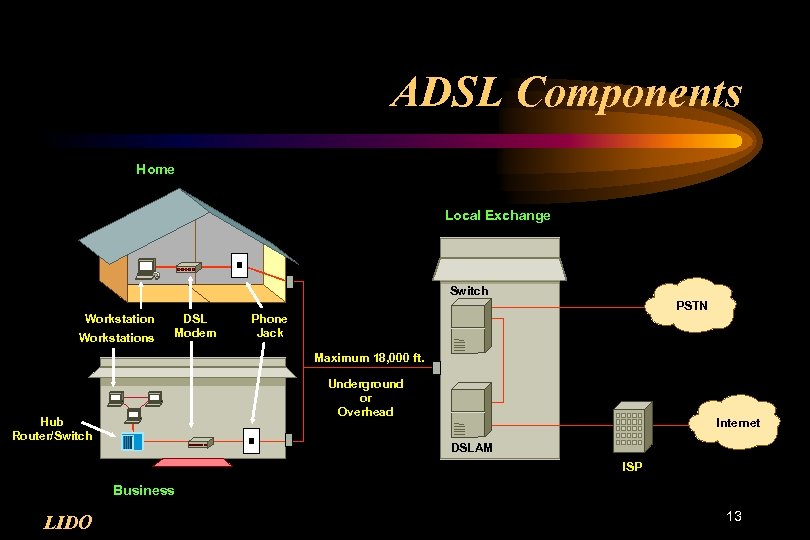 ADSL Components Home Local Exchange Switch Workstations DSL Modem PSTN Phone Jack Maximum 18, 000 ft. Underground or Overhead Hub Router/Switch Internet DSLAM ISP Business LIDO 13
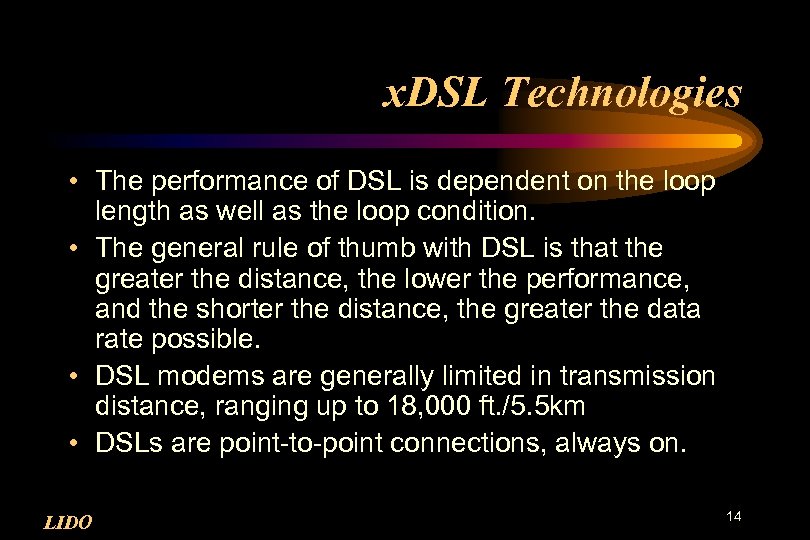 x. DSL Technologies • The performance of DSL is dependent on the loop length as well as the loop condition. • The general rule of thumb with DSL is that the greater the distance, the lower the performance, and the shorter the distance, the greater the data rate possible. • DSL modems are generally limited in transmission distance, ranging up to 18, 000 ft. /5. 5 km • DSLs are point-to-point connections, always on. LIDO 14
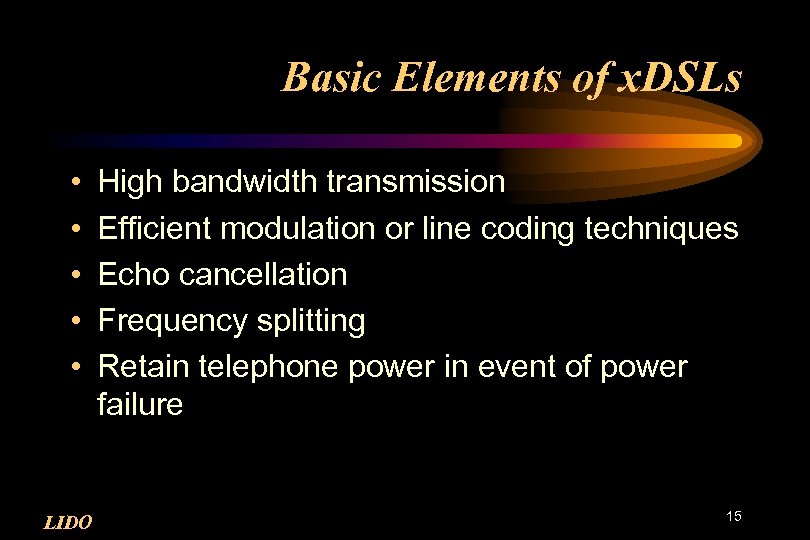 Basic Elements of x. DSLs • • • LIDO High bandwidth transmission Efficient modulation or line coding techniques Echo cancellation Frequency splitting Retain telephone power in event of power failure 15
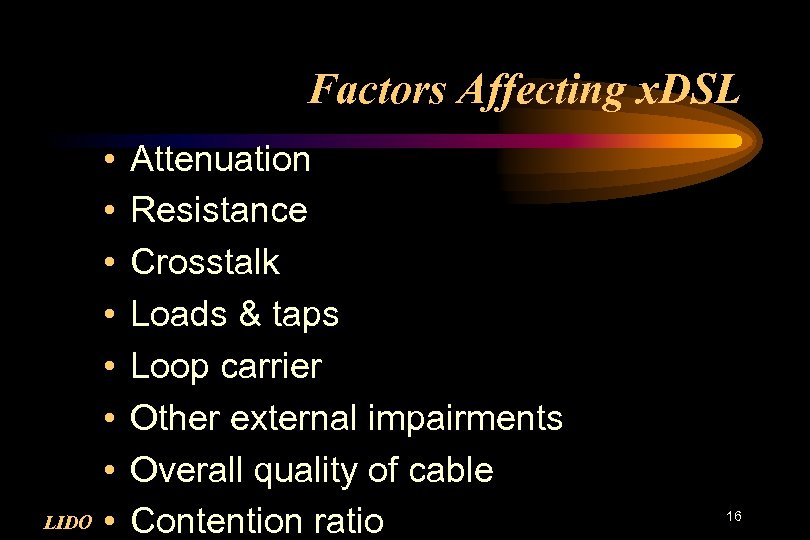 Factors Affecting x. DSL • • LIDO • Attenuation Resistance Crosstalk Loads & taps Loop carrier Other external impairments Overall quality of cable Contention ratio 16
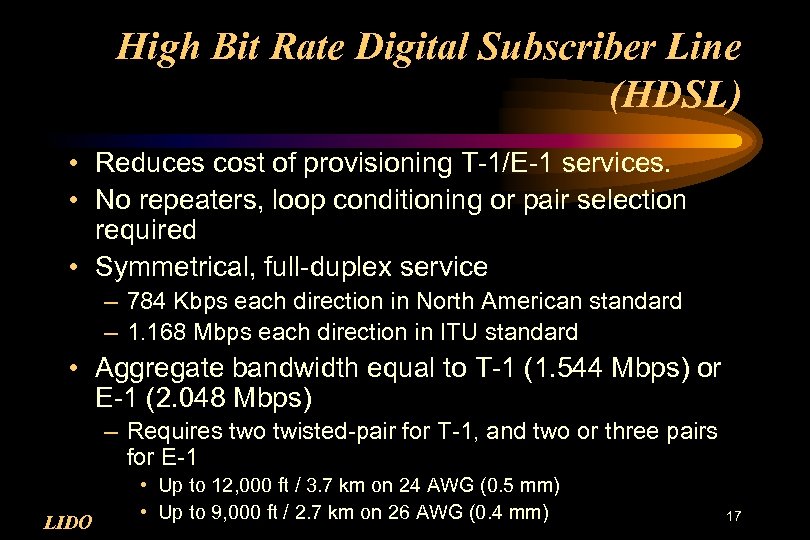 High Bit Rate Digital Subscriber Line (HDSL) • Reduces cost of provisioning T-1/E-1 services. • No repeaters, loop conditioning or pair selection required • Symmetrical, full-duplex service – 784 Kbps each direction in North American standard – 1. 168 Mbps each direction in ITU standard • Aggregate bandwidth equal to T-1 (1. 544 Mbps) or E-1 (2. 048 Mbps) – Requires two twisted-pair for T-1, and two or three pairs for E-1 LIDO • Up to 12, 000 ft / 3. 7 km on 24 AWG (0. 5 mm) • Up to 9, 000 ft / 2. 7 km on 26 AWG (0. 4 mm) 17
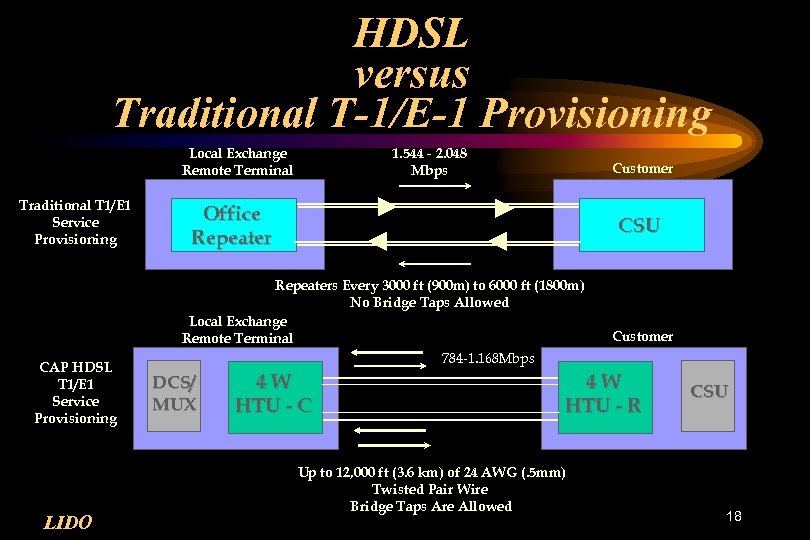 HDSL versus Traditional T-1/E-1 Provisioning Local Exchange Remote Terminal Traditional T 1/E 1 Service Provisioning CAP HDSL T 1/E 1 Service Provisioning LIDO 1. 544 - 2. 048 Mbps Customer Office Repeater CSU Repeaters Every 3000 ft (900 m) to 6000 ft (1800 m) No Bridge Taps Allowed Local Exchange Remote Terminal 784 -1. 168 Mbps DCS/ MUX 4 W HTU - C Customer 4 W HTU - R Up to 12, 000 ft (3. 6 km) of 24 AWG (. 5 mm) Twisted Pair Wire Bridge Taps Are Allowed CSU 18
 HDSL Benefits • HDSL reduces the cost of provisioning services to customers. • Allows customers outside the range of the traditional T-1/E-1 environment to enjoy the privileges of this high-bandwidth option. • HDSL enables rapid provisioning. • Good solution for increasing the number of access lines via the digital loop carrier transport. LIDO 19
 HDSL Applications • Key business applications – PBX interconnection – Cellular antenna stations interconnection – Interexchange POP interconnection • Residential offerings – Developed to provide the capacity and symmetry of HDSL to residences – HDSL 2 (two-wire) – HDSL 4 (four-wire) extends reach by up to 30% • Newer standards, like G. SHDSL, are preferred today LIDO 20
 SDSL (Symmetric Digital Subscriber Line) • Symmetric (or Single-line) Digital Subscriber Line, or SDSL, involves a single twisted copper pair that can be up to 3. 5 miles (or 5. 5 km) long. • It is a symmetrical, full-duplex service • SDSL supports multiple data rates – up to T-1 or E-1 rates – you can subscribe to varying bandwidths, up to 1. 5 Mbps or 2 Mbps. LIDO 21
 SDSL (Symmetric Digital Subscriber Line) • Applications include – Replacement of local repeatered T-1/E-1 trunks – Fractional T-1/E-1 service – PBX interconnection – multirate ISDN – switched 384 Kbps – local frame relay alternative – traffic aggregation – high speed residential service LIDO 22
 SDSL (Symmetric Digital Subscriber Line) • SDSL is not standardized • ITU standardized G. SHDSL • Leads to some confusion because in Europe G. SHDSL was standardized by the European Telecommunication Standards Institute (ETSI) under the name SDSL. • Equipment referred to as supporting SDSL is generally proprietary equipment that only talks to SDSL equipment from the same vendor or another vendor's equipment that uses the same DSL chipset. LIDO 23
 G. SHDSL • G. SHDSL stands for Symmetric High Speed Digital Subscriber Line. • Two main drivers influenced the introduction of G. SHDSL. – a need for a higher-speed digital transport service for business applications. – a global standard was therefore needed. • G. SHDSL was developed to incorporate the features of other DSL technologies, such as ADSL and SDSL. • G. SHDSL can transport T-1, E-1, ISDN, ATM, and IP signals. 24 LIDO
 G. SHDSL • G. SHDSL, often referred to as simply SHDSL, was the first international standard for DSL. Ratified by the ITU (G. 991. 2) in February 2001. • Symmetric service with options to operate over one pair or two pairs of copper wires • Up to 5. 6 Mbps in both downstream and upstream directions • Rate-adaptive capability • G. SHDSL promises to operate over ranges 15 -20% greater than HDSL. 25 LIDO
 G. SHDSL • G. SHDSL eliminates the need for T-1/E-1 repeaters on loops under 3. 5 miles (or 5. 5 km). • G. SHDSL offers improved reach, providing a 20% to 30% increase compared to HDSL or SDSL. • G. SHDSL is spectrally compatible with ADSL, which means G. SHDSL can be mixed in the same cable bundles with ADSL, HDSL, and HDSL 2 without much, if any, interference. • G. SHDSL and ADSL can be deployed from the same platform. LIDO 26
 G. SHDSL Applications • Business applications – – – Multiline Voice over DSL Web hosting Videoconferencing Virtual Private Network (VPN) services Remote LAN Access • Residential applications LIDO – – – Extended reach for remote customers Internet gaming Residential gateway access Peer-to-peer services Multi-unit market • multiple-dwelling unit (MDU) or multiple-tenant unit (MTU) 27
 ADSL (Asymmetrical Digital Subscriber Line) • Initially introduced in 1993 with the intention of supporting video-on-demand. • Ratified by the ITU-T in 1999, under recommendation G. 992. 1. • It is also standardized under ANSI T 1. 413 Issue 2 • Applications include Internet access, remote LAN access, voice over DSL, DSL bonding, Video on Demand (Vo. D) LIDO 28
 ADSL • Asymmetric service, operating over a bandwidth of 1. 1 MHz. – Downstream rates from 256 Kbps to 7 Mbps – Upstream rates from 64 Kbps to 800 Kbps – Maximum reach of 3. 5 miles (or 5. 5 km). • Performance of ADSL depends on LIDO – – – Distance from the CPE to the DSLAM Signal-to-noise ratio Signal attenuation Cable diameter Line impedance General condition of the cable 29
 ADSL & ATM • Because ADSL carries a mixture of traffic, a multiplexing technology is required to carry both time-critical and less time-critical data. – ADSL is therefore commonly deployed with ATM, which serves this purpose. • Because different ATM virtual circuits (VCs) can be allocated for different services, ATM ensures that service providers can provide triple-play services. • Some network operators have been moving away from the use of ATM and replacing it with Ethernetbased solutions. LIDO 30
 ADSL Operation • Allows for simultaneous voice and Internet traffic on the same phone line • Reserves the bottom 4 KHz of spectrum for voice traffic • Filters, known as splitters, are used at each end of the copper pair to split the frequency bands LIDO – The lower frequencies are sent to the local exchange, the high frequencies are sent to the ADSL modems 31
 ADSL Modulation • Carrierless Amplitude Phase (CAP) modulation, was the de facto modulation scheme for ADSL deployments until 1996. • The DMT modulation scheme was selected for the first ITU-T ADSL standards, G. 992. 1 (also called G. dmt) and G. 992. 2 (also called G. lite), and CAP is no longer used. • DMT is an Orthogonal Frequency Division Multiplexing (or OFDM) technique. • The result is improved performance. Compared to CAP, DMT is less prone to interference and can carry data over a longer distance. 32 LIDO
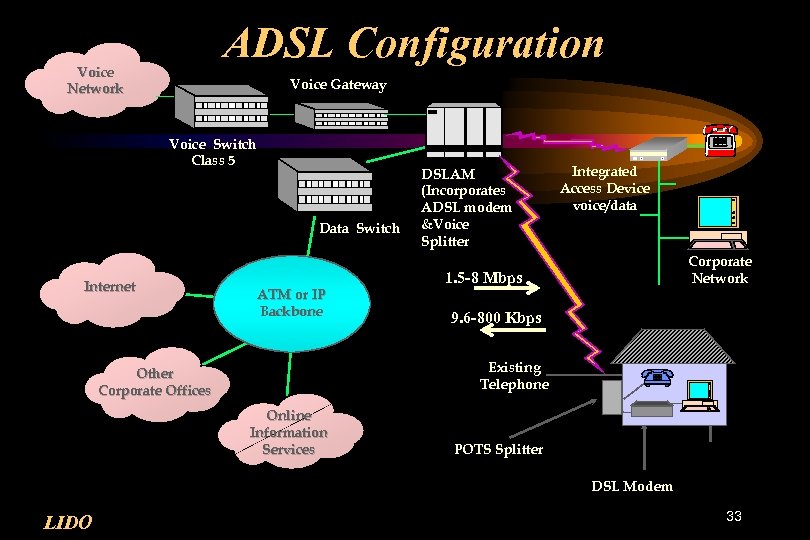 ADSL Configuration Voice Network Voice Gateway Voice Switch Class 5 Data Switch Internet ATM or IP Backbone DSLAM (Incorporates ADSL modem &Voice Splitter Integrated Access Device voice/data Corporate Network 1. 5 -8 Mbps 9. 6 -800 Kbps Existing Telephone Other Corporate Offices Online Information Services POTS Splitter DSL Modem LIDO 33
 DSL Access Multiplexers (DSLAMs) • Designed to concentrate hundreds of x. DSL access lines onto ATM or IP trunks and then route them to the ISP • DSLAMs aggregate dedicated DSL pipes up to routers or multiservice edge switches • Combine ADSL bit coding and ATM cell switching • Allow ATM demarcation point to be at the local exchange or at the customer premise LIDO 34
 ADSL 2 • In July 2002, the ITU completed G. 992. 3 and G. 992. 4, two new standards for ADSL technology collectively called ADSL 2. • The basic goals are – to increase the transmission rate – increase the range, – improve the overall reliability and manageability of DSL services. LIDO 35
 ADSL 2 • ADSL 2 adds new features and functionality targeted at improving performance and interoperability, and adds support for new applications, services, and deployment scenarios. • Among the changes are improvements in – – LIDO data rate and reach performance rate adaptation diagnostics stand-by mode 36
 ADSL 2 • ADSL 2 has been specifically designed to improve the rate and reach of ADSL. – Downstream rates up to 12 Mbps – Upstream data rates up to 1 Mbps – Improves reach by about 600 ft (or 180 meters). • ADSL 2 introduces a number of new features – – – LIDO – Power cutback capability Reduced framing overhead Better modulation efficiency Channelization capability Bonding of lines Optional “all-digital mode” 37
 ADSL 2 • Additional features of ADSL 2 include – Integrated diagnostics – Faster startup – Inverse Multiplexing (IMA) – Ethernet support LIDO 38
 ADSL 2+ • In January 2003, G. 992. 5 officially joined the ADSL 2 family as ADSL 2+ (or ADSL 2 plus). • ADSL 2+ doubles the downstream frequency band to 2. 2 MHz, increasing the DMT channel count to 512. • ADSL 2+ doubles the maximum downstream bandwidth, achieving rates of up to 24 Mbps on phone lines as long as 1 mile (or 1. 5 km). LIDO 39
 ADSL 2+ • ADSL 2+ solutions will most commonly be multimodal, interoperating with ADSL and ADSL 2, as well as with ADSL 2+ chipsets. • ADSL 2+ enables service providers to evolve their networks to support advanced services such as video in a flexible way, with a singular solution for both short-loop and long-loop applications. • It includes all the feature and performance benefits of ADSL 2 while maintaining the capability to interoperate with legacy equipment. LIDO 40
 ADSL 2+ Enhancements • Power Spectrum Density (PSD) Masks – The other major enhancement with ADSL 2+ is the Annex L additions to improve crosstalk and interference control. – The standard specifies a set of upstream and downstream Power Spectrum Density (PSD) masks that defines methods for shaping the DSL transmission signal. – The PSD masks allow the modems to optimize performance by adjusting the power levels on the various DMT channels. – Particularly important on longer loops (e. g. 14, 000 to 18, 000 ft), LIDO 41
 ADSL 2+ and TV • Some telcos are already beginning to use ADSL 2+ to support Internet Protocol TV (or IPTV) services, with an eye toward HDTV. • However ADSL 2 and ADSL 2+ are still not sufficient to support applications such as multiple HDTV channels. • Another problem with ADSL 2+ is that the equipment for multiple-vendor setups still requires interoperability testing. LIDO 42
 ADSL 2 -RE • ADSL 2 -RE (extended reach) allows DSL systems to reach up to 3. 75 miles (or 6 km). • This equates to more than a 20% increase in coverage and opens the door for carriers to sign up new subscribers. • The ITU-T ratified ADSL 2 -RE under recommendation G. 992. 3 in 2003. • While it can support up to 8 Mbps downstream and 1 Mbps upstream, when taking advantage of its main feature, ADSL 2 -RE extends a 768 Kbps downstream service by approximately 0. 5 mile (or 1 km). LIDO 43
 RADSL (Rate Adaptive Digital Subscriber Line) • Adapts data rates dynamically, based on changes in line conditions. • Can operate over a wider range of loop lengths and conditions, up to 18, 000 ft • Can operate with symmetrical or asymmetrical send/receive channels • Downstream rates from 600 Kbps to 7 Mbps, upstream from 128 Kbps to 1 Mbps • Most RADSL devices use DMT encoding LIDO 44
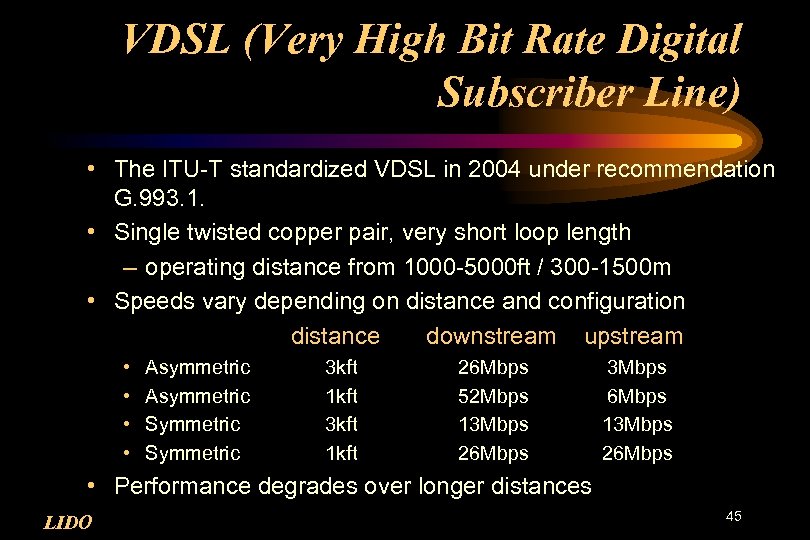 VDSL (Very High Bit Rate Digital Subscriber Line) • The ITU-T standardized VDSL in 2004 under recommendation G. 993. 1. • Single twisted copper pair, very short loop length – operating distance from 1000 -5000 ft / 300 -1500 m • Speeds vary depending on distance and configuration distance downstream upstream • • Asymmetric Symmetric 3 kft 1 kft 26 Mbps 52 Mbps 13 Mbps 26 Mbps 3 Mbps 6 Mbps 13 Mbps 26 Mbps • Performance degrades over longer distances LIDO 45
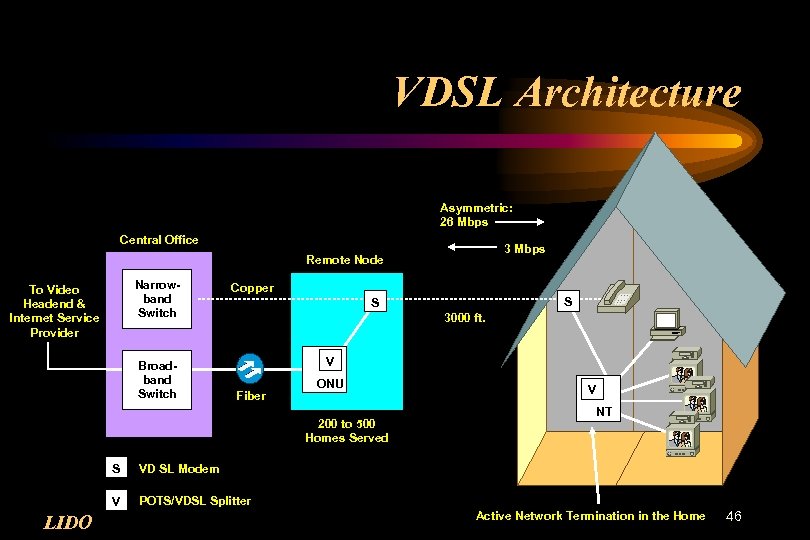 VDSL Architecture Asymmetric: 26 Mbps Central Office 3 Mbps Remote Node Narrowband Switch To Video Headend & Internet Service Provider Broadband Switch Copper 3000 ft. V Fiber ONU 200 to 500 Homes Served S V NT VD SL Modem V LIDO S S POTS/VDSL Splitter Active Network Termination in the Home 46
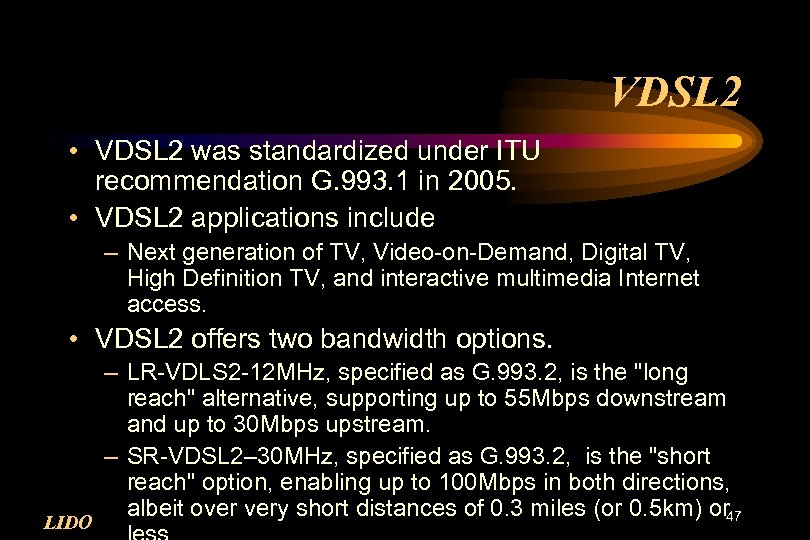 VDSL 2 • VDSL 2 was standardized under ITU recommendation G. 993. 1 in 2005. • VDSL 2 applications include – Next generation of TV, Video-on-Demand, Digital TV, High Definition TV, and interactive multimedia Internet access. • VDSL 2 offers two bandwidth options. LIDO – LR-VDLS 2 -12 MHz, specified as G. 993. 2, is the "long reach" alternative, supporting up to 55 Mbps downstream and up to 30 Mbps upstream. – SR-VDSL 2– 30 MHz, specified as G. 993. 2, is the "short reach" option, enabling up to 100 Mbps in both directions, albeit over very short distances of 0. 3 miles (or 0. 5 km) or 47
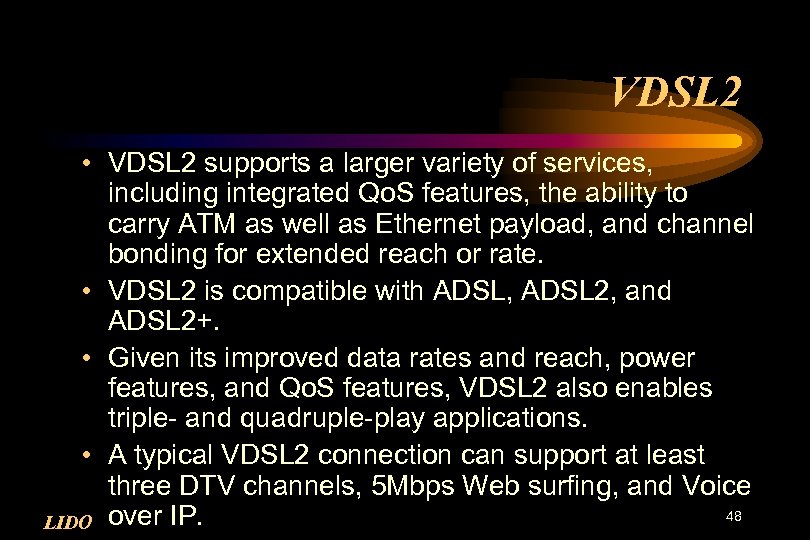 VDSL 2 • VDSL 2 supports a larger variety of services, including integrated Qo. S features, the ability to carry ATM as well as Ethernet payload, and channel bonding for extended reach or rate. • VDSL 2 is compatible with ADSL, ADSL 2, and ADSL 2+. • Given its improved data rates and reach, power features, and Qo. S features, VDSL 2 also enables triple- and quadruple-play applications. • A typical VDSL 2 connection can support at least three DTV channels, 5 Mbps Web surfing, and Voice 48 LIDO over IP.
 VDSL 2 • VDSL 2 is viewed as the ultimate DSL standard, being a natural evolution of ADSL 2+, allowing continued exploitation of copper plants, and providing sufficient bandwidth for advanced applications. • VDSL 2 gives telcos the ability to support multiple standard definition and high-definition video streams via copper. • Adoption of VDSL 2 appears to be moving quickly, with major activity worldwide. LIDO 49
 Cable TV • Cable TV operators are also called Mutiple System Operators (MSOs) • In major competition with telcos – Cable TV operators are providing Internet access and voice services – Telcos are providing TV and interactive services LIDO 50
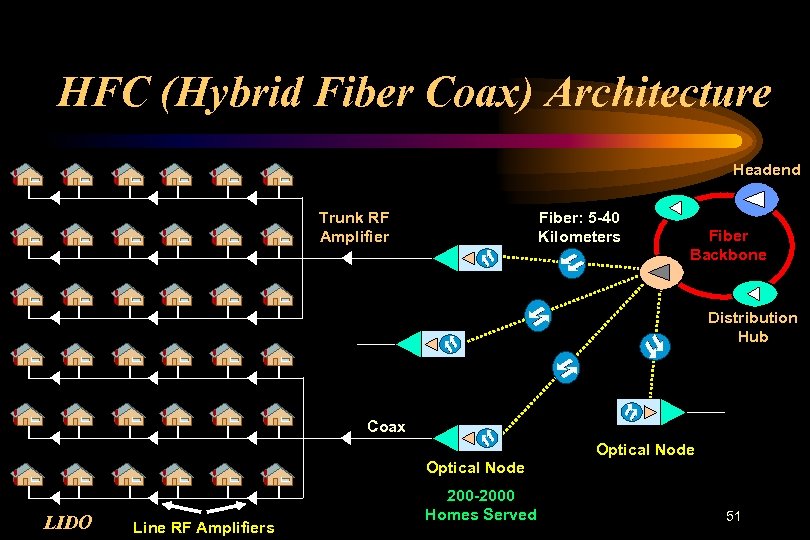 HFC (Hybrid Fiber Coax) Architecture Headend Trunk RF Amplifier Fiber: 5 -40 Kilometers Fiber Backbone Distribution Hub Coax Optical Node LIDO Line RF Amplifiers 200 -2000 Homes Served 51
 Cable TV Network • Traditional cable TV plants were one-way analog networks. • Two-way infrastructures are required to handle Internet access, voice communications, or any other interactive services. • Since the 1990 s, the upgrade to digital two-way systems has been occurring in countries with existing cable infrastructures. LIDO 52
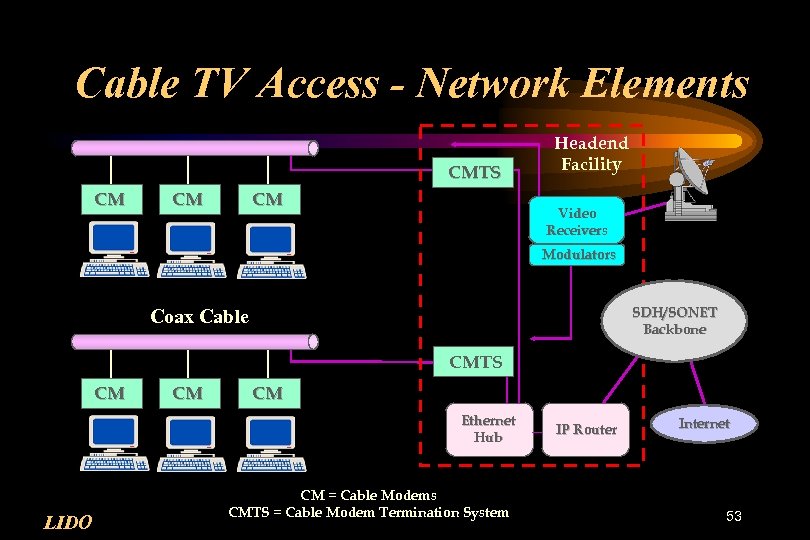 Cable TV Access - Network Elements CMTS CM CM CM Headend Facility Video Receivers Modulators SDH/SONET Backbone Coax Cable CMTS CM CM CM Ethernet Hub LIDO CM = Cable Modems CMTS = Cable Modem Termination System IP Router Internet 53
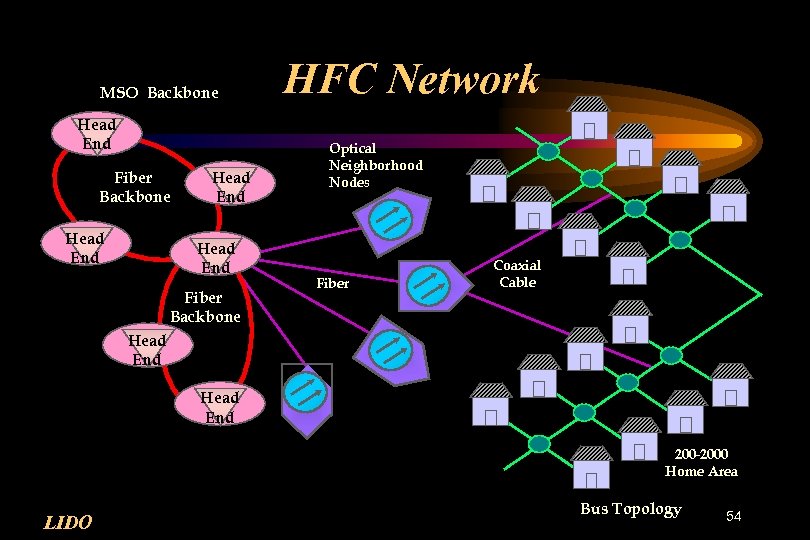 MSO Backbone Head End Fiber Backbone Head End Fiber Backbone HFC Network Optical Neighborhood Nodes Fiber Coaxial Cable Head End 200 -2000 Home Area LIDO Bus Topology 54
 HFC (Hybrid Fiber Coax) • Multiple access coax system represents a hostile environment – requires additional signal processing to overcome impairments. • Requires a cable modem for data communications services • Major concerns include security, privacy, reliability and return path issues. • Subdividing nodes alleviates bandwidth constraints and reduces ingress noise LIDO 55
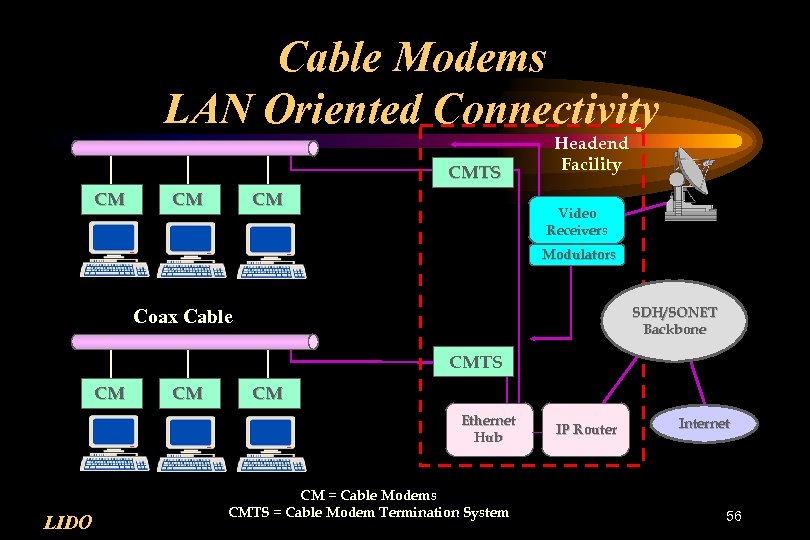 Cable Modems LAN Oriented Connectivity CMTS CM CM CM Headend Facility Video Receivers Modulators SDH/SONET Backbone Coax Cable CMTS CM CM CM Ethernet Hub LIDO CM = Cable Modems CMTS = Cable Modem Termination System IP Router Internet 56
 CMTS Functions • CMTS functions include LIDO – – – – – providing Qo. S allocating bandwidth classifying packets policing packets for Type of Service (To. S) fields adjusting the To. S fields as needed performing traffic shaping forwarding packets converting and classifying Qo. S parameters handling signaling and reservation of backbone Qo. S recording call resource usage 57
 Cable Modems Characteristics • Downstream data rates up to 36 Mbps – 42 -750 MHz range – 64/256 QAM modulation technique – more bits per second • Upstream data rates up to 10 Mbps – 5 -40 MHz range – QPSK and 16 QAM modulation technique – better noise-resistance LIDO 58
 Cable Modem Standards • Cable. Labs – Data Over Cable Service Interface Specification (DOCSIS) – Packet. Cable – Open. Cable – VOD Metadata – Cable. Home LIDO 59
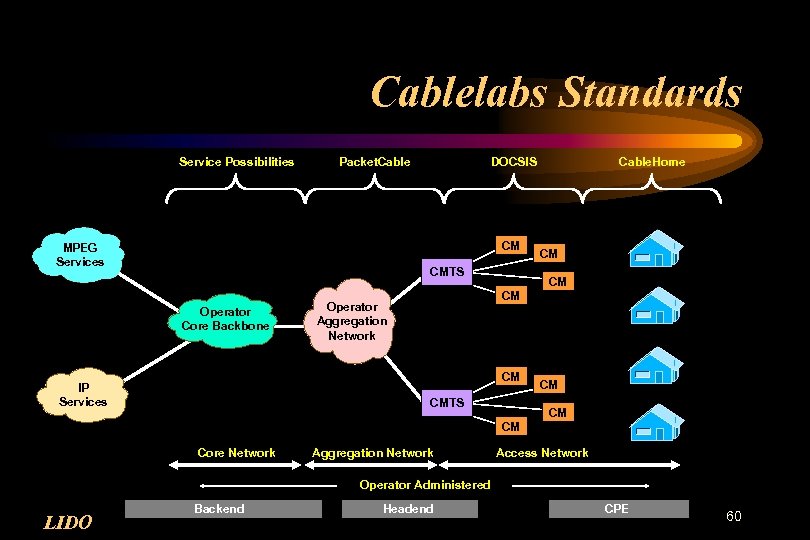 Cablelabs Standards Service Possibilities Packet. Cable DOCSIS CM MPEG Services CMTS Operator Core Backbone CM CM CM Operator Aggregation Network CM IP Services Cable. Home CMTS CM CM CM Core Network Aggregation Network Access Network Operator Administered LIDO Backend Headend CPE 60
 Cable Modem Standards • The Cable. Labs® Certified™ Cable Modem project, also known as DOCSIS® defines interface requirements for cable modems involved in highspeed data distribution over cable television system networks. • The certified cable modem project also provides cable modem equipment suppliers with a fast, market-oriented method for attaining cable industry acknowledgment of DOCSIS compliance. LIDO 61
 Euro. DOCSIS & DOCSIS • The Euro-DOCSIS standard was created based on the U. S. DOCSIS standard. • ETSI has approved both DOCSIS and the Euro. DOCSIS annex as specifications. • With the DOCSIS and Euro-DOCSIS standards, the downstream channel occupies the capacity of a single TV transmission channel. – In North America it is the 6 MHz NTSC channel – In Europe it is the 8 MHz PAL channel • Euro-DOCSIS also takes advantage of a higher capacity in the upstream band, ranging from 5 MHz 62 LIDO to 65 MHz.
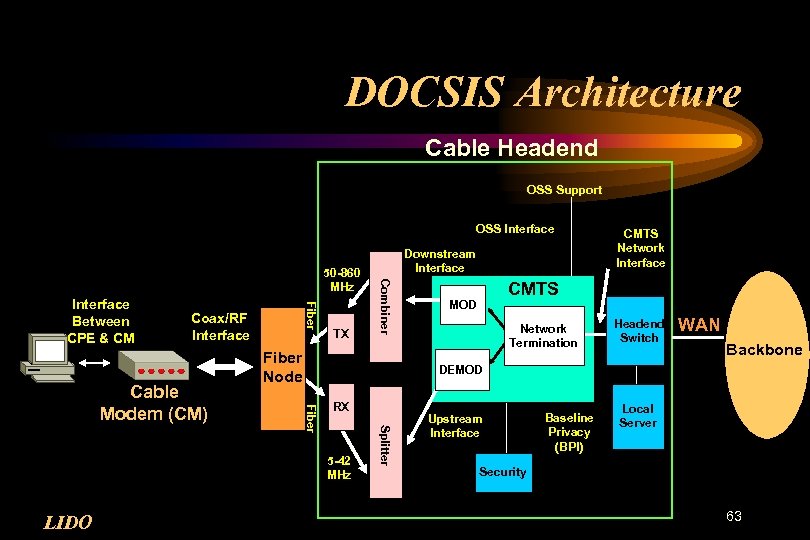 DOCSIS Architecture Cable Headend OSS Support OSS Interface Fiber Interface Between CPE & CM Coax/RF Interface Fiber Node RX Splitter 5 -42 MHz LIDO CMTS MOD Network Termination Headend Switch WAN Backbone DEMOD Fiber Cable Modem (CM) TX Combiner 50 -860 MHz Downstream Interface CMTS Network Interface Upstream Interface Baseline Privacy (BPI) Local Server Security 63
 DOCSIS Standards Family • Three successive versions of DOCSIS – DOCSIS® 1. 0 – DOCSIS® 1. 1 – DOCSIS® 2. 0 – DOCSIS 3. 0 • The ITU has adopted two of the DOCSIS variants as international standards LIDO – DOCSIS 1. 1 ratified as ITU-T Recommendation J. 112. – DOCSIS 2. 0 ratified as ITU-T Recommendation J. 122. 64
 DOCSIS 1. 0 • DOCSIS 1. 0 enables the cable TV industry to deliver high-speed data using cable modems. • The main service with DOCSIS 1. 0 is two-way access to the Internet. • With DOCSIS 1. 0, the downstream data rate is up to 40 Mbps, and the upstream rate is up to 10 Mbps over a 3. 2 MHz channel. • For downstream data, the modulation technique specified is either 64 -QAM or 256 -QAM, and upstream it is either QPSK or 16 -QAM. LIDO 65
 DOCSIS 1. 1 • DOCSIS 1. 1 specifications features include – Improved operational flexibility – Security – Quality-of-Service (Qo. S) • These features enable real-time services such as – Voice-over-IP telephony (Vo. IP) – Interactive gaming – Tier-based services. LIDO 66
 DOCSIS 1. 1 • For downstream data, the modulation technique specified is either 64 -QAM or 256 QAM • For upstream data, it is either QPSK or 16 QAM. • Along with cable modems, DOCSIS 1. 1 also supports Vo. IP phones and residential gateways. LIDO 67
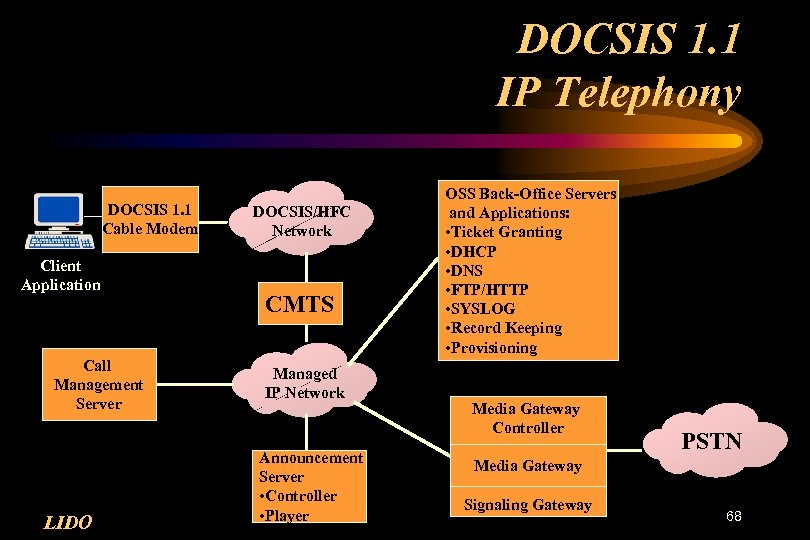 DOCSIS 1. 1 IP Telephony DOCSIS 1. 1 Cable Modem Client Application Call Management Server LIDO DOCSIS/HFC Network CMTS Managed IP Network Announcement Server • Controller • Player OSS Back-Office Servers and Applications: • Ticket Granting • DHCP • DNS • FTP/HTTP • SYSLOG • Record Keeping • Provisioning Media Gateway Controller PSTN Media Gateway Signaling Gateway 68
 DOCSIS 1. 1 • The DOCSIS 1. 1 standard addresses real-time applications such as IP telephony. • Key issues in cable-based IP telephony include voice quality and how to guarantee it in terms of latency, fidelity, jitter, packet loss, and reliability at the customer end. • Other issues are legacy signaling support, data security, scalability, and feature deployment at the service provider's end. LIDO 69
 DOCSIS 2. 0 • DOCSIS 2. 0 supports downstream speeds of up to 40 Mbps and increases upstream speeds up to 30 Mbps. • DOCSIS 2. 0 also supports symmetric services. • Along with broadband Internet access, Vo. IP, and tiered services, DOCSIS 2. 0 also supports commercial services and videoconferencing. • In addition to cable modems, Vo. IP phones, and residential gateways, it also supports video phones. LIDO 70
 DOCSIS 2. 0 • For downstream data, the modulation technique specified is either 64 -QAM or 256 -QAM, and upstream it is either QPSK, 16 -QAM, or 64 -QAM. • DOCSIS 2. x also adds support for mobile devices. • Although most operators will build it into their hardware, it will be the services—from IP voice to multimedia gaming—that will drive MSOs' decisions to implement DOCSIS 2. 0 or higher. LIDO 71
 DOCSIS 3. 0 • DOCSIS 3. 0 increases the capacity, offering a minimum of 160 Mbps downstream to customers and a minimum of 120 Mbps upstream. • DOCSIS 3. 0 achieves its speed boost in part through "channel bonding" for both up- and downstream transmission. • DOCSIS 3. 0 supports IPv 6. • DOCSIS 3. 0 adds entertainment video on top of the services supported by DOCSIS 2. 0 and 2. x, and adds support for IP set-top boxes to the list of equipment supported by the earlier DOCSIS 72 LIDO versions.
 DOCSIS DSG • The cable industry is applying DOCSIS to many services and applications beyond just Internet access. • These include new applications to monitor the health of the cable plant, including power supplies and amplifiers, and a communications pathway for digital set-tops. • DOCSIS Set-top Gateway (DSG) is a capability that gives operators a standard method to deliver messages, to guide data and more advanced streaming applications via a DOCSIS channel to the 73 LIDO digital set-top box.
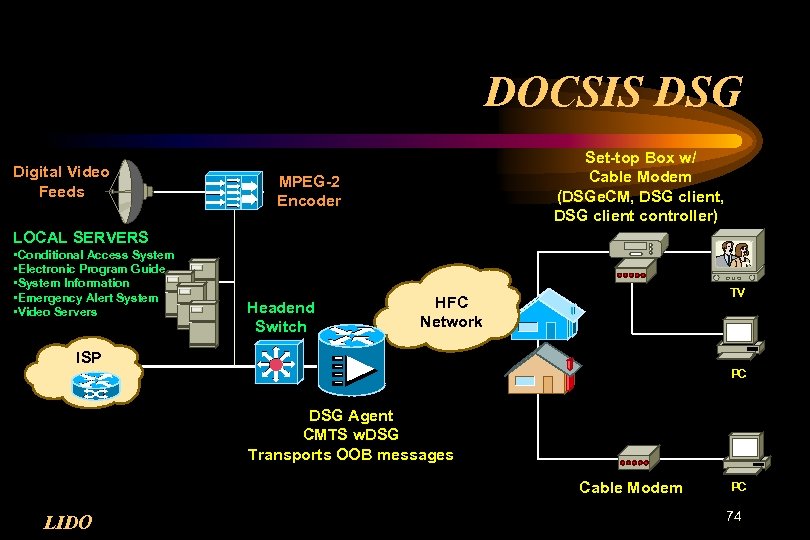 DOCSIS DSG Digital Video Feeds Set-top Box w/ Cable Modem (DSGe. CM, DSG client controller) MPEG-2 Encoder LOCAL SERVERS • Conditional Access System • Electronic Program Guide • System Information • Emergency Alert System • Video Servers Headend Switch TV HFC Network ISP PC DSG Agent CMTS w. DSG Transports OOB messages Cable Modem LIDO PC 74
 Packet. Cable • Packet. Cable is focused on developing interoperable interface specifications for delivering advanced, real -time multimedia services over two-way cable plant. • Packet. Cable interconnects three networks – the HFC access network – the PSTN – IP networks • Packet. Cable networks use IP to enable various multimedia services, including IP telephony, videoconferencing, multiparty game playing, and other multimedia applications. LIDO 75
 Packet. Cable • The Packet. Cable suite of specifications is internationally known as IPCablecom. • Packet. Cable documents have been approved by the ITU for adoption as worldwide standards. • The Packet. Cable project also seeks to help establish international standards to foster interoperability. LIDO 76
 Packet. Cable Standards • There are three Packet. Cable standards – Packet. Cable 1. 0 – Packet. Cable 1. 5 – Packet. Cable 2. 0 • First service defined for this platform is Voice-over. Internet Protocol (Vo. IP). • The core set of Packet. Cable 1. 0 specifications describes how to move the basic functions, that are typically consolidated on a single, expensive Class 5 local exchange switch, onto several generalpurpose servers – leads to a low-cost, highly flexible, scalable, distributed LIDO architecture 77
 Packet. Cable 1. 5 • Packet. Cable 1. 5 supersedes previous versions and supports additional capabilities. • Defines items necessary to implementing a singlezone or multizone solution for residential IP voice – – – – LIDO call signaling Qo. S codec client provisioning billing message collection PSTN interconnection security interfaces 78
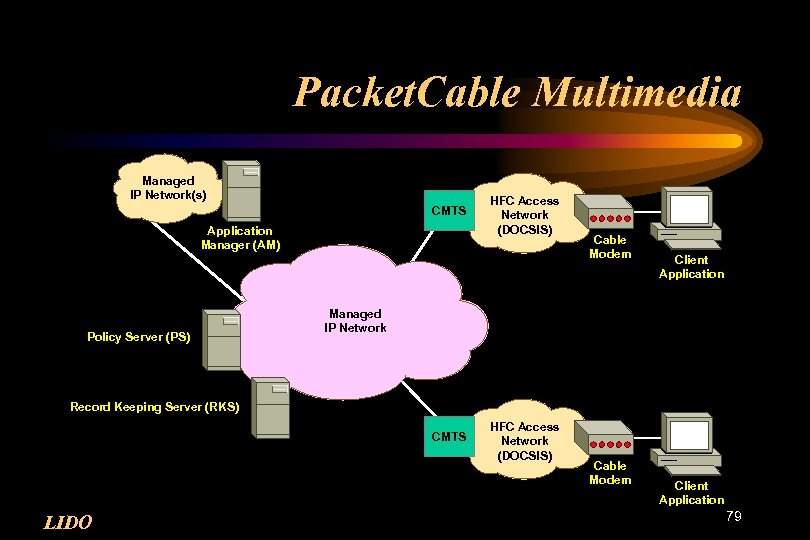 Packet. Cable Multimedia Managed IP Network(s) CMTS Application Manager (AM) Policy Server (PS) HFC Access Network (DOCSIS) Cable Modem Client Application Managed IP Network Record Keeping Server (RKS) CMTS LIDO HFC Access Network (DOCSIS) Cable Modem Client Application 79
 Packet. Cable 2. 0 • Packet. Cable 2. 0 is designed to extend cable TV’s IP network architecture. • The goal is to accelerate the convergence of voice, data, video, and mobility services. • Defines a modular architecture. • Replaces MGCP (or the Media Gateway Control Protocol) with Session Initiation Protocol (SIP). LIDO 80
 Open. Cable • The goal of the Open. Cable™ initiative is to help the cable industry deploy interactive services over cable. • Open. Cable represents a major effort on the part of North American cable operators to – – Define the next-generation digital consumer device, Encourage supplier competition Create a common platform for two-way interactive services Create a retail hardware platform • the Open. Cable project has two key components – A hardware specification – A software specification LIDO 81
 Open. Cable Hardware • Open. Cable hardware will consist of DOCSIS used with Open. Cable set-top boxes, creating terminals that are capable of supporting next-generation video and the entire range of current and future Internet and Web-based applications. • Characteristics of Open. Cable digital set-top boxes include – expanded memory – powerful graphics engines – and support for one-way broadcasts as well as two-way interactive services LIDO 82
 Open. Cable Software • Open Cable Applications Platform (OCAP) enables application writers to create new interactive services that will run on a broad range of advanced digital set tops and cable-ready TVs. • OCAP is intended to enable the developers of interactive television services and applications to design products that will run successfully on any cable TV system in North America. • It enables application writers to write their software once and be assured it will run on all OCAPcompliant devices produced by any manufacturer. LIDO 83
 Open. Cable OCAP • OCAP specifications include two main sets of software: middleware and applications software/content authoring tools. • Open. Cable's objective is to put OCAP middleware into all sorts of intelligent devices and then use OCAP authoring tools to create interactive content to run on those devices. • OCAP creates the opportunity to establish a standardized platform to launch a myriad of interactive services over a wide variety of digital devices. LIDO 84
 Video-On-Demand Metadata • VOD Metadata is a project to investigate the distribution of content assets. • Metadata is descriptive data associated with a content asset package. • It may vary in depth greatly - from merely identifying content title for the electronic program guide (EPG) to providing a complete index of movie scenes • Initial efforts focus on creating specifications for Video-on-Demand (VOD) and Subscription Videoon-Demand (SVOD) applications. LIDO 85
 Cable. Home • Cable. Labs also has a home networking initiative, called Cable. Home. • Cable. Home's objective is to deliver to subscribers high-quality managed, value-added, broadband services over any home network media. • Cable operators and telcos are taking advantage of revenue opportunities provided by home networking services. • In addition, forward-looking services, such as medical monitoring, energy management, and networked personal video recording (or PVR) 86 LIDO distribution will be increasingly visible.
 Cable Futures • The industry’s perspective is that LIDO – within 10 to 15 years, cable networks will have evolved to a converged platform – analog video will have ceased – telephone will have migrated to Vo. IP – QAM-modulated downstream channels carrying MPEG transport stream (MPEG-TS) packets – upstream communications will be DOCSIS – decryption modules will be portable – headend encryption will no longer be inseparable 87 from multiplexing and modulation
 Cable Futures • Video-on-demand is cable TV’s fastest growing new service category. • VOD is an essential tool in the competition with satellite. • It exploits three inherent advantages that HFC networks have over DBS networks: – greater raw information capacity, – a broadband two-way connection, – and a customer base that can be segmented into small groups. LIDO 88
 Cable Futures • There are limited options for solving the immediate bandwidth crunch: – – – – LIDO Increasing downstream bandwidth Decreasing node sizes (or sub-dividing nodes) More efficient digital video encoding More efficient sharing of bandwidth between applications, More aggressive modulation formats (e. g. 1024 QAM), or Switched real-time broadcast Advanced codecs Next-Generation Network Architecture (NGNA) 89
 Fiber To The x Node, Building, Home, Premise, Curb • FTTx solutions are gaining momentum as the best means for offering bundled services — but there are some key considerations for the provider. • These considerations are often dependent upon numerous factors, such as existing infrastructure and geographical density. • The current FTTx market is primarily comprised of – – – LIDO Municipalities Utilities Smaller independent and competitive local exchange carriers Multiple System Operators (MSO, or Cable TV provider) Incumbent telcos 90
 FTTx • Most of the sector have focused on the residential home side. • On the commercial and multi-dwelling unit front, it is believed that cable operators have a keen interest in plugging fiber directly into small and medium-sized businesses and apartment buildings. • Incumbent telcos are expected to warm up to FTTx technologies as cable operators achieve more success with the video, voice and data bundling strategies. 91 LIDO
 FTTx • High equipment and construction costs have long been a barrier for FTTx, but costs are declining as the technology matures. • Due to cheaper equipment and more efficient field operations, those costs are now nearly on par with advanced HFC architectures. • Current FTTx expense figures, per connected home, range from US$800 to US$2000. – Depends on the technology and the footprint reality 92 LIDO
 FTTx • Because FTTx is best set for greenfield environments, some providers see their main market as the international marketplace, where traditional infrastructures are not in place. • How deep into the network should fiber be placed and what will be the cost of replacing existing copper with fiber? • The main architectural difference between major service providers is how far to drive the fiber toward the home. LIDO 93
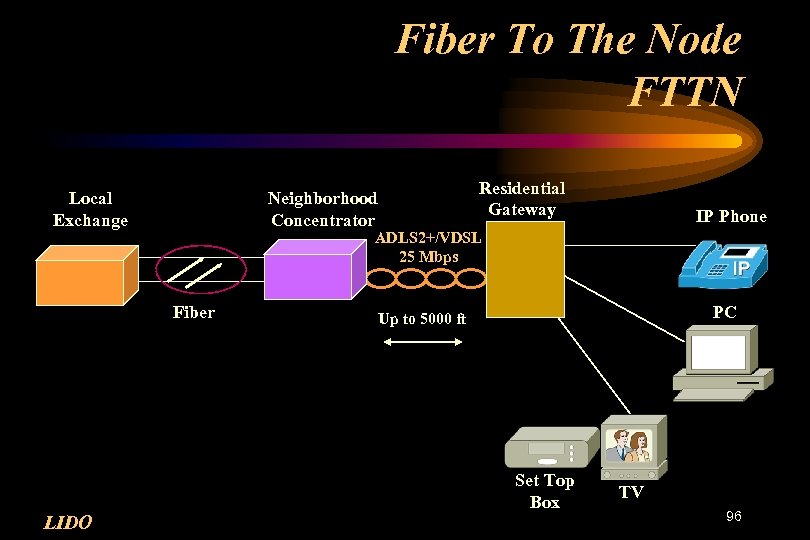
 Fiber To The x Node, Building, Home, Premise, Curb • There are main several options – Fiber to the Node (FTTN) – Fiber to the Home or Premise (FTTH/FTTP) • The first option is to extend FTTN where the network then takes advantage of existing copper or HFC plants to deliver services. – the former uses a variety of DSL technologies to optimize the copper bandwidth – the latter is being employed today by the MSOs (cable TV companies) LIDO 94
 FTTN • The biggest advantage of FTTN is that is takes advantage of the enormous amount of embedded copper. • The most important challenge, and disadvantage, is squeezing sufficient capacity out of that plant to deliver the Triple Play, or more specifically, video. – In order to accommodate more bits per second down the transmission path, two techniques must be applied • Increase the useable bandwidth • Strive to get greater bandwidth efficiency LIDO 95
 Fiber To The Node FTTN Local Exchange Residential Gateway Neighborhood Concentrator ADLS 2+/VDSL 25 Mbps Fiber PC Up to 5000 ft Set Top Box LIDO IP Phone TV 96
 FTTN • One solution for packet based video is the DSL Forum’s IP video distribution technology. • The other solution involves proprietary vendordefined schemes. • Those pursuing a FTTN strategy are investigating new technologies addressing three key areas – New technology for wire pair transmission – Video compression – Packet video with appropriate and adequate channel changing performance LIDO 97
 Fiber To The Home/Premise FTTH/FTTP • The second method takes fiber directly to the side of each home, typically referred to as FTTH or FTTP. • FTTH/FTTP offers the greatest potential for realizing the long term end-user service needs. • Accordingly, this is the most "future-proof" of these architectures. • The most common implementation today is the PON. LIDO 98
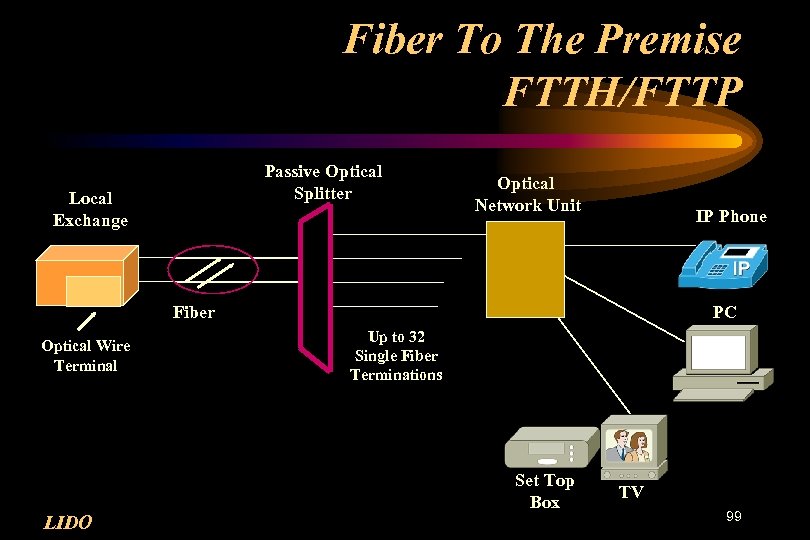 Fiber To The Premise FTTH/FTTP Passive Optical Splitter Local Exchange Optical Network Unit IP Phone Fiber Optical Wire Terminal PC Up to 32 Single Fiber Terminations Set Top Box LIDO TV 99
 Passive Optical Networks (PONs) • Most common fiber implementation today is the PON • Allows multiple buildings to share one access line. • It is a point-to-multipoint configuration, which reduces the amount of fiber required. • PONs allow for two-way traffic on a single fiber pair by making use of one wavelength for downstream traffic and another for upstream traffic. • Utilize passive optical splitters to split the power of the optical signal and route it to multiple subscribers. • Theoretical range of about 12 miles (or 20 km). LIDO 100
 Passive Optical Networks (PONs) • PONs share one fiber channel among up to 32 customers, and deliver voice, data and potentially video. • PONs reduce costs by distributing costs across more endpoints and replacing expensive add-drop multiplexers or DWDM nodes with optical splitters and couplers at each fiber connection in the network. • Downstream signals are encrypted to prevent eavesdropping. • Upstream bandwidth is allocated by assigning a timeslot to each subscriber when the user has traffic to send. LIDO 101
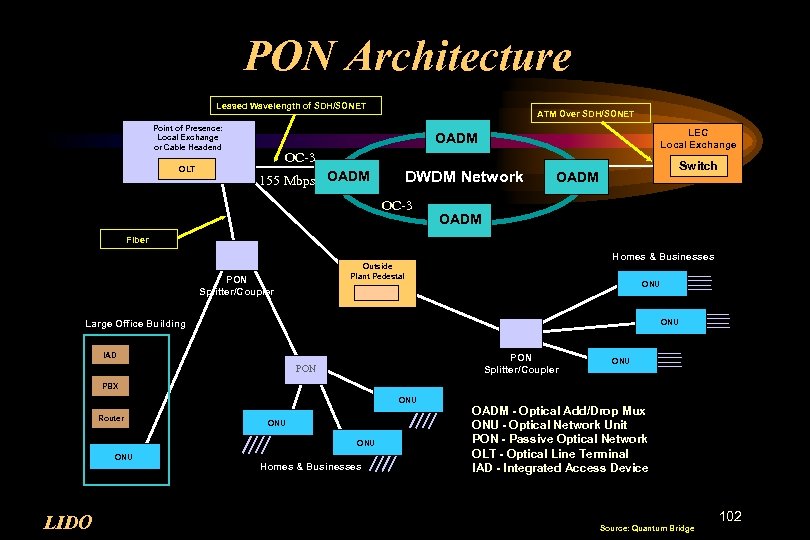 PON Architecture Leased Wavelength of SDH/SONET Point of Presence: Local Exchange or Cable Headend OLT Switch ATM Over SDH/SONET LEC Local Exchange OADM OC-3 DWDM Network 155 Mbps OADM OC-3 Switch OADM Fiber Homes & Businesses Outside Plant Pedestal PON Splitter/Coupler ONU Large Office Building IAD PON Splitter/Coupler PON ONU PBX ONU Router ONU ONU LIDO Homes & Businesses OADM - Optical Add/Drop Mux ONU - Optical Network Unit PON - Passive Optical Network OLT - Optical Line Terminal IAD - Integrated Access Device Source: Quantum Bridge 102
 PON Categories • Three types of PONs LIDO – ATM PON (APON) • Based on ATM • Advantage is that traditional telco’s have invested heavily in ATM – Ethernet PON (EPON) • Stress cost advantages – Gigabit PON (GPON) • Stress significant CAPEX and OPEX savings, Qo. S/Co. S assurance, and extensible network 103 architecture
 PON Characteristics • APON, EPON and GPON all operate over a single fiber and use different wavelengths for transmissions • Upstream and downstream channels are shared by multiple users • APONs LIDO – Downstream operates at 155 Mbps or 622 Mbps, and upstream at 155 Mbps. – A separate wavelength around 1550 nm also can be used to carry analog video like HFC 104 configurations now used in cable TV.
 PON Characteristics • EPONs – typically operate symmetrically at 1. 25 Gbps. • GPONs • operate at approximately 2. 5 Gbps downstream and 1. 2 Gbps upstream. LIDO 105
 PON Characteristics • APON, EPON and GPON characteristics (cont’d) – Passive optical splitters/combiners are used to split the power of the optical signal and route it to multiple customers – Maximum transmission range of about 12 miles or 20 km – Shortage of fiber in access networks – Bandwidth shared among users, as with cable modems LIDO 106
 PON Considerations • Optimizing splitter ratios – Important to reducing hardware costs and saving labor time – Split ratios can range from 2 to 32, and sometimes more – Additional factors to consider include • Proximity of homes • Scalability • Reliability • Managing the fear factor – Minimizing the use of underground vaults • Control of resource mapping LIDO – Up to 50% of the cost of the project is in on-site labor 107
 PON Considerations • PONs significantly reduce the cost of provisioning fiber to the subscriber. • PONs are of increasing interest to independent and local and telcos, MSOs, utilities and municipalities. • The International marketplace, where traditional infrastructures are not in place is considered a main market • Shared channel and bandwidth limitations may pose restrictions in terms of long-term usability. LIDO 108
 Powerline Telecommunications • Powerline telecommunications (PLT), broadband over powerlines (BPL), or powerline communication (PLC), has emerged as a darkhorse technology in the broadband access marketplace. • The PLT vision is to allow electrical utilities to provide high-speed Internet, voice, and data services via power transmission and distribution lines. • The concept is not new; PLT made its initial appearance in the 1920 s. LIDO 109
 PLT Today • PLT today includes – broadband over powerlines, or BPL, which infers data rates above 1 Mbps – narrowband over powerlines, which involves much lower data rates • The power company can communicate voice and data by superimposing an analog signal over the standard 50 Hz or 60 Hz alternating current (AC). • In the broadband race, high-speed data transmission has been developed using the lowervoltage transmission lines used for power 110 LIDO distribution.
 PLT Applications • There are three distinct applications for powerline communication. – Outdoor long-haul or broadband access – Indoor short-haul or home area networking – Automotive applications, which include • Mechatronics • Telematics • Multimedia LIDO 111
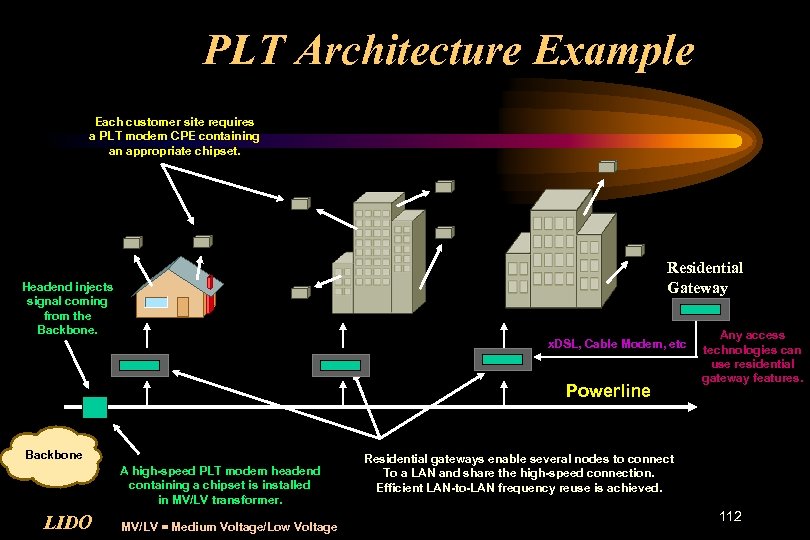 PLT Architecture Example Each customer site requires a PLT modem CPE containing an appropriate chipset. Residential Gateway Headend injects signal coming from the Backbone. x. DSL, Cable Modem, etc Powerline Backbone A high-speed PLT modem headend containing a chipset is installed in MV/LV transformer. LIDO MV/LV = Medium Voltage/Low Voltage Any access technologies can use residential gateway features. Residential gateways enable several nodes to connect To a LAN and share the high-speed connection. Efficient LAN-to-LAN frequency reuse is achieved. 112
 BPL – The Big Picture • The greatest advantage of BPL over DSL or cable modems is the extensive availability of power infrastructure. • The lack of standards for powerline as an access technology means that there is no standard provisioning of the service. • There also differences in the physical characteristics of the electricity network. • And, there is the question about the total bandwidth BPL can provide as compared to DSL or cable modems. LIDO 113
 How BPL Works • BPL makes use of the electric circuit between the electric substations and home networks. • PLT modems transmit in the 1. 6 MHz to 30 MHz electric carrier. • The asymmetric speed in the modem is usually from 256 Kbps to 2. 7 Mbps. • The speed in the repeater is up to 45 Mbps, and up to 256 PLT modems can be connected. • In the medium-voltage (MV) stations, the speed from the headends to the Internet is up to 135 Mbps. • Utilities use either optical fiber or wireless links to 114 LIDO connect to the Internet.
 How BPL Works • In the access network, current technology can deliver speeds of up to 45 Mbps. • In home area networking applications, up to 200 Mbps is possible using the Homg. Plug AV standard. • Qo. S and Co. S capabilities can be implemented by using PLT technologies, which is a critical feature in support of real-time and streaming media applications. LIDO 115
 BPL Developments • New developments include the use of microwave frequencies employing new propagation mechanisms which permit much higher-speed transmission using a single powerline conductor. • Trials have also demonstrated that analog TV along with multiple Wi-Fi channels can operate simultaneously in the 2. 4 GHz and 5. 3 GHz unlicensed bands over medium-voltage lines. LIDO 116
 BPL Considerations • More than 80 PLC initiatives in more than 40 countries have been launched, worldwide, by electric utilities. • The largest technology dilemma hinges on finding a reliable way to send data on power lines without causing interference for either data or electrical signals. • There also issues with the number of users it can reach and the distance over which it can travel while still providing good-quality data and voice transmission. • PLT's maximum access speed depends on a shared connection. LIDO 117
 BPL Considerations • The interference problem is being addressed by developments using orthogonal frequency-division multiplexing (OFDM). – OFDM divides available spectrum into small paths that are overlapped and spaced perpendicular to each other. – While each path has a low data rate, together they offer a higher rate and more efficient use of the spectrum. • PLT also suffers from distance limitations – About two miles with a very low bandwidth or a few hundred yards offering several Mbps – However, most premises worldwide are within 300 yards of an electricity substation. 118 LIDO – Vendors are working on extending the reach.
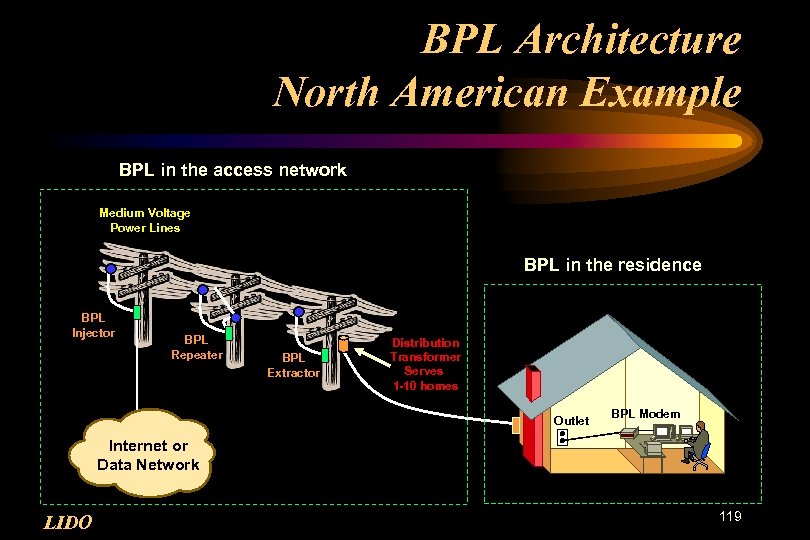 BPL Architecture North American Example BPL in the access network Medium Voltage Power Lines BPL in the residence BPL Injector BPL Repeater BPL Extractor Distribution Transformer Serves 1 -10 homes Outlet BPL Modem Internet or Data Network LIDO 119
 BPL Standards Efforts • There was no global technology standard for the use of PLT as a broadband access line in place until early 2006. • The Open PLC European Research Alliance (OPERA), a European initiative to develop BPL technologies and specifications, has been busy working on developing such standards. • In February 2006, OPERA announced the approval of the first open global specification for PLC access, also known as BPL. LIDO 120
 BPL Future • With more than 3 billion users worldwide – the penetration of the electricity networks is almost ubiquitous – bringing access to a global communications infrastructure within reach of all – without the need for heavy infrastructure costs • However, DSL, cable modems, and now fiber alternatives like PONs, have already made a significant headway, while PLT technology is still experimental. LIDO 121
 Broadband Wireless Access Options • Wireless broadband access provides the opportunity to make use of many new technologies – – – wireless local area networks (WLANs) wireless metropolitan area networks (WMANs) Direct Broadcast Satellite (DBS) Free Space Optics Virtual Fiber (VF) • Wireless systems increasingly offer more options, each of which promises – greater speeds – supports Qo. S LIDO – operates over a wider range of footprints. 122
 Broadband Wireless Access Options • Going forward, more than half of the new fixed phone lines installed worldwide each year will be wireless • The cost of a radio link has been halving every seven years, while its data capacity has been doubling every three years. • For wireless links, construction and equipment costs have a ratio of roughly 20: 80, whereas for a terrestrial optical-fiber link the ratio would be 90: 10. LIDO 123
 Broadband Wireless Access Options • Wireless systems often operate in a point-tomultipoint mode • Since the air is a shared medium, like cable, the maximum transmission rate that can be provided to any one client decreases as more clients are served. • Clients who need the greatest bit-rate obtainable from a system (like an ISP for example) may find it advisable to arrange for a point-to-point system. LIDO 124
 Wi-Fi in the Local Loop • The IEEE 802. 11 x WLAN technologies offer a potential WLL solution. • "Wi-Fi" is a trade term promulgated by the Wireless Ethernet Compatibility Alliance (WECA). • Products certified as Wi-Fi by WECA are interoperable with each other even if they are from different manufacturers. LIDO 125
 Wi-Fi in the Local Loop • Wireless networks are on the rise. Many of these have been set up by grassroots groups that want to get on the Net by sharing local connections. • The attitude is putting the grassroots networks on a collision course with cable companies and telecom carriers. • These new community wireless networks are based on Wireless Fidelity (Wi-Fi) technology. LIDO 126
 Wi-Fi in the Local Loop • Wi-Fi allows users to plug a single high-speed Internet connection like a cable modem into a wireless base station and share it with scores of people in a building, park, or small neighborhood. • Anyone can snap an antenna into a laptop and tap into many of these unsecured mini-networks for free, without permission. – Some entrepreneurs may charge their neighbors from US$20 to US$75 per month, others may offer it for free. LIDO 127
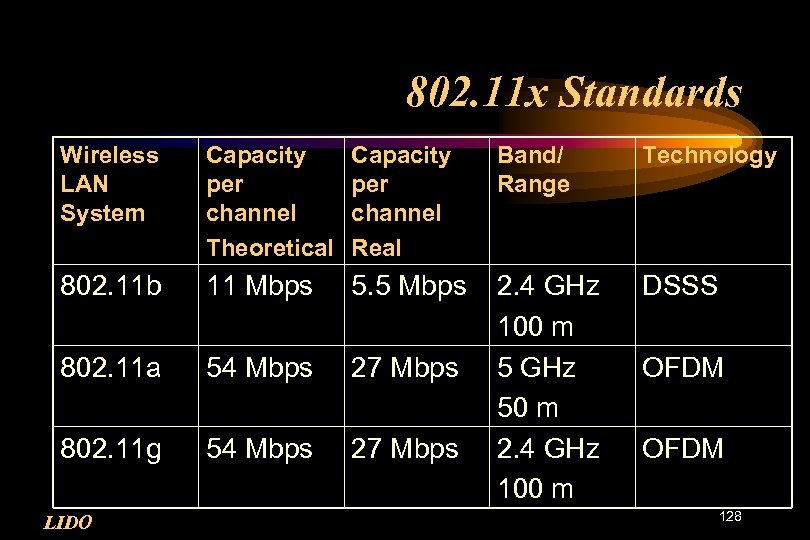 802. 11 x Standards Wireless LAN System Capacity per channel Theoretical Capacity per channel Real Band/ Range Technology 802. 11 b 11 Mbps 5. 5 Mbps DSSS 802. 11 a 54 Mbps 27 Mbps 802. 11 g 54 Mbps 27 Mbps 2. 4 GHz 100 m 5 GHz 50 m 2. 4 GHz 100 m LIDO OFDM 128
 Wi-Fi Considerations • Key advantage is that Wi-Fi technologies use unlicensed spectrum • Main disadvantage is that WLANs offer lower data rates and are subject to interference from other WLANs as well as a growing number of devices that also use that unlicensed spectrum. • The only way to guarantee bandwidth is to use licensed spectrum. LIDO 129
 Wi-Fi Considerations • Even though Wi-Fi is extremely cost-effective to deploy and is extremely popular in today’s world, there are some issues that need to be recognized and dealt with. – Limited range of service – Lack of Quality of Service – Lack of Security LIDO 130
 Wi. MAX in the Local Loop • Another solution for broadband wireless local loop involves the IEEE 802. 16 Broadband Wireless Access Standards, commonly referred to as Wi. MAX (Worldwide Interoperability for Microwave Access) • Wi. Max is designed from ground up to provide wireless last-mile broadband access in the metropolitan area network (or MAN). • By providing a standards-based, cost-effective, and flexible technology, IEEE 802. 16 can fill the existing gaps in broadband coverage and create new forms of wireless broadband services. LIDO 131
 Wi. MAX Standards • IEEE 802. 16 first issued standards for the PHY and MAC layers of systems in the 10 -66 GHz bands. – Requires line-of-sight to the base station. • IEEE 802. 16 a and 802. 16 REVd supports operation in the 2 GHz– 11 GHz bands, utilizing OFDM to mitigate the impairments fading and multipath. – Supports fixed and nomadic access in line-of-sight and non-line-of-sight environments. • The IEEE 802. 16 e standard, called Mobile Wi. Max, calls for operation on frequencies below 6 GHz, does not require line-of-sight, and introduces mobility. LIDO 132
 Wi. MAX Advantages • The main advantages of Wi. Max include – the ability to provision services quickly – the avoidance of costly installations – the ability to overcome the physical limitations associated with wired infrastructures. LIDO 133
 Wi. MAX Applications • Phase 1 – Fixed location private line and/or hot spot backhaul – Involves dedicated facilities using outdoor antennas, supporting up to 100 Mbps • Phase 2 – Broadband wireless access – The first mass market application for Wi. MAX is intended to be wireless DSL. • Phase 3 – Nomadic or Mobile applications – New developments, such as 802. 16 e (Mobile Wi. MAX) are designed to also support moving users, traveling at speeds up to 75 mph. LIDO 134
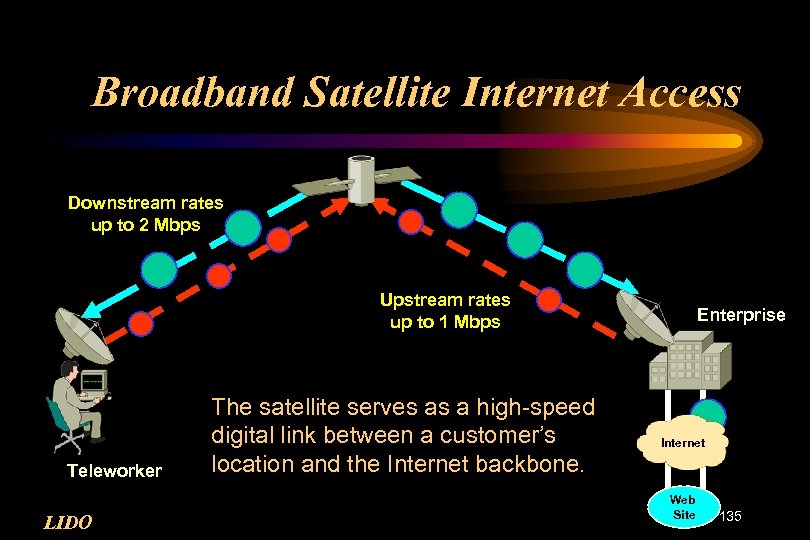 Broadband Satellite Internet Access Downstream rates up to 2 Mbps Upstream rates up to 1 Mbps Teleworker LIDO The satellite serves as a high-speed digital link between a customer’s location and the Internet backbone. Enterprise Internet Web Site 135
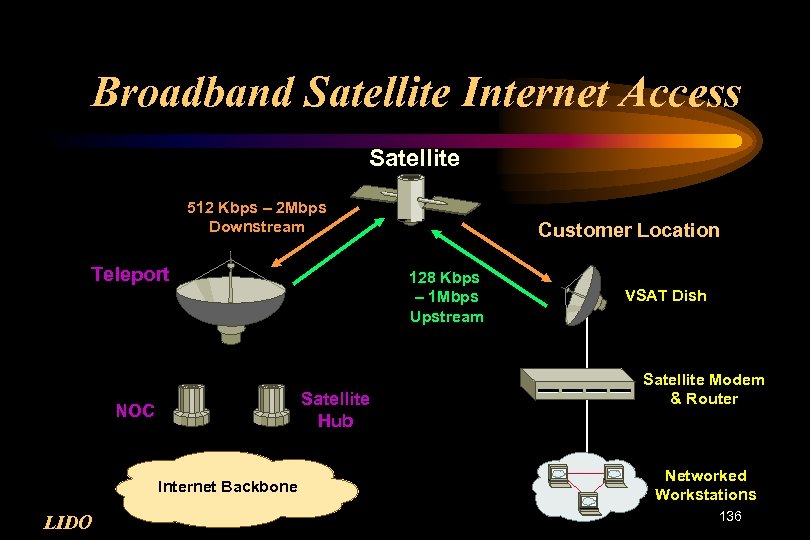 Broadband Satellite Internet Access Satellite 512 Kbps – 2 Mbps Downstream Teleport Internet Backbone LIDO 128 Kbps – 1 Mbps Upstream Satellite Hub NOC Customer Location VSAT Dish Satellite Modem & Router Networked Workstations 136
 Satellite Considerations • A major consideration in using satellites for Internet access is the latency. – Round-trip latency off satellite can be 700 -900 msec. – This means time sensitive applications, like voice, multimedia and interactive gaming will suffer in performance. LIDO 137
 Free Space Lasers • Also known as Free Space Optics • Uses low-powered infrared lasers • Two categories – Point-to-point products used to provide highspeed connection between two buildings – Multiple high-speed connections through the air at much shorter distances, either in a point-tomultipoint or meshed architecture. LIDO 138
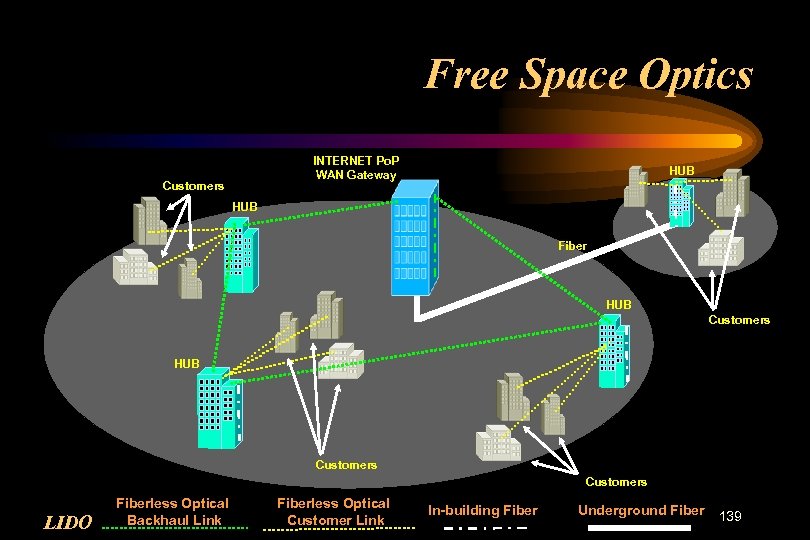 Free Space Optics INTERNET Po. P WAN Gateway Customers HUB Fiber HUB Customers LIDO Fiberless Optical Backhaul Link Fiberless Optical Customer Link In-building Fiber Underground Fiber 139
 Free Space Lasers • Key issues – Weather • Biggest issue is fog – Moving buildings • Need autotracking mechanisms – Flying objects • Meshed architecture more reliable – Safety precautions • Less power than laser pointers LIDO 140
 Virtual Fiber (VF) Characteristics • One of the newer broadband wireless solutions to the “first mile” problem of delivering high-speed access to the end user. • The use of VF is based on Millimeter Wave (MMW) technology to deliver line-of-sight broadband • MMW is often used in wireless local loops (WLL) • Usually covers the range between 10 GHz-300 GHz • The limiting factor for MMW is heavy rain, but the signal loss is much less than for FSO in fog. LIDO 141
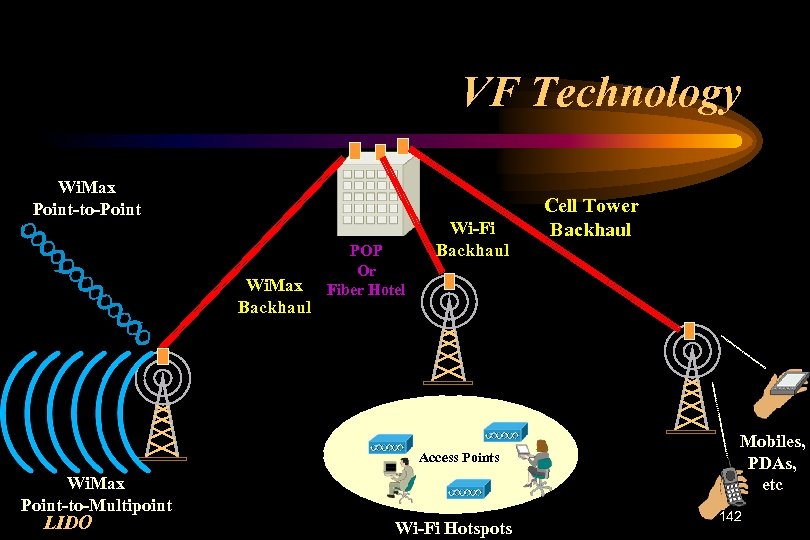 VF Technology Wi. Max Point-to-Point Wi. Max Backhaul POP Or Fiber Hotel Wi-Fi Backhaul Access Points Wi. Max Point-to-Multipoint LIDO Wi-Fi Hotspots Cell Tower Backhaul Mobiles, PDAs, etc 142
 VF Applications • VF technology is deployed as point-to-point links, using ultra-high radio frequencies. • VF supports multi-Gbps transmission of data, voice, and video, as well as streaming HDTV. • VF technology can support implementation of triple-play and quadruple-play services. LIDO 143
 VF Applications • Additional applications of VF, including – – – – – fiber (backbone) POP access network diversity (providing redundant access) enterprise campus connectivity LAN extension local loop MANs WAN access local exchange bypass storage access (including storage area networks [SANs] and network attached storage [NAS]) – wireless backhaul (3 G, 4 G, Wi. Max, and Wi-Fi) 144 LIDO – high-definition video
 Virtual Fiber (VF) • Current VF products support duplex rates of at least 1. 5 Gbps with promised future enhancements reaching 10 Gbps. • Reliable distances, with nearly 0% loss, are short, only 1. 5 -2 km. This means many pairs of radios are needed even for moderate distances. • Effective reach can be extended to 3 miles (5 km), pending availability requirements; reliability at the longer distance is only 99. 9%. LIDO 145
 VF Benefits • The key benefits associated with VF include – reduced costs – reduced risk – reduced time-to-market LIDO 146
 Virtual Fiber (VF) Considerations • Millimeter wave systems have some other undesirable propagation characteristics: – Free space loss increases with the square of the frequency; losses are much higher in millimeter wave range – Above 10 GHz, attenuation due to rainfall and atmospheric or gaseous absorption are large – Multipath losses can be quite high – Security is an important consideration. – VF is not currently standards-based, so users should evaluate claims of interoperability carefully. LIDO 147
 HAN Drivers • Smart things need to communicate in order to realize their true value. • Smart devices need channels over which to communicate, so the more smart things you have, the greater the likelihood you need a home area network HAN). • The emergence of intelligent appliances also opens up an entirely new level of market involvement. • A smart appliance acts as a vehicle for stimulating interest in activities that benefit from using the appliance. 148 LIDO
 The Last 100 Meters • Traditionally, broadband deployments have focused on core networks and on the last mile. • The HAN brings the broadband access solution closer to completion. • We can expect to see the global market for home networking equipment rise substantially. • Connectivity products will offer additional voice management, home monitoring, and new entertainment services. • The home network is now considered part of the 149 LIDO service provider network.
 HAN Environment • Home networking is substantially different from enterprise networking. • Home users will need a residential gateway to access their broadband connection and allow it to be shared among multiple devices. • Home users also want additional services, such as Vo. IP, support for interactive multiplayer games, and streaming entertainment media. • The most common choices for HAN media are generally phone lines, powerlines, and wireless technologies. LIDO 150
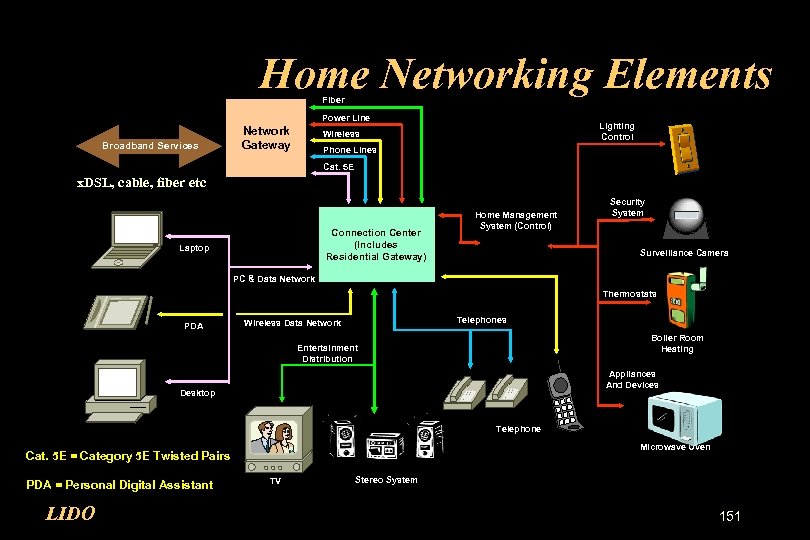 Home Networking Elements Fiber Power Line Broadband Services Network Gateway Lighting Control Wireless Phone Lines Cat. 5 E x. DSL, cable, fiber etc Connection Center (Includes Residential Gateway) Laptop Home Management System (Control) Security System Surveillance Camera PC & Data Network Thermostats PDA Telephones Wireless Data Network Boiler Room Heating Entertainment Distribution Appliances And Devices Desktop Telephone Microwave Oven Cat. 5 E = Category 5 E Twisted Pairs PDA = Personal Digital Assistant LIDO TV Stereo System 151
 HAN Categories • Several different technologies can be applied in HANs. • The home network is likely to become a composition of layered networks, including – – – computer networks control networks mobility networks entertainment networks backbone networks • The wireless approach has by far the greatest penetration today, using the popular Wi-Fi standard 152 LIDO for wireless LANs.
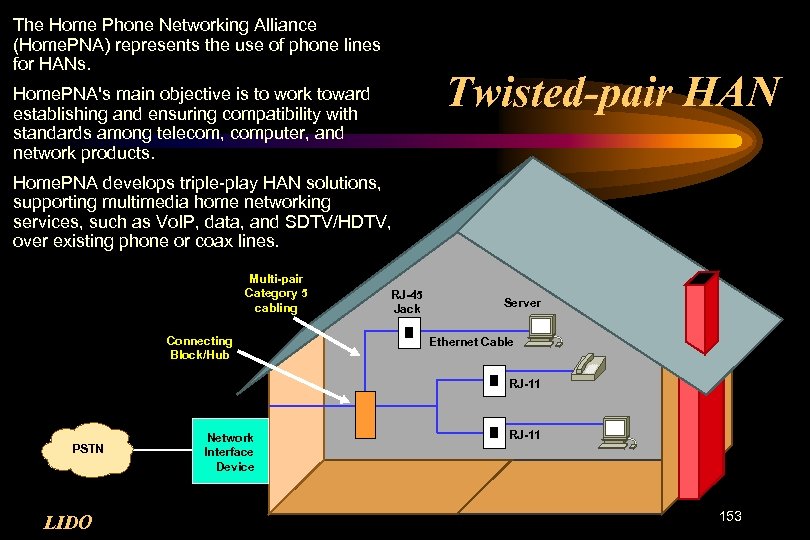 The Home Phone Networking Alliance (Home. PNA) represents the use of phone lines for HANs. Twisted-pair HAN Home. PNA's main objective is to work toward establishing and ensuring compatibility with standards among telecom, computer, and network products. Home. PNA develops triple-play HAN solutions, supporting multimedia home networking services, such as Vo. IP, data, and SDTV/HDTV, over existing phone or coax lines. Multi-pair Category 5 cabling Connecting Block/Hub RJ-45 Jack Server Ethernet Cable RJ-11 PSTN LIDO Network Interface Device RJ-11 153
 Home. PNA Characteristics • Makes use of different frequencies for the data streams than for the basic phone traffic. – Frequencies can be reserved and prioritized. • The technology – provides data rates up to 320 Mbps – with guaranteed Quality of Service – enabling service providers to support • multimedia services in the home, including broadcast IPTV inhome distribution and networked personal video recorders (PVRs). • The most current specification is Home. PNA 3. 1. – Standardized by the ITU-T in January 2007, under Recommendation G. 9954. LIDO 154
 Home. PNA Upgrades • Home. PNA 3. 1 upgrades the specification to support data rates up to a combined 320 Mbps over two simultaneous channels • Home. PNA 3. 1 enables high-speed Internet services (IPTV, Vo. IP, and data) over both phone wires and coaxial cables. • Home. PNA 3. 1 provides multi-spectrum operation, supporting as many as four spectrum bands. • Multi-spectrum operation also allows multiple Home. PNA networks to coexist on the same wiring. LIDO 155
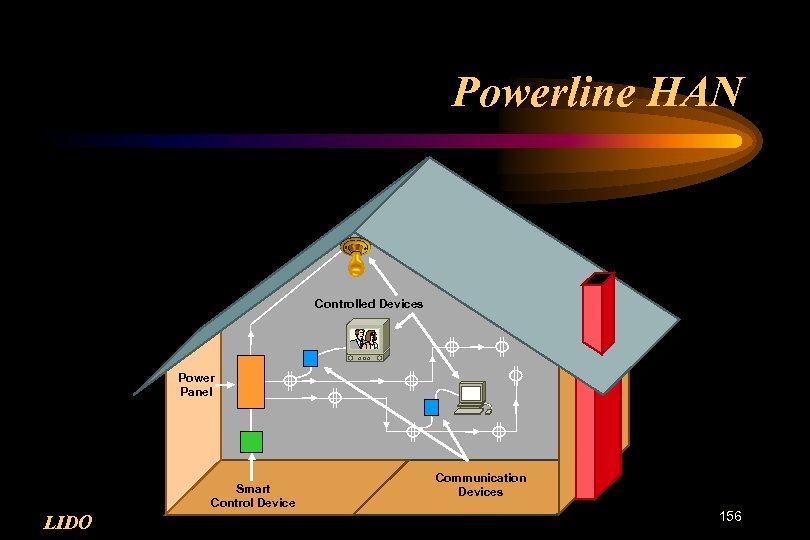 Powerline HAN Controlled Devices Power Panel Smart Control Device LIDO Communication Devices 156
 Powerline HAN Considerations • The flexibility of a PLT HAN depends on the availability and placement of the power sources. • Another important consideration is the topology of the power distribution to the home. • Networking signals from your home could show up on the powerline in any of the other homes served by the same source, creating privacy and security concerns similar to those experienced with wireless networks. LIDO 157
 Home. Plug Powerline Alliance • The Home. Plug Powerline Alliance certifies products for Homg. Plug compliance so that devices marked with its certification mark are interoperable. • There are two versions of Home. Plug. LIDO – Home. Plug 1. 0 enables speed up to 14 Mbps. – Home. Plug 2. 0, also known as Home. Plug AV, promises a raw data rate of up to 200 Mbps, although the practical throughput is closer to 100 Mbps. – Home. Plug 2. 0, while compatible with Home. Plug 1. 0, can support Vo. IP and HDTV. – The alliance is also now working on a Home. Plug BPL standard. 158
 Home. Plug • Home. Plug brings back the ability to use Ethernet in a bus topology through the use of OFDM modulation. • Home. Plug technology uses OFDM as the basic transmission technique to deal with the noise problems inherent in the powerline medium. • Home. Plug also makes use of a combination of sophisticated forward error correction (FEC), interleaving, error detection, and automatic repeat request (ARQ) to ensure that the channel appears reliable to the network-layer protocols. LIDO 159
 Consumer Electronics Powerline Communication Alliance (CEPCA) • The main mission of the Consumer Electronics Powerline Communication Alliance (CEPCA) is to promote and continuously advance high-speed PLT technology. • CEPCA will be working on promoting coexistence in the United States, Europe, and China and encouraging PLT deregulation in Japan while also submitting proposals to the IEEE, ETSI PLT, and PLC-J (in Japan). LIDO 160
 Additional PLT Standards • The Panasonic HD-PLC Ethernet adaptor supports up to 190 Mbps data speed over a range of 500 feet (or 150 m). • X 10 Ltd. 's standard X 10 is a communications protocol for remote control of electrical devices and communications over standard household AC powerline wiring. • The CEBus home networking standard is for multiple alternatives, including powerlines. – The standard defines protocols for how to make products communicate through powerline wires, low-voltage twisted pairs, coax, infrared, RF, and fiber. 161 LIDO
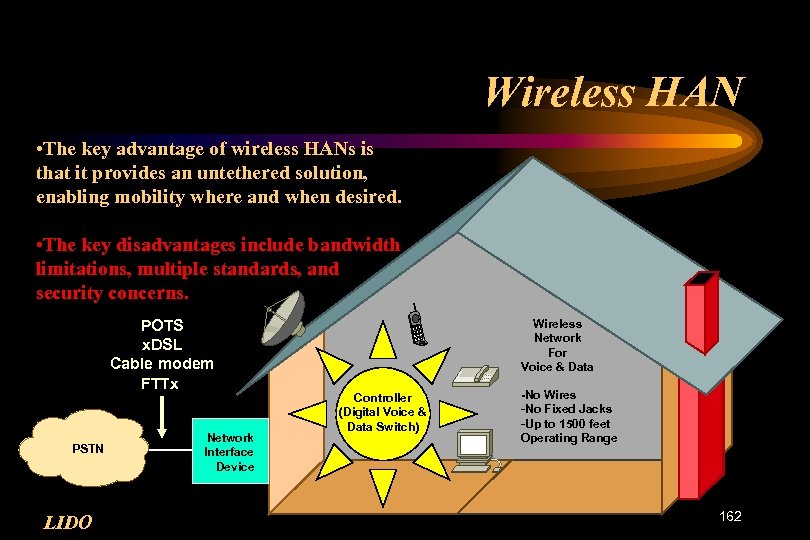 Wireless HAN • The key advantage of wireless HANs is that it provides an untethered solution, enabling mobility where and when desired. • The key disadvantages include bandwidth limitations, multiple standards, and security concerns. POTS x. DSL Cable modem FTTx PSTN LIDO Network Interface Device Wireless Network For Voice & Data Controller (Digital Voice & Data Switch) -No Wires -No Fixed Jacks -Up to 1500 feet Operating Range 162
 Wireless HAN Characteristics • Two of the more prominent wireless HAN standards today include IEEE 802. 11 and Bluetooth. • IEEE 802. 11, better known as Wi-Fi, originally supported 1 Mbps to 2 Mbps, in the 2. 4 GHz band. – The IEEE has since published three supplements to the 802. 11 standard: 802. 11 b, 802. 11 a, and 802. 11 g. • The greatest advantage of Wi-Fi is its simplicity. • The Bluetooth Consortium deals with networks that operate over very short ranges (about 100 ft. , or 30 m), but more and more devices are being created to work in these ranges. LIDO 163
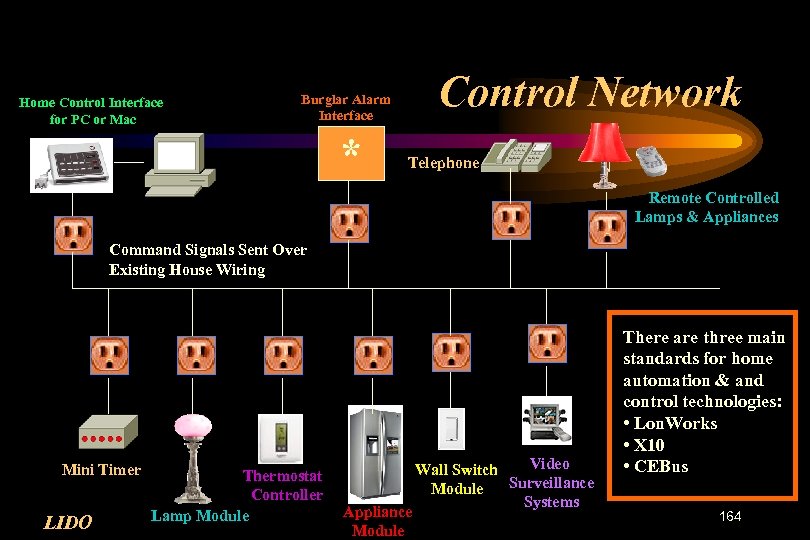 Home Control Interface for PC or Mac Control Network Burglar Alarm Interface * Telephone Remote Controlled Lamps & Appliances Command Signals Sent Over Existing House Wiring Mini Timer LIDO Thermostat Controller Lamp Module Appliance Module Video Wall Switch Surveillance Module Systems There are three main standards for home automation & and control technologies: • Lon. Works • X 10 • CEBus 164
 Wired HANs • Wired HANs include – Universal Serial Bus (USB) – Category 5 or 10 Base. T wiring – IEEE 1394 (or Fire. Wire) • The benefits of wired HANs are that wired network standards are reliable and robust. • The drawbacks of wired networks are that penetrating the mass market requires a "no new wires" technology. LIDO 165
 HAN Gateways • A HAN requires gateways and servers. • A residential gateway connects a HAN to the Internet. • Most residential gateways support broadband connectivity, the sharing of the Internet connection, and firewall security. • The residential gateway will also interact with the home telephone, entertainment systems, kitchen and home appliances, and the entire new generation of network-enabled devices. 166 LIDO
 Cable. Labs Cable. Home • Cable. Home 1. 0 (ITU-T J. 191) provides the following key residential gateway features – Hands-off authentication and provisioning of the residential gateway; – Secure remote management and configuration of the residential gateway; – Home device visibility and connectivity tests; – Cable and application-friendly address translation; – Protection of the cable network from in-home traffic; – Firewall management and rule-set download; and – Local name service. LIDO 167
 Cable. Labs Cable. Home • The Cable. Home 1. 1 (ITU-T J. 192) specification includes the following features: LIDO – Standardized firewall configuration, reporting, and baseline functionality; – Simple parental control; – Static port forwarding support; – VPN support in the firewall and address translator; – Configuration file authentication; – Prioritized Qo. S on the home network; – Device and service discovery for key applications and services; – LAN management messaging; and 168 – LAN IP statistics monitoring.
 HAN Considerations • HANs are becoming a fundamental aspect of a person's residence, and they will become more functional and important as we go forward into the realm of interactive and mobile multimedia lifestyles. • Points to consider…. . – Who is in control in the smart house? – Does the house's behavior act consistently with the image you would like to project? – Does the house now have a personality of its own? – What happens when the power goes off? – What happens when the house crashes? LIDO 169
 LIDO Telecommunications Essentials® Broadband Access Alternatives Lili Goleniewski The LIDO Organization, Inc. www. telecomessentials. com +1 -415 -457 -1800 lili@lidoorg. com Skypes ID: lili. goleniewski Telecom Essentials Learning Center www. telecomessentials. com LIDO Copyright © 2007 - The LIDO Organization, Inc. All Rights Reserved 170