


 Скачать презентацию lichens and air Pollution Shpakovskaya Anastasia
Шпаковская А.pptx
- Количество слайдов: 11
 lichens and air Pollution … Shpakovskaya Anastasia
 WHAT IS A LICHEN? Lichens are made up of two different organisms living together: a fungus and an alga. The fungus provides the body in which the alga can live protected from light and drought. The alga makes the food for the fungus.
 Many lichens do not like air pollution There are many types of air pollution: Natural sources: forest fires, pollen, dust storm. Unnatural sources: man-made; coal, wood and other fuels used in cars, homes, and factories for energy.
 What physiological properties make lichens useful indicators of air quality? Ø Lichens absorb water and minerals from rainwater and directly from the atmosphere, over their entire surface area. This makes them extremely sensitive to atmospheric pollution. As a result, there are usually very few lichens around industrial centres and towns. Ø Different lichen species vary in their tolerance to pollution and therefore make very good biological indicators of levels of atmospheric pollution.
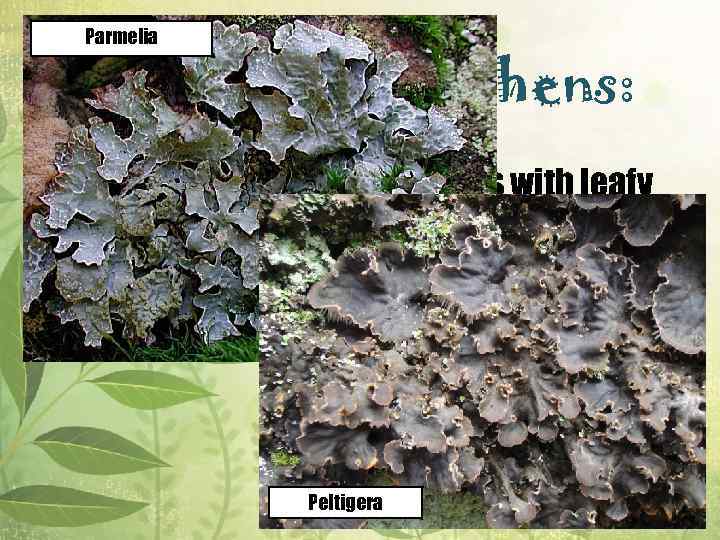 Parmelia Life forms of lichens: v Foliose lichens are lichens with leafy lobes, which spread out in a horizontal layer over the surface. Peltigera
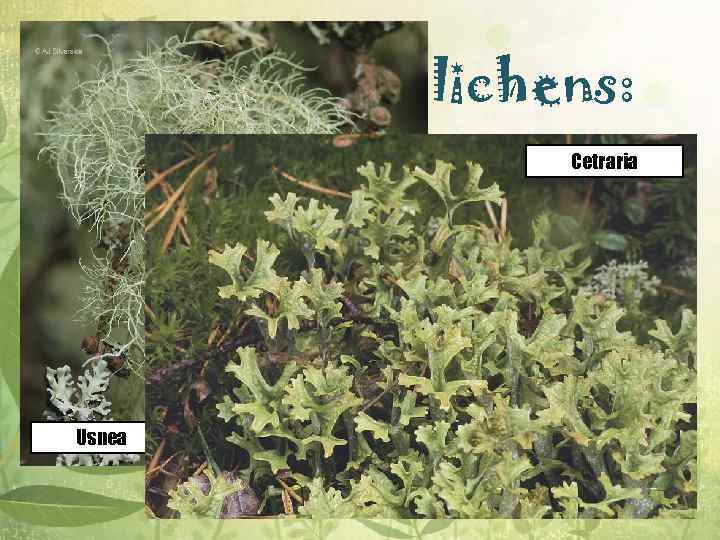 Life forms of lichens: Cetraria v Fruticose lichens are shrubby forms with many branches. Usnea
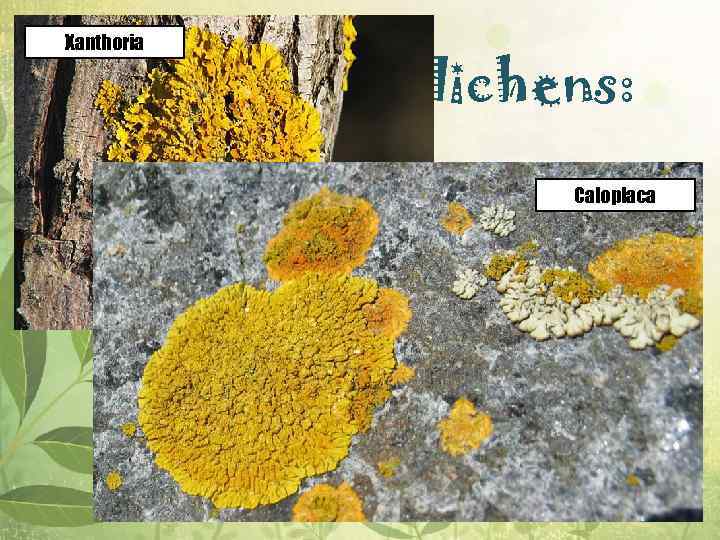 Xanthoria Life forms of lichens: v Crustose lichens are, as their name Caloplaca suggests, encrusting forms which spread over and into the surface of their habitat.
 Life forms of lichens v. Fruticose and foliose lichens are most sensitive to air pollution than crustose lichens.
 A simple method of lichen monitoring: 1. You should find the suitable trees on which it was possible to observe lichens. 2. You should use trees with similar size, freestanding, circumference larger than 70 cm. 3. You should look for the different lichens on the trunk of a tree and should be noted how much of each type of lichen is on the tree.
 What do the results mean? Use the modified Hawskworth-Rose Index below to estimate air quality in the area. • No lichens present – very poor air quality • Crustose lichens only – poor air quality • Crustose and foliose lichens – moderate to good quality (based on number of different lichens) • Fruticose, foliose and crustose lichens – very good air quality
 Thank you for attention!