 Скачать презентацию LICENSING IS A TEAM SPORT Camille Urban Brown
e585b384021ef2eec5a12755778ddfb6.ppt
- Количество слайдов: 49



LICENSING IS A TEAM SPORT Camille Urban Brown. Winick 666 Grand Avenue, Suite 2000 Des Moines, IA 50309 -2510 Telephone: 515 -242 -2451 Facsimile: 515 -FAX E-mail: curban@brownwinick. com
Me… • • Chemist Teacher Sales IP Lawyer – Mechanical, biotech, all things ag – Deals, licenses, transfers, joint development – Litigation – “I’ve looked at things from both sides now…”
You… • How many of you have a science degree? • How many are in research/development? • How many of you graduated from one of our state universities? • How many of you have been listed as an inventor on a patent? • How many of you routinely draft or negotiate licenses to IP?
The next 40 minutes… • This will be much more interesting if you… – Ask questions: if I don’t know, another will – Volunteer information – Participate PLEASE FEEL FREE TO INTERJECT; WE ALL LEARN MORE WHEN THERE IS INTERACTION
• LICENSING IS A TEAM SPORT? – Goals (think football, soccer) – Boundaries – Players – Team work – Rules
DEAL TERMS= GOALS and BOUNDARIES • The value in an IP-driven deal is typically largely based on rights to use, rights to change, rights to modify, rights to sell
THE ELEMENTS OF THE GAME • • Licensee and its objectives Licensor and its objectives Licensed Property and its scope Consideration More on this later……
The “TEAM” • A three legged stool, different lengths, always a degree of instability… • Personality matters LICENSOR Science guy Corporate type Money dude LICENSEE Science guy Corporate type Money dude If one is missing, either no deal or the wrong deal…
TEAMWORK • • Licensing is people dense Not everyone can be the negotiator A backup for each “role” is a good idea A solid understanding of the license objectives is CRITICAL! (Translate: spend time filtering and crystallizing your own objectives so all are clear)
TEAMWORK (cont. ) • Team must understand each member’s responsibility, • Needs to be articulate regarding the goals/objectives of the negotiation, • Foresee the quicksand before sinking We will work through each, from both the Licensor’s perspective and the Licensee’s perspective
Technology License Commonalities • Technology--process, product, apparatus, know-how • Rights: trade secret, patent, TM • Term • Territory • Limitations on the above
Determine your Objectives for the Technology • Licensor: (B 4 discussions with any potential licensees) • Number of licensees • Volume royalty v flat royalty • Level of confidentiality • Share new with licensee? • Transfer of knowledge from licensee? • Minimum progress milestones • Territory, market restrictions, liability
Determine your Objectives for the Technology • Licensee (B 4 discussions with the Licensor) • Exclusivity level • • • Willingness to report back Time needed to reach goals How long to “profit”, budget, graduated royalty Share new developments Ownership of new developments Risk/liability issues
Filter for Critical/ Look out for Quicksand • Licensor – priority: ROI? Speedy commercialization? Gain/share knowledge? Co-development? • Licensee – priority: price? Licensor knowledge or ongoing support? Profit? Further development? Purely defensive? Getting your “house in order” to negotiate is often more difficult than negotiating.
Set Acceptable Scope Limits LICENSOR • Time span in which ROI must be met • Triggers for definition of commercialization • Discuss the +/- of sharing new knowledge, both directions • On-going assistance anticipated – included or additional. • Will you require royalty-free or paid license or no license to new developments?
Acceptable Scope – Licensor (cont. ) • Term length? • Ownership default for new inventions made by Licensee based on IP? • What level of sales/performance is necessary to maintain license? Requires every team member… Working through before negotiating reduces quick sand…
Set Acceptable Scope Limits LICENSEE • Range per unit profit needed, when? • Time span until commercial ready • Amount willing to pay for additional assistance. • Is the tech springboard? will licensor be necessary in future? license back? • Expected lifetime of IP as understood now
Acceptable Scope - Licensee • • • Term of license needed to meet goals? Max royalty/fee willing to commit? Prefer flat or volume fees, per profit? Ownership default for improvements? Access to Licensor improvements? Requires every team member… Working through before negotiating avoids quick sand…
Create a Matrix Your key terms (must haves) v. Your understanding of their key motivators LOOK FOR WAYS TO PRESENT YOUR KEY TERMS IN WAYS THAT MEET THEIR MOTIVATIONS Requires the viewpoint of each team member in order to address their like-members
Don’t I need a lawyer for this? ? – Only if you get stuck; sometimes we can help come up with alternatives – Lawyers are not usually the best business people; you need them AFTER you’ve set your objectives – Your lawyer is a great consultant regarding specific questions, and can “finish” a license for you. More later….
WHEN TO USE NDA • Meeting 1: would you want to have coffee sometime? – Are you interested in outlicensing? – Do you have other licensees? – Generally describe what you need/seek – You probably don’t need an NDA here
WHEN TO USE NDA • Meeting 2: Dinner and drinks – Teams are assembled and have filtered their own critical factors – Anticipate disclosure of some sensitive information, but not detailed – You would be wise to seek an NDA even if you don’t anticipate disclosing highly sensitive now; you never know where the conversation may lead. But it’s not a deal breaker.
AFTER NDA ENTERED • Meeting 3: Weekend in the country KEY: If no reason to disclose, then don’t disclose. This goes for all negotiations. – If discussion of deal terms that reveal your market strategy or financials, then need NDA – If discussion of technology, then need NDA – Make detailed notes regarding who was present and what you disclosed, date
NEGOTIATIONS • Meeting 3 with other party (cont. ) – May discuss level of exclusivity – Usually addresses timelines to revenue – Can include decisions regarding info sharing – Often reaches the sensitive area of ownership of new developments Always debrief with your team; list perceived hot buttons, suspected speed bumps, possible resolutions
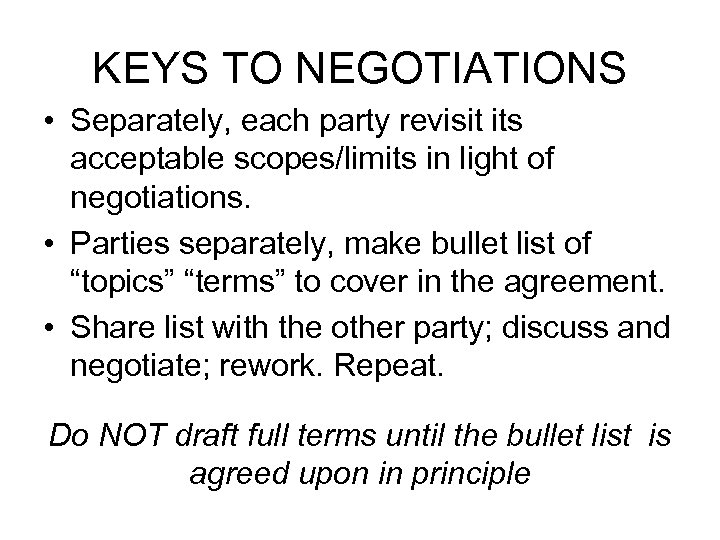
KEYS TO NEGOTIATIONS • Separately, each party revisit its acceptable scopes/limits in light of negotiations. • Parties separately, make bullet list of “topics” “terms” to cover in the agreement. • Share list with the other party; discuss and negotiate; rework. Repeat. Do NOT draft full terms until the bullet list is agreed upon in principle
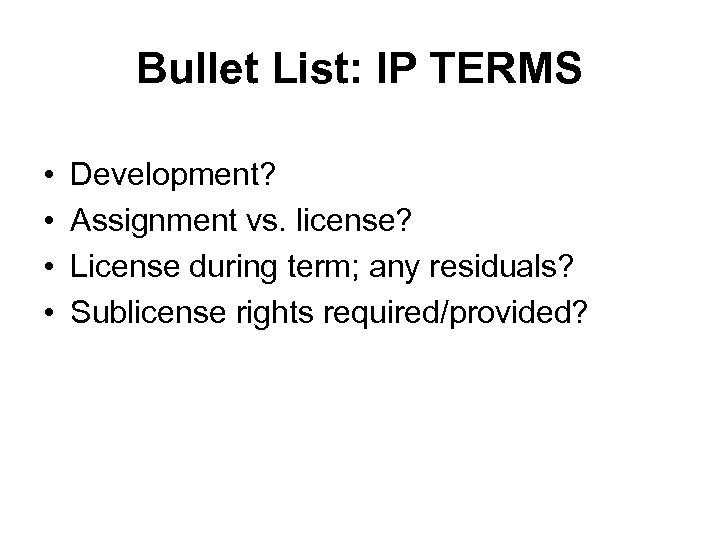
Bullet List: IP TERMS • • Development? Assignment vs. license? License during term; any residuals? Sublicense rights required/provided?
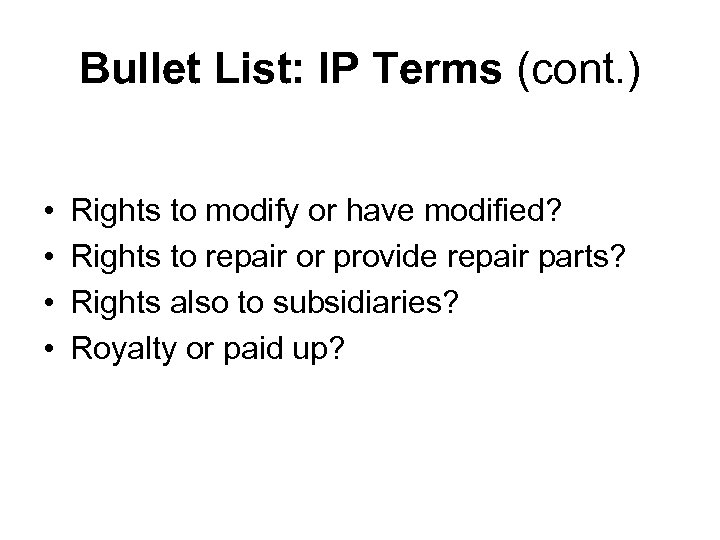
Bullet List: IP Terms (cont. ) • • Rights to modify or have modified? Rights to repair or provide repair parts? Rights also to subsidiaries? Royalty or paid up?
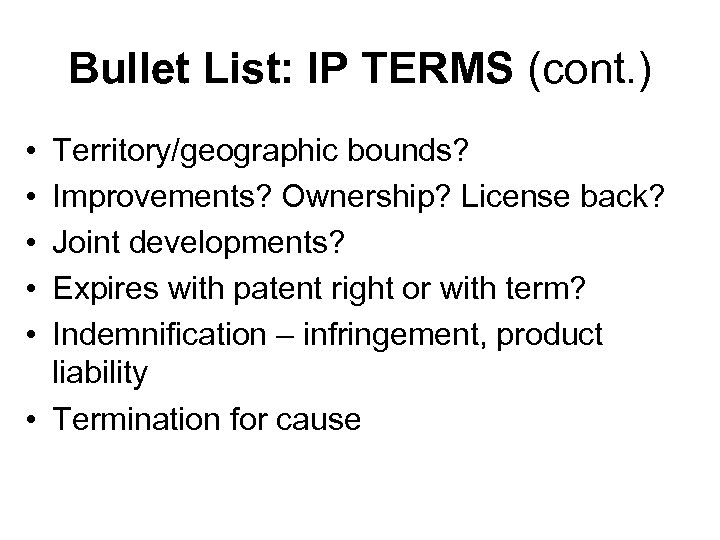
Bullet List: IP TERMS (cont. ) • • • Territory/geographic bounds? Improvements? Ownership? License back? Joint developments? Expires with patent right or with term? Indemnification – infringement, product liability • Termination for cause
DRAFTING THE AGREEMENT • Someone has to take the first stab • Where possible, stay close to the bullet list language; avoid perception of “new” terms • Work first on the terms that pertain to the “meat” of the agreement until agreed. • Consider presenting two versions of the same term – label it “for discussion”
FINISHING THE AGREEMENT • Now it’s time to add the legalese. • If the parties have agreed to a bullet list, finishing the license should be relatively simple. • But, then again, the lawyers will be involved.
Licensing is a Team Sport • • • Goals; license v. royalty Boundaries; rights to use, territory, market Players; Sci Guy, Corporate, Money Dude Teamwork; Bullet List, refine and rework Rules; License terms to govern remaining relationship


DEAL TERMS • • Scope of rights to use Sublicense Working relationship and contributions Term/Time Exclusive v. Nonexclusive v. Blend Royalty: flat, graded, lump, periodic License for pre-existing On-going support
GENERAL TERMS • Parties: watch for over inclusive • Sloppy “whereas”: shadows the agreement • Term: short, long, extensions
GENERAL TERMS (cont. ) • Imprecise descriptions of services: schedules, deliverables • Mismatch with objective: all clauses • Time but no milestones: progress issues • Incentive before completion: no incentive
IP TERMS • • Development? Assignment vs. license? License during term; any residuals? Sublicense rights required/provided?
IP Terms (cont. ) • • Rights to modify or have modified? Rights to repair or provide repair parts? Rights also to subsidiaries? Royalty or paid up?
IP TERMS (cont. ) • • • Territory/geographic bounds? Improvements? Ownership? License back? Joint developments? Expires with patent right or with term? Indemnification – infringement, product liability • Termination for cause
COMPONENTS OF VALUE APPROACH Consider the key terms only first e. g. royalty, overall use rights, ability to modify, development services. Then fill in the remainder without renegotiating any of the key terms if possible.
DEAL TERMS • Categorize each term on the continuum: negotiable→ barely negotiable→ nonnegotiable • Create realistic expectations for each term • Determine room to maneuver, basis for maneuverability, and factors affecting same.
LICENSOR DEAL TERMS • • Exclusive or nonexclusive Need knowledge sharing? Volume royalty v. flat royalty Level of confidentiality needed? Share Licensor developments? Share Licensee developments? Minimum progress milestones? Territory, market restrictions?
LICENSEE DEAL TERMS • • Exclusive or nonexclusive Territory required for business plan Prefer little report back vs open exchange Expect to create new, related developments? Willing to share/license to licensor? Need training from licensor? Time to reach profit? royalty back loaded?
Then, filter priorities… • LICENSOR: ROI? Fast commercialization? Gain new knowledge? Open new markets? Multiple licensees (blitz)? • LICENSEE: Price? Transfer of knowledge from Licensor? Ongoing assistance? Complete autonomy and no ongoing obligations but for $? Ability to sublicense?
NEGOTIATE REALISTICALLY • Determine “walk away” • Concede if reasonable, but make sure every concession has meaning • Watch out for “last minute” demands • Know when to stop
NOTHING IS AGREED ON UNTIL ALL IS AGREED ON Be willing to re-open a clause in order to negotiate another clause within the agreement.
LICENSING NEGOTIATION IS A TEAM SPORT Don’t attempt to negotiate a license agreement by yourself! Assemble a small team to include proficiency in contract law and some with understanding of the field and of your company
DON’T BURN BRIDGES Believe it or not, licensing negotiations whether successful or not, are yet another way to network; unreasonable negotiation tactics will follow you.
Website: www. brownwinick. com Toll Free Phone Number: 1 -888 -282 -3515 OFFICE LOCATIONS: 666 Grand Avenue, Suite 2000 Des Moines, Iowa 50309 -2510 Telephone: (515) 242 -2400 Facsimile: (515) 283 -0231 616 Franklin Place Pella, Iowa 50219 Telephone: (641) 628 -4513 Facsimile: (641) 628 -8494 DISCLAIMER: No oral or written statement made by Brown. Winick attorneys should be interpreted by the recipient as suggesting a need to obtain legal counsel from Brown. Winick or any other firm, nor as suggesting a need to take legal action. Do not attempt to solve individual problems upon the basis of general information provided by any Brown. Winick attorney, as slight changes in fact situations may cause a material change in legal result.
Скачать презентацию LICENSING IS A TEAM SPORT Camille Urban Brown
e585b384021ef2eec5a12755778ddfb6.ppt