


 Скачать презентацию Licensing information Users should treat this material
34884d89d9182605f46cc0af04386dfe.ppt
- Количество слайдов: 8
 Licensing information • Users should treat this material as a working draft. This material can be used in its current form, customized, and/or printed or displayed by the user. • The author(s) request feedback on all materials so that they can be continually improved and updated. • This material is licensed under the Creative Commons Attribution-Share Alike license: (http: //creativecommons. org/licenses/by-sa/3. 0/). • Author: Kevin Hall Wording for the legal statement above is adapted from the legal statement for Trigonometry, published in 2009 by The CK-12 Foundation: http: //about. ck 12. org/
 Teaching notes • Before getting to class, be sure to print out the answers and have them handy. While students are practicing the drill questions, you want to be walking around praising and prompting them, not trying to solve the questions for yourself. • On the drill slides, 4 questions come up at a time. It’s ok if some students only do the first couple, as long as they get them right. • Again, these are designed to let you walk around the room and see how students are doing while the classes discusses and/or practices.
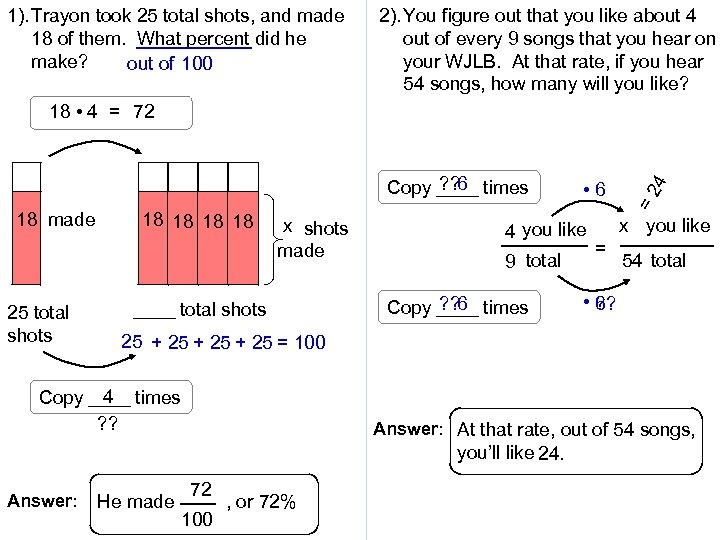 1). Trayon took 25 total shots, and made 18 of them. What percent did he make? out of 100 2). You figure out that you like about 4 out of every 9 songs that you hear on your WJLB. At that rate, if you hear 54 songs, how many will you like? 18 made 25 total shots 18 18 _____ x shots made total shots 4 you like 9 total ? ? 6 Copy _____ times x you like = 54 total • ? ? 6 25 + 25 = 100 4 Copy _____ times ? ? Answer: At that rate, out of 54 songs, you’ll like 24. Answer: • 6 =2 ? ? 6 Copy _____ times 4 18 • 4 = 72 He made 72 100 , or 72%
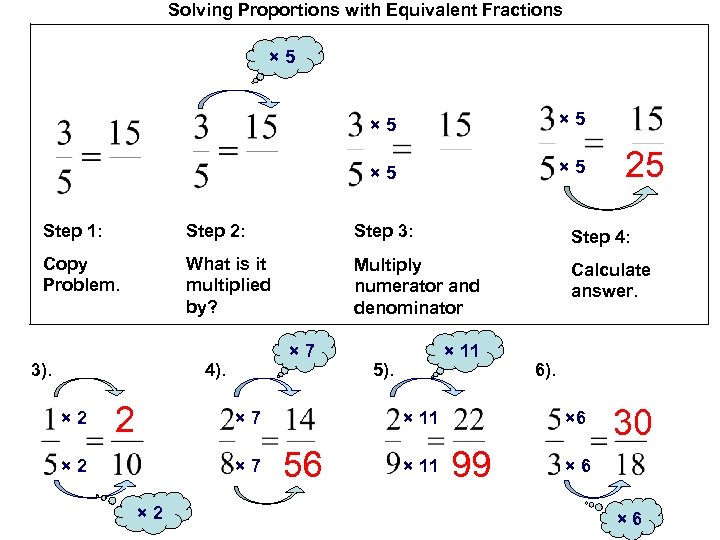 Solving Proportions with Equivalent Fractions × 5 × 5 × 5 25 Step 1: Step 2: Step 3: Step 4: Copy Problem. What is it multiplied by? Multiply numerator and denominator Calculate answer. 3). × 7 4). × 2 2 × 7 × 2 × 11 5). × 11 56 × 11 6). × 6 99 30 × 6
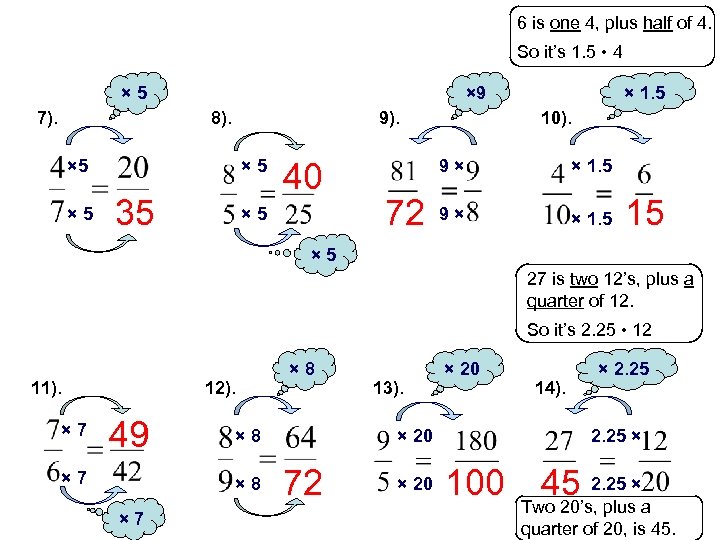 6 is one 4, plus half of 4. So it’s 1. 5 • 4 × 5 7). × 9 8). 9). × 5 × 5 35 40 × 5 × 1. 5 10). 9× 72 × 1. 5 9× × 1. 5 15 × 5 27 is two 12’s, plus a quarter of 12. So it’s 2. 25 • 12 11). × 7 12). 49 × 7 × 8 13). × 20 14). × 2. 25 × 20 72 2. 25 × × 20 100 45 2. 25 × Two 20’s, plus a quarter of 20, is 45.
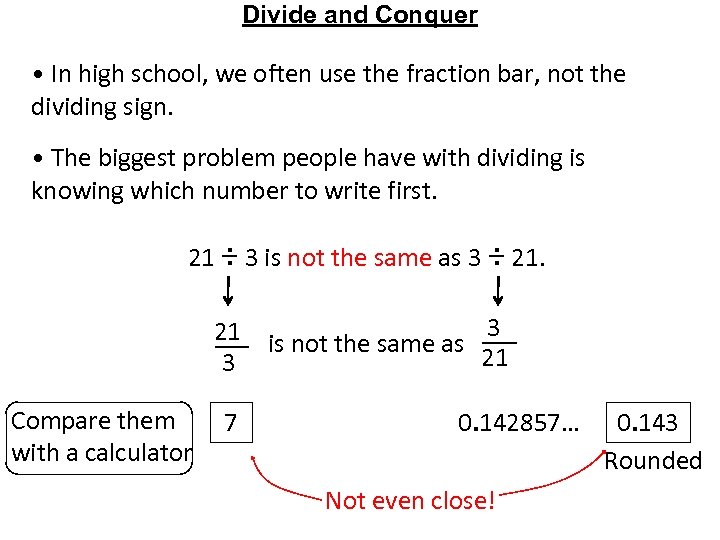 Divide and Conquer • In high school, we often use the fraction bar, not the dividing sign. • The biggest problem people have with dividing is knowing which number to write first. 21 ÷ 3 is not the same as 3 ÷ 21. 21 is not the same as 3 21 3 Compare them with a calculator 7 0. 142857… Not even close! 0. 143 Rounded
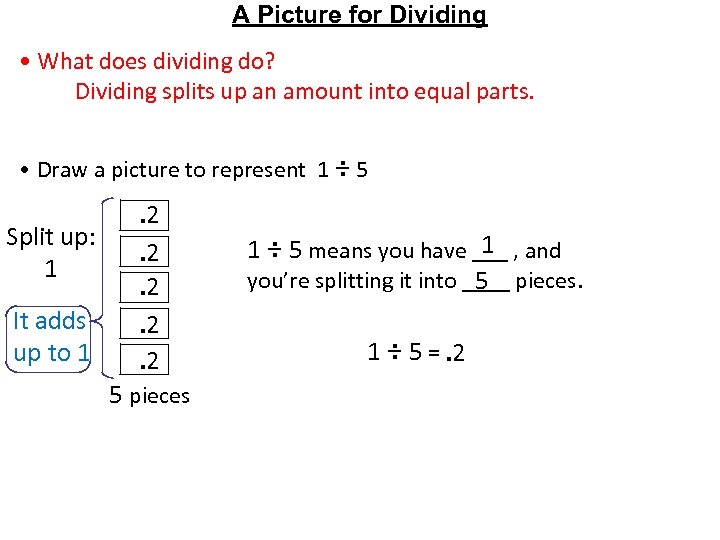 A Picture for Dividing • What does dividing do? Dividing splits up an amount into equal parts. • Draw a picture to represent 1 ÷ 5 Split up: 1 It adds up to 1 . 2. 2. 2 5 pieces 1 1 ÷ 5 means you have ___ , and you’re splitting it into ____ pieces. 5 1 ÷ 5 =. 2
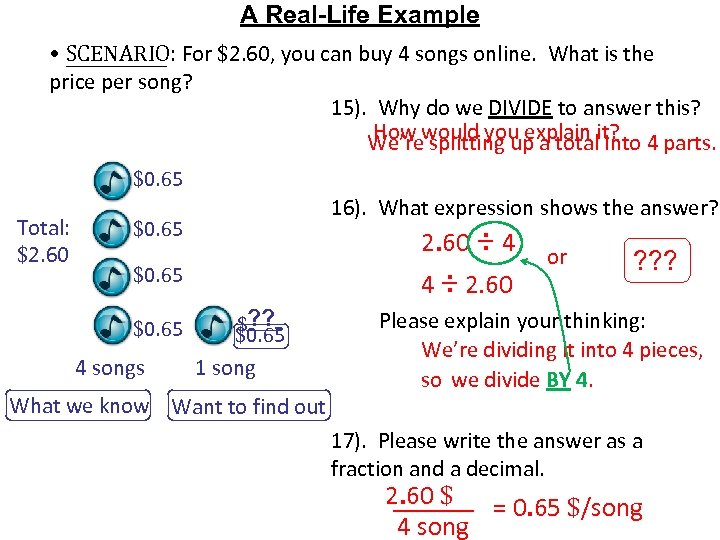 A Real-Life Example • SCENARIO: For $2. 60, you can buy 4 songs online. What is the price per song? 15). Why do we DIVIDE to answer this? How splitting up a total into We’rewould you explain it? 4 parts. $0. 65 Total: $2. 60 16). What expression shows the answer? $0. 65 2. 60 ÷ 4 4 ÷ 2. 60 $0. 65 4 songs $? ? $0. 65 1 song What we know Want to find out or ? ? ? Please explain your thinking: We’re dividing it into 4 pieces, so we divide BY 4. 17). Please write the answer as a fraction and a decimal. 2. 60 $ = 0. 65 $/song 4 song