 Скачать презентацию LIBRARY Library Orientation for HIV AIDS Cultural Social and
e673f9c7431653b5fc3a95c885441a7f.ppt
- Количество слайдов: 23



LIBRARY Library Orientation for HIV/AIDS: Cultural, Social, and Scientific Aspects of the Pandemic Thursday, October 12, 2017 Vince Graziano Sexuality Studies Librarian vince. graziano@concordia. ca
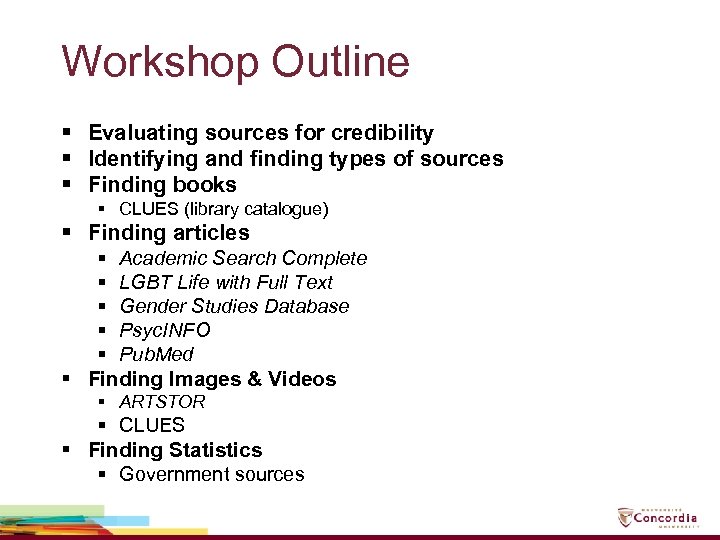
Workshop Outline § Evaluating sources for credibility § Identifying and finding types of sources § Finding books § CLUES (library catalogue) § Finding articles § Academic Search Complete § LGBT Life with Full Text § Gender Studies Database § Psyc. INFO § Pub. Med § Finding Images & Videos § ARTSTOR § CLUES § Finding Statistics § Government sources
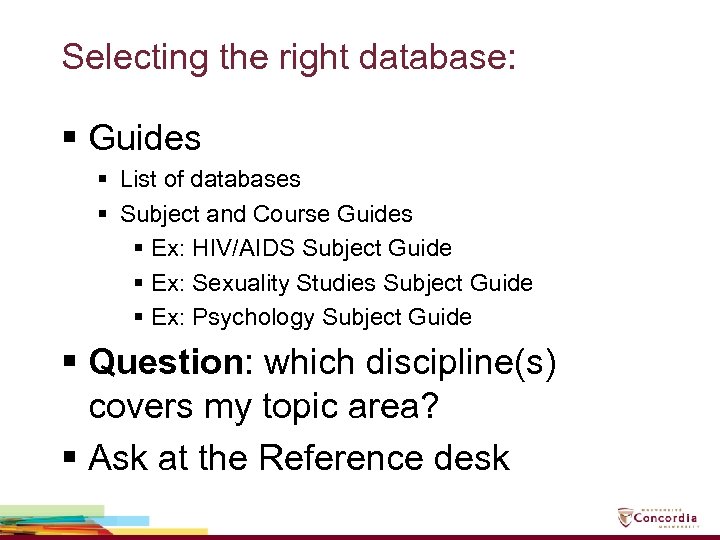
Selecting the right database: § Guides § List of databases § Subject and Course Guides § Ex: HIV/AIDS Subject Guide § Ex: Sexuality Studies Subject Guide § Ex: Psychology Subject Guide § Question: which discipline(s) covers my topic area? § Ask at the Reference desk
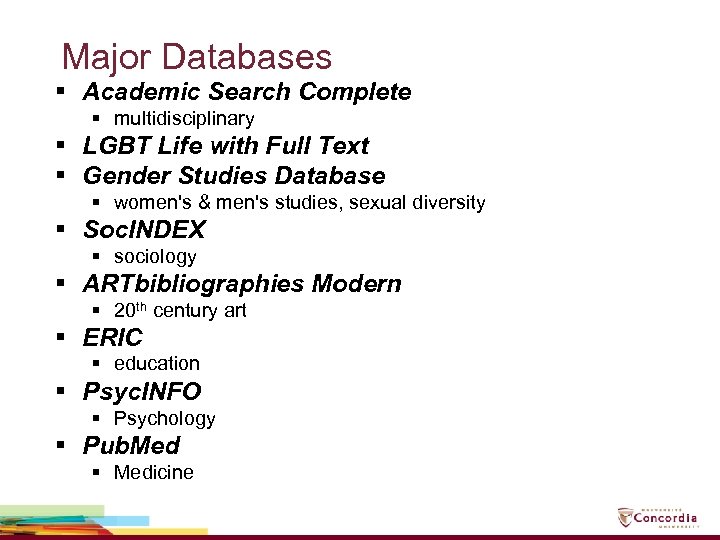
Major Databases § Academic Search Complete § multidisciplinary § LGBT Life with Full Text § Gender Studies Database § women's & men's studies, sexual diversity § Soc. INDEX § sociology § ARTbibliographies Modern § 20 th century art § ERIC § education § Psyc. INFO § Psychology § Pub. Med § Medicine
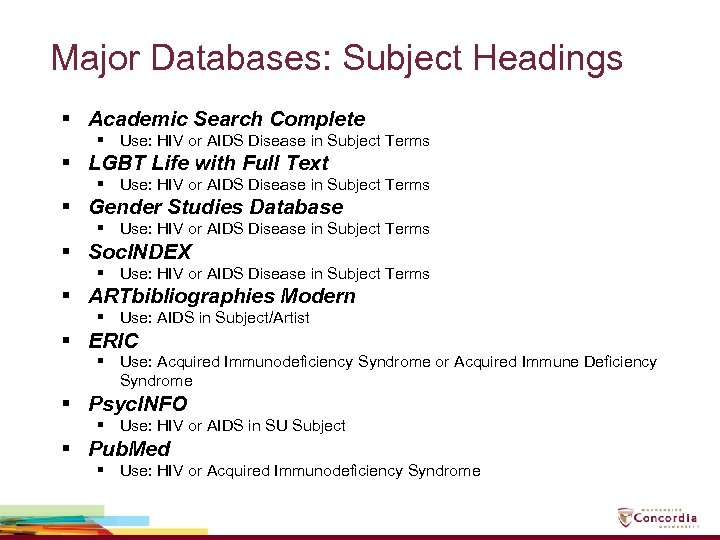
Major Databases: Subject Headings § Academic Search Complete § Use: HIV or AIDS Disease in Subject Terms § LGBT Life with Full Text § Use: HIV or AIDS Disease in Subject Terms § Gender Studies Database § Use: HIV or AIDS Disease in Subject Terms § Soc. INDEX § Use: HIV or AIDS Disease in Subject Terms § ARTbibliographies Modern § Use: AIDS in Subject/Artist § ERIC § Use: Acquired Immunodeficiency Syndrome or Acquired Immune Deficiency Syndrome § Psyc. INFO § Use: HIV or AIDS in SU Subject § Pub. Med § Use: HIV or Acquired Immunodeficiency Syndrome
Research Question § How does stigma affect mental health in HIV positive older adults? § What discipline? § Psychology/psychiatry § What database? § Psyc. INFO
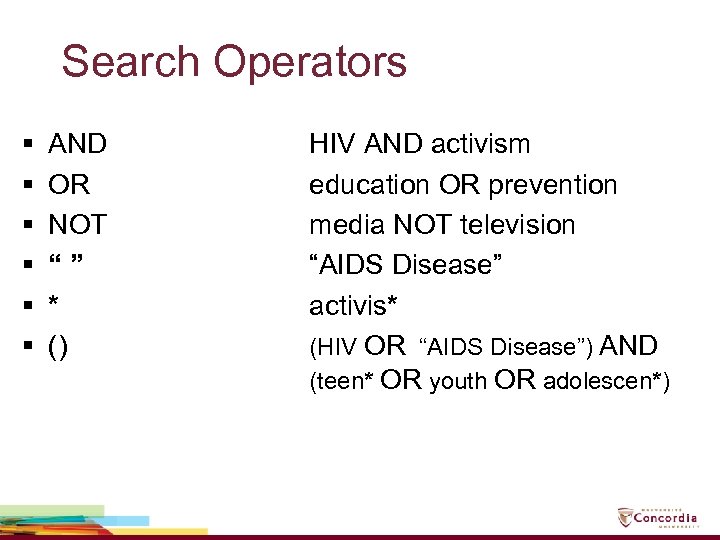
Search Operators § § § AND OR NOT “” * () HIV AND activism education OR prevention media NOT television “AIDS Disease” activis* (HIV OR “AIDS Disease”) AND (teen* OR youth OR adolescen*)
More Databases § Canadian Periodical Index § Pro. Quest Central § Repère (Québec French-language) § Newspapers § § § New York Times (1851 -2014) Globe & Mail (1844 -2014) Times Digital Archive (1785 -2009) Canadian Newsstream Factiva § Full text of current international newspapers § Eureka § French-language Quebec and international newspapers
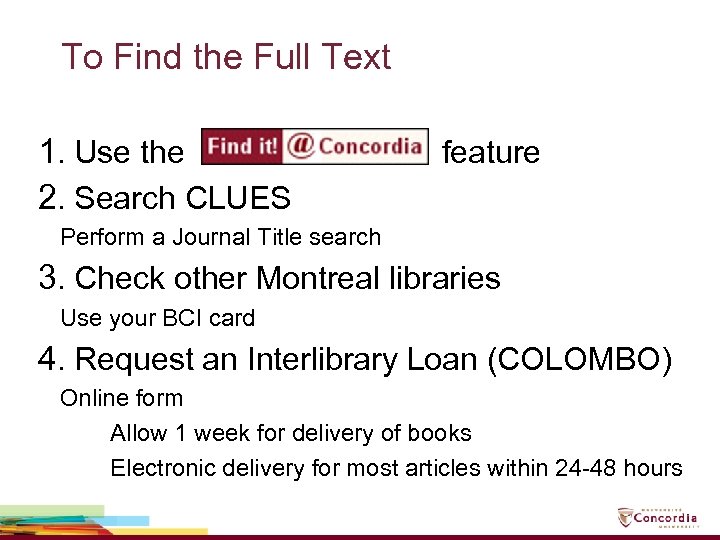
To Find the Full Text 1. Use the 2. Search CLUES feature Perform a Journal Title search 3. Check other Montreal libraries Use your BCI card 4. Request an Interlibrary Loan (COLOMBO) Online form Allow 1 week for delivery of books Electronic delivery for most articles within 24 -48 hours
EVALUATING SOURCES for CREDIBILITY
Evaluation Criteria § PURPOSE § AUTHORITY § ACCURACY § RELEVANCE § CURRENCY § OBJECTIVITY
PURPOSE § What is the purpose of the source? Why was it created? § To inform? To sell? To entertain? To amuse? To advance knowledge? To educate? To teach? § Who is the intended audience? § Experts/scholars? General public? Children? § Is the readership level appropriate for your research?
AUTHORITY § Who is the author/creator? § What are the credentials of the author/creator? § What is the author/creator’s organizational affiliation? § Who is the publisher? § Is it a university press? § Is the source peer-reviewed? § What organization is responsible for the source? § Governmental organization? Learned society? § If you cannot find information regarding the authority of the author or publisher, you should not use the source.
ACCURACY § Is the information accurate and does it have bibliographic references? § What are the author’s sources of information? § Is it well-researched? § Does it provide sufficient evidence? § What kind of language, imagery and/or tone is used? § Is it emotional, objective, professional, etc. ? § Fact checking § Can you find other sources that corroborate the evidence? § If you cannot verify that the information is accurate, you should not use the source.
RELEVANCE § How relevant is the source? § Is the information and content relevant to your research paper or project topic? § Does the source provide a superficial treatment, or a detailed analysis? § Is it an opinion piece? An editorial? A scholarly analysis? § In what medium is the source published? § Book? Journal article? A blog post? A You. Tube video? § What does the medium tell you about the source?
CURRENCY § What is the copyright, publication, or posting date? § Is there a date? § Is the information outdated? § Is the time of publication or writing appropriate for your topic? § Some sources remain authoritative regardless of them being published less recently, e. g. seminal works. § What has changed in your field of study since the publication date?
OBJECTIVITY § Is the material objective and free of advertising, bias, and hidden agendas? § Is the language impartial? § Is the statistical evidence credible? § Conclusions should be based on research and supported evidence § Websites should acknowledge affiliations and associations such as universities, community organizations, social, scientific or government groups or bodies § Media may have a specific intent, and aim to represent a particular stance or bias.
IDENTIFYING AND FINDING TYPES OF SOURCES
What is it and how to find it? § Mc. Donnell, Terence E. Best Laid Plans: Cultural Entropy and the Unraveling of AIDS Media Campaigns. Chicago: University of Chicago Press, 2016. § Book § Search in CLUES by TITLE: Best laid plans …
What is it and how to find it? § Van Buren, Kathleen J. “Music, HIV/AIDS, and Social Change in Nairobi, Kenya. ” In The Culture of AIDS in Africa: Hope and Healing through Music and the Arts, edited by Gregory Bartz and Judah M. Cohen, 70 -84. Oxford: Oxford University Press. 2011. § Chapter or essay in and edited book § Search in CLUES by TITLE: Culture of AIDS in Africa…
What is it and how to find it? § Furlotte, Charles and Karen Schwartz. “Mental health experiences of older adults living with HIV: Uncertainty, stigma, and approaches to resilience. ” Canadian Journal on Aging 36, no. 2 (2017): 125 -140. § Journal article § Search in CLUES by JOURNAL TITLE: Canadian journal on aging § Search in Discovery by title of article
Help is Available § At the Reference Desk § HIV/AIDS Subject Guide § Ask a Librarian § E-mail form § Chat with a Librarian § Ask Vince: § 514 -848 -2424, ext. 7689 § vince. graziano@concordia. ca § Office hours: by appointment
 Скачать презентацию LIBRARY Library Orientation for HIV AIDS Cultural Social and
e673f9c7431653b5fc3a95c885441a7f.ppt