 Скачать презентацию Library consortia and cooperation in this digital age
f0251773a778ea7f66e3d57255857148.ppt
- Количество слайдов: 41



Library consortia and cooperation in this digital age: an overview of the Philippine experience By Fe Angela M. Verzosa
Consortial Trends and Cooperation n n n Definitions commonalities and variations consortial goals consortial models obstacles and barriers how should libraries proceed? Recommendations/conclusion
DEFINITION LIBRARY COOPERATION IS AN UMBRELLA TERM FOR A WIDE SPECTRUM OF COOPERATION PROCESSES AND MECHANISMS Brewer
Library Cooperation RECIPROCALLY BENEFICIAL SHARING OF RESOURCES; DEVELOPED OR PRE -EXISTING BY TWO OR MORE LIBRARIES Edmonds
INTERCHANGE • • TWO OR MORE INSTITUTIONS TEMPORARY EXCHANGE OF RESOURCES
EXCHANGE n n n ALL KIND OF MATERIALS INFORMATION (for staff) INFORMATION(for reader inquiries) USERS BIBLIOGRAPHIC PERSONNEL
OTHER TYPES OF COOPERATION n LIBRARY ASSOCIATIONS n INTERLIBRARY LOANS
Resource-sharing n n n bibliographic access - know what is available for sharing interlibrary lending - expedite ILLS and DDS cooperative collection development build complementary collections of materials on which to draw
Definition: Consortium Brings together librarians and libraries for activities and objectives that cannot be as effectively undertaken individually.
Definition: Consortium n n consortium network association virtual library
Commonalities and Variations n informal n government - sponsored
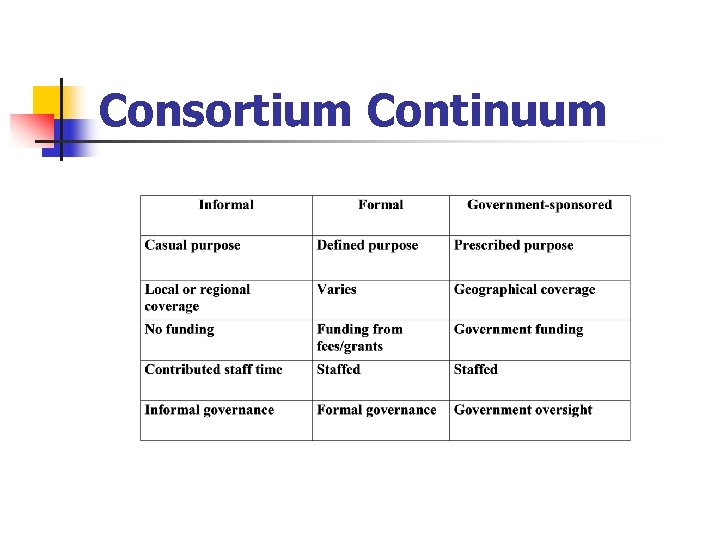
Consortium Continuum
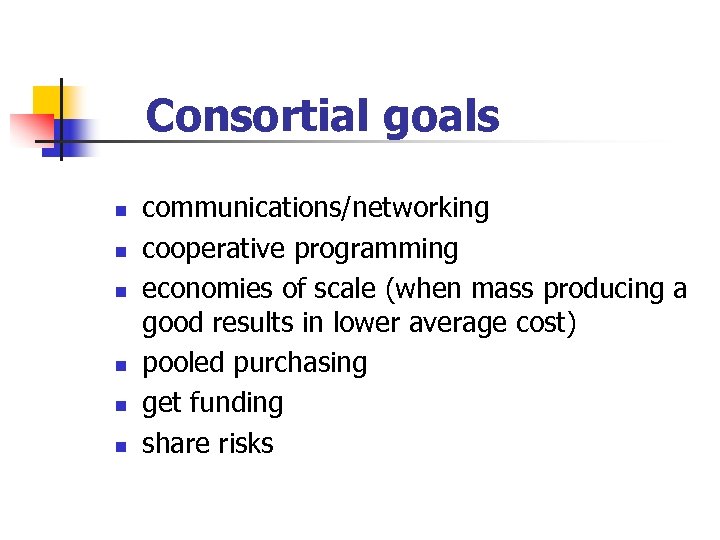
Consortial goals n n n communications/networking cooperative programming economies of scale (when mass producing a good results in lower average cost) pooled purchasing get funding share risks
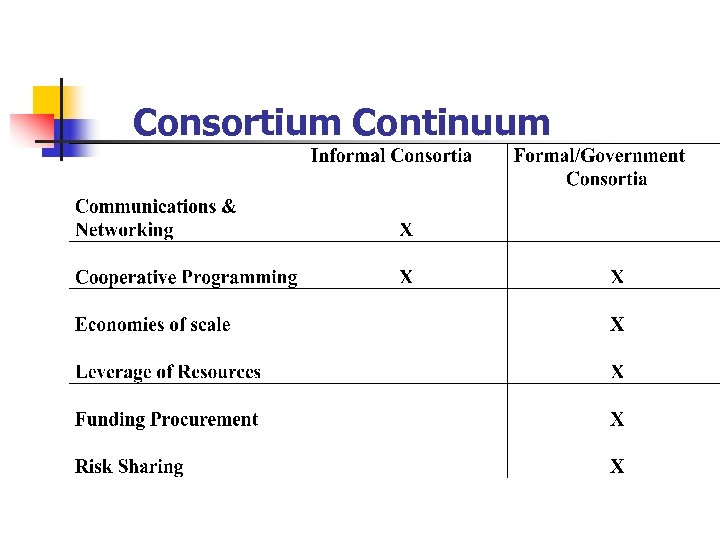
Consortium Continuum
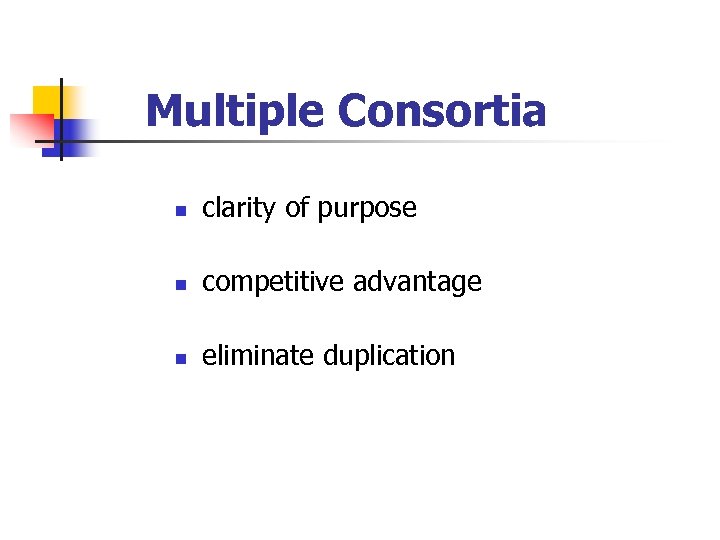
Multiple Consortia n clarity of purpose n competitive advantage n eliminate duplication
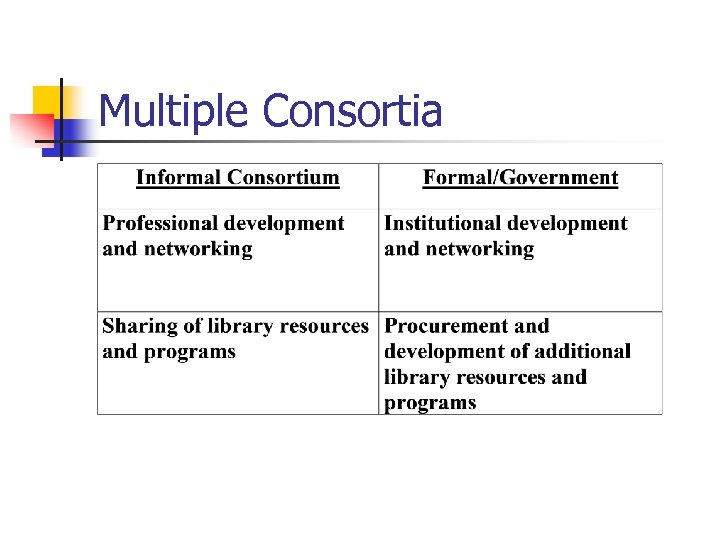
Multiple Consortia
Multiple Consortia: Questions n n n What is the mission and purpose of the consortium? What value and benefits do member libraries obtain from the consortium? What other consortia, if any, have the same or a similar mission and purpose?
Multiple Consortia n n n : Effectiveness Missions are mutually supportive Expertise or resources are complementary Value to members is increased through multi-consortia cooperation
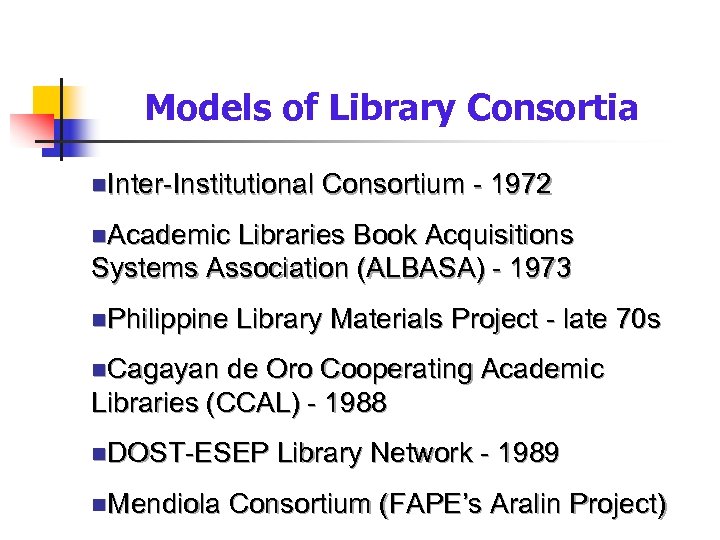
Models of Library Consortia n. Inter-Institutional Consortium - 1972 n. Academic Libraries Book Acquisitions Systems Association (ALBASA) - 1973 n. Philippine Library Materials Project - late 70 s n. Cagayan de Oro Cooperating Academic Libraries (CCAL) - 1988 n. DOST-ESEP n. Mendiola Library Network - 1989 Consortium (FAPE’s Aralin Project)
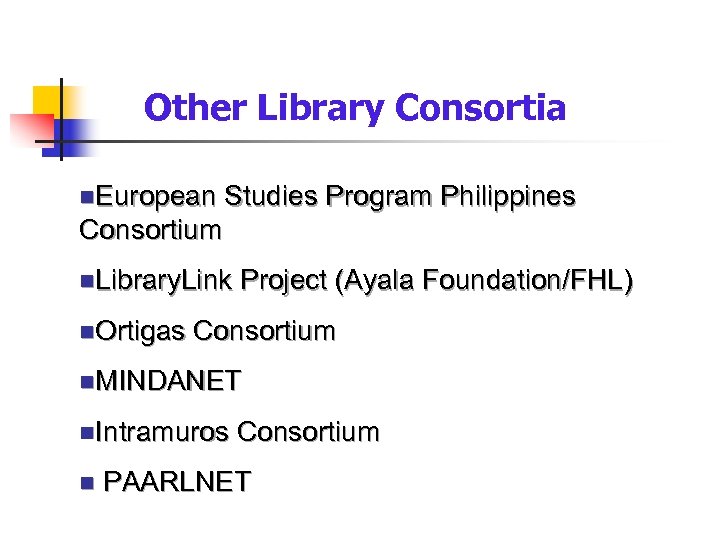
Other Library Consortia n. European Studies Program Philippines Consortium n. Library. Link n. Ortigas Project (Ayala Foundation/FHL) Consortium n. MINDANET n. Intramuros n Consortium PAARLNET
Inter-Institutional Consortium n n n n Established in 1972 by five institutions Governed by a Board of Responsibles With permanent Secretariat Funded by United Board for Higher Ed Members contribute annual fees Meet monthly and plan annually Report annually on all activities
IIC - Achievements n n n n Cooperative cataloging Cooperative indexing Union lists Theses databases Digitization of rare Filipiniana Standardization of Library handbooks Shared access to OCLC Firstsearch Library skills development training programs
Academic Libraries Book Acquisitions Systems Assn (ALBASA) n n n Established in 1973 by 13 institutions Initially founded by Ford Foundation and Asia Foundation Governed by a Board of Directors With permanent secretariat Engaged primarily in cooperative acquisitions
ALBASA - Achievements membership n book purchases n discounts n book fairs n continuing professional development n staff continuity n
Cagayan de Oro Cooperating Academic Libraries (CCAL) n Established in 1988 by 6 institutions: Cagayan de Oro College Cagayan Capitol College Liceo de Cagayan Lourdes College Mindanao Polytechnic State College Xavier University n Engaged primarily in interlibrary lending services
CCAL - Achievements n n n Access to information Bibliographic Center / Cooperative Cataloging Training programs, workshops, etc. Consulting services Cooperative materials development
DOST-ESEP CONSORTIUM n n n Established in 1989 by 8 institutions Sponsored by DOST Funded by World Bank With permanent secretariat in Taguig Focused on science education and engineering infrastructure development a multiple consortia
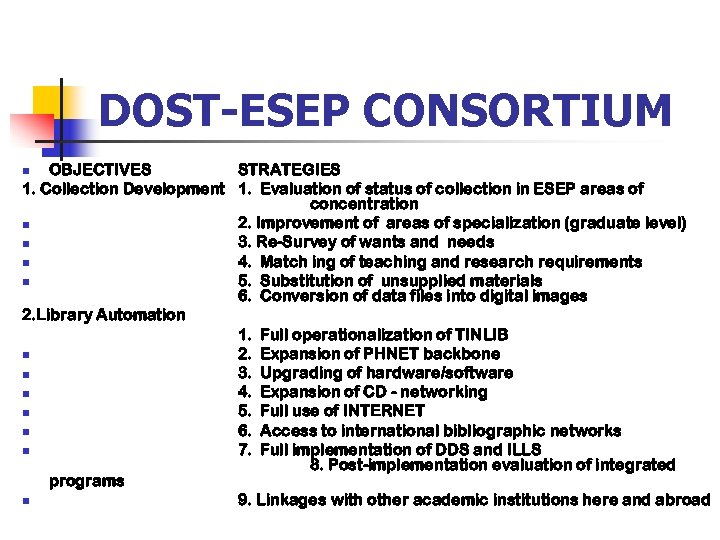
DOST-ESEP CONSORTIUM OBJECTIVES STRATEGIES 1. Collection Development 1. Evaluation of status of collection in ESEP areas of concentration n 2. Improvement of areas of specialization (graduate level) n 3. Re-Survey of wants and needs n 4. Match ing of teaching and research requirements n 5. Substitution of unsupplied materials 6. Conversion of data files into digital images 2. Library Automation 1. Full operationalization of TINLIB n 2. Expansion of PHNET backbone n 3. Upgrading of hardware/software n 4. Expansion of CD - networking n 5. Full use of INTERNET n 6. Access to international bibliographic networks n 7. Full implementation of DDS and ILLS 8. Post-implementation evaluation of integrated programs n 9. Linkages with other academic institutions here and abroad n
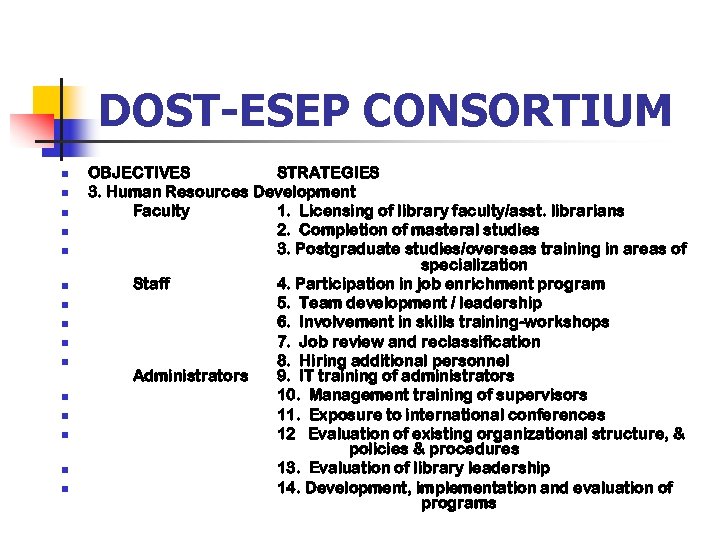
DOST-ESEP CONSORTIUM n n n n OBJECTIVES STRATEGIES 3. Human Resources Development Faculty 1. Licensing of library faculty/asst. librarians 2. Completion of masteral studies 3. Postgraduate studies/overseas training in areas of specialization Staff 4. Participation in job enrichment program 5. Team development / leadership 6. Involvement in skills training-workshops 7. Job review and reclassification 8. Hiring additional personnel Administrators 9. IT training of administrators 10. Management training of supervisors 11. Exposure to international conferences 12 Evaluation of existing organizational structure, & policies & procedures 13. Evaluation of library leadership 14. Development, implementation and evaluation of programs
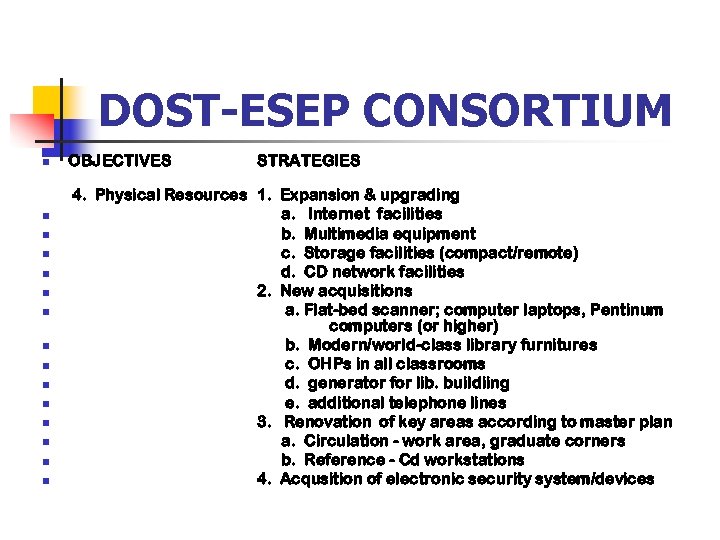
DOST-ESEP CONSORTIUM n n n n OBJECTIVES STRATEGIES 4. Physical Resources 1. Expansion & upgrading a. Internet facilities b. Multimedia equipment c. Storage facilities (compact/remote) d. CD network facilities 2. New acquisitions a. Flat-bed scanner; computer laptops, Pentinum computers (or higher) b. Modern/world-class library furnitures c. OHPs in all classrooms d. generator for lib. buildiing e. additional telephone lines 3. Renovation of key areas according to master plan a. Circulation - work area, graduate corners b. Reference - Cd workstations 4. Acqusition of electronic security system/devices
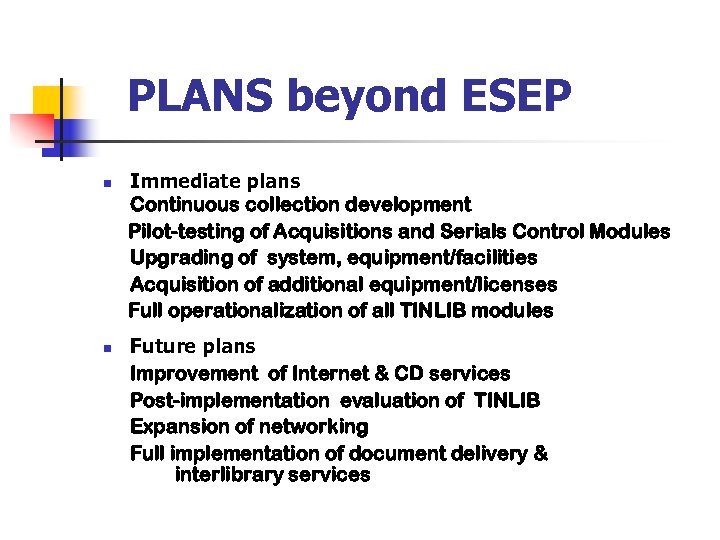
PLANS beyond ESEP n n Immediate plans Continuous collection development Pilot-testing of Acquisitions and Serials Control Modules Upgrading of system, equipment/facilities Acquisition of additional equipment/licenses Full operationalization of all TINLIB modules Future plans Improvement of Internet & CD services Post-implementation evaluation of TINLIB Expansion of networking Full implementation of document delivery & interlibrary services
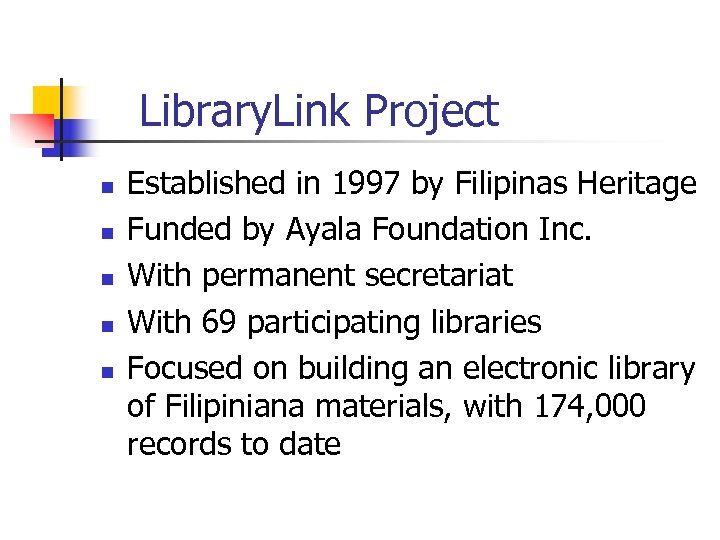
Library. Link Project n n n Established in 1997 by Filipinas Heritage Funded by Ayala Foundation Inc. With permanent secretariat With 69 participating libraries Focused on building an electronic library of Filipiniana materials, with 174, 000 records to date
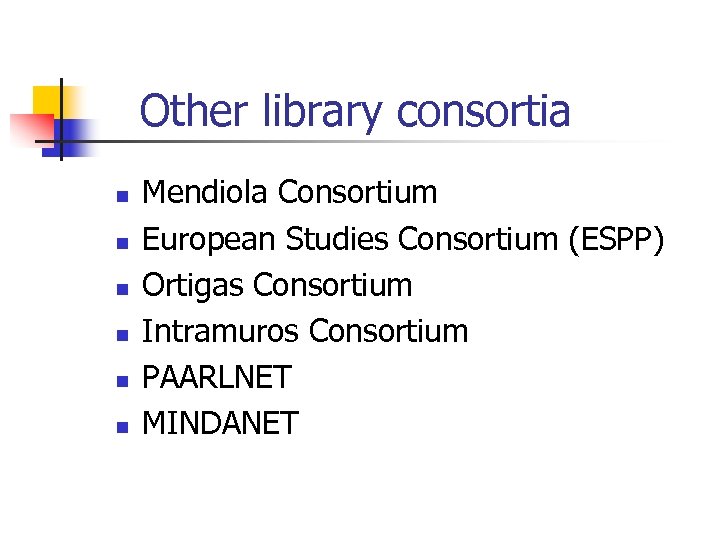
Other library consortia n n n Mendiola Consortium European Studies Consortium (ESPP) Ortigas Consortium Intramuros Consortium PAARLNET MINDANET
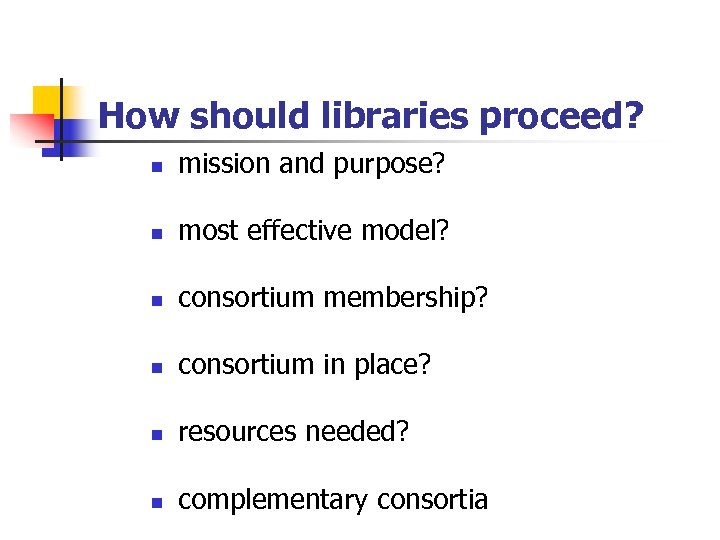
How should libraries proceed? n mission and purpose? n most effective model? n consortium membership? n consortium in place? n resources needed? n complementary consortia
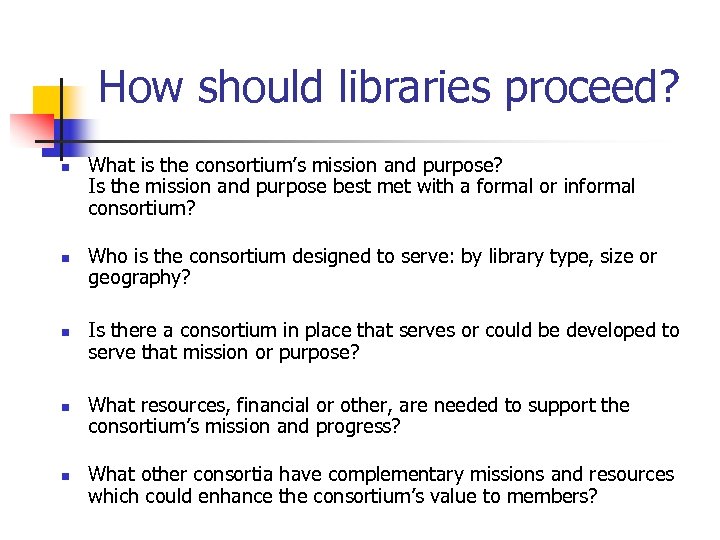
How should libraries proceed? n n n What is the consortium’s mission and purpose? Is the mission and purpose best met with a formal or informal consortium? Who is the consortium designed to serve: by library type, size or geography? Is there a consortium in place that serves or could be developed to serve that mission or purpose? What resources, financial or other, are needed to support the consortium’s mission and progress? What other consortia have complementary missions and resources which could enhance the consortium’s value to members?
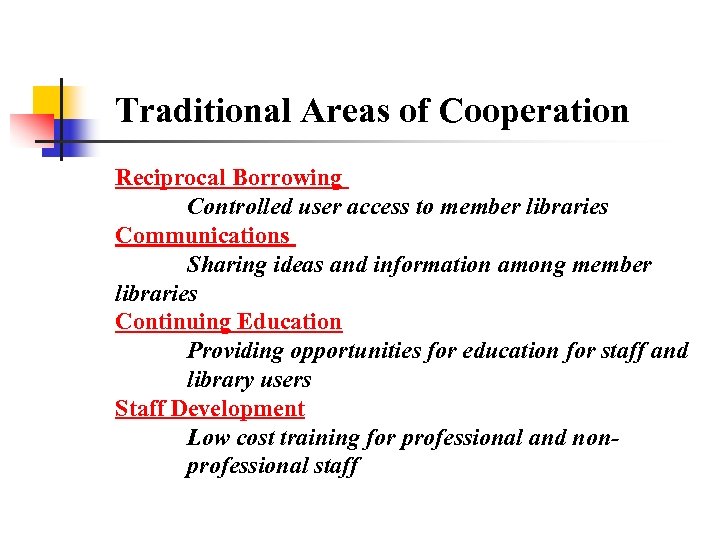
Traditional Areas of Cooperation Reciprocal Borrowing Controlled user access to member libraries Communications Sharing ideas and information among member libraries Continuing Education Providing opportunities for education for staff and library users Staff Development Low cost training for professional and non- professional staff
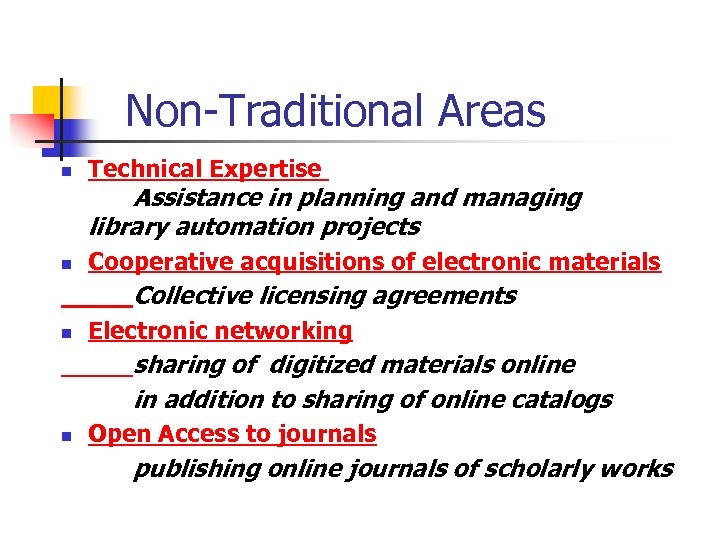
Non-Traditional Areas n Technical Expertise Assistance in planning and managing library automation projects n Cooperative acquisitions of electronic materials Collective licensing agreements n Electronic networking sharing of digitized materials online in addition to sharing of online catalogs n Open Access to journals publishing online journals of scholarly works
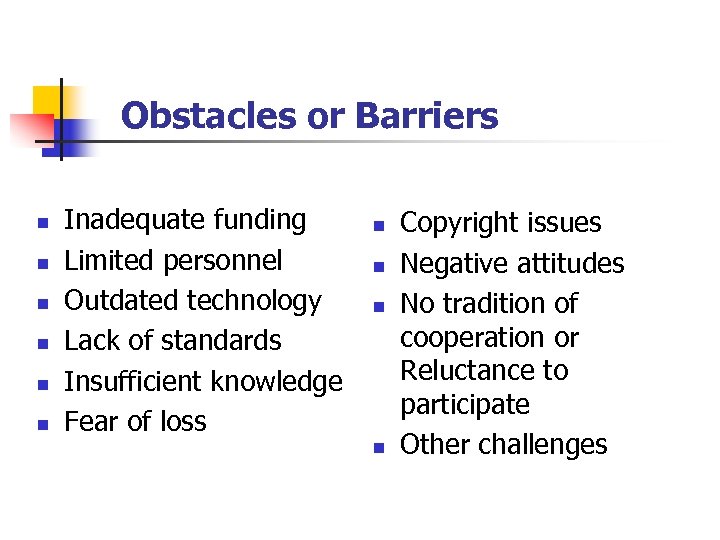
Obstacles or Barriers n n n Inadequate funding Limited personnel Outdated technology Lack of standards Insufficient knowledge Fear of loss n n Copyright issues Negative attitudes No tradition of cooperation or Reluctance to participate Other challenges
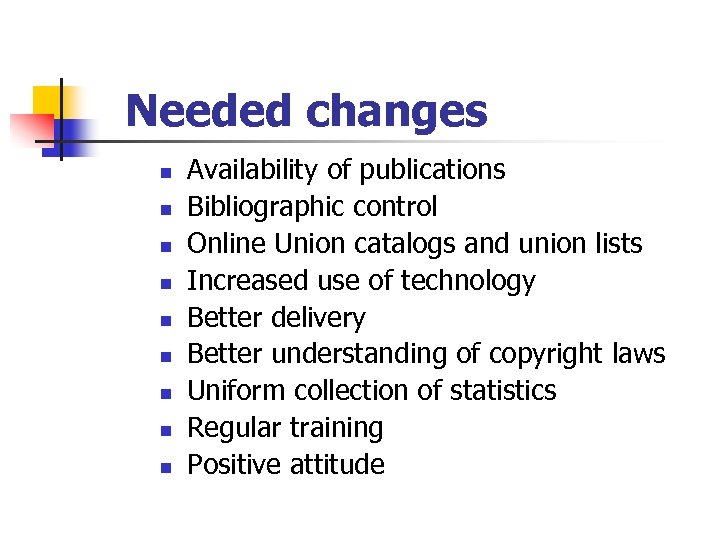
Needed changes n n n n n Availability of publications Bibliographic control Online Union catalogs and union lists Increased use of technology Better delivery Better understanding of copyright laws Uniform collection of statistics Regular training Positive attitude
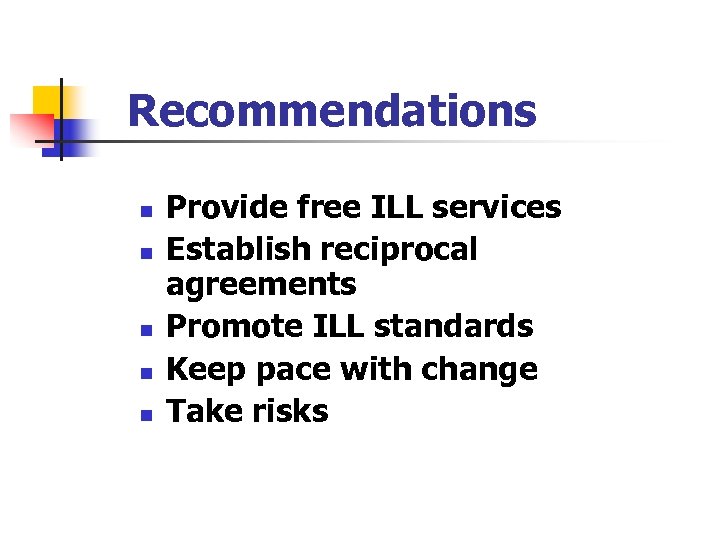
Recommendations n n n Provide free ILL services Establish reciprocal agreements Promote ILL standards Keep pace with change Take risks
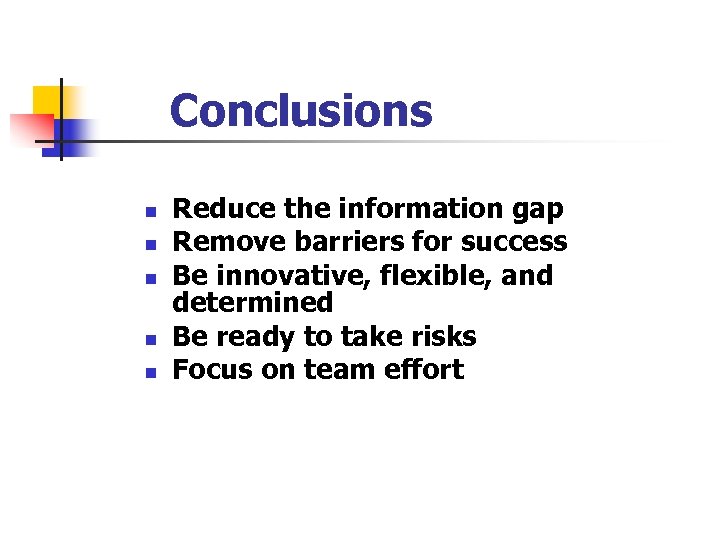
Conclusions n n n Reduce the information gap Remove barriers for success Be innovative, flexible, and determined Be ready to take risks Focus on team effort
Скачать презентацию Library consortia and cooperation in this digital age
f0251773a778ea7f66e3d57255857148.ppt