 Скачать презентацию Library Automation Trends in Transition Can new forces
679a4a59a0d7732e74f4ff1fb14f85b5.ppt
- Количество слайдов: 62



Library Automation Trends in Transition: Can new forces disrupt longstanding patterns? ” Marshall Breeding Friday 17 October 2008 Oxford University Libraries Director for Innovative Technologies and Research Vanderbilt University http: //staffweb. library. vanderbilt. edu/breeding http: //www. librarytechnology. org/
Abstract Marshall Breeding, Director for Innovative Technologies and Research and Vanderbilt University Library, gives a view of the current state library automation arena and looks forward as some of the trends evolve. Especially in North America, but also in other regions, open source software has made a large impact on the market. Will it displace the dominant position of the current commercial vendors? As electronic content increases in proportion for libraries, new models of automation are beginning to emerge that break away from the mould cast decades ago. A new genre of discovery interfaces, based on a new set of assumptions have gained wide interest and are displacing many of the traditional library OPACS. Breeding will discuss these topics and give a brief overview of the current vendor landscape, and will respond to questions and discussion from the audience.
Part I. Broad Industry and Product Trends
Library Technology Guides n n Repository for library automation data Lib-web-cats tracks 35, 000 libraries and the automation systems used. – Expanding to include more international scope n Announcements and developments made by companies and organizations involved in library automation technologies
Recent Upheavals n n n Industry Consolidation continues Abrupt transitions for major library automation products Increased industry control by external financial investors Demise of the traditional OPAC, emergence of next-generation discovery interfaces Frustration with ILS products and vendors Open Source alternatives hit the mainstream Breeding, Marshall: Perceptions 2007 an international survey of library automation. http: //www. librarytechnology. org/perceptions 2007. pl January 2008.
LJ Automation System Marketplace n n n n Annual Industry report published in Library Journal 2008: Opportunity out of turmoil 2007: An industry redefined 2006: Reshuffling the deck 2005: Gradual evolution 2004: Migration down, innovation up 2003: The competition heats up 2002: Capturing the migrating customer
ILS Industry in Transition n n Consolidation through mergers and acquisitions have resulted in a fewer number of players; larger companies Uncomfortable level of product narrowing Increased ownership by external interests Yet: Some companies and products continue on solid ground Breeding, Marshall “Automation system marketplace 2008: Opportunity Out of Turmoil” Library Journal. April 1, 2008.
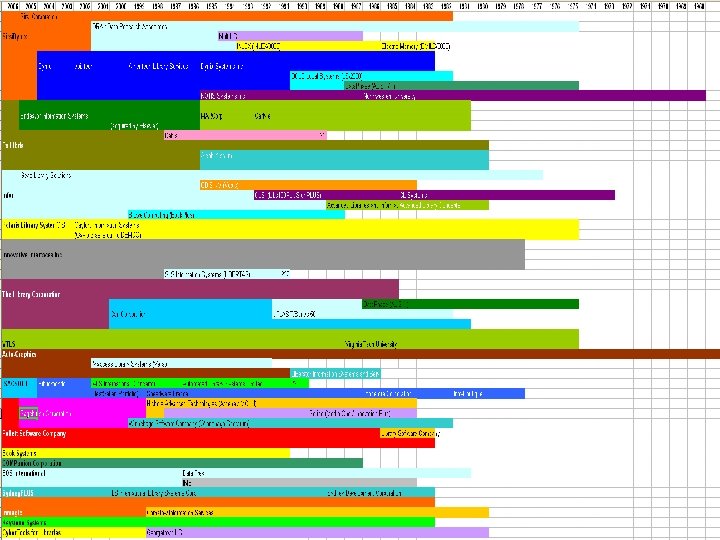
Library Automation M&A History
Internationalization Many large companies extending their geographic reach n Ex Libris – Based in Israel n Civica – Based in the United Kingdom n Sirsi. Dynix – Based in the United States n Innovative Interfaces – Based in the United States n
Broad Industry Trends Fewer number of larger companies n Consolidation of product offerings n Internationalization: strong opportunities for systems with strong multilingual capabilities. n Local companies challenged by global companies n Strong interest in open source alternatives n Overall R&D Focused on fewer new n
Product and Technology Trends Innovation below expectations n Conventional ILS less tenable n Proliferation of products related to econtent management n New genre of discovery-layer interfaces n
Part II. A Mandate for Openness
Opportunities for Openness n Open Source – Alternative to traditionally licensed software n Open Systems – Software that doesn’t hold data hostage
Open Source ILS enters the mainstream Earlier era of pioneering efforts to ILS shifting into one where open source alternatives fall in the mainstream n Off-the-shelf, commercially supported product available n Still a minority player, but gaining ground n
Open Source ILS options n Koha – Commercial support from Lib. Lime n Evergreen – Commercial support from Equinox Software n OPALS – Commercial support from Media Flex n New. Gen. Lib – Open Source ILS for the developing world
Impact of Open Source ILS n n n Library automation industry cannot be complacent Some libraries moving from traditionally licensed products to open source products with commercial support plans Disruption of ILS industry – new pressures on incumbent vendors to deliver more innovation and to satisfy concerns for openness n New competition / More options
More Open Systems n n Pressure for traditionally licensed products to become more open APIs (Application Programming Interfaces) let libraries access and manipulate their data outside of delivered software A comprehensive set of APIs potentially give libraries more flexibility and control in accessing data and services and in extending functionality than having access to the source code. Customer access to APIs does not involve as much risk to breaking core system functions, avoids issues of version management and code forking associated with open source models.
A Continuum of Openness
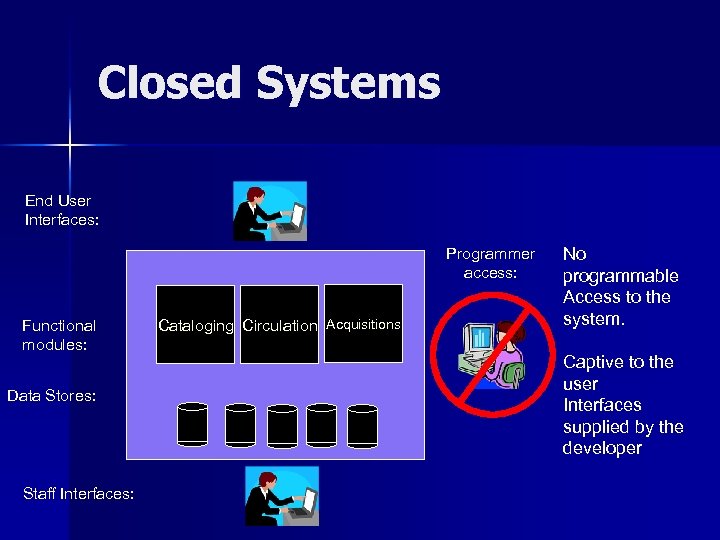
Closed Systems End User Interfaces: Programmer access: Functional modules: Data Stores: Staff Interfaces: Cataloging Circulation Acquisitions No programmable Access to the system. Captive to the user Interfaces supplied by the developer
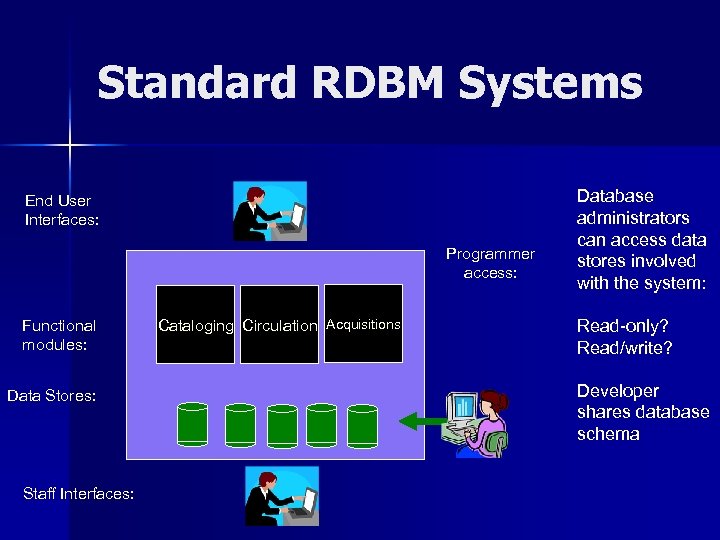
Standard RDBM Systems End User Interfaces: Programmer access: Functional modules: Data Stores: Staff Interfaces: Cataloging Circulation Acquisitions Database administrators can access data stores involved with the system: Read-only? Read/write? Developer shares database schema
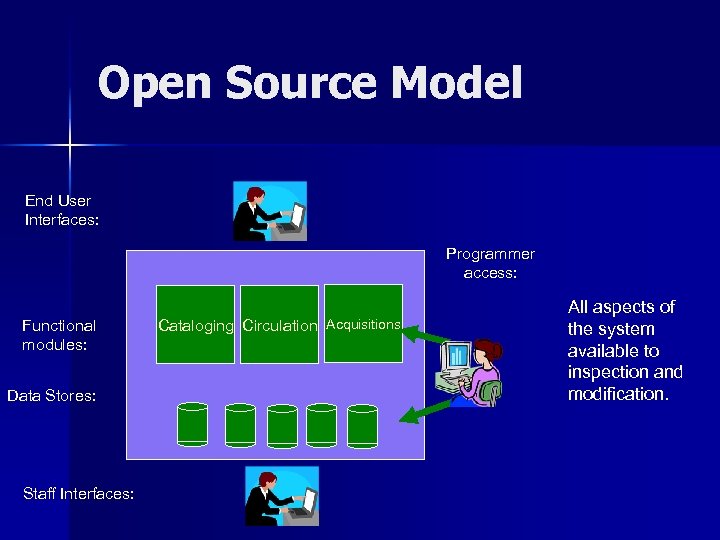
Open Source Model End User Interfaces: Programmer access: Functional modules: Data Stores: Staff Interfaces: Cataloging Circulation Acquisitions All aspects of the system available to inspection and modification.
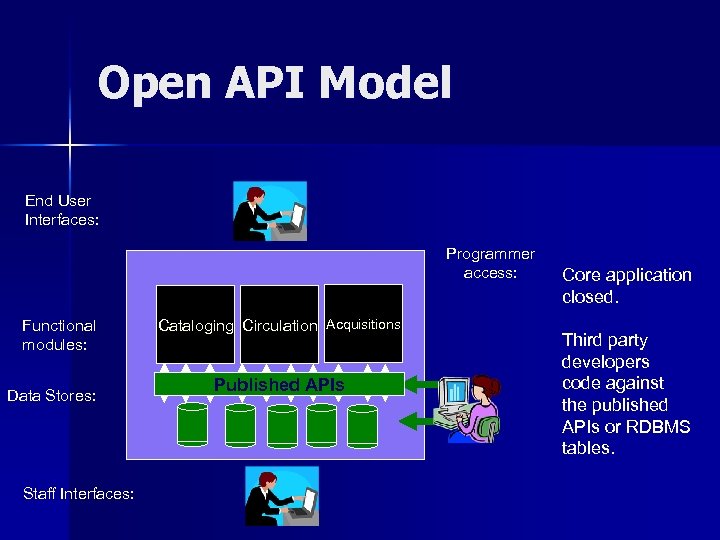
Open API Model End User Interfaces: Programmer access: Functional modules: Data Stores: Staff Interfaces: Cataloging Circulation Acquisitions Published APIs Core application closed. Third party developers code against the published APIs or RDBMS tables.
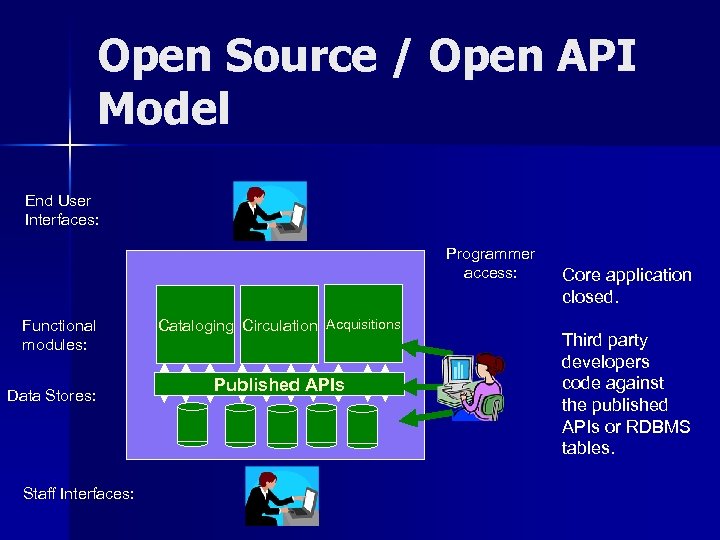
Open Source / Open API Model End User Interfaces: Programmer access: Functional modules: Data Stores: Staff Interfaces: Cataloging Circulation Acquisitions Published APIs Core application closed. Third party developers code against the published APIs or RDBMS tables.
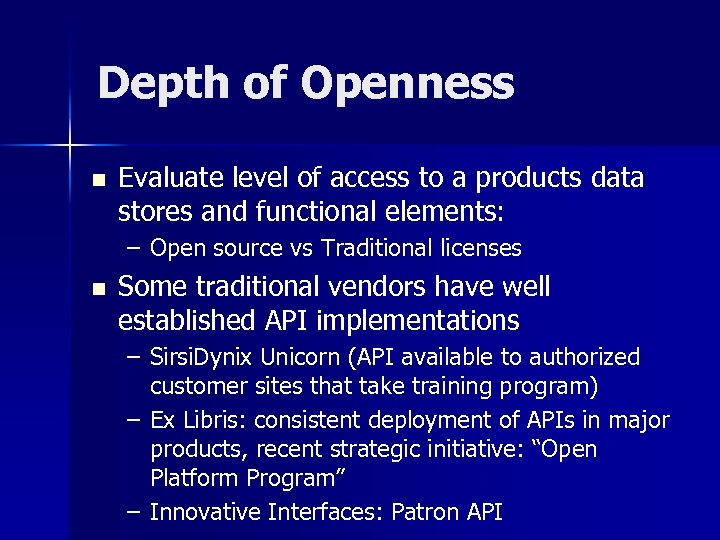
Depth of Openness n Evaluate level of access to a products data stores and functional elements: – Open source vs Traditional licenses n Some traditional vendors have well established API implementations – Sirsi. Dynix Unicorn (API available to authorized customer sites that take training program) – Ex Libris: consistent deployment of APIs in major products, recent strategic initiative: “Open Platform Program” – Innovative Interfaces: Patron API
Universal open APIs? n n Some progress on API to support discovery layer interfaces, but no comprehensive framework yet. Many industry protocols work like APIs: – Z 39. 50, SRU/W, NCIP, OAI-PMH, Open. URL, etd n It would be ideal if there were an open set of APIs that were implemented by all automation system products. – Third party components and add-ons would then work across all products. n DLF ILS-Discovery Interface protocol. Targets interoperability between ILS and new genre of interfaces n AKA: Berkeley Accords
Next-Generation Library Interfaces
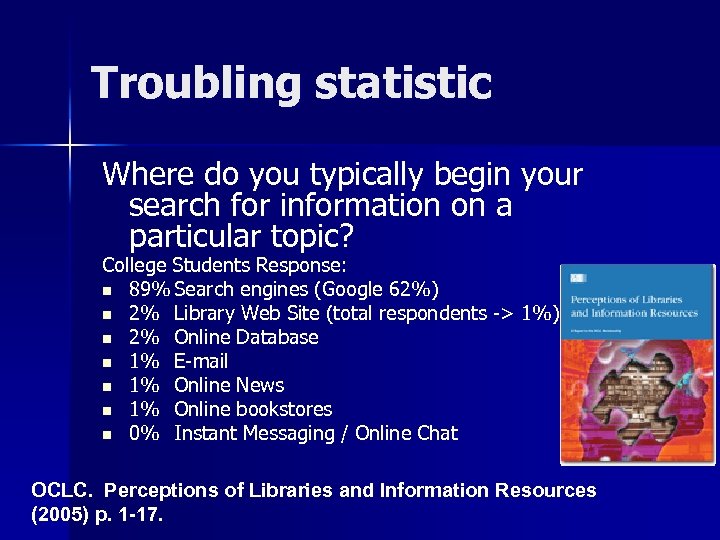
Troubling statistic Where do you typically begin your search for information on a particular topic? College Students Response: n 89% Search engines (Google 62%) n 2% Library Web Site (total respondents -> 1%) n 2% Online Database n 1% E-mail n 1% Online News n 1% Online bookstores n 0% Instant Messaging / Online Chat OCLC. Perceptions of Libraries and Information Resources (2005) p. 1 -17.
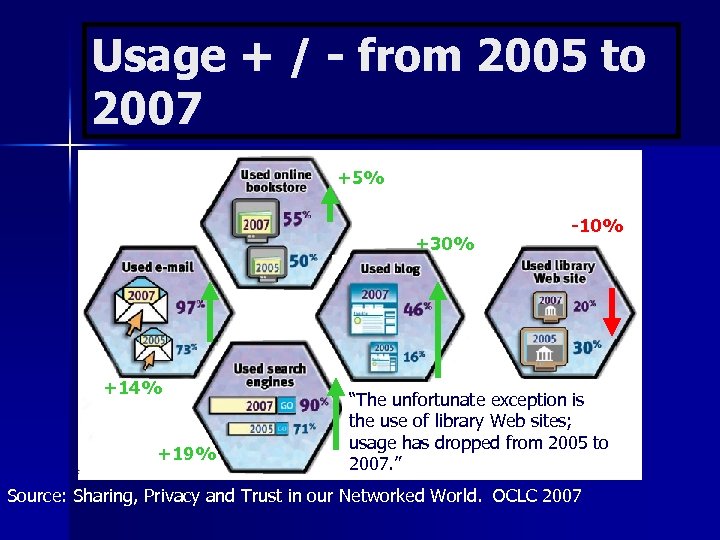
Usage + / - from 2005 to 2007 +5% +30% +14% +19% -10% “The unfortunate exception is the use of library Web sites; usage has dropped from 2005 to 2007. ” Source: Sharing, Privacy and Trust in our Networked World. OCLC 2007
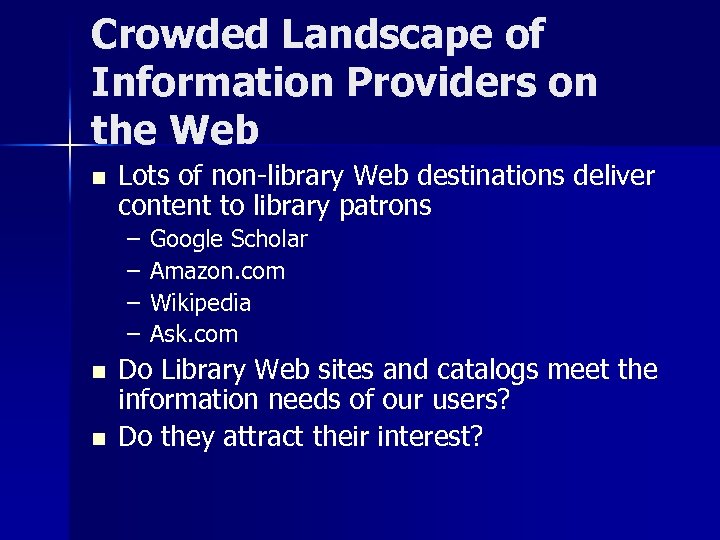
Crowded Landscape of Information Providers on the Web n Lots of non-library Web destinations deliver content to library patrons – – n n Google Scholar Amazon. com Wikipedia Ask. com Do Library Web sites and catalogs meet the information needs of our users? Do they attract their interest?
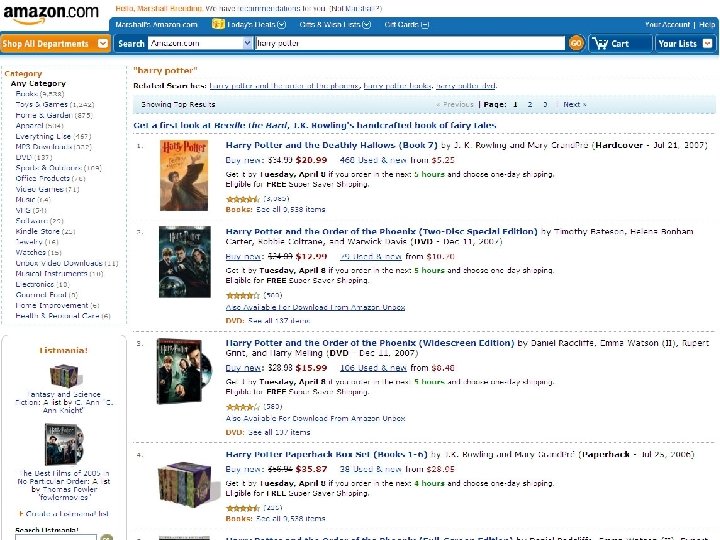
The Competition
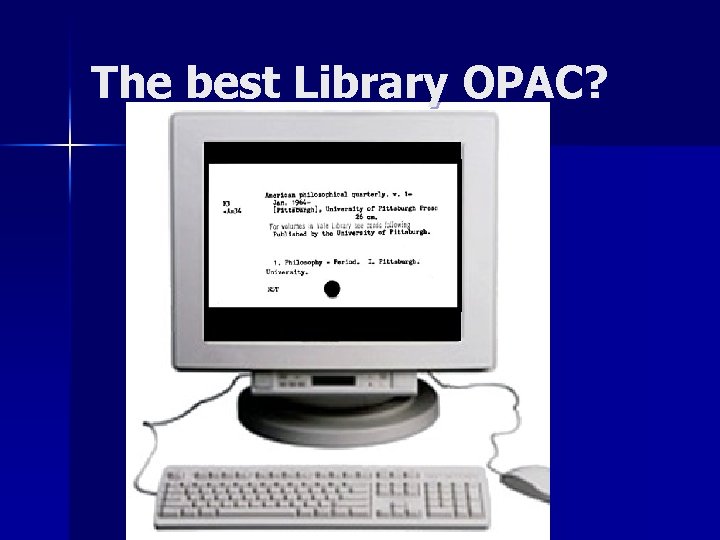
The best Library OPAC?
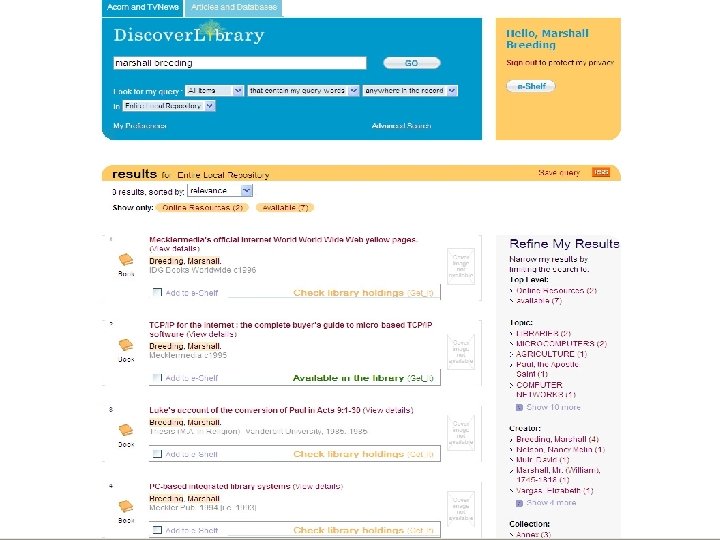
Better?
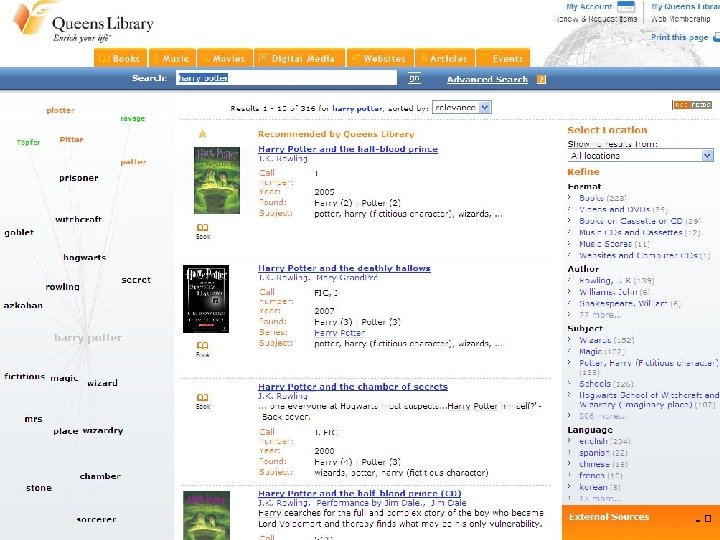
Better?
Demand for compelling library interfaces Urgent need for libraries to offer interfaces their users will like to use n Move into the current millennium n Powerful search capabilities in tune with how the Web works today n Meet user expectations set by other Web destination n
Inadequacy of ILS OPACs Online Catalog modules provided with an ILS subject to broad criticism as failing to meet expectations of growing segments of library patrons. n Not great at delivering electronic content n Complex text-based interfaces n Relatively weak keyword search engines n
Disjointed approach to information and service delivery n n n Books: Library OPAC (ILS module) Articles: Aggregated content products, ejournal collections Open. URL linking services E-journal finding aids (Often managed by link resolver) Local digital collections – ETDs, photos, rich media collections n n Metasearch engines All searched separately
Change underway n n Widespread dissatisfaction with most of the current OPACs. Many efforts toward next-generation catalogs and interfaces. Movement among libraries to break out of the current mold of library catalogs and offer new interfaces better suited to the expectations of library users. Decoupling of the front-end interface from the back -end library automation system. Eventual redesign of the ILS to be better suited for current library collections of digital and print content
Redefining the “catalog” n n n More comprehensive information discovery environments It’s no longer enough to provide a catalog limited to print resources Digital resources cannot be an afterthought Systems designed for e-content only are also problematic Forcing users to use different interfaces depending on type of content becoming less tenable Libraries working toward consolidated user environments that give equal footing to digital and print resources
Comprehensive Search Service n n Current distributed query model of federated search model not adequate Expanded scope of search through harvested content – Consolidated search services based on metadata and data gathered in advance (like OAI-PMH) n n n Problems of scale diminished Problems of cooperation persist Federated search currently operates as a plug-in component of next-gen interfaces.
Web 2. 0 Flavorings Strategic infrastructure + Web 2. 0 n A more social and collaborative approach n Web Tools and technology that foster collaboration n Integrated blogs, wiki, tagging, social bookmarking, user rating, user reviews n Avoid Web 2. 0 information silos n
The Ideal Scope for Next Gen Library Interfaces Unified user experience n A single point of entry into all the content and services offered by the library n Print + Electronic n Local + Remote n Locally created Content n User contributed content? n
Interface Features / User Experience n Simple point of entry – Optional advanced search n n n n Relevancy ranked results Facets for narrowing and navigation Query enhancement – spell check, etc Suggested related results Navigational bread crumbs Enriched visual and textual content Single Sign-on
Deep search n n n Entering post-metadata search era Increasing opportunities to search the full contents – Google Library Print, Google Publisher, Open Content Alliance, Microsoft Live Book Search, etc. – High-quality metadata will improve search precision Commercial search providers already offer “search inside the book” No comprehensive full text search for books quite yet Not currently available through library search environments Deep search highly improved by high-quality metadata See: Systems Librarian, May 2008 “Beyond the current generation of next-generation interfaces: deeper search”
Beyond Discovery Fulfillment oriented n Search -> select -> view n Delivery/Fulfillment much harder than discovery n Back-end complexity should be as seamless as possible to the user n Offer services for digital and print content n
Library-specific Features n Appropriate relevance factors – Objective keyword ranking + Library weightings – Circulation frequency, OCLC holdings, scholarly content Results grouping (FRBR) n Collection focused (vs sales-driven) n
Enterprise Integration Ability to deliver content and services through non-library applications n Campus portal solutions n Courseware n Social networking environments n Search portals / Feed aggregators n
Architecture and Standards n n n Need to have an standard approach for connecting new generation interfaces with ILS and other repositories Proprietary and ad hoc methods currently prevail Digital Library Federation – ILS-Discovery Interface Group n Time to start thinking about a new generation of ILS better suited for current library collections and missions.
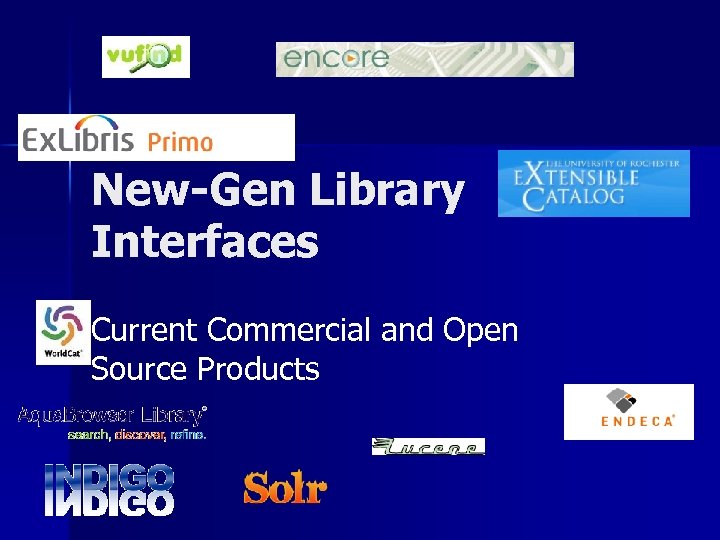
New-Gen Library Interfaces Current Commercial and Open Source Products
Part III. Moving toward new generation of library automation
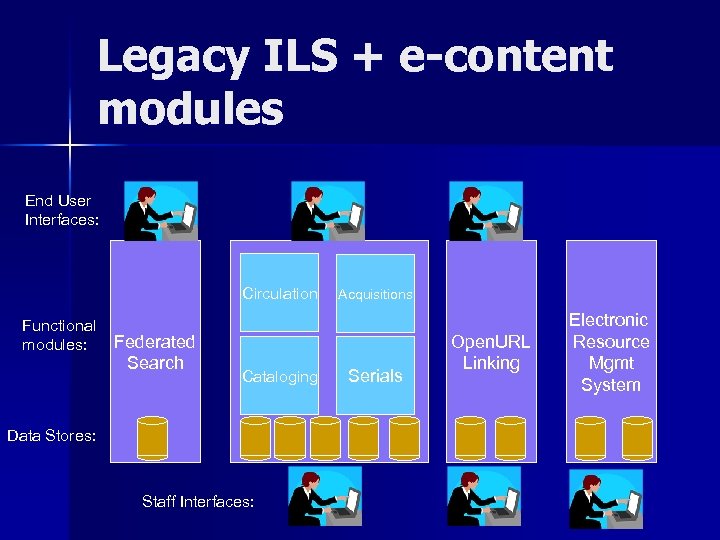
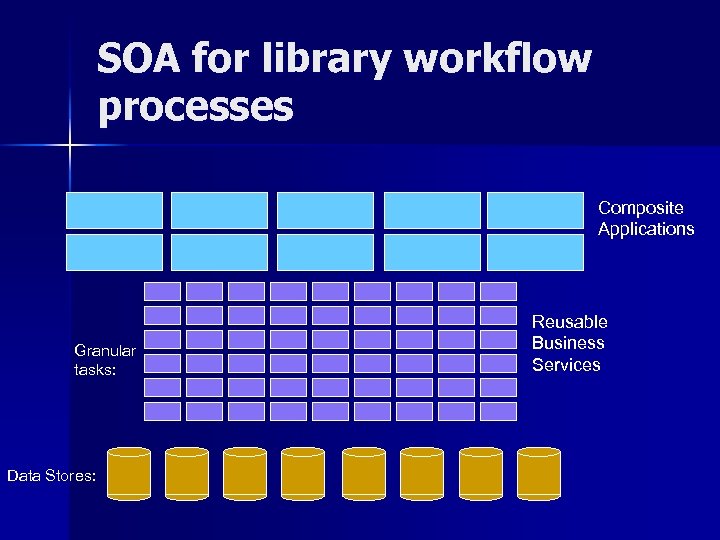
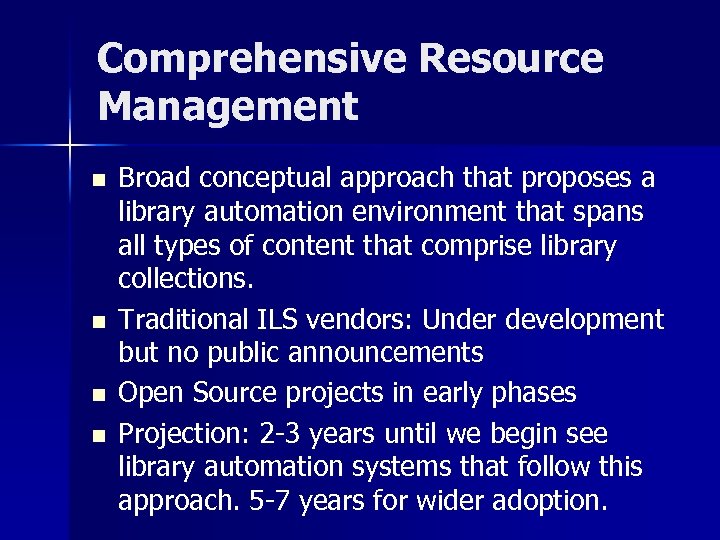
Rethinking the ILS n n n Fundamental assumption: Print + Digital = Hybrid libraries Traditional ILS model not adequate for hybrid libraries Libraries currently moving toward surrounding core ILS with additional modules to handle electronic content New discovery layer interfaces replacing or supplementing ILS OPACS Working toward a new model of library automation – Monolithic legacy architectures replaced by fabric of SOA applications – Comprehensive Resource Management “It's Time to Break the Mold of the Original ILS” Computers in Libraries Nov/Dec 2007
ILS: a legacy concept? n ILS = Integrated Library System (Cataloging + Circulation + OPAC + Serials + Acquisitions) n n n Focused on print and physical inventory Electronic content at the Journal Title or collection level Emerged in the 1960’s – 1970’s Functionality has evolved and expanded, but basic concepts and modules remain intact Note: Some companies work toward evolving the ILS to competently handle both print and digital content (e. g. Innovative Interfaces)
ILS: ever diminishing role n n n Many libraries putting much less emphasis on ILS Just an inventory system for physical materials Investments in electronic content increasing Management of e-content handled outside of the ILS Yet: libraries need comprehensive business automation more than ever. Mandate for more efficient operations. Do more with less.
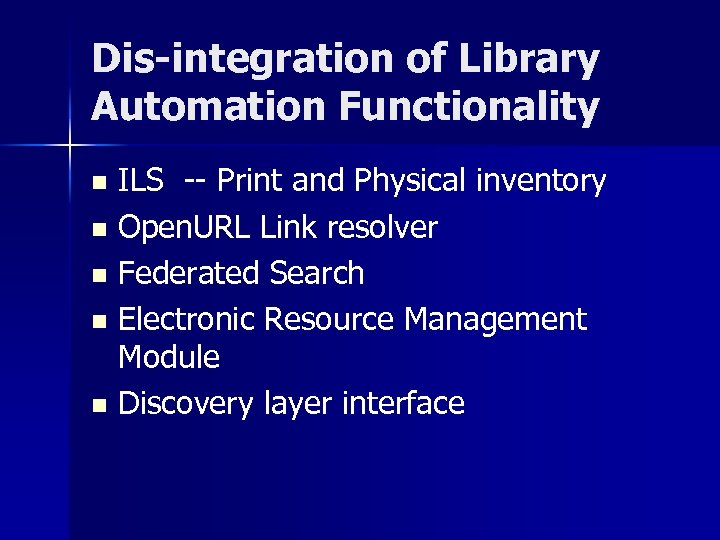
Dis-integration of Library Automation Functionality ILS -- Print and Physical inventory n Open. URL Link resolver n Federated Search n Electronic Resource Management Module n Discovery layer interface n
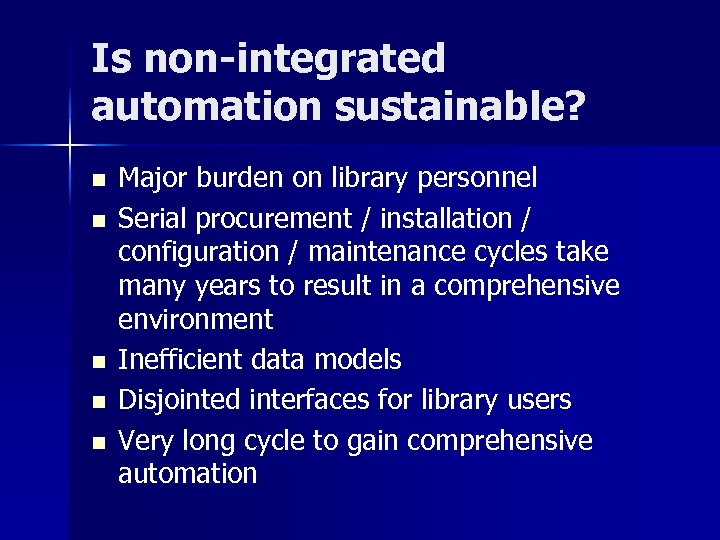
Is non-integrated automation sustainable? n n n Major burden on library personnel Serial procurement / installation / configuration / maintenance cycles take many years to result in a comprehensive environment Inefficient data models Disjointed interfaces for library users Very long cycle to gain comprehensive automation
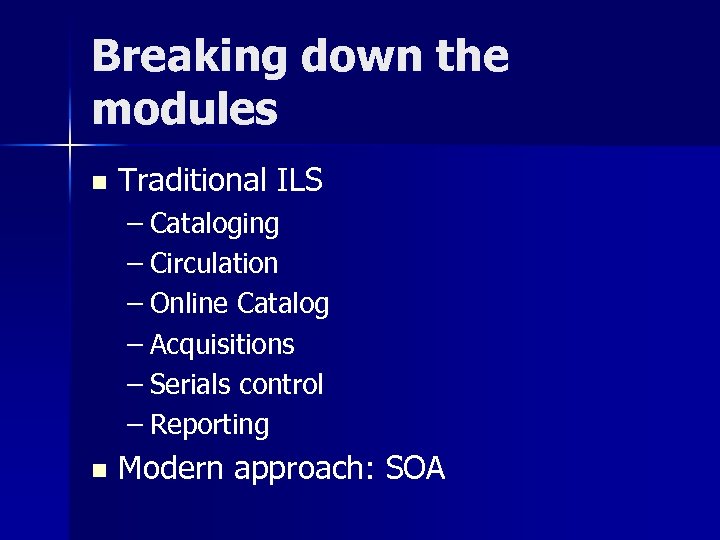
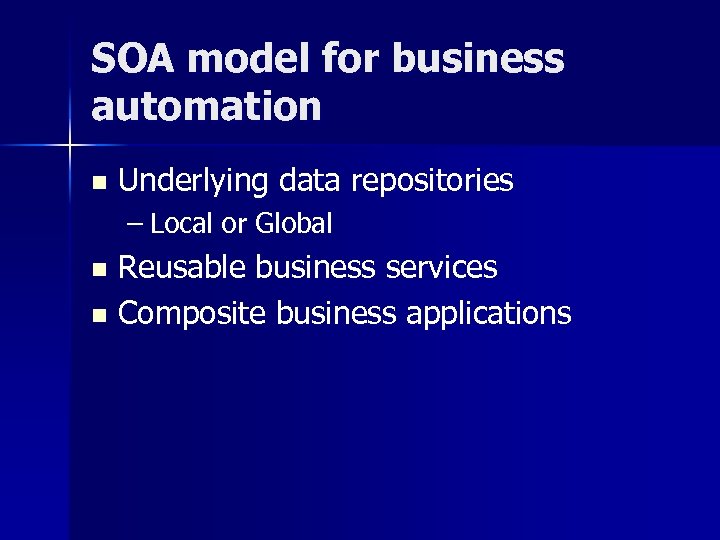
Breaking down the modules n Traditional ILS – Cataloging – Circulation – Online Catalog – Acquisitions – Serials control – Reporting n Modern approach: SOA
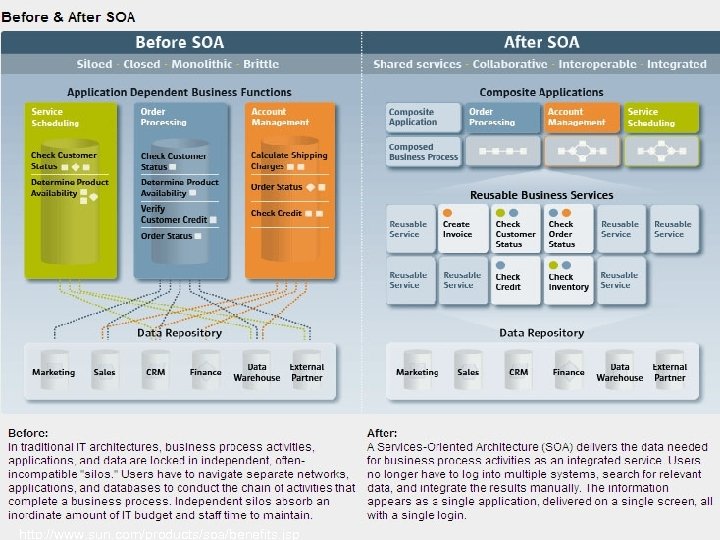
Service Oriented Architecture http: //www. sun. com/products/soa/benefits. jsp
Legacy ILS + e-content modules End User Interfaces: Circulation Functional modules: Federated Search Cataloging Data Stores: Staff Interfaces: Acquisitions Serials Open. URL Linking Electronic Resource Mgmt System
SOA model for business automation n Underlying data repositories – Local or Global Reusable business services n Composite business applications n
SOA for library workflow processes Composite Applications Granular tasks: Data Stores: Reusable Business Services
Comprehensive Resource Management n n Broad conceptual approach that proposes a library automation environment that spans all types of content that comprise library collections. Traditional ILS vendors: Under development but no public announcements Open Source projects in early phases Projection: 2 -3 years until we begin see library automation systems that follow this approach. 5 -7 years for wider adoption.
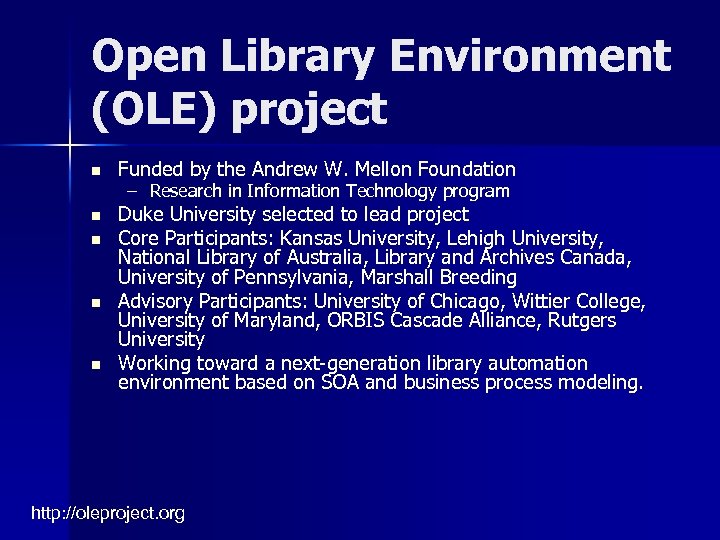
Open Library Environment (OLE) project n Funded by the Andrew W. Mellon Foundation n Duke University selected to lead project Core Participants: Kansas University, Lehigh University, National Library of Australia, Library and Archives Canada, University of Pennsylvania, Marshall Breeding Advisory Participants: University of Chicago, Wittier College, University of Maryland, ORBIS Cascade Alliance, Rutgers University Working toward a next-generation library automation environment based on SOA and business process modeling. n n n – Research in Information Technology program http: //oleproject. org

Questions and Discussion
Скачать презентацию Library Automation Trends in Transition Can new forces
679a4a59a0d7732e74f4ff1fb14f85b5.ppt