 Скачать презентацию Library Automation Systems Breaking from the Past into
2d4b3f40f816e4a0048c64a77dfeee4f.ppt
- Количество слайдов: 65



Library Automation Systems: Breaking from the Past into a New Future Marshall Breeding Director for Innovative Technology and Research Vanderbilt University http: //www. librarytechnology. org/ Northwestern University Library November 27, 2007
Summary • Breeding will provide an overview of where we have been and where we are going in the ILS (Integrated Library System) environment. ILS’s have been around for 35 years and technology has changed exponentially during this timeframe. This session will provide a review of the evolutionary path that the ILS has taken to date, give a look at some of the next-generation library interfaces, and offer some suggestions for a more transformational approach possible for the
Automation Trends • Business environment where commercial companies prevail, offering proprietary systems • ILS developers struggle to adapt to changing technology expectations. • OCLC acquiring library automation companies –no one is really sure of OCLC’s intentions and motivations • Libraries hard at work creating library automation software, willing to share with peer institutions • A major new ILS product created by a publicly funded library agency • Developers from that agency form a new company to promote and support that software in other libraries
When?
1982!
The Ghost of ILS Past
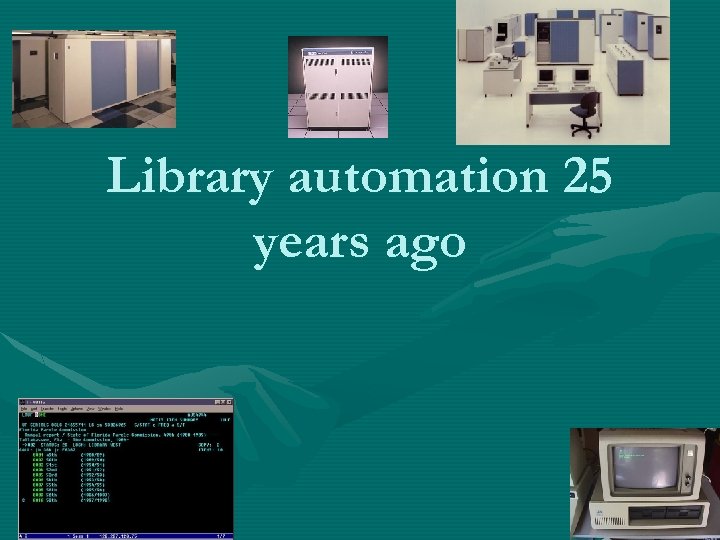
Library automation 25 years ago
Technology Environment • Age of turnkey systems • Large-scale mainframes, transition to: – Minicomputers – Super-micros • • • Very high hardware costs Limited telecommunications bandwidth Proprietary operating systems Proprietary programming languages Open systems beginning to emerge – – Unix VMS
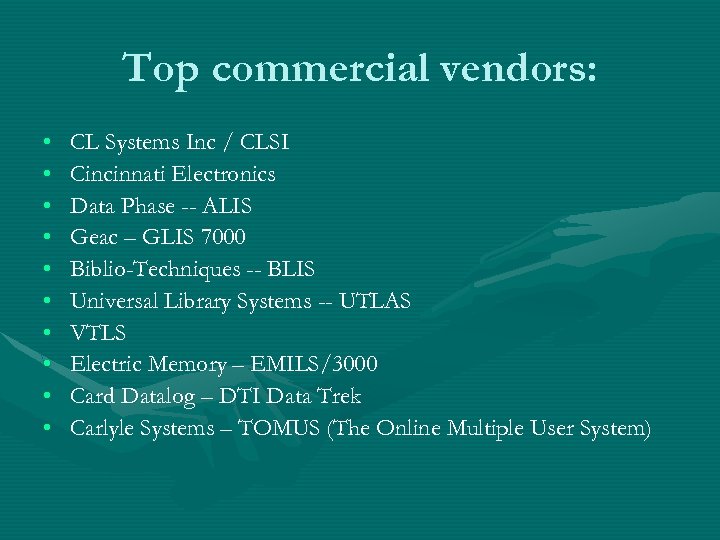
Top commercial vendors: • • • CL Systems Inc / CLSI Cincinnati Electronics Data Phase -- ALIS Geac – GLIS 7000 Biblio-Techniques -- BLIS Universal Library Systems -- UTLAS VTLS Electric Memory – EMILS/3000 Card Datalog – DTI Data Trek Carlyle Systems – TOMUS (The Online Multiple User System)
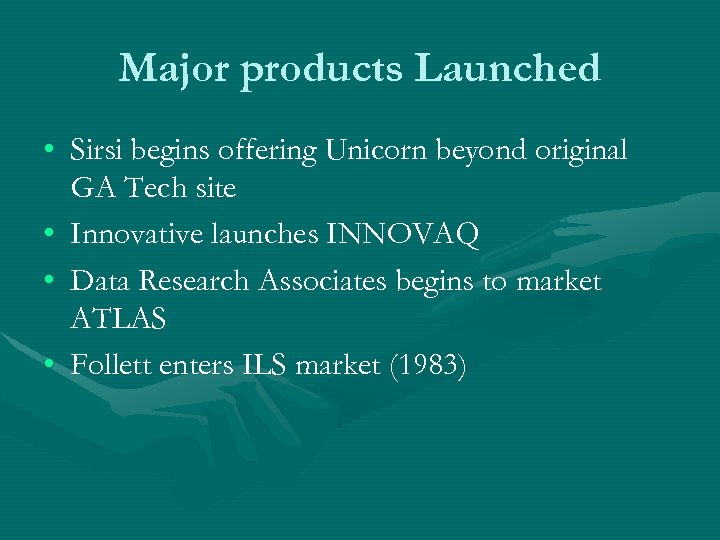
Major products Launched • Sirsi begins offering Unicorn beyond original GA Tech site • Innovative launches INNOVAQ • Data Research Associates begins to market ATLAS • Follett enters ILS market (1983)
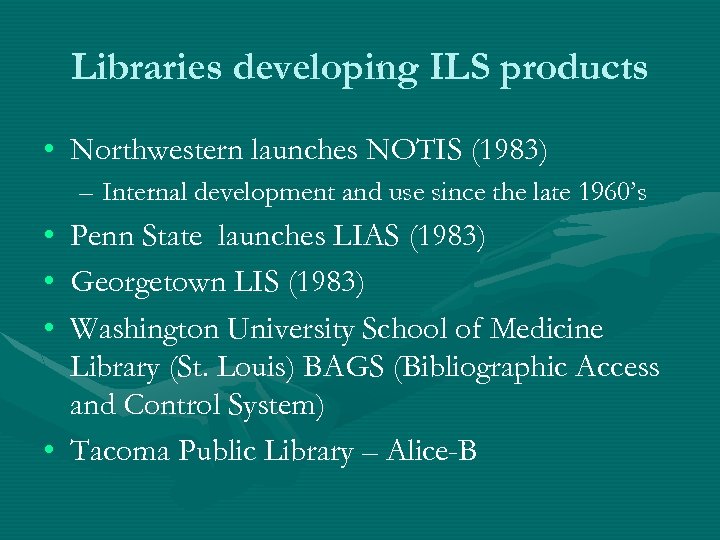
Libraries developing ILS products • Northwestern launches NOTIS (1983) – Internal development and use since the late 1960’s • • • Penn State launches LIAS (1983) Georgetown LIS (1983) Washington University School of Medicine Library (St. Louis) BAGS (Bibliographic Access and Control System) • Tacoma Public Library – Alice-B
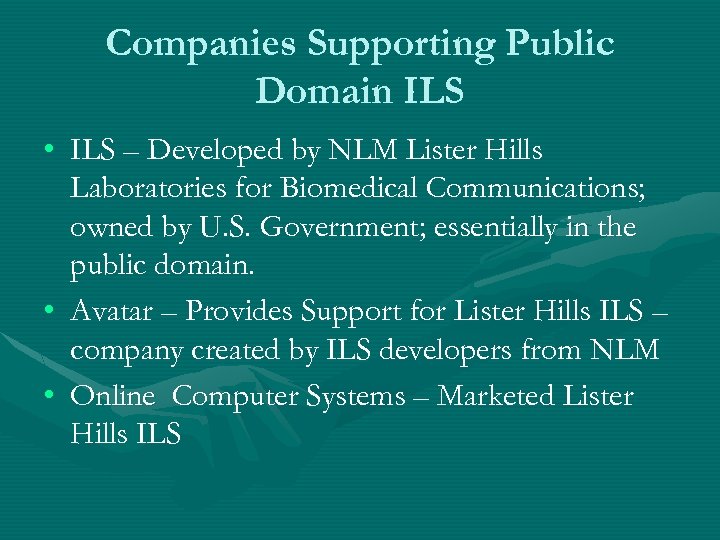
Companies Supporting Public Domain ILS • ILS – Developed by NLM Lister Hills Laboratories for Biomedical Communications; owned by U. S. Government; essentially in the public domain. • Avatar – Provides Support for Lister Hills ILS – company created by ILS developers from NLM • Online Computer Systems – Marketed Lister Hills ILS
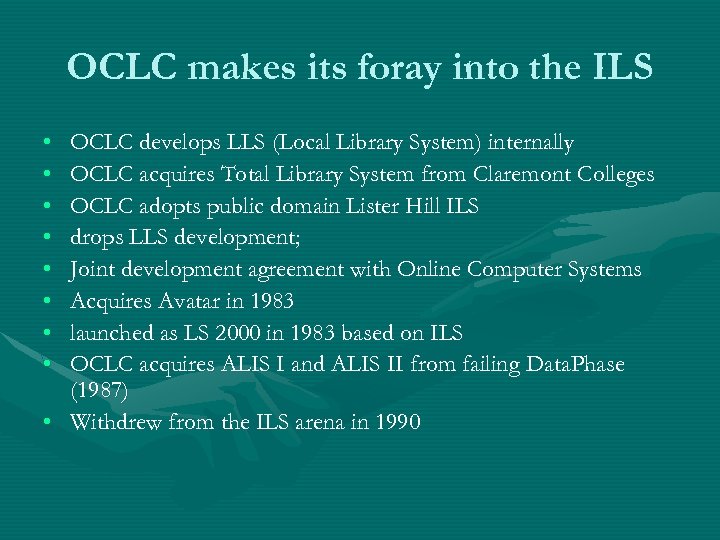
OCLC makes its foray into the ILS • • OCLC develops LLS (Local Library System) internally OCLC acquires Total Library System from Claremont Colleges OCLC adopts public domain Lister Hill ILS drops LLS development; Joint development agreement with Online Computer Systems Acquires Avatar in 1983 launched as LS 2000 in 1983 based on ILS OCLC acquires ALIS I and ALIS II from failing Data. Phase (1987) • Withdrew from the ILS arena in 1990
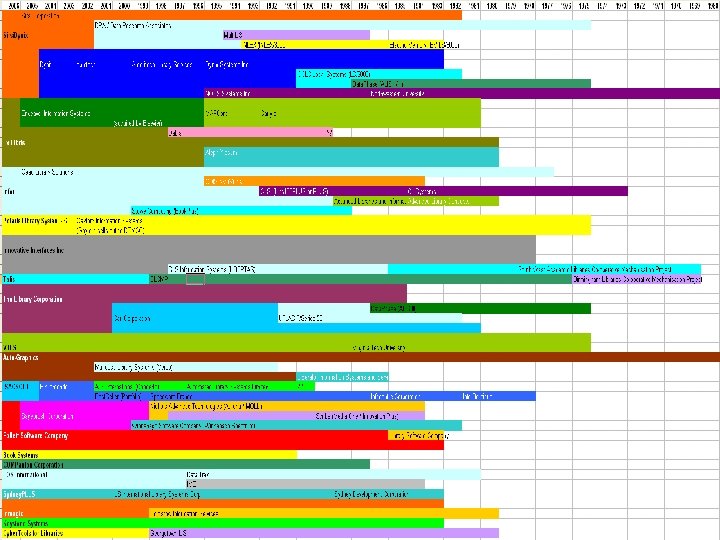
Library Automation M&A History
The Ghost of ILS Present
Technology Landscape • Most ILS products from commercial vendors mature – None less than a decade old – Approaching end of life cycle? • Evolved systems • No success in launching new systems – Horizon 8. 0 – Taos
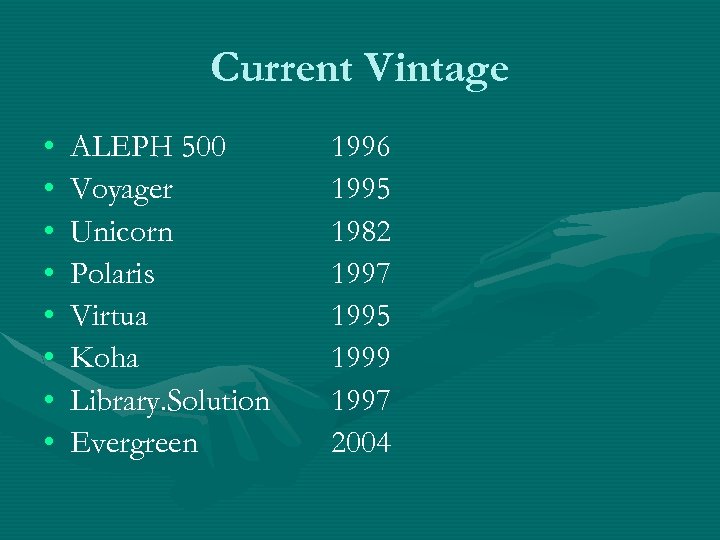
Current Vintage • • ALEPH 500 Voyager Unicorn Polaris Virtua Koha Library. Solution Evergreen 1996 1995 1982 1997 1995 1999 1997 2004
Business Landscape • Library Journal Automated System Marketplace: – An Industry redefined (April 1, 2007) • • • An increasingly consolidated industry Moving out of a previous phase of fragmentation where many companies expend energies producing decreasingly differentiated systems in a limited marketplace Venture Capital firms have cashed out Private Equity playing a stronger role then ever before Narrowing of product options Open Source opportunities rise to challenge the grip of traditional commercial model
Other Business Observations • Level of innovation falls below expectations, despite deep resources and large development teams. • Companies struggle to keep up with ILS enhancements and R&D for new innovations. • Pressure within companies to reduce costs, increase revenue • Pressure from libraries for more innovative products
Companies owned by private equity • Golden Gate Capital – Infor Extensity Geac (formerly a public company) • Francisco Partners – Ex Libris (acquired from Tamar Tech, Walden, Hebrew U. ) – Endeavor Information Systems (acquired from Elsevier) • Vista Equity Partners – Sirsi. Dynix (acquired from Seaport)
Private Holding Company • Croyden – Polaris Library Systems (Formerly part of Gaylord Bros)
Public companies: • Auto-Graphics – De-listed from SEC reporting requirements – Was OTC: AUGR now Pink Sheets: AUGR • Open. Text – – – Spin-off form Battelle Information Dimensions Acquired by OCLC, run as for-profit business unit Sold to Gores Technology Group Acquired by Open. Text • Move involved in enterprise information management than ILS
Founder / Family owned companies • Innovative Interfaces – 100% ownership by Jerry Kline following 2001 buyout of partner Steve Silberstein • The Library Corporation – Owned by Annette Murphy family • VTLS – tech spin-off from Virginia Tech, wholly owned by Vinod Chachra • These companies not under the control of external financial interests
Cambridge Information Group / Bowker • Emerging as a major library technology company: – Serials Solutions – Syndetic Solutions • • • Electronic Resource Management Federated Search E-Journals data – Aqua. Browser • Next-gen Interface
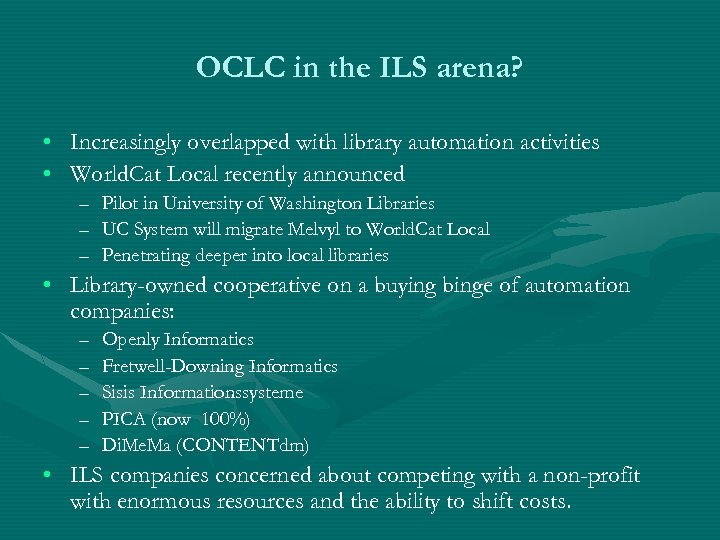
OCLC in the ILS arena? • Increasingly overlapped with library automation activities • World. Cat Local recently announced – Pilot in University of Washington Libraries – UC System will migrate Melvyl to World. Cat Local – Penetrating deeper into local libraries • Library-owned cooperative on a buying binge of automation companies: – – – Openly Informatics Fretwell-Downing Informatics Sisis Informationssysteme PICA (now 100%) Di. Me. Ma (CONTENTdm) • ILS companies concerned about competing with a non-profit with enormous resources and the ability to shift costs.
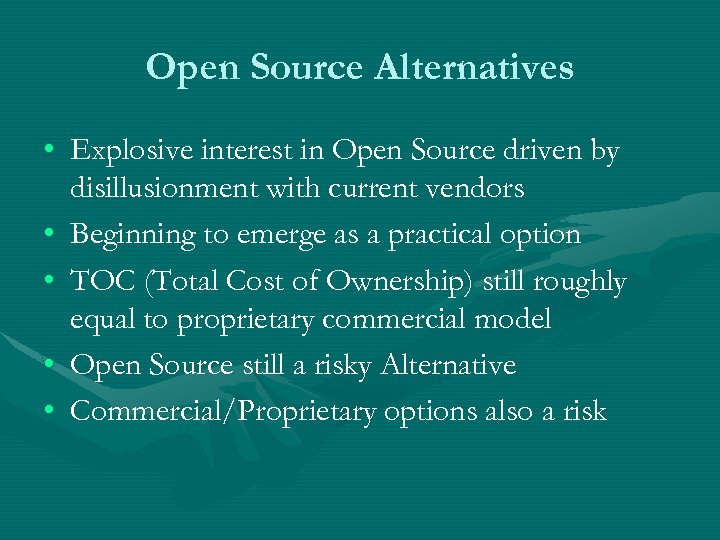
Open Source Alternatives • Explosive interest in Open Source driven by disillusionment with current vendors • Beginning to emerge as a practical option • TOC (Total Cost of Ownership) still roughly equal to proprietary commercial model • Open Source still a risky Alternative • Commercial/Proprietary options also a risk
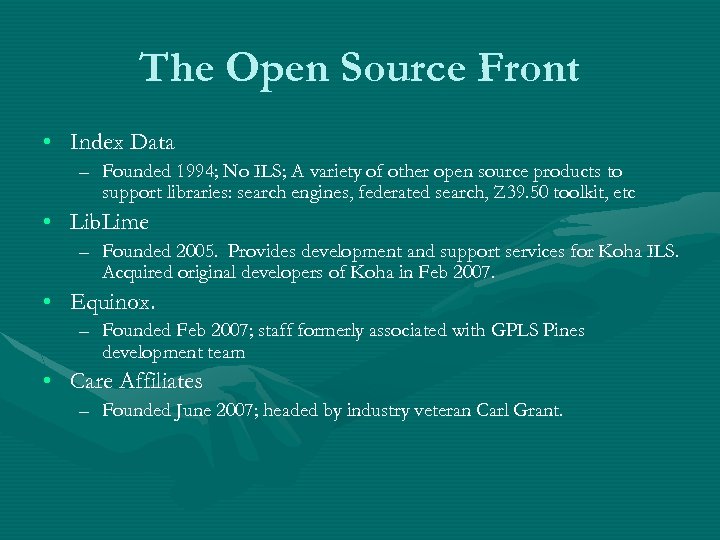
The Open Source Front • Index Data – Founded 1994; No ILS; A variety of other open source products to support libraries: search engines, federated search, Z 39. 50 toolkit, etc • Lib. Lime – Founded 2005. Provides development and support services for Koha ILS. Acquired original developers of Koha in Feb 2007. • Equinox. – Founded Feb 2007; staff formerly associated with GPLS Pines development team • Care Affiliates – Founded June 2007; headed by industry veteran Carl Grant.
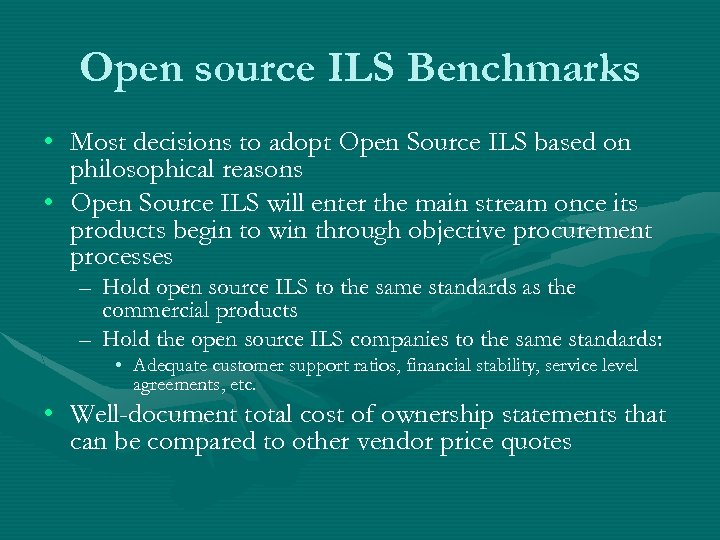
Open source ILS Benchmarks • Most decisions to adopt Open Source ILS based on philosophical reasons • Open Source ILS will enter the main stream once its products begin to win through objective procurement processes – Hold open source ILS to the same standards as the commercial products – Hold the open source ILS companies to the same standards: • Adequate customer support ratios, financial stability, service level agreements, etc. • Well-document total cost of ownership statements that can be compared to other vendor price quotes
Open Source Market share / Perspective • Open Source ILS implementations still a very small percentage of the total picture • Initial set of successful implementations will likely serve as a catalyst to pave the way for others • Successful implementations in wider range of libraries: – – – State-wide consortium (Evergreen) Multi-site public library systems (Koha) School district consortia (OPALS-NA)
ILS Migration Trends • Few voluntary lateral migrations • Forced Migrations – Vendor abandonment – Need to move from legacy systems – Exit from bad marriages with vendors – Exit from bad marriages with consortia
Products surrounding the ILS • It’s never been harder to justify investments in ILS – Nothing transformational about a lateral migration • Need for products focused on electronic content and user experience – Next-gen interfaces – Federated search – Linking – Electronic Resource Management
An age of less integrated systems • Core ILS supplemented by: – Open. URL Link Resolvers – Metasearch / Federated Search – Electronic Resource Management – Next Generation Library Interfaces
No longer an ILS-centric industry • Portion of revenues derived from core ILS products diminishing relative to other library tech products • Many companies and organizations that don’t offer an ILS are involved in library automation: – OCLC – Cambridge / Bowker – Web. Feat – Muse Global
Working toward next generation library interfaces • Redefinition of the library catalog • More comprehensive information discovery environments • Better information delivery tools • More powerful search capabilities • More elegant presentation
Comprehensive Search Service • • • More like OAI Problems of scale diminished Problems of cooperation persist
Incorporate Web 2. 0 concepts • A more social and collaborative approach • Web Tools and technology that foster collaboration • User supplied ratings, rankings, and reviews • Blogs, wiki, blogs, tagging, social bookmarking • Example: Library. Thing for Libraries
Web 2. 0 supporting technologies • Web services • XML Application Programming Interfaces (APIs) • AJAX (asynchronous Java. Script and XML) • RSS • Open. Search vs SRU/SRW
Redefinition of library catalogs • Traditional notions of the library catalog are being questioned • It’s no longer enough to provide a catalog limited to print resources • Digital resources cannot be an afterthought • Forcing users to use different interfaces depending on type of content becoming less tenable • Libraries working toward consolidated search environments that give equal footing to digital and print resources
Interface expectations • Millennial generation library users are well acclimated to the Web and like it. • Used to relevancy ranking – – – The “good stuff” should be listed first Users tend not to delve deep into a result list Good relevancy requires a sophisticated approach, including objective matching criteria supplemented by popularity and relatedness factors. • Very rapid response. Users have a low tolerance for slow systems • Rich visual information: book jacket images, rating scores, etc.
Faceted Navigation • Well established discovery method in e-commerce arena • Let users drill down through the result set incrementally narrowing the field • Faceted Browsing – Drill-down vs up-front Boolean or “Advanced Search” – gives the users clues about the number of hits in each sub topic. • Navigational Bread crumbs
Current Next-Gen catalog products
Common characteristics • Decoupled interface Mass export of catalog data Alternative search engine Alternative interface
Endeca Guided Navigation • North Carolina State University http: //www. lib. ncsu. edu/catalog/ • Mc. Master University http: //libcat. mcmaster. ca/ • Phoenix Public Library http: //www. phoenixpubliclibrary. org/ • Florida Center for Library Automation http: //catalog. fcla. edu/ux. jsp
Aqua. Browser Library • Queens Borough Public Library – http: //aqua. queenslibrary. org/
Ex Libris Primo • Vanderbilt University http: //alphasearch. library. vanderbilt. edu • University of Minnesota http: //prime 2. oit. umn. edu: 1701/primo_library/libwe b/action/search. do? vid=TWINCITIES • University of Iowa http: //smartsearch. uiowa. edu/
Encore from Innovative Interfaces • Nashville Public Library http: //nplencore. library. nashville. org/iii/encore/app • Scottsdale Public Library http: //encore. scottsdaleaz. gov/iii/encore/app • Yale University Lillian Goldman Law Library http: //encore. law. yale. edu/iii/encore/app
VUFind – Villanova University Based on Apache Solr search toolkit http: //www. vufind. org/
OCLC Worldcat Local • OCLC Worldcat customized for local library catalog – Relies on hooks into ILS for local services • Washington University Libraries http: //uwashington. worldcat. org/ • University of California Melvyl Catalog
Library-developed solutions • e. Xtensible Catalog • University of Rochester – River Campus Libraries • Financial support from the Andrew W. Mellon Foundation • http: //www. extensiblecatalog. info/ – Just received a second round of funding from Mellon – Wider institutional participation
The Ghost of ILS Yet to Come
Working toward a new ILS Vision • How libraries work has changed dramatically over the last 20 years. • ILS built largely on workflows cast more than 25 years ago • Based on assumptions that have long since changed • Digital resources represent at least half of most libraries collection budgets
Change demanded • Level of dissatisfaction with the current slate of ILS products is very high. • Large monolithic systems are unwieldy—very complex to install, administer and maintain. • Continue to be large gaps in functionality – – – Interlibrary loan Collection development Preservation: print / digital Book binding Remote storage operations
Less Proprietary / More Open • • Libraries demand more openness Open source movement greatest challenge to current slate of ILS products • Demand for open access to data – – – API’s essential Beyond proprietary APIs Ideal: Industry-standard set of API’s implemented by all systems – Current NISO effort to define API for an ILS for decoupled catalogs
Comprehensive automation • Need the ability to automation all aspects of library work • Suite of interoperable modules • Single point of management for each category of information • Not necessarily through a single monolithic system
More lightweight approach • • • More elegant and efficient Easier to install and administer Automation systems that can be operated with fewer number of technical staff
Redefining the borders • Many artificial distinctions prevail in today’s ILS model • Online catalog / library portal / institutional portal • Circulation / ILL / Direct consortial borrowing / remote storage • Collection Development / Acquisitions / budget administration • Library acquisitions / Institutional ERP • Cataloging / Metadata document ingestion for digital collections • Digital / Print workflows
Separation of front-end from backend • • • ILS OPAC not necessarily best library interface Many efforts already underway to offer alternatives Too many of the resources that belong in the interface are out of the ILS scope • Technology cycles faster for front-end than for backend processes.
Service-oriented Architecture • • • Work toward a service-oriented business application Suite of light-weight applications Flexibility to evolve in step with changes in library services and practices
Massively consolidated implementations • Large scale Software as a Service – Hosted in industrial strength distributed data centers – Managed by vendor or library organization • • • State/Province-wide ILS implementations Increased reliance on consortia Radical simplification of library policies affecting services offered to patrons
Interoperability with the Local Enterprise • • • Interoperate with non-library applications Course management Accounting, finance, ERM applications External authentication services Other portal implementations
Fitting into the Global Enterprise • Leverage capabilities of search engines: – Google, Google Scholar, Microsoft Live, Ask, etc • OCLC World. Cat • Sort out the relationships between the global enterprise and local systems • Leverage the content in enterprise discovery systems to drive users toward library resources
Revise assumptions regarding Metadata • The next-gen ILS must natively support many flavors of metadata: MARC, Dublin Core, Onix, METS, etc • Reliance on MARC widely questioned • XML widely deployed • Library of Congress Subject Headings vs FAST • Approaching a post-metadata where discovery systems operate on actual digital objects themselves, not metadata about them – High-quality metadata will always improve discovery • Incorporate content from mass digitization efforts • Increasing proportions of rich media content: audio, video
New models of Software Development • Role of commercial partners – Break out of marketing / consumer model – Substantial dialog that shapes the direction of product development • • • Increased partnerships Accelerated development cycles Cost-effective / realistic cost expectations
Evolution vs Revolution • What we have today is a result of 35 years of evolution • Is it possible to break free of the constraints of these evolved systems toward a new generation that will offer a fresh approach? • How much are we willing to let the ghosts of ILS past and present constrain the ILS of Times Yet to Come?
Questions / Discussion
Скачать презентацию Library Automation Systems Breaking from the Past into
2d4b3f40f816e4a0048c64a77dfeee4f.ppt