 Скачать презентацию Libraries supporting e-Science — combining cultures
1cb6f6f82ed11eb73b2850c8caa9af0a.ppt
- Количество слайдов: 64



Libraries supporting e-Science --- … combining cultures … Pauline Simpson National Oceanography Centre University of Southampton, UK Digital Libraries à la Carte 2007 Tilburg University 27 -31 Aug 2007
Overview § § § § Not about Libraries supporting research per se e-Science Open Data Digital Repositories and Open Access Vision of ‘joined up research’ Issues for e-Science Combining cultures, connecting people – New roles for libraries Digital Libraries à la Carte 2007
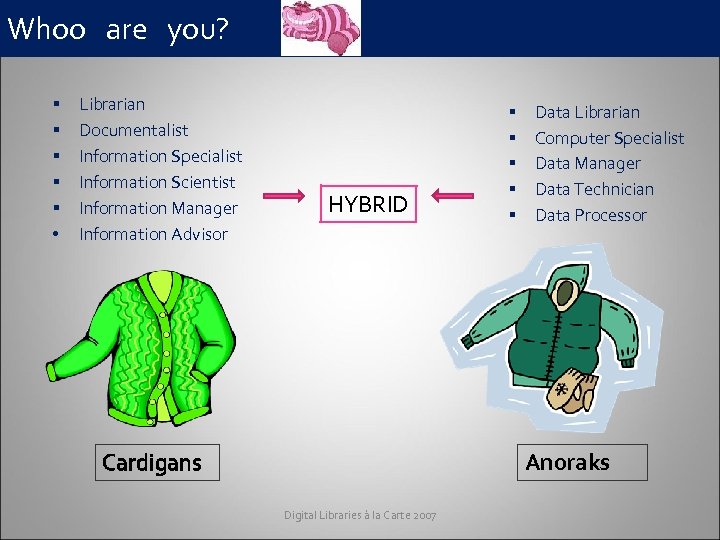
Whoo are you? § § § • Librarian Documentalist Information Specialist Information Scientist Information Manager Information Advisor HYBRID § § § Data Librarian Computer Specialist Data Manager Data Technician Data Processor Anoraks Cardigans Digital Libraries à la Carte 2007
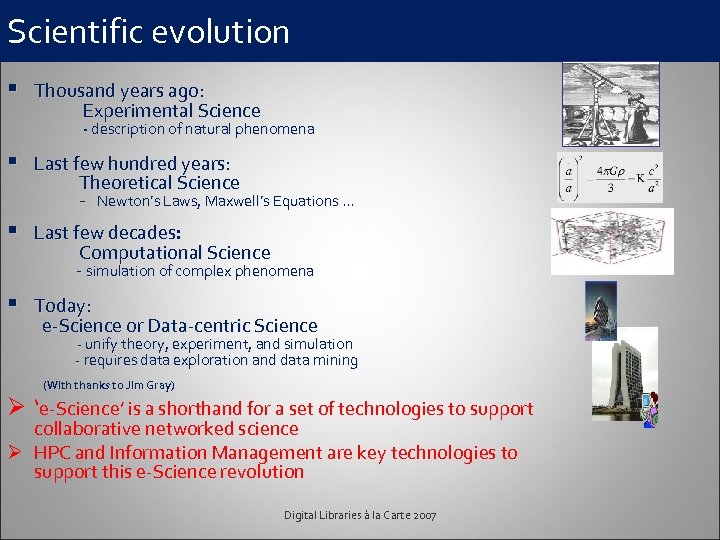
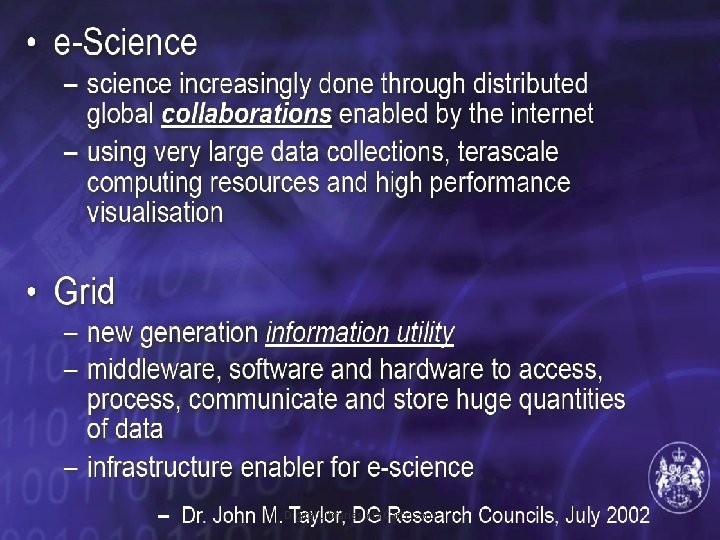
Scientific evolution § Thousand years ago: Experimental Science - description of natural phenomena § Last few hundred years: Theoretical Science - Newton’s Laws, Maxwell’s Equations … § Last few decades: Computational Science - simulation of complex phenomena § Today: e-Science or Data-centric Science - unify theory, experiment, and simulation - requires data exploration and data mining (With thanks to Jim Gray) Ø ‘e-Science’ is a shorthand for a set of technologies to support collaborative networked science Ø HPC and Information Management are key technologies to support this e-Science revolution Digital Libraries à la Carte 2007
Digital Libraries à la Carte 2007
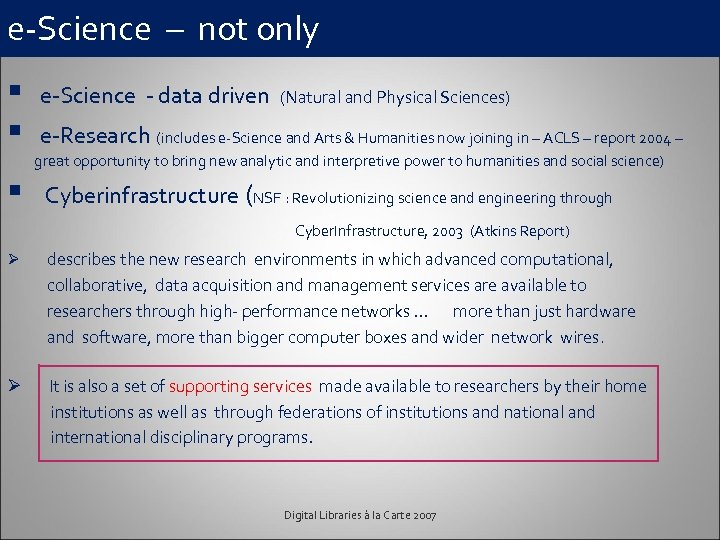
e-Science – not only § § e-Science - data driven (Natural and Physical Sciences) e-Research (includes e-Science and Arts & Humanities now joining in – ACLS – report 2004 – § Cyberinfrastructure (NSF : Revolutionizing science and engineering through Cyber. Infrastructure, 2003 (Atkins Report) great opportunity to bring new analytic and interpretive power to humanities and social science) Ø describes the new research environments in which advanced computational, collaborative, data acquisition and management services are available to researchers through high- performance networks … more than just hardware and software, more than bigger computer boxes and wider network wires. Ø It is also a set of supporting services made available to researchers by their home institutions as well as through federations of institutions and national and international disciplinary programs. Digital Libraries à la Carte 2007
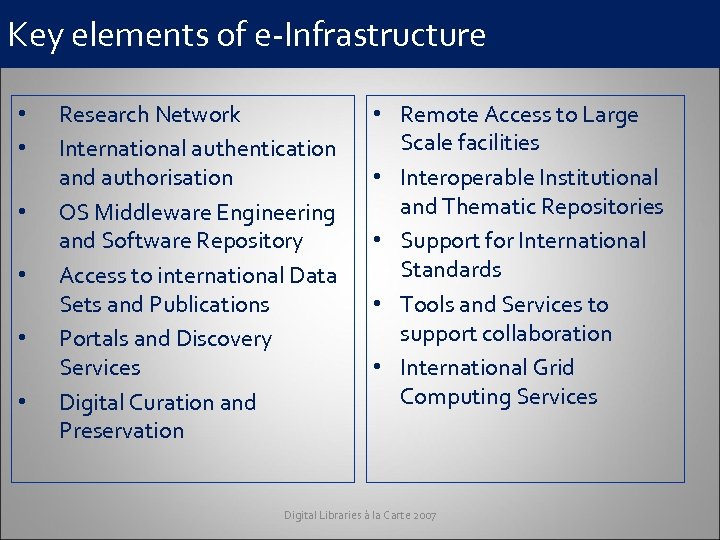
Key elements of e-Infrastructure • • • Research Network International authentication and authorisation OS Middleware Engineering and Software Repository Access to international Data Sets and Publications Portals and Discovery Services Digital Curation and Preservation • Remote Access to Large Scale facilities • Interoperable Institutional and Thematic Repositories • Support for International Standards • Tools and Services to support collaboration • International Grid Computing Services Digital Libraries à la Carte 2007
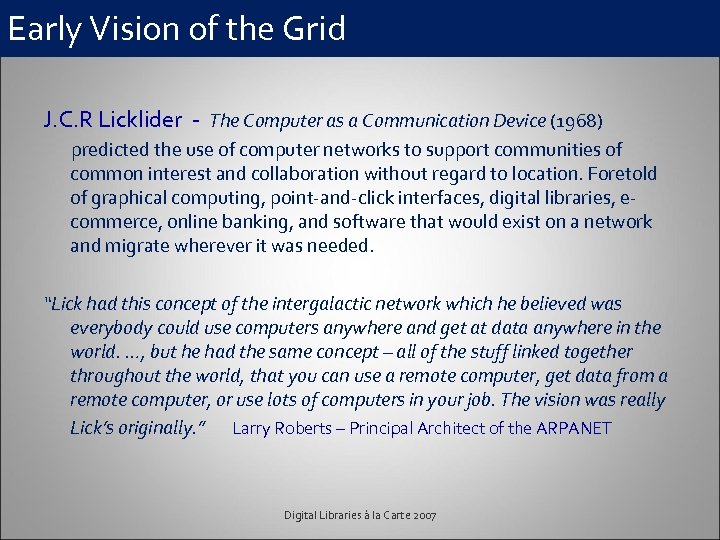
Early Vision of the Grid J. C. R Licklider - The Computer as a Communication Device (1968) predicted the use of computer networks to support communities of common interest and collaboration without regard to location. Foretold of graphical computing, point-and-click interfaces, digital libraries, ecommerce, online banking, and software that would exist on a network and migrate wherever it was needed. “Lick had this concept of the intergalactic network which he believed was everybody could use computers anywhere and get at data anywhere in the world. …, but he had the same concept – all of the stuff linked together throughout the world, that you can use a remote computer, get data from a remote computer, or use lots of computers in your job. The vision was really Lick’s originally. ” Larry Roberts – Principal Architect of the ARPANET Digital Libraries à la Carte 2007
1990’s The Web • Tim Berners-Lee developed the Web at CERN as a tool for exchanging information between the partners in physics collaborations • It was the international particle physics community who first embraced the Web • The first Web Site in the USA was a link to the SLAC Library Catalogue (Stanford Linear Accelerator Center) Ø Web has transformed the modern world – science, academia, business and leisure Digital Libraries à la Carte 2007
Web+ § Scientists developing collaboration technologies that go far beyond the capabilities of the Web – To use remote computing resources – To integrate, federate and analyse information from many disparate, distributed, data resources – To access and control remote experimental equipment § Capability to access, move, manipulate and mine data is the central requirement of these new collaborative science applications – Data held in file or database repositories – Data generated by accelerator or telescopes – Data gathered from mobile sensor networks § Grid = set of services for sharing computing power and data storage. Use middleware to handle the complex authentication and scheduling, linking together applications, devices and computing resources as seamlessly as possible Digital Libraries à la Carte 2007
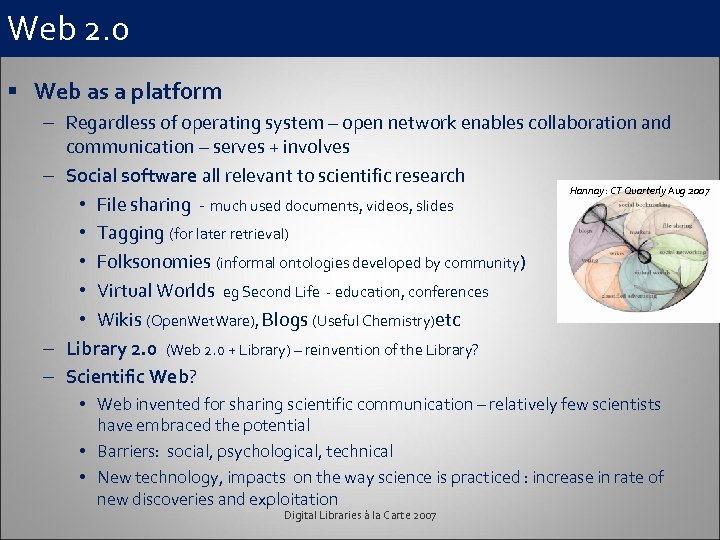
Web 2. 0 § Web as a platform – Regardless of operating system – open network enables collaboration and communication – serves + involves – Social software all relevant to scientific research Hannay: CT Quarterly Aug 2007 • File sharing - much used documents, videos, slides • Tagging (for later retrieval) • Folksonomies (informal ontologies developed by community) • Virtual Worlds eg Second Life - education, conferences • Wikis (Open. Wet. Ware), Blogs (Useful Chemistry)etc – Library 2. 0 (Web 2. 0 + Library) – reinvention of the Library? – Scientific Web? • Web invented for sharing scientific communication – relatively few scientists have embraced the potential • Barriers: social, psychological, technical • New technology, impacts on the way science is practiced : increase in rate of new discoveries and exploitation Digital Libraries à la Carte 2007
Some e-Science projects § Particle Physics – global sharing of data and computation § Astronomy – ‘Virtual Observatory’ for multi-wavelength astrophysics § Chemistry – remote control of equipment and electronic logbooks § Bioinformatics – data integration, knowledge discovery and workflow § Healthcare – sharing normalized mammograms § Environment – climate modelling – Undersea sensors Digital Libraries à la Carte 2007
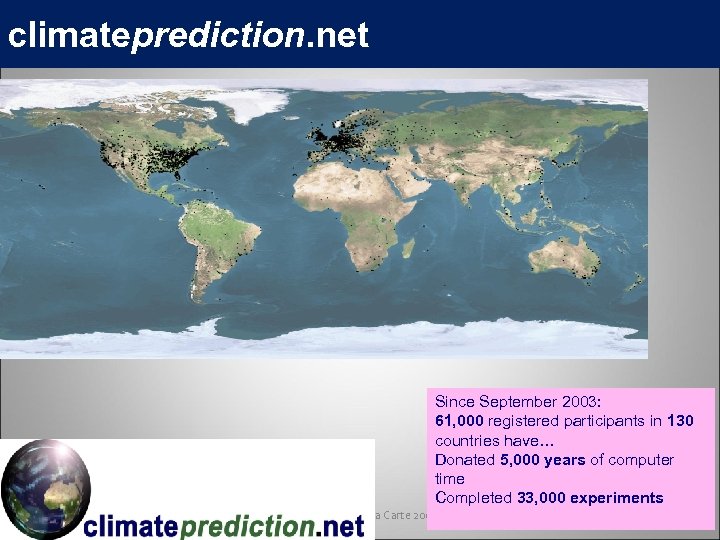
climateprediction. net Since September 2003: 61, 000 registered participants in 130 countries have… Donated 5, 000 years of computer time Completed 33, 000 experiments Digital Libraries à la Carte 2007
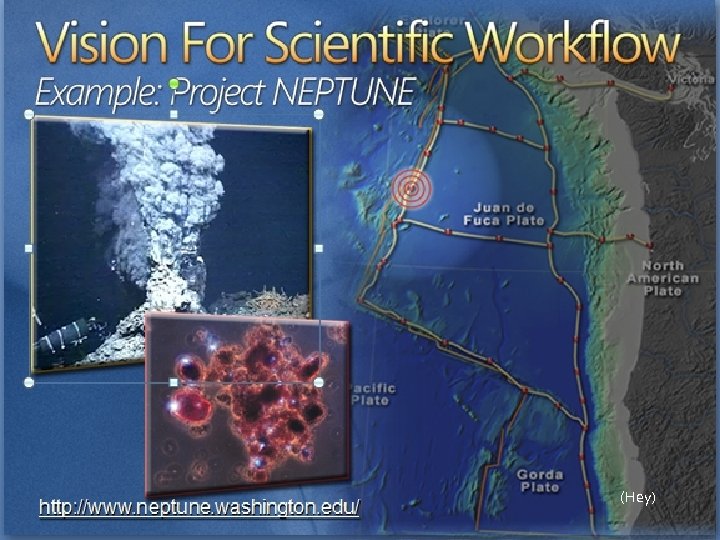
(Hey) Digital Libraries à la Carte 2007
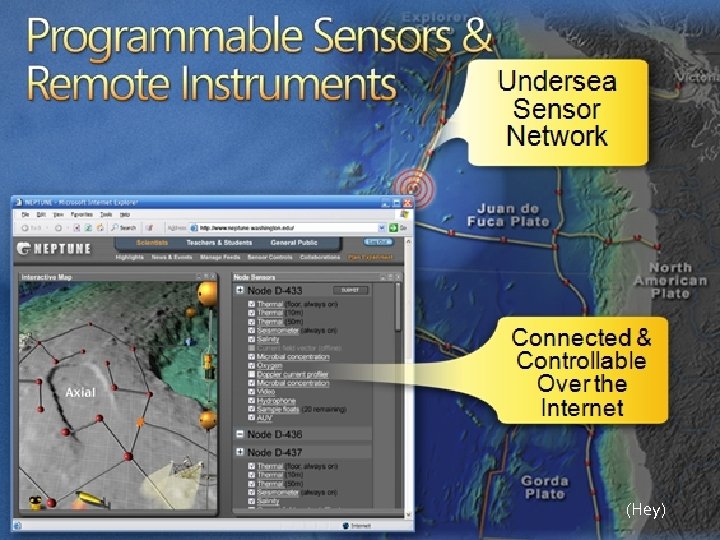
Digital Libraries à la Carte 2007 (Hey)
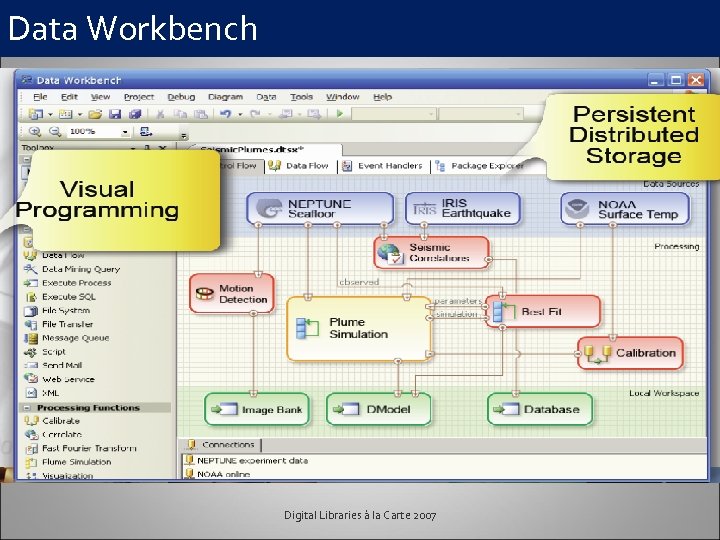
Data Workbench Digital Libraries à la Carte 2007
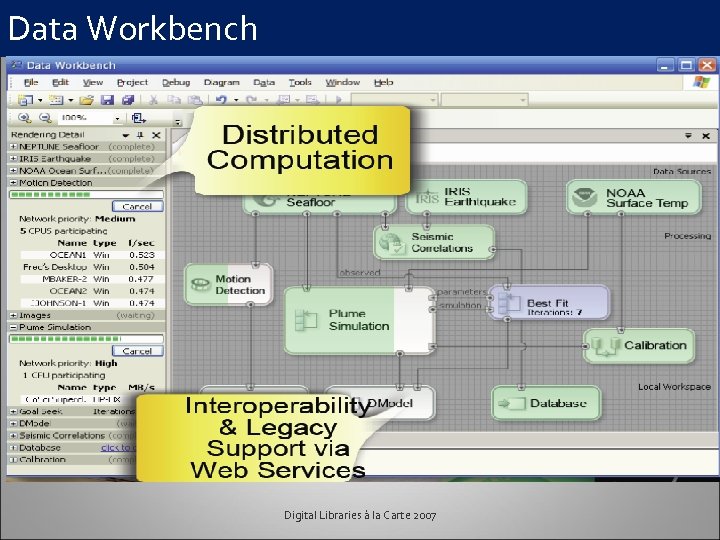
Data Workbench Digital Libraries à la Carte 2007
The ‘Data Deluge’ – science is turning to e-Science § In next 5 years e-Science projects will produce more scientific data than has been collected in the whole of human history § Some normalizations: § § The Bible = 5 Megabytes Annual refereed papers = 1 Terabyte Library of Congress = 20 Terabytes Internet Archive (1996 – 2002) = 100 Terabytes § New high throughput devices, sensors and surveys § In terms of bytes - moving beyond giga 109 through tera 1012 onto peta 1015 and onto exabytes 1018 (petabyte (PB) 1015 = 10005 = quadrillion bytes) Digital Libraries à la Carte 2007 (Hey)
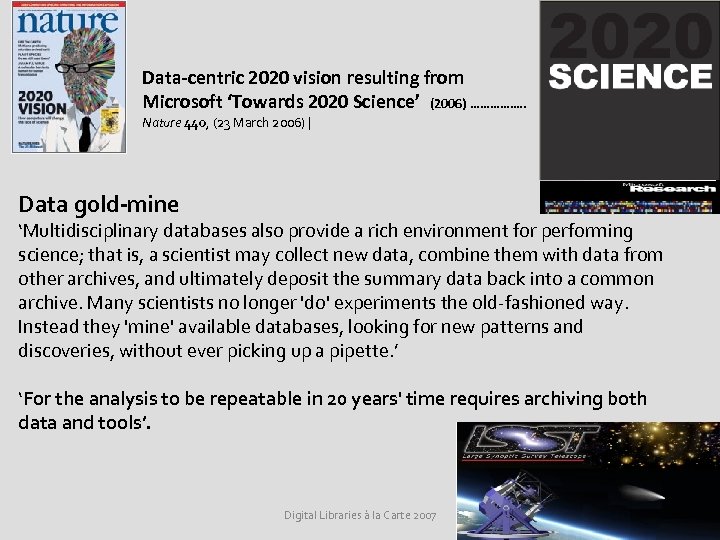
Data-centric 2020 vision resulting from Microsoft ‘Towards 2020 Science’ (2006) ……………. . Nature 440, (23 March 2006) | Data gold-mine ‘Multidisciplinary databases also provide a rich environment for performing science; that is, a scientist may collect new data, combine them with data from other archives, and ultimately deposit the summary data back into a common archive. Many scientists no longer 'do' experiments the old-fashioned way. Instead they 'mine' available databases, looking for new patterns and discoveries, without ever picking up a pipette. ’ ‘For the analysis to be repeatable in 20 years' time requires archiving both data and tools’. Digital Libraries à la Carte 2007
Data Loss § e-Science is about improving the use and reuse of research data § Huge amounts of research data cease to exist each year. – Hardware, software obsolescence – Represents the loss of expensive intellectual resources; a huge opportunity cost for comparative and longitudinal research § Unintentional data loss in the sciences due to: – lack of incentives to maintain them, or due to neglect (benign and otherwise – forget where or what it is! – personal computers, Web sites, blogs, wikis, e-mails, digital photo and film etc. Digital Libraries à la Carte 2007
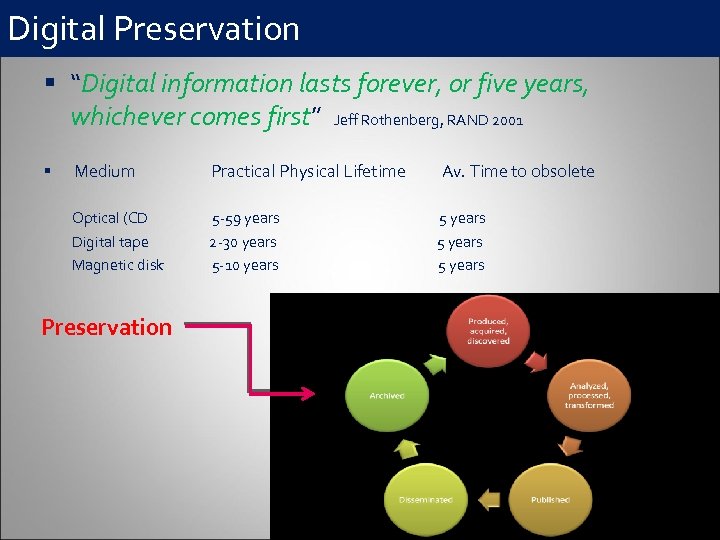
Digital Preservation § “Digital information lasts forever, or five years, whichever comes first” Jeff Rothenberg, RAND 2001 § Medium Practical Physical Lifetime Av. Time to obsolete Optical (CD 5 -59 years 5 years Digital tape 2 -30 years 5 years Magnetic disk 5 -10 years 5 years Preservation Digital Libraries à la Carte 2007
Preservation - Trusted Repositories § Preservation – UK Digital Curation Centre: advice, tools & services • Rep. Info Registry – representation information adding meaning to data for preservation – EU CASPAR Integrated Project http: //www. casparpreserves. info/pages/1/index. htm – EU Task Force on the Permanent Access to the Records of Science http: //tfpa. kb. nl/ – EU projects DPE and PLANETS (leverage library and archive experience) § Long-term access: trust, responsibility, policy – Trusted DR Audit Checklist for Certification Draft - Research Libraries Group-NARA Taskforce 2005 • Defined criteria under 4 categories – – Organisation Functions, processes & procedures Designated community & usability Technologies & technical infrastructure • Can these concepts be extended to data repositories? Digital Libraries à la Carte 2007
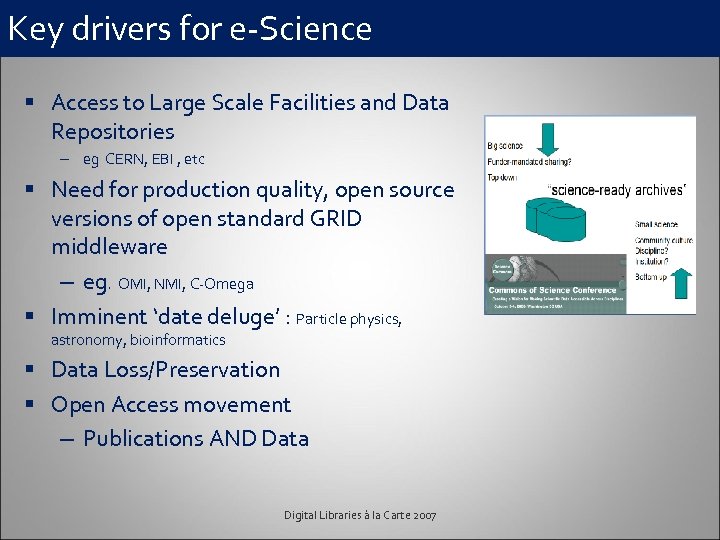
Key drivers for e-Science § Access to Large Scale Facilities and Data Repositories – eg CERN, EBI , etc § Need for production quality, open source versions of open standard GRID middleware – eg. OMI, NMI, C-Omega § Imminent ‘date deluge’ : Particle physics, astronomy, bioinformatics § Data Loss/Preservation § Open Access movement – Publications AND Data Digital Libraries à la Carte 2007
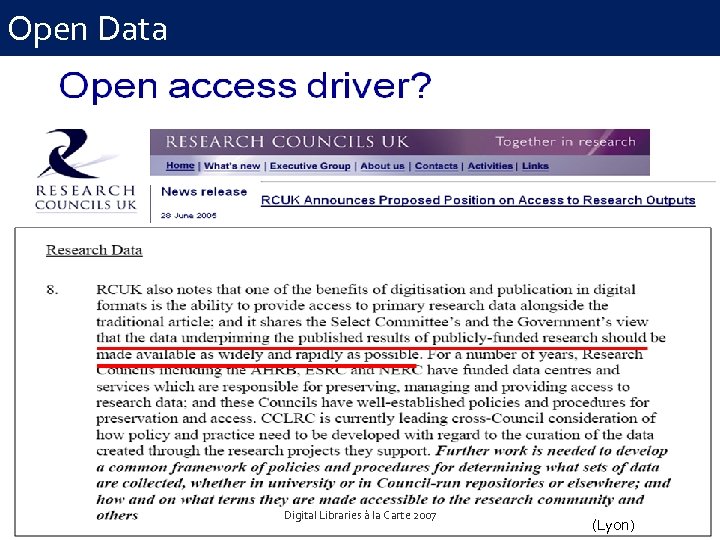
Open Data Digital Libraries à la Carte 2007 (Lyon)
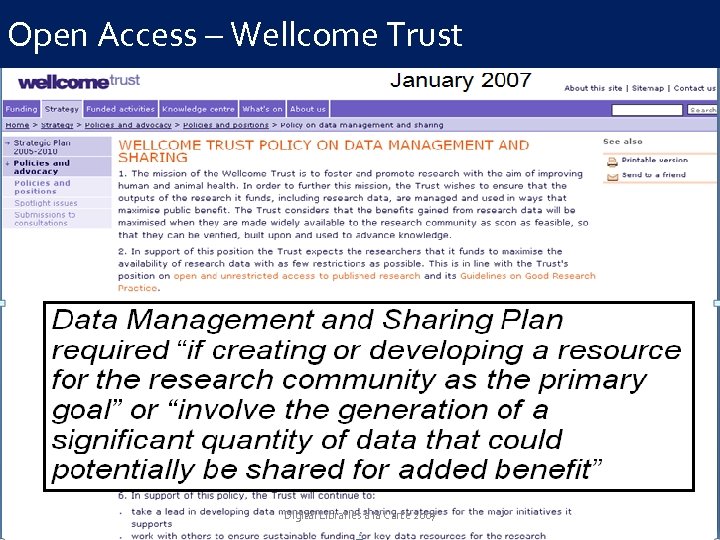
Open Access – Wellcome Trust Digital Libraries à la Carte 2007
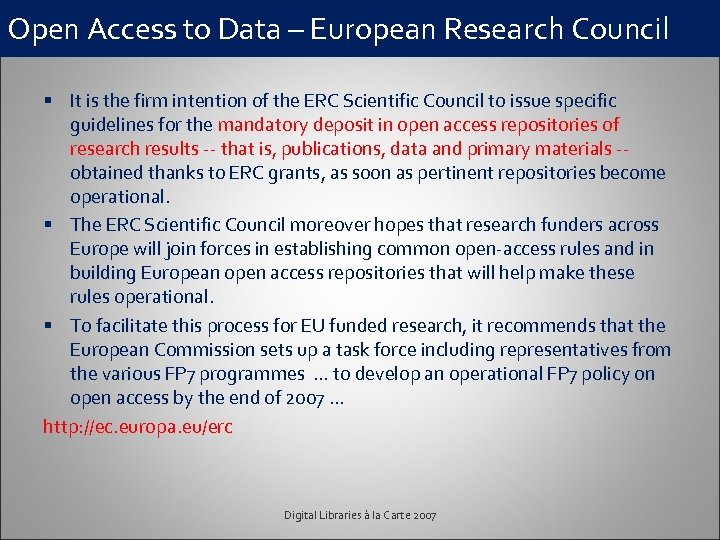
Open Access to Data – European Research Council § It is the firm intention of the ERC Scientific Council to issue specific guidelines for the mandatory deposit in open access repositories of research results -- that is, publications, data and primary materials -- obtained thanks to ERC grants, as soon as pertinent repositories become operational. § The ERC Scientific Council moreover hopes that research funders across Europe will join forces in establishing common open-access rules and in building European open access repositories that will help make these rules operational. § To facilitate this process for EU funded research, it recommends that the European Commission sets up a task force including representatives from the various FP 7 programmes … to develop an operational FP 7 policy on open access by the end of 2007 … http: //ec. europa. eu/erc Digital Libraries à la Carte 2007
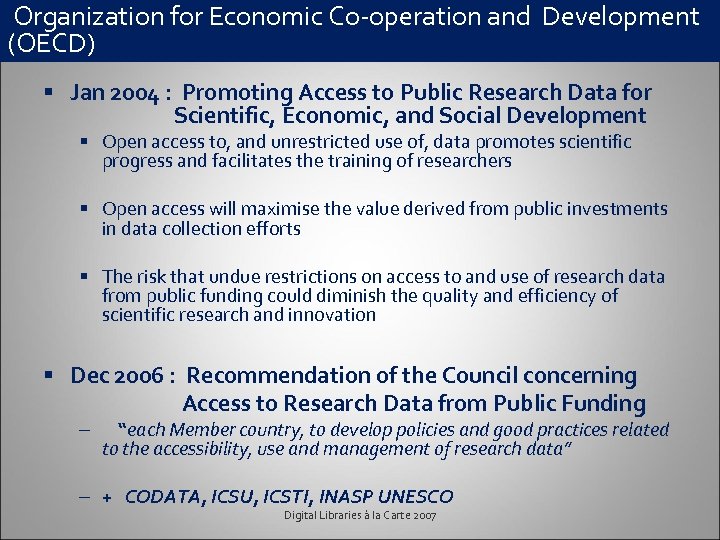
Organization for Economic Co-operation and Development (OECD) § Jan 2004 : Promoting Access to Public Research Data for Scientific, Economic, and Social Development § Open access to, and unrestricted use of, data promotes scientific progress and facilitates the training of researchers § Open access will maximise the value derived from public investments in data collection efforts § The risk that undue restrictions on access to and use of research data from public funding could diminish the quality and efficiency of scientific research and innovation § Dec 2006 : Recommendation of the Council concerning Access to Research Data from Public Funding – “each Member country, to develop policies and good practices related to the accessibility, use and management of research data” – + CODATA, ICSU, ICSTI, INASP UNESCO Digital Libraries à la Carte 2007
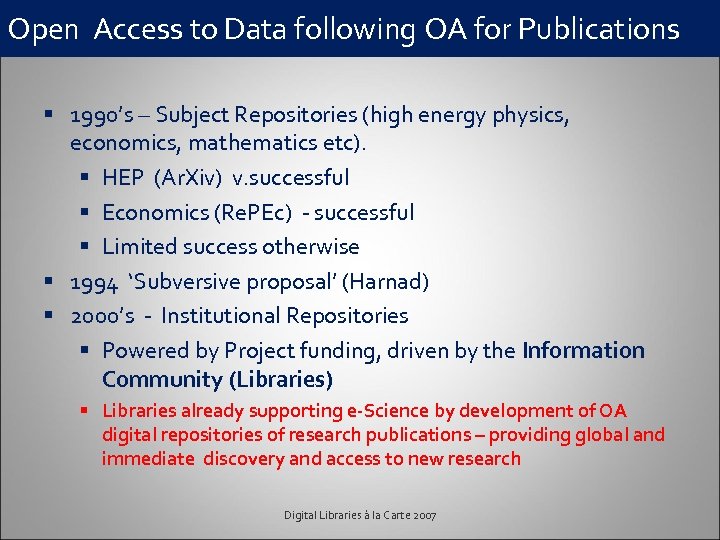
Open Access to Data following OA for Publications § 1990’s – Subject Repositories (high energy physics, economics, mathematics etc). § HEP (Ar. Xiv) v. successful § Economics (Re. PEc) - successful § Limited success otherwise § 1994 ‘Subversive proposal’ (Harnad) § 2000’s - Institutional Repositories § Powered by Project funding, driven by the Information Community (Libraries) § Libraries already supporting e-Science by development of OA digital repositories of research publications – providing global and immediate discovery and access to new research Digital Libraries à la Carte 2007
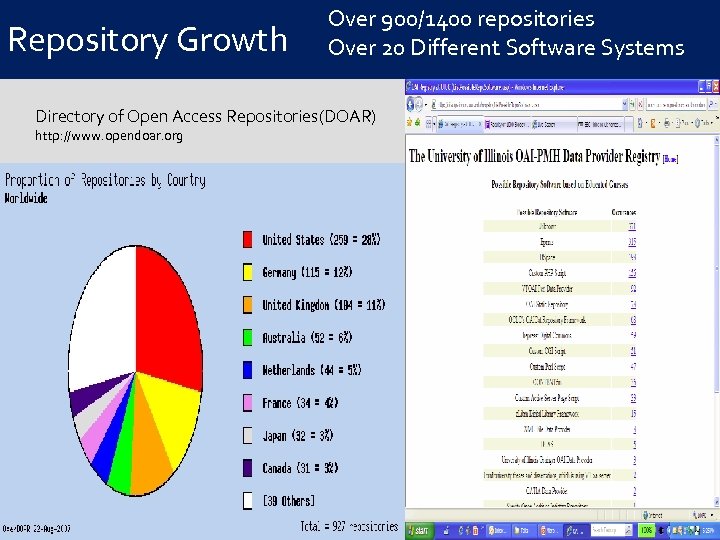
Over 900/1400 repositories Over 20 Different Software Systems Repository Growth Directory of Open Access Repositories(DOAR) http: //www. opendoar. org ROAR Registry of Open Access Repositories 2007 112 Repositories in 2002 Digital Libraries à la Carte 2007
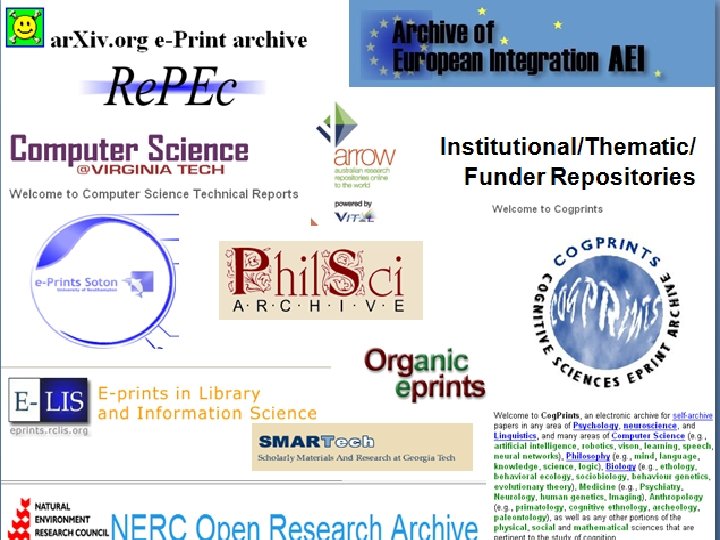
Digital Repositories – where are we? Digital Libraries à la Carte 2007
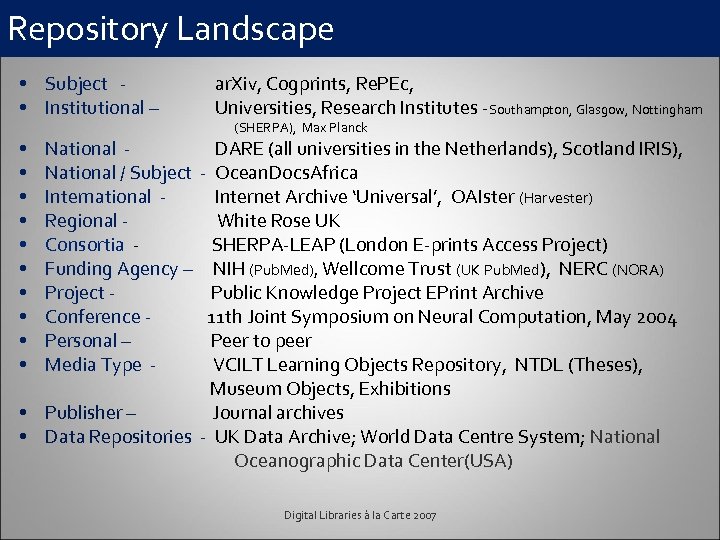
Repository Landscape • Subject - ar. Xiv, Cogprints, Re. PEc, • Institutional – Universities, Research Institutes -Southampton, Glasgow, Nottingham (SHERPA), Max Planck • National - DARE (all universities in the Netherlands), Scotland IRIS), • National / Subject - Ocean. Docs. Africa • International - Internet Archive ‘Universal’, OAIster (Harvester) • Regional - White Rose UK • Consortia - SHERPA-LEAP (London E-prints Access Project) • Funding Agency – NIH (Pub. Med), Wellcome Trust (UK Pub. Med), NERC (NORA) • Project - Public Knowledge Project EPrint Archive • Conference - 11 th Joint Symposium on Neural Computation, May 2004 • Personal – Peer to peer • Media Type - VCILT Learning Objects Repository, NTDL (Theses), Museum Objects, Exhibitions • Publisher – Journal archives • Data Repositories - UK Data Archive; World Data Centre System; National Oceanographic Data Center(USA) Digital Libraries à la Carte 2007
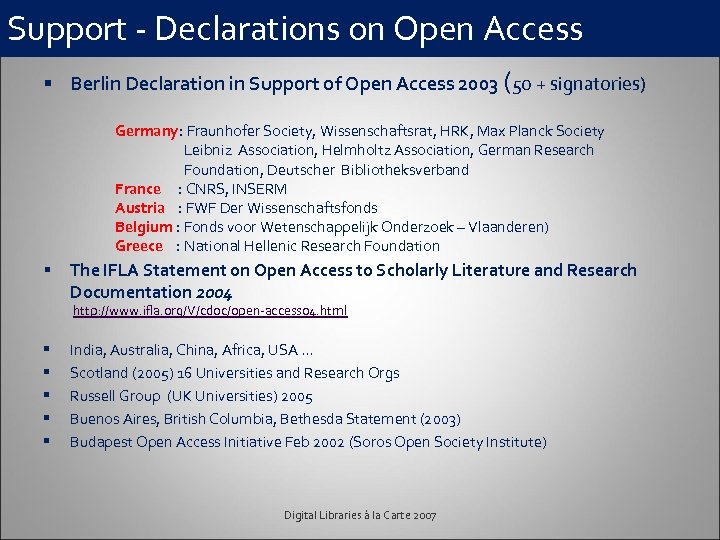
Support - Declarations on Open Access § Berlin Declaration in Support of Open Access 2003 (50 + signatories) Germany: Fraunhofer Society, Wissenschaftsrat, HRK, Max Planck Society Leibniz Association, Helmholtz Association, German Research Foundation, Deutscher Bibliotheksverband France : CNRS, INSERM Austria : FWF Der Wissenschaftsfonds Belgium : Fonds voor Wetenschappelijk Onderzoek – Vlaanderen) Greece : National Hellenic Research Foundation § The IFLA Statement on Open Access to Scholarly Literature and Research Documentation 2004 http: //www. ifla. org/V/cdoc/open-access 04. html § § § India, Australia, China, Africa, USA … Scotland (2005) 16 Universities and Research Orgs Russell Group (UK Universities) 2005 Buenos Aires, British Columbia, Bethesda Statement (2003) Budapest Open Access Initiative Feb 2002 (Soros Open Society Institute) Digital Libraries à la Carte 2007
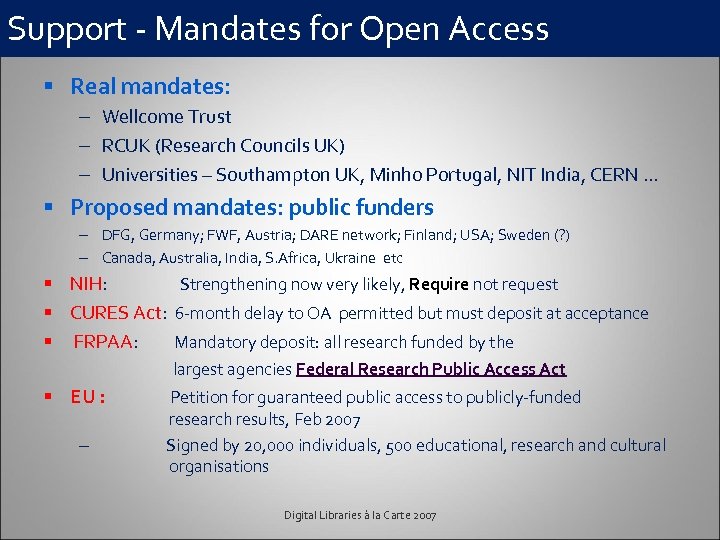
Support - Mandates for Open Access § Real mandates: – Wellcome Trust – RCUK (Research Councils UK) – Universities – Southampton UK, Minho Portugal, NIT India, CERN … § Proposed mandates: public funders – DFG, Germany; FWF, Austria; DARE network; Finland; USA; Sweden (? ) – Canada, Australia, India, S. Africa, Ukraine etc § NIH: Strengthening now very likely, Require not request § CURES Act: 6 -month delay to OA permitted but must deposit at acceptance § FRPAA: Mandatory deposit: all research funded by the largest agencies Federal Research Public Access Act § EU : Petition for guaranteed public access to publicly-funded research results, Feb 2007 – Signed by 20, 000 individuals, 500 educational, research and cultural organisations Digital Libraries à la Carte 2007
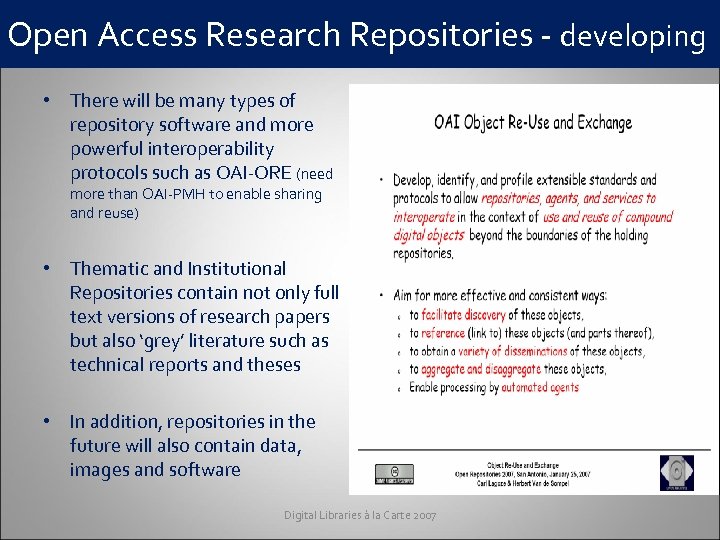
Open Access Research Repositories - developing • There will be many types of repository software and more powerful interoperability protocols such as OAI-ORE (need more than OAI-PMH to enable sharing and reuse) • Thematic and Institutional Repositories contain not only full text versions of research papers but also ‘grey’ literature such as technical reports and theses • In addition, repositories in the future will also contain data, images and software Digital Libraries à la Carte 2007
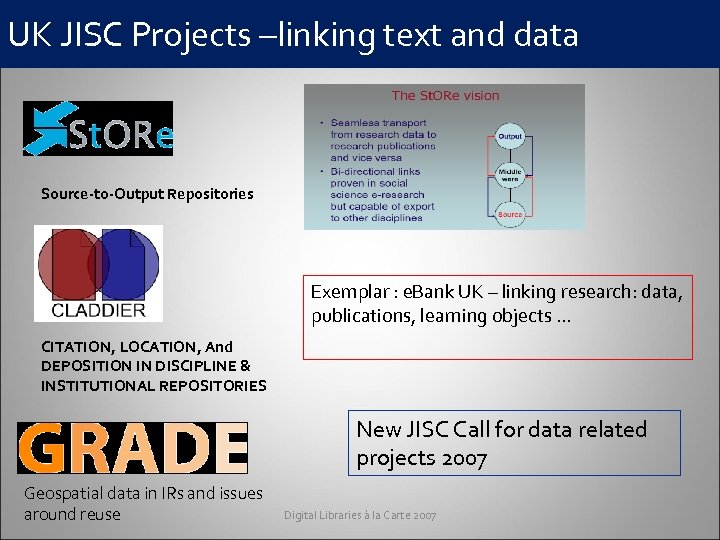
UK JISC Projects –linking text and data Source-to-Output Repositories Exemplar : e. Bank UK – linking research: data, publications, learning objects … CITATION, LOCATION, And DEPOSITION IN DISCIPLINE & INSTITUTIONAL REPOSITORIES New JISC Call for data related projects 2007 Geospatial data in IRs and issues around reuse Digital Libraries à la Carte 2007
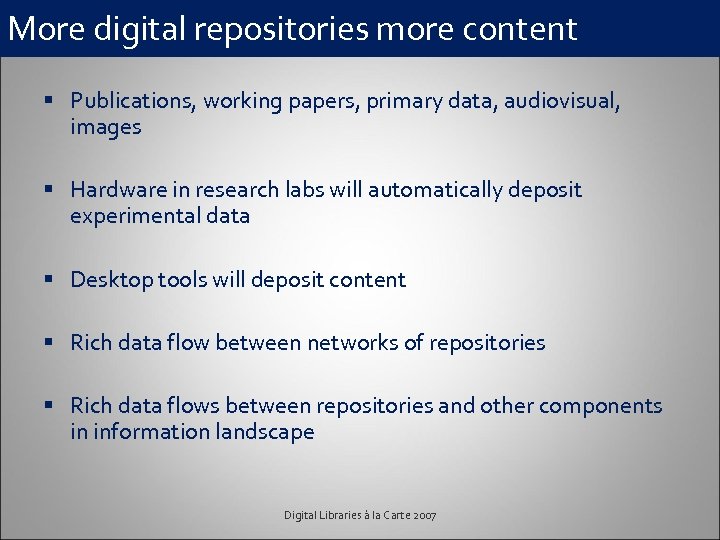
More digital repositories more content § Publications, working papers, primary data, audiovisual, images § Hardware in research labs will automatically deposit experimental data § Desktop tools will deposit content § Rich data flow between networks of repositories § Rich data flows between repositories and other components in information landscape Digital Libraries à la Carte 2007
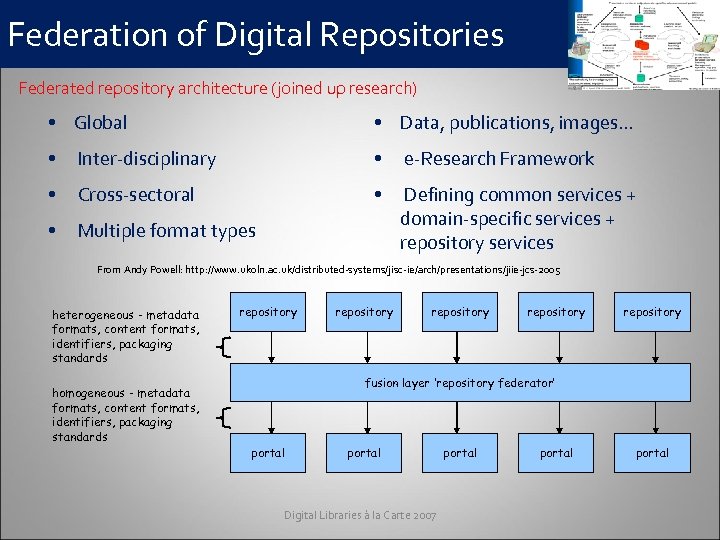
Federation of Digital Repositories Federated repository architecture (joined up research) • Global • Data, publications, images… • Inter-disciplinary • e-Research Framework • Cross-sectoral • Defining common services + domain-specific services + repository services • Multiple format types From Andy Powell: http: //www. ukoln. ac. uk/distributed-systems/jisc-ie/arch/presentations/jiie-jcs-2005 heterogeneous - metadata formats, content formats, identifiers, packaging standards homogeneous - metadata formats, content formats, identifiers, packaging standards repository repository fusion layer ‘repository federator’ portal Digital Libraries à la Carte 2007 portal
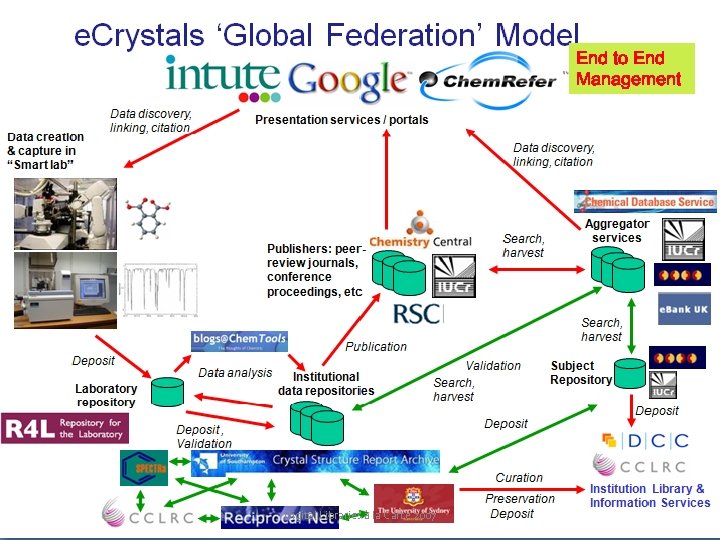
End to End Management Digital Libraries à la Carte 2007
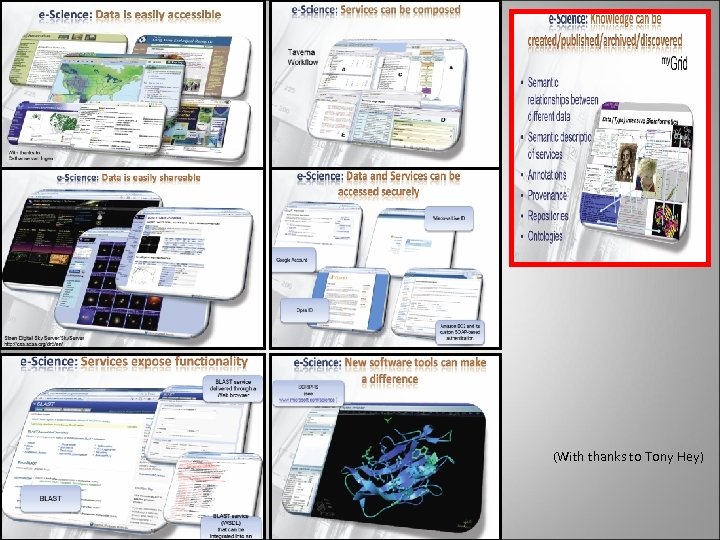
(With thanks to Tony Hey) Digital Libraries à la Carte 2007
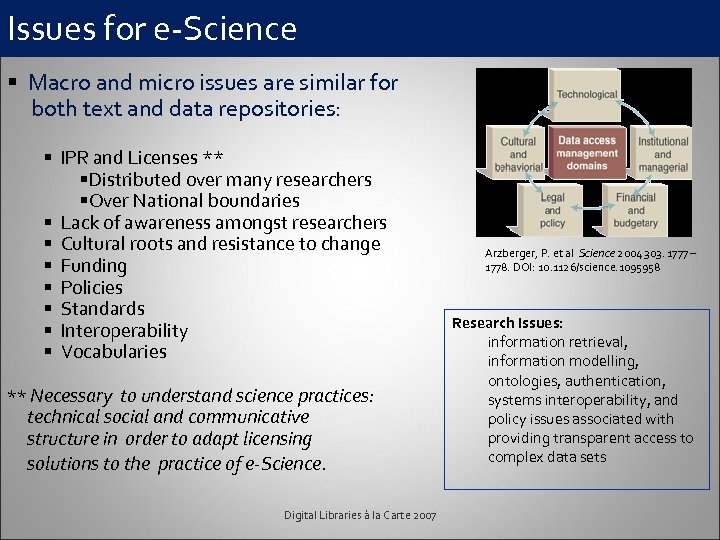
Issues for e-Science § Macro and micro issues are similar for both text and data repositories: § IPR and Licenses ** §Distributed over many researchers §Over National boundaries § Lack of awareness amongst researchers § Cultural roots and resistance to change § Funding § Policies § Standards § Interoperability § Vocabularies ** Necessary to understand science practices: technical social and communicative structure in order to adapt licensing solutions to the practice of e-Science. Digital Libraries à la Carte 2007 Arzberger, P. et al Science 2004 303. 1777 – 1778. DOI: 10. 1126/science. 1095958 Research Issues: information retrieval, information modelling, ontologies, authentication, systems interoperability, and policy issues associated with providing transparent access to complex data sets
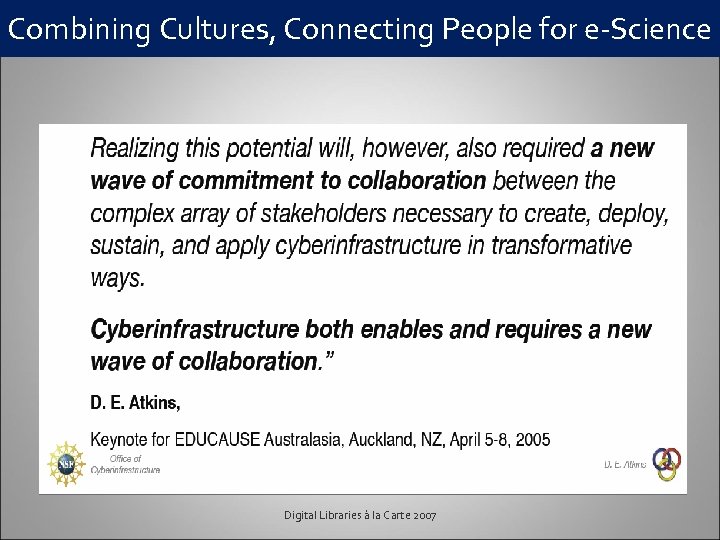
Combining Cultures Many of the same research issues that the international digital library community has been grappling with for the past decade. § NSF Report “Long lived digital data collections”. 2005 – “Data scientist” - hybrid skills § Facilitate collaboration – “Multidisciplinary teams: computer scientists, domain scientists, digital library experts, statisticians/modellers – Lessons learnt: e-Science Human Factors Audit Report (to be published 2006? ) Roy Kawalsky, Loughborough Digital Libraries à la Carte 2007
Combining Cultures NSF Report : § “It is timely to seriously consider the role that digital libraries can and should play in this emerging e-Science computational infrastructure”. § “Bringing the digital library and the emerging scientific infrastructure worlds together can lay the foundation for providing truly integrated support for the entire process of science, from formulation of research questions to the publication of the outcomes”. § “Specifically, the e-Science and digital libraries research communities need to work together to identify the potential contributions of each of these communities for supporting the conduct of science and to articulate a shared research agenda” Digital Libraries à la Carte 2007
Calls for Combining Cultures for e-Science needs – EU Framework 7 – e-Research Infrastructure development – UK – JISC – Report on future requirements for curation and preservation – Australia DEST – e-Infrastructures Reflection Group includes CAUL (Council of Australian University Librarians) member - Interim Report http: //www. dest. gov. au/sectors/research_sector/policies_issues_reviews/key_issues/e_research_co nsult/interim_report. htm – UK –CURL/SCONUL Joint e-Research Task Force (2006) – USA – ARL Libraries and Changing Research Practices (2004) Digital Libraries à la Carte 2007
CURL/SCONUL Joint e-Research Task Force Nov 2006 Terms of Reference 1. To raise awareness and understanding of the issues associated with support of e -research in CURL and SCONUL member libraries and to stimulate discussion about them at institutional level. 2. To position CURL and SCONUL member libraries’ staffs to engage with their local e-research stakeholders and to encourage them to make appropriate inputs at the research proposal stage. 3. To identify skills gaps in relation to support of e-research and to assist member libraries in addressing them. 4. To work with other e-research stakeholders, including the DCC, RLN and BL, to ensure that information management to support e-research is a high priority for future investment by funders. 5. To advise the CURL Board and the SCONUL Executive Board on matters relating to the support of e-research. 6. To monitor, and report on, the Group’s progress against an action plan agreed annually by the CURL Board and SCONUL Executive Board. Digital Libraries à la Carte 2007
Has your library engaged with the e-Research agenda? § Management of the large datasets is likely area of involvement. § Why are libraries not already involved: – Lack of foresight by librarians? – No e-Science funds for development of data management in libraries – no call for projects – No Customer demand for data curation • Data curation - whose responsibility, individual, institution, national or international? Digital Libraries à la Carte 2007
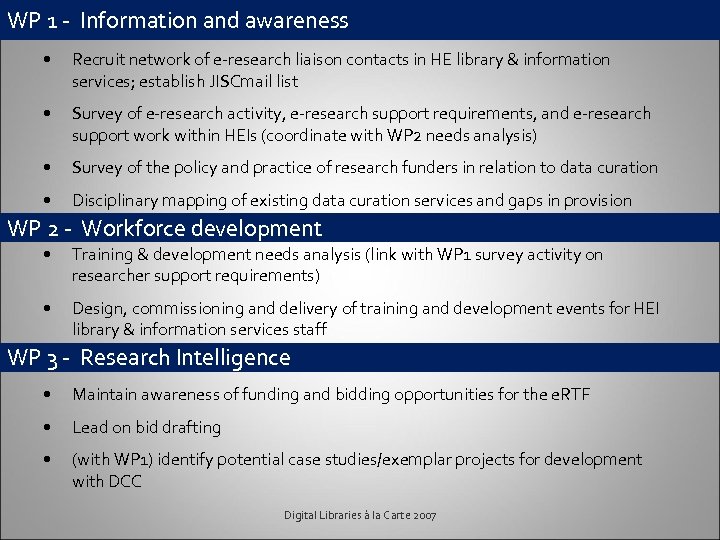
WP 1 - Information and awareness • Recruit network of e-research liaison contacts in HE library & information services; establish JISCmail list • Survey of e-research activity, e-research support requirements, and e-research support work within HEIs (coordinate with WP 2 needs analysis) • Survey of the policy and practice of research funders in relation to data curation • Disciplinary mapping of existing data curation services and gaps in provision WP 2 - Workforce development • Training & development needs analysis (link with WP 1 survey activity on researcher support requirements) • Design, commissioning and delivery of training and development events for HEI library & information services staff WP 3 - Research Intelligence • Maintain awareness of funding and bidding opportunities for the e. RTF • Lead on bid drafting • (with WP 1) identify potential case studies/exemplar projects for development with DCC Digital Libraries à la Carte 2007
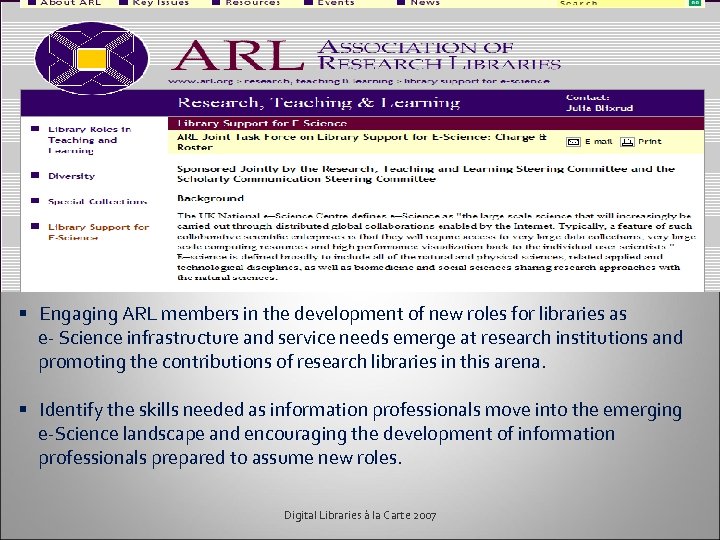
§ Engaging ARL members in the development of new roles for libraries as e- Science infrastructure and service needs emerge at research institutions and promoting the contributions of research libraries in this arena. § Identify the skills needed as information professionals move into the emerging e-Science landscape and encouraging the development of information professionals prepared to assume new roles. Digital Libraries à la Carte 2007
ARL Workshop Recommendations 1. . § NSF should fund projects in which university research libraries develop deep archives of irreplaceable data, assuring descriptions of these data at a minimal level (floor, not ceiling) and facilitating discovery and access to these data, according to prevailing community standards § NSF should partner with IMLS to train information and library professionals (extant and future) to work more credibly and knowledgably on data curation as members of research teams § NSF should foster the training and development of a new workforce in data science § Promote new curricula § Develop new programs § Link to training of domain scientists and information/library scientists ARL Workshop on New Collaborative Relationships Sep 06 Digital Libraries à la Carte 2007
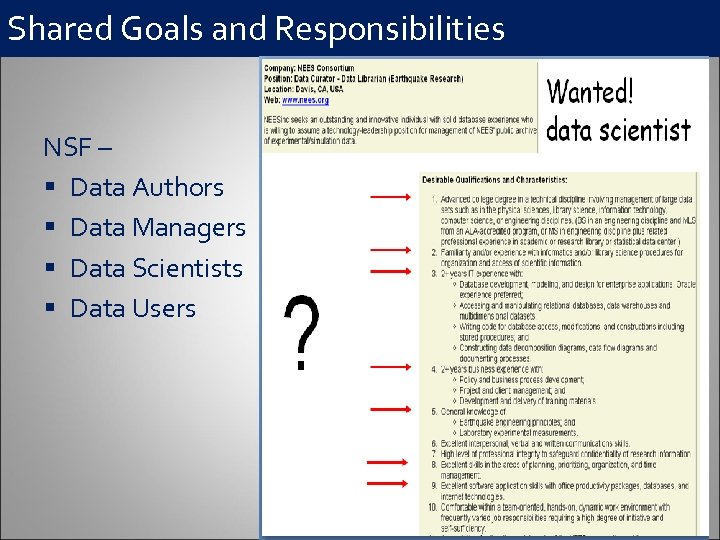
Shared Goals and Responsibilities NSF – § Data Authors § Data Managers § Data Scientists § Data Users Digital Libraries à la Carte 2007
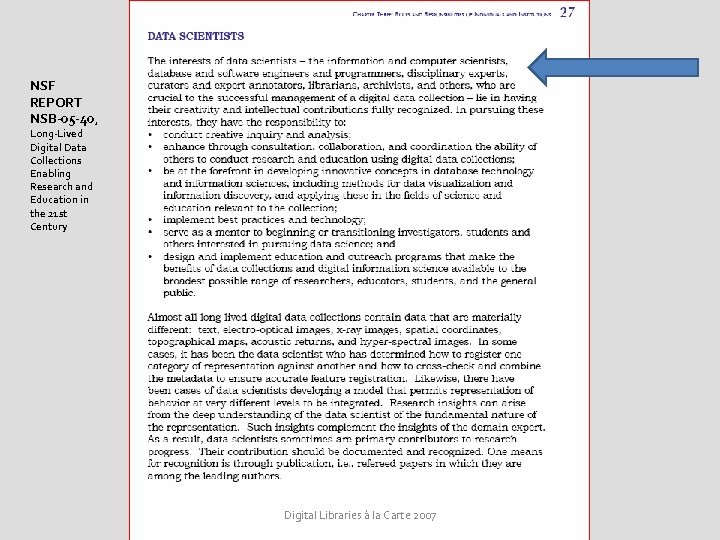
NSF REPORT NSB-05 -40, Long-Lived Digital Data Collections Enabling Research and Education in the 21 st Century Digital Libraries à la Carte 2007
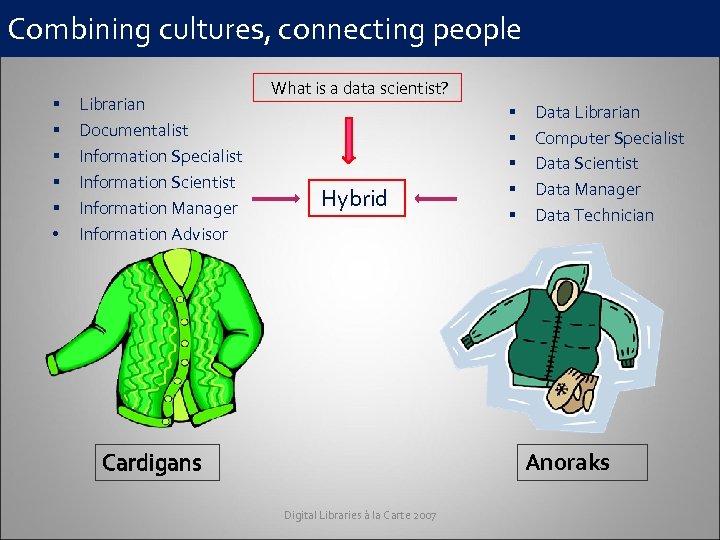
Combining cultures, connecting people § § § • Librarian Documentalist Information Specialist Information Scientist Information Manager Information Advisor What is a data scientist? Hybrid § § § Data Librarian Computer Specialist Data Scientist Data Manager Data Technician Anoraks Cardigans Digital Libraries à la Carte 2007
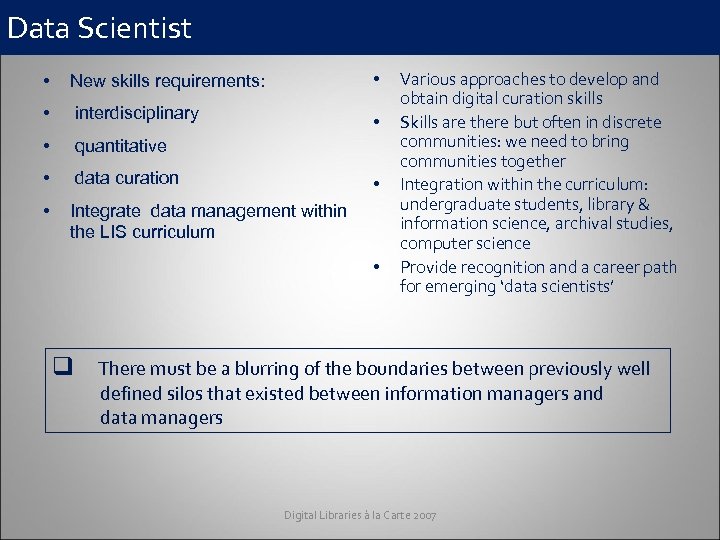
Data Scientist • New skills requirements: • • interdisciplinary • • quantitative • data curation • Integrate data management within the LIS curriculum • • Various approaches to develop and obtain digital curation skills Skills are there but often in discrete communities: we need to bring communities together Integration within the curriculum: undergraduate students, library & information science, archival studies, computer science Provide recognition and a career path for emerging ‘data scientists’ q There must be a blurring of the boundaries between previously well defined silos that existed between information managers and data managers Digital Libraries à la Carte 2007
Connecting People – how to § § § § Encouraging partnerships - Inter-institutional partnerships Institutional management support Competencies – shared and developed Common issues – authentication, metadata, ontologies, standards, IPR, licenses New curricula - CPE Share experience of Institutional repositories- libraries fundamentally transforming research publication practices and scholarly communication forerunner of e-Science Libraries involved in the research underlying the design of e-Science. Is there new research on Digital Libraries over the Grid Funding Agencies – JISC, NSF, EU etc – define project members from library and data communities – promote the necessary international dialog between communities Digital Libraries à la Carte 2007 uuee
Role for Libraries in digital data universe • Data as primary source material – Libraries : – Will not be primary providers of large scale storage infrastructure required – Will not provide the specialized tools to work with data – Will not provide the detailed information about the data – Unlikely to provide the solutions to digital preservation because of cost • Can contribute library practices : • Data as part of ‘enhanced publications’ – Libraries: – Well positioned to define standards for • Taxonomies and ontologies (for complex publications that include data) • • Persistent identifiers Consistent description practices Data structuring conventions Interoperability protocols for searching and retrieval • Collection policies (appraisal, selection, – Well positioned to exploit IR weeding, destruction etc) experiences • Data clean up, normalisation, description and submission to repositories • Data Citation • Curation and Preservation • Collaboration with researchers re scholarly communication , deposit, education and training • Innovative discovery and presentation Digital Libraries à la Carte 2007 mechanisms
Role of Digital Libraries - IRs § Institutional repository is a key component of e-infrastructure – – Mostly in library domain Access and preservation Digitization – data archaeology Interoperable with departmental, national, subject repositories § Data Curation – Creation, metadata, preservation institutional intellectual assets • but disparate data types and ontologies § Training Provision – Research methods training for researchers • Data creation, documentation, management § Advocacy, policy setting – Cross disciplinary approach to key issues • Expand OA agenda – Interweave e-Research, OA and – Virtual Research Environments Digital Libraries à la Carte 2007
Roles for Libraries § Institutional repositories accept ‘small’ datasets (size or subject outside remit of Data Repositories). Data deposited in IR until accepted by data repository § Development of Regional or Discipline Repositories alongside IRs (singly or consortia). Research libraries a natural home for content curation, (with funding) § Mapping of commonalities (eg metadata) across disciplines, maintaining ready interoperability § Management of metadata throughout a research project § Address conditional and role-based access requirements for scientific data § Support e-Science interface functions for local users § Adding Value: linking, annotation, visualization § Libraries and researchers can add value by creating ‘e-Science Mashups’ - data needs to be re-used in multiple ways, on multiple occasions and at multiple locations (reuse, remix) Digital Libraries à la Carte 2007
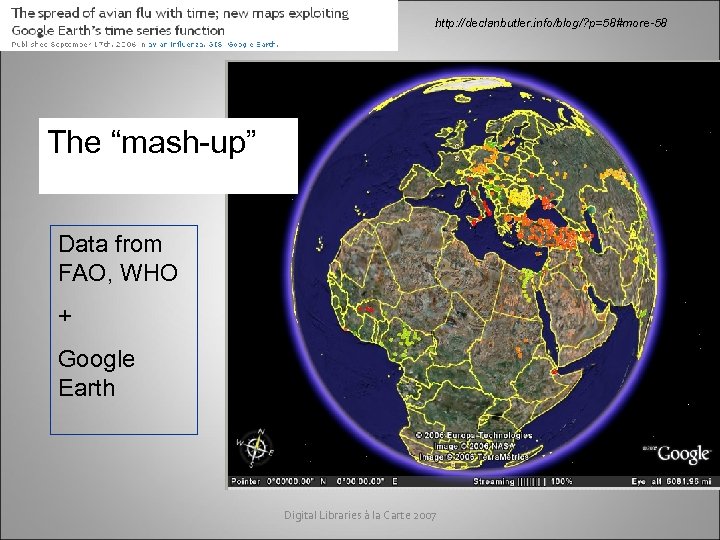
http: //declanbutler. info/blog/? p=58#more-58 The “mash-up” Data from FAO, WHO + Google Earth Digital Libraries à la Carte 2007
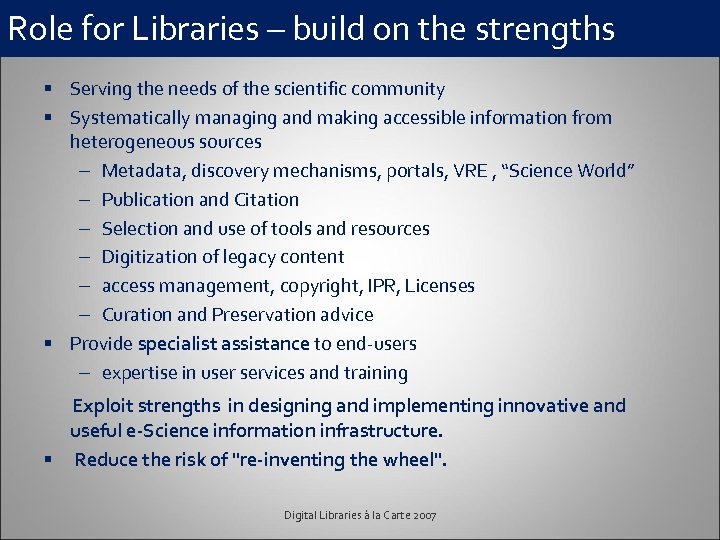
Role for Libraries – build on the strengths § Serving the needs of the scientific community § Systematically managing and making accessible information from heterogeneous sources – Metadata, discovery mechanisms, portals, VRE , “Science World” – Publication and Citation – Selection and use of tools and resources – Digitization of legacy content – access management, copyright, IPR, Licenses – Curation and Preservation advice § Provide specialist assistance to end-users – expertise in user services and training Exploit strengths in designing and implementing innovative and useful e-Science information infrastructure. § Reduce the risk of "re-inventing the wheel". Digital Libraries à la Carte 2007
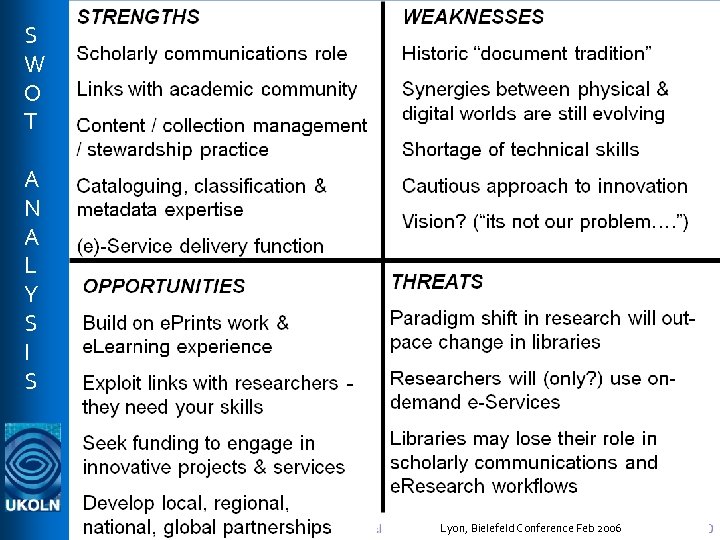
S W O T A N A L Y S I S Digital Libraries à la Carte 2007 Lyon, Bielefeld Conference Feb 2006
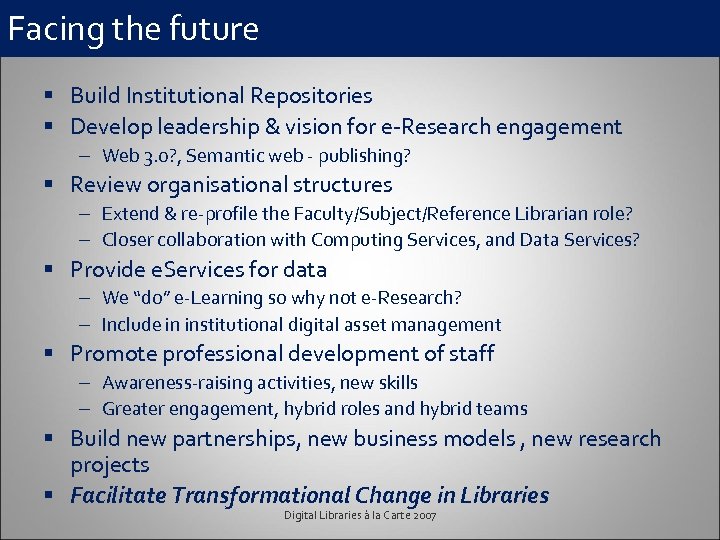
Facing the future § Build Institutional Repositories § Develop leadership & vision for e-Research engagement – Web 3. 0? , Semantic web - publishing? § Review organisational structures – Extend & re-profile the Faculty/Subject/Reference Librarian role? – Closer collaboration with Computing Services, and Data Services? § Provide e. Services for data – We “do” e-Learning so why not e-Research? – Include in institutional digital asset management § Promote professional development of staff – Awareness-raising activities, new skills – Greater engagement, hybrid roles and hybrid teams § Build new partnerships, new business models , new research projects § Facilitate Transformational Change in Libraries Digital Libraries à la Carte 2007
Combining Cultures, Connecting People for e-Science Digital Libraries à la Carte 2007
Acknowledgements With special thanks to Prof Tony Hey, Vice-President for Technical Computing. Microsoft Corporation , (previously Director of UK e-Science Programme ) Dr Liz Lyon, Director, UKOLN Digital Libraries à la Carte 2007
Thank You Questions? Pauline Simpson ps@noc. soton. ac. uk ; psimpson 07@aol. com
Discussion 1. What is the role of libraries in supporting e-research? 2. What are the risks of : getting involved? not getting involved? 3. Should e-research data be held locally or in large-scale repositories? 4. What skills are needed to manage and curate e-research data? to advise researchers on e-research data management? Do we have them? 5. Who pays for the e-research information infrastructure? Digital Libraries à la Carte 2007
Скачать презентацию Libraries supporting e-Science — combining cultures
1cb6f6f82ed11eb73b2850c8caa9af0a.ppt