 Скачать презентацию Liberalization of Telecom A Catalyst for Regional Development
d53398939dafc27dddc91ce674ae5002.ppt
- Количество слайдов: 19



Liberalization of Telecom A Catalyst for Regional Development The 9 th Arab Telecom and Internet Forum Habtoor Grand Hotel 15 -16 April 2009 Dr. Kamal Shehadi Chairman and CEO Telecommunications Regulatory Authority
CONTENTS I. Status of telecommunications in Lebanon II. Needs of un/underserved areas III. Options for ubiquitous coverage 3/17/2018 2
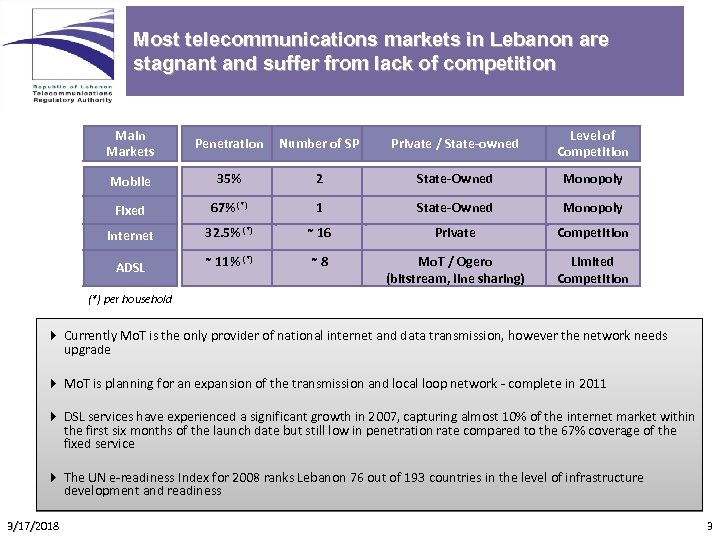
Most telecommunications markets in Lebanon are stagnant and suffer from lack of competition Main Markets Penetration Number of SP Private / State-owned Level of Competition Mobile 35% 2 State-Owned Monopoly Fixed 67% (*) 1 State-Owned Monopoly Internet 32. 5% (*) ~ 11% (*) ~ 16 Private Competition ~ 8 Mo. T / Ogero (bitstream, line sharing) Limited Competition ADSL (*) per household 4 Currently Mo. T is the only provider of national internet and data transmission, however the network needs upgrade 4 Mo. T is planning for an expansion of the transmission and local loop network - complete in 2011 4 DSL services have experienced a significant growth in 2007, capturing almost 10% of the internet market within the first six months of the launch date but still low in penetration rate compared to the 67% coverage of the fixed service 4 The UN e-readiness Index for 2008 ranks Lebanon 76 out of 193 countries in the level of infrastructure development and readiness 3/17/2018 3
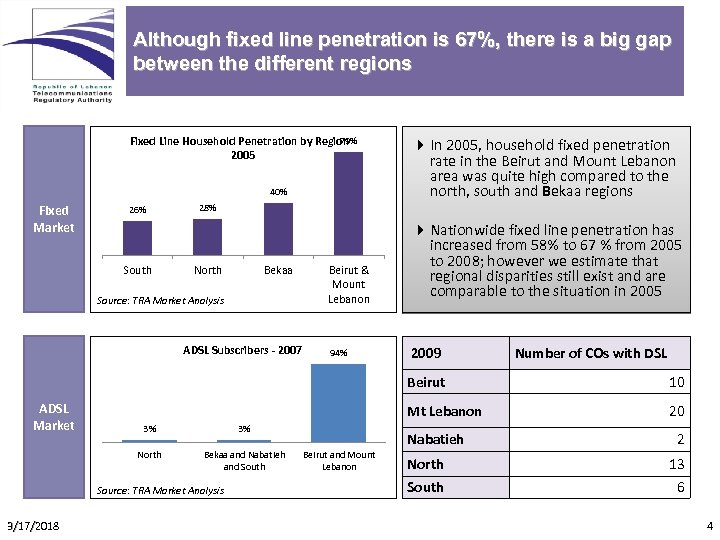
Although fixed line penetration is 67%, there is a big gap between the different regions 79% Fixed Line Household Penetration by Region - 2005 40% Fixed Market 26% South 4 In 2005, household fixed penetration rate in the Beirut and Mount Lebanon area was quite high compared to the north, south and Bekaa regions 28% North Bekaa Beirut & Mount Lebanon Source: TRA Market Analysis ADSL Subscribers - 2007 94% 4 Nationwide fixed line penetration has increased from 58% to 67 % from 2005 to 2008; however we estimate that regional disparities still exist and are comparable to the situation in 2005 2009 Number of COs with DSL Beirut ADSL Market Mt Lebanon 3% 3% North Bekaa and Nabatieh and South Source: TRA Market Analysis 3/17/2018 10 20 Nabatieh Beirut and Mount Lebanon 2 North 13 South 6 4
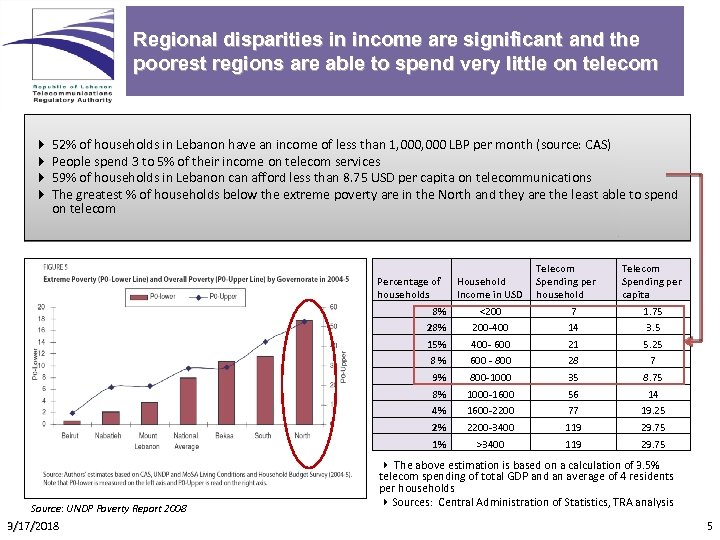
Regional disparities in income are significant and the poorest regions are able to spend very little on telecom 4 52% of households in Lebanon have an income of less than 1, 000 LBP per month (source: CAS) 4 People spend 3 to 5% of their income on telecom services 4 59% of households in Lebanon can afford less than 8. 75 USD per capita on telecommunications 4 The greatest % of households below the extreme poverty are in the North and they are the least able to spend on telecom Percentage of households Household Income in USD Telecom Spending per household Telecom Spending per capita 8% 1. 75 200 -400 14 3. 5 15% 400 - 600 21 5. 25 8 % 600 - 800 28 7 9% 800 -1000 35 8. 75 8% 1000 -1600 56 14 4% 1600 -2200 77 19. 25 2% 2200 -3400 119 29. 75 1% 3/17/2018 7 28% Source: UNDP Poverty Report 2008 <200 >3400 119 29. 75 4 The above estimation is based on a calculation of 3. 5% telecom spending of total GDP and an average of 4 residents per households 4 Sources: Central Administration of Statistics, TRA analysis 5
I. Status of telecommunications in Lebanon II. Needs of un/underserved areas III. Options for ubiquitous coverage 3/17/2018 6
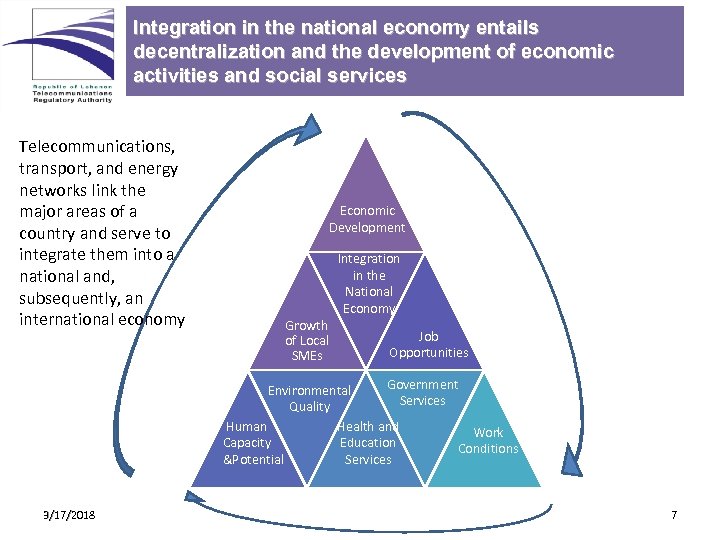
Integration in the national economy entails CONTENTS decentralization and the development of economic activities and social services Telecommunications, transport, and energy networks link the major areas of a country and serve to integrate them into a national and, subsequently, an international economy Economic Development Growth of Local SMEs Integration in the National Economy Job Opportunities Government Environmental Services Quality Human Health and Work Capacity Education Conditions &Potential Services 3/17/2018 7
Mobile telecommunications, for example, has changed the lives of people and foster economic growth Telecommunications transforms life styles – lessons from Mobile 4 Because of its availability, affordability and convenience, mobile telephony has produced in less than a decade the same impact that fixed line phones achieved in a century. 4 In Mongolia, young people have taught their parents enough English words to be able to read text messages and reply to them, so they can be in touch with their sons and daughters. 4 In Uganda, the leading cellular operator understood well that its customers could learn and enjoy SMS texting long before using the Internet. 4 The spread of mobile phone access, and the low unit cost of SMS text messages, is enabling dramatic changes in the retail and wholesale pricing, marketing and distribution of agricultural goods in a large number of developing countries. Farmers were able to get the market price of farm products using SMS, well before they learn how to use a computer. 4 In Kerala the spread of mobile phones among fishing fleets is transforming fish marketing, reducing wastage and price volatility, improving profits of the fishermen, and reducing consumer prices. 4 Responding to these changes, a wide range of entrepreneurs and innovators are providing new mobile-based tools and services for these markets such as m-banking. 4 The Philippines (which has a very large number of nationals working overseas and wishing to send remittances home) has been a leader in this field, with two well-known services, SMART Money and GLOBE G-Cash, currently serving over 3 million people. 3/17/2018 8
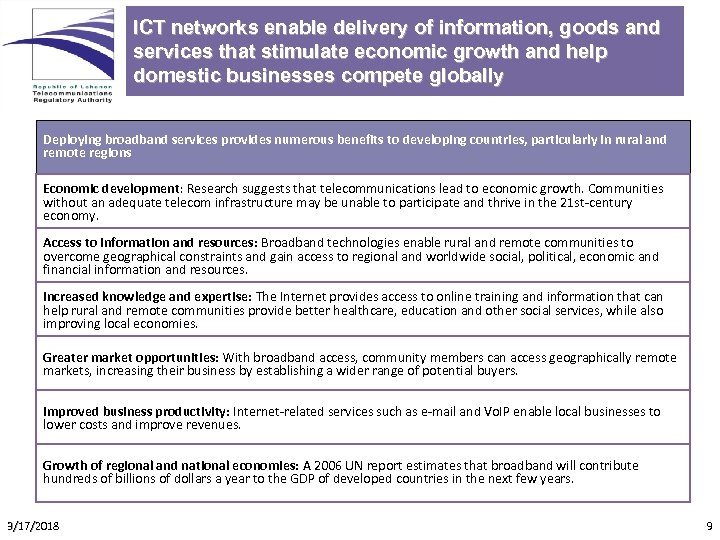
ICT networks enable delivery of information, goods and services that stimulate economic growth and help domestic businesses compete globally Deploying broadband services provides numerous benefits to developing countries, particularly in rural and remote regions Economic development: Research suggests that telecommunications lead to economic growth. Communities without an adequate telecom infrastructure may be unable to participate and thrive in the 21 st-century economy. Access to information and resources: Broadband technologies enable rural and remote communities to overcome geographical constraints and gain access to regional and worldwide social, political, economic and financial information and resources. Increased knowledge and expertise: The Internet provides access to online training and information that can help rural and remote communities provide better healthcare, education and other social services, while also improving local economies. Greater market opportunities: With broadband access, community members can access geographically remote markets, increasing their business by establishing a wider range of potential buyers. Improved business productivity: Internet-related services such as e-mail and Vo. IP enable local businesses to lower costs and improve revenues. Growth of regional and national economies: A 2006 UN report estimates that broadband will contribute hundreds of billions of dollars a year to the GDP of developed countries in the next few years. 3/17/2018 9
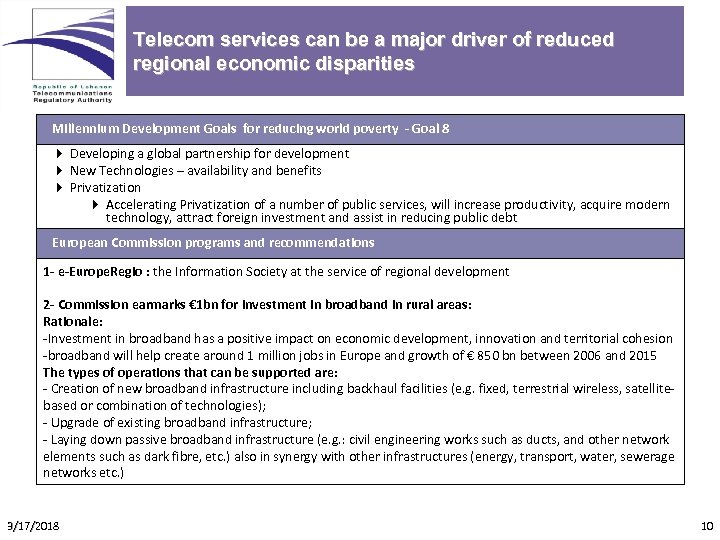
Telecom services can be a major driver of reduced regional economic disparities Millennium Development Goals for reducing world poverty - Goal 8 4 Developing a global partnership for development 4 New Technologies – availability and benefits 4 Privatization 4 Accelerating Privatization of a number of public services, will increase productivity, acquire modern technology, attract foreign investment and assist in reducing public debt European Commission programs and recommendations 1 - e-Europe. Regio : the Information Society at the service of regional development 2 - Commission earmarks € 1 bn for investment in broadband in rural areas: Rationale: -Investment in broadband has a positive impact on economic development, innovation and territorial cohesion -broadband will help create around 1 million jobs in Europe and growth of € 850 bn between 2006 and 2015 The types of operations that can be supported are: - Creation of new broadband infrastructure including backhaul facilities (e. g. fixed, terrestrial wireless, satellitebased or combination of technologies); - Upgrade of existing broadband infrastructure; - Laying down passive broadband infrastructure (e. g. : civil engineering works such as ducts, and other network elements such as dark fibre, etc. ) also in synergy with other infrastructures (energy, transport, water, sewerage networks etc. ) 3/17/2018 10
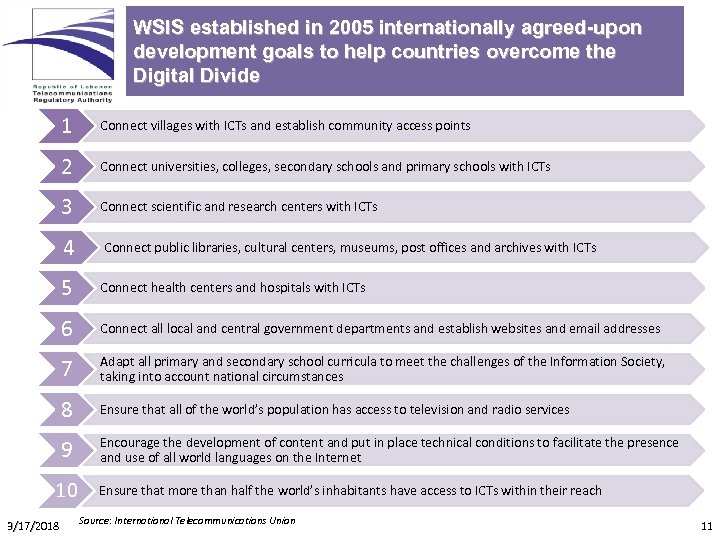
WSIS established in 2005 internationally agreed-upon development goals to help countries overcome the Digital Divide 1 Connect villages with ICTs and establish community access points 2 Connect universities, colleges, secondary schools and primary schools with ICTs 3 Connect scientific and research centers with ICTs 4 Connect public libraries, cultural centers, museums, post offices and archives with ICTs 5 Connect health centers and hospitals with ICTs 6 Connect all local and central government departments and establish websites and email addresses 7 Adapt all primary and secondary school curricula to meet the challenges of the Information Society, taking into account national circumstances 8 Ensure that all of the world’s population has access to television and radio services 9 Encourage the development of content and put in place technical conditions to facilitate the presence and use of all world languages on the Internet 10 3/17/2018 Ensure that more than half the world’s inhabitants have access to ICTs within their reach Source: International Telecommunications Union 11
I. Status of telecommunications in Lebanon II. Needs of un/underserved areas III. Options for ubiquitous coverage 3/17/2018 12
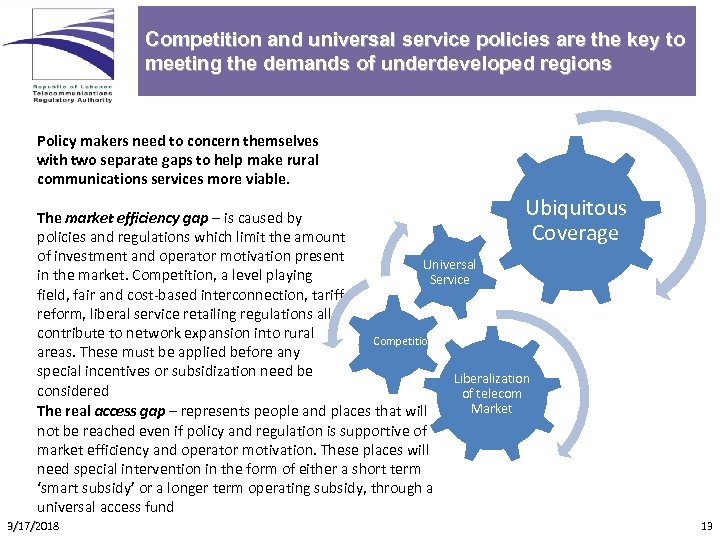
Competition and universal service policies are the key to meeting the demands of underdeveloped regions Policy makers need to concern themselves with two separate gaps to help make rural communications services more viable. Ubiquitous The market efficiency gap – is caused by Coverage policies and regulations which limit the amount of investment and operator motivation present Universal in the market. Competition, a level playing Service field, fair and cost-based interconnection, tariff reform, liberal service retailing regulations all contribute to network expansion into rural Competition areas. These must be applied before any special incentives or subsidization need be Liberalization considered of telecom Market The real access gap – represents people and places that will not be reached even if policy and regulation is supportive of market efficiency and operator motivation. These places will need special intervention in the form of either a short term ‘smart subsidy’ or a longer term operating subsidy, through a universal access fund 3/17/2018 13
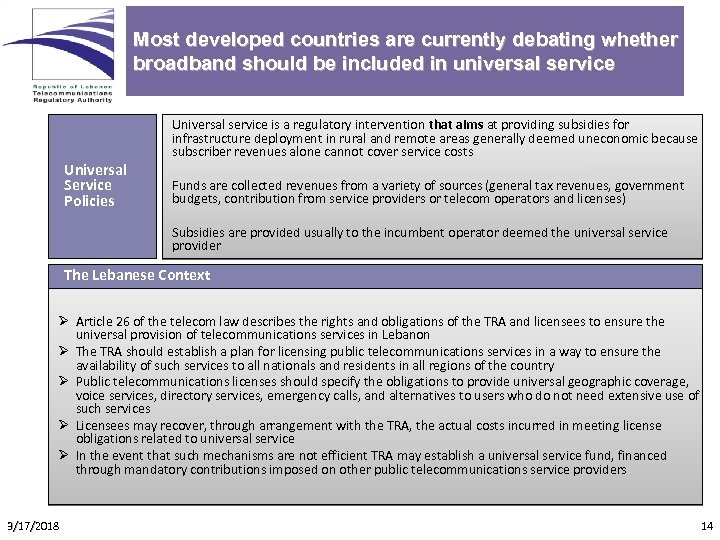
Most developed countries are currently debating whether broadband should be included in universal service Universal Service Policies Universal service is a regulatory intervention that aims at providing subsidies for infrastructure deployment in rural and remote areas generally deemed uneconomic because subscriber revenues alone cannot cover service costs Funds are collected revenues from a variety of sources (general tax revenues, government budgets, contribution from service providers or telecom operators and licenses) Subsidies are provided usually to the incumbent operator deemed the universal service provider The Lebanese Context Ø Article 26 of the telecom law describes the rights and obligations of the TRA and licensees to ensure the universal provision of telecommunications services in Lebanon Ø The TRA should establish a plan for licensing public telecommunications services in a way to ensure the availability of such services to all nationals and residents in all regions of the country Ø Public telecommunications licenses should specify the obligations to provide universal geographic coverage, voice services, directory services, emergency calls, and alternatives to users who do not need extensive use of such services Ø Licensees may recover, through arrangement with the TRA, the actual costs incurred in meeting license obligations related to universal service Ø In the event that such mechanisms are not efficient TRA may establish a universal service fund, financed through mandatory contributions imposed on other public telecommunications service providers 3/17/2018 14
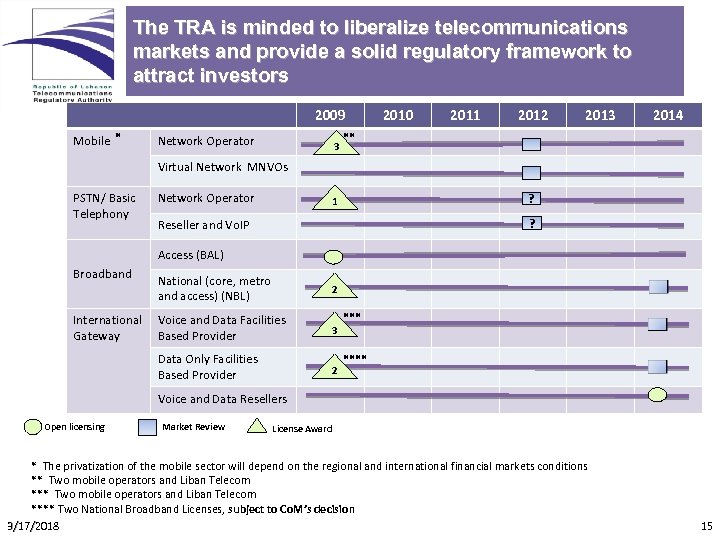
The TRA is minded to liberalize telecommunications markets and provide a solid regulatory framework to attract investors 2009 Mobile * Network Operator 3 2010 2011 2012 2013 2014 ** Virtual Network MNVOs PSTN/ Basic Telephony Network Operator ? 1 ? Reseller and Vo. IP Access (BAL) Broadband National (core, metro and access) (NBL) International Voice and Data Facilities Gateway Based Provider Data Only Facilities Based Provider 2 3 2 **** Voice and Data Resellers Open licensing Market Review License Award * The privatization of the mobile sector will depend on the regional and international financial markets conditions ** Two mobile operators and Liban Telecom **** Two National Broadband Licenses, subject to Co. M’s decision 3/17/2018 15
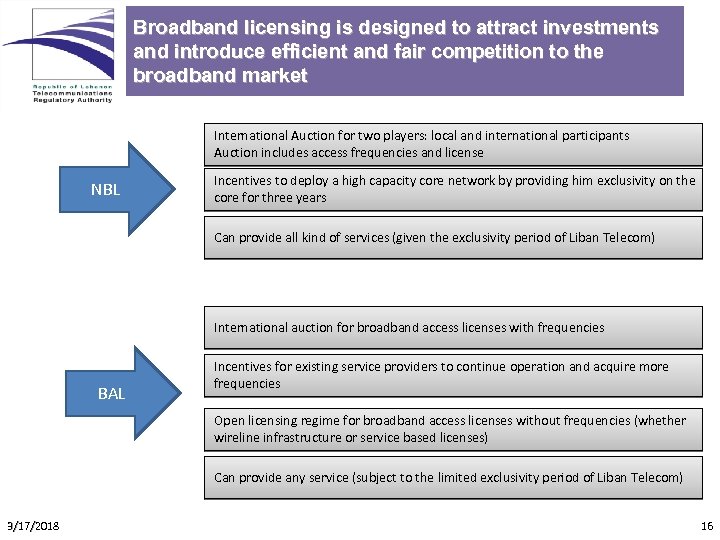
Broadband licensing is designed to attract investments and introduce efficient and fair competition to the broadband market International Auction for two players: local and international participants Auction includes access frequencies and license NBL Incentives to deploy a high capacity core network by providing him exclusivity on the core for three years Can provide all kind of services (given the exclusivity period of Liban Telecom) International auction for broadband access licenses with frequencies BAL Incentives for existing service providers to continue operation and acquire more frequencies Open licensing regime for broadband access licenses without frequencies (whether wireline infrastructure or service based licenses) Can provide any service (subject to the limited exclusivity period of Liban Telecom) 3/17/2018 16
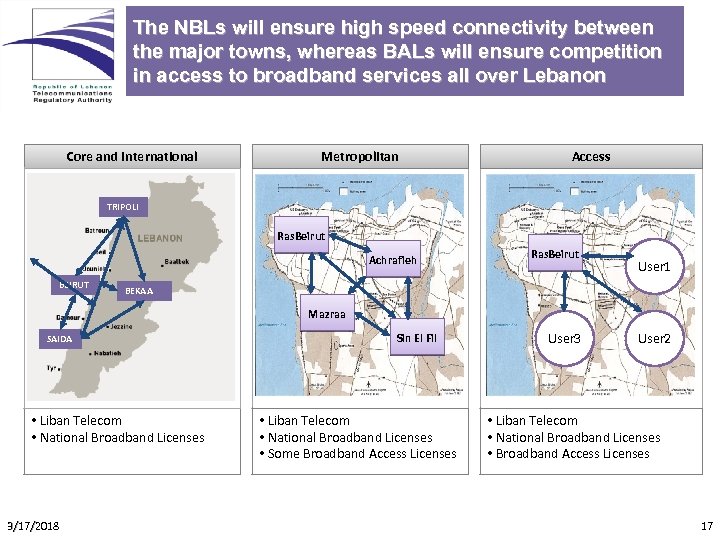
The NBLs will ensure high speed connectivity between the major towns, whereas BALs will ensure competition in access to broadband services all over Lebanon Core and International Metropolitan Access TRIPOLI Ras. Beirut Achrafieh BEIRUT Ras. Beirut User 1 BEKAA Mazraa SAIDA • Liban Telecom • National Broadband Licenses 3/17/2018 Sin El Fil • Liban Telecom • National Broadband Licenses • Some Broadband Access Licenses User 3 User 2 • Liban Telecom • National Broadband Licenses • Broadband Access Licenses 17
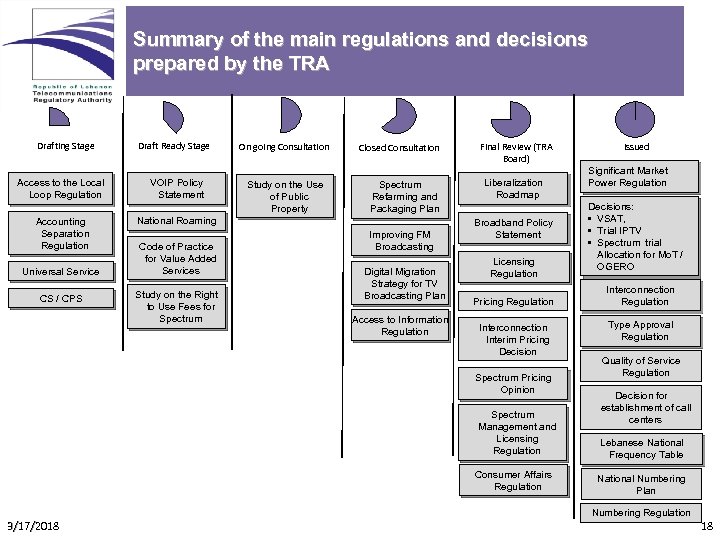
Summary of the main regulations and decisions prepared by the TRA Drafting Stage Access to the Local Loop Regulation Accounting Separation Regulation Universal Service CS / CPS Draft Ready Stage VOIP Policy Statement On going Consultation Study on the Use of Public Property Closed Consultation Spectrum Refarming and Packaging Plan National Roaming Code of Practice for Value Added Services Study on the Right to Use Fees for Spectrum Improving FM Broadcasting Digital Migration Strategy for TV Broadcasting Plan Access to Information Regulation Final Review (TRA Board) Liberalization Roadmap Broadband Policy Statement Licensing Regulation Pricing Regulation Interconnection Interim Pricing Decision Spectrum Pricing Opinion Spectrum Management and Licensing Regulation Consumer Affairs Regulation 3/17/2018 Issued Significant Market Power Regulation Decisions: • VSAT, • Trial IPTV • Spectrum trial Allocation for Mo. T / OGERO Interconnection Regulation Type Approval Regulation Quality of Service Regulation Decision for establishment of call centers Lebanese National Frequency Table National Numbering Plan Numbering Regulation 18
Thank you! www. tra. gov. lb
Скачать презентацию Liberalization of Telecom A Catalyst for Regional Development
d53398939dafc27dddc91ce674ae5002.ppt