 Скачать презентацию Liberalism In International Relations Theory Dmitry Pobedash Ural
Liberalism.ppt
- Количество слайдов: 26



Liberalism In International Relations Theory Dmitry Pobedash Ural State University
Outline Major figures The first IR paradigm It takes all sorts to make the liberalism Key concepts A success story?
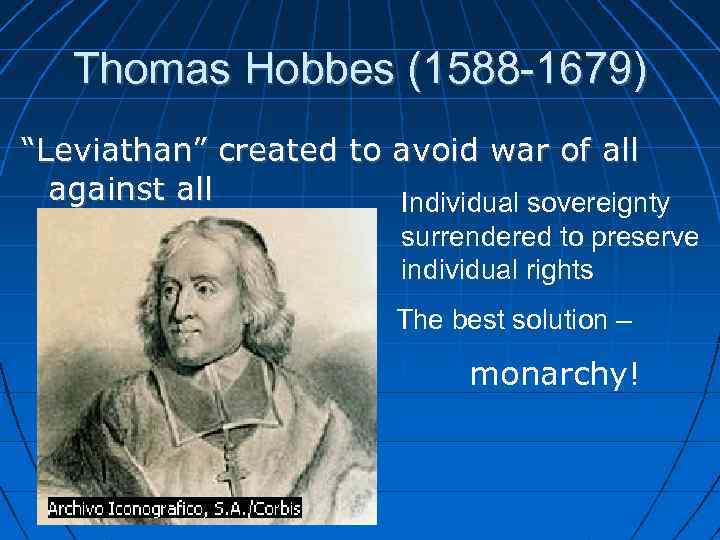
Thomas Hobbes (1588 -1679) “Leviathan” created to avoid war of all against all Individual sovereignty surrendered to preserve individual rights The best solution – monarchy!
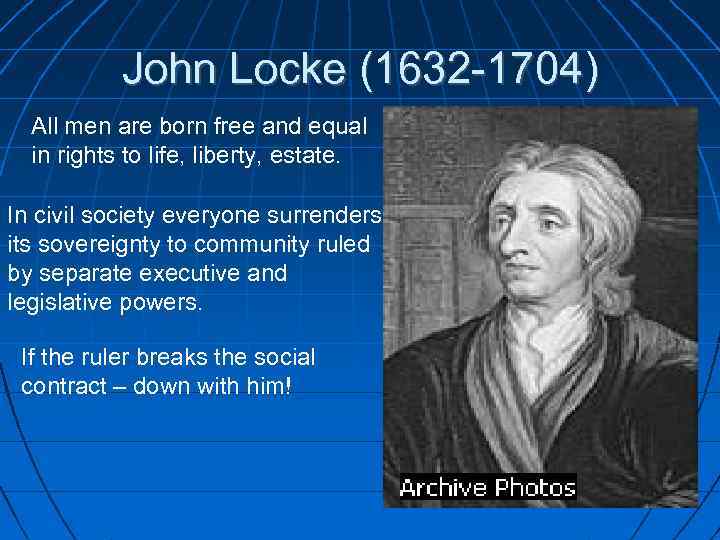
John Locke (1632 -1704) All men are born free and equal in rights to life, liberty, estate. In civil society everyone surrenders its sovereignty to community ruled by separate executive and legislative powers. If the ruler breaks the social contract – down with him!
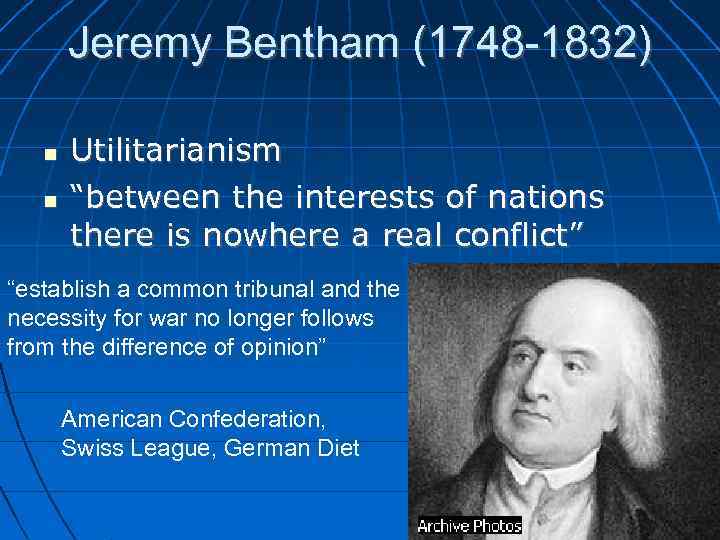
Jeremy Bentham (1748 -1832) Utilitarianism “between the interests of nations there is nowhere a real conflict” “establish a common tribunal and the necessity for war no longer follows from the difference of opinion” American Confederation, Swiss League, German Diet
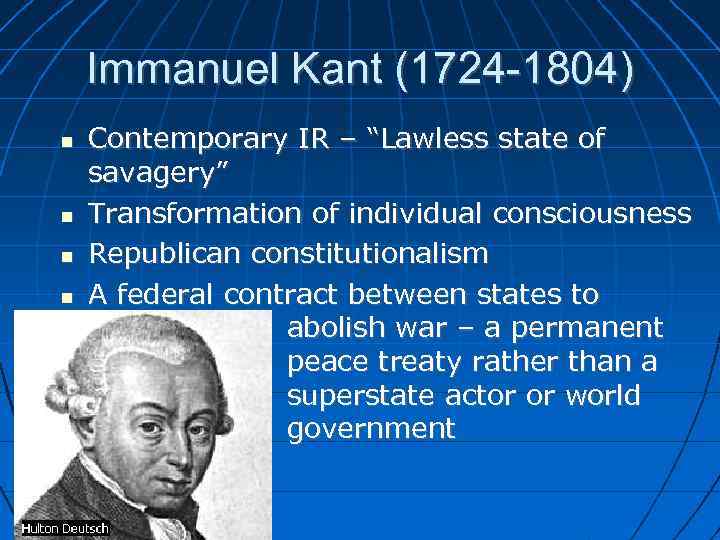
Immanuel Kant (1724 -1804) Contemporary IR – “Lawless state of savagery” Transformation of individual consciousness Republican constitutionalism A federal contract between states to abolish war – a permanent peace treaty rather than a superstate actor or world government
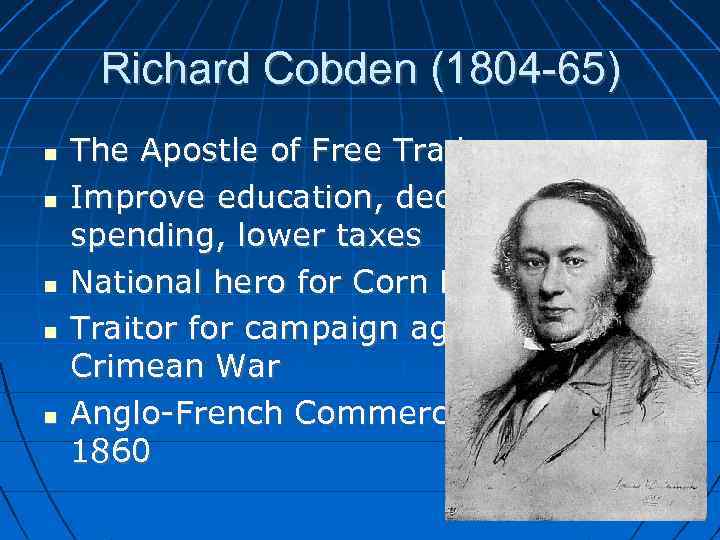
Richard Cobden (1804 -65) The Apostle of Free Trade Improve education, decrease military spending, lower taxes National hero for Corn Law, 1846 Traitor for campaign against the Crimean War Anglo-French Commercial Treaty, 1860
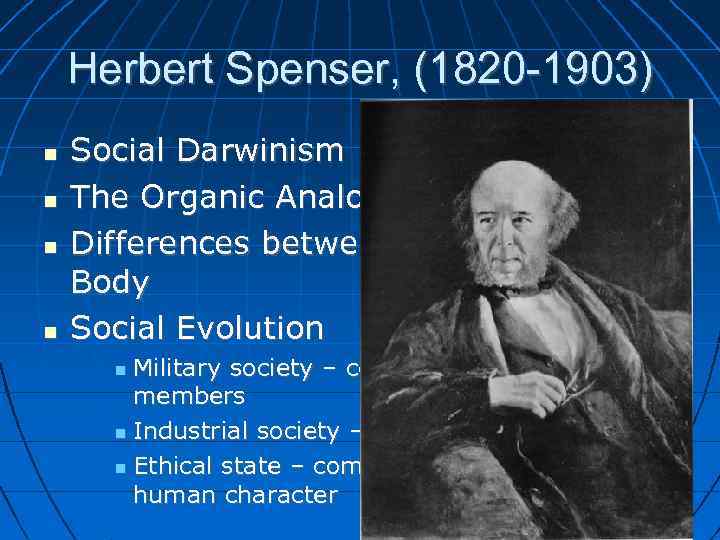
Herbert Spenser, (1820 -1903) Social Darwinism The Organic Analogy, but Differences between Society and Body Social Evolution Military society – compulsory cooperation of members Industrial society – voluntary Ethical state – common resources to perfect human character
The Happy Gang John Atkinson Hobson Norman Angell Alfred Eckhardt Zimmern James Thomson Shotwell Pitman Potter
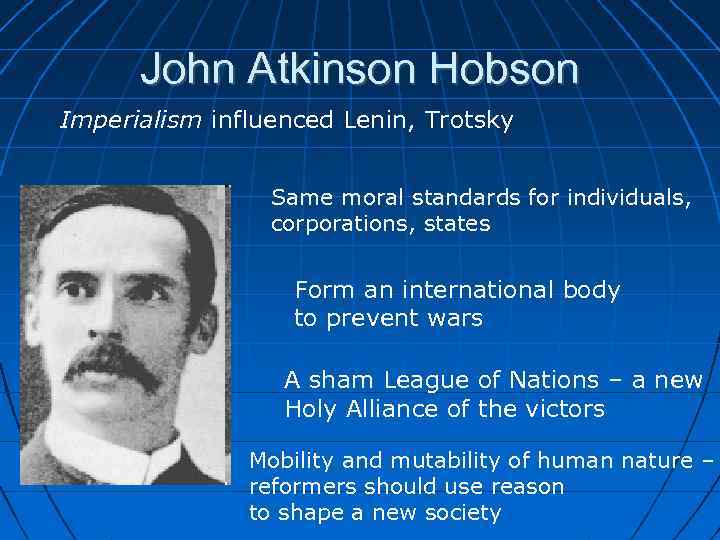
John Atkinson Hobson Imperialism influenced Lenin, Trotsky Same moral standards for individuals, corporations, states Form an international body to prevent wars A sham League of Nations – a new Holy Alliance of the victors Mobility and mutability of human nature – reformers should use reason to shape a new society
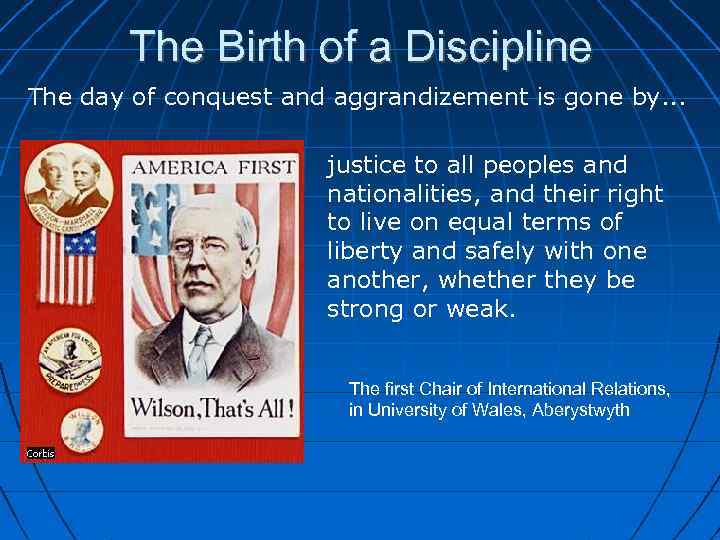
The Birth of a Discipline The day of conquest and aggrandizement is gone by. . . justice to all peoples and nationalities, and their right to live on equal terms of liberty and safely with one another, whether they be strong or weak. The first Chair of International Relations, in University of Wales, Aberystwyth
Woodrow Wilson The only President with a Ph. D. President of Princeton University, 1902 -10 The 14 points – address to Congress, January 1918 The first sitting President to visit Europe Women and blacks are excluded
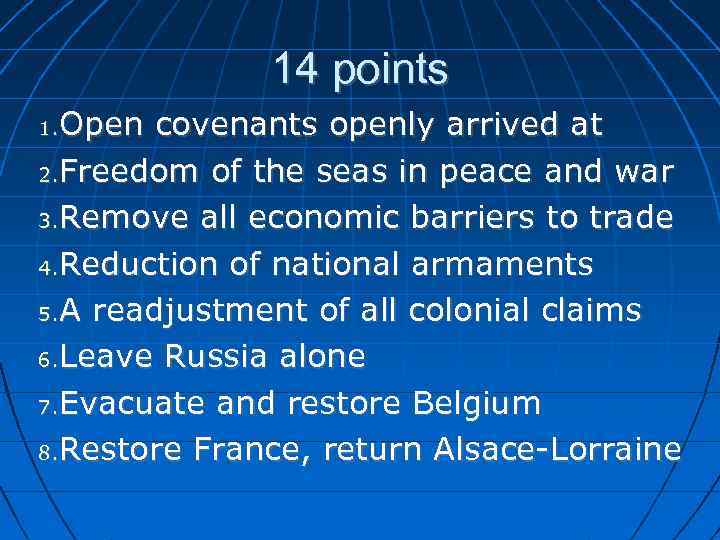
14 points Open covenants openly arrived at 2. Freedom of the seas in peace and war 3. Remove all economic barriers to trade 4. Reduction of national armaments 5. A readjustment of all colonial claims 6. Leave Russia alone 7. Evacuate and restore Belgium 8. Restore France, return Alsace-Lorraine 1.
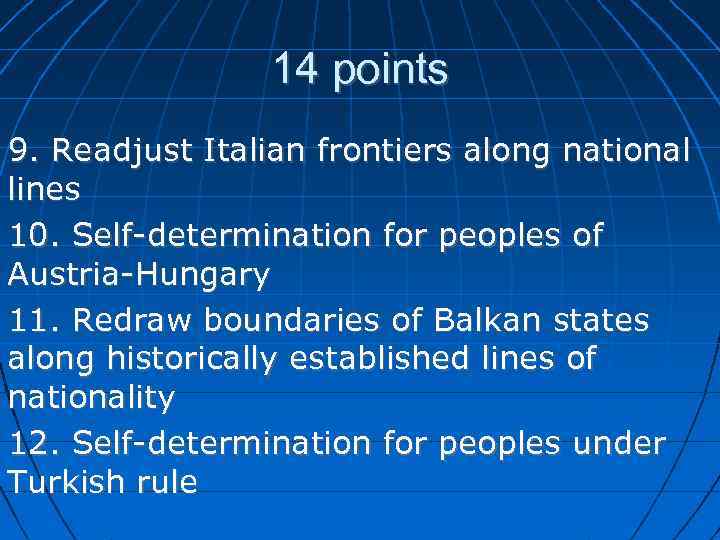
14 points 9. Readjust Italian frontiers along national lines 10. Self-determination for peoples of Austria-Hungary 11. Redraw boundaries of Balkan states along historically established lines of nationality 12. Self-determination for peoples under Turkish rule
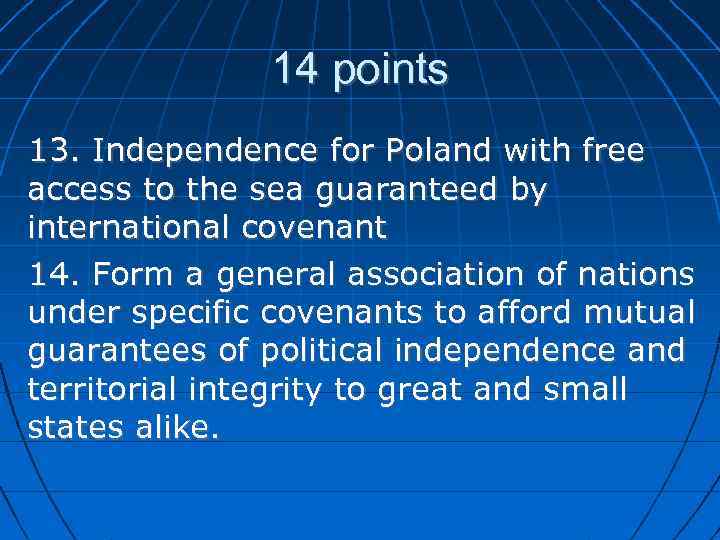
14 points 13. Independence for Poland with free access to the sea guaranteed by international covenant 14. Form a general association of nations under specific covenants to afford mutual guarantees of political independence and territorial integrity to great and small states alike.
Three Images Individual State System
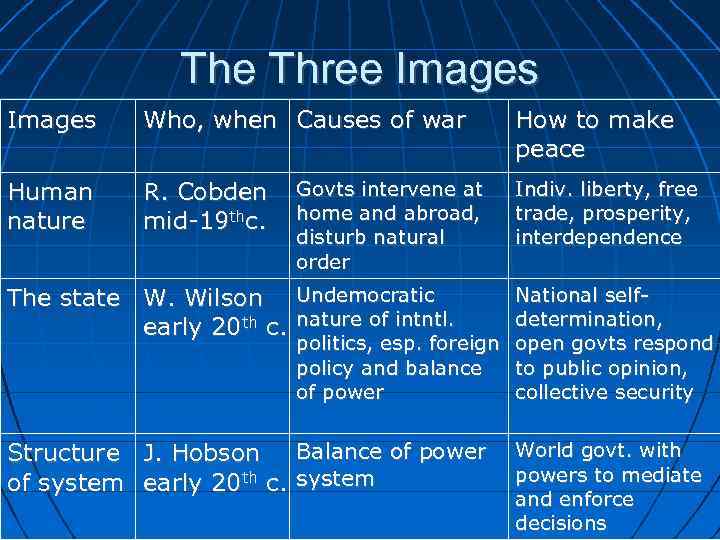
The Three Images Who, when Causes of war How to make peace Human nature R. Cobden mid-19 thc. Indiv. liberty, free trade, prosperity, interdependence Govts intervene at home and abroad, disturb natural order The state W. Wilson Undemocratic early 20 th c. nature of intntl. National selfdetermination, politics, esp. foreign open govts respond policy and balance to public opinion, of power collective security Structure J. Hobson Balance of power of system early 20 th c. system World govt. with powers to mediate and enforce decisions
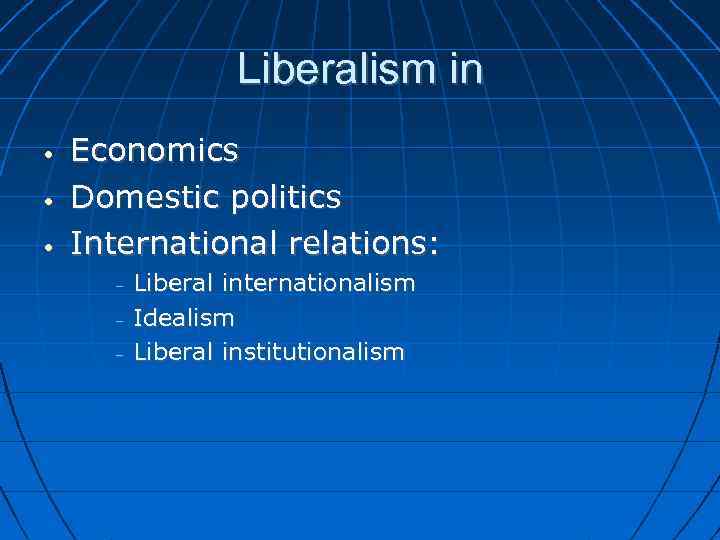
Liberalism in • • • Economics Domestic politics International relations: – – – Liberal internationalism Idealism Liberal institutionalism
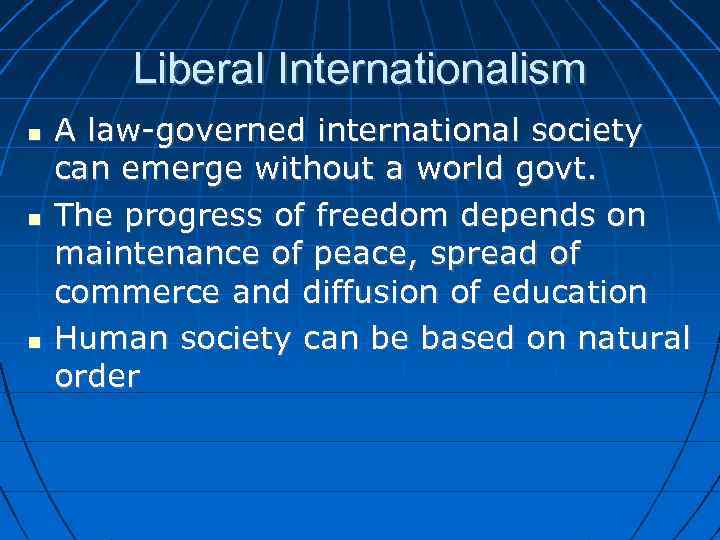
Liberal Internationalism A law-governed international society can emerge without a world govt. The progress of freedom depends on maintenance of peace, spread of commerce and diffusion of education Human society can be based on natural order
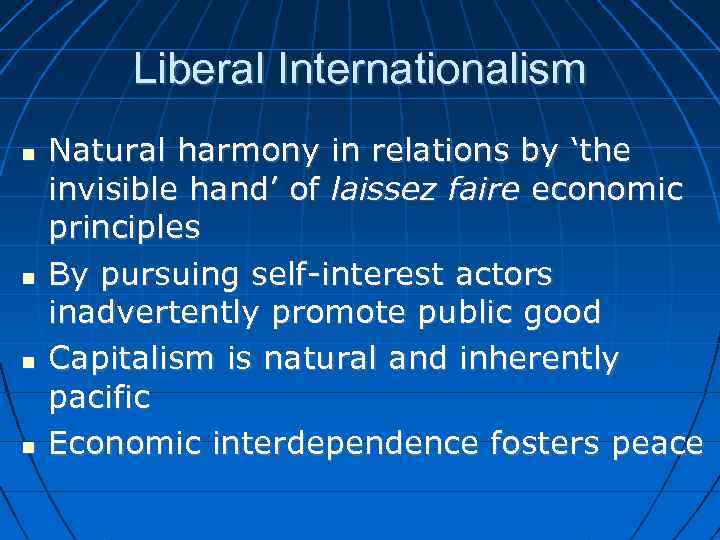
Liberal Internationalism Natural harmony in relations by ‘the invisible hand’ of laissez faire economic principles By pursuing self-interest actors inadvertently promote public good Capitalism is natural and inherently pacific Economic interdependence fosters peace
Idealism Peace is not natural but must be constructed Domestic analogy – international governance must use the same procedures Collective security rather than alliance system (collective defence) Teaching what ought to be and not just what is – Wilson Chair
Liberal Institutionalism Transnational cooperation needed to resolve common problems Cooperation in one sector would extend range of collaboration Growing integration increases the ‘cost’ of withdrawal from cooperative ventures Pluralism of actors
Key Concepts of Liberalism Collective security Democratic peace and democracy promotion Integration and interdependence Rule of law, human rights Normative element in theory Pluralism of actors World government
Liberalism in a Nutshell States are important, but not the only actors Actors in an interdependent world – anarchic, but with elements of governance – compete and cooperate is pursuit of absolute gains
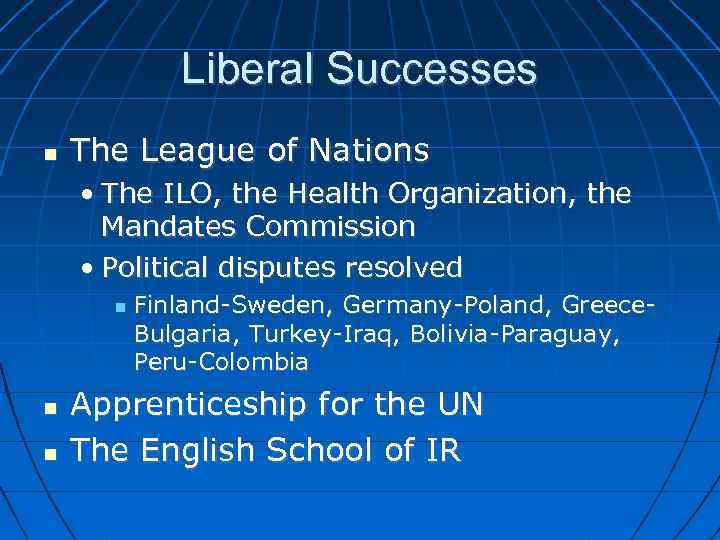
Liberal Successes The League of Nations • The ILO, the Health Organization, the Mandates Commission • Political disputes resolved Finland-Sweden, Germany-Poland, Greece. Bulgaria, Turkey-Iraq, Bolivia-Paraguay, Peru-Colombia Apprenticeship for the UN The English School of IR
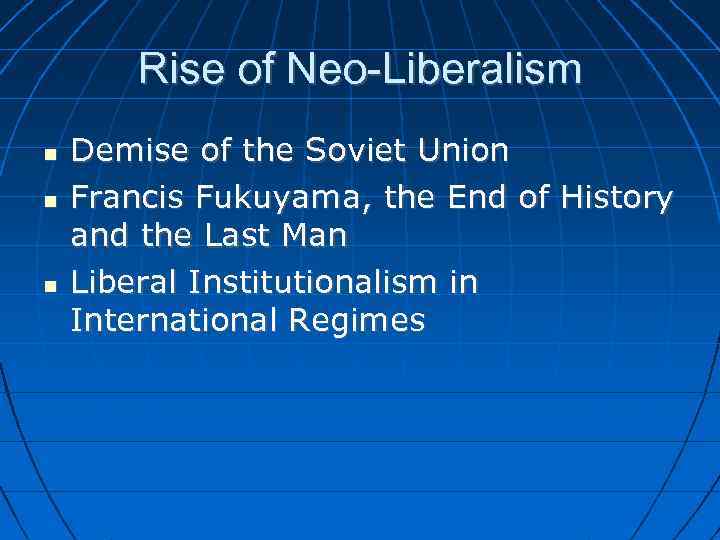
Rise of Neo-Liberalism Demise of the Soviet Union Francis Fukuyama, the End of History and the Last Man Liberal Institutionalism in International Regimes
Скачать презентацию Liberalism In International Relations Theory Dmitry Pobedash Ural
Liberalism.ppt