


 Скачать презентацию Liana Heitin Associate Editor of Education Week Teacher
6a6182594780f3ff9e7da7000cd59102.ppt
- Количество слайдов: 27

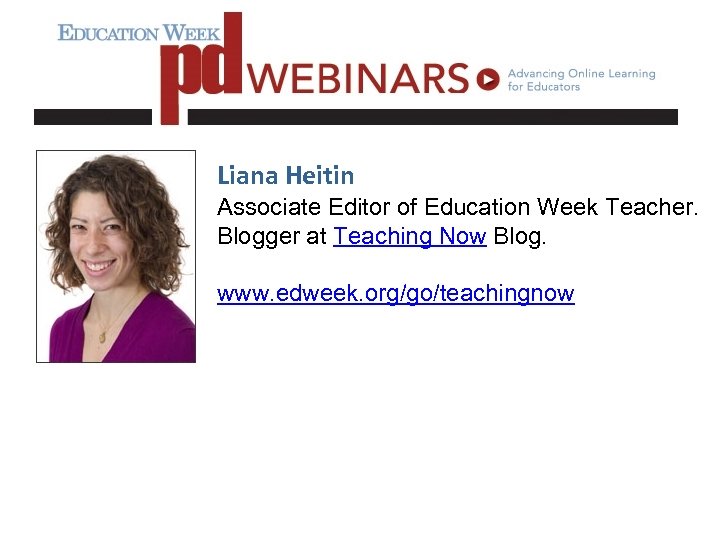 Liana Heitin Associate Editor of Education Week Teacher. Blogger at Teaching Now Blog. www. edweek. org/go/teachingnow
 As a participant of this webinar, you have earned a certificate of completion from Education Week PD Webinars. To claim your certificate, please send an email to webinars@epe. org with the names and titles of those who attended, and the mailing address to which you would like the certificates sent.
 An on-demand archive of this webinar is going to be available at www. edweek. org/go/PDarchives in less than 24 hrs.
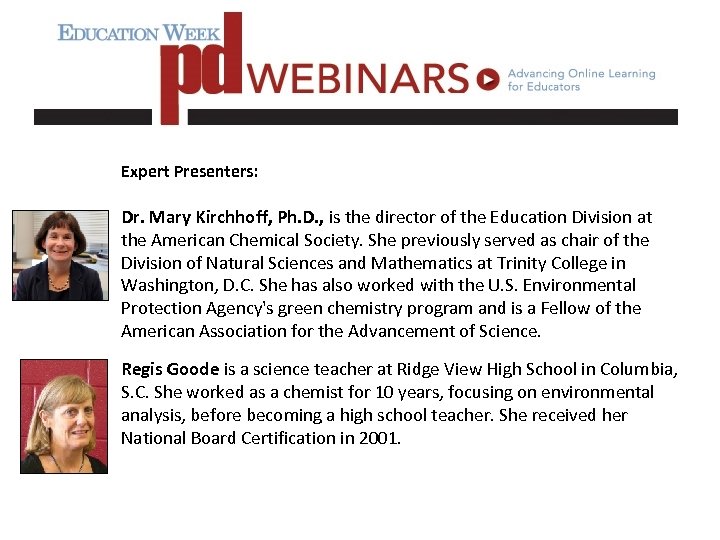
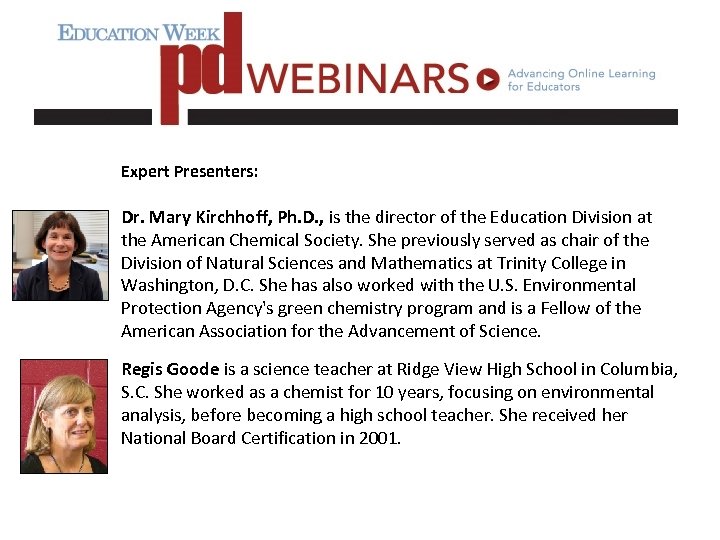 Addressing Diverse Student Learning Needs Expert Presenters: Dr. Mary Kirchhoff, Ph. D. , is the director of the Education Division at the American Chemical Society. She previously served as chair of the Division of Natural Sciences and Mathematics at Trinity College in Washington, D. C. She has also worked with the U. S. Environmental Protection Agency's green chemistry program and is a Fellow of the American Association for the Advancement of Science. Regis Goode is a science teacher at Ridge View High School in Columbia, S. C. She worked as a chemist for 10 years, focusing on environmental analysis, before becoming a high school teacher. She received her National Board Certification in 2001.
 American Chemical Society Engaging Girls and Underrepresented Populations in STEM Mary Kirchhoff 26 July 2011
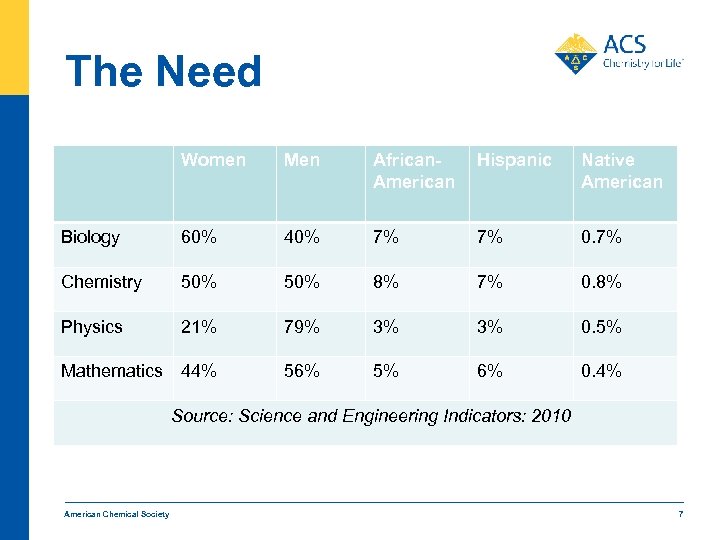 The Need Women Men African. American Hispanic Native American Biology 60% 40% 7% 7% 0. 7% Chemistry 50% 8% 7% 0. 8% Physics 21% 79% 3% 3% 0. 5% Mathematics 44% 56% 5% 6% 0. 4% Source: Science and Engineering Indicators: 2010 American Chemical Society 7
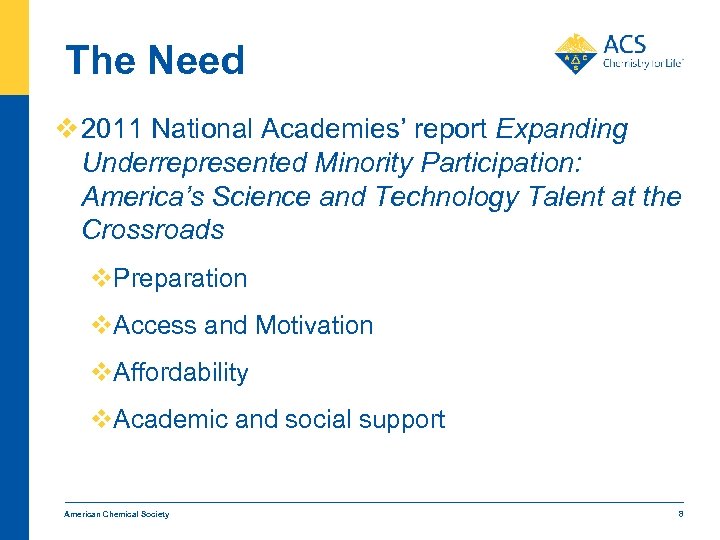 The Need v 2011 National Academies’ report Expanding Underrepresented Minority Participation: America’s Science and Technology Talent at the Crossroads v. Preparation v. Access and Motivation v. Affordability v. Academic and social support American Chemical Society 8
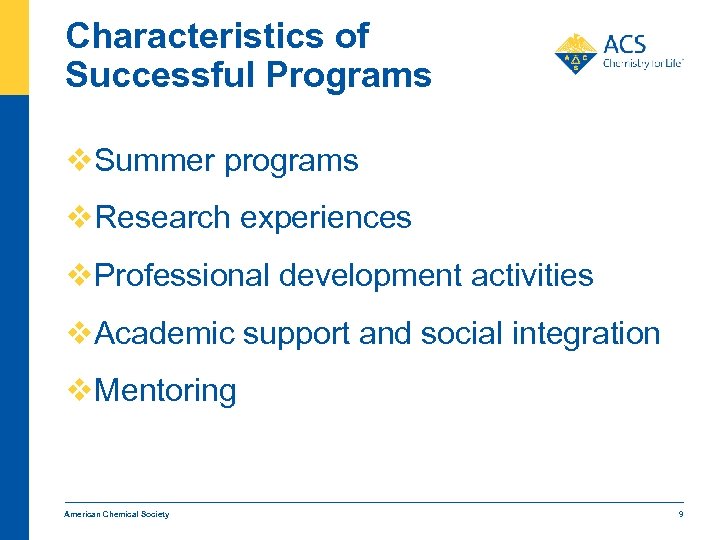 Characteristics of Successful Programs v. Summer programs v. Research experiences v. Professional development activities v. Academic support and social integration v. Mentoring American Chemical Society 9
 Engaging All Students v. Encourage, not discourage v. Role models v. Active learning v. Lecturing does not work for many students v. Labs, demonstrations, group discussions, problem solving activities v. Engage students in the process of science American Chemical Society 10
 Science for All Students v National Science Education Standards v. Science education policies must be equitable for all students v “Chemistry teachers should be preparing their students for a multicultural world by celebrating diversity in an inclusive classroom environment, but this is not as easy as it sounds. ” Chemistry in the National Science Education Standards American Chemical Society 11
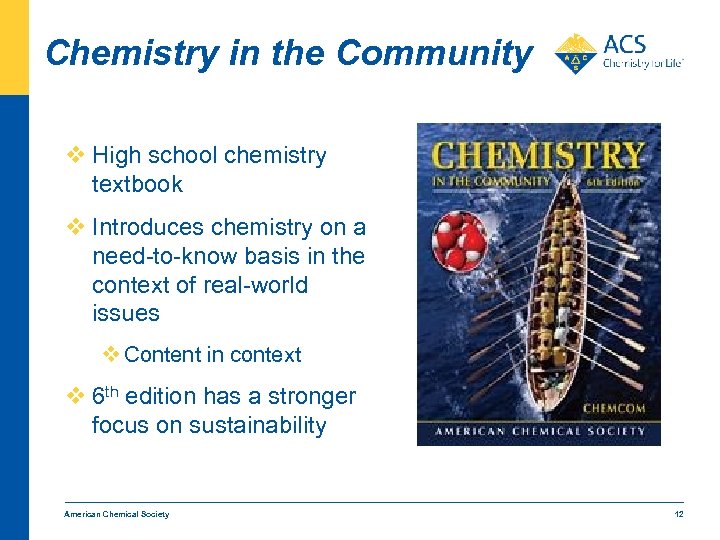 Chemistry in the Community v High school chemistry textbook v Introduces chemistry on a need-to-know basis in the context of real-world issues v Content in context v 6 th edition has a stronger focus on sustainability American Chemical Society 12
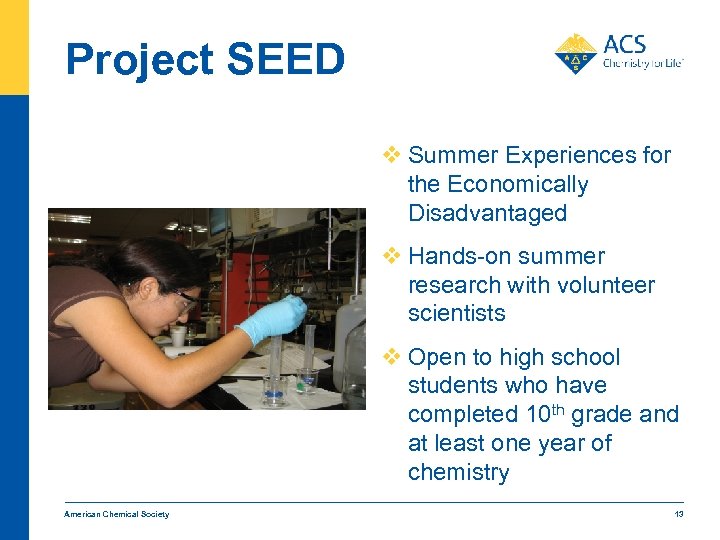 Project SEED v Summer Experiences for the Economically Disadvantaged v Hands-on summer research with volunteer scientists v Open to high school students who have completed 10 th grade and at least one year of chemistry American Chemical Society 13
 The Harvest v. Approximately 9, 000 high school students have participated in Project SEED v 70% from underrepresented groups v 62% female v. Evaluation of first 25 years of SEED v 70% of students earned a degree in science v 63% BS; 13% MS; 7% Ph. D American Chemical Society 14
 ACS Scholars v. College scholarships for African American, Hispanic, and Native American students pursuing degrees in the chemical sciences v. Students are matched with a mentor v 2, 500 scholarships awarded since 1995 American Chemical Society 15
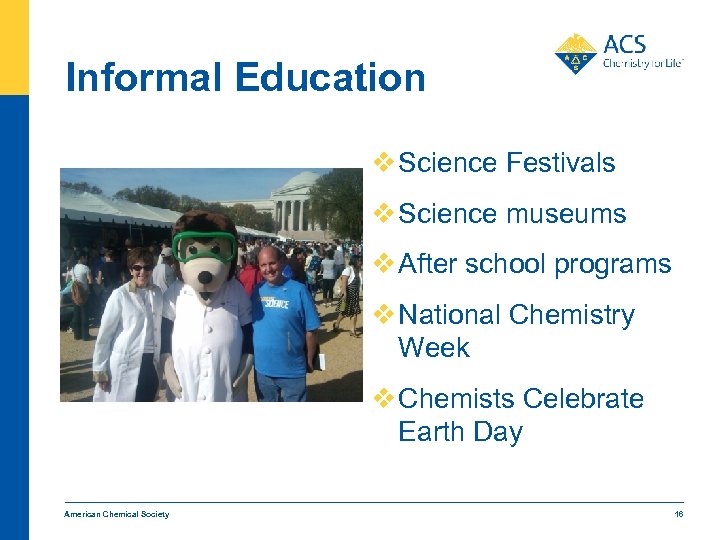 Informal Education v Science Festivals v Science museums v After school programs v National Chemistry Week v Chemists Celebrate Earth Day American Chemical Society 16
 ACS National Charter v…to promote scientific interests and inquiry, thereby fostering public welfare and education, aiding the development of our country’s industries, and adding to the material prosperity and happiness of our people. v…the improvement of the qualifications and usefulness of chemists through high standards of professional ethics, education and attainments… American Chemical Society 17
 American Chemical Society Engaging Girls and Underrepresented Populations in STEM: Perspectives from the Classroom Regis Goode 26 July 2011
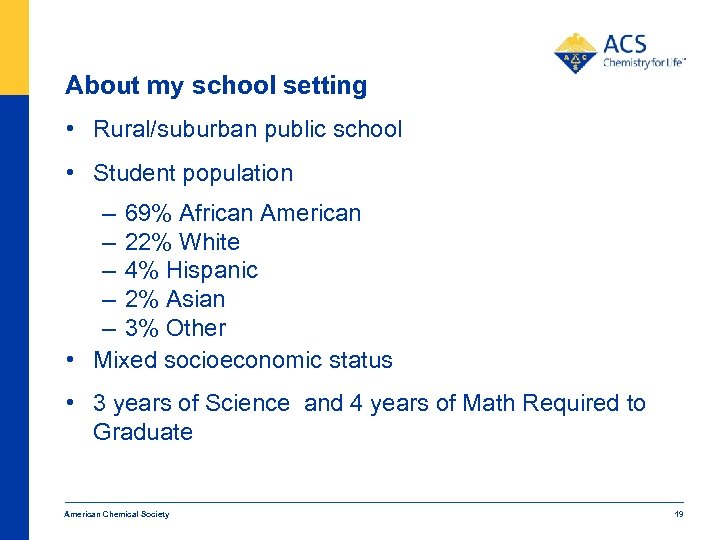 About my school setting • Rural/suburban public school • Student population – 69% African American – 22% White – 4% Hispanic – 2% Asian – 3% Other • Mixed socioeconomic status • 3 years of Science and 4 years of Math Required to Graduate American Chemical Society 19
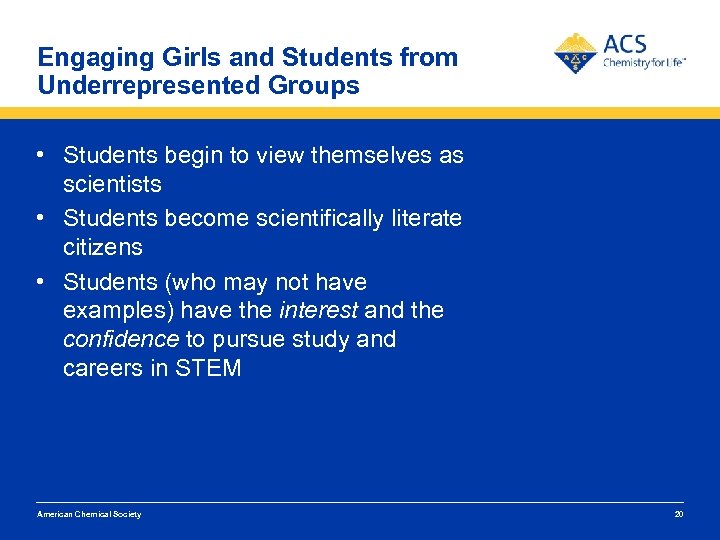 Engaging Girls and Students from Underrepresented Groups • Students begin to view themselves as scientists • Students become scientifically literate citizens • Students (who may not have examples) have the interest and the confidence to pursue study and careers in STEM American Chemical Society 20
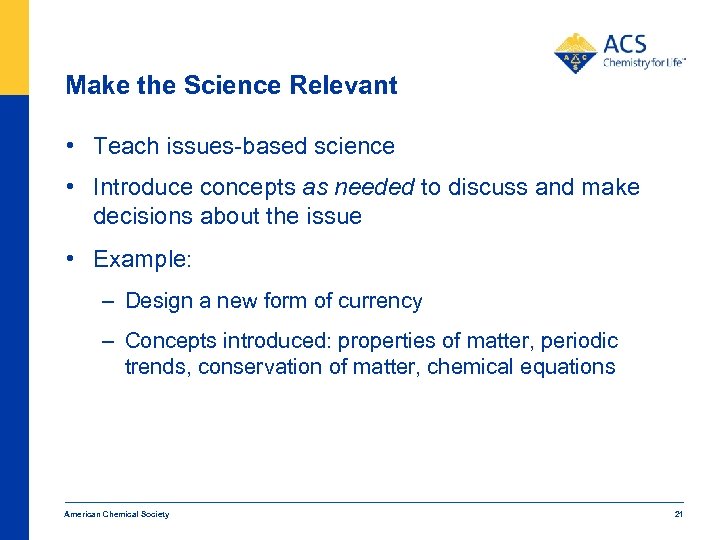 Make the Science Relevant • Teach issues-based science • Introduce concepts as needed to discuss and make decisions about the issue • Example: – Design a new form of currency – Concepts introduced: properties of matter, periodic trends, conservation of matter, chemical equations American Chemical Society 21
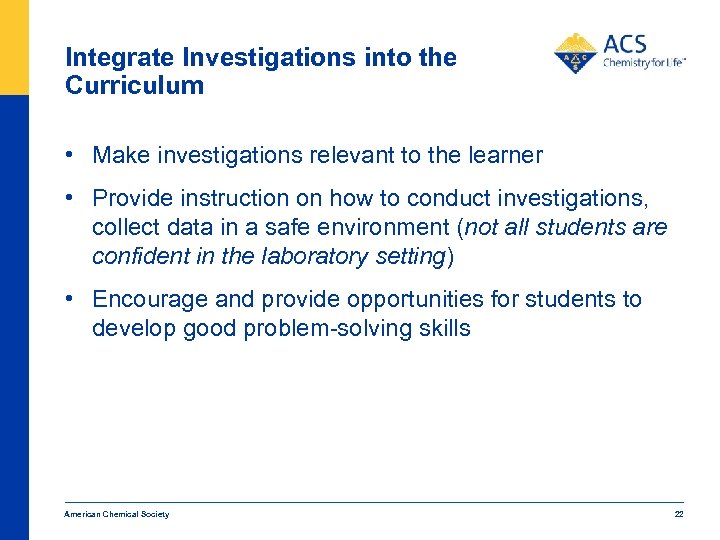 Integrate Investigations into the Curriculum • Make investigations relevant to the learner • Provide instruction on how to conduct investigations, collect data in a safe environment (not all students are confident in the laboratory setting) • Encourage and provide opportunities for students to develop good problem-solving skills American Chemical Society 22
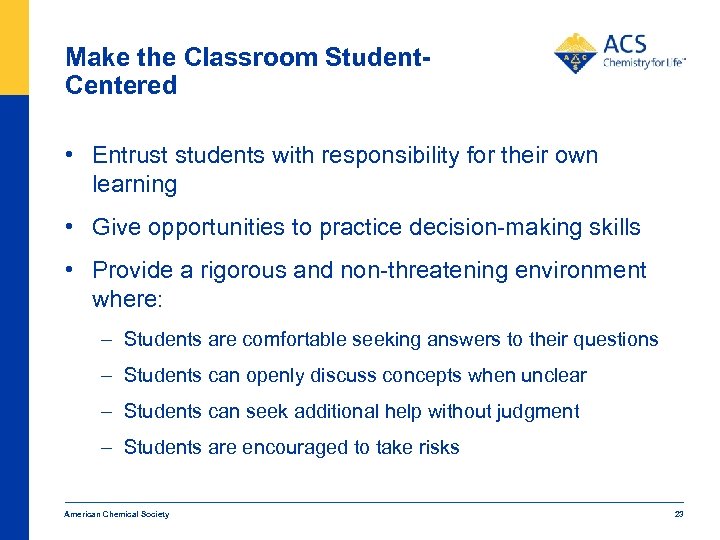 Make the Classroom Student. Centered • Entrust students with responsibility for their own learning • Give opportunities to practice decision-making skills • Provide a rigorous and non-threatening environment where: – Students are comfortable seeking answers to their questions – Students can openly discuss concepts when unclear – Students can seek additional help without judgment – Students are encouraged to take risks American Chemical Society 23
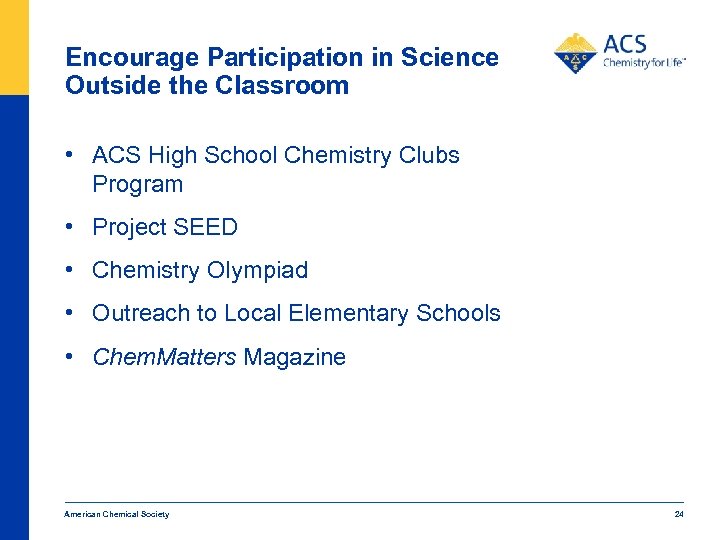 Encourage Participation in Science Outside the Classroom • ACS High School Chemistry Clubs Program • Project SEED • Chemistry Olympiad • Outreach to Local Elementary Schools • Chem. Matters Magazine American Chemical Society 24

 Addressing Diverse Student Learning Needs Expert Presenters: Dr. Mary Kirchhoff, Ph. D. , is the director of the Education Division at the American Chemical Society. She previously served as chair of the Division of Natural Sciences and Mathematics at Trinity College in Washington, D. C. She has also worked with the U. S. Environmental Protection Agency's green chemistry program and is a Fellow of the American Association for the Advancement of Science. Regis Goode is a science teacher at Ridge View High School in Columbia, S. C. She worked as a chemist for 10 years, focusing on environmental analysis, before becoming a high school teacher. She received her National Board Certification in 2001.
 An on-demand archive of this webinar is going to be available at www. edweek. org/go/PDarchives in less than 24 hrs.