 Скачать презентацию LHe C Linac-Ring Option J Osborne Frank Zimmermann
5cafe5e42ef1fae1d91e3400e8509262.ppt
- Количество слайдов: 30



LHe. C Linac-Ring Option J. Osborne Frank Zimmermann Euc. ARD-Acc. Net-RFTech Workshop PSI, 2 December 2010
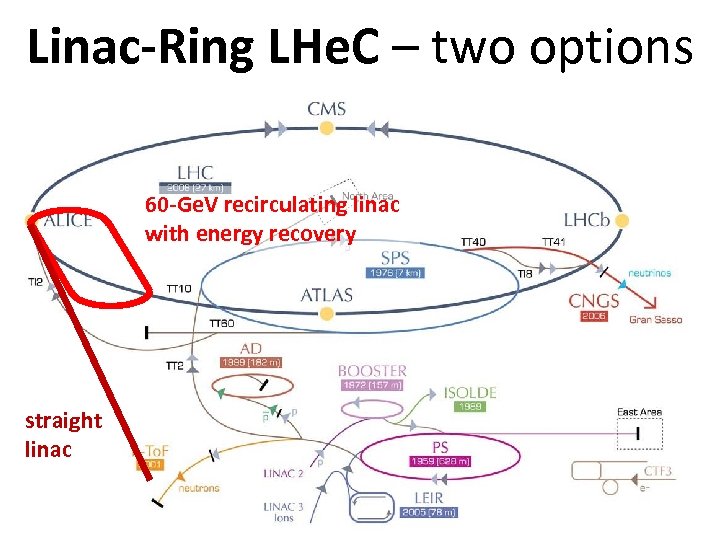
Linac-Ring LHe. C – two options 60 -Ge. V recirculating linac with energy recovery straight linac
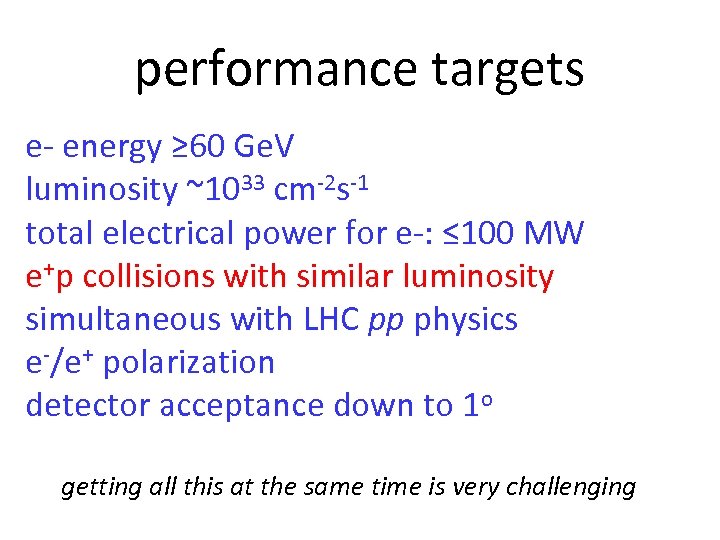
performance targets e- energy ≥ 60 Ge. V luminosity ~1033 cm-2 s-1 total electrical power for e-: ≤ 100 MW e+p collisions with similar luminosity simultaneous with LHC pp physics e-/e+ polarization detector acceptance down to 1 o getting all this at the same time is very challenging
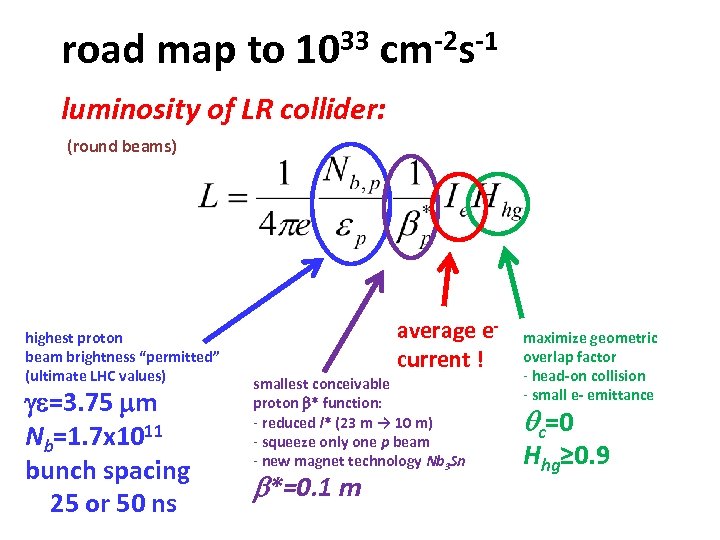
road map to 1033 cm-2 s-1 luminosity of LR collider: (round beams) highest proton beam brightness “permitted” (ultimate LHC values) ge=3. 75 mm Nb=1. 7 x 10¹¹ bunch spacing 25 or 50 ns average ecurrent ! smallest conceivable proton b* function: - reduced l* (23 m → 10 m) - squeeze only one p beam - new magnet technology Nb 3 Sn b*=0. 1 m maximize geometric overlap factor - head-on collision - small e- emittance qc=0 Hhg≥ 0. 9
electron beam e- emittances and b* not critical (protons are big, ~7 mm!) most important parameter: average beam current in addition: bunch structure and polarization
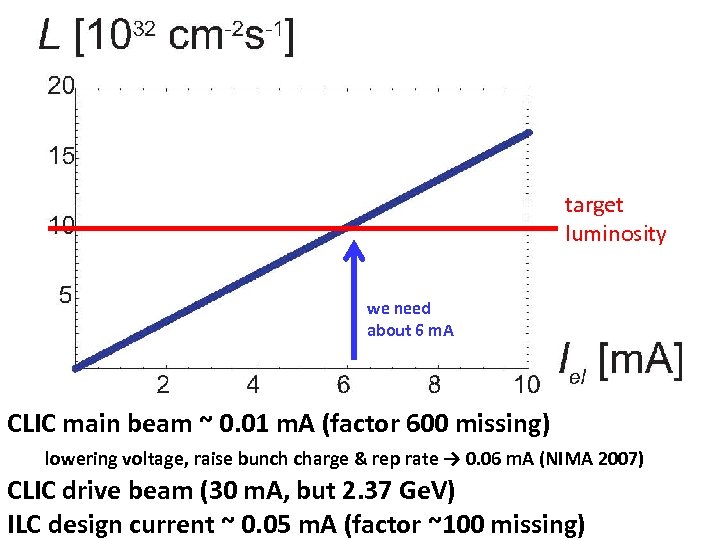
target luminosity we need about 6 m. A CLIC main beam ~ 0. 01 m. A (factor 600 missing) lowering voltage, raise bunch charge & rep rate → 0. 06 m. A (NIMA 2007) CLIC drive beam (30 m. A, but 2. 37 Ge. V) ILC design current ~ 0. 05 m. A (factor ~100 missing)
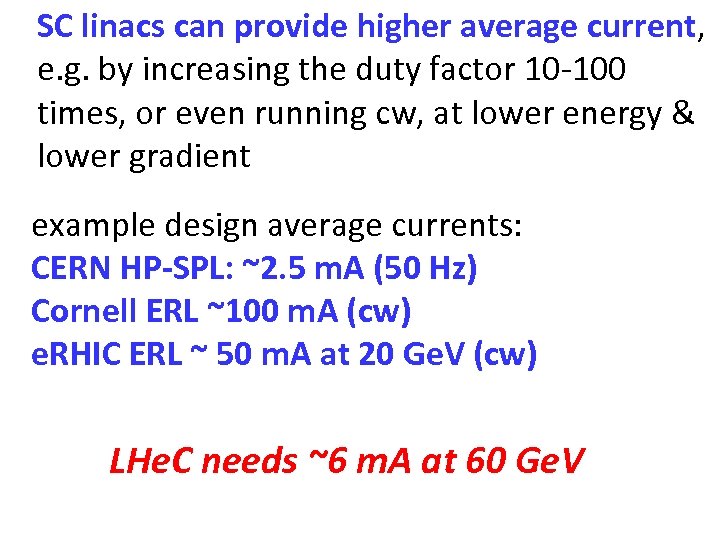
SC linacs can provide higher average current, e. g. by increasing the duty factor 10 -100 times, or even running cw, at lower energy & lower gradient example design average currents: CERN HP-SPL: ~2. 5 m. A (50 Hz) Cornell ERL ~100 m. A (cw) e. RHIC ERL ~ 50 m. A at 20 Ge. V (cw) LHe. C needs ~6 m. A at 60 Ge. V
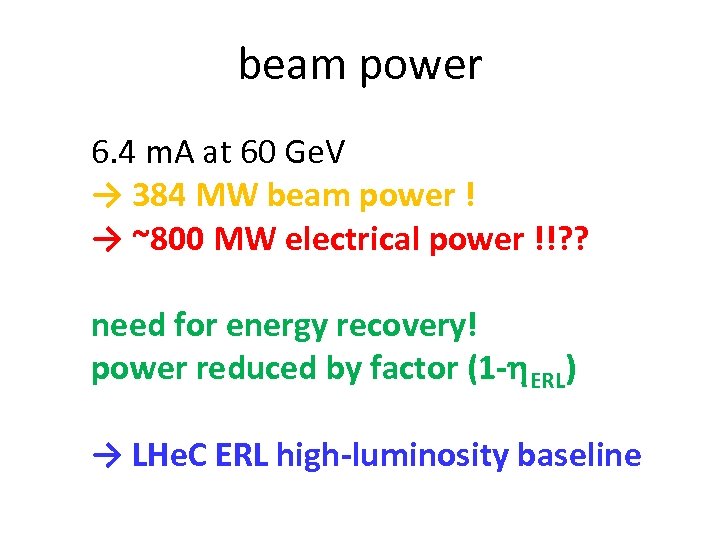
beam power 6. 4 m. A at 60 Ge. V → 384 MW beam power ! → ~800 MW electrical power !!? ? need for energy recovery! power reduced by factor (1 -h. ERL) → LHe. C ERL high-luminosity baseline
one more ingredient choice of SC linac RF frequency: 1. 3 GHz (ILC)? ~720 MHz? ! • requires less cryo-power (~2 times less from BCS theory); true difference ↔ residual resistance, [J. Tückmantel, E. Ciapala] • better for high-power couplers? [O. Napoly] • synergy with SPL, e. RHIC and ESS
![linac RF parameters duty factor RF frequency [GHz] cavity length [m] energy gain /](https://present5.com/presentation/5cafe5e42ef1fae1d91e3400e8509262/image-10.jpg "linac RF parameters duty factor RF frequency [GHz] cavity length [m] energy gain /")
linac RF parameters duty factor RF frequency [GHz] cavity length [m] energy gain / cavity [Me. V] R/Q [100 W] Q 0 [1010] power loss stat. [W/cav. ] power loss RF [W/cav. ] power loss total [W/cav. ] “W per W” (1. 8 k to RT) power loss / Ge. V @RT [MW] length / Ge. V [m] (filling=0. 57) ERL 720 MHz cw 0. 72 1 18 400 -500 2. 5 -5. 0 5 8 -32 13 -37 (!? ) 700 0. 51 -1. 44 97 ERL 1. 3 GHz cw 1. 3 ~1 18 1200 2? <0. 5 13 -27 ? 13 -27 700 0. 6 -1. 1 97 Pulsed 0. 05 1. 3 ~1 31. 5 1200 1 <0. 5 <10 11 700 0. 24 56
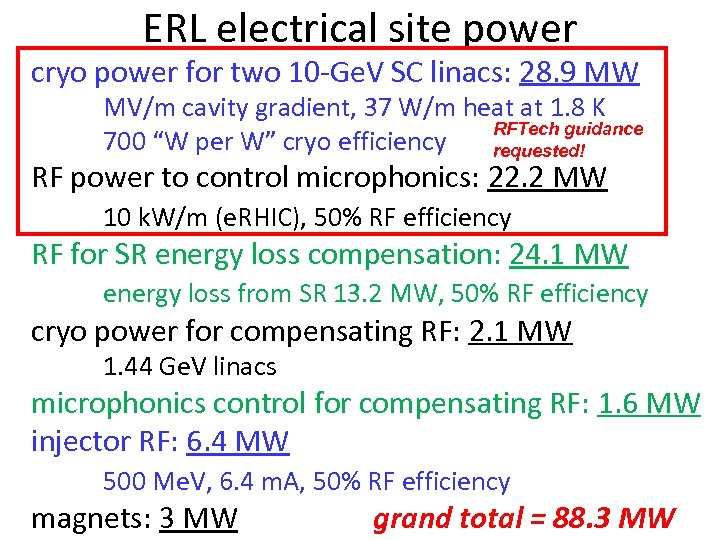
ERL electrical site power cryo power for two 10 -Ge. V SC linacs: 28. 9 MW MV/m cavity gradient, 37 W/m heat at 1. 8 K RFTech guidance 700 “W per W” cryo efficiency requested! RF power to control microphonics: 22. 2 MW 10 k. W/m (e. RHIC), 50% RF efficiency RF for SR energy loss compensation: 24. 1 MW energy loss from SR 13. 2 MW, 50% RF efficiency cryo power for compensating RF: 2. 1 MW 1. 44 Ge. V linacs microphonics control for compensating RF: 1. 6 MW injector RF: 6. 4 MW 500 Me. V, 6. 4 m. A, 50% RF efficiency magnets: 3 MW grand total = 88. 3 MW
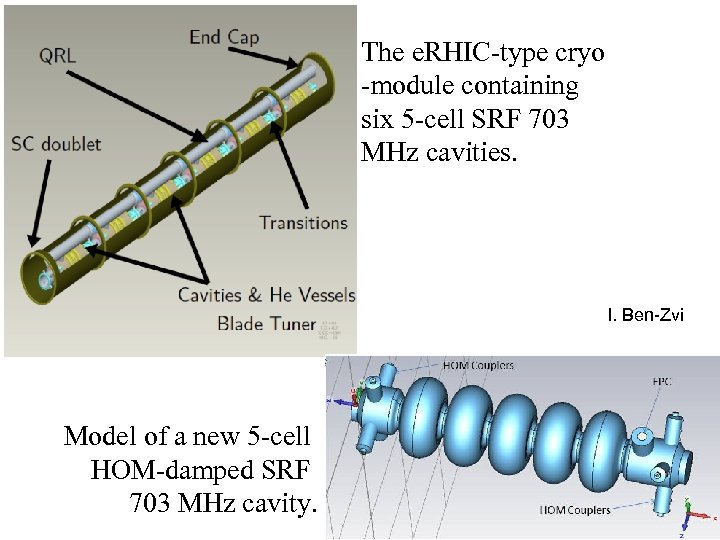
The e. RHIC-type cryo -module containing six 5 -cell SRF 703 MHz cavities. I. Ben-Zvi Model of a new 5 -cell HOM-damped SRF 703 MHz cavity.
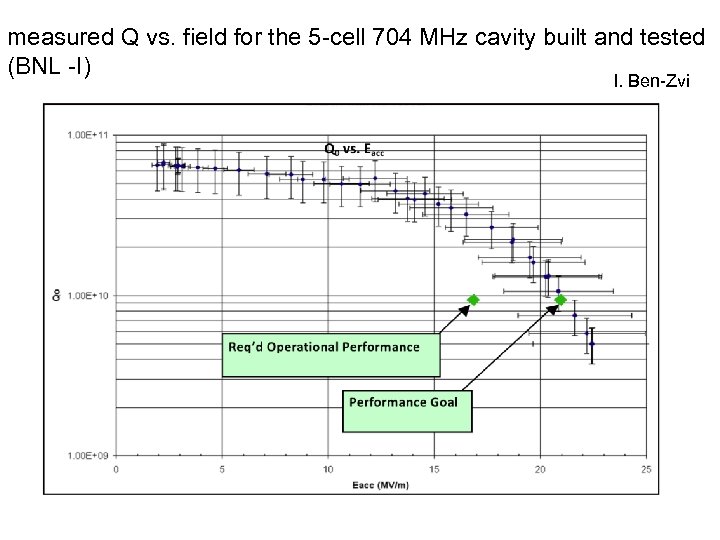
measured Q vs. field for the 5 -cell 704 MHz cavity built and tested (BNL -I) I. Ben-Zvi
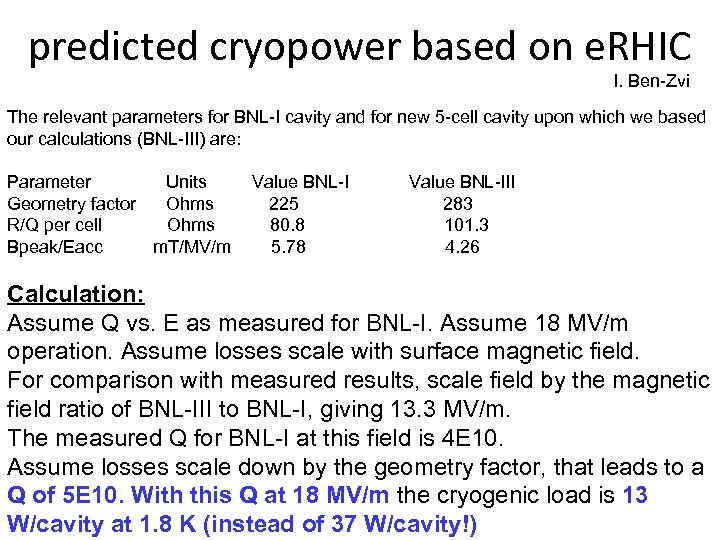
predicted cryopower based on e. RHIC I. Ben-Zvi The relevant parameters for BNL-I cavity and for new 5 -cell cavity upon which we based our calculations (BNL-III) are: Parameter Units Value BNL-III Geometry factor Ohms 225 283 R/Q per cell Ohms 80. 8 101. 3 Bpeak/Eacc m. T/MV/m 5. 78 4. 26 Calculation: Assume Q vs. E as measured for BNL-I. Assume 18 MV/m operation. Assume losses scale with surface magnetic field. For comparison with measured results, scale field by the magnetic field ratio of BNL-III to BNL-I, giving 13. 3 MV/m. The measured Q for BNL-I at this field is 4 E 10. Assume losses scale down by the geometry factor, that leads to a Q of 5 E 10. With this Q at 18 MV/m the cryogenic load is 13 W/cavity at 1. 8 K (instead of 37 W/cavity!)
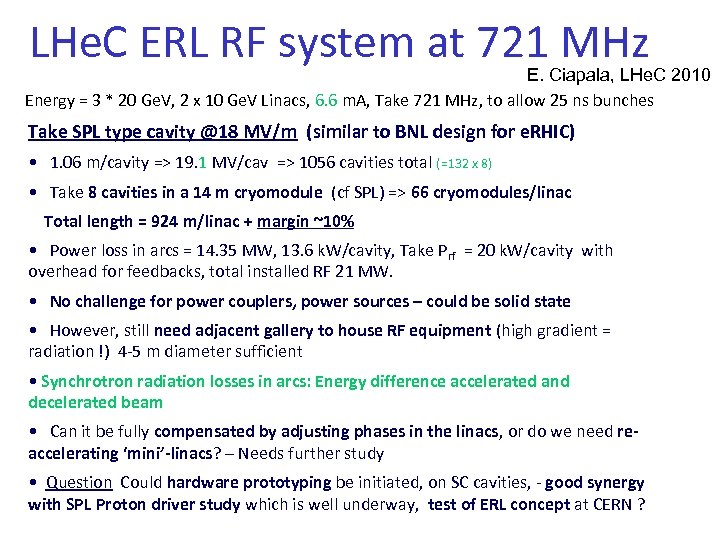
LHe. C ERL RF system at 721 MHz E. Ciapala, LHe. C 2010 Energy = 3 * 20 Ge. V, 2 x 10 Ge. V Linacs, 6. 6 m. A, Take 721 MHz, to allow 25 ns bunches Take SPL type cavity @18 MV/m (similar to BNL design for e. RHIC) • 1. 06 m/cavity => 19. 1 MV/cav => 1056 cavities total (=132 x 8) • Take 8 cavities in a 14 m cryomodule (cf SPL) => 66 cryomodules/linac Total length = 924 m/linac + margin ~10% • Power loss in arcs = 14. 35 MW, 13. 6 k. W/cavity, Take Prf = 20 k. W/cavity with overhead for feedbacks, total installed RF 21 MW. • No challenge for power couplers, power sources – could be solid state • However, still need adjacent gallery to house RF equipment (high gradient = radiation !) 4 -5 m diameter sufficient • Synchrotron radiation losses in arcs: Energy difference accelerated and decelerated beam • Can it be fully compensated by adjusting phases in the linacs, or do we need reaccelerating ‘mini’-linacs? – Needs further study • Question Could hardware prototyping be initiated, on SC cavities, - good synergy with SPL Proton driver study which is well underway, test of ERL concept at CERN ?
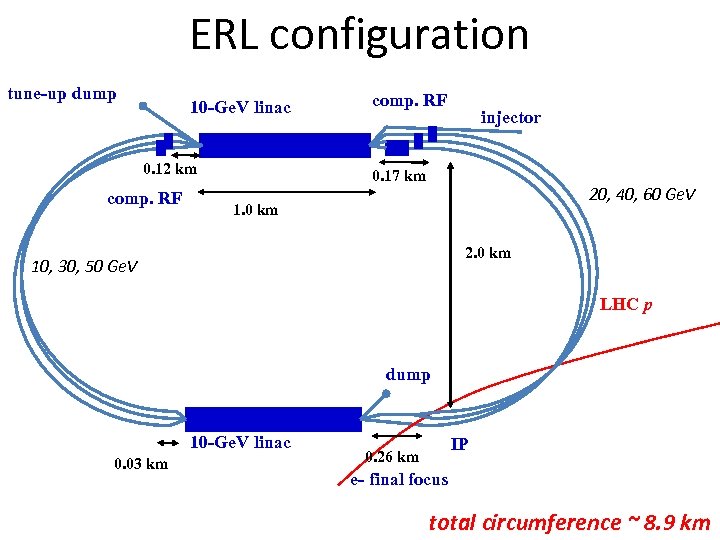
ERL configuration tune-up dump 10 -Ge. V linac 0. 12 km comp. RF injector 0. 17 km 20, 40, 60 Ge. V 1. 0 km 2. 0 km 10, 30, 50 Ge. V LHC p dump 10 -Ge. V linac 0. 03 km IP 0. 26 km e- final focus total circumference ~ 8. 9 km
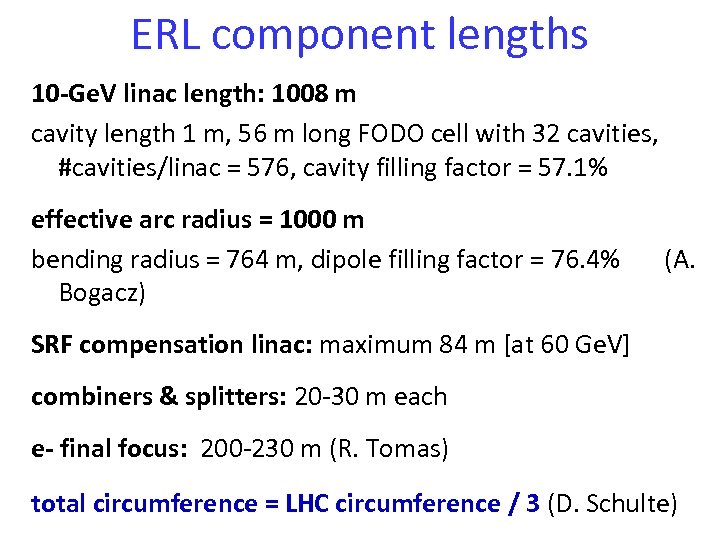
ERL component lengths 10 -Ge. V linac length: 1008 m cavity length 1 m, 56 m long FODO cell with 32 cavities, #cavities/linac = 576, cavity filling factor = 57. 1% effective arc radius = 1000 m bending radius = 764 m, dipole filling factor = 76. 4% Bogacz) (A. SRF compensation linac: maximum 84 m [at 60 Ge. V] combiners & splitters: 20 -30 m each e- final focus: 200 -230 m (R. Tomas) total circumference = LHC circumference / 3 (D. Schulte)
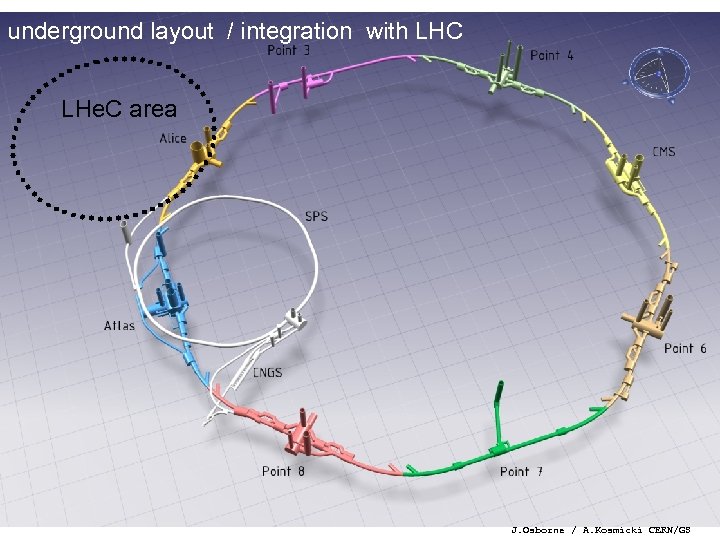
underground layout / integration with LHC LHe. C area J. Osborne / A. Kosmicki CERN/GS
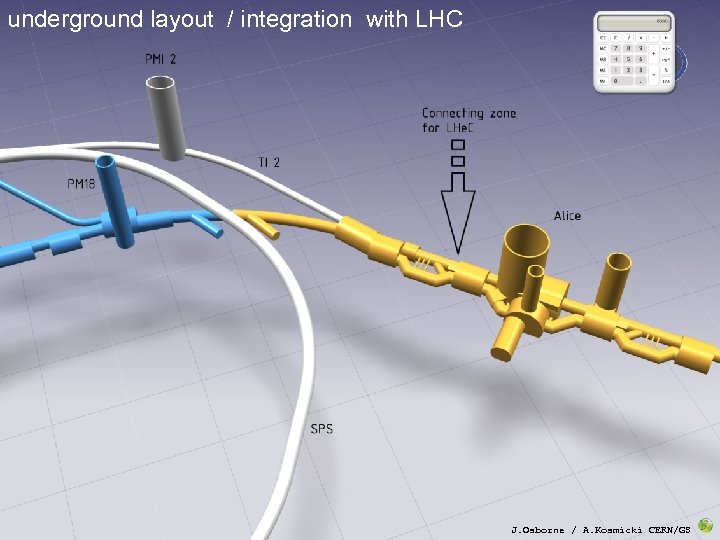
underground layout / integration with LHC J. Osborne / A. Kosmicki CERN/GS
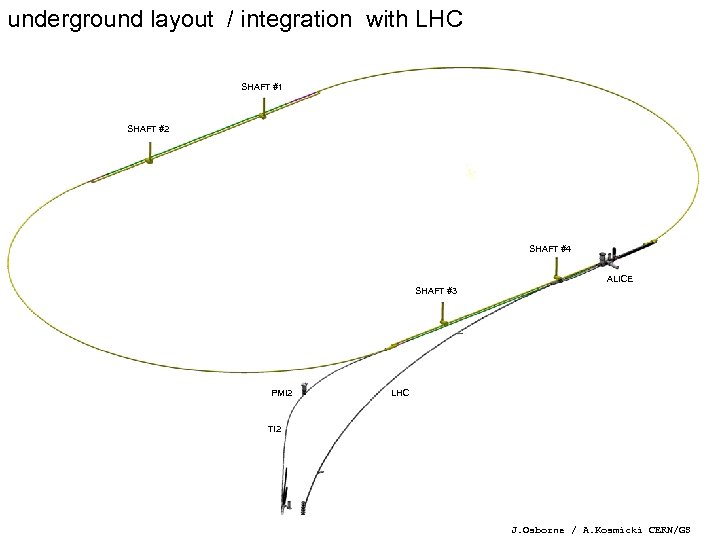
underground layout / integration with LHC SHAFT #1 SHAFT #2 SHAFT #4 ALICE SHAFT #3 PMI 2 LHC TI 2 J. Osborne / A. Kosmicki CERN/GS
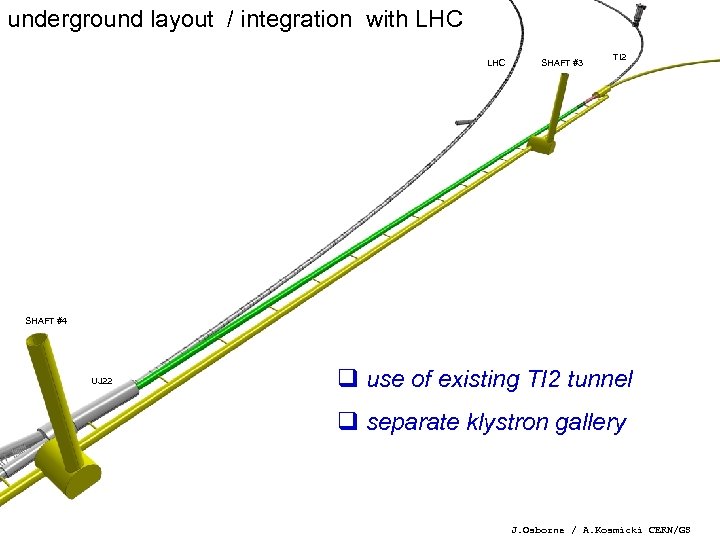
underground layout / integration with LHC SHAFT #3 TI 2 SHAFT #4 UJ 22 q use of existing TI 2 tunnel q separate klystron gallery J. Osborne / A. Kosmicki CERN/GS
![IP parameters beam energy [Ge. V] Lorentz factor g normalized emittance gex, y [mm]](https://present5.com/presentation/5cafe5e42ef1fae1d91e3400e8509262/image-22.jpg "IP parameters beam energy [Ge. V] Lorentz factor g normalized emittance gex, y [mm]")
IP parameters beam energy [Ge. V] Lorentz factor g normalized emittance gex, y [mm] geometric emittance ex, y [nm] IP beta function b*x, y [m] rms IP beam size s*x, y [mm] rms IP divergence s’x, y [mrad] beam current [m. A] bunch spacing [ns] bunch population crossing angle protons 7000 7460 3. 75 0. 50 0. 10 7 70 ≥ 430 25 or 50 1. 7 x 10¹¹ electrons 60 117400 50 0. 43 0. 12 7 58 6. 6 50 2 x 10⁹ 0. 0
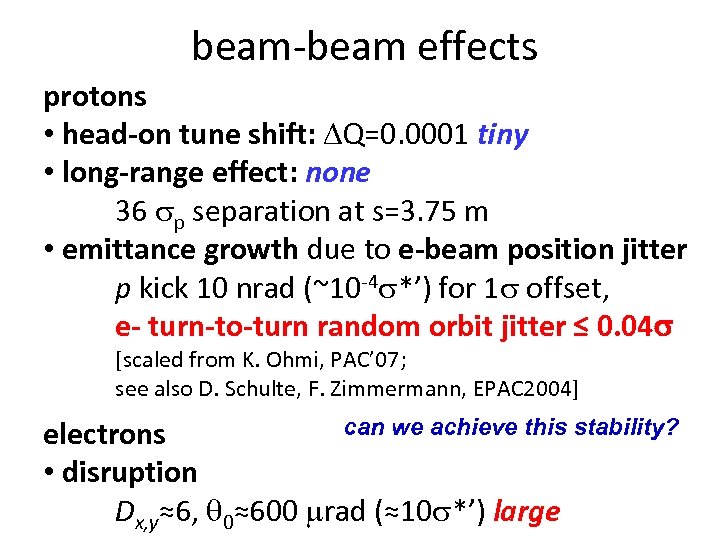
beam-beam effects protons • head-on tune shift: DQ=0. 0001 tiny • long-range effect: none 36 sp separation at s=3. 75 m • emittance growth due to e-beam position jitter p kick 10 nrad (~10 -4 s*’) for 1 s offset, e- turn-to-turn random orbit jitter ≤ 0. 04 s [scaled from K. Ohmi, PAC’ 07; see also D. Schulte, F. Zimmermann, EPAC 2004] can we achieve this stability? electrons • disruption Dx, y≈6, q 0≈600 mrad (≈10 s*’) large
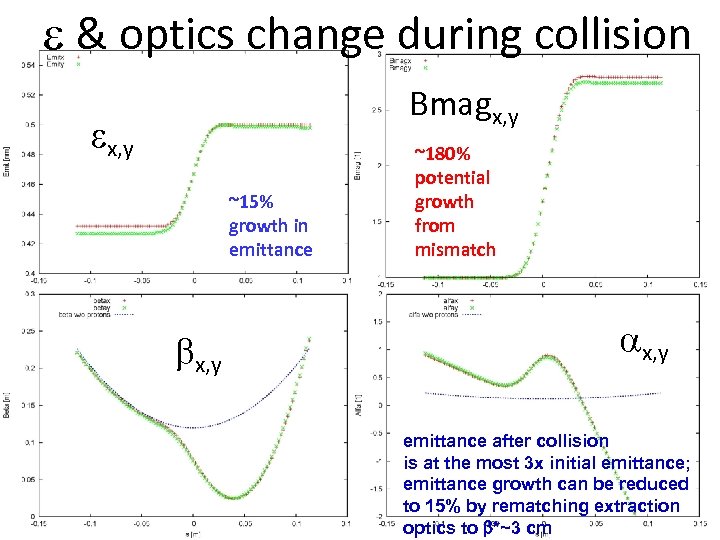
e & optics change during collision Bmagx, y ex, y ~15% growth in emittance bx, y ~180% potential growth from mismatch ax, y emittance after collision is at the most 3 x initial emittance; emittance growth can be reduced to 15% by rematching extraction optics to b*~3 cm
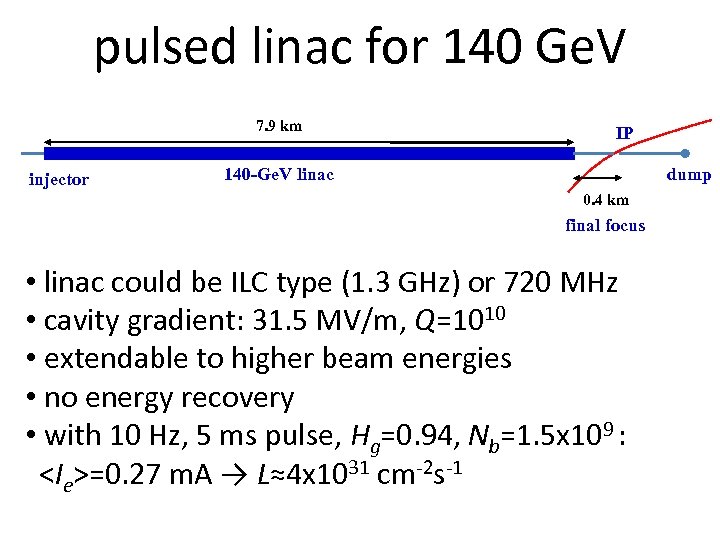
pulsed linac for 140 Ge. V 7. 9 km injector IP 140 -Ge. V linac dump 0. 4 km final focus • linac could be ILC type (1. 3 GHz) or 720 MHz • cavity gradient: 31. 5 MV/m, Q=1010 • extendable to higher beam energies • no energy recovery • with 10 Hz, 5 ms pulse, Hg=0. 94, Nb=1. 5 x 10⁹ : <Ie>=0. 27 m. A → L≈4 x 1031 cm-2 s-1
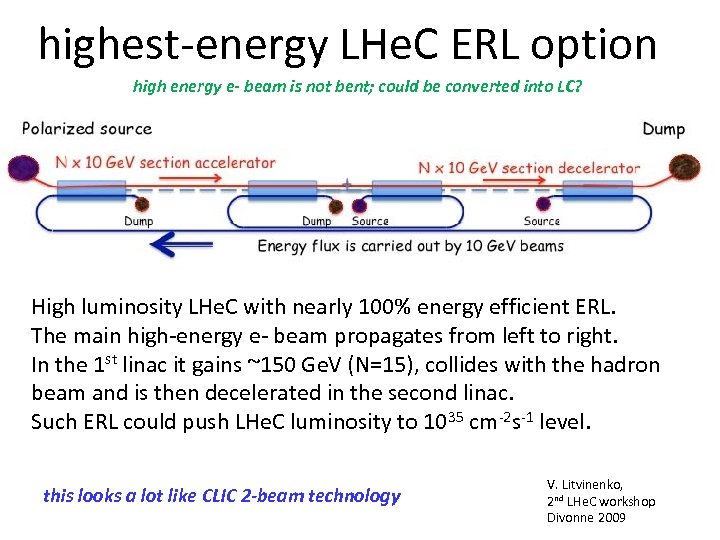
highest-energy LHe. C ERL option high energy e- beam is not bent; could be converted into LC? High luminosity LHe. C with nearly 100% energy efficient ERL. The main high-energy e- beam propagates from left to right. In the 1 st linac it gains ~150 Ge. V (N=15), collides with the hadron beam and is then decelerated in the second linac. Such ERL could push LHe. C luminosity to 1035 cm-2 s-1 level. this looks a lot like CLIC 2 -beam technology V. Litvinenko, 2 nd LHe. C workshop Divonne 2009
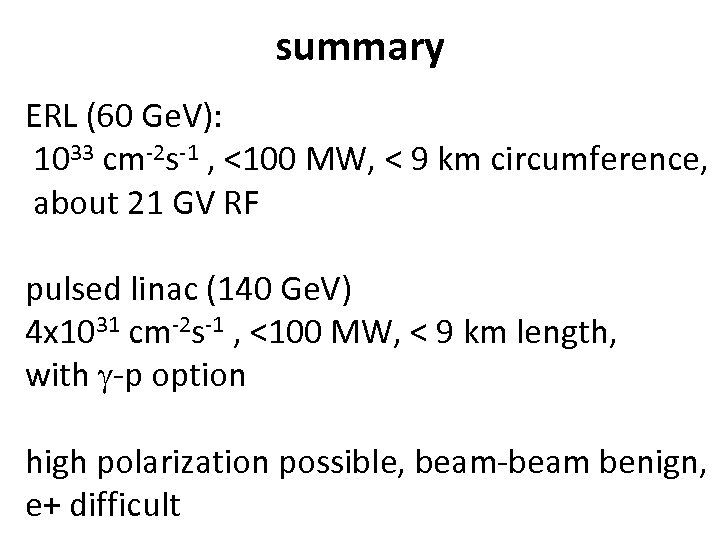
summary ERL (60 Ge. V): 1033 cm-2 s-1 , <100 MW, < 9 km circumference, about 21 GV RF pulsed linac (140 Ge. V) 4 x 1031 cm-2 s-1 , <100 MW, < 9 km length, with g-p option high polarization possible, beam-beam benign, e+ difficult
questions to RFTech experts LHe. C ERL: 721 MHz or 1. 3 GHz? Cryo power (heat load at 1. 8 K in cw)? Power to control microphonics? Linac position jitter?
contributors S. Bettoni, C. Bracco, O. Brüning, H. Burkhardt, E. Ciapala, B. Goddard, F. Haug, B. Holzer, B. Jeanneret, M. Jimenez, J. Jowett, A. Kosmicki, K. H. Mess, J. Osborne, L. Rinolfi, S. Russenschuck, D. Schulte, H. ten Kate, H. Thiesen, R. Tomas, D. Tommasini, F. Zimmermann, CERN, Switzerland; C. Adolphsen, M. Sullivan, Y. -P. Sun, SLAC, USA; A. K. Ciftci, R. Ciftci, K. Zengin, Ankara U. , Turkey; H. Aksakal, E. Arikan, Nigde U. , Turkey; E. Eroglu, I. Tapan, Uludag U. , Turkey; T. Omori, J. Urakawa, KEK, Japan ; S. Sultansoy, TOBB, Turkey; J. Dainton, M. Klein, Liverpool U. , UK; R. Appleby, S. Chattopadhyay, M. Korostelev, Cockcroft Inst. , UK; A. Polini, INFN Bologna, Italy; E. Paoloni, INFN Pisa, Italy; P. Kostka, U. Schneekloth, DESY, Germany; R. Calaga, Y. Hao, D. Kayran, V. Litvinenko, V. Ptitsyn, D. Trbojevic, N. Tsoupas, V. Yakimenko , BNL, USA; A. Eide, NTNU, Norway ; A. Bogacz, JLAB, USA ; N. Bernard, UCLA, USA et al
many thanks for your attention!
Скачать презентацию LHe C Linac-Ring Option J Osborne Frank Zimmermann
5cafe5e42ef1fae1d91e3400e8509262.ppt