 Скачать презентацию LHCb Muon System TDR Outline Introduction
3f219016bc123e7a74fb7fbff14f4e54.ppt
- Количество слайдов: 23



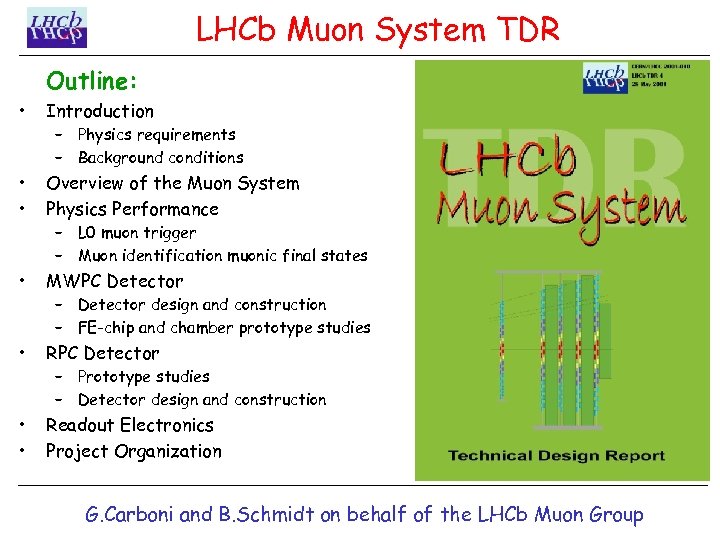
LHCb Muon System TDR Outline: • Introduction • • Overview of the Muon System Physics Performance • MWPC Detector • RPC Detector • • Readout Electronics Project Organization – Physics requirements – Background conditions – L 0 muon trigger – Muon identification muonic final states – Detector design and construction – FE-chip and chamber prototype studies – Prototype studies – Detector design and construction G. Carboni and B. Schmidt on behalf of the LHCb Muon Group
Introduction Physics Goals: • The Muon system of LHCb is primarily used to trigger on muons produced in the decay of b-hadrons: b X ; 0 In particular: B 0 J/ ( + -) Ks ; B 0 J/ ( + -) ; Bs + s • The muon momentum is measured precisely in the tracking system • The muon system identifies muons from tracks in the tracking system Requirements: • Modest momentum resolution (~20%) for a robust PT -selective trigger • Good time resolution (a few ns) for reliable bunch-crossing identification • Good muon identification (~90%); small pion-misidentification (~1%) LHCC Open Session 4 July 2001 B. Schmidt
Introduction Background sources in the LHC environment: • , K X decays – main background for L 0 muon trigger • Shower particles – hadron punch-through including shower muons • Low-energy background induced by n- processes – contributes significant to chamber hit rate • Machine background, in particular high energy beam-halo muons Requirements: • High rate capability of chambers • Good ageing properties of detector components • Detector instrumentation with sufficient redundancy LHCC Open Session 4 July 2001 B. Schmidt
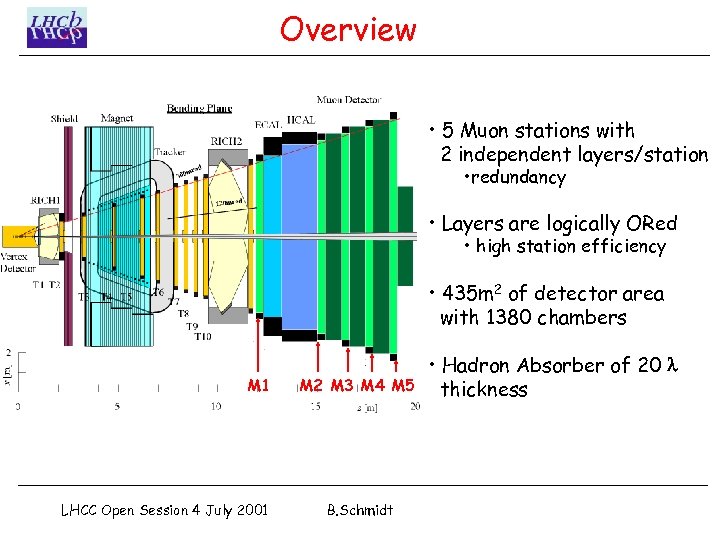
Overview • 5 Muon stations with 2 independent layers/station • redundancy • Layers are logically ORed • high station efficiency • 435 m 2 of detector area with 1380 chambers M 1 LHCC Open Session 4 July 2001 M 2 M 3 M 4 M 5 B. Schmidt • Hadron Absorber of 20 thickness
Muon Trigger Algorithm Level 0 Muon Trigger: Muon track finding: • Find seed pad in station M 3 • Find pads within opened search windows (FOI) in stations M 2, M 4 and M 5 • Use pads found in M 2 and M 3 to extrapolate to M 1 and find pad in M 1 within FOI • Stations M 1 and M 2 are used for the PT-measurement -> Muon Trigger exploits multiple scattering in the muon shield by applying tight search windows LHCC Open Session 4 July 2001 B. Schmidt
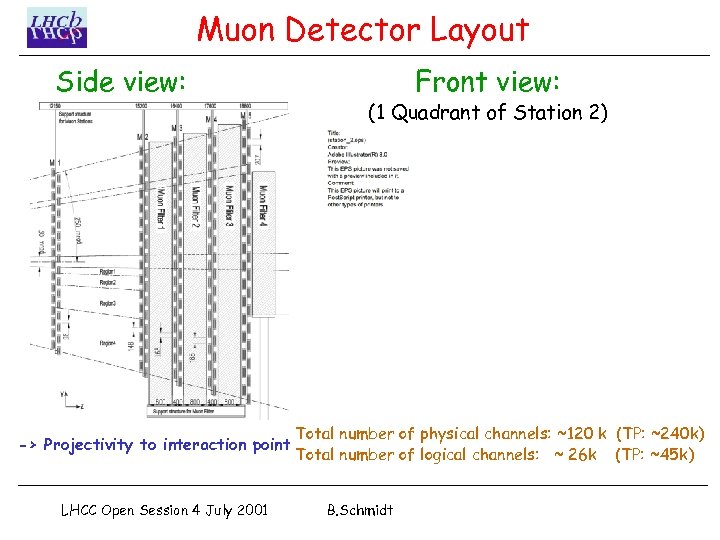
Muon Detector Layout Side view: -> Projectivity to interaction point LHCC Open Session 4 July 2001 Front view: (1 Quadrant of Station 2) Total number of physical channels: ~120 k (TP: ~240 k) Total number of logical channels: ~ 26 k (TP: ~45 k) B. Schmidt
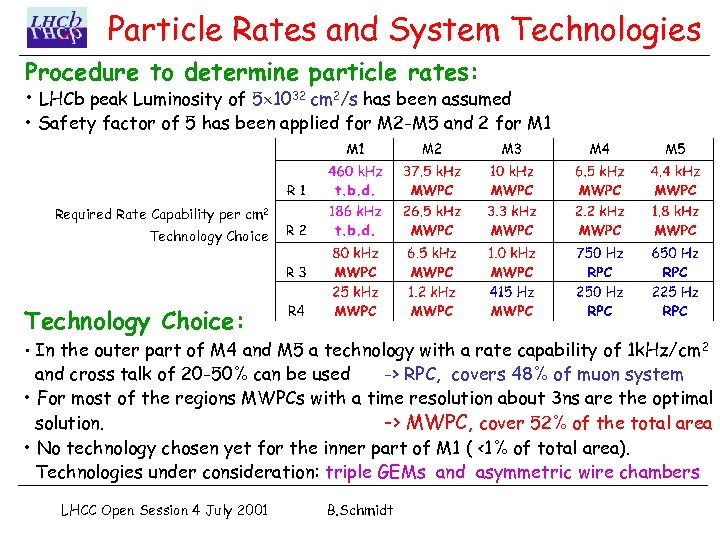
Particle Rates and System Technologies Procedure to determine particle rates: • LHCb peak Luminosity of 5 1032 cm 2/s has been assumed • Safety factor of 5 has been applied for M 2 -M 5 and 2 for M 1 Required Rate Capability per cm 2 Technology Choice: • In the outer part of M 4 and M 5 a technology with a rate capability of 1 k. Hz/cm 2 and cross talk of 20 -50% can be used -> RPC, covers 48% of muon system • For most of the regions MWPCs with a time resolution about 3 ns are the optimal solution. -> MWPC, cover 52% of the total area • No technology chosen yet for the inner part of M 1 ( <1% of total area). Technologies under consideration: triple GEMs and asymmetric wire chambers LHCC Open Session 4 July 2001 B. Schmidt
Level 0 Muon Trigger Performance: • TDR Muon system includes realistic chamber geometry and detector response -> TDR Muon System is robust -> Slight improvement in performance compared to the TP Muon System. LHCC Open Session 4 July 2001 B. Schmidt
Level 0 Muon Trigger Beam halo muons: • Distribution of energy and radial position of halo muons 1 m upstream of IP travelling in the direction of the muon system • Muons entering the experimental hall behind M 5 give hits in different BX in the muon stations -> No significant effect • Halo muons are present in ~1. 5% of the bunch crossings • About 0. 1% of them cause a L 0 muon trigger LHCC Open Session 4 July 2001 B. Schmidt
Muon Identification Algorithm: • Extrapolate reconstructed tracks with p > 3 Ge. V/c and first hits in Velo from T 10 to the muon system (M 2 etc. ) • Define a field of interest (FOI) around extrapolation point and • Define minimum number of stations with hits in FOIs • M 2+M 3 for 3 p 6 Ge. V/c • M 2+M 3+(M 4 or M 5) for 6 p 10 Ge. V/c • M 2+M 3+M 4+M 5 for p 10 Ge. V/c LHCC Open Session 4 July 2001 B. Schmidt
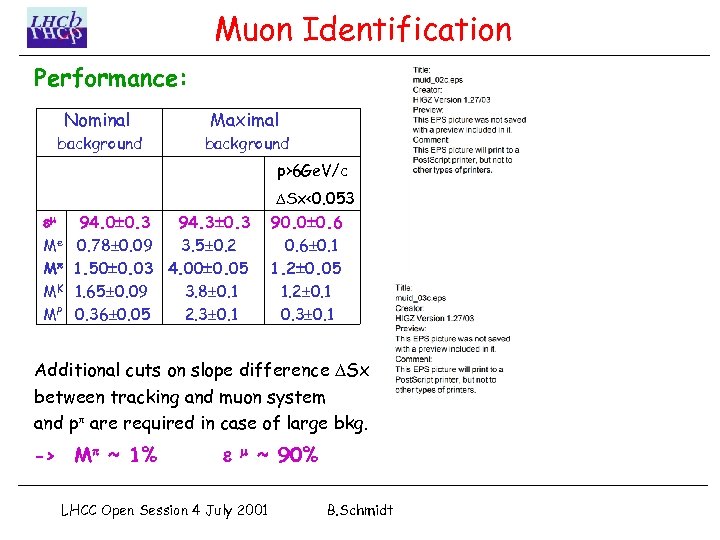
Muon Identification Performance: Nominal Maximal background p>6 Ge. V/c Me M MK MP Sx<0. 053 90. 0 0. 6 0. 1 1. 2 0. 05 1. 2 0. 1 0. 3 0. 1 94. 0 0. 3 94. 3 0. 78 0. 09 3. 5 0. 2 1. 50 0. 03 4. 00 0. 05 1. 65 0. 09 3. 8 0. 1 0. 36 0. 05 2. 3 0. 1 Additional cuts on slope difference Sx between tracking and muon system and p are required in case of large bkg. -> M ~ 1% ~ 90% LHCC Open Session 4 July 2001 B. Schmidt
Muonic Final States • • • B 0 J/ ( + -) Ks : Well established CP-violating decay from which angle in the unitary triangle can be determined. J/ ( + -) reconstruction: - oppositely charged tracks identified as muons. - Mass of dimuon pair consistent with J/ mass -> More than 100 k ev. /year expected in LHCb 0 B s + - : Decay involves FCNC and is strongly suppressed in the Standard Model -> BO mass resolution 18 Me. V/c 2 -> ~10 signal events over 3 bkg expected per year • • LO performance for both decays: L 0 trigger acceptance of fully reconstructed events is 98%. L 0 muon acceptance is 95% with >70% triggered by muon trigger alone. LHCC Open Session 4 July 2001 B. Schmidt
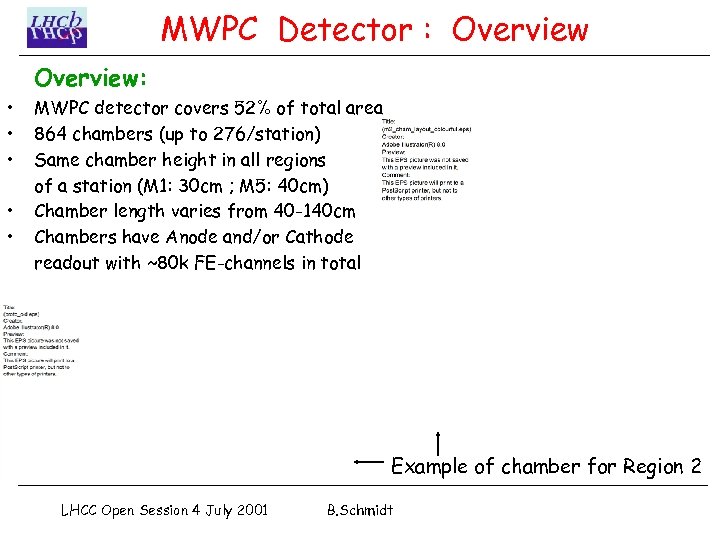
MWPC Detector : Overview: • • • MWPC detector covers 52% of total area 864 chambers (up to 276/station) Same chamber height in all regions of a station (M 1: 30 cm ; M 5: 40 cm) Chamber length varies from 40 -140 cm Chambers have Anode and/or Cathode readout with ~80 k FE-channels in total Example of chamber for Region 2 LHCC Open Session 4 July 2001 B. Schmidt
MWPC Detector Performance requirements: • Efficiency within 20 ns time window >99% : -> 1. 5 mm wire spacing -> Hardwired OR of two 5 mm gaps per FE-channel • Redundancy: -> Two independent double gaps • Good ageing properties: -> Gas mixture: Ar/CO 2/CF 4 40: 50: 10 -> Charge densities in 10 LHCb years: -> 0. 5 C/cm on wires and 1. 7 C/cm 2 on cathodes -> Ageing test is continues in GIF: LHCC Open Session 4 July 2001 -> up to now about 30% of total charge accumulated, no important effect B. Schmidt
Chamber Components Panels: • Key element in MWPC, ± 50 m precision over 40 cm x 140 cm required – Nomex Honeycomb panels are baseline choice (made good experience in tests) – Other materials like polyurethanic foam are under consideration Cathode PCB: • • For Region 3 access to cathode pads from top and bottom, For Region 1 and 2, double layer PCB with readout traces Capacitance between cathode pads ~ 4 p. F. -> Electrical cross talk ~2% LHCC Open Session 4 July 2001 B. Schmidt
Chamber Components Frames: • • Solution which does not require precision on wire fixation bars has advantages -> Precision could come from spacers introduced every 10 -15 cm in the frames Side bars will be used to bring the Gas in -> 2 independent gas cycles foreseen in the chamber to enhance redundancy; Wire: • Gold-plated tungsten wire of 30 m with 60± 10 g tension will be used LHCC Open Session 4 July 2001 B. Schmidt
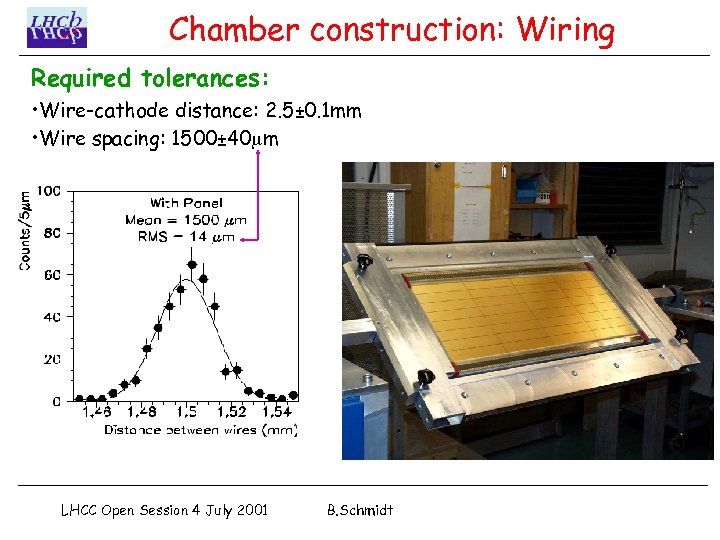
Chamber construction: Wiring Required tolerances: • Wire-cathode distance: 2. 5± 0. 1 mm • Wire spacing: 1500± 40 m LHCC Open Session 4 July 2001 B. Schmidt
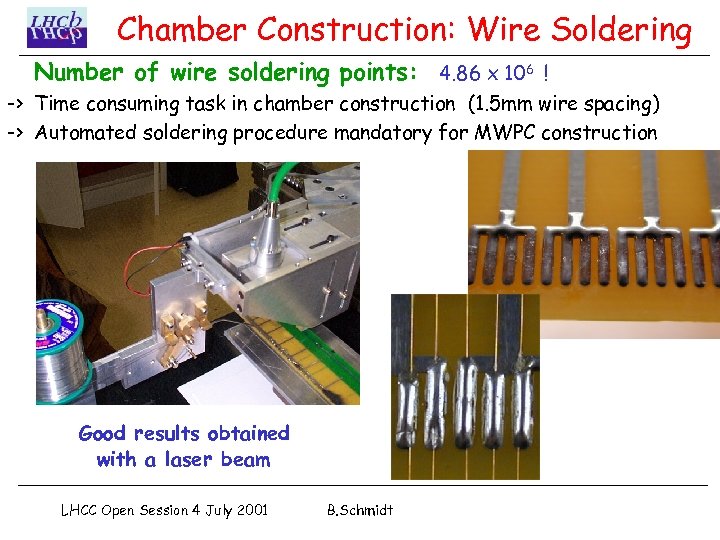
Chamber Construction: Wire Soldering Number of wire soldering points: 4. 86 x 106 ! -> Time consuming task in chamber construction (1. 5 mm wire spacing) -> Automated soldering procedure mandatory for MWPC construction Good results obtained with a laser beam LHCC Open Session 4 July 2001 B. Schmidt
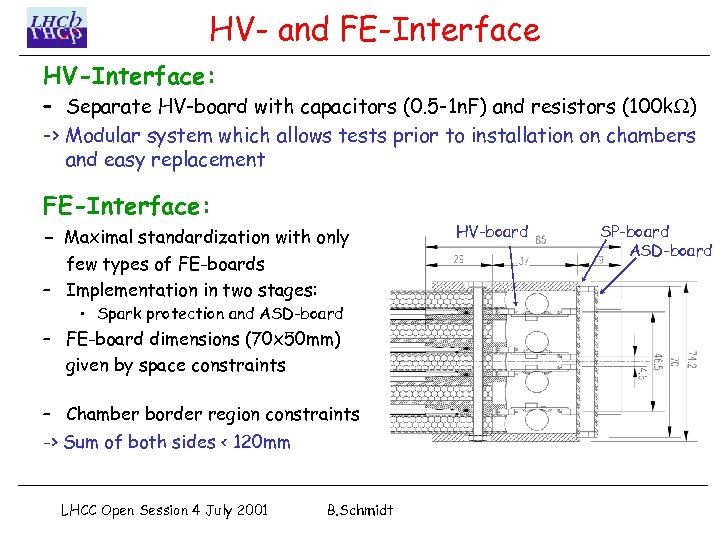
HV- and FE-Interface HV-Interface: – Separate HV-board with capacitors (0. 5 -1 n. F) and resistors (100 k ) -> Modular system which allows tests prior to installation on chambers and easy replacement FE-Interface: - Maximal standardization with only few types of FE-boards – Implementation in two stages: • Spark protection and ASD-board – FE-board dimensions (70 x 50 mm) given by space constraints – Chamber border region constraints -> Sum of both sides < 120 mm LHCC Open Session 4 July 2001 B. Schmidt HV-board SP-board ASD-board
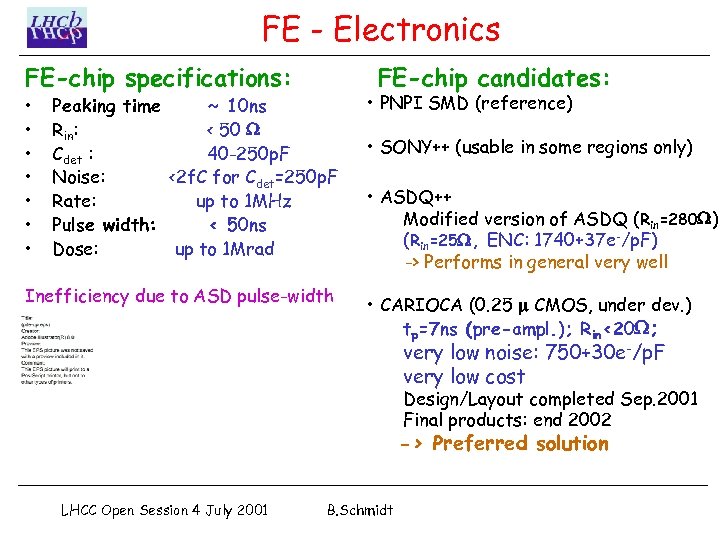
FE - Electronics FE-chip specifications: • • Peaking time ~ 10 ns Rin: < 50 Cdet : 40 -250 p. F Noise: <2 f. C for Cdet=250 p. F Rate: up to 1 MHz Pulse width: < 50 ns Dose: up to 1 Mrad Inefficiency due to ASD pulse-width FE-chip candidates: • PNPI SMD (reference) • SONY++ (usable in some regions only) • ASDQ++ Modified version of ASDQ (Rin=280 ) (Rin=25 , ENC: 1740+37 e-/p. F) -> Performs in general very well • CARIOCA (0. 25 CMOS, under dev. ) tp=7 ns (pre-ampl. ); Rin<20 ; very low noise: 750+30 e-/p. F very low cost Design/Layout completed Sep. 2001 Final products: end 2002 -> Preferred solution LHCC Open Session 4 July 2001 B. Schmidt
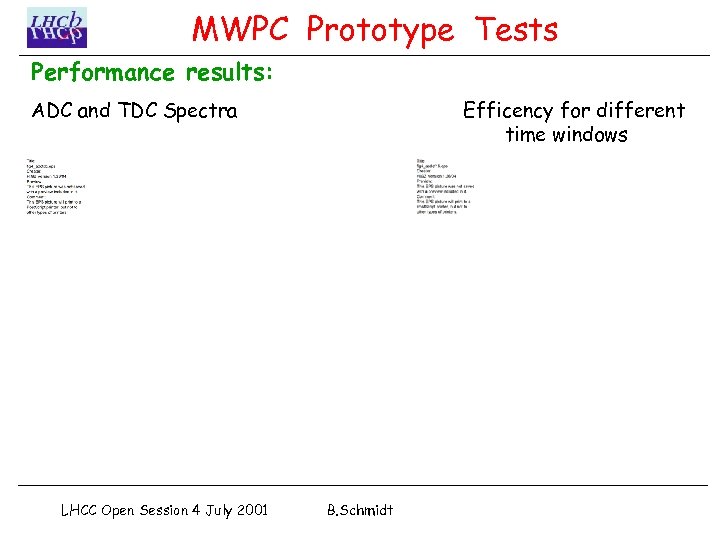
MWPC Prototype Tests Performance results: ADC and TDC Spectra LHCC Open Session 4 July 2001 Efficency for different time windows B. Schmidt
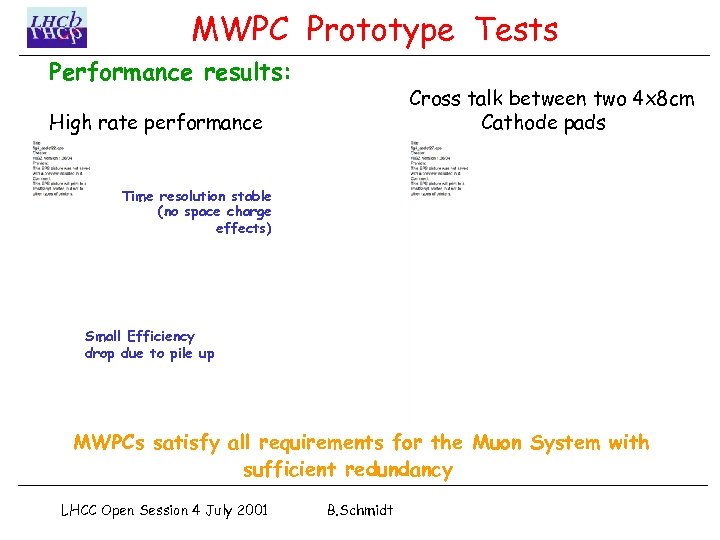
MWPC Prototype Tests Performance results: Cross talk between two 4 x 8 cm Cathode pads High rate performance Time resolution stable (no space charge effects) Small Efficiency drop due to pile up MWPCs satisfy all requirements for the Muon System with sufficient redundancy LHCC Open Session 4 July 2001 B. Schmidt
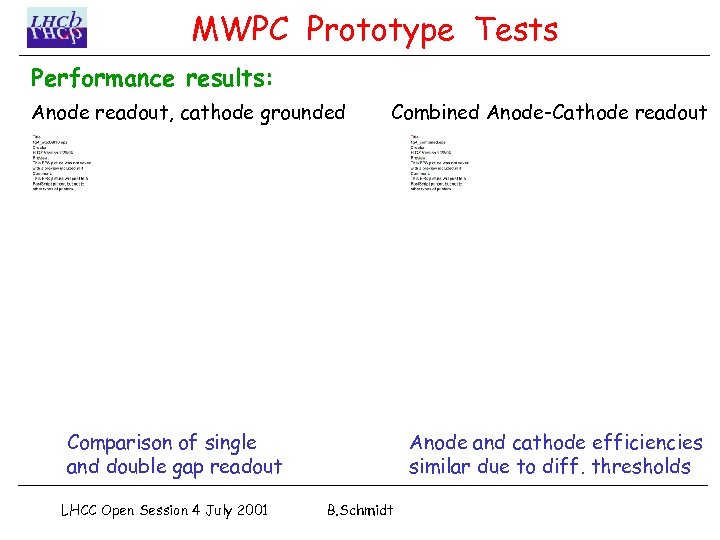
MWPC Prototype Tests Performance results: Anode readout, cathode grounded Combined Anode-Cathode readout Comparison of single and double gap readout LHCC Open Session 4 July 2001 Anode and cathode efficiencies similar due to diff. thresholds B. Schmidt
Скачать презентацию LHCb Muon System TDR Outline Introduction
3f219016bc123e7a74fb7fbff14f4e54.ppt